PART2:They Left Sarita to Rot Where No One Would Find Her—Then One Tiny Twitch Changed Everything
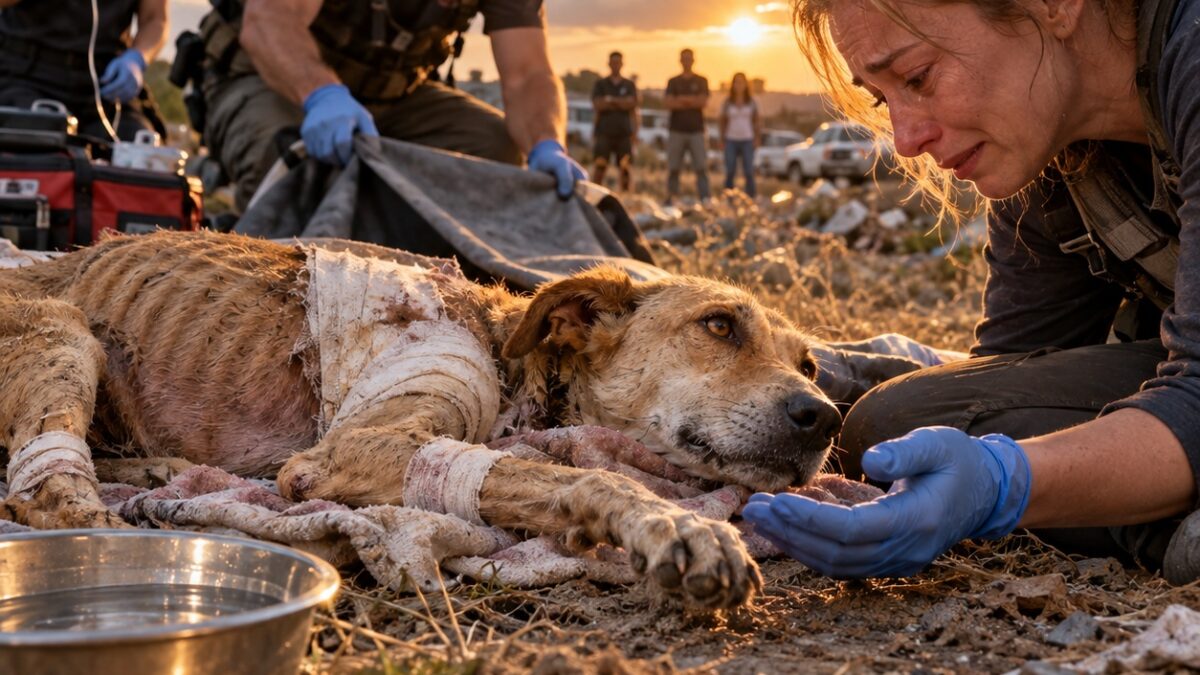
PART2
The emergency veterinary hospital was waiting for us.
The moment we arrived, everything moved quickly.
Hands.
Equipment.
Questions.
Examinations.
People talking in the urgent, controlled voices medical teams use when there is no time to waste.
We gave them what little information we had.
Found abandoned.
Unable to stand normally.
Severe wounds.
Signs of infection.
No known history.
No explanation for how long she had been lying there.
No one who could tell us what had happened before we arrived.
Sarita could not explain any of it.
Her body had to tell the story.
And the story was worse than we feared.
Multiple fractures.
Severe wounds.
A spinal injury.
She could not use her back legs.
The veterinarians were careful when they talked to us.
There are moments in rescue when you want someone in a white coat to look at you and say everything will be okay.
That is not what responsible medical professionals do when they do not know.
They tell you what they see.
They tell you what they fear.
They tell you what may never improve.
Sarita might never walk again.
That possibility sat in the room between us.
Not temporarily.
Not “give her a few days.”
Never.
For a little greyhound already carrying so much damage, that word felt unbearably heavy.
Some people believed the kindest option might be to let her go.
I understood why.
That is important to say.
No one looking at Sarita’s condition was being cruel by asking whether continuing would mean more suffering.
She had fractures.
Open wounds.
Infection.
Spinal trauma.
Pain.
A body already exhausted almost beyond its limits.
Sometimes love means fighting.
Sometimes love means recognizing when the fight belongs to the human more than the animal.
We had to ask ourselves which situation this was.
For a moment, none of us spoke.
I looked at Sarita.
She was lying there, surrounded by people discussing the possible end of her life.
She could not understand the words.
But she watched us.
Those eyes again.
The same eyes that had looked up from the ground.
There was fear in them.
Of course there was.
Pain too.
But I could not see surrender.
Maybe that was my human interpretation.
I know that.
Dogs do not make speeches about wanting to live.
They do not sign consent forms.
They do not tell us that tomorrow matters to them.
We read what we can from appetite, attention, response, comfort, engagement.
And when we looked at Sarita, we saw enough to believe she deserved more time.
Not a guarantee.
A chance.
That distinction mattered.
We were not promising that she would walk.
We could not promise that.
We were not promising some miracle ending.
We had no right.
We promised something smaller and, at that moment, more honest.
We would not give up while Sarita was still showing us she had not given up.
The first goal was not walking.
It was survival.
Her wounds needed care.
Her body needed support.
The infection had to be fought.
Pain had to be managed.
Every day would tell us whether continuing was fair to her.
That became our rule.
Not:
How much do we want this?
But:
What is Sarita telling us with the life she still has?
The first days were difficult.
There is no beautiful way to describe caring for wounds that have been neglected long enough to rot.
The smell.
The damaged tissue.
The careful cleaning.
The awareness that every touch might hurt.
Sarita had already been failed by human hands.
Now human hands had to become something different.
Gentle.
Predictable.
Helpful.
That change could not be explained to her.
It had to be demonstrated.
Again and again.
A hand approaching did not always mean pain.
Sometimes it brought food.
Sometimes comfort.
Sometimes cleaning that hurt in the moment but helped afterward.
Sometimes it simply rested near her so she would not be alone.
We learned to watch her face.
The tension.
The fatigue.
The moments she needed quiet.
There were no grand victories yet.
Just another hour.
Another day.
Another wound cleaned.
Another meal.
Another night survived.
That was enough.
Then Cata entered Sarita’s life.
If rescue gave Sarita a second chance, Cata gave that chance somewhere to live.
She welcomed Sarita into her home so she could recover near the clinic.
It was supposed to be temporary.
A foster arrangement.
A safe place between appointments.
A place where Sarita could rest outside the hospital environment while still staying close enough for continued care.
At least, that was the practical description.
In reality, Cata became something far more important.
She became the person Sarita could count on every day.
Morning.
Afternoon.
Night.
When Sarita’s wounds needed cleaning, Cata cleaned them.
When she needed food, Cata fed her.
When she was frightened, Cata stayed.
When she hurt, Cata comforted her.
When Sarita could not stand, Cata did not look at her as though she were less of a dog.
She simply adjusted her care to the dog Sarita was that day.
There is something powerful about that kind of acceptance.
People sometimes love an injured animal by imagining the animal healed.
They love the future version.
The running version.
The dog they hope will exist after rehabilitation.
Cata loved Sarita before anyone knew whether that future version was possible.
That mattered.
Sarita did not have to earn care by improving.
She did not have to stand before she deserved affection.
She did not have to take a step before she was worth the effort.
Her value was not waiting at the end of recovery.
It was already there.
Cata understood that.
Rehabilitation began slowly.
Pain changes the relationship an animal has with its own body.
When movement has hurt for long enough, even asking the body to try can become frightening.
Sarita had another problem layered over that.
Her spinal injury had taken away normal use of her hind legs.
The body she had once known was no longer answering in the same way.
Therapy became part of every day.
Massage.
Warm compresses.
Carefully guided exercises.
Again.
Again.
Again.
Nothing about it looked miraculous.
Most of rehabilitation is repetitive.
That is why people who only see the final video misunderstand how much work happens before the moment that makes everyone cry.
A leg does not suddenly move because someone believes hard enough.
Before that movement came countless days where nothing visible happened.
Hands working gently along muscles.
Heat.
Stretching.
Positioning.
Waiting.
Watching for response.
Trying again.
Cata showed up for all of it.
So did Sarita.
Some days she seemed stronger.
Those days made everyone hopeful.
Maybe her posture looked a little better.
Maybe she tolerated an exercise more comfortably.
Maybe her body seemed more engaged.
Then another day would come and nothing seemed different.
Or she would be more tired.
Or progress would appear to disappear.
Those were the dangerous days emotionally.
Not necessarily medically.
Emotionally.
Because hope becomes vulnerable once it has something to measure.
At the beginning, success had been survival.
Then survival became expected enough that we began wanting more.
That is when disappointment can hurt.
You catch yourself watching a back leg.
Waiting.
Nothing.
You tell yourself not to expect.
Then expect anyway.
Another therapy session.
Another warm compress.
Another massage.
Another exercise.
Nothing dramatic.
Sarita did not know she was disappointing anybody.
And she was not.
We had to remind ourselves of that.
Recovery is not an obligation.
Sarita did not owe us walking because we worked hard.
Cata did not clean wounds in exchange for a future miracle.
Every day Sarita was comfortable enough to remain engaged was already meaningful.
If she never walked, she would still deserve a life.
That became important because weeks passed.
Then more weeks.
The back legs remained the question.
Could they recover function?
Would the spinal injury allow it?
No one could answer.
We continued.
Months began replacing weeks.
Sarita’s wounds improved.
The immediate horror of those first days slowly receded.
The dog underneath the medical emergency became easier to see.
Her eyes looked different.
Not because their color changed.
Because exhaustion no longer occupied every expression.
She began responding more to the people around her.
Cata talked to her.
Touched her gently.
Stayed nearby.
Sarita learned the pattern of the home.
Food arrived.
Comfort arrived.
Nobody abandoned her after dark.
Nobody left her somewhere isolated and walked away.
That last part mattered to me.
I kept thinking about the place where we found her.
People had seen her and continued walking.
Now Sarita lived with someone who noticed everything.
A shift in her expression.
A change in a wound.
A different response during therapy.
The tiniest sign mattered.
That is what love sometimes looks like.
Attention.
The world had once behaved as if Sarita were invisible.
Now somebody was watching closely enough to notice a muscle twitch.
That is exactly what happened.
One day during rehabilitation, there was a movement in her hind leg.
Tiny.
So small that in another context someone might have missed it.
A twitch.
That was all.
No step.
No standing.
No dramatic rise to her feet.
A twitch.
But we had been waiting so long for any sign that the back legs might answer.
Everyone froze.
Did that happen?
We watched again.
Sarita lay there, unaware that she had just changed the emotional temperature of the entire room.
The leg moved.
Just enough.
I remember my heart pounding.
It felt ridiculous to have so much emotion attached to such a small movement.
But it was not small.
Not to us.
Not after months of uncertainty.
That tiny twitch meant the connection between intention and movement might not be completely gone.
It did not guarantee anything.
We knew that.
One twitch did not mean walking.
It did not mean recovery was suddenly inevitable.
But for the first time, the possibility we had been protecting without proof had given us something visible.
Cata cried.
So did others.
I did too.
You can spend months telling yourself not to expect miracles.
Then one muscle moves and every wall you built against hope disappears.
Sarita had no idea why everyone suddenly looked at her differently.
Maybe that was good.
She did not need the pressure.
We needed to remain patient.
So therapy continued.
Same massages.
Same warm compresses.
Same exercises.
But now we watched differently.
The next movement came.
Then another.
Progress was still slow.
Painfully slow.
But it was no longer imaginary.
Sarita’s body was answering.
Little by little.
The first twitch had been a whisper.
Then the whispers became more frequent.
The hind legs began participating in ways they had not before.
We could see effort.
Actual effort.
Sarita did not suddenly leap up.
She worked.
That is the part I want people to understand.
The moment when a disabled dog walks again can look magical when reduced to a short clip.
It is not magic.
It is an accumulation of work so small that most of it never looks important enough to record.
Cata’s hands.
The therapists.
The warm compresses.
The exercises.
Sarita trying.
Fatigue.
Rest.
Try again.
Days where nothing seems different.
Then one day when something is.
That was Sarita’s miracle.
Not an event from nowhere.
A thousand small acts finally becoming visible.
Standing came next.
Even saying those words now brings me back to that moment.
Sarita learned to stand.
Not perfectly.
Not with the casual confidence of a healthy dog who has never thought about balance.
For Sarita, standing was work.
The body had to remember how to carry itself.
The back legs had to participate.
The spine had to allow enough control.
Every second upright felt earned.
The first time she held herself there, nobody breathed normally.
We were all watching.
Sarita looked uncertain.
Then steadier.
For months, people had carried her through the moments her body could not manage.
Now her own legs were taking part.
I thought about the place where we found her.
Motionless.
Back legs useless.
Wounds rotting.
Maggots.
People passing.
The possibility that we might choose euthanasia because asking her body for more could be cruel.
Now she was standing.
I wish I could say everyone remained calm and professional.
We did not.
There were tears.
Hands over mouths.
Cata talking to her in that voice people use when they are trying not to overwhelm an animal with their own emotion.
Sarita did not understand the significance.
She just stood there.
That made it more beautiful.
She was not performing a miracle for us.
She was using her body because she could.
Then came the first step.
One.
Awkward.
Careful.
Small.
Nobody cared what it looked like.
It happened.
Sarita moved forward under her own strength.
That first step seemed to contain every day behind it.
Every wound cleaning.
Every feeding.
Every appointment.
Every massage.
Every warm compress.
Every exercise.
Every moment Cata stayed beside her when improvement could not be seen.
One step.
Then another.
I remember thinking:
People left this dog to die because they believed her life was finished.
Look at her now.
Another step.
The little greyhound who might never walk again was moving.
Not fast.
Not far.
But forward.
That word mattered.
Forward.
For so long, Sarita’s story had been defined by things done to her.
Abandoned.
Injured.
Ignored.
Left.
Found.
Carried.
Treated.
Fed.
Cleaned.
Helped.
Now she was doing something herself.
She was moving forward.
Her strength grew.
The steps became less tentative.
Standing became something she could do rather than something everyone held their breath over.
Movement became practice.
Practice became ability.
Ability became part of everyday life.
There were still setbacks.
Healing does not stop being complicated because the ending becomes hopeful.
Some days were harder.
Some sessions asked more.
The body that had survived fractures and spinal injury did not become untouched simply because movement returned.
But Sarita had crossed a line nobody knew for certain she would ever cross.
Her back legs were no longer only the part of her body that failed.
They were becoming part of her life again.
Cata watched every stage.
She had met Sarita when care meant cleaning wounds.
Holding her through pain.
Helping with the things she could not do.
Now she watched Sarita begin doing them.
I sometimes wondered whether that was harder emotionally than the early rescue.
At the beginning, there was no room to imagine.
You just work.
Keep the dog alive.
Later, every improvement brings the future closer.
And with the future comes another question.
What happens when the foster period ends?
Cata had welcomed Sarita temporarily.
Near the clinic.
Recover until she was stronger.
That was the plan.
But plans are easy before you have cleaned a dog’s wounds every day.
Before you have fed her.
Held her.
Celebrated a muscle twitch.
Watched her stand.
Cried over her first step.
Somewhere during those months, Sarita stopped being a patient staying in Cata’s home.
She became part of it.
That truth did not need an announcement.
You could see it.
Sarita looked for Cata.
Cata looked for Sarita.
Their routines had grown around each other.
The person who had once promised to help a broken dog for a little while could no longer imagine handing her life to somebody else.
But before that ending came fully into view, Sarita had more surprises for us.
Walking was not enough for her.
The first time I saw her moving with something approaching confidence, I had to force myself not to compare her with the dog we found.
The comparison was too overwhelming.
That abandoned body.
Then this.
Legs under her.
Head up.
Eyes alert.
Each step no longer looking like a question.
Her world expanded.
Once, reaching the end of a room would have been impossible.
Now she could follow.
Explore.
Choose where she wanted to go.
Movement gives an animal independence in ways people do not always notice until it is gone.
A dog who cannot use her back legs depends on someone for almost everything.
Where she rests.
When she moves.
How far.
When she reaches food.
When she goes outside.
Regaining mobility returned pieces of choice to Sarita.
That mattered as much as the physical achievement.
She could move toward people.
Away from noise.
Toward a toy.
Toward another dog.
Toward food.
Toward sunlight.
Those decisions belonged to her again.
The first running came later.
I almost do not have words for that.
Running.
Sarita.
The dog we had once carried because her body could not take her away from the place where she had been thrown.
Running.
Not merely walking carefully through rehabilitation.
Running because her legs could carry her.
Running because something in front of her was worth chasing.
The first time, everyone reacted as though they had watched the impossible happen.
Maybe we had.
Not impossible medically.
We were never told recovery was absolutely impossible.
We had been told she might never walk.
There was uncertainty.
The miracle was not that science had been broken.
It was that Sarita had landed on the side of possibility we had barely dared to hope for.
She ran.
There is freedom in a greyhound’s body when it moves.
Even after everything Sarita endured, you could see pieces of that natural joy returning.
The back legs that once lay useless now pushed.
Her body moved through space.
For the first time, speed belonged to her again.
Cata laughed and cried at once.
I think everybody did.
There are moments when language becomes unnecessary.
That was one.
Sarita did not need anyone to tell her what she had accomplished.
She was already moving.
Soon, running was not a special event.
It became part of her life.
She played with her friends.
That detail meant almost as much to me as the running.
Because play tells you something pain cannot.
Play requires enough safety to spend energy on something unnecessary.
A dog fighting for survival does not need to chase a toy.
A dog lying with rotting wounds does not need to play with friends.
A dog whose every movement hurts cannot waste energy on joy.
Sarita could now.
She chased toys through the yard.
Think about that transformation.
The dog who had once lain beneath open sky waiting for someone to stop now had reasons to move toward things.
A toy.
A friend.
A person she loved.
Life was no longer only happening to her.
She was participating.
She ate standing proudly on all four legs.
That image made Cata emotional every time.
Feeding had once been an act of care performed for a dog who could not support herself.
Now Sarita stood at her food.
Four legs under her.
Body carrying its own weight.
Eating because she was hungry in the ordinary way healthy dogs are hungry.
Not starvation.
Not desperation.
Appetite.
There is a difference.
Normal hunger expects food.
Starvation fears there may never be another meal.
Sarita had entered a world where meals were simply part of the day.
Morning.
Food.
Water.
Friends.
Play.
Rest.
Cata.
That was home.
I thought often about the people who passed her.
I do not know who they were.
I do not know what they thought.
Maybe they were afraid.
Maybe they assumed someone else would help.
Maybe they looked at the maggots, the wounds, the broken legs and decided the situation was hopeless.
Maybe some simply did not care.
I cannot know.
What I know is that Sarita noticed people before us.
Animals notice.
Footsteps.
Voices.
Movement.
Hope can rise even when the body cannot.
Then those people disappeared.
If Sarita had learned one lesson from that place, it could have been:
Humans see me and leave.
Instead, rescue gave her another lesson.
Humans can also stay.
Cata stayed.
That mattered more than any speech about kindness ever could.
She stayed through the unpleasant care.
Through the wounds.
Through the uncertainty.
Through the possibility Sarita might never walk.
Through rehabilitation.
Through setbacks.
Through the tiny twitch.
Through the first stand.
The first step.
The first run.
People often want the glamorous part of rescue.
The transformation.
The photograph.
The miracle.
Cata accepted the whole thing.
That is why the ending feels so right.
The foster arrangement had always been described as temporary.
Just until Sarita recovered enough.
Just while she needed to remain near the clinic.
Just for a little while.
Temporary is a useful word when you are opening your home to an animal whose future is uncertain.
It protects the heart.
Or at least people like to believe it does.
Cata never had a chance.
Not after everything.
The day it became official that Sarita would not be leaving, it did not feel like a dramatic change.
It felt like paperwork catching up with a truth that had been obvious for months.
Cata was Sarita’s family.
Sarita was home.
There was no reason to move her away from the woman whose voice she knew, whose hands had cleaned her wounds, whose house had become the first place she could build a life instead of merely survive one.
Cata did not just foster Sarita.
She chose her permanently.
That word mattered too.
Permanently.
Sarita’s earliest chapter with us began with being discarded.
Someone deciding:
I do not want you anymore.
Her new life became the opposite.
I choose you.
Today.
Tomorrow.
When you are sick.
When you are well.
When you cannot stand.
When you run.
That is family.
Looking at Sarita now, the contrast feels almost impossible.
The frightened little greyhound beneath the tree.
The wounds.
The maggots.
The motionless back legs.
The emergency hospital.
The conversation nobody wanted to have about whether continuing was fair.
Then Cata.
Healing.
Therapy.
Months.
A twitch.
Stand.
Step.
Another step.
Run.
Play.
Toys.
Friends.
Four legs under her at the food bowl.
Home.
The same dog.
That is important.
We did not create a new Sarita.
We helped the one who had always been there reach a life where her personality could exist without pain occupying everything.
Sometimes people use rescue language like an animal becomes worthy after recovery.
Look how beautiful she is now.
Look how happy she is now.
Look how well she walks.
Sarita was worthy when she was lying in rot.
She was worthy before she twitched a leg.
She was worthy if she had never walked again.
Walking did not prove she deserved to live.
It gave her more freedom inside the life she already deserved.
That distinction matters to me.
If her legs had never recovered, Cata still would have loved her.
That is what made every step a celebration rather than a condition.
There was no contract saying:
Get better and you can stay.
Sarita could fail every exercise and still be wanted.
Perhaps that kind of security gave her the best possible environment in which to try.
Not pressure.
Support.
Cata believed enough for both of them when Sarita could not do anything except endure another difficult day.
I watched their relationship deepen in ways rehabilitation charts could never measure.
Cata learned Sarita’s expressions.
Sarita learned Cata’s routines.
The dog who had once been left where nobody was supposed to find her began living a life where somebody noticed when she entered a room.
That is a profound reversal.
Invisible to cherished.
Abandoned to expected.
Disposable to family.
The physical recovery was spectacular.
The emotional reversal was even bigger.
Sarita did not wake up one morning and understand:
I am safe forever.
Dogs do not receive legal documents and comprehend adoption.
Forever is taught through repetition.
Cata wakes up.
Sarita is still there.
Cata goes away.
Cata comes back.
Meal.
Another meal.
Night.
Morning.
Warmth.
Friends.
Hands that help.
No abandonment.
Again.
Again.
Again.
That is how forever becomes real to an animal.
Not as a word.
As a pattern that never breaks.
Sarita began waking each morning surrounded by love instead of loneliness.
That line still catches in my chest.
Because I remember the first morning we feared she might never see.
The first night we wondered whether her body could tolerate another day.
Now she wakes.
Gets up.
Moves.
Eats.
Plays.
Runs.
The ordinary acts are the miracle.
I sometimes think the greatest transformation is not her ability to run.
It is the fact that running no longer surprises the people who live with her.
Imagine that.
At first, one twitch sent a room into tears.
Now she can chase a toy and someone might laugh, call her name, then continue with the day.
Miracle becoming routine.
That is what healing eventually should become.
Not spectacle forever.
Life.
Ordinary.
Safe.
Repetitive.
A dog running through a yard because that is what she does.
A dog standing at her bowl because that is how she eats.
A dog sleeping in a home because that is where she belongs.
We remember the contrast so she does not have to live inside it.
People sometimes ask whether animals remember what happened to them.
There is no way I can tell you exactly what Sarita remembers.
We should be careful about pretending to know.
Her body certainly carried consequences.
Her behavior carried responses to pain and fear.
But whether she thinks about the place where she was abandoned in the human sense, I do not know.
What matters to me is that her current life does not resemble it.
She does not wake under open sky with nobody coming.
She wakes with Cata.
She does not wait for strangers to decide whether she is worth helping.
She is already chosen.
She does not depend on a passerby for water.
There is water.
Food.
Home.
Friends.
She does not lie trapped inside a body that cannot take her somewhere else.
She runs.
That is enough.
The image of the first twitch remains almost sacred to everyone who saw it.
A movement so small.
Yet it divided the story.
Before it:
Maybe never.
After it:
Maybe.
People underestimate the power of maybe.
Maybe is not certainty.
But certainty was not what Sarita needed.
She needed room for possibility.
Once that possibility became visible, every therapy session felt different.
Not easier.
Different.
We had proof there was something to work toward.
Then standing changed maybe again.
Walking changed it.
Running changed everything.
At each stage, Sarita expanded the definition of what recovery could look like.
That is why people say she proved everyone wrong.
I understand the phrase.
But I do not think the veterinarians who warned us were wrong.
They gave us the honest prognosis based on serious spinal injury.
Sarita’s outcome was uncertain.
The responsible thing was to prepare us.
She simply reached a better outcome than anyone could promise.
That distinction makes her story more powerful, not less.
Nobody guaranteed the miracle.
We had to walk into uncertainty anyway.
That was Cata’s gift.
She did not wait for assurance.
She opened the door while the ending was still unknown.
Imagine what that means.
Fostering a dog who may never walk.
Wounds requiring daily care.
Appointments.
Therapy.
Pain.
Possibility of disappointment.
No promise of the cheerful ending everyone wants.
Cata said yes before the ending existed.
People sometimes call foster families temporary homes.
There was nothing temporary about the love required in those months.
The paperwork might have been temporary.
Commitment was not.
Cata built each day as though Sarita’s comfort mattered completely, regardless of what tomorrow brought.
Then tomorrow kept bringing more.
A twitch.
Strength.
Standing.
Walking.
Running.
Eventually it became impossible to imagine those tomorrows happening anywhere else.
That is how the forever family happened.
Not as one grand decision.
As hundreds of daily choices that had already become forever before anyone used the word.
I think back to the question I imagined in Sarita’s eyes when we found her.
Is this finally the day someone chooses me?
I cannot know that was what she thought.
It was what her eyes made me feel.
And if I could answer that version of Sarita now, lying motionless under the sky, I know exactly what I would tell her.
Yes.
Not just today.
Today is only the beginning.
Someone is going to choose you tomorrow too.
And the next day.
Someone is going to clean the wounds nobody else wanted to look at.
Feed you.
Comfort you.
Sit through the days when nothing improves.
Celebrate a movement so tiny most people would miss it.
Help you work again.
Watch you stand.
Cry when you step.
Laugh when you run.
And when the time comes for the temporary home to end, the woman who opened her door is going to realize there is nowhere else you belong.
You are going to become family.
Of course Sarita could not hear any of that on the day we found her.
We could not know it either.
That is why rescue starts before certainty.
Sometimes the only thing you can promise is:
You will not die alone here.
Then you build from there.
One hour.
One appointment.
One meal.
One night.
One exercise.
One twitch.
One step.
A whole future made from units small enough to survive.
Sarita’s story could easily have ended under that tree.
That is the frightening part.
Not because her injuries were beyond help.
Because people had already looked and continued walking.
Rescue did not begin with some extraordinary medical discovery.
It began when someone finally stopped.
Stopped long enough to look at Sarita and decide her suffering created responsibility.
That is all.
Someone stopped.
Then other people did their jobs.
Veterinarians assessed.
Caregivers treated.
Cata fostered.
Therapy continued.
Everyone contributed a piece.
No one person performed the miracle.
Sarita’s body did the hardest work.
The rest of us simply stopped abandoning her.
There is humility in that.
Humans sometimes tell rescue stories as though we give animals life.
We do not create the will inside them.
We provide opportunity.
Medicine.
Safety.
Time.
Care.
Sarita used what she had.
Her body answered in ways we could not command.
The most honest description is that we finally gave her conditions where recovery was possible.
Then she surprised us.
Again.
Again.
Again.
I remember the emotional rhythm of those months more than individual dates.
The horror of the first day.
The uncertainty at the hospital.
The relief when Cata opened her home.
The exhausting sameness of wound care.
The fear that rehabilitation might never produce movement.
The emotional discipline of not expecting too much.
Then the twitch.
After that, everything had a little more light.
The first time she stood felt impossible.
The first step felt even bigger.
Then, somehow, the biggest miracle became not the dramatic first but the ordinary tenth.
Twentieth.
Hundredth.
Because repetition meant the ability was becoming hers.
Not an accident.
Not one lucky moment.
She could walk.
Then run.
I watched Cata’s relationship with Sarita change alongside the physical recovery.
At first, Cata’s body language around her was caregiver-first.
Careful.
Protective.
Always watching what needed to be done.
Later, there was more ease.
Affection without immediate worry.
Laughter.
The ordinary interactions between a woman and her dog.
That transition mattered.
Cata was no longer only helping Sarita survive.
They were living together.
That is why the adoption felt inevitable.
Nobody wanted to break something that had already become home.
Sarita had already lost enough places.
No one was going to remove her from the first one where she truly belonged.
Her friends became part of that life too.
Seeing her play around other dogs always brought me back to the stillness of the first day.
Play requires so much that people take for granted.
Enough physical comfort.
Enough confidence.
Enough social safety.
Enough strength.
Enough curiosity.
Enough expectation that the next second might be fun.
Sarita had none of those things when we found her.
Later, she chased toys.
What is a toy to a dying animal?
Nothing.
What is a toy to Sarita now?
An invitation.
Run.
Chase.
Turn.
Play.
Come back.
Again.
That difference says more about recovery than any photograph.
Eating standing on all four legs did too.
It became one of my favorite scenes because it was so ordinary.
No therapist.
No audience.
No applause.
Just Sarita at her bowl.
Balanced.
Strong enough.
Eating.
I watched once and felt tears before I understood why.
Then I remembered.
There had been a time when we discussed whether she should be allowed to die because her body might never provide a life with acceptable comfort.
Now she was standing through an entire meal.
The question had been answered in the quietest possible way.
Not by argument.
By living.
Of course, that does not mean choosing euthanasia would always be wrong for an animal in Sarita’s original condition.
Every case is different.
That matters too.
Her story should not become a reason to force every severely injured animal through suffering because maybe a miracle will happen.
Sarita had medical professionals monitoring her.
Caregivers watching quality of life.
People making decisions based on her responses.
Her outcome was hers.
The beautiful part is not that everyone should always fight regardless of suffering.
It is that Sarita was given a fair chance when there were still reasons to believe the chance belonged to her.
She used it.
That is enough.
As months passed, people who first met Sarita after recovery had trouble believing the photographs.
The dog in front of them moved too easily.
Played too naturally.
Her eyes no longer carried the exhaustion they remembered.
The image beneath the tree seemed like another animal.
It was not.
That contradiction is one reason rescue photography is so powerful.
Same face.
Different life.
The difference is not identity.
It is circumstance.
Change the circumstance long enough and the body can reveal what suffering had hidden.
Sarita had always contained the dog who wanted to run.
Her broken spine and fractured body simply would not let her.
She had always contained the dog capable of forming bonds.
Abandonment simply gave her nobody safe enough to form them with.
She had always been worthy of family.
Someone else had failed to see it.
Cata did.
That is why I never liked saying Cata “saved” Sarita by herself.
The rescue team got her off the ground.
The hospital treated her.
Rehabilitation mattered.
But Cata gave the whole process continuity.
She connected the days.
A clinic can treat a wound.
A foster home teaches the body what life between treatments feels like.
Safe sleep.
Regular food.
Familiar hands.
Someone greeting you in the morning.
That continuity may have mattered as much emotionally as any single therapy session.
Sarita knew what came next.
That is the opposite of abandonment.
Abandonment is a broken pattern.
A person disappears.
Food stops.
Safety disappears.
Home stops being home.
Cata created a pattern that kept continuing.
No wonder neither of them wanted it to end.
There was another thing I noticed.
As Sarita gained mobility, Cata stopped needing to be her strength in the literal way.
At the beginning, when Sarita could not stand, Cata had to compensate.
Support.
Care.
Bring what Sarita could not reach.
Over time, Sarita’s own body became stronger.
But Cata did not become less important.
The role changed.
She was no longer the person replacing Sarita’s missing strength.
She was the person Sarita returned to after using her own.
That may be the healthiest version of love.
Not keeping someone dependent.
Helping until they can do more themselves, then staying anyway.
Sarita could run and still choose home.
Could stand on four legs and still lean into affection.
Could chase toys and come back.
Independence did not reduce connection.
It made connection voluntary.
That made the forever ending even sweeter.
The people who abandoned Sarita had treated her value as conditional.
Healthy enough?
Useful enough?
Convenient enough?
We do not know their reasoning.
We only know the outcome.
She was discarded.
Cata’s love did not depend on condition.
That is what transformed the story.
The ending was not:
Sarita recovered, therefore she earned a family.
The ending was:
Sarita had a family while recovery was uncertain, and recovery allowed her to enjoy more of that family.
That is the version worth remembering.
Today, when Sarita runs with her friends, there is no visible question in her movement.
Her body goes where she wants.
She turns.
Accelerates.
Stops.
Chases.
A greyhound doing what a greyhound’s body was made to do.
When she eats, four legs support her.
When she wakes, she is not alone.
When she hears Cata, the person is not a stranger passing by.
Cata is home.
There is no one dramatic moment when a dog stops being abandoned.
Technically, rescue removes the animal from abandonment immediately.
Emotionally, I think the opposite identity takes longer.
Belonging needs evidence.
Sarita got that evidence every day.
The same woman.
The same home.
The same care.
The same return.
No disappearing.
No being thrown away.
Forever taught through repetition.
That is why the final chapter feels stronger than revenge ever could.
We never found satisfaction in imagining what should happen to whoever abandoned her.
The best answer was Sarita’s life itself.
Someone treated her like garbage.
She became cherished.
Someone left her in pain.
She learned to run.
Someone assumed the world would look away.
People did not.
Someone believed her story was finished.
It was barely beginning.
That is enough consequence for me to focus on.
Not what happened to the person who failed her.
What happened to Sarita.
She lived.
She healed.
She walked.
She ran.
She belonged.
Those verbs are the answer.
I sometimes return in my mind to the place where we found her.
The tree.
Open sky.
Dust.
Still body.
People passing.
Maggots.
Rot.
Eyes lifting.
Then I compare it with an ordinary morning at Cata’s home.
Sarita wakes.
Moves.
Finds her friends.
Eats.
Maybe chases something through the yard.
Maybe rests.
Nothing dramatic needs to happen.
That ordinary morning is the victory.
Every normal day proves the abandoned dog had a future nobody could see from the roadside.
The future did not arrive all at once.
It arrived disguised as small things.
A cleaned wound.
A meal.
A warm compress.
A massage.
A therapy session.
A twitch.
Standing.
One step.
Another.
Running.
Home.
That is why I resist calling the twitch a miracle by itself.
The miracle was the chain.
If rescuers had not stopped, there was no hospital.
Without the hospital, no stabilization.
Without Cata, no consistent home care.
Without rehabilitation, no repeated opportunity for the body to respond.
Without patience, maybe discouragement would have come too soon.
Without Sarita’s own response, none of it became walking.
The miracle had many hands.
Sarita’s included.
Cata still talks about the first time she saw Sarita run as though it happened yesterday.
The voice changes when she tells it.
Part laughter.
Part disbelief.
I understand.
Some images permanently carry the weight of everything that came before them.
When you see the run, you still see the dog who could not stand.
When you see the white of her eyes bright with excitement, you remember the exhausted stare beneath the tree.
When you see Cata laughing, you remember the woman cleaning wounds every day without knowing whether walking would ever come.
The contrast makes joy sharper.
That is one of the strange gifts of surviving something terrible.
Ordinary happiness becomes visible.
Most people do not stop and celebrate their dog standing to eat.
Cata does.
Maybe not every meal anymore.
But somewhere in her, she knows.
Four legs.
That matters.
Most people do not cry because their dog runs across a yard.
Cata remembers when one twitch made her cry.
The body stores gratitude too.
That is why Sarita’s story remained with everyone who helped.
Not because it was the only difficult rescue.
There are many.
Because the arc was so clear.
From abandoned.
To chosen.
From motionless.
To running.
From a place where people walked past.
To a home where one woman could not let her go.
From the possibility of euthanasia.
To mornings full of ordinary life.
That is a complete reversal.
And yet it never felt false because every stage took time.
Weeks.
Months.
Work.
Nothing was skipped.
That is important.
The more satisfying the ending, the more tempting it is to make the middle look easy.
It was not.
The middle was where love did most of its work.
The hardest nights.
The wound care.
The disappointment.
The repeated exercises.
The days where nobody knew whether the next milestone would ever come.
Cata did not get to live only in the ending.
She lived the uncertainty.
That is why she earned the joy of seeing it.
Sarita did too.
When people see her now, I want them to see the running dog.
Not only the injured one.
But I also want them to understand what made the running possible.
Not pity.
Commitment.
Not one dramatic act.
Consistency.
Not believing every day would be good.
Returning on the bad days too.
Hope is easy when progress is visible.
The harder form of hope is cleaning a wound when yesterday looked almost exactly the same.
Massaging a leg that still does not move.
Doing another exercise.
Preparing another warm compress.
Feeding.
Cleaning.
Waiting.
Then doing it again.
That is the hope Cata gave Sarita.
Sarita eventually answered with movement.
Today, Cata does not refer to her as the dog she fostered.
Sarita is hers.
Not possession.
Family.
There is a difference.
The foster arrangement ended because the relationship had outgrown the word.
The woman who opened her home for a little while became the person who would be there for the rest of Sarita’s life.
That is the only forever home she needed.
I like imagining Sarita waking before Cata one morning.
Not because I know she does.
Because I know what the reality means now.
Walls.
Home.
Safety.
No open sky above a dying body.
No waiting for strangers.
No footsteps that disappear.
Just morning.
Maybe light coming through a window.
Maybe another dog moving nearby.
Maybe Cata’s voice.
A body that can stand.
Legs that can run later.
A bowl waiting.
A life continuing.
That is enough.
The people who left Sarita believed her story was over.
Maybe they expected the heat, infection, wounds, or hunger to finish what abandonment started.
Maybe they thought nobody would find her.
Maybe they simply did not care what happened after they walked away.
They were wrong about the only thing that ultimately mattered.
Sarita had more life.
More strength.
More love.
More movement.
More mornings.
More chapters.
And the greatest chapter did not begin when she first walked.
It began before that.
It began the moment somebody finally stopped, looked at the dog everyone else had passed, and decided:
You matter enough for us to try.
Everything after that grew from the decision.
Hospital.
Cata.
Therapy.
Twitch.
Standing.
Steps.
Running.
Family.
Today, when Sarita races through the yard after a toy, she does not look like a dog proving anything.
That may be my favorite part.
She is not running to prove the veterinarians wrong.
Not running to defeat the person who abandoned her.
Not running so rescuers can claim a miracle.
She runs because she can.
Because there is something worth chasing.
Because her friends are there.
Because the yard is hers to move through.
Because home gave her enough safety to become ordinary.
And when she gets tired, she knows exactly where she belongs.
With Cata.
The woman who once agreed to keep her for “just a little while.”
The woman who cleaned every wound she could not heal overnight.
The woman who believed during the weeks when belief had no visible reward.
The woman who watched one tiny hind leg twitch and cried as if the whole world had moved.
The woman who watched the first step.
Then another.
Then the run.
Cata did not just witness Sarita’s second life.
She became part of it.
Forever.
I still think about Sarita’s eyes on the day we found her.
That last exhausted question I imagined there.
Is this finally the day someone chooses me?
If I could go back to that moment, I would kneel beside her again.
I would not promise that nothing would hurt.
It did.
I would not promise she would walk.
We did not know.
I would not promise the recovery would be quick.
It was not.
I would tell her something we could actually keep.
Yes.
Today someone chooses you.
Tomorrow someone will choose you again.
And one day, little girl, you are going to rise on the legs everyone feared might never carry you, take a step into a life that almost ended beneath this tree, and keep going until nobody who loves you can remember why they ever doubted you would.
Then, eventually, you are going to run home.








