PART2:They Burned Him, Locked Him in a Cage, and Abandoned the House—Then Eliseu Kept Looking Back at Me Like He Wasn’t Ready to Die
PART2
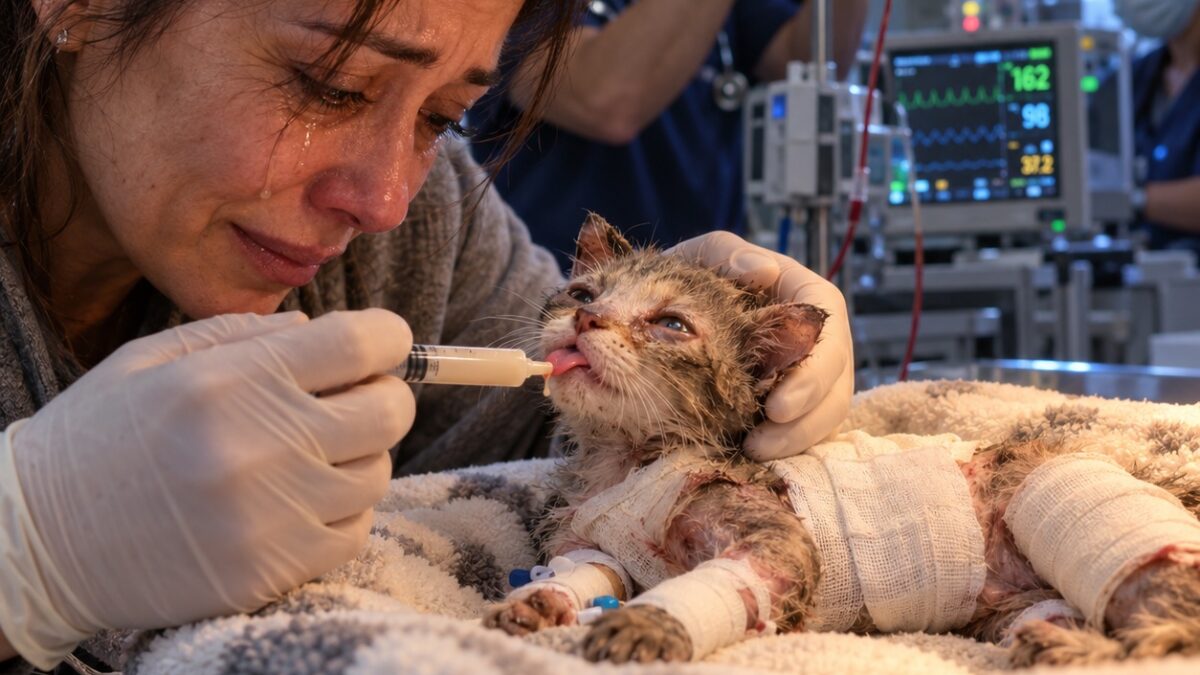
The first night was terrifying.
His blood sugar kept dropping.
A body needs energy simply to remain alive.
Eliseu had almost none stored.
No fat.
Very little muscle.
Nothing to draw from when his system came under stress.
The veterinary team corrected the glucose level.
Watched it.
Then watched it fall again.
His temperature became the next problem.
Warm blankets.
Controlled heat.
Careful monitoring.
Too much external heat can injure already damaged skin.
Too little and the body continues cooling.
Everything had to be measured.
Everything adjusted.
I sat nearby.
I remember staring at his chest because I needed to see it move.
Up.
Down.
Up.
Down.
Whenever the rhythm changed, my heart changed with it.
Then came the first seizure.
His tiny body suddenly stiffened.
The movement was violent compared with how still he had been.
I called for someone even though the medical team was already moving.
Medication.
Hands around him without restraining more than necessary.
Protect his head.
Protect his airway.
Wait.
The seizure ended.
Eliseu lay completely exhausted.
I touched the top of his head with one finger.
His skin there was one of the few places I could touch without reaching a wound.
“I’m here.”
His damaged eyes did not open.
“I’m right here.”
Another seizure came later.
Then another.
Each one seemed to take something from him.
I became afraid to leave the room.
Not because I believed my presence could stop his body from failing.
I knew it couldn’t.
But I had found him alone.
I could not bear the possibility that he might die alone too.
The veterinarians told me to rest.
I said I would.
I didn’t.
I would walk into the hallway.
Drink water.
Then return.
If someone asked whether I wanted coffee, I usually said yes and forgot to drink it.
I watched medication bags empty.
Watched new ones replace them.
Watched nurses record numbers.
Temperature.
Glucose.
Heart rate.
Respiration.
Numbers became our language for hope.
A little warmer.
Good.
Blood sugar holding longer.
Good.
He ate two more mouthfuls.
Very good.
Then a seizure.
Back again.
Nothing about the first days moved in a straight line.
Hope would rise for an hour.
Then collapse.
Eliseu would seem slightly more alert.
Then become frighteningly still.
His temperature would improve.
Then fall.
He would swallow food.
Then refuse the next feeding.
Every time somebody said, “He’s stable,” I learned not to hear, “He’s safe.”
Stable only meant he had not worsened in that moment.
That was all.
And sometimes a moment was enough.
The burns required constant wound care.
There was damaged tissue over much of his body.
Some areas were raw.
Others were infected.
The team had to clean them without causing unnecessary trauma.
Medication helped control pain, but pain could not simply be erased.
I could see that in the way Eliseu reacted.
A tiny twitch.
A flinch.
The movement of an ear.
A tightening around his damaged eyes.
He did not cry loudly.
That made it worse.
Some suffering is quiet.
Eliseu’s had been quiet for far too long.
I kept thinking about the cage.
How many nights had he lain there like this?
How many seizures had happened when nobody was watching?
How many times had his body temperature fallen while the house stood empty?
How often had he been thirsty enough to cry and received no answer?
Those questions were useless medically.
I knew that.
They still came.
Anger likes unanswered questions.
I tried not to let anger become the center of what we were doing.
Eliseu did not need my rage.
He needed people who could make decisions clearly.
So whenever my mind went back to the family who left him, I forced myself back to the animal in front of me.
What does he need now?
Food.
Warmth.
Treatment.
Pain control.
Rest.
Company.
Now.
That word became everything.
We could not fix the days before rescue.
Only now.
The second day became the third.
The third became the fourth.
I began recognizing the staff by the sound of their shoes in the hallway.
They began recognizing me by the chair I refused to abandon.
Someone brought me a blanket.
Another person brought bread.
One technician sat beside me after midnight and said:
“He knows you’re here.”
I looked at Eliseu.
“How could he?”
“He responds when you talk.”
I had noticed movement, but I thought I imagined it.
She leaned toward him.
“Eliseu.”
Nothing.
Then I said:
“Hey, little one.”
One ear moved.
Only slightly.
The technician smiled.
“See?”
I started crying.
Not dramatically.
I was too tired for dramatic crying.
Tears simply started falling.
I stroked his head.
“You know me.”
Maybe he did.
Maybe he only recognized the rhythm of my voice.
Maybe that was enough.
In those first days, I whispered constantly.
I told him nonsense.
What time it was.
Who had walked into the room.
That the blanket was warm.
That he had eaten well.
That we needed him to eat more.
I told him people were waiting for updates.
I told him nobody was going to put him back in that cage.
I told him he would never have to be alone like that again.
I did not know whether I was making promises I could keep.
The last one, at least, I could.
No matter how his story ended, he would not end it alone.
For a short period, we thought his body might finally be stabilizing.
The blood sugar became easier to manage.
His temperature improved.
The seizures became less frequent.
His wounds still looked frightening, but infection markers seemed to be moving in the right direction.
He swallowed more food.
One morning, he even lifted his head when someone entered.
Everyone noticed.
I remember thinking:
Maybe.
That one word.
Maybe.
Maybe he had survived the worst.
Then his bloodwork came back.
Severe anemia.
His body did not have enough healthy red blood cells to carry oxygen properly.
The veterinarian sat with me.
“He needs blood.”
“How soon?”
“Now.”
Everything became fast again.
Compatibility.
Preparation.
Transfusion.
Monitoring for reactions.
I watched the blood move through the line.
Red.
Slow.
Life entering a body that had almost run out of everything.
Eliseu remained still.
His breathing looked fragile.
Someone told me transfusions sometimes produce obvious improvement quickly.
Sometimes not.
We waited.
Waiting is one of the hardest forms of rescue.
There is nothing to do with your hands.
You cannot force bone marrow to work.
Cannot order infection to stop.
Cannot bargain with a body.
You sit.
You watch.
You hope the intervention reaches whatever part of the animal is still holding on.
The transfusion helped.
Not enough.
The infection continued spreading.
One antibiotic had not controlled it.
Then another treatment plan had to be changed.
New medication.
Stronger strategy.
One final attempt to get ahead of bacteria that had been given far too much time before Eliseu ever reached us.
The medical team became quieter again.
I knew that quiet by then.
I asked directly.
“How bad?”
The veterinarian did not avoid my eyes.
“If he doesn’t respond, we may be talking about hours.”
I looked at Eliseu.
He looked almost smaller than the blanket.
“Hours?”
“Yes.”
“How many?”
“No one can tell you.”
I nodded.
I had asked an impossible question because I wanted an answer I could hold.
There wasn’t one.
I sat beside him.
The clinic noise seemed far away.
Machines.
Phones.
Footsteps.
Other animals.
Other emergencies.
But our little room felt completely still.
“Eliseu.”
His eyes opened slightly.
Damaged.
Clouded.
Painful.
But he looked in my direction.
I leaned closer.
“I don’t know how tired you are.”
His eyes stayed on me.
“And I’m not going to ask you to suffer for us.”
That sentence was hard.
“But if you still want to be here…”
I swallowed.
“We’re still here too.”
His gaze did not move.
I do not believe animals understand speeches.
I do believe they understand presence.
Tone.
Touch.
Safety.
Maybe what Eliseu understood was simply that the person beside him was not leaving.
That was enough.
The next night, I expected the call.
Every time my phone moved, my stomach clenched.
No call.
Morning came.
Eliseu was still alive.
Not better.
But alive.
Another day.
Then something happened that sounds almost ridiculous compared with blood transfusions, seizures, infected burns and damaged eyes.
Eliseu sat up.
For twenty seconds.
That was all.
One technician called me.
“You need to come see this.”
I rushed in.
His front legs trembled violently.
His back legs were tucked awkwardly underneath him.
His head wobbled.
But he was sitting.
I dropped to my knees.
“Look at you.”
Twenty seconds.
Maybe slightly more.
Then his strength failed.
He lowered himself.
Everyone in the room was smiling.
For most cats, sitting is nothing.
They do it without thought.
For Eliseu, it required muscles that had nearly wasted away.
Energy his body barely possessed.
Balance.
Will.
Those twenty seconds were a declaration.
Not from him in some human, symbolic sense.
From his body.
Something was working again.
That same day, he ate more.
Not just a lick or two.
A small amount.
Then a little more later.
The veterinarian warned us not to overinterpret it.
“Recovery is still uncertain.”
I nodded.
I understood.
But something had changed inside me.
Hope no longer felt imaginary.
It had a shape.
Twenty seconds long.
From that point forward, we celebrated absurdly small things.
Eliseu turned his head toward a sound.
Celebration.
Eliseu finished slightly more food.
Celebration.
He tried to lift one paw.
Celebration.
One afternoon, while I was touching the blanket beside him, his paw moved toward my hand.
It barely traveled a few centimeters.
Maybe he was reaching.
Maybe simply repositioning.
I chose not to care about the technical distinction.
I put my finger beneath his paw.
He left it there.
That night, I slept for almost five hours.
Longest stretch since finding him.
His progress remained painfully slow.
The wounds needed ongoing treatment.
The skin did not repair overnight.
New tissue formed.
Some areas closed.
Others remained fragile.
His damaged eyes continued requiring medication.
No one knew how much vision he would eventually retain.
Sometimes he seemed to react to movement.
Other times not.
Bright light bothered him.
We kept the room comfortable.
Quiet.
Consistent.
Twenty days after rescue, I walked into the clinic and saw Eliseu holding himself upright longer than before.
Not strong.
Not stable.
But clearly stronger.
A technician looked at me.
“Twenty days.”
I knew what she meant.
Twenty days since the cage.
Twenty days since we did not know whether he would survive the car ride.
Twenty days since a few licks of liquid food had felt like a miracle.
Now he was trying to support his own body.
Hope felt real.
Dangerous, but real.
There were still risks.
The infection could return.
His blood counts could fall.
His eyes remained severely damaged.
His nutritional recovery had only begun.
His muscles were weak.
But we had moved beyond counting survival in hours.
That alone felt enormous.
Weeks passed.
Eliseu began gaining weight.
First slowly enough that we debated whether the scale difference mattered.
Then undeniably.
His face changed.
The sharpness softened.
His body stopped looking like nothing but bones beneath injured skin.
Healthy tissue replaced wounds.
The burns began becoming scars instead of active injuries.
Scars are strange things to celebrate.
With Eliseu, we celebrated them.
A scar meant that area had closed.
It meant the body had survived the wound.
His legs became steadier.
Standing came first.
A few seconds.
Then more.
The first actual steps were almost accidental.
He leaned forward.
One front paw moved.
Then another.
His back legs followed clumsily.
He stopped after only a few steps.
I clapped.
He looked toward me, probably confused by the noise.
“Sorry.”
I laughed.
“You’re walking.”
Soon physical therapy began becoming a larger part of his recovery.
Nothing dramatic.
Careful movements.
Strengthening.
Balance.
Helping muscles remember their jobs after starvation, illness and long periods of immobility.
Eliseu did not always enjoy it.
That was another sign of recovery.
He developed preferences.
He began objecting.
A weak grumble appeared when he was tired.
The first time I heard it, I looked at the technician.
“Was that him?”
She laughed.
“He’s complaining.”
I leaned down.
“Do it again.”
Eliseu stared at me.
No sound.
Eventually the grumbles became soft meows.
Quiet at first.
Then clearer.
There was a particular meow he used when food arrived.
Another when someone handled him longer than he wanted.
Personality emerged from beneath the medical crisis.
For the first weeks, Eliseu had been mostly symptoms.
Burns.
Anemia.
Seizures.
Low temperature.
Low blood sugar.
Infection.
Damaged eyes.
That is what critical illness does.
It hides the animal.
Then recovery creates room for personality.
Eliseu was gentle.
Patient.
Sometimes stubborn.
More affectionate than I expected after everything humans had done to him.
That last part affected me deeply.
He had every reason to fear hands.
Hands had been present in the world where he was hurt.
Hands had closed the cage.
Hands had failed to carry him to treatment.
Yet he continued allowing ours near him.
More than that, he began seeking them.
He would angle his head toward touch.
Press slightly into fingers.
Eventually purr.
The first purr was so faint we were not sure.
I placed two fingers near his throat.
There.
Tiny vibration.
I looked at him.
“You’re purring?”
He continued.
Someone behind me whispered:
“Oh my God.”
We had spent weeks listening for danger in every sound Eliseu made.
Labored breathing.
Seizure movements.
Distress.
Now his body was making a sound associated with comfort.
That meant more than I can explain.
One day, when he was strong enough, we carried him outside.
Not far.
A quiet patch of grass.
The weather was gentle.
I placed him down carefully.
His paws touched the ground.
He froze.
Grass moved beneath him.
Soft.
Cool.
Alive.
He lowered his head and smelled it.
Then took one hesitant step.
Another.
For all I knew, Eliseu had touched grass before the fire.
But this felt like the first time he could experience it without pain consuming everything else.
He walked slowly.
Uncertainly.
His muscles still weak.
His eyesight poor.
But he moved.
No cage.
No burned floor beneath him.
No cold metal.
Just grass.
At one point he stopped and lifted his face.
Wind moved across him.
His eyes opened slightly wider.
I sat several feet away and cried again.
Someone once told me rescue work must become easier after enough cases.
It doesn’t.
You become better at functioning through emotion.
That is different.
Eliseu’s first grass still hurt.
In a good way.
Recovery continued for months.
And because his story began spreading, people began following every update.
Messages came from people who had never met him.
People asking whether he had eaten.
Whether his bloodwork was better.
Whether he was walking.
Whether he could see.
People sent encouragement.
Some called him a miracle.
I was careful with that word.
The veterinary team worked too hard for their work to disappear inside “miracle.”
Eliseu received intensive medical care.
Monitoring.
Medication.
Wound management.
Transfusion.
Antibiotics.
Nutrition.
Physical therapy.
Repeated assessments.
People made thousands of small decisions correctly.
And Eliseu’s body responded.
That felt miraculous.
But it was also medicine.
Work.
Persistence.
Months after rescue, the question about his eyes became harder.
At first, we hoped inflammation would settle enough to preserve some useful vision.
His eyes opened more.
That gave us hope.
Sometimes he appeared to respond to light.
Movement.
Shadows.
But damaged tissue does not always heal simply because the rest of the body does.
His eyes had suffered too much.
The veterinarians continued specialized care.
We continued hoping.
But hope cannot become a reason to prolong pain.
That is something rescue teaches brutally.
Saving an animal does not mean preserving every part of the body at any cost.
It means protecting the animal’s quality of life.
Eventually, after months of treatment, the medical team gave us the news we had been afraid of.
Both eyes could no longer be saved.
They remained painful.
They were not going to recover useful function.
Surgery was the only way to end that pain.
I stared at the veterinarian.
“Both?”
“Both.”
I looked at Eliseu.
He was healthier by then.
Stronger.
Walking.
Eating.
Responding to voices.
He had fought his way through almost everything.
Now we had to make a decision that sounded, emotionally, like taking something else from him.
I hated it.
The veterinarian explained again.
The surgery would not take useful sight away.
The sight was already gone or severely compromised.
What surgery would take away was pain.
That was the sentence I needed.
Not eyes.
Pain.
Still, signing another surgical consent form brought me back to those first days.
The fear.
The waiting.
The possibility of complications.
I sat with Eliseu before surgery.
His face looked so different from the burned kitten I had carried into the emergency clinic.
Fuller.
Healthier.
Scars healed.
Coat growing.
He leaned toward my voice.
I touched his head.
“You’ve done this before.”
He purred.
“I know.”
Then I corrected myself.
“No.”
I smiled through tears.
“You haven’t done this. We have.”
A technician came for him.
I kissed the top of his head.
“Come back.”
Surgery went well.
Both damaged eyes were removed.
The first time I saw him afterward, his face was swollen.
Sutures where his eyes had been.
For a moment, grief hit me unexpectedly hard.
He had endured so much.
And now he would never see anything again.
Not grass.
Not faces.
Not sunlight.
Not the people who loved him.
Then Eliseu heard my voice.
His head turned immediately.
I stopped.
“Eliseu?”
He moved toward the sound.
Slowly.
Then pressed his face against my hand.
And I understood how human my grief had been.
I was mourning sight because sight mattered enormously to me.
Eliseu had already been living differently.
Smell.
Hearing.
Touch.
Memory.
The vibration of footsteps.
Air movement.
Voices.
Warmth.
He did not sit there grieving the idea of vision.
He was learning the map available to him.
Animals can be extraordinary that way.
Not inspirational because disability means nothing.
It does mean something.
It changes their lives.
But they do not compare themselves endlessly with the body they were supposed to have.
They adapt to the body they have.
Eliseu did.
At first, he walked cautiously after surgery.
Whiskers forward.
Head slightly low.
He bumped into things.
Stopped.
Reoriented.
We kept his environment consistent.
Food in the same place.
Water in the same place.
Bed.
Litter.
Nothing moved unnecessarily.
We used voices before touching him.
Soon, he began mapping spaces.
Count the steps from bed to food.
Follow scent.
Listen for people.
Use whiskers.
His confidence grew.
The first time he crossed a room without bumping into anything, I watched from the doorway.
He moved like he had practiced secretly.
Straight to the place where he knew I was sitting.
Then climbed against me.
“Show-off.”
He purred.
The surgery had removed something else we had almost forgotten was constantly present.
Pain.
After recovery, his face relaxed.
That was when I fully understood the decision.
He slept more deeply.
Accepted touch around his head without flinching.
His appetite remained strong.
He became curious again.
Losing the eyes had not destroyed his world.
It had made his world more comfortable.
That was a hard lesson.
Sometimes love holds on too tightly to what looks normal.
Real care asks what hurts.
Eliseu no longer hurt there.
His rehabilitation continued past one hundred days.
Then beyond.
Months.
His body strengthened.
Weight improved.
Walking became easier.
His muscles filled out.
His coat softened.
The kitten who had been unable to stand became a cat who could navigate familiar rooms confidently without sight.
He learned voices.
Mine especially.
Sometimes I would enter quietly to test him.
I never fooled him.
His ears would rotate.
Then his head.
Then a small meow.
“You know.”
Another meow.
He always knew.
Eliseu began receiving attention beyond the rescue community.
His story had reached thousands of people.
Not because suffering should become entertainment.
I worried about that.
But because his recovery opened conversations people needed to have.
Neglect.
Animal responsibility.
Burn injuries.
Disability.
The importance of medical care.
The danger of hiding an accident instead of seeking help.
Eventually Eliseu visited schools.
The first school visit made me nervous.
Children had been part of how his suffering began.
I wondered how he would respond to their voices.
He sat on a soft blanket.
I kept one hand near him.
A room full of children tried very hard to remain quiet.
Then one little girl whispered:
“Can he hear us?”
“Yes.”
“Does he know we’re here?”
“Yes.”
“Is he scared?”
I looked at Eliseu.
His ears moved toward the whispering.
His body remained relaxed.
“I don’t think he is right now.”
She raised her hand again.
“Can I touch him?”
We showed the children how.
Let Eliseu smell their hands.
Speak first.
Touch gently.
One child at a time.
Eliseu leaned toward the first small hand.
Then another.
He purred.
The room changed.
Children stopped seeing a cat without eyes.
They saw Eliseu.
One boy asked:
“How does he know where you are?”
“He listens.”
Another:
“How does he know where the door is?”
“He remembers.”
Another:
“Is he sad because he can’t see?”
That question stayed with me.
“I can’t know exactly what Eliseu feels.”
I looked at him.
“But he eats. He plays. He looks for people. He purrs. He explores. He sleeps comfortably.”
Then:
“I think those things matter more than whether his life looks like another cat’s.”
The teacher nodded.
So did some of the children.
Eliseu eventually appeared on television.
Bright studio.
Strange sounds.
Microphones.
People moving around him.
I kept him close.
We did not force him to stay longer than he was comfortable.
The interviewer asked the obvious question.
“How can an animal go through this and still trust people?”
I did not have a perfect answer.
Maybe Eliseu simply responded to what happened after rescue more than what happened before.
Maybe trust is not one permanent decision.
Maybe it is repeated.
This person feeds me.
Again.
This person touches me gently.
Again.
This person returns.
Again.
Eventually the pattern changes.
Fear stops being the only expectation.
I said something like that.
Eliseu meowed into the microphone.
Everyone laughed.
He had better timing than I did.
His life slowly became ordinary.
That was my favorite part.
Not television.
Not school visits.
Ordinary.
Food.
Warm bed.
Medication when needed.
Affection.
Sleep.
Exploring familiar rooms.
A favorite place near a window where he could feel sunlight even though he could not see it.
That detail always moves me.
Eliseu could not see sunshine.
But he found it.
He would locate the warm patch on the floor and settle there.
Stretch out.
Turn his face slightly upward.
Sleep.
The world did not need to enter through his eyes for him to experience it.
He felt warmth.
He smelled rain.
He heard birds.
He recognized footsteps.
He knew voices.
He knew safe hands.
He knew a full stomach.
He knew the difference between a cage floor and a soft blanket.
He knew when somebody entered a room because he was never forgotten anymore.
People sometimes said:
“It’s heartbreaking that he survived only to lose both eyes.”
I understood why.
But I stopped seeing it that way.
Eliseu had not survived only to lose his eyes.
He survived to lose pain.
To gain food.
To gain warmth.
To gain companionship.
To walk.
To purr.
To trust.
To become known by thousands of people who had once never known he existed inside an abandoned cage.
Sight was one part of life.
Not the entire life.
He taught us that without trying to teach anything.
One evening, long after his surgery, I sat near him while rain hit the roof.
He was asleep.
Completely relaxed.
I remembered the cold nights after the family left him behind.
What must rain have sounded like then?
Metal cage.
Empty house.
No footsteps coming.
No food.
Pain worsening.
Maybe he cried.
Maybe by then he had stopped.
Now rain meant something else.
A roof.
Warm room.
Someone nearby.
His breathing remained slow.
I touched his back.
He purred without waking fully.
That was the difference rescue had created.
We could not erase memory.
But we could change what came after it.
The story people knew publicly was dramatic.
Burned kitten.
Abandoned cage.
Seizures.
Blood transfusion.
Blindness.
Recovery.
But the moments I remember most are smaller.
The first lick of liquid food.
Twenty seconds sitting upright.
The paw reaching toward my hand.
The first purr.
Grass beneath his feet.
His first confident walk after losing his eyes.
A classroom full of children whispering because they did not want to frighten him.
Eliseu finding sunlight.
Those moments built his life.
Not one miracle.
Hundreds of small victories.
That is what recovery usually is.
People want a single turning point.
A surgery.
A medication.
A morning when everything changes.
Sometimes there is one.
Usually there are many.
A blood sugar reading slightly better.
A wound closing.
An extra spoonful of food.
One more step.
One more day without a seizure.
Recovery accumulates.
Eliseu accumulated life.
The medical team celebrated each piece because they remembered where he began.
A normal cat sitting upright is not news.
Eliseu sitting for twenty seconds had people crying.
A normal cat eating dinner is ordinary.
Eliseu eating a little more meant his body had energy to continue.
A normal cat walking across grass is nothing unusual.
Eliseu’s first careful steps across grass felt enormous.
Context changes everything.
The people who began following his story understood that.
They cheered for grams gained.
For stronger legs.
For a louder meow.
Then after his eye surgery, they celebrated navigation.
Confidence.
Comfort.
There is something beautiful about people learning to value small progress.
Modern life rewards dramatic results.
Eliseu offered another scale.
Today was slightly better than yesterday.
Enough.
Tomorrow, try again.
That was his whole recovery.
I often think about the moment we were told he might have hours.
If somebody had shown me a photograph of Eliseu months later, walking steadily without sight, I would not have believed it.
Not because I lacked hope.
Because the distance between those two versions felt impossible.
Hours left.
Then months.
Then years.
Life can widen unexpectedly when care arrives at the right moment.
That does not happen every time.
I need to say that.
Not every critically injured animal survives.
Not every infection responds.
Not every transfusion works.
Not every body can recover.
Eliseu’s story should never become a reason to judge rescuers or veterinarians when another animal cannot be saved.
Sometimes compassion means continuing.
Sometimes compassion means ending suffering.
The difference is not measured by how much people loved the animal.
With Eliseu, his body kept giving us reasons to continue.
A lick.
A look.
A stronger blood value.
Twenty seconds upright.
More food.
Another day.
We followed those signs.
And eventually those signs became a life.
The question of responsibility remained.
People asked me how someone could do what happened to Eliseu.
I still do not know.
I can understand panic after an accident.
I can understand a child making a terrible mistake.
I cannot understand choosing concealment over treatment.
Every hour after the fire mattered.
Burns need care.
Eyes need care.
Infection grows.
Dehydration worsens.
Pain compounds.
The family did not simply fail in one moment.
They failed repeatedly.
Then left.
That is hard to forgive.
But I try not to carry them around inside Eliseu’s story.
They had already taken enough of his life.
They do not deserve the rest.
So when people ask who Eliseu was, I do not begin with the family anymore.
I begin with him.
A cat with enormous determination.
A gentle temperament.
A talent for recognizing voices.
A surprisingly loud complaint when meals are late.
A patient visitor at schools.
A television guest who once meowed at exactly the right moment.
A cat who cannot see sunlight but somehow always finds the warmest spot in the room.
That is Eliseu.
Not what happened to him.
What happened is part of him.
Not all.
One day after a school visit, a teacher emailed me.
She said a boy in her class had been teased because of a visible disability.
After meeting Eliseu, several children had started treating him differently.
Not perfectly.
Children are children.
But more thoughtfully.
The boy’s mother later sent a message thanking us.
I sat with that for a long time.
Eliseu had spent days hidden behind an empty house because someone did not want people to see what had happened.
Now people were seeing him.
And because they saw him, another child felt less hidden.
Life is strange.
I do not believe everything happens for a reason.
I refuse to say Eliseu needed to suffer so others could learn.
He did not.
His suffering was unnecessary.
But once it existed, he and the people around him created meaning afterward.
That is different.
Meaning is something we build from what happened.
Not an excuse for why it happened.
Eliseu never needed the fire.
Never needed the cage.
Never needed blindness.
But given the life that remained, he used all of it simply by continuing to live.
The rest of us learned because we paid attention.
Years after rescue, people still recognized his name.
Some remembered the original images.
Others knew only the healthy blind cat visiting schools.
I preferred the second group.
It meant his identity had expanded beyond emergency.
A rescue animal deserves that.
There comes a point when “the burned cat” becomes unfair.
Yes, he was burned.
But he also healed.
Why should the worst thing that happened remain his permanent title?
He became Eliseu.
That is enough.
At home, nobody cared that thousands knew him.
He still had ordinary habits.
He liked certain blankets more than others.
He preferred voices he knew.
He could become irritated if somebody moved furniture without giving him time to relearn the space.
He followed sounds.
He liked affection but sometimes decided he had received enough.
Then he would walk away.
That choice always made me happy.
There had been a time when he could not walk away from anything.
The cage decided where he stayed.
Pain decided.
Weakness decided.
Now Eliseu could say, in his own way:
Enough touching.
I’m leaving.
That is freedom too.
He navigated using memory so effectively that visitors sometimes forgot he was blind.
Then someone would move a chair.
Eliseu would bump it.
Pause.
Sniff.
Walk around.
Adapt.
No drama.
He taught us to stop rushing toward him every time.
At first, if he touched anything, we wanted to rescue him immediately.
Eventually we realized over-helping could reduce his independence.
So we allowed him to solve safe problems.
Find the route.
Map the chair.
Locate the bowl.
Blindness required support.
Not helplessness.
That balance mattered.
It made Eliseu more confident.
The stronger he became, the more obvious it was that disability had not taken away curiosity.
New smell?
Investigate.
New voice?
Turn toward it.
Bag opening?
Probably food.
Find it.
Children laughed when he followed snack sounds faster than any sighted cat in the room.
His hearing was extraordinary.
Or maybe we simply noticed it more because vision was absent.
Either way, Eliseu was never disconnected from the world.
He was intensely connected.
Just through different doors.
Sometimes when I watched him, I remembered his damaged eyes barely opening inside the cage.
Back then, I had wanted desperately to save them.
I thought opening his eyes wider would be proof of recovery.
Later I learned that healing sometimes means letting go of something the body cannot keep.
The eye surgeries felt like failure before they happened.
Afterward, seeing him without constant eye pain, I understood they had been mercy.
There is a wider lesson there, though I hesitate to make Eliseu into a metaphor.
Still:
Holding on is not always the same as saving.
Sometimes we save by releasing.
Painful tissue.
Impossible expectations.
The idea that a good life must look one particular way.
Eliseu’s good life was blind.
That did not make it incomplete.
It made it his.
One of my favorite photographs was taken months after surgery.
Eliseu was sitting outdoors.
Grass beneath him.
Face turned toward the sun.
No eyes.
No attempt to hide the scars.
His posture relaxed.
A tiny breeze lifting the fur around his ears.
If you looked only at what was absent, the photograph was sad.
If you looked at the whole cat, it was peaceful.
That distinction became important to me.
People often look at rescued animals and immediately inventory damage.
Missing leg.
Missing eye.
Scar.
Burn.
Paralysis.
We should acknowledge those things.
But after that, look again.
What else is there?
Appetite.
Interest.
Comfort.
Relationship.
Play.
Choice.
Sleep.
Trust.
Eliseu had all of those.
He had life.
The very thing that seemed almost impossible inside the abandoned cage.
I sometimes returned mentally to that first liquid meal.
One lick.
Then another.
At the time, it felt like he was telling us:
I want to live.
Maybe that is too human an interpretation.
A hungry body responds to food.
Simple.
But emotion does not need perfect scientific language.
What mattered was that he could still participate.
He swallowed.
That allowed nutrition.
Nutrition supported treatment.
Treatment allowed another day.
Another day allowed the transfusion.
The transfusion bought time.
Time allowed antibiotics to work.
Then sitting.
Walking.
Therapy.
Surgery.
Adaptation.
School visits.
Sunlight.
Everything later depended on small earlier things.
That is how fragile survival can be.
One mouthful becomes years.
Marilucy? Wait, I am Marilucy in first person. Need continue “I”. Good.
People sometimes gave me credit for saving Eliseu.
I corrected them whenever I could.
I found him.
That mattered.
But no one person saved him.
The veterinary team saved him.
The donor blood saved him.
The technicians who changed dressings saved him.
The people who monitored him at night saved him.
The medication saved him.
The people who supported his care saved him.
And Eliseu’s own body did enormous work.
Healing burns.
Producing blood cells.
Rebuilding muscle.
Adapting neurologically after blindness.
Rescue is almost never a single hero.
It is a chain.
For Eliseu, the chain finally became a good thing.
One person to another.
Care passed forward.
Nothing pulling him backward.
I think about the old cage sometimes.
I do not know what became of it.
I hope it rusted.
I hope grass grew around it.
I hope nobody ever put another animal inside.
There are objects that do not deserve preservation.
The cage is one.
Eliseu does not need a monument to confinement.
His scars already tell enough.
The places I want preserved are different.
The first patch of grass where he walked.
The clinic room where he sat for twenty seconds.
The warm spot where he sleeps.
The classroom floor where a child learned to touch a blind cat gently.
Those are better landmarks.
Today, Eliseu does not know hunger.
He does not wake on cold metal.
Nobody waits for him to become quiet enough that they can forget he exists.
When he needs food, someone notices.
When he needs medical care, he gets it.
When he becomes uncomfortable, people respond.
If he meows, someone listens.
That last part seems simple.
It is not.
Being heard changes a life.
In the cage, Eliseu could have cried for hours and no one came.
Now one small meow can bring a person from another room.
Imagine what that does to an animal’s understanding of the world.
My voice matters.
My discomfort matters.
My existence causes somebody to respond.
That is belonging.
Not being owned.
Being considered.
Eliseu became deeply considered.
His environment changed because he existed.
Furniture stayed predictable.
Food schedule mattered.
School visits were planned around his comfort.
Medical checks continued.
People spoke before touching him.
The world made room for him.
That is what love often is.
Making room.
Not pity.
Adjustment.
When I first found him, the family had solved their discomfort by hiding him.
Do not look at the burned cat.
Put him behind the house.
Close the cage.
Move away.
Their solution removed Eliseu from their view.
The people who loved him later did the opposite.
They changed their own behavior so he could remain in the world comfortably.
That contrast says everything.
Kindness is not simply feeling bad about suffering.
It is allowing suffering to inconvenience you enough that you act.
Drive to the clinic.
Stay awake.
Pay attention.
Clean wounds.
Rearrange furniture.
Return tomorrow.
Eliseu’s life was rewritten by inconvenience.
People chose him anyway.
Maybe that is why he trusted again.
Trust is not a speech.
It is repetition.
Food came.
Again.
Marilucy came back.
Again.
Wounds were cleaned.
Again.
Hands were gentle.
Again.
Pain decreased.
Again.
No cage.
Again.
Eventually the old pattern lost some of its power.
The world that hurt him stopped being the only world he knew.
I wish every neglected animal reached that point.
Not all do.
That makes Eliseu’s ordinary happiness precious without making it magical.
He was lucky to be found.
Lucky to reach care before his body crossed a line medicine could not reverse.
Lucky the transfusion helped.
Lucky infection responded.
Lucky surgery later ended his eye pain without complications.
Luck mattered.
So did the fact that someone finally looked behind an empty house.
That may be the most frightening part.
If nobody had looked, Eliseu’s story would have ended inside the cage.
No school visits.
No television.
No grass.
No purr.
No second chance.
Just an abandoned animal dying where someone had decided not to see him.
That thought keeps me searching.
Behind buildings.
Inside yards.
Anywhere silence feels wrong.
Because suffering is often hidden deliberately.
And hidden suffering does not become smaller because nobody sees it.
Sometimes it becomes worse.
Eliseu taught thousands of people that after he survived.
Not through a lecture.
Simply by existing publicly after someone tried to make him disappear.
There is one memory I carry more strongly than the television interviews.
It happened long after his eye surgery.
Eliseu was resting beside me.
Someone entered the room whom he did not know.
He lifted his head.
Listened.
The person stopped.
Spoke softly.
Eliseu waited.
Then relaxed.
No panic.
No hiding.
He assessed.
Decided.
Trusted the environment enough to remain.
That was astonishing when I remembered the cage.
Fear no longer controlled his first response.
Caution, yes.
Awareness.
But not collapse.
That is what healing looked like.
Not becoming fearless.
Becoming safe enough to choose.
I placed my hand beside him.
He leaned into it.
People often say Eliseu became an inspiration.
I understand what they mean.
His story reached thousands.
He showed children something about disability and kindness.
He reminded adults to seek treatment instead of hiding mistakes.
He demonstrated how much an animal can adapt.
But when I am with him, I try not to burden him with inspiration.
He does not wake every morning intending to teach anybody resilience.
He wakes hungry.
He wants breakfast.
He wants warmth.
Sometimes affection.
Sometimes not.
That is healthier.
Let Eliseu be a cat.
After everything, he earned ordinary selfishness.
Let him complain.
Let him sleep.
Let him decide he has had enough attention.
Let him find the sun.
The world demanded too much from him when he was tiny.
He does not owe us a beautiful lesson every day.
His continued existence is enough.
And it is beautiful anyway.
The scars remain.
They always will.
His face will never look like that of a cat whose eyes were never injured.
His body carries marks from burns no animal should have endured.
People sometimes stare.
Children ask questions.
That is okay if we answer with respect.
The scars are not ugliness.
They are history.
But neither are they the only history.
There is the rescue.
The transfusion.
The twenty seconds.
The grass.
Physical therapy.
Recovery.
Surgery.
Adaptation.
The schools.
The warmth.
The hands he trusts.
A scar is one chapter written on skin.
Not the whole book.
If I could speak to the person I was during those first nights, sitting beside Eliseu convinced every phone call might be the last, I would not tell her:
“Everything will be fine.”
Because I did not know that.
And life does not work that way.
I would say:
“Stay.”
That is all.
Stay for this hour.
Then the next.
Listen to the doctors.
Celebrate the mouthful.
Do not demand tomorrow before today is finished.
Eliseu’s recovery taught me to live in increments.
Twenty seconds sitting.
Enough.
Two more bites.
Enough.
One careful step.
Enough.
One clean blood test.
Enough.
Months later, those enoughs became a future.
Today, if Eliseu could understand the story people tell about him, I wonder which part he would recognize.
The cage?
Maybe.
The pain?
His body remembers somehow.
The clinic?
Certainly.
My voice?
I hope.
Would he understand that thousands of people know his name?
Probably not.
And perhaps that is good.
Fame has no meaning to him.
A familiar voice does.
Sun warmth does.
Food does.
Touch does.
Safety does.
Those are the currencies that matter.
That is why his happy ending is not television.
It is not an article.
Not applause at a school.
Not thousands of comments.
His happy ending is boring.
He wakes.
Someone is there.
He eats.
He moves through a space he knows.
Nobody hurts him.
Nobody hides him.
Nobody leaves him starving behind an empty house.
He sleeps.
Then does it again.
And again.
That repetition is the opposite of what came before.
Once, every day made his suffering worse.
Now every day confirms he is safe.
Once, cold nights drained his strength.
Now night means warmth.
Once, hunger emptied him.
Now meals return.
Once, people saw his wounds and turned away.
Now people see his scars and move closer gently.
Once, the world took both his eyes.
Now he experiences that world through everything it could not take.
Sound.
Smell.
Touch.
Memory.
Affection.
He may never see another face.
But he knows when someone he loves enters a room.
He may never see grass beneath his paws.
But he can feel every blade.
He may never see sunlight.
But he finds its warmth.
He may never see the children smiling at him during a school visit.
But he hears their careful voices.
Feels their small hands.
Hears their laughter.
And when he purrs, they know he feels them too.
That is the part of Eliseu’s story I hold closest.
He lost sight.
He did not lose the world.
For a while, when I first found him, I thought saving Eliseu meant returning everything the fire had taken.
His strength.
His skin.
His eyes.
That was impossible.
Rescue could not restore the exact kitten who existed before the accident.
We had to let go of that idea.
What we could do was protect the life still available.
That life became much larger than any of us expected.
He learned to stand again.
Walk again.
Trust again.
Live without sight.
Connect with people.
Bring comfort to children.
Receive affection without fear.
None of that required returning to the body he once had.
It required helping the body he had become.
That changed the way I understand recovery.
Sometimes recovery means restoration.
Sometimes adaptation.
Both count.
Eliseu is proof of the second.
Not because his story makes suffering acceptable.
It does not.
Because his happiness afterward is real even though the damage was real too.
Both truths can exist.
He was horribly hurt.
He has a good life.
He lost both eyes.
He is loved.
He almost died.
He lived.
Nothing about the second truth erases the first.
Nothing about the first prevents the second.
One afternoon, long after the hardest months were over, I sat beside Eliseu while he slept in sunlight.
His head rested against my leg.
I ran one finger gently between his ears.
I remembered the cage.
How light he had felt when I lifted him.
How cold.
How his damaged eyes barely opened.
How frightened I was that the small movement of his tongue against liquid food might be the final thing he ever did.
Then Eliseu stretched.
Rolled partly onto his side.
Made one soft irritated sound because my leg had moved beneath his head.
I laughed.
“Sorry.”
He settled again.
That tiny annoyance meant everything.
The cat who once had no control over pain, hunger, cold or confinement now expected his pillow not to move.
Good.
Let him expect comfort.
Let him be spoiled by reliability.
Let him believe people exist to solve minor inconveniences.
He had learned enough about cruelty.
There was nothing else useful in that lesson.
The rest of his life deserved to teach him something different.
People come back.
Food comes back.
Warmth comes back.
Hands can be gentle.
Pain can end.
Home can remain.
And even when darkness is permanent, it does not have to mean being alone.
That is Eliseu’s ending.
Not a perfect body.
Not restored eyesight.
Something better than perfection.
A life that belongs to him again.
A life filled with voices he recognizes, hands he trusts, food he no longer has to fear losing, and people who celebrate a meow, a step, a warm afternoon, simply because they remember the kitten who once could not even stand.
The family who abandoned that empty house probably believed hiding Eliseu meant the consequences would disappear with him.
They were wrong.
Eliseu did not disappear.
He survived.
He became visible.
He became loved.
And today, the cat who was once locked inside a cage where no one had to look at him is surrounded by people who cannot imagine looking away.
He will never see them.
But every day, in every gentle touch, every familiar voice, every warm patch of sunlight and every safe night of sleep—
Eliseu feels exactly how deeply he is seen.








