PART2:They Brought Their Senior Malinois to My Clinic to Be Put Down—One Look at Him Told Me Something Was Terribly Wrong
PART2
The clinic closed at seven.
By seven-thirty, the last client had gone.
The phones stopped.
The hallway lights dimmed.
Metal doors clicked shut one by one.
And the old Malinois sat in the kennel without touching his food.
He was not frantic.
That would almost have been easier.
He simply faced the door.
Waiting.
I finished my notes.
Checked the recovering patients.
Answered an email.
Then walked back to him.
Same position.
Same eyes.
I unlocked the kennel.
“You and I are apparently making poor professional decisions today.”
One ear moved.
That was the first reaction I had gotten.
I clipped on a leash.
He stood slowly.
I led him through the empty clinic.
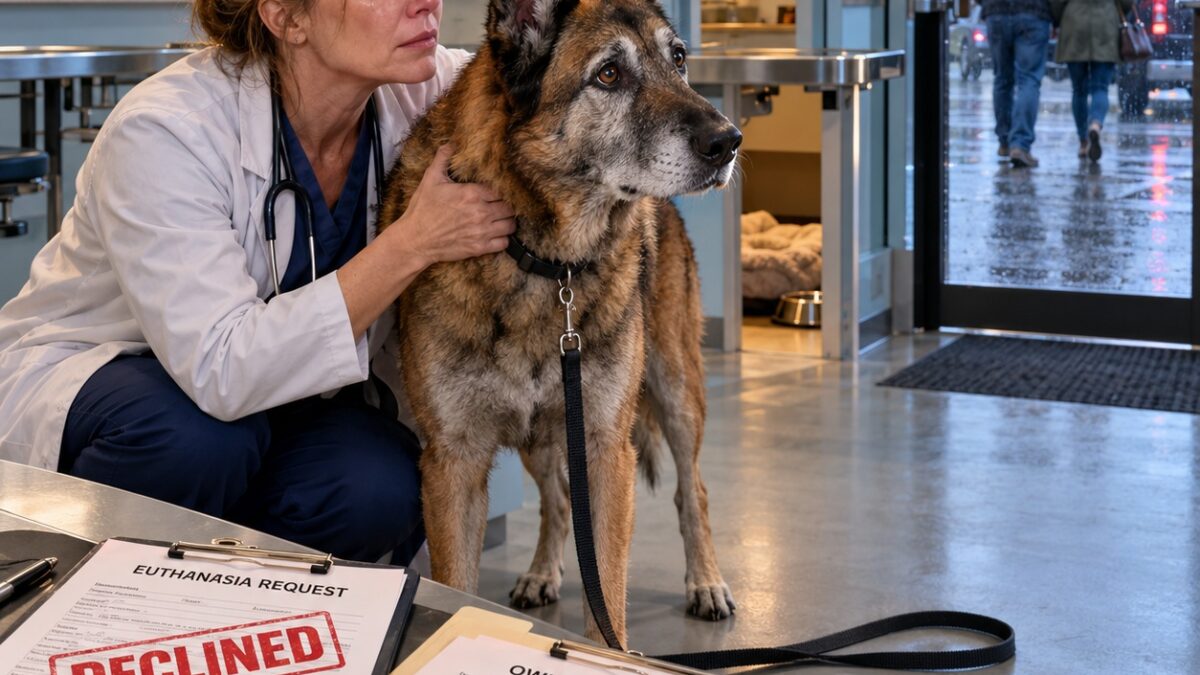
When we reached the waiting room, he stopped.
Exactly where his family had been standing.
He looked toward the entrance.
My heart broke a little.
“They’re not coming back.”
I hated saying it.
Maybe dogs do not understand sentences.
Tone, though?
Absence?
That, they understand perfectly.
He waited another few seconds.
Then followed me outside.
I opened the back door of my car.
He hesitated.
Perhaps cars had once meant family.
Trips.
Home.
People he trusted.
Now?
I had no idea.
“Come on.”
He placed his front paws inside.
Paused.
I supported his rear end carefully.
He climbed onto the seat and immediately turned to look through the rear window toward the clinic.
I drove home.
For the entire ride, he remained upright.
Watching the road behind us.
As though every pair of headlights might belong to the people who had changed their minds.
They never did.
I had not planned to adopt a dog that afternoon.
I had work.
Responsibilities.
A quiet house that, if I was being truthful, had become quieter than I liked.
But I had not gone to work that morning thinking:
Today I will bring home an elderly Belgian Malinois with arthritis and abandonment trauma.
Life does not usually ask permission before rearranging itself.
When we reached my house, I opened the door.
The dog stood beside me.
I looked at him.
The name on his old paperwork belonged to his old life.
I did not hate the name.
But somehow it felt attached to everything he had just lost.
I wanted one thing that did not belong to the people who left him.
Something that began here.
“Sam.”
He looked at me.
There.
A response.
“Sam.”
Another look.
“All right.”
I rubbed the side of his neck.
“Sam it is.”
Renaming him did not erase his past.
I knew that.
Trauma does not disappear because someone gives it a prettier label.
But names can mark beginnings.
I needed one.
Maybe he did too.
I opened the front door.
Sam entered slowly.
One paw.
Pause.
Second paw.
His nails clicked softly against the floor.
He stood in my living room as if crossing into a museum where touching anything might get him punished.
I took off the leash.
He did not move.
“Free.”
Nothing.
I walked toward the kitchen.
He stayed.
I prepared water.
Food.
A soft bed.
He ignored the bed.
Ignored the food.
Sniffed the water, then turned away.
I sat on the couch.
Sam eventually moved toward the living-room window.
There was a dark corner beside it where the curtain blocked part of the room.
He lowered himself there.
Face toward the glass.
And waited.
That became his place.
For the first three days, Sam barely ate.
That terrified me.
Medically, I knew what prolonged food refusal could do, especially in an older dog already needing better nutrition.
Emotionally, I knew forcing him would accomplish nothing.
So I tried.
High-quality canned food.
Nothing.
Boiled chicken.
He sniffed it.
Turned away.
Warm broth.
No.
Ground beef prepared plain.
He looked at the bowl and then through me.
That was the strangest part.
Food should have mattered.
At least a little.
But Sam seemed to have entered a state where hunger was less important than waiting.
He drank only when I left the room.
I discovered that by accident.
I would put down fresh water.
Sit several feet away.
Nothing.
Walk to the kitchen.
Come back.
Water level lower.
It felt as though he were embarrassed to need something.
Or perhaps afraid that showing need gave people power.
I stopped trying to interpret every behavior.
Instead, I made sure the opportunity remained.
Food offered.
Water available.
No pressure.
During the day, Sam moved through the house like a shadow.
Careful.
Quiet.
If I entered a room too quickly, he stood.
If I opened a cabinet, he looked toward the door.
If I dropped something, his whole body tightened.
He never got in the way.
That sentence sounds positive until you understand how hard he was trying not to.
Dogs living comfortably in a home get in your way constantly.
They block hallways.
Sleep where you need to walk.
Stand between you and the refrigerator.
Push noses under elbows.
Sam seemed determined to occupy as little space as possible.
Every movement said:
I will not be a problem.
That broke me.
Because someone had taught him that being a problem meant losing home.
At night, it got worse.
He would lie directly on the tile in the hallway in front of the main door.
Not his bed.
Not the rug.
The cold tile.
Facing the entrance.
Waiting.
The first night I assumed he preferred the cool surface.
The second night I understood.
He was guarding the door for a return that would never happen.
From my bedroom, I could hear him breathing.
Not sleeping deeply.
Short, uneven breaths.
Occasional movement.
Sometimes his tail would tap the floor.
Slow.
One tap.
Pause.
Another.
As if he had heard something outside.
A car.
Footsteps.
A sound that reminded him of them.
Each time I heard that tail, my chest hurt.
Around two in the morning on the second night, I stopped pretending I could sleep.
I took a wool blanket from the closet.
Went into the hallway.
Sam raised his head.
I sat against the wall about three feet from him.
Not touching.
Not calling.
Just there.
He watched me.
“You know, this floor is terrible.”
His eyes stayed on me.
“I bought a bed.”
Nothing.
“Very expensive.”
One ear moved.
“That is disrespectful.”
For the first time, his eyes softened by a fraction.
Maybe imagination.
I kept talking.
Not about him.
About me.
Perhaps that sounds ridiculous.
But when you have spent your professional life reassuring frightened animals, you learn that content matters less than rhythm.
So I told Sam about my nineteen years as a veterinarian.
The first patient I lost.
The first euthanasia I performed.
How I went to my car afterward and cried because I thought a real doctor should have been stronger.
How I learned later that strength had nothing to do with not feeling.
I told him about the animals people saved.
The animals they failed.
The ones that arrived too late.
The ones that surprised everyone.
I told him about my house.
How sometimes it felt peaceful.
Sometimes too quiet.
How I had made choices in my own life that left me more alone than I expected.
Failed relationships.
Long hours.
Work becoming easier than intimacy because patients did not ask why I avoided certain conversations.
Sam stared.
I smiled faintly.
“You’re an excellent therapist.”
Tail.
Once.
“You don’t interrupt.”
He lowered his head.
I stayed until nearly four.
He never approached.
That was okay.
The following night, I did the same.
And the next.
I made no grand promises.
No:
I’ll love you forever.
Dogs do not understand forever.
They understand Tuesday.
Then Wednesday.
Then Thursday.
Food appears.
The door opens.
The person comes back.
Nobody drags you away.
Trust is often repetition before it becomes feeling.
By the fourth evening, I was exhausted.
Sam still had not eaten a meaningful meal.
I was beginning to worry that grief had tipped into a medical problem of its own.
His bloodwork from the clinic had shown no major disease process, but older dogs do not tolerate prolonged nutritional stress well.
I warmed chicken broth.
Not too hot.
Carried it into the living room.
Sam was beside the window.
I sat on the floor.
Placed the bowl near me.
Then spoke.
Softly.
Nothing important.
Clinic gossip.
A ridiculous client who once brought in a dog because it “looked judgmental.”
The weather.
The fact that Sam had selected the only part of the living room where the draft was strongest.
His eyes followed me.
I did not push the bowl.
Eventually, silence settled.
Sam turned his head.
Looked at me for a long time.
Not through me.
At me.
That was different.
I held completely still.
He looked toward the broth.
Then back at me.
One step.
Pause.
Another.
His nose reached the bowl.
He sniffed.
I barely breathed.
He licked once.
Stopped.
Looked at me.
“It’s yours.”
Second lick.
Then another.
Three.
Five.
He drank.
Not much.
Enough.
My eyes filled before I could stop them.
Veterinarian for nineteen years.
Reduced to tears by chicken broth.
Sam finished a little more.
Then lifted his head.
For several seconds, he simply stood there.
And then he walked toward me.
I put my hands loosely in my lap.
No reaching.
He lowered his head.
Not onto my knee.
Into my hands.
His weight settled against my palms.
Heavy.
Warm.
Trusting just enough.
I felt my throat close.
“Hi, Sam.”
He stayed.
Then his tongue touched my wrist.
One slow lick.
That was all.
But I knew.
Something had shifted.
He had not forgotten his old family.
He had not stopped grieving.
He had not magically healed.
He had simply allowed the possibility that the person sitting beside him might matter too.
That was the beginning.
The next morning he ate a few bites of chicken.
That evening, more.
Within a week, he accepted proper food mixed with broth.
I started treating the things in his body that actually needed treatment.
Anti-inflammatory medication appropriate for his age and condition.
Joint supplements.
Carefully improved nutrition.
Gentle exercise.
No miracle cure.
Just good medicine.
His rear-leg limp began easing.
At first, almost imperceptibly.
Then enough that I noticed he no longer shifted his weight every time he stood.
The stiffness remained after long rest.
But he moved more comfortably.
His coat changed too.
Nutrition does remarkable things slowly.
What had looked dry and brown began deepening.
New growth.
Better shine.
He started grooming himself more.
That mattered psychologically as much as cosmetically.
He was participating in his own life again.
The window still mattered.
He continued lying there.
But not all day.
Sometimes he followed me into the kitchen.
Not close.
Doorway.
Watching.
One afternoon I dropped a piece of chicken.
Sam caught it before it hit the floor.
I stared.
He froze with the food in his mouth as if he expected punishment.
Then I laughed.
“Really?”
He swallowed.
“Veterinarian’s house, and you’re stealing food?”
Tail moved.
Tiny.
I pointed.
“That is unacceptable.”
Tail again.
I gave him another piece.
Professional standards deteriorated quickly.
The front door remained harder.
Every car slowing outside made him look up.
Sometimes he stood.
Walked into the hallway.
Waited.
When nothing happened, he returned.
The first time I left him alone for twenty minutes, I almost did not go.
That was not healthy.
For either of us.
I needed Sam to learn I could leave without abandoning him.
And I needed to trust that his anxiety would not destroy whatever progress we had made.
So I set up a camera.
Yes.
The veterinarian became the anxious owner.
I left.
Drove around the block.
Watched the camera at a red light.
Terrible behavior.
Sam stood at the door.
For three minutes.
Then five.
At minute eleven, he lay down.
At minute sixteen, he lifted his head.
When I returned at twenty-three minutes, I opened the door expecting panic.
Sam stood.
Looked at me.
Then his tail moved.
Once.
Twice.
I crouched.
“I came back.”
He walked to me.
That became our next lesson.
I leave.
I return.
Short trips.
Longer.
Clinic.
Market.
He watched.
Waited.
Learned.
And I kept returning.
One month after I brought him home, I woke before sunrise.
The hallway was empty.
My stomach dropped.
“Sam?”
No answer.
I got out of bed.
Checked the door.
Nothing.
Living room window.
Empty.
Kitchen.
No.
For a ridiculous second, I felt panic.
Then I looked down.
Sam was stretched across the rug at the foot of my bed.
Deep asleep.
Not curled tight.
Not facing the door.
On his side.
Legs extended.
Breathing slowly.
He had come into my room sometime during the night.
Not to monitor me.
Not because I called.
Because he wanted to be near me.
I sat on the edge of the bed.
Watched him.
He did not wake.
That was the miracle.
A dog who had spent his first nights refusing to sleep deeply enough to miss the sound of returning owners now trusted the world enough to sleep while I moved above him.
I did not touch him.
I let him sleep.
Progress should not always be interrupted so we can celebrate it.
Our walks became part of the routine.
Morning first.
Quiet streets.
Cool air.
Short distance at first because of his joints.
Sam loved trees.
Specifically the base of every tree ever grown.
Each required investigation.
Ten-minute walks became twenty.
He gained strength.
His gait loosened.
People began noticing him.
“What a handsome boy.”
I would smile.
“He knows.”
Sam did not know.
He was becoming slightly more social, though.
Children interested him.
That surprised me.
I was cautious the first time a little boy asked to pet him.
Sam stood still.
Child approached from the side.
Hand low.
Sam sniffed.
Then allowed a scratch behind the ear.
After that, he seemed to collect children on our route.
They knew him before they knew me.
“Sam!”
Tail.
Always children.
Adults got polite interest.
Children got tail.
Perhaps he had known children before.
I never learned enough about his old life to know.
That was difficult at first.
I wanted explanations.
How long had he lived with them?
Had he been loved once?
Had he slept on a couch?
Was there a child?
When did they begin deciding he was too old?
Did the neglect happen gradually?
Did someone argue for him before they gave up?
Human brains want complete stories.
Dogs survive without them.
Eventually, I learned to stop constructing his past.
What mattered was the dog in front of me.
At the third month, Sam surprised me again.
It was Sunday.
Sunny.
I was reading on the couch.
He had been sleeping near the window.
I felt something wet press against my elbow.
I looked down.
A tennis ball.
Old.
Faded.
I had forgotten I even owned it.
Years earlier, a friend’s dog had left it under a cabinet.
Somehow Sam had found it.
He stood there.
Ball in mouth.
Ears higher than usual.
Eyes brighter.
Tail moving.
I stared.
“You want to play?”
Tail faster.
“You?”
He dropped the ball onto my lap.
I laughed.
“All right.”
I threw it gently down the hallway.
Sam moved.
Not a sprint.
He was an older Malinois.
But the change was extraordinary.
His front legs stretched.
Rear legs followed.
He trotted after the ball with a kind of joyful determination I had not seen.
Picked it up.
Turned.
Came back.
Mouth open.
Ball between his teeth.
Tail.
I took it.
Threw again.
This time he moved faster.
I found myself laughing.
“Sam!”
He returned.
Again.
Again.
After five throws, I stopped.
Veterinarian.
Responsible joint management.
Sam disagreed.
He pushed the ball against my knee.
“No.”
Push.
“You’re old.”
Tail.
“So am I, apparently.”
Push.
“One more.”
We played nine more.
That afternoon, Sam slept on the couch.
Yes.
The couch.
The dog who had spent his first days trying not to occupy space had somehow concluded that the entire middle cushion belonged to him.
I did not correct him.
He stretched into sunlight coming through the window.
Head on the armrest.
One rear leg hanging over the edge.
Completely inappropriate.
Completely at home.
I took a picture.
Then another.
Then stopped because I realized I was behaving like every client who had ever shown me forty-eight nearly identical photographs of their pet.
I finally understood them.
The months that followed were peaceful.
Not perfect.
Healing rarely is.
Sam still woke some nights.
Suddenly.
Head up.
Eyes wide.
Disoriented.
Sometimes he would stand and go toward the hall.
On those nights, I did not call loudly.
I would reach my hand from the side of the bed.
“Sam.”
His ears moved.
“Here.”
He would look toward me.
Walk closer.
I touched the gray fur around his muzzle.
“That’s it.”
A long breath.
Then the body softened.
He lay down.
Those moments became less frequent.
But they reminded me that recovery is not erasure.
The nervous system remembers things long after life becomes safe.
Humans do too.
I knew that personally.
Perhaps that was part of why Sam and I fit.
I had spent years becoming professionally competent at helping suffering creatures while being less talented at accepting help myself.
Work filled space.
Long shifts.
Emergencies.
Continuing education.
More shifts.
You can build an impressive life around avoiding the parts that hurt.
Sam did not let me.
Not intentionally.
He simply required presence.
Morning walk.
Medication.
Food.
Play.
Evening.
If I stayed at the clinic too late, someone was waiting.
If I considered skipping my own dinner, I was already in the kitchen preparing his.
If I spent too long thinking about work, a tennis ball appeared.
He brought me into the present without knowing the word.
I had saved him from euthanasia.
That was what colleagues sometimes said.
“You saved him.”
I disliked it.
Not because it was entirely false.
If I had agreed that afternoon, Sam would have died.
That fact made me cold every time I considered it.
But “saved” sounded like one action.
One heroic moment.
Real rescue was less elegant.
Waking at two in the morning.
Sitting on tile.
Offering food nobody ate.
Monitoring medication.
Cleaning accidents once his stomach began adjusting.
Repeating walks.
Returning home.
Not demanding gratitude.
Not expecting trauma to behave according to my schedule.
Rescue was Tuesday and Wednesday and Thursday.
It was patience without applause.
Sam did his part too.
He kept trying.
That mattered.
By the sixth month, I decided to take him to the clinic for a day.
Not as a test.
At least, that was what I told myself.
I was covering a longer shift.
His routine had become stable.
The staff loved him.
It seemed reasonable.
Still, as I drove toward the clinic, I became nervous.
Sam sat in the back seat.
Calm.
Looking out the window.
When we turned onto the street, his head lifted.
Recognition.
My hands tightened around the steering wheel.
He knew.
Of course he knew.
Scent.
Road patterns.
Buildings.
Dogs remember places in ways people underestimate.
I almost turned around.
Then I looked at him in the mirror.
No panic.
Just attention.
“We can go home.”
Sam looked at me.
“This was a bad idea.”
No response.
I parked.
Opened his door.
He climbed down carefully.
We entered.
The smell hit him first.
Disinfectant.
Animals.
Medicine.
Metal.
The particular mixture every veterinary clinic carries.
Sam stopped.
Staff at reception went quiet.
They knew the story.
No one called him.
No one approached.
Thank God.
They let him decide.
Sam walked three steps.
Then five.
Into the waiting room.
And stopped.
Exactly there.
I knew the spot immediately.
The place where his old family had stood.
The place where I had first realized he was watching them leave.
The door was ahead of him.
Same glass.
Same frame.
Different afternoon.
Sam stared.
I stopped behind him.
Every instinct in me wanted to kneel.
Touch him.
Reassure.
I did not.
This was his moment.
He looked at the door for several seconds.
Long enough that the entire clinic seemed to disappear around us.
I wondered what existed in his memory.
Their smell.
Their voices.
The leash.
The closing door.
The kennel.
Waiting.
Could dogs remember betrayal as an event?
I do not know.
But Sam remembered something.
Then he turned his head.
Looked at me.
I held my breath.
His tail moved.
Once.
Then faster.
And he walked past me.
Straight toward the hallway.
Straight toward my office.
He pushed the half-open door with his nose and went inside.
I stood in the waiting room unable to move.
One of my technicians whispered:
“Well, I’m going to cry.”
“Don’t.”
“You’re crying.”
“I am not.”
“You absolutely are.”
I wiped my face.
Professional dignity gone.
I walked into my office.
Sam was lying beside my desk.
Like he had done it every day for years.
I sat in my chair.
He looked up.
Then put his head down.
That was the moment I knew the past had lost its authority over him.
Not disappeared.
Not erased.
But it no longer told him where home was.
He had looked at the door where one life ended.
Then chosen my office.
Chosen me.
I reached down.
Touched his head.
“Good boy.”
His eyes closed.
The staff spoiled him mercilessly that day.
I pretended to object.
Chicken appeared.
Treats appeared.
Someone brought a new tennis ball.
Sam charmed a child in the waiting room.
Slept through a staff meeting.
By closing time, he acted as though the clinic had always belonged to him.
When we walked through the waiting room on the way out, he did not stop at the old spot.
He walked directly to the door.
Outside.
Car.
Home.
That mattered too.
Home was no longer the clinic.
It was where we were going together.
Several months have passed since then.
Sam still walks beside me.
Slowly.
Wisely.
His muzzle continues whitening.
Age has not reversed.
It never needed to.
His arthritis is managed, not magically cured.
Some mornings are stiffer.
On cold days, we shorten the walk.
On warm days, he takes his time beneath the trees.
He still loves the tennis ball.
Within reason.
My reason.
Not his.
He still believes nine throws after “one more” are legally distinct.
He owns the couch now.
I no longer maintain the fiction that it is mine.
He also sleeps at the foot of my bed most nights.
Sometimes beside it.
Sometimes, when he is particularly bold, halfway across the doorway where I am guaranteed to nearly trip over him at six in the morning.
The dog who once worked desperately not to inconvenience anyone has become an obstacle.
I could not be happier.
He asks for things now.
That is one of the changes I value most.
Water bowl low?
He finds me.
Walk delayed?
He stands by the leash.
Dinner late?
You would think I had violated international law.
Tennis ball under furniture?
He stares at the exact location until I understand my duty.
Need.
Expressed freely.
No shame.
That may sound like a minor behavioral change.
It is not.
A living creature that once drank only when I left the room now walks up to me and demands breakfast.
That is trust.
Sometimes people at the park ask how long I have had him.
I say:
“Not long enough.”
They usually laugh.
I do too.
But part of me means it.
I know Sam is old.
I know exactly what old means.
I am a veterinarian.
I have no illusions about mortality.
His time with me will not be measured in decades.
Maybe that would scare some people away from adopting an older dog.
They say:
“I couldn’t handle losing them so soon.”
I understand.
Loss frightens me too.
But look at the alternative.
Sam nearly lost the rest of his life because someone decided the final chapter was not worth reading.
Every morning he spends smelling trees is a morning he would not have had.
Every afternoon on my couch.
Every child who pets him.
Every tennis-ball trot.
Every night he sleeps deeply enough to dream.
Time does not have to be long to be valuable.
That is something veterinary medicine teaches repeatedly.
Sometimes one pain-free week matters.
One summer.
One Christmas.
One afternoon in sunlight.
Sam did not need a guarantee of five more years.
He needed someone to believe today was still worth having.
The old family occasionally enters my thoughts.
Less now.
At first I was furious.
I replayed the examination-room conversation.
He gets in the way.
He’s not himself.
What are we supposed to do with him?
Anger is easy.
Later, I let some of it go.
Not because I suddenly thought they were right.
I still believe surrender should have been considered before euthanasia.
Treatment should have been considered.
Options existed.
But living permanently inside rage at people who are no longer part of Sam’s life gives them too much space.
They left.
Sam stayed.
That is the story that matters.
I do not know whether they think about him.
Whether they wonder.
Whether they tell themselves euthanasia was necessary and I was sentimental.
Whether they regret signing him over.
It does not matter.
Sam does not stand at the door waiting for them anymore.
Neither do I.
Healing sometimes means losing interest in the apology you once thought you needed.
One evening, months after the clinic visit, I sat on the floor beside him.
Not because he was afraid.
Because my back hurt and apparently veterinarians also make poor ergonomic decisions.
Sam put his head on my lap.
Same position as the fourth night.
I remembered broth.
Cold hallway tile.
Dark window.
The dog who looked at me as though trust itself were dangerous.
I ran my fingers through the fur behind his ears.
“You know you almost died?”
His ear moved.
“Very inconvenient.”
Tail.
“I had plans.”
Tail again.
“You completely rearranged them.”
He sighed.
I laughed.
“You don’t care.”
He did not.
Good.
Animals rarely care about the narratives we build around saving them.
Sam did not wake each morning grateful I had refused euthanasia.
He woke because breakfast existed.
Sunlight existed.
Interesting smells existed.
I existed.
That simplicity grounded me.
Humans turn survival into identity.
Sam turned survival into Tuesday.
That was healthier.
At the clinic, cases continue.
Some beautiful.
Some awful.
I still perform euthanasia.
That surprises people when they hear Sam’s story.
“How can you?”
Because humane euthanasia remains one of the kindest things veterinary medicine can offer when an animal is suffering without meaningful hope of comfort.
Sam did not change that.
He sharpened something else.
I ask more questions now.
Not because I had been careless before.
Because every case deserves the pause.
Pain?
Function?
Treatment?
Environment?
Caregiver limitations?
Could surrender, rescue, or hospice be reasonable?
Is the request about suffering?
Or inconvenience?
Not every answer changes the outcome.
Sometimes death remains the compassionate decision.
But Sam reminds me that age alone is not suffering.
Slowness is not suffering.
Needing medication is not suffering.
Requiring more patience is not suffering.
Being inconvenient is certainly not suffering.
Quality of life belongs to the animal.
Not merely to the ease of the humans around it.
That distinction matters.
One afternoon, an older woman brought in a senior mixed-breed dog with arthritis.
She was crying.
“I don’t want to be selfish.”
I examined him.
Talked to her.
He still ate.
Still enjoyed walks.
Still sought affection.
Pain manageable.
We adjusted treatment.
Before leaving, she asked:
“You really think it’s okay to keep trying?”
I looked at her dog.
Then at Sam asleep behind my office door.
“Yes.”
As long as we keep evaluating his comfort.
She hugged me.
I am not usually a hug person.
I let her.
Sam had changed that too, apparently.
I once believed veterinary medicine was mostly about diagnosis and treatment.
Nineteen years taught me it is often about translation.
Animals cannot tell us:
I hurt here.
I am frightened.
I still enjoy this.
I am tired.
I want another morning.
We infer.
Observe.
Listen.
Sometimes people also need translation.
They say:
“He’s not himself.”
And mean:
I am scared watching him age.
They say:
“I don’t want him to suffer.”
And mean:
I don’t know when love becomes letting go.
Those conversations deserve compassion.
But sometimes the truth is less noble.
Sometimes an animal becomes difficult.
Expensive.
Slow.
Inconvenient.
And someone asks medicine to make the inconvenience disappear.
That is where my responsibility becomes different.
Sam taught me to trust that discomfort.
The first afternoon, I could have followed the request.
No one outside the room might have questioned it.
Old dog.
Arthritis.
Owner request.
Procedure.
Quiet end.
Instead, he is sleeping on my couch as I think about this.
His paw is twitching.
Dreaming.
Maybe chasing the tennis ball with younger legs.
Maybe nothing.
His existence now is not dramatic.
That is precisely why it matters.
I did not save Sam so he could perform a miracle.
He never pulled a child from a river.
Never alerted me to a fire.
Never discovered a hidden illness.
His great achievement was smaller.
He trusted again.
People underestimate how difficult that can be.
After betrayal, trust is work.
For animals.
For humans.
You can survive the event and still live as though it is happening.
Sam spent his first nights listening for people who had already left.
I had done versions of that myself.
Not literally at a door.
Emotionally.
Waiting for old losses to reverse.
Old relationships to explain themselves.
Old disappointments to become different because enough time passed.
Sam moved on before I did.
He turned from the clinic door.
Walked toward my office.
A choice so simple I almost missed how profound it was.
You cannot live facing the door that closed forever.
At some point, you have to look toward the room that is still open.
That became Sam’s gift to me.
Not companionship alone.
Perspective.
The future does not always announce itself dramatically.
Sometimes it is an old dog walking into your office because that is where you are.
Our morning walks remain my favorite.
We go early.
Before the park gets crowded.
Sam’s pace is slower than it used to be.
Or slower than I imagine it once was.
He has to inspect the same tree every morning.
I tell him:
“Nothing has changed.”
He disagrees.
Apparently scent news is important.
We pass children waiting for school.
Runners.
An older man with a small terrier.
Sam knows them all by smell.
One little girl always asks:
“Can I pet Sam?”
Always.
He stands patiently.
She touches his gray muzzle.
“You’re getting whiter.”
I say:
“So am I.”
She looks at my hair.
Then politely chooses silence.
Smart child.
Sam likes her.
At home after the walk, he eats.
Medication.
Water.
Then couch.
Sun.
His life is ordinary.
That is what I wanted for him.
No more proving.
No more waiting to be chosen.
No more worrying that age will make him disposable.
He already belongs.
Sometimes belonging is the most radical treatment we can offer.
Sam still has occasional nights when he wakes abruptly.
Fewer.
He lifts his head.
Looks around.
I say his name.
“Sam.”
That is usually enough.
He hears my voice.
His eyes find me.
A long exhale.
Then sleep.
I wonder what his old name would do if someone said it.
I never tested.
I do not need to.
Sam is not a disguise.
It became who he is here.
When I say it, he knows:
Food.
Walk.
Ball.
Bed.
Home.
Me.
Names gather meaning through repetition too.
The first time, it was a word I chose because I wanted a new beginning.
Now it is thousands of small moments.
“Sam, breakfast.”
“Sam, leave that.”
“Sam, slow down.”
“Sam, come here.”
“Sam, it’s okay.”
“Sam, bedtime.”
Eventually, a name becomes a map of relationship.
His old life had one.
This one has another.
I am not erasing anything.
I am adding.
That is what healing does.
It adds safe memories until the painful ones no longer occupy every room.
One of my technicians once asked:
“Do you think he forgave them?”
I looked at her.
“Dogs don’t need our moral vocabulary.”
“You know what I mean.”
I did.
“I think he stopped waiting.”
That answer felt more accurate.
Forgiveness can be too abstract.
Freedom is sometimes simply no longer organizing your life around who left.
Sam stopped waiting.
That was enough.
There is still a small mark on the hallway tile where I used to place the water bowl during those first nights.
I notice it occasionally.
The hallway itself looks unchanged.
But I cannot walk through it without seeing both versions.
Sam lying there.
Head toward the door.
Me sitting against the wall with a blanket.
Then Sam now.
Walking through without pausing.
Tail relaxed.
Heading toward my bedroom because his preferred sleeping spot is apparently whichever place causes me the greatest inconvenience when I wake.
That contrast makes me smile.
People often talk about rescue animals becoming grateful.
I do not think gratitude is the point.
Safety is.
Confidence.
Preference.
Personality.
The moment an animal feels secure enough to annoy you is often a good moment.
Sam began refusing to come inside when the weather was beautiful.
Good.
He began stealing my side of the couch.
Excellent.
He once ignored me completely because a squirrel was more interesting.
Wonderful.
A traumatized animal being obedient because it is afraid is not success.
A secure animal developing opinions?
That is life returning.
Sam has opinions now.
Many.
Chicken superior to dry food.
Rain unnecessary.
Veterinary clinics acceptable only if followed by treats.
Children good.
Vacuum cleaner suspicious.
Tennis ball sacred.
Couch legally his.
I accept most rulings.
Several months into our life together, I found myself driving home after a difficult shift.
We had lost a young dog after emergency surgery.
Owners devastated.
I had held myself together for them.
Completed paperwork.
Cleaned up.
Drove.
By the time I reached my driveway, the day had become heavy.
I sat in the car longer than necessary.
Did not want the silent house.
Old habit.
Then I remembered.
Not silent.
I opened the door.
Sam was waiting.
Not anxiously.
Happily.
Tail.
One small bounce his joints probably did not appreciate.
He pressed his head against my leg.
I knelt.
And I cried.
No explanation.
Sam did not need one.
He stayed.
That night, I finally understood something I had been telling clients for years.
Animals do not fix grief.
They do not replace people.
They do not cure loneliness like medication.
They simply refuse to let us experience everything alone.
That can be enough.
Sam was abandoned at my clinic because someone no longer wanted to carry the inconvenience of his aging body.
Months later, that aging body became the thing I reached for when I could no longer carry a difficult day by myself.
Life has a sense of irony I sometimes appreciate.
If someone asks me now what happened the day Sam arrived, I can tell the clinical version.
Senior Belgian Malinois.
Arthritis.
Poor body condition.
No terminal pathology identified.
Owner-requested euthanasia declined.
Ownership surrendered.
Supportive treatment initiated.
Outcome favorable.
That is accurate.
It is also almost meaningless.
The real story lives in the parts no medical record captures.
A dog staring at a door.
A veterinarian sitting on tile at two in the morning.
A bowl of warm broth.
A tongue against a wrist.
First deep sleep.
First tennis ball.
First time waking from a nightmare and calming at a new name.
The clinic waiting room six months later.
Sam looking at the entrance.
Then turning toward me.
Those are the measurements that mattered.
Medicine kept his joints comfortable.
Nutrition restored his body.
Time restored strength.
But trust?
Trust came from everything between treatments.
Presence.
Repetition.
Choice.
One day after another.
I once thought that refusing to euthanize Sam was the moment I saved his life.
Now I think that was only the moment his life did not end.
Saving came afterward.
And it was not something I did alone.
Sam participated.
Every bite after refusing food.
Every step away from the front door.
Every night he chose the rug over the hallway tile.
Every time he let himself sleep.
Every time he brought me the ball.
Every time I left and he allowed himself to believe I would return.
Healing was something we practiced together.
That may be why he changed me so much.
I had spent nineteen years treating animals as patients.
Sam reminded me what it meant to share life with one.
There is no professional distance at six in the morning when a Malinois is staring at you because breakfast is eight minutes late.
There is no clinical detachment when he takes your favorite spot on the couch.
There is no treatment plan for the way your house feels when another heartbeat becomes part of it.
Sam is beside me now.
Older than the dog who arrived at the clinic, obviously.
That is how time works.
His muzzle nearly white.
His pace measured.
He still carries the tennis ball sometimes.
More often now he brings it to me and then changes his mind about chasing it.
I throw.
He watches.
I retrieve.
Apparently roles evolve.
I complain.
He does not care.
At night, he sleeps.
Deeply.
That is still the thing I notice most.
The dog who once refused to close his eyes because the people he loved might return while he was sleeping now trusts that nothing important will disappear simply because he rests.
There is a lesson in that I am still trying to learn.
We cannot stay awake enough to prevent loss.
Cannot stand at every door.
Cannot monitor every departure.
Cannot make people remain by being useful enough, quiet enough, easy enough, young enough.
Eventually, peace requires believing that what is meant to stay will not demand constant vigilance.
Sam learned that in my hallway.
I am learning it from him.
When I think back to the examination room, I still see him before he became Sam.
Old dog.
Gray muzzle.
Body slightly stiff.
Watching people discuss whether his life still had value.
That image will probably never leave me.
But it no longer ends there.
Now, immediately after it, I see another image.
Sam on my couch.
Sun across his coat.
Tennis ball near one paw.
Eyes closed.
No one deciding anything about him.
No one measuring whether he is useful enough.
He simply exists.
Loved.
And maybe that is the most important thing this old dog taught a veterinarian who thought she already understood the value of life.
Life does not have to be young to be worth protecting.
It does not have to be easy.
It does not have to be fast.
It does not need to earn one more day through usefulness.
Sometimes one more day is valuable because there is sunlight on a couch.
Because chicken tastes good.
Because a child might scratch behind your ear in the park.
Because someone will whisper your name when you wake frightened.
Because there is a tennis ball under a cabinet you have not discovered yet.
Because trust might still return on the fourth evening.
Because the door that closed behind one family does not mean every door is closing.
Sam is proof of that.
When his old family brought him to my clinic, they believed they were bringing his story to an end.
They were wrong.
They had only brought him to the place where his next chapter happened to begin.
And every morning when he walks beside me—slowly, comfortably, at the pace his aging body chooses—I am reminded that sometimes the most compassionate thing we can give another living creature is not a perfect future.
It is the chance to discover that a future still exists at all.








