PART2:The Mother Dog Refused to Get Into Our Rescue Van—Then We Realized She Was Trying to Tell Us Someone Was Still Trapped Underground
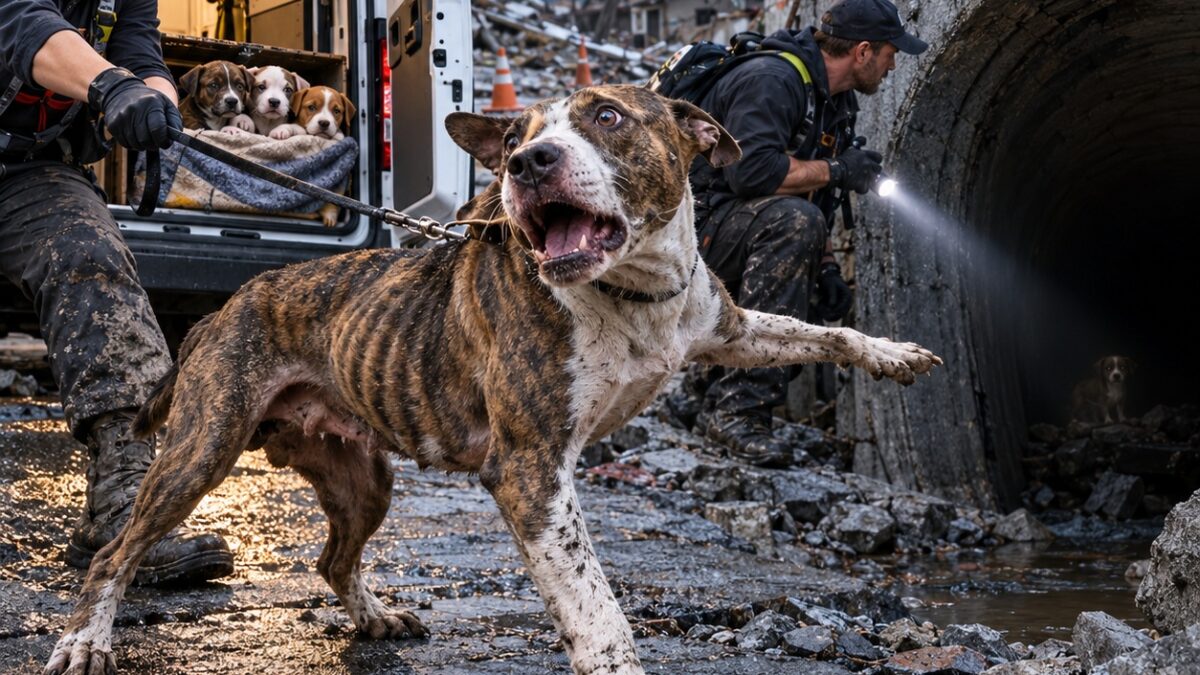
PART2
The second time we entered the tunnel, it felt different.
Nothing about the physical space had changed.
Same concrete.
Same damp smell.
Same mud along the lower walls.
Same narrow beam of artificial light cutting through darkness.
But now every shadow felt like a question.
Our first inspection had been fast.
Not careless.
Fast.
We had been focused on the mother and three puppies we could see near the entrance.
Once we confirmed no obvious additional animals were lying along the immediate passage, our priority had been getting the visible dogs out.
Reasonable.
Necessary.
And possibly incomplete.
Arthur walked several steps ahead.
His flashlight swept left.
Right.
Ceiling.
Floor.
We moved slowly.
Much more slowly than before.
I heard water dripping somewhere deep in the tunnel.
Each drop echoed.
Tick.
Pause.
Tick.
The air was cooler farther in.
Humid.
Stale.
The kind of place where sound does strange things.
Arthur stopped.
“What?”
I whispered.
He raised one hand.
We listened.
Nothing.
Then:
A rough sound.
Almost a scrape.
Then silence.
Arthur angled his light.
“Did you hear that?”
“Yes.”
We waited.
Another sound came from deeper inside.
Not a bark.
Not a whine.
Breathing.
Harsh.
Broken.
The unmistakable sound of something struggling to pull air into exhausted lungs.
My entire body went cold.
“Arthur.”
“I hear it.”
We moved toward the sound.
Slow.
The tunnel narrowed slightly.
Debris from the damaged structure above had fallen into one side.
Dirt.
Broken concrete.
Fragments of brick.
Arthur’s beam passed over the wall.
Nothing.
Then came movement.
Small.
Low.
He swept the light back.
“There.”
In a recess behind the debris, something shifted.
At first, I saw eyes.
Reflecting the beam.
Then the outline of a head.
Dog.
Another dog.
She was lying almost flat against the concrete floor.
Smaller than Bella.
Much thinner.
Her coat was a pale gray beneath the dirt.
For one terrible second, she looked dead.
Then she lifted her head.
Barely.
Her eyes met mine.
I have seen frightened animals.
Angry animals.
Animals in pain.
That look was different.
Exhaustion beyond fear.
She had spent so much time struggling that she seemed to have reached a place where even panic required more energy than she had left.
I lowered myself.
“Oh, sweetheart.”
The dog tried to shift.
A sound escaped her.
Pain.
That’s when I noticed her rear leg.
Wrong angle.
Not grotesquely fresh.
Something older.
A badly healed fracture, maybe.
The limb had limited movement and she clearly couldn’t put proper weight on it.
Arthur crouched beside me.
“She couldn’t get out.”
“No.”
I looked around the recess.
Scratches lined part of the concrete.
Old claw marks.
Dirt disturbed repeatedly.
This wasn’t a hiding place she had entered that morning.
She had been living here.
They had been living here.
Bella.
This dog.
The puppies.
Together.
And suddenly Bella’s refusal made perfect sense.
The puppies had been near the entrance.
Visible.
Reachable.
Bella had kept them close enough to where someone might notice.
But farther in was another dog who could not walk out.
Bella had not been refusing rescue.
She had been refusing to leave someone behind.
I sat back on my heels.
Arthur stared at the injured dog.
Then whispered:
“Damn.”
I knew exactly what he was thinking.
We had almost left.
Another five minutes.
Maybe less.
We might have loaded Bella by force.
Driven away.
Called the rescue complete.
The thought made me sick.
I reached one hand forward.
Palm up.
No grabbing.
No sudden movement.
The gray dog sniffed.
Even that looked exhausting.
She hesitated.
Then her tail moved.
Once.
One tiny sweep against the concrete.
Arthur inhaled sharply.
I had seen rescues where animals screamed.
Thrashed.
Bit.
Fought for life violently.
That one weak tail movement hit me harder.
It was hope reduced to almost nothing.
Still there.
Still asking.
Please.
I moved closer.
“Okay.”
My voice shook.
“We’ve got you.”
Her ears moved.
“We’ve got you now.”
We needed to lift carefully.
If the leg had an old fracture, rough movement could cause severe pain.
She was also dangerously thin.
I positioned one arm beneath her chest.
Arthur supported her hindquarters.
“Ready?”
“Yes.”
We lifted.
The dog tensed.
Then went almost completely limp.
Not unconscious.
Trust.
Or exhaustion so complete it looked like trust.
Her ribs pressed against my arms.
She weighed almost nothing.
That frightened me.
An adult pit bull should feel substantial.
This dog felt like bones under skin.
She lowered her head onto my forearm.
Eyes closed.
I carried her.
Arthur kept one hand beneath the injured rear leg to prevent movement.
We started back.
Every step echoed.
I spoke quietly as we walked.
“Almost out.”
The dog didn’t lift her head.
“Bella’s waiting.”
Her ear twitched.
I noticed.
“Yeah.”
I said it again.
“Bella.”
This time, her head moved slightly.
Arthur looked at me.
“She knows.”
Of course she did.
They had survived here together.
Bella had not been guarding an empty tunnel.
She had been standing between rescue and abandonment.
We could see the entrance ahead.
A rectangle of morning light.
As we approached, I heard Bella before I saw her.
A short whine.
Then claws on pavement.
We stepped out.
The sunlight felt almost blinding after the darkness.
Bella stood ten feet away.
For the entire time we had been underground, she had not moved toward the van.
Not one inch.
Then she saw the dog in my arms.
Her body changed instantly.
Tension released from shoulders.
Tail dropped from rigid alertness into movement.
She came toward us.
Slowly.
Carefully.
I knelt.
Arthur helped lower the injured dog onto a blanket.
Bella approached.
Nose first.
She sniffed the gray dog’s muzzle.
Eyes.
Ears.
Then the injured leg.
The gray dog lifted her head.
Their noses touched.
No dramatic barking.
No jumping.
Just recognition.
Bella exhaled.
Then she turned toward me.
I know how easy it is to project human emotion onto animals.
We do it constantly.
Maybe her eyes did not contain “gratitude” in the way I interpreted it.
But I know what changed.
Before we returned to the tunnel, Bella would not come near the van.
After she saw her companion safely on the blanket, she walked directly toward it.
No leash pressure.
No food lure.
Nothing.
Arthur opened the side door.
Bella climbed in.
By herself.
I stood frozen for half a second.
Arthur looked at me.
“Told you she wasn’t scared of the van.”
I shook my head.
“She was scared we’d leave without her.”
Bella lay beside the injured dog.
Close.
Body touching body.
Then we brought the three puppies over.
The moment they were placed near Bella, they burrowed toward her.
Tiny bodies against hers.
The gray dog rested beside them.
What formed on the blankets looked almost like a living pile.
Bella.
The injured dog.
Three puppies.
Together.
Safe.
For the first time since we arrived, Bella closed her eyes.
Arthur got behind the wheel.
I sat in the passenger seat but turned around.
Bella watched me.
The gray dog slept.
The puppies were pressed between them.
Arthur looked in the rearview mirror.
“I almost called it.”
His voice was low.
I knew what he meant.
Almost gave the departure signal.
Almost drove away.
“Me too.”
He stared at the road.
“I hate that.”
“So do I.”
Silence.
Then I looked back at Bella.
“But she didn’t let us.”
Arthur smiled slightly.
“No.”
I watched Bella rest her chin beside the gray dog’s head.
“She held out for two.”
The drive to the shelter was quiet.
Not peaceful exactly.
Exhaustion after crisis.
I watched the dogs.
Every few minutes Bella checked the injured one.
Nose.
Breathing.
Contact.
Then back to the puppies.
She had been carrying too much responsibility for too long.
Mother.
Guard.
Companion.
Sentinel.
Now, finally, there were other hands.
At the shelter, Dr. Nathan Ross met us.
Nathan had seen everything.
Starved dogs.
Hit-by-car cases.
Neglect.
Infection.
Abandoned litters.
He rarely reacted visibly.
But when we opened the van and he saw all five animals packed together, he paused.
“What happened?”
Arthur said:
“Long story.”
Nathan looked at the gray dog.
“Start with her.”
We moved quickly.
Puppies first evaluation.
Weak but responsive.
Dehydration.
Poor nutrition.
No immediate catastrophic concerns.
Good.
Bella next.
Exhausted.
Underweight.
But surprisingly stable.
Nathan ran his hands carefully along her body.
“She’s tougher than she looks.”
I laughed.
“You have no idea.”
Then Rose.
I had named her in my head before saying it aloud.
Pale gray.
Fragile.
Yet still alive.
Nathan examined the rear leg.
X-rays.
Pain response.
Range of motion.
We waited.
Bella did not like being separated from her.
She paced.
Whined.
Looked toward the medical area.
I sat beside her.
“She’s coming back.”
Bella stared at the door.
“I know.”
I smiled sadly.
“You’re very consistent.”
When Nathan returned, his face told me the injury was complicated.
“Old fracture.”
“How old?”
“Hard to say.”
“Healed badly?”
“Yes.”
“Can we fix it?”
Nathan nodded cautiously.
“We can improve it.”
That mattered.
Not miracle.
Improvement.
Pain management.
Rehabilitation.
Possibly corrective treatment depending on response.
Physical therapy.
Time.
The word again.
Always time.
Arthur asked:
“She’ll walk normally?”
Nathan shook his head.
“I didn’t say that.”
Reality.
“Let’s see what her body gives us.”
I appreciated that.
Rescue work becomes dishonest if we promise outcomes we don’t control.
Nathan touched Rose’s shoulder.
“She survived this long with it.”
I looked toward Bella waiting outside.
“Not alone.”
“No.”
He followed my gaze.
“They bonded?”
“More than bonded.”
I told him about the van.
The tunnel.
Bella refusing to leave.
Nathan listened.
Then looked at Rose.
“Well.”
He said quietly.
“Then we should probably keep them close.”
That became the rule.
Bella and Rose together.
Medical separation only when necessary.
Their response confirmed everything.
When Rose returned from evaluation, Bella sniffed every inch of her.
Then lay down beside her.
Rose pressed against Bella’s chest.
Within minutes, both slept.
Deeply.
The puppies slept nearby.
That first night, I stayed late.
I didn’t need to.
Staff were there.
Everyone was stable.
But I kept thinking about the tunnel.
The weak breathing.
The light hitting Rose’s face.
How close we had come to leaving.
I sat outside the kennel.
Bella opened one eye.
“You were right.”
She closed it.
I laughed.
“Yes.”
“You were absolutely right.”
No response.
“I hate that.”
Tail thump.
Once.
Maybe coincidence.
I chose to accept the judgment.
The next few days were about basics.
Food.
Water.
Rest.
Medical treatment.
Puppies recovered fastest.
Young bodies are remarkable.
They started filling out.
Their eyes brightened.
Movement increased.
Within a week, the kennel changed from exhausted silence to puppy chaos.
They bit blankets.
Chewed toys.
Climbed on Bella.
Tried chewing Rose’s ears.
Rose tolerated more than any creature should.
Bella corrected them when necessary.
One puppy discovered that water bowls could be used for swimming.
Nathan did not appreciate the experiment.
Arthur did.
“Future athlete.”
“Future problem.”
Both true.
Bella changed too.
Once her puppies were safe and Rose was receiving care, the tension left her.
She ate.
Slept.
Accepted affection.
But she never stopped checking.
If Rose went for therapy, Bella waited near the door.
The first rehabilitation session was difficult.
Rose did not trust the exercise.
Why would she?
Her rear leg had hurt for a long time.
Pain becomes expectation.
Nathan and the therapy staff moved slowly.
Weight shifts.
Supported movement.
Gentle range.
Rose trembled.
Bella watched through the gate.
Then something interesting happened.
Rose looked toward Bella.
Bella stood.
Rose tried again.
I know not to turn every animal interaction into a fairy tale.
But this was observable.
Rose was calmer when Bella was visible.
So we adjusted.
Whenever possible, Bella remained nearby during therapy.
Nathan joked:
“Unlicensed physical therapy assistant.”
Arthur said:
“She works cheap.”
Bella accepted payment in treats.
Professional arrangement.
Week by week, Rose improved.
Not magically.
Progress came in tiny increments.
More weight on the leg.
Less guarding.
Longer standing.
A few more steps.
Then rest.
One morning, she crossed the rehabilitation room without stopping.
I watched from the doorway.
Bella stood outside.
Rose reached her.
Tail wagging.
Bella sniffed her.
Then they walked back together.
Rose still limped.
Maybe she always would a little.
That didn’t matter.
Pain was decreasing.
Confidence increasing.
The puppies grew.
That created the next emotional problem.
Adoption.
Three puppies.
Three excellent homes came forward.
Families visited.
Asked questions.
Underwent checks.
One by one, plans formed.
I thought Bella might struggle when the puppies left.
Any mother might.
But there was something different about her by then.
The pups were strong.
Independent.
Healthy.
She seemed less anxious.
The first puppy left with a young couple and their daughter.
Bella sniffed them.
Watched the puppy go.
Then returned to Rose.
The second left several days later.
Third soon after.
All three went to good homes.
I felt the familiar shelter mix.
Joy.
Loss.
Relief.
Pride.
Empty-space sadness.
The kennel became quiet after the last puppy left.
Rose seemed confused by the silence.
Bella lay beside her.
Then rested her head across Rose’s back.
Same role.
Different chapter.
The puppies had never been the whole reason Bella refused to leave the tunnel.
We knew that now.
Rose had been.
Once the puppies were adopted, people began asking whether Bella and Rose would be listed separately.
Nathan’s answer was immediate.
“No.”
Arthur laughed.
“Doctor’s orders?”
“Common sense.”
Finding a home for one adult pit bull can be difficult.
Finding one willing to adopt two adult pit bulls together?
Harder.
Add Rose’s medical history.
Her residual limp.
Follow-up care.
Now you’re asking for a very specific kind of adopter.
Still, we agreed.
No separation.
Not unless circumstances forced something truly unavoidable.
Their bond had already survived hunger, concrete, fear, motherhood, injury, rescue, and recovery.
We were not going to become the next thing that pulled them apart for convenience.
Applications came.
Some people liked Bella.
“She’s beautiful.”
Then:
“Can we take just her?”
No.
Others connected with Rose.
“She seems so sweet.”
Then:
“Two dogs might be too much.”
Understandable.
But no.
Weeks passed.
Bella and Rose became shelter favorites.
Volunteers knew them.
Bella liked leaning her whole body against people.
Rose preferred gentle ear scratches.
They ate side by side.
Slept touching.
Walked together.
Always together.
On walks, Bella naturally adjusted her pace to Rose.
At first, she moved several steps ahead.
Then noticed.
Stopped.
Waited.
Eventually she simply walked slower.
Rose’s limp improved.
The distance between them disappeared.
One day Arthur and I stood near the yard watching them.
Rose sniffed a patch of grass.
Bella waited.
Arthur said:
“She would’ve stayed underground.”
I knew.
“If we’d taken the puppies and forced Bella into the van?”
“She would’ve fought us.”
“Probably.”
“Because Rose was still there.”
“Yes.”
He was quiet.
Then:
“How long do you think she would’ve stayed?”
I looked at Bella.
“As long as Rose did.”
That answer sat between us.
Loyalty is easy to admire after everyone is safe.
Harder when it makes rescue inconvenient.
Bella had looked stubborn.
Uncooperative.
Possibly fearful.
What she had really been saying was simple.
Not without her.
That changed the way I approached difficult animals afterward.
Refusal isn’t always refusal.
Sometimes it’s information.
Why won’t you move?
What are you looking at?
What are you protecting?
What am I missing?
Animals cannot explain in our language.
That doesn’t mean they aren’t communicating.
We have to become good enough to notice.
Months passed.
Rose’s physical therapy continued.
Her muscle strength improved.
She began playing.
At first, awkwardly.
One toy.
Short bursts.
Bella joined.
Then stopped if Rose tired.
The first time Rose ran—not walked, ran—across the shelter yard, everyone nearby reacted.
Not cheering loudly.
We knew better than to scare her.
But smiles.
Huge.
Rose made it maybe fifteen feet.
Stopped.
Looked shocked by herself.
Bella ran to her.
They bounced once.
Play bow.
Rose tried again.
That evening, Nathan said:
“You can stop asking me if she’ll recover.”
I smiled.
“Will she recover?”
He stared.
“Go away.”
She wasn’t perfectly normal.
Good.
“Normal” is overrated.
She was comfortable.
Mobile.
Happy.
That mattered.
Then, on a Sunday afternoon, Sophie Laurent walked into the shelter.
Nothing dramatic announced her.
No sense that this woman was about to become the answer we’d been waiting for.
Soft voice.
Simple clothes.
Calm.
She had contacted us earlier about adopting an adult dog.
Not a puppy.
That alone got my attention.
We showed her several.
Good dogs.
Kind dogs.
Then we reached Bella and Rose.
Bella approached the gate first.
Rose behind.
Sophie crouched.
“Hello.”
Bella sniffed.
Rose watched.
Sophie did something I liked immediately.
She didn’t shove her hands through the bars.
Didn’t squeal.
Didn’t insist.
She waited.
When we brought them into the yard, Sophie sat directly on the ground.
No concern about dirt.
Rose approached first.
That surprised me.
She was normally more cautious.
She limped slightly.
Tail moving.
Sophie held one hand low.
Rose sniffed.
Then stayed.
Bella walked around Sophie once.
Inspected.
Then came closer.
Sophie spoke quietly.
“You two are a package, aren’t you?”
I looked at Arthur.
He raised one eyebrow.
Interesting.
We explained.
Tunnel.
Puppies.
Rose’s leg.
Bella refusing the van.
Sophie listened.
No interruption.
No “poor babies.”
Just attention.
Then she asked practical questions.
Medication?
None long-term beyond routine needs at that point.
Mobility?
Good.
Stairs?
Manageable, though fewer was better.
Other animals?
We explained what we knew.
Exercise?
Moderate.
Follow-up?
Yes.
Cost?
We discussed realistically.
She asked:
“Do they have to stay together?”
“Yes.”
I expected hesitation.
Instead:
“Good.”
I must have looked surprised.
She smiled.
“I wasn’t asking because I wanted to separate them.”
“What were you asking?”
“To make sure you wouldn’t let someone.”
Arthur turned away.
I knew he was smiling.
Sophie lived alone.
Large house.
Fenced garden.
She wanted companions.
Not decorations.
Not protection dogs.
Companions.
We continued the meeting.
Rose eventually lay beside Sophie.
Then Bella placed her head directly across Sophie’s knees.
Sophie stroked the side of Bella’s face.
Rose shifted closer.
Within twenty minutes, all three looked absurdly comfortable.
Arthur came beside me.
Whispered:
“They picked her.”
I whispered back:
“You can’t say that yet.”
“I can.”
“We have procedures.”
“They don’t care.”
I laughed.
He was right emotionally.
Procedures still mattered.
Application.
Home review.
Veterinary plan.
Fencing.
References.
Everything checked.
Sophie passed.
The adoption date was set.
The last few days were strange.
I had spent so much energy insisting Bella and Rose remain together that I had emotionally prepared for them to remain at the shelter a long time.
Suddenly:
Home.
Together.
Exactly what we wanted.
And still, leaving hurt.
That’s shelter work.
Success often feels like grief wearing good clothes.
The morning Sophie arrived, Bella recognized her.
Immediate tail.
Rose moved faster than usual.
Sophie knelt.
“Ready?”
Bella leaned.
Rose sniffed her coat.
We packed their records.
Rose’s therapy instructions.
Food information.
Everything.
Sophie had already bought two beds.
Two collars.
Two leashes.
I told her:
“They’ll probably share one bed.”
She said:
“I assumed.”
Smart woman.
Arthur helped load supplies.
I walked Bella and Rose toward the car.
For half a second, I remembered Bella at the rescue van.
Paws planted.
Refusing.
Not without Rose.
Now?
Rose climbed first with assistance.
Bella followed immediately.
No hesitation.
That felt like the universe answering a question.
Sophie secured them.
Closed the door.
Before she got into the driver’s seat, she hugged me.
“Thank you.”
I shook my head.
“Take care of them.”
“I will.”
Arthur stood behind me.
Car started.
We watched.
Bella visible through the rear window.
Rose beside her.
The vehicle turned.
Left the shelter drive.
I expected sadness.
There was some.
But stronger than sadness was relief.
The kind that settles deep in your chest.
They had made it.
Not just out of the tunnel.
Home.
That evening, I finished the rescue report.
Dates.
Condition found.
Medical outcome.
Puppy placements.
Bella.
Rose.
Adoption.
Formal language.
Then at the bottom, I added a note.
Not standard.
Probably unnecessary.
I wrote:
“When an animal refuses to follow you, don’t be too quick to call it stubbornness. It may be trying to show you where the rest of its heart is.”
I stared at the sentence.
Then left it.
Arthur saw it later.
“You getting poetic?”
“Don’t start.”
“Very moving.”
“Arthur.”
“Should frame it.”
“Leave.”
He laughed.
I kept the note.
Weeks passed.
Sophie sent updates.
At first, frequently.
Smart adopters do.
First night.
They slept touching.
First walk.
Rose handled the yard well.
Bella investigated everything.
First vet follow-up.
Good.
Then photos.
Bella on a couch despite whatever rule had once existed.
Rose in sunlight.
Both lying in the garden.
We smiled every time.
Nathan pretended not to care.
He saved one photo on his phone.
I saw.
“Professional detachment?”
“Medical record.”
“Sure.”
Months later came the picture I still keep.
Green grass.
Warm sunlight.
Rose stretched comfortably on her side.
Her injured rear leg extended naturally.
Bella beside her.
Head up.
Looking toward Rose.
But there was no tension in Bella’s face.
No checking.
No fear.
No waiting.
Peace.
Sophie wrote:
Rose’s leg is doing wonderfully. They spend most afternoons like this. Bella still watches over her, but I think she finally understands that she doesn’t have to.
That line hit me.
Bella finally understands that she doesn’t have to.
For however long they had lived in that tunnel, Bella had been responsible.
Puppies near the opening.
Rose injured deeper inside.
Food scarce.
Danger.
She stayed alert because no one else would.
Then humans came.
At first, we misunderstood.
Eventually, we listened.
After rescue, she still monitored Rose.
Therapy.
Meals.
Walks.
Home.
And now, finally, she could rest.
Not because she loved Rose less.
Because safety had become someone else’s responsibility too.
That is what home does.
It lets you stop surviving every second.
I thought often about our first attempt to get Bella into the vehicle.
What if we had forced her?
We could have.
Physically.
Several trained adults.
Leash.
Equipment.
We could have gotten her into that van.
And congratulated ourselves.
Mother and puppies rescued.
Success.
Rose would have remained underground.
That possibility still bothers me.
Not as guilt.
As instruction.
Competence can become dangerous when it convinces you that resistance is merely a problem to overcome.
Sometimes resistance is the clue.
Bella’s body had been telling us:
Wrong.
Incomplete.
Turn around.
We nearly missed the message because we thought we already understood the situation.
Mother.
Puppies.
Done.
No.
Mother.
Puppies.
Companion.
Family.
Different story.
After Bella, I changed.
So did Arthur.
During later rescues, if an animal repeatedly looked in one direction, we checked.
If a dog refused to leave a structure without obvious reason, we asked why.
Not endlessly.
Safety still matters.
But attention became part of procedure.
A horse refusing a trailer might simply fear the trailer.
A dog refusing a yard might be protecting puppies.
A mother circling a drain might be leading you toward something.
Behavior is information.
Obvious now.
Bella made it unforgettable.
One evening months after the adoption, Arthur and I drove past the neighborhood where we had found them.
The old tunnel entrance had been sealed properly.
Concrete repaired.
You wouldn’t know.
Arthur slowed.
“That’s it?”
“Yeah.”
He looked.
“Doesn’t look like much.”
“Never does after.”
Disaster sites return to ordinary faster than memory.
He drove on.
Then said:
“I still hear that breathing.”
“So do I.”
The sound from the darkness.
Rose.
Almost nothing.
But enough.
I sometimes dream about it.
In the dream, we don’t go back.
I wake before I see the ending.
Then I remember the photo.
Green grass.
Sun.
Both dogs.
Home.
Dream loses power.
Real ending wins.
The puppies did well too.
We received updates.
One became obsessed with socks.
Another apparently believed the family’s couch belonged entirely to him.
The third grew into a muscular dog who feared vacuum cleaners.
Perfect.
Bella raised three lives in a tunnel and got them to the surface.
Then she refused to save herself until Rose came too.
People use the word loyalty easily.
Dogs are loyal.
Common phrase.
Bella gave that word weight.
Loyalty wasn’t her sitting happily beside Rose when things were easy.
It was staying when leaving would have been safer.
It was risking the van departing because one member of her family had not emerged.
That is loyalty.
Not romantic.
Costly.
Rose’s role mattered too.
People sometimes tell the story as if Bella alone was heroic.
Rose survived.
With a painful leg.
Thin.
Trapped.
Likely dependent on whatever shared resources they found.
She kept breathing.
Stayed responsive enough to move when our light hit her.
That tiny tail movement.
Hope.
Survival isn’t passive.
Sometimes continuing to breathe is the work.
She did it.
Bella stayed.
We returned.
Four kinds of effort met in one tunnel.
That’s how rescue happens.
Not hero saves victim.
Everyone carries something.
Dr. Ross once said:
“You know Rose may always have a slight gait change.”
I said:
“Sophie doesn’t care.”
“Rose doesn’t either.”
He smiled.
“Exactly.”
Perfection was never the goal.
Comfort.
Function.
Life.
I wish more people understood that about injured animals.
Healing isn’t returning to the body you had before.
It’s building a good life with the body you have now.
Rose did.
In Sophie’s garden, she ran differently.
Fine.
She still ran.
Bella didn’t care about symmetry.
She wanted Rose beside her.
Rose was.
Success.
A year after the rescue, Sophie invited us to visit.
Arthur.
Nathan.
Me.
Nathan refused at first.
“I’m not doing social calls.”
Sophie sent another photo.
He came.
We arrived on a warm afternoon.
Bella heard the car first.
She ran toward the fence.
Bark.
Then recognition.
Tail.
Everything.
Rose followed.
Still a slight hitch in the rear leg.
Much stronger.
Sophie opened the gate.
Bella hit Arthur first.
Full-body greeting.
He pretended to dislike it.
“Control your dog.”
Sophie laughed.
“You’re hugging her.”
“I am restraining her.”
Rose came to me.
I knelt.
She pushed her head against my chest.
I remembered carrying her.
That weightless body.
Eyes closed.
Head on my arm.
Now solid.
Healthy.
Warm.
“You got heavy.”
Tail.
“That’s a compliment.”
She licked my chin.
Nathan examined her gait from a distance.
Of course.
Sophie caught him.
“She’s off duty today, Doctor.”
“I’m looking.”
“You’re always looking.”
He smiled.
Then Rose walked to him.
Sat on his shoe.
Professional detachment ended.
We toured the garden.
Large.
Secure.
Shaded areas.
Two beds inside.
As predicted, unused separately.
Bella and Rose slept together on one.
Sophie had stopped trying.
“Why buy two?”
I asked.
“Optimism.”
“Wasteful.”
“They use the second for toys.”
Naturally.
We sat outside.
Bella under the table.
Rose in sunlight.
Sophie told us how the first weeks went.
Bella initially woke at every sound.
Checked Rose.
Checked doors.
Checked the yard.
Gradually, less.
Rose gained confidence.
Stairs improved.
Muscle strengthened.
They learned Sophie’s routine.
Morning garden.
Breakfast.
Walk.
Rest.
Evening.
Routine.
Safety.
One day Sophie realized Bella had slept through a thunderstorm beside Rose.
“That was when I knew.”
“Knew what?”
“She felt safe.”
I looked down at Bella.
Asleep beneath the table.
Yes.
Nathan said:
“That’s the real rehab.”
Not leg.
Nervous system.
The ability to sleep.
I understood.
In the tunnel, Bella had been unable to stop monitoring.
At home, she could close her eyes.
Rose could too.
Later, we walked through the garden.
Bella and Rose ahead.
For a moment, Rose moved faster.
Bella followed.
I smiled.
Arthur noticed.
“What?”
“Nothing.”
“You’re doing the sentimental thing.”
“What sentimental thing?”
“Face.”
“I don’t have a face.”
“You have one right now.”
I ignored him.
But I was thinking about the tunnel.
Bella had once been the one who could move.
Rose could not.
Now Rose trotted ahead.
Bella followed.
Roles change when healing works.
That is beautiful.
Before we left, Sophie said:
“I don’t think they saved each other in equal ways.”
I looked at her.
“What do you mean?”
“Bella physically stayed for Rose.”
“Yes.”
“But Rose gives Bella somewhere to put all that loyalty.”
I thought about it.
Sophie continued.
“She watches Rose and relaxes.”
“Like the job became love instead of fear.”
Exactly.
That’s what had changed.
In the tunnel:
If I don’t stay, something terrible may happen.
At home:
I stay because I want to.
Same closeness.
Different nervous system.
Love after safety feels different from love during survival.
It can breathe.
I understood why Bella’s face in that photograph had looked so peaceful.
She was still watching Rose.
But no longer guarding against catastrophe.
There is a lesson there for humans too, though I try not to turn every dog story into philosophy.
We sometimes carry responsibilities long after danger ends.
Keep checking.
Keep bracing.
Keep waiting for the next loss.
Safety can arrive and the body not believe it.
Healing is the slow process of learning:
You can sleep now.
Someone else is here.
You don’t have to hold everything alone.
Bella learned.
So did Rose.
Maybe so did we.
At the shelter, we placed Sophie’s photo near the staff desk.
Not as decoration.
Reminder.
The first line underneath was Rose’s intake condition.
The second:
Adopted with Bella.
The third:
Home together.
New volunteers asked.
We told them.
Always emphasizing the same thing.
Why did Bella refuse the van?
Not fear.
Not stubbornness.
Information.
Her family was incomplete.
One new volunteer said:
“How did you know to go back?”
I answered honestly.
“We almost didn’t.”
Important.
Rescue workers shouldn’t become myths either.
We miss things.
We misread.
Experience helps.
Humility helps more.
“We listened late.”
I said.
“But we listened.”
That became enough.
Years of animal rescue taught me no single rule works every time.
Sometimes an animal refusing rescue truly is terrified.
Sometimes pain.
Sometimes aggression.
Sometimes protecting something.
Context.
Look.
Listen.
Think.
Then act.
Bella sharpened that instinct in all of us.
Arthur became notorious for saying:
“Check twice.”
Someone would say:
“We did.”
“Check twice.”
We teased him.
But we checked.
One day, a team found two kittens inside a wall cavity because he insisted.
He called me afterward.
“Bella tax.”
“What?”
“Second inspection.”
I laughed.
“Good.”
Another time, nothing.
Good too.
The point isn’t every suspicion reveals a miracle.
The point is you respect uncertainty.
Bella had no language to say:
There is an injured dog fifty yards inside that tunnel.
She had only behavior.
Refuse.
Look.
Wait.
We finally translated.
That’s rescue too.
Not lifting.
Understanding.
I kept the rescue report for years.
The handwritten note at the bottom remained.
When an animal refuses to follow you, don’t be too quick to abandon the effort. It may be trying to show you where the rest of its heart is.
I cringe slightly at the poetry now.
Arthur was right.
Sentimental.
Still true.
Bella’s heart had been underground with Rose.
That was all.
She couldn’t leave half of herself behind.
Would you?
Probably not.
Why expect her to?
The photo Sophie sent eventually faded from being printed and handled.
I printed another.
Green grass.
Bella.
Rose.
Sun.
No tunnel.
That’s the image I choose.
Not because I want to erase what happened.
Because rescue should move beyond the worst moment.
If every survivor is forever defined by the tunnel, then the tunnel keeps too much power.
Bella became a dog who loved sun.
Rose became a dog who liked sleeping under Sophie’s kitchen table.
Those identities matter.
More than “stray pit bull.”
More than “injured dog.”
More than “mother who refused rescue.”
They became Bella and Rose.
Home.
Simple.
Sophie later sent a video.
Rose chasing a ball.
Bella attempted to steal it.
Rose refused.
They tugged.
Sophie laughed.
I watched five times.
The dog who could barely lift her head in that recess was arguing over a toy.
Excellent.
That is the kind of recovery I want.
Not solemn gratitude.
Trouble.
Play.
Normal.
Bella barked at the delivery driver.
Also normal.
Sophie apologized.
We told her to enjoy it.
An animal feeling safe enough to be mildly annoying is underrated.
The puppies did the same in their homes.
One destroyed a shoe.
Owner sent a picture.
Caption:
Remember when you said he was a survivor?
Yes.
He survived the shoe.
Barely.
Life after rescue shouldn’t remain sacred every minute.
Let them be dogs.
That may be one of the kindest things.
The rescue anniversary came again.
We didn’t hold a ceremony.
Didn’t need one.
Sophie sent a simple message:
Two years home.
Photo.
Bella asleep.
Rose’s head across her back.
I smiled.
Arthur replied:
“Good.”
Nathan:
“Rose looks overweight.”
Sophie:
“She is not.”
Nathan:
“I am a doctor.”
Sophie:
“You are not her current vet.”
I laughed for ten minutes.
Family, in its strange way.
That’s what formed.
Not just between the dogs.
Between people too.
Rescue creates temporary communities.
Most dissolve.
Some remain.
Bella and Rose connected ours.
Years later, when people ask which rescue I remember most, I rarely choose the biggest.
Not the most dramatic storm.
Not the worst injury.
I choose Bella.
Not even Rose’s extraction.
The refusal.
That moment beside the van.
Because it taught me something foundational.
Help can fail when it assumes it already knows the whole problem.
We thought:
Mother and puppies.
She said:
No.
We thought:
Fear.
She said:
Look.
We thought:
Time to go.
She said:
Not yet.
Thank God we listened.
I sometimes replay the exact moment the gray shape moved behind the debris.
Arthur’s light.
Eyes.
Breath.
Tail once.
Then Bella waiting in sunlight.
All of it.
A chain of tiny decisions.
Five more minutes.
One more pass.
Another angle.
Listen.
Lift carefully.
Return.
Sometimes an entire life depends on someone deciding not to call a task finished too early.
That is a heavy thought.
But not paralyzing.
It makes me attentive.
When someone younger joins our team, I tell them:
“Efficiency matters.”
Then:
“But don’t let efficiency become certainty.”
They look confused.
I explain.
You can move fast and still question.
You can follow procedure and still observe.
Checklists don’t replace awareness.
Animals don’t know our protocols.
They communicate through what they do.
Bella’s refusal was data.
Emotional data, if you like.
Still data.
One trainee asked:
“Would you really go back every time a dog refuses a van?”
“No.”
“Then how do you know?”
“You don’t.”
That answer dissatisfied him.
Good.
Rescue is full of uncertainty.
“You assess.”
“Look at patterns.”
“Where does the animal look?”
“Does it respond to food?”
“Does it approach and retreat consistently?”
“Is it protecting a direction?”
“What’s changed?”
“Then decide.”
Experience doesn’t remove ambiguity.
It makes you more respectful of it.
Bella taught that.
Rose paid the price for any arrogance we might have had.
I carry that.
Sophie once told me Bella eventually stopped following Rose constantly around the house.
At first, everywhere.
If Rose stood, Bella stood.
If Rose left the room, Bella followed.
Then, months later, Sophie noticed Bella asleep on the couch while Rose was outside.
No panic.
No checking.
Trust.
Rose would come back.
That’s such a small thing.
It moved me.
Survival bonds can become anxiety bonds.
But theirs matured.
Closeness without panic.
Independence without fear.
Then, according to Sophie, Rose became the one who checked on Bella when Bella slept too long.
Role reversal again.
Fair.
One afternoon, Sophie found Rose nudging Bella awake because it was dinner time.
Bella had no medical emergency.
Rose simply had priorities.
Food.
Healing complete.
The older Bella got, the calmer she became.
Rose too.
They spent less time running.
More time lying in sun.
The photo updates shifted.
Youngish energy.
Then mature peace.
Always together.
No tragedy in aging.
Only evidence they received time.
The tunnel had offered almost none.
Home offered years.
That’s the miracle if you want one.
Not that we found Rose.
That mattered.
But finding is a moment.
Living is the gift after.
Meals.
Walks.
Vet visits.
Naps.
Toys.
Barking.
Sophie talking to them.
Rain against windows while both dogs sleep indoors.
Those are rescue outcomes.
Statistics don’t capture them.
“Two adult dogs adopted.”
That’s what a report says.
Reality:
Hundreds of safe nights.
You cannot fit that in a spreadsheet.
Maybe that’s why photos matter.
They show what “adopted” actually means.
A body relaxed in grass.
No concrete.
No debris.
No breath struggling in darkness.
Just sun.
I am older now than I was on that rescue.
Arthur has more gray hair.
He denies it.
Nathan has not become less sarcastic.
I still keep that report.
Not because we were heroes.
We weren’t.
Bella deserves more credit than any of us.
She knew the situation.
We didn’t.
Our contribution was eventually believing her.
That humility remains central.
People love rescue stories where humans arrive and understand everything.
Reality is messier.
The animal may know more.
The mother knows where the baby is.
The dog knows where the companion is.
The horse knows what sound scared it.
Our job is not only to act.
Sometimes to ask:
What are you trying to tell me?
Bella answered with her feet.
I am not getting in that van.
Not yet.
The first time, I interpreted it as resistance.
Now I remember it as courage.
Imagine the choice from her perspective.
Puppies already moved.
Strangers around.
Vehicle open.
Maybe safety.
But Rose still below.
Bella could leave.
Food.
Water.
Rest.
Yet whatever bond existed between them outweighed exhaustion.
She stayed.
And because she stayed, we returned.
Because we returned, Rose came out.
Because Rose came out, Bella climbed in.
Because they stayed together, both healed.
Because we refused to separate them, Sophie met both.
One refusal changed everything.
Not ours.
Bella’s.
That’s why I no longer tell the story as:
We rescued five dogs.
No.
We rescued three puppies.
Bella rescued Rose first by refusing to abandon her.
Then she taught us where to look.
Maybe that is closer.
I once said this to Sophie.
She smiled.
“Bella still does that.”
“What?”
“Looks after everyone.”
Apparently, if Sophie cried, Bella came.
If Rose limped after overdoing play, Bella noticed.
If someone entered the property, Bella monitored.
Guardian.
Not aggressive.
Attentive.
A dog shaped by responsibility.
Sophie said:
“I’m trying to teach her she can retire.”
I laughed.
“How’s that going?”
“Terribly.”
Some identities stay.
But they soften.
Bella’s guarding became care.
Not crisis.
Sophie gave her enough stability for that transformation.
Rose became more independent too.
She walked the garden without Bella.
Slept separately sometimes.
Yet every night, according to Sophie, they eventually ended up touching.
Paw.
Back.
Head.
Some contact.
As if checking:
Here.
Here.
Good.
You don’t need to outgrow every bond to be healthy.
Some bonds are the health.
Bella and Rose found that.
I hope I never become cynical enough to stop being moved by it.
Animal rescue exposes you to cruelty.
Neglect.
Abandonment.
Things that can make you think badly of people.
Then Sophie walks in.
Sits on the dirt.
Adopts two adult pit bulls without asking which is easier.
Dr. Ross spends weeks working a leg.
Arthur goes back into a tunnel after being tired enough to leave.
Volunteers hand-feed puppies.
Families adopt them.
Goodness rarely erases harm.
But it stands beside it.
Sometimes wins the next chapter.
That’s enough to keep going.
The final time I visited Bella and Rose, the afternoon was warm.
Both were older.
Rose’s gait still slightly uneven.
Bella’s face had grayed around the muzzle.
Sophie brought tea.
We sat outside.
The dogs lay in grass.
At one point, Rose stood.
Walked a short distance.
Bella watched.
Did not stand.
Rose sniffed.
Then returned.
Lay beside her.
Bella rested her chin on Rose’s back.
I stared.
Sophie noticed.
“You’re doing it again.”
“What?”
“Getting emotional.”
“Sun in my eyes.”
She laughed.
“Margaret-level excuse.”
Wrong story, but same principle: rescuers lie badly about tears.
I looked at the dogs.
The tunnel felt very far away.
Good.
That’s what we wanted.
Not for memory to disappear.
For safety to become larger.
Before leaving, I knelt by Bella.
She leaned into me.
Heavy.
Warm.
I whispered:
“You were right.”
She licked my chin.
Rose came over.
I put one hand on each.
There are moments in rescue where you feel the entire timeline at once.
Darkness.
Breathing.
Light.
Van.
Shelter.
Therapy.
Adoption.
Grass.
All compressed into touch.
I stood.
Sophie walked us to the gate.
Arthur, who had come with me, looked back once.
Bella and Rose stood beside Sophie.
Then turned together toward the house.
Home.
We left.
No sadness.
Only relief.
Exactly like the adoption day.
Some endings feel complete not because nothing bad will happen again.
Life doesn’t promise that.
Complete because the central question has been answered.
Will they be left behind?
No.
Will they be separated?
No.
Will Rose remain trapped by pain?
No.
Will Bella have to guard everyone alone forever?
No.
They made it.
That’s enough.
I still think about the rescue report note.
It was sentimental.
I keep it anyway.
Because every word came from the moment.
When an animal refuses to follow you, don’t hurry to decide it is being difficult.
It may be pointing toward something you cannot see.
Maybe food.
Maybe fear.
Maybe a puppy.
Maybe another dog lying in darkness.
Maybe the rest of its heart.
Bella’s was waiting underground.
And she would not move until we brought it back into the light.
The morning we rescued them, I thought my job was to get Bella into the van.
I was wrong.
My job was to understand why she wouldn’t.
That difference saved Rose.
And years later, whenever I see the photo Sophie sent—the one with both dogs stretched in green grass beneath the sun—I always notice Bella’s eyes.
Calm.
No scanning.
No warning.
No desperate need to make us understand.
Rose is beside her.
Safe.
Nothing missing.
Bella no longer has to refuse anything.
She can simply close her eyes.
And rest.








