PART2:The HOA Used My Private Ranch Road for 15 Years—Then Sued Me for $500,000 When I Locked the Gate
PART2
I nodded.
“I was hoping somebody would.”
Her sunglasses came off.
“What does that mean?”
“I’ve had cars crossing my property since six this morning.”
Brenda stared at me.
“Yes.”
“That normal?”
“This road has been community access for fifteen years.”
“I checked my deed.”
Her expression tightened slightly.
“There may be older documents.”
“I checked the title report too.”
“You just moved here.”
“Yes.”
“So perhaps you don’t understand the arrangement.”
I smiled.
“That’s why I’m asking.”
She crossed her arms.
“The Gallagher family allowed Pinerest Valley residents to use this road.”
“Allowed.”
“Yes.”
“So permission.”
“It’s established access.”
“Those are different things.”
Brenda’s face changed.
She had expected gratitude for the explanation.
Instead, she got vocabulary.
I continued.
“There’s no recorded easement.”
Her jaw tightened.
“This road has been used continuously for fifteen years.”
“By permission.”
“That doesn’t mean you can suddenly cut off seventy-three families.”
“Why not?”
For the first time, she looked genuinely offended.
“Because people depend on it.”
“Then somebody should have formalized the agreement.”
“You can’t just move here and change everything.”
“I bought the land.”
“The previous owners understood their responsibility to the community.”
I looked at the road.
Then at her Lexus sitting on my dirt.
“What responsibility?”
“Being a good neighbor.”
“Does being a good neighbor involve asking permission?”
She blinked.
“This is ridiculous.”
“No.”
I pointed toward the road.
“This is private property.”
Her cheeks colored.
“You’re creating a problem where none existed.”
“No. Somebody created a problem fifteen years ago when they relied on a handshake instead of an easement.”
Brenda took one step closer.
“There are seventy-three homes in Pinerest Valley.”
“I heard you.”
“The alternate route adds fifteen minutes.”
“That sounds inconvenient.”
“It is.”
“I believe you.”
“Then why are you being difficult?”
I smiled.
“I haven’t actually closed anything yet.”
She paused.
That was true.
Cars were still passing while we spoke.
I had not blocked the road.
Not posted a sign.
Not called a tow truck.
I was asking questions.
Brenda treated questions as aggression.
She said:
“We have attorneys.”
I almost laughed.
For two decades, people had tried intimidating me in conference rooms with versions of that sentence.
Investors.
Competitors.
Partners.
Lawyers.
Bankers.
It had been more effective when I was twenty-eight.
“That’s good.”
She frowned.
“We have significant resources.”
“Also good.”
“You don’t seem concerned.”
“I’m trying to understand why I should be.”
Brenda’s eyes narrowed.
“You don’t know how things work here.”
I had heard that sentence before too.
Usually right before somebody did something stupid.
“My ranch isn’t in your HOA.”
“This isn’t about HOA rules.”
“Good.”
“It’s about established community access.”
“Then show me the legal access.”
She looked toward the road.
Then back at me.
“The Gallaghers never had an issue.”
“The Gallaghers moved to Arizona.”
“That doesn’t erase fifteen years.”
“No.”
I nodded.
“It also doesn’t turn permission into ownership.”
She put her sunglasses back on.
“You’re making a mistake.”
Maybe.
But at that moment, I recognized something familiar.
I had spent enough years around executives to know the expression people get when they discover money, reputation, or status will not produce instant compliance.
First disbelief.
Then irritation.
Then calculation.
Brenda was already calculating.
She got back into the Lexus.
Gravel sprayed behind her as she drove away.
Three minutes later, another SUV crossed my ranch.
The driver waved.
I did not wave back.
That evening, I called Tom Gallagher.
He answered from Arizona.
“Liam?”
“Got a question about the road.”
Silence.
Then:
“Ah.”
Not what I wanted to hear.
“Ah?”
“I figured that might come up.”
“You figured?”
Tom sighed.
“Pinerest started using it when the first houses went in.”
“You gave permission?”
“My father did initially.”
“In writing?”
“No.”
“Any easement?”
“Not that I know.”
“Any payment?”
“No.”
“Maintenance?”
“They graded it a couple times.”
“Who is they?”
“HOA hired somebody.”
I closed my eyes.
“Tom.”
“I know.”
“Why didn’t this come up during closing?”
“It was never legal access. Just neighbor courtesy.”
“Seventy-three households use it.”
“Not all of them.”
“That makes me feel better.”
He laughed weakly.
“I’m sorry.”
“Did you ever tell them permission would transfer with the property?”
“No.”
“Did you promise permanent access?”
“No.”
“Did they ever ask?”
“No.”
That was useful.
“Brenda Carmichael?”
Tom groaned.
“So you met Brenda.”
“Yes.”
“She’ll fight.”
“I noticed.”
“She wanted us to grant an easement five years ago.”
That got my attention.
“What?”
“She asked.”
“And?”
“I said no.”
“Why?”
“Liability. Maintenance. Didn’t want something permanent tied to the ranch.”
“So she knew they didn’t have permanent rights.”
Tom went quiet.
Then:
“Yes.”
That changed the entire conversation.
Brenda had not misunderstood.
She knew.
I thanked Tom.
Then I spent half the night reading Colorado property law.
I am not a lawyer.
Never pretend to be one after three hours online.
But I learned enough to understand two issues mattered.
Permission.
Time.
If Pinerest Valley wanted to claim a prescriptive easement, they would need to establish legal requirements that included long, continuous, adverse use.
My first concern was duration.
The neighborhood had used the road for about fifteen years.
Colorado prescriptive-right claims generally require a longer statutory period than that.
My second concern was even more important.
Their use began with permission.
Permissive use is not the same thing as hostile or adverse use.
At least, that was my understanding.
I needed a professional.
Before I called one, the neighborhood began talking.
The first note appeared on my gate the next morning.
PLEASE KEEP COMMUNITY ACCESS OPEN.
No signature.
Second one:
BE A GOOD NEIGHBOR.
Third:
WE ALL DEPEND ON THIS ROAD.
I did not remove the road.
I did not lock anything.
Still, residents began acting as if I had already trapped them behind a mountain.
A man in a Subaru stopped while I was replacing a fence staple.
“You Liam?”
“Yes.”
“You closing the road?”
“I haven’t decided anything.”
“This road is important.”
“So I’m learning.”
“We’ve used it forever.”
“Fifteen years.”
“That’s basically forever.”
“It isn’t.”
He looked annoyed.
“Why move somewhere if you don’t want to be part of the community?”
I pointed toward the Pinerest sign.
“I didn’t.”
He drove off.
That became a pattern.
Residents stopped.
Lectured.
Some polite.
Some angry.
One woman told me I had moved to a rural area and needed to learn “rural values.”
I had grown up on a ranch.
She had moved from Denver four years earlier.
I decided not to mention it.
Then Sheriff Dalton called.
I had met him twice.
Once at a livestock auction.
Once when a delivery driver accidentally backed into a county ditch near my property.
Decent man.
“Liam, we received a complaint.”
“Let me guess.”
“Pinerest Valley.”
“Public-road obstruction?”
“Exactly.”
“It’s not public.”
“I figured.”
“So why are we talking?”
“Because I need documentation before this gets stupid.”
I liked him more immediately.
“When?”
“This afternoon?”
“Come by.”
Dalton arrived around two.
I spread everything across my kitchen table.
Deed.
Survey.
Title commitment.
Closing documents.
He studied them.
Then I drove him along the road.
He took photographs.
Checked gates.
Looked for county signage.
Nothing.
We stood near the Pinerest boundary.
Dalton said:
“This appears entirely inside your parcel until it hits the county road.”
“Yes.”
“No recorded public access?”
“None.”
“No county-maintained section?”
“No.”
He shook his head.
“You’re right.”
That felt good for about two seconds.
Then he added:
“But Brenda won’t stop.”
“You know her?”
“Everybody knows Brenda.”
“What can she actually do?”
“Civil suit.”
“For what?”
“Prescriptive easement. Implied access. Reliance. Whatever her attorney thinks might stick.”
“Would it?”
Dalton shrugged.
“Not my area.”
“I’ve been reading.”
“Dangerous.”
“Looks like they don’t have enough years.”
“Probably not.”
“Also permission.”
“That helps.”
He looked toward the road.
“But if she files, you still have to answer.”
That was the part people forget when they say:
Just let them sue.
Winning costs money too.
That night, I called Rachel Kim.
Rachel had been my corporate attorney in San Francisco.
She handled mergers, contracts, partner disputes, intellectual-property problems, and once prevented one of my investors from accidentally committing what I was fairly sure would have become securities fraud.
She answered:
“You retired.”
“I did.”
“So why are you calling me?”
“I bought a ranch.”
“I know.”
“There’s an HOA.”
She started laughing.
“I haven’t explained anything.”
“You said ranch and HOA.”
“Fair.”
I told her.
Fifteen years.
Informal permission.
No recorded easement.
Seventy-three homes.
Brenda.
By the end, Rachel was openly enjoying herself.
“Let me make sure I understand.”
“Go ahead.”
“A private community has been using your property for fifteen years.”
“Yes.”
“Because the prior owners were nice.”
“Yes.”
“They never purchased an easement.”
“Correct.”
“Never recorded anything.”
“Correct.”
“And now the HOA president is angry because you noticed.”
“That’s the summary.”
Rachel laughed again.
“Rachel.”
“Sorry.”
“Can they win a prescriptive easement?”
“Not based on what you told me.”
“Why?”
“Wrong time period, likely permissive origin, factual problems.”
“Likely?”
“Lawyers say likely because judges exist.”
“Great.”
“Send me everything.”
I did.
She called the next day.
“You’re in a strong position.”
“Good.”
“Do not do anything weird.”
“What counts as weird?”
“Do not dig trenches across the road.”
“I wasn’t planning to.”
“Do not put spikes down.”
“Obviously.”
“Do not block emergency services.”
“Rachel.”
“I know you.”
“You know Silicon Valley Liam.”
“I assume Ranch Liam has access to machinery.”
Fair.
Her advice was simple.
Document.
Do not grant any new written permission.
Do not sign anything.
Do not make statements suggesting the road was public.
And wait.
We waited three days.
Then a process server knocked on my door.
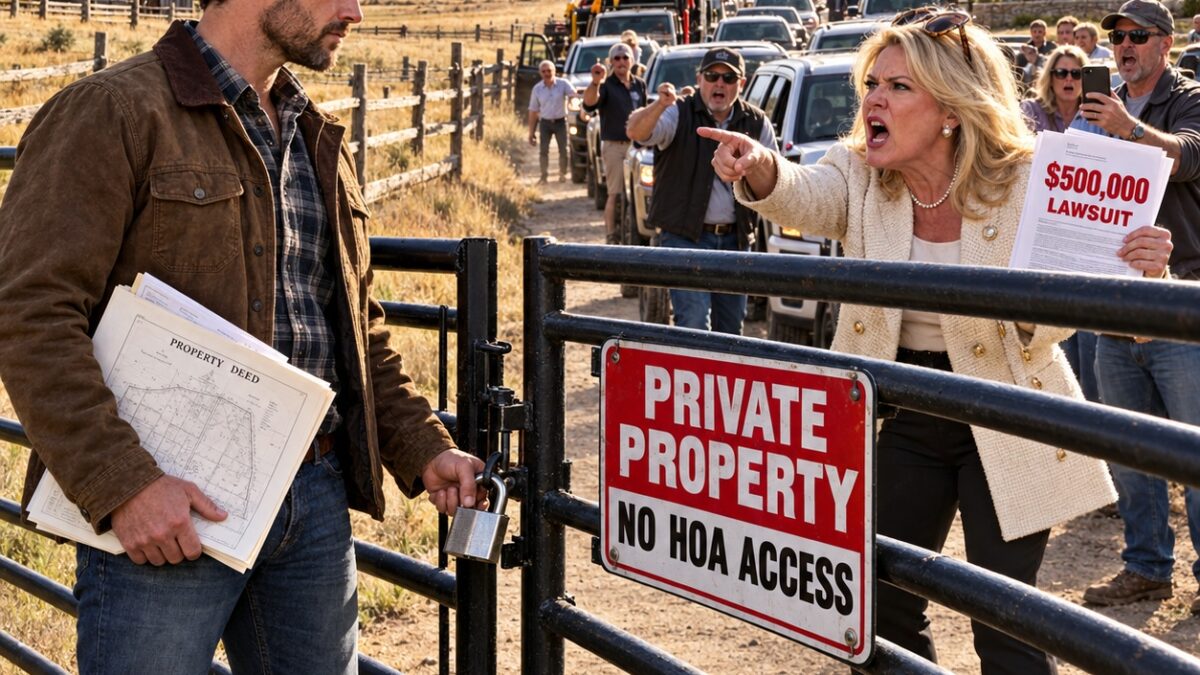
Pinerest Valley HOA v. Liam Hayes.
Claim for access rights.
Injunction request.
Damages.
Five hundred thousand dollars.
I sat at the kitchen table reading it.
Then I got to the part accusing me of violating Pinerest Valley community standards.
I called Rachel.
“You need to see page eleven.”
“I already did.”
“How?”
“Electronic filing.”
“They say I violated HOA standards.”
“Yes.”
“I’m not in their HOA.”
“I know.”
“What does that even mean?”
“It means somebody wanted more paragraphs.”
She was still amused.
I was not.
“Five hundred thousand dollars.”
“Inflated damages claim.”
“They’re saying I’m intentionally interfering with commerce and property values.”
“They need to prove things.”
“Do they?”
“Yes.”
“Expensively?”
“Yes.”
That was the first moment I became genuinely angry.
Brenda was not asking for a conversation.
She was trying to make defending my ownership expensive enough that I would surrender.
I had spent twenty years negotiating against people who used cost as a weapon.
I recognized the tactic.
Make the other person calculate that being right costs more than giving in.
It works.
Often.
Rachel said:
“Do not react emotionally.”
“I’m not.”
“You sound emotional.”
“I’m paying you.”
“That is not evidence of calm.”
“What happens now?”
“We answer.”
“And the road?”
“Leave it alone for now.”
So I did.
Traffic continued.
Seventeen vehicles became thirty.
Then forty.
I started counting occasionally.
Morning commute.
Afternoon.
Service vehicles.
Contractors.
Moving trucks.
Delivery vans.
All crossing property whose owner they were simultaneously suing for the right to cross.
That contradiction bothered me more every day.
Then the harassment escalated.
Someone moved my private-property sign.
I replaced it.
Someone pulled it down.
I installed a larger one.
PRIVATE PROPERTY
ACCESS BY PERMISSION ONLY
Two days later, somebody spray-painted PERMISSION GRANTED across it.
I photographed everything.
Rachel added it to the file.
Then I installed a gate.
Normal ranch gate.
Metal.
Lock.
No dramatic wall.
I did not close it immediately.
I wanted control.
The lock disappeared overnight.
Cut cleanly.
I installed a camera.
Someone spray-painted the lens.
That was the moment I stopped seeing this as a property disagreement.
A legal disagreement happens in filings.
This was intimidation.
I replaced the camera with two.
One hidden.
One visible.
The hidden one recorded a dark SUV stopping around two in the morning.
A person in a hood stepped out.
Sprayed the visible camera.
Returned to the vehicle.
License plate partially obscured.
Not enough to identify confidently.
I filed a report.
Sheriff Dalton looked tired.
“I told you.”
“Yes.”
“You still want quiet mountain life?”
“Ask me next year.”
He smiled.
Then came the landscaping trucks.
Tuesday morning.
I was repairing fence posts near the southern meadow.
I heard diesel engines.
Two commercial landscaping trucks entered from Pinerest Valley.
Fast.
Too fast.
Instead of staying on the dirt road, the first veered into my field.
Then the second.
They cut across wet ground.
Tore two deep tracks through the grass.
One driver leaned out.
Gave me the finger.
They were laughing.
I stood there holding a fence-post driver.
Not moving.
Not yelling.
Because behind them, my hidden camera was recording.
I got both plates.
Clear.
Company logos too.
That afternoon, I drove into town.
Filed a trespassing and property-damage report.
Then called Rachel.
“I’m done.”
“With?”
“Pretending this is a misunderstanding.”
She went quiet.
“What happened?”
I told her.
“Video?”
“Yes.”
“Plates?”
“Yes.”
“Damage?”
“Yes.”
“Police report?”
“Filed.”
A pause.
Then her voice changed.
Professional amusement disappeared.
“All right.”
“What are my options?”
“You can revoke access.”
“I already thought I had.”
“Formally.”
“How?”
“Written notice to the HOA. Notice to residents if practical. Post the road. Then secure it.”
“How secure?”
“As secure as lawfully necessary.”
“They cut my first lock.”
“Then build something they can’t casually cut.”
I looked toward the old road through the kitchen window.
“What happens to Pinerest?”
“They use their legal entrance.”
“Long route.”
“Yes.”
“Fifteen extra minutes.”
“Under ideal conditions.”
“What does that mean?”
“I checked a map.”
Of course she did.
“Morning traffic on that mountain road could add more.”
“How much?”
“Maybe thirty to forty-five.”
I exhaled.
“That’ll hurt.”
“Yes.”
“Families didn’t all do this.”
“I know.”
“So we punish seventy-three homes because somebody damaged my field?”
“No.”
Rachel’s answer came immediately.
“You enforce your property rights because the community is currently asserting a legal right to use your land while people associated with that community are repeatedly ignoring your attempts to control access.”
“That sounds lawyerly.”
“It is.”
“Would closing the road look retaliatory?”
“Brenda will say yes.”
“And?”
“You have documentation of trespass, cut locks, damaged cameras, field damage, and no recorded easement.”
I stayed quiet.
Rachel continued.
“Liam, property rights that you refuse to exercise can become harder to protect. Especially while they’re already suing over use.”
“What would you do?”
“I’m your lawyer. I don’t own the ranch.”
“Rachel.”
“I would secure it.”
I spent two days thinking.
That mattered.
I did not want to wake up angry and build something permanent because two idiots drove across my grass.
The road had been used for fifteen years.
Families planned routines around it.
School.
Work.
Deliveries.
Emergency response.
Convenience becomes dependence quickly.
But Pinerest’s dependence did not make the road theirs.
And their response to me asking questions had been a half-million-dollar lawsuit and escalating trespass.
Eventually, the answer became clear.
Not revenge.
Clarity.
I called Hank Morrison.
Local contractor.
We had become friends while he helped stabilize the old barn.
“Hank.”
“Liam.”
“I need a gate.”
“You have a gate.”
“I need a better gate.”
Silence.
“HOA?”
“Yes.”
He laughed.
“How better?”
“Steel.”
“How tall?”
“Eight feet.”
“That’s not a gate. That’s a statement.”
“Good.”
“What else?”
“Cattle guard.”
“Road width?”
I told him.
He whistled.
“You want normal ranch-grade or apocalypse?”
“Something legal and extremely inconvenient to remove.”
“So tasteful apocalypse.”
“Exactly.”
Hank arrived Friday at dawn with three men, welding equipment, a skid steer, and enough steel to make Brenda deeply unhappy.
We built on my side of the boundary.
Verified survey markers twice.
The cattle guard was properly installed for ranch use.
The steel gate spanned the full opening.
Heavy posts.
Concrete.
Protected hinges.
Commercial lock.
Nothing booby-trapped.
Nothing dangerous.
No spikes.
No traps.
Just a gate.
A very serious gate.
Above it, I mounted a sign.
PRIVATE PROPERTY
NO TRESPASSING
ACCESS BY OWNER PERMISSION ONLY
VIOLATORS MAY BE PROSECUTED
At noon, Hank stepped back.
“Beautiful.”
“It’s a gate.”
“It’s art.”
“What do I owe you?”
“Whatever I quoted plus ten percent for entertainment.”
“There was no entertainment.”
He pointed down the road.
A silver Lexus was approaching.
“Oh, there will be.”
Brenda stopped twenty feet from the gate.
Her face through the windshield was worth Hank’s imaginary entertainment surcharge.
She got out.
Walked toward the steel.
Stared.
Then saw me.
“What is this?”
“Gate.”
“I can see that.”
“Then we agree.”
“You cannot close this road.”
“I just did.”
Her face went red.
“We have a pending lawsuit.”
“Yes.”
“You’re interfering with disputed access.”
Rachel had prepared me for this.
I pulled out an envelope.
“This is formal notice revoking any permissive use of the road pending resolution.”
Brenda did not take it.
“I’m not accepting that.”
“It’s already been served through your attorney.”
Her eyes narrowed.
“You think you’re clever.”
“No.”
“This is retaliation.”
“This is my property.”
“You’re harming seventy-three families.”
“You sued me for half a million dollars while continuing to drive across my ranch for free.”
“That road belongs to the community.”
“Then show me the deed.”
She stared at me.
Behind her, cars started arriving.
First one.
Then three.
Then seven.
Within twenty minutes, a line formed.
Drivers stepped out.
People walked toward the gate.
Questions.
Anger.
Disbelief.
One man shouted:
“You can’t trap us in here.”
“You have another road.”
“That takes forever.”
“It’s also your legal entrance.”
Someone else:
“My commute is already forty-five minutes.”
I nodded.
“I’m sorry.”
“Then open the gate.”
“No.”
Brenda turned toward the crowd.
“This is exactly what I warned everyone about.”
I looked at her.
“What did you warn them about?”
“That you were hostile.”
“I asked for an easement.”
“You demanded control.”
“I own the road.”
A woman near the back called:
“Why didn’t the HOA buy access years ago?”
Good question.
Brenda ignored her.
Another resident asked:
“We don’t have an easement?”
Silence.
People looked at Brenda.
She finally said:
“Our attorneys are handling it.”
That answer did not satisfy them.
It should not have.
I went back to the ranch house.
My phone rang before I reached the porch.
Rachel.
She was laughing.
“What?”
“I just got a call from Pinerest’s attorney.”
“That was fast.”
“They want an emergency meeting.”
“Of course.”
“Apparently Brenda described your gate as an act of economic warfare.”
“That sounds expensive.”
“Also dramatic.”
“What now?”
“What do you want?”
I sat on the porch.
That question mattered.
Not:
How much can you get?
Not:
How badly can you hurt them?
What do you want?
I looked down the road.
Cars were turning around.
Heading back toward Pinerest.
I said:
“Three things.”
“I’m listening.”
“First, written acknowledgment that they currently have no recorded legal right to use my property.”
“Good.”
“Second, full payment for all documented damage.”
“Camera?”
“Camera. Locks. Field.”
“Good.”
“Third, lawsuit dismissed with prejudice and they pay my legal fees.”
Rachel paused.
“That’s it?”
“Yes.”
“You don’t want access fees?”
“Not for the temporary settlement.”
“You don’t want punitive money?”
“No.”
“You don’t want Brenda’s clipboard?”
“What?”
“Nothing.”
“Rachel.”
“You’re being more reasonable than I expected.”
“I’m not trying to destroy seventy-three families.”
“Good.”
“I want them to understand that permission has to mean something.”
“Anything else?”
I looked toward the gate again.
“If they want future use, we negotiate a real easement separately.”
“Excellent.”
“With maintenance.”
“Obviously.”
“And annual compensation.”
“Now you’re learning.”
Negotiations started that afternoon.
They lasted one week.
Brenda fought everything.
I was not in the room for most of it.
That was intentional.
Rachel handled my side.
The HOA’s attorney, a man named Stephen Marks, handled theirs.
Brenda apparently attended every board session and objected to every concession.
But the neighborhood was turning against her.
The long route was worse than most residents realized.
In good weather, fifteen minutes.
Morning traffic made it thirty.
Snow or heavy tourist weekends could make it much more.
Commuters were furious.
Delivery companies started adjusting routes.
Service calls cost more.
One realtor privately told the board the access dispute had already scared off a potential buyer.
Suddenly, the abstract principle of “community access” had a dollar value.
So did bad planning.
I received emails from residents.
Some angry.
Some apologetic.
One man wrote:
I didn’t know the road wasn’t ours. Brenda always said it was.
Another:
I’m sorry about the damage. Most of us had nothing to do with that.
Another:
Can we please work something out? My wife is a nurse and the extra route is killing her schedule.
That one bothered me.
Not enough to open the gate immediately.
Enough to remind me that HOA and residents were not identical.
I told Rachel.
“She’s a nurse.”
“I know.”
“How?”
“Their lawyer mentioned emergency workers.”
“This is becoming ugly.”
“Then settle.”
“I’m trying.”
“You offered reasonable terms.”
“What if Brenda refuses?”
“The board can overrule her.”
That was the key.
Brenda acted like Pinerest Valley was hers.
It was not.
It belonged to seventy-three homeowners collectively.
Eventually, they recognized that.
On day five, the board voted to authorize settlement without requiring Brenda’s approval.
Rachel called that evening.
“She lost control.”
“Of the lawsuit?”
“Of the board.”
“What happens now?”
“They’ve agreed in principle.”
“How much damage?”
“Fifteen thousand total including repairs and a contribution toward legal fees.”
“My legal bill is higher.”
“They’re covering the agreed amount plus separate dismissal costs.”
“Fine.”
“You could push.”
“I know.”
“You don’t want to?”
“No.”
There was a pause.
Then Rachel said:
“You really did retire.”
“What does that mean?”
“Old Liam would’ve pushed until somebody cried.”
“Old Liam had investors.”
“Fair.”
Settlement signed Thursday.
Written apology from the HOA board.
Written acknowledgment that the existing road was private property and that no recorded easement currently granted Pinerest Valley residents access.
Lawsuit dismissed.
Damage reimbursement.
Legal-cost payment.
A clause prohibiting interference with gates, cameras, signs, or ranch property.
Future access subject only to my permission or a later negotiated easement.
I signed.
They signed.
Friday morning, I drove down to the gate.
Unlocked it.
Opened both sides.
At seven fifteen, the first vehicle approached.
A gray pickup.
The driver slowed.
Stopped beside me.
Older man.
I had seen him before but never spoken.
Window down.
“Morning.”
“Morning.”
He looked at the open road.
“We okay to use it?”
That question mattered.
I nodded.
“For now.”
“Thank you.”
He drove through slowly.
Stayed on the road.
Next vehicle.
Woman in a minivan.
She waved.
Then another.
And another.
People suddenly drove differently.
Slower.
No cutting corners.
No racing.
No entitlement.
Some waved.
Some stopped to thank me.
One resident brought me a six-pack that evening.
“I’m not speaking for Brenda.”
“Good.”
“I’m speaking for me.”
“Even better.”
He handed over the beer.
“Sorry.”
I accepted.
The temporary permission continued while we discussed a permanent solution.
Brenda hated that part.
Not access.
The fact that everyone now understood it came from permission.
Her authority had depended on presenting convenience as entitlement.
That illusion was gone.
Two months later, Brenda resigned as HOA president.
Official explanation:
Personal reasons.
Unofficial explanation from three different residents:
The board wanted her gone.
The lawsuit cost money.
The harassment had created liability.
The gate crisis angered residents.
Property values briefly became a topic.
And people discovered Brenda knew years earlier that no easement existed.
Tom Gallagher’s old correspondence confirmed it.
That fact mattered.
She had claimed community ownership over access she once tried unsuccessfully to formalize.
Hard to explain.
The new president was Arthur Whitcomb.
Retired civil engineer.
Sixty-eight.
Quiet.
Practical.
He called before visiting.
That alone was refreshing.
“Mr. Hayes?”
“Liam.”
“Arthur.”
“When would be convenient to discuss the road?”
I almost laughed.
“Tomorrow?”
“Ten?”
“Perfect.”
He arrived at ten.
Not nine fifty.
Not ten fifteen.
Ten.
We sat on the porch.
Coffee.
No threats.
No lawyers at first.
Arthur spread a map on the table.
“We need the road.”
“I know.”
“You own the road.”
“Yes.”
“We should have secured an easement fifteen years ago.”
“Yes.”
He looked at me.
“I assume this is where you say I told you so.”
“Not necessary.”
“Thank you.”
He pointed toward the route.
“We’re willing to maintain the entire section from the Pinerest boundary to the county road.”
“Good.”
“Grading twice annually minimum.”
“After storms when needed.”
“Agreed.”
“Dust control?”
“Reasonable treatment.”
“Drainage?”
“HOA responsibility if use increases erosion.”
He nodded.
“Insurance.”
“Yes.”
“Indemnification.”
“Yes.”
“Annual access payment.”
He looked up.
“How much?”
I gave him a number.
He thought.
“Reasonable.”
That was almost disappointing.
“What, no outrage?”
“I used to design municipal roads.”
“So?”
“I know what fifteen extra minutes of access is worth to seventy-three homes.”
I liked him.
We negotiated for three weeks.
Not because we were fighting.
Because proper easements deserve detail.
Who could use it?
Residents.
Guests.
Delivery vehicles.
Emergency services.
HOA contractors.
No commercial public traffic unrelated to Pinerest.
Speed limit.
Maintenance.
Snow.
Drainage.
Liability.
Gate rights.
Emergency closure.
Temporary closures for ranch operations.
No expansion or paving without written consent.
Annual fee.
Term.
Renewal.
Enforcement.
Transfer with future ownership.
Everything Brenda should have wanted documented fifteen years earlier.
Once completed, both sides signed.
Recorded with the county.
Permanent clarity.
That was worth more than winning a lawsuit.
For the first time, people crossing Gallagher Ranch had a legal right to do so.
Not because they had used it long enough.
Because we agreed.
In exchange, I got compensation.
Road maintenance.
Insurance protection.
Defined limits.
Respect.
Everybody gained.
That is what good agreements do.
The road itself improved quickly.
Pinerest paid Hank’s company to grade it properly.
He called me.
“You’re letting the enemy improve your road?”
“They’re not the enemy.”
“What am I supposed to do with all my jokes?”
“Retire them.”
“Never.”
He upgraded drainage.
Added gravel.
Reinforced two weak spots.
No pavement.
I wanted it to remain a ranch road.
Arthur agreed.
Within months, the road looked better than it had under the Gallaghers.
And I paid none of the maintenance cost.
That was the ironic part.
A conflict caused by avoiding paperwork ended with a much better arrangement than the original handshake.
One morning, I stood with coffee on the porch.
Vehicles crossed in the distance.
Quiet.
Slow.
Normal.
I realized I no longer felt irritated.
That surprised me.
Same cars.
Same road.
Same ranch.
Different legal relationship.
Permission changes how something feels.
That is not petty.
Ownership includes the right to decide.
When that decision was mine, the traffic stopped feeling like invasion.
I met more residents after that.
Most were good people.
A couple became friends.
Mara and Jeff lived near the lower Pinerest entrance.
They had two kids.
Jeff worked construction.
Mara was the nurse whose commute had become terrible during the gate closure.
One evening, they invited me for dinner.
Mara said:
“I hated you for five days.”
I laughed.
“Fair.”
“Then I learned we didn’t own the road.”
“Also fair.”
“I asked Brenda.”
“What did she say?”
“That you were exploiting a technicality.”
I shook my head.
“Deed ownership is a technicality?”
“That’s what Jeff said.”
Jeff raised his beer.
“I got in trouble.”
Mara continued.
“I’m sorry.”
“You didn’t cut my lock.”
“No.”
“Didn’t spray my camera?”
“No.”
“Drive through my field?”
“No.”
“Then we’re fine.”
She smiled.
“That’s what Arthur said you’d say.”
Interesting.
People had started predicting my reasonableness.
I preferred that to being feared.
The landscaping company involved in the field damage paid separately through insurance after the police report.
The drivers claimed they had been told the road was HOA-controlled and that I was illegally obstructing access.
That explained part of it.
Not the finger.
Not leaving the road.
But context.
I repaired the field.
Grass grew back.
The camera housing got replaced.
Locks cost nothing compared with legal bills.
Eventually, physical evidence disappeared.
The lesson stayed.
Brenda did not.
She remained in Pinerest for another year or so.
I saw her occasionally driving through.
She stopped speeding.
Never waved.
I did.
Not to irritate her.
Mostly.
One afternoon, she pulled over while I repaired the gate.
I expected trouble.
Instead, she got out.
No sunglasses.
No clipboard.
“Liam.”
“Brenda.”
She looked at the steel gate.
“You still keep that thing?”
“It works.”
“It caused a nightmare.”
“It prevented people cutting locks.”
She looked away.
Then said:
“I wanted to apologize.”
I did not answer immediately.
Mostly because I wanted to know whether she could.
She continued.
“I handled the situation badly.”
“Yes.”
Her mouth tightened.
“You don’t make this easy.”
“I’m listening.”
She nodded.
“I believed the road had become ours through use.”
“You knew Tom refused an easement.”
“I knew.”
“Then you knew there was a question.”
“Yes.”
“Why sue?”
She looked toward the mountains.
“Because once you started questioning the road, people started blaming me.”
“For what?”
“For never securing access.”
There it was.
I understood.
Not excused.
Understood.
Brenda had been president for years.
The missing easement was partly her institutional problem.
When I arrived, admitting I had the right to close the road meant admitting she had allowed seventy-three families to depend on access they did not own.
So instead of admitting vulnerability, she attacked the person who revealed it.
Humans do that.
Executives definitely do.
I had watched boardrooms burn millions protecting somebody from saying:
I made a mistake.
Brenda said:
“I thought if we pushed hard enough, you’d back down.”
“That almost worked.”
She looked at me.
“Really?”
“No.”
She almost smiled.
“You’re difficult.”
“I’ve heard.”
“The residents were furious at me.”
“I know.”
“Arthur is doing a better job.”
“He is.”
She nodded.
“Anyway.”
She looked uncomfortable.
“I’m sorry about the lawsuit.”
I waited.
“And the other stuff?”
“What other stuff?”
I looked at the camera.
She sighed.
“I never authorized vandalism.”
“I didn’t say you did.”
“I didn’t.”
“I believe you.”
“And the trucks?”
“I didn’t tell them to drive through your field.”
“Okay.”
That mattered.
There was never proof she ordered any of the harassment.
I had assumed her rhetoric encouraged it.
Different claim.
She said:
“I should have stopped people.”
“Yes.”
“I was angry.”
“So was I.”
She looked toward the road.
“The easement is better now.”
“Yes.”
“Residents pay an annual fee.”
“Yes.”
“I argued against that for years.”
“I know.”
She laughed quietly.
“Arthur says it’s cheaper than maintaining the long route.”
“He’s probably right.”
Silence.
Then I said:
“Want coffee?”
She looked genuinely surprised.
“No.”
Fair.
She left.
We never became friends.
Did not need to.
A year later, she moved.
I heard she relocated closer to her daughter.
I wished her well privately.
Never sent anything.
The Pinerest road arrangement lasted.
Annual fee adjusted periodically.
HOA maintained it.
I maintained gates.
We coordinated closures during ranch work.
If I needed heavy equipment across the road, Arthur sent a notice to residents.
If Pinerest needed major maintenance, they called me.
No drama.
That is what proper agreements look like.
Boring.
Boring is beautiful.
The ranch changed too.
I restored the barn.
Not fancy.
Kept the old beams.
New roof.
Straightened the west wall.
Added two horses.
Then cattle.
Not many.
Enough to remind me that growing up around livestock did not mean I remembered everything.
Hank enjoyed watching me relearn.
“You were a tech CEO?”
“Yes.”
“And you can’t convince that cow to walk through a gate?”
“Apparently.”
“Should we negotiate an easement?”
“Go home.”
He laughed for ten minutes.
I started enjoying work again.
Physical problems have honesty.
Fence is broken.
Fix it.
Water line leaks.
Repair it.
Horse needs a farrier.
Call one.
Software companies rarely offer problems that clean.
The mountain did not care whether I had sold a company.
Cattle did not care what I used to earn.
That was healthy.
Pinerest residents became part of the landscape.
Not intruders.
The easement clarified the relationship so well that resentment became unnecessary.
One winter storm proved why.
Heavy snow.
Main Pinerest route became dangerous.
Switchbacks iced.
Our ranch road was lower and easier to plow.
Arthur called at five in the morning.
“Can we prioritize your route for emergency access?”
“It’s their legal access too now.”
“I know. I’m asking because the easement gives you temporary closure rights.”
“Keep it open.”
Pinerest paid for plowing.
A resident had a medical emergency that afternoon.
Ambulance used the ranch road.
Saved time.
That stayed with me.
Imagine if we had stayed enemies.
If I had insisted on permanently blocking the road out of spite.
Legally, maybe I could have before the easement.
Morally?
Harder.
That is why I never regretted reopening it after settlement.
Property rights matter because choice matters.
Choice includes saying yes.
Sometimes people hear property rights and imagine fences, guns, no trespassing.
It can also mean:
I choose to let my neighbors cross.
On clear terms.
That is stronger than forced access.
Arthur stepped down as HOA president years later.
Mara replaced him.
Yes.
The nurse.
First thing she did was call me.
“I have a terrible idea.”
“No.”
“You don’t know the idea.”
“You’re HOA president now. No.”
She laughed.
“Annual road review.”
“That’s actually good.”
“I know.”
We created a simple yearly inspection.
One HOA representative.
Me.
Hank sometimes.
Walk the road.
Check culverts.
Surface.
Gate.
Drainage.
Thirty minutes.
Maybe coffee.
No lawyers.
That was institutional maturity.
Problems stopped becoming emergencies.
The annual fee helped cover my liability insurance related to access.
Pinerest saved far more than building a new route.
Property values stabilized.
Nobody talked about the five-day gate crisis except as neighborhood history.
People moving into Pinerest received easement disclosure with their purchase documents.
Important.
No future resident could say:
I thought this road belonged to the HOA.
It belonged to Gallagher Ranch.
They held legal access rights under recorded terms.
Simple.
I sold the old visible gate eventually.
Not the cattle guard.
The eight-foot structure had become unnecessary.
I replaced it with a normal heavy ranch gate equipped with coded emergency access.
Hank objected.
“You’re destroying history.”
“It’s ugly.”
“It defeated Brenda.”
“No. Documents defeated Brenda.”
“The gate helped.”
“It did.”
“What are you doing with it?”
“Scrap.”
He looked horrified.
“I’ll take it.”
“Why?”
“Art.”
“You need help.”
He installed part of it at his shop.
Added a sign:
BRENDA’S WALL.
I told him to remove my name from any explanation.
He refused.
One day, I went inside.
Someone had attached a fake museum plaque.
THE GREAT PINEREST ACCESS WAR
YEAR 1 OF LIAM HAYES’ RETIREMENT
I hated it.
I also took a photograph.
Rachel loved the picture.
By then she had become a friend.
She visited the ranch occasionally.
First time she came, she stood on the porch looking toward the mountains.
“You were right.”
“That’s rare. About what?”
“Retiring.”
I smiled.
“You could.”
“No.”
“You like fighting.”
“I like billing people who fight.”
Also fair.
We walked the easement road.
She said:
“You realize this ended better than if you’d won outright.”
“What does that mean?”
“If the court had simply ruled no easement, then what?”
“I could keep it closed.”
“Yes.”
“And Pinerest hates you forever.”
“Probably.”
“Road remains your maintenance problem.”
“Yes.”
“Residents still need access.”
“Yes.”
“Pressure continues.”
I nodded.
“Instead?”
“They pay.”
“Yes.”
“They maintain.”
“Yes.”
“You control terms.”
“Yes.”
“They have certainty.”
“Yes.”
Rachel smiled.
“Settlements are underrated.”
“Lawyers say that after billing litigation rates.”
“Exactly.”
I learned to stop telling the story as:
The HOA tried to steal my road and I beat them.
That was not quite true.
They tried to transform a long-standing favor into a legal entitlement without negotiating.
I refused.
Then things became ugly.
Eventually we created the agreement that should have existed from the beginning.
That is the full story.
Brenda made it adversarial.
I made it adversarial too, once pushed.
Residents escalated.
I escalated.
Lawyers entered.
Money burned.
Fields got damaged.
Commutes doubled.
Nobody should call that efficient.
The permanent easement could have been negotiated over coffee during my first week.
Imagine.
Brenda:
“We’ve used this road for fifteen years. Would you consider formal access?”
Me:
“Yes, if you maintain it and compensate me.”
Done.
Maybe three attorney drafts.
No half-million-dollar lawsuit.
No steel fortress.
No vandalized cameras.
No ruined field.
No neighborhood revolt.
Ego is expensive.
That may be the clearest lesson.
Especially when institutions are involved.
HOAs are not inherently evil.
Neither are property owners automatically reasonable.
Any group can become stupid when pride replaces negotiation.
Pinerest needed something.
I owned it.
That created a potential transaction.
Brenda treated it like an entitlement.
Conflict followed.
Years later, Mara asked whether I would ever sell the ranch.
“No plans.”
“If you do?”
“What?”
“The easement transfers.”
“Yes.”
“Good.”
“Why?”
“Because I don’t want to repeat history.”
I laughed.
Neither did I.
When I eventually updated my estate plan, the road got its own section.
My heirs will know exactly what rights Pinerest has.
Maintenance responsibilities.
Fees.
Closure limits.
Everything.
No handshake ambiguity.
The Gallaghers were good neighbors.
I believe that.
Their mistake was assuming goodwill did not need documentation.
Goodwill changes when ownership changes.
People move.
Die.
Sell.
Boards rotate.
Memories become stories.
Stories become assumptions.
Assumptions become lawsuits.
Paper prevents that.
Not always.
Often enough.
I eventually visited Tom Gallagher in Arizona.
Years after I bought the ranch.
I was passing through Phoenix for a wedding.
We met for lunch.
He looked older.
Happy.
He asked:
“How’s the place?”
“Good.”
“Barn?”
“Restored.”
“Creek?”
“Still there.”
He laughed.
“And Pinerest?”
I stared at him.
He knew.
“I heard.”
“You could have warned me better.”
“I said mostly quiet.”
“That was not sufficient.”
Tom laughed so hard he coughed.
Then he apologized.
“I should’ve put the road in the disclosure more clearly.”
“Yes.”
“My dad started it.”
“I know.”
“He let the first homeowners use it because the paved road wasn’t finished.”
That was new.
“What?”
“Development road washed out one spring. Dad said they could cross temporarily.”
“Temporarily became fifteen years.”
“Pretty much.”
“Did anybody ever ask to formalize it?”
“Brenda did.”
“I know.”
Tom’s smile disappeared.
“She hated that we said no.”
“Why did you say no?”
“My father didn’t trust permanent easements.”
“I gathered.”
“He’d say, ‘Give away access once, you’ll never get it back.’”
“Was he right?”
Tom looked at me.
“You gave them one.”
“Yes.”
“Regret it?”
“No.”
“Then maybe he was partly wrong.”
That conversation helped.
The Gallagher family had not been careless idiots.
They made a choice that worked during their ownership.
It became inadequate later.
That happens.
No document survives unchanged forever.
Good stewardship means updating relationships before they become fights.
I thought about that on the ranch.
Fences.
Water agreements.
Neighbor access.
Everything.
I became proactive.
If neighboring owners needed temporary access for utility work, we wrote it down.
If I used somebody’s pasture crossing, I asked.
If Pinerest wanted extra construction traffic for a clubhouse renovation, we discussed whether the easement covered it.
Boring emails.
Clear answers.
No misunderstandings.
I became the person who says:
Put it in writing.
Hank mocked me.
“You were cooler during the gate war.”
“There was no gate war.”
“You built an eight-foot steel gate.”
“I had trespassers.”
“War.”
“Go away.”
He never did.
The ranch became home.
That surprised me most.
At first, I bought it to escape.
Escape San Francisco.
Escape business.
Escape meetings.
Escape complexity.
Then I learned a ranch has meetings too.
County.
Veterinarian.
Contractors.
HOA presidents.
Apparently there is no geographic escape from humans.
But the difference was choice.
I chose which problems mattered.
That mattered.
Morning coffee on the porch stayed worth everything.
Sometimes a Pinerest resident drove past and waved.
I waved back.
Kids occasionally rolled down windows to look at horses.
Delivery drivers slowed.
The road became normal.
Not because ownership disappeared.
Because everybody finally understood it.
That is what respect feels like.
Not absence of use.
Acknowledged permission.
One afternoon, years after the settlement, a new Pinerest homeowner stopped.
Young guy.
Probably early thirties.
He walked toward me while I fixed fencing.
“Mr. Hayes?”
“Liam.”
“I’m Daniel.”
We shook hands.
“I just bought number forty-two.”
“Congratulations.”
“Thanks. I wanted to ask about the road.”
“Sure.”
“Our agent said it crosses your ranch under a private easement.”
“Correct.”
“So can I use it?”
“Yes.”
He seemed surprised.
“That’s it?”
“Stay on the road. Follow speed limit.”
“Of course.”
“HOA handles the rest.”
He nodded.
Then asked:
“I heard there was some big lawsuit once.”
I smiled.
“Long time ago.”
“What happened?”
“Bad paperwork.”
That was the version I liked best.
Because underneath the personalities, that was true.
Bad paperwork.
Bad assumptions.
Bad communication.
Good steel gate.
Eventually good paperwork.
Daniel laughed.
“I heard someone cut your locks.”
“That too.”
“Crazy.”
“People get emotional about fifteen minutes.”
He drove away.
I watched him use the road.
Slow.
Legal.
No problem.
That was the future we had built.
Not exciting.
Stable.
When Brenda first threatened me with lawyers and resources, I thought the conflict was about whether she could intimidate me.
Later I realized she had made the same mistake I almost made.
She thought leverage existed only to force surrender.
Real leverage gives you a chance to negotiate something better.
I had the road.
They had seventy-three households with a real need.
The solution was always there.
Compensation.
Maintenance.
Liability.
Defined rights.
Permission converted into contract.
Everybody got something.
Brenda could not see that because she needed to win.
I almost missed it because I became angry enough to want her to lose.
Rachel pulled me back.
Arthur did later.
Mara too.
Good people change the direction of conflicts.
That is worth remembering.
If I had surrounded myself only with people saying:
Destroy them.
Make them suffer.
Never reopen the gate.
Maybe the story ends differently.
Worse.
The internet loves revenge.
Real neighbors still have to live beside each other after the applause ends.
That fact should shape decisions.
Even when you are right.
Especially when you are right.
The legal settlement check went mostly toward road repairs and restoring the field.
I could have bought something stupid with it.
Hank suggested a bigger gate.
I declined.
I did keep one item from that first serious steel gate.
The lock.
Heavy commercial padlock.
Scratched from years outside.
It sits in a drawer in the barn office.
Not a trophy.
Reminder.
A lock solves one kind of problem.
Agreement solves another.
Know which one you need.
The ranch is quieter now.
Not silent.
Never silent.
Creek.
Wind.
Horses.
Occasional traffic on the dirt road.
I hear vehicles some mornings while drinking coffee.
It no longer bothers me.
Once, the sound felt like strangers taking something.
Now it sounds like neighbors passing through under terms we all understand.
Same noise.
Different meaning.
That difference is law, consent, and respect.
Three boring concepts.
Very powerful ones.
If somebody asked whether I would buy Gallagher Ranch again knowing everything that followed, the answer is yes.
Immediately.
Even with Brenda.
Even with the lawsuit.
Even with the gate.
Because conflict taught me the property better.
I learned every survey marker.
Every line.
Every access route.
Every drainage issue.
Every legal instrument tied to the land.
I became an owner instead of simply the man whose name appeared on a deed.
There is a difference.
A deed says you own something.
Stewardship requires understanding it.
Tom Gallagher knew that.
His father knew parts of it.
I had to learn my version.
The old barn is still standing.
The creek still runs.
Mountain light still turns the meadow gold in the evening.
Pinerest Valley is still beside me.
Seventy-three homes became seventy-eight after a small expansion.
The easement was amended before any new home received access rights.
Mara called first.
Of course.
“Five new houses.”
“I heard.”
“Easement caps access at existing platted lots.”
“I know.”
“We need to amend.”
“What do you propose?”
“Higher annual fee.”
I laughed.
“You’re my favorite HOA president.”
We negotiated.
Five homes added.
Fee adjusted.
Road maintenance schedule increased.
Signed.
Recorded.
No gates.
No lawyers threatening half-million-dollar lawsuits.
No one yelling.
Growth.
I wonder sometimes what Brenda would think.
Maybe she would call it surrender.
I call it functioning adulthood.
Property rights are not suggestions.
That part of the original fight was true.
But property rights are also not a religion requiring you to deny every request.
They give you the ability to decide.
That is why forced use bothered me.
If people already possess something regardless of my consent, then I do not really control that part of my land.
Once Pinerest accepted that access required agreement, saying yes became easy.
That is the paradox.
Respecting no makes yes possible.
Brenda never understood that when she stood beside her Lexus telling me seventy-three homes depended on the road.
She wanted the answer before asking the question.
You cannot negotiate that way.
Or you can.
It costs more.
Around the tenth anniversary of buying Gallagher Ranch, Pinerest held a neighborhood barbecue.
Mara invited me.
I went.
Hank too.
Rachel happened to be visiting.
Arthur was there.
Somebody had printed an old photograph of the eight-foot gate.
Displayed it near the clubhouse.
I stared.
Mara walked over.
“Historical exhibit.”
“Take it down.”
“No.”
Rachel started laughing.
Under the photo:
THE WEEK EVERYONE LEARNED TO READ EASEMENTS.
I had to admit that was funny.
A resident I did not recognize approached.
“So you’re Liam.”
“Unfortunately.”
“You’re the gate guy.”
“I own the ranch.”
“Right. Gate guy.”
Rachel almost fell over laughing.
I gave up.
Then Mara made a short speech.
Not about me.
About the HOA reserve fund.
Road maintenance.
Boring things.
At the end she said:
“And thanks to our neighbors at Gallagher Ranch for continuing to work with us on access.”
People clapped lightly.
Normal.
No hero.
No villain.
Just acknowledgment.
That felt better than revenge ever would have.
Later, Arthur and I stood near the edge of the clubhouse lawn.
He said:
“You know Brenda started all this because she thought you were some rich tech guy she could push around.”
“I was a rich tech guy.”
“You still are.”
“Retired.”
“Rich doesn’t retire.”
“Fair.”
He laughed.
Then:
“Do you ever miss San Francisco?”
“No.”
“Not even restaurants?”
“Sometimes.”
“Culture?”
“No.”
“People not knowing your gate history?”
“Definitely.”
He raised his beer.
“To private property.”
I raised mine.
“To recorded easements.”
He looked disgusted.
“You’re getting boring.”
“Best thing that ever happened to me.”
We drank.
The mountains turned dark.
Cars eventually used the ranch road to go home.
Every one of them crossed legally.
Every one under a written agreement.
Every one on a road the HOA paid to maintain.
That was the ending.
Not Brenda resigning.
Not the $15,000.
Not the lawsuit disappearing.
Those were moments.
The real ending came when the road stopped being a fight.
It became infrastructure.
Known.
Defined.
Respected.
If I ever sell Gallagher Ranch, the next owner will not wake up on day three wondering why seventeen vehicles crossed his land before breakfast.
The easement will be in the title package.
Highlighted.
Surveyed.
Explained.
The annual fee disclosed.
Maintenance obligations clear.
No surprises.
That may be the most satisfying part.
I inherited somebody else’s handshake problem.
I will not pass it on.
Sometimes people ask me what I would tell anyone buying rural property beside a development.
Simple.
Read everything.
Walk every boundary.
Ask who uses every road.
Ask where every utility line runs.
Ask whether every easement is recorded.
Do not assume because something looks private that nobody has rights.
Do not assume because people have used something for years that they do have rights.
Documents first.
Opinions later.
And if somebody tells you:
“We’ve always done it this way.”
Ask:
“Where is that written?”
That question saved me.
Eventually.
Brenda hated it.
The law did not.
The morning after the permanent easement was recorded, I stood on my porch with coffee.
Same place I had been three days after moving in.
A gray SUV crossed the ranch.
Then a pickup.
Then two sedans.
Probably fifteen or seventeen vehicles in half an hour.
Almost exactly like that first morning.
But this time, I smiled.
Not because I had given up.
Because nobody was taking anything.
The residents had access because I had granted it under terms we both accepted.
They maintained the road.
Paid for the right.
Respected the boundaries.
That is what Brenda should have asked for from the beginning.
Instead, she told me I had no choice.
She sued me when I disagreed.
She discovered the hard way that relying on someone else’s property for fifteen years does not automatically make it yours.
And I discovered something too.
Sometimes defending your rights does not end with keeping everyone out.
Sometimes it ends with opening the gate again—after everybody understands whose hand is on the latch.








