PART2:The HOA Invented a “No Wheel Zone” to Make Me Remove My Wheelchair Ramp—They Didn’t Expect Me to Keep the Old Rulebook
PART2
I rolled into my home office and pulled the binder from the bottom shelf.
The original governing handbook was thick enough that I had regretted printing it at the time.
Now I was grateful.
Section 1.
Section 2.
Architectural standards.
Parking.
Landscaping.
Exterior maintenance.
Common areas.
Pets.
Nothing unusual.
I kept turning pages.
Section 12.
Section 13.
Then appendices.
No Section 14.
No No Wheel Zone.
No restrictions on ramps.
No language about wheel devices.
Nothing.
I opened Margaret’s emailed version beside the old handbook.
At first glance, it looked official.
HOA logo.
Section headings.
Policy language.
Signature line.
But once I compared them, differences became obvious.
Different font.
Different margin spacing.
Different header placement.
Even the page-number style was wrong.
The older handbook used centered numbering at the bottom.
Margaret’s document had numbers in the upper-right corner.
I stared at both versions.
My anger began replacing confusion.
Maybe there had been a legitimate amendment.
HOAs could update rules.
I knew that.
But rule changes required a process.
Board consideration.
Notice.
Usually some form of vote or documented adoption.
There should have been meeting minutes.
A resolution.
Something.
Instead, Margaret had sent me a single page claiming a new rule had been approved a month before I needed a ramp.
That timing bothered me.
The next morning, another envelope appeared.
$500 fine.
UNAPPROVED ACCESSIBILITY STRUCTURE.
Attached beneath it was a bright red sign placed on the edge of my lawn:
NO WHEEL ZONE.
I actually laughed when I first saw it.
Not because it was funny.
Because it was so absurd my brain briefly refused to treat it as real.
Then I saw the fine.
The laughter stopped.
Margaret had also included a notice warning that additional daily penalties could begin if the ramp remained in place.
I called the HOA office.
Margaret answered.
“I received your notice.”
“Yes.”
“I want to appeal.”
“You may speak during the next meeting.”
“I also want the meeting minutes showing when Section 14 passed.”
Pause.
“They’re part of association records.”
“Send them.”
“You can submit a written records request.”
“I will.”
“And Daniel?”
“What?”
“I strongly recommend that you avoid accumulating additional fines.”
I looked through the window at my ramp.
“You’re telling me to remove the only accessible entrance to my house.”
“There are procedures.”
“Was there a procedure when you created Section 14?”
Her voice cooled.
“We’ll discuss this at the meeting.”
Then she hung up.
I should have left the ramp in place.
Emotionally, that’s what I wanted.
But the threat of daily fines scared me.
I had medical bills.
Reduced work hours.
Savings already depleted by the ramp itself.
The thought of watching hundreds of dollars accumulate every day while the HOA controlled the appeal terrified me.
So pending review, the contractor removed it.
He hated doing it.
“So we’re taking down a ramp we built to code because an HOA doesn’t like wheels?”
“For now.”
He looked at me.
“That is insane.”
“Yes.”
He stacked the lumber along the side of the house.
The front steps returned.
Three simple slabs of cold concrete.
The next HOA meeting was held at the clubhouse.
I couldn’t get through the main entrance by myself.
A small irony.
My neighbor David saw me outside and held the door.
David lived two houses down.
Good guy.
Quiet.
Two kids.
Wood fence Margaret had complained about more than once.
He leaned closer.
“This is messed up.”
“I know.”
“I’d say something, but…”
He stopped.
“Margaret?”
He nodded.
“She’ll come after the fence again.”
That sentence told me more about our HOA than any bylaw.
People weren’t agreeing with Margaret.
They were afraid of becoming her next project.
Inside, the board sat behind a long table as though they were conducting a congressional hearing instead of deciding whether Mrs. Clark could paint her shutters dark blue.
Margaret sat in the center.
Three other board members beside her.
I recognized two.
Neither looked at me when I rolled forward.
Public comment began.
I spoke first.
“The new Section 14 is not in the handbook I received when I purchased my home.”
Margaret folded her hands.
“The board approved an update.”
“I requested the meeting records.”
“They’re being processed.”
“You emailed me a rule with only your signature.”
“You’re out of line.”
“No.”
My voice shook.
I hated that.
I wanted to sound calm.
I wanted to sound strong.
Instead, my hands trembled against the rims of my chair.
“I installed a ramp because I cannot enter my house without it.”
Margaret replied:
“And accessibility does not eliminate architectural procedures.”
“This isn’t about procedure.”
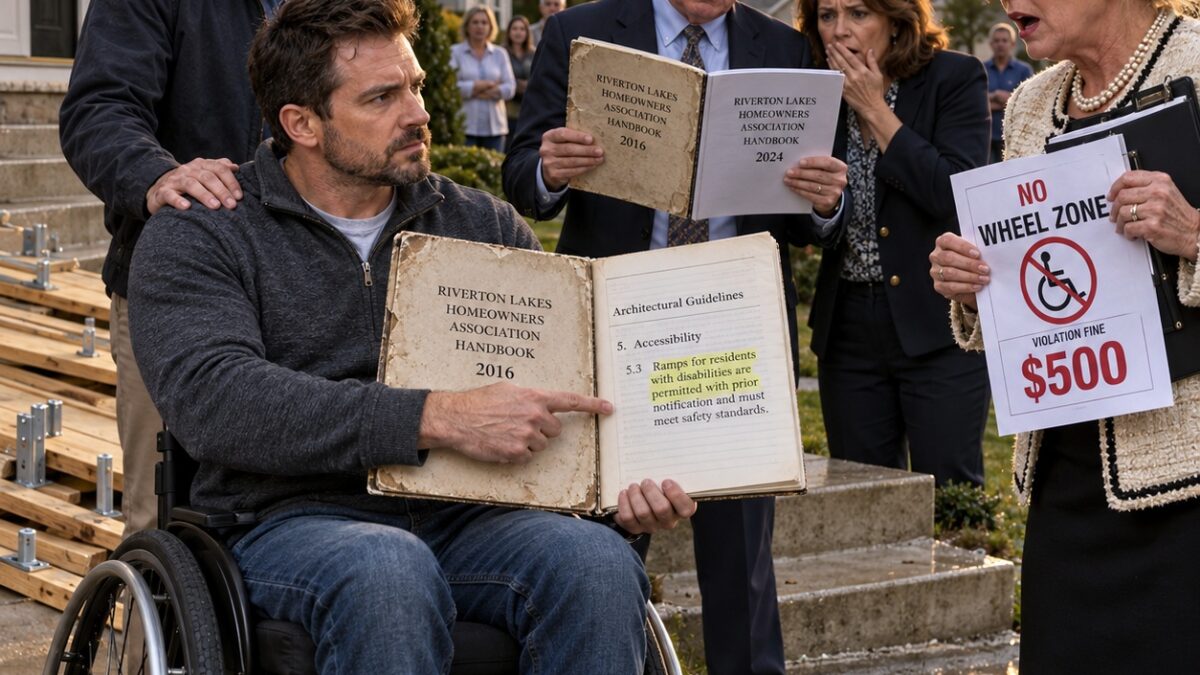
I held up both documents.
“This is the handbook from three months ago. This is the page you emailed me. The formatting doesn’t even match.”
One board member shifted.
I looked directly at him.
“Did you vote for Section 14?”
He looked down.
Another board member stared at the table.
Margaret answered for them.
“The board approved it.”
“I want the vote entered into the record.”
“It already was.”
“Then show me.”
“You’re disrupting the meeting.”
“I want a vote tonight.”
Her jaw tightened.
“Motion denied.”
“You can’t deny—”
She grabbed the small wooden gavel in front of her and struck it once.
“This discussion is concluded.”
I stared at her.
“Margaret—”
“The meeting is moving on.”
That was my appeal.
Over.
No review.
No documents.
No vote.
Nothing.
I looked toward the other board members.
Not one met my eyes.
I left before I cried in front of them.
David followed me outside.
“Daniel.”
“Don’t.”
“I’m sorry.”
“Don’t apologize.”
He held the door again.
Outside, the air had turned cold.
My shoulders hurt from pushing the chair harder than I needed to.
Anger makes you do stupid things to your own body.
I rolled home.
Reached the front walk.
Stopped.
Three steps.
No ramp.
The contractor had removed it exactly as ordered.
For the first time, I understood how cruel that instruction really was.
The HOA hadn’t ordered me to repaint trim.
They hadn’t told me to move a trash can.
They had taken away the physical means I used to enter my own home.
I tried transferring onto the first step.
Bad idea.
My arms were already exhausted.
My chest ached.
I sat there in the cold for several minutes pretending I could figure it out alone.
Eventually, I called my brother.
“Hey.”
“What happened?”
“I need help getting inside.”
Silence.
Then:
“I’m coming.”
He arrived twenty minutes later.
He didn’t say much while helping me.
That made it worse.
Once I was inside, he stood in the living room looking through the window toward the dismantled ramp lumber.
“They made you remove that?”
“Yes.”
“Why?”
“Because apparently wheels are ugly.”
His face changed.
“Tell me you’re fighting this.”
I looked at the binder on the table.
“I am now.”
That was the moment the anger sharpened into something useful.
Margaret wanted to act like a judge.
Fine.
I would find a real one.
The next morning, I began documenting.
First, the old handbook.
Every page.
Photographed.
Scanned.
Dated as best I could from the copy provided when I purchased the home.
Then Margaret’s new Section 14.
Printed in full.
Side by side, the differences looked almost embarrassing.
Font.
Margins.
Numbering.
Header.
Approval line.
The supposed board-approval section contained only Margaret’s digital signature.
No resolution number.
No adoption date beyond a vague month.
No signatures from other officers.
No minutes.
No amendment history.
I submitted another records request.
Then started talking to neighbors.
Not publicly.
Not at meetings.
Driveways.
Sidewalks.
Over fences.
People spoke differently when Margaret wasn’t sitting at the center of a table.
I asked David first.
“Did you ever hear about a No Wheel Zone before my ramp?”
“No.”
“Any vote?”
“No.”
“Any notice?”
“No.”
“Would you put that in writing?”
He hesitated.
I could see the fear.
Then he looked at my front steps.
“Yes.”
That mattered.
Another neighbor, Mrs. Alvarez, had received a warning about her grandson’s bicycle being left on the porch.
“Was that before or after Section 14?”
“After.”
“Did the notice reference it?”
“Yes.”
“Did you know the rule existed before?”
“No.”
She went inside and brought the warning.
Section 14.
Interesting.
Another neighbor had a scooter warning.
Another had been told to move a child’s wagon.
The rule seemed to have suddenly appeared and then been used broadly enough that Margaret could argue it wasn’t solely about my ramp.
But none of them remembered a vote.
Then I spoke with a former board member.
He had resigned two months earlier.
When I showed him the page, he frowned.
“I’ve never seen this.”
“It says it passed last month.”
“I was still on the board last month.”
That stopped me.
“You never voted?”
“No.”
“Was it discussed?”
“Not while I was there.”
“Would you write that down?”
He did.
The next step was an attorney.
I found one in Chicago who handled disability-access and housing disputes.
His name was Michael Grant.
We spoke by phone first.
I explained the ramp.
Fine.
New rule.
Old handbook.
Missing vote.
Meeting.
Removal.
By the time I reached the phrase No Wheel Zone, he actually laughed.
Not at me.
At the rule.
“I’m sorry.”
“It’s fine.”
“That’s really what she called it?”
“Section 14, No Wheel Zone.”
“And it explicitly includes ramps?”
“Yes.”
“Send me everything.”
I did.
He called the next day.
His tone was completely different.
“This is serious.”
“How serious?”
“Based on what you’ve sent me, there are at least two separate issues.”
I waited.
“First, accessibility. An association generally cannot simply use an aesthetic rule to deny a reasonable disability-related accommodation without going through the applicable legal analysis.”
“And second?”
“Whether this rule was validly adopted at all.”
I looked at Margaret’s fake-looking page.
“You think she forged it?”
“I am not saying that yet.”
Lawyers love that phrase.
“What are you saying?”
“I am saying we have no evidence of proper board adoption, the formatting is inconsistent, former board members deny voting on it, and the association has not produced the records you requested.”
“So?”
“So we ask formally.”
Michael sent a letter.
Not emotional.
Not dramatic.
That made it scarier.
He demanded preservation of records.
Meeting minutes.
Board votes.
Amendment history.
Communications concerning Section 14.
Communications concerning my ramp.
He also demanded immediate suspension of fines and permission to reinstall the accessibility structure.
Margaret responded through the HOA.
The board stood by its enforcement.
Bad choice.
Michael filed complaints.
One with the city concerning the accessibility issue.
Then court proceedings seeking relief against the HOA’s actions.
The questionable rule adoption became part of the case.
I didn’t feel victorious.
I felt exhausted.
Legal fights sound exciting after they’re over.
During them, they’re mostly emails, paperwork, anxiety, and waiting.
Meanwhile, I still had no ramp.
Every entrance and exit required planning.
My mother came more often.
My brother rearranged work hours when he could.
I hated that.
Not them.
Needing them.
That distinction is difficult to explain to somebody who has never lost independent access to their own home.
People say:
“Just ask for help.”
And yes.
Ask.
But imagine needing to coordinate assistance every time you enter the place you pay for.
Every grocery run.
Appointment.
Workday.
Emergency.
Independence is built from small actions nobody notices until they’re gone.
Margaret had taken one of mine because she thought the ramp looked cluttered.
Then the city inspector called.
He wanted to see the property.
I almost enjoyed telling Michael.
“He’s coming Thursday.”
“Good.”
“Should you be here?”
“No.”
“Why not?”
“Let the inspector inspect.”
“I feel like I need adult supervision.”
“You’re thirty-something.”
“I use that term generously.”
Michael laughed.
“Have the original handbook ready.”
I did.
Thursday morning was clear.
Cool.
I sat near the porch waiting.
Getting outside had already required help.
My arms hurt.
Margaret lived farther down the same street.
Apparently she saw the city vehicle arrive because she came marching toward us before the inspector had finished introducing himself.
Her clipboard was back.
Of course.
“What is this?”
The inspector glanced at her.
“I’m here regarding a complaint about an accessibility ramp removed from this property.”
“This is a private HOA matter.”
“Are you the association representative?”
“President.”
She held up the No Wheel Zone document.
“We have governing restrictions.”
The inspector took it.
Read.
His forehead tightened.
“Do you have the original bylaws?”
“These are updated.”
“I asked for the original governing documents.”
Margaret hesitated.
“I don’t carry all association records with me.”
I almost smiled.
“I do.”
I rolled forward with my binder.
“You mean these?”
The inspector took it.
Compared sections.
Flipped toward the end.
Then returned to Margaret’s page.
“Where is Section 14 in this version?”
“It was added.”
“When?”
“Last month.”
“By what process?”
“The board approved it.”
“Where is the recorded approval?”
Margaret’s face tightened.
“I would have to retrieve the minutes.”
I said:
“I’ve requested those twice.”
The inspector looked at me.
“Have they been provided?”
“No.”
Neighbors had noticed the conversation.
Of course they had.
Curtains moved.
Then doors opened.
David leaned against his car.
Mrs. Alvarez stood near her walkway.
At least three phones appeared.
Margaret noticed.
That made her more defensive.
“This is being made unnecessarily dramatic.”
The inspector ignored that.
He looked at her document again.
“Who drafted this?”
“The board.”
“Who specifically?”
Silence.
He pointed at the bottom.
“This only contains your signature.”
“As president.”
“Did counsel review it?”
Margaret didn’t answer directly.
The inspector looked at me.
“Do you have photographs of the removed ramp?”
“Yes.”
I showed him.
Dimensions.
Placement.
Contractor information.
He took notes.
Then turned back to Margaret.
“I’m going to need the association’s actual adoption records for this section.”
Margaret said:
“The HOA has authority to clarify existing standards.”
The inspector’s eyes narrowed.
“Clarify?”
“Yes.”
“The original rules prohibit front-yard clutter.”
“So you added ramps?”
She froze.
Someone behind us actually snorted.
Margaret recovered.
“I clarified wheel-related structures.”
“Without a formal amendment?”
Her face reddened.
“I was acting within the president’s authority.”
The inspector closed his notebook.
“That is something you’re going to need to establish.”
He did not arrest anyone.
He did not announce some dramatic victory.
Real inspectors generally don’t perform for crowds.
He documented.
Requested records.
Inspected the front approach.
Took photographs.
Measured.
Then left.
But the neighborhood atmosphere had changed.
Margaret’s authority depended heavily on everyone assuming her paperwork was legitimate.
Now a city official had stood on the street asking basic questions she couldn’t answer.
David walked over after the inspector left.
“She really added it herself.”
“We don’t know yet.”
“Come on.”
“I want the records.”
Mrs. Alvarez joined us.
“She made my grandson move his bike because of that fake rule.”
“Maybe.”
She looked toward Margaret’s house.
“No maybe.”
People were angry now.
That frustrated me.
Not because I didn’t want support.
Because where had everybody been when I needed help getting inside?
Fear is powerful until someone else proves the bully can be challenged.
Then courage arrives quickly.
I tried not to resent them.
Sometimes I failed.
Michael reminded me:
“You don’t need them to have been perfect. You need them truthful now.”
Fair.
The inspector’s written report arrived later.
It questioned the authority and documented lack of evidence presented for valid adoption of Section 14.
It confirmed the ramp had been removed following HOA enforcement.
That became important.
Then the records finally started coming.
And the absence was more revealing than anything present.
No legitimate recorded vote approving Section 14.
No proper amendment resolution matching Margaret’s page.
No complete board approval packet.
Emails suggested Margaret had circulated language internally as though it were already policy.
One board member wrote:
When did we vote on this?
Margaret replied:
This is a clarification, not a substantive change.
That email became one of Michael’s favorite documents.
“Why?”
“Because she is simultaneously calling it a board-approved new section and claiming it never required a vote.”
“That’s bad?”
“For consistency? Very.”
The case moved quickly after that.
Not instantaneously.
But faster than I expected.
A few weeks later, I sat beside Michael in an actual courtroom.
My palms were damp.
I kept rubbing them against my pants.
Margaret sat at the other table beside the HOA’s attorney.
For the first time since I met her, she had no clipboard.
I noticed that immediately.
The judge was older.
Gray hair.
Sharp eyes.
Calm voice.
No patience for unnecessary speeches.
Michael presented the sequence.
My accident.
Need for accessible entrance.
Contractor installation.
Margaret’s objection.
Section 14.
Fine.
Removal.
Failed appeal.
Old handbook.
Missing adoption records.
Neighbor statements.
Inspector’s findings.
Photographs.
Emails.
The whole thing sounded almost worse when organized chronologically.
Margaret’s lawyer tried to frame Section 14 as a neutral neighborhood rule covering all visible wheels.
Bicycles.
Scooters.
Equipment.
Not just my ramp.
Michael didn’t argue that other items had been cited.
He didn’t need to.
“Neutral language does not resolve whether the rule was validly adopted or whether it can lawfully be applied to deny disability access.”
That sentence landed.
David’s statement was submitted.
So was the former board member’s statement that no vote had occurred while he served.
Mrs. Alvarez documented the sudden appearance of the rule.
Then Margaret was questioned.
The judge held the Section 14 page.
“Did you author this language?”
Margaret hesitated.
“I helped prepare it.”
“Did the board vote to adopt it?”
“It was understood as a clarification.”
“That was not my question.”
Silence.
“Was there a board vote?”
“Not in the traditional sense.”
I looked down.
Michael did not.
The judge continued.
“Yet the document states that it was board approved.”
“The board was aware of the policy.”
“Awareness and approval are not the same thing.”
Margaret shifted.
“I was trying to protect neighborhood standards.”
The judge looked at her.
“From what?”
She gestured slightly toward me.
“Visible structures. Wheels. Clutter.”
“My wheelchair ramp?”
“I did not say his wheelchair.”
“You included ramps.”
“They affect visual consistency.”
The courtroom went very still.
Margaret apparently heard herself too late.
The judge stared at her.
“A structure required for a disabled resident to access his home was, in your view, visual clutter?”
She tried to recover.
“That’s not what I meant.”
“What did you mean?”
“I was only doing what was best for the community.”
That was Margaret’s favorite defense.
Best for the community.
As if those words transformed individual judgment into lawful authority.
The judge picked up the rule again.
“You understand that an association cannot simply invent procedures to avoid accommodation obligations.”
Margaret said nothing.
“And it certainly cannot represent that a provision received formal board approval when the records do not support that representation.”
Her lawyer leaned toward her.
Too late.
Then came the part I remember most.
The judge looked down at the printed Section 14.
Folded it once.
Then tore the copy in half.
Not dramatically.
Just one clean rip.
The sound carried through the quiet courtroom.
He placed the pieces down.
“This purported Section 14 is void and unenforceable.”
I stopped breathing for a second.
Michael touched my arm lightly.
The judge continued.
“The association shall immediately cease enforcement under this provision.”
He ordered the HOA to permit reconstruction of the accessibility ramp.
The association would cover the cost of restoring what its enforcement had caused to be removed.
My legal expenses were addressed as part of the ruling and subsequent orders.
The HOA also faced consequences tied to the disability-access violation.
Then the judge looked toward the board representatives.
“I strongly suggest this association examine its governance procedures and leadership.”
Someone in the back clapped once.
The bailiff turned.
“No reactions.”
Silence again.
I looked at Margaret.
She was staring at the torn rule.
For months, that piece of paper had controlled whether I could enter my own house independently.
Now it was two pieces on a courtroom desk.
Paper is strange that way.
Its power depends entirely on whether the authority behind it is real.
Outside the courthouse, Michael asked:
“How do you feel?”
I thought about it.
“Like I want my ramp back.”
He smiled.
“Good answer.”
The story spread through the neighborhood almost immediately.
Faster than any official HOA email ever traveled.
Somebody had recorded the inspector visit from across the street.
Clips circulated.
The courtroom itself had no phone footage, but people described the torn Section 14 until the story grew slightly more dramatic with each retelling.
In one version, the judge threw it across the room.
He did not.
In another, Margaret screamed.
She did not.
Reality was enough.
Residents nicknamed her.
No Wheel Margaret.
Ramp Ripper.
Queen of Nothing.
That last one was apparently David’s favorite.
I didn’t participate much.
At first, mocking Margaret felt satisfying.
Then it felt empty.
What I wanted was the ramp.
Within weeks, Margaret resigned as HOA president.
Her announcement said:
For personal reasons.
Nobody challenged the wording.
The remaining board members scheduled a special election.
David ran.
I was surprised.
“I thought you were afraid she’d come after your fence.”
“She did.”
“What changed?”
He looked embarrassed.
“You.”
“That’s too flattering.”
“No.”
He glanced at my front steps.
“I watched you leave that meeting.”
I didn’t say anything.
“I should’ve spoken.”
“You held the door.”
“That wasn’t enough.”
“No.”
The honesty mattered.
He nodded.
“That’s why I’m running.”
David won a seat.
So did two other residents who campaigned on transparency and basic governance reform.
The new board reviewed the rulebook.
Real rulebook.
Not Margaret’s creative-writing version.
They adopted a formal procedure for amendments.
Written notice.
Documented board votes.
Meeting minutes.
Member access to records.
Legal review when disability accommodations were involved.
Remarkable concepts.
My ramp was rebuilt.
The HOA paid.
This time, we improved it.
Better railing.
Stronger materials.
Smoother landing.
Same basic location.
The contractor who had removed the first one came back.
When he arrived, he looked at the front steps.
“Told you this was insane.”
“You did.”
“Can I build it better?”
“Absolutely.”
He did.
The city inspector returned after completion.
Checked slope.
Landing.
Railings.
Anchoring.
He rolled his measuring wheel back.
Then gave me a thumbs-up.
“Looks good.”
I rolled up the ramp.
Stopped at the porch.
Turned.
For a second, I couldn’t move.
My mother stood near the driveway again.
Same place she had stood when the first ramp was completed.
She was crying.
Again.
I pointed at her.
“We’ve done this already.”
“I know.”
“You need new material.”
She laughed through tears.
Then I cried too.
Again.
Apparently we also needed new material.
The difference was how the second ramp felt.
The first had given me independence.
The second gave it back after someone deliberately removed it.
That is not the same feeling.
Going up that ramp, I did not feel grateful that the HOA finally allowed me into my house.
I refused to frame it that way.
They were correcting something they should never have done.
Access was not a gift.
It was not Margaret’s generosity.
Not the board’s charity.
It was my home.
My entrance.
My life.
Neighbors started coming by.
Cookies.
Cards.
Apologies.
Offers to help.
Mrs. Alvarez brought a plate of brownies.
David brought beer.
One board member from Margaret’s old board stood awkwardly at the bottom of the ramp.
“I owe you an apology.”
“Yes.”
He blinked.
I wasn’t going to make it easy.
“I should have challenged her during that meeting.”
“Yes.”
“I was worried about becoming a target.”
“I know.”
He looked down.
“That’s not an excuse.”
“No.”
He nodded.
Then looked at me.
“I’m sorry.”
This time, I said:
“Thank you.”
We were never close.
Didn’t need to be.
But he started speaking more at meetings.
Sometimes guilt can become useful if you don’t waste it.
The neighborhood changed in small ways.
That’s what I noticed first.
Bicycles appeared on porches.
Scooters beside steps.
A child’s wagon near a driveway.
Nobody received a No Wheel Zone notice.
Obviously.
The rule did not exist.
But seeing wheels everywhere became almost funny.
Before, I had never noticed them.
Now I did.
A blue bicycle leaning against a railing.
Skateboard.
Stroller.
Wheelchair.
Scooter.
All the ordinary mobility devices Margaret had tried to compress into one aesthetic category.
Wheels.
As though a neighborhood looked cleaner when nobody visibly needed or enjoyed them.
It made no sense.
The new board officially rescinded all notices tied to Section 14.
Fines refunded or canceled.
Records corrected.
Margaret still lived in the neighborhood.
That created awkwardness.
She stopped parking near the front of her house for a while.
Used the garage more.
Avoided meetings.
Avoided me.
Sometimes I saw her when I rolled outside.
She would glance toward the ramp.
I never confronted her.
Never shouted.
Never asked whether she had learned anything.
I usually gave her the same small, polite smile she once gave me.
Not cruel.
Not triumphant.
Just enough to say:
It’s still here.
That was sufficient.
My relationship with the wheelchair changed too.
Before Margaret, I had spent months trying not to make disability the first thing people noticed about me.
I hated the chair sometimes.
Not because the chair limited me.
The chair actually gave me mobility.
I hated what it symbolized to other people.
Questions.
Pity.
Awkwardness.
Margaret turned that discomfort into something uglier.
She treated the physical evidence of disability as a visual defect.
That forced me to confront an idea I hadn’t fully articulated.
The wheelchair was not the problem.
The stairs were.
The inaccessible entrance was.
The rule was.
The attitude was.
My chair got me places.
The ramp got me home.
Once I understood that, some of my shame loosened.
Not all.
Recovery isn’t a motivational poster.
There are still days I hate needing adaptations.
Days when something simple becomes complicated.
Days when my shoulders hurt.
Days when an elevator breaks and ruins an entire plan.
But I stopped apologizing for visible access.
That was Margaret’s issue.
Not mine.
Michael, my lawyer, said something similar after the case.
We were reviewing final documents.
He asked whether I planned to remain in the neighborhood.
“Yes.”
“Good.”
“Why?”
“Because people who discriminate often expect the person they targeted to disappear.”
I had not thought about that.
“So staying is revenge?”
“No.”
He smiled.
“Don’t turn me into an inspirational quote.”
“Too late.”
“Staying is simply staying.”
He tapped the file.
“You bought the house because you wanted to live there.”
Exactly.
That became another reason I stayed.
Not to prove anything.
Because it was my home before Margaret made herself part of the story.
It remained my home after she left the board.
She did not get to define the place for me.
The HOA meetings changed too.
I attended more frequently.
Not every one.
I had suffered enough.
But enough to know what was happening.
David sat at the table now.
He hated the gavel.
The first meeting after being elected, someone told him he was supposed to use it to call the room to order.
He looked at me.
“No.”
I laughed.
“Trauma?”
“Absolutely.”
The gavel remained on the table.
Mostly decorative.
Meetings became boring.
Beautifully boring.
Budget.
Landscaping.
Pool repairs.
Snow contracts.
Fence requests.
Sometimes disagreement.
No dictators.
No invented sections.
If someone proposed a new rule, board counsel reviewed it and residents received notice.
Again:
Remarkable.
One meeting involved bicycle storage.
Everyone looked at me.
I said:
“Don’t.”
The room laughed.
Motion withdrawn.
Maybe I had a little power after all.
I tried to use it responsibly.
The city also took interest in HOA accessibility issues after my complaint.
I wasn’t involved in every detail.
But associations in the area received reminders about accommodation obligations and proper permit procedures.
Michael told me my case was being mentioned informally among lawyers handling similar disputes.
That felt strange.
I hadn’t set out to become an example.
I just wanted to get through my front door.
That is how many civil-rights disputes begin, I think.
Not grand principles.
Something ordinary.
A doorway.
A parking space.
A service counter.
A workplace schedule.
A person saying:
I need this in order to participate.
And somebody else saying:
But it looks bad.
Or it’s inconvenient.
Or we’ve never done that before.
My case looked absurd because Margaret literally called her policy No Wheel Zone.
Most discrimination is not labeled that honestly.
In a strange way, her arrogance made the problem easier to expose.
She wrote it down.
Named it.
Signed it.
Applied it.
Then refused to produce a proper vote.
Bad for her.
Useful for me.
I kept the original Section 14 email.
Printed.
Framed?
No.
I considered it.
My brother wanted me to.
“Put it beside the ramp.”
“I’m not decorating with Margaret.”
“Fair.”
Instead, I kept it in the legal folder.
The old handbook stayed too.
That binder became famous among my friends.
My mother calls it “the Bible.”
It isn’t.
But I learned the value of keeping documents.
When people in authority tell you:
The rule says…
Read the rule.
When they say:
The board approved…
Ask for the minutes.
When they say:
Everyone agreed…
Ask who voted.
Official tone is not the same thing as official authority.
Margaret’s fake-looking page worked because most people did not imagine an HOA president would simply add a section.
That assumption protected her until somebody checked.
I checked because the rule affected whether I could enter my house.
But several neighbors admitted they had paid fines without verifying anything.
Small amounts.
Fifty dollars.
One hundred.
Easier than fighting.
That’s how controlling leadership becomes entrenched.
Not through some giant seizure of power.
Through convenience.
It’s easier to pay.
Easier to move the bike.
Easier to repaint.
Easier not to ask.
One surrender means little.
A hundred create culture.
David understood that after joining the board.
He told me once:
“Half the job is telling people the HOA can’t do what they think it can.”
“Good.”
“And the other half is explaining that some rules are actually real.”
“Less good.”
He laughed.
I had become slightly unreasonable in the opposite direction.
Every notice made me suspicious.
One year after the case, I received a letter concerning a tree near my property line.
I stormed into the clubhouse carrying it.
David read it.
Then looked at me.
“Daniel.”
“What?”
“This came from the city.”
I took it back.
City logo.
Not HOA.
“Oh.”
“The tree is dead.”
“I know.”
“It could fall.”
“I know.”
“You should remove it.”
I sighed.
“Fine.”
He smiled.
“Growth.”
I hate him.
In a healthy way.
That taught me another lesson:
After being targeted by fake authority, you can start treating all authority as fake.
That’s not useful either.
Some rules protect people.
Some processes matter.
The answer isn’t blind obedience.
It also isn’t automatic rejection.
Verify.
Then respond.
Simple.
Emotionally harder.
The dead tree came down.
No lawsuit.
Margaret probably would have been disappointed.
My ramp survived winters.
Snow.
Rain.
Salt.
Repairs.
I replaced one board after two years.
Another after four.
It became ordinary.
That’s the best part.
At first, everyone noticed.
Neighbors.
Visitors.
Delivery drivers.
Ramp.
Then they stopped.
It was just part of the house.
Exactly what accessibility should become.
Not a political statement.
Not visual clutter.
Not a heroic symbol.
Infrastructure.
A way in.
A way out.
One summer, a delivery driver rolled a heavy package up the ramp on a hand truck.
He said:
“Love this thing.”
I laughed.
“So do I.”
The ramp made his job easier.
My mother’s knees liked it too.
David once pushed a cooler up during a barbecue.
Kids sat on the edge.
A neighbor with a temporary knee injury used it.
Accessibility often helps more people than the person whose need made it visible.
Margaret had seen only difference.
She missed usefulness.
The neighborhood children eventually created their own unofficial answer to the No Wheel Zone.
Bikes everywhere.
Scooters.
Roller skates.
One kid had a tiny electric go-kart that was probably illegal for completely different reasons.
Every time I saw wheels on a porch, I smiled.
Not because they were rebellious.
Because nobody cared.
Normal.
That is the victory marginalized people often want more than praise.
Normal.
I don’t want someone applauding because I entered a building.
I want to enter.
Margaret taught me that indirectly.
A couple years later, a new family moved into the neighborhood.
Their daughter used forearm crutches.
Her father stopped me one evening.
“Can I ask you about your ramp contractor?”
“Sure.”
They were considering modifying the entrance.
“The HOA won’t be a problem, right?”
I laughed.
He looked worried.
“No.”
I reassured him.
“No. Trust me.”
I gave him the contractor’s number.
The family submitted the accommodation paperwork.
Approval came quickly.
No drama.
Their ramp was built.
Different design.
Smaller.
When I saw it finished, I felt something I hadn’t expected.
Not pride.
Relief.
The system worked this time.
No one had to become a legal case.
That’s what change should accomplish.
Not simply vindicate the first person.
Make the next person’s life boring.
I told Michael about it.
He said:
“That’s better than a judgment.”
“Don’t judges hear you say that.”
“I won’t.”
Margaret still lived nearby.
Time softened the intensity.
Not what happened.
The intensity.
People stopped talking about her every week.
New residents knew vaguely that a former HOA president had caused trouble.
Some didn’t know the details.
That’s normal.
Neighborhood history fades.
I didn’t need permanent public humiliation.
Her resignation was enough.
Rules changed.
Ramp stayed.
I moved on.
Once, years later, we ended up waiting at the same neighborhood entrance while road work blocked traffic.
She was in her car.
I was on the sidewalk.
She rolled down the window.
“Daniel.”
I looked over.
“Margaret.”
Silence.
I expected something strange.
Instead:
“How have you been?”
“Fine.”
She nodded.
“The ramp looks good.”
That surprised me.
“Thanks.”
Another silence.
Then traffic moved.
She drove away.
No apology.
No reconciliation.
No dramatic confession.
Life rarely provides those things.
I was okay with it.
I no longer needed her to say she had been wrong.
A judge had.
The records had.
The rebuilt ramp did every day.
Some truths don’t require the other person to admit them.
That is freeing.
My brother asked later why I didn’t say something sharper.
“Like what?”
“I don’t know. ‘Still seeing too many wheels?’”
I laughed.
“Would’ve been good.”
“Exactly.”
“Thought of it too late.”
He looked disappointed.
Family is cruel.
The accident changed my life.
Margaret didn’t.
For a while, I gave her too much credit.
I framed the story as:
She took my independence.
She humiliated me.
She made me fight.
True in moments.
But she did not define what happened after.
I did.
My family did.
Neighbors who eventually spoke did.
Michael did.
The inspector did.
The judge did.
The contractor did.
A whole chain of people turned one woman’s abuse of a position into something temporary.
That’s important.
People with authority can make your life harder.
Sometimes terribly harder.
But authority is rarely singular.
HOA president.
City.
Court.
Law.
Records.
Neighbors.
Board elections.
Different systems intersect.
Margaret behaved as if the HOA table was the highest court in Illinois.
It wasn’t.
Once I stopped accepting her frame, her power shrank.
The night after the judgment, I sat in my living room and looked at those front steps through the window.
The temporary situation had not yet been rebuilt.
Still three concrete steps.
Still inaccessible.
Technically, I had won.
Practically, I still needed help entering.
That kept me grounded.
Legal victories matter.
Implementation matters too.
A judgment saying access should exist does not physically become lumber.
Somebody still has to build the ramp.
That’s why the day of reconstruction felt more real than court.
Saw.
Drill.
Boards.
Railings.
Actual independence returning piece by piece.
The contractor tightened the final bolt.
“Try it.”
I rolled forward.
Down.
Turn.
Up.
No assistance.
That was justice I could use.
Sometimes I think about the first time Margaret said:
Rules are rules.
She wasn’t completely wrong.
Rules matter.
She just missed the second half.
Rules have to actually be rules.
Lawfully adopted.
Lawfully applied.
Consistent with higher obligations.
Subject to review.
People like Margaret love the phrase rules are rules because it sounds like the end of conversation.
In healthy systems, it’s the beginning.
Which rule?
Who adopted it?
Under what authority?
Does it conflict with law?
Is there an accommodation?
Is there an appeal?
Those questions are not rebellion.
They’re governance.
I wish more homeowners understood that before conflict.
I wish I had.
Maybe I would have challenged Margaret earlier on smaller things.
Maybe other residents would too.
But hindsight is comfortable.
Courage is easier after someone else goes first.
I try to remember that when I think about neighbors who stayed silent during my first meeting.
For a while, I was angry at them.
Especially the board members.
Some deserved that anger.
They had responsibilities.
But ordinary residents?
David?
Mrs. Alvarez?
They had seen Margaret retaliate over fences and decorations for years.
Fear doesn’t always look dramatic.
Sometimes it looks like:
I can’t afford another fine.
I don’t have time for this.
I have kids.
I have work.
It’s easier to stay quiet.
That doesn’t make silence right.
It makes it understandable.
Afterward, many of those same people helped change the board.
People can fail one moment and do better the next.
If I demand perfection before accepting support, I’ll end up alone.
Another lesson I did not want.
My mother still gets emotional about the ramp.
She pretends not to.
One Thanksgiving, she stood on the porch while I rolled up.
She touched the railing.
“Remember the first one?”
“Yes.”
“I hated that woman.”
“Mom.”
“I did.”
“You’re supposed to become wise with age.”
“I am wise. I wisely hated her.”
I laughed.
Some wounds turn into family jokes only after enough time.
That one did.
The $500 fine never got paid.
Every Section 14 fine was erased.
The HOA covered the rebuild and the legal obligations imposed on it.
Financially, I ended better than I feared.
Emotionally, the cost was harder to calculate.
Weeks of dependence.
Humiliation.
Stress.
Feeling unwelcome at home.
No reimbursement line item fixes those neatly.
But life filled the space afterward.
That’s enough.
I don’t need a dollar assigned to every bad night.
I need what came after to be larger than what happened.
It is.
Today, when I roll up the ramp, I barely think about Margaret.
Most days.
I think about groceries.
Work.
Whether I remembered to charge my phone.
Normal things.
Every now and then, I notice a bicycle lying across someone’s porch.
Or a scooter by a garage.
Or the little girl down the street using her crutches to reach her family’s ramp.
Then I remember.
And I smile.
Not because I defeated anyone.
Because the neighborhood finally looks like a place where people live rather than a display somebody controls.
Living creates clutter.
Bikes.
Wheelchairs.
Ramps.
Toys.
Packages.
Trash cans occasionally remaining outside five minutes too long.
Human beings are visually inconsistent.
Good.
A neighborhood that values appearance more than access has misunderstood what homes are for.
Homes are not photographs.
They’re supposed to hold lives.
Mine holds mine.
The ramp is part of that life.
Margaret once tried to make me ashamed of it.
Now it is the most ordinary piece of wood attached to the house.
That is exactly what I wanted.
If I could speak to myself on the night my brother had to lift me over those steps, I wouldn’t tell him:
You’re going to win.
I didn’t know that.
I would tell him something simpler.
Keep the binder.
Take the pictures.
Write down what happened.
Ask for the vote.
Ask for the minutes.
Talk to people away from the room where they’re afraid.
Get help from someone who understands the law.
Do not let official-looking paper convince you that nonsense has become legitimate.
And most importantly:
Needing access does not make you difficult.
That took me longer to learn than everything else.
I had spent months after the accident worrying about being inconvenient.
Could this restaurant fit the chair?
Should my friends choose somewhere else?
Was I asking too much?
Could someone help with the door?
Could my brother come over?
Could my mother drive me?
Could the contractor make the ramp less visible?
Less noticeable.
Less disruptive.
Margaret took that insecurity and made it policy.
No visible wheels.
Hide the evidence that some people move differently.
Once I saw that clearly, I stopped cooperating with the shame.
The ramp can be visible.
So can my chair.
So can a kid’s bicycle.
The world will survive.
The neighborhood did.
Property values did not collapse.
No one fled because wood rails appeared beside my steps.
The only thing that really disappeared was Margaret’s ability to pretend her personal preferences were law.
I’m okay with that.
My name is Daniel.
I live in Naperville.
I use a wheelchair.
My house has a ramp.
And if you drive down my street today, you’ll probably see bicycles, scooters, strollers, skateboards, wagons, and all kinds of wheels sitting in full view.
Nobody calls them violations.
Nobody measures them.
Nobody fines them.
Nobody says they make us look bad.
They just look like evidence that people live here.
And every time I roll up the ramp Margaret tried to take away, that is exactly what I feel.
Not victorious.
Not rebellious.
Home.








