PART2:The HOA Fined Me $1.24 Million for My Own House—Then My Attorney Found Out Who Really Owned Their Roads
PART2
I sat at my grandfather’s kitchen table.
Same oak table that had been there when I was a child.
“What kind of problem?”
“The HOA sued you three years ago.”
I stood.
“They what?”
“Civil action. Declaratory judgment.”
“I was never sued.”
“You were.”
“No, Steven. I think I would remember being sued.”
“You didn’t appear.”
“Because I didn’t know.”
“I know.”
I started pacing.
“What did they claim?”
“That your parcel was functionally part of Whispering Pines because you share the main access road and allegedly benefit from infrastructure maintained by the HOA.”
“That’s insane.”
“I agree.”
“My grandfather built that road.”
“I know.”
“They repaved it once.”
“I know.”
“So how did they win?”
“Default.”
The word dropped into the room.
“What?”
“They claimed service was completed.”
“Where?”
Steven gave me an address.
I stopped walking.
“That was my apartment before I moved back here.”
“I know.”
“I haven’t lived there in almost ten years.”
“I know.”
“Patricia knows where I live.”
“Yes.”
“She literally tapes violations to my front door.”
“Yes.”
I sat down again.
“You’re telling me she sued me over this property while sending the lawsuit to an old apartment?”
“That is what the file currently appears to show.”
My hands went cold.
“What did the judge order?”
“The court entered a default judgment recognizing HOA regulatory authority over your parcel based on the allegations presented.”
“That can’t be legal.”
“Default judgments can be vacated when service is defective, especially if there was intentional misrepresentation.”
“Intentional.”
“I’m being careful.”
“Don’t.”
Steven exhaled.
“It looks bad.”
I stared through the kitchen window.
Tomato plants.
Old pickup.
Mailbox.
My grandfather’s porch post.
Everything suddenly felt less solid.
“So Patricia has been sending fines based on that judgment.”
“Yes.”
“For years.”
“Yes.”
“And now she wants to foreclose.”
“That appears to be where this is heading.”
I rubbed my face.
“What do we do?”
“We move to vacate the judgment immediately.”
“Will that stop foreclosure?”
“I’ll seek emergency relief.”
“Can she actually take the house?”
“Not tomorrow.”
“That wasn’t my question.”
“No.”
Steven paused.
“Not if I can help it.”
That was both reassuring and not.
Then he said:
“There’s something else.”
“What?”
“I pulled older records.”
“How old?”
“1962.”
“My grandfather bought the land before that.”
“Exactly.”
I heard papers moving.
“Daniel, can you come to my office?”
“Why?”
“Because I want to show you this in person.”
“Is it bad?”
“No.”
The answer came too quickly.
I had known Steven for years.
His version of excitement was usually a raised eyebrow.
Now I could hear it through the phone.
“What did you find?”
“Come here.”
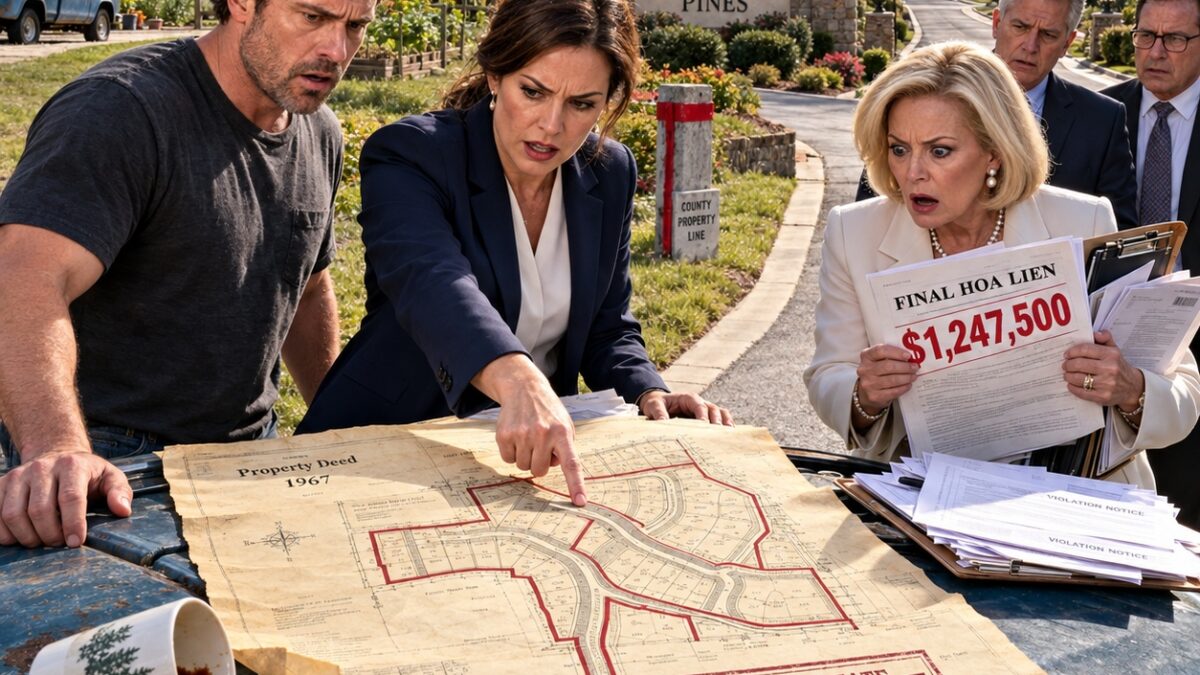
An hour later, I was sitting across from him in downtown Houston while faded deeds, plats, and old sale agreements covered his conference table.
Steven wore glasses he usually avoided.
That meant serious reading.
He pointed at one document.
“Your grandfather originally owned seventeen acres.”
“I knew he had more land.”
“Fourteen of those acres were sold to Oakmont Development Company in 1989.”
“Okay.”
“Oakmont eventually developed Whispering Pines.”
“I know.”
Steven slid the sale agreement toward me.
“Read this clause.”
I leaned in.
The paper was a photocopy of an old typed document.
Seller retains perpetual easement rights over all access roads, common areas, and recreational facilities developed upon the conveyed property.
I read that once.
Then the next sentence.
Any homeowners association subsequently formed shall obtain written consent from Seller or Seller’s successors for exclusive management or control of said common facilities.
I looked at Steven.
“I don’t understand.”
He smiled.
Not friendly.
Lawyer smile.
The kind you want your own attorney making.
“Your grandfather sold the dirt.”
“Okay.”
“He did not completely surrender rights to the infrastructure later developed on it.”
“What does that mean?”
“It means he reserved perpetual easement rights over the roads, sidewalks, common spaces, and recreational facilities.”
I looked down again.
“Perpetual.”
“Yes.”
“And when he died?”
“You inherited his retained property rights unless otherwise extinguished or transferred.”
I stared at him.
Steven leaned back.
“Whispering Pines HOA was formed in 2009.”
“Right.”
“They took over roads, clubhouse, playground, sidewalks, landscaping.”
“Right.”
“Show me where your family consented to exclusive HOA control.”
I looked through the papers.
“I don’t know.”
“Neither do I.”
He tapped the clause.
“Because as far as I can tell, they never obtained the written consent required by the original agreement.”
I tried to fit the idea into something that made sense.
“So they’re saying my house belongs under their authority because I use their road.”
“Yes.”
“But—”
Steven’s smile widened.
“Exactly.”
“The road…”
“Your grandfather built the original access road.”
“And kept rights over it.”
“Yes.”
“And the HOA—”
“Has been managing property subject to easement rights inherited by you.”
I sat back.
“Steven.”
“Yes?”
“Are you telling me I have rights over their roads?”
“Roads.”
“Sidewalks?”
“Yes.”
“Playground?”
“Likely.”
“Clubhouse?”
“Common area, depending on exact legal description.”
I stared at him.
He folded his arms.
“Patricia got the relationship backward.”
For the first time since opening the letter, I laughed.
Not because the situation was funny.
Because the reversal was almost too perfect.
“She says I benefit from their road.”
“Yes.”
“They’ve been benefiting from rights my family retained.”
“Yes.”
“For fifteen years.”
“Yes.”
“And they never got permission?”
“Not the permission the sale agreement appears to require.”
I leaned forward.
“What can we do?”
Steven’s expression became serious again.
“A lot.”
“Such as?”
“First, vacate the default judgment.”
“Obviously.”
“Second, stop every collection effort.”
“Good.”
“Third, investigate exactly how service was handled.”
“Good.”
“Fourth…”
He pulled out a legal pad.
“I send the board notice that their claimed exclusive operation of the common facilities is defective unless and until your rights are properly addressed.”
I stared.
“Can I shut the road?”
“Potentially.”
“The road every homeowner uses?”
“Potentially.”
I thought about twelve families.
Then the clubhouse.
Playground.
Sidewalks.
“What happens if we revoke access?”
“Chaos.”
“That doesn’t sound good.”
“Leverage rarely does.”
I looked back at the million-dollar demand.
“What do you recommend?”
Steven wrote three lines.
“Drop every fine.”
Another line.
“Formal written apology.”
Another.
“Patricia resigns from the board.”
I looked at him.
“That last one seems personal.”
“It is professional.”
“You hate her.”
“I dislike people who manipulate service to obtain judgments against parties who never got a chance to appear.”
“Allegedly.”
He pointed his pen at me.
“Good. Keep saying allegedly.”
I smiled.
He continued.
“And if she knowingly used the wrong address after having actual knowledge of your residence, that may create personal exposure.”
“For her?”
“Yes.”
“Not the HOA?”
“Potentially both.”
I leaned back.
“This is bigger than the fines.”
“It always was.”
That was Steven.
Problems were never what they looked like in the first letter.
We spent the next three hours building a timeline.
My grandfather George bought the full tract in the early 1960s.
Built the road himself around 1965.
Built the house in 1967.
Sold fourteen acres in 1989.
Reserved easement rights.
Oakmont built Whispering Pines later.
Grandfather remained at the entrance.
He died in 2003.
I inherited the house and residual rights.
The HOA formed in 2009.
Nobody apparently revisited the old easement language.
For years, things remained peaceful.
Then Patricia became president.
She saw my property as visual disorder at the gateway to her perfect neighborhood.
First notice:
Truck.
Second:
Garden.
Third:
Paint.
Then signs.
Landscaping.
Parking.
Storage.
Seventeen categories over time.
I ignored them because I believed they had no jurisdiction.
Instead of proving jurisdiction openly, Patricia sued.
Using an address where I no longer lived.
Then used the resulting default judgment as a weapon.
That part made Steven angrier each time he explained it.
“There are procedures for service.”
“I know.”
“She had current contact information.”
“She mailed violation notices here.”
“Exactly.”
“Maybe her attorney used old county records.”
“Possible.”
“You think she directed it?”
“I think we subpoena records before accusing anyone.”
Good answer.
By evening, I drove home carrying copies of everything.
The place looked exactly the same.
That felt strange.
My house had not changed.
The tomatoes had not changed.
The pickup had not changed.
Yet in one day, my understanding of the legal world around them had flipped.
I walked down the access road.
The road my grandfather built.
As a child, I had heard stories.
George Vance with a borrowed grader.
Friends helping.
Truckloads of gravel.
Sweat.
Dust.
That road was there before Whispering Pines.
Now twelve households relied on it.
Patricia had argued that reliance gave her authority over me.
The old deed suggested reliance created obligations in the other direction.
I stood there until sunset.
Then went inside.
Steven filed motions the following week.
Motion to vacate default judgment.
Emergency request to suspend collection.
Challenge to HOA lien rights.
Request for discovery on service.
Then he sent a formal demand letter to Whispering Pines.
It was seven pages.
I called it a legal missile.
Steven called it “measured.”
The key points were simple.
Daniel Vance, successor to George Vance, possessed perpetual easement rights over designated roads and common areas.
Whispering Pines HOA had never obtained the written consent contemplated by the original conveyance.
Any claim of exclusive control therefore required immediate review.
Until resolved, I reserved all rights regarding access and use.
Steven demanded:
All fines rescinded.
Any lien released.
Foreclosure threat withdrawn.
Formal written apology.
Reimbursement of legal fees.
Board review of Patricia’s conduct.
The letter did not technically demand Patricia resign.
Steven saved that for negotiation.
Patricia called me personally the day the HOA received it.
That was a mistake.
For her.
I answered because Steven had told me I could, provided I kept it short and did not negotiate.
“Daniel.”
Her voice shook.
Not fear.
Rage.
“What are you doing?”
“Good afternoon, Patricia.”
“This letter is extortion.”
“My attorney wrote it.”
“You are threatening to block twelve families from their homes.”
“I haven’t blocked anything.”
“You’re threatening to revoke access.”
“I’m asserting property rights.”
“You don’t own our roads.”
“My grandfather did.”
“The HOA has maintained them for fifteen years.”
“My family maintained them for decades before that.”
“You’re insane.”
“I received a bill for $1.247 million because you dislike my garden.”
“That is not why.”
“Why, then?”
“Because you have refused to comply with standards.”
“I never agreed to them.”
“A judge said otherwise.”
“A judge who never heard my side because I never received notice.”
Silence.
Tiny.
Very important.
I said:
“You knew where I lived.”
She snapped:
“Court service is not my job.”
Maybe.
Maybe not.
Investigation would decide.
I kept my voice steady.
“Here’s what happens next. You call your board.”
“You do not give me orders.”
“You show them Steven’s letter.”
“I have counsel.”
“Good.”
“You are trying to hold this neighborhood hostage.”
“No.”
I looked through the window at the road.
“I’m trying to stop you from taking my house.”
“You brought this on yourself.”
That sentence settled something inside me.
No uncertainty left.
I had wondered whether Patricia believed she was enforcing legitimate rules.
Maybe she did.
But foreclosure over paint, tomatoes, and a truck?
Using a default judgment I never knew existed?
Whatever public-interest story she told herself had gone far beyond standards.
I said:
“Let the board decide if your fight with me is worth risking every access right your HOA thinks it owns.”
She hung up.
No goodbye.
The emergency HOA meeting was scheduled for Saturday.
Steven told me not to attend.
“There is no strategic benefit.”
“I want to hear it.”
“Daniel.”
“It’s a clubhouse my easement rights apparently cover.”
“That sentence is why I don’t want you there.”
“I’ll sit in back.”
“Say nothing.”
“I’ll try.”
“Do better than try.”
Saturday evening, I walked into the Whispering Pines clubhouse for the first time in my life.
Funny.
Patricia had spent years accusing me of benefiting from HOA amenities.
I had never even been inside.
The clubhouse was modest.
Meeting room.
Small kitchen.
Bulletin board.
Pool-access notices.
Landscaping schedule.
Twelve households can fill a room surprisingly well when everyone is angry.
Steven had mailed copies of the relevant documents to every homeowner in advance.
That turned out to matter.
Patricia stood at the front beside three other board members.
Her face was tight.
She started immediately.
“We are facing an unprecedented threat to community access and property values.”
Not:
I tried to foreclose on Daniel.
Not:
There may be a problem with an old easement.
No.
Threat to community.
She continued.
“Mr. Vance has retained counsel and is attempting to exploit an obscure technicality to interfere with the HOA’s lawful management.”
A man in the second row raised his hand.
Patricia ignored him.
“We have operated these common areas continuously for fifteen years.”
The man stood anyway.
“Patricia.”
She stopped.
He was perhaps fifty.
Gray suit.
No tie.
“I’m Michael Lawson.”
“I know who you are.”
“I’m a real-estate attorney.”
That changed the room.
Michael held up Steven’s packet.
“I reviewed the documents.”
Patricia’s expression hardened.
“And?”
“He’s right.”
Silence.
Not total.
Someone shifted in a folding chair.
Patricia said:
“It’s a technicality.”
Michael shook his head.
“No.”
“It’s an old clause.”
“It’s a recorded property interest.”
“We’ve controlled the roads since the HOA formed.”
“Control does not automatically erase reserved easement rights.”
“Our attorneys disagree.”
“Have they issued a written opinion?”
Patricia hesitated.
“I’m not discussing privileged advice.”
Michael nodded.
“Fair.”
Then he held up another page.
“What I am discussing is this.”
The million-dollar fine schedule.
“Seventeen violations?”
Patricia straightened.
“Mr. Vance has repeatedly refused to comply.”
A woman near the front turned toward me.
“You’re the house with the garden?”
“Yes.”
Steven was not there to kick me.
I answered anyway.
She looked back at Patricia.
“You fined him for growing vegetables?”
“For unauthorized front-yard landscaping.”
I heard someone laugh.
Patricia snapped:
“This is not funny.”
Another resident stood.
Older woman.
“I’ve driven past that garden every day for ten years.”
Patricia said:
“That isn’t relevant.”
“It looks fine.”
“The issue is compliance.”
The woman held up a copy of one notice.
“Five hundred dollars a day?”
“Accumulated penalties.”
“For tomatoes?”
“Stop calling it tomatoes.”
I almost laughed.
Michael stepped in.
“Patricia, there is a larger issue.”
She turned.
“The lawsuit.”
“What about it?”
“You sued Daniel three years ago.”
“Yes.”
“You obtained a default judgment.”
“Yes.”
“Where was he served?”
She glanced toward the HOA’s attorney.
He was present now.
Older man named Robert Keller.
He looked extremely unhappy.
Keller said:
“That matter is under active litigation and should not be discussed in detail.”
Michael nodded.
Again, fair.
Then someone in the back called:
“He says you used an old address.”
Another voice:
“Is that true?”
Patricia’s face reddened.
Keller stood.
“I strongly recommend the board avoid making statements about service until the court reviews the evidence.”
That answer did not calm anyone.
It made things worse.
One man said:
“Are we paying for this lawsuit?”
Another:
“Are we paying to foreclose on Daniel?”
Patricia raised her voice.
“His property affects every one of your values.”
I had heard that before.
“The entrance to this community is represented by a deteriorating ranch-style house, an old commercial-looking truck, nonconforming paint, and an agricultural garden.”
I stood.
Steven would have hated it.
But there are moments when silence starts looking like agreement.
“No.”
Every head turned.
Patricia stared.
I stayed near the back.
“What hurts this neighborhood isn’t my truck.”
She opened her mouth.
I kept going.
“It isn’t my grandfather’s house.”
“Mr. Vance—”
“It isn’t tomatoes.”
A few people smiled.
“What hurts you is having an HOA president who decided her personal dislike of my property justified claiming authority over a house that predates the HOA by decades.”
Applause started.
Not everybody.
Enough.
Patricia slapped one hand against the table.
“This meeting is out of order.”
Michael said:
“Daniel, let the board handle—”
I nodded.
“Fair.”
I sat.
Patricia looked furious.
Then the woman beside her—treasurer, I later learned—opened a folder.
“Patricia, we need to discuss the financial exposure.”
That changed the meeting again.
“What exposure?”
“Legal fees.”
“We have insurance.”
“Maybe.”
The treasurer continued.
“If Mr. Vance’s motion succeeds and the court vacates the judgment, our fine balance may become unenforceable.”
Patricia said:
“Our counsel advised—”
Keller interrupted.
“I advised that the judgment currently existed.”
The room went quiet.
He continued carefully.
“I did not advise the board that all underlying service issues were immune from challenge.”
Patricia looked at him.
Keller looked back.
That was not support.
Michael asked:
“What happens if Daniel enforces the easement?”
Keller rubbed his forehead.
“We would need to negotiate or litigate the scope.”
“Could he restrict our roads?”
“Potentially.”
“Clubhouse?”
“Potentially.”
“Playground?”
“Potentially.”
People began talking over one another.
The HOA had spent years treating my property like the fragile one.
Suddenly their own legal foundations looked unstable.
Patricia tried to regain control.
“This is fearmongering.”
Michael held up the deed.
“No. This is what your board should have reviewed before threatening foreclosure.”
Another resident stood.
“You’re trying to take a man’s family home because you don’t like his pickup.”
“That is a gross oversimplification.”
“How much did we spend filing this?”
“Sit down.”
“No.”
The rebellion happened fast after that.
Not planned.
Not dramatic in the movie sense.
Just people realizing they had trusted one person too much.
One homeowner asked about the seventeen violations.
Another asked who approved the fines.
Another asked whether the entire board had voted.
The treasurer looked uncomfortable.
The secretary started checking minutes.
Patricia kept saying:
“Established enforcement procedure.”
But the more specific questions became, the weaker those words sounded.
Finally Michael made a formal motion.
Immediate suspension of all enforcement action against my parcel.
Seconded.
Passed.
Then another motion.
Review Patricia’s authority and the default litigation.
Passed.
Then a homeowner stood and demanded a confidence vote regarding Patricia’s presidency.
That part took longer.
Procedures.
Bylaws.
Keller checking language.
But eventually the vote happened.
Unanimous.
Patricia Thorne was removed as HOA president effective immediately.
She sat completely still.
For years, Patricia had delivered notices to people as if paper itself made her untouchable.
Now one properly conducted vote had reduced her to another homeowner in a folding chair.
No one cheered at first.
Then somebody clapped.
The room followed.
I did not.
I felt relief.
Not triumph.
There is a difference.
After the meeting, Michael approached me.
“Daniel?”
“Yes.”
“I’m sorry.”
“You didn’t sue me.”
“No, but I paid dues to an organization that did.”
“That doesn’t make it yours.”
“We should’ve asked more questions.”
I looked toward Patricia.
She was speaking angrily with Keller.
“Everybody should have.”
Michael nodded.
“We need to fix the access issue.”
“Yes.”
“You actually want to shut us out?”
“No.”
He looked surprised.
“I want my rights acknowledged.”
“That’s reasonable.”
“I want the fines gone.”
“Obviously.”
“I want nobody ever using a secret judgment to threaten my house again.”
Michael’s expression hardened.
“Also reasonable.”
“And if the HOA wants continued management of roads and common areas, we document it correctly.”
He offered his hand.
“Deal.”
“Not yet.”
He smiled.
“Right. Lawyers.”
Steven was delighted when I told him.
“You spoke?”
“Yes.”
“I told you not to.”
“I was concise.”
“How concise?”
“Maybe a minute.”
“Terrible client.”
“But useful.”
“Unfortunately.”
The court hearing on the default judgment came next.
That mattered more than the board meeting.
Community outrage does not erase a judgment.
Evidence does.
Steven reconstructed service.
My old address.
Violation notices sent to the correct house during the same period.
HOA records listing my actual residence.
Emails from Patricia to me.
Photographs she herself had taken at my property.
There was no serious argument that the HOA did not know where I lived.
The question became why legal service went elsewhere.
Patricia’s explanation shifted.
Old records.
Administrative oversight.
Attorney process.
Clerical error.
Steven remained calm.
The judge did not look amused.
The default judgment was vacated.
I got the thing I should have had three years earlier.
A chance to defend myself.
Once the judgment disappeared, the million-dollar fine structure lost its foundation.
The HOA, now under interim leadership, withdrew the claims rather than refile.
The $1,247,500 vanished.
Not reduced.
Not negotiated.
Gone.
I asked Steven to repeat that.
“You owe zero.”
“Zero?”
“Correct.”
“Not even the original fines?”
“No.”
I leaned back.
“How much do I owe you?”
He named his fee.
I said:
“Close enough to a fine.”
He laughed.
The board issued a formal written apology.
I still have it.
Not framed.
Filed.
Whispering Pines Homeowners Association acknowledges that Mr. Daniel Vance’s property was subjected to enforcement action under disputed and ultimately vacated authority. The Association withdraws all related fines and liens and regrets the hardship caused.
Steven thought “regrets the hardship” was weak.
I did too.
Still accepted it.
Because we had larger things to solve.
Roads.
Common areas.
The original clause could not remain unresolved.
I did not want twelve families waking up wondering if I could suddenly close their access.
They did not want me wondering whether they would again claim exclusive rights.
So we negotiated.
Real survey.
Real title review.
Real easement agreement.
The HOA received formal rights to manage and maintain designated roads and common areas.
My retained rights were protected.
No HOA authority extended to my three-acre residential parcel.
No aesthetic enforcement.
No architectural control.
No dues obligation.
No fines.
No attempt to convert easement use into HOA membership.
Any future amendment affecting my property required my written consent.
Road maintenance remained the HOA’s responsibility.
They could repave.
Repair.
Clear snow.
Maintain drainage.
But they did so under authority properly documented.
For the first time since 1989, the relationship made sense.
Steven said:
“You could demand payment.”
“I don’t need it.”
“You could.”
“I need them to maintain the road.”
“They already do.”
“Exactly.”
“You’re not maximizing leverage.”
“No.”
“You disappoint me.”
“You’re still getting paid.”
“Excellent point.”
The agreement was signed.
Recorded.
Clear.
That should have been the end.
It was not.
Because Steven kept investigating service.
He found emails.
Internal HOA correspondence.
Patricia asking for “alternative service information.”
References to my old address.
Discussion of whether I would “ignore the lawsuit like previous notices.”
Nothing alone dramatic.
Together?
Bad.
Very bad.
Steven called.
“We have enough to pursue her personally.”
“For what?”
“Abuse of process.”
“Fraud theories.”
“Intentional misconduct.”
“I don’t want another three-year war.”
“I know.”
“What do you want?”
“Accountability.”
“What does that cost me?”
“Time.”
“Money?”
“Some.”
“Peace?”
“Probably.”
I looked out at the vegetable garden.
Patricia’s original objection.
Tomatoes ripening in the sun.
I said:
“File.”
Not because I wanted revenge.
Because there had to be a line.
Bad HOA judgment?
Fixable.
Aggressive fines?
Negotiable.
Using an address you know someone does not live at so you can obtain a judgment without them?
That deserved scrutiny.
Patricia fought.
Then settled.
Forty-seven thousand dollars covering damages and legal fees.
No admission language she considered humiliating.
Steven wanted more.
I accepted.
She resigned from the HOA entirely.
Sold her house within three months.
Moved.
I never saw her again.
Part of me expected to feel something when the moving truck left.
I did not watch.
I was in the garden.
That was better.
Michael Lawson became the new HOA president.
Real-estate attorney.
Calm.
Boring.
Excellent qualities for HOA leadership.
A week after Patricia moved, he came to my house carrying a bottle of wine and an envelope.
I opened the door.
“Bribery?”
“Apology.”
“You already sent one.”
“This one isn’t written by committee.”
I let him in.
We sat on the porch.
He looked toward the vegetable garden.
“For the record, I like the tomatoes.”
“Careful.”
“I reviewed the comps.”
I laughed.
“You’re serious?”
“I am.”
He pointed toward the house.
“Your place doesn’t lower property values.”
“No?”
“Original 1960s character. Large lot. Historic context for the development.”
“So Patricia was wrong.”
“She was wrong about many things.”
He paused.
“I want you to know most residents had no idea what she was doing.”
“I believe you.”
“We saw notices.”
“Sure.”
“We assumed legitimate board business.”
“Understandable.”
“By the time anybody realized she was manufacturing standards to target you, things were already ugly.”
I nodded.
Michael took a drink.
“She was a bully with a clipboard.”
I looked at him.
“That sounds about right.”
He smiled.
“We changed the violation process.”
“How?”
“Three-board-member approval before fines.”
“Good.”
“Actual rule citation required.”
“Very good.”
“Written appeal process.”
“Even better.”
“No president can unilaterally create enforcement categories.”
“That sounds targeted.”
“It is.”
I respected that.
Institutions should learn.
Not just people.
Then Michael handed me the envelope.
Inside was a document.
HONORARY COMMUNITY MEMBERSHIP.
I stared at him.
“What is this?”
“Symbolic.”
“That word makes me nervous.”
“No dues.”
“No restrictions.”
“No voting requirement.”
“No obligations.”
“Then what?”
“Acknowledgment.”
“Of?”
“That you are part of the community, even if you’re not part of the HOA.”
I looked at the paper.
My grandfather’s house had been there first.
The development surrounded it.
For decades, there had been an awkward distinction.
Near them.
Not of them.
Patricia treated that difference like an offense.
Michael treated it like geography.
I said:
“One condition.”
He looked cautious.
“What?”
“I keep the garden.”
He grinned.
“I think we can manage that.”
I signed the honorary document.
Not because I needed membership.
Because it meant something different when participation was invited rather than imposed.
Three months later, I was in the front yard watering tomatoes.
The garden was bigger than before.
Not as an act of revenge.
Because several neighbors had started asking for produce.
Mrs. Kelly from number seven traded homemade bread for zucchini.
Michael wanted tomatoes.
A family near the clubhouse asked how I kept hornworms off the plants.
My grandfather’s old pickup remained in the driveway.
Faded blue.
Chrome dull.
Still ran.
Michael’s classic Mustang started appearing beside it on Saturday afternoons.
We became friends.
That surprised me.
He was the kind of lawyer who actually enjoyed talking about old deeds.
Steven was horrified.
“You have enough lawyers in your life.”
“Michael brings wine.”
“Traitor.”
The house stayed its original color.
Cream siding.
Dark trim.
Nothing approved by Patricia’s palette.
Nothing needed approval.
The access road was repaved again.
This time the HOA contacted me first.
“Daniel, here’s the contractor.”
“Fine.”
“Here’s the schedule.”
“Fine.”
“Any concerns?”
“Don’t block my driveway.”
“Done.”
Simple.
Permission.
Clarity.
Amazing what those two things do.
The board added a small plaque near the entrance.
I did not ask for it.
ORIGINAL ACCESS ROAD
BUILT BY GEORGE VANCE
1965
I stood in front of it longer than I expected.
My grandfather was not an emotional man.
He fixed things.
Worked.
Complained about taxes.
Grew peppers.
Drove the same truck forever.
I had never thought of his road as history.
To him it was probably gravel and labor.
But sixty years later, that road nearly determined whether I kept his house.
The plaque made my throat tighten.
Michael stood beside me.
“You okay?”
“Yes.”
“Too much?”
“No.”
I touched the edge of the sign.
“He would’ve hated this.”
“The plaque?”
“Attention.”
Michael laughed.
“Then it’s perfect.”
Life became ordinary again.
That is always my favorite part of these stories.
People focus on the million-dollar fine.
The legal reversal.
The board revolt.
Patricia losing power.
The settlement.
But real victory happened later.
Tuesday mornings became Tuesday mornings again.
Mail was boring.
I worked in the garden.
Drove the pickup.
Repaired fence.
Talked with neighbors.
No certified envelope made my hands shake.
That was victory.
Still, I kept the original $1,247,500 letter.
Steven told me to.
“Evidence?”
“No.”
“Then why?”
“Perspective.”
He was right.
Whenever some ordinary problem feels catastrophic, I can open that file.
One million two hundred forty-seven thousand five hundred dollars.
Because of paint.
Parking.
Vegetables.
A judgment obtained without me.
Everything that followed began with that absurd number.
But the number was only possible because I ignored the smaller notices for years.
That is one of the uncomfortable truths.
I was right that Patricia lacked legitimate authority.
I was wrong to assume that meant paperwork could never hurt me.
If somebody sends a legal document, do not throw it in a drawer simply because you believe the sender is ridiculous.
Check.
Verify.
Respond when necessary.
Being right is not a substitute for participating in the process.
I learned that the expensive way.
Or almost expensive.
The other lesson?
Read old deeds.
Every line.
My grandfather’s retained easement looked like dusty language from another century of my family’s life.
It became the most powerful document I owned.
Property rights do not disappear because nobody remembers them.
But forgotten rights are practically useless until somebody finds them.
Steven found them.
That changed everything.
Years later, he admitted something.
“I almost missed that clause.”
“What?”
“We were focused on the default judgment.”
“You’re joking.”
“No.”
“What made you look?”
“Patricia’s argument.”
“What argument?”
“That you benefited from HOA-maintained access.”
He smiled.
“I wondered who owned the access originally.”
I laughed.
“So she defeated herself.”
“Not exactly.”
“Close.”
“Close.”
That interested me.
Patricia’s strongest argument pointed us toward her weakest foundation.
She said:
You benefit from our road.
Steven asked:
Whose road was it?
Sometimes the answer is hiding inside the accusation.
My relationship with Whispering Pines improved steadily.
Not perfect.
No neighborhood is.
Someone complained about dogs barking.
Someone wanted a taller fence.
People fought over pool hours.
Michael had to explain reserve funds at least twice a year.
But nobody treated rules like personal weapons.
When complaints came, people cited actual documents.
When mistakes happened, they corrected them.
I attended the annual picnic.
Honorary member privilege, apparently.
No dues.
Free hamburgers.
Excellent arrangement.
At the first picnic after everything settled, Mrs. Kelly walked up holding a plate.
“You’re Daniel?”
“Yes.”
“The million-dollar man?”
I groaned.
“Please don’t call me that.”
She laughed.
“My husband told me.”
“Your husband exaggerates.”
“Did they fine you a million dollars?”
“Yes.”
“Then he didn’t exaggerate.”
Fair.
She handed me potato salad.
“Patricia once fined us because our wreath stayed up until January tenth.”
“I’m sorry.”
“We paid twenty-five dollars.”
“Why?”
“Because she was exhausting.”
There it was again.
Exhaustion.
The quiet fuel behind petty power.
Not everyone is cowardly.
Sometimes they are busy.
Jobs.
Kids.
Illness.
Bills.
A fifty-dollar fine becomes easier than spending six hours reading bylaws.
Patricia depended on that.
Then she tried the same strategy on a property owner outside her system.
Except she pushed too far.
A million dollars attracts attention.
Foreclosure attracts attorneys.
Once Steven started reading, every forgotten assumption got tested.
If Patricia had kept sending me twenty-five-dollar notices, maybe nothing changed.
Her overreach destroyed the silence that protected her.
That lesson became important to the board.
Michael said:
“We want residents to challenge notices if they think they’re wrong.”
“That sounds dangerous for an HOA.”
“It’s healthy.”
He was right.
Unquestioned authority becomes sloppy.
Questioned authority has to explain itself.
I saw that in my own life too.
I had employees once.
Managed people.
I remembered moments when somebody questioned me and I felt irritated because I assumed my position should end the debate.
Patricia became an uncomfortable mirror.
Not identical.
But enough to make me think.
Power does not feel like abuse from the side holding it.
It feels like efficiency.
That is why limits matter.
Procedures.
Multiple approvals.
Appeals.
Written authority.
Those things slow decisions.
Good.
Some decisions should be slowed.
I expanded the garden.
Tomatoes.
Zucchini.
Peppers.
Beans.
Herbs.
At one point it covered nearly half the front lawn.
Not because I wanted to provoke anyone.
Because vegetables were more useful to me than decorative grass.
Neighbors liked it.
Kids visited.
I taught Michael’s grandson how to pick a tomato without tearing the vine.
Patricia once said the garden reduced property values.
A realtor later told Michael the old house and garden made the entrance “distinctive.”
Words change depending on who is selling.
I kept growing tomatoes.
The pickup stayed too.
Grandfather’s 1972 Ford.
People had offered to buy it.
No.
It belonged there.
I restored the engine.
Not the paint.
The faded exterior was part of it.
Michael parked his Mustang beside it some weekends.
Modern gloss next to old blue.
People took pictures.
I used to hate that my house sat at the entrance.
After the dispute, I understood the position differently.
The original home told the history of the land.
Whispering Pines did not appear from nowhere.
Someone owned those seventeen acres before there were cul-de-sacs.
That someone was George Vance.
The plaque on the road acknowledged that.
Small thing.
Important.
One evening, I found an old photograph.
Grandfather standing beside a road grader.
1965 written on the back.
The access road under construction.
No houses.
No sidewalks.
No clubhouse.
Just dirt.
Trees.
Grandfather squinting into the camera.
I showed Michael.
He stared.
“That needs to go in the clubhouse.”
“You want a picture of my grandfather hanging in your HOA clubhouse?”
“Yes.”
The irony was almost too good.
We framed a copy.
Underneath:
GEORGE VANCE CONSTRUCTING ORIGINAL ACCESS ROAD, 1965.
Patricia would have hated it.
I tried not to enjoy that thought too much.
Years passed.
The HOA membership changed.
People moved.
New families arrived.
Some had never heard the full story.
Good.
A community should not be permanently defined by its worst board president.
Still, the procedural reforms remained.
Three signatures.
Written rule citation.
Notice.
Appeal.
No secret fines.
No service games.
Every new board member received a legal packet explaining the easement agreement with my property.
Michael insisted.
“Future-proofing.”
“Good.”
“I don’t want another Daniel.”
“Meaning?”
“Another person opening a million-dollar letter.”
Fair.
Eventually Michael stepped down.
He had done enough.
The next president, Sarah Nolan, came to my porch before her first board meeting.
“Anything I should know?”
“About what?”
“The HOA relationship with your property.”
I handed her the easement summary.
“Read this.”
She smiled.
“I was warned you’d say that.”
“By who?”
“Michael.”
“Smart man.”
She read it.
Asked questions.
No problem.
That is what institutional memory should look like.
Not:
Everybody remembers Patricia.
But:
The documents make Patricia impossible to repeat.
I liked Sarah.
Efficient.
One day she called.
“Daniel, road repair next month.”
“Okay.”
“We need temporary access to the edge of your driveway.”
“How long?”
“Two days.”
“Contractor insured?”
“Yes.”
“Send the certificate.”
“Already emailed.”
I smiled.
People can learn.
My own estate planning changed because of everything.
I had no children at the time of the dispute.
Later, I married.
My wife, Elena, moved into the ranch house.
She loved the garden.
Hated the pickup until she drove it.
Then loved that too.
We had a son.
I started thinking about what documents he would inherit.
That scared me more than Patricia ever did.
My grandfather’s old clause saved me because he had preserved rights.
But other ambiguities created the conflict.
So I organized everything.
Deed.
Survey.
Easements.
HOA agreement.
Court order vacating judgment.
Settlement.
Property tax records.
Road rights.
Utilities.
I wrote a summary in plain English.
Elena laughed.
“You wrote a manual for the house.”
“Yes.”
“How many pages?”
“Twenty-three.”
“You need hobbies.”
“I grow tomatoes.”
“Another hobby.”
My son will probably ignore half of it.
Children preserve family tradition.
Still, it will be there.
He will never have to discover from a stranger that some old clause controls his land.
At least not if I can help it.
Patricia’s personal settlement eventually became old news.
Forty-seven thousand dollars.
People loved repeating the number.
I did not.
Not because I felt sorry for her.
Because money was not the important consequence.
She lost credibility.
Position.
Trust.
Then chose to leave.
Those were deeper.
Money returns.
Reputation takes longer.
I never wanted her homeless.
I never wanted destruction.
I wanted the conduct stopped.
That happened.
The settlement helped pay Steven’s fees and repair the damage created by years of legal fighting.
That was enough.
Sometimes people ask why I did not demand the full million back as some kind of reverse punishment.
Because that is not how damages work.
Also because becoming Patricia was not my goal.
She used inflated numbers to scare me.
I was not going to answer with my own fantasy number.
Actual damages.
Actual fees.
Actual consequences.
Facts.
That was the difference.
One summer afternoon, Michael and I sat on the porch.
He looked at the garden.
“Remember when this was an HOA violation?”
“It never was.”
“You know what I mean.”
“Yes.”
He drank lemonade.
“I still can’t believe the number.”
“$1,247,500?”
“Don’t say it like you’re proud.”
“I’m not.”
“Steven is.”
“He has the letter framed in his office.”
Michael stared.
“He does?”
“Copy.”
“That’s insane.”
“He calls it a teaching tool.”
“For what?”
“Read the deed.”
Michael laughed.
We sat quietly.
Cars drove along the access road.
Road the HOA now maintained legally.
Under rights everybody understood.
No one thought it strange.
That was what struck me.
The same infrastructure that nearly tore everything apart became invisible once the legal relationship was correct.
Good agreements disappear into daily life.
Bad agreements become stories.
The clubhouse still stood on land subject to the old retained rights, now incorporated into the modern easement.
Playground.
Sidewalks.
Green space.
Nobody cared.
Because everybody knew where authority came from.
I had no desire to manage their clubhouse.
Never did.
I did not want a key.
Did not want pool access.
Did not want control.
I wanted them to stop using their control over common areas as an argument that they controlled me.
Once that ended, cooperation became easy.
That is the strange thing about boundaries.
People sometimes think boundaries create distance.
Often they make relationships possible.
If I know where your authority ends, I can trust what happens inside it.
If you know where mine begins, you do not need to fear surprise.
Whispering Pines and my three acres became better neighbors after the legal line became clearer.
Patricia had tried to erase the line.
That created war.
Years later, Sarah asked whether I wanted the honorary membership renewed in writing.
“It doesn’t expire.”
“I know.”
“Then why?”
“Board records are messy.”
I smiled.
“Now you’re thinking like me.”
She grimaced.
“That’s what Michael said would happen.”
We updated it anyway.
Honorary.
No fees.
No restrictions.
No obligations.
Symbolic.
I kept it.
Not because I wanted a membership card.
Because the gesture represented the opposite of Patricia’s approach.
Invitation.
Not compulsion.
You belong because we welcome you.
Not:
You belong because I say so.
That difference is everything.
The original front door eventually needed repainting.
The paint had faded.
Elena asked:
“What color?”
I looked at her.
She started laughing before I answered.
“Same color.”
“Of course.”
We matched the original 1960s cream.
Not because I was afraid of change.
Because I liked it.
That mattered.
Choice.
I painted the door myself.
Sarah drove past halfway through.
Stopped.
Rolled down the window.
“Is that approved?”
I stared.
She smiled.
“Sorry. Couldn’t resist.”
I threw the paint rag at her car.
Missed.
Probably for the best.
That joke would have been impossible years earlier.
Once fear leaves authority, humor returns.
My son eventually learned the story.
He was nine.
Found the old certified letter while helping me organize the office.
“Dad?”
“Yes?”
“What’s one million two hundred…”
I turned.
Too late.
He held it up.
“What is this?”
I sat down.
“Long story.”
“Did you owe this?”
“No.”
“Why does it say you did?”
“Someone made a mistake.”
“That’s a big mistake.”
“Yes.”
“Did you pay it?”
“No.”
“What happened?”
I gave him the child version.
HOA president thought she controlled our house.
She did not.
Lawyers found old papers.
Neighbors fixed the problem.
He stared.
“That’s boring.”
I laughed.
“Good.”
“Did anyone go to jail?”
“No.”
“Did somebody get arrested?”
“No.”
“Did Grandpa’s truck fight the HOA?”
“What?”
“I don’t know.”
“Go outside.”
He ran off.
Children prefer action.
Adults learn to value paperwork.
Maybe.
Eventually.
I still think about the day the mug broke.
Not often.
But sometimes.
There is a moment when fear strips away everything else.
I remember looking at that number and thinking:
Can someone really take this house from me?
That was the fear beneath all of it.
Not money.
Home.
My grandfather’s kitchen.
His porch.
The garden.
The truck.
The road.
The place where family history had accumulated.
Patricia wanted compliance.
Maybe at first that was all.
Then enforcement became punishment.
Punishment became leverage.
Leverage became foreclosure.
That progression is why limits matter.
People rarely begin with:
I am going to abuse power.
They begin:
I need people to follow rules.
Then:
They are disrespecting authority.
Then:
They deserve consequences.
Then the consequences stop having any relationship to the original problem.
A million dollars for tomatoes.
That is not compliance.
That is obsession wearing administrative language.
I learned to watch for that in myself.
If somebody disagrees with me, I ask:
Am I solving the problem?
Or punishing resistance?
Important question.
Patricia stopped asking it.
Maybe she never did.
The house is still here.
So is Whispering Pines.
Twelve homes became thirteen after one lot was subdivided.
The HOA asked me before changing anything affecting road use.
Imagine.
Asked.
I reviewed the proposal.
No issue.
Signed consent where necessary.
Life continued.
The road plaque weathered.
We replaced it.
Same wording.
ORIGINAL ROAD BUILT BY GEORGE VANCE, 1965.
The garden changed every year.
Some seasons tomatoes thrived.
Some years bugs won.
Grandfather’s pickup required a full transmission rebuild eventually.
I paid more than the truck was worth.
Elena called that irrational.
She was correct.
I did it anyway.
Not every decision should be efficient.
Michael’s Mustang still visits.
We sit on the porch.
Talk about property values sometimes just to make ourselves laugh.
One afternoon he said:
“Technically, your vegetable garden may increase walkability appeal.”
“What does that mean?”
“I have no idea.”
“You’re becoming a bad realtor.”
“I’m a lawyer.”
“Worse.”
We laughed.
The community feels different now.
Not because the houses changed.
Because the relationship did.
My property no longer represents disorder to them.
It represents history.
Their road no longer represents HOA intrusion to me.
It represents a shared piece of infrastructure governed by an agreement my grandfather’s old deed eventually forced everyone to understand.
Conflict turned into structure.
That may be the best outcome any dispute can have.
I sometimes wonder what Patricia thinks now.
Wherever she moved.
Whether she still believes she was protecting Whispering Pines.
Maybe.
People rarely rewrite themselves as villains.
Maybe she tells the story differently.
A stubborn homeowner exploited an obscure deed.
Turned residents against her.
Cost her money.
Forced her out.
I can imagine it.
That is okay.
I do not need control over her version.
I have documents.
Actual ones.
Court order.
Settlement.
Deed.
Easement.
Board minutes.
Facts.
Facts are quieter than grudges.
They also age better.
If I ever sell the property, I will hand the new owner a binder.
First page:
YOU ARE NOT SUBJECT TO WHISPERING PINES HOA COVENANTS.
Second:
YOU HOLD AND ARE SUBJECT TO SPECIFIC EASEMENT RIGHTS—READ THEM.
Third:
CALL A LAWYER BEFORE IGNORING ANY CERTIFIED LETTER.
Elena suggested adding:
DO NOT THROW AWAY MAIL.
Fair.
The buyer will probably think I am paranoid.
I hope they never understand why.
The best legacy is a problem the next person never has to experience.
George Vance left me a hidden advantage.
I want to leave clarity.
That is an upgrade.
The original million-dollar notice is now sealed in a plastic sleeve.
Not framed.
Steven can be theatrical.
I keep it in the property binder.
Sometimes I show people.
They always react the same way.
“No way.”
Yes.
“$1.247 million?”
Yes.
“For what?”
Garden.
Truck.
Paint.
Parking.
Seventeen alleged violations.
“Were you even in the HOA?”
No.
Then comes the best part.
“Then how did they think they could fine you?”
That question takes longer.
Because power is rarely created in one moment.
It accumulates through assumptions.
A default judgment nobody challenges.
A notice nobody questions.
A fee somebody pays because fighting costs more.
A president trusted too much.
A deed nobody reads.
Until one day a ridiculous number forces everyone to look.
That number was my alarm.
$1,247,500.
Patricia intended it to scare me into surrender.
Instead, it made me call Steven.
Steven read the judgment.
The judgment made him read the deed.
The deed exposed the easement.
The easement forced the HOA to confront what it had ignored.
The residents confronted Patricia.
The court reopened the case.
Everything unraveled from there.
Her biggest weapon became the reason we inspected the foundation beneath it.
That is almost poetic.
Steven hates when I say that.
“Nothing about civil litigation is poetic.”
“You smiled when you found the easement.”
“I’m a professional.”
“You looked like a shark.”
“Professional shark.”
Fair.
He eventually retired too.
At his retirement dinner, he mentioned my case.
Not names.
Just:
“Always read the old conveyance before assuming the modern structure tells the whole story.”
I raised my glass.
He pointed at me from the stage.
“Especially you.”
People laughed.
I did too.
Good lessons survive embarrassment.
I am older now than my grandfather was when he sold the fourteen acres.
That realization hits differently.
At his age, George probably thought he was simplifying his life.
Sell land.
Keep house.
Keep access rights.
Let development happen.
He could not imagine Patricia.
Could not imagine me.
Could not imagine an HOA threatening foreclosure over zucchini.
Still, he protected something.
A clause.
Maybe his attorney insisted.
Maybe he insisted.
I wish I could ask.
Either way, the clause remained.
Decades later, it became the leverage that protected the house he built.
That makes me think differently about every document I sign.
Contracts are messages to people you may never meet.
Future owners.
Children.
Courts.
Neighbors.
They say:
This is what we meant.
Clarity is kindness across time.
Ambiguity sends bills.
Sometimes million-dollar ones.
One late summer afternoon, I stood in the front garden.
Tomatoes warm from the sun.
Zucchini leaves broad and green.
Pickup in the driveway.
House behind me.
Original colors.
Across the road, the plaque marking my grandfather’s road caught the light.
A car from Whispering Pines slowed.
Driver waved.
I waved back.
Nothing dramatic.
Michael’s Mustang sat beside my truck.
He was on the porch waiting with two glasses of iced tea.
I picked a tomato.
Walked toward him.
He said:
“You know Patricia would hate how big that garden is.”
I took a bite.
Warm.
Sweet.
Perfect.
“She doesn’t live here.”
“Good point.”
We sat.
Cars passed.
Neighbors walked.
Kids rode bikes near the entrance.
The clubhouse roof was visible through trees.
Everything Patricia once claimed needed protection had survived her absence perfectly well.
Maybe better.
That was the final lesson.
Authority without legitimacy is not order.
It is pressure.
Pressure works until someone checks the foundation.
Patricia had titles.
Notices.
Fines.
A judgment.
For a while, that looked like power.
My grandfather had an old deed.
I had an attorney who actually read it.
In the end, that mattered more.
I did not evict twelve families.
I did not lock people out of their homes.
I did not seize their clubhouse.
I did not demand that Whispering Pines disappear.
I could have made the dispute uglier.
Instead, we corrected the relationship.
They got proper rights.
I kept mine.
Their board reformed.
My home stayed outside HOA control.
Patricia faced consequences for what she did personally.
The neighborhood continued.
That is the ending I am proud of.
Not destruction.
Correction.
And if somebody ever asks me what I learned from opening a letter demanding $1,247,500 on a Tuesday morning, I tell them three things.
Never assume a ridiculous claim is harmless just because it is ridiculous.
Never ignore paperwork that threatens your home.
And never underestimate what one forgotten sentence in an old deed can do when somebody finally reads it.
Then I usually point toward the garden.
Still there.
The pickup.
Still there.
The house.
Still mine.
And the road leading into Whispering Pines?
Still carrying residents every day.
Only now, everybody knows exactly whose rights made that possible.








