PART2:The HOA Called Police on Me Nine Times to Force Me Off My Grandfather’s Land—Then I Played Them the Recording They Never Expected
PART2
The second complaint was noise.
According to the report, I had been operating “industrial machinery” at disruptive volume.
The industrial machinery was my table saw.
At two in the afternoon.
I was cutting boards for a shelving unit.
The officer who responded stood in the workshop doorway while I showed him what I had been doing.
He checked the time.
Looked around.
Listened.
No violation.
Third complaint:
Livestock odor.
I had six chickens.
Six.
Not six hundred.
Six hens in a coop behind the workshop.
The responding officer actually walked to the coop.
One of the hens pecked at his boot.
He looked at me.
“This is the livestock?”
“Apparently a major agricultural crisis.”
He shook his head.
No violation.
Fourth complaint:
Abandoned vehicle.
My pickup had been parked beside the workshop for several days because I was replacing a fuel pump.
It was registered.
Insured.
On my property.
No violation.
Fifth:
Illegal auto-repair business.
That one made me laugh at first.
The allegation claimed I was operating a commercial mechanic shop.
The “business” consisted of me working on the Mustang my grandfather had owned and occasionally helping a friend fix something.
No customers.
No signs.
No commercial traffic.
No money changing hands.
No violation.
Sixth complaint:
Hazardous materials.
That one brought county personnel.
Paint.
Solvents.
Fuel containers.
Welding supplies.
All stored properly.
No violation.
Seventh:
Illegal exterior construction.
They inspected the chicken coop.
Again.
No violation.
Eighth:
More noise.
This time from an air compressor.
I had used it for less than twenty minutes in the middle of the day.
No violation.
By then, the officers knew me.
One cruiser rolled into the driveway and the deputy stepped out already smiling.
“Mr. Vance.”
“Officer.”
He looked at the paper.
“Apparently your pickup is abandoned again.”
I pointed to it.
“I drove it this morning.”
He looked at me.
Then at the truck.
Then back at the form.
“Dangerous situation.”
“Extremely.”
He closed the folder.
“I’ll document it.”
That was how ridiculous the harassment had become.
But ridiculous does not mean harmless.
Every visit interrupted my day.
Every allegation created paperwork.
Every report put my name into another government database.
Every investigation required me to prove, one more time, that ordinary activities on land my family had owned for seventy years were ordinary.
Then came the ninth complaint.
The one that erased any remaining possibility that Cynthia was merely overzealous.
Somebody reported to the fire marshal that I was storing explosives.
Not fuel.
Not welding gas.
Explosives.
The fire marshal arrived with two additional officials.
Professional.
Polite.
Serious.
Because an explosives allegation is not something officials can ignore.
They inspected everything.
Storage cabinets.
Fuel.
Welding tanks.
Paint.
Electrical equipment.
The Mustang.
The back of the workshop.
The shed.
I let them.
What else could I do?
After nearly an hour, the marshal closed his folder.
“No explosives.”
“I could have saved you the trip.”
“I know.”
He looked toward the development.
“You have somebody angry with you?”
“Yes.”
“HOA?”
I stared at him.
He shrugged.
“Wouldn’t be the first time.”
That sentence was what finally changed something in me.
Until then, part of me had still been treating Cynthia as a difficult neighbor.
An annoying HOA president.
A woman with too much time and too much confidence.
But false allegations involving law enforcement and public safety agencies were different.
This was not about ugly chickens.
This was pressure.
Systematic pressure.
And I knew exactly why.
Cynthia had already told me.
The first time she came to my porch, she offered five hundred thousand dollars.
She had moved into Whispering Pines about two months earlier.
Biggest house on the hill.
Four thousand square feet.
Balcony overlooking part of my property.
She arrived wearing tennis whites and designer sunglasses.
I was drinking coffee in my grandfather’s old rocking chair.
“Mr. Vance.”
“Mrs. Sterling.”
“I’d like to discuss your property.”
I knew where it was going.
Developers had approached me before.
Not aggressively.
Just offers.
I had always declined.
Cynthia smiled.
“The HOA has been considering long-term neighborhood improvements.”
“Good for the HOA.”
“Your parcel creates some challenges.”
“My parcel?”
“The architectural transition is awkward.”
I looked toward the fields.
“That sounds painful.”
Her smile tightened slightly.
“We’re prepared to offer five hundred thousand dollars.”
I laughed before I could stop myself.
She looked offended.
“I’m sorry.”
I put the coffee down.
“For what?”
“For thinking that number was serious.”
“It’s extremely generous.”
“For agricultural land?”
“Yes.”
I pointed toward the two-million-dollar homes surrounding me.
“Do I look agricultural to you anymore?”
Her eyes narrowed.
“Mr. Vance, the property itself is outdated.”
“Outdated.”
“Underutilized.”
There it was.
One of those words people use when they want what you own.
“What would you do with it?”
“Integrate it.”
“Meaning?”
“Future development.”
I stood.
“Not interested.”
She left.
A month later, she returned.
One million.
No.
Then two million.
No.
Each visit changed her slightly.
The first had been pleasant.
The second more businesslike.
The third irritated.
By the time she offered two million, she no longer hid her contempt for the property.
“You’re being unreasonable.”
“Am I?”
“You’re sitting on prime real estate.”
“It’s also my home.”
“That house is decades old.”
“Yes.”
“The workshop is visually incompatible.”
“Yes.”
“You keep chickens.”
“Yes.”
She said that one as though I had confessed to running an illegal slaughterhouse.
I almost smiled.
She didn’t.
Then came the conversation six weeks before the police harassment intensified.
No offer folder.
No friendly introduction.
She stood in my doorway and said:
“Your property doesn’t belong here anymore.”
I remember going completely still.
“What?”
“It’s an eyesore.”
“My family was here before Whispering Pines.”
“That doesn’t change what the area has become.”
“It changes who arrived first.”
“That isn’t relevant.”
“It’s relevant to me.”
Her perfectly manicured fingers tapped against my doorframe.
“The HOA board has discussed this.”
“Good.”
“We are prepared to make your life very difficult until you see reason.”
That sentence was so direct that for a second I wondered whether I had misunderstood.
“You’re threatening me.”
“I’m explaining reality.”
“Reality is that my land isn’t in your HOA.”
“Your land affects our HOA.”
“Not the same thing.”
“You’re lowering values.”
“These houses are selling for two million dollars.”
“They could sell for more.”
I laughed once.
Wrong reaction.
Her cheeks flushed.
“This place is a blight.”
“This place has been here since 1952.”
“Exactly.”
That was when I understood her problem.
Not danger.
Not code.
Not noise.
Age.
Difference.
A farmhouse where she wanted another mansion.
A workshop where a developer wanted luxury lots.
Six chickens where she wanted curated landscaping.
To Cynthia, history was acceptable only if it came with decorative plaques.
I stepped closer to the doorway.
“My grandfather cleared these fields.”
No response.
“My father learned to drive on that dirt road.”
She stared at me.
“I grew up in that workshop.”
Still nothing.
“I am not selling.”
“Everybody has a number.”
“Not two million.”
“Five?”
“No.”
She laughed.
“Ten?”
“No.”
“You’re being ridiculous.”
“Maybe.”
I looked directly at her.
“But I’m not selling.”
She stepped back.
“We’ll see.”
Then the police calls began.
Again.
And again.
And again.
For the first several weeks, I responded to each complaint separately.
That was my mistake.
I treated each as an isolated incident.
Arthur Pendleton was the one who changed my thinking.
Arthur was a property-rights attorney in his fifties.
Sharp.
Dry sense of humor.
The kind of man who could make silence feel like cross-examination.
I had spoken with him after the fourth complaint.
He told me:
“Stop thinking incident by incident.”
“What does that mean?”
“It means one false report can be a misunderstanding.”
“And nine?”
“A pattern.”
That word mattered.
Pattern.
He told me to document everything.
Not just major events.
Everything.
Date.
Time.
Complaint.
Agency.
Result.
Who filed it, if known.
Any related communication.
Property offers.
Threats.
Board letters.
I built a binder.
Then a digital folder.
Then backups.
Every police report showed no violation.
Every agency inspection ended the same way.
Nothing.
Nothing.
Nothing.
Nothing.
I also installed additional security cameras.
Not because I thought Cynthia would trespass.
Because once somebody tells you openly that she plans to make your life difficult, you stop assuming ordinary rules of behavior will contain her.
Then I had the property appraised.
Three separate firms.
I wanted numbers Cynthia couldn’t dismiss.
The first appraisal came back at roughly ten million dollars.
The second slightly higher.
The third pushed toward twelve depending on development use.
I sat at my kitchen table staring at the reports.
Ten to twelve million.
Suddenly the offer progression made sense.
Five hundred thousand.
One million.
Two.
They had never been generous.
They had been trying to buy the land before I fully understood its value.
The surrounding development had transformed my fifteen acres into some of the most strategically valuable land in the area.
Centrally located.
Views.
Existing road access.
Subdivision potential.
Utilities nearby.
Cynthia knew.
Gregory Hayes knew.
I was beginning to know.
Then Arthur found something else.
Something that made the situation worse.
Whispering Pines had been describing my parcel in certain materials as though it was subject to association control.
It wasn’t.
No annexation.
No recorded covenants.
No membership agreement.
No dues.
No governing document binding my land.
Yet some sales materials and HOA communications implied that the whole pocket, including my property, was governed by Whispering Pines standards.
I remembered conversations years earlier with people interested in buying a small portion of my acreage.
More than one had backed away after asking about HOA restrictions.
At the time, I thought they were confused.
Now Arthur suspected that confusion had a source.
“Can they do that?”
I asked.
“Not if they knowingly represent authority they don’t have.”
“Fraud?”
“Potentially.”
His favorite word.
Potentially.
Lawyers never hand you certainty when uncertainty can still be billed.
But his tone was serious.
Then Cynthia brought Gregory Hayes to my porch.
That was the moment everything came together.
It was early evening.
I was sitting in my grandfather’s chair.
Sunset turning the sky orange and purple.
A silver Mercedes rolled down the gravel drive.
Cynthia climbed out first.
Two men followed.
I recognized Gregory immediately.
He was a local developer.
The kind who appeared in business articles beside renderings of projects that did not yet exist.
He had bought land all over the county.
I stayed seated.
“Mr. Vance.”
Cynthia smiled.
False sweetness again.
“May we have a moment?”
“Make it quick.”
Gregory stepped forward.
No clipboard.
No small talk.
“Mr. Vance, I’m prepared to offer eight million dollars for this property.”
That got my attention.
Eight million.
Cash.
Fast closing.
Relocation costs covered.
The number sat in the air.
I won’t pretend I felt nothing.
Eight million dollars is not abstract.
It is freedom from most ordinary financial fears.
It is retirement.
It is travel.
It is the ability to buy a beautiful house somewhere quiet and never hear the words HOA again.
For a few seconds, I imagined it.
Then I looked across the property.
Workshop.
Old oak.
Chicken coop.
Farmhouse.
The field my grandfather had worked.
The driveway my father taught me to steer on.
“Not interested.”
Gregory blinked.
Cynthia’s face changed immediately.
“You’re being a fool.”
“Maybe.”
“Do you understand what this land could become?”
“Yes.”
“Do you understand what eight million dollars means?”
“Yes.”
“This place is a blight.”
I stood.
That word finally got to me.
Not the money.
Not the pressure.
Blight.
“You want to know something, Cynthia?”
She folded her arms.
“This workshop was here before your house had a street address.”
She rolled her eyes.
“The farmhouse was here before your decorative stone entrance.”
“History doesn’t excuse neglect.”
“My property isn’t neglected.”
“You have junk everywhere.”
I looked around.
“Where?”
She pointed toward the workshop.
“Cars.”
“One Mustang.”
“Equipment.”
“Tools.”
“Chicken coop.”
“I have chickens.”
She threw both hands out.
“Exactly!”
I laughed.
Wrong thing to do again.
Her face turned red.
“Do you know how chickens affect the ambiance?”
“The ambiance.”
“Yes.”
“That’s what we’re calling it now?”
The second suited man stepped forward.
I had not met him.
He looked less polished than Gregory but more aggressive.
“Mr. Vance, I don’t believe you appreciate the position you’re in.”
“Explain it.”
“The HOA has significant resources.”
“Congratulations.”
“We can create substantial legal complications.”
“More than the police visits?”
He stopped.
Cynthia’s eyes shifted.
“More than fake code complaints?”
Nobody spoke.
“More than telling the fire marshal I store explosives?”
Gregory turned slowly toward Cynthia.
That part, I realized, was news to him.
I kept going.
“Because I have records of every single one.”
The second man said:
“Anybody can make complaints.”
“Sure.”
I reached into my pocket.
“But not everybody tells the property owner beforehand that they’ll make his life difficult until he sells.”
Cynthia stiffened.
“You can’t prove that.”
I looked at her.
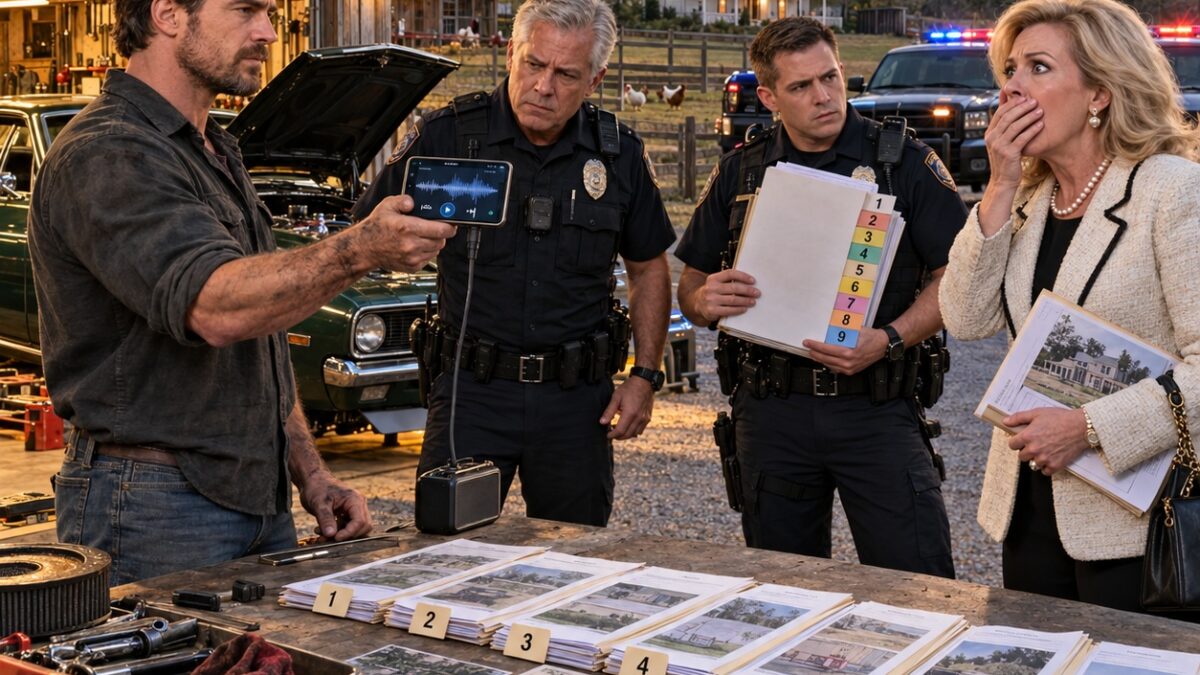
Then pulled out my phone.
The recording screen was open.
Timer running.
The entire conversation had been captured.
Her eyes widened.
Only slightly.
Enough.
“I’ve been documenting everything.”
She stared at the phone.
“All the police calls.”
Gregory looked at her again.
“Every inspection.”
I kept my voice calm.
“Every offer.”
Her breathing changed.
“And every threat.”
The second man stopped looking confident.
I continued.
“My attorney believes the sequence is extremely interesting.”
Cynthia recovered enough to sneer.
“You think some recording scares me?”
“No.”
I put the phone back in my pocket.
“I think evidence scares insurance companies.”
That landed harder.
Gregory stepped toward Cynthia and touched her arm.
“We should go.”
She pulled away.
“No.”
“Cynthia.”
“He’s bluffing.”
I said nothing.
She looked at me.
“You’ll regret this.”
Gregory’s face hardened.
“Stop.”
“We will bury you in legal fees.”
There it was.
Perfect.
Clear.
Recorded.
“We’ll make sure you can’t afford to keep this dump.”
My heart was pounding so hard I could feel it in my neck.
But my voice came out quiet.
“Get off my property.”
“You have no idea—”
“Now.”
Gregory finally took Cynthia’s arm firmly.
“Enough.”
They walked back toward the car.
Cynthia twisted once to look at me.
“This isn’t over.”
I said:
“Yes, it is.”
The Mercedes sprayed gravel as Gregory pulled away.
Only after they disappeared did my hands start shaking.
I sat back down.
Adrenaline.
Anger.
Maybe fear.
Not that they could legally take the land.
Fear of how far people with money and influence might go when they believed inconvenience could become coercion.
I called Arthur the next morning.
“It’s time.”
He didn’t ask what I meant.
“About time.”
“I want to file.”
“I’ll draft.”
I sent him the recording.
He called back twenty minutes later.
For Arthur, that was practically sprinting.
“You did well.”
“I wanted to yell.”
“Good thing you didn’t.”
“She threatened legal fees.”
“I heard.”
“And the earlier statement about making my life difficult?”
“We already had your notes. Now this strengthens the pattern.”
“What about Gregory?”
“His presence helps establish the purchase context.”
“Is he liable?”
“Don’t get ahead of me.”
Arthur always ruined the fun.
The complaint went forward.
Harassment.
Abuse of process.
False jurisdiction representations.
Defamation-related allegations.
Fraud theories where the evidence supported them.
Damages.
Injunctive relief.
Arthur was careful about every word.
I wanted:
Cynthia is trying to steal my land.
The filing said things like:
Coordinated course of conduct.
Repeated unsupported regulatory complaints.
Material misrepresentation.
Interference with property rights.
Less satisfying emotionally.
Far more dangerous legally.
Then the HOA’s insurer requested the file.
We gave them everything.
Nine police incidents.
Inspection reports.
Fire-marshal findings.
Emails.
Appraisals.
HOA materials falsely implying jurisdiction.
Cynthia’s purchase offers.
My contemporaneous notes.
And the recording.
That recording became the spine.
Cynthia:
We are prepared to make life very difficult for you.
Then complaints.
Then more offers.
Then:
We will bury you in legal fees.
Sequence.
Arthur called it chronology.
I called it obvious.
Once somebody assembled it all, the pattern was brutal.
Offer.
Refusal.
Higher offer.
Refusal.
Threat.
Police.
Complaint.
Inspection.
Complaint.
Police.
More pressure.
Eight-million-dollar offer.
Refusal.
Another threat.
It no longer looked like a strict HOA president trying to protect property values.
It looked like coercion with paperwork.
The insurer apparently agreed.
They requested mediation.
Fast.
“Is that good?”
I asked Arthur.
“It means somebody has done risk analysis.”
“Meaning?”
“Meaning they don’t like what trial might look like.”
For the first time since the harassment began, I felt the balance shift.
Cynthia had relied on accumulation.
One call.
One citation.
One investigation.
One inconvenience at a time.
Now all of it sat in one binder.
One timeline.
One legal file.
Her weapon had become evidence.
Mediation happened in a conference center forty minutes away.
I arrived early.
Arthur beside me.
Cynthia sat across the hall with attorneys.
She looked different without the neighborhood around her.
No clipboard.
No HOA board table.
No white-glove certainty.
Just a woman in a blazer sitting under fluorescent lights while lawyers discussed exposure.
Gregory was not there.
That told me plenty.
We spent hours in separate rooms.
Offers moved back and forth.
I asked Arthur:
“Do I get to talk to her?”
“No.”
“Why?”
“Because nothing useful can come from that.”
“I could think of several useful things.”
“For you emotionally.”
“Yes.”
“We’re negotiating money and legal obligations, not emotional closure.”
I hated that he was right.
At one point, the mediator came in.
“The insurer is prepared to make a substantial move.”
“How substantial?”
He named the number.
One point two million dollars.
I stopped breathing for a second.
Arthur did not react.
Of course.
Lawyers must attend special training where they surgically remove visible surprise.
I looked at him.
He said:
“We need to review the nonmonetary terms.”
That grounded me.
Because money was not the most important part.
I wanted the harassment stopped.
I wanted written acknowledgment that Whispering Pines had no jurisdiction over my land.
I wanted their records corrected.
I wanted the misrepresentations stopped.
I wanted no more officers sent because Cynthia disliked chickens.
The final agreement addressed those points.
The HOA formally recognized my parcel as outside its jurisdiction.
They would stop enforcement communications directed at me.
Incorrect representations in association materials had to be corrected.
The harassment campaign ended.
And the financial settlement?
$1.2 million.
Sixty days after filing.
When Arthur and I walked out, I stood beside my truck holding the signed paperwork.
“This feels strange.”
“How?”
“I expected fireworks.”
He looked at me.
“Most successful litigation ends with signatures.”
“That’s disappointing.”
“Trust me, trial is less entertaining than television suggests.”
I laughed.
Then something happened that felt more satisfying than the money.
Whispering Pines called an emergency board meeting.
The insurer’s attorneys had apparently explained exactly how Cynthia’s conduct had exposed the association.
Residents learned about the repeated complaints.
The threats.
The recording.
The false jurisdiction claims.
The settlement.
One neighbor later told me the clubhouse was packed.
Cynthia stood at the front insisting she had only been defending the neighborhood.
Someone asked:
“Defending us from what?”
She said:
“Declining property standards.”
Another homeowner asked:
“His property isn’t even in our HOA, correct?”
Silence.
Then:
“Correct?”
Cynthia tried to explain that adjacent properties affected values.
Someone else said:
“Did the board authorize nine police complaints?”
She denied personally filing all of them.
Then another resident asked the question that apparently ended the room:
“Did you tell him you would make his life difficult until he sold?”
Cynthia said the recording had been taken out of context.
That was when somebody played it.
Not me.
A board member had a copy through counsel.
The room heard her voice.
Clear.
We are prepared to make life very difficult for you until you see reason.
Then, later:
We will bury you in legal fees.
According to the neighbor who told me, nobody spoke for several seconds.
Cynthia tried to recover.
“We were protecting our investment.”
One homeowner shouted:
“With our insurance money?”
That changed the temperature.
Homeowners tolerate a lot until consequences reach their dues.
The emergency vote removed Cynthia Sterling as HOA president.
Immediately.
When Arthur called to tell me, I was in the workshop.
“You hear?”
“No.”
“She’s out.”
I set down the wrench.
“Removed?”
“Emergency board vote.”
I leaned against the Mustang.
I expected some huge rush of triumph.
Instead, I felt tired.
“Good.”
“That’s it?”
“What do you want me to do? Fireworks?”
“Knowing you? Maybe.”
I laughed.
“Good.”
And it was.
Not because I needed Cynthia humiliated.
Because she no longer controlled the machinery she’d been using against me.
Gregory Hayes disappeared almost as quickly.
A local newspaper ran a story about the harassment campaign, the disputed HOA jurisdiction, and the settlement.
His company quietly abandoned any immediate development pursuit involving my land.
No public statement.
No apology.
No return visit.
No new offer.
He understood risk.
Developers do.
Cynthia had allowed emotion to override it.
Gregory did not.
The police stopped coming.
That part took time to feel real.
For months, any vehicle slowing on the gravel made me look up.
UPS truck?
Deputy?
County inspector?
Neighbor?
Harassment gets into your nervous system.
Even when you know you’re right, repeated official visits create a sense that your home is conditional.
Like some new allegation might appear at any time and make you defend normal life again.
Then a week passed.
No police.
Two weeks.
Nothing.
One month.
Nothing.
The first quiet month felt almost unnatural.
I went out to the chicken coop one morning.
Six hens scratching in the dirt.
No clipboard.
No complaint.
No patrol car.
I laughed.
“Congratulations, ladies. You’re legal again.”
They did not care.
Typical.
I rebuilt the coop shortly afterward.
Bigger.
Stronger.
Better roof.
Partly because the old one genuinely needed replacement.
Partly because I am human and revenge occasionally expresses itself through poultry architecture.
Arthur came by.
Looked at it.
“That’s larger.”
“Yes.”
“Any particular reason?”
“Improved ambiance.”
He laughed so hard he had to lean against his car.
The Mustang finally got finished too.
That mattered more than I expected.
Through most of the harassment, it had sat in the workshop half restored.
The car had become another thing interrupted by Cynthia.
Every inspection.
Every complaint.
Every call.
I lost time.
Focus.
Patience.
The week after the settlement finalized, I went back to the engine.
No lawyers.
No police.
No emails.
Just work.
I adjusted.
Rechecked.
Reassembled.
The day the Mustang started correctly for the first time, the sound filled the workshop.
Deep V8 idle.
Metal vibration through concrete.
Loud.
Beautiful.
Exactly the type of noise Cynthia once reported.
I stood behind the open driver’s door with my hand on the wheel.
Then I started laughing.
Not because I was trying to annoy Whispering Pines.
Because for the first time in months, the sound belonged only to me.
Not evidence.
Not a complaint.
Not a violation.
An engine.
My grandfather’s engine.
I drove the Mustang down the dirt road my father had learned to drive on.
Windows down.
The road curved through the property.
Whispering Pines visible beyond the trees.
I imagined my grandfather beside me.
He would have complained about the tuning.
Probably the tires.
Definitely how much money I spent.
Then he would have smiled.
I like to think so.
That drive felt more like victory than the settlement check.
Because it answered the real question.
Had they changed what this land meant to me?
No.
Had they forced me away?
No.
Had they made me ashamed of the farmhouse, workshop, chickens, gravel, or history?
No.
I was still here.
And the land was still mine.
The settlement money changed things.
Of course it did.
I paid legal expenses.
Strengthened savings.
Repaired parts of the farmhouse I’d been postponing.
Roof work.
Electrical updates.
Foundation maintenance.
Nothing flashy.
I did not bulldoze the house and build something “appropriate.”
I restored it.
Kept the shape.
Kept the porch.
Kept the old details where I could.
Whispering Pines became even more manicured over time.
More houses.
More landscaping.
My property remained visibly different.
That stopped bothering me.
Actually, I began to like the contrast.
Old oak beside ornamental trees.
Gravel beside decorative paving.
Workshop beside three-car show garages.
Real chicken coop beside outdoor kitchens that cost more than my first car.
Neither was inherently better.
Just different.
The problem had never been difference.
The problem had been Cynthia deciding difference gave her authority.
The new HOA board seemed to understand that.
A letter arrived a few weeks after her removal.
I opened it expecting trouble.
Instead:
Whispering Pines Homeowners Association acknowledges that the Vance property is not subject to the Association’s covenants, restrictions, or enforcement authority.
I read the sentence twice.
Then framed it.
Arthur saw the frame in my office.
“You are petty.”
“I am organized.”
“You framed it.”
“Documentation.”
He shook his head.
I also used part of the settlement money to create something I had not planned.
A small legal defense fund.
Not some giant foundation.
Not a crusade against every HOA in America.
Just a pool of money for property owners facing the kind of overreach I had experienced.
Arthur helped structure it.
He insisted on screening.
“Real cases.”
“Obviously.”
“No funding people because they don’t like legitimate rules.”
“Agreed.”
“No man who wants to park twelve boats on his lawn.”
“Very specific.”
“You’d be surprised.”
The first case involved an older couple receiving HOA threats over a parcel outside the association’s recorded boundary.
Arthur looked at the file.
Then at me.
“This feels familiar.”
It did.
They won.
Second case:
False enforcement against agricultural property.
Resolved before trial.
Third:
An association claiming jurisdiction based on nothing more than adjacency and outdated maps.
Resolved successfully.
I didn’t take credit.
Arthur did the legal work.
But helping people pay for the first consultation or title review felt important.
Because I remembered how powerless official-looking paper could make you feel.
HOA letterhead.
Attorney letter.
Complaint notice.
Police visit.
People assume authority because it arrives printed.
Sometimes it’s legitimate.
Sometimes it isn’t.
The first step is finding out.
That became my biggest lesson.
Not:
Fight everything.
Not:
Never sell.
Not:
All HOAs are evil.
Verify.
Where is the boundary?
Where is the recorded covenant?
Who actually has authority?
What does the deed say?
What does the law say?
What happened?
What can you prove?
Cynthia had volume.
I had records.
Eventually, records won.
The appraisal value of my property kept climbing.
Ten million.
Maybe twelve.
Maybe more.
I stopped checking often.
Real estate agents still sent letters.
Developers.
Investors.
“Confidential acquisition opportunity.”
“Cash buyer.”
“Premium land assemblage.”
Most went into a drawer.
One offer exceeded eight million.
I read it.
Then went outside to feed chickens.
That surprised me.
Years earlier, eight million had required thought.
Now I understood something better.
The point was never that the land could never be sold.
Maybe one day circumstances change.
Maybe I get older.
Maybe maintaining fifteen acres becomes too much.
Maybe family priorities change.
The important thing is that if I ever sell, it will be because I decide.
Not because somebody sends police until I surrender.
There is a huge difference between price and pressure.
My grandfather understood that.
He used to say:
“They can make you offers, Elias, but they can’t make you sell.”
When I was young, I thought it was just one of those stubborn things old men say.
Now I understand.
An offer respects ownership.
Coercion tries to hollow it out.
Cynthia crossed that line.
The strangest thing happened after she lost power.
Whispering Pines residents started talking to me.
Actual conversations.
A man from two streets over stopped by while I was working on the Mustang.
“That’s a ’67?”
“Yes.”
“My dad had one.”
He stood there for twenty minutes.
Never mentioned property values.
Another family began buying eggs.
The chickens that supposedly damaged the neighborhood ambiance became breakfast.
A woman walking her dog asked about the garden.
Kids slowed their bikes near the workshop when I had the Corvette outside.
Nothing about the property changed dramatically.
Cynthia did.
Or rather, her control over the narrative disappeared.
People had been told:
Eyesore.
Noise.
Illegal repairs.
Bad for values.
When nobody repeated those claims constantly, most neighbors saw the place for what it was.
An old family property beside a newer subdivision.
That’s all.
One winter storm brought down a large tree near the road connecting part of Whispering Pines.
My tractor could move it.
The new HOA president called.
Not demanded.
Called.
“Elias, any chance you can help?”
I looked toward the tractor.
The same kind of equipment Cynthia had complained about.
“I can be there in ten minutes.”
I dragged the tree clear.
Several residents stood nearby.
One man laughed.
“Good thing you’ve got the farm equipment.”
I said:
“Careful. That tractor has a history of reducing property values.”
People laughed.
The new president shook his head.
“That era is over.”
Those four words meant more than he knew.
That era is over.
Good.
I did not need Whispering Pines to love my property.
I needed them to understand where theirs ended.
That boundary made coexistence possible.
Cynthia remained in the neighborhood for a while.
I avoided her.
She avoided me.
We could see each other’s properties from a distance.
Sometimes I caught sight of her Mercedes.
No interest in conversation.
Then one afternoon, I was repairing a fence along the road.
Her car slowed.
Stopped.
Window came down.
I straightened.
“Elias.”
“Cynthia.”
For a few seconds, neither of us said anything.
She looked toward the farmhouse.
Then workshop.
Then chicken coop.
“Your property looks better.”
I almost laughed.
“Does it?”
“Yes.”
I leaned on the fence post.
“Still chickens.”
She glanced toward them.
“I noticed.”
Silence again.
I waited.
Some part of me expected:
I’m sorry.
It never came.
Instead, she said:
“I think things got out of hand.”
The most Cynthia Sterling apology imaginable.
No subject.
Things.
As though harassment had developed naturally like weather.
I could have attacked her.
Reminded her of nine police visits.
Explosives complaint.
Threats.
One-point-two-million-dollar settlement.
Emergency removal.
But none of that would change anything.
“They did.”
She nodded.
Then drove away.
My brother later asked why I didn’t give her a better line.
“What would you have said?”
He thought.
“Maybe, ‘Nice ambiance, isn’t it?’”
I stared at him.
“That would’ve been excellent.”
“I know.”
“Why weren’t you there?”
He looked disappointed in me.
I still regret missing that one.
But maybe the quiet ending was better.
By then, Cynthia had become irrelevant.
That was the real victory.
She no longer controlled police calls.
Board meetings.
My schedule.
My stress.
My relationship with my own land.
I did.
The legal defense fund continued helping people.
Not dozens.
A few.
Enough.
One woman cried on the phone after an attorney showed her that an HOA threatening her family had no recorded jurisdiction over half the property involved.
“I thought I was crazy.”
I remembered that feeling.
“You’re not.”
That was when I understood why I had created the fund.
Harassment by official-looking systems often works by isolating people.
One letter makes you anxious.
A second makes you doubt yourself.
A third makes you think maybe paying is easier.
A police cruiser makes the authority feel real.
Then one knowledgeable person says:
Wait.
Show me the document.
That can change everything.
I became that person for some people because Arthur had been that person for me.
My own land settled back into ordinary life.
That is what people miss when they think about a dramatic ending.
The best ending is not always destruction of the villain.
Sometimes it’s ordinary life returning.
Coffee on the porch.
Engine noise.
Chicken feed.
A package delivered without a police cruiser behind it.
Sunset.
Work.
Nothing happening.
Nothing happening became beautiful.
I restored the Corvette next.
Needed more work than I expected.
Of course.
Arthur stopped by one afternoon.
“You finished one expensive mistake and immediately bought another?”
“This one has character.”
“So did Cynthia.”
“Get off my property.”
He laughed.
We had become friends by then.
Or the closest thing you become with a lawyer who has seen every angry email you have ever written and advised you not to send half of them.
I fired up the Corvette engine for the first serious test.
Loud.
Not ridiculous.
Loud enough.
I looked automatically toward Whispering Pines.
No cruiser.
No complaint.
No Cynthia.
I smiled.
Then shut it down because I had an oil leak.
Victory remains mechanical.
There were also difficult aftereffects I hadn’t expected.
For months after the settlement, I saved every unknown number on my phone.
Every envelope from the county made my stomach tighten.
Every slow-moving car near the driveway caught my attention.
False complaints teach you that ordinary institutions can suddenly appear at your door.
Even when the institution itself is behaving correctly, your body remembers the intrusion.
That faded.
Not all at once.
The first year was easier than the harassment months.
The second easier than the first.
Eventually, a patrol car could drive through the area without me wondering if it was turning toward my property.
That felt like freedom too.
Whispering Pines eventually changed some internal policies.
I heard this from residents.
Complaints against adjacent properties required legal review before the HOA involved outside agencies.
Jurisdiction had to be confirmed.
Board officers could not simply represent personal disputes as association enforcement.
Common sense.
Expensive lesson.
Homeowners paid increased premiums after the settlement.
That created anger.
Some aimed at me initially.
One man confronted me near the road.
“You know our insurance went up because of that lawsuit.”
I looked at him.
“Your insurance went up because your president conducted a documented harassment campaign.”
He stopped.
I continued:
“I did not call police on myself nine times.”
He looked away.
“Fair.”
That was enough.
People often resent the person who makes institutional failure expensive.
Because the bill is visible.
The conduct that created it happened slowly.
But accountability costs money.
Better governance is cheaper.
Eventually, many residents understood that.
The board stopped treating me like an enemy.
I stopped treating every resident like Cynthia.
That mattered.
Because bitterness can become another prison.
I wanted my land.
Not permanent war.
One evening, years after the settlement, I sat in my grandfather’s chair watching sunset.
Same chair.
Same porch.
Whispering Pines lights turning on one by one.
The farmhouse behind me.
Mustang in the workshop.
Corvette half apart.
Chickens quiet.
I had one of the old appraisal reports beside me.
Twelve million dollars.
Maybe outdated now.
I read the number.
Then looked at the land.
Numbers are useful.
They tell you what markets think.
But markets do not know what my grandfather sounded like yelling from the workshop.
They don’t know which oak my father used to park under.
They don’t know where my mother’s garden used to run.
They don’t know how the gravel feels under tires in summer.
They don’t know why finishing that Mustang mattered.
An appraisal measures exchange value.
It does not measure belonging.
That was what Cynthia could never price correctly.
She thought every no was secretly:
Offer more.
It wasn’t.
Sometimes no means:
You are asking for the wrong thing.
I kept the first police officer’s card.
The older one.
The man who said somebody was wasting their time.
Years later, I found it while cleaning my desk.
I wondered whether he remembered me.
Probably not.
Police see thousands of people.
But I remembered him.
Because that first visit taught me something.
The officers were never really the enemy.
Nor the fire marshal.
Nor code enforcement.
They came because complaints triggered procedures.
The problem was the person using legitimate systems for illegitimate pressure.
That distinction mattered.
I did not want to become somebody who hated all government because Cynthia filed false reports.
The correct answer was evidence.
Each official inspection eventually helped me.
No violation.
No violation.
No violation.
Her harassment generated its own rebuttal.
That was almost elegant.
Arthur once said:
“She built your case for you.”
I laughed.
“She made me work for it.”
“Yes.”
“But she created the paper.”
“Exactly.”
That may be why the insurer settled quickly.
Not because I had the loudest lawyer.
Because their own insured had produced a trail too clean to explain away.
The recording was powerful.
But the repeated no-violation reports made it devastating.
One threat could be denied.
One complaint could be coincidence.
Nine?
Then an $8 million purchase attempt?
Then another recorded threat?
Pattern.
Always pattern.
I tell people that now.
If you’re being harassed, don’t just save the worst thing.
Save everything.
Small events become meaningful when ordered.
A date is boring.
Ten dates become chronology.
Chronology becomes story.
Story becomes proof.
Years after Cynthia, I added another section to the workshop.
Properly permitted.
Not because the HOA required it.
Because county law did.
I submitted plans.
Paid the fee.
Passed inspection.
The inspector recognized the address.
“You’re the HOA guy.”
I sighed.
“Apparently.”
He looked at the new framing.
“Everything’s good.”
“Thank you.”
He smiled.
“No explosives?”
“Only dangerous levels of nostalgia.”
He laughed.
Permit approved.
That small interaction felt symbolic.
I was not anti-rule.
I was anti-fake authority.
There is a difference.
Real permitting?
Fine.
Safety codes?
Fine.
Property boundaries?
Essential.
An HOA pretending my land belonged to them because they didn’t like my workshop?
No.
That clarity became part of who I was.
The legal defense fund adopted a simple motto Arthur hated because it sounded too catchy.
READ THE DEED.
I put it on the website anyway.
He threatened to resign.
He did not.
People emailed us stories.
Some legitimate.
Some not.
One man wanted help because his HOA fined him for painting his house neon orange despite a clear recorded color covenant.
Arthur read the email.
“No.”
I agreed.
The fund wasn’t about defeating every rule.
It was about ensuring rules came from actual authority.
That’s more important.
Power without boundaries becomes Cynthia.
Boundaries without enforcement become meaningless.
Good systems need both.
The Mustang still runs.
Not perfectly.
Old cars are relationships based on intermittent disappointment.
I drive it on Sundays sometimes.
People wave.
Kids stare.
One day I drove through the main public road beside Whispering Pines.
I passed Cynthia.
She was walking near the entrance.
She looked at the car.
Then at me.
I raised two fingers from the wheel.
Small wave.
She hesitated.
Then waved back.
Nothing more.
No reconciliation.
No friendship.
No need.
At that point, the story was no longer hers.
It belonged to the land.
To my family.
To the fact that I stayed.
My grandfather’s saying remains taped to the inside of a cabinet in the workshop.
I wrote it there after the settlement.
THEY CAN MAKE YOU OFFERS, BUT THEY CAN’T MAKE YOU SELL.
Underneath it, I added:
UNLESS YOU LET THEM MAKE EXHAUSTION FEEL LIKE CONSENT.
Arthur told me that was too long.
He’s right.
Still stays.
Because that’s what Cynthia tried to do.
She didn’t have legal authority to force a sale.
So she tried to make ownership unbearable.
Police.
Complaints.
Inspections.
Threats.
Fear of legal fees.
Pressure.
The goal was not to win the land in court.
The goal was to make me quit.
People do that in property disputes more than most realize.
Delay can be leverage.
Stress can be leverage.
Cost can be leverage.
Shame can be leverage.
I answered with patience.
Records.
Law.
And the refusal to confuse inconvenience with defeat.
There were nights I almost broke.
That’s important to admit.
When the fire marshal inspected the workshop, I sat at my kitchen table afterward and seriously considered calling Gregory.
Not to accept eight million.
Just to ask whether the offer was still open.
I was tired.
I thought:
Is this land worth living like this?
Then I hated myself for thinking it.
Later, I understood that was exactly Cynthia’s strategy.
She didn’t need to legally beat me.
She needed me to ask whether keeping the property was worth the pain.
That realization made me angry enough to continue.
Not stubborn for its own sake.
Clear.
If I sold one day after deciding freely?
Fine.
If I sold because she made my home feel unsafe?
I would regret that forever.
So I stayed.
And eventually, the pressure reversed.
Her board seat gone.
Insurance paying.
Developer gone.
Harassment stopped.
The same tools she used—paper, authority, legal threat—came back toward her once they were placed inside a real process.
That’s why I don’t think of the settlement as revenge.
It was correction.
Expensive correction.
But correction.
Today, the view from my porch still includes Whispering Pines.
I can’t pretend the development doesn’t exist.
At night, the houses glow.
Some are beautiful.
Families live there.
Children grow up there.
People grill.
Argue.
Pay mortgages.
Normal life.
My land isn’t a battlefield anymore.
That’s the ending I’m most grateful for.
The farmhouse stands.
Workshop doors open in good weather.
Chickens wander their enclosure.
Garden grows badly some years and well others.
Cars get restored slowly.
Developers occasionally mail offers.
The HOA stays on its side of the line.
I stay on mine.
Sometimes the new HOA president waves while driving past.
I wave back.
Good neighbors do not need identical houses.
They need boundaries and enough sense to respect them.
The legal defense fund has helped more owners now.
Nothing huge.
A handful.
But every time Arthur calls and says:
“We found the document,”
I remember my own case.
One family kept their property.
Another stopped paying fines they never owed.
Another association corrected a boundary error before things became ugly.
Those outcomes make the $1.2 million settlement feel more meaningful.
Money can compensate.
It can also continue the lesson.
Cynthia wanted the land because she thought money defined its value.
Part of her money now helps other people protect theirs.
There is poetry in that.
I would never say that to Arthur.
He hates poetry in legal budgets.
My grandfather never knew Whispering Pines.
He died before the worst of the development.
Sometimes I wonder what he would have done if Cynthia came to his porch.
Probably nothing sophisticated.
He would have listened.
Taken off his glasses.
Said:
“No.”
Then gone back to work.
Maybe that’s where I got it.
The modern version required more.
Cameras.
Lawyer.
Appraisals.
Insurance negotiations.
Digital records.
But the foundation remained simple.
No.
This is home.
Not for sale.
One evening, I finished work on the Corvette later than planned.
Sunset had faded.
Workshop lights were on.
The engine finally turned over cleanly.
I stepped outside while it idled.
The sound rolled across the property.
For half a second, old instinct returned.
I looked toward the road.
Waiting for headlights.
A cruiser.
Complaint.
Nothing.
Just darkness.
Then one porch light came on in Whispering Pines.
Another.
Normal.
I went back inside.
Turned the engine off.
The silence afterward was peaceful.
That was when I realized I had finally stopped expecting Cynthia.
Completely.
Her power was gone from my mind too.
That’s the part legal settlements can’t order.
It just happens slowly.
You reclaim space.
Then routine.
Then calm.
Eventually, the person who tried to make your home unbearable becomes somebody you barely think about.
That is a deeper victory than seeing her removed from a board.
I don’t know what Cynthia thinks about me now.
Maybe she still believes I was stubborn.
Maybe she still thinks the farm is ugly.
Maybe she tells herself the insurance company overreacted.
People protect their self-image in strange ways.
Doesn’t matter.
The farmhouse does not need her approval.
Neither do I.
My property remains worth somewhere north of ten million dollars.
Probably more now.
Still not for sale.
Not today.
Maybe not ever.
And every once in a while, I sit in my grandfather’s rocking chair with a cup of coffee and look out over those fifteen acres.
The same fifteen acres Cynthia tried to pressure me out of.
The same fifteen acres Gregory tried to buy for eight million.
The same fifteen acres police were sent to nine times because an HOA president decided my refusal was a problem she could punish away.
The workshop still stands.
The coop still stands.
The farmhouse still stands.
The Mustang runs.
The Corvette eventually did too.
My name is still on the deed.
And Whispering Pines?
It stays exactly where it belongs.
On the other side of my property line.
That is what makes the ending satisfying to me.
Not that Cynthia lost.
Not that I received money.
Not that Gregory disappeared.
Not even that the HOA had to put in writing what should have been obvious from the beginning.
It’s that after everything they tried, the one thing they wanted never happened.
I never left.
My grandfather once told me:
“They can make you offers, Elias, but they can’t make you sell.”
For years, I thought he was talking about money.
He wasn’t.
He was talking about pressure.
He was talking about knowing when somebody else’s urgency has no right to become yours.
He was talking about standing on land you know, understanding the paper underneath it, and refusing to let somebody with more money, newer houses, louder lawyers, or a prettier entrance sign convince you that history has expired.
I understand now.
So yes, Cynthia called the police.
Again.
And again.
And again.
She sent inspectors.
Complaints.
Threats.
She brought a developer to my porch with eight million dollars.
She told me they would bury me in legal fees.
And then, once everything she had done was finally placed in chronological order and handed to people whose authority was real, her entire campaign collapsed in less time than she had spent trying to manufacture it.
She lost the presidency.
The HOA lost $1.2 million.
The false jurisdiction claims ended.
The developer walked away.
The police stopped coming.
And I stayed exactly where I had been the whole time.
On my grandfather’s land.
Home.
Some people think winning means taking something from the person who came after you.
I learned something different.
Sometimes winning means making sure they don’t take anything from you at all.








