PART2:The HOA Billionaire Built 100 Luxury Cabins on My Family Land—Then She Learned Why My Great-Grandfather Built the Dam
PART2
I learned how far Victoria intended to go three weeks later.
I woke just after seven to the sound of chainsaws.
That was unusual.
No logging was scheduled.
No forestry crew had permission to be on the western shoreline.
I drove down in my old pickup.
By the time I reached the lower slope, I could see orange safety vests moving through the trees.
Then an excavator.
Then fresh stumps.
My stumps.
I slammed the truck into park.
“What the hell are you doing?”
Workers looked toward me.
One of them killed a chainsaw.
Another pointed uphill.
Victoria stood near a temporary survey stake wearing a white hard hat and designer boots.
I walked straight toward her.
“This is my land.”
She barely turned.
“No.”
I stopped.
“What?”
She held out a rolled document.
“Boundary adjustment.”
I took it.
Survey map.
County formatting.
Parcel references.
Coordinates.
Stamps.
Signature from a licensed surveyor named Marcus Vance.
And a new boundary line that pushed several acres of my shoreline into Sterling Peak Estates.
I stared at it.
“This is fake.”
Victoria smiled.
“It’s recorded.”
“That line has never been there.”
“It is now.”
“That isn’t how property works.”
“You should talk to your attorney.”
Behind her, another tree fell.
I looked at the workers.
“Stop cutting.”
Victoria said calmly:
“Continue.”
Nobody moved.
Good.
I pointed toward the slope.
“You are standing on Thorne property.”
Victoria tapped the survey.
“According to this, I’m standing on mine.”
I pulled out my phone and called the sheriff.
Victoria did not seem concerned.
That bothered me more than anger would have.
Deputy Lawson arrived less than twenty minutes later.
He knew me.
Most local deputies did.
Not closely.
But two thousand acres and a regulated private dam generate occasional official contact.
Lawson stepped out.
“What’s happening?”
“She’s trespassing.”
Victoria walked forward before he could ask anything else.
“Deputy, this is the updated boundary survey.”
She handed him the map.
Lawson read.
Looked at the flags.
Looked at me.
“Elias?”
“It’s fraudulent.”
Victoria laughed softly.
Lawson held up one hand.
“Everybody slow down.”
He studied the survey again.
The problem became obvious.
On the dirt, in that moment, her document looked legitimate.
Professional lines.
Official-looking stamps.
Proper parcel references.
I knew it was false.
Knowing is not proving.
Lawson said:
“Do you have a current recorded survey contradicting this?”
“At the house.”
“County copy?”
“Old deeds. Original plat.”
He exhaled.
“I can’t adjudicate a boundary dispute standing here.”
“She’s cutting my trees.”
“If her recorded survey shows this line, I don’t have probable cause to treat her crew as criminal trespass until the ownership issue is resolved.”
Victoria smiled.
I wanted to knock that smile off her face.
Instead, I asked:
“So she gets to keep cutting?”
Lawson looked uncomfortable.
“You need an injunction.”
Victoria said quietly:
“You should’ve taken my offer.”
I turned toward her.
That sentence told me something important.
This had not been a survey error.
Not confusion.
Not competing deed interpretations.
She had planned it.
I stepped close enough that she had to lift her chin slightly.
“You think paper changed the mountain?”
“No.”
She smiled.
“Money did.”
I went home.
Not because I surrendered.
Because rage is useless if the other person has documentation and you do not.
I climbed into the attic of the stone lodge where my grandfather stored everything nobody else had the patience to keep.
Old ledgers.
Maps.
Tax records.
Water permits.
Photographs.
Handwritten maintenance logs.
Original deeds.
Boxes labeled in my father’s handwriting.
I searched until after midnight.
Then past two.
At 3:17 in the morning, I found the map.
Heavy parchment.
Edges brittle.
Ink faded but readable.
Original county boundary.
Survey monuments.
Shoreline.
Stone markers.
The western slope Victoria claimed was clearly inside the Thorne parcel.
Not barely.
Not ambiguous.
Entirely.
I sat on the attic floor with the map across my knees and felt my anger become something better.
Direction.
The next morning, I brought copies to the sheriff.
Lawson looked at them.
Then at me.
“This helps.”
“Then stop the work.”
“I can’t.”
“What?”
“The newer survey is recorded.”
“It’s fraudulent.”
“I believe you may be right.”
“May?”
“Elias, I’m not a judge.”
He pointed to the old map.
“This becomes a civil title dispute unless there’s immediate proof the survey was criminally falsified.”
“How long?”
“For court?”
“My attorney says five months.”
Lawson gave me the look officials give when they hate the answer but still have to say it.
“File for emergency relief.”
I did.
My attorney, Rebecca Hale, filed for an injunction.
Victoria’s lawyers opposed.
They argued the newer survey was valid.
The hearing got scheduled.
Not soon enough.
Victoria accelerated construction.
That was the part I had not expected.
I thought she would slow down once the lawsuit started.
Instead, she moved faster.
Bulldozers ran from dawn until dark.
The stolen shoreline was graded.
Trees disappeared.
Concrete slabs appeared.
Prefab cabins arrived on trucks.
Ten.
Twenty.
Forty.
By the second month, the first rows had roofs.
By the third, almost all one hundred units stood.
Victoria was spending money at a pace designed to create a legal reality before the court could examine how she got there.
Rebecca explained it.
“She wants established investment.”
“Meaning?”
“The more she builds, sells, leases, and finances, the harder she thinks it becomes for a court to unwind.”
“She stole the land.”
“I know.”
“She knows.”
“Yes.”
“And she thinks construction makes theft legal?”
“She thinks construction creates leverage.”
That was Victoria.
Leverage.
Every decision she made relied on forcing other people into positions where resisting cost more than surrender.
One afternoon, I drove to the ridge and watched workers installing glass railings on cabins sitting fifty yards inside my boundary.
Victoria saw me.
She walked over.
“Beautiful, isn’t it?”
I looked at the buildings.
“You’re building fast.”
“Efficiency.”
“Desperation.”
She smiled.
“Reality.”
“You forged the survey.”
“Prove it.”
“I will.”
“When?”
She glanced at her watch.
“Four months?”
Then toward the cabins.
“A lot can happen in four months.”
There it was.
She knew.
I went home.
That night I stopped studying boundary documents.
Victoria had chosen time as her weapon.
Fine.
I needed something that did not require waiting for court.
I went back to the archives.
This time, I opened the dam records.
My great-grandfather documented everything.
Painfully.
Water levels.
Spillway height.
Maximum storage elevation.
Emergency overflow paths.
Maintenance tolerances.
Later engineering reports refined the numbers.
The dam had been modernized legally over the decades, but one thing remained unchanged.
The flood easement.
The lake was permitted to rise several feet during maintenance, controlled inspection, heavy inflow management, or emergency operations.
That easement extended across a low shelf of shoreline.
I knew that shelf.
Everyone in my family did.
We never built there.
Never stored equipment there.
Never fenced livestock there permanently.
Because under normal water levels, it looked like dry ground.
At maximum permitted elevation, it was lake.
I unfolded the easement map.
Then the disputed survey.
Then Victoria’s development plan.
I stared.
Her first four rows of luxury cabins sat directly inside the flood zone.
Not near it.
Inside.
I drove out before sunrise the next morning with survey equipment, a drone, camera, GPS unit, and every engineering document I had.
I spent two days measuring.
Cabin elevations.
Road grade.
Slab height.
Distance to current waterline.
Distance to maximum permitted waterline.
Then I hired an independent civil engineer.
Dr. Martin Reyes.
I told him nothing about my plan.
Just asked him to review the dam permit, flood easement, and construction elevations.
He came back with a report.
The cabins occupied land subject to lawful inundation under the dam’s operating parameters.
I asked:
“If the lake is raised to maximum authorized inspection level?”
He looked at me.
“They get wet.”
“How wet?”
“The first rows?”
He turned a page.
“Badly.”
“And the rest?”
“Depends on exact elevation.”
“Is raising the lake legal?”
He looked at me carefully.
“For a legitimate operational purpose, within your permit and safety plan, yes.”
“Maintenance inspection?”
“If performed properly.”
I nodded.
Reyes did not.
“What are you thinking?”
“I’m thinking my dam needs an inspection.”
He leaned back.
“Elias.”
“What?”
“Do this exactly by the book.”
“I intend to.”
“I mean exactly.”
“So do I.”
I contacted the dam safety consultant we had used for years.
Scheduled a controlled high-water structural inspection.
Documented the operational reasons.
Checked downstream conditions.
Checked weather.
Verified legal maximum elevation.
Reviewed emergency procedures.
Then Rebecca drafted a certified forty-eight-hour notice.
It went to Victoria.
Sterling Peak Estates.
Her registered agent.
Her attorney.
The notice explained that the lake would be raised to the permitted inspection level as part of dam safety operations and that portions of the disputed construction sat inside a recorded flood easement.
It advised immediate removal of vulnerable equipment and evacuation of anyone from affected areas.
Not revenge.
Not threat.
Notice.
Victoria refused delivery at the development office.
The carrier documented it.
RETURN TO SENDER.
REFUSED.
Her attorney accepted a separate copy electronically.
That was enough.
Rebecca called me.
“She has notice.”
“Good.”
“Elias.”
“Yes?”
“She may seek an emergency order.”
“Has she?”
“Not yet.”
“Then we proceed.”
“Stay inside the permit.”
“I will.”
Forty-eight hours passed.
Victoria did not remove the cabins.
She did not pause construction.
Instead, workers staged furniture.
Mounted TVs.
Hung curtains.
Placed outdoor chairs on decks.
Landscapers laid sod.
It was almost insulting.
On the second afternoon, Victoria posted promotional photographs online.
STERLING PEAK—OPENING SOON.
She thought I was bluffing.
Maybe anyone else would have.
At 6:30 the next morning, I drove to the dam.
Toolbox.
Thermos.
Operations binder.
Engineer on site.
Two maintenance technicians.
Everything documented.
No cameras.
No dramatic audience.
I unlocked the steel access door and entered the concrete corridor.
The temperature dropped immediately.
My footsteps echoed.
The gate controls were mechanical backup systems tied into later upgrades.
Large wheel valves.
Steel.
Heavy.
Familiar.
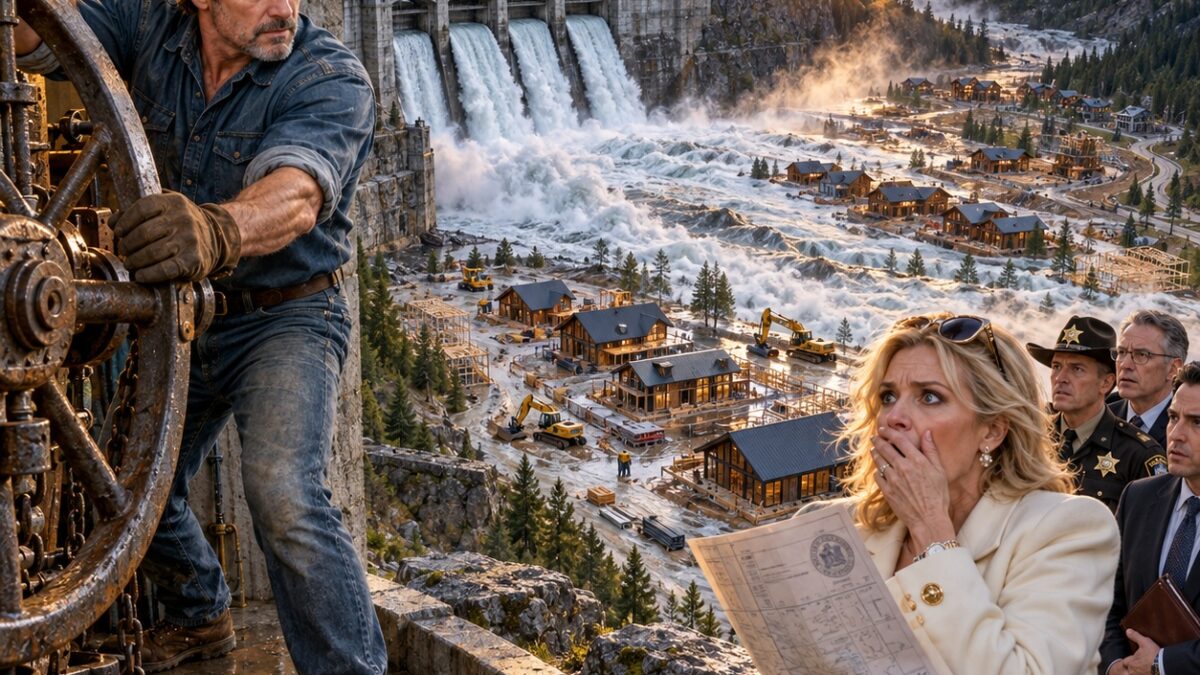
I placed both hands on the first wheel.
For a moment, I thought about my great-grandfather.
He built the first version of that dam before Victoria’s grandparents probably knew the valley existed.
I wondered what he would think.
Then I stopped wondering.
I turned.
Metal groaned.
The system responded.
Water discharge changed.
The lake began its slow controlled rise.
Nothing dramatic happened at first.
That is the thing about water.
People imagine walls of it.
Roaring waves.
Disaster.
This was quieter.
An inch.
Then another.
The shoreline shifted.
Grass darkened.
Low stones disappeared.
By late morning, the water reached the edge of Victoria’s new sod.
My engineer checked gauges.
Still legal.
Still controlled.
Still below maximum.
Workers noticed around noon.
They called supervisors.
I watched from the ridge through binoculars.
People walked toward the water.
Pointed.
At 12:40, it reached the first concrete slab.
At 1:15, the lower access road became muddy.
At 1:50, someone drove a forklift backward through standing water.
At 2:06, Victoria arrived.
Pearl-white SUV.
Too fast.
She stopped near the cabins.
Stepped directly into mud.
Even from the ridge, I could see her posture.
Hands out.
Demanding answers.
Workers pointed toward the lake.
Then someone pointed toward me.
Victoria looked up.
She started walking.
Mud splashed her expensive boots.
By the time she reached the ridge, she was breathing hard.
“What the hell have you done?”
I held a copy of the certified notice.
“Exactly what I warned you I was doing.”
“Stop it.”
“No.”
She looked behind her.
Water had reached beneath the first row of decks.
“You’re flooding my property.”
“No.”
“What do you call that?”
I pointed toward the flood easement map clipped inside the folder.
“Your cabins are inside a permitted inundation zone.”
Her face changed.
“Bullshit.”
“You received notice.”
“I refused some ridiculous letter.”
“That is not the same as not receiving notice.”
“You did this intentionally.”
“Yes.”
The word hit her.
I continued before she could twist it.
“I intentionally raised my lake within permitted operating limits for a documented dam inspection after giving legal notice to every affected party.”
“You’re destroying twenty million dollars.”
“You built twenty million dollars of cabins on land you don’t own inside a flood easement you never checked.”
Her mouth opened.
Behind us, workers shouted.
Water crossed the first cabin threshold.
Victoria spun around.
“No.”
The lake kept rising.
Slow.
Steady.
She grabbed her phone.
“Lower it.”
“No.”
“I’m calling the sheriff.”
“Go ahead.”
She did.
Deputy Lawson arrived about fifteen minutes later.
Same patrol truck.
Same man.
Different paperwork.
Victoria ran toward him.
“Arrest him.”
Lawson looked toward me.
Then the water.
“Elias?”
I handed him the packet.
Everything.
Original boundary map.
Current dispute filing.
Flood easement.
Dam permit.
Inspection schedule.
Engineer certification.
Elevation readings.
Photographs.
Certified notice.
Proof of attempted delivery.
Electronic service to counsel.
Lawson read.
Not fast.
Victoria paced beside him.
“He’s destroying my development.”
Lawson kept reading.
“You need to stop him.”
He turned a page.
“Deputy!”
Finally, Lawson looked up.
“Ma’am, you were notified.”
“I refused that letter because this is harassment.”
“That doesn’t invalidate notice.”
“He manipulated the lake.”
Lawson looked at me.
“Are you within permitted operating level?”
I pointed toward Reyes, who stood near the instrumentation vehicle.
“Engineer can confirm.”
Reyes did.
Maximum level had not been exceeded.
Operational purpose documented.
No downstream safety issue.
No emergency violation.
Lawson looked toward the flooded cabins.
Then back at Victoria.
“This isn’t a criminal matter.”
She stared.
“What?”
“I don’t have grounds to arrest him.”
“He is flooding my houses.”
“They’re inside a recorded flood easement.”
“Because he says so?”
“Because the county records say so.”
Her voice cracked.
“You believed my survey last time.”
Lawson’s expression hardened.
“At the time, your survey appeared valid.”
“It is valid.”
I said:
“No, it isn’t.”
She turned toward me.
“You shut that dam down.”
“No.”
“You have no right.”
I held up the old map.
“My family has had that right longer than you’ve been alive.”
Water climbed.
The first row of cabins took several inches.
Electrical crews began shutting off circuits.
Furniture was being carried out.
Boxes floated from a storage area.
Victoria watched her perfect development turn into confusion.
Then she looked at me.
“You planned this.”
“I warned you.”
“You wanted this.”
“I wanted you off my land.”
“You could have waited for court.”
“You could have waited before building.”
She had no answer.
The inspection continued.
The lake reached the authorized level.
We held it.
Not above.
Not beyond.
Exactly where the permit allowed.
That was enough.
The lower cabins were devastated.
Several higher units avoided full interior flooding but suffered foundation, utility, and site damage.
Access roads washed.
Landscaping disappeared.
Retaining structures failed.
Victoria stood watching the water like it had betrayed her personally.
But water does not understand wealth.
It only follows elevation.
The next morning, insurance adjusters arrived.
Then lenders.
Then county investigators.
Then lawyers.
Lots of lawyers.
The forged survey became the center of everything.
Marcus Vance, the surveyor Victoria had hired, initially claimed the boundary shift resulted from a correction.
The county disagreed.
The old monuments still existed.
My original deeds matched historical records.
Independent surveyors confirmed the Thorne boundary.
Metadata and filing records raised questions about Vance’s documentation.
Then investigators found communications between him and Victoria.
I never saw every message.
Rebecca did.
She called me one evening.
“You were right.”
“About?”
“She knew.”
I sat down.
“Knew what?”
“The true boundary.”
I closed my eyes.
“How bad?”
“Bad.”
Victoria had apparently pushed for an “adjusted interpretation.”
Vance had produced it.
Whether every part constituted criminal fraud was for prosecutors to decide.
For me, the important part was simpler.
I had not imagined it.
She tried to take the land.
Insurance companies noticed too.
Coverage became complicated immediately.
Construction on disputed land.
Flood easement.
Questionable survey documents.
Ignored notice.
No insurer wanted to be the last person holding that bill.
Claims were denied or contested.
Lenders froze further funding.
Contractors filed liens.
Investors demanded answers.
Sterling Peak Estates stopped construction.
Then stopped marketing.
Then stopped paying people.
The project that had risen in four months began collapsing faster than it had been built.
Victoria’s investors came to the valley.
Richard Cole.
Eleanor Price.
People who had trusted Victoria because she had always looked like certainty.
I watched them stand in mud staring at damaged cabins.
Richard asked me:
“Did she know the boundary was disputed before construction?”
“Yes.”
Eleanor looked sick.
“Did she tell you to stop interfering?”
“She told me I should have taken her offer.”
Richard closed his eyes.
Nobody asked anything else.
The court hearing finally arrived.
By then, the facts had changed dramatically.
Not legally.
Practically.
Victoria no longer walked in like a queen.
She entered with three attorneys and no smile.
Rebecca presented the historical deeds.
Survey monuments.
County records.
Original map.
Independent survey.
Flood easement.
Engineering documents.
Victoria’s new survey was challenged.
Marcus Vance’s role was examined.
I testified.
So did Deputy Lawson.
So did Harrison from county records.
The judge asked Victoria’s attorney one question I remember clearly.
“Your client proceeded with substantial construction after receiving actual notice of a boundary dispute?”
Her attorney answered carefully.
“Yes, Your Honor, but based on a recorded survey.”
“And later received written notice of flood easement exposure?”
“Yes.”
“And refused delivery?”
“Technically—”
The judge interrupted.
“Did she refuse delivery?”
“Yes.”
That was enough for that moment.
The boundary was eventually ruled in my favor.
No surprise to me.
Enormous surprise to Victoria, apparently.
The cabins built on Thorne property had no lawful right to remain.
Further litigation handled removal, damages, restoration, financing, fraud allegations, and contractor claims.
It took time.
Real life always takes longer than the clean version of a story.
Nobody waved a wand.
Nobody lost everything in one afternoon.
But Victoria’s empire had broken at its foundation.
Debt.
Lawsuits.
Frozen accounts.
Investor claims.
Survey investigation.
County scrutiny.
Environmental remediation.
She had built too much too fast on one assumption:
No one would successfully tell her no.
That assumption became expensive.
Very expensive.
I kept the lake at the inspection elevation only as long as operations and engineering requirements justified.
Then we lowered it properly.
As the water retreated, the damage emerged.
Mud lines.
Warped siding.
Displaced steps.
Broken landscaping.
Debris caught in trees.
The first time I walked the exposed shoreline afterward, I expected satisfaction.
I felt none.
Mostly exhaustion.
My land looked wounded.
Victoria had cut trees that had stood longer than her development company existed.
Heavy equipment had torn into the slope.
Concrete sat where forest should have been.
Water had done what water does.
Now I had to clean up what people had done.
So I did.
Cabins removed under court orders and settlement agreements.
Concrete broken out.
Debris hauled.
Contaminated materials cleared.
Soil stabilized.
Native vegetation replanted.
I spent months restoring shoreline.
That was the part nobody would put in a dramatic story.
Justice is not a final scene.
It has cleanup.
Paperwork.
Invoices.
Mud.
Seed.
Patience.
Deputy Lawson visited one afternoon.
No emergency.
No Victoria.
Just drove up.
He stood looking across the recovering slope.
“You doing all this yourself?”
“Some.”
He nodded.
“I owe you an apology.”
“For what?”
“That first day.”
“You had a document.”
“I should’ve looked harder.”
“You’re a deputy, not a survey court.”
“Still.”
I looked at him.
“You came back when she called the second time.”
He laughed.
“That was unforgettable.”
“Then we’re even.”
He stared at the lake.
“Never seen someone destroy themselves that thoroughly.”
I shook my head.
“She had multiple chances to stop.”
“That’s usually how it happens.”
He left.
The county eventually filed actions related to the fraudulent survey documents.
I stayed out of whatever did not involve my land.
Victoria’s private financial collapse was not entertainment to me.
Banks did what banks do.
Contractors protected themselves.
Investors sued.
Regulators investigated.
Marcus Vance lost his license while legal proceedings moved through the system.
Victoria sold assets.
Sterling Peak Estates disappeared from advertising.
The remaining ridge property changed hands.
The hundred-cabin dream died.
I never celebrated.
People expected me to.
Friends asked:
“How does it feel?”
I usually said:
“Quieter.”
That was enough.
The valley returned slowly.
Birds first.
They always come back before people think they will.
Then deer.
Wild turkey.
Grass.
Young trees.
The scarred slope turned green.
Not the same.
Never exactly.
But alive.
One morning, two years after the conflict began, I stood near the dam with coffee.
Mist over the lake.
No machinery.
No chainsaws.
No luxury cabins.
Nothing but water and ridge.
My father had loved mornings like that.
I could almost hear him.
“This is ours.”
Not ownership as conquest.
Responsibility.
That is what Victoria never understood.
She believed owning land meant controlling it.
My family taught the opposite.
Land controls you too.
You repair fences.
Maintain roads.
Monitor water.
Clear invasive growth.
Pay taxes.
Inspect structures.
Protect wildlife.
Think fifty years ahead.
Ownership is work.
Victoria wanted the view.
She never bothered learning the valley.
If she had studied it for one week, she would have discovered the flood easement.
If she had hired an honest surveyor, she would have discovered the real boundary.
If she had listened the first time I said no, she would have saved herself millions.
But money had taught her the wrong lesson.
She believed enough money converted desire into authority.
Usually people stepped aside.
So when I did not, she did not reconsider herself.
She escalated.
That is the pattern.
People who cannot tolerate no eventually spend their lives trying to punish whoever says it.
I thought about the first offer often.
Millions.
More money than my great-grandfather would have imagined.
Some people told me afterward:
“You should’ve taken it.”
Maybe.
Money is useful.
Two thousand acres are expensive.
The dam alone costs a fortune to maintain.
But value is not always price.
My family’s cemetery sits above the eastern meadow.
My mother’s garden is still beside the lodge.
My father carved his initials into a workbench in 1978.
The lake reflects the same mountain my grandfather saw every morning.
Sell all that and you cannot buy it back later.
Victoria understood acquisition.
I understood continuity.
We were never going to agree.
Years later, one of the former Sterling Peak investors contacted me.
Eleanor Price.
She asked to meet.
I almost refused.
Curiosity won.
She came alone.
No attorneys.
We sat on the porch.
She looked older than I remembered.
“I invested because I trusted her.”
I nodded.
“I know.”
“She showed us the survey.”
“I know.”
“She said you were trying to extort her.”
That surprised me.
“What?”
“She said you discovered the development was successful and started claiming more shoreline because you wanted a payout.”
I laughed once.
Not because it was funny.
“That sounds like Victoria.”
Eleanor looked toward the lake.
“I’m sorry.”
“You didn’t cut my trees.”
“I funded the people who did.”
I did not answer.
She continued.
“I should have checked.”
“Yes.”
She nodded.
No argument.
That mattered.
She asked if she could walk the restored shoreline.
We did.
She saw the young trees.
New erosion plantings.
Removed foundation sites.
At one point she stopped.
“This is where the first cabins were?”
“Yes.”
“Hard to tell.”
“That’s the goal.”
She smiled sadly.
“I used to think development meant improvement.”
“Sometimes it does.”
“You don’t hate development?”
“No.”
That seemed to surprise her.
“I hate theft.”
Simple.
People want every conflict to become ideological.
Nature versus progress.
Old farmer versus billionaire.
Tradition versus growth.
Mine was simpler.
She took land that was not hers.
Everything else followed.
Eleanor left before sunset.
No friendship.
No dramatic reconciliation.
Just one more person who understood what happened.
I appreciated that.
Victoria herself did not speak to me for years.
Then one winter afternoon, I found a letter in my mailbox.
No return address.
I recognized her name inside.
Elias,
I spent a long time believing you destroyed everything I built.
I no longer believe that.
I built where I had no right to build.
I trusted people who told me what I wanted to hear.
I ignored warnings because I believed warnings were another form of negotiation.
They were not.
I do not expect forgiveness.
Victoria.
That was the entire letter.
I read it twice.
Then placed it in the same archive box as the disputed survey.
Not because I hated her.
Because it belonged to the record.
My father taught me that.
Keep the documents.
Future generations forget how easily truth can become complicated when nobody keeps the paperwork.
I never wrote back.
Not out of cruelty.
There was nothing I needed to say.
She was right.
That was enough.
The dam still stands.
We inspect it every year.
Maximum water level remains marked in the operations manual.
The flood easement remains recorded.
Nobody has built there since.
I added new signage along the vulnerable low slope.
FLOOD EASEMENT
NO PERMANENT STRUCTURES
Subtle.
Very.
My nephew laughed when he saw it.
“Think that’s necessary?”
“Yes.”
“Because of Victoria?”
“Because human memory is short.”
He looked toward the lake.
“You really flooded a hundred cabins?”
“No.”
“But everybody says—”
“I raised the lake within authorized operating limits during an inspection.”
He stared at me.
“That sounds less cool.”
“It’s also true.”
“Did you know it would flood them?”
“Yes.”
“That part is cool.”
“Go fix the fence.”
He laughed and left.
Younger people always prefer the dramatic version.
Maybe everyone does.
The truth is more interesting to me.
I did not secretly open a dam in the night.
I did not unleash a wall of water.
I did not destroy a village.
I documented.
Measured.
Consulted.
Notified.
Waited.
Then operated my own dam exactly within the rights attached to the land.
Victoria’s mistake was building something fragile inside a place designed to become water.
She gambled that my restraint was weakness.
It was not.
I simply refused to act before I knew exactly where I stood.
That difference saved me.
Had I touched her equipment.
Threatened workers.
Damaged cabins directly.
Crossed permitted water levels.
Ignored safety.
She could have turned everything against me.
Instead, every time she escalated, I collected another document.
That is less satisfying in movies.
Far more satisfying in court.
The original hand-drawn map now hangs framed in my study.
Not the real one.
The original remains protected.
A copy.
My great-grandfather’s lines.
My grandfather’s notes added later.
The flood easement shaded lightly.
Sometimes visitors notice it.
“That’s the famous map?”
“Apparently.”
“You knew the whole time?”
“I knew the land.”
Not the same thing.
That conflict taught me how dangerous it is to rely only on memory.
I knew where the line was.
The sheriff could not act on my certainty.
Courts need records.
Banks need records.
Insurers need records.
Rights survive better when documented.
My family kept everything.
That habit protected the property a century later.
I think about that often.
Some old man in 1919 wrote down flood elevations because he believed details mattered.
He could not know Victoria Sterling would arrive generations later.
He simply did his work properly.
That work became my defense.
We inherit more than land.
We inherit the consequences of other people’s diligence.
And carelessness.
Victoria inherited neither history nor restraint.
She tried to manufacture both.
For a few months, it worked.
Workers obeyed her.
Deputy Lawson could not immediately challenge her map.
Banks released money.
Investors believed.
Cabins rose.
That is the dangerous thing about falsehoods.
They can build real structures.
Concrete.
Debt.
Contracts.
Jobs.
Expectations.
A lie does not remain imaginary simply because it is false.
People act on it.
That is why correcting it becomes so expensive.
Victoria’s forged boundary was ink on paper.
Then it became chainsaws.
Roads.
One hundred cabins.
Millions in loans.
By the time truth caught up, damage existed.
That is why the ending never felt triumphant.
I got the land back.
But trees were gone.
Soil disturbed.
People lost money.
Workers lost jobs.
Investors were cheated.
Victoria lost nearly everything.
Justice restored ownership.
It did not rewind time.
That lesson changed me too.
Afterward, whenever someone proposed development near our boundary, I met them early.
Shared maps.
Clarified easements.
No hostility.
The new owner of Victoria’s remaining ridge was a man named Kevin Marsh.
He came to my gate before doing anything.
“Mr. Thorne?”
“Yes.”
“I bought the Sterling ridge.”
“I heard.”
His face tightened.
“I want to avoid… history.”
I almost smiled.
“Good start.”
We sat at the kitchen table.
I showed him surveys.
Flood maps.
Access rights.
He showed me his plans.
Twenty small cabins.
All outside disputed areas.
No fake lakefront claims.
No construction inside easements.
I said:
“Looks reasonable.”
He blinked.
“That’s it?”
“What were you expecting?”
“I don’t know.”
“Pitchfork?”
“Maybe.”
I laughed.
“Build where you own.”
He nodded.
“Fair.”
Kevin’s project eventually opened.
Smaller.
Safer.
Guests used trails that stayed on his parcel.
He paid for limited lake-view access from designated overlooks without claiming rights he did not have.
We became decent neighbors.
That proved something.
The fight had never been about outsiders.
Or cabins.
Or rich people.
It was about one person deciding my no did not count.
Kevin asked.
Listened.
Respected boundaries.
No war.
Amazing how well that works.
Years passed.
My hair went grayer.
The dam remained.
The lake remained.
The stone lodge remained.
Some trees Victoria’s crews cut were replaced by saplings now taller than me.
The valley healed faster than my anger did.
Then eventually that healed too.
One summer evening, I took my nephew down to the shoreline.
He was seventeen.
Same age I had been when my father first let me assist with dam maintenance.
We stopped at an old stone marker.
“This is the boundary.”
He looked at his GPS.
“Matches.”
“It should.”
“Why do we still check the stones?”
“Because batteries die.”
He rolled his eyes.
Then we walked to the dam.
I showed him the gauges.
Inspection logs.
Emergency procedures.
He asked:
“Is this the wheel?”
“What wheel?”
“The one you turned.”
I sighed.
“You’ve been listening to local gossip.”
“So it is.”
“Yes.”
He put his hand on it.
“Can I turn it?”
“No.”
“Why?”
“Because this is infrastructure, not a tourist attraction.”
He laughed.
Then became serious.
“Were you angry?”
“When?”
“When you did it.”
I thought.
“Yes.”
“Then how did you know you weren’t doing it for revenge?”
Good question.
Better than I expected.
“I didn’t completely.”
He waited.
I continued.
“That’s why I hired engineers.”
“Meaning?”
“If your emotions are strong, build procedures between what you feel and what you do.”
He frowned.
“Sounds complicated.”
“It’s supposed to be.”
I pointed toward the operations binder.
“The law, permits, engineers, notices, inspections—those things forced me to move slower than my anger.”
“And that was good?”
“Yes.”
He nodded.
“Grandpa teach you that?”
“No.”
“Who did?”
“Victoria.”
He laughed.
But I meant it.
Enemies teach too.
Sometimes better than friends.
Victoria taught me how quickly anger can become justification.
She justified trespass because she wanted development.
Forgery because she wanted a boundary.
Construction because she wanted leverage.
Ignoring notice because she wanted certainty.
Every step was explained to herself as reasonable.
That is the danger.
Nobody wakes up thinking:
Today I become the villain.
They create stories where their desire equals fairness.
I did not want to do the same from the other side.
So I made myself answer to documents.
That is the part of the story I respect most.
Not the flood.
The restraint before it.
One fall afternoon, I stood where Victoria once screamed:
“What have you done?”
There were no cabins.
Just grass.
Young trees.
Water farther below.
I could still picture her.
Mud on her boots.
Rage.
Disbelief.
She thought I had destroyed her project.
But the truth was simpler.
Her project carried its destruction inside from the day she placed the first foundation on land she had no right to use.
I merely stopped protecting her from the consequences of that choice.
Even that sentence needs care.
Consequences are not magic.
They do not always arrive.
Bad people sometimes win.
Good people sometimes lose.
Paperwork fails.
Courts fail.
Systems fail.
I got lucky in some ways.
My family kept records.
The flood easement existed.
The dam permit remained valid.
The county eventually investigated.
I had resources.
Land.
Attorney.
Time.
Those things matter.
I never pretend justice simply appeared because I deserved it.
Justice required leverage too.
Mine came from history, documentation, and a structure built generations before Victoria arrived.
That humbles me.
My great-grandfather did not build the dam to defeat some future developer.
He built it because water needed controlling.
Yet his work became the thing that protected the valley when paper boundaries were manipulated.
There is poetry in that.
Not magic.
Continuity.
Every generation maintains something the next may need.
That is why I still inspect stonework nobody else sees.
Why I keep records.
Why I replace markers.
Why I save maintenance logs.
Some future Thorne may roll his eyes at all of it.
Fine.
I did too.
Then one day, perhaps, he will need a box in an attic.
I want the answer inside.
If people ask whether I regret what happened to Sterling Peak, my answer is no.
I regret the damage to the land.
I regret that workers got caught in somebody else’s fraud.
I regret that lenders and investors failed to investigate sooner.
I regret that Victoria could not hear no before millions disappeared.
But I do not regret defending the property.
Not for one second.
Some things become priceless precisely because somebody before you refused to sell them.
My father refused.
I refused.
Maybe my nephew will too.
Maybe not.
His choice.
Ownership without choice is another kind of prison.
But if the land stays in our family, it will not be because Victoria Sterling lacked money.
It will be because money was never the only measurement.
One morning not long ago, I walked the full western shoreline.
Mist.
Cold air.
No wind.
The lake looked almost like dark glass.
I stopped where Victoria’s first cabin row once stood.
Nothing remained.
No concrete.
No roads.
No deck posts.
Only grass and a few young pines.
The mountain had taken the place back.
I stood there a long time.
Then I heard my father’s voice in memory.
Not something profound.
Something he used to say whenever I complained about maintenance.
“Land doesn’t need you to own it, Elias. It needs you to take care of it.”
At twenty, I thought that was old-man philosophy.
At fifty-one, I understood.
Victoria wanted possession.
I wanted stewardship.
Those are not the same relationship.
She looked at the valley and saw inventory.
Cabin count.
Rental revenue.
Premium lake frontage.
I looked and saw water levels.
Tree lines.
Family graves.
Easements.
History.
Responsibility.
Neither perspective automatically makes someone morally superior.
Development can be responsible.
Conservation can be selfish.
But theft is theft.
Forgery is forgery.
A boundary still matters when the person crossing it has more money than you.
That is where everything began.
Victoria offered millions.
I said:
Not for sale.
She could not accept that the conversation had ended.
Everything after was an attempt to reopen it by force.
Fake map.
Chainsaws.
Cabins.
Lawyers.
Speed.
She thought enough pressure would convert no into yes.
Instead, the valley answered for me.
Water reached the line it had always been allowed to reach.
Paper lies met physical elevation.
The mountain did not care whose name was on the development brochure.
And neither did the lake.
If there is one thing I learned, it is this:
Never mistake someone’s patience for surrender.
I waited because I needed facts.
I stayed quiet because anger did not move boundaries.
I let Victoria think she had won because I knew the argument had become bigger than what either of us could shout across a property line.
Then I found the one thing she had never bothered to study.
The land itself.
The slope.
The dam.
The legal flood easement.
The old records.
Everything she considered irrelevant because it existed before she arrived.
That history defeated her.
Not me.
I was simply the person who still knew where to look.
Today, the lake sits at its normal level.
The gates operate smoothly.
The ridge is quiet.
The land remains under my family name.
Sometimes tourists driving toward Kevin’s smaller development stop near the road and ask where Sterling Peak Estates used to be.
I point toward the recovered hillside.
“There.”
They stare.
“There’s nothing there.”
“Exactly.”
Then they usually ask:
“Is it true there were a hundred cabins?”
“Yes.”
“And you flooded them?”
I smile.
“No.”
They look disappointed.
I give them the truth anyway.
“They built in a flood easement.”
That is less dramatic.
But it is the whole story.
Victoria Sterling thought money made her powerful enough to rewrite a boundary.
For a few months, it looked like she was right.
Then the water rose to a line drawn more than a century before she arrived.
And everything she had built on the wrong side of that line learned the difference between ownership and arrogance.








