PART2:The Gray Pit Bull Had Clung to the Same Worn Basketball for Three Years—Then I Realized Who He Belonged To
PART2
I was twelve the first time Julian threw a basketball at my head.
Not toward me.
At me.
We had both recently moved into the same neighborhood and had spent our first several encounters pretending we did not like each other.
He was louder.
Faster.
Better at basketball.
I was taller.
More stubborn.
Better at insults.
One afternoon, he saw me watching him shoot alone on the cracked neighborhood court.
He bounced the ball once.
Then fired it directly at my chest.
I caught it.
Barely.
“You play?”
“No.”
“You caught it.”
“That doesn’t mean I play.”
“You scared?”
“No.”
“Then shoot.”
That was Julian.
Every challenge sounded like an invitation.
I shot.
Missed everything.
He laughed so hard he had to bend over.
I nearly went home.
Instead, I spent the next three hours trying to make one shot just to shut him up.
By sunset, we were friends.
For the next twenty years, basketball was the background noise of our friendship.
Summer afternoons.
Winter evenings under bad park lights.
Pickup games.
Driveway hoops.
Cheap sneakers.
Arguments over imaginary fouls.
Julian had talent.
Real talent.
Not NBA talent.
Not celebrity talent.
But enough that people noticed.
By high school, he was starting.
By college, he played at a smaller program.
Eventually he joined a local semi-professional team.
He never became famous.
He did not care.
He got paid to play the game he loved.
That was enough.
I went to nearly every home game.
Afterward, Julian had a ritual.
Win or lose, he searched the stands for me.
Then he would throw me the game ball if he could get away with it.
“Keep it, Alex!”
Sometimes staff made me give it back.
Sometimes Julian brought another ball later and wrote KEEP IT across one panel.
I still had three of them in storage.
At least I thought I did.
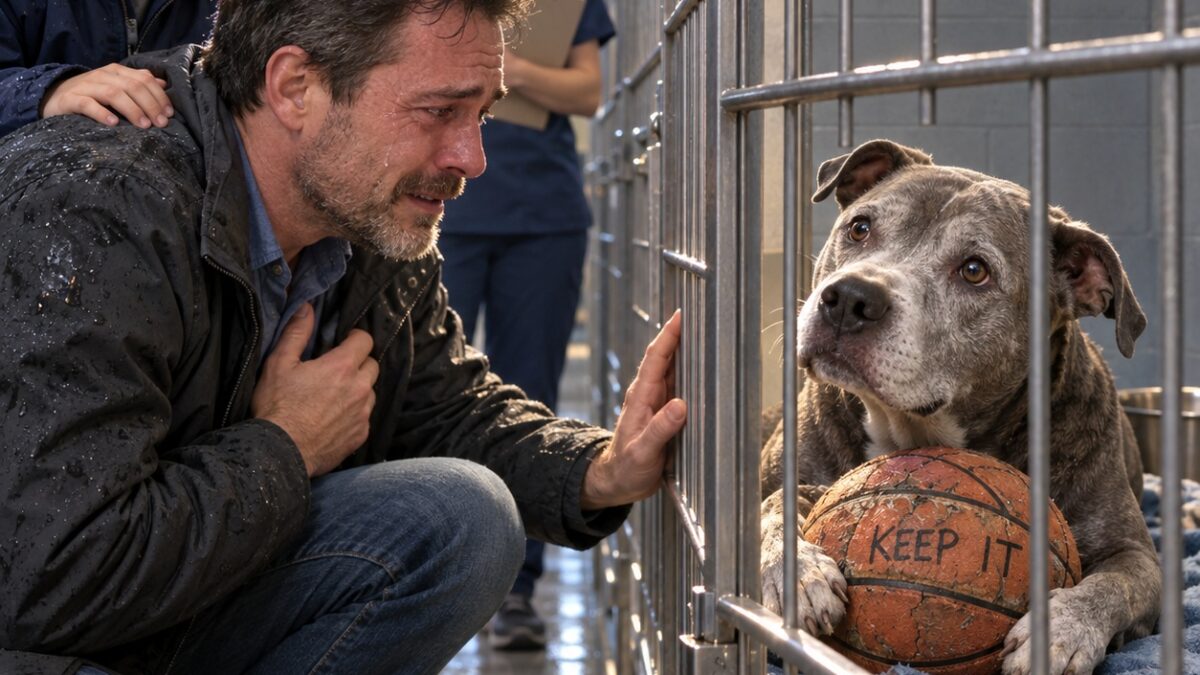
Now one was inside a shelter kennel.
Between the paws of his dog.
“Buster.”
I said the name again.
The pit bull’s head lifted.
Slowly.
His eyes were older.
Tired.
But I knew those eyes.
I had seen them under Julian’s dinner table.
In his car.
At practices.
On Sunday walks.
Buster had once been a muscular, ridiculous bundle of energy who believed every basketball had been created for him personally.
Julian adopted him at around ten months old.
A rescue.
Too much energy.
No manners.
Terrified of raised voices.
Within six months, the dog followed Julian everywhere.
Practices.
Jogging.
My house.
Family cookouts.
If Julian sat, Buster sat.
If Julian moved, Buster moved.
If Julian touched a basketball, Buster lost his mind.
He would chase it.
Push it with his paws.
Bark.
Spin.
Julian eventually taught him a game.
He would roll the ball to someone.
Buster would push it back.
Then, when Julian trusted someone completely, he would point and say:
“Give it.”
Buster would nudge the basketball toward that person’s feet.
Julian joked it was Buster’s way of choosing people.
“He doesn’t give the ball to anybody.”
“Because you trained him not to.”
“Details.”
I had forgotten all of that until I stood outside that kennel.
Leo looked up at me.
“Dad?”
I could not answer.
The shelter worker asked:
“You know him?”
I nodded.
Or tried to.
“This was my friend’s dog.”
“Your friend?”
“Julian.”
The name almost did not come out.
“He died.”
Her expression changed.
“Oh.”
“When did Buster come here?”
She hesitated.
“Three years ago.”
My stomach dropped.
“Three years?”
“Yes.”
“Exactly three?”
“Almost.”
I stared at her.
“He’s been here the whole time?”
“Mostly.”
“What does mostly mean?”
“He had two trial adoptions.”
My voice became sharper.
“What happened?”
“Both families returned him.”
“Why?”
“He shut down.”
I looked at Buster.
“He wouldn’t play. Barely ate. Guarded the basketball. Sat by doors. The first family thought he was depressed.”
“He was.”
“The second family kept him almost two weeks. He escaped through a gate and came back toward this area.”
“Toward the shelter?”
“Yes.”
I closed my eyes.
Three years.
Three years while I had told myself someone else had taken care of him.
Three years while I complained about my divorce.
My rent.
My exhaustion.
Three years while Julian’s dog slept in a concrete kennel beside one destroyed basketball.
I crouched.
“Buster.”
He stared.
Maybe he remembered my voice.
Maybe only the name.
I reached toward the bars.
He did not come closer.
“Hey, man.”
My voice broke.
That was what I used to call him.
Not buddy.
Not boy.
“Hey, man.”
Buster stood.
Slowly.
He picked up the basketball in his mouth.
It barely fit.
Then he walked toward me.
Leo became completely still.
Buster reached the bars.
Dropped the basketball.
Sniffed my hand.
Long.
One breath.
Another.
Then his eyes changed.
I do not know how else to say it.
Recognition is not always dramatic.
No barking.
No jumping.
His body simply softened.
He pushed his muzzle between the bars.
I put both hands around his face.
“Oh God.”
Buster closed his eyes.
I started crying.
Harder than I had at Julian’s funeral.
That sounds terrible.
Maybe it was because grief at funerals has witnesses.
You control yourself.
Shake hands.
Thank people.
Listen to stories.
Sign things.
Stand straight.
But this?
No preparation.
No suit.
No cemetery.
Just one old dog remembering me.
I sank to my knees.
The shelter worker quietly opened the kennel.
Buster did not rush out.
He stepped toward me.
Then pressed his head against my shoulder.
A long, deep sound came out of him.
Almost a groan.
Almost a sigh.
Three years.
That is what it sounded like.
Three years leaving his body in one breath.
I wrapped both arms around him.
“I’m sorry.”
His head grew heavier against me.
“I’m so sorry.”
I had no idea whether I was apologizing for not finding him.
For Julian dying.
For assuming.
For my own life being too broken to ask one simple question:
Where did Buster go?
Leo knelt beside us.
He placed one small hand on Buster’s back.
Buster opened his eyes.
Looked at him.
Leo whispered:
“Hi.”
Buster sniffed his fingers.
Then leaned back into me.
My son looked at my face.
“Dad, who’s Julian?”
That question hurt.
Not because Leo had never heard the name.
He had.
But Julian died when Leo was little.
To him, Julian was a photograph.
A story fragment.
One of Dad’s old friends.
I looked at Buster.
“My best friend.”
“Like Uncle Ryan?”
“No.”
I thought.
“Different.”
Leo waited.
“He was my brother without being my brother.”
My son nodded as if that made perfect sense.
Kids understand chosen family.
The shelter worker asked quietly:
“Would you like some time?”
“Yes.”
She left.
I sat on the floor of Buster’s kennel.
Leo beside me.
Buster between us.
The basketball against my leg.
I picked it up.
Surface nearly smooth.
One seam splitting.
KEEP IT barely visible.
I ran my thumb over the letters.
Julian’s handwriting.
Same lazy K.
Same crooked T.
My eyes filled again.
Leo asked:
“Did Julian write that?”
“Yes.”
“What does it mean?”
I laughed weakly.
“Long story.”
“We have time.”
That sounded exactly like something Julian would have said.
I looked at Leo.
Then Buster.
“Yeah.”
“We do.”
The shelter records filled in the pieces I had never known.
After Julian died from sudden cardiac arrest following an ordinary evening practice, his parents had been shattered.
His mother could not enter his apartment without breaking down.
His father handled the legal things.
Buster temporarily went to a relative.
That relative had two dogs.
The arrangement failed.
Another family friend tried.
Buster escaped.
Eventually, overwhelmed and grieving themselves, the family surrendered him to the shelter with the hope that a stable home would adopt him quickly.
Everyone assumed it would happen.
Friendly pit bull.
House-trained.
Good with people.
Trained.
Healthy.
It should have been easy.
Except grief had changed him.
Buster refused to engage with families.
He would tolerate petting.
Follow basic commands.
Then return to his basketball.
A shelter employee had brought the ball with him because it was the one object that calmed him.
No one knew its significance.
They only knew Buster would panic if separated from it.
So the ball stayed.
Year one.
Year two.
Year three.
Staff changed.
Volunteers changed.
Buster remained.
He became a shelter favorite.
The dog everyone loved but nobody could reach completely.
I felt sick.
“Why didn’t anyone contact Julian’s friends?”
The worker looked uncomfortable.
“We had the surrender contact.”
“His family.”
“Yes.”
“They knew he was still here?”
“At first.”
My chest tightened.
“What do you mean at first?”
“His father died the following year.”
I stared.
“And his mother moved out of state.”
That silenced me.
Grief had scattered everyone.
No villain.
Just people barely surviving.
The same thing I had done.
I had not abandoned Buster intentionally.
Neither had they.
But intention does not change the kennel.
I looked at Leo.
Then Buster.
Then the basketball.
“We’re taking him.”
Leo’s mouth opened.
“Really?”
I nodded.
“Really.”
The shelter worker looked surprised.
“You should think about it.”
“I have.”
“For more than twenty seconds.”
“I’ve known this dog for eight years.”
“You knew him.”
The distinction landed.
She continued.
“He’s older now. He has arthritis starting in his hips. He has separation anxiety. Shelter stress. He may need decompression.”
“I understand.”
“He may not become the dog you remember.”
“I don’t need him to.”
That answer came quickly.
Because I meant it.
I had spent three years learning the cruelest lesson grief teaches:
Nothing comes back exactly as it was.
You either love what remains or spend your life arguing with time.
“I’m taking him home.”
Leo looked at me.
“Us.”
I corrected myself.
“We’re taking him home.”
Paperwork could not be completed that minute.
Background checks.
Landlord approval.
Veterinary review.
Adoption process.
The rental allowed dogs, thankfully.
I called the landlord from the shelter parking lot.
“What breed?”
I hesitated.
“Pit bull.”
Silence.
My stomach tightened.
Then:
“How old?”
“About eleven.”
Another pause.
“Does he destroy stuff?”
“He’s spent three years protecting one basketball.”
My landlord laughed.
“Fine.”
“Seriously?”
“You pay on time.”
“Thank you.”
“No puppies.”
“He’s definitely not a puppy.”
When I returned to the kennel, Buster was lying beside Leo.
My son had one hand resting on his back.
The basketball between them.
Leo was talking softly.
Not to me.
To him.
“We have a yard.”
Buster’s ear moved.
“There’s a big tree.”
Ear again.
“My room’s upstairs, but you can sleep there if Dad says yes.”
I said:
“Yes.”
Leo looked at me.
“You weren’t supposed to listen.”
“I’m three feet away.”
He returned to Buster.
“And Dad snores.”
“I do not.”
Buster looked at me.
“Don’t take his side.”
For the first time in years, something in my chest loosened.
The adoption was finalized two days later.
I barely slept between those days.
I pulled old boxes from storage.
Found Julian photographs.
Three basketballs.
One had KEEP IT written across it.
I sat on my living-room floor holding that ball for almost an hour.
I remembered the night Julian died.
Tuesday.
He had practiced.
Called me afterward.
I did not answer.
That fact had lived inside me like a stone for three years.
He left a voicemail.
“Man, call me back. We gotta talk about Saturday.”
Nothing urgent.
No goodbye.
No warning.
I listened to it the next morning after his sister called.
I had replayed it hundreds of times.
Sometimes guilt is irrational and still permanent.
If I had answered, he still would have died.
I knew that.
But grief asks impossible questions.
What if?
What if?
What if?
Buster had probably heard Julian’s last normal evening.
Watched him leave.
Maybe waited by the door.
Then strangers came.
Then Julian never returned.
Another form of what if.
No wonder he held the ball.
I understood the object differently now.
It was not a toy.
It was evidence.
Julian existed.
This smelled like him once.
He touched this.
We played with this.
Keep it.
Buster had obeyed.
For three years.
Adoption morning arrived.
Leo wore his favorite blue hoodie.
I brought a blanket.
Treats.
Water.
The shelter worker smiled when she saw us.
“He’s waiting.”
That word again.
We walked down the corridor.
Buster stood before we reached his kennel.
Tail moving.
Not wildly.
But moving.
“Hey, man.”
He came to the door.
The worker opened it.
Buster walked out carrying the basketball.
Of course.
Leo laughed.
“He’s really bringing it?”
“It goes where he goes.”
Outside, Buster stopped at my car.
Sniffed.
Looked at me.
Cars used to mean adventures with Julian.
Practices.
Parks.
My house.
Maybe he remembered.
I opened the rear door.
Leo climbed in first.
Buster put his front paws up.
Hesitated.
Then jumped.
Ball still in his mouth.
He settled beside Leo.
Placed the ball between his paws.
My son touched his shoulder.
“Ready?”
Buster looked toward me in the driver’s seat.
I met his eyes in the mirror.
“Home.”
He lowered his head onto the ball.
The drive was almost silent.
Not uncomfortable.
Peaceful.
Leo talked enough for everyone.
He explained the house.
His toys.
Our backyard.
The tree.
Where the sun hit the grass in the afternoon.
The fact that I sometimes burned pancakes.
I objected.
He ignored me.
Buster listened.
Every change in Leo’s tone made his ears tilt.
At a red light, I looked in the mirror.
My son.
My best friend’s dog.
Julian’s basketball.
For years, family had felt like something shrinking.
Divorce.
Death.
Separate holidays.
Empty chairs.
Now something unexpected was expanding.
We reached the house.
Buster stood at the doorway.
Would not cross.
I did not pull.
Leo went inside.
Sat on the floor.
“Come on, Buster.”
Nothing.
I entered too.
Left the door open.
Buster sniffed.
One paw.
Then another.
Finally inside.
He explored slowly.
Kitchen.
Living room.
Hallway.
Stairs.
He did not climb them yet.
Every room received a careful inspection.
Then he returned to the living room.
Late-afternoon sun fell across the rug.
Buster walked into the warm patch.
Turned once.
Twice.
Lay down.
Placed the basketball between his paws.
Rested his muzzle on it.
Closed his eyes.
His body changed.
I noticed immediately.
The tension in his back released.
His legs loosened.
One deep breath.
Then another.
Leo sat cross-legged beside him.
He scratched the top of Buster’s head.
“Dad?”
“Yeah?”
“Tell me about Julian.”
I sat on the floor.
For the next three hours, I did.
I told him about the first basketball to the chest.
The cracked neighborhood court.
Julian laughing when I missed everything.
High school games.
Cheap pizza.
Road trips.
The time Julian drove three hours with the parking brake partly engaged and insisted the smell was “probably outside.”
Leo laughed so hard he fell backward.
I told him Julian was generous.
Too generous.
Loaned money he did not have.
Helped people move.
Visited injured teammates.
Remembered birthdays.
Called my mother every Mother’s Day after his own mother moved away.
I told Leo about Buster.
How Julian found him.
Scared young pit bull.
Returned twice by previous adopters for being “too much.”
Julian saw him in a rescue video.
“That’s my dog.”
He adopted Buster the next morning.
“He knew immediately?”
“Yes.”
“Like us?”
I looked at Buster.
“Maybe.”
I explained the basketball game.
Julian would push the ball.
Buster returned it.
And sometimes, when Julian wanted to show off, he told Buster to give the ball to somebody.
“Did he give it to you?”
“Eventually.”
“How long?”
“Six months.”
Leo smiled.
“So he didn’t trust you.”
“I was offended.”
“What happened?”
“One day Julian said, ‘Give it to Alex.’ Buster pushed the ball across the driveway and sat at my feet.”
“What did Julian say?”
I remembered perfectly.
“Told you. He knows family.”
My voice broke.
Leo noticed.
He moved closer.
Buster opened his eyes at Julian’s name.
Every time I said it, he listened.
I started wondering whether the sound itself remained comforting.
“Julian.”
Buster’s ears lifted.
Leo whispered:
“He remembers.”
“Yes.”
“Do dogs remember for three years?”
I looked at the basketball.
“Apparently some things stay.”
That first night, Buster refused the dog bed we bought.
Instead, he slept on the rug with the basketball.
Leo wanted him upstairs.
Buster would not take the stairs.
Arthritis.
Fear.
Maybe both.
So Leo brought a pillow downstairs.
I found him at midnight sleeping beside Buster.
“No.”
My son opened one eye.
“What?”
“You have school.”
“So?”
“Bed.”
“Buster needs me.”
“Buster slept alone for three years. He can manage one night.”
Leo sat up.
“That’s exactly why I should stay.”
Children are unfair when they use logic.
I sighed.
“Fine. Couch.”
We arranged blankets.
Leo slept on the couch.
Buster on the rug beneath him.
I stood in the doorway.
For a moment, Julian’s absence hit so hard I had to grip the frame.
He should have seen this.
He should have grown older.
He should have known Leo better.
He should have laughed at my divorce drama.
He should have complained about his knees after basketball.
He should have been here.
Grief does not care how many years pass.
It waits around corners.
Buster lifted his head.
Looked at me.
I whispered:
“I know.”
His tail moved once.
The first few weeks were difficult.
Buster followed us but remained emotionally cautious.
If Leo left a room quickly, Buster watched the doorway.
If I picked up car keys, he became tense.
If we went outside without him, he paced.
The first time I left for work after adoption, he tried to follow me through the door.
I stayed.
Called my manager.
“I’m going to be late.”
“Why?”
“Dog.”
Pause.
“Your son okay?”
“Dog problem.”
Another pause.
“You got a dog?”
“Long story.”
“Ten minutes.”
“Thanks.”
I sat beside Buster near the front door.
“You think I’m not coming back.”
He stared.
“Yeah.”
I knew that fear.
I had it too.
When someone leaves unexpectedly, ordinary departures become suspicious.
So we trained with tiny absences.
I stepped outside.
Thirty seconds.
Returned.
Buster watched.
Again.
One minute.
Returned.
Five minutes.
Returned.
Then work.
Leo came home before me that afternoon.
When I opened the door after six, Buster stood in the hallway.
He stared.
Then his tail started moving.
I crouched.
“See?”
He walked toward me.
Pressed his head against my chest.
“I came back.”
That became our routine.
Every departure had an ending.
Groceries.
Work.
School.
Dinner.
We came back.
Trust is often boring repetition.
Buster needed boring.
So did I.
His appetite improved.
At the shelter, he ate enough.
At home, he became a pit bull with opinions.
He hated dry food unless something interesting was mixed into it.
Chicken.
Broth.
Egg.
I accused Julian of creating that habit.
Buster offered no defense.
He gained healthy weight.
His coat became brighter.
The arthritis medication helped.
The shelter veterinarian had warned us not to expect puppy behavior.
Then one Saturday, three weeks after adoption, Leo rolled a tennis ball through the backyard.
Buster watched.
No reaction.
Leo rolled it again.
Buster stood.
I froze.
Third roll.
Buster chased.
Not fast.
But he chased.
Leo screamed:
“Dad!”
“I see!”
Buster reached the ball.
Sniffed it.
Looked unimpressed.
Then turned toward the porch.
Leo’s shoulders dropped.
I laughed.
“He has standards.”
The next day, Leo brought out the basketball.
The old one.
I almost stopped him.
That ball felt sacred.
Too fragile.
Too much history.
Leo set it in the grass.
Buster stood instantly.
His entire posture changed.
Tail up.
Ears forward.
Leo nudged the ball.
It rolled three feet.
Buster approached.
Touched it with one paw.
Roll.
Leo laughed.
Buster pushed again.
Faster.
Suddenly they were moving.
Leo running.
Buster bumping the ball with his paws.
The same game.
My chest hurt.
I stood in the kitchen doorway.
For a second, I saw Julian.
Not literally.
Memory.
Twenty-seven years old.
Laughing.
Calling to Buster.
“Push it!”
Then Leo shouted:
“Come on!”
Buster ran.
The old basketball that had spent three years pinned beneath his body like a relic was moving again.
That was the moment I understood recovery.
At the shelter, the ball represented before.
Do not take this.
Do not change this.
This is all I have.
In our yard, the same ball became a game again.
No longer just memory.
Use.
Joy.
Noise.
The past moving instead of freezing.
I cried where nobody could see.
Or so I thought.
Leo spotted me.
“Dad?”
“Allergies.”
“You’re inside.”
“Powerful allergies.”
He rolled his eyes.
Buster kept playing.
Over the next months, something remarkable happened between Leo and Buster.
They chose each other.
At first Buster slept near me.
Then halfway between my room and Leo’s.
Once he learned the stairs, everything changed.
I found him at Leo’s bedroom door one morning.
Then inside.
Then beside the bed.
Eventually at the foot of it.
Leo would read aloud before sleeping.
Adventure books.
Comics.
Whatever school assigned.
Buster listened.
Or slept.
Same difference.
My son began taking responsibility without being asked.
Water bowl.
Food.
Walks.
Brushing.
He saved allowance money for a new collar.
Gray with orange stitching.
Basketball colors.
Buster tolerated baths only when Leo stood beside the tub.
I realized one day that my son had become gentler.
Not weak.
Gentler.
He paid attention to mood.
Body language.
Silence.
“Buster doesn’t like when people hug his neck.”
“How do you know?”
“He gets stiff.”
I looked.
Leo was right.
“So I hug his chest instead.”
Nine-year-old wisdom.
Buster taught him consent better than many adults learn it.
One afternoon, Leo came running into the kitchen.
“Dad!”
“What happened?”
“You have to see.”
“Is anyone bleeding?”
“No.”
“Anything broken?”
“No.”
“Then lower the volume.”
“Come on!”
He grabbed my wrist.
Dragged me outside.
Buster stood near the old basketball.
Leo positioned himself several feet away.
“Watch.”
He pointed.
“Buster.”
The dog looked at him.
Leo tapped his foot.
I almost stopped breathing.
Buster looked at the ball.
Then at Leo.
Then he pushed it.
Not hard.
The ball rolled slowly across the grass.
Stopped against Leo’s sneakers.
Buster sat.
Looked up.
My son’s face lit.
“See?”
I swallowed.
“Yeah.”
“He gave it to me.”
“Yes.”
“That means what you said, right?”
I could not speak immediately.
Julian’s voice came back.
He knows family.
Leo waited.
I put one hand on his shoulder.
“Yeah, buddy.”
My throat tightened.
“It means he trusts you.”
“All the way?”
I looked at Buster.
He watched Leo with the same softness he once reserved for Julian.
“All the way.”
Leo hugged me.
Then crouched.
Buster leaned into him.
Something inside me finally broke open in a good way.
For years, I thought grief preserved people by keeping them unchanged inside memory.
I did not want Julian to become an old story.
So I avoided talking about him too much.
Avoided his old court.
Avoided games.
Avoided photographs.
As if silence protected him.
Buster taught me the opposite.
Memory stays alive through use.
Tell the joke.
Bounce the ball.
Say the name.
Teach the child.
Love someone new with something the dead person taught you.
That is how people continue.
Julian was not disappearing because Leo had never known him.
I could build a bridge.
So I did.
We went to the old basketball court.
First time for me in almost four years.
The asphalt had more cracks.
Rim bent slightly.
New graffiti on the backboard pole.
I stood near the three-point line.
Leo bounced the ball.
A newer one.
Not Buster’s.
Buster sat near the bench.
I showed Leo where Julian hit his first game-winning shot in high school.
“That happened here?”
“Practice game.”
“So it didn’t count.”
“Do not disrespect history.”
Leo laughed.
I showed him the spot where I sprained my ankle.
The fence Julian once climbed to retrieve a ball.
The bench where we sat after Julian learned he made the semipro roster.
Buster sniffed everything.
At one point he stopped near the baseline.
Sat.
Looked toward the court.
Maybe scent was gone.
Of course it was.
Maybe memory connected through shape.
Who knows.
I sat beside him.
“You remember?”
Buster leaned against my leg.
Leo took a shot.
Missed.
I shouted:
“That was terrible!”
“Shut up!”
Julian would have approved.
Eventually I contacted Julian’s mother.
We had spoken rarely since his death.
Grief creates strange distance.
People connected to the dead sometimes avoid one another because seeing each other activates too much.
I called.
“Mrs. Parker?”
“Alex?”
Her voice immediately aged me backward.
“Yes.”
“Is everything okay?”
“I found Buster.”
Silence.
Then a sharp breath.
“What?”
I explained.
Shelter.
Three years.
Ball.
Adoption.
Leo.
She cried.
So did I.
“I thought he was adopted.”
“So did I.”
“After Henry died, I couldn’t…”
“I know.”
“No, Alex. I should have checked.”
“I should have too.”
We spent several minutes taking turns blaming ourselves.
Then stopped because blame had nowhere useful to go.
She asked:
“Can I see him?”
“Yes.”
She flew in two weeks later.
I worried about Buster’s reaction.
Would he remember her?
She had been part of Julian’s life constantly.
Family dinners.
Holidays.
Practices.
Buster knew her well.
When Mrs. Parker entered the backyard, Buster stared.
She whispered:
“Baby.”
His tail stopped.
Then started.
He walked toward her.
Slowly.
Sniffed.
Mrs. Parker knelt.
“Buster.”
He leaned into her.
She wrapped her arms around him and cried into his neck.
“I’m sorry.”
The same words I had used.
Buster accepted us both.
No tribunal.
No punishment.
Just recognition.
Later, Mrs. Parker held the basketball.
Her fingers traced KEEP IT.
“Julian wrote this.”
“I know.”
She laughed through tears.
“He ruined every ball with marker.”
“He said it added value.”
“He was an idiot.”
“The best.”
We sat on the patio.
Leo listened while she told new Julian stories I had forgotten.
Baby Julian.
Teenage Julian.
The time he broke a lamp practicing dribbling indoors and blamed the cat.
They never owned a cat.
Leo laughed.
Buster slept between us.
That evening, Mrs. Parker said something I needed.
“You know Julian would be relieved.”
“About what?”
“Buster.”
I looked at the dog.
“I should’ve found him sooner.”
“So should I.”
She touched my hand.
“But we didn’t.”
“No.”
“And now?”
“He’s here.”
She nodded.
“Then be here too.”
That sentence stayed.
Be here too.
I had spent years with half my mind in the past.
Replaying Julian’s missed call.
My marriage.
Mistakes.
Alternate endings.
Buster had spent three years physically curled around the past.
Now he played in the yard.
If he could move, maybe I could.
My divorce did not magically heal because of a dog.
Co-parenting remained frustrating.
Money remained tight.
Two jobs were still exhausting.
But home changed.
Before Buster, our house felt temporary.
Rental furniture.
Cardboard boxes still unopened months after moving.
After him, routines formed.
Leash near the door.
Food bin.
Orange-gray collar on a hook.
Basketball in the corner.
Leo’s shoes beside Buster’s bed.
Life leaves marks when it intends to stay.
I started unpacking.
Hung photographs.
Including Julian.
One image showed us at seventeen.
Sweaty.
Holding a basketball.
Making stupid faces.
Leo asked if we could frame one of Julian and Buster too.
We did.
Placed it near Buster’s bed.
For a while, he would sometimes look toward it.
Maybe coincidence.
Maybe not.
I stopped needing answers.
A year after adoption, Buster became something of a neighborhood celebrity.
Not because of his story.
Mostly because Leo told everyone.
Kids came to play basketball with him.
Buster could no longer run like he used to, but he would push the ball around the yard.
Children cheered.
He loved attention.
The shelter staff visited once.
The woman who had cared for him longest stood at the gate and cried immediately.
“I knew he had this in him.”
Buster ran—or his version of running—toward her.
She knelt.
“You look so good.”
I showed her the old ball.
Still intact.
Barely.
“We’re thinking about retiring it.”
She laughed.
“Good luck.”
We tried.
Bought another basketball.
Buster played with it.
But at night, he still wanted the old one nearby.
So we compromised.
New ball outside.
Old ball inside.
Memory and future.
Both.
That became a theme.
I started coaching Leo’s youth team.
I had resisted when another parent asked.
“No time.”
“You played.”
“Years ago.”
“You know basketball.”
“Unfortunately.”
Then Leo said:
“Julian would make you.”
Unfair.
I coached.
Standing in a gym again hurt at first.
Whistles.
Sneakers.
Echo.
Crowd.
Everything returned.
But pain softened into familiarity.
I told the kids something Julian used to say:
“Make the pass you’d want somebody to make to you.”
Basketball advice.
Life advice.
Julian probably stole it from someone.
Still useful.
Leo knew where it came from.
Sometimes after games, he would hand me the ball.
“Keep it.”
I pretended annoyance.
Inside, something healed.
Buster aged.
Gray muzzle became white.
Hip stiffness increased.
Stairs got harder.
I installed a gate at the bottom so he would not hurt himself trying.
Leo protested.
“He wants my room.”
“So sleep downstairs sometimes.”
He did.
Friday nights became living-room campouts.
Mattress.
Blankets.
Movie.
Buster between us.
The first time we did it, I woke at three in the morning.
Leo asleep.
One hand resting on Buster.
Basketball near the dog’s paws.
I stared at them.
Julian would have loved that kid.
That thought no longer destroyed me.
It warmed me.
That was progress.
People say time heals.
I do not believe that exactly.
Time gives you opportunities to build things around the wound.
Memories.
Relationships.
Routines.
Meaning.
Eventually the wound stops being the only structure.
Buster helped build around mine.
He also forced me to confront another truth.
I had been angry at Julian.
I did not admit that for years.
Angry he died.
Angry he left.
I knew it was irrational.
His heart stopped.
He did not choose it.
Still, grief often disguises itself as anger because anger feels active.
One night, after Leo went to bed, I sat beside Buster.
I held the old basketball.
“You know I’m mad at him?”
Buster slept.
“Still.”
Nothing.
“He left me with all this.”
My voice cracked.
“Then you.”
Buster opened his eyes.
I laughed bitterly.
“Not his fault.”
The dog put his head on my thigh.
“I know.”
That was the first time I said it aloud.
Something eased.
We blame the dead because they cannot argue.
Sometimes saying the unfair thing is how you finally let it go.
I visited Julian’s grave the next weekend.
Buster came.
Leo too.
We brought no flowers.
Leo carried a basketball.
At the grave, I told him:
“This is Julian.”
Leo looked at the marker.
“Hi.”
Simple.
Buster sniffed around.
Then lay down near the stone.
I sat.
For a long time, we said nothing.
Then Leo asked:
“Do you think he knows Buster’s with us?”
I looked at my son.
“I don’t know.”
“What do you think?”
That was different.
I looked at Buster.
“I think if there’s any way to know, he knows.”
Leo nodded.
He placed the basketball beside the headstone.
Then picked it up again.
“What?”
“I think he’d want us to use it.”
I smiled.
“Yes.”
We went to the park after.
Played.
That day felt like closing something without ending it.
Buster eventually became Leo’s dog in every practical sense.
He waited for school buses.
Knew homework time.
Recognized soccer days.
Disliked the vacuum.
Loved peanut butter.
On nights Leo stayed with his mother, Buster became restless.
He would check the bedroom.
Front door.
Then settle beside me.
I understood.
“Different kind of waiting.”
He looked at me.
“He comes back Sunday.”
That sentence became part of our shared language.
He comes back.
People come back.
Not everyone.
But some.
That distinction matters.
Buster had learned the hardest version.
Julian did not.
Leo did.
I did.
The first time Leo spent a full week away during summer, Buster struggled.
So I placed one of Leo’s shirts near his bed.
Buster slept on it.
Sunday afternoon, he heard the car before I did.
He stood.
Tail beating.
Leo opened the door.
Buster almost knocked him over.
My son laughed.
“I came back!”
I had to look away.
Same words.
Different story.
One year became two.
Two became three.
Buster had now spent as much time with us as he had spent in the shelter.
That milestone hit me unexpectedly.
I told Leo.
“He waited three years?”
“Yes.”
“And now he’s been here three.”
“Yes.”
“So he has more good years now.”
I stopped.
“More recent good years.”
“That’s what I mean.”
Kids simplify in useful ways.
More recent good years.
That became enough.
We celebrated with a hamburger.
Vet-approved portion.
Mostly.
Buster inhaled it.
The basketball received a new place beside his bed.
We considered putting it in a clear case.
Leo objected.
“He still uses it.”
“He barely does.”
“Still.”
He was right.
Objects should not become museums while the living still need them.
So the ball remained cracked.
Dirty.
Loved.
One afternoon, Buster nudged it toward Leo again.
Slower than before.
Leo sat beside him.
“Good boy.”
Buster rested.
I watched.
The ritual no longer belonged only to Julian.
That once would have scared me.
Now I saw what it meant.
Tradition is memory that learns how to move.
Julian taught Buster.
Buster taught Leo.
Leo would remember.
Nothing copied perfectly.
Everything continued.
When Buster turned approximately thirteen, the veterinarian found a heart issue.
Small at first.
Manageable.
Medication.
Less exertion.
Monitoring.
The word heart terrified me.
Julian.
Same category.
Different condition.
I became obsessive.
“Dad, he’s okay.”
“He coughed.”
“Once.”
“He never coughs.”
“You cough.”
“That’s different.”
Leo rolled his eyes.
Our veterinarian eventually told me:
“Alex, you cannot monitor him into immortality.”
I disliked her for saying it.
She was right.
Buster still enjoyed life.
Food.
Sun.
Leo.
Short walks.
Basketball.
So we let him.
That year, Leo turned twelve.
The same age I had been when Julian threw that first ball at me.
I told him.
“Did you become friends right away?”
“No.”
“You said you did.”
“I edited.”
“What happened?”
“We hated each other for two weeks.”
“Why?”
“He was annoying.”
“You loved him.”
“Both can happen.”
Leo considered.
“Like you and Mom?”
I nearly choked.
“Different.”
He laughed.
Buster slept through my humiliation.
We took Leo to the old court on his birthday.
Mrs. Parker came too.
Caleb—one of Julian’s old teammates—joined us.
We played badly.
Buster watched from a shaded spot.
At sunset, I handed Leo a basketball.
New.
On one panel I had written:
KEEP IT.
He stared.
“Seriously?”
“Tradition.”
“Dad.”
“Take it.”
He smiled.
Mrs. Parker cried.
I did too.
Buster opened his eyes when everyone clapped.
That may have been the happiest grief had ever felt.
Not absent.
Transformed.
Buster’s final decline started quietly.
More sleeping.
Then appetite changes.
Less interest in the yard.
He still greeted Leo.
Always.
Even when standing hurt.
The veterinarian adjusted medication.
For several months, things stabilized.
Then one morning Buster did not get up when Leo came downstairs.
My son froze.
“Dad.”
I was beside them immediately.
Buster looked at us.
Tail moved.
But he stayed down.
We carried him to the car.
The old basketball came too.
Tests showed cancer.
Advanced.
I hated everything about that room.
White walls.
Soft voice.
Options that were not really options.
The veterinarian gave us time.
Weeks maybe.
Months if lucky.
Comfort care.
I looked at Leo.
He was crying silently.
Buster leaned against his leg.
I wanted to fix it.
Fathers are supposed to want that.
There are things you cannot fix.
Only accompany.
That night, we put Buster’s bed in Leo’s room despite the stairs problem.
I carried him.
My son slept on the floor beside him anyway.
We made the remaining weeks gentle.
No unnecessary rules.
Hamburger.
Chicken.
Sun.
Visitors.
Mrs. Parker came.
Shelter staff.
People from Julian’s old team.
Everyone brought stories.
Buster received affection.
Mostly he wanted Leo.
That was fitting.
One afternoon, Mrs. Parker sat beside me while Buster slept.
“He chose well.”
“Who?”
“Buster.”
She looked toward Leo.
“He picked his next person.”
I swallowed.
“Julian taught him.”
“No.”
She smiled.
“Julian taught him how to love.”
Different.
Better.
Buster stopped playing with the basketball.
But he still slept near it.
Leo cleaned it gently with a damp cloth.
Not enough to remove the marker.
Never that.
One night, he asked:
“Dad, when Buster dies, do we bury the ball with him?”
I had not thought about it.
“What do you want?”
“I don’t know.”
He touched the cracked surface.
“It was Julian’s.”
“Yes.”
“Then Buster’s.”
“Yes.”
“And kind of mine.”
“Yes.”
He frowned.
“If we bury it, nobody gets it.”
I waited.
“If we keep it, is that wrong?”
“No.”
“Why?”
“Because Buster never needed the ball underground.”
Leo looked at me.
“He needed it when he was alive.”
“Exactly.”
My son nodded.
“We keep it.”
“Keep it.”
He smiled sadly.
The words had completed their circle.
Buster’s last morning was warm.
Spring.
Windows open.
He could no longer stand without help.
The veterinarian came to the house.
We did not make him travel.
Buster lay on his favorite rug in a patch of sunlight.
Leo sat beside him.
I sat on the other side.
The basketball touched one paw.
Buster’s breathing was slow.
I put my hand on his head.
“Hey, man.”
His eyes opened.
That phrase again.
First meeting.
Last morning.
Leo whispered:
“I love you.”
Buster’s tail moved once.
Then my son said something that nearly broke me.
“You can go see Julian.”
I closed my eyes.
The veterinarian waited.
No rush.
Leo leaned down.
“But if you can’t, that’s okay too.”
I looked at him.
He was crying.
“Just don’t hurt anymore.”
That was love.
Not ownership.
Not keeping.
Permission.
I touched Buster’s ear.
“You did good.”
His eyes moved toward me.
“You kept it.”
My hand rested on the ball.
“All these years.”
I swallowed.
“Now we’ve got it.”
Buster exhaled.
The medication worked gently.
His body relaxed.
Head heavy against Leo’s leg.
No fear.
No kennel.
No waiting.
He died surrounded by us.
For several minutes, neither Leo nor I moved.
Then my son put both arms around Buster.
I held both of them.
Three generations of a friendship, if you count properly.
Julian.
Me.
Leo.
Buster linking us all.
We cremated Buster.
His ashes came home in a simple wooden box.
No fancy inscription.
Leo chose one line.
BUSTER
HE NEVER STOPPED LOVING
The basketball remained beside the box for a while.
Then one day Leo picked it up.
“Can we take it outside?”
I hesitated.
“Why?”
“He’d want us to.”
I smiled.
“Yeah.”
We brought it into the yard.
Too damaged to bounce.
Leo rolled it.
I rolled it back.
We sat in the grass.
For a moment, the ball stopped between us.
Neither touched it.
Then Leo pushed it with his foot.
“Your turn.”
I pushed it back.
That became a quiet ritual.
Not every day.
Sometimes.
Years later, the ball became too fragile even for that.
We placed it on a shelf.
Beside photographs.
Julian holding Buster as a young dog.
Buster with Leo.
Julian and me as teenagers.
Three basketballs.
One old collar.
Not a shrine.
History.
There is a difference.
My life continued.
Leo grew.
My divorce stopped feeling like a daily emergency.
I eventually reduced my work hours.
Moved into a better house.
Coached more basketball.
Laughed more.
Grief did not disappear.
It became integrated.
Julian’s name became easy to say again.
Buster’s too.
Sometimes new friends of Leo would see the old basketball and ask:
“Why do you keep that thing?”
Leo always answered differently.
Sometimes:
“It was my dog’s.”
Sometimes:
“It belonged to my dad’s best friend.”
Sometimes:
“It’s complicated.”
My favorite answer came when he was sixteen.
A friend asked:
“Why not throw it away?”
Leo looked at the faded marker.
“Because some things are worn out, not finished.”
I wrote that down later.
He got that wisdom from somewhere.
Maybe Julian.
Maybe Buster.
Maybe grief.
Leo became a good basketball player.
Not great.
Good.
Enough to love the game without letting it own him.
Before one important high-school game, he handed me his ball.
“Hold this.”
“Why?”
“Tradition.”
After the game, he found me in the stands.
I tossed it toward him.
“Keep it!”
He laughed.
For one second, Julian stood inside that laugh.
Not ghost.
Echo.
I understood then what people mean when they say the dead live on.
Not literally.
I cannot prove anything beyond death.
But influence?
Absolutely.
Julian lives in the way I pass a ball.
In the way Leo trusts dogs.
In the way we open our home.
In one phrase written in black marker.
In Buster’s old habit of offering what he loved to people he trusted.
That is continuation.
When I think back to the shelter now, what hurts most is not the three years Buster spent there.
Though that will always hurt.
What stays with me is the moment he recognized me.
He had every reason to stop trusting people.
Everyone from his old life disappeared.
Julian died.
Family changed.
Homes failed.
Adoptions failed.
Doors closed.
Yet when I said his name, something inside him opened.
That is courage.
We talk about pit bulls as strong animals.
Muscle.
Jaw.
Power.
Buster’s greatest strength was none of those.
It was his willingness to attach again.
To Leo.
To me.
To a new home.
After losing the center of his world.
That takes a kind of bravery humans understand badly.
We protect ourselves after loss.
Close doors.
Lower expectations.
Do not love too much.
Do not need anyone.
Buster had tried that for three years.
Ball under chin.
Corner kennel.
Past preserved perfectly.
Then I showed up.
Then Leo.
And eventually he risked joy.
That is what I remember.
Risked joy.
Because happiness after grief feels dangerous.
If you love something again, you can lose again.
Buster did.
So did I.
And I would still choose it.
Every second.
That is the lesson Julian never got to teach me himself.
Buster did it for him.
I sometimes wonder what would have happened if Leo had not asked to visit the shelter that rainy Saturday.
Maybe another family eventually adopted Buster.
Maybe not.
Maybe I found out later.
Maybe never.
Those possibilities bother me less now.
We happened to arrive.
We recognized each other.
Then we acted.
That is enough.
I used to believe fate was some giant invisible system arranging lives.
Now I think maybe fate is simply what we call the moment opportunity and recognition meet.
I saw Buster.
He saw me.
Leo saw both of us.
We chose what came next.
That choice became a family.
One of the shelter workers once told me:
“You gave Buster his life back.”
I disagreed.
“No.”
“What do you mean?”
“He had a life.”
She looked confused.
“It was painful.”
“Yes.”
“But it was still his.”
I thought about it.
“We gave him somewhere new to put the love.”
That felt more accurate.
Buster had never lacked love.
That was the problem.
He had nowhere to give it after Julian died.
So he gave it to a basketball.
A cracked orange object that smelled like memory.
Then to me.
Then Leo.
Then our house.
His love did not restart.
It redirected.
Maybe mine did too.
For a long time after Julian’s death, I thought the love I had for him had become useless.
Pain with nowhere to go.
Then Buster needed it.
Then Leo needed stories.
Then kids I coached needed patience.
Then Mrs. Parker needed someone who still remembered her son before the obituary.
Love found work.
That is what saved me.
Not moving on.
Putting love back to work.
Today, the old basketball sits in a glass-front cabinet Leo built for it.
He finally allowed protection.
Not because we worship it.
Because it is falling apart.
The words KEEP IT are almost invisible now.
You need the right angle.
Right light.
But they remain.
I sometimes stand there alone.
Touch the glass.
Remember Julian throwing a ball over a crowd.
“Keep it, Alex!”
At seventeen, I thought he meant until next weekend.
At twenty-five, until the next game.
At thirty, it was a joke.
Now I understand differently.
Keep the stories.
Keep the kindness.
Keep the people alive in what they taught you.
Keep what matters long enough to pass it forward.
Not everything.
You cannot.
Time takes objects.
Bodies.
Voices.
Even memory changes.
But some things can move through you.
Julian to Buster.
Buster to Leo.
Julian to me.
Me to my son.
One day, maybe Leo to someone I will never meet.
That is enough.
The last photograph I have of Buster was taken about two weeks before he died.
He is lying at the foot of Leo’s bed.
White muzzle.
Eyes half closed.
The old basketball against his paws.
Leo is asleep above him.
One hand hanging over the mattress.
Buster’s nose almost touching his fingers.
That photograph is my favorite.
Not because it is sad.
Because it completes something.
Three years before, Buster lay alone in a shelter kennel with the ball.
Waiting.
In the photograph, he had the same ball.
But he was no longer waiting.
He was home.
That difference is everything.
People sometimes think home means the place where nothing bad happens.
That is impossible.
Bad things happened in our house.
Arguments.
Sickness.
Bills.
Grief.
Eventually death.
Home means something else.
It means pain has company.
It means somebody notices when you enter.
It means someone knows which object matters and does not throw it away.
It means when your old world ends, maybe—if you are lucky—there is another person willing to sit on the floor beside you until a new one begins.
Buster got that.
So did I.
Leo did too, though he was too young to understand at first.
He understands now.
He once asked me whether Buster loved Julian more than us.
I answered immediately.
“Different question.”
“What do you mean?”
“Love isn’t a ranking.”
“But Julian was first.”
“Yes.”
“Does that mean more?”
“No.”
I thought.
“It means first.”
Leo nodded slowly.
“Then what were we?”
“Next.”
He smiled.
“That sounds worse.”
“It isn’t.”
I looked toward Buster sleeping.
“Sometimes being next is the most important job in the world.”
I believe that even more now.
You cannot become the person someone lost.
You can become the person who stays afterward.
That is sacred enough.
Julian was Buster’s first home.
We were next.
Buster was one of the bridges from the worst period of my life into everything that followed.
He did not erase Julian.
He carried him into our house.
He did not replace my marriage.
He helped me believe a broken family could still become a family.
He did not magically fix Leo.
He gave my son something to care for and trust.
And in return, Leo gave an old dog a child to watch over again.
Fair trade.
If Julian could have seen them together, I know exactly what he would have done.
He would have laughed.
He would have called me sentimental.
Then he would have thrown the ball toward Leo.
“Keep it.”
I can hear him.
Maybe that is memory.
Maybe it is imagination.
I do not care anymore.
The result is the same.
My son catches it.
Buster watches.
I stand nearby.
For a moment, nobody is gone.
That is what love can do.
Not reverse death.
Not undo abandonment.
Not return lost years.
It can connect what came before to what comes next strongly enough that the story does not end at the worst chapter.
Buster’s story could have ended in the last kennel of a shelter.
Gray muzzle.
Concrete floor.
One ruined basketball.
It did not.
Julian’s influence could have ended the night his heart stopped.
It did not.
My life could have become nothing but divorce papers, exhaustion, and grief.
It did not.
Leo could have grown up knowing Julian only as a name adults stopped saying because it hurt.
He did not.
Something continued.
Something always can.
That is what Buster taught me.
The beings we love do leave.
Sometimes suddenly.
Sometimes unfairly.
Sometimes before we are ready.
But love is stubborn.
It hides in routines.
Objects.
Animals.
Children.
Phrases.
Games.
Stories.
It waits.
Then one day you recognize it somewhere you never expected.
In my case, it was in the final kennel of an animal shelter.
A gray pit bull.
An old basketball.
Two faded words.
KEEP IT.
I did.
And then, when the time was right, I passed it on.








