PART2:The Doberman Wouldn’t Leave His Dead Owner—Then He Waited at the Shelter for the Cop Who Stayed Beside Him
PART2
The medical examiner arrived.
Then animal control.
There was paperwork.
Phone calls.
Questions about relatives.
The ordinary machinery that starts moving after someone dies.
Through all of it, Rex stayed beside the bed.
Animal-control officer Melissa Carter crouched several feet away.
“Rex?”
One ear moved.
His name was engraved on the tag attached to his collar.
“Come here, buddy.”
Nothing.
She offered food.
He turned his head away.
Water.
Nothing.
A leash.
Rex looked at it and then at Mr. Harris.
Melissa stood.
“He’s grieving.”
“I know.”
“Sometimes they won’t leave.”
“What happens?”
“We give him time.”
There was no family coming to take him.
A sister had died years earlier.
No children listed.
No emergency contact except an old number that had been disconnected.
Mr. Harris had apparently lived exactly as he died.
Quietly.
With one dog.
After nearly an hour, Rex still had not moved.
I sat on the floor.
Melissa looked at me.
“What are you doing?”
“I don’t know.”
That was true.
I leaned against the wall opposite the bed.
Not close to Rex.
Not reaching.
Just there.
He watched me.
His eyes were dark and tired.
“You did your job,” I said quietly.
Melissa raised an eyebrow.
I ignored her.
“You stayed.”
Rex blinked.
“That’s all anybody could have asked.”
Of course he did not understand the words.
Maybe he understood the voice.
I sat there another ten minutes.
Then fifteen.
Finally, Rex stood.
He walked to Mr. Harris’s hand.
Sniffed it.
Touched his nose to the fingers.
Then returned to the floor.
Melissa whispered, “Give him a little more.”
So we did.
Eventually she slipped the leash onto his collar.
Rex did not resist.
But when she moved toward the hallway, he stopped.
Looked back.
I had seen humans make that same movement.
At hospital doors.
At accident scenes.
At funerals.
That last look.
The mind knows.
The heart has not caught up.
I stood.
“Come on, Rex.”
His ears moved.
I walked beside him.
Not pulling.
Just walking.
He followed me through the hallway.
At the front door, he stopped again.
Looked back into the house.
I put one hand against his shoulder.
“I know.”
He trembled.
Only once.
Then stepped outside.
Animal control loaded him into their vehicle.
Before Melissa closed the door, Rex looked straight at me.
I remember thinking there was accusation in his eyes.
Maybe that is ridiculous.
Maybe I was projecting.
But it felt as though he were asking:
Are you leaving too?
I told him, “You’re going to be okay.”
Then Melissa closed the door.
And I went back to work.
That should have been the end.
It was not.
The next night, I dreamed about the bedroom.
Except in the dream, Mr. Harris was gone.
The room was empty.
Rex sat beside the bed anyway.
Waiting.
I woke at 2:17 a.m.
Sat upright.
Could not get back to sleep.
The second night, same thing.
Different dream.
Rex behind shelter bars.
Everyone walking past.
Me among them.
He watched me leave.
Third night, I gave up pretending the call had not followed me home.
I called the shelter.
Melissa answered.
“County Animal Services.”
“This is Officer Morgan.”
Pause.
“Rex.”
“You remembered.”
“I had a feeling.”
“How is he?”
Another pause.
“Not great.”
My grip tightened around the phone.
“Medical?”
“No.”
“Eating?”
“Some.”
“Behavior?”
“He sits.”
“What does that mean?”
“It means he sits.”
I could hear dogs barking behind her.
“He doesn’t play. Doesn’t approach visitors. Doesn’t show aggression. He just stays in the back of the kennel and watches the door.”
I leaned against my kitchen counter.
“Has anyone come for him?”
“No relatives.”
“Adopters?”
“A few have asked.”
“And?”
“He ignores them.”
I told myself my next question was casual.
“When do you close?”
“Six.”
It was 4:40.
I looked at the uniform shirt hanging over the back of a chair.
“I might stop by.”
Melissa said nothing for a second.
Then:
“Rex would probably like that.”
“How would you know?”
“You should come find out.”
So I did.
The shelter sat behind the county maintenance yard.
Concrete-block building.
Chain-link exercise areas.
Rows of barking dogs who could hear a car door from three buildings away.
I signed in.
Melissa met me near reception.
“You came.”
“I said I might.”
“That means yes in police.”
“I thought shelter workers liked visitors.”
“We like useful visitors.”
She led me through the kennel corridor.
The noise was immediate.
Dogs jumping against gates.
Barking.
Whining.
Tails hitting metal.
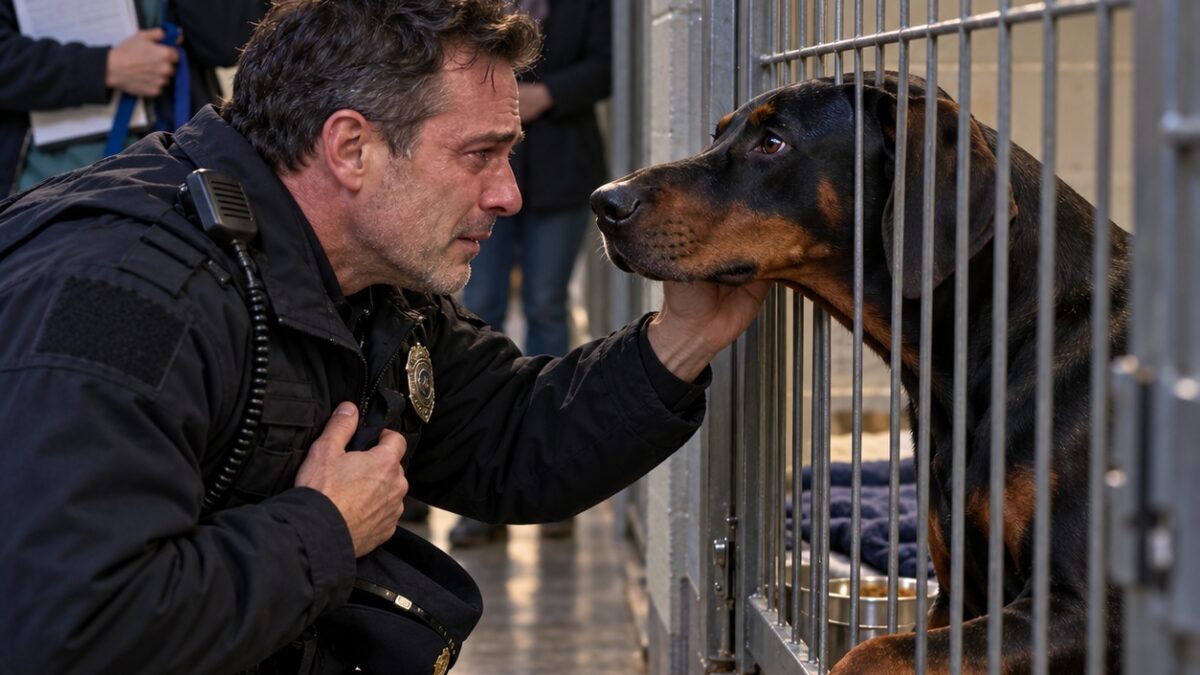
Then we reached Kennel 18.
Rex sat in the far corner.
Head lowered.
Eyes half closed.
He looked thinner.
Not dangerously.
Enough that I noticed.
“Hey, Rex.”
Nothing.
I crouched outside the gate.
“It’s me.”
One ear moved.
Then his head lifted.
Slowly.
He looked at my face.
I do not know what recognition looks like scientifically.
I know what I saw.
His eyes changed.
His posture changed.
He stood.
Took one step.
Stopped.
I stayed where I was.
“Yeah.”
Another step.
“Come on.”
He reached the gate.
Sniffed my fingers through the bars.
Then pressed the side of his muzzle against them.
I swallowed.
“Hey, buddy.”
Melissa stood several feet away.
“He hasn’t done that.”
“To anyone?”
“No.”
I scratched the fur between his ears.
Rex closed his eyes.
His whole body seemed to exhale.
Something in my chest moved with it.
I stayed for almost an hour.
He never played.
Never wagged his tail.
But he sat against the gate while I talked.
Mostly nonsense.
Work stories.
Traffic.
Weather.
A guy who tried to convince me his speeding ticket should be dismissed because Mercury was in retrograde.
Rex listened like none of it mattered.
Because it did not.
Presence mattered.
When I stood to leave, Rex stood too.
His eyes followed me.
“Tomorrow,” I said.
Melissa looked at me.
“You coming tomorrow?”
I looked at Rex.
“Apparently.”
I came back the next day.
And the next.
Sometimes before shift.
Sometimes after.
Sometimes in uniform.
Sometimes jeans and a sweatshirt.
Rex began waiting near the front of the kennel around the time I usually arrived.
Melissa noticed before I did.
“He knows your schedule.”
“Dogs don’t read clocks.”
“They read routines.”
One evening I arrived forty minutes late.
Rex was standing.
Not sitting.
Pacing.
When I appeared, he froze.
Then rushed to the gate.
Not barking.
Just moving faster than I had ever seen him move.
I laughed.
“Okay.”
His tail moved.
Barely.
One sweep.
Then another.
Melissa pointed.
“You see that?”
“See what?”
“The tail.”
I looked down.
Rex stopped as if embarrassed.
I crouched.
“Don’t let her pressure you.”
His tail moved again.
That was the first time.
Two weeks after Mr. Harris died, a shelter employee named Noah approached me while I sat beside Rex.
“We need to talk.”
“That sentence never leads anywhere good.”
He smiled.
“Rex is cleared for adoption.”
I looked through the bars.
Rex was lying beside my leg.
“Okay.”
“We’ve had interested families.”
“That’s good.”
“Three this week.”
“Good.”
Noah waited.
“What?”
“He didn’t choose any of them.”
I frowned.
“Dogs don’t choose adopters.”
Noah smiled.
“You sure?”
“They meet people.”
“Exactly.”
“And?”
“Rex stays in the corner.”
“He’s grieving.”
“Yes.”
“He needs time.”
“Yes.”
I looked at him.
“Why are you telling me this?”
“Because when you walk through that door, he gets up.”
I said nothing.
“When they walk in, he waits for them to leave.”
I laughed uncomfortably.
“You’re making this dramatic.”
“I work at an animal shelter. Drama is how we survive the cleaning schedule.”
“Noah.”
He became serious.
“He’s waiting for you.”
The words landed harder than they should have.
I looked down.
Rex had placed his head against my thigh.
Eyes closed.
Peaceful.
“He barely knows me.”
Noah shrugged.
“Maybe he knows what matters.”
“I’m a cop.”
“I’m aware.”
“I work weird hours.”
“So do nurses, firefighters, paramedics, truck drivers, people with lives.”
“I’ve never owned a dog.”
“No one is born knowing how.”
“I live alone.”
“Rex seems fine with one person.”
That hit.
I rubbed his head.
“I wouldn’t know what I’m doing.”
Noah leaned against the wall.
“Nobody knows how to take care of somebody else at first.”
“That’s a very shelter-worker answer.”
“It’s also true.”
“I could mess him up.”
“He’s already been through something terrible.”
“Exactly.”
“And you are the person he trusts.”
I looked at Rex.
“What if he’s expecting me to bring his owner back?”
Noah’s expression softened.
“Maybe he was.”
“And when he realizes I can’t?”
“He’ll need someone there for that too.”
I hated how much sense that made.
Noah walked away.
I sat another twenty minutes.
Then whispered:
“What do you think?”
Rex opened his eyes.
His tail moved once.
I laughed.
“That’s manipulative.”
Another wag.
I left the shelter that night with an adoption application.
I stared at it on my kitchen table for three hours.
Name.
Address.
Employment.
Work schedule.
Home type.
Yard.
Veterinarian.
Experience with animals.
Emergency plan.
The form was ordinary.
The decision was not.
At 11:20 p.m., I filled it out.
The next morning, I returned.
Melissa was at the desk.
I placed the form in front of her.
“I want him.”
She looked at it.
Then me.
“Say that again.”
“Don’t enjoy this.”
“I’ve earned it.”
“I want to adopt Rex.”
Her face softened.
“Okay.”
“That’s it?”
“No.”
“Of course not.”
“Home check.”
“I’m a police officer.”
“Dogs don’t care.”
“References?”
“Yes.”
“Work verification?”
“Yes.”
“Background?”
She smiled.
“We know where to find you.”
The approval process took several days.
Someone inspected my house.
They checked the backyard.
Fence.
Doors.
Space.
Asked where Rex would sleep.
I said I had not decided.
The woman looked at my bedroom.
“Probably wherever he wants.”
“That seems like a bad precedent.”
“You’re about to own a Doberman.”
“Fair.”
I bought things.
Too many things.
Dog bed.
Food.
Bowls.
Leash.
Harness.
Brush.
Treats.
Toys.
I stood in a pet store holding two different chew toys like I was selecting tactical equipment.
A teenage employee asked:
“What kind of dog?”
“Doberman.”
She pointed to the larger one.
“That.”
“How do you know?”
“Trust me.”
I bought both.
Then I bought a red rubber ball.
I do not know why.
It seemed like a dog should have a ball.
The day the adoption became official, Rex sat beside me while I signed documents.
Name.
Daniel Morgan.
Dog.
Rex.
Microchip transfer.
Medical records.
Adoption agreement.
The shelter manager handed me the final page.
“Sign there.”
I did.
“That’s it.”
I looked down at Rex.
“That’s it?”
“You sound disappointed.”
“I expected something bigger.”
She smiled.
“Most life-changing decisions end with a signature nobody else remembers.”
I stood.
Rex stood.
I clipped on his leash.
“Ready?”
He looked toward the shelter corridor.
For a second, fear returned to me.
What if he refused?
What if the exit reminded him of losing Mr. Harris?
Then Rex looked at me.
And his tail moved.
Slow.
Careful.
But unmistakable.
We walked out together.
He jumped into the back seat of my car.
Sat upright.
Did not lie down.
For the entire drive, his eyes stayed on the back of my head.
Every time I checked the mirror, he was watching.
“You’re making me nervous.”
His ears moved.
“I’m not disappearing.”
He kept watching.
At home, he hesitated at the front door.
I opened it.
“Come on.”
He looked inside.
Then at me.
“Different house.”
Nothing.
“Same guy.”
One step.
Another.
Then inside.
He inspected every room.
Slowly.
Carefully.
Sniffed corners.
Doors.
Furniture.
My bedroom.
Kitchen.
Living room.
Then returned to the front door.
And sat.
That broke my heart.
He faced the door.
Waiting.
For Mr. Harris.
I knew it immediately.
I sat beside him.
“Yeah.”
He did not look at me.
“I know.”
We sat there almost an hour.
That first night, Rex would not sleep.
I put his bed beside mine.
He ignored it.
Sat near the bedroom door.
Watching me.
Every time I closed my eyes, I could feel him staring.
At 1:00 a.m., I sat up.
“You planning to do that all night?”
Rex did not move.
I lay down again.
Twenty minutes.
Opened my eyes.
Still watching.
I sighed.
Got out of bed.
Sat on the floor beside him.
“You think I’m leaving?”
His eyes stayed on mine.
“I’m not.”
I put my hand on the floor.
“You live here now.”
He sniffed my fingers.
“Whatever that means.”
I leaned against the wall.
“You’re stuck with me.”
Rex moved closer.
Slowly.
Lay down.
Put his head on my leg.
Within five minutes, he was asleep.
Deeply.
For the first time since I had known him, I watched his body fully relax.
No alert ears.
No sudden head movements.
No waiting.
Just sleep.
I stayed on the floor.
At some point, I fell asleep too.
I woke at 5:40 with my back against the wall, one leg numb, and a Doberman using me as a pillow.
It was the best sleep I had gotten in two weeks.
The first week was hard.
Every morning, Rex went to the front door.
Sat.
Waited.
At first I thought he needed outside.
I opened the door.
He stayed.
Looked past me toward the street.
“Rex.”
Nothing.
Then I understood.
He was waiting for Mr. Harris to come home.
I sat beside him.
“He’s not coming.”
How do you tell a dog that?
You cannot.
You can only make absence consistent enough that eventually the animal understands.
Every sound in the driveway made Rex stand.
Delivery truck.
Neighbor’s car.
Someone walking past.
He would rush to the window.
Then slowly return to the door.
At night, he listened for footsteps.
He still ate.
Still followed me.
But hope lived in him like a wound that refused to close.
I did not try to take it away.
I sat beside it.
Every morning.
Sometimes for five minutes.
Sometimes twenty.
“I know you miss him.”
Rex would look at me.
“I know.”
Then:
“I’m here.”
That became our sentence.
I’m here.
When I left for work, I hated closing the door.
The first shift after adoption lasted ten hours.
I arranged for a neighbor to check on him at lunch.
Still, I spent half the day imagining Rex sitting by the door.
When I returned, I unlocked the house.
No dog.
“Rex?”
Nothing.
My stomach dropped.
Then nails hit the hallway floor.
Rex came around the corner at full speed.
He stopped inches from me.
Stared.
Then jumped.
Not elegantly.
Eighty pounds of Doberman hit my chest.
I nearly fell backward.
“Whoa!”
His tail moved so hard his entire rear half moved with it.
“You act like I’ve been gone a year.”
He pressed his head against me.
That was the first time I realized something important.
Rex was learning that departure did not mean abandonment.
I left.
I returned.
Again.
Next shift.
I left.
I returned.
Grocery store.
I left.
I returned.
Coffee.
I left.
I returned.
Tiny repetitions.
Trust built from predictable endings.
The second week, Rex started playing.
Not much.
He had ignored every toy.
The rope.
Chew.
Squeaky animal.
Then one evening I rolled the red ball across the living room.
Rex watched it.
Looked at me.
Looked at the ball.
“Go.”
Nothing.
I rolled it back.
Again.
On the third attempt, he stood.
Walked toward it.
Sniffed.
Picked it up.
My heart actually jumped.
“Good.”
Rex carried it to me.
Dropped it.
I stared.
He stared.
I threw it.
He ran.
For the first time, I saw him move like a dog who had forgotten grief for a few seconds.
He returned.
Ball.
Drop.
Throw.
Again.
Again.
Again.
After fifteen minutes I was laughing.
“You knew how to do this the whole time?”
His tail wagged.
When he finally lay down, breathing hard, I sat beside him.
Proud.
Ridiculously proud.
He had played.
That sounds small until you know what it means for an animal who stopped expecting pleasure.
The third week, someone rang the doorbell.
Rex barked.
One enormous, deep bark that made the delivery driver jump back three feet.
I came around the corner.
“Rex.”
He stood at the door.
Alert.
Chest forward.
Home.
His home.
I opened the door.
The driver handed me a package.
“Big dog.”
“He’s harmless.”
Every dog owner says that.
Rex sniffed the box.
Then returned to the couch.
I smiled for the next hour.
He had barked.
Not from fear.
Territorial confidence.
This was his house.
The fourth week, I realized I could no longer imagine the house without him.
My routines changed.
Morning coffee happened while Rex stood beside the counter.
Walk before work.
Walk after work.
Ball in the evening.
He learned the sound of my patrol car.
I learned the sound of his nails in the hallway.
I talked to him constantly.
At first because silence felt awkward.
Then because he listened better than most people.
Bad shift?
Rex heard about it.
Supervisor meeting?
Rex heard about it.
Traffic court?
Rex heard about it.
He never interrupted.
Never gave bad advice.
Never said, “At least.”
Sometimes he put his head on my knee.
That was enough.
I began taking him to the station occasionally.
Not on patrol.
Just administrative days.
He would sit in my office.
Officers stopped by.
At first Rex watched them from behind my chair.
Then he allowed Officer Kim to give him treats.
Then Sergeant Alvarez.
Eventually everybody knew him.
Someone taped a paper sign above his bed:
ASSISTANT WATCH COMMANDER.
Another officer added:
PROMOTION PENDING.
Rex took rank seriously.
The fifth week, I did something I still cannot fully explain.
I drove him back to Mr. Harris’s street.
Maybe it was for Rex.
Maybe for me.
Maybe I wanted proof that we had moved forward.
When I turned onto the block, Rex stood in the back seat.
Immediately.
He knew.
His breathing changed.
We stopped near the old house.
Empty now.
Real-estate sign in the yard.
Rex looked through the window.
I opened the door.
He jumped out.
Walked toward the house.
Stopped at the sidewalk.
Sniffed the air.
For a long moment, he simply stood.
I did not pull.
Then he looked at me.
There was recognition in those eyes.
Memory.
Grief.
But not panic.
He walked back.
Pressed his head against my leg.
I rested my hand on him.
“You remember.”
His tail moved once.
“We can go.”
And we did.
He did not look back.
That night, for the first time, Rex did not sit at my front door in the morning.
He came straight into the kitchen.
I noticed immediately.
“You okay?”
He looked at the food bowl.
“Breakfast?”
Tail.
Something had shifted.
Not forgetting.
Acceptance.
There is a difference.
The sixth week, an elderly woman stopped us in the park.
She had silver hair.
Bright red gloves.
She smiled at Rex.
“What a beautiful Doberman.”
“Thank you.”
“What’s his name?”
“Rex.”
“How long have you had him?”
“About a month and a half.”
She looked surprised.
“He watches you like he’s known you forever.”
I glanced down.
Rex was leaning lightly against my leg.
“He’s had a complicated year.”
The woman crouched carefully.
Held out her hand.
Rex sniffed.
Allowed one touch beneath his chin.
“He trusts you.”
“I think we found each other.”
She smiled.
“Sometimes that’s how family works.”
I laughed.
“He’s a dog.”
“I can see that.”
“I mean—”
“I know what you mean.”
She stood.
“You think family means blood.”
“No.”
“Then what?”
I looked at Rex.
“I’m still figuring that out.”
She nodded.
“Maybe family is whoever teaches you that you’re not alone.”
Then she walked away.
I thought about that sentence for the rest of the day.
The seventh week, I received a call from the realtor handling Mr. Harris’s estate.
The house had finally been cleared for sale.
“There are some personal effects nobody claimed,” she said. “The shelter gave me your number.”
“What kind?”
“Dog things. Photos. A bed. Food containers.”
I almost said no.
Then I thought of Rex.
“When can I come?”
Saturday.
I brought him.
The front door opened.
Rex froze.
His entire body recognized the house before his brain seemed to know what to do.
I knelt.
“We don’t have to.”
He stepped forward.
Inside, the furniture was mostly gone.
Sheets covered what remained.
Dust everywhere.
The silence felt heavier than the night I first entered.
Rex walked room to room.
Kitchen.
Living room.
Hallway.
Bedroom.
He sniffed the spot beside the bed.
Stopped.
I stood in the doorway.
He did not lie down.
That mattered.
He sniffed.
Then moved on.
In a drawer I found photographs.
Mr. Harris younger.
Rex as a puppy.
Rex wearing a red bandana.
One photo showed them sitting in the backyard together.
Mr. Harris had one arm around Rex.
Both looked toward the camera.
Happy.
I stared at it.
I had known this man only as someone dead in a bedroom.
The photograph corrected that.
He had lived.
Laughed.
Loved this dog.
I slipped the photograph into my coat pocket.
Not to steal a memory.
To preserve one.
On the way out, Rex stopped in the doorway.
Looked inside.
Then looked at me.
I swear he understood.
Goodbye.
That evening, I placed the photograph on a shelf near Rex’s bed.
He sniffed it.
Sat.
Looked for several seconds.
Then walked to me.
I sat on the couch.
He climbed beside me.
Head on my lap.
We stayed that way for a long time.
I thought about Mr. Harris.
A man I had never truly known.
Did he worry about Rex?
In his final moments, if there had been any awareness, did he wonder what would happen to the dog?
I hoped not.
But if there is anything beyond us, anything at all, I hoped he could see one thing.
Rex was safe.
The eighth week, I realized Rex had changed me as much as I had changed him.
Before him, I had structured my life around work.
Shift.
Sleep.
Laundry.
Groceries.
Repeat.
I told myself that was independence.
Maybe it was loneliness with good scheduling.
My apartment had always been quiet.
I liked it that way.
Then Rex filled the quiet.
Not noisily.
Presence.
He was there when I woke.
There when I came home.
There when I sat on the couch.
Somebody cared that I returned.
That is not a small thing.
Police work can distort your relationship with people.
You meet strangers on their worst days.
You become suspicious professionally and accidentally bring some of that suspicion home.
You learn that every closed door may hide something.
Every silence may mean something.
Every sudden movement matters.
Rex had his own version of that.
Every door might mean abandonment.
Every absence might become permanent.
Every sound might be the person he lost.
We were both learning something similar.
Not every door hides danger.
Not every goodbye is forever.
Not every attachment ends badly.
The ninth week, I returned to the shelter.
Without Rex at first.
Melissa looked up.
“Problem?”
“No.”
“Then why do you look guilty?”
“I don’t.”
“You do.”
I put my hands in my pockets.
“I want to help.”
“With?”
“Dogs.”
She smiled.
“No.”
“What?”
“You did not spend twelve years as a cop developing that intimidating posture just to stand there pretending you casually want to volunteer.”
“I can clean cages.”
“You?”
“Yes.”
“Chiefly qualified?”
“I’m not a chief.”
“Still funny.”
I started volunteering on days off.
At first, basic tasks.
Laundry.
Food.
Kennels.
Walking dogs.
Then frightened animals.
That became my preference.
Give me the dog hiding in the corner.
The one visitors skipped.
The one who did not understand hands yet.
I knew how to sit.
Rex had taught me.
No forcing.
No reaching.
Be predictable.
Come back.
Some dogs took days.
Some weeks.
The first time a terrified shepherd mix walked over and sniffed my hand, I almost cried.
Melissa saw.
“Don’t.”
“I’m not.”
“You absolutely are.”
“Dust.”
“Inside?”
“Very dusty.”
She laughed.
The tenth week, a family arrived looking to adopt.
Mother.
Father.
Two children.
They wanted a small dog.
We had one.
Brown mixed breed.
Maybe twenty pounds.
He had been surrendered after years in a chaotic home.
Terrified.
Would not approach people.
The family asked about him.
I gave them the truth.
“He’s afraid.”
“Will he bite?” the father asked.
“He has never bitten here.”
“Good with kids?”
“We don’t know yet.”
The mother looked uncertain.
One of the children, a boy about ten, sat on the floor.
The dog watched.
Boy did nothing.
Five minutes.
Ten.
Then the dog stepped closer.
The father looked at me.
“Is that good?”
I smiled.
“That’s very good.”
They stayed nearly an hour.
When they left, they had an application.
Two days later, they adopted him.
I watched the little dog ride away in the back seat.
Still trembling.
But beside a child who understood waiting.
For the first time, I saw the circle.
Rex had been afraid.
Someone stayed.
Now I knew how to stay.
Because of him, another dog might get a chance.
That realization did more to heal me than I expected.
The eleventh week, Rex and I sat on my couch during a thunderstorm.
His head on my lap.
Rain against the windows.
I looked at Mr. Harris’s photograph.
“You know, buddy…”
Rex opened one eye.
“I never knew him.”
Ear moved.
“But I think he loved you.”
Rex closed his eye.
“I hope he knows.”
Lightning flashed.
I rubbed his head.
“I don’t know what happens after people die.”
Silence.
“I don’t know whether anybody is watching.”
Rex breathed slowly.
“But if he is…”
My voice caught.
I cleared my throat.
“If he is, you’re okay.”
Rex lifted his head.
Looked at me.
Then put one paw across my leg.
I laughed quietly.
“Yeah.”
Maybe love does not disappear.
Maybe it changes hands.
Mr. Harris loved Rex.
Then he was gone.
That love did not make Rex immune to pain.
But it had taught him how to belong to someone.
Eventually, he belonged again.
The twelfth week, I returned to the shelter office.
Melissa looked up.
“What now?”
“I want to adopt Rex.”
She stared.
“You did.”
“I mean officially.”
“You signed the paperwork ten weeks ago.”
I frowned.
“No, I—”
Then I realized.
She started laughing.
“What?”
“You’re tired.”
“I know I signed adoption paperwork.”
“You just wanted another dramatic signature moment?”
“Apparently.”
She shook her head.
“Officer Morgan, Rex is legally yours.”
I smiled.
“No.”
“No?”
“He’s legally himself.”
Melissa rolled her eyes.
“You police officers get philosophical after adopting dogs.”
“Occupational hazard.”
The truth was that by then paperwork felt irrelevant.
Rex was mine.
I was his.
Family is rarely announced by a document.
It sneaks up.
One morning you realize there is a leash beside the door.
Dog hair on your uniform.
A water bowl in the kitchen.
And you cannot remember what the room looked like before.
Months passed.
Rex grew stronger.
His coat shone.
He gained healthy weight.
He loved long walks.
He became obsessed with the red ball.
He hated vacuum cleaners.
He tolerated baths.
Barely.
He liked riding in the car.
At first he always watched me.
Eventually he learned to lie down.
Sleep.
Trust that the destination would include me.
That was one of my favorite changes.
The first time I looked in the mirror and saw Rex asleep in the back seat, I nearly pulled over.
Before, he had watched every movement.
Now his eyes were closed.
Because I was driving.
And that was enough.
He came to the station more often.
Officer Kim kept treats in her desk.
Alvarez claimed he did not like dogs but somehow Rex spent half his visits inside Alvarez’s office.
I caught them once.
Alvarez was feeding him pieces of turkey.
“I thought you didn’t like dogs.”
“I don’t.”
“You’re hand-feeding mine.”
“He’s not a dog.”
“What is he?”
“Coworker.”
The station eventually ordered a small patch for Rex’s harness.
HONORARY K-9.
He had no training.
No official duties.
He wore it proudly anyway.
Children loved him at community events.
The first time I saw him calmly allow a little girl to wrap both arms around his neck, I thought about the shelter.
Corner.
Head down.
Eyes avoiding everyone.
I had to look away for a second.
Healing is strange.
You rarely notice it while it happens.
Then one day the terrified dog is standing in a school gym surrounded by children.
And you realize how far he traveled.
Rex never completely forgot Mr. Harris.
I know that.
Certain older men made him stop.
Men with gray hair.
Plaid shirts.
One man at the park laughed a particular way and Rex stared at him for nearly a minute.
Sometimes I wondered whether memory arrived through smell.
Voice.
Movement.
He would watch.
Then return to me.
I never felt threatened by that.
Love is not replacement.
I did not replace Mr. Harris.
I never wanted to.
That man was part of Rex’s life.
Part of why Rex could love so deeply.
I became what came next.
There is dignity in being what comes next.
Years passed.
Rex became part of every version of my life.
Promotions.
Bad cases.
Good cases.
Injuries.
Holidays.
Lonely nights.
My mother’s birthday dinner.
Station cookouts.
Long hikes.
Lazy Sundays.
He slept beside the couch.
Then eventually on the couch despite my original rule.
No dogs on furniture.
That rule survived six days.
No dogs in bed lasted three weeks.
Rex was a persuasive attorney.
When I dated someone, Rex judged them.
I wish I were joking.
One woman came over.
Rex stayed in another room.
Relationship lasted two months.
Another scratched behind his ears immediately.
Rex followed her everywhere.
We lasted a year.
I learned not to ignore his instincts entirely.
But the relationship I valued most remained the simplest.
Me and him.
Every morning.
Every night.
Same promise.
I’m here.
One evening, several years after adoption, I went back to the street where we first met.
Not because Rex needed closure anymore.
I did.
Mr. Harris’s house had new paint.
New family.
Children’s bicycles on the lawn.
Different curtains.
Life had moved in.
I parked across the street.
Rex sat beside me.
“Remember?”
He looked at the house.
Then me.
He was older now.
Gray beginning around the muzzle.
Calm.
I thought about the night I entered that door.
How professionally detached I had been.
Body.
Scene.
Report.
Animal control.
Then one dog looked at me.
And somehow an ordinary welfare check opened a door into the rest of my life.
I scratched his neck.
“You changed everything.”
Rex leaned against me.
I laughed.
“No argument?”
Nothing.
“Typical.”
We stayed five minutes.
Then drove home.
Years later, people at the shelter began asking me to speak with adopters considering traumatized dogs.
I always started the same way.
“Do not adopt the dog you hope he becomes.”
They would look confused.
“Adopt the dog in front of you.”
Afraid?
Adopt that.
Hiding?
Adopt that.
Not ready to cuddle?
Adopt that.
Because love offered conditionally is another test.
Traumatized animals have already taken enough tests.
One couple asked:
“How long before he trusts us?”
I said, “Wrong question.”
“What’s the right one?”
“How long are you willing to be trustworthy?”
They adopted the dog.
Six months later, they sent me a photograph of him asleep between them.
I kept it.
Not because I had done anything.
Because Rex had.
Through me.
That is what I mean when I say love moves.
Mr. Harris loved Rex.
Rex taught me.
I taught someone else.
They taught a frightened dog.
Who knows what comes after that?
Maybe kindness has a lineage too.
Not blood.
Behavior.
A chain of people and animals teaching each other how to stay.
Rex turned nine.
Still strong.
Still handsome.
Slower.
Gray muzzle.
Longer naps.
Ball obsession unchanged.
He still walked beside me.
Still slept close enough that I could hear him breathe.
At nine, a Doberman begins reminding you that time is not unlimited.
I tried not to think about it.
Failed.
Every gray hair felt like a warning.
I had spent my career witnessing endings.
Now I understood why Mr. Harris might have worried.
What happens to the one left behind?
One night, Rex slept beside my bed.
I looked down.
Thought about the old house.
The bedroom.
His vigil.
And made a decision.
The next day I updated my will.
Not because I expected to die.
Because Mr. Harris probably did not either.
Rex would go to Melissa if something happened to me.
She had already agreed.
Funds set aside.
Vet care.
Everything.
When I signed the papers, I felt stupidly relieved.
“You’re covered,” I told Rex.
He yawned.
“No gratitude.”
Another yawn.
“Fine.”
That paperwork mattered.
Not because it changed our family.
Because love should plan for absence too.
Mr. Harris had not failed Rex intentionally.
Life simply ended faster than plans formed.
I could at least learn from that.
The shelter eventually created a program for animals whose owners died unexpectedly.
Temporary grief foster.
Emergency planning.
Family contacts.
Behavioral support.
Melissa credited me.
I corrected her.
“Rex.”
She smiled.
“Rex doesn’t attend committee meetings.”
“Smart dog.”
“You helped design it.”
“Because Rex showed us the problem.”
The program was named Second Home.
I liked that.
Not new life.
Not replacement home.
Second Home.
Because first homes matter.
First loves matter.
Second does not erase first.
It continues life after loss.
We placed dozens of animals through that program.
One senior cat whose owner died in hospice.
Two bonded Labradors after a car accident.
A parrot that swore at every man who approached but adored a retired teacher named Susan.
And dogs.
So many dogs.
Some waited by doors.
Some stopped eating.
Some became destructive.
Some appeared completely normal until night.
Grief has different languages.
We learned to listen.
Whenever someone asked why I cared so much, I told them about Rex.
Not the dramatic version.
Not:
Cop rescues grieving Doberman.
Because that was not true.
I did not rescue him that first night.
I removed him from a house.
The shelter fed him.
Veterinarians cared for him.
Workers sat with him.
Rex did most of the healing himself.
What I did was return.
Again.
Again.
Again.
Maybe that is rescue sometimes.
Return.
At age ten, Rex developed arthritis.
Mild.
Medication helped.
Our walks shortened.
He still insisted on carrying the red ball.
The original had died years earlier.
We were on Red Ball Number Seven.
I kept Number One in a drawer.
Chewed almost in half.
Sentimental nonsense.
I did not care.
At eleven, Rex stopped jumping into the car.
I bought a ramp.
He stared at it like I had insulted generations of Dobermans.
“You need it.”
He refused.
“Rex.”
No.
I eventually lifted him.
He looked humiliated.
“Your secret is safe.”
At the station, Alvarez saw the ramp.
“You getting old?”
“Dog.”
“Same question.”
Rex liked him.
I reconsidered the friendship.
Age came gradually.
Then suddenly.
One year he could hike five miles.
The next, one.
But his eyes stayed clear.
His trust stayed complete.
He no longer watched doors.
That may have been his greatest victory.
Doors became doors.
Not threats.
I could leave a room without him following.
I could close a bathroom door.
He knew I would emerge.
Sometimes I would deliberately notice that.
Walk upstairs.
Look back.
Rex stayed on his bed.
Did not worry.
The dog who once feared sleep because people disappeared had learned permanence without constant visibility.
That is trust.
Not never losing someone.
Knowing love remains even when you cannot see it.
Maybe that was what he eventually understood about Mr. Harris too.
I hope so.
I certainly did.
For years I had thought healing meant letting go.
Rex taught me something more accurate.
Healing means learning how to carry something without it preventing you from moving.
He never forgot.
Neither did I.
We moved anyway.
At twelve, Rex still came to the shelter with me sometimes.
Young volunteers knew him as the old Doberman who belonged to Officer Morgan.
They had no idea he once sat in Kennel 18.
I would show them.
“That one.”
“No way.”
“Yes.”
“He was scared?”
“Terrified.”
Rex would stand beside me calmly while dogs barked.
A volunteer once said:
“He doesn’t look scared of anything.”
I smiled.
“That took years.”
She scratched his neck.
“What fixed him?”
I looked at Rex.
“Nothing.”
She frowned.
“He wasn’t broken.”
The answer surprised me when I said it.
But it was true.
Fear was not brokenness.
Grief was not brokenness.
He had been wounded.
Not defective.
There is a difference humans should remember too.
Rex did not need fixing.
He needed safety long enough to become himself again.
One winter afternoon, a newly admitted dog sat in Kennel 18.
Black shepherd mix.
Shaking.
Rex stopped.
Looked through the bars.
Then lay down outside the kennel.
I froze.
For a moment, time folded.
Mr. Harris’s bedroom.
Rex at the shelter.
Me sitting outside his cage.
Now Rex, old and gray, lying beside another frightened dog.
Melissa walked up.
Saw him.
Covered her mouth.
“You seeing this?”
“Yeah.”
Rex rested his head on his paws.
The shepherd watched him.
Did not retreat.
We let Rex stay there nearly an hour.
Eventually the shepherd moved forward.
One step.
Then another.
Rex did nothing.
He knew.
I sat against the opposite wall.
Three creatures.
One frightened.
One old.
One man who had once believed police officers should never carry strangers home.
I laughed quietly.
Melissa asked, “What?”
“Nothing.”
But it was something.
A circle.
Complete enough to hurt.
The shepherd was adopted three weeks later.
Family with a teenage son.
Rex never saw him again.
Did not need to.
That afternoon had been enough.
At thirteen, my veterinarian gave me the conversation I knew was coming someday.
Heart issue.
Manageable.
For now.
I listened.
Asked clinical questions.
Medication.
Exercise.
Monitoring.
Then sat in my car afterward with Rex beside me.
He looked out the window.
I put both hands on the steering wheel.
“Not yet.”
Rex turned.
“Okay?”
Tail.
Slow.
I drove home.
We adjusted.
Short walks.
More sleep.
Station visits became rare.
Shelter visits stopped.
He preferred home.
So did I.
I had spent years learning how to help Rex survive loss.
Now I began preparing myself for mine.
There is no training for that.
Knowing an ending is coming does not make you wise.
Mostly it makes ordinary moments hurt more.
Rex drinking water.
Rex sleeping in sunlight.
Rex nudging my hand.
I photographed everything.
Then felt guilty for photographing instead of experiencing.
So I stopped.
Then wished I had more pictures.
Love makes hypocrites of us all.
One evening, I sat on the floor beside him.
Same position as our first night.
My back against the wall.
Rex’s head on my thigh.
I looked down.
“Remember this?”
He slept.
“This is how we started.”
His ear moved.
“I told you I wasn’t leaving.”
I swallowed.
“You kept your end too.”
Rex opened his eyes.
Looked at me.
I ran my hand over his gray muzzle.
“You stayed.”
That was what mattered.
Not forever.
Nothing gets forever.
He stayed as long as he could.
So did Mr. Harris.
So would I.
There is a kind of peace in accepting that.
Not happiness.
Peace.
Rex eventually fell asleep.
I stayed on the floor long after my leg went numb.
Because some things deserve repetition.
The first night.
The last years.
Same dog.
Same promise.
I’m here.
People sometimes ask whether I rescued Rex.
I always say no.
That answer confuses them.
They expect modesty.
It is not modesty.
It is accuracy.
Rex saved me from a life I had not realized was becoming empty.
He taught me patience.
Routine that meant more than work.
Attachment without control.
Grief without surrender.
He made me volunteer.
Made me care about shelter policy.
Made me create plans for animals left behind.
Made me speak more gently to people whose pain looked irrational.
Because I had watched a dog sit beside a door waiting for someone who was never coming.
After that, you become slower to judge what grief makes people do.
Rex gave me family when I had convinced myself I did not need it.
And he gave me a strange connection to a dead man I barely knew.
Mr. Harris.
I still have the photograph.
It sits beside one of Rex and me.
Two men.
Same dog.
Different chapters.
Sometimes I imagine Mr. Harris would approve.
Maybe he would be jealous of the red ball.
Maybe he would tell me Rex hated baths even as a puppy.
Maybe he would thank me.
I would tell him the same thing I told Rex:
You did your job.
You stayed as long as you could.
Then I stayed.
That is how love survived.
Not by replacing him.
By continuing what he began.
My name is Daniel Morgan.
I am still a police officer.
Still working.
Still volunteering.
Still carrying dog treats in pockets where I once carried only spare gloves and notebooks.
Rex is older now.
Nine in the version most people first heard about.
Older still as I tell it.
He remains my friend.
My family.
My shadow when his joints allow it.
Every morning, I wake and listen for him.
Every night, I check where he settled.
Sometimes beside the bed.
Sometimes near the door.
But he does not watch the door anymore.
He sleeps.
Peacefully.
That may be the greatest gift I ever gave him.
Or maybe he gave it to himself because I happened to stay long enough.
I do not know.
What I know is this.
Years ago, I entered a stranger’s house to perform a welfare check.
I expected paperwork.
A report.
Maybe a sad phone call.
Instead, I found a Doberman sitting beside a man who had died.
I thought the tragedy was that Rex had lost his whole world.
I was wrong.
His world was not over.
It was waiting to become larger.
He waited at the shelter.
I came back.
He trusted.
I stayed.
Then one day I understood the thing Rex had been teaching me from the first night.
Love does not promise that nobody will leave.
Life makes that promise impossible.
Love promises something harder.
That while we are here, we show up.
We sit beside the bed.
We return to the shelter.
We sleep on the floor.
We come home after work.
We throw the ball again.
We wait beside the frightened one.
We make plans for the day we cannot stay.
We remember the people who came before without making the people here now compete with ghosts.
We keep showing up.
That is family.
Not blood.
Not ownership.
Not a name written on adoption papers.
Family is the one who sees you waiting and sits down beside you.
The one who comes back tomorrow.
The one who teaches you that leaving the room does not mean leaving your life.
The one who says, in every action that matters:
I’m here.
Rex spent days waiting for the man he lost.
Then he spent weeks learning to believe in the man who returned.
And somewhere in that waiting, both of us found what we needed.
I thought I had taken him home.
Years later, I understood the truth.
Rex had given me one.








