PART2:The Car Shattered Her Jaw, Broke Three Legs, and Cost Her an Eye—But Bianca Refused to Let It Take Her Life
PART2
The clinic became Bianca’s whole world.
At first, that world was small.
A bed.
Hands.
Medication.
Equipment.
Voices.
The careful rhythm of people moving around an animal who could not protect herself from pain.
Every touch had to mean something.
There was no room for careless handling.
Her jaw was too fragile.
Her legs were too damaged.
Her body had already endured enough.
So every movement was deliberate.
Support here.
Lift there.
Hold steady.
Do not twist.
Do not rush.
Bianca could not understand the procedures being planned around her.
She did not know what surgery meant.
She did not know why people were examining her mouth again.
Why her legs needed support.
Why the damaged eye could not simply become normal again.
She only knew that everything hurt.
And yet she continued allowing people close.
That trust became one more thing we felt responsible for protecting.
The veterinary team worked to repair what could be repaired.
Her shattered jaw required extraordinary care.
A cat uses her mouth for almost everything.
Eating.
Drinking.
Cleaning.
Exploring.
Defending herself.
Communicating discomfort.
Bianca had lost normal use of one of the most basic parts of her body in a single violent moment.
Three separate fractures had turned something automatic into something dangerous.
Even after repair, healing would take time.
Then there were the legs.
Three of them.
One broken limb would have made movement difficult.
Bianca had three badly fractured legs.
There was almost no way for her to compensate.
A cat cannot simply shift weight onto another healthy limb when almost the entire body is injured.
Every attempt to reposition herself could disturb healing.
Every future step would have to be relearned through weakness, stiffness, and fear.
The eye was another loss entirely.
Some injuries can be repaired.
Some cannot.
Bianca’s damaged eye had suffered irreversible harm.
There was no treatment that could restore what had been lost.
The focus had to become comfort and the future she could still have.
Cats are remarkable adapters.
We knew that.
But knowledge does not make the first look at an injured face easier.
It does not stop you from thinking about what was taken.
One moment on a road.
One impact.
And Bianca’s world had changed permanently.
Still, there was no time to grieve every loss.
Bianca needed action.
Surgery came.
Then another stage of treatment.
Monitoring.
Pain management.
Medication.
Rest.
The clinic seemed to move around her while she stayed mostly still.
Sometimes I wondered what she thought of all those people.
Did we feel like safety yet?
Or simply another unknown thing happening after the accident?
There was no way to know.
But Bianca kept watching us.
That remaining eye became the center of every interaction.
You could see fatigue there.
Pain.
Uncertainty.
But something else too.
Awareness.
Presence.
She had not withdrawn.
She was still participating in the world.
Even when participation meant nothing more than lifting her head slightly when someone approached.
Those tiny responses became our landmarks.
A whisker twitch.
Her head turning toward a familiar voice.
An attempt to shift her body.
The faint movement of a paw.
Things healthy cats do without anyone noticing.
With Bianca, we noticed everything.
Because after trauma that severe, ordinary behavior becomes evidence.
Evidence that the body is still connected to life.
Evidence that the mind is still curious.
Evidence that there is something worth fighting toward.
The surgeries did not end the hard part.
In some ways, they only made the next problem clearer.
Bianca could not eat normally.
Her jaw had been repaired, but repaired did not mean strong.
Healing bone is fragile.
Pain makes appetite complicated.
And chewing was not something her jaw could safely do the way it once had.
Food had to reach her another way.
At first, feeding became a slow, careful process.
Tiny amounts.
Measured.
Patient.
Nothing forced.
Nothing rushed.
There were days when it felt like the entire world had narrowed to one question.
Can Bianca get enough nourishment to keep healing?
A body recovering from multiple fractures and surgery needs energy.
Bianca had no energy to waste.
Every calorie mattered.
Every bit of hydration mattered.
And feeding a cat who cannot use her mouth normally turns something simple into a procedure.
One tiny amount at a time.
Pause.
Watch.
Another.
Pause.
Let her rest.
Start again.
It was exhausting.
For her.
For the people caring for her.
But mostly for her.
Imagine being hungry and unable to simply eat.
Imagine smelling food and having the basic mechanics of taking it into your body turned into something painful or impossible.
We watched Bianca through each feeding.
Sometimes I thought about healthy cats complaining because dinner was several minutes late.
Bianca would have traded everything for that kind of problem.
Instead, nourishment arrived slowly.
Drop by drop.
Feeding support became part of survival.
There were moments when progress felt almost invisible.
That is one of the hardest things about long recoveries.
The beginning is dramatic.
The injuries are obvious.
Everyone focuses.
Then healing asks for patience.
And patience does not always produce visible reward each day.
Bone does not heal because we are desperate.
A jaw does not become strong because everyone loves the patient.
Nerves.
Muscle.
Skin.
Strength.
All of it has its own pace.
Bianca’s body did not care how badly we wanted reassurance.
So we learned to look smaller.
Not:
Is she recovered?
Instead:
Did she tolerate this feeding better?
Did she lift her head a little higher?
Did she stay awake a little longer?
Did her breathing settle?
Did she respond to touch?
Did she shift herself without help?
Small questions.
Small answers.
That was how hope survived.
There were days when I could almost imagine the future.
Bianca standing.
Eating.
Exploring.
Then another hard day would arrive and remind everyone how much road remained.
Maybe she was more tired.
Maybe movement seemed harder.
Maybe we simply remembered all over again how fragile she was.
Recovery is cruel that way.
One better day creates confidence.
One difficult morning can take it away.
But Bianca never seemed interested in our emotional swings.
She simply kept going.
There was no performance to her determination.
No dramatic refusal to lie down.
Most of the time she had no choice except to lie down.
Her fight happened quietly.
She kept accepting food.
Kept responding.
Kept waking.
Kept turning toward people.
Kept making tiny attempts to move.
That was enough.
People use the word fighter so easily with injured animals.
I understand why.
But I never want that word to imply that survival is a moral achievement.
Animals who do not survive are not weaker.
They do not fail.
Bodies have limits.
Trauma has consequences.
Bianca’s survival was extraordinary partly because the injuries could so easily have been beyond those limits.
What made her special to us was not that she somehow deserved life more because she fought.
It was the way she remained present inside pain.
She kept meeting us.
Kept trying.
And we had the privilege of trying with her.
As her body stabilized, attention began moving toward mobility.
Standing.
Such a simple word.
For Bianca, it was enormous.
Before the accident, standing would have required no thought.
Muscles.
Bones.
Balance.
Automatic.
After three broken legs, standing became a problem the entire body had to solve again.
Which leg takes weight?
How much?
Where is balance when your vision has changed?
What does the floor feel like after so much time being supported?
How do you trust limbs that have been sources of pain?
The first attempts were hard to watch.
Her body seemed uncertain.
Weak.
The legs did not always feel as if they belonged to the confident little animal somewhere inside her.
We helped.
Supported.
Waited.
Bianca tried.
Sometimes an attempt lasted only seconds.
That did not matter.
Seconds become longer seconds.
Pressure becomes weight.
Weight becomes balance.
Balance becomes a step.
We were not there yet.
But every attempt was something.
I remember one moment when she lifted herself higher than before.
Her legs trembled.
Her body wavered.
Every instinct in me wanted to rush in and hold her completely.
But help has to be measured.
Too much support can turn effort into dependence.
Too little can create pain or risk.
So we steadied her enough.
Bianca did the rest.
She held herself.
Briefly.
Then lowered again.
That moment probably looked like failure from the outside.
She stood.
Then she could not.
To us, it was victory.
She had stood.
The impossible keeps becoming possible that way.
First for one second.
Then five.
Then something else.
Feeding followed a similar path.
For days, food had been something delivered to Bianca because she could not take it normally herself.
Then her jaw became stronger.
The healing progressed.
We watched for signs that eating might become possible again.
Nobody wanted to rush.
A setback in a healing jaw could cost more than patience.
So when the day finally came for Bianca to try, the room seemed to hold its breath.
Food was placed where she could reach it.
She smelled it.
That alone felt different.
She showed interest.
Moved her face closer.
Stopped.
For a second, I thought that might be all.
That would have been okay.
Then Bianca tried again.
Her mouth moved.
Carefully.
Tentatively.
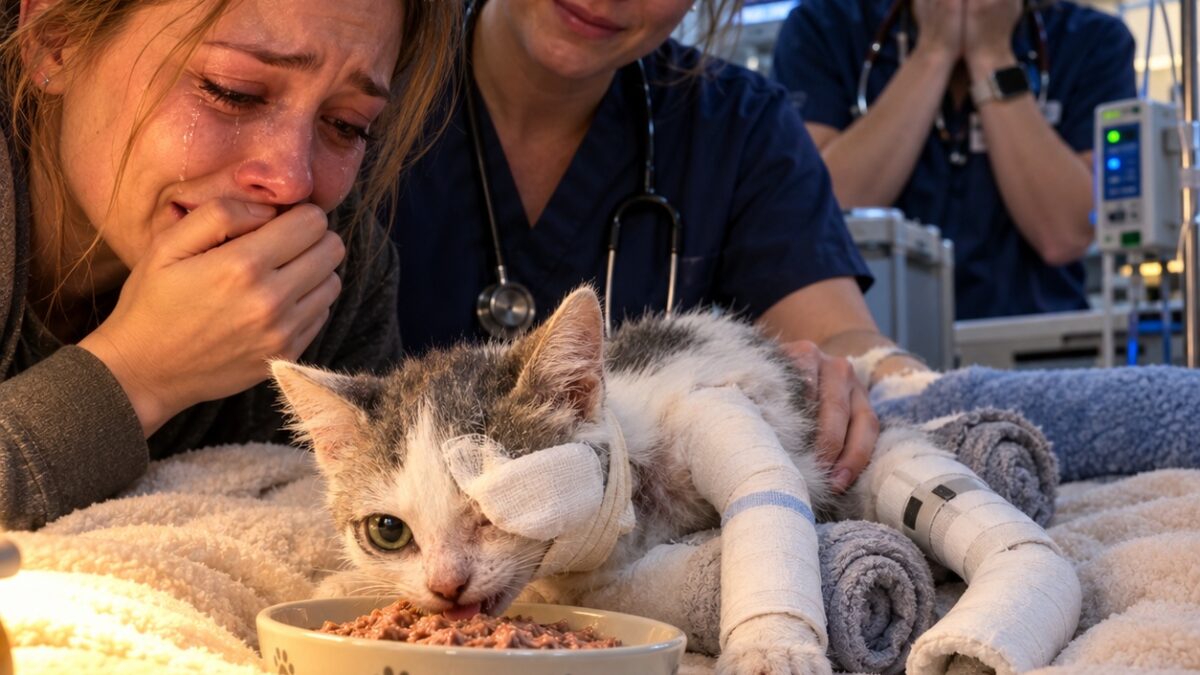
And she took one bite.
One.
Tiny.
Bite.
I wish I could explain what happened in that room without making it sound exaggerated.
Some people smiled immediately.
Some cheered.
Others cried.
All because a cat ate one bite of food.
But it was not food.
Not really.
It was independence returning.
It was the jaw working.
It was strength.
Appetite.
Coordination.
Healing.
Choice.
Bianca had spent days receiving nourishment because survival depended on other people putting it into her body.
Now she had taken something herself.
That little bite contained the whole recovery in miniature.
She had been hit by a car.
She had arrived unable to eat.
Doctors had repaired a jaw broken in three places.
People had fed her slowly.
She had endured.
And now she was eating.
No one expected the first bite to become a full meal.
We did not need it to.
We only needed to know the door had opened.
Bianca had found it.
The next bites came in their own time.
Feeding support continued until she no longer needed it.
The tube that had helped sustain her could eventually be removed.
That day mattered too.
One less piece of medical equipment between Bianca and normal life.
Then medications began decreasing.
Not all at once.
Carefully.
Another sign that emergency was slowly becoming recovery.
The casts came off later.
That was one of the most emotional transitions.
For so long, Bianca’s legs had been objects to protect.
Immobilize.
Support.
Do not disturb.
Now the protection could begin coming away.
What was underneath was not instant strength.
Healing bones are only part of walking.
Muscle had weakened.
Balance had changed.
Confidence had to return.
But seeing those legs without casts made the future seem closer.
Bianca looked physically smaller without all the equipment around her.
And somehow larger too.
Less like a patient.
More like a cat.
She still moved carefully.
One step could be awkward.
Another better.
She had to understand a body that no longer worked exactly the way it had before.
Her vision was different.
Three legs had been through trauma.
Her jaw had been reconstructed through healing.
Nothing about recovery demanded that she return to who she had been before the accident.
That cat was gone.
The goal was not backward.
It was forward.
Who could Bianca become now?
The answer arrived gradually.
She could become a cat who navigated with one functioning eye.
She could become a cat who walked after three fractured legs.
A cat who ate after a shattered jaw.
A cat who explored.
Rested.
Sought attention.
Learned where objects were.
Learned distances.
Turned her head differently when needed.
Adaptation became part of her confidence.
At first, I worried about her depth perception.
Her ability to understand space.
Would she bump into things?
Would she hesitate?
Would the lost vision make her timid?
Bianca had other plans.
She mapped her surroundings.
Cats are astonishingly capable of adapting when the environment allows them time.
Bianca learned where things were.
She moved with increasing certainty.
If something was unfamiliar, she investigated.
The remaining eye followed movement.
Her whiskers helped tell her what space was doing around her.
Her body learned.
There was no moment when she became a two-eyed cat again.
That would never happen.
Instead, she became a confident one-eyed Bianca.
That distinction mattered.
We stopped measuring her against the animal she had been before the accident.
We watched the animal in front of us.
And she was doing beautifully.
Not perfectly.
Healing never promised perfection.
But confidently.
The transformation was most obvious when you compared the Bianca who arrived with the cat now moving through a room.
The first Bianca could not stand.
Could not eat.
Could not lift herself.
Everything had to be done for her.
The recovering Bianca started making decisions.
Go there.
Turn.
Explore.
Eat.
Rest.
Look.
Approach.
Those decisions returned dignity.
There is a profound difference between keeping an animal alive and watching that animal begin living.
Bianca crossed that line slowly.
Then one day, she gave us the sign I did not know I had been waiting for.
A blanket.
Soft.
Warm.
Nothing special.
Bianca settled onto it.
At first, there was no reason to think the moment would be memorable.
She adjusted herself.
Found a comfortable position.
Then her front paws began moving.
Press.
Release.
Press.
Release.
Bianca was making biscuits.
I stopped.
So did someone else nearby.
We watched without speaking.
Her paws moved slowly against the blanket.
Back and forth.
One.
Then the other.
Again.
Again.
A simple, familiar cat behavior.
We had seen healthy cats do it countless times.
But Bianca had not been simply any cat.
Her paws had been part of shattered legs.
Her body had spent weeks in pain.
Her whole existence had revolved around surviving.
Now those paws were not being asked to bear painful weight.
Not being examined.
Not being stabilized.
Not testing balance.
They were kneading a blanket because Bianca felt comfortable enough to do something ordinary and instinctive.
That moment hit harder than the casts coming off.
Harder than I expected.
Making biscuits is not a medical test.
No one writes a recovery plan saying:
Day 37: patient must knead blanket.
That was exactly why it mattered.
Bianca was doing something medicine had not asked her to do.
Something unnecessary.
Something connected to comfort.
Safety.
Contentment.
She was no longer spending every moment responding to injury.
She had enough room inside herself for pleasure.
That was the difference.
Survival asks:
What must I do next?
Happiness allows:
What feels good?
Bianca had finally reached the second question.
Her paws kept moving.
I looked at those little legs and remembered them broken.
I thought about the first day.
The way she could not stand.
Now:
Press.
Release.
Press.
Release.
If healing needed a sound, maybe it was the soft movement of paws against a blanket.
No applause.
No machines.
No emergency.
Just a cat doing what cats do when the world feels gentle.
Follow-up visits became easier after that.
Not because nobody worried anymore.
We still watched carefully.
Bones have to keep healing.
Strength needs time.
The jaw had to remain healthy.
Her remaining vision mattered.
Everything mattered.
But the tone changed.
Early appointments asked:
Can she survive?
Later appointments asked:
How well is she healing?
That is a wonderful change in language.
Survival was no longer the central question.
Life was.
The veterinarians who had first looked at Bianca’s injuries with such concern now smiled when she returned.
They remembered the motionless little patient.
Then they saw the cat exploring an examination room.
The contrast made even experienced people emotional.
Medical professionals learn to control their reactions.
They have to.
But Bianca had become personal.
Not because anyone stopped being professional.
Because when you spend weeks helping a fragile animal survive, you cannot completely separate outcome from feeling.
Each good report belonged to everyone who had held their breath earlier.
Bones continuing to heal.
Strength improving.
Appetite strong.
Movement more confident.
Another stage behind her.
Another piece of the impossible becoming routine.
The feeding tube was gone.
The casts were gone.
The medication burden decreased.
Bianca remained.
That was the theme of everything.
Things disappeared.
Pain.
Equipment.
Dependence.
Fear.
Bianca stayed.
Her remaining eye became brighter with curiosity.
Her steps became more purposeful.
She started finding sunny places.
Warm places.
Soft places.
The ordinary luxuries of being a cat.
One day I watched sunlight fall across her body and thought about how close she had come to never experiencing something so simple again.
No one knows what a cat thinks while lying in sunlight.
Probably nothing poetic.
Maybe that is the point.
Bianca had earned the right to have moments containing nothing important.
No emergency.
No treatment.
No fight.
Just warmth.
Her appetite became something we could celebrate without anxiety.
Food no longer arrived through a slow medical process.
Bianca ate.
Normal.
Simple.
Beautiful.
She grew stronger.
Her body began looking less like a record of trauma and more like itself.
The scars remained.
One eye remained lost.
No happy ending could reverse those facts.
But scars are not the opposite of healing.
Sometimes they are evidence that healing happened.
Bianca did not need to look untouched to be whole.
That became important later.
Because eventually, another question appeared.
Home.
Where would Bianca go when medical recovery no longer required the same level of care?
Would someone see the missing vision first?
Would they see scars?
A cat who had needed extensive treatment?
Would they worry about what had happened?
Or would someone see Bianca?
That question can be frightening in rescue.
People say they want survivors.
Sometimes they mean survivors who no longer look like survival happened.
Bianca could never offer that.
Her history remained visible.
One eye.
The story of the fractures.
The jaw.
The scars.
She needed a family who understood that none of those things reduced her value.
Then a family came forward.
They did not look at Bianca and ask for the cat she might have been if the car had never hit her.
They looked at the cat standing in front of them.
Bianca.
The cat who had endured surgery.
The cat who had accepted feeding one tiny amount at a time.
The cat who had relearned standing.
Eating.
Walking.
Navigating.
The cat who made biscuits when she finally felt safe.
That was the cat they wanted.
There is no more beautiful kind of adoption than one where nobody needs the animal to hide the past.
The family knew who she was.
What she had survived.
What had changed permanently.
They saw no reason any of it should prevent love.
Bianca had spent her recovery proving that limitation and life are not the same thing.
One eye did not mean no curiosity.
Three healed legs did not mean no movement.
A repaired jaw did not mean no appetite.
Scars did not mean no beauty.
Trauma did not mean no happiness.
Her family understood.
And so, after all the rooms Bianca had passed through—
Emergency care.
Surgery.
Recovery.
Feeding.
Rehabilitation.
Follow-ups.
She entered another one.
Home.
Her forever home.
I try to imagine the first evening there.
Not because I know every detail.
I do not.
I refuse to invent a scene and pretend it happened.
But I know what her life became.
Soft beds.
Sunny corners.
Gentle affection.
People who adored her.
The same ordinary things that had once seemed impossibly far away.
Bianca explored.
Adapted.
Learned.
Her remaining eye stayed curious.
Her steps stayed confident.
Her appetite stayed strong.
The fear surrounding those early days no longer defined every hour.
Comfort replaced it.
Then routine.
Then love.
That is the progression I think about.
At first, everybody simply wanted Bianca to survive the next stage.
Then we wanted her to recover.
Then we wanted her to feel safe.
Then happy.
Then home.
Each goal sounded enormous until she reached it.
She kept turning impossible things into completed things.
Could she survive the surgeries?
She did.
Could her jaw heal enough for her to eat?
One day she took that first bite.
Could she stand after three fractured legs?
She learned.
Could she move confidently with one functioning eye?
Yes.
Could she relax after all that pain?
The blanket beneath her paws gave us the answer.
Could someone love her without seeing damage first?
Her family did.
Bianca’s story contains so much pain that it is tempting to tell it only as a triumph.
I do not want to do that.
The accident was not beautiful.
A shattered jaw is not inspiring.
Three broken legs are not a gift.
Losing vision in an eye did not make Bianca stronger in some magical way.
Pain is pain.
There is no need to make suffering meaningful in order to respect survival.
What was beautiful came afterward.
The people who chose treatment.
The veterinarians using everything they knew.
The caregivers feeding her patiently.
The hands supporting her while she learned balance.
The person celebrating one bite.
The blanket.
The family.
Bianca herself continuing through all of it.
We do not have to thank the accident for showing us how strong she was.
We can wish it had never happened and still stand in awe of what she did afterward.
Both things can be true.
If Bianca could have chosen a life without the accident, that is the life she deserved.
Instead, she received the life that came after.
And she made something extraordinary from it.
I often think about her remaining eye.
On the first day, we looked into it searching for signs.
Pain.
Awareness.
Response.
What we saw felt like hope.
Maybe that was us projecting a human word onto an animal expression.
Maybe.
But whatever we call it, something was there.
She had not stopped engaging.
She watched.
Responded.
Stayed.
Weeks later, that same eye followed movement around a safe home.
Curiosity.
Same eye.
Different world.
That contrast tells the entire story.
The accident changed Bianca physically.
It did not freeze her emotionally in the moment of impact.
She continued.
Life continued.
That is something trauma survivors—animal or human—often show us.
A catastrophic moment may divide life into before and after.
But after is still life.
It can contain pain.
Adjustment.
Loss.
And also food.
Sunlight.
Soft blankets.
Love.
Bianca’s after became larger than the accident.
That is what recovery gave her.
Not erasure.
More.
More days.
More experiences.
More identities.
Patient became survivor.
Survivor became explorer.
Explorer became beloved cat at home.
The accident remained one chapter.
A brutal one.
Not the whole book.
I wish the people who saw Bianca only at the beginning could have seen her later.
The cat who could not stand moving confidently through familiar space.
The mouth that could not eat taking meals normally.
The paws once immobilized pressing into a blanket.
The one remaining eye bright with interest.
It would have looked impossible.
Maybe that is why the first bite mattered so much.
That was the day impossible stopped being one solid wall.
A crack appeared.
Then another.
Casts off.
Tube out.
Standing.
Walking.
Biscuits.
Home.
A recovery becomes believable only after it has already begun.
Before the first improvement, faith can feel foolish.
Then Bianca gave us something measurable.
One bite.
That bite was her argument.
Not a guarantee.
An argument.
Maybe we can keep going.
So we did.
There were setbacks.
The source of Bianca’s story tells us recovery was not effortless, and no honest version should make it seem so.
Every procedure carried risk.
Every stage demanded patience.
Her body needed time.
But the direction remained.
Forward.
Sometimes slowly.
Still forward.
I have come to love that word in rescue.
Forward.
It does not require perfection.
It does not require yesterday to disappear.
You can limp forward.
Rest forward.
Cry forward.
Eat one bite forward.
Stand for two seconds forward.
Make biscuits forward.
Bianca moved forward.
Until eventually home was no longer some imagined reward at the end of treatment.
It was where she lived.
Today, Bianca’s life contains the things a cat’s life should contain.
Beds.
Sun.
Exploration.
Food.
Affection.
Curiosity.
Rest.
Her remaining eye takes in the world.
Her body moves through it.
Maybe not exactly the way it would have before the accident.
Who cares?
It is her way.
That is enough.
Her family does not wake each morning and see a tragedy.
They see Bianca.
That may be the greatest gift of all.
Medical stories can turn animals into diagnoses.
Three fractures.
Jaw trauma.
Eye loss.
Surgery.
Feeding tube.
Medication.
Those things were crucial.
They were never Bianca.
She was the cat inside all of them.
The one we first saw looking back.
The one who responded to voices.
The one whose whiskers moved.
The one who tried to lift her head.
The one who ate.
The one who kneaded.
The one who adapted.
The one who loved.
The one who was loved.
That is who went home.
Her scars went too.
Of course.
They belong to the same body.
But they did not arrive at that home as warnings.
They arrived as history.
There is a difference between carrying history and being trapped inside it.
Bianca carries hers.
She is not trapped.
I think about those early questions now.
Would she eat?
Yes.
Would she stand?
Yes.
Would her strength return?
Yes, gradually.
Could she adapt to one eye?
She did.
Would anyone want her?
That question feels almost insulting now.
Of course.
Once someone saw Bianca, truly saw her, the scars were only details.
The courage was impossible to miss.
Not dramatic courage.
Bianca was never standing on a mountaintop declaring victory.
She was simply living.
That is courage enough.
One meal.
One step.
One nap.
One curious look.
One kneading paw after another.
The first time she made biscuits may always remain my favorite.
The surgeries saved her body.
The feeding kept her alive.
The rehabilitation gave movement back.
But those kneading paws told us Bianca had found something medicine could not prescribe.
Comfort.
A cat does not make biscuits because someone tells her recovery is going well.
She does it because some ancient instinct says:
This is soft.
This is safe.
I can relax here.
After everything, Bianca finally felt that.
That was the moment surviving became something more.
Maybe happiness.
Maybe peace.
Maybe simply being a cat again.
Whatever word we choose, I am grateful she reached it.
I am grateful for every person who refused to reduce her to the worst moment of her life.
The rescuer who brought her in.
The veterinary team who looked at catastrophic injuries and still built a plan.
The people who fed her.
Held her.
Monitored her.
Waited.
Celebrated.
And the family who opened their home at the end.
No one person saved Bianca alone.
Her recovery was a chain.
One link after another.
The accident almost broke everything.
Care rebuilt enough.
Bianca did the rest.
There is something humbling about that.
Humans sometimes speak as if rescuing means we give an animal life.
No.
Life was already there.
Bianca brought that.
We provided surgery.
Food.
Medication.
Shelter.
Time.
She used them.
Her cells healed bone.
Her muscles relearned work.
Her brain adapted to vision loss.
Her appetite returned.
Her paws moved.
She did the living.
Our privilege was making living possible.
That is how I remember it.
And that is why I will never say she was lucky to be hit and rescued.
No.
She was unlucky to be hit.
Then fortunate that care came.
Those are different statements.
The happy ending does not justify the suffering.
It defeats the idea that suffering gets the last word.
Bianca’s last word is not accident.
Not broken.
Not blind in one eye.
Not surgery.
Not patient.
Home.
That is where the story belongs.
There are probably moments now when Bianca’s family looks at her asleep and the accident does not enter their minds at all.
I hope so.
I hope there are whole afternoons where nobody thinks about shattered bones.
Nobody counts the legs that broke.
Nobody studies the eye that was lost.
I hope they simply wonder why she has stolen the warmest spot.
Why dinner is apparently late.
Why a blanket requires twenty minutes of kneading before it can be slept on.
That kind of forgetfulness is beautiful.
Not forgetting the story.
Forgetting to treat the survivor like an emergency forever.
Bianca deserves boredom.
Routine.
Normal annoyance.
Normal joy.
Cats are very good at making a home revolve around ordinary demands.
I hope she does.
I hope her people know the privilege of being ordered around by the little cat veterinarians once feared might not survive.
What better revenge on tragedy than becoming inconveniently alive?
Hungry.
Curious.
Comfortable.
Loved.
That is Bianca.
If someone had shown me her future on the first day, I might not have believed it.
The broken jaw.
Three broken legs.
Irreversible eye damage.
A motionless little body.
The question in every face.
Can this really be overcome?
Then imagine being shown another image.
Bianca on a blanket.
Paws moving.
Press.
Release.
Press.
Release.
One bright eye.
Safe.
There is the answer.
Yes.
Not unchanged.
Not untouched.
But yes.
She could live.
She could heal.
She could be happy.
The road took much from Bianca.
There is no reason to pretend otherwise.
It took vision from one side.
Took months of comfort.
Broke bone.
Broke the jaw she needed to eat.
Left her dependent on others for the most basic things.
But it did not take everything.
It did not take her capacity to adapt.
It did not take her ability to trust.
It did not take appetite forever.
It did not take movement forever.
It did not take comfort forever.
And most of all, it did not take Bianca herself.
That small stubborn presence remained from the first day.
The little spark we thought we saw.
I’m still here.
She proved it through every stage.
When she accepted another feeding:
Still here.
When she lifted her head:
Still here.
When she tried to stand:
Still here.
When her casts came off:
Still here.
When she took that first bite:
Still here.
When she explored with one eye:
Still here.
When she made biscuits:
More than still here.
Living.
And when her family took her home, the fight finally had somewhere gentle to end.
Bianca no longer needed to prove anything.
Not to us.
Not to the veterinarians.
Not to the world.
She had already done enough.
She could stop being brave every minute.
That is one thing people forget about happy endings.
We admire courage so much that sometimes we keep asking survivors to perform it.
Bianca had been courageous enough.
Home meant she could finally be ordinary.
Curl up.
Sleep.
Eat.
Explore.
Ask for affection.
Make biscuits.
Look out at the world through the eye she still had.
No one measuring every breath.
No one wondering if she would see tomorrow.
Tomorrow simply came.
Again.
And again.
That is what she fought for.
Not a headline.
Not admiration.
Days.
Soft, ordinary days.
If I could speak to the Bianca who arrived at the clinic, I would not tell her she had to fight.
She was already doing that.
I would tell her something else.
You do not have to know how this ends.
You only have to stay with us for this moment.
Then the next one.
We will handle the medicine.
We will hold you steady.
We will feed you when you cannot feed yourself.
We will support the legs that cannot support you yet.
We will protect the jaw while it heals.
We will help you learn a world seen through one eye.
You do not need to solve your future today.
Just stay.
And she did.
Long enough for the future to reach her.
One bite at a time.
One step at a time.
One kneading paw at a time.
All the way home.
Today, Bianca is not the cat who should have died.
I do not like defining her that way anymore.
She is the cat who lived.
There is a difference.
One centers death.
The other centers her.
Bianca lived.
She adapted.
She found comfort.
She found people.
She found home.
Her scars remain.
Her missing vision remains.
Her history remains.
But when she curls into a soft bed or follows sunlight across a room, none of those things need to disappear for her life to be beautiful.
She does not need to be what she was before.
She only needs to be Bianca.
And after everything that little body endured, being Bianca—safe, fed, curious, confident, loved—is more than enough.








