PART2:The Burned Puppy Had Stopped Wanting to Live—Until an Old Rottweiler Nobody Wanted Chose Him
PART2
For the first forty-eight hours, everything was about keeping Oskar alive.
Fluids.
Oxygen.
Medication.
Monitoring.
Cleaning his paws.
Checking his temperature.
Listening to his lungs.
Waiting.
Waiting was the worst part.
When you work around injured animals, you learn how fragile hope can become.
One good hour can make you believe everything will be fine.
One bad breath can destroy that confidence immediately.
Oskar survived the first night.
Then the second.
By the third morning, Dr. Ruiz finally gave me the first piece of good news.
“His lungs sound a little better.”
“A little?”
“A little matters.”
I smiled.
“So he’s going to make it?”
She looked at me carefully.
“I said his lungs sound better.”
That was Elena.
She never promised what medicine could not guarantee.
Oskar started eating small amounts.
At first, only soft food from a spoon.
Then from a bowl.
His burns were painful but manageable.
His oxygen levels improved.
Physically, every day gave us another reason to believe we were winning.
But something else was happening.
Or rather, something was not happening.
Oskar showed almost no normal puppy behavior.
No curiosity.
No excitement.
No interest in toys.
No tail wagging.
If a staff member entered the room too quickly, he backed into the wall.
If keys dropped onto the floor, he shook.
If a door slammed anywhere in the building, he panicked.
His whole body would flatten.
His eyes would widen.
He would breathe so rapidly I worried we were undoing the progress in his lungs.
At night, it became worse.
We had cameras in the recovery room.
I began checking them from home.
Then I started staying late again.
Oskar barely slept.
He would lower his head.
Close his eyes.
Ten minutes later, he would wake suddenly and stare toward the door.
Sometimes nothing had happened.
No sound.
No movement.
Nothing I could detect.
But something inside his memory had.
One night, around two in the morning, I found him standing in the farthest corner of his enclosure.
He was facing the wall.
Not sleeping.
Just standing.
I opened the door slowly.
“Oskar?”
His ears moved.
He did not turn.
I sat on the floor outside.
“I’m not coming in.”
Nothing.
“You’re okay.”
His body trembled.
“You’re safe.”
I hated the words as soon as I said them.
Safe.
How was he supposed to understand that?
His entire world had become smoke.
Heat.
Noise.
Running.
Loss.
He had learned at three months old that familiar places could kill you.
That roofs could fall.
That air could burn.
That being alone could happen without warning.
I sat there for almost an hour.
Eventually he lay down.
But he did not sleep.
The next morning, I found Dr. Ruiz reviewing his chart.
“His body’s healing.”
“Yes.”
“But he isn’t.”
She sighed.
“No.”
“What do we do?”
“Time.”
“That’s not treatment.”
“Sometimes it is.”
I looked through the glass.
Oskar sat with his back against the wall.
“What if time isn’t enough?”
Elena had no answer.
That was when Jax began noticing him.
Jax had arrived at our shelter four months earlier.
Her story was less dramatic.
Maybe that was why nobody paid much attention to it.
Her owner had died.
An older man.
Widower.
No children nearby.
Jax had apparently lived with him almost her entire life.
When he suffered a fatal stroke, neighbors found her lying beside his chair.
The family could not take her.
One relative lived in an apartment.
Another had young dogs and worried about introducing a senior Rottweiler.
So Jax came to us.
Nine years old.
Nearly ninety pounds.
Arthritis beginning in her hips.
Gray around the muzzle.
A few benign lumps.
Otherwise healthy.
She was quiet from the first day.
Too quiet.
Some dogs arrive at shelters desperate for attention.
They bark.
Paw.
Jump.
Press themselves against kennel doors.
Jax did none of that.
She stood when someone approached.
Accepted affection.
Then lay back down.
It was as though she had already understood the arrangement.
Her person was gone.
This place was temporary.
No point asking questions.
Families passed her constantly.
“Oh, she’s beautiful.”
“How old?”
“Nine.”
“Oh.”
That “oh” became the soundtrack of her life.
Nine meant medical bills.
Nine meant less time.
Nine meant grief sooner.
People wanted puppies.
Young adults.
Dogs they could imagine having for another decade.
Jax offered no such illusion.
Every week, I updated her profile.
Gentle.
House-trained.
Calm.
Good on leash.
Affectionate.
Senior sweetheart.
Nothing.
We featured her on social media.
People commented.
“She deserves the best!”
“Someone please adopt this angel!”
Hundreds of hearts.
No applications.
I watched her stop getting up when visitors entered.
That hurt.
The first month, Jax would stand when families walked through.
By the third, she sometimes only lifted her head.
Hope becomes expensive when it keeps being disappointed.
Then Oskar arrived.
The first time Jax stopped outside his recovery enclosure, I thought she was simply curious.
She stared through the gate.
Oskar was curled against the back wall.
Jax sat down.
Five minutes passed.
Then ten.
“Come on, girl.”
She did not move.
I tugged gently on the leash.
She looked at me.
Then back at Oskar.
I let her stay.
The next morning, she did it again.
Then again.
Sometimes Oskar looked at her.
Sometimes he did not.
But after several days, I noticed something.
When Jax sat outside the enclosure, Oskar stopped pressing himself so tightly into the corner.
It was subtle.
His body softened.
His eyes followed her.
One morning, his nose appeared near the bottom of the gate.
Jax lowered her head.
They smelled each other through the gap.
No growl.
No excitement.
Just recognition.
I spoke to Elena.
“I want to introduce them.”
She frowned.
“Inside?”
“Yes.”
“Claire, he’s still medically fragile.”
“I know.”
“Jax is huge.”
“She’s also calmer than half the people who work here.”
“That is not a medical argument.”
“Look.”
We watched them.
Jax sat outside.
Oskar had moved closer than usual.
He was not shaking.
Elena sighed.
“You’re going to bother me until I agree.”
“Yes.”
“Controlled introduction.”
“Yes.”
“Short.”
“Yes.”
“And if either dog shows stress—”
“We stop.”
The next morning, we opened the gate.
I will remember those first few seconds for the rest of my life.
Jax entered slowly.
Not cautiously in the nervous sense.
Carefully.
As though she understood the puppy inside that enclosure could be frightened by too much dog.
Oskar lifted his head.
His body stiffened.
Jax stopped.
She waited.
No pulling.
No whining.
No attempt to force contact.
Then she took one step.
Another.
Oskar did not retreat.
Jax reached him.
Lowered her head.
Sniffed his ears.
Then his shoulders.
Oskar’s eyes closed briefly.
Jax turned.
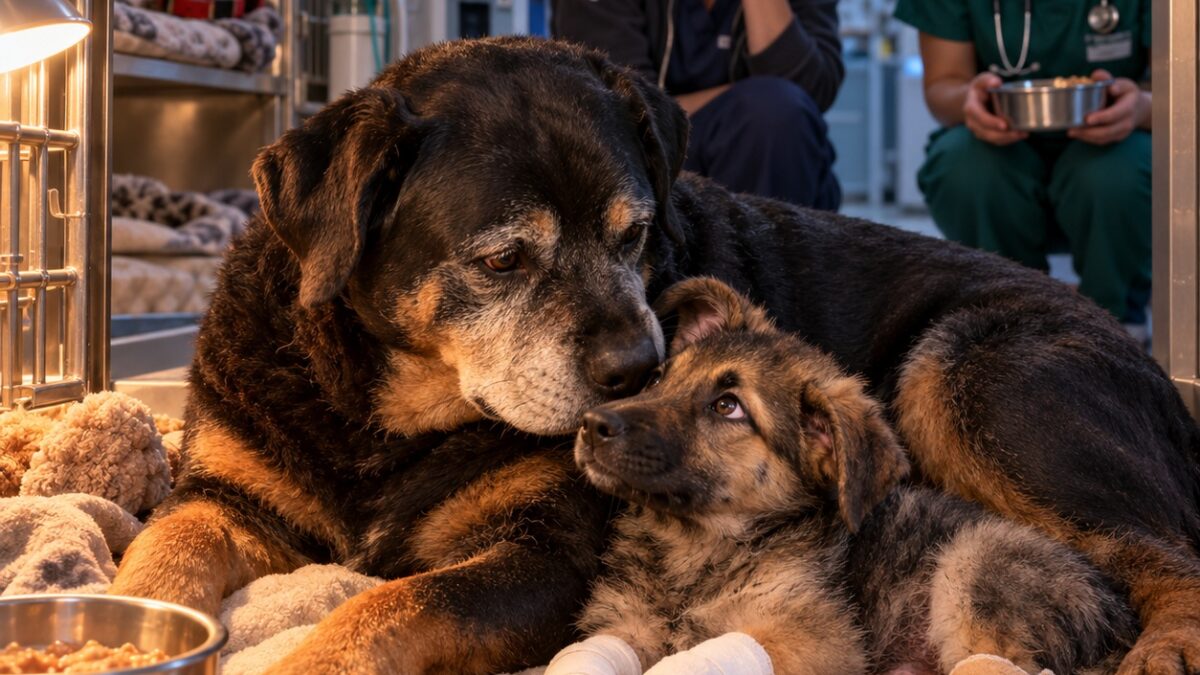
Lowered herself.
And lay directly beside him.
Her back pressed against his chest.
Nothing dramatic happened for several seconds.
Then Oskar moved.
Very slowly.
His head lowered until it touched Jax’s side.
He froze there.
Jax did not move.
Oskar exhaled.
I had heard that puppy breathe thousands of times by then.
Short breaths.
Panicked breaths.
Painful breaths.
But that was the first relaxed breath I remembered.
His eyes closed.
Five minutes later, he was asleep.
Deeply.
His paws twitched.
His jaw relaxed.
Elena stood beside me.
“Oh my God.”
I did not answer.
I was crying too hard.
That day, Jax stayed with him for nearly three hours.
We expected her to become restless.
She did not.
At one point, she shifted slightly.
Oskar woke immediately.
His eyes widened.
Jax placed her head across his back.
He fell asleep again.
From then on, everything changed.
Not quickly.
Not magically.
Oskar still had nightmares.
Still panicked at loud sounds.
Still refused to walk through some doorways.
But now fear had somewhere to go.
When a kennel door slammed, Jax stood.
She positioned herself between Oskar and the sound.
When a metal bowl dropped, Oskar ran behind her.
When a volunteer accidentally knocked over a cleaning cart, Oskar tried to hide.
Jax followed.
She did not pull him out.
She simply sat beside the hiding place.
Waited.
Eventually he emerged.
One afternoon, I watched Oskar press his entire face beneath Jax’s chest because a maintenance worker started a drill.
Jax stood completely still until the noise stopped.
Then she licked his ear.
It became impossible not to describe her as maternal.
Yet Jax had never had puppies.
Her medical history confirmed it.
No litter.
No motherhood.
Nothing that explained why she behaved as though protecting Oskar was a responsibility written into her bones.
Maybe some animals simply know.
Maybe pain recognizes pain.
Jax had lost the only person she had ever belonged to.
Oskar had lost everything familiar in fire.
Neither could explain grief.
Perhaps that was why they understood each other.
The first autumn storm proved just how deep their bond had become.
Rain began shortly before closing.
At first, gentle.
Then harder.
Our shelter roof was metal.
Within minutes, the entire building sounded like someone throwing gravel from the sky.
Oskar froze.
I saw it immediately.
His pupils widened.
His breathing changed.
Thunder rolled somewhere in the distance.
He bolted.
Straight toward the corner.
“Oskar!”
He tried to squeeze beneath a raised cot.
His front half fit.
His back did not.
He clawed at the floor.
My chest hurt watching him.
Then Jax moved.
She walked to him.
Oskar backed out.
Another crack of thunder.
He shoved himself beneath Jax’s body.
Not beside her.
Under her.
Jax looked down.
Then carefully lowered herself.
She curled around him.
Chest.
Legs.
Body.
A circle.
Oskar disappeared except for one ear and part of his nose.
The roof roared.
Jax stayed.
Twenty minutes.
Thirty.
An hour.
I sat on the floor nearby.
At some point, Oskar fell asleep.
During the storm.
The same puppy who had once woken because a pen dropped in another room now slept while thunder shook the windows.
Because Jax was there.
That night, after everyone left, I walked past their enclosure one last time.
Oskar was tucked against her.
Jax was awake.
Watching the door.
“You know,” I whispered, “you’re doing our job better than we are.”
Her tail moved once.
Life slowly returned to Oskar.
First came food.
He began eating enthusiastically.
Then toys.
A rope.
A rubber ball.
A stuffed fox he eventually destroyed with the enthusiasm of a normal puppy.
Then came curiosity.
He followed Jax everywhere.
If she stood, he stood.
If she drank, he drank.
If she walked outside, he followed so closely he occasionally stepped on her rear paws.
Jax tolerated everything.
One morning, I watched Oskar climb directly across her while she was sleeping.
She opened one eye.
Looked at me.
I swear the expression said, “Are you going to do something about this?”
I laughed.
“You adopted him.”
Her eye closed.
Three weeks after their first meeting, I heard a sound from the exercise yard.
A bark.
Not fear.
Not warning.
Play.
I walked outside.
Oskar faced Jax.
Front legs bent.
Tail moving so fast his entire rear end shook.
He bounced backward.
Barked.
Forward.
Back.
He grabbed gently at the loose skin around Jax’s neck.
She ignored him.
Oskar tried again.
Then again.
Finally Jax stood.
Slowly.
Her joints were stiff.
Oskar exploded with excitement.
He ran around her.
Jax turned.
He ran the other direction.
Then something beautiful happened.
Jax played.
Not like a young dog.
She could not run fast.
Her hips would not allow it.
But she lowered her front end.
Turned slowly.
Pretended to chase.
Then pretended Oskar had caught her.
He bounced away like he had defeated a wolf.
I stood outside the fence with my hand over my mouth.
A volunteer came beside me.
“Is that Oskar?”
“Yes.”
“He’s playing.”
“Yes.”
The volunteer smiled.
I cried.
Not because I was sad.
Because I had not realized how badly I needed to see him become a puppy again.
For weeks, Oskar had been defined by what happened to him.
The fire puppy.
The burn case.
The smoke inhalation puppy.
The trauma patient.
That morning, he was just Oskar.
Young.
Ridiculous.
Alive.
And Jax looked younger too.
She began moving more.
Waiting near the door when she knew it was yard time.
Her eyes brightened.
She had been fading before him.
Not physically.
Emotionally.
Oskar gave her a job.
Maybe more than that.
He gave her someone to love after losing the person who had been her entire world.
The shelter changed around them.
Staff members started adjusting schedules to keep them together.
Volunteers brought two blankets instead of one.
Someone donated an orthopedic bed for Jax.
Oskar immediately claimed half of it.
One of our younger volunteers made a sign.
JAX + OSKAR
PLEASE DO NOT SEPARATE WITHOUT STAFF
We laughed.
Then stopped laughing when we realized the day was coming when separation might actually happen.
Oskar’s final medical examination arrived sooner than I wanted.
Dr. Ruiz listened to his lungs.
Checked his paws.
Watched him walk.
Then smiled.
“He’s doing beautifully.”
I should have been happy.
Instead, my stomach tightened.
“Adoption clearance?”
“Soon.”
“How soon?”
“A week.”
I stared at her.
She knew.
“Claire.”
“What?”
“You knew this was the goal.”
“I know.”
“He needs a home.”
“I know.”
She softened.
“You’re thinking about Jax.”
“Yes.”
“We can list them together.”
“Who adopts a three-month-old German Shepherd and a nine-year-old Rottweiler?”
“Someone.”
“You believe that?”
She hesitated.
That hesitation hurt.
Young German Shepherds did not stay long in our shelter.
The moment photos went online, applications arrived.
People saw potential.
Training.
Hikes.
Family adventures.
Ten years ahead.
Jax was nine.
She had arthritis.
Gray hair.
A body already moving toward old age.
Every adoption conversation eventually reached the same terrible question.
“How long do Rottweilers usually live?”
I hated that question.
Not because it was unreasonable.
Because I knew what people were really asking.
How soon will this hurt me?
And I understood.
Grief is frightening.
But avoiding old dogs because you might lose them sooner means some animals spend the last years of their lives never being chosen at all.
I could not imagine Jax watching Oskar leave.
And I could not imagine Oskar looking for her after he was gone.
I spoke to our director.
“We have to make them a bonded pair.”
She rubbed her forehead.
“Claire.”
“They’re bonded.”
“I know.”
“Then?”
“We have limited capacity.”
“So?”
“If a perfect family wants Oskar but cannot take Jax—”
“No.”
She looked at me.
“Claire.”
“No.”
“You’re emotional.”
“Of course I’m emotional.”
“We have to think about what is sustainable.”
“Separating them is not sustainable for either dog.”
“Oskar is young. He may adapt.”
I stared at her.
“And Jax?”
Silence.
“That’s what I thought.”
She sat down.
“I’m not the enemy.”
“I know.”
“Then stop looking at me like I am.”
I looked away.
“I’m sorry.”
She sighed.
“We’ll advertise them together first.”
“For how long?”
“Two weeks.”
“That’s not enough.”
“Three.”
“Six.”
“Claire.”
“Four.”
She smiled despite herself.
“Four.”
I nodded.
“Thank you.”
That evening, I sat with them.
Oskar slept partly on top of Jax.
His paws had already grown too big for the rest of him.
Jax’s muzzle rested on the floor.
“You two are making my life impossible.”
Oskar opened one eye.
Jax did not.
I touched her gray muzzle.
“I need you to get lucky, old girl.”
The adoption listing went live.
Their photograph showed Oskar leaning against Jax.
The caption explained their story.
Applications arrived.
For Oskar.
Only Oskar.
“Would you consider separating?”
“No.”
“We already have another large dog.”
“No.”
“We don’t have the budget for senior medical care.”
“I understand.”
“We really love the puppy.”
“I understand.”
“Could we meet him alone?”
“No.”
Every refusal felt like I was gambling with Oskar’s future.
Every day Jax stayed in the shelter, she got older.
Every day Oskar stayed, he grew.
At six months, he would still be adoptable.
At nine months, probably.
But young shepherds become large shepherds quickly.
Some families wanted tiny puppies.
I started doubting myself.
Was I protecting them?
Or trapping them?
One night, I stood outside the kennel after closing.
Oskar was chewing a toy.
Jax slept.
“Tell me what to do.”
Neither answered.
I sat down.
“What if I’m wrong?”
Oskar brought the toy to the gate.
I smiled despite myself.
“Very helpful.”
Then he turned.
Walked back to Jax.
Dropped the toy beside her.
Curled against her.
That was my answer.
The second week passed.
No joint applications.
The third week began.
Our director stopped reminding me about the deadline.
She did not need to.
I knew.
On Wednesday afternoon, a family visited.
They loved Oskar.
Two parents.
Teenage son.
Huge backyard.
Previous shepherd experience.
Everything sounded perfect.
Then they saw Jax.
“Oh.”
There was that word again.
I explained.
The father shook his head.
“We just can’t take two.”
I nodded.
“I understand.”
The son looked heartbroken.
“Couldn’t they visit?”
No.
I did not say it aloud.
You cannot explain to a dog that his mother figure lives somewhere else now but maybe you can visit on Saturdays.
They left without adopting.
That night, I cried in my car.
Not dramatically.
Just exhausted tears.
I felt guilty for Oskar.
Guilty for Jax.
Guilty for wanting an impossible solution.
The next morning, I delayed entering the shelter.
I sat in the parking lot for five minutes.
Then six.
I told myself I was tired.
Truthfully, I was afraid of seeing them.
Afraid Jax would trust me.
Afraid Oskar would be happy.
Afraid I would eventually have to betray both.
Then Thursday came.
The Miller family arrived after lunch.
I almost assigned them to another staff member.
That still embarrasses me.
Their application said:
Seeking younger dog.
Active.
Medium to large.
Good with children.
Large fenced yard.
Previous dog experience.
Everything screamed Oskar.
Nothing screamed Jax.
Mrs. Miller entered first.
Warm smile.
Her husband behind her.
Their daughter, Sophie, looked about twelve.
Their son, Ben, perhaps eight.
Ben spotted Oskar immediately.
“That one!”
Oskar ran toward the fence.
Tail moving.
Ben laughed.
Mrs. Miller knelt.
“He’s gorgeous.”
“He’s special.”
“How old?”
“Still very young.”
Mr. Miller smiled.
“We had a German Shepherd when I was growing up.”
Oskar pushed his nose toward Sophie.
She scratched under his chin.
Then she stopped.
She was looking past him.
Toward Jax.
“Who’s the big one?”
“Jax.”
“Is she his mom?”
I swallowed.
“No.”
Sophie studied them.
Oskar had already moved toward Jax.
He stood beside her.
Their shoulders touched.
“She looks like his mom.”
I smiled.
“She acts like one.”
Sophie walked closer.
Jax approached slowly.
She sniffed the girl’s hand.
Sophie crouched.
“How old is she?”
“Nine.”
Mrs. Miller looked at me.
“Nine?”
“Yes.”
I heard the familiar calculation.
Old.
I braced myself.
But Sophie was still focused on Jax.
“She’s gray.”
“A little.”
“That’s cute.”
I nearly laughed.
No one had ever described Jax’s gray muzzle that way.
Sophie stroked her face through the fence.
Jax closed her eyes.
Ben was throwing a toy for Oskar.
Oskar ran after it once.
Then brought it back to Jax instead of Ben.
The family laughed.
I did not.
My chest had tightened.
Mrs. Miller noticed.
“What?”
“Nothing.”
“You looked sad.”
I had a choice.
Give them the simple version.
Or the truth.
So I told them everything.
The fire.
Oskar arriving almost silent.
His lungs.
The nights he would not sleep.
His fear.
The storm.
Jax sitting outside his enclosure.
The first introduction.
Oskar sleeping against her.
Jax protecting him.
Oskar bringing life back into Jax.
By the time I finished, Mrs. Miller’s eyes were wet.
Mr. Miller looked down at the floor.
Sophie was crying openly.
Ben hugged Oskar.
Then Sophie asked me a question.
“Will he be scared if he leaves her?”
I could have softened it.
Instead I said, “Probably.”
She looked at Jax.
“Will she be sad if he leaves?”
“Yes.”
“How sad?”
That broke me.
I breathed in.
“Very.”
Sophie wiped her cheek.
Then she asked the sentence I will never forget.
“Do they need to stay together to be happy?”
I looked at the two dogs.
Jax had lowered herself onto the floor.
Oskar was lying against her front legs.
“They’ve become family.”
Sophie turned toward her parents.
Mrs. Miller looked at her husband.
He already knew.
I could see it.
“We came for one dog,” he said quietly.
“I know.”
Mrs. Miller asked about Jax’s health.
I explained everything.
Arthritis.
Possible future medication.
Senior bloodwork.
Potential costs.
Reduced activity.
Maybe years.
Maybe less.
I refused to hide anything.
“She may not have a long time.”
Mrs. Miller nodded.
“How long?”
“No one can promise.”
“And Oskar?”
“Could live another decade or more.”
Silence.
Then Sophie spoke.
“If we take Oskar and leave Jax here, she’ll think he left her.”
Her father closed his eyes briefly.
Children are cruelly good at finding the truth adults are trying to avoid.
Mrs. Miller whispered, “Yes.”
Sophie touched Jax through the fence.
“She already lost someone once.”
I looked at her.
“How did you know?”
“You said her owner died.”
I nodded.
“She lost him.”
Sophie’s voice shook.
“Then she found Oskar.”
Nobody spoke.
“And now we’re going to take him too?”
Mr. Miller turned away.
Ben stopped playing.
He looked at his mother.
“We can take both.”
Adults like to believe children do not understand money.
They do not understand mortgages, insurance deductibles, veterinary estimates.
But they understand leaving someone behind.
Mrs. Miller looked at me.
“If we adopt both, what does Jax need?”
I answered carefully.
“A soft place to sleep.”
Sophie smiled through tears.
“We have that.”
“Shorter walks.”
“We can do that.”
“Joint support.”
“Okay.”
“Regular veterinary monitoring.”
Mr. Miller nodded.
“Okay.”
“Possibly more medical care as she ages.”
He exhaled.
“That part scares me.”
“I understand.”
He looked through the fence.
Jax was grooming Oskar’s ear.
“What happens when she dies?”
Nobody expected the question.
Mrs. Miller looked at him.
I answered.
“You’ll be heartbroken.”
He gave a sad laugh.
“At least you’re honest.”
“You asked.”
“And Oskar?”
“He’ll grieve.”
“How badly?”
“I don’t know.”
Mr. Miller watched them.
“So even if we take both, this still ends painfully.”
“Yes.”
That was the truth.
Love does not protect you from endings.
Sometimes love guarantees them.
But Mrs. Miller said something I still repeat to adopters.
“Pain later doesn’t mean we should cause pain now.”
Her husband looked at her.
She looked back.
Then at me.
“Our home has room.”
I stopped breathing.
“For both?”
“For both.”
Sophie covered her mouth.
Ben shouted.
Oskar barked because everyone else had suddenly become loud.
Jax lifted her head.
Confused.
I cried immediately.
No dignity.
No pretending.
Mrs. Miller laughed while crying too.
Mr. Miller shook his head.
“We came for one dog.”
Sophie wrapped her arms around him.
“We’re leaving with two.”
The adoption could not happen that second.
There were procedures.
Home verification.
Medical planning.
Paperwork.
A consultation.
I spent the next three days terrified they would change their minds.
Every time the phone rang, I expected:
We talked about it.
It’s too much.
We’re sorry.
That call never came.
Instead, Mrs. Miller emailed me a picture.
Two new dog beds.
One enormous.
One slightly less enormous.
Caption:
Are these big enough?
I replied:
Oskar will sleep in Jax’s anyway.
She answered:
Then I guess we bought one bed and one decoration.
Monday arrived.
Adoption day.
I got to work early.
Too early.
I packed Jax’s medication.
Then unpacked it to double-check.
Packed Oskar’s blanket.
Added his damaged stuffed fox.
Removed it because it looked disgusting.
Put it back because it was his.
One of the technicians watched me.
“You okay?”
“No.”
“You know this is good?”
“Yes.”
“You look like someone died.”
“It feels like someone’s leaving.”
“They are.”
“Not helpful.”
She hugged me.
That made it worse.
The Millers arrived at eleven.
Their vehicle had blankets arranged in the back.
Water bowls.
Harnesses.
Sophie had made two name signs.
JAX.
OSKAR.
Ben had drawn a picture of four humans and two dogs standing beside a house.
Jax was twice the size of everyone.
Accurate enough.
We reviewed the medical records.
I made Mr. Miller repeat the arthritis medication schedule.
Then Mrs. Miller.
Then Sophie.
“Claire.”
Mrs. Miller touched my arm.
“We’ve got it.”
“I know.”
“You’re worried.”
“Yes.”
“We will call.”
“Yes.”
“We’ll send pictures.”
“Yes.”
“You can visit.”
That nearly destroyed me.
I looked down.
“Sorry.”
“Don’t be.”
I signed the final form.
Then Jax’s.
Two names.
One family.
When we brought them outside, Oskar knew something was happening.
He bounced.
Pulled.
Sniffed everything.
Jax walked more slowly.
At the vehicle, Oskar jumped into the back.
Jax stopped.
She looked at the open door.
Then at me.
I still wonder what she thought in that moment.
Had she been loaded into a vehicle after her owner died?
Had she believed someone was taking her home then too?
Did she understand that transitions usually meant losing something?
I knelt.
“Hey, old girl.”
Jax looked at me.
Her amber eyes were cloudy at the edges.
I held her face between my hands.
“You did good.”
Her tail moved once.
“No.”
My voice broke.
“You did more than good.”
I pressed my forehead against hers.
“You saved him.”
Jax licked my wrist.
“And I think he saved you too.”
Behind us, Oskar whined.
Jax turned immediately.
He stood inside the vehicle looking down at her.
Waiting.
I smiled through tears.
“There’s your boy.”
Jax placed her front paws inside.
Her rear legs struggled.
Mr. Miller stepped forward.
“Can I?”
I nodded.
Together we supported her hips.
She climbed in.
Oskar immediately pressed against her.
Jax lay down.
He curled beside her.
Just like the first day.
Sophie climbed into the back seat and placed one hand through the barrier.
Jax sniffed her fingers.
The door closed.
Mrs. Miller hugged me.
“Thank you for trusting us.”
I wanted to say thank you.
Instead I cried into her shoulder.
The car pulled away.
Oskar’s face appeared briefly in the rear window.
Then disappeared.
I stood in the parking lot until the road was empty.
When I returned inside, their enclosure felt enormous.
Two blankets.
One empty bed.
A water bowl.
Silence.
I sat on the floor.
That was when I understood something shelter workers rarely admit.
A happy ending can hurt almost as much as a sad one.
You spend weeks begging the universe to take them away from you.
Then it does.
And suddenly every place they occupied becomes painfully empty.
That evening, at 7:13, my phone buzzed.
A photograph.
Jax asleep on a thick rug beside the fireplace.
Oskar stretched across her.
Mrs. Miller wrote:
They ate dinner. Oskar explored every room. Jax has already claimed the warmest spot in the house.
I laughed.
Then cried again.
A second message:
Sophie says you’re allowed to stop worrying now.
I replied:
Tell Sophie I’ll consider it.
The weeks that followed became a collection of photographs.
Oskar running through the yard.
Oskar digging a hole Mr. Miller definitely had not approved.
Jax lying on the patio.
Oskar dropping toys onto her head.
Sophie reading a book with one hand resting on Jax’s back.
Ben sleeping on the floor beside Oskar.
Then a video during a thunderstorm.
I almost did not open it.
My chest tightened.
Oskar still hated storms.
In the video, thunder sounded outside.
He lifted his head.
Looked around.
Then walked calmly toward Jax.
She was lying on her orthopedic bed.
Oskar curled beside her.
No panic.
No scratching.
No desperate attempt to escape.
Just Jax.
Mrs. Miller whispered behind the camera:
“He still knows where home is.”
I watched that video six times.
Winter came.
Oskar grew fast.
His legs lengthened.
His chest broadened.
His ears finally stood properly.
Within months, the fragile puppy began looking like the German Shepherd he was becoming.
But every picture revealed the same pattern.
Near Jax.
Always.
When Jax walked slowly, Oskar slowed.
When she rested, he stayed nearby.
When she received medication wrapped in cheese, Oskar waited hopefully for his own piece.
The Millers gave him one.
Unfair otherwise.
Jax changed too.
Her arthritis did not disappear.
Love does not reverse age.
Some mornings she was stiff.
Cold weather made her hips ache.
The family added rugs so she would not slip.
They installed a small ramp near the back step.
Mr. Miller lifted her into the vehicle when needed.
Sophie learned how to massage the muscles around her hips.
She sent me one picture of Jax asleep with her head in Sophie’s lap.
Caption:
She snores louder than Dad.
Mr. Miller replied from his own phone:
Fake news.
Their home became Jax’s retirement.
But not the quiet retirement I expected.
Oskar made sure of that.
He brought her sticks.
Toys.
Leaves.
Once, according to Mrs. Miller, half a muddy gardening glove.
Jax accepted everything with the exhausted dignity of a mother whose child keeps giving her garbage as presents.
Then came a message I had feared.
Jax had a difficult morning today.
I stared at the screen.
My heart stopped.
I called immediately.
Mrs. Miller answered.
“She’s okay.”
“What happened?”
“Couldn’t get up easily.”
“Vet?”
“We went.”
“And?”
“Arthritis flare. Nothing more serious.”
I closed my eyes.
“Okay.”
“But Claire…”
“Yes?”
“Sophie’s scared.”
Of course she was.
That evening, I drove to their house.
They had invited me before.
I had never gone.
Partly because I wanted the dogs to belong fully to them.
Partly because I was afraid.
Jax met me at the door.
Slowly.
Oskar arrived like a missile.
He nearly knocked me over.
I laughed into his fur.
“You remember me?”
His entire body wagged.
Jax stood behind him.
I knelt.
“Oh, old girl.”
She came closer.
Pressed her head against my chest.
I cried immediately.
Sophie stood nearby.
“She remembered you.”
“I think so.”
That evening, we sat around the living room.
Jax near the fireplace.
Oskar beside her.
Sophie asked the question everyone had been avoiding.
“Is she going to die soon?”
Her mother closed her eyes.
Mr. Miller looked at me.
They had allowed me into this conversation because Jax began with me.
I chose my words carefully.
“She’s old.”
“I know.”
“And one day, yes.”
Sophie’s face crumpled.
“I don’t want her to.”
“I know.”
“Why do dogs get such short lives?”
No answer exists that makes that fair.
“I don’t know.”
“She finally got a family.”
“Yes.”
“That’s not enough time.”
I looked at Jax.
Then at Sophie.
“Maybe time isn’t measured only by how much you get.”
She cried.
“That sounds like something adults say because they don’t know what else to say.”
I smiled sadly.
“You’re right.”
That almost made her laugh.
I moved closer.
“Then I’ll say this instead.”
She waited.
“Jax does not know she got you late.”
Sophie looked at the old dog.
“She knows she has you now.”
Tears rolled down Sophie’s face.
“And every morning she wakes up here, she does not think about how many mornings are left.”
Sophie wiped her cheek.
“She thinks about breakfast.”
That got a small laugh.
“Probably.”
“And Oskar.”
“Definitely Oskar.”
The puppy—no longer much of a puppy—was asleep with one paw resting across Jax.
Sophie looked at them.
“I’m still going to be sad.”
“You should be.”
She looked at me.
“That’s weird.”
“Grief means somebody mattered.”
We sat quietly after that.
Jax’s flare improved.
Spring came.
Then summer.
She moved slower.
Oskar moved faster.
The contrast became beautiful.
He would sprint across the yard.
Turn.
Race back.
Jax stood near the porch watching him.
Sometimes she took three or four playful steps.
Oskar always reacted as though she had just challenged him to a championship race.
He would leap around her.
Jax would open her mouth in a slow dog smile.
Then stop.
She knew her limits.
Oskar seemed to know them too.
He never slammed into her.
Never knocked her down.
Never played as roughly with her as he did with other dogs.
Somehow, the wild puppy had learned gentleness from the old dog who taught him not to fear.
Months turned into a year.
Oskar became magnificent.
Tall.
Athletic.
Powerful.
His coat dark and rich.
His eyes alert.
People who saw him in photographs would never guess he had once been the tiny burned puppy hiding against a shelter wall.
But the first winter after his adoption, Mrs. Miller sent me the photograph that became my favorite.
Snow fell outside the large living room window.
Jax lay on a rug.
Her muzzle almost entirely gray.
Oskar lay beside her.
Full grown now.
His body larger than hers in some ways.
Strong enough to protect her from almost anything.
Yet his head rested on her side.
Exactly where it had when he was three months old.
Jax was awake.
Watching the snow.
Oskar slept.
I stared at that picture for a long time.
Then I noticed something.
Jax’s head was slightly turned toward him.
Not enough to wake him.
Just enough to know he was there.
I thought about the first night at our shelter.
The smell of smoke.
Oxygen tubes.
Burned paws.
A puppy who seemed to have lost his way back into the world.
Then Jax.
Old.
Unwanted.
Grieving.
Passed over by family after family.
Everyone looked at her and saw what she had already used up.
Years.
Energy.
Time.
Oskar saw none of that.
He only knew she was safe.
And Jax looked at Oskar and did not see a broken puppy.
She saw someone who needed her.
People sometimes say Jax saved Oskar.
They are right.
She taught him to sleep.
To trust.
To survive storms.
To play.
But Oskar saved Jax too.
Before him, she had been waiting.
Waiting in a kennel.
Waiting while families walked past.
Waiting while old age moved closer.
Waiting for a life she may have stopped believing would come.
Then Oskar arrived.
Suddenly someone needed her.
She had a reason to stand.
A reason to watch.
A reason to play.
A reason to walk toward tomorrow.
And because Oskar needed her, the Miller family finally saw her.
Not as an old Rottweiler.
Not as veterinary expenses.
Not as limited time.
They saw what she was to him.
Family.
Sometimes I wonder what would have happened if Sophie had not asked that question.
Do they need to stay together to be happy?
Maybe another family would have taken Oskar.
Maybe Jax would have remained with us.
Maybe months would have passed.
Maybe she would have stopped getting up altogether when visitors arrived.
Maybe her final years would have been spent watching other dogs leave.
I try not to imagine that version.
Because it did not happen.
A twelve-year-old girl looked at an old dog and understood something adults frequently miss.
You cannot measure the value of loving someone by how much time you are guaranteed in return.
You love them because they are here.
That is enough.
I still receive photographs.
Jax grows grayer.
Oskar grows more protective.
Sometimes he lies beside her in the yard while she sleeps.
Sometimes he waits for her before going through a doorway.
If she falls behind on walks, he turns around.
Mrs. Miller told me once that when Jax has a difficult morning, Oskar refuses to go into the backyard without her.
He waits.
Not impatiently.
Just waits.
The puppy who once needed Jax to face every frightening thing now makes sure the old dog never has to face anything alone.
There is a terrible beauty in that.
One day Jax will not be there.
I know it.
The Millers know it.
Sophie knows it.
Perhaps Oskar knows it in whatever way dogs understand age.
That day will break their hearts.
It will break mine too.
But when it comes, Jax will not leave this world from a shelter kennel.
She will not leave wondering why everyone passed her by.
She will leave knowing the warmth of a fireplace.
The hands of children.
Soft beds.
Good food.
A yard.
A family.
And somewhere beside her, if life is kind enough, there will be a German Shepherd who once hid beneath her body during thunderstorms.
That is all I wanted for her.
Not forever.
Forever was never available.
Just enough time to know she was loved.
And maybe that is the most painful lesson animals teach us.
They rarely stay as long as we want.
But sometimes the point is not to keep them forever.
The point is to make the time they have mean something.
Oskar was three months old when fire taught him that the world could disappear without warning.
Jax was nine when loss taught her the same thing.
They met in a shelter because both had lost a home.
And somehow, in each other, they built another one before either of them ever left our building.
Jax became the wall between Oskar and fear.
Oskar became the reason Jax stood up again.
Then four strangers walked in looking for one young dog and walked out with an entire family.
That is the part I return to when rescue work becomes too heavy.
When kennels are full.
When an old dog is passed over.
When another frightened animal arrives.
I remember Jax.
I remember how everyone saw her age before they saw her heart.
I remember Oskar.
I remember how damaged he looked before he discovered he was allowed to feel safe again.
And I remember their first morning together.
Jax lying down.
Oskar hesitating.
Then that tiny head lowering onto her side.
No one told Jax what to do.
She simply stayed.
Sometimes that is love in its purest form.
Not fixing.
Not promising.
Not knowing what comes next.
Just staying beside someone while they are afraid.
Jax stayed through Oskar’s nightmares.
Through storms.
Through slammed doors.
Through the days when he did not know how to be a puppy.
And eventually Oskar learned the lesson well enough to return it.
Now, when Jax moves slowly, he slows down.
When she sleeps, he watches.
When she struggles, he waits.
The frightened baby grew into her protector.
Not because anyone trained him to.
Because she had shown him how.
I keep the winter photograph framed on my desk at the shelter.
Visitors sometimes ask about it.
They see two dogs.
A German Shepherd.
An old Rottweiler.
Snow beyond the window.
They do not see the oxygen enclosure.
The burned paws.
The empty kennel Jax sat in for months.
They do not hear Sophie asking whether Jax would think Oskar had abandoned her.
They do not know how hard I cried when the Miller family drove away.
So sometimes I tell them.
Especially when they say they only want a puppy.
I never pressure anyone.
Adoption has to be right.
But I point at Jax.
“That old dog changed a puppy’s entire life.”
Sometimes they listen.
Sometimes they walk past the senior kennels a little more slowly afterward.
And once in a while, someone stops.
That matters.
Because Jax taught me something I should have understood after eleven years in rescue.
The animals who look like they have the least time left may still have the most important thing they will ever do ahead of them.
At nine years old, Jax’s greatest chapter had not happened yet.
Everyone thought her story was winding down.
It was only beginning.
She did not need to be young to change a life.
She only needed someone to need the love she still had left to give.
Oskar did.
And because he did, both of them found home.
So whenever people ask me which dog saved which, I never answer.
There is no answer.
They saved each other.
One from fear.
One from loneliness.
And perhaps that is what family really is.
Not blood.
Not breed.
Not age.
Not how many years you have left.
Family is the one who moves closer when the world becomes frightening.
The one who does not leave when staying is inconvenient.
The one who becomes your shelter when you no longer remember what safety feels like.
Oskar found that shelter in a nine-year-old Rottweiler with a gray muzzle.
And Jax found hers in a burned little puppy who needed her badly enough to make her believe in tomorrow again.
The fire almost ended Oskar’s life before it had properly begun.
Age and grief had nearly convinced Jax that the best parts of hers were already over.
Both were wrong.
Because sometimes, after everything has burned down, love does not arrive looking like rescue.
Sometimes it arrives quietly.
On four old paws.
Lies down beside you.
And refuses to leave.








