PART2:Someone Threw a Pregnant Pit Bull From a Moving Car—Weeks Later, the Veterinarian Saw What She Had Endured to Keep Five Puppies Alive
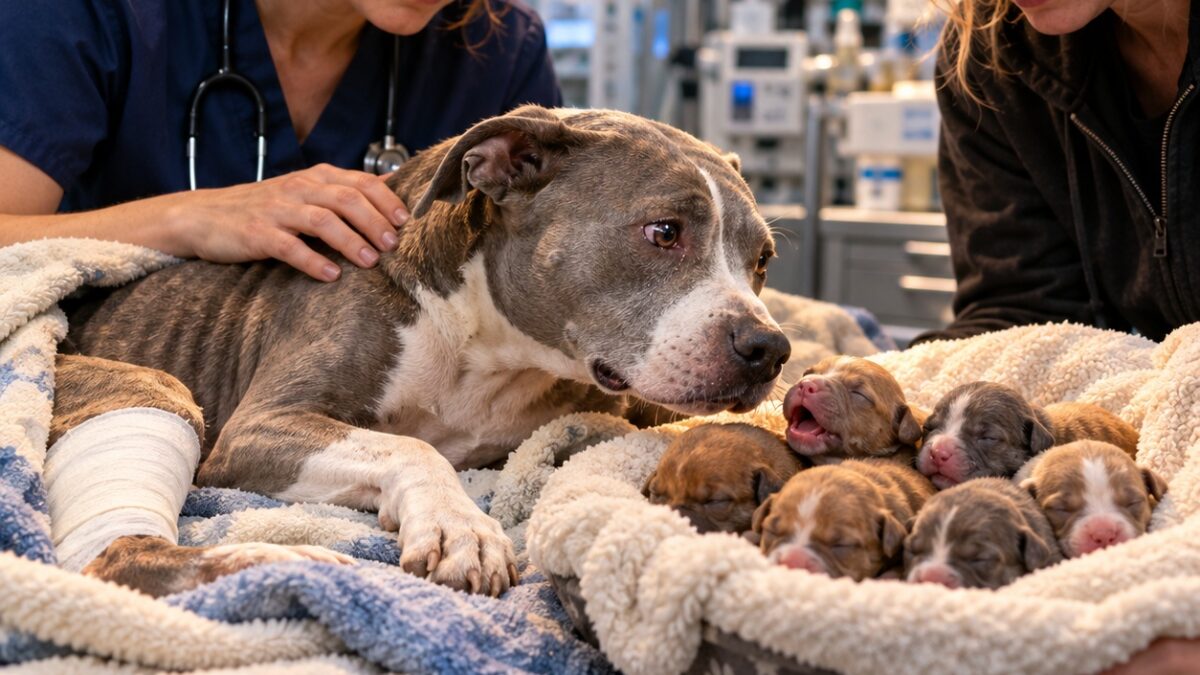
PART2
I almost followed her.
Sarah stopped me.
“Emma.”
I looked at her.
“The puppies.”
Right.
Five fragile lives.
I turned back.
Another volunteer had already prepared warm bottles with special formula.
We wrapped each puppy carefully and began feeding them one at a time.
Their mouths were tiny.
Their bodies far too light.
But once the milk reached them, something changed.
They fought for it.
Weak little paws pressing.
Tiny mouths pulling at soft nipples.
The room filled with thin cries.
The same sounds that had seemed frightening in the ditch now sounded different inside the clinic.
Stronger.
Demanding.
Alive.
Michael stood beside me holding one puppy against his chest.
“He’s hungry.”
“She.”
“What?”
I checked.
“She.”
Michael smiled tiredly.
“Good. She’s hungry.”
“That’s good.”
“That’s very good.”
We held onto small good things because we had no idea what was happening in the exam room with Grace.
After nearly an hour, Sarah came out.
There was blood on one glove.
She had removed it before entering the puppy area, but I saw it folded in her hand.
“How bad?”
I asked.
Sarah looked at the puppies first.
Then at me.
“Very.”
My stomach tightened.
“What does that mean?”
“She has fractures in the pelvis.”
“We knew she was hurt.”
“Multiple fractures.”
I stopped.
“How many?”
“Enough that I don’t want to speculate until I’ve reviewed every image.”
Michael asked:
“Recent?”
“No.”
Sarah’s answer made the room colder.
“The bones have already begun healing in poor alignment.”
“How long?”
“I can’t give you an exact timeline.”
I thought about the ditch.
The puppies.
The fact that she had given birth there.
“She did all of that with a broken pelvis?”
Sarah looked at me.
“Yes.”
I could not process it.
She continued.
“The rear leg is another problem.”
“The wounds?”
“They’re deeply infected.”
“Can you clean them?”
“Yes, but there’s tissue damage.”
“How much?”
Sarah hesitated.
“Some tissue has started to die.”
Michael lowered his eyes.
Necrosis.
I knew the word.
Knowing it did not make hearing it easier.
“Can she keep the leg?”
“We’re going to try.”
“And the pelvis?”
“She’ll need surgery.”
“When?”
“As soon as she’s stable enough.”
“Will she survive surgery?”
Sarah’s face became careful.
Veterinarians become careful when someone asks for certainty that does not exist.
“She is severely exhausted. Malnourished. Dehydrated. She has infection. Her body has already been under enormous stress.”
I looked at the puppies.
“And she gave birth.”
“Yes.”
“And fed them.”
“Yes.”
Sarah was quiet for a moment.
Then said:
“Her vital signs are more stable than I expected.”
I looked at her.
“That’s good?”
“It’s surprising.”
“Why?”
“Because her body has every reason to be shutting down.”
Sarah glanced toward the exam room.
“But she’s still fighting.”
I remembered Grace trying to lift her head when the puppy cried.
Sarah said quietly:
“It is a miracle she’s alive.”
Then, after a pause:
“And I don’t just mean medically. Something in that dog refused to stop.”
The first surgery happened only hours later.
I stayed.
Nobody asked me to.
I simply could not leave.
Michael stayed too.
We took turns feeding puppies.
Five of them.
Eventually they received names because saying “puppy one” and “puppy two” felt too cold for animals whose mother had nearly destroyed herself keeping them alive.
Hope.
Brave.
Sunshine.
Moon.
And the smallest—
Little Grace.
Michael laughed when we settled on the last name.
“Confusing.”
“Perfect.”
“Sarah will hate it.”
“She’ll survive.”
Every time one puppy finished a bottle, I felt irrational relief.
One more meal.
One more hour.
One more tiny body refusing to disappear.
The operation went on for hours.
From the hallway, we heard nothing except the usual clinic sounds.
Monitor alarms far away.
Doors.
Footsteps.
Metal instruments.
Once, Sarah’s assistant came out quickly for supplies.
I stood.
He gave me a small nod.
“She’s still stable.”
Still.
That word mattered.
Eventually, long after I had lost track of time, Sarah came out.
Her shoulders looked tired.
“Finished.”
I stood so quickly my chair moved backward.
“She made it?”
“Yes.”
My knees nearly gave.
Michael touched my shoulder.
I asked:
“The leg?”
“We removed dead tissue and cleaned everything thoroughly. We’ll watch the infection carefully.”
“And the pelvis?”
“We corrected as much as we safely could.”
She explained that the old fractures had already begun setting incorrectly.
Metal plates and screws had been used to stabilize what could be repaired.
Grace would face pain.
Rehabilitation.
Possibly permanent changes to her gait.
But she was alive.
That night, she was moved to a quiet recovery room.
The first time I saw her afterward, I had to stop in the doorway.
Bandages.
Shaved areas.
IV lines.
Her right rear leg wrapped.
Her body positioned carefully to protect the repaired pelvis.
She looked smaller than she had in the ditch.
Not physically.
Emotionally.
The fight had temporarily gone quiet.
Sarah stood beside me.
“Let her sleep.”
I nodded.
“Can she see the puppies?”
“Not yet.”
“Can she smell something?”
Sarah thought.
“Maybe.”
That idea would matter later.
The first days were harder than the surgery.
People imagine rescue as a line.
Danger.
Help arrives.
Treatment.
Recovery.
Home.
Real recovery does not move that cleanly.
Grace woke frightened.
She refused food.
She kept herself as far back in the recovery kennel as her body allowed.
If someone entered too quickly, her eyes widened.
If a hand approached unexpectedly, her muscles tightened.
She never snapped.
That somehow made the whole thing more painful.
Aggression would have been understandable.
Grace responded instead by retreating.
Making herself smaller.
Avoiding.
As if her strategy for surviving humans was simply not to give them a reason to notice her.
I began sitting outside her kennel.
Hours sometimes.
I brought a book.
Read aloud.
Not dog books.
Anything.
Novels.
Articles.
Once a gardening magazine because it was nearby.
Grace probably knew nothing about tomato pruning.
Neither did I.
The words were not the point.
Consistency was.
Same voice.
Same person.
Nothing bad happens.
Again.
Again.
Again.
Some days I talked instead.
About the puppies.
“They’re eating.”
One ear might move.
“Hope is greedy.”
No response.
“Brave pushes everybody.”
An eye would open.
“Little Grace screams if she’s hungry for more than ten seconds.”
That sometimes got both eyes.
I liked to imagine she understood the topic.
Maybe she understood only tone.
Either was enough.
Grace continued refusing food.
Sarah worried.
“We need calories.”
“What if I stay while you feed?”
“We’ve tried.”
“What about hand feeding?”
“We’ve tried.”
“What about something with the puppies’ smell?”
Sarah looked at me.
That evening I took a small piece of soft faux-fur blanket.
Rubbed it gently against the puppies.
All five.
Their smell collected in it.
Milk.
Warm bodies.
That particular sweet scent newborn animals have.
I carried it to Grace’s recovery area.
Placed it near her.
She did not move.
I sat.
Waited.
Minutes passed.
Then her nose twitched.
Once.
Again.
Grace lifted her head.
Very slowly.
Her eyes found the blanket.
She sniffed.
And her tail moved.
Just once.
Weak.
Barely off the bedding.
I covered my mouth.
“Sarah.”
She was already watching from outside.
Her eyes filled.
It was the first tail wag anyone had seen.
I moved the blanket closer.
Grace pressed her nose against it.
Inhaled deeply.
The tail moved again.
I whispered:
“They’re okay.”
She closed her eyes with her nose still against the fabric.
That night, Sarah offered food by hand.
Grace took one bite.
Then another.
The entire clinic celebrated three mouthfuls of canned dog food like a championship victory.
It sounds ridiculous unless you have ever waited for an animal to choose life one bite at a time.
The next day she ate five.
Then from a bowl.
Slowly.
Suspiciously.
But she ate.
The puppies, meanwhile, were transforming.
Milk-filled bellies.
Stronger voices.
Eyes opening.
Legs beginning to understand walking.
Hope was the explorer.
Brave pushed forward even when balance suggested otherwise.
Sunshine had a way of falling asleep halfway through everything.
Moon preferred piling beneath siblings.
Little Grace remained the smallest and somehow the most stubborn.
If another puppy got between her and food, she objected loudly.
Michael called her tiny dictator.
I agreed.
Their play area became the happiest room in the building.
Little cries.
Paws.
Bodies tumbling.
Bottles.
Blankets.
Warmth.
Grace could sometimes hear them from farther down the hall.
Whenever the puppies became loud, she lifted her head.
Sarah noticed.
“So did I.”
“They’re helping her.”
Sarah nodded.
“Probably more than they know.”
Grace’s physical recovery was slow.
She had to heal surgery while fighting infection.
Pain medication helped.
So did good nutrition.
The wounds gradually became cleaner.
Healthier tissue appeared.
Her temperature stabilized.
The concern over the damaged leg decreased.
Then rehabilitation began.
The first time staff encouraged her to stand, Grace looked terrified.
Not of standing.
Of pain.
Her body remembered.
Sarah supported her carefully.
A technician used a sling.
Grace pushed with her front legs.
The rear legs followed.
She stood.
For three seconds.
Then sank.
I cried.
Again.
Michael teased me.
“You cry a lot.”
“Leave.”
Four days later she stood longer.
Then one step.
Two.
Uneven.
Painful.
But forward.
Weeks passed before Sarah was comfortable discussing a meeting with the puppies.
By then, they were around six weeks old.
Unrecognizable from the tiny trembling bodies in the ditch.
They ran now.
Badly, but enthusiastically.
They wrestled.
Stole each other’s toys.
Climbed into laps without permission.
Grace could manage short walks with a special supportive harness.
She still limped.
The repaired pelvis would never move exactly as it once had.
Cold weather might always hurt.
But she could walk.
Sarah picked a quiet room for the reunion.
Everyone wanted to watch.
We tried to keep the number of people reasonable.
Failed.
Michael stood beside me.
Sarah had Grace on the harness.
Another volunteer opened the puppy gate.
The puppies noticed her before Grace fully noticed them.
Hope ran first.
Then Brave.
Then all five.
Grace stopped.
Her entire body trembled.
For one terrible second, I thought she might be overwhelmed.
The puppies reached her.
Grace lowered her head.
Sniffed Hope.
Long.
Deep.
Then Brave.
Sunshine.
Moon.
Little Grace.
One after another, as if counting.
One.
Two.
Three.
Four.
Five.
All here.
All alive.
Grace’s tail started moving.
Not the weak single movement from the blanket.
Full.
Fast.
Her whole rear body wanted to join even though the healing pelvis limited it.
Then she began licking them.
Face.
Ear.
Back.
Whichever puppy came close enough.
A low sound came from her chest.
Not aggression.
A deep maternal rumble.
The puppies climbed over each other trying to reach her.
Little Grace ended up under her chin.
Grace froze.
Then lowered her head over the puppy.
I could not see through my tears.
Michael was openly crying now too.
“You’re crying.”
“So are you.”
“Exactly.”
Sarah stood behind us wiping one cheek with the back of her hand.
Grace kept counting them.
That is what it looked like.
Checking.
Smelling.
Touching.
Five.
She had broken bones for them.
Bled for them.
Fed them when her own body had almost nothing left.
Dragged herself through pain.
Stayed alive.
And now, for the first time, someone else had carried the responsibility.
She did not have to keep them alive alone anymore.
I think some part of her finally understood that.
After the reunion, her recovery changed.
Not magically.
Pain remained.
Rehab remained.
But the darkness in her eyes began lifting.
She ate better.
Walked willingly.
Rested instead of merely collapsing.
She started seeking us.
Me especially.
I would sit near her bed and, instead of staying against the far side, Grace would approach.
Slowly.
Rest her head on my knees.
The first time, I stopped breathing.
Michael smiled.
“You’re done.”
“What?”
“That dog owns you.”
“She owns everyone.”
Fair.
Months passed.
The puppies grew.
Vaccinations.
Socialization.
Health checks.
Then the adoption process began.
That part was harder than expected.
Happy.
Painful.
Grace had survived everything to keep these five together.
Now humans were going to separate them.
For good reasons.
Good homes.
Still.
I felt guilty.
Michael did too.
We personally spoke with potential adopters.
Maybe we were excessive.
I do not care.
Grace had not done what she had done so we could become careless at the finish line.
Hope went to a young family with three children.
The children sat on the floor during the meet-and-greet.
Hope climbed into the middle of them and never looked back.
The mother laughed.
“I think she chose.”
“Yes.”
I crouched.
Held Hope one last time.
“You behave.”
She bit my sleeve.
Promising start.
Brave was adopted by a veteran who had recently returned from military service.
He sat beside the puppy quietly.
Brave walked over.
Placed one paw on his boot.
The man smiled for the first time in the entire conversation.
“I think I need a dog who understands second chances.”
I looked at him.
Then at Brave.
“That makes two of you.”
Sunshine and Moon had become almost inseparable.
Every attempt to separate them during play ended with one searching for the other.
So we refused to split them.
That made placement harder.
Then an older woman with a large home and a sunny garden came to meet them.
Sunshine slept on her foot.
Moon climbed into her lap.
She looked at me.
“I suppose I’m taking two.”
“Yes, ma’am.”
She laughed.
“I walked in for one.”
“They’re persuasive.”
Then Little Grace.
Sarah had spent months insisting she was not adopting another dog.
Nobody believed her.
Little Grace followed her constantly.
Sarah complained.
Little Grace followed harder.
Eventually Sarah walked into the puppy area after work, picked her up, and said:
“This is ridiculous.”
I smiled.
“You’re taking her.”
“No.”
Little Grace licked her chin.
Sarah closed her eyes.
“Yes.”
So Little Grace went home with Dr. Sarah Miller.
That left Grace.
Her puppies had homes.
Her body had healed as much as it ever would.
She still limped.
The fur over parts of her pelvis never returned normally.
Cold, wet days made her stiff.
She would probably live with discomfort from those old fractures for the rest of her life.
But her face was different.
The constant suspicion was gone.
Not completely.
Fast movements could still make her flinch.
Loud vehicles still made her body tighten.
Some memories live below thought.
But curiosity had returned.
Trust had returned.
She wanted affection.
She wanted sunlight.
She wanted food.
She wanted walks.
She wanted life.
And now she needed a family of her own.
I secretly wanted to take her.
Michael knew.
“You can’t adopt every dog.”
“Watch me.”
“You work rescue.”
“Exactly.”
“You already have responsibilities.”
I knew.
Love and suitability are not identical.
Grace deserved the right home, not simply the person most emotionally attached to her story.
Then Albert and Margaret Harrison walked into Paws of Hope.
Albert was a retired professor in his seventies.
Margaret was around the same age.
They had lost their old Labrador several months earlier.
They had spent months debating whether to adopt again.
“We’re not young anymore,” Albert said.
His smile was gentle.
“We love dogs. We just don’t think we’re the right home for a puppy that wants to run six miles before breakfast.”
Margaret touched his arm.
“He means he doesn’t want to admit he gets tired now.”
“I was a professor. I survived forty years of students.”
“That is not cardiovascular exercise.”
I liked them immediately.
I also thought of Grace immediately.
Sometimes matching an adopter with an animal feels like solving a puzzle.
This did not.
This felt like recognizing something that had already decided itself.
“Come with me.”
Grace was lying on her favorite round bed near a sunny window.
The light warmed one side of her face.
She lifted her head when we entered.
Did not rush.
Did not wag wildly.
That was not Grace.
Margaret crouched slowly.
Her hand shook slightly as she extended it.
Grace stood.
Carefully.
One rear leg slower.
Step.
Pause.
Another.
She reached Margaret.
Sniffed her fingers.
Once.
Twice.
Then licked them.
Margaret’s eyes immediately filled.
“Oh.”
Albert stayed still.
Grace turned toward him.
He did not reach.
Good.
She walked closer.
Then did something I had never seen her do with a stranger.
She pressed the entire side of her body against his legs.
Not a brief lean.
She put her weight there.
And sighed.
Long.
Deep.
Albert looked down.
His face changed.
He placed one hand very gently behind her shoulder.
“Well,” he whispered.
Margaret looked at me.
“What does that mean?”
I swallowed.
“I think it means you should sit down.”
She laughed through tears.
Grace stayed pressed against Albert.
That sound she had made—
the sigh—
was not exhaustion.
I had heard exhausted Grace.
This was different.
It sounded like a body giving up the need to remain guarded.
I felt it more than heard it.
I had spent months watching Grace fight.
Fight infection.
Fight pain.
Fight fear.
Fight the memory of human hands.
Now, standing against an old professor she had met thirty seconds earlier, she stopped fighting for a moment.
Just leaned.
Albert scratched behind her ear.
“I’m old too, girl.”
Grace looked up.
“We can limp together.”
That was it for me.
I turned away before I embarrassed everyone.
Margaret noticed.
“You love her.”
“Yes.”
“Then why don’t you keep her?”
The honest question.
I looked at Grace.
“Because loving her means I want the life that fits her best.”
Margaret nodded slowly.
“And you think that might be us?”
Grace answered before I did.
She lowered herself beside Albert’s shoes.
I smiled.
“Yes.”
The adoption was not rushed.
They visited again.
And again.
Grace reacted the same way every time.
Calm.
Interested.
Close.
Albert and Margaret learned her medication schedule.
What cold weather might do.
The signs that meant her pain needed reassessment.
How to help her into a vehicle without stressing the pelvis.
No jumping from high surfaces.
Short consistent walks.
Good footing.
Everything.
They listened.
Asked questions.
Took notes.
Albert actually took notes.
Professor.
Of course.
The day Grace left with them, I prepared myself.
Poorly.
I had survived five puppy adoptions.
Grace was different.
She walked toward the Harrison car wearing a new collar.
Then stopped.
Turned.
Looked at me.
I crouched.
She came back.
Placed her head on my knees.
I buried both hands in the fur around her neck.
“You’re okay.”
She stayed.
I whispered:
“You don’t have to save anybody anymore.”
My voice broke.
“You hear me?”
Grace breathed against me.
“Your babies are safe.”
Hope.
Brave.
Sunshine.
Moon.
Little Grace.
Five homes.
Five lives.
“You did it.”
I kissed the top of her head.
“Now go be a dog.”
She pulled away.
Walked toward Margaret.
Margaret opened the back door.
Grace climbed with help.
Albert settled beside her for the ride.
The car left.
I stood there long after it disappeared.
For the first time since Grace arrived, no part of her life was my responsibility.
That should have felt like loss.
Mostly it felt like relief.
She was finally somewhere no emergency existed.
The Harrisons’ home suited her exactly.
I received updates constantly at first.
Partly because I asked constantly.
Grace’s first days there were cautious.
Every room required examination.
Every sound required evaluation.
A passing car could make her body contract.
A dropped object sent her toward the far side of the room.
Albert learned quickly.
If he moved too fast and Grace flinched, he stopped.
Lowered himself.
Waited.
“All right, girl.”
His voice stayed soft.
“You’re safe.”
Margaret told me Grace gradually started coming to him after those moments.
Not because the fear disappeared.
Because she learned the sound that followed fear was comfort, not punishment.
Their backyard became Grace’s kingdom.
A large old oak stood near the center.
Albert put a dog bed beneath it.
I laughed when Margaret sent the first photograph.
Grace stretched in filtered sunlight.
Eyes closed.
Grass around her.
No ditch.
No concrete.
No exam table.
No cage.
Just shade.
Margaret spent afternoons reading on the porch.
Grace slept nearby.
Albert worked in his study in the evenings.
Grace crawled beneath his desk, wedged herself between his feet, and snored loudly enough to ruin his concentration.
He called me once.
“Is the snoring medically concerning?”
I said:
“Yes.”
Silence.
“Really?”
“No.”
He laughed.
“She sounds like farm equipment.”
“Then your reading will become stronger.”
Grace began asking for things.
That mattered to me.
She stood by the door when she wanted outside.
Went to Margaret when dinner was late.
Nudged Albert’s hand when he stopped petting too soon.
Traumatized dogs often learn to make themselves invisible.
Safe dogs become inconvenient.
Grace was becoming inconvenient.
Wonderful.
Her scars remained.
They always would.
The fur never fully covered parts of her pelvis.
Her gait carried a slight asymmetry.
On cold, damp mornings, Albert said she rose slowly.
He would warm her bedding.
Give prescribed medication when needed.
Wait.
Then she walked.
There was no shame in the limp.
No attempt to make her look like a dog who had never been hurt.
She had been hurt.
Terribly.
Healing did not require pretending otherwise.
That mattered to me.
People love transformation stories because they want the final animal to look untouched.
New coat.
Perfect body.
No fear.
No evidence.
Grace never became untouched.
Her body told the truth.
Scars.
Uneven gait.
A flinch when something sounded too much like a car.
Those things remained.
But suffering stopped defining everything around them.
A scar is not the same thing as an open wound.
That was Grace.
Eventually, the puppies became adult dogs.
The families sent pictures.
Hope surrounded by children on a living-room floor.
Brave sitting beside the veteran who had adopted him.
Sunshine and Moon sleeping against each other in a patch of garden light.
Little Grace stealing one of Sarah’s shoes inside her house.
Sarah sent that photo with:
THIS IS YOUR FAULT.
I replied:
YOU NAMED HER.
Grace’s puppies had lives.
Real ones.
Not symbolic extensions of what their mother suffered.
That was important.
They ran.
Played.
Misbehaved.
Slept.
Greedily occupied furniture.
Their beginning had been dramatic.
Their lives did not need to remain dramatic.
Grace’s life did not either.
The greatest gift after trauma is often boredom.
Nothing happening.
No one running toward you.
No emergency.
No fear.
A meal at the expected time.
A person walking into the room whom you already know.
A bed where you slept yesterday and will probably sleep tomorrow.
Grace had spent so long surviving unpredictability.
The Harrisons gave her routine.
Same morning.
Same yard.
Same voices.
Same gentle hands.
That may have healed more than anything I could have offered at the clinic.
Years later, Margaret told me about one warm spring evening.
She described it so clearly that I can still see it even though I was not there.
Sunset filled the backyard with orange light.
Albert sat on the steps.
Grace lay beside him.
Older now.
Muzzle grayer.
Her head heavy across his lap.
She was sleeping.
Deeply.
Her paws moved slightly in a dream.
As though running.
Margaret stood inside near the window.
Watching.
She told me something changed inside her in that moment.
Because years earlier, Grace had used every remaining piece of strength to give life to five puppies.
She had dragged a broken body into a ditch.
Endured infection.
Pain.
Hunger.
Birth.
Nursing.
She gave everything.
Then life slowly began giving things back.
Not all at once.
Not as payment.
Not because suffering earns reward.
Life is not that fair.
But through hands.
Sarah’s hands in surgery.
Mine around a bottle.
Michael holding puppies.
Adopters opening doors.
Margaret reaching toward her.
Albert waiting patiently when she flinched.
A warm bed under an oak tree.
Food every day.
Medication.
Quiet.
Routine.
Love.
Margaret said she watched Grace dreaming against Albert’s knees and understood what peace looked like.
It was not dramatic.
No rescue van.
No operating room.
No applause.
No miracle headline.
Peace was an old dog asleep deeply enough to dream because she no longer expected pain to wake her.
That sentence stayed with me.
I had known Grace at her worst.
So weak she could barely lift her head toward the sound of her own puppies.
I had watched Sarah shave dirty fur and expose bruises that made experienced staff look away.
I had seen X-rays showing a pelvis broken in multiple places and healing wrong because no one came when Grace needed help.
I had smelled infection from wounds left untreated long enough for tissue to die.
I had watched her refuse food.
Hide at the back of a kennel.
Scan every approaching person for danger.
I had also watched her nose press into a blanket carrying the smell of her puppies.
Tail move.
One bite.
Then another.
First step.
First reunion.
First time resting her head on my knees.
First stranger she chose.
First home.
That is why I refuse to call Grace’s life a tragedy.
Terrible things happened to her.
That is not the same thing.
A tragedy would have been if the ditch were the end.
It was not.
I sometimes wonder what Grace remembered from being thrown from the vehicle.
Dogs process trauma differently from us.
Maybe no narrative.
Maybe sensations.
Motion.
Impact.
Road noise.
Pain.
That might explain the way cars frightened her afterward.
I never needed to know.
Knowing would not make me love her more.
The body remembers enough.
What mattered was giving it new information.
Car sound.
Nothing bad follows.
Footstep.
Safe.
Hand reaches.
Gentle touch.
Door closes.
Person returns.
Night falls.
Morning comes.
Again.
Again.
Again.
Safety is repetition too.
When people ask what impressed me most about Grace, they expect me to say giving birth with a fractured pelvis.
Or nursing five puppies while starving.
Or surviving infected wounds.
Those things are extraordinary.
But they are not my answer.
Trusting again.
That was harder.
Instinct can force a body forward.
Motherhood can create incredible drive.
Pain can be endured when survival is immediate.
But after the emergency?
After humans had already proven what they were capable of?
Grace still allowed Sarah to touch her wounds.
Allowed me to sit beside her.
Allowed Michael near her puppies.
Allowed Albert and Margaret into the part of her heart that expected betrayal.
That was courage.
Not the absence of fear.
The willingness to move toward love while fear still existed.
I learned something from that dog I have never forgotten.
People often think rescue ends when an animal is physically safe.
Get them out of danger.
Treat injuries.
Feed them.
Done.
No.
Physical rescue is the first bridge.
Then the animal has to decide whether the world on the other side is worth joining.
Grace had every reason not to.
Humans put her in that ditch.
Humans hurt her.
Humans left her.
Still, eventually, she leaned against Albert.
That sigh.
I remember it.
A body saying:
Maybe I can stop bracing.
That is why the Harrison match meant so much.
Albert did not need Grace to perform gratitude.
Margaret did not need her to be instantly affectionate.
They did not adopt a symbol.
They adopted a dog with scars.
Pain management.
Fear triggers.
A limp.
History.
And they let her choose the speed.
That is love in a form I trust.
Not:
Look what I saved.
But:
You do not have to hurry here.
Grace learned the house slowly.
The garden slowly.
Their movements slowly.
Then one day none of it was new.
Home had become boring.
Familiar.
Hers.
That is the outcome every rescue animal deserves.
Not celebrity.
Ordinariness.
Grace got it.
One afternoon, long after her adoption, I visited.
She saw me from the garden.
For a moment, she stared.
I wondered whether she remembered.
Then the tail moved.
Grace stood.
Walked toward me with that unmistakable uneven gait.
Not fast.
Grace never needed fast anymore.
I crouched.
She came directly between my knees and pressed her head against my chest.
I laughed and cried at the same time.
Albert said:
“She remembers you.”
Maybe.
I rubbed her ears.
“You remember all those books I read you?”
No answer.
“The gardening magazine?”
Tail.
“I knew it.”
Margaret brought tea.
We sat outside under the oak.
Grace moved between us.
Not anxious.
Just social.
She eventually settled beside Albert.
I watched the way her eyes closed when his hand rested on her shoulder.
Not flinch.
Close.
The same location on her body that had once tensed beneath every human touch now relaxed under one.
Healing can be measured in that distance.
I looked at Albert.
“She trusts you.”
He smiled.
“We trust each other.”
Simple answer.
Best one.
He told me she had started waking him early on sunny mornings.
Standing beside the bed.
Staring.
“Walk?”
I asked.
“No.”
“Food?”
“No.”
“What?”
“Apparently she wants me to open the back door so she can lie under her tree.”
I laughed.
“She survived all that so she could inconvenience a retired professor before sunrise.”
“Exactly.”
Good.
Let her.
Let Grace be demanding.
Let her want sunlight.
Let her decide where to sleep.
Let her sigh when a walk is too long.
Let her refuse rain.
Let her take up space.
There had been a time when the world treated her body like something disposable.
Every comfortable demand she made afterward felt like defiance.
I wish every injured animal could get an ending like Grace.
They do not.
That is another truth rescue teaches.
Not all surgeries work.
Not every dog survives.
Not every foster becomes a home.
Not every cruel act has justice attached.
That is why I do not tell Grace’s story as proof everything always works out.
It does not.
I tell it because what happened to her should have ended her life, and still there were enough people along the way willing to say:
Not yet.
Sarah looked at broken bones and said we operate.
Volunteers looked at tiny puppies and said we feed.
Adopters looked at responsibility and said yes.
Albert and Margaret looked at scars and said come home.
Grace herself kept saying not yet long before any of us arrived.
Every breath in the ditch.
Every time she fed a puppy.
Every time she dragged herself far enough to keep them protected.
Not yet.
That is the miracle.
Not fate.
Persistence meeting help.
There is a dangerous way people tell stories about strong animals.
We praise how much they survived.
Then accidentally make survival sound beautiful.
It is not.
Grace should never have needed that strength.
She should never have known what it felt like to hit the ground from a moving vehicle.
She should never have carried puppies on a fractured pelvis.
She should never have had wounds rot because no one treated them.
Her strength is admirable.
The circumstances that demanded it were not.
What I celebrate is not the suffering.
I celebrate what came after.
Medical care.
Warmth.
Food.
Choice.
Family.
Peace.
That distinction matters to me deeply.
If you only admire the fighter, you may forget to build a world where she does not have to fight.
The Harrisons gave Grace that world.
No tests.
No mission.
No need to be extraordinary.
Albert once told me:
“She doesn’t owe us anything.”
I never forgot that.
Rescued animals do not owe us perfect behavior because we gave them safety.
They do not owe gratitude.
They do not owe affection on command.
Grace chose affection.
That made it more meaningful.
One winter, Margaret called because Grace’s hip bothered her more.
Cold weather.
Exactly as Sarah had warned.
Grace was slower.
Reluctant to stand.
I visited.
For one awful second, seeing her move stiffly brought the clinic flooding back.
I had to remind myself:
This is not then.
She was not starving.
No infection.
No ditch.
Age and old injury.
Pain being managed.
Albert had already spoken to Sarah.
Medication adjusted.
Warm bed.
Shorter walks.
Grace ate.
Drank.
Wanted affection.
Still went outside when the sun appeared.
Still stole Albert’s place near the fireplace.
Life had discomfort.
Not despair.
Those are different.
The scars remained visible.
One broad area over the pelvis never grew a completely normal coat.
People occasionally asked what happened.
Albert never turned it into entertainment.
He would say simply:
“She had a difficult beginning.”
Then move on.
Grace did not live inside the story humans told about her.
She lived in the present.
We could learn from that too.
Her puppies continued sending updates through their families.
Hope became inseparable from the three children.
Brave’s owner said the dog seemed to know when he had difficult nights and would lie near him without being called.
Sunshine and Moon still slept together.
Little Grace became Sarah’s shadow at home.
Five lives Grace had nearly died protecting.
Living.
That thought never became normal to me.
Whenever all five appeared in photographs, I found myself counting.
One.
Two.
Three.
Four.
Five.
All here.
Just like Grace did during the reunion.
Maybe I inherited the habit.
Years later, I met one of the children from Hope’s family again.
Older.
He told me:
“Hope is my best friend.”
He had no idea what that sentence did to me.
Because somewhere once, Hope had been a weak newborn crying in a cold place beside a mother whose pelvis was broken.
Now she was somebody’s best friend.
That is the scale of rescue.
Not just survival.
Relationships that would never have existed otherwise.
Walks.
Birthdays.
Beds.
Children growing up beside dogs.
Morning routines.
An old professor laughing because Grace snored beneath his desk.
Lives touching lives because one animal survived one impossible stretch of time.
I sometimes returned mentally to the first surgery.
The monitors.
The waiting.
My hand around a bottle.
Little Grace making the loudest noise despite being the smallest.
Sarah coming out exhausted.
“She made it.”
How little we knew then.
We knew nothing about Albert.
Margaret.
The oak tree.
The sunny bed.
The quiet office naps.
We only knew Grace had survived one more procedure.
That is how hope often works.
You do not need the entire ending.
You need the next hour.
Then the next day.
Grace did that before us.
Maybe that is how she endured the ditch.
Not:
I must survive until my puppies find homes months from now.
No animal thinks that.
Just:
One more breath.
One more feeding.
One more night.
Keep them close.
Keep going.
Humans can learn from that when life becomes too large.
Do not survive forever.
Survive now.
Tomorrow can be negotiated later.
Grace became one of the stories I carried with me into every difficult rescue afterward.
Not as a guarantee.
As a reminder.
The animal in front of you may be closer to possibility than the condition suggests.
Do not confuse how broken someone looks with how finished they are.
Grace looked finished.
She was not.
Her bones were broken.
Her skin infected.
Her body empty.
Still:
Not finished.
That phrase became mine.
When a frightened dog would hide at the back of a kennel:
Not finished.
When an injured animal refused food on day one:
Not finished.
When an adopter said, “She’s too damaged to trust anyone”:
Maybe.
Maybe not.
Not finished.
Time deserves a chance to answer.
Grace eventually became old.
Of course.
Not tragedy.
Privilege.
Growing old after nearly dying young is a privilege.
Albert once said that to me.
“We complain about her gray face,” he said, “but gray hair means she got the years.”
Exactly.
Grace got years.
Years she was never supposed to have if the road, fractures, infection, hunger, or fear had won.
Instead:
Years.
Under the oak tree.
Beside Margaret.
Under Albert’s desk.
Warm floors.
Cold mornings when she moved slower.
Spring evenings.
The ordinary accumulation of life.
That is the greatest revenge against cruelty I know.
Not punishment.
Continuance.
Cruelty said:
Your life does not matter.
Grace kept living until the statement became absurd.
She mattered to five puppies.
To Paws of Hope.
To Sarah.
To Michael.
To me.
To Albert.
To Margaret.
To everyone who had ever watched her put that scarred body down in sunlight and finally sleep.
One warm spring evening, Margaret stood by the window watching Albert and Grace outside.
I was not there.
But she told me afterward.
Orange sunset.
Albert on the steps.
Grace beside him.
Her head resting heavily across his lap.
Eyes closed.
Paws moving slightly.
Dreaming.
Albert’s hand resting on her shoulder.
Margaret said she watched them for a long time and suddenly remembered the first day at the shelter.
Grace pressing against Albert’s legs.
That great sigh.
Back then, Margaret thought Grace had been choosing them.
Years later, she understood Grace had been allowing herself to stop searching for danger.
That was the real choice.
Margaret told me:
“She looked completely peaceful.”
I asked:
“Asleep?”
“No.”
She paused.
“Safe.”
Different.
I knew exactly what she meant.
Grace’s life had once been pain measured in inches.
How far she could crawl.
How long she could hold herself upright.
How many puppies could still feed.
Later her life was measured differently.
How many minutes of sunlight before she moved into shade.
How loudly she snored.
How long Albert could read before Grace demanded attention.
Whether Margaret had remembered the treats.
That transition is everything rescue is supposed to achieve.
From survival metrics to ordinary ones.
The scars did not vanish.
They stopped being the most important thing about her.
That is healing.
Grace never walked perfectly.
She did not need to.
Some days she limped more.
No shame.
Albert limped a little too as he aged.
He joked that they made a good pair.
“Between us, we’ve got two decent sets of legs.”
Grace would look at him.
Margaret would roll her eyes.
Domestic life.
Beautifully boring.
People sometimes asked me whether Grace knew what she had done for her puppies.
I cannot answer.
Did she understand sacrifice?
Heroism?
Maternal courage?
Those are our words.
Grace knew her babies.
She knew hunger.
Pain.
Danger.
She knew staying.
She knew licking them.
Feeding them.
Keeping them near.
That is enough.
Love does not become less real because it lacks vocabulary.
The same goes for healing.
Grace never said:
I forgive humans.
She did not need to.
She leaned against Albert.
That told me more.
She never said:
I am no longer afraid.
Sometimes she still was.
Courage does not require fear to vanish.
She never said:
This is my home.
She slept beneath Albert’s desk and complained when dinner was late.
Message received.
I keep one photograph of Grace from early recovery.
Not the worst one.
I cannot look at the worst often.
This photograph shows her lying on a blanket carrying the puppies’ scent.
Her nose pressed into it.
Eyes closed.
That weak tail resting just after its first wag.
Beside it, I keep another picture.
Years later.
Grace beneath the oak tree at the Harrisons’ home.
Gray muzzle.
Full body.
Scar visible.
Sleeping.
Sometimes I put the photos side by side.
Not because one erases the other.
Because together they tell the truth.
Before.
After.
Not miracle.
Work.
Care.
Time.
Trust.
Love.
If someone had shown me the second photo on the day the rescue van reached Greenwood, I would have wanted desperately to believe it.
I am not sure I could have.
That is okay.
We did not need to believe in the oak tree then.
We needed to get through surgery.
One stage at a time.
Today, whenever I think about Grace, I do not first see the ditch.
That took years.
I see sunlight.
That feels important.
Trauma was something that happened to her.
It was never all she was.
She was a mother.
A survivor.
A patient.
A dog who loved children.
A dog who trusted slowly.
A dog who liked warm places.
A dog who snored under desks.
A dog who pressed herself against a retired professor and decided perhaps she could stop fighting.
The title of her life is not what somebody did to her.
It is everything she did afterward.
And what everyone who loved her gave back.
Grace gave five puppies life when her own body was breaking.
Later, five families gave those puppies futures.
Sarah gave Grace medicine.
We gave her time.
Albert and Margaret gave her rest.
And Grace gave all of us something harder to name.
Proof that being wounded and being finished are not the same thing.
Proof that scars can stay while fear loses ground.
Proof that trust can return without pretending betrayal never happened.
Proof that a body that once crawled because standing was impossible can one day cross a garden simply because the sun feels good under an old oak tree.
I think that is why Margaret’s description of that spring evening stays with me.
Grace dreaming.
Paws moving.
Maybe she was running.
Maybe back through the ditch.
Maybe through some other place.
But whatever the dream held, she did not wake frightened.
She remained asleep with her head on Albert’s lap.
And Margaret watched from the window and realized something had come full circle.
Once, Grace had spent every piece of strength she possessed keeping other lives close to her.
Now she did not have to hold anything together.
People held space for her.
Home held her.
Love held her.
She could sleep.
That was the debt life finally returned.
Not because life owes us fairness.
It does not.
But because ordinary people sometimes choose kindness after someone else chose cruelty.
Enough small kindness can change where a story ends.
Grace’s ended nowhere near the road where someone tried to discard her.
Nowhere near the ditch.
Not in surgery.
Not in the shelter.
Her story settled beneath an old oak tree.
In a quiet house.
With an aging couple who never needed her to be brave.
Never needed her to prove what she had survived.
Never asked her to protect anyone again.
They only asked her to stay.
And Grace, after everything, finally could.
That is the image I keep.
Not the pit bull who crawled broken into a ditch because five tiny lives depended on her.
Not the patient trembling under hospital lights.
Not the mother frantically counting puppies during reunion.
Grace sleeping.
Safe enough that nothing hurt badly enough to keep her awake.
Safe enough that a car passing somewhere beyond the house was only a car.
A sudden movement was only Albert reaching for a book.
A closed door was only a closed door.
A human hand meant warmth.
A home meant home.
And in that quiet, at last, the dog who had spent so long refusing to die was finally allowed to stop fighting and simply live.








