PART2:Six Men Cornered Me and My 6-Year-Old Daughter in a Dark Alley—They Had No Idea Why I’d Spent Four Years Hiding Who I Used to Be
PART2
“Evening,” he said.
His voice was friendly enough to fool nobody.
I stopped.
The five others shifted.
Not much.
Just enough.
The alley behind them narrowed between two closed storefronts, brick walls wet from rain, delivery crates stacked near a rear door, one security light buzzing overhead.
I could hear traffic from the main street.
Far enough away to matter.
Close enough that eventually somebody might hear something.
Eventually was not useful.
The big man looked at my coat.
My shoes.
Then at Maisie.
“Wallet. Phone. Whatever you’ve got.”
Maisie pressed herself against the back of my leg.
I kept my voice low.
“Okay.”
One of the men laughed.
That was what men like this wanted first.
Not money.
Submission.
They wanted to feel the moment when the other person understood the balance of power.
Fine.
I had no ego left for them.
I reached slowly into my coat.
“My daughter’s here.”
The big man grinned.
“Yeah. We see her.”
“Whatever you want, take it. Just leave her alone.”
The man beside him—thin, scar across his chin—laughed.
“Hear that, boys? Daddy’s scared.”
“Yes,” I said.
That made him pause.
Because most men try to deny fear in front of men who want to exploit it.
I did not care what they thought of me.
I was scared.
Not of getting hit.
Not of six men.
Of one hand reaching past me.
That was different.
Maisie clutched the back of my jacket.
I could feel her fingers through the fabric.
The leader held out his hand.
“Wallet.”
I gave it to him.
He flipped it open.
Forty-three dollars.
One credit card.
Driver’s license.
A folded photograph of Maisie at a school pumpkin festival.
He pulled out the cash.
“That all?”
“That’s what I have.”
He tossed the wallet into a puddle.
Maisie flinched.
I did not.
“Phone.”
I handed it over.
He passed it to one of the others without looking.
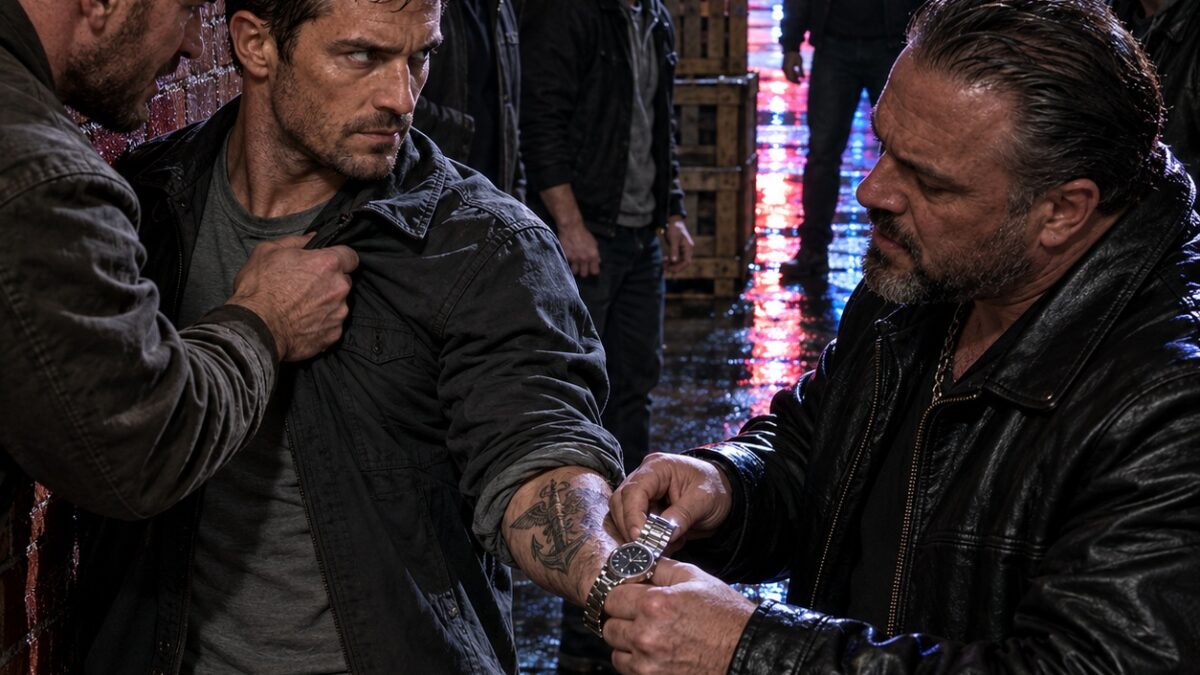
“Watch.”
That was the first thing I hesitated over.
Small movement.
Probably less than a second.
Still enough.
The silver watch on my left wrist had belonged to Elena.
It was not expensive.
Maybe two hundred dollars new.
Probably worth less now.
Scratched face.
Old band.
But Elena had worn it on our wedding day.
At the reception, she kept checking the time until I finally asked why.
She said, “Because you’re always late. One of us should know what time it is.”
Three months later, she gave it to me.
“You need it more.”
I had worn it ever since.
In the hospital, near the end, she noticed it on my wrist.
She touched it with two fingers.
“Still late?”
“Never.”
“Liar.”
The memory came and went in less than a breath.
The man saw my hesitation.
His smile disappeared.
“Watch.”
“I’ll give you my phone.”
“You already did.”
“Take the card too.”
He stepped closer.
“You think you negotiate with me?”
“No.”
“Then watch.”
I looked at his hands.
Right dominant.
Weight forward.
Scar-chin man half a step behind.
Another one to my left.
Youngest farther back, red baseball cap, nervous eyes.
Two behind Dorian—I learned his name later—trying to look harder than they felt.
Six total.
Maisie behind me.
I could give up the watch.
An object is an object.
Elena was not inside it.
I knew that.
I also knew the men were watching the hesitation because they smelled a boundary.
The problem with people who enjoy taking things is that once they find something you care about, they stop being interested in what it is worth.
They become interested in making you surrender it.
I reached for the clasp.
Then Dorian shoved me.
Hard.
My shoulder hit brick.
Maisie screamed.
That sound changed the alley.
Not because I became angry.
Anger is loud.
What came over me was quieter.
A narrowing.
A clarity I had spent four years trying not to feel.
The alley stopped being six men and a wall and rainwater and neon.
It became geometry.
Hands.
Feet.
Distances.
Angles.
Who was watching me.
Who was watching Maisie.
Who was pretending to be confident.
Who actually was.
Dorian leaned close.
“Last chance.”
I barely heard him.
My mind had gone somewhere older.
Elena in a hospital bed.
Thin fingers around mine.
Promise me something.
Anything.
Maisie cannot grow up afraid of the world because I’m gone.
She won’t.
Teach her kindness.
I will.
Don’t teach her your version of strong.
I had laughed weakly.
What’s my version?
The one where you think you have to carry everything alone.
That memory hurt worse than the brick against my shoulder.
Dorian reached for my wrist.
I stepped back.
Not aggressively.
Just enough.
Then I looked over my shoulder.
Near the wall were stacked delivery crates.
Wood.
Low.
Enough to break line of sight.
I crouched slightly toward Maisie.
“Sweetheart.”
Her eyes were wide.
“What?”
“Go behind those boxes.”
She shook her head immediately.
“No.”
“Maisie.”
“I don’t want—”
“Listen to me.”
Something in my voice reached her.
Not volume.
Certainty.
“Go behind the crates. Sit down. Cover your ears. Close your eyes until I tell you.”
“Daddy—”
“I’m right here.”
The scarred man laughed.
“Look at this.”
Dorian said:
“Let the kid watch.”
I turned my head.
“No.”
For the first time, I put something into my voice that was not fear.
Dorian noticed.
So did the others.
Maisie moved.
Fast little steps.
She crouched behind the delivery crates.
I waited until I could no longer see her shoes.
Then I faced the men again.
Dorian smiled.
“There. Better?”
“Yes.”
That confused him.
He swung first.
Not because I provoked him.
Because men like Dorian eventually need violence to restore the story they are telling themselves.
His right shoulder moved before the fist.
I stepped away from the line.
Caught his wrist only long enough to redirect him.
His own momentum carried him sideways.
He collided with scar-chin.
Both stumbled.
The laughter stopped.
Immediately.
The man on my left rushed.
I turned enough to keep him away from the crates, blocked the strike, and shoved him off balance.
Not dramatic.
Not the kind of movement people cheer for in movies.
Short.
Controlled.
The third man grabbed the back of my jacket.
I rotated free and pinned his arm against the brick just long enough to break the grip.
Then I released him.
That mattered.
I was not trying to punish anyone.
Every second I spent hurting one man was a second another could move toward my daughter.
My objective was simple.
Keep them in front of me.
Keep Maisie behind me.
Create space.
Survive until help arrived or they decided the price was too high.
Scar-chin stared at me.
“What the hell?”
Nobody answered him.
Another man came in fast.
I moved.
He missed.
Dorian recovered.
His face had changed.
The smile was gone.
Humiliation had replaced confidence.
That made him more dangerous.
Men protecting pride make stupid decisions quickly.
“You think you’re some tough guy?”
“No.”
He stepped forward.
“What are you?”
I stayed between him and the crates.
“A father.”
He spat toward the pavement.
“Get him.”
Two came at once.
I backed toward the wider part of the alley so they could not surround me cleanly.
One tried to grab.
The other swung.
I avoided the first, absorbed enough of the second against my arm to feel pain shoot toward my shoulder, then drove them apart with controlled force.
One stumbled into a trash bin.
Metal crashed.
The sound echoed.
Good.
Noise was good now.
Noise carried.
Somewhere, maybe a window opened.
Maybe somebody reached for a phone.
I did not know.
I heard Maisie breathing behind the crates.
Fast.
Trying not to cry.
That sound kept every movement disciplined.
Dorian cursed.
The youngest man—the one in the red baseball cap—had not moved yet.
He looked about twenty.
Maybe younger.
He kept glancing from Dorian to me.
He did not want to be there anymore.
I knew that look.
I had seen it in men overseas.
The moment somebody realizes following another person was easier than thinking until the consequences became real.
Dorian saw him hesitate.
“Eli!”
So that was his name.
“Do something.”
Eli flinched.
Then reached inside his jacket.
Metal caught light.
A short pipe.
My stomach dropped.
Not because the weapon made the fight impossible.
Because weapons change accidents into funerals.
Dorian actually looked worried.
“Don’t,” he snapped.
That told me something.
Even he knew the line was moving too far.
But Eli had already committed to the motion.
His hands were shaking.
He raised the pipe.
I moved toward him before he could build confidence.
The pipe came down awkwardly.
I intercepted the movement, controlled his arms, forced the metal toward the pavement, and broke his grip.
The pipe hit concrete with a sharp clang.
Eli backed away immediately.
I kicked the pipe out of reach.
Then stepped back.
Breathing hard now.
My shoulder hurt.
One knuckle bleeding.
Nobody else had serious injuries.
That was intentional.
I looked at Dorian.
“It’s over.”
He stared.
“Walk away.”
Nobody moved.
I could hear a siren somewhere distant.
Maybe coincidence.
Maybe us.
The man near the trash bin looked toward the alley entrance.
Scar-chin swore.
Dorian did not look away from me.
Then his eyes moved to my left forearm.
My sleeve had pulled back during the struggle.
There was a small old tattoo near the inside of my arm.
Weathered.
Not something most people would recognize.
Dorian did.
Or thought he did.
His face changed.
“My brother was Navy.”
I lowered my arm.
Dorian stared at the tattoo.
“He told me about guys with marks like that.”
I said nothing.
“You military?”
No answer.
He looked at his men.
Then back at me.
“My brother said there were teams that went places nobody talked about.”
I could see the calculation happening.
The quiet maintenance guy.
The controlled movements.
The refusal to panic.
The old insignia.
Dorian had finally found an explanation.
It should have ended there.
He should have taken the excuse.
Walk away.
Tell his friends they picked the wrong man.
Keep whatever pride remained.
Instead, humiliation did what humiliation often does.
Made him reckless.
His eyes flicked toward the crates.
Toward Maisie.
I saw it before he moved.
“No.”
Dorian lunged.
Not at me.
Past me.
Toward my daughter.
Everything inside me went cold.
I intercepted him before he got two steps.
We hit the pavement hard.
I turned him away from the crates and held him down.
He fought.
Wild now.
No plan.
Just fury.
I kept enough pressure to stop him.
Not more.
He cursed.
Tried to twist free.
I leaned close enough that only he could hear.
“Do not ever go near my daughter.”
The sirens were louder.
Real now.
Dorian heard them too.
His body changed beneath me.
Fight becoming escape.
I released him and stood.
That surprised him.
“You’re letting me up?”
“I told you to leave.”
The three men closest to the street ran.
Scar-chin followed.
Another disappeared between buildings.
Dorian stumbled to his feet and tried to move, but one of his own men had knocked over enough trash and crates that the alley exit had become cluttered.
Eli did not run.
He stood with both hands hanging at his sides.
Red cap crooked.
Face pale.
Tears forming.
Dorian shouted:
“Move!”
Eli did not.
Dorian looked at him.
“What are you doing?”
Eli whispered:
“I didn’t know there was a kid.”
Dorian stared.
“What?”
“You said these people owed you.”
“Shut up.”
“You said we were collecting.”
“Eli.”
“You didn’t say—”
Dorian stepped toward him.
I moved between them.
“No.”
Dorian looked at me.
For the first time, there was no confidence at all.
Only fear.
Police lights flashed blue against the brick wall at the alley entrance.
Voices.
“Police! Hands where we can see them!”
I raised mine.
Dorian froze.
Eli immediately put his hands over his head.
Two officers entered.
Then another.
I turned toward the crates.
“Maisie.”
No answer.
My heart stopped.
“Maisie?”
A tiny voice:
“Daddy?”
I dropped to my knees.
“You can open your eyes.”
Her head appeared over the crates.
Tears across her cheeks.
“Is it safe?”
“Yes.”
I did not know if the alley was technically safe yet.
Police were shouting.
Men being restrained.
People moving.
But she needed an answer bigger than logistics.
“Yes, sweetheart. It’s safe.”
She ran.
I caught her.
Her arms locked around my neck so hard it hurt.
I held her with both arms and felt something strange happen.
For the first time that night, my hands started trembling.
Not during the attack.
After.
When she was safe.
My body finally understood what almost happened.
Maisie pulled back.
“Daddy?”
“I’m okay.”
“You’re shaking.”
“I know.”
“Were you scared?”
I could have lied.
A lot of fathers would.
There is an instinct to make children believe we are walls.
Unbreakable.
Fearless.
Certain.
But Elena had asked me for kindness, not mythology.
I brushed wet hair away from Maisie’s forehead.
“Yes.”
Her eyes widened.
“You were?”
“Very.”
“But you made the bad men stop.”
“I tried.”
She thought about that.
Then said:
“Mommy said brave people help other people.”
My throat closed.
Elena had told her that.
I remembered the exact afternoon.
Maisie had been three.
A thunderstorm.
Power outage.
She asked whether brave people were never scared.
Elena told her:
“No. Brave people are scared and still help.”
I swallowed.
“Your mom was right.”
One of the officers approached.
“Sir?”
I looked up.
He glanced at Maisie.
“Is she hurt?”
“No.”
“You?”
“I’m okay.”
“Ambulance is coming anyway.”
“I don’t need—”
The officer gave me a look.
“Let them check.”
Old habits.
I almost argued.
Then Maisie said:
“Daddy.”
“What?”
“Listen to the policeman.”
The officer smiled.
I surrendered.
They checked my shoulder.
Bruising.
Small cut.
Nothing serious.
Maisie had no injuries.
That was the only result I cared about.
The neighbor who called 911 turned out to be a shop owner named Mr. Alvarez who lived above his store.
He heard the trash bin crash, looked out his rear window, and saw six men around us.
He called immediately.
He had watched part of the encounter from upstairs.
Enough to confirm we had been surrounded.
Enough to confirm I had tried to give them my property.
Enough to confirm Dorian had been the aggressor.
Eli gave them more.
At first, he sat on the curb silent.
Red cap in his lap.
Then one detective arrived and began asking questions separately.
I was giving my statement when I heard Eli say:
“He lied to us.”
The detective leaned closer.
“Who?”
“Dorian.”
“What did he tell you?”
“That people owed him.”
Dorian, handcuffed twenty feet away, shouted:
“Shut your mouth!”
An officer pushed him back against the cruiser.
Eli flinched.
Then looked at me.
I was not sure why.
Maybe because I had taken the pipe away and then stopped.
Maybe because I did not hit him after he was disarmed.
Maybe because for the first time that night, somebody had given him a choice.
He looked down.
“I didn’t know about the kid.”
I said:
“You know now.”
He nodded.
“I’m sorry.”
I wanted to hate him.
It would have been easy.
He had raised a metal pipe while my daughter hid behind crates.
But he looked young.
Terrified.
Ashamed.
Not innocent.
Ashamed.
Those are different things.
I walked closer, staying outside the police line.
“You need to decide what kind of man you’re going to be when nobody is forcing you to follow someone.”
Eli looked at me.
Dorian laughed bitterly.
“Oh, now he’s your dad?”
The detective told Dorian to be quiet.
Eli kept looking at me.
I said:
“You’re responsible for what you did.”
His eyes lowered.
“Yes, sir.”
“But what you do next still matters.”
He nodded once.
That was all.
The police arrested Dorian and two of the men before they could get away.
The others fled.
Eli stayed and cooperated.
Investigators identified the remaining suspects over the following days.
I answered every question.
No exaggeration.
No invented heroics.
I explained that I gave them my wallet.
My phone.
That Dorian demanded my watch.
That the confrontation became physical after he shoved me and Maisie screamed.
That I moved Maisie behind cover.
That the men continued attacking.
That Eli produced a pipe.
That Dorian later moved toward my daughter.
I did not mention my old military service until an officer asked why I appeared unusually capable of defending myself.
I told him enough.
Not everything.
He stared at me for a second.
Then said:
“That explains some things.”
I looked at Maisie sitting on the curb under a police blanket.
“No.”
The officer followed my eyes.
“That explains everything.”
By the time we got home, it was after midnight.
Maisie was exhausted but refused to let go of my hand.
I made her warm milk.
She drank three sips.
Then said she wanted bed.
I tucked her in.
Turned off the lamp.
She immediately said:
“Can the hallway light stay on?”
“Yes.”
“Both lights?”
“Yes.”
“Your door open?”
“Yes.”
She watched me sit beside her.
“Daddy?”
“Yeah?”
“Are you going to be a soldier again?”
That question hurt in a place I had not expected.
“No.”
“You promise?”
“Yes.”
“But you did soldier stuff tonight.”
I smiled weakly.
“Maybe a little.”
She frowned.
“I like you better here.”
“Here where?”
“With me.”
My eyes burned.
“I like me better here too.”
She yawned.
“Good.”
Then she closed her eyes.
Within minutes, she slept.
I stayed.
Ten minutes.
Then twenty.
Then an hour.
The hallway light spilled across the carpet.
I listened to her breathing.
For years after leaving the military, I had been afraid of one thing more than any physical danger.
That the man I had been would someday become the only man I knew how to be.
I had seen veterans get trapped there.
Every crowded room became a threat.
Every noise became a possibility.
Every disagreement became something to control.
I did not want Maisie raised inside someone else’s war.
So I had gone too far in the opposite direction.
I believed peace meant never touching that part of myself again.
Never using it.
Never acknowledging it.
That night taught me something different.
I had not fought because I missed violence.
I had not enjoyed it.
I had spent the entire encounter trying to avoid it.
I handed over money.
Phone.
Would have given them the watch.
Would have taken a beating if that ended the threat.
The training only mattered when they refused to stop.
Maybe peace was not pretending danger never existed.
Maybe peace was knowing exactly what you were capable of and choosing restraint until restraint was no longer enough to protect someone who depended on you.
I looked at Maisie.
Elena’s promise came back.
Teach her kindness.
I finally understood something.
Kindness did not mean helplessness.
The next morning, Maisie woke at seven.
She climbed into my bed.
Normally, she would have asked for cartoons.
Instead she lay beside me.
Quiet.
I waited.
Eventually she said:
“Are the bad men coming here?”
“No.”
“Sure?”
“Yes.”
“Police know where they are?”
“Some of them.”
That answer scared her.
I corrected carefully.
“The police are looking for the others. Our door is locked. I’m here.”
She pressed closer.
“What if they come?”
I almost said:
They won’t.
Parents love certainty.
Children deserve honesty.
“If anything ever scares you, you tell me. Or your teacher. Or a police officer. You don’t have to handle scary things alone.”
She thought.
“Did you handle it alone?”
“No.”
“You did.”
“No.”
I pointed toward the window.
“Mr. Alvarez called police.”
“Police came.”
“Eli told them who the others were.”
“A lot of people helped.”
She frowned.
“But you fought them.”
“I protected you until help came.”
Different sentence.
I needed her to understand that difference.
She nodded slowly.
Then asked:
“Can I have cereal?”
Six-year-olds do not stay philosophical long.
Thank God.
The pharmacy replaced the medicine that had been dropped during the robbery.
Police returned my wallet.
Wet.
Cards ruined.
Forty-three dollars gone.
Phone recovered later from one of the arrested men.
The watch never left my wrist.
I felt guilty about that for a while.
Not because I defended it.
Because I had hesitated.
What if that hesitation caused everything?
What if I had simply handed it over?
Maybe Dorian walks away.
Maybe no fight.
Maybe Maisie sleeps without the hallway light.
I told the detective that.
He looked at me like I had said something ridiculous.
“You think this was about your watch?”
“It escalated there.”
“He had six guys surrounding you and your daughter.”
“I know.”
“You gave him your wallet.”
“Yes.”
“Phone?”
“Yes.”
“He shoved you anyway.”
“Yes.”
“Mr. Mercer, you don’t know what happens if you hand over the watch.”
He leaned back.
“People who blame themselves after surviving an assault usually pick one moment and pretend it was a door they could have closed.”
I said nothing.
“You didn’t create this.”
That helped.
Not immediately.
But eventually.
The investigation revealed Dorian’s group had been working the area for months.
Late-shift workers.
Restaurant employees.
Nurses.
Warehouse workers.
People walking home alone.
Mostly small robberies.
Cash.
Phones.
Jewelry.
Enough intimidation to keep victims quiet.
They told some people they were collecting debts.
Others they were gang-affiliated.
They changed the story depending on who they targeted.
Most victims never reported it.
Embarrassment.
Fear.
Immigration concerns.
Worry about retaliation.
After Dorian’s arrest, word spread.
Mr. Alvarez told one shop owner.
Police canvassed businesses.
Security footage surfaced.
Then victims started coming forward.
One woman worked nights at a nearby hospital cafeteria.
Dorian’s group had taken her purse two weeks earlier.
A dishwasher from a restaurant had been hit behind the same block.
An older man had lost a week’s cash wages.
One by one, the case grew.
I followed it only as much as necessary.
I did not need every detail.
I had enough nights replaying my own.
Maisie had nightmares for about two weeks.
Not every night.
Enough.
In one, she woke screaming that she could not find me.
I ran into her room.
She was sitting upright.
Crying.
I held her.
She asked:
“Did you leave?”
“No.”
“You were gone.”
“Dream.”
“You promised.”
“I’m right here.”
She slept beside me after that.
I called a child therapist.
Not because something was wrong with her.
Because something frightening had happened and I refused to make her carry it silently.
The therapist told me something I remembered.
“Children often watch adults to decide what an experience means.”
That scared me.
“What do you mean?”
“If you treat her like she’s permanently damaged, she may begin to believe she is.”
“So pretend nothing happened?”
“No.”
“Be calm, honest, predictable.”
Those words became my plan.
School pickup.
Same time.
Lunchbox.
Same strawberry sandwich.
Homework.
Bath.
Story.
Hallway light.
Routine told Maisie the world had not ended.
It told me too.
The first time we walked past the pharmacy again, she stopped.
My chest tightened.
“We can go another way.”
She looked down the street.
“No.”
“You sure?”
“Yes.”
She took my hand.
We walked.
Not through the alley.
I was not going to turn healing into stupidity.
But we walked the main street.
When we reached the corner near the alley entrance, she squeezed my fingers.
I squeezed back.
No speech.
We kept going.
A month after the attack, Detective Ruiz called.
“Eli Foster wants to cooperate fully.”
“He already was.”
“He’s giving us more.”
“About Dorian?”
“Yes.”
“What do you need from me?”
“Nothing right now.”
I hesitated.
“How old is he?”
“Nineteen.”
The transcript I later saw listed him as barely twenty.
Close enough.
Young.
Not a child.
Not old enough to stop me wondering how somebody gets there.
Ruiz said:
“He’s accepting responsibility.”
“Good.”
“He may get consideration for cooperation, but he’s still facing consequences.”
“He should.”
Ruiz paused.
“Thought you’d say that.”
“What else would I say?”
“Some victims want the cooperating defendant treated like nothing happened.”
“I don’t.”
Eli had still raised the pipe.
Fear does not erase responsibility.
Regret does not erase it either.
But responsibility should not erase the possibility of becoming better.
Both things can be true.
Dorian’s case strengthened.
So did the cases against the other men.
I did not attend every hearing.
I had work.
A daughter.
A life.
That was important.
Dorian had already taken one night.
I was not giving him every Tuesday morning too.
Neighbors learned pieces of the story.
Not my history.
The attack.
A few people knew I had military experience.
Rumors grew.
Former Marine.
Army Ranger.
Secret agent.
One kid told Maisie at school that I had been “the most dangerous soldier in America.”
She came home furious.
“Were you?”
“No.”
“Good.”
“Why good?”
“Because Tyler is annoying.”
Fair.
I told her not to discuss my old work.
Not because it was shameful.
Because I did not want her building an identity around it.
At school, I wanted to be the dad who forgot spirit day once.
The dad who made strawberry sandwiches.
The dad who volunteered badly at craft tables.
Not a story children whispered about.
The neighborhood, though, had a real problem.
Dorian’s group was gone.
The fear they created remained.
People who worked late changed routes.
Restaurants began having employees leave in groups.
Mr. Alvarez started waiting downstairs at closing so his cashier did not walk to the bus stop alone.
A nurse who lived three blocks away told me she carried her keys between her fingers every night.
One evening, a community officer named Reynolds held a meeting at the library.
I went.
Maybe twenty people.
Shop owners.
Residents.
Restaurant workers.
Two nurses.
A hotel clerk.
Reynolds asked:
“What would help?”
People gave ideas.
Better lighting.
More patrols.
Cameras.
Then an older woman said:
“Sometimes I just need someone to walk me to my car.”
Simple.
That changed the conversation.
Not armed patrols.
Not vigilantes.
Neighbors.
Walk together.
Look out for each other.
I volunteered before I could overthink it.
The neighborhood escort program started small.
Friday and Saturday nights.
Volunteers near the restaurant strip and pharmacy block.
Reflective vests.
Radios supplied through a community grant.
Coordination with local officers.
No weapons.
No chasing suspects.
No pretending to be police.
If someone working late wanted company to a car, bus stop, or nearby building, a pair of volunteers walked with them.
Boring safety.
Exactly what I wanted.
Maisie heard me discussing it with Reynolds.
“I’m helping.”
“No.”
She crossed her arms.
“Why?”
“You’re six.”
“I can look out for people.”
“You can look out for people from home.”
She considered.
“Can I make a sign?”
That I allowed.
The first evening of the escort program, Maisie stood beside me near the folding table outside Mr. Alvarez’s shop.
Her sign was construction paper taped to cardboard.
Bright blue letters.
LOOK OUT FOR EACH OTHER.
The O in LOOK was a heart.
Not grammatically necessary.
Artistically mandatory.
A tired nurse came out of the clinic across the street around ten.
Two volunteers walked with her toward the parking structure.
A dishwasher waited at the table drinking coffee until another worker finished closing.
Mr. Alvarez handed out bottled water.
Nothing dramatic happened.
That was success.
Maisie watched the volunteers.
Then tugged my sleeve.
“Daddy?”
“Yeah?”
“Are you the strongest man in the neighborhood?”
I laughed.
“No.”
Her eyebrows came together.
“Then who is?”
I looked around.
Mr. Alvarez helping an older volunteer carry a box.
Officer Reynolds explaining routes to two college students.
A woman calling her neighbor to make sure she got home.
People who had previously rushed through the block with their heads down now standing together.
“Maybe it’s all the people who look out for each other.”
Maisie considered that.
Then nodded.
“Okay.”
Apparently my answer passed review.
We stayed an hour.
Then walked home under streetlights.
Her hand in mine.
I noticed something halfway back.
I was not scanning every doorway.
Not calculating every passing stranger.
Not because danger disappeared.
Because fear no longer owned the street.
People had filled the empty spaces with presence.
That mattered.
Months passed.
Dorian and the others moved through the legal system.
Eli continued cooperating.
Several earlier victims testified or provided statements.
The case no longer rested only on what happened to us.
I was grateful for that.
Not because I doubted our evidence.
Because the other victims deserved to be counted.
For a while, I thought about Elena every time I looked at the watch.
The alley had attached Dorian to it.
I hated that.
One afternoon, Maisie climbed onto the kitchen stool beside me.
“You always wear Mommy’s watch.”
“Yes.”
“Even sleeping?”
“Usually.”
“Why?”
“Because she gave it to me.”
“What if it breaks?”
“I’ll fix it.”
“What if you lose it?”
I stopped.
That had been the fear in the alley.
Not losing metal.
Losing one of the objects that made Elena feel physically connected to the life we had.
But Elena had not asked me to guard a watch.
She asked me to raise our daughter.
“If I lose it,” I said, “I’ll still remember her.”
Maisie smiled.
“Me too.”
Something released in me.
Small.
Important.
A few weeks later, I took the watch to a jeweler.
Had the band serviced.
Crystal polished.
Not erased.
Polished.
I wore it home.
No guilt.
No alley.
Just Elena.
I also stopped hiding my military past from myself quite so aggressively.
Not from neighbors.
I still did not want stories.
But I contacted two old teammates.
Men I had not spoken with in over a year.
One answered:
“Well, look who finally remembers phones work both directions.”
“Good to hear you too.”
He heard something in my voice.
“What happened?”
I told him.
Not every detail.
Enough.
He went quiet.
“You okay?”
“Yes.”
“Kid?”
“She’s good.”
“Then what’s wrong?”
I thought.
“I used it.”
“What?”
“The old part.”
He understood.
“And?”
“I thought I’d feel like I went backward.”
“Did you?”
“No.”
He laughed softly.
“Ken, tools aren’t identities.”
That annoyed me because it sounded too wise.
“When did you become a therapist?”
“My wife says I’m emotionally unavailable.”
“That makes more sense.”
We talked for an hour.
For the first time since leaving, I realized I could remember the men I served with without needing to live permanently in the man I had been among them.
Past is not a uniform you accidentally put back on forever.
It is part of you.
You decide how to carry it.
Maisie gradually stopped needing the hallway light.
First she wanted both lights.
Then one.
Then the door open.
Then cracked.
Then one night I tucked her in, went to the door, and she said:
“You can close it.”
I turned.
“You sure?”
“Yes.”
“Completely?”
“Daddy.”
“What?”
“I’m sleeping.”
I smiled.
Closed it.
Stood in the hallway longer than necessary.
Then turned off the light.
That felt like winning something no court could award.
Mr. Alvarez eventually showed me the old security footage from his rear window.
I had never watched it.
Police had.
Prosecutors had.
I had not wanted to.
Months later, I decided I could.
The angle was distant.
Grainy.
Six figures.
Me.
Maisie barely visible.
The fight looked nothing like it felt.
Fast.
Confusing.
Ugly.
No heroic choreography.
No music.
Just a father trying to keep men away from a place where his daughter was hiding.
I watched Dorian move toward the crates.
Saw myself intercept him.
Then police entered.
That was enough.
I stopped the video.
Mr. Alvarez asked:
“You okay?”
“Yes.”
“You were something.”
“No.”
I looked at the frozen frame.
“The police were something.”
“You know what I mean.”
I did.
But I had learned to be careful with the story.
People love the part where the quiet father turns out to be dangerous.
It satisfies something.
Hidden strength.
Bullies surprised.
Justice delivered quickly.
But that was not the important part to me.
The important part came before.
I tried to give them what they wanted.
The important part came after.
I stopped when the threat stopped.
And the most important part?
Maisie learned I was scared.
If she had grown up believing bravery meant never feeling fear, I would have failed Elena’s promise.
Years of special operations had taught me how to survive danger.
Fatherhood was teaching me how not to worship survival.
Different skill.
Harder some days.
The escort program grew.
Not huge.
We did not turn into some citywide organization.
A few blocks.
Enough volunteers.
Enough businesses willing to provide coffee, lights, safe waiting spaces.
Police checked in.
The local clinic posted the number.
Late-shift workers began requesting walks.
Crime on those blocks dropped.
Maybe because Dorian’s group was gone.
Maybe because more people were paying attention.
Probably both.
The deeper change was social.
People knew names now.
The nurse became Rebecca.
The dishwasher was Luis.
The hotel clerk was Jamal.
The older man at the bus stop was Mr. Greene.
Fear isolates.
Community puts names back.
Maisie loved the sign table.
When she turned seven, she upgraded the original cardboard sign.
LOOK OUT FOR EACH OTHER.
This one had glitter.
Officer Reynolds complained the glitter violated professional standards.
Maisie told him:
“You’re not the boss of signs.”
He looked at me.
I said:
“She’s technically correct.”
He regretted knowing us.
Eli’s name came up once more.
Detective Ruiz called to tell me he had entered a plea arrangement that reflected both his role and his cooperation.
I did not ask for exact sentencing details.
That was between him, the court, and what he had done.
Ruiz said:
“He’s trying.”
“Good.”
“Thought you’d want to know.”
“I do.”
Would Eli become a good man?
I had no idea.
One decision in an alley does not magically rewrite a person.
Neither does one apology.
But he had stood at a fork.
Run with Dorian.
Or stay.
He stayed.
Then told the truth.
That did not make him innocent.
It made a different future possible.
That was enough for me to hope.
Dorian never apologized.
I did not need him to.
There are people who confuse closure with receiving the perfect sentence from the person who hurt them.
I stopped waiting for that in my life long before Dorian.
Elena’s illness taught me there are questions nobody answers.
Why her?
Why then?
Why Maisie?
Peace cannot depend on the universe explaining itself.
It has to be built anyway.
Friday nights returned to normal eventually.
Pharmacy.
Groceries.
Homework.
Occasional escort shifts.
Maisie still preferred the main street.
So did I.
We never used the alley shortcut again.
Some lessons do not need dramatic overcoming.
Sometimes choosing a better-lit route is simply intelligent.
One Friday, almost a year later, we walked past the mouth of that alley.
Maisie looked down it.
Then at me.
“That’s where the bad men were.”
“Yes.”
She was quiet.
“Are you scared?”
I thought about lying.
Then smiled.
“A little.”
“Me too.”
She took my hand.
We kept walking.
No shame.
No test.
No need to conquer brick and pavement.
Courage does not require reenacting trauma to prove you have healed.
That understanding took me longer than it took my seven-year-old.
At home, we made strawberry sandwiches.
She put too much jam on hers.
I told her.
She disagreed.
Some things remain stable.
The watch ticked on my wrist.
The hallway light stayed off.
My old life stayed in the past without being denied.
The neighborhood stayed imperfect.
People still forgot to look out for each other sometimes.
Then remembered.
One night during the escort program, Maisie sat on a folding chair beside me coloring while volunteers changed shifts.
A man I did not know approached.
Late fifties.
Work uniform.
He looked at the sign.
Then at me.
“You Ken?”
“Yes.”
He offered his hand.
“My daughter works at the hospital.”
“Okay.”
“She said you people walk staff to the garage.”
“Some nights.”
He nodded.
“Thank you.”
“That’s everyone here.”
“I know.”
He looked toward the volunteers.
Then back at me.
“She used to call me every night while she walked.”
“What about now?”
“She calls after she gets to the car.”
He smiled.
“Complains instead.”
“Progress.”
He laughed.
Maisie looked up.
“What does she complain about?”
“Work.”
“Oh.”
Then returned to coloring.
That small conversation meant more to me than anyone recognizing my tattoo in an alley.
Protection had changed shape.
Before, protection meant putting my body between danger and someone vulnerable.
Now it sometimes meant standing beneath a streetlight holding coffee while a nurse walked safely past.
Less dramatic.
More sustainable.
The older I got, the more I respected ordinary people who choose to show up before things become emergencies.
That was what Dorian’s group had counted on.
People looking away.
Victims staying silent.
Strangers assuming somebody else would call.
Darkness was not only lack of light.
It was lack of witnesses.
We changed that.
One pair of eyes became six.
One business staying open five minutes longer.
One neighbor checking the sidewalk.
One police officer sharing information.
One parent walking with another.
Nothing heroic alone.
Powerful together.
Maisie asked again one night:
“Are you sure you’re not the strongest?”
“Very sure.”
“You beat six men.”
I nearly choked on coffee.
“Who told you that?”
“Tyler.”
“Tyler needs hobbies.”
“So did you?”
“I protected us.”
“That means yes.”
“No.”
She crossed her arms.
I could see Elena in that expression so clearly it hurt.
I crouched.
“You know what strength is?”
“Yes.”
“What?”
“Muscles.”
“Fair.”
She laughed.
“But there are different kinds.”
“Like what?”
“Getting help.”
“That’s not strong.”
“It is.”
“Why?”
“Because scared people sometimes pretend they don’t need anyone.”
She considered.
“Were you like that?”
“Yes.”
“Before?”
“Yes.”
“Mommy knew.”
I smiled.
“Mommy knew everything.”
“That’s what Aunt Sara says.”
“She exaggerates.”
“She says Mommy knew when you lied.”
“That is unfortunately true.”
Maisie looked toward the volunteers.
“So everybody can be strong?”
“Sometimes.”
That answer satisfied her.
Again.
I do not know what she will remember when she is older.
Maybe the alley.
Maybe the police lights.
Maybe hiding behind crates.
I wish I could remove those memories.
I cannot.
What I can shape is everything around them.
She will also remember neighbors showing up.
Police helping.
A therapist listening.
People walking nurses to cars.
A young man telling the truth after following the wrong person.
Her father admitting fear.
Her mother’s words surviving after her mother did not.
That is the world I can give her.
Not one where nothing bad happens.
One where bad things are not the only things that happen.
Elena asked me to make sure Maisie grew up knowing kindness, not fear.
For a long time, I thought those were opposites.
Now I know kindness can exist inside fear.
Sometimes especially there.
Kindness was giving up my wallet instead of proving something.
It was telling Eli to choose differently instead of hurting him after he dropped the pipe.
It was Mr. Alvarez calling 911.
It was volunteers walking strangers home.
It was letting Maisie keep the hallway light on without telling her she should be brave.
It was admitting:
Yes, I was scared too.
That Friday night did not turn me back into a SEAL.
It did not awaken some hidden warrior I secretly missed.
I did not miss that life.
It reminded me why I had left it.
To protect a chance at something gentler.
But gentleness without boundaries is not peace.
Sometimes the person who loves peace still has to stand in front of danger and say:
You do not get past me.
Then stop the moment danger stops.
That was the balance I had been searching for.
Years overseas taught me the first half.
Maisie taught me the second.
If you ask people in my neighborhood who I am now, most still will not know the details.
Maintenance supervisor.
Widower.
Maisie’s dad.
Guy who helps with the escort program.
Makes terrible coffee.
Carries a tiny silver watch.
That is exactly how I want it.
I do not need anybody impressed by who I used to be.
The people who mattered in that life already know.
Some of them are gone.
The person who matters most now is usually six—or seven now—steps ahead of me on the sidewalk, turning around every thirty seconds to make sure I am still listening to a story about school.
One evening after an escort shift, Maisie and I walked home under the streetlights.
Same neighborhood.
Same city.
Different feeling.
She slipped her hand into mine.
“Daddy?”
“Yeah?”
“When I’m big, can I help people too?”
“You already do.”
“No. Like really.”
I looked down.
“You really do.”
She frowned.
“How?”
“You remind me.”
“Of what?”
I looked back at the block.
Neighbors folding tables.
Officer Reynolds helping Mr. Alvarez lock up.
A hospital worker crossing toward her car with two volunteers.
Ordinary people choosing not to look away.
“That nobody keeps anyone safe alone.”
Maisie smiled.
Then skipped ahead three steps, pulling my arm.
I laughed.
For the first time in a long time, I did not look behind me.
Not because I had forgotten danger.
Not because the world had become harmless.
I had spent years in places where harmless was not an option.
I knew better.
I did not look behind me because I finally understood that being prepared for darkness did not mean living inside it.
Once, I had been trained to survive some of the darkest places in the world.
That night in the alley, six men learned I had not forgotten how.
But that was never the victory.
The victory was walking home afterward with my daughter’s hand wrapped around mine, knowing I could still choose exactly what kind of man she would grow up remembering.
Not the man who hurt people.
Not the man with the tattoo.
Not the man Dorian suddenly became afraid of.
Her father.
The one who packed strawberry sandwiches.
The one who admitted he got scared.
The one who stayed.
And if I had one mission left in my life, it was not to make Maisie believe the world would never frighten her.
It was to make sure she grew up knowing that when fear came, she would never have to face it alone.








