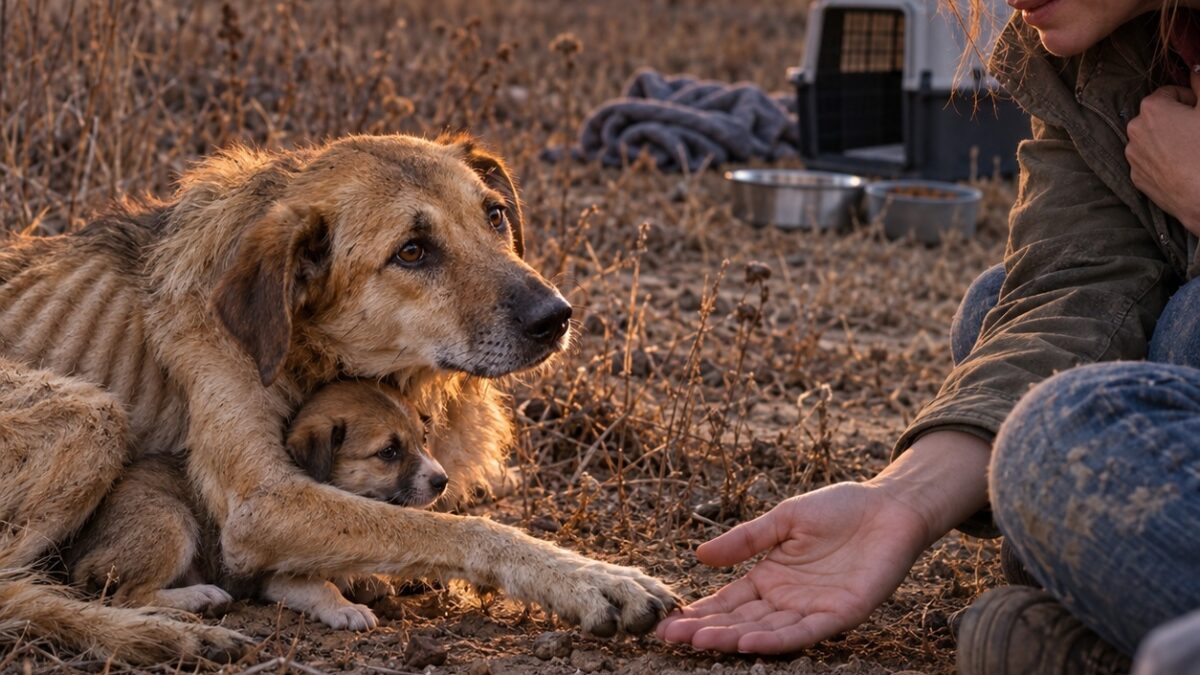
PART2:She Was Too Weak to Stand, but She Still Covered Her Puppy With Her Body—Then She Gave Me One Trembling Paw
PART2
I stayed where I was.
The worst thing I could have done in that moment was treat her trembling paw like permission for everything.
Trust is not a door that swings wide because a frightened animal gives you one good second.
Sometimes it is only a crack.
You respect the crack.
You do not force it open.
So I breathed slowly and kept my hands low.
The mother watched me.
Her puppy had fallen asleep against the hollow behind her front leg.
His head was tucked so tightly into her that I could barely see his face.
Every now and then his small body twitched.
Dreaming, maybe.
Or simply exhausted.
The mother did not sleep.
Not truly.
Her eyes closed for a few seconds at a time, then opened again.
Checking him.
Checking me.
Checking the world.
I wondered how many nights she had spent like that.
Half awake.
Hungry.
Unable to relax because relaxing meant failing the babies depending on her.
That is one of the hardest things about seeing a mother dog on the edge of collapse.
You know her body is begging her to stop.
But motherhood does not listen.
It asks for one more hour.
One more feeding.
One more warning growl.
One more night awake.
One more attempt to stand.
Her instincts keep collecting strength from a place that should already be empty.
I shifted my weight.
She tensed again.
So I stopped.
“Okay,” I whispered. “I’m staying right here.”
The puppy stirred.
He crawled over her front leg and pressed his nose against her chest.
She turned her face toward him and gave one slow lick across the top of his head.
It took effort.
I could see that.
But she did it anyway.
That single lick stayed with me.
There was no food around them.
No water.
No shelter.
Nothing suggesting that anyone was coming back.
She had almost nothing left to give.
And somehow she was still giving.
I looked around the field again.
That was when I noticed movement farther back in the grass.
At first I thought it was a piece of dry vegetation shifting in the wind.
Then it moved again.
Smaller.
Closer to the ground.
Another puppy.
He was several yards away, half hidden against a patch of weeds.
I had been so focused on the mother and the puppy pressed against her body that I had not seen him.
My stomach dropped.
Two babies.
The second puppy stayed low.
He did not come toward me.
He looked in our direction and then disappeared behind the grass again.
Now the situation felt even more urgent.
The mother was not protecting one puppy.
She was protecting two.
I did not know whether the second one had wandered away searching for something or whether he had been hiding when I approached.
What I did know was that every hour mattered.
I kept looking at the mother’s body.
Her hip bones.
The sharp line of her shoulders.
The narrowness of her waist.
The dust coating her coat.
When she inhaled, her ribs showed more clearly.
She needed food.
She needed water.
She needed rest.
The puppies needed all of those things too.
But knowing what an animal needs and being able to give it safely are not the same thing.
I had rescued enough dogs to know what panic could do.
If I rushed toward her, she might use the last of her strength trying to escape.
She could run into danger.
The puppies could scatter.
Fear could turn one bad situation into three worse ones.
So I stayed.
The sun moved.
The shadows changed.
Time became difficult to measure.
Every so often I stood slowly, backed away, then returned a little later.
I wanted her to learn that my movement did not always mean I was coming for her.
I wanted her to see me leave and come back.
I wanted to become predictable.
Predictability is safety to a frightened animal.
Hands that move slowly.
A voice that stays low.
A person who does what they did before.
No surprise.
No sudden grabbing.
No cornering.
Nothing that says danger.
At one point, the first puppy lifted his head and looked at me directly.
His face was dusty.
His eyes were too serious for something so small.
He did not bark.
He did not come closer.
He just stared.
Then he leaned back into his mother.
As though deciding she was still the safest answer available.
That broke something in me again.
There is a specific kind of helplessness in seeing a baby choose a starving mother because the rest of the world has given him no better option.
He had no concept of rescue.
No understanding that I wanted to feed him.
He knew one thing.
Her body.
Her smell.
Her heartbeat.
If she was there, he stayed.
If she was afraid, he was afraid.
If she rested, he curled into her.
The mother was his whole map of safety.
And she was barely holding herself together.
I tried putting water at a distance.
Not close enough to make her feel trapped.
I backed away.
She looked at it.
Then at me.
Did not move.
I waited.
Nothing.
Her fear was stronger than her thirst.
Or maybe standing was simply too difficult.
That thought frightened me more.
I could not know.
I resisted the urge to approach.
Again.
Wait.
Watch.
Give her a choice.
The second puppy came out briefly.
He moved toward his mother in an uncertain little walk.
The first puppy lifted his head.
The two touched noses.
Then the second one crawled in against her back leg.
The mother raised her head as he arrived.
Her eyes softened for one second.
Then she looked at me again.
Protective.
Alert.
Still scared.
I remember thinking that she must have been so tired of being afraid.
Fear takes energy.
Constant vigilance takes energy.
She had almost no calories in her body.
Still, she was spending what remained watching me.
That was why I needed to become less frightening before I could become helpful.
Hours passed.
I spoke to her occasionally.
Not because the words mattered.
Because silence can sometimes feel like stalking.
So I let my voice become part of the environment.
Soft.
Steady.
“You’re okay.”
“I see your babies.”
“I’m not taking them away from you.”
“We’ll figure this out.”
“I promise.”
Promises to animals are dangerous things.
They cannot hold us accountable with language.
That means we have to hold ourselves accountable for them.
So when I said it, I meant it.
I would figure something out.
The problem was daylight.
It would not wait for us.
Afternoon began sliding toward evening.
The heat softened, but the field was becoming darker around the edges.
The mother still had not allowed me close enough to lift her.
Every attempt to reduce the distance ended the same way.
Head up.
Body tense.
Eyes wide.
Sometimes a weak shift away.
Never aggression.
She did not snap.
Did not bark.
Did not lunge.
She simply said no with the little strength she had.
That made the situation harder emotionally.
If she had been aggressive, I could have blamed fear and focused only on safety.
Instead, she was gentle.
Terrified.
Exhausted.
Trying to protect her babies without hurting anyone.
It felt unbearable.
I remember standing near the edge of the field and looking back at the three of them.
Mother in the dirt.
Two puppies tucked close.
The light behind them turning warmer.
I had been there for hours.
I still could not take them.
The thought entered my mind.
Maybe tonight I cannot.
I hated it immediately.
Another night.
Another night without proper food.
Another night without water close enough to trust.
Another night of her body between two puppies and whatever might come through that field after dark.
I could not accept it.
But wanting to rescue a dog does not make fear disappear.
I had to think.
Food.
Something warm.
Something with enough smell to reach her even through panic.
Something I could put down without forcing contact.
I left.
Leaving felt awful.
Even though I knew I was coming back.
I drove away with the image of the first puppy pressed into her ribs filling my mind.
I kept seeing her paw.
That shaking paw.
I worried the whole time.
What if she moved?
What if something happened while I was gone?
What if I returned and found the field empty?
What if she became weaker?
What if the puppies wandered?
There are rescue moments where ten minutes feels like negligence.
This was one.
I got warm food.
Enough for her.
Enough for the puppies to have something too.
I prepared it so the smell would carry.
Then I went back.
By the time I reached the field, evening had settled in.
The mother was still there.
For one second, relief hit me so hard my knees felt weak.
Both puppies were close to her.
She raised her head when she saw me.
But something was different.
The fear did not disappear.
It shifted.
She remembered me.
That mattered.
I approached only as far as I had before.
Then lowered the food.
Warm smell moved through the air.
The first puppy noticed immediately.
His head came up.
The second one did too.
The mother’s nose moved.
Once.
Then again.
I backed away.
Not a few feet.
Far enough.
I sat.
She stared at the food.
Then at me.
Food.
Me.
Her babies.
Food again.
Her body seemed caught between instinct and exhaustion.
Protect them.
Do not trust the stranger.
But eat.
Live.
Feed yourself so you can keep them alive.
I did not move.
The puppies whined softly.
The mother licked her lips.
Then, slowly, painfully, she pushed herself up.
I held my breath.
Her front legs straightened first.
Her body trembled.
Her back end came up.
For a moment I thought she might fall.
She stood.
Not strongly.
Not steadily.
But she stood.
Then she took one step.
Stopped.
Looked at me.
Another step.
Stopped.
I stared at the ground instead of directly into her eyes.
One step.
Then another.
It felt like watching someone cross an ocean.
Finally, she reached the food.
She smelled it.
Looked at me again.
Then ate.
The first bite was small.
Careful.
As though even hunger could not completely overpower caution.
Then another.
Then another.
Her pace changed.
Not frantic.
But urgent.
Every bite disappeared.
I could see her body trying to remember what it felt like to be fed.
I put one hand over my mouth.
I had been worrying for hours.
Waiting.
Negotiating with fear.
Watching daylight go.
And now she was eating.
It sounds like such a simple thing.
A dog eating.
But if you have ever sat beside an animal who is too frightened to accept help, you understand.
Food means something else then.
It means the wall moved.
Maybe one brick.
Maybe two.
Enough.
The puppies came closer to the bowl.
The mother did not push them away.
She ate.
Paused.
Checked them.
Ate again.
The first puppy tasted a little.
Then the second.
Their small tails gave the faintest movements.
I smiled without meaning to.
“Good,” I whispered. “That’s good.”
The mother heard my voice.
She stopped eating.
Looked at me.
I froze.
For several seconds, we stayed like that.
Then she lowered her head.
And continued.
I cannot explain how much that meant.
She had chosen food even while I remained.
She had decided my presence did not make the food unsafe.
That was the beginning.
I let her finish.
Then I offered fresh water.
This time she approached it sooner.
Her tongue moved quickly.
The puppies tried to drink beside her.
One put a paw too close and almost stepped into the container.
For the first time all day, I almost laughed.
It was not funny exactly.
It was relief finding somewhere to go.
When she stopped drinking, she stood there for a moment.
She was closer to me than she had been all day.
I kept my posture low.
My hand rested on the dirt.
Palm down.
Still.
The mother stared at it.
Then took one cautious step.
Her nose reached toward me.
I could hear her breathing.
She smelled my fingers.
Pulled back.
Looked at the puppies.
Then forward again.
I did not touch her.
Not yet.
She needed to be the one deciding.
Her nose brushed my knuckles.
Barely.
A second later she stepped away.
That was enough.
“Thank you,” I whispered.
It may sound strange to thank a starving dog for allowing help.
But trust is a gift.
Especially when the animal giving it has every reason to withhold it.
We tried again.
Food.
Distance.
My voice.
Her approach.
The puppies followed her more now.
One stayed closer to her front legs.
The other wandered a little farther, then hurried back as if embarrassed by his own courage.
I began thinking about how to get them out safely.
The mother was exhausted.
I did not want her walking a long distance.
I also did not want the puppies scattered.
Every movement had to be slow.
We positioned ourselves so the route toward safety did not feel like a trap.
No rush.
No grabbing.
The mother watched.
I moved the food a little closer to where we needed her to go.
She followed.
One puppy followed her.
Then the other.
A few bites.
Another small move.
Wait.
Let her choose.
It became a quiet sequence.
Food.
Pause.
Look.
Step.
Babies.
Step.
Food again.
Every foot felt earned.
The sky darkened.
The first stars were beginning to show.
I could feel the urgency in my chest, but I kept it out of my hands.
Dogs can feel urgency.
Urgency becomes pressure.
Pressure becomes fear.
So I breathed.
Slow.
The mother ate another bite.
I shifted.
She noticed.
Did not retreat.
That was new.
I moved again.
She stayed.
“Okay,” I whispered. “We’re getting there.”
One puppy stumbled.
The mother immediately turned.
Forgot me.
Forgot food.
Went straight to him.
She nosed his side until he stood properly.
Then waited for him before moving again.
Even then.
Even now.
Still mother first.
The sight almost made me lose control of my emotions.
She needed someone to care for her.
But she could not stop caring for them.
I wanted to tell her she did not have to do everything anymore.
Not tonight.
Not once we got her home.
She could sleep.
She could eat.
She could close her eyes without checking every sound.
We would check.
We would bring water.
We would make sure both babies were there.
She did not have to be the whole world anymore.
Of course I could not explain any of that.
So I tried to show it.
Slow hands.
Food.
Space.
No separation.
The puppies remained with her.
That mattered.
At one point, she became uncertain and stopped completely.
Her body lowered.
She looked back toward the field.
For one terrifying second, I thought she was going to turn around and retreat to the place where I had first found her.
The place was terrible.
But it was familiar.
Animals will sometimes choose familiar suffering over unfamiliar safety because familiar is the one thing they understand.
I waited.
She looked at me.
I lowered myself again.
No pressure.
The first puppy leaned against her front leg.
The second puppy sat behind her.
A tiny family frozen between two worlds.
Behind them was the field.
Hunger.
Dust.
Night.
In front of them was everything they could not yet understand.
Food.
Water.
Safety.
But also humans.
Doors.
Walls.
Unknown smells.
Unknown dogs.
Unknown hands.
The mother did not know which world was safer.
She only knew one of them.
I whispered:
“You can bring them.”
Her ears shifted.
“They stay with you.”
She stared at me.
“Come on, Mama.”
The word escaped without thinking.
Not a name.
Just what she was.
Mama.
She looked down at her babies.
Then took one step forward.
I nearly cried.
Another step.
Then another.
The puppies followed.
That was the moment I knew we had a chance.
We moved slowly.
No celebration.
No sudden voices.
Everyone helping stayed calm.
The mother was fragile enough that every stumble frightened me.
But she kept going.
The babies kept with her.
When we finally reached the point where we could safely lift and transport them without separating the family, we did it as gently as possible.
I kept talking.
Soft.
Low.
The mother trembled.
But she did not fight.
One puppy cried.
She turned immediately toward the sound.
We made sure she could see him.
The second puppy was placed beside him.
Then the mother.
Together.
That was the rule.
Together.
The moment the two puppies pressed against her, some of the tension left her face.
Not all.
But enough.
I sat beside them for a second.
The mother looked at me.
Her eyes were still tired.
Still uncertain.
But something in them had changed.
Maybe she recognized me now as the person with the warm food.
Maybe the person who had waited.
Maybe nothing so complicated.
Maybe she was simply too exhausted to be afraid anymore.
Whatever the reason, she did not pull away when my fingers touched the side of her face.
Very gently.
One stroke.
Then I stopped.
She closed her eyes.
Just for a second.
That was the first time I saw her allow herself to rest while I was close.
We brought them home that night.
All three.
The mother and both puppies.
I cannot describe the relief of saying that sentence.
All three.
Not one rescued and two left behind.
Not puppies safe while their mother remained frightened in a field.
Not a plan to return tomorrow.
Together.
Home.
The place where we care for rescued dogs was not silent when we arrived.
There were other dogs.
Other lives.
Other stories.
But we prepared a quiet space for the family.
Food.
Fresh water.
Soft bedding.
Enough room for the mother to settle with the puppies beside her.
No one crowded them.
No one expected gratitude.
Rescue is not a transaction.
You do not save an animal so it will love you on schedule.
You give safety.
Then let safety do its work.
The mother stood in the new space and looked around.
Her body was tense again.
Different environment.
New smells.
She checked the corners.
The door.
Us.
Then the puppies.
One of them found the bedding first.
He stepped onto it.
Turned around once.
Then collapsed.
Not elegantly.
His tiny body simply gave up on staying upright.
The second puppy climbed beside him.
For a moment the two were a tangled little pile.
The mother watched them.
Then looked at the bowl.
She ate.
This time without needing hours of distance.
Not fully relaxed.
But eating.
I sat on the other side of the room.
Every bite felt like a victory.
She drank.
Then returned to the puppies.
She lowered herself slowly.
The babies moved immediately against her belly and chest.
One tucked under her chin.
The other pressed against her side.
The mother curled around them.
Then she did something I had not seen in the field.
She slept.
Not the brief eye-closing of an animal staying ready to run.
Real sleep.
Her head lowered.
Her breathing changed.
Muscles softened.
The puppies slept too.
Three bodies touching.
Safe.
I sat there longer than I needed to.
I could have left.
They had food.
Water.
Shelter.
Everything was prepared.
But I stayed.
Because for hours that day, I had watched her refuse to sleep so she could keep protecting them.
Now I wanted to see what happened when she finally believed somebody else was watching.
Her ears still moved occasionally.
Instinct.
But she did not lift her head.
She slept.
I remember thinking:
There.
That is rescue.
Not the photograph.
Not the moment someone carries an animal away.
This.
A mother sleeping because, for once, she does not have to stand guard.
The next morning I expected her to be frightened again.
She was.
Healing is not a straight line.
The room was safer than the field, but safe did not automatically feel safe yet.
When I entered, the mother raised her head.
The puppies moved closer.
Her body tightened.
But then she smelled the food.
Looked at me.
And did not try to hide.
Progress.
Small.
Real.
I set the bowl down.
Backed away.
She stood.
Her legs were still weak.
Her body still painfully thin.
Nothing about one night indoors had magically repaired what hunger had done.
But there was something different in her posture.
She had slept.
She had eaten.
She had water.
And somewhere inside her, maybe the first small piece of a new expectation had formed.
Humans enter.
Food appears.
No one hurts my babies.
That expectation grew slowly.
We fed them carefully.
We let the mother determine distance.
Some days she came toward us.
Other moments she hesitated.
The puppies adapted faster.
Puppies often do.
The smaller world of fear can change quickly when warmth and food keep appearing.
They began exploring.
First the edge of the bedding.
Then the rest of their space.
One discovered that blankets could be pulled.
The other discovered that bowls made interesting sounds when nudged.
They would wander a few feet.
Then run back to their mother.
Every time, she checked them.
A nose to the face.
A quick look.
Then relaxation.
Her job had not disappeared from her mind.
But the environment was helping carry some of it.
She no longer had to search for water.
We brought it.
No longer had to leave the puppies to search for food.
Food arrived.
No longer had to watch an open field from every direction.
Walls stood around them.
People checked.
Other rescued dogs existed nearby.
Life had structure.
I watched her begin to understand that.
The first time she remained lying down while I refreshed the water, I noticed.
The first time I walked past without her body tensing completely, I noticed.
The first time one puppy came toward me and she did not call him back with her eyes, I noticed.
Trust grows in moments so small most people miss them.
A dog choosing not to move away.
A deeper breath.
A head resting on a blanket instead of hovering above it.
Eating while someone stands nearby.
Sleeping when a door opens.
Those are milestones.
They do not look dramatic.
They are everything.
The mother still had the trembling paw sometimes.
That was the part that stayed with me.
When she felt unsure, one front leg would shake.
The same paw she had offered in the field.
One afternoon I sat near her.
Not reaching.
Just sitting.
The puppies were asleep.
She looked at me.
Then slowly placed that paw forward.
This time it touched my shoe.
I did not move.
She left it there.
For maybe ten seconds.
Then pulled it back.
I turned my face away because my eyes had filled.
That paw had become a language.
I’m scared.
But I’m trying.
I remember you.
I’m not leaving.
Maybe all of those.
Maybe none.
I did not need to define it.
I only needed to respect it.
As days passed, the mother began eating more confidently.
Her body did not change overnight.
She was still thin.
Still tired.
But she no longer looked like she was disappearing in front of us.
There is a different quality in an animal who has started expecting the next meal.
In the field, every bite might have been the last one she would find.
At home, the bowl came back.
Morning.
Evening.
Again.
Again.
Predictability.
That is one of the great gifts of safety.
Not abundance.
Certainty.
There will be water later.
There will be food tomorrow.
The door will not open only when something bad happens.
The hands reaching toward you will stop if you say no.
Your babies will still be beside you when you wake up.
The mother began sleeping more.
I loved seeing that.
At first, whenever the puppies moved, she woke.
Then one day one pup climbed over her shoulder and stepped directly on her neck.
She opened one eye.
Looked annoyed.
Then closed it again.
I laughed.
Not loudly.
But enough.
For the first time, she had decided something involving her babies was not an emergency.
That felt enormous.
The puppies became puppies.
That sounds obvious.
But in the field, they had not had the luxury.
They had been small survivors.
Quiet.
Pressed against their mother.
Watching.
Saving energy.
Now they played.
They wrestled.
Chased each other for short bursts.
Fell over.
Attacked blankets.
Discovered that another puppy’s ear was apparently the most interesting object in the world.
Their mother watched.
Sometimes she corrected them gently.
Sometimes she moved away when they became too much.
That also mattered.
In the field, she could not take a break from motherhood.
There was nowhere to go.
Now she could stand.
Move a few feet.
Lie down alone.
Let the puppies entertain each other.
She was still their mother.
She was no longer their entire survival system.
We had joined her.
That was the promise I had wanted to make in the field.
You do not have to protect them alone anymore.
Now she was learning it without words.
Other rescued dogs became part of their new world too.
We introduced everything carefully.
No rushing.
No overwhelming.
The mother observed from a distance.
Some of the other dogs were curious.
Some barely cared.
That normalcy helped.
The puppies watched older dogs moving calmly around people.
Animals learn from one another.
A human hand touches a dog.
Nothing bad happens.
Food arrives.
Dog eats.
Door opens.
Dog returns.
These things become evidence.
The mother collected evidence the same way she had once collected reasons to fear.
Slowly, the balance changed.
I often thought about what might have happened if nobody had gone into that field.
I tried not to stay with the thought long.
Rescue work can destroy you if you spend too much time imagining every possible ending.
You deal with the life in front of you.
Still, sometimes at night I saw the original image.
Her body in the dust.
The puppy’s face buried against her ribs.
The second baby hiding in the grass.
Her eyes opening only enough to check them.
Then I would remember them sleeping on blankets.
That helped.
A rescue gives memory another ending.
It does not erase the beginning.
I do not want it to.
Remembering the beginning keeps gratitude honest.
The mother had not been dramatically transformed into some different dog.
She remained cautious.
Gentle.
Watchful.
But she started revealing pieces of herself that starvation and fear had hidden.
She liked warmth.
She liked quiet.
She liked knowing where her puppies were.
She liked food enough that the sound associated with feeding eventually made her ears lift before the bowl even arrived.
She tolerated affection before she sought it.
Then, little by little, she began moving closer.
One day she rested her chin near my leg.
Not on me.
Near.
Another day closer.
Then contact.
Small.
Brief.
The first time she leaned her head against my knee, I stopped breathing.
The same dog who had barely allowed me to exist in the field was choosing touch.
Again, I did not immediately stroke her.
I let her decide.
Her head stayed.
So I moved my hand slowly.
One gentle pass along her neck.
She did not pull away.
Another.
Her eyes closed.
That moment was quiet.
No one cheering.
No dramatic music.
Just a tired mother learning that touch could mean comfort.
It is one of the greatest privileges in rescue.
Watching an animal rewrite a rule it learned through fear.
Stranger does not always mean danger.
Hand does not always mean pain.
Door does not always mean abandonment.
Sleep does not always mean vulnerability.
Motherhood does not always mean doing everything alone.
The puppies had their own milestones.
One became bolder first.
He would approach us, retreat, approach again.
The other stayed closer to his mother longer.
Eventually both discovered that humans sometimes had treats.
After that, diplomacy improved rapidly.
They would climb over each other trying to reach a hand.
The mother watched.
The first few times, tension returned to her body.
Then she saw the puppies come back happy.
No harm.
Again.
Again.
Evidence.
Soon she allowed it.
Later, she joined.
The first time all three ate peacefully near us, I thought about that warm food in the field.
The mother taking one slow step toward it.
How impossible safety had seemed then.
Now there were bowls.
Clean water.
Soft bedding.
Other dogs resting nearby.
People moving around.
And the family was simply eating.
Ordinary.
That is the happy ending people often underestimate.
Not every rescue ends with fireworks.
Sometimes the ending is a dog eating without looking over her shoulder.
A puppy sleeping without hiding inside a ribcage.
A mother lying on her side while both babies wander several feet away because she knows they will come back.
Ordinary safety is extraordinary when you have known fear.
As the weeks continued, the mother’s appearance began changing too.
Her coat looked cleaner.
Her face less hollow.
Her movements more deliberate.
She had energy to stand without trembling every time.
Energy to walk.
Energy to look curious instead of only vigilant.
That is what food does when it becomes consistent.
That is what rest does when a body finally receives it.
But what moved me most was not physical.
It was the way she started letting herself be cared for.
At the beginning, every interaction centered on the puppies.
If we came close, she positioned herself.
If they moved, she checked.
If a sound happened, she woke.
Then one afternoon I brought food and found both puppies asleep several feet away.
The mother was lying alone.
She looked at me.
I sat down.
She did not move toward them.
Did not use their bodies as a reason to stay alert.
She stayed where she was.
I set the food nearby.
Instead of eating immediately, she came toward me first.
Slowly.
Her nose touched my hand.
Then she sat.
Her paw lifted.
Not trembling much this time.
She placed it on my wrist.
I stared at it.
The same paw.
The field came back all at once.
Dust.
Setting sun.
Fear.
That tiny movement toward me.
Back then, the paw had felt like a question.
Now it felt like recognition.
I touched the top of it gently.
“You’re okay,” I whispered.
She looked at me.
“You’re all okay.”
The puppies woke.
One yawned dramatically.
The other stumbled over a blanket.
Their mother turned.
Watched.
Did not rush.
I smiled.
“You see?”
She could not understand.
But I needed to say it.
“You did it.”
Because she had.
Whatever happened before I found her, she had kept those puppies alive long enough for us to reach them.
Her body had paid for it.
Her sleep.
Her strength.
Her safety.
Everything.
She had given what she had.
Then given what she did not have.
That does not mean she should have had to.
There is nothing beautiful about an animal starving.
Nothing romantic about suffering.
I hate when people turn survival into proof that suffering was somehow necessary.
It was not.
The field should never have been their home.
She should never have been forced to protect two babies while too weak to lift her head.
The puppies should never have learned that hunger and fear were normal.
The beauty is not in what happened to them.
It is in the fact that it did not get to be the end.
That matters.
Their life did not stay frozen in that field.
It moved.
Into food.
Water.
Blankets.
Other rescued dogs.
Human voices that meant safety.
Days with no need to search.
Nights with no need to keep watch.
The mother became part of our rescue family.
So did the puppies.
They had personalities now.
Preferences.
Little routines.
One puppy tended to fall asleep after eating as if meals came with an immediate off switch.
The other wanted to investigate everything first.
Their mother usually chose the quietest place available.
If the puppies became too wild, she gave them the look every tired mother in every species seems to know.
Enough.
They rarely listened.
She endured them.
Sometimes I would watch the three together and remember the exact shape they had made in the field.
Puppy pressed against ribs.
Mother curved protectively.
Second baby hidden nearby.
Now the shapes were different.
Puppies sprawled upside down.
Mother stretched on bedding instead of curled around them.
Bodies taking up space.
Safety makes animals larger in ways beyond weight.
They spread out.
In danger, everything contracts.
Body tight.
Tail close.
Head low.
Stay small.
Stay quiet.
Do not be seen.
In safety, legs stretch.
Bellies show.
Tails move.
Sleep gets deep.
The body stops apologizing for existing.
The mother started stretching.
That was one of my favorite changes.
At first, when she lay down, she kept herself compact.
Ready.
Then one morning she extended her front legs.
Then her back.
Long.
Relaxed.
One puppy climbed over them.
She did not react.
I stood in the doorway and felt tears come again.
Rescue people cry about strange things.
A stretch.
A yawn.
A dog sleeping too deeply to hear you enter.
Because we know what those things mean.
The nervous system is no longer sounding every alarm.
The body believes, for now:
I am safe.
Today, they eat without fear.
That sentence would have sounded impossible when I first saw her.
Now food is ordinary.
Water is ordinary.
Rest is ordinary.
The puppies no longer bury their faces against a starving body because it is the only shelter they have.
They still cuddle with their mother.
But now it is affection.
Not desperation.
There is a difference.
Their mother still checks on them.
Of course she does.
She is still herself.
But she does not have to stand between them and the entire world.
We help.
That is the promise rescue makes.
Not that nothing bad will ever happen again.
No one can promise that.
The promise is:
You will not face everything alone.
That is what I wanted her to understand from the beginning.
I remember the first day so clearly.
How afraid she was when I stepped closer.
How my own heart wanted to rush.
How rescue experience forced me to slow down.
I am grateful for that.
If I had tried to take control because I was desperate to help, I might have destroyed the little trust she had left.
Instead, we waited.
She decided.
A trembling paw.
Warm food.
One step.
Another.
That sequence brought them home.
People sometimes think rescue requires bravery from the human.
Maybe.
But I think more about the bravery of the animal.
Imagine being exhausted.
Hungry.
Responsible for two babies.
Unable to know whether the person approaching you is help or danger.
Everything in your history says caution.
Everything in your body says eat.
Your babies need you.
You are too weak.
Then you make a choice.
One paw forward.
That was her courage.
Not mine.
I was sitting in the dirt with food.
She was risking the only thing she had left.
Trust.
I will never forget that.
Sometimes I wonder what she thought the first night indoors.
Did she expect the food to disappear?
Did she expect the door to open and put them back outside?
Did she think the blankets were temporary?
Dogs do not think in the same stories we do.
But bodies remember uncertainty.
That is why repetition matters.
Food again.
Water again.
Morning again.
Night again.
Still here.
Still safe.
One day becomes evidence.
Then another.
Eventually safety is not an exception.
It becomes routine.
That is what happened to this little family.
The field became history.
Not erased.
History.
The mother no longer lives inside that moment.
Her puppies do not either.
They live now.
That is the gift.
I wish every rescue could end this way.
It does not.
That truth sits behind every happy ending.
There are animals we cannot reach in time.
Animals too frightened.
Too injured.
Too far gone.
That is why this family stays close to my heart.
Because when I first saw the mother’s body in the dirt, I feared I was looking at an ending.
I was not.
I was looking at the last chapter of one life.
The frightened life.
The hungry life.
The life where a mother had to spend everything she had keeping her babies alive.
The next chapter began with a paw.
Then a bowl.
Then a ride home.
The climax of the story was not dramatic from the outside.
No chase.
No heroic leap.
No miracle.
A starving dog walked toward food.
That was all.
But if you had been sitting in that field for hours, watching the sun drop while she refused every attempt to help, you would understand how enormous that walk was.
One step.
Pause.
Look.
One step.
Pause.
Babies behind her.
Food ahead.
Stranger nearby.
One step.
That is how a life changes sometimes.
Not all at once.
One step.
When we finally carried them home, I felt relief.
But I also felt something heavier.
Responsibility.
She had trusted me.
Now I had to become worthy of it every day after.
That is rescue.
Taking the dog is the beginning.
The promise comes afterward.
Feed.
Clean.
Wait.
Respect.
Care.
Repeat.
Let the animal become more than what happened to them.
The mother did.
The puppies did.
Today, when she looks at me, I do not see the field first.
Not always.
That took time.
Now I see the dog she became once survival stopped consuming every part of her.
Gentle.
Quiet.
Watchful.
Patient.
A mother who still notices every sound her puppies make but has learned that somebody else is listening too.
Sometimes she sleeps while they play.
That may be my favorite image of all.
She sleeps.
Think about that.
The dog who once could barely close her eyes in an empty field while two puppies depended entirely on her can now sleep while those same babies move around nearby.
Because she knows.
Food will come.
Water is there.
Walls stay.
People stay.
Her babies are safe.
She is safe too.
That last part took her longest to learn.
Mothers in survival mode often seem to understand safety for their babies before they understand it for themselves.
She accepted food because they needed her alive.
She tolerated us because they needed protection.
But eventually she began accepting care that belonged only to her.
A hand on her neck.
A blanket under her body.
A quiet place away from the puppies.
Extra rest.
A gentle voice.
The first time she chose to lie beside me without either puppy present, I nearly cried again.
Not because I needed her affection.
Because she was finally existing as more than a mother under pressure.
She was a dog.
A living being with needs that mattered even when they were not connected to her babies.
That is why the last line I want her to understand is simple.
We will take care of you too.
Not only because you kept them alive.
Not only because you were a good mother.
Not because you earned rescue through sacrifice.
Because you matter.
You mattered when you were lying in the dust.
You mattered before you gave me your paw.
You mattered while you were afraid of me.
You mattered when you could not stand.
You mattered when your babies were the only thing keeping your eyes open.
And you matter now.
The puppies matter too.
Of course.
Watching them safe brings me joy I cannot fully explain.
But when I think about that family, my heart still goes first to their mother.
To how completely exhausted she was.
To the way she still opened her eyes when a puppy nudged her.
To the weak attempt to put herself between him and a stranger.
To that trembling paw.
There are gestures you carry forever.
That is one of mine.
Sometimes, when I see her sleeping now, I imagine going back to the field for one minute.
Not to change anything.
Just to kneel several yards away from the dog she was and somehow let her know what was coming.
I would tell her:
Hold on a little longer.
The person sitting in the dirt will come back.
The warm food is coming.
Your other baby is safe.
No one is going to separate you.
Tonight, there will be water.
Tonight, there will be something soft beneath you.
Tonight, you will sleep.
And tomorrow, when you open your eyes, your babies will still be there.
The day after that too.
Then again.
And again.
Until the field feels far away.
Of course I could not tell her any of that then.
All I could do was wait.
Maybe that was enough.
Maybe the greatest act of love available in that moment was not touching her.
Not rushing.
Not proving anything.
Just staying.
Then returning.
Then feeding.
Then staying again.
She did the rest.
She chose one step.
Then another.
She brought her babies with her.
And eventually all three crossed the invisible line between surviving and being cared for.
That line is the part people do not always see.
It is not the doorway of the rescue.
It is not the car ride.
It happens inside them.
Maybe the day food stops feeling like luck.
Maybe the night sleep becomes deep.
Maybe the first time a hand feels good.
Maybe the moment a puppy wanders away from his mother and neither of them panics.
Maybe the first stretch across a blanket.
Maybe the first tail movement.
Maybe it is all of them.
Small evidence piling up until fear is no longer the loudest thing.
That happened here.
Slowly.
Beautifully.
Painfully.
The mother who could barely lift her head became a dog who could finally rest.
The puppies who pressed themselves into her starving body became little dogs who ate, played, slept, and explored without needing fear to tell them what came next.
Their family stayed together.
That matters.
They had already lost enough.
No one needed to take away the one thing they still had.
Each other.
So we did not.
We gave them what had been missing.
Food.
Water.
Warmth.
Protection.
Time.
And most important:
A place where love did not have to hurt.
I still visit them and sometimes catch the mother watching her puppies.
Her face changes when she does.
Not dramatic.
A softness.
Recognition.
The same instinct I saw in the field is still there.
Motherhood did not disappear when danger did.
It just stopped being desperate.
She can care without emptying herself.
She can watch without standing guard.
She can correct them, clean them, lie beside them, walk away from them, come back.
Normal motherhood.
Not survival.
There is so much mercy in normal.
People often want rescue stories to end with something spectacular.
A dramatic adoption.
A dog running across a beach.
A huge reunion.
I understand why.
But I think about bowls.
Blankets.
Sleep.
The mother eating without shaking.
The puppies resting with full bellies.
Those things are spectacular enough.
One evening, long after the field, I watched the three of them settle.
The puppies had worn themselves out.
One lay partly across the other.
Their mother curled nearby.
For once, neither puppy was pressed desperately into her.
They had space.
She had space.
They were simply choosing to be close.
I sat several feet away.
The mother looked at me.
Her eyes stayed on mine.
No panic.
No calculation.
No need to protect anyone from me.
Then her head lowered.
She slept.
I remained for another minute.
Maybe two.
The room was quiet.
I thought about the field.
The dust.
The setting sun.
My fear that darkness would arrive before trust did.
I thought about leaving to get warm food.
About driving back worried I would find nothing.
About seeing her still there.
About the first bite.
The first step.
The paw.
Every part of the story seemed to exist in that room at once.
Then one puppy gave a tiny sleepy sigh.
The mother’s ear moved.
She did not wake.
I smiled.
“Good night, Mama.”
This time I could leave.
She did not need me sitting guard.
That was the whole point.
Today, they eat without fear.
They drink clean water whenever they want.
They rest together somewhere safe.
They live among other dogs who also know what it means to get another chance.
Their mother does not have to carry the entire weight of their survival anymore.
We carry some.
That is what she deserved from the beginning.
Sometimes I still picture the puppy hiding his face against her ribs.
I picture how painfully thin she was.
I picture the second baby waiting in the grass.
And yes, it still hurts.
Happy endings do not make beginnings less cruel.
They simply refuse to let cruelty have the final word.
This little family has another final word now.
Home.
Not the field.
Not hunger.
Not fear.
Home.
And if there is one image I hope stays with me longer than the sight of her collapsed in the dirt, it is this:
The same mother dog stretched out on something soft.
Her puppies nearby.
A full stomach.
Fresh water.
Her eyes closed.
No one asking anything from her.
No one threatening the babies she loves.
No need to be brave for another minute.
Just rest.
Sweet mama, you tried to protect your babies when you barely had enough strength to lift your own head.
You kept checking them when your body was begging you to stop.
You stayed with them.
You gave them everything you had.
Then somehow, after all of that, you found enough courage left to give a stranger one trembling paw.
That paw brought us closer.
Warm food brought you another step.
Trust brought the next.
And eventually, all three of you came home.
Now your babies are safe.
And so are you.
You do not have to protect them all by yourself anymore.
We’ve got them.
And this time, sweet girl, we’ve got you too.








