PART2:She Was Found Chained in a Cage, Lying in Her Own Waste… Then Vets Revealed the Deadly Secret Her Body Was Hiding
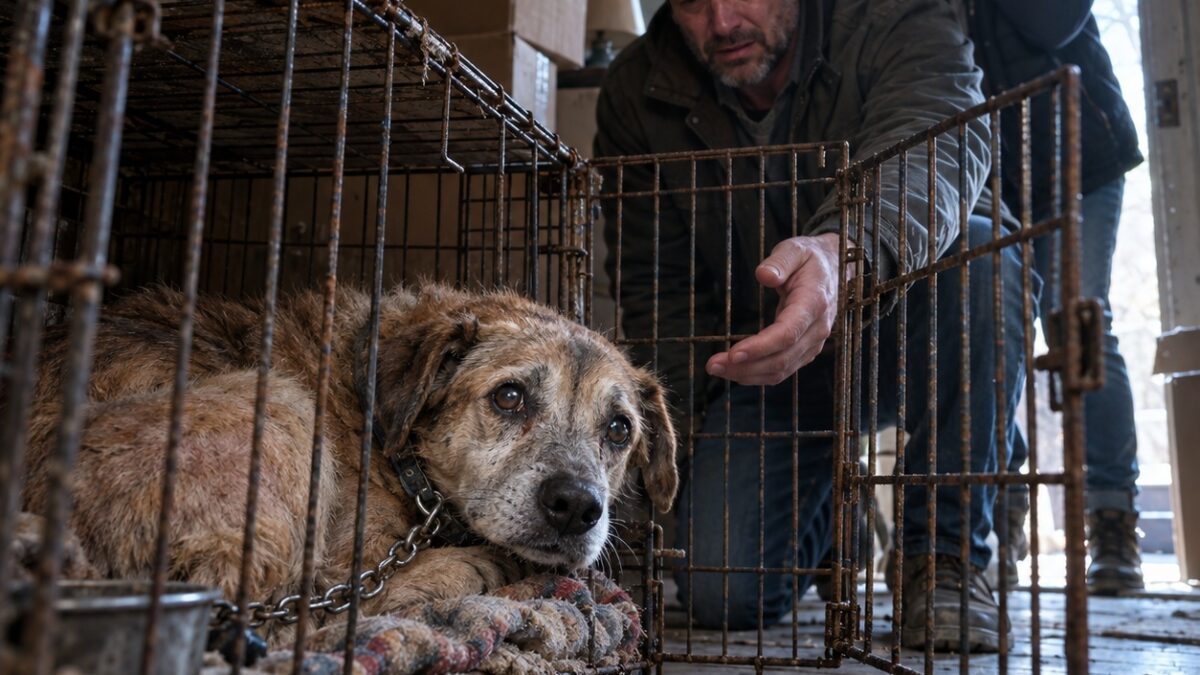
PART2
There is something especially cruel about discovering a condition you know needs urgent treatment and then being told the patient is too weak for the treatment.
It creates a contradiction.
Do something.
But not yet.
Act quickly.
But first, wait.
Angela’s body had been neglected to such an extent that we could not simply treat each problem as though the others did not exist.
Her infected skin mattered.
Her malnutrition mattered.
Her weakness mattered.
The uterine infection mattered.
And all of them were happening inside one elderly dog.
We wrapped her in warm cloth.
That image stays with me too.
The cage had been cold and filthy.
Now soft fabric surrounded her.
A small thing.
Almost nothing medically.
But Angela’s body relaxed slightly beneath it.
I sat near her.
She watched me from the corner of her eye.
“We’re not putting you back there.”
I said it quietly.
Not because she understood the sentence.
Because I needed to hear it.
The veterinary team began treating the visible wounds.
Cleaning.
Managing the infected skin.
Making her comfortable.
Every touch had to be careful because she was exhausted.
Her body did not have much reserve.
We needed nutrition.
Strength.
Time.
And time was the one thing pyometra made frightening.
I asked the veterinarian:
“How long before surgery?”
“We have to see how she responds.”
“Days?”
“Hopefully.”
Hopefully.
Rescue teaches you to hate vague hopeful words.
You want numbers.
Tuesday.
At 9 a.m.
She will be strong enough.
Medicine does not offer that kind of certainty.
So we watched.
Blood was taken.
Tests came back.
And then another problem joined the list.
Her liver.
The results suggested liver dysfunction significant enough that her diet needed to be managed carefully.
I remember staring at the veterinarian.
“Anything else?”
Not angrily at him.
At the universe.
He understood.
“We work with what we have.”
The plan became even more deliberate.
Special diet.
Small meals.
Four to five times each day.
Not one large bowl placed down in front of her.
Her body needed careful support.
The team monitored what she ate.
How much.
Whether she tolerated it.
Whether her appetite changed.
Food became part of the medical treatment.
The first attempts were difficult.
Angela was interested sometimes.
Other times she seemed too tired.
Someone would sit beside her.
Offer food.
Encourage without forcing.
A few bites.
Rest.
More later.
Four to five meals a day sounds simple when written down.
It isn’t when every meal carries a question.
Will she eat this time?
Will her body accept it?
Will this be enough to move the scale even slightly in the right direction?
Can we build strength before the infection takes more from her?
I started measuring my days through Angela’s meals.
Breakfast.
Did she eat?
Midmorning.
How much?
Afternoon.
Any better?
Evening.
Finish it?
Every small amount became evidence.
She is still participating.
That matters.
The first night, I worried constantly.
Would she decline?
Would the pyometra worsen before we could get her strong enough?
Would her liver complicate everything further?
Would the skin infection respond?
Would she wake tomorrow wanting food?
Fear becomes repetitive in rescue.
You ask the same questions because asking gives you the illusion that you’re doing something.
The real work was being done quietly.
Veterinary care.
Nutrition.
Cleaning.
Warmth.
Monitoring.
Angela slept.
A lot.
At first, I took that as a bad sign.
Then I reminded myself what her body had been through.
Perhaps sleep was not surrender.
Perhaps it was work.
Healing work.
Survival work.
I sat beside her when I could.
No constant touching.
Angela had been handled enough.
Sometimes the kindest thing was presence without demand.
I would sit near her bed.
She would keep her head low.
Her eyes sometimes followed me.
Then closed.
The first time she slept while I stayed nearby, I felt something shift.
A frightened dog does not easily surrender awareness around unfamiliar humans.
Maybe exhaustion simply won.
Maybe.
But I chose not to disturb her.
Let sleep win.
Day one became day two.
Two days after rescue, something changed.
It happened at a meal.
We brought Angela her food.
The special diet.
Prepared carefully.
I expected the same slow encouragement.
Instead, Angela raised her head.
Looked at the bowl.
Then moved toward it on her own.
Not standing.
Not yet.
But reaching.
She began eating.
No one had to do everything for her.
We watched.
Bite.
Another.
She continued.
I looked at the caregiver beside me.
Neither of us spoke for several seconds.
Then I whispered:
“She’s doing it.”
Angela kept eating.
The significance of an elderly dog eating by herself should not be extraordinary.
For Angela, it was.
Twenty-four or forty-eight hours earlier, she had been lying inside a cage unable even to lift herself properly.
Now hunger had become strong enough for her to act on it.
She finished more than I expected.
I felt tears in my eyes.
Ridiculous.
No.
Not ridiculous.
Her body was asking for fuel.
That was something.
“Good girl.”
I said.
Angela looked up briefly.
Then returned to the bowl.
Perfect.
Food before sentiment.
I liked that.
From then on, meals began changing.
Still carefully managed.
Still four to five times a day.
Still special because of the liver concern.
But Angela was becoming a participant instead of only a patient.
She ate.
Sometimes slowly.
Sometimes with surprising determination.
The caregivers began learning what helped her.
Temperature.
Texture.
Position.
Timing.
All of those small decisions add up.
When someone says:
“We fed her.”
What they often mean is:
We watched.
Adjusted.
Tried.
Waited.
Tried again.
Angela’s body did not gain weight rapidly.
That worried me.
I wanted visible change.
Immediately.
Ribs disappearing.
Muscle returning.
Energy.
Medicine does not care about our emotional impatience.
Her body had been starved for too long to rebuild in a day.
So we celebrated other things.
She finished a meal.
Good.
She held her head up longer.
Good.
She looked when someone entered.
Good.
One evening, she shifted her front legs beneath herself.
I watched closely.
Angela seemed to be trying to change position.
The movement required effort.
Far more than it should.
Her entire body trembled.
“Easy.”
I moved closer but did not immediately lift her.
She deserved the chance to try.
Her front legs pushed.
Her body rose slightly.
Then dropped.
My heart broke.
Not because she failed.
Because sitting should not be this difficult.
Angela rested.
Then tried again.
This time, she got her front half higher.
Her hind legs adjusted slightly beneath her.
She wobbled.
I placed one hand near her side, ready to catch.
“Come on.”
She pushed.
And sat.
Angela sat up.
That was it.
No walking.
No running.
Just an old dog sitting.
I felt as if I were watching someone stand on top of a mountain.
Her head lifted.
She looked around.
The world must have appeared different from that height after days spent lying down.
Everyone nearby stopped.
One caregiver smiled.
Another covered her mouth.
Angela held the position for only a short time.
Then tired.
We helped her down gently.
But the movement had happened.
Her body was beginning to support itself again.
I kept replaying it.
The cage.
Angela flat against the bottom.
Unable to lift herself.
Now:
Sitting.
Two days.
A few meals.
Care.
And something inside her had answered.
Not enough yet.
We knew.
Pyometra had not disappeared.
Liver problem had not disappeared.
Skin infection still required treatment.
She was still dangerously thin.
But Angela had given us a new measurement.
Strength.
Some was returning.
That night, hope felt less abstract.
Maybe she could get strong enough for surgery.
Maybe.
I refused to say more.
The third day became a study in tiny changes.
Angela was more alert.
Not energetic.
That would be an exaggeration.
But present.
She watched people.
She seemed more aware of meals.
She tolerated care with the same gentleness.
I began to wonder whether gentleness was simply part of who she was.
Maybe beneath fear and exhaustion, Angela had always been a soft-natured dog.
That made her cage even harder to understand.
How do you look at a gentle old dog and allow her to live like that?
I stopped asking.
There would never be an answer satisfying enough.
Anger can consume energy better spent on care.
Angela needed us in the present.
The infected skin was treated regularly.
I watched the team work.
Warm cloth.
Cleaning.
Medicine according to the veterinary plan.
Angela stayed still.
Sometimes she looked at the hand touching her.
But the frantic fear was beginning to soften.
One afternoon, after care, I left my hand resting lightly near her shoulder.
Angela did not pull away.
I moved my fingers gently.
She allowed it.
One stroke.
Two.
Then stopped.
I wanted every interaction to end before she needed it to.
Trust grows when the animal learns humans listen to subtle signals.
Not only growls.
Not only bites.
A turned head can mean enough.
A tense body can mean pause.
Angela had lived too long without control.
We could give some back.
Her appetite kept improving.
The caregivers began smiling before meal times instead of entering with dread.
“Angela.”
Her head lifted.
“Food.”
Sometimes she looked almost offended by how slowly humans moved.
That made me laugh.
“Two days ago we were begging.”
Angela did not care.
Good.
Let the past belong to us.
Her job was to eat.
I became fascinated by the emotional meaning of appetite in rescue.
A severely ill dog can still eat for many reasons.
It isn’t a guarantee.
But when you’ve seen an animal too weak to engage, interest in food feels like the body voting.
Another day.
Please.
Angela kept voting.
Her weight was still not rising quickly.
We checked.
Worried.
Adjusted under veterinary guidance.
But strength can improve before the scale satisfies your hopes.
Her posture changed.
She held her head higher.
Her front legs seemed more reliable.
When she sat, she did not collapse as quickly.
The body was rebuilding something.
Muscle.
Coordination.
Confidence.
Maybe all three.
Then came day four.
I did not expect anything dramatic that morning.
That matters.
The biggest moments often arrive during routine.
We had already been thrilled by eating.
Then sitting.
What else could four days realistically give us?
Angela was lying on warm bedding.
We needed to move her.
Normally, we would support most of her weight.
This time, when she tried to rise, we paused.
Her front legs planted.
Hindquarters shifted.
She pushed.
The first attempt failed.
Angela lowered herself again.
I thought that was it.
Then she tried once more.
Her legs trembled visibly.
One paw found the floor.
Then another.
Her body rose.
Not gracefully.
Not strongly.
But it rose.
Angela was standing.
I held my hands near her sides without gripping.
“Easy.”
She wobbled.
Her head stayed forward.
Then one front paw moved.
A step.
The hind leg followed awkwardly.
Another step.
I stopped breathing.
“Angela.”
Someone behind me whispered her name.
Angela kept going.
One step.
Then another.
Four days earlier, she had been lying tethered in a cage, too weak to lift her body.
Now she was walking.
Not far.
Not fast.
Nobody would have mistaken it for the gait of a healthy dog.
But those were steps.
Her steps.
No one carrying her.
The room went silent.
It was the kind of silence people make when they are afraid emotion itself might interrupt what is happening.
Angela took a few more steps.
Then tired.
We supported her immediately.
Wrapped her again.
Helped her rest.
I crouched beside her.
My hands were shaking.
“You walked.”
Angela lowered her head onto the bedding.
She looked exhausted.
“You actually walked.”
No tail celebration.
No understanding of why every human in the room looked emotional.
She had simply done what her body could do.
That was enough.
The update spread quickly among the people caring for her.
Angela walked.
Four days.
The words sounded almost impossible together.
But I had to keep myself honest.
Walking did not mean recovered.
Walking did not mean the pyometra had disappeared.
She still needed the surgery we had been trying to prepare her for.
The update we had at that point did not tell us the outcome of that operation.
It did not promise a perfect future.
It did not tell us whether her liver problem would resolve.
It did not tell us how much weight she would eventually gain.
We did not know.
All we knew was what Angela had already done.
Found barely able to move.
Day two:
Eating.
Then:
Sitting.
Day four:
Walking.
Sometimes that is enough of a story for one chapter.
Still, the emotional weight of those four days was enormous.
I kept thinking about the house.
Sold.
New owners entering.
Finding her.
The accident of timing.
If they had arrived later.
If the sale had happened later.
If nobody had looked closely.
No.
I stopped.
Alternate tragedies are endless.
Reality had finally moved in Angela’s favor.
Someone had seen her.
Patricia did not exist in this story; there was no named rescuer in the source, so I kept my own role simple in my mind.
I was one of the people who got to witness what happened after she was seen.
That was enough.
The new owners could have looked at the cage and decided it was someone else’s problem.
They didn’t.
They were heartbroken.
They reached for help.
That first decision made every later step possible.
The bath.
The diagnosis.
The meals.
The sitting.
The walking.
Rescue is a chain.
One person sees.
Another transports.
A veterinarian diagnoses.
Caregivers feed.
Someone stays through the boring middle.
Then an old dog walks.
People love the last part.
I wish they understood how much the first parts matter.
Angela did not walk because of one dramatic act.
Her body was supported toward that moment.
Food four to five times a day.
Warmth.
Treatment.
Rest.
Monitoring.
Gentle handling.
All of it.
When people later heard she walked after four days, some reacted as though the crisis must be over.
I understood the instinct.
Walking looks like recovery.
But walking was only one measure.
Inside her body, pyometra remained a serious threat.
Inside her bloodwork, the liver problem still mattered.
Her skin had not healed completely in four days.
Her weight had not magically returned.
The work continued.
That’s important.
Happy milestones can coexist with dangerous disease.
You celebrate without becoming careless.
Angela taught us that.
After the first walk, she rested for a long time.
I watched her breathing.
Not distressed.
Tired.
That seemed fair.
She had performed more physical effort than she had in who knew how long.
I put the blanket around her.
She looked at me.
Something about her expression had changed.
Maybe I imagined it.
But the fear was not as dominant.
Four days of safe hands.
Four days of food.
Four days of nobody hitting her for an accident.
Nobody forcing her back into a cage.
Nobody tethering her.
Evidence.
Animals learn from evidence.
Maybe Angela had begun collecting enough.
I stroked the side of her head.
She kept it there.
No flinch.
I thought about the first time I reached toward the wire.
Her body had recoiled before my fingers even touched it.
Now my hand meant warmth.
Or at least not danger.
That was another kind of movement.
The legs were easier to photograph.
Trust was quieter.
I valued it more.
At meal time, Angela became increasingly interested.
She could now sit while eating for part of the meal.
That mattered because posture itself uses energy.
We did not force her to maintain it longer than she comfortably could.
She ate.
Rested.
Ate again.
Her special diet remained necessary because of the liver concern.
I sometimes wished we could simply feed her anything she wanted.
Emotion makes you want to overcompensate.
Ten years of deprivation?
Give her everything.
But responsible care is not indulgence.
Her body had specific needs now.
Love meant following them.
Four to five carefully planned meals.
Not random food because it felt generous.
The veterinary team knew better than our guilt.
We listened.
Angela began recognizing the meal routine.
That became funny.
She could be sleeping.
Bowls moved.
Packaging opened.
Head up.
“You heard that?”
Of course she did.
Food was becoming an expectation.
A dog who expects food is living in a different world from one who does not know whether food comes.
Expectation is one of the first forms of security.
Meal happened yesterday.
It happens today.
It will probably happen tomorrow.
Routine writes hope into the body.
Angela’s life had probably lacked predictable kindness for too long.
We could at least give that now.
There were still moments when old fear surfaced.
If someone moved unexpectedly above her, she lowered her head.
If a hand approached too quickly, tension returned.
We adjusted.
No rushing.
No looming.
Speak before touch.
Let her see.
Small accommodations.
People sometimes ask how to help a traumatized animal trust.
There is rarely one trick.
Consistency.
Respect.
Time.
Angela was already giving us more than I expected after only four days.
But we did not assume that meant every fear was gone.
Trauma does not operate on the same schedule as appetite.
A body can stand before a heart fully trusts.
Both need patience.
Her wounds became another daily measure.
Clean.
Treat.
Check.
The skin infection had been severe.
We did not expect transformation overnight.
But cleaner skin meant less ongoing harm.
Warm cloth around her meant comfort.
Angela seemed to appreciate warmth.
Or at least stopped resisting it.
I found myself constantly touching the edge of her blanket to make sure it was positioned properly.
Perhaps excessive.
I thought about the cage too often.
A dog who had been lying in filth now deserved obsessive blanket management.
Let me be ridiculous.
She had earned ridiculous care.
One afternoon, Angela sat up before anyone asked her to.
I looked over.
There she was.
Not because food was immediately in front of her.
Not because we were helping.
She had chosen to sit.
I smiled.
“Show-off.”
Angela looked around.
Her body still thin.
But posture changes the way an animal occupies space.
Lying helpless is one visual story.
Sitting independently is another.
She could survey the room.
Watch people.
Choose where to look.
A little agency returning.
Mobility is not only movement.
It is perspective.
Being able to raise yourself means seeing the world from a position you chose.
That mattered.
The more she sat, the more we saw her eyes.
Less hidden.
Her personality was still subtle.
Gentle.
Quiet.
But gentleness no longer looked like surrender every second.
There were moments of curiosity.
Someone entered.
Angela watched.
Food moved.
Angela noticed.
A caregiver left and returned.
Angela followed with her eyes.
Life was becoming relevant beyond immediate survival.
That is one of the transitions I treasure most.
When an animal begins spending attention on things that are not pain.
Angela had enough energy to care who walked into the room.
That was progress.
I kept wondering about the surgery.
It was the shadow behind everything.
She had pyometra.
We knew.
She needed intervention.
We were strengthening her toward it.
But the update available to us ended before revealing the outcome.
That uncertainty would have been emotionally difficult to live through.
Every meal mattered because surgery waited.
Every step mattered because surgery waited.
Every gram of strength mattered because surgery waited.
It was almost impossible not to turn Angela’s recovery into a countdown.
I had to stop myself.
She deserved days that were more than preparation for an operation.
So we celebrated what was already true.
She was out of the cage.
That could never be undone.
She was clean.
Warm.
Fed.
Seen.
Whatever happened next medically, those facts mattered.
This is something rescue people learn reluctantly.
You do not control every ending.
Sometimes your responsibility is to improve the present honestly.
Angela’s present had already changed radically.
I reminded myself of that whenever fear about surgery became too loud.
The new owners who found her came up in conversation.
They had walked into their newly purchased property and discovered something nobody expects to find.
A living animal hidden in terrible condition.
That must change the way a house feels.
A new home is usually possibility.
Rooms.
Plans.
Furniture.
Instead, their first relationship with the place included Angela.
I was grateful they did not look away.
There are people who might have said:
This is not our dog.
Technically perhaps true.
Morally irrelevant.
They saw need.
They acted.
Sometimes that is all rescue requires from the first person.
Not expertise.
Recognition.
This is wrong.
Call someone.
The rest can follow.
Angela existed for years—perhaps; we only feared she might have spent much of her life this way—without enough people acting.
Then one set of strangers did.
Four days later, she walked.
That timeline is almost painful.
How long had the possibility of improvement been inside her body while she remained uncared for?
We cannot know.
Maybe her decline accelerated recently.
Maybe not.
Speculation would not help.
Still, the contrast was hard to ignore.
Food.
Medical attention.
Warmth.
And suddenly a body that looked finished began responding.
It made the neglect feel even crueler.
Some suffering is inevitable.
Aging.
Disease.
Pyometra can happen.
Liver problems can happen.
What humans control is response.
Do we notice?
Treat?
Feed?
Clean?
Stay?
Angela had finally received the response she needed.
That is what changed.
The first bath remained one of the hardest memories.
Waste washing from her coat.
Seeing what had been hidden.
But later we cleaned her again and the experience felt different.
Not rescue from filth.
Routine hygiene.
The same action changes meaning once safety exists.
Angela knew the hands.
Maybe not fully.
Enough.
She remained calm.
Someone wrapped her afterward.
She rested.
The body remembers repetition.
Touch.
Clean.
Warm.
Food.
No cage.
Again.
Again.
The nervous system learns.
I wanted that for her as much as weight gain.
When she slept, her posture slowly changed.
At first she seemed curled inward despite weakness, as though making herself small.
Later, she stretched slightly.
Not dramatically.
But less braced.
Sleep is where safety reveals itself.
An animal can behave calmly while awake because it has no strength.
Deep sleep is different.
You cannot monitor everything while sleeping.
Angela began allowing herself that.
I stood nearby once and listened.
Slow breathing.
No startle when someone moved across the room.
I almost cried again.
Rescue makes you emotional about very boring things.
A dog sleeping.
A dog eating.
A dog sitting.
A dog walking five steps.
Normal becomes extraordinary only after it has been taken away.
Angela was reclaiming normal one function at a time.
There were still conversations about body weight.
“Not enough yet.”
“How much did she gain?”
“Slowly.”
“Is that okay?”
“She needs time.”
Time.
Always.
We could feed four to five times a day.
We could not command tissue to rebuild faster.
Patience became another form of care.
No overfeeding from desperation.
No forcing.
Follow the plan.
Trust biology where appropriate.
Monitor closely.
The liver problem complicated the desire to simply pack calories into her.
Special diet existed for a reason.
We had to support one system without harming another.
This is why veterinary guidance matters.
Rescue intuition says:
Feed the thin dog.
Medicine says:
Yes, but correctly.
We listened.
Angela kept eating.
That was her contribution.
I used to thank her after meals.
“You did good.”
Eventually I realized the absurdity.
She wasn’t eating for us.
Good.
I preferred that.
She was eating because she wanted food.
Self-interest is healthy.
For perhaps too long, Angela’s life had been organized around what humans did to her.
Now hunger belonged to her.
Choice.
Even small choice matters.
One meal, she turned her head from the first offering.
My heart immediately panicked.
Not eating?
Problem?
Then we waited.
Tried again later.
Angela ate.
I laughed at myself.
I had become too reactive.
Recovering animals have preferences and fluctuations too.
Not every pause is catastrophe.
Still, with pyometra and liver issues, vigilance was necessary.
We learned the difference between watching and panicking.
Not perfectly.
Better.
Day four remained the emotional high point of the update.
Angela walking.
I replayed it mentally.
Front paw.
Rear legs supporting.
Tremble.
Step.
The fact that she could bear weight at all after being unable to lift herself was astonishing.
But what moved me most was the direction.
Outward.
Away from where she had been lying.
Movement creates possibility.
A dog that can walk can choose a new spot.
Move toward food.
Toward a person.
Away from discomfort.
It restores some independence.
Angela had been physically contained in a cage and tethered.
Now she was making her own steps.
That symbolism was impossible to miss.
I tried not to impose too much meaning on it.
Angela wasn’t staging an inspirational moment.
She was walking because her legs could finally support her.
Still, to us:
Freedom.
A few steps after confinement.
How could we not feel it?
I wondered what the floor felt like under her paws.
Probably normal.
Maybe strange after weakness.
Her nails and feet had not been described as severely overgrown in the source, so I did not invent that part.
I focused on what we knew.
She could take steps.
Her legs were beginning to support her.
That was enough.
The veterinary team kept the next priority clear.
Do not mistake early improvement for readiness to do too much.
Angela was old.
Malnourished.
Medically complicated.
Rest mattered.
So after walking, she rested.
No dramatic exercise program invented from nowhere.
No long stroll.
She had nothing to prove.
We were trying to build strength, not showcase it.
That discipline matters in rescue storytelling too.
People love the image of a dog running days after being found.
Reality is usually slower.
Angela walked.
That was plenty.
I sat beside her after.
Her eyes half closed.
I placed a hand lightly on the warm cloth around her.
“Four days.”
I whispered.
No response.
“Do you know that?”
Of course not.
“Four days ago…”
I stopped.
She didn’t need the past narrated.
Neither did I.
The present was better.
Stay there.
I thought about her age.
Ten years.
Roughly.
Maybe more, maybe less.
Senior.
There is a particular pain in seeing an old animal neglected because old age should be the time when a lifetime of companionship is paid back.
Young dogs demand.
Run.
Chew.
Need training.
Old dogs often ask less.
A slower bed.
A shorter walk.
Medication.
Warmth.
Familiarity.
Whoever had failed Angela had failed her at the exact stage when loyalty should become easiest to recognize.
That thought made me furious.
But then I would look at the people feeding her.
Five small meals.
Cleaning wounds.
Wrapping her.
Watching liver values.
Preparing her for surgery.
This was also humanity.
You cannot let the worst humans define the species.
Someone neglected her.
Other people found her.
Helped.
Stayed.
I needed that balance.
Angela probably did too, in the only way dogs experience such things.
Not “humans are good.”
Specific people.
This hand feeds.
This hand cleans.
This voice doesn’t yell.
This person returns.
Trust is individual before it becomes general.
Angela was learning individuals.
I started noticing that she reacted differently to familiar caregivers.
Less tension.
More eye contact.
No dramatic tail wag described in the source, so I won’t invent one.
But comfort can be visible without wagging.
The body softens.
The head does not drop as quickly.
The eyes remain open instead of avoiding.
Small things.
Angela gave us small things.
We accepted them.
When she sat, we didn’t force affection.
When she walked, we didn’t surround her.
Let her own the achievements.
Traumatized animals have had enough control taken.
Recovery should restore some.
I imagined what the surgery discussion would feel like once she was stronger.
The team would have to weigh her condition.
Liver.
Nutrition.
Age.
Pyometra.
Anesthesia.
All serious.
But that part of the source had not yet been updated.
So in our story, we remained at the threshold.
Preparing.
Hoping.
Not knowing.
Sometimes readers dislike uncertain endings.
Real rescue often contains them.
A dog can make extraordinary progress while one major question remains open.
That was Angela on day four.
Walking.
Still sick.
Hopeful.
Still at risk.
Both.
I think the coexistence made the moment more powerful.
If someone told me:
“She walked, so she’s fine.”
I would correct them.
No.
She walked, so she is stronger than she was.
That is all.
And that is enough for today.
The caregivers continued meals.
One caregiver joked that Angela would soon start demanding them.
I hoped so.
Demand means expectation.
Expectation means routine.
Routine means some part of an animal believes tomorrow exists.
That thought stayed with me.
Perhaps the greatest shift in Angela was not physical.
It was temporal.
Inside the cage, life may have been reduced to endurance.
Whatever comes next.
No control.
At the clinic, there was rhythm.
Morning food.
Care.
Rest.
Another meal.
More care.
Warm cloth.
Sleep.
A tomorrow built out of repeated support.
Dogs may not conceptualize future the way we do.
But bodies learn patterns.
Angela’s body was beginning to learn one worth keeping.
The skin infection remained visible.
Some areas looked better after cleaning.
Still far from normal.
We treated each wound as a separate responsibility.
No disgust.
No frustration with how long healing took.
Neglect creates problems slowly.
Treatment often cannot erase them quickly.
That’s another difficult lesson.
People want before-and-after.
Day one.
Day ten.
Perfect.
But Angela’s real victory in four days was not appearance.
It was function.
Eating.
Sitting.
Walking.
Skin would take its own time.
Weight too.
The people around her understood.
Nobody expected her to become photogenic before she deserved affection.
She deserved it while thin.
While infected.
While unable to stand.
Worth comes before recovery.
Important.
One evening, I thought about the phrase “she was only discovered because the house was sold.”
It is a brutal sentence.
Almost random.
Property transaction.
Keys change hands.
Dog’s life changes.
Human bureaucracy accidentally becomes rescue.
Life is strange.
Angela could not call anyone.
Could not open the cage.
Could not explain.
Her rescue depended on circumstances outside her control.
That vulnerability bothered me.
How many animals are hidden in places nobody has reason to enter?
Again.
Useless spiral.
I stopped.
Focus on the one we know.
Angela.
She had been found.
Do right by her.
The new owners’ heartbreak mattered too.
It is easy to become numb when rescue becomes frequent.
They weren’t.
They saw suffering and responded emotionally enough to act.
Heartbreak can be useful when it moves.
Not when it stays as sadness.
They reached out.
That action gave Angela access to medicine.
Whenever I felt helpless waiting for the next medical step, I remembered:
Action does not need to solve everything to matter.
They could not perform surgery.
They could call.
I could not repair her liver.
I could feed according to the plan.
The caregiver could not reverse ten years.
She could wrap Angela warmly.
Everyone did the part available.
Together, that became rescue.
The day Angela first walked, we recorded the moment mentally more than anything.
I watched her legs.
Thin.
Shaking.
But underneath the weakness, there was function.
Her muscles had not forgotten entirely.
They were starved.
Deconditioned.
Exhausted.
Yet capable of responding when nutrition and care began returning.
I wondered how long she had been unable to stand before we found her.
We did not know.
I refused to make up a number.
But even a short period of immobility is frightening in an elderly dog.
The fact that she regained enough strength in four days to take steps made everyone hopeful.
Careful hope.
That is the only kind I trust.
The veterinary team did not suddenly promise a full recovery.
They continued doing what professionals do.
Observe.
Treat.
Reassess.
Her surgery still mattered.
The pyometra did not care that we were emotional about walking.
Disease is rude that way.
It does not pause for milestones.
So we kept preparing her body.
Meal after meal.
I began to think of each one as a brick.
Strength built slowly.
One bowl.
Another.
Protein and calories appropriate to her condition.
Liver-friendly plan.
Whatever the veterinarian specified.
Not glamorous.
But surgery readiness is built from the unglamorous.
When Angela finished a meal, we weren’t simply feeding hunger.
We were building capacity.
That gave ordinary acts urgency.
But we tried not to let Angela feel urgency.
Stress itself is a burden.
Calm voices.
Gentle handling.
Warmth.
Let the humans carry the fear.
The dog gets peace.
That became my personal goal.
If I entered Angela’s area worried, I tried to leave the worry outside.
She had already spent too much time in an environment where human emotions may have meant danger.
Now our presence should mean predictability.
One caregiver had a particularly soft voice.
Angela seemed to settle when she spoke.
No magical bond.
Just a noticeable response.
I watched.
“Keep talking.”
The caregiver laughed.
“About what?”
“Anything.”
So she talked.
Weather.
Food.
Nothing.
Angela listened or slept.
That is another kind of medicine not recorded in dosage charts.
Familiar sound.
Safety cue.
I do not confuse it with treatment.
It does not cure pyometra.
But reducing fear matters to an animal living through medical care.
We gave both.
Science and gentleness.
Angela needed both.
At one point, I thought about what would happen if surgery succeeded but Angela remained physically frail for a long time.
Where would she go?
Who would care for her?
The source did not provide that answer.
So I kept it as a question, not invented conclusion.
Rescue planning often begins before medical resolution.
Senior dog.
Potential ongoing liver management.
Skin recovery.
Nutrition.
Someone would need to understand that “rescued” does not mean “easy.”
But that conversation belonged later.
First:
Get her strong enough.
That was the mountain.
On the fourth day, we had evidence we were climbing.
Steps.
Actual steps.
I want to linger there because the story ends there.
Not because nothing happened afterward.
Something certainly did in real life.
But the update we have does not tell us what.
Honesty requires stopping.
Angela deserves that.
I would rather leave her walking toward an uncertain next chapter than fabricate surgery success, adoption, or years of happiness unsupported by the source.
Her existing progress is powerful enough.
Look at the sequence.
Cage.
Wire.
Waste.
Head lowered.
Cannot lift body.
Clinic.
Bath.
Wounds.
Pyometra.
Too weak for surgery.
Liver concern.
Special diet.
Four to five meals.
Day two:
Eating independently.
Then:
Sitting.
Day four:
Walking.
That is already an astonishing shift.
Not miracle.
Response to care.
I think that distinction matters.
Miracle can make the humans disappear.
As though strength returned magically.
No.
People found her.
Veterinarians diagnosed.
Caregivers fed.
Wounds treated.
Warmth provided.
Angela’s body responded.
Collaboration.
That is more useful than magic.
It tells us what compassion looks like operationally.
Notice.
Seek veterinary care.
Follow medical guidance.
Provide nutrition appropriately.
Monitor.
Do not give up simply because the first image is terrible.
Also:
Do not assume recovery.
Stay honest.
Angela’s case contained all of that.
The source says she remained gentle through her care.
That detail may be the most heartbreaking of all.
An animal can become defensive after neglect.
Understandably.
Angela did not.
She stayed gentle.
I don’t interpret that as proof of forgiveness.
We cannot know.
Maybe she was simply exhausted.
Maybe gentleness was her temperament.
Either way, it shaped the people around her.
You wanted to protect her.
Not because aggressive dogs deserve less.
They don’t.
But because Angela’s quietness made her vulnerability visible.
Every lowered head asked:
What are you going to do?
And every safe touch answered:
Help.
Again.
Again.
Slowly.
The day she walked, her head position changed too.
Higher.
Not dramatically.
Enough.
When a body rises, the face comes with it.
I saw more of her.
A ten-year-old French Bulldog? No, Angela’s breed wasn’t specified. So just an elderly dog.
A senior dog.
Gentle.
Thin.
Sick.
But upright.
I smiled.
“There you are.”
She took another step.
That sentence felt right.
Not:
You’re fixed.
Not:
You’re safe forever.
Just:
There you are.
Because Angela had been hidden.
Literally.
Inside a cage at a house nobody had reason to inspect until ownership changed.
Now people were looking at her.
Really looking.
Her needs.
Her bloodwork.
Her meals.
Her strength.
Her future.
Visibility was part of her rescue.
The hidden dog became the most closely watched creature in the room.
There is something deeply satisfying about that reversal.
Neglect says:
No one notices.
Care says:
We noticed you ate three bites fewer than yesterday.
That is how different her world had become.
Four or five meals a day meant someone looked at her four or five times with intention.
Did she eat?
How much?
How did she respond?
That is care measured in attention.
For Angela, attention itself may have been new.
I wondered whether too much attention overwhelmed her.
So we balanced.
Check.
Then leave her to rest.
Help.
Then step away.
Affection when she welcomed it.
Not constant hovering.
Safety includes the right to sleep undisturbed.
She slept.
And woke.
And ate again.
Simple.
Beautiful.
I began to understand why old dogs affect rescuers differently.
With puppies, there is a whole future to imagine.
Years.
Growth.
Training.
With seniors, time feels more precious because you know there may be less.
Every comfort feels urgent.
Angela had already lived around ten years.
We did not know how many had been good.
That was not a reason to despair.
It was a reason not to waste the day we had.
Day four.
She walked.
Let day four be good.
Tomorrow can carry its own fear.
This perspective helped when I thought about surgery.
We did not know the outcome.
So I could not borrow happiness from a future that had not yet happened.
I also refused to borrow grief.
Today:
Angela walked.
Stay there.
The caregivers took photographs.
Not for spectacle.
Documentation.
Progress.
The difference between the dog found in the cage and the dog standing four days later was visible.
Still terribly thin.
Still clearly recovering.
But upright.
That matters.
I imagined the new owners seeing the update.
The dog they discovered almost unable to move now taking steps.
Their decision to call for help had become legs under her body.
Not literally.
But causally.
One action can travel farther than the person who starts it realizes.
They opened a door.
Angela walked through many others after.
Clinic.
Treatment.
Strength.
The next one would be surgery if her body allowed.
That is where we leave her.
Not finished.
Moving.
I think “moving” is the right word.
Her life had been static inside that cage.
Contained.
Tethered.
Hidden.
Then rescue introduced motion.
Out of house.
Into clinic.
Food through body.
Strength into muscles.
Body into sitting.
Feet into steps.
Movement.
Even medically, the plan moved forward.
Too weak.
Strengthen.
Reassess.
Possible surgery.
Nothing guaranteed.
But no longer trapped.
That is enough for an ending when truth is the priority.
I sat with Angela later that fourth day.
She was resting after the walk.
Warm cloth around her.
Her head lower again from fatigue.
But different now.
I knew she could raise it.
I knew she could sit.
I knew her legs could carry her, at least a little.
Knowledge changes how you see stillness.
Before, lying down looked like helplessness.
Now it looked like rest.
Important difference.
I stroked her head.
She stayed.
No retreat.
I thought about the cage.
The wire.
The way she lowered her face.
Then I looked at the warm blanket.
Clean skin being treated.
The food bowl.
The people nearby.
No cage.
No tether.
I whispered:
“You don’t have to prove anything else today.”
Angela closed her eyes.
Good.
She had done enough.
People sometimes make recovery into performance.
Stand for us.
Walk for us.
Eat for us.
No.
She was not alive to inspire us.
She was alive because she was alive.
Our responsibility was to support that.
If tomorrow brought another step, wonderful.
If tomorrow required rest, still care.
The pyometra would demand its own next decision.
The liver would need its own monitoring.
Skin would need time.
Weight would need time.
But whatever happened, Angela’s first four days outside the cage had already given her something no medical outcome could take away.
She had been treated as a life worth effort.
That matters.
I do not know whether dogs understand neglect conceptually.
Probably not.
But they understand conditions.
Cold.
Dirty.
Hungry.
Restricted.
Then:
Warm.
Clean.
Fed.
Free enough to move.
The body does not need philosophy to recognize improvement.
Angela’s body recognized food.
Then strength.
Then floor under feet.
That is enough.
I wish I could give the reader the surgery outcome.
I cannot from this source.
And I refuse to turn hope into fiction.
What I can give is the image we actually have.
Angela.
Around ten years old.
Four days after being discovered in a small cage.
Still painfully thin.
Still medically fragile.
Still facing a serious uterine infection.
Still carrying a liver problem that changed how she had to be fed.
But standing.
One paw forward.
Then another.
A dog once unable to lift herself now moving under her own power.
That is not the complete ending.
It is the honest ending.
And sometimes honesty can still be hopeful.
Because the most important difference between the Angela in the cage and the Angela taking those steps was not that every disease had disappeared.
It was that she was no longer alone with them.
Someone knew about the pyometra.
Someone knew about the liver.
Someone prepared those four or five meals.
Someone cleaned the infected skin.
Someone wrapped her in warmth.
Someone watched when she tried to sit.
Someone stood close enough to catch her when she tried to walk.
For perhaps the first time in a very long time, if Angela’s body failed beneath her—
there were hands waiting to hold her.
That is where I leave her.
Not inside the cage.
Not with her head down.
Not tethered.
Walking.
Slowly.
Weakly.
But forward.








