PART2:She Escaped Her Abusive Owner the Night Labor Began—Days Later, We Found Her in the Frozen Mountains Guarding Five Newborn Puppies
PART2
The mountains in winter make you feel small.
Sound changes.
Distances become deceptive.
A dog can be fifty yards away and invisible.
We called gently rather than shouting.
“Hey, girl.”
“Come on, sweetheart.”
Nothing.
We avoided using the owner’s voice or name.
Claire said he usually called the dog “mutt” or worse.
If Maya had learned that human voices meant punishment, louder would not help.
We moved slowly.
At one point, Claire slipped on frozen ground and caught herself against a tree.
“I’m fine.”
“You sure?”
“Yes.”
Her gloves were soaked.
I gave her my spare pair.
She resisted.
“Take them.”
“What about you?”
“I have another.”
I did not.
She put them on.
We reached a narrow shelf of rock where the wind suddenly dropped.
One rescuer pointed.
“Tracks.”
Paw prints.
Fresh enough to matter.
Then tiny drops of blood.
Not injury blood.
Birth blood.
My stomach tightened.
“She delivered.”
Claire whispered, “Oh God.”
We followed the prints around a boulder.
There was a natural cavity beneath an overhang.
Dark.
Narrow.
Protected from direct wind.
At first, I saw only a shape.
Then eyes.
Two dark eyes staring back.
“Maya?”
She lifted her head.
Slowly.
Every muscle in my body changed.
Alive.
She was alive.
Then I heard it.
Tiny sounds.
Not barking.
Squeaking.
Puppies.
I lowered myself immediately.
“Everybody stop.”
The team froze.
Claire covered her mouth.
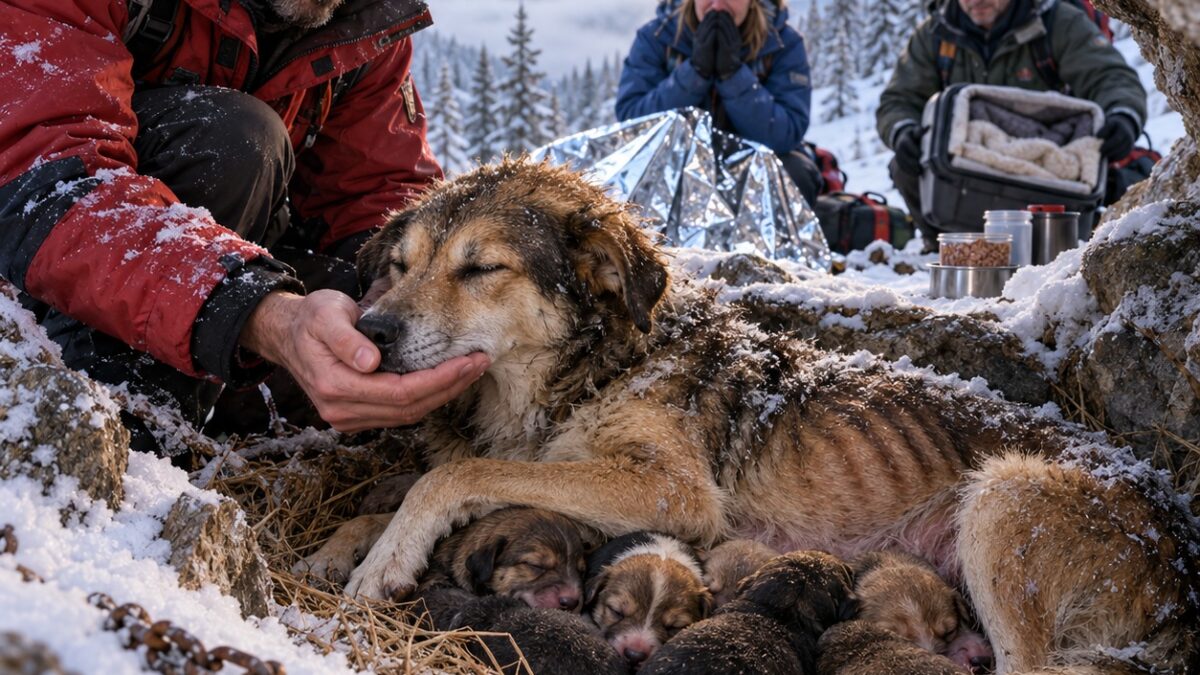
Inside the rocky hollow, Maya lay on one side.
Five newborn puppies were pressed against her belly.
So small they looked unreal.
Eyes closed.
Pink paws.
Bodies shifting weakly against her.
Maya herself looked worse than I had imagined.
Hip bones visible.
Ribs.
Matted fur.
Dried blood around her back legs.
Mud.
Snow melt.
One paw scraped raw.
She had clearly lost weight even before running.
Now labor had drained whatever remained.
Yet she had curled herself around the puppies so tightly that they were warm against her.
I crawled closer.
Not directly toward her.
Sideways.
Hands visible.
No eye contact for too long.
“Easy.”
Her head rose another inch.
The eyes were what I remember.
Fear, yes.
But fear mixed with something stronger.
She was calculating.
Could she still defend them?
Did she have enough strength left?
If I reached for a puppy, would she need to bite me?
I stopped outside her striking distance.
“It’s okay.”
Maya’s lips did not lift.
No growl.
She did not have much energy for threat.
That worried me more than aggression would have.
A dog protecting newborns should warn.
Maya barely had enough strength to breathe.
One puppy crawled away from her stomach.
Maya tried to pull herself forward.
Her leg trembled.
She nudged the puppy back with her nose.
Then collapsed again.
Claire began crying behind me.
I whispered:
“We’re getting all of you out.”
Maya watched my hand.
I placed it palm-up on the rock.
Did not move closer.
“Nothing bad now.”
Maybe words meant nothing.
Tone did not.
Minutes passed.
Maya’s breathing remained fast.
Then something subtle changed.
Her shoulders lowered.
Not completely.
Just enough.
I moved my hand two inches.
Stopped.
She watched.
Another two.
Stopped.
When my fingers were close enough for her to smell, Maya leaned forward.
Barely.
Her nose touched my skin.
I did not touch her.
She sniffed.
Then, with a movement so small I almost missed it, she lowered her head into my palm.
The weight surprised me.
Not physically.
Emotionally.
She did not just permit contact.
She surrendered her vigilance.
For however long she had been running, hiding, giving birth, fighting cold, and guarding those puppies, she had held herself responsible for everything.
Now, finally, she was letting someone else take a shift.
“I’ve got you.”
Her eyes closed.
I stroked one finger along her cheek.
“You can stop fighting for a minute.”
One of the rescuers whispered:
“Can we move the pups?”
“Yes.”
“Mother first?”
“No.”
Maya’s eyes opened when he shifted.
“We take puppies where she can see them.”
One by one, we lifted them.
Five.
I counted aloud.
“One.”
Tiny female.
Warm.
“Two.”
Male.
Good movement.
“Three.”
Smaller.
“Four.”
Strong.
“Five.”
Very small.
But breathing.
Every time a puppy left her side, Maya tried to raise her head.
So I kept my hand against her.
“They’re here.”
We placed each pup into a heated rescue carrier lined with thermal blankets, positioned directly in front of her face.
She could smell them.
Hear them.
See movement.
Only when all five were secured did we move Maya.
She tried to stand.
Her legs failed.
Claire made a sound behind us.
I turned.
“Don’t panic.”
“She can’t walk.”
“Right now she doesn’t have to.”
We slid a blanket beneath her.
Four people lifted.
Maya did not resist.
Her head turned toward the puppy carrier.
“Bring them beside her.”
We did.
During the entire descent, she watched that carrier.
Rock.
Ice.
Steep ground.
Cold wind.
Every few minutes, we stopped.
Checked puppies.
Checked mother.
Maya’s body temperature was dangerously low.
We wrapped another thermal layer around her.
Claire walked beside the stretcher.
At one point she whispered:
“I’m sorry.”
Maya looked at her.
Claire cried harder.
“I’m so sorry.”
Nobody spoke.
I do not know whether Maya understood an apology.
But Claire needed to say it.
At the base of the mountain, the veterinary transport vehicle waited.
Maya was loaded first.
Puppies beside her.
As soon as the carrier opened inside the heated vehicle, we placed the puppies back against her.
Every one immediately searched for her.
Maya curled around them.
Even then.
Still.
The veterinarian at our shelter met us at the door.
Dr. Léon Bernard had seen almost everything.
He took one look at Maya.
“Treatment room now.”
We moved quickly.
Weight.
Temperature.
Blood glucose.
Hydration.
Blood work.
Ultrasound to check for retained puppies.
No retained fetus.
That was one relief.
Severe malnutrition.
Dehydration.
Anemia.
Skin abrasions.
Bruising along ribs and hindquarters consistent with old trauma.
Her milk production was present but questionable.
Dr. Bernard looked at me.
“She’s lucky.”
I looked at Maya.
“Lucky?”
“You found her before she crashed.”
“How close?”
He paused.
“Too close.”
The puppies were examined.
All five alive.
Two slightly underweight.
One mildly chilled.
No obvious congenital problems.
We started supplemental feeding while allowing them to nurse.
Maya watched every hand.
But she did not snap.
Once we returned each puppy, she relaxed.
Her trust was conditional.
Protect them, and you may stay.
Fair enough.
We prepared a quiet recovery room.
Dim lights.
Thick bedding.
Heat.
No kennel corridor.
No barking near her.
Food in small portions because a starving dog cannot safely be allowed to gorge.
Water.
Medication.
Dr. Bernard warned us about refeeding.
Slowly.
Carefully.
Maya ate the first bowl as if she had forgotten food could exist without competition.
Then she stopped halfway.
Looked at the puppies.
Went back to them.
I moved the bowl closer.
She ate lying down beside them.
That night, I stayed later than my shift.
Not because I needed to.
Because I wanted to see if she would sleep.
For the first hour, she did not.
Every sound made her eyes open.
A door.
Footsteps.
Heating vent.
Then the puppies settled.
One tucked under her front leg.
Another pressed against her chest.
Maya lowered her head onto the bed.
Her breathing slowed.
Her eyes closed.
Ten minutes.
Twenty.
She did not jerk awake.
Did not lift her head.
Did not check the door.
She slept.
Deeply.
I sat outside the room watching through the glass.
Claire came beside me.
“She’s sleeping?”
“Yes.”
“Really?”
“Yes.”
Claire pressed both hands to her face.
“I thought she was dead.”
“So did I when we first saw her.”
“I should’ve done something sooner.”
I looked at her.
“You can keep saying that.”
She lowered her hands.
“Or?”
“Do something now.”
“How?”
“Help us.”
She did.
Every day.
Not once.
Not for photographs.
Every day.
Claire brought washable blankets.
Then toys for later.
Then food approved by the veterinarian.
She sat quietly outside Maya’s room until Maya tolerated her presence.
The first few visits, Maya watched Claire nervously.
Maybe Claire smelled like the neighboring property.
Maybe like the owner.
Maybe not.
We cannot know.
Claire never forced contact.
“I don’t deserve her trust.”
“This isn’t about what you deserve.”
“What is it about?”
“What she needs.”
So Claire waited.
That became part of her apology.
Not words.
Consistency.
The police and animal-control investigation into Maya’s former owner moved separately.
I will not turn that part into a revenge story.
There were documented welfare issues.
The property was inspected.
Other animals were removed.
Statements were taken.
Maya was not returned.
That was enough for me.
The rescue room became her world.
At first, she allowed only a few people near the puppies.
Me.
Dr. Bernard.
Two veterinary technicians.
Then Claire.
The first time Claire touched her, it happened by accident.
She was replacing a blanket.
Maya was lying beside the pups.
Claire’s hand brushed her shoulder.
Everyone froze.
Maya lifted her head.
Claire whispered:
“I’m sorry.”
Then held still.
Maya sniffed her wrist.
And put her head back down.
Claire sat on the floor and cried silently for five minutes.
Maya’s recovery came in increments.
Day four, she stood without wobbling.
Day six, she finished a full meal.
Day eight, she walked outside for five minutes.
The sunlight seemed to confuse her.
She stayed close to the wall.
Tail low.
I walked beside her.
No leash pressure.
She sniffed snow.
Then air.
Then looked toward the building.
“Puppies are inside.”
She immediately turned toward the door.
“Okay.”
We went back.
Motherhood remained her center.
The puppies grew faster than seemed possible.
Newborns become dogs in front of your eyes.
First they were warm potatoes with legs.
Then noses became more active.
Then ears.
Then eyes.
Tiny blue-gray openings.
The first pup to open both eyes was a male we temporarily called Blue.
Another, the smallest, became Pip.
We normally avoid becoming attached to temporary names.
We failed completely.
Claire named one Clover.
A veterinary technician named another Scout.
The final female became Rosie.
Maya did not care.
To her, they were all equally hers.
When their eyes opened, their world expanded.
They began crawling beyond the bed.
Maya would watch.
If one went too far, she nudged it back.
Then walking began.
Poorly.
Puppies do not learn dignity first.
They wobble.
Fall over.
Walk into walls.
Bite each other’s ears.
Sleep in food.
Maya tolerated everything.
Her body strengthened.
Her coat changed.
We bathed her only after she had enough trust and strength.
The first bath was difficult.
Running water made her freeze.
Not panic.
Freeze.
That response told me enough.
We stopped immediately.
Used warm cloths instead.
Several days later, we tried again with a basin.
No hose.
Claire sat nearby.
I fed Maya tiny pieces of chicken.
She endured it.
Afterward, for the first time, I saw what her coat probably looked like before neglect.
Rich brown.
Black shading.
Soft.
Under grime had been a beautiful dog.
Not that beauty mattered.
But recovery becomes visible in fur.
A month after rescue, photographs of Maya before and after barely looked like the same animal.
Before:
Bones.
Blood.
Fear.
After:
Weight returning.
Eyes brighter.
Ears relaxed.
Puppies climbing over her.
She had begun wagging her tail when I entered.
The first time she did, I stopped in the doorway.
“Did you just wag at me?”
Another wag.
“Claire!”
Claire came running.
“What?”
“Watch.”
I stepped out.
Came back.
Maya’s tail moved again.
Claire laughed.
“You’re ridiculous.”
“I earned that tail.”
“You absolutely did not.”
“Let me have this.”
The puppies became increasingly chaotic.
Maya increasingly patient.
By six weeks, they attacked her ears.
Climbed over her back.
Bit her tail.
She corrected them gently.
One low sound.
One look.
They learned.
Watching her mother them after everything she had survived was extraordinary.
She was never rough.
Never impatient.
Never absent.
Dr. Bernard once stood beside me watching.
“Good mother.”
“The best.”
“She probably learned none of that from humans.”
That sentence hurt.
Claire heard it too.
Later she asked:
“Do you think she hates people?”
I looked at Maya sleeping while Rosie used her leg as a pillow.
“No.”
“How?”
“Because she keeps letting us prove ourselves.”
That is one of the things I admire most about dogs.
Some remain cautious forever.
Some should.
But many keep reopening the door.
Not because they forget.
Because they evaluate the present.
Maya had learned humans could hurt.
Now she was learning humans could feed.
Heal.
Wait.
Protect.
Both truths existed.
By the seventh week, adoption conversations began.
That always changes shelter energy.
People start imagining endings.
Which puppy goes where?
Who gets Maya?
Should she remain with one pup?
Could she live with other dogs?
Children?
Cats?
We evaluated carefully.
The puppies were easy.
Healthy.
Social.
Ridiculously cute.
Applications arrived quickly.
Maya was different.
Adult.
History of abuse.
Protective instincts.
Needed patient home.
Secure yard.
No harsh correction.
No chaotic household.
I worried.
Puppies always leave first.
Mothers sometimes wait.
Claire worried too.
“I wish I could take her.”
“Why can’t you?”
“My landlord allows one dog.”
“You have one?”
“Twelve-year-old beagle.”
“Then no.”
She nodded.
“I know.”
She looked through the glass.
“I just don’t want her abandoned again.”
“She won’t be.”
“How can you know?”
“I don’t.”
I hated promising what shelters cannot guarantee.
“But we’ll choose carefully.”
Then Claire surprised me.
“My aunt might.”
“Your aunt?”
“She lives about thirty minutes away.”
“What’s she like?”
Claire smiled.
“Better than me.”
“That’s not an answer.”
“She’s seventy-one. Widowed. Big house. Fenced garden. Retired teacher. Has had dogs her whole life.”
“Other pets?”
“None now.”
“What happened?”
“Her old spaniel died last year.”
“Would she want a shepherd mix?”
“I don’t know.”
Two days later, Claire brought her.
Her name was Margaret.
Silver hair.
Warm face.
Flowered scarf.
The kind of woman who enters an animal shelter and immediately lowers her voice.
She did not ask:
“Which one is available?”
She asked:
“May I sit with them?”
Good sign.
We let her into the visiting room.
Maya entered with two puppies.
Margaret sat on the floor.
No reaching.
No calling.
Maya circled once.
Sniffed.
Then lay near the puppies.
Margaret watched for nearly ten minutes.
Her eyes filled with tears.
Claire whispered:
“Aunt Margaret?”
“I’m fine.”
She was not.
Margaret looked at me.
“You found her in the mountains?”
“Yes.”
“With all five?”
“Yes.”
“She kept them alive?”
“Yes.”
Margaret looked at Maya.
Then at the puppies.
“I have a garden.”
Claire smiled.
“I told him.”
“Big one.”
“I heard.”
“Fence around the whole property.”
“Good.”
“Quiet house.”
Maya lifted her head.
Margaret continued.
“And far too much empty space.”
Claire reached for her hand.
Margaret looked at me.
“I want her.”
My throat tightened.
Then she added:
“And one baby.”
That surprised me.
“You want two dogs?”
“If you think that’s good for her.”
“Why one puppy?”
Margaret smiled.
“Because she has spent everything protecting them.”
She looked at Maya.
“I think she should get to keep one part of this chapter while starting the next one.”
I had to look away for a moment.
We discussed reality.
Puppy training.
Mother’s medical follow-up.
Behavior.
Possible fear.
Costs.
Exercise.
Margaret listened.
Asked smart questions.
“What scares her?”
“Sudden yelling.”
“Then nobody will yell.”
“Fast reaching.”
“Then I’ll wait.”
“Running water worried her during bathing.”
“I hate baths too.”
Claire laughed.
Margaret pointed to Clover.
The little female had been sleeping against Maya’s chest.
“That one.”
“Clover?”
“If no one has claimed her.”
Not yet.
So the plan formed.
Maya and Clover together.
The other four puppies each went to carefully selected homes over the next several days.
Leaving the litter gradually helped Maya.
The first puppy departure worried her.
She searched.
Whined once.
We gave her extra time with the remaining pups.
By the fourth, she seemed calmer.
Clover stayed.
The final evening before adoption, I sat with Maya.
She rested her head against my leg.
Clover was asleep nearby.
“You’re leaving tomorrow.”
Maya looked up.
“Good leaving.”
Tail.
“You’ll have a garden.”
Tail again.
“I hear it’s impressive.”
She put her head back down.
“I’m going to miss you.”
That time, no tail.
“Rude.”
The next morning, Margaret arrived with a vehicle prepared like she was moving royalty.
Seat covers.
Harness attachments.
Blankets.
Water.
Dog ramp.
Emergency kit.
I looked inside.
“You’ve done this before.”
“I’m seventy-one, Julien. I’ve done most things before.”
Fair.
We completed the final paperwork.
Maya watched activity.
She sensed change.
Dogs always do.
Clover climbed into Margaret’s lap.
Maya approached.
Margaret let her sniff.
Then gently touched her cheek.
“You’re coming too.”
Maya leaned into the hand.
I felt the familiar pressure behind my eyes.
At the front door, Maya stopped.
For one second I worried.
Was she frightened of the outside?
Vehicle?
Another abandonment?
Then she turned.
Walked back to me.
I crouched.
She came directly between my knees.
Placed her head against my chest.
Not my hand this time.
My chest.
Her tail moved slowly.
I wrapped my arms around her.
“You’re okay.”
She stayed.
I whispered:
“You did it.”
Her ears moved.
“All five.”
I swallowed.
“You kept them alive.”
Maya leaned harder into me.
Then she stepped back.
Looked at me.
That gaze felt different from the mountain.
No terror.
No question.
Something calmer.
I know better than to claim she was thanking me.
But if gratitude has a posture, it looked close.
“Go.”
She turned.
Walked to Margaret.
Clover bounced behind her.
Both got into the vehicle.
Before the door closed, Maya looked back once.
Then forward.
That mattered to me.
Forward.
We placed the other puppies over the following week.
Blue went to a young couple with a fenced property and another gentle dog.
Pip went to a veterinary technician.
Scout joined a family with two teenagers.
Rosie went to a retired firefighter and his wife.
Every home sent updates.
Every puppy grew.
But Maya remained the dog I thought about most.
For months, I imagined that first night.
Not what we saw.
What we did not.
Her breaking the chain.
Running.
Labor beginning.
Cold.
Finding the rock hollow.
Giving birth alone.
One puppy.
Then another.
Five total.
Cleaning them.
Keeping them close.
No food.
No safety.
No reason to trust anyone would come.
Still she stayed alive.
Still they stayed alive.
It is tempting to make that romantic.
Mother’s love conquers all.
But the truth is harsher.
She almost died.
Maternal instinct did not make her invincible.
It pushed her beyond what her body should have endured.
That is why rescue matters.
Admiring survival is not enough.
Someone has to arrive.
A few months after adoption, Margaret invited me to visit.
Summer had arrived.
I drove through open country to a stone house surrounded by gardens.
Claire met me at the gate.
“Wait until you see her.”
“I’ve seen photographs.”
“Not the same.”
She was right.
The garden looked unreal.
Flowers everywhere.
Lavender.
Roses.
Native grasses.
Fruit trees.
A giant oak near the center of the property.
Beneath it lay an enormous outdoor dog bed.
And on that bed was Maya.
For a moment I did not recognize her.
Not because her face changed.
Everything else had.
Strong body.
Healthy weight.
Glossy coat.
Relaxed posture.
She was lying on her side in sunlight.
Clover, now gangly and adolescent, was chewing something beside her.
I stopped at the gate.
Maya’s ears lifted.
Her head rose.
She stared.
Then stood.
One second.
Two.
Recognition.
She ran.
Full speed.
I laughed before she reached me.
“Maya!”
She hit me hard enough to push me backward.
Front paws up.
Tail whipping.
Tongue everywhere.
“Okay! Okay!”
Claire was laughing.
“I told you.”
I dropped to my knees.
Maya climbed against me.
Licked my face.
Whined.
The dog who had once been too weak to growl now nearly knocked me over with joy.
I held her.
Tears came immediately.
“I know.”
Clover arrived next.
Larger than I expected.
She jumped around us.
Maya moved between me and Clover for half a second.
Old habit.
Then relaxed.
Margaret came onto the porch.
“I see she remembers you.”
I stood.
Maya stayed against my leg.
“How is she?”
Margaret smiled.
“Look at her.”
“I am.”
“She rules the house.”
“Of course.”
“Clover rules Maya.”
“That also sounds right.”
Margaret led us into the garden.
Maya followed freely.
No leash.
No fear.
She stopped to smell flowers.
Watched birds.
Lay in sun.
Every ordinary movement moved me.
At the shelter, recovery had been visible.
Here, life was visible.
Margaret said Maya slept in her bedroom.
Sometimes on a bed.
Usually on the floor beside Margaret’s side.
The first month, Maya woke whenever Margaret moved.
By the third month, she slept through the night.
“She snores.”
“That’s good.”
“Very loudly.”
“Still good.”
“She steals toast.”
“Excellent.”
“Julien.”
“She nearly starved. I’m pro-toast.”
Margaret laughed.
Maya looked at us.
Clover ran past carrying a gardening glove.
“That one steals everything.”
Like mother, like daughter in reverse.
We sat beneath the oak.
Maya lay beside my chair.
Margaret told me about her progress.
At first, male visitors frightened her.
Especially tall men.
They introduced people slowly.
No one forced interaction.
Eventually Maya learned that the mail carrier was safe.
Then Margaret’s nephew.
Then neighbors.
She still disliked raised voices.
Margaret did not mind.
“Neither do I.”
Thunderstorms worried her.
Clover did not care.
During one storm, Margaret found Maya standing in the hallway while Clover slept upside down.
Maya watched the puppy.
Then lay beside her.
Still mothering.
Always.
But there was another side too.
Clover helped Maya.
When Margaret introduced something new, Clover approached first.
New toy.
New path.
New visitor.
Maya watched.
Then followed.
Mother and daughter had reversed roles in small ways.
Clover had no memory of cruelty.
No reason to assume danger.
Her confidence pulled Maya forward.
I loved that.
The puppy Maya had nearly died protecting now taught her how to be less afraid.
We stayed until evening.
Before I left, I walked with Maya toward the far end of the garden.
She moved beside me.
No tension.
No scanning.
No broken chain.
I rested my hand on her head.
“You know what I remember?”
She looked up.
“The rocks.”
Tail moved.
“You looked terrible.”
She sneezed.
“Yes, I know. Very rude.”
We reached the fence.
Mountains were visible faintly in the distance.
Not the exact ridge.
Close enough.
I wondered if Maya recognized the shape.
Probably not.
Maybe dogs do not remember landscapes the way we do.
Maybe scent would matter more.
I was glad she could not smell that place from here.
Margaret joined us.
“She watches the mountains sometimes.”
“Does she?”
“Yes.”
“What do you think she’s thinking?”
Margaret shrugged.
“I don’t pretend to know.”
Good answer.
Then she added:
“But she always comes back inside when I call.”
That sentence touched me more than she knew.
Maya had once run because staying meant danger.
Now she returned because coming home meant safety.
That is healing.
Not forgetting what happened.
Changing what happens next.
Claire visited often.
Her guilt softened over time.
Not disappeared.
Softened.
One afternoon, while we sat outside Margaret’s house, Claire told me:
“I still think about the months before she escaped.”
“I know.”
“I should’ve reported him.”
“Yes.”
She looked surprised.
“You’re not going to tell me it wasn’t my fault?”
“No.”
She stared at the grass.
I continued.
“You saw something.”
“Yes.”
“You were scared.”
“Yes.”
“You made the wrong choice.”
Her eyes filled.
“Yes.”
“Then you made a different one.”
She looked at Maya.
“I don’t think that cancels it.”
“It doesn’t.”
“Then how do you live with it?”
“By becoming the person who calls next time.”
Claire nodded.
That became her answer.
Later she began volunteering with us.
Not dramatically.
One shift every other Saturday.
Laundry.
Walking dogs.
Transport.
Eventually she became one of the people who spoke with callers worried about suspected neglect.
She never told them:
You’re overreacting.
She said:
Tell me what you saw.
That mattered.
Maya’s former owner eventually lost custody rights to the animals removed from his property.
Other legal consequences followed.
I will leave them there.
Maya’s story was never about him.
He was the reason she ran.
He did not deserve to remain the center.
Too many abuse stories continue orbiting the abuser long after the victim escapes.
Maya’s life grew bigger than him.
That is the ending I care about.
The puppies reached one year.
Margaret organized a reunion.
All five families came.
I almost declined.
Too sentimental.
Then Claire threatened to come get me.
So I went.
Five dogs.
Same litter.
Different lives.
Blue was huge.
Pip stayed small.
Scout never stopped moving.
Rosie had ears that pointed in opposite directions.
Clover believed the entire gathering existed for her.
Maya stood in the middle.
At first overwhelmed.
Then curious.
The puppies approached her.
Adult-sized now.
Sniffing.
Wagging.
Did they remember?
I do not know.
Maya knew they were familiar somehow.
She greeted each.
Then sat.
All five wandered around her.
For one remarkable moment, they formed a loose circle.
Claire whispered:
“Look.”
I did.
Five dogs.
Alive.
Healthy.
Loved.
I remembered lifting them one by one in a freezing cave.
One.
Two.
Three.
Four.
Five.
Each breath had felt fragile.
Now Scout stole a hot dog from a picnic table.
Pip chased a butterfly.
Blue tried climbing into someone’s lap despite weighing nearly seventy pounds.
Life.
Messy.
Loud.
Complete.
Margaret stood beside me.
“Worth the trouble?”
“What trouble?”
“The mountains.”
I smiled.
“Yes.”
Maya came over.
Sat against my leg.
Still did that.
Some memories remain in the body.
I scratched behind her ears.
“She did the hard part.”
Margaret nodded.
“She still does.”
“What?”
“Trusts us.”
That stayed with me.
We congratulate ourselves for rescuing animals.
But an abused animal choosing to trust again is not our achievement alone.
It is theirs.
We provide evidence.
They decide whether to believe it.
Maya kept deciding yes.
Day after day.
That took courage too.
Several years passed.
Maya aged.
White appeared around her muzzle.
Clover became calmer.
Margaret sent holiday cards.
Always dogs in the photograph.
Sometimes both wearing ridiculous scarves.
One Christmas, Maya wore antlers.
She looked offended.
I kept that card on the shelter refrigerator for months.
New volunteers asked:
“Who’s that?”
Then I told the story.
But over time, I changed how I told it.
At first I emphasized the rescue.
Mountain.
Cold.
Five puppies.
Dramatic.
Later, I emphasized the escape.
She knew she needed to leave.
Whatever triggered that final decision, she broke away.
Pregnant.
Weak.
Terrified.
She chose uncertainty over known violence.
That was the first rescue.
Her own.
We only completed it.
There is something important in that.
Victims often survive long before help arrives.
Animals too.
They adapt.
Hide.
Endure.
Wait for openings.
Maya created her own opening.
Then protected five lives through it.
I often wondered why she went uphill.
Maybe she was simply fleeing.
Maybe noise pushed her.
Maybe she sought isolation for birth.
Pregnant dogs often seek protected spaces.
The rocky cavity offered that.
No mystical explanation needed.
Her instincts were enough.
We sometimes diminish animals by making their choices magical.
Maya did not need magic.
She needed intelligence.
Instinct.
Endurance.
And eventually help.
Years after her rescue, I returned to the mountain with a different search team.
Not because of Maya.
Another dog was missing.
As we climbed, I recognized sections of trail.
A rock.
A bend.
A stand of pines.
Then the hollow.
I stopped.
Empty.
Summer now.
Green moss.
Warm air.
Nothing dramatic.
One rescuer asked:
“You okay?”
“Yes.”
I stepped closer.
The space looked smaller than I remembered.
How had Maya fit there with five puppies?
I crouched.
Touched the stone.
No trace remained.
Of course.
Weather erases.
But I remembered.
Her eyes.
The puppies.
Her head settling into my palm.
I had thought that moment meant:
Save me.
Years later, I understood it differently.
It meant:
I’ve carried them this far.
Now you carry them too.
Responsibility transferred.
That is rescue.
Not hero and victim.
A handoff.
I stayed a minute.
Then continued searching for the new dog.
We found him three hours later.
Cold.
Scared.
Alive.
I thought of Maya.
Always.
Maya eventually became something of an unofficial ambassador for our rescue.
Not publicly famous.
I preferred that.
But when we trained new volunteers about handling fearful dogs, I sometimes used her photographs.
Before.
After.
I would ask:
“What changed?”
People answered:
Weight.
Coat.
Body condition.
Environment.
Then someone usually said:
“Her eyes.”
Exactly.
In the mountain photo, her eyes were wide.
Hard.
Expecting danger.
Months later, the garden photo showed softness.
Not weakness.
Softness.
There is a difference.
Safety lets living things become soft.
That became one of my measures of success.
Not whether a dog obeys.
Whether it sleeps deeply.
Plays badly.
Exposes its stomach.
Turns its back.
Makes mistakes.
Those behaviors require belief.
Nothing is coming.
Maya became excellent at mistakes.
She stole bread.
Dug one hole beneath Margaret’s hydrangeas.
Barked at a garden statue for twenty minutes.
Rolled in something dead.
Chewed one expensive cushion.
Every time Margaret called me, delighted.
“You sound happy.”
“She destroyed my pillow.”
“Yes.”
“Why are you laughing?”
“Because she’s finally doing normal dog crimes.”
Margaret understood.
Normal misbehavior is sometimes recovery.
A terrified dog tries to disappear.
A safe dog steals a sock.
I will take the sock.
Claire once gave a talk at our community center about reporting animal neglect.
I sat in the back.
She told Maya’s story differently from me.
“I was the neighbor who waited too long.”
The room became quiet.
She did not excuse herself.
She explained fear.
Uncertainty.
The social pressure not to interfere.
Then she said:
“If you are waiting for absolute proof before you make a welfare call, ask yourself whether the animal can afford your certainty.”
That line stayed with everyone.
Afterward, a woman approached her.
“I have something I need to report.”
Claire took out her phone.
Maya continued helping animals she would never meet.
That is how stories should work.
Not just make people cry.
Move them.
Margaret’s garden became a frequent foster-stop for older dogs later.
Not inside the main home if incompatible.
A small guest cottage sat on the property.
One senior spaniel stayed two weeks.
Then a terrier.
Then an elderly shepherd.
Maya tolerated them all.
Clover wanted to play with all of them.
Margaret joked that retirement had become a branch office.
I blamed Claire.
Claire blamed me.
Maya accepted no responsibility.
One particularly frightened dog, Daisy, refused to come out of the cottage for three days.
Maya sat outside the open doorway.
Not forced.
Just sat.
I visited on day four.
“There she goes again.”
Margaret smiled.
“Who?”
“Maya.”
Daisy watched from inside.
Maya lay in sun.
No pressure.
Eventually Daisy emerged.
Two steps.
Stopped.
Maya ignored her.
Another step.
By evening, Daisy was lying six feet away.
I remembered Maya in the cave.
Then Maya in our recovery room.
Then Maya beneath Margaret’s oak.
Healing becomes transferable.
One safe animal can teach another.
Clover had done that for Maya.
Maya now did it for Daisy.
No one planned it.
That is the beauty.
When Maya reached about ten, arthritis appeared.
Medication.
Supplements.
Softer bedding.
Shorter walks.
Margaret worried constantly.
“You need to stop Googling symptoms at midnight.”
“I’m seventy-five. What else am I supposed to do?”
“Sleep.”
“Overrated.”
Maya still followed her into the garden.
Slowly.
Clover ran ahead.
At the big oak, Maya rested.
Margaret put a second cushion there.
Then a canopy on hotter days.
Then a fan.
Maya’s outdoor setup became more comfortable than my apartment.
I complained.
Margaret said:
“Survive a mountain birth and I’ll buy you a fan.”
Fair.
One autumn, I visited alone.
Claire could not come.
Margaret made tea.
Maya rested beside us.
Her head eventually found my knee.
Same weight.
Different dog.
Not physically.
Emotionally.
The first time she gave me that weight, she was surrendering from exhaustion.
Now she did it because she wanted to.
That difference almost made me cry.
I told Margaret.
She smiled.
“She does that every evening.”
“I’m jealous.”
“You saved her.”
“No.”
Margaret looked at me.
“No?”
“She saved herself first.”
We sat quietly.
Clover barked at a squirrel.
Maya did not bother getting up.
Wisdom.
Margaret asked:
“Do you ever think about her puppies?”
“All five.”
“I wonder if she does.”
“Maybe.”
“You always say maybe.”
“Because we don’t know.”
“That’s boring.”
“It’s honest.”
She smiled.
“Do you know what I think?”
“What?”
“She knows.”
“Probably.”
“That wasn’t very scientific.”
“I’m off duty.”
We both laughed.
Maya opened one eye.
Closed it again.
Sometimes uncertainty is okay.
We do not have to translate every animal emotion to respect it.
The fact remains:
Maya protected them.
That was enough.
When Maya’s health declined years later, Margaret called me before she told almost anyone.
Her voice was steady.
Too steady.
“Julien.”
“What happened?”
“Dr. Bernard found a mass.”
I closed my eyes.
“Where?”
“Spleen.”
Surgery was possible but risky.
Maya was old.
We discussed options.
Quality of life.
Comfort.
Not panic.
Margaret chose treatment recommended by the veterinarian.
Maya recovered from surgery better than expected.
Got another year.
A good year.
Garden.
Clover.
Toast theft.
Sunlight.
I was grateful.
But time wins eventually.
The final decline was slower.
Appetite changed.
Energy.
Breathing.
One morning Margaret called.
“You should come.”
I knew.
Claire came too.
Maya lay beneath the oak.
Favorite cushion.
Clover beside her.
Margaret on the other side.
The garden was in bloom.
No hospital room.
No metal table.
Only wind through leaves.
I sat near Maya.
Her eyes opened.
Tail moved once.
“There you are.”
I touched her head.
She leaned faintly into my hand.
That broke me.
Same gesture.
Years apart.
Mountain.
Garden.
Beginning.
End.
Claire knelt.
“I’m sorry it took me so long.”
Maya looked at her.
Claire smiled through tears.
“And thank you for waiting.”
Margaret stroked Maya’s shoulder.
Clover pressed close.
The veterinarian came later.
Maya died surrounded by the people and dog who had become her family.
No fear.
No chains.
No cold stone.
Her body relaxed.
That mattered.
Afterward, Margaret kept Clover.
Of course.
The great oak cushion stayed empty for weeks.
Then Clover started using it.
Life again.
I thought grief would make Maya’s story feel tragic.
It did not.
Sad, yes.
Not tragic.
Tragedy would have been the mountain as her ending.
It was not.
The mountain was the middle.
That distinction changes everything.
We often encounter animals at the worst moment of their lives and accidentally believe that moment defines them.
Starving dog.
Abused dog.
Abandoned dog.
Injured dog.
Those are circumstances.
Not identities.
Maya was not “the abused mother dog” forever.
She became:
Garden thief.
Toast criminal.
Mother.
Companion.
Foster mentor.
Margaret’s shadow.
Clover’s patient mother.
Claire’s reason to become brave sooner.
My reminder to move slowly with frightened animals.
Her life became larger than the thing done to her.
That is the outcome every rescue should hope for.
Not merely survival.
Expansion.
For years after, Margaret hosted a small gathering on the anniversary of Maya’s rescue.
Nothing formal.
Claire.
Me.
Sometimes the families who adopted the other puppies.
Clover.
Later grandchildren from the litter.
We called it Maya Day only because Margaret refused every better name.
There was food.
Dogs everywhere.
Someone always brought five small flowers and placed them beneath the oak.
One for each puppy.
The first year after Maya died, I almost skipped it.
Too emotional.
Claire called.
“You’re coming.”
“I’m busy.”
“No.”
“What?”
“You use that voice on everyone else. Doesn’t work on me.”
I went.
Under the oak was a framed photograph.
Maya healthy.
Clover beside her.
Mountains faint in the background.
Not intentional.
Just landscape.
Margaret had written one sentence below it:
SHE RAN TOWARD LIFE.
I stood there for a long time.
Because that was the story.
Not simply:
Dog escapes cruel owner.
Not:
Mother saves puppies.
Not:
Rescuers find dog.
She ran toward life.
Even when life meant freezing mountains.
Even when it meant labor alone.
Even when she did not know anyone safe was ahead.
She chose movement away from harm.
Then stayed alive long enough for help to catch up.
I have carried that with me ever since.
People sometimes ask whether animals understand freedom.
That is too big a philosophical question for me.
But I know Maya understood the difference between being trapped and being able to leave.
I know she understood the difference between a hand that hurts and a hand that waits.
I know she understood the difference between sleeping lightly and sleeping deeply.
Between guarding food and leaving it unfinished.
Between protecting puppies from the world and allowing strangers to hold them.
Between hearing someone approach and expecting pain versus wagging a tail.
Those differences are real.
Call them freedom.
Safety.
Trust.
It does not matter.
She knew.
I still keep one item from Maya’s rescue.
Not a collar.
She had none.
Not a photograph.
Many.
The thermal blanket.
One corner torn.
Stained beyond cleaning.
It should have been thrown away.
I kept it in a storage box.
Sometimes during volunteer orientation, I show it.
“This carried five puppies down a mountain.”
People touch it.
Then I correct myself.
“No. Maya carried them farther.”
We only handled the last mile.
That humility matters in rescue.
We are not always the beginning of salvation.
Sometimes we arrive after an animal has already done almost everything possible to survive.
Our job is to respect that effort.
Finish the distance.
Years later, a volunteer asked:
“What was the bravest animal you ever met?”
Easy question.
“Maya.”
“Because she saved the puppies?”
“Yes.”
Then I thought.
“And because she trusted us.”
The volunteer looked confused.
“Trust is brave?”
“For some animals, yes.”
Maya had every reason not to.
Human hands had hurt her.
Human voices had terrified her.
A human property had been a prison.
Then I crawled toward her in a dark mountain hollow and extended my hand.
She could have spent her last strength fighting.
Instead, she smelled me.
Evaluated.
And placed her head in my palm.
That was not weakness.
That was a risk.
Trust is always a risk when experience has taught you otherwise.
Maya took it.
That risk gave us permission to save her puppies.
Then her.
Then, in ways none of us expected, she kept changing people for years.
Claire most of all.
Claire once told me:
“Maya forgave me.”
I answered:
“You don’t know that.”
She frowned.
“Why would you say that?”
“Because maybe she never blamed you.”
Claire thought.
“What’s the difference?”
“A lot.”
Maya did not live in our moral categories.
Guilty neighbor.
Cruel owner.
Hero rescuer.
Victim.
She responded to what happened in front of her.
Danger.
Run.
Puppies.
Protect.
Safe hand.
Rest.
Food.
Eat.
Kind woman.
Approach.
Garden.
Sleep.
Maybe there is wisdom there.
Humans carry stories until they become heavier than facts.
Maya carried only what she needed.
She remembered enough to survive.
Then learned enough to live.
Claire eventually forgave herself.
Not entirely.
Enough.
She became one of our strongest advocates for early intervention.
Whenever someone hesitated to report neglect because they were uncertain, Claire said:
“You do not need to prosecute the case yourself. You need to make the call.”
That sentence probably saved animals.
Maya never knew.
That is okay.
Good effects do not require the origin to witness them.
The five puppies spread out into five homes.
Those homes changed too.
Scout’s family later adopted another rescue.
Pip’s veterinarian owner fostered neonatal pups.
Rosie helped a retired firefighter through grief after his wife died.
Blue became inseparable from a child with anxiety.
Clover stayed with Margaret until old age.
Five lives.
Then more lives touching them.
All because one exhausted mother kept them warm in a hole in the rocks.
That scale humbles me.
We rarely know what saving one animal becomes.
A child gets a friend.
An elderly person gets a reason to walk every morning.
A family learns patience.
A volunteer chooses a career.
A neighbor learns courage.
One rescue echoes.
That is why I still answer late-night calls.
Why we search after dark.
Why we climb hills in snow.
Not because every ending is perfect.
Many are not.
Because sometimes you reach a hollow beneath a rock expecting tragedy.
And five tiny bodies move.
A mother opens her eyes.
And there is still time.
Time.
That was the miracle.
Not that Maya was invincible.
She was not.
Not that love defeated hunger.
It did not.
She needed food.
Heat.
Medicine.
Human help.
The miracle was simply that there was still time to give those things.
We reached her before the final moment.
That changed six lives immediately.
Then dozens more.
I think about the first night at the shelter often.
Maya sleeping deeply.
The puppies breathing against her.
No noise.
No flinch.
That may be my favorite image.
Not the reunion.
Not the garden.
Sleep.
Because sleep meant something.
For the first time in who knows how long, Maya did not have to watch.
Someone else was watching.
That is what rescue meant to her that night.
You can close your eyes.
I’ve got the door.
I’ve got the puppies.
I’ve got you.
Rest.
Years later, when Maya was dying beneath Margaret’s oak, I touched her head the same way.
And in my mind, the message was the same.
You can close your eyes.
Clover is here.
Margaret is here.
Claire is here.
I’m here.
You do not have to guard anything anymore.
Rest.
Her story began for me with a dog fighting desperately to keep five tiny lives alive.
It ended with that same dog surrounded by a life so safe she no longer needed to fight at all.
That is what I call a happy ending.
Not immortality.
Not pretending pain never happened.
A life transformed enough that its final chapter no longer resembles its worst one.
When people ask why animal rescue matters, I could talk for hours.
Statistics.
Neglect.
Overpopulation.
Abuse.
Veterinary care.
Adoption.
I usually do not.
I tell them about a narrow rock hollow in the mountains.
A freezing night.
A starving dog.
Five newborn puppies pressed against her.
And one exhausted mother lifting her head when strangers approached.
I tell them how she watched my hand.
How terrified she was.
How little strength remained.
How she could have bitten.
Could have crawled deeper into the rocks.
Could have used her last energy to say no.
Instead, she smelled my skin.
Then lowered her head into my palm.
That was the moment everything changed.
Not when we carried her down.
Not when the veterinarian treated her.
Not when Margaret adopted her.
The moment Maya decided:
Maybe this hand is different.
From there, life opened.
Food.
Warmth.
Sleep.
Grass.
Sunlight.
Clover.
Margaret.
A garden full of flowers.
Years.
She escaped one night because danger was behind her.
She kept running because somewhere ahead had to be better, even if she had no way of knowing what better looked like.
And when her puppies came, she stopped in the cold mountains and gave them every ounce of strength she had left.
All five lived.
So did she.
That is the part I will never forget.
She was not invincible.
She was exhausted.
Terrified.
Starving.
Injured.
She simply refused to stop being their mother before help arrived.
And when help finally did arrive, she did something just as brave.
She let us help.
Sometimes survival means fighting.
Sometimes survival means running.
And sometimes, after you have fought and run as far as you possibly can, survival means placing your tired head in a stranger’s hand and trusting that, this time, they will not hurt you.








