PART2:Raider Should Have Weighed 80 Pounds—When We Found Him at 18, the Vets Discovered What He Had Been Eating Just to Stay Alive
PART2
At first, the team could not tell exactly what was wrong.
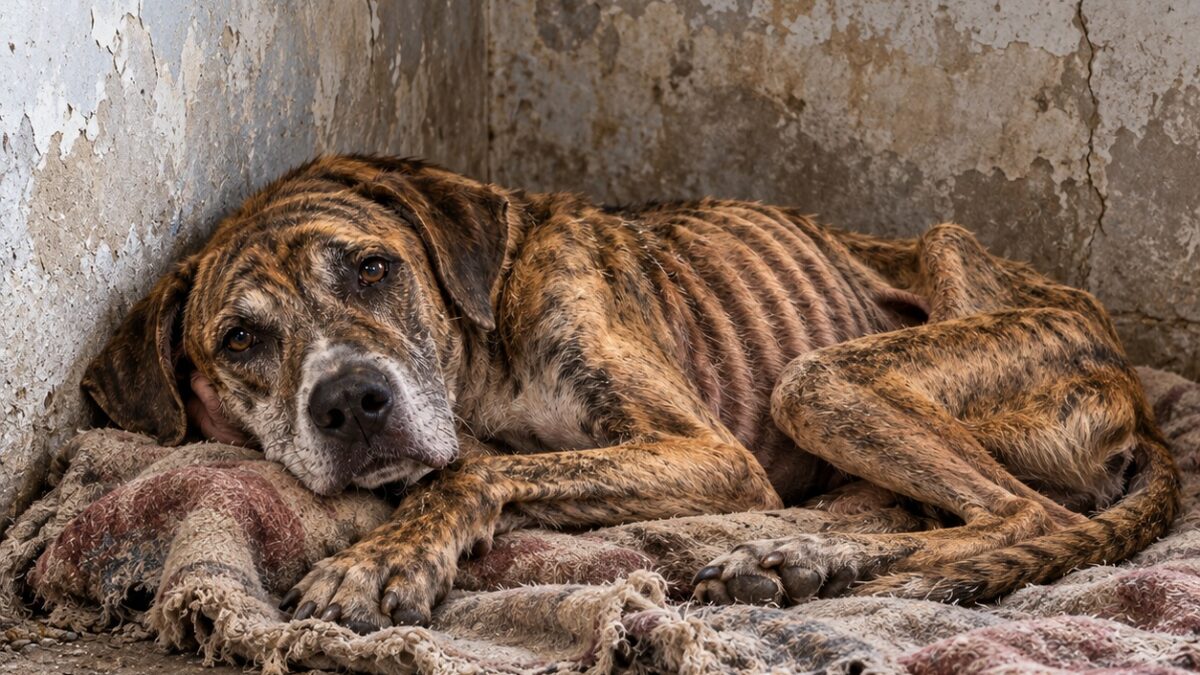
Raider was so emaciated that normal examination became difficult.
His abdomen did not have the layers of muscle and tissue you expect.
Everything felt different.
Everything looked distorted by the severity of his starvation.
Something suggested there might be an obstruction.
A blockage somewhere in his gastrointestinal tract.
That created an immediate question.
Had Raider become this thin because he could not properly digest or pass food?
Was there a foreign object preventing nutrition from moving through him?
Or was the obstruction a separate problem in a dog who had already been starving for another reason?
Imaging.
Bloodwork.
Repeated examination.
More waiting.
Raider lay on a padded surface while the team worked around him.
He watched every person carefully.
Not aggressive.
Not relaxed either.
Fear in a dog this weak looks different.
He did not have energy for dramatic resistance.
No lunging.
No frantic struggle.
He simply stiffened whenever hands approached.
His eyes followed needles.
Followed gloves.
Followed movement.
I stayed near his head when I could.
“You’re okay.”
I hated saying that.
Because he was not okay.
Not even close.
“You’re not alone.”
That was more honest.
The veterinarians became increasingly concerned.
There was something inside him.
Something that should not have been there.
And it was not moving.
Raider needed surgery.
Urgently.
I remember the veterinarian explaining it to us.
His voice was calm.
That professional calm that somehow makes bad news worse because you understand this is not panic.
This is assessment.
“We have two problems.”
I looked at Raider.
“What?”
“The obstruction itself.”
I nodded.
“And the fact that he is a very poor surgical candidate.”
The sentence hit hard even though it was obvious.
Raider looked as though anesthesia alone might be more than his body could handle.
“How poor?”
“He has almost no reserve.”
Reserve.
That word.
A healthy dog goes into surgery with muscle.
Fat stores.
Protein.
Blood volume.
A body capable of responding to stress.
Raider had survived by burning through almost everything.
His body was running on whatever remained.
“If we don’t operate?”
“The obstruction could become fatal.”
“And if we do?”
“There are significant risks.”
Anesthesia.
Blood pressure instability.
Healing.
Infection.
Electrolyte problems.
Recovery.
All of them multiplied by starvation.
I looked at Raider.
He lifted his head slightly.
Maybe because he heard his name.
Maybe because somebody opened food nearby.
I asked:
“Does he have a chance?”
The veterinarian looked at the latest bloodwork.
“That’s why we’re still talking about surgery.”
There were pieces of hope.
His vital signs, while concerning in context, were not collapsing.
His bloodwork showed enough stability in key areas that the team believed there was a reasonable path forward.
Not safe.
Possible.
That was all we had.
Possible.
I touched Raider’s head.
His coat felt dry.
“Okay.”
I do not know who I was answering.
The veterinarian.
Raider.
Myself.
“Let’s do it.”
Preparing him for surgery felt terrifyingly quiet.
There was no dramatic movie moment.
No long speech.
No certainty.
A technician adjusted his blanket.
Another checked a line.
Someone confirmed medication calculations twice because everything about Raider’s body required precision.
I stood close enough that he could see me.
“Hey.”
His eyes were heavy.
“You don’t have to do anything.”
One ear moved.
“They’re doing the work now.”
His nose touched my fingers.
Then they took him through the doors.
And we waited.
Waiting during surgery is one of the worst forms of helplessness because nothing you do affects the outcome.
Walk.
Sit.
Stand.
Check phone.
Look at door.
Repeat.
I kept thinking:
Eighteen pounds.
How can an eighty-pound dog become eighteen pounds and still be alive?
Then another thought:
What has he been eating?
The answer arrived when the surgical team finally found the blockage.
Rubber bands.
Plastic.
Hair.
Pieces of things no animal should have needed to consider food.
When the veterinarian later described what they removed, I stared at him.
“Plastic?”
“Yes.”
“Rubber bands?”
“Yes.”
“Hair?”
“Yes.”
My stomach turned.
“So that did this to him?”
I expected yes.
A physical explanation.
Blockage causes poor intake.
Poor absorption.
Weight loss.
Terrible, but understandable.
Instead, the veterinarian shook his head.
“No.”
I waited.
“The obstruction is serious, but it does not explain this degree of emaciation.”
I looked through the recovery area toward where Raider would eventually be taken.
“What does?”
The answer was simple.
Starvation.
The objects were not why he became hungry.
He swallowed the objects because he was hungry.
That distinction changed everything.
Raider had not accidentally eaten one toy.
He had apparently eaten whatever he could find.
Rubber.
Plastic.
Hair.
Anything his brain, driven by prolonged hunger, told him might quiet his stomach for one more hour.
I imagined him searching.
Trash.
Floor.
Discarded objects.
Something smelling faintly like food.
Chew.
Swallow.
Try again.
A dog does not know that plastic cannot nourish him.
He knows his body is screaming.
He knows his stomach hurts.
He knows something is available.
So he eats it.
That was the story inside Raider.
Not misbehavior.
Not curiosity.
Desperation.
There are images I wish my mind did not make.
Raider alone somewhere, chewing a rubber band because no meal came.
Swallowing plastic because hunger had erased the difference between food and object.
Searching for one more thing that might make the emptiness stop.
I will never know exactly what those days looked like.
I do not need to.
The surgery told us enough.
The veterinarian continued.
“We removed the obstruction.”
My attention snapped back.
“He survived?”
“He made it through surgery.”
I exhaled so hard my chest hurt.
Then the veterinarian raised one hand slightly.
“But.”
There is always a but.
“The next several days are critical.”
Raider had survived anesthesia.
That did not mean his body had survived everything surgery demanded.
There was healing.
Nutrition.
Blood pressure.
Pain control.
The possibility of postoperative complications.
A starved body does not suddenly become strong because the surgeon closes the incision.
In some ways, recovery was the next dangerous part.
When Raider woke, he looked even smaller under the hospital blankets.
A surgical line along his abdomen.
IV.
Monitoring equipment.
He lifted his head briefly.
Saw people.
Then lowered it.
I sat near him.
“You made it.”
His eyes opened again.
“You actually made it.”
I wanted that to be the ending.
It was not.
The first meals after surgery were tiny.
Careful.
Measured.
Raider did not appreciate this.
The moment food appeared, something primitive woke inside him.
His eyes sharpened.
Nose lifted.
He tried to stand.
A technician gently stopped him.
“Easy.”
Raider searched for the bowl.
I said:
“There’s more later.”
He looked at me.
That became one of the hardest things.
We knew food was coming.
Raider did not.
Every small meal ended.
Every empty dish looked like abandonment to him.
He licked the bowl.
The mat.
Sometimes the floor.
Looked at hands.
Searched pockets.
Then eventually settled.
I remember wishing I could explain:
You never have to eat trash again.
Breakfast is scheduled.
Lunch exists.
Dinner too.
Tomorrow already has food in it.
Imagine the luxury of knowing tomorrow contains food.
Raider had not known that.
Now we had to teach his nervous system as much as his stomach.
The veterinary team calculated everything.
Calories.
Frequency.
Tolerance.
Hydration.
Blood values.
Too little nutrition and he could not rebuild.
Too much too fast and his already fragile system could fail in another way.
Progress had to be deliberately slow.
Raider did not understand slow.
Hunger does not understand medical caution.
He understood only wanting.
Still, he cooperated.
Mostly because he was too tired not to.
The first time he stood after surgery, everyone watched.
Not because standing is impressive in a healthy dog.
Because Raider’s legs looked too thin to support him.
He pushed.
Front legs first.
Rear legs shaking.
Up.
For maybe ten seconds.
Then down.
A technician smiled.
“Good.”
I looked at Raider.
He looked exhausted.
“We’re applauding standing now.”
His ears moved.
“Yes.”
That became our scale.
Not pounds first.
Moments.
Standing.
A few steps.
One slightly brighter expression.
Food tolerated.
Bloodwork not worse.
We celebrated tiny things because Raider had arrived with almost nothing to spare.
Then his blood pressure dropped.
The call came with that controlled urgency hospitals use when something is serious but everyone is already working.
Raider was hypotensive.
Too low.
His body was struggling again.
When I saw him, the difference frightened me immediately.
He looked flatter.
Quieter.
The little progress of the previous day seemed erased.
“What happened?”
“We’re supporting him.”
“Why is it dropping?”
“There can be multiple causes in a patient this fragile.”
I wanted one reason.
One fix.
Instead, there were possibilities.
Postoperative stress.
Fluid balance.
Nutrition.
Systemic weakness.
His body still trying to regulate itself after prolonged starvation and surgery.
They adjusted treatment.
Monitored constantly.
I sat outside feeling that awful return of the beginning.
Maybe he had survived surgery only to lose the fight afterward.
That felt crueler somehow.
We had already allowed hope in.
Raider had stood.
He had eaten.
I had mentally moved him one inch toward a future.
Now monitors and numbers were pulling him backward.
A feeding tube became part of the plan.
At first, hearing that felt like failure.
He had been eating some by mouth.
Why a tube?
Because Raider’s nutritional needs had to be managed precisely.
Because he was too fragile for guesswork.
Because there were times when appetite, stress, fatigue, medication, and recovery made oral intake unreliable.
The tube gave the team another way to support him without forcing large meals into a system that could not handle them.
I watched them manage feedings carefully.
Slow.
Controlled.
Measured.
Raider rested.
I touched the side of his head.
“This is food too.”
His eyes stayed on me.
“Not rubber.”
Ear.
“Not plastic.”
Nothing.
“Actual food.”
He looked exhausted enough to sleep.
I lowered my voice.
“You don’t have to find it anymore.”
That sentence broke me.
You don’t have to find it anymore.
How long had Raider spent finding things?
Anything?
Scraps?
Trash?
Objects?
What kind of life teaches an animal that eating hair is an option?
I sat there with my hand against his cheek while the feeding tube delivered nutrition his body desperately needed.
And I cried.
Quietly.
Not because he looked worse than the day we found him.
He actually looked medically safer in many ways.
I cried because somebody finally had control over his hunger.
And for once, the person controlling it was trying to keep him alive.
The blood pressure eventually stabilized.
Not instantly.
Hours.
Checks.
Adjustments.
Waiting.
Then numbers improved.
The next morning:
Still stable.
The next:
Holding.
Raider began sitting up more.
His face changed before his body did.
At first, his eyes had looked vacant from exhaustion.
Then they began following people with more interest.
A technician walked by carrying food.
Raider’s head turned.
“Of course you noticed.”
His appetite remained enormous.
His allowed meals remained controlled.
That created a deeply offended patient.
One caregiver joked:
“He thinks we’re starving him.”
The joke fell flat for half a second.
Then everyone went quiet.
Because there are sentences you should not say casually around Raider.
The technician immediately crouched beside him.
“I’m sorry, buddy.”
Raider sniffed her pocket.
She laughed softly.
“He doesn’t care.”
Maybe not.
But we did.
Language changed around him.
Not:
He’s greedy.
He’s food-motivated.
We understood.
Raider was afraid food would end.
That deserved compassion, not teasing.
Days passed.
The feeding tube continued supporting him while oral intake slowly increased.
His incision looked good.
His vital signs became less frightening.
Blood pressure held.
His body began doing something new.
Building.
Not much at first.
You could not look at him and say:
He gained weight.
But his posture improved.
When standing, he lasted longer.
He began taking a few steps willingly.
One morning, a physical therapy caregiver supported him with a sling.
Raider stood.
“Ready?”
He did not know what ready meant.
One step.
His rear legs trembled.
Another.
Pause.
“Good boy.”
One more.
Then he sagged.
The caregiver supported him immediately.
“That’s enough.”
Three steps.
Maybe four.
We celebrated.
The next session:
A few more.
Physical therapy for Raider was not about athletic performance.
It was rebuilding a body starvation had dismantled.
Muscle does not return because food arrives.
The nervous system and joints also have to remember how to carry weight.
He needed balance.
Coordination.
Endurance.
Everything slowly.
The same word followed Raider everywhere.
Slow.
Feed slowly.
Walk slowly.
Increase slowly.
Reduce support slowly.
Gain weight slowly.
Raider had nearly died from deprivation.
Now even abundance had to arrive carefully.
That felt unfair.
But he accepted more than I expected.
The tube eventually became less necessary.
Oral intake improved.
Medications transitioned.
He began taking some by mouth instead of needing everything delivered through lines and tubes.
Another milestone.
Someone wrote it on his chart.
I remember thinking:
Normal medication has become good news.
Rescue distorts your standards in useful ways.
Raider started standing when people entered.
Not every time.
But enough.
Then one day, he made a sound.
Not a bark.
Something between a grumble and a complaint.
A caregiver was preparing his meal.
Raider watched.
She took too long.
He vocalized.
Everyone stopped.
“What was that?”
Raider did it again.
A low, raspy little:
Rrrrr-woo.
The caregiver laughed.
“Excuse me?”
Raider stared at the bowl.
Another sound.
“Are you talking to me?”
He was.
That became the next stage of his recovery.
Raider found his voice.
At first, food triggered it.
Then attention.
If someone walked past without acknowledging him:
Woo.
If a technician had a treat and was moving too slowly:
Rrrr-woo.
If physical therapy ended before Raider had decided it should:
A smaller complaint.
For the first time, we were seeing personality instead of survival.
That difference cannot be overstated.
A critically ill animal does not have spare energy for opinions.
Raider now had opinions.
Strong ones.
His caregivers started saying:
“He’s talking again.”
Again assumed he had once done it before.
We did not know.
But I liked the idea.
Maybe somewhere inside the eighteen-pound body had always been this expressive dog.
Starvation had silenced him.
Now food and safety were turning the volume back up.
His face changed too.
The first photographs were hard to look at.
Head low.
Eyes dull.
Mouth closed.
Then one afternoon, somebody took a picture after a walk.
Raider’s mouth was slightly open.
Ears relaxed.
Eyes bright.
It looked like a smile.
Not a human smile.
A dog’s loose, comfortable face.
I stared at the image.
Same bones still visible.
Same recovering body.
Completely different presence.
There you are.
That was what I thought.
There you are, Raider.
We had been treating a body for weeks.
Now the dog inside it was introducing himself.
He liked people.
More than we expected considering everything.
He particularly liked the caregivers who spent the most time helping him stand.
Maybe because their hands had never demanded more than his body could give.
He leaned against them.
Followed them with his eyes.
Sometimes complained when they left.
One physical therapist sat on the floor after a session.
Raider walked toward her.
Slow.
Placed his chin on her thigh.
She froze.
Then whispered:
“I guess we’re done.”
Raider closed his eyes.
They stayed like that for ten minutes.
I took a picture.
She said:
“Don’t.”
Too late.
Those were the moments I needed.
Not for social media.
For memory.
Because recovery can feel endless when you are inside it.
Photographs remind you.
Day one:
Skeleton.
Week two:
Standing.
Later:
Chin on somebody’s lap.
Progress.
Raider’s weight increased.
Still far from eighty.
We were not chasing a number recklessly.
Healthy weight would come in stages.
The goal was stability, muscle, organ function, wound healing, digestion, strength.
Every pound mattered.
But the number no longer felt like the only story.
The first time he walked farther than the length of a room, we celebrated more than the scale.
One caregiver walked backward.
“Come on.”
Raider followed.
Step.
Step.
Step.
He tired.
Stopped.
Looked at her.
She crouched.
“You want to quit?”
Raider made a tiny woo.
She laughed.
“I’ll take that as no.”
He walked another few feet.
Then she stopped him.
Because Raider’s desire was beginning to outrun his body.
That was a good problem.
A dangerous one.
But good.
He wanted more.
The dog who arrived almost empty wanted to move through the world again.
Eventually, the feeding tube came out.
That day felt enormous.
The site was managed.
He continued eating carefully measured meals by mouth.
Raider still inspected every crumb.
Nothing wasted.
If a piece fell, he found it.
If somebody ate nearby, Raider noticed.
The old survival wiring remained.
We expected it to.
Healing does not delete history.
The goal was to teach him that history was no longer current.
Meal arrives.
Then another.
Then another.
He did not have to believe us on day one.
Consistency would do the teaching.
Raider received breakfast.
Lunch.
Dinner.
Additional carefully planned feedings where appropriate.
Every day.
Same certainty.
The bowl returned.
That is trust in a form dogs understand.
His weight climbed.
The spine still visible.
Then less.
Ribs still obvious.
Then one day I realized I could not count them as easily from across the room.
I almost cried.
“What?”
Someone asked.
“Nothing.”
They looked at Raider.
Then understood.
“Oh.”
His body was covering its bones again.
Not quickly.
Not dramatically.
Quietly.
The rebuilding of a living thing.
There were setbacks.
Of course.
Some days Raider tired faster.
One morning he did not want to eat as eagerly and everyone panicked.
For any other dog, mild appetite variation might be nothing.
For Raider, food refusal terrified us.
The team evaluated him.
Nothing catastrophic.
Medication timing.
Fatigue.
He ate later.
We exhaled.
Another physical therapy session ended early because his legs were shaking.
No failure.
Rest.
Try again.
That became another lesson.
Recovery is not a straight staircase.
It is forward.
Pause.
Forward.
Small backward step.
Hold.
Forward again.
Raider did not care about our emotional need for constant visible improvement.
His body had its own schedule.
We learned to respect it.
Then came the conversation we had all wanted and feared.
He could leave the hospital.
Not because he was finished recovering.
Because he was stable enough to continue somewhere else.
Somewhere quieter.
A home.
The word felt huge.
Hospital care had saved him.
But hospitals are not homes.
Monitors.
Footsteps all hours.
Other animals.
Clinical smells.
Raider needed routine without constant medical intensity.
He still required follow-up.
Carefully controlled nutrition.
Medication.
Physical therapy.
Monitoring.
Someone willing to notice changes.
Someone who would not confuse his improved personality with full recovery.
He had a long way to go.
But he was going.
That mattered.
The day he left, I expected something dramatic.
Raider had other priorities.
He wanted food.
We prepared him.
Records.
Instructions.
Medication.
Diet plan.
Physical therapy guidance.
Warning signs.
Recheck schedule.
He stood beside us wearing a leash.
Stronger now.
Still painfully thin by ordinary standards.
But ordinary standards no longer fit him.
Compared with the dog carried into the hospital, he looked alive in a new way.
He made one of his talking noises.
A caregiver laughed.
“What?”
Raider looked toward the bag holding food.
“Of course.”
He walked out.
Slowly.
That image undid me.
Walking out.
Not being carried.
Not on a stretcher.
Walking.
The first time he entered the hospital, every step had looked borrowed.
Now he left on his own legs.
One caregiver crouched to say goodbye.
Raider leaned against her.
She hugged him carefully.
“Don’t eat anything stupid.”
We all laughed.
Then immediately felt sad.
She corrected herself.
“No more garbage.”
Raider licked her face.
I whispered:
“He won’t need to.”
That was the promise.
No more rubber bands.
No plastic.
No hair.
No choosing between dangerous scraps and an empty stomach.
He had food now.
Real food.
Measured because people cared what happened after he swallowed it.
At home, recovery changed again.
Hospital progress is measured medically.
Blood pressure.
Blood values.
Incision.
Input.
Output.
At home, you discover other milestones.
Where does the dog choose to sleep?
Does he relax when nobody is touching him?
Can he walk to the water bowl and back without exhausting himself?
Does he ask to go outside?
Will he rest instead of pacing for food?
Raider entered his new environment cautiously.
He sniffed.
One room.
Then another.
At first, he remained near the food area whenever meals were prepared.
Of course.
He tracked every sound.
Cupboard.
Bag.
Bowl.
He knew kitchen language immediately.
Meals stayed controlled.
This was important.
Love did not mean unlimited food.
For a dog whose entire emotional world revolved around hunger, that was difficult for the humans too.
You wanted to fill the bowl again because Raider looked at you like hunger had become his identity.
But responsible care meant the plan.
Portions.
Schedule.
Gradual increase.
Raider would learn abundance through reliability, not excess.
After each meal he licked the bowl.
Then looked up.
More?
“Later.”
He did not understand later at first.
Weeks of repetition began teaching him.
Eventually, after finishing, he started walking away from the bowl.
The first time that happened, nobody noticed immediately.
Then someone said:
“Wait.”
Raider had eaten.
Licked.
And left.
No frantic search.
No checking floor corners.
He went to his bed.
That was psychological recovery.
You cannot measure it on bloodwork.
His body was beginning to believe another meal would come.
The walks continued.
At first, extremely short.
A few minutes.
Slow.
Flat ground.
Raider’s caregivers stayed close.
Sometimes a support sling still helped.
Sometimes he managed without it.
His legs were rebuilding muscle.
Every step represented calories transformed into tissue.
Protein becoming strength.
Sleep becoming recovery.
Care becoming body.
One morning Raider reached the end of the driveway.
Stopped.
Looked around.
Wind.
Birds.
Cars far away.
He stood there longer than necessary.
Not because he was tired.
Curious.
That mattered.
A starving dog’s world shrinks to survival.
Food.
Pain.
Warmth.
Immediate threat.
Curiosity means the world is expanding again.
Raider sniffed a patch of grass.
Then another.
His caregiver waited.
No rushing.
A walk did not need distance to be successful.
Raider was rediscovering what dogs do when they are not dying.
Smell.
Look.
Listen.
Choose.
On another day, he saw a squirrel.
His ears rose.
Whole body alert.
One step forward.
Then he remembered his legs were still Raider’s recovering legs.
The squirrel escaped.
Raider made a complaint.
A soft woo.
His caregiver laughed.
“One day.”
Maybe.
The important thing was he wanted to chase it.
Desire again.
The weight continued coming.
Slow.
Exactly as it should.
Photographs months apart became startling.
Not because Raider suddenly looked like an eighty-pound dog.
He did not.
Recovery from that degree of starvation is not a makeover montage.
It is painstaking.
But the hollows filled.
Shoulders gained shape.
His neck looked less fragile.
His thighs slowly developed muscle.
His coat looked healthier.
His posture changed.
Instead of hanging his head, Raider began carrying it higher.
And he talked.
Constantly.
That became his signature.
Woo when breakfast preparation took too long.
Woo when somebody stopped scratching his neck.
Woo at the leash.
Woo when exercise ended.
Sometimes a deeper sound if he felt strongly about something.
People would ask:
“Is he complaining?”
Yes.
Beautifully.
A dog once too weak to waste energy on sound had enough energy to argue.
I loved every complaint.
One evening, Raider finished his meal.
Walked into the living area.
Saw his caregiver sitting.
Approached.
Then lowered himself beside her.
Not near the food.
Not watching the kitchen.
Just beside a person.
She put one hand against his shoulder.
Raider leaned.
His eyes closed.
I thought about the objects surgeons had removed from his body.
Rubber.
Plastic.
Hair.
Things eaten because no person had guaranteed the next meal.
Now Raider was lying beside someone while food existed in another room.
And he was not searching for it.
That may be the image that best explains his healing.
He could rest with food somewhere else.
Security had entered his body.
The hospital team continued seeing him at follow-ups.
Every return became a reunion.
Raider walked through the door.
Someone called:
“Raider!”
His ears lifted.
Tail.
Then the talking started.
Woo.
A technician crouched.
“You have complaints?”
Woo.
“I knew it.”
They weighed him.
More.
Again.
Not enough to rush.
Enough to smile.
Bloodwork.
Physical exam.
Abdominal check.
Surgical recovery solid.
Nutrition plan adjusted.
Physical therapy updated.
The veterinarian once stood back and looked at him.
“Hard to believe.”
I knew what he meant.
We had all seen the eighteen-pound dog.
Raider stood there still thin, still recovering, but undeniably present.
The veterinarian touched his chest.
“You’re stubborn.”
Raider talked.
Everyone laughed.
Raider smiled.
Or what looked like it.
Mouth open.
Eyes bright.
The smile became something caregivers searched for.
Not because dog expressions work exactly like ours.
Because relaxation was new.
A loose face.
A comfortable body.
A tail moving easily.
Those things had been absent when he arrived.
Now they were part of him.
Eventually, people who met Raider without knowing his history saw an underweight recovering dog.
They did not immediately see death.
That was progress too.
The first version of Raider demanded explanation.
“What happened to him?”
Later, the question became:
“How’s he doing?”
Better.
That is a meaningful shift.
He was no longer defined only by what had happened.
He was becoming a dog with a future tense.
Raider will go for a walk.
Raider will eat dinner.
Raider will have another appointment.
Raider will get stronger.
Will.
The word had not felt safe in the beginning.
Now we used it carefully.
He never stopped loving food.
I do not think anyone expected him to.
Hunger leaves memory.
Even after the body fills, some animals retain behaviors shaped by scarcity.
Raider monitored meals.
He knew schedules.
A few minutes late and he reminded everyone.
Loudly.
But panic gradually softened.
He no longer looked as though every empty bowl meant famine returning.
That change required hundreds of ordinary repetitions.
Food.
Every day.
No competition.
No searching.
No trash.
Nothing dramatic.
Reliability heals in ways rescue videos cannot capture.
The first time Raider left a crumb in his bowl, someone took a picture.
Not because one crumb mattered nutritionally.
Because Raider had once swallowed plastic to feel something in his stomach.
Now his brain could say:
Enough.
Even for one bite.
There will be more.
That was enormous.
His caregivers continued gentle exercises.
Sit-to-stand where appropriate.
Careful walking.
Balance work.
Short sessions.
Rest.
Raider sometimes objected to rest.
He believed recovering strength meant using all of it immediately.
His body disagreed.
A caregiver would say:
“Enough.”
Woo.
“Yes, enough.”
Woo.
“Doctor’s orders.”
Raider stared.
“Don’t argue with me.”
Woo.
Apparently he did not respect medical authority.
Good.
Personality.
The dog inside the skeletal patient had become impossible to ignore.
One afternoon, after a slightly longer walk, Raider returned home tired.
He drank.
Ate his planned meal later.
Then curled onto a soft bed.
Sun through the window.
His body looked peaceful.
I stared at him.
The bones were still there, of course.
Bones always are.
But they no longer looked like they were trying to escape through skin.
He had softness now.
Not much.
Enough.
I remembered touching his back that first day and feeling vertebra after vertebra.
I remembered wondering whether his heart had enough energy to keep beating overnight.
Now he snored.
Quietly.
I laughed.
Something about snoring felt wonderfully disrespectful to death.
Raider had nearly died.
Now he was annoying people in his sleep.
Perfect.
There was never one day when somebody announced:
Raider is recovered.
That would have been dishonest.
Recovery was gradual enough that the finish line kept moving.
First goal:
Survive surgery.
Then:
Maintain blood pressure.
Then:
Tolerate nutrition.
Then:
Stand.
Walk.
Tube out.
Oral medications.
Hospital discharge.
Gain.
Build muscle.
Increase endurance.
Learn food security.
Live.
Every completed goal revealed another.
But eventually, nobody talked about whether Raider would survive tomorrow.
They talked about the next stage of strength.
That transition happened so slowly I almost missed it.
We had crossed from rescue into rehabilitation.
Then rehabilitation into life.
That is one of the most beautiful transitions in animal medicine.
You stop trying to keep a patient from dying.
You start helping a dog live better.
Raider still had work ahead.
But work ahead means future.
I think about the number eighteen sometimes.
It still makes me angry.
An eighty-pound frame reduced to eighteen pounds does not happen overnight.
Starvation that severe is time.
Day after day of the body asking for what it needs and not getting it.
Muscle consumed.
Fat gone.
Organs adapting.
Behavior changing.
A dog becoming willing to swallow objects.
It is easy to see Raider after recovery and focus on his resilience.
I do.
But I never want resilience to make what happened seem acceptable.
He should never have needed to be that strong.
He should never have known the taste of plastic because there was no food.
Survival is impressive.
Prevention would have been better.
I hold both truths.
Raider was extraordinary.
And what happened to him was unacceptable.
Sometimes rescue stories become celebrations of suffering.
Look what this dog overcame.
I prefer:
Look what happened once suffering stopped.
That is the better story.
Raider did not become valuable because he survived.
He was valuable at eighteen pounds.
Too weak to stand.
Silent.
Terrified.
Before the talking.
Before the smile.
Before he could show gratitude or personality.
Care was not a reward for courage.
Care was owed because he was alive and suffering.
Everything afterward was a gift.
The wooing.
The smiles.
The complaints.
Those were bonuses.
The first responsibility was simply:
Help him.
I think about the feeding tube too.
At the time, it looked sad.
A dog so starved he needed nutrition delivered through a tube.
Later, I saw it differently.
That tube was the opposite of everything Raider had known.
Before:
Find whatever exists.
Chew.
Swallow.
Hope.
After:
Every calorie calculated.
Every amount monitored.
Every reaction observed.
People asking:
Is this too much?
Is it enough?
How do we protect him?
The tube looked medical.
What it represented was care made precise.
Raider had moved from nobody noticing what entered his stomach to an entire team caring about each milliliter.
That matters.
The same with his blood pressure.
Somebody was watching.
That phrase became central to his story.
Somebody was watching.
When it dropped, someone knew.
When he stopped eating normally, someone noticed.
When he stood longer, someone noticed.
When he smiled, someone noticed.
When he talked, everybody noticed.
Neglect often means absence of attention.
Recovery was attention returned.
Raider learned that people could watch without threatening.
Touch without hurting.
Control food without withholding it cruelly.
Ask him to walk because strength was waiting on the other side.
He learned care could be structured and still kind.
Those are difficult lessons for an animal whose history taught the opposite.
Months into recovery, Raider approached a full water bowl.
Drank.
Walked away.
A normal moment.
I watched anyway.
In the beginning, everything looked urgent.
Now he could satisfy a need and move on.
Thirst did not have to become desperation.
Food did not have to become scavenging.
A bed did not have to be temporary.
People did not disappear after treatment.
That is what home offered.
Regularity.
Predictability.
Raider could spend energy on being Raider.
One caregiver discovered he liked his chest scratched.
Not merely tolerated.
Liked.
If she stopped:
Woo.
Scratch.
Silence.
Stop.
Woo.
She demonstrated this to everyone.
“See?”
Stop.
Woo.
Laughter.
Raider looked pleased with his training of humans.
That dog had gone from eighteen pounds and nearly silent to issuing orders.
I hope he never stopped.
On walks, his distance gradually increased.
Not miles.
Progress.
To the corner.
Then farther.
Rest.
Another day.
He learned the neighborhood through his nose.
One patch of grass held extraordinary significance for reasons unknown.
He stopped there every time.
His caregiver waited.
Never rushed.
For a dog who had been deprived of basic needs, control over little choices mattered.
Smell the grass.
Choose the direction within safety.
Stop.
Rest.
Raider’s life was no longer something happening to him entirely.
He had agency.
One afternoon a neighbor saw him and asked:
“Is he the dog who was starving?”
His caregiver nodded.
The neighbor looked at Raider.
“He looks so happy.”
That sentence made me emotional.
Not:
He looks better.
Happy.
His body still had catching up to do.
But happiness had arrived before perfect health.
That gave me hope.
We often think life can begin only once everything is fixed.
Raider did not wait.
He talked while still thin.
Smiled while still in therapy.
Enjoyed people while still rebuilding.
Living and healing overlapped.
Maybe they always do.
There was no dramatic final reveal in Raider’s story.
No hidden owner appearing.
No miraculous cure.
No overnight transformation to eighty pounds.
The ending was quieter.
Raider kept eating.
Real food.
Every day.
He kept walking.
A little farther when his body allowed.
He kept doing exercises with people beside him.
He kept returning to the veterinarian, not because he was dying, but because everyone wanted to make sure he continued moving in the right direction.
And he kept talking.
That part became my favorite.
The dog who had arrived with almost nothing left now had so much personality he filled rooms with it.
He complained.
Asked.
Responded.
Smiled.
Demanded attention.
All things requiring energy.
Energy that starvation once stole.
One evening, Raider stood beside his caregiver while she prepared dinner.
His bowl was on the counter.
He knew.
Of course he knew.
He stared.
She measured the portion.
Raider:
“Woo.”
“I know.”
Measure.
“Woo.”
“You ate lunch.”
Raider:
“Rrrrr-woo.”
“I have records.”
Raider stared at her.
She placed the bowl down.
“Okay.”
He ate.
Not frantically like before.
Quickly.
Still Raider.
But not panic.
Afterward, he licked the bowl.
Looked at her.
She pointed toward his bed.
“No.”
Raider considered arguing.
Then walked away.
Lay down.
I smiled.
He trusted dinner enough to leave the kitchen.
That may have been his real victory.
Not weight.
Not surgery.
Trust.
Tomorrow has food.
I wish I could put that sentence inside every animal who has starved.
Tomorrow has food.
You do not need to swallow garbage.
You do not need to fight.
You do not need to fill yourself now because nothing is coming later.
Tomorrow has food.
Raider learned slowly.
Through bowls.
Through people.
Through time.
And the people caring for him learned something too.
Recovery is not about restoring the animal to who we imagine he was before suffering.
We did not know Raider before.
Maybe he had always talked.
Maybe he had always been funny.
Maybe starvation changed him.
Maybe home revealed traits no one had ever allowed to exist.
It did not matter.
We loved the dog appearing in front of us.
That was enough.
Eventually, someone showed me two photographs.
The first day.
Later.
I almost turned away from the first.
Eighteen pounds.
Spine.
Ribs.
Head too large.
Then the second.
Raider standing.
Still lean.
But taller somehow because posture had changed.
Eyes bright.
Mouth open.
The hint of that smile.
I looked between them.
Same dog.
People like to say:
“He doesn’t even look like the same dog.”
I understood the phrase.
But I started resisting it.
Yes, he did.
It was the same Raider.
The dog at eighteen pounds was still him.
That dog deserved all the love we gave the stronger version.
Recovery did not create his worth.
It revealed what starvation had hidden.
That distinction matters.
We do not save animals so they can become photogenic enough to justify saving.
We save them because suffering matters.
Raider’s later joy was proof of possibility, not proof of value.
He had value before he could stand.
Before surgery.
Before smiling.
Before talking.
I hope whoever hears his story remembers that too.
There is another detail I think about.
The veterinary team initially suspected the blockage might explain everything.
That would have created a tidy story.
Dog accidentally swallows objects.
Gets blocked.
Cannot eat.
Loses weight.
Surgery fixes problem.
Recovery.
But the truth was messier.
Raider was already starving.
The foreign material was evidence of what he had been forced to do because of that starvation.
Sometimes medicine does not merely find disease.
It finds history.
Those rubber bands and pieces of plastic were history.
Objects transformed into evidence of hunger.
I wish they had never been inside him.
But once found, they told the truth his body could not say in words.
I ate what I could find.
That sentence sits with me.
Now Raider’s caregivers could answer:
You never have to again.
And they did.
Not once.
Every day.
That is what changed him.
Every day.
Not one surgery alone.
Not one heroic rescue.
A hundred ordinary acts afterward.
Meal.
Medication.
Walk.
Rest.
Therapy.
Affection.
Repeat.
Survival opened the door.
Routine carried him through it.
That is why his home recovery matters as much as the hospital.
The hospital saved his life.
Home taught him what life could feel like.
Raider eventually had favorite places.
Favorite people.
Favorite times of day.
He learned the sound of his food container.
The leash.
The door.
He learned that hands could scratch his chest instead of restrain him.
He learned that tiredness after a walk could end in a soft bed instead of collapse somewhere unsafe.
He learned humans could notice when he needed rest.
He learned someone would notice if he was quiet.
That last one may be the opposite of neglect.
Somebody notices silence.
If Raider stopped talking unexpectedly, people checked him.
Because his voice mattered now.
He mattered now.
He always had.
But now his environment reflected it.
I do not know exactly how much Raider eventually weighed.
The story I care about does not end on a scale.
The scale was crucial at the beginning because eighteen pounds told us how much had been taken from him.
At the end, the better measurement was different.
Could he walk?
Yes.
Could he eat safely?
Yes.
Did he seek affection?
Yes.
Did he express himself?
Constantly.
Did he have food tomorrow?
Yes.
Was somebody watching?
Yes.
Was he alone?
No.
That is recovery.
Maybe not complete.
Real.
There is power in leaving a rescue story before perfection.
Because life does not often provide perfect endings.
Raider was still rebuilding.
His caregivers still had work.
Medical follow-up still mattered.
His past did not disappear.
But his present had become safe.
Sometimes that is the ending.
Not:
Everything bad is gone.
But:
Nothing bad is happening right now, and someone will be here if that changes.
Raider could sleep inside that.
One night, after dinner and a short walk, he settled onto his bed.
His caregiver sat nearby.
Raider lifted his head.
Made one soft sound.
“Woo.”
She looked at him.
“What?”
He stared.
“Food?”
No.
“Outside?”
No.
She reached down.
Scratched his chest.
Raider laid his head back.
Eyes closed.
That was what he wanted.
Touch.
Not food.
Not survival.
Company.
Think about how far a dog has to travel emotionally before affection can outrank hunger for a moment.
From swallowing plastic.
To asking for a chest scratch.
That is Raider’s story to me.
Not simply the dog who weighed eighteen pounds.
The dog who eventually had enough.
Enough food.
Enough medicine.
Enough strength.
Enough safety.
Enough certainty to want something unnecessary.
Love.
I think that is why his caregivers smiled whenever he talked.
Every sound meant there was surplus life inside him now.
Energy beyond heartbeat.
Beyond digestion.
Beyond survival.
Enough to complain.
Enough to communicate.
Enough to be funny.
The first Raider barely had enough energy to stand.
The later Raider had enough energy to argue.
What a beautiful waste of calories.
Let him waste them.
On barking.
On walking to investigate something unimportant.
On tail wags.
On refusing to end a cuddle.
On staring at a squirrel.
On every ordinary thing starvation once denied him.
He had earned ordinary.
Although “earned” is wrong too.
No animal should have to earn it.
He deserved ordinary from the beginning.
We were only late providing it.
That truth makes the story both painful and hopeful.
Painful because Raider had to reach eighteen pounds before help came.
Hopeful because help still mattered when it did.
It was not “too late” simply because the damage was severe.
He survived anesthesia.
Survived the postoperative crash.
Accepted the tube.
Regained strength.
Found his voice.
Left the hospital.
Kept walking.
There were so many points where the story could have ended.
It did not.
Raider kept adding another line.
That is resilience without romanticizing suffering.
Not:
Everything happens for a reason.
No.
Nothing about an eighty-pound dog becoming eighteen pounds needed to happen.
There was no lesson worth that.
The meaning came from what people chose after finding him.
The veterinary team chose to operate because his vital signs and bloodwork gave a sliver of hope.
They chose careful nutrition instead of emotional overfeeding.
They chose constant monitoring when his blood pressure dropped.
They chose a feeding tube when his body needed more support.
Caregivers chose physical therapy.
Patience.
Home.
Raider chose, insofar as animals choose, to keep participating.
The story was made from those choices.
That is enough meaning for me.
I sometimes imagine the first full day when Raider no longer had anything non-food in his stomach.
No plastic.
No rubber bands.
No hair.
Only what people intentionally gave him.
Food designed to nourish.
Medicine designed to help.
Water.
That contrast feels almost sacred.
A stomach once used as a desperate trash can becoming simply a stomach again.
Digest.
Heal.
Live.
Bodies deserve that simplicity.
Raider’s had forgotten it.
Then learned again.
His physical therapy became less dramatic over time.
Which was wonderful.
At first:
Can he stand?
Later:
Can we add a little more distance?
Then:
How is his endurance?
Progress became technical.
Boring.
Good.
The caregiver who once had to support most of his weight eventually kept the sling loose.
Then carried it only as backup.
Raider walked.
She walked beside him.
No lifting.
That day she cried.
He talked.
Probably demanding the next thing.
Perfect.
One day, nobody needed the sling.
Another ordinary miracle.
The dog who seemed made of bones moved under his own strength.
Muscle returned because meals returned because people returned.
Everything connected.
That is what recovery really is.
A system of trust.
Food supports muscle.
Muscle supports movement.
Movement supports confidence.
Confidence encourages engagement.
Engagement helps a dog show personality.
Personality deepens human connection.
Connection sustains care.
Raider rebuilt not only a body.
A life.
The home where he recovered became part of his medical care even when no procedure happened there.
Quiet.
Routine.
Soft surfaces.
Predictable meals.
Gentle exercise.
Attention.
Those things do not look dramatic enough for hospital charts.
They matter anyway.
Raider started napping in sunlight.
There is no medical code for that.
I wish there were.
Patient spent twenty minutes warm, safe, and completely unnecessary.
Excellent prognosis for happiness.
He deserved that.
The first time somebody sent me a picture of him asleep with his mouth slightly open, I laughed.
No ribs visible from that angle.
No tubes.
No equipment.
Just dog.
Sometimes the absence of medical objects is the most beautiful part of a photograph.
I kept it.
Alongside the early ones.
Not to compare bodies obsessively.
To remember trajectory.
People talk about “before and after” as if after is a destination.
Raider’s after was still happening.
Every day.
Maybe that is true for all survivors.
There is no final after while you are alive.
Only now.
Raider’s now became better.
That was enough.
And if you ask me what I remember most, it is not the surgery.
Not the blood pressure.
Not even the scale.
It is the moment Raider began talking.
Because that was when I knew survival had started making room for selfhood again.
Woo.
One strange sound.
Everyone laughed.
Raider did it again.
He discovered that people responded.
Then he kept doing it.
Communication creates relationship.
He had something to say.
People wanted to hear it.
After everything, imagine that gift.
Someone listening.
Raider had spent who knows how long with hunger screaming through his body.
Now Raider could make a small ridiculous sound and an entire room turned toward him.
“What do you need?”
That question may have been the opposite of his past.
What do you need?
Food?
Rest?
Pain control?
Outside?
Touch?
Tell us.
We are listening.
I hope he felt the difference even if he never understood the words.
His needs mattered.
All of them.
Not just enough to keep him breathing.
Enough to make him comfortable.
Happy.
Annoying.
A dog.
That is where I like to leave Raider.
Not at eighteen pounds.
Not on an operating table.
Not during the blood pressure drop.
I leave him walking beside someone.
Slowly.
Building strength.
Then home.
Meal measured and waiting.
Water clean.
Bed soft.
Caregiver noticing every little improvement.
Raider finishes eating.
Looks around.
Nothing else needs to be swallowed.
Nothing has to be scavenged.
There will be another meal.
He walks toward the person beside him.
Makes that familiar sound.
Woo.
They laugh.
“What is it, Raider?”
He looks up.
Maybe he wants attention.
Maybe another walk.
Maybe he simply wants someone to answer.
They do.
Because now Raider lives in a world where when he asks for something, somebody listens.
And for a dog who once ate rubber bands, plastic, and hair because hunger had convinced him there might never be enough, I cannot imagine a more satisfying ending than that.
He has food.
He has care.
He has a voice.
And finally, he has people who hear it.








