PART2:Nola Was Starving, Sick, and Too Weak for a Bath—But Her Tail Still Wagged When She Saw Us
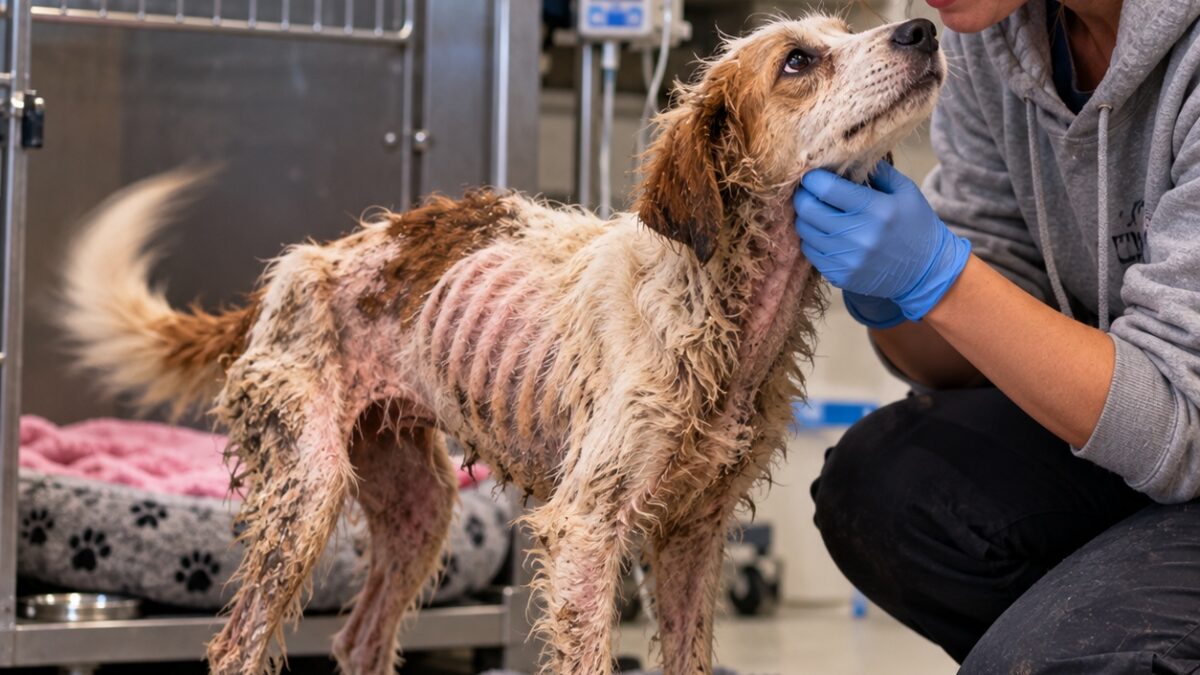
PART2
When she was finally stable enough to leave the hospital, nobody mistook that discharge for recovery.
Nola was still fragile.
Still thin.
Still fighting her way out of what had happened to her.
She needed medication.
Monitoring.
Rest.
Food.
Warmth.
And a home willing to accept that progress might come in inches rather than leaps.
That was what fostering her became.
Not a dramatic transformation.
Not a montage where the sick dog suddenly runs through a yard two days later.
It was learning Nola one small behavior at a time.
Her first night in the foster home, we put tiny pajamas on her.
They looked almost absurdly small in our hands.
On her body, they looked necessary.
She had so little fat that she needed help maintaining warmth.
Healthy dogs can curl into themselves.
Move from a cool floor into a blanket.
Regulate.
Nola’s body did not have the same resources.
The pajamas were not decorative.
They were part of keeping her comfortable while her body tried to rebuild itself.
I remember seeing her in them and feeling two things at once.
She looked incredibly sweet.
And incredibly sick.
Those two things could exist together.
People often respond to a tiny dog in pajamas with affection.
I did too.
But every time I looked at Nola, the reason she needed them was impossible to forget.
There simply was not enough of her yet.
That first night also revealed how unfamiliar ordinary home life was.
Nola did not seem to know where she was supposed to sleep.
She did not seem to understand where she should go to the bathroom.
Everything was new.
Floors.
Furniture.
Doors.
Rooms.
Household sounds.
The predictable pattern of people moving from one place to another and coming back again.
We did not know exactly what she had experienced before rescue.
The source of every behavior could not be proven.
So we did not invent a history for her.
We only responded to the dog in front of us.
And the dog in front of us needed patience.
If she made a mistake, we cleaned it.
If she looked uncertain, we gave her room.
If she seemed cold, we helped her stay warm.
If she rested, we let her rest.
There was no value in demanding that Nola understand rules she had never had the chance to learn.
When morning light came through the windows, she found the sun.
She stretched out in it.
Quiet.
Still.
As though warmth itself was something worth stopping for.
Watching her lie there was one of those moments that looked insignificant unless you knew where she had come from.
She was not playing.
Not running.
Not doing anything people would normally photograph as a milestone.
She was simply warm.
For Nola, that mattered.
For the first time, maybe she did not have to spend every second solving the problem of how to survive.
She could lie in sunlight.
That was enough.
The family had a little boy.
His voice caught Nola’s attention almost immediately.
Whenever he spoke, her ears seemed to notice.
They would lift.
Turn.
Track the sound.
She watched him carefully.
Not with the frozen vigilance of a dog preparing to flee.
More like curiosity.
His voice interested her.
Soon we noticed she was interested in almost everything the family did.
She followed people through the house.
Kitchen.
Living room.
Hallway.
Back again.
Part of that may have been the newness of the environment.
Part of it was almost certainly food.
Nola had learned hunger too deeply.
Whenever people moved, especially around the kitchen, she watched.
If something might fall, she wanted to know.
A crumb.
A piece of food.
Anything.
That behavior made sense.
When your body has been starving, food does not become casual simply because somebody fills a bowl today.
The body remembers scarcity long after the bowl appears.
Nola seemed to live inside that memory.
Food was available now.
But she did not yet understand the word always.
Always comes from repetition.
Breakfast.
Then another meal.
Then another.
One day.
Another day.
Food appearing reliably enough that eventually the panic around it can soften.
You cannot explain that promise to a dog.
You have to demonstrate it.
Again.
Again.
Again.
That was what we began doing.
We were not only feeding Nola.
We were teaching her nervous system that the next meal existed.
By the fourth day, another gap in her experience became obvious.
Nola did not know how to play.
We placed toys around her.
Normal dog things.
Objects many dogs would immediately sniff, grab, chew, carry, shake, or guard.
Nola looked at them.
That was mostly it.
She seemed to understand they were there.
She did not understand what they were for.
It is difficult to describe how sad that felt without exaggerating it.
Playing looks frivolous until you see an animal who has never learned it.
Play requires something basic.
Security.
A dog who believes survival is uncertain has more urgent problems than toys.
When every calorie matters, when illness hurts, when the body is exhausted, play is a luxury.
Nola had apparently spent so much energy surviving that the ordinary behaviors of a comfortable dog had never become ordinary to her.
She climbed onto the couch.
For a second, I thought maybe she had discovered another comfort.
Then she stepped back down almost immediately.
It was as though she had reached a place she wanted to be and then decided she was not supposed to stay.
Again, we did not know exactly why.
Maybe the couch was simply unfamiliar.
Maybe soft furniture was new.
Maybe being allowed close to people in that way felt uncertain.
The important thing was not to force meaning onto it.
We let her choose.
If she climbed up, fine.
If she stepped down, fine.
Tomorrow the couch would still exist.
The same way tomorrow food would still exist.
Tomorrow the family would still be there.
We were trying to build something Nola could only understand through repetition.
Continuity.
Then came the morning that showed us just how far we still had to go.
I found her in the kennel eating her own waste.
For a second, I froze.
Not because the behavior itself was shocking in some abstract way.
Dogs can do things people find unpleasant for many reasons.
But with Nola, context changed everything.
She had been fed.
She had access to food.
Nobody was depriving her now.
Yet she was still searching inside the one place she knew for something edible.
After everything her body had endured, hunger was still dictating behavior.
The old emergency had not ended inside her simply because the new home was safe.
That broke my heart in a different way than her ribs showing had.
You can look at a thin body and understand starvation physically.
This was starvation living on after the bowl had been filled.
A habit shaped by deprivation.
A survival response that did not yet know survival was no longer required every minute.
We did not punish her.
There was nothing to punish.
Nola was not being bad.
She was doing something that had probably made sense to her body at some point when food was not dependable.
So we cleaned the kennel.
Made sure she had what she needed.
Continued the routine.
Continued meals.
Continued patience.
Continued proving the same promise.
Food comes back.
You do not have to search everywhere for it.
You do not have to consume anything available because you do not know when you will eat again.
There will be another bowl.
And another.
And another.
That became one of the most important parts of her foster care.
Not correcting her through fear.
Replacing fear with predictability.
There were other moments when Nola reminded us that safety itself was unfamiliar.
One day, a hair dryer frightened her.
To most dogs living comfortably in homes, a hair dryer may be annoying or noisy.
For Nola, the sound was too much.
The rush of air.
The sudden mechanical noise.
The unfamiliar sensation.
Her fear came immediately.
So we stopped.
Again, recovery meant letting Nola set the pace.
There was no prize for exposing her to everything quickly.
No reason to prove she could tolerate a household on our timeline.
If something scared her, we could make it smaller.
Quieter.
Farther away.
Try later.
Or not try at all until there was a reason.
The goal was not to create a dog who never reacted to anything.
The goal was to give her enough safe experiences that the world gradually stopped feeling unpredictable.
That is slower work.
But it is kinder.
Meanwhile, her body kept changing.
The bloodwork had already given us that first tiny reason for hope.
Now the changes began appearing outside laboratory results too.
Not dramatic.
Not all at once.
The simplest evidence was that she could do more.
Follow the family.
Watch the little boy.
Seek warmth.
Notice food.
Climb onto furniture even if she did not yet stay.
Interact with the world instead of merely lying inside it.
Those were not medical numbers.
But they told us something.
Nola had enough energy to become curious.
Curiosity is expensive when a body is starving.
So is movement.
So is attention.
Every time Nola turned her ears toward a voice or followed someone into another room, she was spending energy on something beyond immediate survival.
That felt enormous.
Her coat still carried the physical record of where she had been.
The smell was improving as we continued gently wiping her.
But there were stains that did not disappear after one cleaning.
We had to work slowly.
Her white fur was there underneath.
You could begin seeing it.
A little more each time.
That became almost symbolic without us trying to make it symbolic.
We were not revealing some perfect dog hidden underneath neglect.
Nola was already Nola when she smelled of urine.
Already worthy of help.
Already herself.
But seeing clean white fur gradually emerge made the progress visible.
The stains were not permanent.
That mattered.
The infection had made her sick.
The anemia had left her frighteningly weak.
Starvation had reshaped her body and behavior.
The urine had stained her coat.
None of those things were her identity.
They were conditions she had endured.
The longer she stayed safe, the more room there was for something else to appear.
Personality.
Preference.
Curiosity.
Connection.
At first, we knew Nola mostly through needs.
Medication time.
Food.
Fluids.
Rest.
Warmth.
Blood tests.
Clean-up.
Watch her gums.
Watch her energy.
Watch for any sign the infection was worsening.
That is what happens with very sick animals.
Their medical crisis fills the entire frame.
You stop asking:
What kind of dog is she?
You ask:
Will she eat?
Is she warm?
Is she responding?
Will her bloodwork improve?
Can her body handle this?
Then gradually those questions stop being the only ones.
We began asking different things.
What sounds does she notice?
Who does she follow?
Where does she choose to lie?
What makes her nervous?
Does she want to be near the other dogs?
Will she stay on the couch a little longer someday?
Will she ever understand toys?
Those questions meant something had changed.
The crisis was not gone.
But Nola finally had enough future for curiosity to matter.
That became even more obvious when she visited the family’s ranch.
There were other rescue dogs there.
That was important.
Dogs can sometimes teach each other things people cannot.
Not through lessons.
Through example.
One dog walks confidently into a space.
Another watches.
One dog runs.
Another realizes running can be part of something fun rather than escape.
One dog relaxes.
Another begins to understand that maybe this place is safe enough to lower your guard.
Nola started exploring.
That alone was different from the dog we first met.
The dog we first met barely had the reserves to exist.
Now she had enough strength to investigate the world.
She moved around.
Followed scents.
Watched the other dogs.
Then came running.
Not the desperate movement of an animal trying to get away.
Running because there was space.
Because other dogs were moving.
Because her body could.
Seeing that was almost difficult to process.
A short time earlier, we had been worried about whether she could withstand a bath.
Now she had enough physical strength to move through open space with other dogs.
That did not mean everything had disappeared.
The old behaviors were still there.
Food mattered intensely.
New things could frighten her.
Play was still something she was learning.
But healing does not require every wound to vanish before joy appears.
Those things can overlap.
Nola could be afraid of a hair dryer and enjoy running at the ranch.
She could still carry a deprivation habit and also follow the family because she wanted to be near them.
She could need pajamas at night and still perk her ears when the little boy spoke.
Recovery was not one straight line from broken to fixed.
It was many small lines crossing each other.
Physical strength.
Trust.
Routine.
Warmth.
Food security.
Social comfort.
Curiosity.
They grew at different speeds.
We learned to stop measuring her against an imaginary healthy dog.
The only fair comparison was Nola yesterday.
Could she do something today that had been too hard before?
Did she look a little more comfortable?
Was she less frightened?
Was she eating?
Was the bloodwork moving in the right direction?
Did she have enough energy to notice the world?
Those were the questions.
At the ranch, the other rescue dogs seemed to give her permission to be ordinary.
They were not staring at her because her coat was stained.
They did not know what the blood tests meant.
They did not care that she had once eaten waste in her kennel.
They interacted with the dog standing in front of them.
And increasingly, Nola could meet them there.
She began relaxing.
That word mattered.
Relaxing is not the same as exhaustion.
When we first saw her, Nola was still because she had so little left.
Later, she could be still because she felt safe.
Those two kinds of stillness look similar from across a room.
Up close, they are entirely different.
An exhausted dog collapses.
A relaxed dog settles.
An exhausted dog has no choice.
A relaxed dog makes one.
At the ranch, we started seeing more of the second kind.
She did not have to monitor every movement.
She could exist near the other dogs.
Explore.
Run.
Come back.
Rest.
The world was beginning to offer choices instead of emergencies.
We kept cleaning her coat gently.
No sudden insistence on making her pristine.
No forcing her through something her body or nervous system could not handle.
The stains slowly faded.
White began replacing the yellow and brown discoloration.
Soft fur underneath grime.
Each cleaning session revealed a little more.
People sometimes describe rescue transformations like there was a beautiful animal hidden underneath an ugly one.
I never liked that idea.
Nola had never been ugly.
Suffering was ugly.
Neglect was ugly.
Starvation was ugly.
An infection draining an already anemic dog was ugly.
Nola herself had been beautiful from the moment her tail moved.
What changed was our ability to see more than the emergency.
The cleaner coat simply made visible what her body was starting to feel.
She was no longer entirely defined by survival.
I kept thinking about that first wag.
At the time, it had seemed almost impossible.
How could a dog whose body was so depleted still offer friendliness?
Maybe there is no answer.
Maybe animals do not need the complicated narratives people build around trust.
Nola saw someone.
Her tail moved.
That was enough.
But later, when she began following the foster family around, I thought about it again.
The first wag had not been an isolated gesture.
Nola wanted connection.
Her condition had not erased that.
Starvation had taught her desperate food behavior.
Illness had reduced her strength.
Fear had made unfamiliar things difficult.
But some part of her still leaned toward people.
That mattered enormously.
We could build on that.
The little boy’s voice remained especially interesting to her.
He would speak and those ears would turn.
Sometimes she would follow.
We were careful not to turn that into a sentimental story that the source did not support.
We did not need to claim they had some magical bond.
What was visible was enough.
She noticed him.
His voice mattered to her.
In a dog whose world had been narrowed by survival, attention itself was a form of opening.
The same was true of food.
At first, watching Nola follow people hoping something would drop made me sad.
Later, I started seeing another side of it.
She was engaged.
Participating.
She had expectations.
Maybe those expectations still came from scarcity.
But expectations point toward a future.
A dog who expects something to happen is not entirely trapped in the present emergency.
Over time, what she expected could change.
At first:
Maybe food will fall.
Later, perhaps:
Food will arrive anyway.
At first:
I should get off the couch.
Later:
Maybe I am allowed to stay.
At first:
That sound might be dangerous.
Later:
Someone safe is nearby.
At first:
This object has no purpose.
Later:
Maybe toys are something dogs can enjoy.
We did not know how long each change would take.
That was okay.
The biggest mistake we could have made was treating a safe environment as proof Nola should immediately behave like a dog who had always lived in one.
Safety offered today does not erase yesterday overnight.
The body learns gradually.
So does the mind.
That morning in the kennel made that impossible to forget.
I thought about it often.
She had eaten.
She was being cared for.
There was no actual need to search for nutrition inside her own waste.
But somewhere in Nola, the instruction remained:
Waste nothing edible.
Take what you can.
Do not assume food comes again.
That is what deprivation does.
It transforms survival into habit.
Then, once circumstances change, the habit remains because it once kept the animal alive.
We treated it accordingly.
No disgust.
No punishment.
Just management.
Clean.
Feed.
Watch.
Repeat.
Let the new pattern become stronger than the old one.
There is something deeply moving about watching an animal learn abundance.
Not luxury.
Abundance in the simplest sense.
Enough food.
Enough warmth.
Enough rest.
Enough patience.
Enough chances.
Most healthy dogs never have to understand the concept because it is simply their environment.
Nola had to discover it.
That discovery did not happen through one giant meal.
It happened through reliability.
The bowl returns.
The hands are gentle.
The medication ends eventually.
The people do not disappear because you make a mistake.
The couch remains available.
The sunlight comes back.
The little boy’s voice stays familiar.
The other dogs are still there.
Again.
Again.
Again.
Her medical care continued in the background of all of this.
Repeated bloodwork.
Monitoring.
Medication.
Those improving values had been the first sign her body was turning a corner.
We never treated one better test as a finish line.
Anemia that severe is not something to dismiss because one number moves.
An infection does not disappear because everybody wants the story to become happier.
So the foster routine remained careful.
We paid attention to her energy.
Her warmth.
Her appetite.
What she could tolerate.
When people saw later photographs of a cleaner, brighter Nola, it might have been easy to assume the hard part was over.
It was not that simple.
Recovery required hundreds of ordinary decisions.
Do we clean more today or let her rest?
Is she warm enough?
Is that new experience too much?
Is she following because she is curious or because she is anxious about food?
How does she respond around the other dogs?
Does she need space?
Does she want closeness?
Nobody could answer perfectly.
The important thing was that the questions were about Nola.
Not about how quickly we wanted progress.
That patience created room for her.
The pajamas remained one of my favorite images from those days.
Tiny dog.
Tiny pajamas.
People could look at them and smile.
I did too.
But I also saw what they represented.
A body so depleted that fabric was helping provide what body fat normally would.
Then I looked at the ranch later.
Nola moving.
Exploring.
Running.
The contrast was almost overwhelming.
Same dog.
Not a miraculous overnight change.
Accumulated care.
Fluids.
Medication.
Food.
Warmth.
Blood draws.
Rest.
Gentle cleaning.
Routine.
Time.
The things that look boring from outside are often the real rescue.
People love dramatic moments.
The hand reaching through a fence.
The dog being carried to safety.
The first run.
The before-and-after photograph.
But most healing happens between those moments.
At three in the morning when somebody checks whether a dog is warm.
When medication is given on schedule.
When another accident is cleaned without frustration.
When a frightening sound is stopped rather than forced.
When the foster family resists the temptation to give a bath because the dog is not ready.
When a bowl appears on time.
When a dog steps off the couch and nobody grabs her to put her back.
When you wipe one stained patch of coat and decide that is enough for today.
Nola’s story lived in those spaces.
That was why the improvement in her bloodwork felt so powerful.
It validated all the things that looked small.
Her body was responding.
Not because we demanded it.
Because it finally had support.
The infection was being treated.
The anemia was being monitored.
Nutrition was returning.
The body could start allocating resources somewhere other than crisis.
Then her behavior began doing the same.
She could allocate attention to the boy’s voice.
Energy to following.
Strength to exploring.
Confidence to other rescue dogs.
Curiosity to furniture and toys.
Even uncertainty was a kind of progress.
A dog cannot be uncertain about a toy if she has no energy to notice it.
Nola noticed.
She just did not yet know what came next.
That was okay.
Somebody would show her.
Or another dog would.
Or she would invent her own way to play when she was ready.
We did not need to stage that moment.
The fact that toys had become part of her environment was enough.
Her world had expanded enough to contain unnecessary things.
That is what toys are.
Beautifully unnecessary.
No survival purpose.
No medical purpose.
Just enjoyment.
For a starving dog, enjoyment may be one of the last concepts to return.
I began looking forward to the day when Nola might understand that unnecessary things can still matter.
A soft place to lie.
A patch of sun.
A toy.
Following someone because you want company, not food.
Running because other dogs are running.
Resting because you choose to stop.
These are ordinary dog experiences.
For Nola, ordinary was extraordinary.
At the ranch, we saw flashes of it.
She moved among dogs who had their own rescue histories.
We did not need to know every story to see what they offered each other.
No pity.
No expectation.
Dogs respond to what is happening now.
One ran.
Nola could run too.
One sniffed a patch of ground.
Nola investigated.
One settled.
She could settle nearby.
Human caregivers tend to look backward.
We see medical records.
The first condition.
The smell.
The weight.
The blood test.
Dogs pull the moment forward.
What are we doing now?
Where are we going?
That helped Nola.
It helped us too.
There came a point where I realized I was not staring at her every minute looking for signs she might collapse.
That fear had been constant early on.
Was she too tired?
Too cold?
Was her body keeping up?
Later, there were moments when I simply watched her be a dog.
Not fully recovered.
Not suddenly free of every deprivation behavior.
But present.
Running.
Following.
Watching.
Resting.
That shift in how we saw her mattered.
Sick animals often become patients before they are allowed to become individuals again.
Every conversation becomes medical.
Nola needed the medical attention.
It saved her.
But she deserved a life larger than being a patient.
Foster care gave that life room to begin.
Her coat continued changing.
White fur appearing more clearly.
Each time we removed another layer of staining, it felt like we were seeing her more accurately.
Not because clean equals worthy.
Because the coat no longer showed only the conditions she had survived.
People meeting her later would see white fur.
They might never know how deeply urine had stained it.
That is okay.
Survivors do not owe everyone visible evidence of what happened.
Nola did not need to remain dirty so people would remember she had suffered.
We remembered.
Her body remembered.
The medical records remembered.
She could become clean.
Warm.
Fed.
And still have her story matter.
One afternoon at the ranch, I watched her move through sunlight.
Her coat was not perfectly clean yet.
There were still traces.
But the white was coming back.
She looked brighter.
More alert.
The other dogs passed near her without ceremony.
For a moment, there was nothing visibly tragic about the scene.
That felt almost shocking.
So much of rescue begins with urgency that peace can look unfamiliar afterward.
I realized that was what we wanted.
Not a dramatic dog.
A peaceful one.
Not a dog whose trauma remained visible forever.
A dog allowed to become boring.
To lie in sun.
Follow a child.
Watch the kitchen.
Explore.
Maybe one day figure out what a toy is for.
People sometimes think the satisfying end to a rescue story has to be adoption.
A forever-home announcement.
A bow around a neck.
A family photograph.
We did not have that in the source we were working from.
So I will not invent it.
The satisfying part of Nola’s ending was quieter.
We got to meet her.
Not only the sick dog.
Not only the starving dog.
Not only the dog whose coat smelled of urine.
Not only the dangerously anemic patient whose blood had to be checked again and again.
The actual Nola.
The dog whose ears perked when a little boy spoke.
The dog who followed people around hoping for food.
The dog who did not understand toys yet.
The dog who tried the couch and then stepped down.
The dog who was frightened by a hair dryer.
The dog who could run with other rescued dogs once her body gave her enough strength.
The dog whose white coat gradually emerged beneath the stains.
That was the transformation.
Not one photograph.
Not one medical result.
A collection of small permissions.
Permission to be warm.
Permission to rest.
Permission to eat and trust that more food would come.
Permission to make mistakes.
Permission to be frightened.
Permission to learn slowly.
Permission to follow.
Permission to explore.
Permission to be around other dogs without needing to fight for survival.
Permission to become something other than an emergency.
That first wag never left my mind.
Nola had almost nothing that day.
No reserve.
No body fat.
No comfort.
Her system was fighting infection.
Her blood was dangerously depleted.
She was filthy.
Exhausted.
Still, some part of her found the energy to greet us.
Maybe that is why everyone became so invested in the next blood test.
Not because we expected her personality to save her.
A wag cannot cure anemia.
Trust cannot replace medicine.
Love does not kill an infection by itself.
Nola needed real veterinary treatment.
Fluids.
Medication.
Monitoring.
Bloodwork.
She needed all of that.
But the wag told us there was somebody inside the crisis waiting for the body to catch up.
When the numbers finally started improving, it felt like the body was answering her.
You kept trying.
Now I am trying too.
I would never pretend that is literally what happened biologically.
It was simply how it felt.
The body that had been failing began to stabilize.
The dog who had never stopped reaching outward finally had more strength with which to do it.
That is why the image of her in pajamas mattered so much.
Weakness and possibility in the same frame.
She needed help staying warm.
But she was no longer alone while doing it.
Her foster family did not expect gratitude.
Nola did not owe anybody that.
Rescue is not a transaction.
You do not save a dog so she will perform affection in return.
You help because she needs help.
Yet Nola kept giving little responses anyway.
Tail.
Ears.
Following.
Watching.
Eventually running.
Those moments felt like gifts precisely because no one had demanded them.
The behavior around food remained the clearest reminder that physical healing could outpace emotional adjustment.
Her body could begin gaining strength while her brain still operated according to starvation rules.
That is not contradiction.
It is how adaptation works.
A response learned under extreme conditions does not vanish because circumstances become safer.
Time is required.
Repetition is required.
That was why we never looked at the kennel incident and thought:
After everything we have done, why is she doing this?
The better question was:
What must life have taught her for this behavior to still feel necessary?
We did not need a complete history to respond compassionately.
The behavior itself told us enough.
She had known deprivation.
Now we needed to show her consistency.
There is a kind of arrogance in expecting rescued animals to understand human generosity immediately.
We know the pantry is full.
They do not.
We know tomorrow’s food exists.
They do not.
We know the door opens again.
They do not.
We know the frightening sound is only a hair dryer.
They do not.
We know the couch is allowed.
They do not.
So we become predictable.
That is the language they can learn.
Meal.
Rest.
Gentle voice.
Same people.
No punishment for confusion.
No rush.
The ranch gave Nola another language.
Other dogs.
Movement.
Social cues.
She could watch behavior that was not centered on crisis.
Dogs sniffing because there were interesting smells.
Running because open space invited movement.
Relaxing because there was nothing to defend against in that moment.
Nola joined gradually.
That is where we saw another version of her.
Not the dog waiting for a blood result.
A dog participating.
Even the way her coat changed seemed connected to that larger shift.
Early cleaning was almost medical.
Remove enough urine to reduce discomfort.
Protect her from extra stress.
Later, grooming could become part of ordinary care.
Work gently at the stains.
Reveal the white fur.
Pause.
Let her rest.
Continue another day.
There was no deadline.
That freedom matters.
Neglect is often a story of somebody repeatedly ignoring an animal’s limits.
Recovery should not repeat the same structure in the name of helping.
So we listened.
Her limits counted.
If a bath was too much, there was no bath.
If the dryer frightened her, we stopped.
If she stepped off the couch, we did not insist she return.
Safety includes control over your own body wherever possible.
Nola was getting some of that control back.
I think that is one reason the ranch suited her.
Space.
Choices.
Other dogs.
Warmth.
No expectation that every moment become a test.
We could observe without pushing.
Would she explore?
Yes.
Would she run?
Eventually, yes.
Would she relax?
More and more.
Would the coat become cleaner?
Little by little.
Would she become playful?
The source ends before giving us that complete answer.
And that is okay.
Not every rescue story has to end at the final milestone.
Sometimes the most truthful ending is the point where direction becomes clear.
Nola’s direction was clear.
When we first met her, everything pointed toward collapse.
Starvation.
Anemia.
Infection.
Exhaustion.
A body barely holding on.
Then:
Bloodwork improved.
She left the hospital.
She stayed warm in pajamas.
She found sunlight.
She followed voices.
She watched the family.
She became interested in her environment.
We discovered behaviors shaped by deprivation and responded with patience.
She encountered frightening things and learned she did not have to face them alone.
She met other rescue dogs.
She explored.
She ran.
She relaxed.
Her white fur began showing again.
That is not a finished life.
It is the beginning of one.
And perhaps that is exactly why it feels hopeful.
A completed rescue story can sometimes make healing seem like a destination.
Nola’s story reminds me that healing is movement.
The blood test moves.
The body moves.
The ears move toward a voice.
The tail moves.
The dog moves through a ranch where she once might not have had the strength to cross a room.
Movement in the right direction.
That first lab improvement had been tiny.
Everyone understood that.
Nobody looked at one better result and declared victory.
But it was enough.
The same was true of everything after.
One moment in sunlight.
One curious look at a toy.
One attempt at the couch.
One day around the other dogs.
One slightly cleaner patch of fur.
Each small.
Together, a life changing direction.
That is how I remember Nola.
Not as one giant before-and-after.
As hundreds of little afters.
After another meal.
After another dose.
After another night warm.
After another blood draw.
After another gentle cleaning.
After another morning when she woke and food appeared again.
After another moment when a person’s hand meant comfort instead of something she needed to fear.
The dog we were getting to know had been there all along.
Starvation had simply taken up all the space around her.
When that space began opening, Nola filled it.
Curious ears.
Following feet.
A soft tail.
Running legs.
White fur.
A little more life every day.
I think about the sun most often.
The way she lay in it after coming home.
Quiet.
No dramatic music.
No audience.
A thin dog in pajamas finding warmth.
That image contains almost the whole story.
At first, warmth had to be given to her.
Pajamas.
Blankets.
Sunlight.
Later, her own body would become stronger.
Not because care erased what happened.
Because care gave her enough stability to start rebuilding.
The same was true emotionally.
At first, safety had to be provided from outside.
Predictable food.
Patient people.
Slow introductions.
Other calm dogs.
Gradually, safety might become something Nola carried inside herself.
We were not there yet.
But we could see it beginning.
The kennel incident did not mean failure.
The hair-dryer fear did not mean failure.
Not knowing how to play did not mean failure.
Those moments were information.
They showed us where deprivation still lived.
And therefore where patience was still needed.
That changed the way we celebrated progress.
We did not celebrate because Nola stopped behaving like a traumatized dog overnight.
We celebrated because she was finally safe enough to show us what she did not know.
That might sound strange.
But hiding is different from learning.
A dog frozen by illness cannot reveal every uncertainty.
Once she grew stronger, more of those gaps became visible.
Play.
Furniture.
House training.
Food security.
Household noises.
Those were not new problems created by recovery.
They were old consequences finally surfacing because the medical emergency was becoming less dominant.
And now we could help with them.
That was progress too.
The little boy’s voice continued pulling her attention.
The kitchen continued pulling the rest of her.
Food still mattered.
Of course it did.
But increasingly, Nola was not only following the possibility of a crumb.
She was following life.
People moving.
Doors opening.
Dogs running.
Sun shifting across the floor.
A house has rhythms.
At first, she did not know them.
Then she started fitting herself inside them.
That may be one of the greatest gifts of fostering.
Not teaching tricks.
Not creating a perfect pet.
Giving an animal enough repetition to understand ordinary rhythms.
Morning.
Food.
Rest.
Outside.
Inside.
People leave a room.
People return.
Noise happens.
Noise stops.
Nothing terrible follows.
The day repeats.
For animals who have lived in unpredictability, repetition can be healing.
Boring is safe.
Nola deserved boring.
By the time we were gently working the stains out of her coat at the ranch, the smell that defined her first rescue day was no longer the first thing I noticed.
That felt important.
I noticed movement.
Her attention.
The way she carried herself around the other dogs.
The white appearing beneath the discoloration.
The smell had once announced her suffering before anyone saw her.
Now it was fading.
Soon, maybe someone meeting Nola for the first time would never know.
That thought did not make me sad.
It made me glad.
Suffering does not need to remain visible for it to have mattered.
The best rescue sometimes means strangers can no longer immediately see the worst thing that happened.
We can remember it for her.
She can move forward.
That is what I wanted.
I did not need Nola to become a symbol.
She was a dog.
A sick dog.
Then a dog recovering.
A hungry dog learning food.
A cold dog finding warmth.
A frightened dog discovering which sounds were safe.
A dog who did not understand toys yet.
A dog beginning to run.
That was enough.
There is a temptation to turn every rescue animal into a lesson about human resilience.
Nola did not exist to teach us.
But caring for her did force us to notice things humans often ignore.
How much trust is built through repetition.
How survival habits can outlive the crisis that created them.
How easy it is to confuse obedience with healing.
How a body can improve before a nervous system believes the danger is over.
How ordinary experiences—sunlight, a couch, another dog running past—can become milestones when an animal has gone without safety.
Most of all, Nola reminded me that recovery does not have to look impressive to be real.
A better blood test.
A warmer body.
A wag.
An ear turning.
One clean patch of fur.
A dog choosing to explore.
Small things.
Real things.
I do not know exactly when Nola stopped feeling like she was barely holding on.
There was no single moment.
No line.
No person announcing:
Now she is safe.
It happened gradually.
The balance changed.
At first, fear outweighed hope.
Then hope became reasonable.
Then hope became something we could see.
The medical improvement made everything else possible.
That cannot be skipped.
Without those fluids, medications, tests, and careful monitoring, there would have been no ranch exploration to celebrate.
No pajamas in a foster home.
No little boy’s voice catching her ears.
No opportunity to learn play later.
Her veterinary care was not background.
It was the foundation.
The foster home built on it.
Warmth.
Routine.
Food.
Observation.
Patience.
Then the ranch added another layer.
Space.
Dogs.
Movement.
The chance to relax socially.
Nothing magical.
Everything important.
The source does not tell us what happened years later.
So I will not.
I will not invent the family who supposedly adopted her.
I will not create a perfect final scene that never happened in the information we were given.
Nola’s real ending here is already enough.
She arrived smelling of urine.
Starving.
Dangerously anemic.
Fighting infection.
So exhausted we were afraid a bath might be too much.
Then her bloodwork began improving.
She went home with foster carers.
She wore pajamas because she could not stay warm enough on her own.
She lay in the sun.
She listened when a little boy spoke.
She followed people.
She struggled with behaviors hunger had taught her.
She was frightened by things she did not understand.
She met rescue dogs.
She explored.
She ran.
She relaxed.
Her carers gently worked the stains out of her coat.
And beneath them, little by little, Nola’s white fur came back into view.
That is where I would leave her.
Not completely finished.
Not transformed into some impossible version of perfect.
Alive.
Stronger.
Learning.
Surrounded by people willing to wait.
The same tail that moved when her body had almost nothing left still belonged to her.
Only now, she had more reasons to wag it.








