PART2:My HOA President Stole Electricity From My House—Then Called the Cops When I Unplugged Her Christmas Lights
PART2
I stared at her.
“A little?”
“It’s temporary.”
“Did you ask me?”
“The HOA strongly encourages holiday participation.”
“That isn’t an answer.”
She sighed dramatically.
“Mark, don’t be such a Grinch.”
I actually looked behind me, half expecting a camera crew.
“You plugged your decorations into my outlet without permission.”
“It’s December.”
“So?”
“It contributes to the neighborhood atmosphere.”
“On my electric bill.”
Brenda folded her arms.
“If your home were more festive, I wouldn’t have to compensate.”
That sentence was so absurd I almost laughed.
Instead, I handed her the cord.
“Find your own power source.”
Her expression changed.
Not much.
Just enough.
Brenda was used to neighbors becoming uncomfortable and backing down.
I did not.
She narrowed her eyes.
“We’ll see.”
Then she closed the door.
I went home.
Two hours later, the cord was back.
I unplugged it again.
This time, I wound it neatly and placed it on Brenda’s porch.
Her front door flew open before I could reach the sidewalk.
“Excuse me!”
I turned.
“What exactly do you think you’re doing?”
The question was so backwards it took me a second.
“I’m returning your extension cord.”
“You disconnected my decorations.”
“From my house.”
“They are HOA-approved decorations.”
“That does not make my outlet HOA property.”
“You’re being deliberately difficult.”
“I’m being billed.”
“For pennies.”
“Then paying for it yourself should be easy.”
Brenda stepped onto the porch.
“You have always had a problem with community standards.”
“No, Brenda. I have a problem with you entering my yard and taking electricity.”
Her face tightened.
“Be careful with accusations.”
“I followed the cord.”
“I’m warning you.”
“No.”
That stopped her.
People like Brenda love giving warnings.
They dislike receiving one.
I pointed toward my property.
“Do not plug anything into my house again.”
Her jaw worked.
Then she said slowly:
“We’ll see what the board thinks.”
That was the moment the extension cord stopped being about electricity.
It became about control.
The next morning, Gary leaned over our shared fence while I drank coffee.
“Please tell me the story I heard is true.”
“What story?”
“Brenda stole your electricity to power Santa.”
“Technically Santa and eight reindeer.”
Gary started laughing.
“She’s lost her mind.”
“You’re just figuring that out?”
“Last week she told me my recycling bins were aesthetically disruptive.”
“What does that mean?”
“I asked.”
“And?”
“She said I was being confrontational.”
Nancy came across the street carrying mail.
“You two talking about Brenda?”
“Always,” Gary said.
Nancy looked at me.
“She cited my garden gnome in October.”
I stared.
“Your what?”
“My gnome.”
“For what?”
“Nonconforming decorative placement.”
Gary nearly spilled his coffee.
Nancy pointed at him.
“You laugh, but she photographed it from three angles.”
That conversation was the first time I realized Brenda’s behavior was not annoying only me.
Everyone had a story.
Fence stain.
Bird feeder.
Trash-bin timing.
Mailbox color.
Basketball hoop.
A child’s chalk drawings on a driveway.
One family had received a warning because their porch pumpkins remained outside until November fifth.
Brenda had turned neighborhood governance into a personal hobby.
Some people fought her.
Most paid whatever small fine appeared and moved on because they had jobs, children, aging parents, and better ways to spend Tuesday evenings.
That was how Brenda became powerful.
Not because the HOA gave her unlimited authority.
Because exhaustion did.
That afternoon, I came home and found an envelope taped to my front door.
MAPLE RIDGE HOMEOWNERS ASSOCIATION
NOTICE OF VIOLATION
I opened it.
The alleged violation:
Unauthorized interference with community-approved seasonal decorations.
I read it twice.
Then a third time.
Apparently unplugging something from my own outlet now constituted interference with community decorations.
The notice instructed me to “cease obstructive activity immediately” and warned that additional penalties could follow.
I called Gary.
“You need to see this.”
He came over.
Read it.
Looked at me.
Then read it again.
“This can’t be real.”
“It has the HOA logo.”
“That doesn’t make it real.”
“Brenda signed it.”
“That makes it less real.”
I laughed.
Then stopped.
Because beneath the absurdity was something serious.
Brenda had used the HOA’s official paperwork to retaliate against me for preventing her from taking my electricity.
If I ignored it, she would escalate.
If I argued verbally, she would rewrite the conversation.
So I did what people should do whenever they encounter a person who enjoys changing facts after the fact.
I started documenting everything.
I photographed the extension cord.
Outlet.
Path across my property.
Location where it entered her garage.
I photographed the violation notice.
Saved every email.
Wrote down dates and times.
Then I installed a security camera.
Nothing dramatic.
A small exterior camera covering the side yard and outdoor outlet.
I told nobody except Gary.
He looked impressed.
“You think she’ll do it again?”
“Yes.”
“Seriously?”
“Yes.”
He grinned.
“I’m bringing popcorn.”
Brenda did not disappoint him.
At 11:43 that night, my camera recorded her walking across the side yard in a winter coat.
She glanced toward my windows.
Bent down.
Plugged the orange cord into my outlet.
Then walked back toward her house.
The next morning, I unplugged it.
That evening, she returned.
Plugged it in again.
I unplugged it.
Three nights.
Four.
By the fourth, I had enough footage to produce a documentary titled The Persistence of Entitlement.
I did not confront her.
That surprised Brenda.
I think she expected anger.
Instead, I got quiet.
Quiet makes controlling people nervous.
I also started reading the HOA bylaws.
All of them.
Maple Ridge had eighty-seven pages of rules, amendments, procedures, architectural guidelines, meeting policies, and financial provisions.
I had never read them because I had a life.
Now Brenda had given me motivation.
I learned something quickly.
She had far less unilateral authority than she implied.
Compliance notices required either an existing rule or formal board authorization.
Fines above a certain amount required review.
Architectural committee decisions could be appealed.
And nowhere—not once—did the bylaws authorize a board member to use another resident’s electricity for community decorations.
Shocking.
I printed the relevant sections.
Then I requested copies of the last twelve months of board meeting minutes.
Brenda emailed back.
“For what purpose?”
I answered:
“Resident review.”
She replied:
“Specific reason required.”
I sent her the bylaw paragraph stating residents could inspect HOA records without providing a special justification.
Forty minutes later, the files appeared.
That was when I knew she understood I was no longer going away quietly.
The next HOA meeting was scheduled for Thursday at seven.
I arrived at 6:40.
Gary came too.
So did Nancy.
Then the couple from three houses down.
Then another neighbor.
And another.
By seven, the meeting room was fuller than I had ever seen it.
Brenda sat at the front behind a thick binder.
Someone had put a label on it.
NEIGHBORHOOD COMPLIANCE.
Gary whispered:
“Villain prop.”
“Behave.”
“I am behaving.”
The HOA president, a mild-mannered accountant named Richard Sloan, called the meeting to order.
Richard had spent most of the previous year trying to keep Brenda contained without admitting she needed containing.
He was polite.
Conflict-averse.
Exactly the kind of person aggressive committee members learn to outmaneuver.
The agenda moved normally until compliance.
Brenda opened her binder.
“I have several ongoing violations requiring board attention.”
Her eyes landed on me.
Of course.
She began with my property.
“Resident has repeatedly interfered with approved holiday decorations serving the aesthetic interests of Maple Ridge.”
Richard frowned.
“What interference?”
Brenda looked irritated that he asked.
“Removal of electrical connection.”
“Whose connection?”
She hesitated.
“Seasonal power access.”
Gary made a choking sound beside me.
I raised my hand.
Richard nodded.
“Mark?”
“I have something that may clarify.”
Brenda immediately said:
“This is not the appropriate time for theatrics.”
“I agree.”
I placed my laptop on the table.
“That’s why I brought video.”
The room changed.
Brenda sat straighter.
“What video?”
I connected to the meeting room screen.
The first clip played.
Date.
Time.
Brenda entering my yard.
Orange cord in hand.
Plug.
Leave.
Nobody spoke.
Second clip.
Different night.
Same action.
Third.
Brenda glanced toward my house.
Plugged in.
Walked away.
Gary whispered:
“Director’s cut.”
Someone laughed.
Brenda’s face went red.
“That is completely out of context.”
I paused the video.
“What context would make this your outlet?”
“This is harassment.”
I looked at Richard.
“My outdoor outlet is on my deeded property. The cord goes from my house to Brenda’s garage. She never asked permission. I disconnected it. She repeatedly returned at night and reconnected it. Then I received an HOA violation notice for unplugging it.”
Nancy said from the back:
“You’ve got to be kidding.”
Another board member, Susan Patel, turned toward Brenda.
“Did you authorize that notice yourself?”
Brenda lifted her chin.
“As compliance coordinator, I have discretion.”
Susan pulled a copy of the bylaws toward her.
“Not for nonexistent rules.”
“It was an emergency seasonal aesthetic issue.”
Gary laughed openly.
Richard raised one hand.
“Let’s keep order.”
Brenda pointed at me.
“He has been antagonistic from the beginning.”
I answered:
“I asked you to stop using my electricity.”
“For a community display!”
“On your house.”
“Visible to the whole neighborhood.”
“Then the whole neighborhood can admire it while you pay for it.”
People laughed.
That made Brenda furious.
She slammed both palms on the table.
“This is exactly the disrespect I have been warning about.”
The room went quiet.
She stood.
“For years, I have been the only person in this neighborhood willing to enforce standards. People complain privately and then refuse to support enforcement publicly. I am trying to protect property values, community appearance, and basic order.”
Gary raised his hand.
Richard sighed.
“Yes, Gary?”
“My recycling bins survived the aesthetic emergency.”
More laughter.
Brenda snapped:
“This is not funny.”
Nancy said:
“Neither was being threatened over a garden gnome.”
A man near the back added:
“You fined me because my daughter’s basketball hoop was visible.”
Another woman said:
“You sent us three notices about a bird feeder.”
The room shifted.
This was no longer my extension cord.
Years of small resentments were coming loose.
Brenda had made a mistake.
She had assumed everyone’s silence meant support.
It meant fatigue.
Once somebody provided a safe opening, the stories started.
One neighbor had paid a seventy-five-dollar fine over fence stain that matched the approved palette.
Another had received warnings for leaving trash bins out four hours too long after a snowstorm.
A retired couple said Brenda repeatedly photographed their property from the sidewalk.
Gary described the recycling-bin issue.
Nancy described the gnome.
Through all of it, Richard sat increasingly pale.
Susan kept taking notes.
Another board member, Peter Lawson, asked:
“How many notices did compliance issue this year?”
Brenda said:
“I don’t have that number in front of me.”
“You have a binder titled Neighborhood Compliance.”
“That does not mean—”
“How many?”
Silence.
Richard finally said:
“We are suspending compliance enforcement pending review.”
Brenda stared at him.
“You cannot do that.”
“I’m HOA president.”
“And I run compliance.”
“Under the board.”
She laughed once.
Cold.
“You people have no idea what will happen if enforcement collapses.”
Susan said:
“People may use electricity they pay for.”
That did it.
The room erupted.
Brenda grabbed her binder.
“This is an ambush.”
I said nothing.
Did not need to.
Richard called a brief recess.
During that break, three board members spoke privately.
When the meeting resumed, Richard looked uncomfortable but resolved.
“There is a motion to remove Brenda Holloway as compliance coordinator and suspend her committee authority pending a formal review of recent notices and procedures.”
Brenda stood.
“You’re joking.”
Susan said:
“I second.”
Vote.
Four to one.
Brenda lost.
Effective immediately.
She was still technically a board member until the membership process could address that separately, but the position she had used as a weapon was gone.
Brenda looked around the room.
Her eyes landed on me.
“You did this.”
I answered:
“No.”
I gestured toward the screen.
“You did.”
Then Gary, who had apparently been saving one line all night, muttered loudly:
“Not anymore.”
That received the biggest laugh.
Brenda stormed out.
I thought the worst was over.
I should have known better.
People who need control rarely accept losing it gracefully.
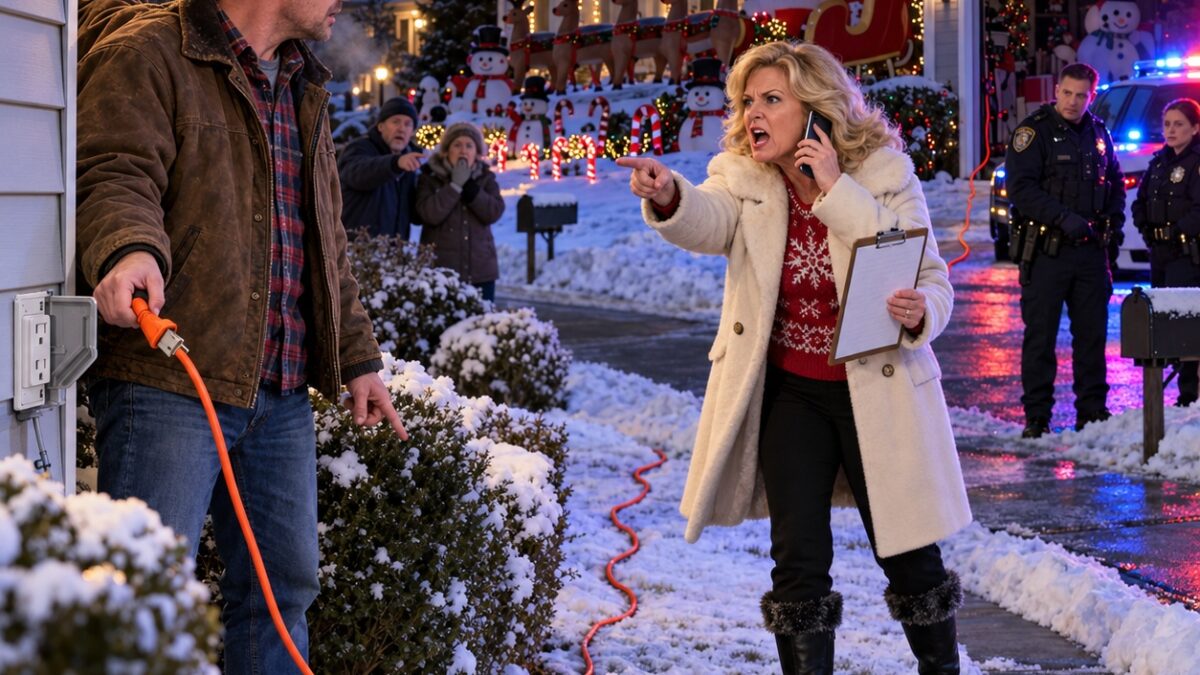
The next morning at 8:12, I looked through my front window and saw a police cruiser.
Then another.
And Brenda.
Standing beside them.
I actually closed my eyes.
“Of course.”
I opened the door.
Two Syracuse-area officers stood near the walkway.
One looked tired already.
The other held a notebook.
Brenda stood behind them wearing the expression of a person who believed reinforcements had arrived.
The older officer asked:
“Mr. Bennett?”
“Yes.”
“We received a complaint involving harassment and property interference.”
I looked at Brenda.
She crossed her arms.
I looked back at the officer.
“I have a pretty good idea what this is about.”
Brenda said:
“He has repeatedly tampered with my personal property and has been stalking me with cameras.”
The officer looked at me.
“Do you have cameras?”
“Yes.”
“Where?”
“On my property.”
“What do they record?”
“My side yard and exterior outlet.”
Brenda jumped in.
“He has illegally surveilled me.”
I almost laughed.
Instead, I pulled out my phone.
“Would you like to see why?”
The officers watched the first clip.
Then the second.
Then the third.
The older officer looked at Brenda.
“Ma’am, is that you?”
She stiffened.
“Yes, but—”
“On his property?”
“The HOA—”
“Is that his outlet?”
“It supplies power to a community-facing holiday display.”
The officer blinked.
“That isn’t what I asked.”
Brenda’s face reddened.
“Yes.”
“And he told you not to use it?”
“He was unreasonable.”
“That’s another yes.”
Brenda’s voice rose.
“I am on the HOA board.”
The officer sighed.
I will remember that sigh forever.
“Ma’am, an HOA does not give you permission to enter private property and take utility service from another residence.”
“It was only a small amount.”
“That does not make it yours.”
She pointed at me.
“He took my extension cord.”
“I placed it on her porch.”
The officer looked at me.
“Did you damage it?”
“No.”
“Keep it?”
“No.”
He looked back at Brenda.
“What exactly are you asking us to arrest him for?”
That question destroyed whatever fantasy she had built.
She started talking faster.
Harassment.
Hostility.
Interference.
HOA rules.
Unauthorized cameras.
Retaliation.
The officers listened.
Then the younger officer said:
“Ma’am, none of what you’ve described changes the fact that the video shows you repeatedly entering his property to connect to his electrical outlet after being told to stop.”
Brenda stared.
“I was performing official HOA duties.”
The older officer said:
“HOA duties are not police powers.”
Silence.
Then Brenda made the mistake that ended any sympathy she might have received.
“So you’re taking his side?”
The officer answered:
“We’re looking at the evidence.”
“There are two sides to everything.”
“Sometimes there’s video.”
Gary was standing in his driveway by then.
He turned away because he was laughing.
I pretended not to notice.
The officers told Brenda to stay off my property.
They advised me that I could make a formal complaint if the conduct continued.
They did not arrest her.
I did not ask them to.
Despite how satisfying revenge stories make escalation sound, I did not want Brenda handcuffed over Christmas lights.
I wanted her to stop.
That should have been enough.
But the police visit became neighborhood news within hours.
Not because I spread it.
Maple Ridge was simply efficient.
By lunch, Nancy texted:
DID SHE REALLY CALL THE COPS BECAUSE YOU UNPLUGGED HER?
I answered:
Yes.
Three dots appeared.
Then:
I’M PUTTING THE GNOME BACK OUT.
The neighborhood changed almost overnight.
For years, Brenda had controlled people partly because everyone assumed she had more authority than she did.
Once they saw officers reject that assumption, the illusion disappeared.
Neighbors started requesting copies of notices.
Challenging fines.
Reading bylaws.
Asking the board to document rules before enforcing them.
The HOA launched a formal review of Brenda’s compliance actions.
The results were embarrassing.
Multiple notices had no clear basis.
Some cited outdated provisions.
Several fines had been threatened without proper board authorization.
A few were technically valid but handled with unnecessary hostility.
Brenda had blurred the line between HOA policy and personal preference so thoroughly that residents could no longer tell which was which.
The board rescinded a stack of old warnings.
Refunded several fines.
Created an appeal process.
Required two-person approval for new compliance notices.
And, most importantly, eliminated the idea that one person with a clipboard could effectively invent neighborhood law.
Brenda resigned from the board before the membership removal vote.
Her letter blamed “a hostile environment created by residents who oppose standards.”
Nobody responded publicly.
Privately, Gary framed the sentence.
Not literally.
I hope.
That December became strangely festive.
After years of worrying about Brenda’s opinions, neighbors seemed to decide they had earned some harmless rebellion.
Gary added multicolored lights around his porch.
Nancy put two garden gnomes beside her Christmas tree display.
Someone three houses down installed a twelve-foot inflatable snowman.
Another family projected dancing candy canes onto their garage.
No one violated any legitimate rules.
The neighborhood simply looked less controlled.
More human.
Brenda’s house?
Dark.
The famous Santa display disappeared.
The reindeer came down.
No roof lights.
No snowflake projector.
Nothing.
Gary stood beside me one evening looking across the street.
“Power outage?”
“Self-funded Christmas is expensive.”
He laughed.
“You did it.”
“Did what?”
“Slayed the HOA dragon.”
I shook my head.
“No.”
He held out a beer.
I took it.
“I just unplugged her power trip.”
Gary stared at me.
“That was awful.”
“You’re still drinking with me.”
“Unfortunately.”
We clinked bottles.
For the first time in years, neighbors started showing up at HOA meetings voluntarily.
Not to fight.
To participate.
That mattered.
Because Brenda had not created the problem alone.
We had helped by checking out.
I had.
Gary had.
Most of us had.
We treated the HOA like background noise until the person willing to invest the most time gained disproportionate influence.
That is how small power structures drift.
Not always through conspiracy.
Sometimes through apathy.
The new compliance committee had three people.
Rotating terms.
Published decisions.
Clear citations.
Residents could appeal.
Richard stayed HOA president for another year, then happily stepped down.
Susan Patel replaced him.
Her first meeting lasted forty-two minutes.
People applauded.
She looked alarmed.
“I don’t think board meetings normally receive standing ovations.”
Gary said:
“Keep them under an hour and we’ll build you a statue.”
Susan pointed at him.
“No statues without architectural approval.”
Everyone laughed.
That was the difference.
Rules still existed.
They should.
Nobody wanted twelve broken cars in front yards or collapsing fences or dangerous structures.
The issue had never been the existence of standards.
It was the transformation of standards into a personality.
Good governance is boring.
Predictable.
Documented.
Appealable.
Brenda had made governance personal.
That is where things went wrong.
My own electric bill eventually became a joke.
Gary asked whether I planned to send Brenda an invoice.
I calculated the likely cost.
The holiday display had probably used less money than the drama suggested.
Maybe twenty or thirty dollars depending on how long she had connected it.
That was never the point.
People occasionally said:
“You went through all that over twenty bucks?”
No.
I went through all that because the amount does not determine ownership.
If I reach into your wallet and take one dollar, the fact that you can afford it does not turn the dollar into mine.
If Brenda had knocked on my door and said:
“My exterior outlet failed. Can I use yours for one night while I get an electrician?”
I probably would have said yes.
That is the irony.
Permission changes everything.
Entitlement changes everything too.
She never asked because asking would acknowledge that I could say no.
Brenda’s entire approach depended on denying other people the legitimacy of no.
No, my mailbox is fine.
No, my gnome can stay.
No, I will not pay this unsupported fine.
No, you cannot enter my yard.
No, you cannot use my electricity.
She could tolerate disagreement only if she remained the final authority.
That was why the extension cord mattered.
Not power.
Permission.
Once she realized I meant no, she escalated because she believed escalation should force surrender.
Violation notice.
HOA meeting.
Police.
Instead, each escalation created a larger audience for the same simple fact.
It was my outlet.
The police incident was the last time Brenda confronted me directly.
She still lived in Maple Ridge.
For months, she barely spoke to anyone.
Curtains closed.
Garage door down.
No clipboard patrols.
At first, some neighbors enjoyed it too much.
I discouraged that.
Nancy once said:
“Maybe we should give Brenda a violation notice for insufficient holiday lighting.”
I laughed.
Then said:
“No.”
“Why not?”
“Because then we become Brenda.”
She thought about it.
“Fine.”
Gary was disappointed.
“We could cite community spirit.”
“No.”
“Grinch behavior?”
“No.”
“Aesthetic darkness?”
“Absolutely not.”
He sighed.
“You’ve gotten boring.”
Good.
I did not want revenge.
I wanted normal.
Eventually Brenda started walking the neighborhood again.
Without the clipboard.
The first time we passed on the sidewalk, she looked straight ahead.
I said:
“Morning.”
She hesitated.
Then:
“Morning.”
That was all.
Several months later, I found an envelope in my mailbox.
No HOA logo.
Inside was a check.
Twenty-five dollars.
No letter.
No apology.
Just the check.
I knew exactly what it was.
Electricity.
I stared at it.
Gary happened to be outside.
“What’s that?”
“Brenda paid me.”
His mouth opened.
“No.”
I showed him.
He examined it like forensic evidence.
“Frame it.”
“I’m depositing it.”
“That’s less fun.”
“It’s money.”
“Symbolism, Mark.”
“My bank accepts symbolism.”
I deposited it.
That was enough for me.
Not forgiveness.
Not friendship.
Account settled.
The following Christmas, Maple Ridge held its first voluntary neighborhood decorating contest.
Voluntary was printed three times on the flyer.
Gary said that was aimed at Brenda.
Susan denied it.
Categories included:
Best Classic Display.
Best Kids’ Display.
Best Minimalist Display.
Most Creative.
And, because neighbors have long memories:
Best Use of Your Own Electricity.
Susan claimed she voted against the category.
Nobody believed her.
I entered nothing.
I put one wreath on my door.
Gary stared at it.
“After everything, that’s your decoration?”
“Yes.”
“One wreath?”
“Powered entirely by me.”
“It has no power.”
“Exactly.”
Nancy won Most Creative because she dressed her formerly illegal garden gnome as Santa.
Justice has strange forms.
The neighborhood became friendlier after Brenda lost control.
Not because everyone suddenly agreed.
We did not.
People argued about snow removal.
Parking.
Dues.
Drainage.
A proposed playground renovation nearly started a civil war.
But disagreements became visible.
Procedural.
People voted.
Minutes were published.
No one received mysterious notices the next morning for speaking against a board member.
That was the improvement.
One night, Susan asked if I wanted to join the board.
I said no so quickly she laughed.
“You did all this and you won’t serve?”
“I did all this because I don’t want people like Brenda running unchecked.”
“Exactly why you should serve.”
“I enjoy my sanity.”
“Committee?”
“No.”
“Advisory role?”
“No.”
“Christmas-light inspector?”
“Get off my porch.”
She laughed.
I eventually agreed to help review the neighborhood camera policy.
One meeting.
That was my limit.
Gary still tells the story incorrectly.
According to him, Brenda built a “commercial-grade winter amusement park” using enough stolen electricity to power three houses.
Not true.
Nancy claims police threatened to arrest Brenda on the spot.
Also not true.
The actual story needs no exaggeration.
A woman plugged her lights into someone else’s house.
Was told to stop.
Refused.
Used HOA paperwork to retaliate.
Got caught on video.
Lost her authority.
Then called police, who watched the video and explained that being on an HOA board did not make private property disappear.
Reality was already ridiculous enough.
The security camera stayed.
Not because I expected Brenda.
Because cameras are useful.
Two years later, it caught a teenager clipping my mailbox with his father’s truck.
He knocked on my door before I even checked the footage.
“Mr. Bennett, I hit your mailbox.”
He looked terrified.
“Bad?”
“Bent.”
“I’ll pay.”
“Your dad know?”
“He’s going to kill me.”
“Probably not.”
He looked toward the camera.
“Did that record?”
“Yes.”
His face fell.
I smiled.
“You came to tell me.”
“So?”
“So I don’t need it.”
We fixed the mailbox together that weekend.
Cost almost nothing.
That experience reminded me how different mistakes feel when someone takes responsibility immediately.
The teenager said:
“I’m sorry.”
I said:
“Okay.”
Finished.
No committee.
No police.
No binder.
No war.
Accountability is easier when ego does not fight it.
Years after the extension-cord incident, someone new moved into the neighborhood.
At the first HOA meeting, she asked why the compliance rules required two approvals.
Gary pointed at me.
“He fought the Christmas War.”
I groaned.
“There was no Christmas War.”
The new neighbor looked interested.
Nancy said:
“Ask him about the extension cord.”
Susan said:
“Do not ask him.”
Of course she asked.
I told the short version.
She laughed.
Then asked:
“What happened to Brenda?”
I glanced toward the back of the room.
Brenda was sitting three rows away.
Yes.
She had eventually started attending meetings again.
Not as a board member.
A resident.
She looked at me.
I looked at her.
Then said:
“She still lives here.”
The new neighbor’s eyes widened.
Brenda spoke from the back.
“And I use my own outlets now.”
The entire room went silent.
Then Gary burst out laughing.
To my surprise, Brenda smiled.
Small.
Reluctant.
But real.
That was the first time she publicly acknowledged it.
No apology.
No confession.
Just a joke.
Sometimes that is as far as people get.
I accepted it.
Later, outside, Brenda approached me.
Alone.
“Mark.”
“Brenda.”
She looked uncomfortable.
“I was difficult.”
Understatement of the decade.
I said:
“Yes.”
She almost smiled.
“I expected you to say something polite.”
“You know me better than that.”
She looked down.
“My husband had been sick that year.”
I had not known.
“He hated holidays.”
I waited.
“After he died, I started… controlling things.”
Her voice lowered.
“The neighborhood. Decorations. Rules. I thought if everything looked right, I’d feel…”
She stopped.
“Better?”
“Yes.”
For a moment, I saw not the HOA tyrant.
A grieving woman who had converted anxiety into authority.
That did not excuse what she did.
Understanding is not absolution.
But it added context.
“I’m sorry about your husband,” I said.
“Thank you.”
She looked toward my house.
“I should have asked.”
“Yes.”
“And when you said no…”
“You should have stopped.”
“Yes.”
We stood quietly.
Then Brenda said:
“The police part was embarrassing.”
I laughed before I could stop myself.
She did too.
“That officer looked so tired.”
“He really did.”
“I thought the HOA gave me more authority.”
“I noticed.”
She winced.
“Fair.”
That conversation did more for me than any dramatic downfall could have.
Because people are rarely villains twenty-four hours a day.
Brenda had become controlling.
Bullying.
Entitled.
She had misused HOA authority.
All true.
She was also a human being who had reacted badly to grief and then spent years being reinforced by people who found it easier not to challenge her.
That does not erase responsibility.
It makes the lesson more useful.
Power does not usually transform perfectly reasonable people into cartoon dictators overnight.
Often it amplifies something already unstable.
Fear.
Insecurity.
Need for control.
Then lack of resistance tells them the behavior is working.
That was Maple Ridge.
We had given Brenda too much room because opposing her felt inconvenient.
Until the inconvenience became bigger.
After that conversation, Brenda and I never became friends.
We did become normal neighbors.
Wave.
Hello.
Occasional package held while someone traveled.
Once, during a power outage, Gary walked over and said:
“You should run an extension cord to Brenda’s.”
I stared at him.
He grinned.
“For community spirit.”
“You have been waiting years to say that.”
“Yes.”
“Go home.”
The power returned an hour later.
That night, Brenda texted me for the first time in years.
Need an extension cord? Mine are available by written permission only.
I laughed harder than I expected.
People can change.
Sometimes.
Maple Ridge changed too.
The bylaws were eventually revised.
Clear limits.
Conflict-of-interest procedures.
Required citations on violation notices.
Hearing rights.
No single board member could issue monetary penalties.
Meeting minutes posted online.
Annual policy review.
None of it was exciting.
Good.
Exciting governance usually means somebody has made a mistake.
The Christmas display rule was rewritten too.
Residents were encouraged to decorate if they wanted.
No minimum lighting.
No aesthetic obligation.
No “community spirit” requirement.
Susan added a line forbidding electrical connections to other lots without permission.
Gary insisted they name it “The Bennett-Holloway Amendment.”
They did not.
Thank God.
Every December, when I plug in the modest string of white lights I eventually bought for my porch, I still think about that orange cord.
The first time it happened, I was angry because someone was using my electricity.
Looking back, the more important violation was smaller and larger at the same time.
Brenda assumed access.
To my yard.
Outlet.
Money.
Compliance.
Silence.
She had become so accustomed to people yielding that she stopped distinguishing what she wanted from what she was entitled to.
That is dangerous anywhere.
Not just HOAs.
Workplaces.
Families.
Schools.
Governments.
Friendships.
Boundaries disappear fastest when someone convinces themselves that their intention makes permission unnecessary.
Brenda wanted a festive neighborhood.
Fine.
She wanted standards.
Fine.
She wanted participation.
Fine.
None of those desires gave her the right to take.
That principle seems obvious.
Yet obvious principles are often the ones people violate while telling themselves they are being reasonable.
I learned something too.
Document before yelling.
That advice has served me well.
Anger feels powerful.
Evidence is powerful.
If I had stormed across Brenda’s lawn shouting, she could have claimed anything.
Threats.
Harassment.
Aggression.
Instead, I had timestamps.
Video.
Emails.
Bylaws.
Her own notice.
When the dispute moved from conversation to board review to police, facts moved with it.
No drama required.
Gary found that disappointing.
I found it efficient.
I also learned that silence is not neutrality.
For years, we watched Brenda bully other neighbors and said:
“That’s Brenda.”
We treated it as personality.
Then she targeted us and suddenly expected everyone to care.
That is hypocrisy.
Nancy’s gnome sounded silly until my outlet became serious.
The underlying behavior was the same.
A person using institutional authority to punish resistance.
If we had challenged the small abuses together earlier, maybe the extension cord never happens.
Maybe Brenda never gains enough confidence to think she can do it.
Communities are not protected by good rules alone.
They are protected by people willing to use them fairly.
And people willing to speak when they are not.
That is the lesson I kept.
Not:
Fight your HOA.
Not:
Humiliate your neighbor.
Not:
Install cameras everywhere.
The lesson is:
Know where authority ends.
Especially your own.
Today, Maple Ridge is still boring.
I mean that affectionately.
Grass grows.
Snow falls.
Kids leave bicycles in driveways.
Mailboxes vary slightly.
Nancy still has the gnome.
Gary still complains about everything.
Susan retired from the board after two terms and celebrated by throwing away a binder in front of witnesses.
Brenda gardens now.
Beautifully, actually.
She has fewer Christmas lights.
She still decorates.
Just enough.
All powered from her own house.
And I still have the old orange extension cord.
That is the strange part.
About a year after everything ended, Brenda knocked on my door.
She held it out.
“I think this belongs in your story more than mine.”
I took it.
“You don’t want it?”
“I bought a new one.”
“Shorter?”
She laughed.
“Yes.”
I stored the old cord in my garage.
No idea why.
Gary insists it belongs in a museum.
Nancy suggested framing it above the HOA meeting table.
I refuse.
But sometimes I see it hanging from a hook and remember the entire ridiculous chain of events.
A cord.
An outlet.
A refusal.
A camera.
A room full of neighbors.
Two exhausted police officers.
A board forced to remember what its job actually was.
People imagine big conflicts begin with big things.
Often they do not.
Sometimes they begin with an extension cord snaking across a lawn.
The object is small.
The assumption behind it is not.
Brenda believed I would either not notice or not fight.
I noticed.
I said no.
Everything after that came from her refusal to hear it.
Years later, I asked Gary whether he thought I overreacted.
He stared at me.
“You spent weeks reading HOA bylaws.”
“That’s not an answer.”
“You voluntarily read eighty-seven pages of HOA bylaws.”
“I know.”
“You suffered enough.”
“Gary.”
He thought.
“No.”
“Why?”
“Because if you let Brenda steal electricity, next year she’s running water lines through your basement.”
I laughed.
“That makes no sense.”
“Neither did the original.”
Fair.
He raised his drink.
“To property rights.”
I raised mine.
“To shorter meetings.”
“Even better.”
We sat on my porch.
Across the street, Christmas lights glowed from several houses.
Different colors.
Different styles.
No uniform theme.
Nobody cared.
Brenda’s porch had a small wreath with battery-powered lights.
I pointed.
“Battery-powered.”
Gary nodded solemnly.
“Growth.”
I smiled.
Maybe that was the real ending.
Not Brenda losing.
Brenda learning.
Not me winning.
The neighborhood getting healthier.
A good conflict resolution should leave fewer enemies than it began with.
It took us years to reach that point.
But we did.
And every December, someone new eventually hears the story.
They always ask the same question:
“She really called the police on you?”
Yes.
“Because you unplugged her Christmas lights?”
No.
Because I unplugged my electricity from her Christmas lights.
That difference is the whole story.








