PART2:My Golden Retriever Refused to Leave the Fence After His Best Friend Was Carried Away—For 23 Days, He Waited for One Thing
PART2
That first evening, I carried his food outside.
Chicken mixed with kibble.
His favorite.
Normally, Buddy could hear a food bowl from another zip code.
I put it beside him.
“Come on.”
He glanced down.
Sniffed.
Then looked back through the fence.
I sat next to him.
The yard next door looked unnaturally empty.
Rocky’s water bowl remained on the porch.
A blue rope toy lay near the steps.
One of his tennis balls sat against the flower bed.
Everything that said Rocky belonged there was still there.
Except Rocky.
Buddy seemed to understand that better than I did.
I rubbed the top of his head.
“Rocky’s at the clinic.”
His ears moved slightly.
“He’s getting help.”
No response.
“He’ll be back.”
I said it too confidently.
I didn’t know that.
I wanted Buddy to believe me.
Maybe I wanted to believe it too.
That night, Buddy refused to come inside.
I called him from the back door.
“Buddy.”
Nothing.
My daughter Emma came beside me.
She was nine.
“Why won’t he come?”
“He’s waiting.”
“For Rocky?”
“I think so.”
“Is Rocky coming home tonight?”
I looked at her.
“I don’t know.”
That answer frightened her.
Kids understand tone before they understand facts.
Emma slipped on her shoes and walked into the yard.
She crouched beside Buddy.
“Come inside.”
Buddy looked at her.
Then back at the empty yard next door.
Emma hugged his neck.
“He’s cold.”
“I’ll get a blanket.”
I carried one outside.
Spread it beside him.
Buddy stepped onto it eventually.
But he didn’t leave the fence.
At midnight, I checked again.
Same position.
Head on his paws.
Eyes toward Rocky’s yard.
The next morning, he was still there.
That was when concern replaced sympathy.
I brought fresh water.
Buddy drank a little.
Maybe four or five laps.
Then stopped.
He wouldn’t eat.
My son Lucas tried throwing Buddy’s old red ball.
That ball had been Buddy’s obsession for years.
He could be asleep in another room and somehow know when someone touched it.
Lucas held it up.
“Buddy!”
No reaction.
He tossed it across the grass.
The ball bounced.
Rolled.
Stopped.
Buddy never turned his head.
Lucas looked at me.
“Dad.”
“I know.”
“He didn’t even look.”
“I know.”
Both kids tried.
Running.
Calling.
Clapping.
The kind of things that normally sent Buddy into instant excitement.
Nothing.
Emma eventually sat down and cried.
Not loudly.
She put both hands over her face.
“Why doesn’t he want to play with us?”
That hurt.
Because children make absence personal.
“He does.”
“But he won’t.”
“He’s sad.”
“About Rocky?”
“Yes.”
“Does he love Rocky more than us?”
“No.”
I sat beside her.
“This isn’t about more.”
She looked toward Buddy.
“What is it about?”
I thought for a moment.
“He doesn’t understand where his friend went.”
That was the simplest answer I had.
On the second day, Daniel called.
His voice sounded exhausted.
Rocky was still alive.
That was the good news.
The bad news was everything else.
Rocky was very sick.
The doctors were treating him.
Monitoring.
Waiting.
No guarantees.
I did not ask for details that weren’t mine to share.
I asked one question.
“Do you think he’ll come home?”
Daniel went quiet.
“I don’t know, James.”
Buddy was sitting beside me when I ended the call.
I crouched.
“Rocky’s still there.”
He looked at me.
His eyes lifted.
That was the first real response I had seen in almost two days.
“He’s fighting.”
Buddy’s ears came forward.
I touched his chest.
“He’s still alive.”
Buddy stared at me.
Then toward Rocky’s house.
That small spark in him almost broke me.
Because suddenly I believed Dr. Katherine Walters before she’d even said the words.
Buddy was not simply sad.
He was waiting.
By the third day, he had eaten almost nothing.
I called Dr. Katherine.
She had treated our dogs for years.
Buddy trusted her as much as any dog can trust the person who occasionally inserts a thermometer where no dog would prefer.
I explained what was happening.
She came to the house that afternoon.
Buddy did not even get up when she entered the yard.
That scared me more than anything.
Normally, he greeted her.
Even at the clinic.
Katherine knelt beside him.
Checked his gums.
Heart.
Eyes.
Abdomen.
Temperature.
Hydration.
Joints.
Everything.
Buddy tolerated all of it while still trying to keep Rocky’s yard in view.
Katherine finally sat back.
“Physically, he’s okay.”
I almost laughed.
“He doesn’t look okay.”
“I said physically.”
She looked at Buddy.
“He’s stressed.”
“How much?”
“A lot.”
“Can a dog really do this because another dog is gone?”
She looked at me.
“James, dogs form attachments.”
“I know.”
“No.”
She shook her head.
“I mean real attachments.”
I sat in the grass.
Katherine continued.
“They build routines around each other.”
“They recognize smell.”
“Voice.”
“Movement.”
“They anticipate each other’s presence.”
“When that suddenly disappears, they don’t have the language we do.”
I looked at Buddy.
“He saw Rocky leave.”
“Yes.”
“He saw him being carried.”
“Yes.”
“So what does Buddy think happened?”
She sighed.
“We can’t know exactly.”
“But he knows Rocky isn’t here.”
“Absolutely.”
“And he may be waiting for the routine to return.”
My throat tightened.
“What do I do?”
“Keep him hydrated.”
“Offer food.”
“Stay near him.”
“Don’t force him away unless his health makes it necessary.”
I looked at her.
“How long can this go on?”
“I don’t know.”
She rubbed Buddy’s shoulder.
“But watch his weight.”
“Watch energy.”
“If he stops drinking, call me immediately.”
I hesitated.
“Katherine.”
“Yes?”
“Do you think he understands me when I tell him Rocky is alive?”
She smiled sadly.
“Maybe not the words.”
Then she looked at Buddy.
“But he understands you.”
That changed how I spoke to him afterward.
Not like a dog.
Like a friend who couldn’t answer.
Every morning:
“Rocky’s still fighting.”
Every afternoon:
“Daniel says he’s holding on.”
Every evening:
“You stay with him, okay?”
Buddy would look at me sometimes.
Then return his gaze to the empty yard.
Days passed.
Four.
Five.
Six.
Seven.
A week.
Buddy grew thinner.
Not dangerously yet.
But enough that I could see it.
Golden retrievers normally have a soft fullness to them.
Buddy began looking narrower through the ribs.
His coat seemed too large for him.
I started hand-feeding.
Small pieces of chicken.
Cheese.
Whatever Katherine approved.
Sometimes he accepted.
Sometimes not.
He drank only when I carried the water bowl directly to the fence.
So that became our routine.
Breakfast at the fence.
Water at the fence.
Blanket at the fence.
Me at the fence.
Buddy at the fence.
Waiting.
The kids began doing homework outside beside him.
That was Emma’s idea.
“If he won’t come to us, we can go to him.”
So we did.
Lucas brought a folding chair.
Emma brought books.
I brought coffee.
We became a strange little family stationed along a chain-link boundary between two yards.
People walking past asked questions.
I kept answers simple.
“His friend is sick.”
Some smiled sadly.
Others looked skeptical.
One neighbor said:
“He’ll forget.”
Buddy heard the voice.
Didn’t turn.
I remember thinking:
You don’t know him.
The second week was harder.
Hope becomes exhausting when it has no timetable.
Daniel called every day.
Rocky had good hours.
Bad hours.
One day his condition improved slightly.
The next, complications.
I stopped asking Daniel whether he believed Rocky would come home.
It wasn’t fair.
He was living his own nightmare.
Instead:
“How are you?”
He usually answered:
“I’m here.”
Sometimes that’s all people can say.
Buddy seemed to know whenever Daniel returned alone.
A car door would close next door.
Buddy would stand instantly.
Tail lifting.
Daniel would enter the yard.
Alone.
Buddy’s tail would stop.
Every time, Daniel came to the fence.
He crouched.
Put his hand through.
“I’m sorry, buddy.”
Buddy would press his nose against Daniel’s fingers.
Daniel cried more than once.
So did I.
The kids stopped asking why adults cried over dogs.
They understood now.
Rocky was not just a pet next door.
He was Buddy’s person in another body.
The one he expected every morning.
The one who understood the ritual.
There is a certain loneliness in watching an animal wait.
You cannot explain calendars.
You cannot say:
Three more days.
Maybe Friday.
He is at this address.
Doctors are watching.
You can only bring water.
Sit.
Promise things you desperately want to be true.
By day eleven, Buddy was sleeping outside full-time.
Even rain didn’t immediately move him.
When rain started, I built a temporary shelter near the fence.
A canopy.
Blankets beneath.
Buddy accepted it only because it let him remain where he could see Rocky’s yard.
At night, I woke and checked the window.
Buddy.
Still there.
Sometimes sitting.
Sometimes curled.
Always close.
My wife, Sarah, stood beside me one night.
“He’s going to make himself sick.”
“I know.”
“What if Rocky doesn’t come back?”
I didn’t answer.
She looked at me.
“James.”
“I don’t know.”
“What do we do with Buddy if that happens?”
I stared through the dark window.
“I don’t know.”
The thought had been in my head for days.
I just hadn’t allowed myself to say it.
What if Rocky died?
Would Buddy understand?
Would we take him next door?
Let him smell the blanket?
Would he keep waiting anyway?
Katherine told us dogs sometimes need some form of closure.
But there was no closure yet.
Rocky was alive.
Barely.
Fighting.
We were suspended between grief and hope.
The worst place.
On day thirteen, Daniel called me in the afternoon.
His voice sounded different.
My stomach dropped.
“What?”
“He ate.”
I sat down.
“What?”
“Rocky ate.”
“How much?”
“Not much.”
Daniel laughed and cried at the same time.
“But he ate.”
I ran outside.
Actually ran.
Buddy lifted his head.
“Hey.”
I crouched.
“Rocky ate today.”
Buddy stared at me.
I swear his tail moved.
Once.
Tiny.
Maybe I imagined it.
Emma saw.
“Dad!”
“I saw.”
Buddy stood.
For the first time in hours, he walked several steps.
Not away from the fence.
Along it.
Then back.
Sniffing.
Alert.
Sarah came outside.
“What happened?”
“Rocky ate.”
She covered her mouth.
We celebrated a sick dog eating a small amount of food like someone had announced a cure.
That’s what long waits do.
They make tiny progress enormous.
Buddy ate half a bowl that night.
The most he’d eaten in nearly two weeks.
Then returned to the fence.
Hope had not ended the waiting.
It had made the waiting possible.
Rocky’s recovery was slow.
Painfully slow.
Day fourteen.
Day fifteen.
Day sixteen.
Doctors began saying things like “encouraged.”
I learned to love that word.
Not safe.
Not recovered.
Encouraged.
Rocky stood briefly.
Then took a few steps.
Daniel sent me a video.
Rocky looked terrible.
Thin.
Weak.
But standing.
I showed Buddy.
Not because I knew whether dogs understood phone screens.
I sat beside him and played the video.
Daniel’s voice:
“Come on, Rocky.”
Rocky moving.
Buddy’s ears shot forward at the sound.
He looked at the phone.
Then behind it.
Then toward the neighboring yard.
I played the video again.
Buddy stood.
His tail moved.
This time, there was no question.
He recognized something.
Daniel’s voice?
Rocky’s?
Movement?
I don’t know.
But he ate again that evening.
Not much.
Enough.
By the third week, Buddy’s body was tired but his attention was sharper.
Every vehicle passing the street made him stand.
Delivery truck.
Neighbor.
Mail carrier.
Garbage truck.
Each time:
Hope.
Then disappointment.
I began hating unfamiliar cars because I could see what they did to him.
Day twenty.
Daniel called.
“James.”
“Yeah.”
“He might come home.”
I stood in the kitchen.
“What?”
“They’re talking about discharge.”
My heart started pounding.
“When?”
“Not sure.”
“Tomorrow?”
“Could be.”
“Daniel.”
“I don’t want to promise.”
“Okay.”
“He’s still weak.”
“Okay.”
“But they’re talking about it.”
I looked through the window.
Buddy at the fence.
Twenty days.
“Should I tell him?”
Daniel laughed softly.
“You’ve been telling him everything else.”
So I went outside.
Buddy looked at me.
I sat.
“Rocky might come home soon.”
Buddy’s head lifted.
I touched the fence.
“Soon.”
He stood.
Sniffed the air.
Then walked toward the gate.
Back.
Gate.
Fence.
Me.
Something had changed.
That night, Buddy came inside for the first time in weeks.
Only for ten minutes.
He drank water in the kitchen.
Ate some chicken.
Then stood at the back door.
I let him out.
He went straight to the fence.
But those ten minutes felt like preparation.
As if part of him finally believed he could leave the post briefly without losing Rocky forever.
Day twenty-one passed.
No Rocky.
Day twenty-two.
Still no Rocky.
Buddy waited.
I was afraid the delay would crush him.
Daniel called:
“Tomorrow.”
One word.
“Tomorrow?”
“Morning.”
“You’re sure?”
“As sure as doctors get.”
I closed my eyes.
“He’s coming home?”
“He’s coming home.”
I had to sit down.
Sarah hugged me.
The kids cried.
We did not tell Buddy that night.
Maybe that sounds strange.
But I had promised him so many times.
I couldn’t make one more promise until I saw the car.
So I sat beside him.
Rubbed his head.
And said:
“Hold on.”
The twenty-third morning began before sunrise.
I woke to barking.
For one disoriented second, I thought something was wrong.
Buddy had barely barked for three weeks.
Then I heard it again.
Not alarm.
Not fear.
Joy.
Pure, uncontrolled joy.
I threw on clothes and ran downstairs.
The back door was already rattling because Buddy was jumping against it.
I opened it.
He exploded into the yard.
A car was pulling into Daniel’s driveway.
I stopped breathing.
Buddy knew before anyone came out.
Maybe smell.
Maybe sound.
Maybe twenty-three days of attention had trained him to notice something we couldn’t.
He raced along the fence.
Barking.
Turning circles.
Running back.
Then the passenger door opened.
Daniel stepped out.
He looked exhausted.
Thinner.
But smiling.
And in his arms—
Rocky.
Buddy made a sound I had never heard from him.
Half bark.
Half whine.
Something from deep in the chest.
He threw himself toward the fence.
Rocky lifted his head.
He saw Buddy.
His tail moved.
Weakly.
Once.
Then again.
Buddy lost his mind.
He ran five feet.
Turned.
Ran back.
Jumped.
Barked.
Whined.
His whole body shook.
The kids came running outside behind me.
Emma screamed:
“ROCKY!”
Sarah covered her mouth.
Daniel carried Rocky into his yard and set him down gently.
Rocky’s legs trembled.
He stood.
Barely.
Buddy stopped moving.
For the first time since the car arrived, completely still.
The two dogs looked at each other through the fence.
No barking.
No jumping.
Nothing.
Buddy walked forward.
Rocky did too.
Slowly.
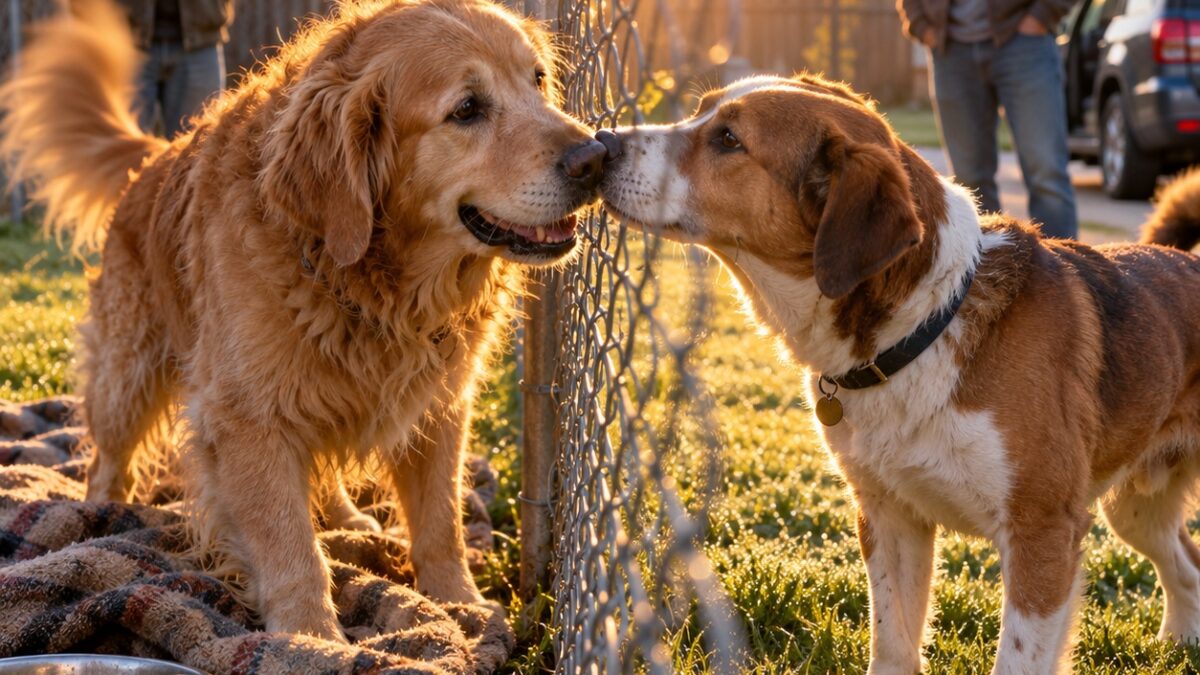
They met nose to nose through the chain links.
Sniffed.
Long.
Quiet.
Buddy’s tail moved so hard his entire back end swayed.
Rocky pressed his muzzle through the opening.
Buddy pressed his against it.
I don’t know what animals understand about absence.
I don’t know whether Buddy knew Rocky had been close to dying.
I don’t know whether Rocky knew Buddy had waited twenty-three days.
But there was recognition.
Immediate.
Complete.
You could see it.
Daniel was crying.
I was crying.
Emma and Lucas were openly sobbing.
Nobody cared.
After several minutes, Daniel looked at me.
“The gate.”
I nodded.
My hands shook while I opened it.
Buddy moved through.
I was afraid he would hit Rocky too hard in his excitement.
He didn’t.
Somehow, he knew.
He circled Rocky once.
Twice.
Tail flying.
Then slowed.
He came alongside him.
Rocky leaned.
Actually leaned his body against Buddy.
Buddy stopped.
Rocky rested his head across Buddy’s shoulder.
That was when I lost whatever control I had left.
I turned away.
Didn’t help.
Sarah was crying beside me.
Emma had both hands over her face.
Lucas whispered:
“He waited.”
Yes.
He did.
Buddy stood completely still so Rocky could rest against him.
No jumping.
No play.
No demanding.
Just presence.
After twenty-three days of waiting, Buddy finally had the thing he wanted.
His friend.
He didn’t need anything else.
Daniel knelt.
“I wasn’t sure he’d make it.”
I looked at him.
“I know.”
“He got bad.”
“I know.”
“There were nights…”
His voice broke.
I put a hand on his shoulder.
No words.
What words?
Rocky shifted.
Buddy followed every movement.
When Rocky sat, Buddy sat.
When Rocky lay down, Buddy lowered himself beside him.
Side by side.
No fence between them.
That morning, the kids brought blankets into Daniel’s yard.
Sarah brought coffee.
I brought food neither dog cared about.
We sat there for hours.
Buddy didn’t leave Rocky.
But the waiting was gone from his face.
That’s the only way I can describe it.
For three weeks, Buddy had looked beyond the fence.
Scanning.
Expecting.
Searching.
Now his eyes were soft again.
Rocky slept.
Buddy watched him.
Different kind of watching.
Not fear.
Guarding.
Company.
Home.
Rocky’s recovery continued at home.
Slow.
He tired easily.
Walked short distances.
Needed rest.
Buddy adjusted to all of it.
Their old play routine did not immediately return.
Buddy seemed to understand that too.
Instead of racing, they lay together.
Instead of chasing, Buddy walked slowly beside Rocky along the fence.
When Rocky stopped, Buddy stopped.
When Rocky slept, Buddy stayed nearby.
I watched that and thought about how shallow our understanding of friendship can be.
We think friendship is activity.
Playing.
Talking.
Laughing.
Doing things.
Sometimes friendship is simply refusing to leave while the other one heals.
Buddy had done that before Rocky even came home.
Now he did it beside him.
Within two days, Buddy’s appetite returned.
Completely.
The first morning after Rocky came home, I filled his bowl.
Buddy ate everything.
Then looked at me as if asking why breakfast was late.
I laughed.
Actually laughed out loud.
“Nice to have you back.”
His tail wagged.
Then he went to the fence.
Rocky was already there.
Weak.
Sitting.
Waiting.
Buddy lay down.
Rocky lay down on the other side.
Same position they had used for years.
Two dogs.
One fence.
Morning light.
Except everything looked different to me now.
Before, it was routine.
After those twenty-three days, it looked sacred.
Katherine came by to check Buddy.
She laughed when she saw him finish food.
“I assume our patient recovered.”
“Immediately.”
She looked through the fence.
Rocky was sleeping in the grass.
“There’s your diagnosis.”
I asked:
“Was Buddy really making himself sick?”
“Stress can do that.”
“But twenty-three days?”
She looked at me.
“You keep wanting me to tell you dogs don’t feel this deeply.”
I smiled.
“I guess.”
“They do.”
“Like us?”
“Not exactly like us.”
She watched Buddy.
“But don’t confuse different with less.”
That line stayed with me.
Don’t confuse different with less.
We do that to animals all the time.
We look at them through human categories.
If they cannot say:
I miss you.
We assume their grief is simpler.
If they cannot explain:
I’m waiting.
We call it instinct.
Maybe some of it is instinct.
But Buddy lost weight.
Refused comfort.
Changed his sleeping habits.
Ignored toys.
Watched one specific place.
Responded when told Rocky was alive.
Recovered when Rocky came home.
Whatever word you want to use, it mattered.
Rocky gained strength.
By the end of the first week home, he could walk farther.
Buddy tested him carefully.
One morning he brought the old red ball to the fence.
Dropped it.
Rocky looked.
Buddy nudged it.
Rocky stood.
Buddy picked up the ball.
Took three slow steps.
Turned.
Waited.
Rocky followed.
Not running.
Walking.
Buddy moved again.
Rocky followed.
It was the gentlest game I’d ever seen.
Lucas whispered:
“He’s teaching him how to play again.”
Maybe.
Or inviting.
That was enough.
Two weeks after Rocky came home, they ran together for the first time.
Not full speed.
Ten seconds.
Maybe fifteen.
Rocky stumbled slightly.
Buddy stopped immediately.
Went back.
Touched noses.
Then they walked.
Daniel saw.
He laughed so loudly I heard from our porch.
That became the next milestone.
Running.
The next:
Rocky barking at the mail carrier.
Daniel came outside cheering.
“I never thought I’d be happy he’s annoying.”
I raised my coffee.
“Recovery.”
The neighborhood learned the story.
People stopped us on walks.
Some had seen Buddy waiting.
Others had heard from Daniel.
One woman told me:
“I drove by every morning and he was always there.”
“Yes.”
“I thought he was guarding the yard.”
“He was waiting.”
She cried.
Buddy accepted a head scratch.
Then moved on.
He had no interest in becoming inspirational.
He wanted Rocky.
That’s all.
Our children changed too.
Emma had been deeply hurt when Buddy stopped playing with her.
After Rocky returned, she understood it differently.
One evening she sat beside me.
“Dad?”
“Yeah?”
“Buddy didn’t stop loving us.”
“No.”
“He was just worried.”
“Yes.”
“Can you love someone and still be sad about someone else?”
I looked at her.
That question was much bigger than two dogs.
“Yes.”
She nodded.
“Okay.”
Kids build emotional vocabulary from whatever life gives them.
Buddy gave her something useful.
Lucas became protective of both dogs.
If Rocky looked tired, he’d tell everyone:
“Leave him alone.”
If Buddy got too excited:
“Easy.”
He became a tiny rehabilitation supervisor.
Daniel joked he owed Lucas a salary.
Rocky eventually returned to almost everything he had done before.
Almost.
Some things changed.
He tired faster.
Certain medications continued for a while.
Daniel watched him more closely.
But joy returned.
That was what mattered.
Buddy returned fully too.
Food.
Play.
Sleeping in the house.
Stealing socks.
Running to the door.
The old red ball again became important enough to ruin family peace.
Yet one habit never changed.
Every morning, Buddy still went to the fence.
Rocky too.
Sometimes Buddy arrived first.
Sat.
Waited.
But that waiting was different.
Minutes.
Not uncertainty.
He knew Rocky would appear.
Usually within moments, Daniel’s back door opened.
Rocky came out.
They greeted.
Then sat.
On opposite sides.
Quiet.
Not because they had to.
The gate could have been opened.
We opened it often.
But they seemed to like the fence.
Maybe it was simply habit.
Maybe that was where their friendship began.
Maybe it was the place where Buddy had spent twenty-three days refusing to give up.
I don’t know.
Dogs don’t explain symbolism.
Humans do enough of that for everyone.
Some mornings, I sat beside Buddy.
Coffee in hand.
Daniel sat on Rocky’s side.
Neither of us talked much.
The dogs looked ahead.
Birds.
Cars.
Kids heading to school.
Life happening.
There was peace in it.
I thought often about those twenty-three days.
At first, I framed the story as loyalty.
Buddy wouldn’t leave.
Then hope.
He believed Rocky would return.
Then love.
All true.
But something else emerged with time.
Presence.
Buddy couldn’t go to the clinic.
Couldn’t understand medicine.
Couldn’t help Daniel.
Couldn’t make Rocky recover.
There was only one thing he could do.
Be where Rocky belonged.
So he stayed.
That is such a simple form of love that humans often miss it.
We want action.
Advice.
Fixing.
Sometimes the person you love is somewhere you cannot reach.
Sometimes all you can do is hold their place.
Buddy held Rocky’s place for twenty-three days.
Every morning.
Every night.
Through cold.
Rain.
Hunger.
Confusion.
That yard never became normal without Rocky because Buddy refused to act like it was.
I do not mean he consciously thought:
I will honor my friend by standing vigil.
Dogs are dogs.
But behavior can carry meaning even when it isn’t narrated.
I watched.
I learned.
Daniel and I became closer too.
Before Rocky got sick, we were good neighbors.
Wave.
Borrow tools.
Talk across the fence.
Afterward, something changed.
We had waited together.
He at the clinic.
Me at the fence.
Different places.
Same hope.
Once Rocky was stronger, Daniel came over with two beers.
We sat on my porch.
Dogs in the yard.
He said:
“There were two nights I thought I wasn’t bringing him home.”
I looked at him.
“He stopped responding well.”
Daniel stared at his bottle.
“The doctors wouldn’t say he was dying.”
“They never do until they have to.”
“But I could see their faces.”
I waited.
“I kept thinking about Buddy.”
That surprised me.
“Buddy?”
“He was waiting.”
Daniel’s eyes filled.
“I thought, I can’t go home without Rocky.”
I didn’t know what to say.
“Obviously I would’ve.”
He wiped his face.
“But the idea of walking into that yard…”
He looked toward the fence.
“And having Buddy see me alone.”
His voice broke.
That was the first time I understood Buddy had become part of Daniel’s fight too.
Hope can move in both directions.
We thought we were giving Buddy updates to keep him going.
Buddy’s waiting had been keeping Daniel going.
Maybe he told Rocky.
I asked.
Daniel laughed weakly.
“Every day.”
“What did you say?”
“Your idiot friend is still at the fence.”
I smiled.
“Accurate.”
“I told him Buddy wasn’t eating.”
“You guilted your sick dog into recovery?”
“Whatever works.”
We laughed.
Then both looked toward them.
Buddy had his head resting over Rocky’s back.
Daniel said:
“I don’t deserve that dog.”
“Which one?”
He thought.
“Either.”
Fair.
Rocky’s illness remained something Daniel preferred to keep private.
I respected that.
The medical details were less important to me than what I saw.
He had been close enough to losing Rocky that every ordinary day afterward felt borrowed for a while.
People who nearly lose someone often become hyperaware of time.
Daniel took more walks.
Spent longer in the yard.
Canceled fewer small pleasures because he was busy.
I did some of the same.
Buddy’s vigil changed my sense of routine.
Before, I rushed through mornings.
Feed dog.
Coffee.
Kids.
Work.
Now I noticed things.
Buddy walking toward the fence.
Rocky approaching.
Noses touching.
Tail.
Sit.
Nothing.
That nothing became one of my favorite parts of the day.
There is a danger in only valuing extraordinary moments.
Life is mostly ordinary.
If you only appreciate reunions, you miss companionship.
If you only appreciate survival after danger, you miss all the mornings before and after.
Buddy and Rocky taught me that.
Not because dogs are philosophers.
Because their lives are direct.
They don’t postpone joy for better circumstances.
Rocky did not come home and decide he needed a larger yard.
Buddy did not demand explanation for twenty-three days of waiting.
They saw each other.
That was enough.
Months passed.
The story became less raw.
Buddy regained the weight he’d lost.
Katherine stopped giving me concerned looks.
Rocky’s coat became glossy again.
His steps strengthened.
The first time he jumped into Daniel’s car by himself, Daniel called me.
“You won’t believe what he did.”
“Robbed a bank?”
“He jumped.”
“That’s less serious.”
“James.”
I laughed.
“That’s great.”
“He jumped.”
I heard the emotion.
“I know.”
Recovery turns ordinary actions into miracles.
Jump.
Eat.
Bark.
Run.
Sleep.
Come home.
The twenty-third day remained a kind of family anniversary.
Not officially.
We didn’t throw parties.
But the next year, Sarah said:
“You know what today is?”
I checked the calendar.
“No.”
“Rocky came home a year ago.”
I looked outside.
Buddy and Rocky were at the fence.
Of course.
I went out with coffee.
Daniel came out too.
“Sarah remembered.”
He nodded.
“So did I.”
We stood.
The dogs ignored us.
Good.
We didn’t need ceremony.
Them sitting there was ceremony enough.
Years went by.
Both dogs aged.
Golden fur around Buddy’s face turned pale.
Rocky moved slower.
Their games shortened.
The fence ritual remained.
Morning.
Buddy.
Rocky.
Sit.
Some days they slept with noses near the links.
Other days watched squirrels.
Once a rabbit ran through both yards and they attempted to chase it.
Attempted.
Age had opinions.
Buddy stopped after ten yards and looked personally betrayed by his own legs.
Rocky didn’t even pretend.
Daniel and I laughed until both dogs looked offended.
Friendship changes with age too.
Young friendship is running.
Old friendship is resting together.
Neither is less.
My kids grew.
Emma became a teenager.
Lucas nearly as tall as me.
Their relationship with Buddy changed.
He could no longer chase them for hours.
They adjusted.
Gentler walks.
More floor time.
Emma studied outside near the fence.
Buddy lay beside her.
Rocky on the other side.
Sometimes I saw the three of them and thought about Emma at nine asking whether Buddy loved Rocky more than her.
She understood now.
Love doesn’t divide so neatly.
It multiplies through attachment.
One afternoon, Emma asked:
“Do you think Buddy remembers those twenty-three days?”
“I don’t know.”
“Really?”
“No idea.”
“He must.”
“Maybe.”
She looked at Rocky.
“I think he does.”
“Why?”
“Because he checks.”
“What?”
“Every morning.”
I looked at Buddy.
“He always looks until Rocky comes out.”
She was right.
Even years later, Buddy arrived at the fence and scanned the other yard until Rocky appeared.
Then his body relaxed.
Maybe it was habit.
Maybe memory.
Maybe friendship is partly the habit of making sure someone is still there.
That idea stayed with me.
I had begun doing the same thing with people.
Calling my parents more.
Checking on Daniel.
Noticing when Sarah seemed tired.
Asking the kids real questions instead of only logistical ones.
You okay?
Not:
Homework done?
Buddy had waited because he couldn’t know Rocky was safe.
Humans often have the ability to check and still don’t.
That seemed foolish afterward.
Daniel once joked:
“Your dog made us all emotionally needy.”
“Your dog started it.”
“Rocky was unconscious.”
“Convenient excuse.”
We laughed.
There was relief in being able to joke.
The story no longer belonged to fear.
It belonged to what came after.
People online eventually heard about Buddy.
Someone had seen him waiting.
A neighbor shared a photograph.
Golden retriever at chain-link fence.
Empty yard beyond.
It spread locally.
I disliked some of the captions.
“Dog refuses to believe best friend is dead.”
Rocky wasn’t dead.
“Golden retriever waits without food for a month.”
Not accurate.
Twenty-three days.
He ate some.
Human storytelling loves exaggeration.
The truth was enough for me.
A dog saw his friend carried away.
Waited at the last place he knew that friend belonged.
Nearly stopped eating.
Stayed through three weeks.
Then heard a car.
Ran.
Saw Rocky.
Came back to life.
Why embellish?
The truth already hurts.
And heals.
I did agree to tell the story because Katherine said something.
“People underestimate grief in animals.”
She thought Buddy’s experience might help others understand.
So I talked about it.
Not as proof dogs think exactly like humans.
They don’t.
As proof that attachment has consequences.
If two animals build a bond, separation matters.
Routine matters.
Loss matters.
Reunion matters.
Owners should pay attention.
That was useful.
I received messages from people whose dogs had grieved.
A Labrador after another dog died.
A cat waiting near a bedroom door after an owner went into hospital.
A horse calling after a companion was moved.
Different species.
Same theme.
Where did they go?
Are they coming back?
I stopped thinking Buddy was unusually sentimental.
Maybe he was simply unusually visible.
Most animals don’t have a chain-link fence framing their grief for humans to watch.
That fence became part of the story.
At first, it frustrated me.
Barrier.
Buddy could see Rocky’s yard but not enter.
Rocky could see Buddy but not cross until we opened the gate.
Later, I thought differently.
The fence was where their friendship formed.
Where Buddy waited.
Where they reunited first.
Where they returned every morning.
A barrier became a meeting place.
Life does strange things with objects.
A fence can separate.
A fence can also mark:
I’ll meet you here.
One winter morning, snow covered both yards.
Buddy walked to the fence slowly.
Rocky wasn’t there.
Buddy waited.
Five minutes.
Ten.
I felt old fear return instantly.
Ridiculous how memory works.
I called Daniel.
No answer.
Buddy stood.
Waited.
Then Daniel opened the back door.
Rocky emerged wearing a ridiculous blue coat.
I laughed with relief.
Buddy’s tail wagged.
Daniel shouted:
“Sorry! He hates the coat.”
I called back:
“He looks humiliated.”
“He’s warm.”
Rocky walked to the fence with the expression of a dog reconsidering friendship with humans.
Buddy sniffed the coat.
Then sneezed.
Daniel said:
“See? Judgment.”
We laughed.
The fear passed.
But that morning showed me something.
Twenty-three days had changed me too.
If Rocky was late, I noticed.
If Buddy didn’t eat immediately, I watched.
Love leaves vigilance behind.
Usually it softens.
Sometimes never completely.
That is true for people too.
Near-loss makes ordinary delays louder.
You learn eventually not to panic.
But part of you remembers.
Buddy’s story wasn’t only happiness.
Waiting had cost him.
His body had suffered.
His sleep.
Appetite.
Energy.
I sometimes wondered whether we should have forced him indoors more.
Katherine said:
“You did what you could.”
“But he lost weight.”
“He was being monitored.”
“Should I have moved him?”
She looked at me.
“Would he have rested inside?”
Probably not.
“He would’ve paced.”
“Probably.”
“Scratched at doors.”
“Yes.”
“Sometimes reducing distress means allowing safe forms of what the animal is trying to do.”
“Wait.”
“Yes.”
She smiled.
“You gave him water.”
“Food.”
“Shelter.”
“Company.”
“And the fence.”
I had never thought of the fence as care.
Maybe it was.
We let him stay where hope made sense.
That’s what he needed.
Rocky lived many good years after that illness.
I want that clear.
He was not fragile forever.
Within months, if you’d met him without knowing the story, you would not have guessed how close everything had come.
He chased.
Barked.
Stole food.
Once dug under part of the fence and appeared in our yard uninvited.
Buddy reacted as though Rocky had accomplished a military breakthrough.
Daniel came over.
“He escaped.”
Buddy and Rocky were running circles.
“Technically, he immigrated.”
Daniel pointed.
“Your dog encouraged him.”
“No evidence.”
We repaired the hole.
Rocky looked offended.
For two days, Buddy sniffed that section as if plotting.
Those moments mattered.
Because recovery is not merely survival.
It is getting enough life back to cause trouble again.
Rocky did.
Buddy happily joined.
The red ball eventually fell apart.
Years of use.
Mud.
Teeth.
One day it split.
Lucas wanted to throw it away.
Buddy stood beside the trash can staring.
Lucas took it back out.
“Fine.”
We bought a new red ball.
Buddy ignored it for three days.
Then accepted it reluctantly.
Rocky liked the new one immediately.
Traitor.
Buddy eventually shared.
That’s friendship too.
Even after twenty-three days of epic loyalty, they could still fight over a ball.
Good.
I didn’t want them becoming symbols to the point we forgot they were dogs.
They were messy.
Jealous.
Joyful.
Annoying.
Hungry.
Loving.
Alive.
That’s better than symbolism.
Daniel became family in the way neighbors sometimes do when enough life happens across a property line.
Cookouts.
Birthdays.
Holidays.
Dog emergencies.
Borrowed tools.
The fence gate stayed unlocked most days.
Buddy and Rocky still preferred meeting through the chain links first.
Then one would look toward us.
Open it.
That became the signal.
I swear.
Maybe projection.
Still.
We opened.
They played.
As years passed, both dogs’ faces grayed.
We talked less about the twenty-three days.
Not forgotten.
Integrated.
The story didn’t need retelling constantly.
It lived in our habits.
Checking.
Showing up.
The kids knowing Daniel could enter our yard without asking if something was wrong.
Us knowing the same.
One animal friendship strengthened two human households.
That feels sentimental.
It is also fact.
Before Rocky’s illness, Daniel and I were neighbors.
After, we were people who had cried together over the same two dogs.
You don’t go back from that.
One summer night, power went out across the neighborhood.
Hot.
No air conditioning.
Everyone came outside.
Buddy and Rocky lay beside the fence.
Daniel brought beer.
Kids complained about Wi-Fi.
Sarah lit candles.
I remember thinking:
This is the kind of night I’d once have considered inconvenient.
Now it felt good.
Everybody present.
Nothing urgent.
The dogs breathing slowly.
Normal life.
Again.
The greatest gift after fear.
Normal life.
Buddy taught me that waiting can be an act.
Rocky taught me returning can be one too.
And both of them taught me reunion is not valuable only because separation hurt.
It’s valuable because presence had mattered all along.
You don’t miss someone deeply unless having them there changed your days.
That’s what friendship does.
It quietly builds itself into routines until absence reveals how much structure it provided.
Morning fence.
Run.
Rest.
Repeat.
Take one away and the whole day changes shape.
Buddy showed us that.
When people asked what the most moving part had been, they expected me to say the reunion.
It was.
Of course.
Buddy barking.
Rocky stepping from the car.
Heads meeting through the fence.
Rocky resting on Buddy’s shoulder.
I’ll never forget it.
But another image stays almost as strongly.
Day seventeen.
Cold evening.
Buddy lying under the canopy.
Blanket beneath him.
I sat beside him.
No good news that day.
No major decline either.
Just waiting.
I put my hand on his back.
Buddy exhaled.
Kept watching.
There was nothing dramatic.
Yet now I think that image says more about love than the reunion.
Anyone can celebrate when the person returns.
Love is what you do on day seventeen when you still don’t know if they will.
You stay.
Buddy stayed.
We stayed with him.
Maybe that’s why the reunion felt so powerful.
It had been earned through waiting.
Years later, Emma wrote a school essay about Buddy and Rocky.
She didn’t tell me beforehand.
Her teacher sent a copy.
The title:
THE FRIEND WHO WAITED.
At the end, Emma wrote:
“When Buddy stopped playing with me, I thought it meant he loved Rocky more. Later I learned love does not leave one person when it goes to another. Sometimes love makes room.”
I read that sentence twice.
Then again.
Emma came home.
I held up the essay.
“You wrote this?”
She looked embarrassed.
“It was an assignment.”
“This is good.”
“Dad.”
“No, really.”
“Please stop.”
So naturally, I read the line aloud at dinner.
She threatened to move out.
Parenting.
But she had captured what I had struggled to explain years earlier.
Love makes room.
Buddy’s grief for Rocky did not reduce his love for us.
His world was large enough for both.
When one piece disappeared, the whole thing hurt.
That’s not competition.
That’s attachment.
Lucas had his own interpretation.
“Buddy’s just stubborn.”
Also true.
Golden retrievers are underrated in stubbornness.
Rocky’s veterinarian once called Buddy “emotionally committed.”
I said:
“That’s the professional term?”
She smiled.
“Today it is.”
Twenty-three days.
That number became shorthand.
If one of us complained about waiting:
“Buddy waited twenty-three days.”
Traffic jam?
“Not Buddy-level.”
Delayed package?
“Not Buddy-level.”
Daniel waiting for a contractor?
“Seventeen days.”
“Still not Buddy.”
We overused the joke.
Buddy deserved royalties.
He received treats.
Acceptable.
As both dogs entered old age, I became more conscious that every friendship eventually meets another kind of separation.
I hated that thought.
Avoided it.
Then accepted that avoiding it wasted the days we had.
Buddy and Rocky didn’t worry about future grief.
Again, as far as I knew.
They lived morning by morning.
So I tried to copy them.
Don’t borrow tomorrow’s pain.
Sit by the fence today.
That became one of the quiet lessons.
We humans rehearse loss constantly.
What will happen?
How will I manage?
What if?
Dogs often seem better at inhabiting what is still here.
Buddy had waited desperately when Rocky vanished.
But once Rocky returned, Buddy didn’t spend years acting afraid he would disappear again.
He went back to playing.
Eating.
Sleeping.
Living.
Maybe the waiting taught him what mattered.
Or maybe dogs are simply wiser about time.
One afternoon, Rocky was late to the fence again.
Buddy sat.
Waited.
I felt that old tension.
Then I stopped myself.
Sat beside him.
No phone call.
No panic.
Five minutes later, Rocky appeared.
Buddy wagged.
I smiled.
The moment passed.
Trust.
That’s what had returned after the twenty-three days.
Not certainty.
Trust.
Rocky comes back.
Until one day, inevitably, someone doesn’t.
But you don’t ruin every morning because of that future.
You enjoy the morning.
That may be the hardest lesson.
I still sit beside Buddy sometimes near the fence.
Coffee.
Same patch of yard.
Same chain links.
Buddy older now.
Rocky older too.
They don’t run much.
Mostly sit.
Sometimes Buddy looks at Rocky.
Rocky looks back.
Then both look ahead.
I used to wonder what they were thinking.
I don’t anymore.
Maybe nothing.
Maybe everything.
It doesn’t matter.
They are there.
Together.
That’s enough.
If you ask me what those twenty-three days taught me, I could give you the sentimental answers.
Love knows no fence.
Friendship survives distance.
Hope endures.
All true.
But the deepest lesson was simpler.
Presence matters.
So much that absence can change appetite.
Sleep.
Behavior.
The shape of a day.
And when presence returns, the body recognizes it before language could ever explain.
Buddy heard the car.
Rocky saw Buddy.
Everything else disappeared.
No speeches.
No promises.
No explanation for where Rocky had been.
Just:
You’re here.
I’m here.
That is the oldest kind of joy.
I think about Daniel getting out of that car often.
How tired he looked.
How carefully he carried Rocky.
How Buddy’s entire body came alive.
For twenty-three days, Buddy had looked at an empty yard and refused to accept it as final.
Then one morning, it wasn’t empty anymore.
Maybe that’s why hope matters.
Not because hope guarantees an outcome.
It doesn’t.
We could have lost Rocky.
Buddy’s waiting could have ended differently.
Hope is not a contract with life.
It’s simply the decision that while the outcome is unknown, love will remain present.
Buddy did that.
If Rocky had not returned, Buddy’s loyalty would still have been real.
The happy ending does not create the love.
It reveals it.
We got lucky.
Rocky came home.
Buddy recovered.
Two dogs returned to their fence.
And my family received one of those rare endings that feels almost too generous.
I am grateful for it.
Not entitled to it.
Grateful.
Every morning I still see them.
Buddy walks out.
Rocky appears.
Noses near the wire.
Then they settle.
Sometimes I join Buddy.
Daniel joins Rocky.
Four old friends now.
Two human.
Two canine.
Separated by a fence we could easily walk around.
Funny.
The object that once looked cruel to me now feels like part of the friendship.
It held Buddy back from following the stretcher.
It held him in place while he waited.
It framed the reunion.
Now it simply sits between two dogs who don’t seem bothered by it at all.
Because love does not require every barrier to disappear.
Sometimes it just finds a way to meet through them.
That’s what Buddy did.
That’s what Rocky did.
For twenty-three days, Buddy didn’t know whether his friend would return.
He stayed anyway.
Rocky fought through whatever his body was fighting and eventually came home.
When he did, they didn’t need anyone to explain what had happened.
They smelled each other through the fence.
Pressed closer.
Then, once the gate opened, stood together until Rocky rested his head on Buddy’s shoulder.
That image will stay with me for the rest of my life.
Not because it was dramatic.
Because it was honest.
I missed you.
You’re back.
I’m still here.
Sometimes that is everything friendship needs to say.
My name is James.
I’m Buddy’s owner.
Though after those twenty-three days, “owner” seems like a small word for a relationship that taught me so much.
I thought I was taking care of Buddy.
Feeding him.
Sheltering him.
Keeping him healthy.
But while I watched him wait, he taught me what devotion looks like when there is nothing useful left to do except remain.
He taught my children that grief does not cancel love.
He taught Daniel that someone was waiting on the other side of the crisis.
And Rocky, by coming home, gave all of us something we had nearly stopped allowing ourselves to expect.
Relief.
Joy.
Ordinary life.
So when people ask me whether dogs really understand friendship, I don’t argue.
I don’t cite studies.
I don’t try to explain animal psychology.
I tell them about a golden retriever who watched his best friend leave on a stretcher and then spent twenty-three days beside a chain-link fence.
I tell them how food stopped mattering.
How the red ball stopped mattering.
How the cold didn’t matter enough to make him leave.
How he listened every time I said Rocky was still fighting.
And how, before anyone in our house knew what was happening, Buddy heard that car on the twenty-third morning and began barking with joy.
Then I tell them about Rocky stepping out.
Weak.
Thin.
Alive.
And two dogs meeting at a fence as though the three missing weeks collapsed into one second.
You don’t have to call that love.
You can call it attachment.
Bonding.
Routine.
Recognition.
Instinct.
Use whatever word makes you comfortable.
Buddy didn’t care about the word.
He just waited.
Rocky came back.
And from that morning forward, every quiet moment they spent together felt like something neither of them took for granted.
Neither did I.
The greatest miracle wasn’t that Rocky survived.
Though that was a miracle to us.
It wasn’t that Buddy waited.
Though I still can’t fully explain the depth of it.
The greatest miracle was what happened afterward.
Nothing.
Nothing dramatic.
Breakfast.
Sunlight.
Two dogs near a fence.
Kids playing.
Neighbors talking.
Rocky getting stronger.
Buddy gaining weight.
Ordinary days returning one at a time.
Because after you’ve spent twenty-three days afraid normal may never come back, normal becomes beautiful.
That’s what I see when I look at them now.
Not the stretcher.
Not the empty yard.
Not Buddy refusing food.
I see two old friends sitting quietly on opposite sides of a fence.
No longer waiting.
Just being there.
And maybe that is what all of us are trying to find in the end.
Someone whose presence makes the world feel right.
Someone worth waiting for.
Someone who, when they finally come back into view, doesn’t need to explain a thing.
You’re here.
I’m here.
That’s enough.








