PART2:Lulu Came to a Stranger’s Door With a Belly So Swollen She Could Barely Stand—Six Weeks Later, the Vet Called Us Back Into the Room
PART2
We carried Lulu into the vehicle as gently as we could.
She made no sound.
That frightened me.
Dogs in pain often communicate somehow. They pant, whine, resist, turn their heads, pull away.
Lulu seemed to have moved beyond protest.
She lay on the blanket and watched us with wide, uncertain eyes while the vehicle started moving.
I sat near her, leaving enough space that she did not feel surrounded.
Every bump in the road made her body tense.
Her abdomen rose and fell with each breath.
The swelling made breathing look like work.
I wanted to stroke her.
I did not.
Trust is not something you take simply because an animal is too weak to stop you.
So I kept my hand near her without touching and talked quietly.
“You’re going somewhere warm.”
Her eyes flicked toward me.
“There are people there who know what to do.”
I hoped that was true.
At the veterinary center, the team was waiting.
The moment the veterinarian saw Lulu’s abdomen, his expression changed.
Not panic.
Veterinarians become good at hiding that.
But focus.
Immediate, serious focus.
They weighed her.
Checked her temperature.
Listened to her chest.
Examined her gums.
Ran careful hands over a body where almost every bone seemed too easy to feel.
Then they turned their attention to the abdomen.
The first ultrasound confirmed what we feared.
There was fluid inside.
A lot of it.
Ascites.
The word itself sounded almost harmless.
The reality was not.
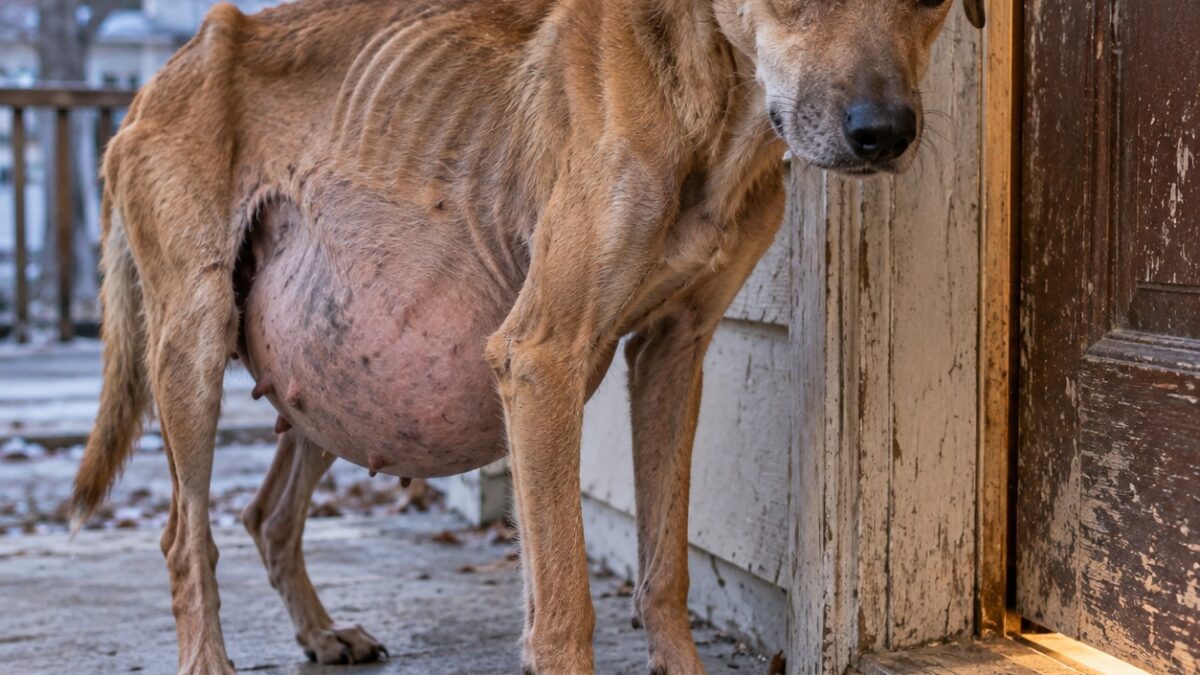
Fluid was accumulating inside Lulu’s abdominal cavity and creating the enormous swelling we had seen from the street.
The veterinarian explained that the fluid was not the disease.
It was evidence that something deeper was wrong.
Possibly the liver.
Possibly protein loss.
Possibly another major organ problem.
Possibly several things at once.
Blood was drawn.
Samples taken.
Liver values.
Kidney function.
Protein levels.
Blood counts.
Everything that might help build a picture.
Meanwhile Lulu lay on the examination table and let strangers handle her because she had no other choice.
I stood near her head.
At one point her eyes met mine.
There was no trust there yet.
Only exhaustion.
I placed my fingertips lightly on the edge of the blanket.
Not on her.
Just close.
“I’m here.”
The veterinarian eventually told us that some of the abdominal fluid needed to be drained because the pressure itself was making Lulu uncomfortable.
The procedure would not solve the underlying cause.
It would only relieve part of what her body was carrying.
But comfort mattered.
So they did it.
I watched the container slowly fill.
More fluid than I wanted to believe had been inside that small dog.
As the pressure reduced, Lulu’s breathing became easier.
Her abdomen remained abnormal, but less terrifying.
For the first time since we found her, she lowered her head and seemed able to rest without every breath fighting against the weight inside her.
I should have felt relieved.
Instead, I felt dread.
Because now I understood that the swollen belly we had seen was only the visible part of the problem.
The real danger was still hidden.
We had to wait for answers.
Waiting in veterinary medicine is its own kind of torture.
You know enough to understand the situation is serious but not enough to know what can be done.
So you begin bargaining with possibilities.
Maybe the liver values will be elevated but manageable.
Maybe it is an infection.
Maybe malnutrition caused changes that can reverse once she eats.
Maybe this.
Maybe that.
Hope can become a form of self-defense.
That first night, Lulu stayed at the clinic.
She needed monitoring.
Her nutritional state was poor enough that feeding had to be managed carefully.
People sometimes see a starving dog and think the solution is obvious.
Fill the bowl.
Let her eat everything.
But a severely malnourished body is not a simple empty container.
The veterinary team planned her meals with care.
Small amounts.
Appropriate nutrition.
Observation.
Lulu sniffed the first bowl.
Looked toward the doorway.
Looked at us.
Then ate a little.
Only a little.
The fact that she ate anything became our first good piece of news.
I went home late.
I could still see her eyes.
Every time I closed mine, there she was standing on that road, wanting to run but physically unable.
I wondered where she had slept before the stranger found her.
I wondered how many days she had carried that abdomen.
I wondered whether she had once belonged to someone.
Then I stopped myself.
We did not know.
And Lulu’s real suffering was already enough.
I did not need to invent more.
The next morning, the veterinarian called.
I returned as quickly as I could.
When I entered, Lulu raised her head.
Just slightly.
I smiled.
“Hi.”
No tail movement.
No excitement.
Still, she had noticed me.
That felt like something.
The veterinarian brought the test results.
He did not sit immediately.
That told me enough.
“How bad?”
I asked.
He looked at Lulu.
Then back at me.
“Her liver is in very poor condition.”
I felt my stomach drop.
“What does that mean?”
“We’re seeing severe liver failure.”
The room seemed suddenly too quiet.
I looked at the small dog on the blanket.
“How severe?”
He paused.
“Advanced.”
“Can you treat it?”
“We can support her.”
“That wasn’t what I asked.”
I regret how sharply I said it.
He didn’t react.
He was used to people asking for different answers than medicine could give.
“We can manage symptoms,” he said. “Support nutrition. Monitor her. Treat anything contributing that we can identify. But the structural damage appears significant.”
“Can the liver recover?”
“The liver can sometimes regenerate remarkably well.”
Hope.
Then his next sentence took it back.
“But from what we’re seeing right now, I would not promise that here.”
I stared at him.
“So you think it’s irreversible?”
“I think we have to prepare for that possibility.”
Possibility.
Another medical word designed to make terrible things fit into sentences.
I walked to Lulu.
She watched me.
The dog had finally stopped running.
Finally allowed people to help.
And we were discovering she might have arrived only in time to be comfortable while dying.
That felt unbearably unfair.
I sat beside her.
She turned her head away.
I let her.
The plan changed.
This was no longer simply rescue followed by recovery.
Now we were balancing treatment with comfort.
Carefully managed meals.
Medication as directed.
Monitoring the abdominal fluid.
Watching her liver values.
Keeping her warm.
Keeping stress low.
And, if possible, finding her a foster home.
That became my obsession.
The clinic was excellent.
But it was still a clinic.
Lights.
Doors.
Other animals.
Procedures.
People coming and going.
If Lulu had limited time, I wanted that time to include something softer.
A quiet house.
A rug.
Maybe sunlight.
Someone sitting nearby.
A place where she could sleep without hearing medical equipment.
We posted.
Called.
Asked.
Explained her condition honestly.
Lulu needs a foster.
Severe liver failure.
Medical management required.
Uncertain prognosis.
Possibly limited time.
We did not hide anything.
And nobody came.
The first person who asked questions eventually said they could not handle the medical uncertainty.
I understood.
Another had other dogs and worried about stress.
Understandable.
Someone else worked too many hours.
Another person wanted to help but lived too far from the veterinary center.
Again and again, reasonable answers.
Yet each one felt like another door closing in front of Lulu.
She had already stood at one stranger’s door asking for something she could not explain.
Now we were asking doors to open for her.
None did.
So Lulu remained at the clinic.
The first week, she still flinched when hands approached.
Every meal was a negotiation.
Someone would place the bowl down.
Step back.
Wait.
Lulu watched.
Then ate.
If a person moved too close, she stopped.
So we learned.
No pressure.
No reaching simply because we wanted affection.
No forcing her to experience human kindness on our schedule.
Food.
Medication.
Distance.
Repeat.
The second week, a technician discovered Lulu tolerated her sitting on the floor nearby.
Not touching.
Just sitting.
The technician began doing paperwork there when she had time.
Lulu watched her.
Day after day.
One afternoon the technician shifted closer.
Lulu did not move away.
That became news.
“She let me sit beside her.”
Not exactly the kind of sentence most people would celebrate.
We did.
Because when your starting point is terror, proximity matters.
The medical picture remained poor.
Some days Lulu ate better.
Some days she did not.
The abdominal fluid threatened to return.
Her liver values remained deeply concerning.
Every time the veterinarian reviewed results, I searched his face for a change.
Usually there wasn’t one.
“Still serious.”
“How serious?”
“Very.”
“Any improvement?”
“Nothing I’d call significant yet.”
Yet.
I grabbed that word and carried it for days.
Lulu began learning our voices.
I know that because her responses changed.
If an unfamiliar person entered, her head lifted sharply.
Body tense.
If one of the people who fed her regularly entered, she stayed softer.
Still cautious.
But not ready to flee.
One afternoon I brought her meal.
Set it down.
Instead of leaving immediately, I sat several feet away.
She stared at the bowl.
Then me.
I looked at the floor.
Eventually I heard chewing.
I did not move.
Lulu ate while I remained in the room.
That was the first time.
When she finished, I whispered:
“Thank you.”
Ridiculous.
She had eaten her own meal.
But trust can make you grateful for things nobody owes you.
The third week, her body seemed slightly more stable.
Not healed.
Not even close.
But the constant feeling that she might collapse at any moment eased a little.
Her nutritional support was helping her maintain more strength.
She could stand longer.
Walk a few careful steps.
Her abdomen remained something we watched closely.
The liver remained the problem no amount of affection could fix.
I learned an important lesson during those weeks.
Love is not medicine.
It helps.
Comfort helps.
Low stress helps.
Good care matters enormously.
But liver failure does not disappear because people care enough.
We needed the veterinary team.
Bloodwork.
Scans.
Medication.
Clinical judgment.
And even with all of that, nothing was guaranteed.
I hated that reality.
Maybe because by then I had started loving her.
Lulu still would not allow anything I would call cuddling.
That didn’t matter.
Love does not require the recipient to perform affection back.
I loved watching her eat.
I loved seeing her lift her head when I entered.
I loved knowing she had slept through part of a night instead of remaining alert.
That was enough.
At the end of the third week, Lulu surprised us.
A caregiver sat beside her bed.
Lulu shifted.
Not away.
Toward her.
Only a few inches.
Then she lowered her head again.
The caregiver did not touch her.
Perfect.
The next day, Lulu moved closer again.
Eventually, she allowed fingers to rest lightly along the side of her neck.
Her body tensed.
Then softened.
One second.
Two.
Three.
The hand withdrew.
Lulu watched it go.
After weeks of veterinary handling, injections, examinations and procedures, she was beginning to discover a different category of touch.
Touch that wanted nothing from her.
No needle.
No restraint.
No examination.
Just contact.
The fourth week was emotionally strange.
The clinic staff had stopped talking about Lulu as though she were temporary.
Her bed had a place.
Her bowls had a place.
People knew her meal schedule without checking.
Someone had brought a softer blanket.
Another person brought a small toy even though Lulu had shown no interest in toys.
“She might eventually.”
They said.
Eventually.
There was that dangerous word again.
We still did not know if Lulu had an eventually.
Her liver values remained severe.
The veterinarian remained cautious.
One afternoon, I asked him directly:
“If she were your dog, would you still be hoping for recovery?”
He was quiet.
Finally he said:
“I’d hope for comfort.”
That answer broke me more than if he had simply said no.
Comfort.
Not recovery.
I nodded.
Went into Lulu’s area.
She looked up.
I sat.
For several minutes, I said nothing.
Then:
“You know what?”
Her ear moved.
“You don’t know what he just said.”
She blinked.
“And I’m not telling you.”
I smiled despite myself.
“You eat your dinner.”
Lulu lowered her head again.
Animals do not live inside prognoses the way humans do.
They live inside the day.
Pain.
Relief.
Hunger.
Safety.
Fear.
Rest.
Maybe I needed to learn from her.
So I stopped asking every morning whether today was the beginning of recovery.
Instead:
Did she eat?
Was she comfortable?
Did she sleep?
Was she breathing easily?
Did she want company?
Today.
That became enough.
By week five, something subtle changed.
Lulu started standing when certain caregivers arrived.
Not every time.
But enough that we noticed.
Her tail did not wag broadly.
Sometimes just a small movement.
But the first time I saw it, I froze.
“Did you see that?”
A technician laughed.
“Yes.”
“No, really.”
“I saw it.”
Lulu looked between us, suspicious of the attention.
I looked away.
“Nothing happened.”
The technician played along.
“Absolutely nothing.”
Tail again.
There is something painfully beautiful about watching a dog rediscover behavior unrelated to survival.
Tail wagging is not necessary for staying alive.
Neither is leaning into a hand.
Neither is curiosity.
Those things appear when enough fear has loosened its grip to let personality through.
The dog at the stranger’s door had been all fear and sickness.
Week-five Lulu had preferences.
She preferred one side of the bed.
She disliked cold food.
She accepted certain people more quickly.
She liked gentle scratching near the shoulder.
And she had learned that if she stared long enough while someone prepared meals, food eventually appeared.
Excellent.
Manipulation is progress.
Her medical condition still shadowed all of it.
No one forgot.
The abdomen was monitored constantly.
Her weight had to be interpreted carefully because fluid could distort the number.
Blood tests continued.
The liver remained deeply compromised.
Some days the values shifted slightly.
Not enough to call recovery.
But not always worse.
That mattered.
“Stable?”
I asked after one test.
“For now.”
I smiled.
I would take it.
The foster search was still going.
No home.
No person saying:
Bring her here.
I felt guilty about that.
Then one of the nurses told me something I needed to hear.
“She doesn’t know this isn’t a home.”
I looked around.
Veterinary center.
Staff.
Blankets.
Dogs barking somewhere down the hall.
“What do you mean?”
“She knows she eats here.”
The nurse adjusted Lulu’s blanket.
“She knows we come back.”
Lulu watched her.
“She knows nobody is chasing her.”
That stopped me.
Maybe I had become so focused on giving Lulu the perfect final chapter that I had failed to see what we had already given her.
Predictability.
Protection.
Food.
Warmth.
Names.
People who noticed when she seemed uncomfortable.
People who sat beside her.
Maybe home begins there.
Not architecture.
Pattern.
The sixth week began quietly.
Nothing dramatic.
Lulu ate breakfast.
Took her medication.
Walked farther down the hall than she normally did.
One technician joked that she had discovered the clinic contained more rooms than her own.
Her abdomen looked different.
I noticed it, but did not trust myself.
“Is she less swollen?”
I asked.
The technician shrugged.
“Maybe.”
Maybe.
We had learned not to celebrate maybes.
Later that week, Lulu stepped onto a scale.
Her weight distribution looked different.
Her body remained thin, but the abdomen was not filling as aggressively as before.
The veterinary team repeated bloodwork.
Routine monitoring.
I tried not to think about it.
The next day, I received a call.
“Can you come in?”
My first thought was terrible.
Something happened.
“Is Lulu okay?”
“She’s okay.”
“Then what?”
“Just come.”
Nobody says “just come” in rescue without making your heart misbehave.
I drove faster than I should have.
When I arrived, Lulu was lying on her blanket.
Alive.
Alert.
I exhaled.
The veterinarian stood near the doorway holding papers.
“What happened?”
He looked at Lulu.
Then me.
“I want to rerun something.”
“What?”
“Her liver panel.”
“Why?”
He handed me the results.
I stared at numbers I only partly understood.
“Tell me.”
He pointed.
“These are better.”
I looked at him.
“Better how?”
“Not normal.”
My heart immediately protected itself.
“Okay.”
“But better.”
“How much?”
“Enough that I don’t want to dismiss it.”
The room became very still.
I looked at Lulu.
She licked one paw.
Completely uninterested in our emotional crisis.
“Could it be a lab error?”
“That’s why I want to repeat it.”
We did.
More blood.
Lulu tolerated it with the offended expression of an animal who had begun believing she deserved fewer needles.
Fair.
Then we waited.
Hours.
The repeat came back.
Improved again.
Not normal.
Not magically cured.
But undeniably moving in the correct direction.
The veterinarian ordered additional imaging.
We were cautious.
Every person in that clinic had spent six weeks training themselves not to imagine recovery.
Now hope felt dangerous.
The scan showed something we had not expected to be able to say.
Lulu’s liver was still damaged.
But her body appeared to be responding.
Inflammation had decreased.
Fluid accumulation was slowing.
Some function was improving.
I kept asking the same question in different forms.
“Are you saying her liver is recovering?”
The veterinarian chose his words carefully.
“I’m saying I am no longer comfortable telling you there is no meaningful recovery happening.”
I stared.
“That sounds very veterinarian.”
He smiled for the first time.
“Yes.”
“What does it mean?”
“It means we keep going.”
I sat down beside Lulu.
She lifted her head.
Six weeks.
Six weeks we had fed her as though each meal might be one of a limited number.
Six weeks people had touched her gently while preparing themselves to lose her.
Six weeks without a foster.
Six weeks inside a clinic because no home had opened.
And now?
Not cured.
Not safe forever.
But her body was doing something none of us had expected.
Fighting back.
I cried.
Of course.
Lulu stared at me.
Then did something almost insulting in its normality.
She yawned.
Everyone laughed.
The tension broke.
“Fine.”
I wiped my face.
“You’re unimpressed.”
Lulu lowered her head.
That afternoon, the clinic felt different.
Nothing medical had become simple.
Her liver needed continued monitoring.
Nutrition remained critical.
Medication remained important.
The abdominal fluid could still return.
The vet warned us repeatedly:
“This is not the finish line.”
We understood.
But it was no longer a hospice story by default.
There was a path ahead.
A narrow one.
Uncertain.
But a path.
The following week, Lulu ate with an appetite we had never seen before.
Not recklessly.
Her meals remained medically managed.
But she came to the bowl eagerly.
That mattered.
Energy returned slowly.
She began walking the full length of the corridor.
At first, someone followed close behind.
Not because she needed help every step.
Because nobody trusted the miracle yet.
One morning Lulu reached the clinic reception area.
Stopped.
Looked through the glass door.
I stood behind her.
Months earlier, she had stood outside someone else’s door.
Terrified.
Now she was inside looking out.
I wondered whether she remembered.
Probably not as a story.
But bodies remember patterns.
Outside once meant danger.
Inside now meant safety.
She turned.
Walked back toward us.
Tail moving.
That moment stayed with me.
She chose the people.
Week eight.
More bloodwork.
Improvement held.
The veterinarian’s caution remained, but the language changed.
Instead of:
We are keeping her comfortable.
Now:
We are trying to support continued recovery.
Words matter.
Lulu gained real body weight as the abnormal fluid decreased.
Her spine became less severe beneath my hand.
Muscle started returning to her legs.
The huge contrast between skeletal chest and swollen belly slowly softened.
She began looking like a dog instead of a medical contradiction.
The clinic toy that had sat untouched for weeks finally became relevant.
It was a small soft thing someone had left near her bed.
One afternoon, Lulu sniffed it.
Nudged it.
Walked away.
That alone caused three people to react.
The next day, she put it in her mouth.
For approximately two seconds.
I laughed.
“She’s playing.”
“She picked something up.”
“That counts.”
Everything counted.
A week later, she carried it several feet.
Lulu had gone from barely standing on the road to voluntarily spending energy on something pointless.
Play is gloriously pointless.
That is why rescuers love it.
Survival does not play.
Safety does.
The foster request remained posted, but the situation had changed.
People who had been afraid to take a dying dog now asked whether Lulu might recover enough for adoption.
I had mixed feelings.
Part of me was happy.
Another part was angry.
She had deserved a home before the good prognosis too.
But I understood human limits.
Not everyone can emotionally or financially manage end-of-life fostering.
The important thing was that Lulu now had possibilities.
Then something happened that none of us had planned.
One of the clinic caregivers—the same woman who had spent so many hours sitting beside Lulu before Lulu allowed touch—asked to speak to us.
She looked nervous.
“I want to take her home.”
I stared.
“As a foster?”
She hesitated.
“At first.”
I understood the unspoken second half.
Maybe more.
We went through everything.
Medical needs.
Follow-up appointments.
Liver monitoring.
Diet.
Medication.
The possibility that improvement could plateau.
The possibility of setbacks.
The fact that nobody could promise Lulu’s liver would ever become completely normal.
She listened.
“I know.”
“You’ve seen the hard days.”
“I know.”
“She may need long-term care.”
“I know.”
I smiled.
Of course she knew.
She had been part of the care.
“When?”
She laughed through tears.
“Whenever you stop interrogating me.”
Lulu’s first trip to a home happened almost ten weeks after we found her.
I went with them.
The house was quiet.
Nothing extravagant.
A soft bed.
Bowls.
A small outdoor space.
Blankets.
The kind of ordinary environment I had wanted for Lulu when we believed she might be dying.
Except now she was walking through the door herself.
She stopped on the threshold.
My chest tightened.
I remembered the stranger’s house.
The first door.
Lulu had approached that one desperate enough to ask for something.
Then fear sent her running.
Now she stood at another doorway.
No swollen belly dragging toward the ground.
No trembling legs from exhaustion.
Still cautious.
But stronger.
Her caregiver walked inside.
Did not pull the leash.
Did not coax excessively.
Just waited.
Lulu looked at her.
Then stepped across.
One paw.
Then another.
Then all four.
I cried again.
Apparently Lulu’s primary medical treatment for me was dehydration through tears.
Inside, she explored slowly.
Sniffed the floor.
Chair.
Wall.
Bed.
Then returned to the woman.
Lulu stood near her knee.
The woman crouched.
For several seconds, neither moved.
Then Lulu leaned.
Just slightly.
Her shoulder touched the woman.
That was all.
But we knew her.
We knew what that contact meant.
The dog who once ran from human hands was choosing one.
The first night, I expected an emergency phone call.
None came.
The next morning I received a photograph.
Lulu asleep on the bed we had prepared.
Actually asleep.
Body stretched rather than curled defensively.
Message:
She ate breakfast. Medication done. She slept almost all night.
I stared at the photo for a long time.
Home.
Finally.
The foster period went well.
Better than any of us had dared hope.
Lulu settled into routine.
Morning meal.
Medication.
Short walks.
Rest.
Follow-up visits.
At the clinic, something funny happened.
She began entering differently.
Before, the clinic had been safety.
Now it was the doctor.
Home had become safety.
She would look toward the exit after examinations as though asking when they were leaving.
I loved that.
She had graduated from patient to dog annoyed by veterinary appointments.
Another milestone.
The liver values continued improving.
Slowly.
Not every number became normal immediately.
Some remained outside the range we wanted.
But the overall trend held.
Her abdomen stayed comfortable.
Fluid stopped returning at the frightening rate we had seen before.
Her nutrition improved.
Body condition changed.
She started growing muscle.
One day the veterinarian leaned back after reviewing her latest work.
“I was wrong.”
I looked up.
“About?”
“How much recovery she had left.”
I smiled.
“That sounds difficult for you.”
“Terrible.”
“What are you saying?”
He looked at Lulu.
“I’m saying she has surprised me.”
“Is her liver normal?”
“No.”
Important.
He would not let emotion turn medicine into fiction.
“But?”
“But she is stable. She is functioning. Her values are significantly better than where we started.”
“Long-term?”
“She needs monitoring.”
“Could she live a good life?”
He looked at me as though that answer was now obvious.
“She already is.”
That sentence became the real turning point.
Not:
She will survive.
None of us gets that promise forever.
She already is living a good life.
Now.
That was enough.
The foster became permanent.
There was no dramatic adoption event.
No crowd.
No banner.
The woman caring for Lulu simply reached a point where returning her became unthinkable.
When paperwork was finalized, Lulu was lying beside her.
I joked:
“Do you have any objections?”
Lulu ignored me.
“Motion passes.”
Her new mom laughed.
That word—mom—felt correct sooner than I expected.
Lulu had chosen routine with her.
Woke near her.
Waited for meals.
Followed her from room to room.
Not obsessively.
Not fearfully.
The relationship was becoming secure.
One evening I visited.
Lulu came to the door.
I froze.
The symbolism was almost too perfect.
The first time we heard about her, she was standing outside a stranger’s door asking for help.
Now she stood inside her own home waiting to greet someone.
Her body looked completely different.
Still lean.
Healthy lean now.
Her abdomen normal enough that the old photos seemed impossible.
Coat improved.
Eyes brighter.
Tail moving.
“Hi.”
Lulu approached.
Sniffed me.
Then leaned against my leg.
I crouched.
This time, when I touched her, there was no tension.
I stroked the side of her neck.
She stayed.
Then she did something I had never seen her do during those first six weeks.
She rolled slightly onto one hip and exposed part of her belly.
Not full submission.
Not dramatic.
Comfort.
The abdomen that had once been painfully filled with fluid was now simply a dog’s belly receiving a cautious scratch.
I almost lost control of myself.
Her mom noticed.
“Don’t.”
“What?”
“You’re going to start crying again.”
“I’m not.”
“You are.”
Lulu sighed.
Traitor.
I scratched her gently.
She closed her eyes.
That was the happy ending I had wanted before I knew she might get one.
Except life kept adding to it.
Her walks became longer.
With veterinary approval, activity increased gradually.
At first she moved carefully.
Then confidently.
She learned the neighborhood.
Knew which corners had interesting smells.
Knew where to stop.
Knew which neighbor sometimes carried treats approved for her diet.
She began greeting people.
Not everyone.
Lulu remained Lulu.
She was allowed to have preferences.
But she no longer saw every stranger as a threat.
One afternoon a visitor entered the house.
Old Lulu would have disappeared.
New Lulu retreated several feet, observed, then approached on her own.
No forcing.
No panic.
She sniffed.
Accepted a gentle touch.
Walked away.
That is confidence.
Not becoming fearless.
Knowing you have choices.
Her liver care remained part of life.
Regular checkups.
Bloodwork.
Appropriate diet.
Medication as prescribed.
We never pretended she was a magical dog whose organ had regenerated into perfection because love was powerful.
Love is not laboratory medicine.
What happened was better because it was real.
Her body had responded beyond the initial prognosis.
Veterinary treatment supported her.
Nutrition mattered.
Time mattered.
Monitoring mattered.
And her liver recovered enough function that Lulu could live comfortably.
That was extraordinary without turning it into fantasy.
Months passed.
The clinic received a photograph that made everyone stop.
Lulu running.
Not far.
Not in some dramatic race.
Across a grassy yard toward her mom.
Four legs moving freely.
Tail behind her.
No distended abdomen.
No road.
No clinic bed.
Just motion.
I remembered the day we found her.
She had wanted to run from me.
Couldn’t.
Now she was running toward someone.
The difference hurt beautifully.
I showed the picture to the veterinarian.
He stared.
“Don’t say it.”
I said.
“What?”
“That you always knew.”
He smiled.
“I absolutely did not.”
Good.
Honesty made the ending better.
Nobody had known.
Lulu surprised all of us.
One year after the day she appeared at the stranger’s door, we marked the date quietly.
Her mom brought her for a scheduled checkup.
The clinic staff gathered around because Lulu had become part of the place.
She did not appreciate the attention.
Good.
The veterinarian examined her.
Weight good.
Abdomen comfortable.
Appetite strong.
Energy good.
Bloodwork still required continued monitoring, but stable enough that his expression remained relaxed.
I stood near the same area where I had once been told:
Severe liver failure.
Likely irreversible.
Prepare for comfort.
Now Lulu was trying to inspect something beneath a chair.
The veterinarian called her back.
She ignored him.
I laughed.
“Terminally disobedient.”
He shook his head.
“Excellent prognosis for that.”
After the appointment, we went outside.
Lulu stood in sunlight.
Her mom held the leash loosely.
A year.
I thought about everything packed inside it.
Doorstep.
Fear.
Disappearance.
Search.
Road.
Swollen abdomen.
Fluid drainage.
Diagnosis.
Six weeks.
No foster.
A hand.
A tail movement.
Bloodwork.
Another test.
Home.
Recovery.
Adoption.
Sunlight.
A whole life built out of moments that once looked impossible.
Her mom knelt.
Lulu leaned against her.
I took a picture.
Not because I wanted evidence that she had survived.
Because I wanted evidence she belonged.
There is a difference.
A survivor can still be between places.
Lulu was not.
This was her person.
Her leash.
Her vet.
Her ride home.
Her dinner waiting.
Her bed.
Her future.
That is what rescue should aim toward.
Not only keeping the heart beating.
Creating somewhere that heart is expected.
Over time, Lulu’s visits to the clinic became less emotional for everyone.
That was another victory.
At first, every test result had carried the weight of life and death.
Later, it became:
How are the values?
Stable.
Good.
See you next time.
Boring medicine.
Wonderful.
I love boring follow-up appointments.
No emergency.
No surprise fluid.
No desperate conversation.
Just responsible long-term care.
Lulu started recognizing the clinic staff as old friends.
Some she liked.
Some she tolerated.
One she avoided because he had been involved in too many blood draws.
Fair.
Her mom joked that Lulu had a very long memory.
Perhaps.
But memory was no longer only fear.
She also remembered food.
Gentle voices.
The person who brought the soft blanket.
The person who sat beside her for days.
Human beings had entered more than one category now.
That is one of trauma recovery’s greatest victories.
Before:
Humans = danger.
Later:
This human = safe.
Then:
Some humans may be safe.
The world expands.
Lulu’s world expanded.
I often thought about the stranger whose doorway started everything.
They had not adopted her.
Had not treated her.
Had not followed her through months of veterinary care.
But they noticed.
Never underestimate that part.
They noticed.
How many people might have seen Lulu and thought:
Stray dog.
Pregnant dog.
Not my problem.
Instead, someone looked long enough to realize the body was wrong.
Then called.
That first act created every act after.
Rescue is often a chain.
One person notices.
Another searches.
Another drives.
Veterinarian diagnoses.
Technicians treat.
Someone feeds.
Someone sits.
Someone opens a home.
Remove one link and the ending can change.
Lulu’s story belongs to all of them.
But it also belongs to Lulu.
Not because she “fought harder” than animals who die.
I dislike that idea.
Animals who don’t survive were not weaker in character.
Disease is not a moral contest.
Lulu was fortunate that her body had more regenerative capacity than the first scans made us believe.
Fortunate to receive care.
Fortunate we found her.
But she did something emotionally difficult too.
She allowed the world to become larger than fear.
The first time she came to a door, desperation beat fear only briefly.
Then fear won.
Months later, she lived behind a door and waited comfortably for her person to come home.
That arc means more to me than calling her a fighter.
She learned belonging.
One cold evening, I visited again.
Her mom was sitting on the couch.
Lulu lay beside her, asleep.
Not on a special medical bed.
Not wrapped in clinic blankets.
Couch.
Ordinary.
I stood in the doorway watching.
Her mom whispered:
“She had a busy day.”
“What did she do?”
“Walked. Ate. Slept. Followed me into the kitchen four times.”
“Exhausting.”
“She’s very committed to supervision.”
I smiled.
Lulu’s paws moved slightly in sleep.
I remembered those thin legs beneath the enormous abdomen.
They had barely supported her.
Now her biggest physical challenge was following someone toward the refrigerator.
That is exactly the downgrade in drama I wanted.
I sat in a chair.
Lulu woke.
Saw me.
Tail hit the couch twice.
Then she went back to sleep.
I felt absurdly honored.
No fear.
No need to check.
Recognition, then rest.
If I could give every rescued animal one thing, maybe it would be that.
The ability to see someone enter and not wonder what pain comes next.
One of the later follow-up scans showed continued stability.
The veterinarian explained that Lulu’s liver would always be part of her medical story.
She could not simply be declared as though nothing had happened.
Her family needed to remain attentive.
Diet.
Medication if required.
Scheduled monitoring.
Signs of recurrence.
Responsible care.
Her mom nodded.
Not intimidated anymore.
The routine had become theirs.
This was what I had wanted from a foster when we thought Lulu had only weeks.
Someone willing to do the hard part.
Instead, Lulu found someone willing to do it for years.
Better ending.
One day, I asked her mom:
“When did you know you were keeping her?”
She laughed.
“Probably before I took her home.”
“Then why did you call it foster?”
“Because I was lying to myself.”
Fair.
She looked down at Lulu.
“I didn’t want to make the decision emotionally.”
“Reasonable.”
“But after everything?”
She shrugged.
“She already knew me.”
Lulu looked up at her voice.
“And I knew her.”
That was it.
No grand adoption speech.
Recognition.
Two beings whose routines had already grown around each other.
Sometimes family happens before the paperwork catches up.
Lulu eventually developed a favorite place near a window.
In the afternoon, sunlight crossed the floor.
She would lie there for hours.
The first time I saw it, I thought again about the road.
Heat.
Exposure.
No shelter.
Now sunlight was something she chose.
That difference matters.
Safety transforms the same sensory experience.
Outside on the street, lying down can mean exhaustion.
Inside a home, lying in sunlight can mean pleasure.
Same body position.
Different world.
Her mom sent pictures.
Lulu with her head on a pillow.
Lulu waiting for dinner.
Lulu outside.
Lulu asleep upside down enough to show trust.
Each one made the original photograph harder to reconcile.
The swollen belly.
The ribs.
The fear.
But I kept that photograph.
Not to exploit suffering.
To remember the sequence.
Because happiness becomes richer when you understand what had to happen for it to become ordinary.
I never wanted Lulu to be introduced forever as:
The dog with liver failure.
That diagnosis saved her because it guided care.
But it was not her identity.
Over time, she became:
Lulu who likes warm blankets.
Lulu who is suspicious of unfamiliar men at first.
Lulu who loves slow walks.
Lulu who knows exactly where food is prepared.
Lulu who follows her mom.
Lulu who takes up too much space on the couch despite being smaller than the person using it.
Good.
Diagnosis should eventually become background.
One of the most emotional moments happened much later and had nothing to do with blood tests.
Her mom opened the front door to take out some trash.
Lulu was nearby.
The door stood wide open.
For a few seconds, nothing blocked Lulu from leaving.
The street was right there.
Months earlier, an open road had been her entire existence.
A frightened dog surviving by moving away from people.
Lulu looked outside.
Then looked at her mom.
And walked deeper into the house.
Nobody else thought much of it.
I did.
She was not trapped.
She stayed.
Home is not the place you cannot leave.
Home is the place you choose to remain.
That image completed something in me.
All those early weeks, we had been trying to contain Lulu enough to keep her safe.
Leash.
Clinic room.
Doors.
Monitoring.
Now she had freedom.
And her choice was belonging.
I stopped thinking about the stranger’s doorway as the saddest part of the story.
It became the beginning.
Some part of Lulu—hungry, sick, terrified—had decided to approach a human space.
That instinct changed everything.
Even though she ran afterward.
Even though fear still controlled her.
She had tried once.
Maybe that was all she could give us.
We took the rest from there.
The story circulated among rescue supporters.
People loved the medical surprise.
They called it a miracle.
I understood.
But I always corrected gently.
Not magic.
Lulu received veterinary treatment.
Nutritional support.
Monitoring.
Fluid management.
Time.
Her liver showed more capacity to recover than the initial condition suggested.
Wonderful.
Extraordinary.
But not evidence that severe liver failure should be treated casually or that every prognosis will reverse.
Lulu was Lulu.
Her case was her case.
The lesson was not:
Ignore veterinarians because miracles happen.
The lesson was:
Listen to veterinarians, provide appropriate care, and leave room for the body to surprise you when a humane treatment path still exists.
Her veterinarian deserved respect precisely because he had been honest from the beginning.
He never promised.
Then, when results changed, he changed his conclusion.
That is good medicine.
Not stubborn certainty.
At one point I teased him:
“You were very pessimistic.”
He answered:
“I was accurately pessimistic with the information I had.”
I laughed.
Fair.
“And now?”
“Now I am accurately pleased.”
Veterinarians.
Even happiness requires cautious terminology.
Lulu wagged.
She did not care.
I liked imagining that.
All our numbers.
Values.
Scans.
Charts.
And Lulu’s priorities remained:
Food.
Mom.
Bed.
Sun.
Walk.
That is healthy.
One autumn morning, almost two years after the doorstep call, I joined Lulu and her mom for a walk.
The air was cool.
Lulu moved at a comfortable pace.
Strong enough that I no longer watched every step.
We passed a house with a front porch.
Lulu slowed to sniff near the sidewalk.
Then kept going.
I thought about the unknown house where she had first appeared.
I wondered whether the people who called for help knew what happened.
We eventually sent an update.
They did.
The response came back:
We thought she had died.
That sentence stopped me.
They had remembered.
The dog who ran away from their door had remained a question for them.
We sent a recent photograph.
Healthy Lulu.
Normal abdomen.
Bright eyes.
Her mom beside her.
The stranger replied with something simple:
I can’t believe that’s her.
Neither could we.
Sometimes rescue gives closure to people who only witnessed the first terrible frame.
I was glad.
They had done the first right thing.
They deserved to see where it led.
As Lulu grew more secure, she developed a habit of greeting her mom at the door.
Every day.
That detail carries almost too much symbolism, but it is real within the ending we built.
A door once represented uncertainty.
Would someone help?
Would someone chase her?
Should she run?
Now:
Key.
Door.
Person returns.
Tail.
Home.
Her mom told me Lulu sometimes began waiting several minutes before she actually arrived, as though recognizing the sound of the car.
I pictured it.
Not a desperate dog outside.
A loved dog inside.
Waiting because experience had taught her somebody always comes through.
This is what repetition does.
Fear teaches through repetition.
Safety does too.
Enough safe meals.
Enough gentle touches.
Enough returns.
Eventually the nervous system updates its expectations.
Not perfectly.
Lulu could still startle.
Still needed respectful introductions.
Healing never required becoming a different dog.
It required having options beyond panic.
She had them.
I think often about those six clinic weeks because they became the bridge between two Lulu’s.
The dog before:
Run.
Hide.
Endure.
The dog after:
Watch.
Consider.
Approach.
Trust.
The body was healing at the same time, but emotional healing did not wait for perfect bloodwork.
It began while the prognosis was still grim.
That is important.
You do not need certainty of a long future to give an animal kindness today.
We thought Lulu might die.
We sat beside her anyway.
Fed her.
Gave her soft blankets.
Learned her preferences.
Those things would still have mattered if the ending had been different.
The happy ending does not retroactively justify compassion.
Compassion was justified because she was alive in front of us.
Period.
Her survival is a gift on top of that.
This matters because people sometimes ask whether expensive care is “worth it” only after knowing the outcome.
We did not know.
That is the point.
Care is given under uncertainty.
Responsible decisions made with veterinary guidance.
Sometimes the result is recovery.
Sometimes comfort.
Both can be meaningful.
Lulu gave us recovery.
We are grateful.
The phrase “she still had a surprise waiting” became a joke around the clinic.
Every time her results improved, someone said:
“Another surprise.”
When she first played:
Surprise.
When she first barked at a delivery person from inside her home:
Very loud surprise.
Her mom called me afterward.
“She barked.”
“Good?”
“I think?”
“What happened?”
“Someone came to the door.”
I laughed.
Of course.
Full circle again.
“What did she do?”
“She barked twice, then came back to me.”
Confidence.
Not fleeing into the street.
Not disappearing.
Signal.
Return to safety.
Beautiful.
We celebrated a bark.
Rescue changes standards.
Another update:
Lulu stole food she was not supposed to have.
Not medically ideal.
Emotionally hilarious.
Her mom managed the situation responsibly.
I replied:
“Remember when we begged her to eat?”
“Yes.”
“Careful what you wish for.”
Healthy enough to be naughty.
Another milestone.
Her diet still mattered because of the liver.
So there were boundaries.
Lulu objected.
Normal dog.
I preferred that version enormously.
Years of rescue have taught me that animals do not need to become inspirational symbols.
They deserve to become inconvenient family members.
Wake you.
Shed.
Refuse a medication.
Steal a pillow.
Demand a walk.
That is living.
Lulu reached that.
One evening, I sat with her mom while Lulu slept between us.
We talked about the first prognosis.
Her mom had been there for some of those conversations as clinic staff.
She remembered.
“I was sure we were going to lose her.”
“Me too.”
“I think that’s why I started sitting with her.”
I looked at her.
“What do you mean?”
“I didn’t want her to be alone if it happened.”
That sentence undid me.
She had not started loving Lulu because she expected years.
She had started because she thought Lulu might have days.
That made the adoption even more satisfying.
The person who had been willing to sit beside a dying dog became the person who got to watch her live.
There is justice in that.
Quiet justice.
Not revenge.
Reward through continuity.
She stroked Lulu’s back.
“I didn’t know she was going to stay.”
“Neither did she.”
Lulu slept.
Oblivious.
Good.
The most extraordinary endings eventually stop feeling extraordinary to the ones living them.
That’s how you know they’ve become real.
Lulu’s mom no longer woke every morning thinking:
The dog with severe liver failure survived.
She thought:
Lulu needs breakfast.
That is the goal.
Not permanent amazement.
Routine.
We visited the clinic less often as the medical schedule allowed longer gaps between checks.
Every extension felt like a graduation.
Come back in two weeks.
Then longer.
Still monitor.
Still careful.
But crisis loosening.
Lulu would enter the clinic, greet some staff, avoid one blood-draw room if possible, then leave with her mom.
People who had met her at the beginning would touch her side and say:
“I can’t believe this abdomen.”
Now flat.
Healthy contour.
Sometimes I caught myself doing the same.
Running my hand along her ribcage.
Not protruding painfully anymore.
Feeling muscle.
Warm fur.
Life repaired enough that touch no longer triggered grief.
One of the original rescuers saw her after a long absence and cried immediately.
Lulu looked confused.
Understandable.
Humans are emotionally exhausting.
“She’s beautiful.”
Yes.
But again, beauty was not the victory.
Comfort.
Strength.
Safety.
Relationship.
Those were the victory.
We took another photograph.
First rescue photo beside current one.
The transformation was enormous.
I hesitated before posting it.
Before-and-after pictures can sometimes turn suffering into spectacle.
But Lulu’s story had already helped people understand something useful:
A swollen abdomen in a thin animal is not normal.
Seek veterinary care.
Severe illness can hide beneath what looks superficially like pregnancy or overeating.
And frightened animals may run even when they desperately need help.
So we shared carefully.
Not:
Look how ugly she was.
Instead:
Look what appropriate care, time, and a safe home allowed her to become.
Respect matters in storytelling too.
Lulu never consented to becoming content.
We owed her dignity.
Her mom agreed.
The happy ending did not mean everything became perfect.
Liver disease required ongoing responsibility.
There were occasional results that made us nervous.
A value moved the wrong direction.
Recheck.
Diet adjustment.
Conversation.
Then stability again.
Real chronic recovery is not a straight line.
But the major crisis never returned in the way we feared.
No enormous fluid-filled abdomen.
No skeletal body.
No collapse.
Lulu remained under veterinary supervision and lived normally within those needs.
That is more satisfying to me than a magical cure.
Because families managing chronic conditions prove love can coexist with inconvenience.
Chester taught that in another story with diabetes.
Lulu taught it with liver disease.
Health does not need to mean medical perfection for a life to be good.
It needs enough stability for joy.
Lulu had joy.
She discovered a soft bed could be rearranged until exactly right.
She discovered sunlight on the floor.
She discovered that walks end back at the same house.
She discovered a human voice can call her name without danger following.
She discovered doors can close and still open again.
And she discovered food arrives whether she begs for it or not, though begging apparently remained worth testing.
Her mom sent a video once.
Lulu sleeping.
Nothing else.
At first, I wondered why she sent it.
Then I noticed the position.
On her back.
Belly partly exposed.
Legs loose.
The abdomen that had once been swollen so painfully we needed to drain fluid was now vulnerable by choice.
She slept through the recording.
I watched it three times.
An exposed belly in a sleeping dog is not just cute when you know the history.
It is trust written in posture.
The animal who could not afford vulnerability now had enough safety to abandon vigilance completely.
I sent back:
This may be my favorite update.
Her mom replied:
Mine too.
No more words needed.
Lulu became known in the neighborhood.
Not as rescue Lulu.
Just Lulu.
Someone described her as “a little cautious but very sweet.”
I almost laughed.
Imagine reducing the whole story to that.
Perfect.
That is what healing should do.
Turn a medical epic into personality.
“A little cautious.”
Yes.
Why wouldn’t she be?
“Very sweet.”
Also yes.
No mention of ascites.
Liver failure.
Six clinic weeks.
The past no longer introduced her.
That is peace.
I thought about the first door one last time on the anniversary.
A stranger had looked outside and seen Lulu.
Maybe Lulu had chosen the house randomly.
Maybe scent.
Maybe chance.
Maybe something in her exhausted body understood she had reached the edge.
We would never know.
But that step toward a human being, however temporary her courage, changed the outcome.
She ran afterward.
People sometimes see that as contradiction.
If she wanted help, why run?
Because fear is not rational.
Because desperate animals can want safety and fear the very thing offering it.
Humans do that too.
Approach.
Retreat.
Test.
Return.
Lulu needed help badly enough to approach once.
Then she needed us to do the rest without demanding immediate trust.
That feels important.
The rescue did not begin when she stopped running.
It began when someone respected the fear and kept looking.
We found her.
Veterinarians respected the disease and kept testing.
Caregivers respected her boundaries and kept sitting.
Her future mom respected the uncertainty and took her home anyway.
Again and again, Lulu’s life changed because someone did not interpret difficulty as rejection.
She ran?
Search.
She won’t let you touch?
Sit.
She won’t eat much?
Adjust and monitor.
The prognosis is bad?
Provide humane care.
No foster?
Care for her where she is.
The liver begins improving?
Test again.
Recovery continues?
Build a life.
Persistence without force.
That is her story.
Today, when I visit Lulu, she usually comes to greet me.
Not always dramatically.
Sometimes a tail.
Sometimes a sniff.
Sometimes she stays on the couch and judges whether I am worth standing for.
I prefer that.
She no longer has to perform gratitude for anyone.
She owes us nothing.
She has a family.
If she wants to sleep through my visit, she can.
That is freedom too.
Her mom once apologized:
“She’s being rude.”
“No.”
I smiled.
“She’s being home.”
Lulu opened one eye.
Exactly.
There are stories where the happy ending arrives as a dramatic rescue.
This one did not.
We rescued Lulu early.
The happy ending came later.
Slowly.
A lab value moving.
Fluid not returning.
One meal.
One walk.
One hand accepted.
One doorway crossed.
One adoption form.
One sleeping position.
Piece by piece.
Maybe that is why it feels so satisfying.
We had already prepared ourselves to love her without getting the outcome we wanted.
Then life gave us more.
Not because we deserved it.
Not because every kind act is rewarded.
Just because sometimes a damaged body responds.
And when it does, you take the gift seriously.
You keep the appointments.
Give the medication.
Feed carefully.
Do not waste the second chance.
Lulu’s family did not.
The stranger at the first door probably never imagined what would follow from making that call.
Neither did we.
A dog appeared.
A dog disappeared.
We searched.
We found her.
That sounds simple written now.
But every step could have gone another way.
Had Lulu hidden more successfully, we might not have found her.
Had the caller ignored her, no search.
Had the team assumed the belly meant pregnancy and delayed veterinary care, different story.
Had the clinic given up after the first prognosis without a humane reason, different story.
Had Lulu’s caregiver decided emotional attachment was too dangerous, maybe no home.
Life is built from choices that look small while being made.
Lulu ended up sleeping in safety because enough people chose one more step.
I return often to what the veterinarian said the day he admitted he had underestimated her recovery.
“She is stable. She is functioning. She is already living a good life.”
That is enough for me.
I don’t need Lulu to become a symbol of miraculous medicine.
I don’t need her liver to be perfect.
I don’t need some impossible claim that every damaged organ heals if you believe hard enough.
That would disrespect both science and the animals whose stories end differently.
What I need is the real victory.
A dog with a terrible prognosis became stable enough to live.
A frightened stray learned a home.
A clinic caregiver became family.
A body that could barely stand on the roadside eventually ran across grass.
A dog once too afraid to stay at a stranger’s door now chooses every evening to stay inside her own.
That is a happy ending.
A real one.
On the last visit I made before writing this story, Lulu was lying near the front window.
Late afternoon.
Warm light.
Her mom was in the kitchen.
I sat nearby.
Lulu looked at me.
Then toward the door.
For one second, the image from the beginning returned.
The door.
The frightened dog.
The road.
But this door was closed behind her.
And she was not asking to be let out.
She was listening.
A car passed.
Nothing.
Footsteps outside.
Nothing.
Then she heard something else.
Keys.
Her mom had stepped outside briefly to get something.
The lock turned.
Lulu stood.
Tail moving.
Door opened.
Her person came back.
Lulu walked toward her.
No fear.
No desperate uncertainty.
Just recognition.
Return.
The ordinary miracle of someone coming back.
I watched them and realized that maybe this was the part of Lulu’s recovery no blood test could measure.
Her liver had surprised us.
Her body had survived.
But her heart had done something just as difficult.
It had revised its expectations.
Human beings leave.
Sometimes they return.
Hands approach.
Sometimes they comfort.
Doors open.
Sometimes they lead home.
The world that had frightened her had become complicated instead of simply dangerous.
That is trust.
Her mom bent down.
Lulu leaned into her.
I looked away because I was crying again.
“Seriously?”
Her mom laughed.
“I’m fine.”
“You say that every time.”
“I have allergies.”
“To happy dogs?”
“Severe.”
Lulu came over and rested her head against my knee.
I placed my hand along the side of her neck.
The same place I had touched her on the road.
Back then, her muscles had gone rigid beneath my fingers.
Now?
Nothing.
Soft.
Relaxed.
She closed her eyes.
And I thought about that first promise.
You don’t have to keep running now.
It had taken months for the promise to become completely true.
But it had.
Lulu no longer ran because fear told her every human was dangerous.
She ran because there was grass.
Because there was a walk.
Because her mom was ahead.
Because her body could.
And when she finished running, she knew exactly where to go.
Home.
Not a stranger’s doorstep.
Not a clinic bed.
Not a road.
Home.
That is where her story ends for me.
With a dog who once arrived looking as though life had nearly emptied her out.
A dog the doctors feared they could not save.
A dog no foster family initially came forward to take.
A dog who spent six weeks inside a veterinary center slowly discovering that the hands around her were not going to disappear simply because she was complicated.
Then a blood test.
Another.
A body surprising medicine.
A woman opening her house.
A dog stepping across the threshold.
One uncertain future becoming a routine.
Meals.
Medicine.
Checkups.
Walks.
Sunlight.
A couch.
A door that always opens for her.
And the most beautiful part is that Lulu does not know she is the dog who beat a terrible prognosis.
She does not wake every morning thinking about liver values.
She does not look at her own before-and-after photographs.
She does not know how frightened we were.
She simply wakes in the house that is hers.
Looks for the person who stayed.
Eats the breakfast prepared for her.
Walks outside.
Comes back in.
Finds the softest place available.
And lives.
For a dog we once feared had almost no time left, that ordinary life turned out to be the biggest surprise of all.








