PART2:I Thought the Blind Dog Was Too Afraid to Change—Then the Night Cameras Showed What His Black Lab Friend Did When No One Was Watching
PART2
For the next several days, I focused on routine.
Same feeding times.
Same bowl location.
Same voice before entering.
Same route through the kennel.
Predictability matters for frightened animals.
For a blind animal, it matters even more.
I would tap lightly near the food.
Let Milo hear where I was.
Then move away.
Some days he ate.
Some days he barely did.
I tried treats.
Cooked chicken.
Soft food.
Different bowls.
Nothing produced the kind of progress I wanted.
That was my first mistake.
Wanting progress on my schedule.
Volunteers do this sometimes.
Not because we mean harm.
Because we care.
We see suffering and immediately want change we can measure.
He ate.
He walked.
He played.
He trusted.
We turn healing into milestones because milestones reassure us.
Animals do not care about our reassurance.
Milo moved at Milo’s pace.
Which, for a while, meant almost not moving at all.
Margaret, the shelter manager, reminded me constantly.
“He’s safe.”
“I know.”
“He’s eating enough.”
“Barely.”
“But he’s eating.”
“He’s scared.”
“Yes.”
“I hate watching him sit there.”
Margaret looked at me.
“Then don’t make this about what you hate.”
That stung.
She saw it.
Softened her voice.
“Ellie, the goal isn’t to make you feel like you fixed him.”
“I know.”
“The goal is to give him enough safety that he decides to try.”
I knew that intellectually.
Emotionally, I still wanted to reach into that kennel and pull fear out of him with my hands.
You can’t.
Fear doesn’t work that way.
That evening, I stayed later than usual.
The shelter quieted gradually.
One employee left.
Then another.
Lights in the front area went off.
The barking faded.
Dogs settle differently at night.
Some curl up immediately.
Some pace.
Some whine.
Some stare toward doors.
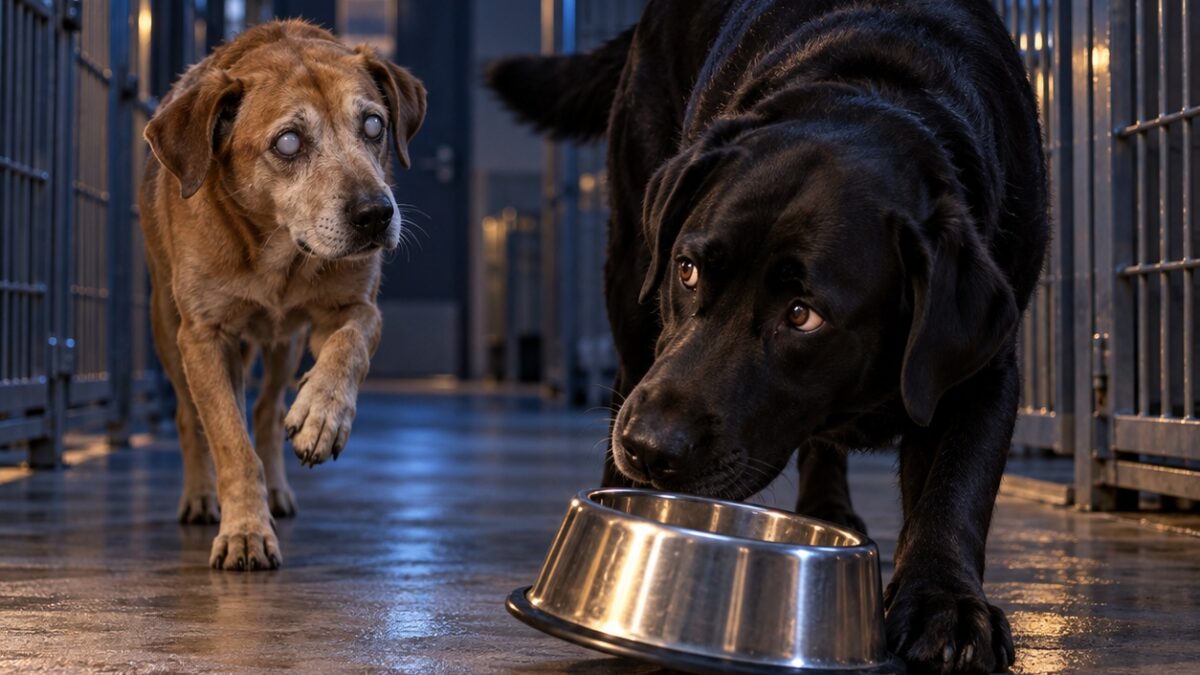
I finished cleaning one section and walked past the room where our security monitors were mounted.
A movement on one screen caught my eye.
Black shape.
Benji.
I stopped.
The camera showed the shared indoor area.
It was dark except for emergency lighting.
Milo was in his usual corner.
Benji stood near the food bowls.
At first, I assumed he was going to eat.
Instead, he lowered his head.
Put his nose against the edge of one bowl.
Pushed.
The bowl scraped across the floor.
A few inches.
Benji stopped.
Looked toward Milo.
I moved closer to the screen.
“What are you doing?”
I whispered.
Benji pushed again.
Scrape.
Stop.
Look.
Milo’s head lifted.
The sound had reached him.
Benji moved the bowl another few inches.
Scrape.
Milo turned his head.
His nose moved.
Benji stopped.
Waited.
Milo took one step.
Then froze.
Benji walked toward him.
Touched his muzzle gently against Milo’s cheek.
Then walked back toward the bowl.
I felt something tighten in my chest.
Milo followed.
One careful step.
Then another.
Benji stopped again.
Waited.
Milo reached the bowl.
His nose touched the rim.
He began eating.
Benji sat down a short distance away.
Not eating.
Just watching.
I stood frozen in front of the monitor.
The entire interaction had taken maybe two minutes.
Nobody had asked Benji to do it.
Nobody had trained him.
Nobody was there to praise him.
He simply saw what Milo needed.
And helped.
I ran.
Actually ran.
Down the hallway.
Past the supply room.
Toward Margaret’s office.
She was still there doing paperwork.
“Margaret.”
She looked up.
“You need to see something.”
“What happened?”
“Nothing bad.”
I was breathing too fast.
“Just come.”
She followed me back.
On the way, I told her what I had seen.
Benji.
The bowl.
Milo following.
Margaret didn’t react immediately.
She watched me finish.
Then she said:
“What if that wasn’t the first time?”
I stopped.
“What?”
She pointed toward the monitors.
“We record overnight.”
My heart started beating faster.
We sat down.
Pulled up footage.
The first recording we found was from the night before.
11:47 p.m.
Empty room.
Milo in his corner.
Benji lying near the far side.
Then Benji stood.
Walked to the bowl.
Pushed.
Exactly the same.
Scrape.
Stop.
Look.
Push.
Stop.
Wait.
Milo moved.
Benji returned when he hesitated.
Touched muzzle to muzzle.
Waited again.
Milo found the food.
Margaret said nothing.
Neither did I.
We pulled another night.
Same.
Another.
Same.
Then another.
Not every sequence was identical.
Sometimes Benji pushed the water bowl.
Sometimes food.
Sometimes Milo started moving after the first scrape.
Other times he stayed frozen and Benji returned to him.
Once, Milo turned the wrong direction.
Benji circled back.
Touched his shoulder.
Walked beside him.
Slowly.
Milo corrected.
Reached the water.
Drank.
Then Benji walked away.
As if this was ordinary.
As if helping another dog navigate darkness required no explanation.
I leaned closer to the monitor.
“How long has he been doing this?”
Margaret checked timestamps.
“At least every night we’ve reviewed.”
We kept watching.
One recording changed everything for me.
Benji pushed the bowl toward Milo.
Then instead of returning to his own bed, he stayed nearby.
Milo stood.
Walked toward the sound.
Stopped too early.
His nose missed the bowl by maybe a foot.
Benji did not push it the rest of the way.
That caught my attention.
He walked to Milo.
Touched his muzzle.
Then walked toward the bowl again.
Milo followed.
Another step.
Benji stopped.
Waited.
Milo took the final step himself.
Found the bowl.
Margaret whispered:
“He’s teaching him.”
I looked at her.
“What?”
“He isn’t just bringing it to him.”
She pointed at the screen.
“He’s teaching him how to find what he can’t see.”
That sentence stayed with me.
Because she was right.
Benji could have pushed the bowl all the way under Milo’s nose.
Sometimes he nearly did.
But gradually, he began leaving space.
A little distance.
Then waiting.
Giving Milo the chance to solve the last part.
That wasn’t dependence.
That was confidence being built quietly.
One small success at a time.
We watched recordings for almost an hour.
Benji never looked toward the cameras.
Of course he didn’t.
He had no idea they mattered.
No audience.
No reward.
No human voice saying:
Good boy.
He simply kept doing what worked.
Help.
Pause.
Wait.
Let Milo move.
Help again if necessary.
I cried before Margaret did.
I tried not to.
Failed.
Margaret handed me a tissue without looking at me.
“You’re crying.”
“So are you.”
“No.”
“You are.”
“Shelter dust.”
“At midnight?”
“Very aggressive dust.”
We both laughed.
Then watched another clip.
Milo finding water.
Benji waiting.
I don’t know how long we sat there.
Eventually Margaret said:
“Tomorrow, don’t interfere too much.”
I nodded.
“I know.”
“No.”
She looked at me.
“Really.”
“I know.”
“Let them show us what they’re doing.”
That was the second major thing I had to learn from Benji.
Sometimes helping means not interrupting a process just because you finally understand it.
The next morning, I entered their area differently.
Benji came toward me.
Tail moving.
Milo remained near the wall.
I sat on the floor.
“Morning, boys.”
Benji sniffed my hand.
Then turned back.
Lay beside Milo.
I didn’t reach.
Didn’t move closer.
Just waited.
Minutes passed.
Milo lifted his head.
His nose touched Benji’s shoulder.
Benji stayed still.
Milo rested there.
Only for a few seconds.
Then longer.
That was the first time I saw his whole body soften against another living creature.
Not collapse from exhaustion.
Relax.
There is a difference.
Fear creates tension you can almost see under fur.
Milo had lived with that tension constantly.
Shoulders tight.
Head ready to pull away.
Paws positioned to retreat.
Beside Benji, something changed.
He breathed differently.
Slower.
I sat there until my legs went numb.
Worth it.
The changes after that were not dramatic.
Not at first.
They arrived in inches.
Milo left the corner more often.
Then stayed away from it longer.
He began following Benji.
Not blindly in the metaphorical sense.
Literally.
Using sound.
Benji’s nails clicked softly on the floor.
Milo followed that rhythm.
Benji walked slower than he normally did.
That was obvious.
If he reached the far side of the kennel first, he stopped.
Waited.
If Milo was not behind him, Benji turned back.
No rushing.
No impatience.
They developed a communication system none of us taught them.
Benji moved.
Milo listened.
Milo moved.
Benji waited.
Sometimes Benji’s shoulder touched Milo’s side.
Sometimes noses.
Sometimes nothing physical at all.
Presence was enough.
I started observing them like a student.
Because that’s what I had become.
Benji never dragged.
Never shoved.
Never forced Milo into a place.
He showed.
Then waited.
That distinction became almost painful because I realized how often humans confuse help with control.
We see someone struggling.
We grab.
Move.
Decide.
Speed things up.
Benji did the opposite.
He made the path available.
Then let Milo take it.
One afternoon, I placed a toy in their area.
A simple rubber toy.
Nothing special.
Benji found it immediately.
Picked it up.
Squeak.
Milo’s head lifted.
Benji dropped it.
Milo listened.
No movement.
Benji picked it up again.
Squeak.
Dropped it closer.
Milo turned.
Benji pawed the toy.
Small scraping sound.
Milo moved one step.
Stopped.
Benji waited.
Another step.
Milo’s nose touched the toy.
He jerked back as though surprised.
Benji nudged it.
Milo touched again.
Then opened his mouth.
Picked it up.
I laughed so loudly both dogs turned toward me.
“Sorry.”
Milo froze.
I immediately softened.
“Sorry, buddy.”
He still had the toy in his mouth.
Benji’s tail started moving.
Milo held it.
Then dropped it.
Benji picked it up.
The game began.
Slow.
Simple.
Benji dropped.
Milo searched.
Found.
Picked up.
At first, it lasted maybe thirty seconds.
The next day, longer.
Then longer.
The toy became part of their routine.
I started bringing different textures.
Something soft.
Something that rattled.
Something with a squeaker.
Milo preferred sound.
Of course.
Benji adapted.
If the toy rolled too far, Benji retrieved it.
Dropped it near Milo.
Waited.
No one told him.
There are things animals understand through attention that training never has to explain.
Weeks passed.
Milo’s body changed.
Not physically much.
Emotionally.
His head stayed higher.
He explored.
He learned where walls were.
Where bedding was.
Where bowls usually sat.
Where the gate opened.
Where Benji slept.
He began using his other senses with growing confidence.
Smell first.
Sound.
Touch.
Memory.
If a volunteer entered, Milo no longer always retreated.
He listened.
Sometimes approached.
Slowly.
One step.
Pause.
Another.
When I sat on the floor, he occasionally came to me.
Not every day.
I never expected every day.
Progress is not a straight line.
Some mornings, Milo behaved as though weeks of trust had vanished.
A dropped metal bowl.
A barking dog too close.
A stranger moving fast.
He would retreat.
Corner again.
Fear.
The old place.
Benji never seemed frustrated.
He simply went over.
Lay nearby.
Waited.
Eventually Milo returned.
Watching that taught me more about trauma than some books have.
Healing doesn’t mean never going backward.
It means the backward movement stops becoming permanent.
You know how to come back.
Benji became Milo’s path back.
Then one afternoon, something happened that I still remember more clearly than almost anything else from those months.
I was sitting outside their kennel.
Not watching closely.
Paperwork in my lap.
Benji was lying near the center.
The toy sat beside Milo.
Then I heard a soft scrape.
Looked up.
Milo had the toy.
He picked it up.
Turned his head toward Benji.
Walked.
Slowly.
Reached him.
Then pushed the toy forward.
Toward Benji.
I stopped breathing.
Benji’s head came up.
Milo pushed again.
Invitation.
For the first time, Milo had started the game.
Not followed.
Not responded.
Started.
Benji stood immediately.
Picked up the toy.
Dropped it.
Milo moved.
They played.
I turned my face away.
Too late.
Tears.
Of course.
Margaret walked past.
“What?”
I pointed.
Couldn’t speak.
She looked.
Then understood.
“That him?”
I nodded.
“He started?”
Another nod.
Margaret stood beside me.
Neither of us said anything.
Milo picked up the toy again.
Benji bounced once.
The movement was almost puppyish.
And I realized something.
We had been so focused on how Benji was changing Milo that I had not fully noticed how Milo changed Benji.
Benji became brighter around him.
More engaged.
More purposeful.
Before Milo, Benji was calm.
After Milo, he was connected.
He had someone to look for.
Someone whose movement mattered.
If staff took Milo briefly for medical checks, Benji paced.
If Benji went for a walk, Milo became restless until he returned.
They were not therapist and patient.
Guide and dependent.
They were friends.
Different needs.
Same bond.
That was when I finally named the blind dog.
Milo.
I don’t know why that name.
It just fit.
Maybe because by then he had stopped feeling like “the blind dog.”
He was Milo.
He liked the rattling toy more than the squeaker.
He preferred Benji’s left side when walking.
He liked chicken treats.
Disliked wet floors.
Tolerated me.
Loved Benji.
Identity arrives through details.
Benji had given him enough safety for those details to appear.
As the weeks went on, Milo followed Benji through larger spaces.
We kept the environment controlled.
No obstacles added suddenly.
Consistent routes.
Benji naturally moved slowly.
At doorways, he paused.
Milo found the frame.
Adjusted.
Followed.
Outside was harder.
Grass felt different.
Wind carried too many smells.
Birds.
Cars.
Other dogs.
Milo froze often.
Benji stayed.
Never pulled away.
Sometimes they’d stand in one spot for five minutes.
Volunteers asked:
“Should we encourage him?”
I said:
“Wait.”
I’d learned.
Milo would eventually move.
One step.
Then another.
The first time he walked across the entire exercise yard, Margaret applauded once.
I glared at her.
She whispered:
“Sorry.”
Milo stopped.
Benji stopped.
Then Milo resumed.
We laughed quietly.
Our shelter began changing procedures around them.
Not officially at first.
Staff simply learned.
Don’t separate them unnecessarily.
If one leaves, let the other know where possible.
Keep routines predictable.
Let Benji be near during stressful moments.
But another challenge was coming.
Adoption.
Shelters exist to move animals into homes.
That’s success.
Yet by then, everyone understood that adopting one without considering the other could undo everything.
Benji was highly adoptable on paper.
Black Labrador.
Friendly.
Calm.
Good with people.
Milo?
Blind.
Anxious.
Still learning.
Needed patient adopters.
The kind of dog people say they want to help until they imagine what daily care involves.
We had inquiries for Benji.
Several.
Families liked him.
I became protective.
Maybe too protective.
One couple visited.
They loved Benji.
Then asked:
“Can he be adopted alone?”
I hesitated.
Margaret answered before I could.
“Technically, yes.”
My stomach tightened.
She continued.
“But we strongly prefer to discuss his bond with Milo.”
They met Milo.
Nice people.
But they wanted one easy dog.
They did not apply.
I felt relieved.
Then guilty for feeling relieved.
Benji deserved a home.
Milo did too.
But every time I imagined Benji leaving, I pictured Milo back in the corner.
Margaret warned me:
“We can’t keep Benji forever because you’re afraid.”
“I know.”
“Milo has to eventually function without him.”
“I know.”
“Then trust what Benji has taught him.”
That was hard.
Because the point of Benji’s help had never been permanent dependence.
Margaret reminded me:
“If we’ve understood this correctly, then Benji hasn’t been teaching Milo to need him.”
“He’s teaching him to trust.”
I knew.
Still, separation felt wrong.
Then a family called about Milo.
Milo.
Not Benji.
A family had seen his profile.
Read about his blindness.
Wanted to meet him.
I was thrilled.
Terrified.
Hopeful.
The family arrived on a Saturday.
Mother.
Father.
Teenage daughter.
Younger son.
Quiet people.
Good energy.
They sat on the floor instead of standing over Milo.
That earned points immediately.
Milo stayed near Benji.
The mother asked questions.
How does he navigate?
Does he startle?
How much help?
How long alone?
What environment?
How does he handle stairs?
Real questions.
Not:
Is he always sad?
Not:
Will he bump into everything?
They wanted to understand.
I explained routines.
Sound cues.
Consistency.
Safety.
Patience.
The daughter let Milo approach her.
He sniffed her hand.
Stayed.
Good.
Then someone asked the question.
I think it was the father.
“What about the other dog?”
I looked toward Benji.
“He’s very important to Milo.”
The family watched them.
Benji was standing beside Milo.
Not touching.
Just there.
I explained the camera footage.
The bowls.
Night after night.
Benji waiting.
Teaching Milo to move.
The toy.
Milo initiating play.
The mother’s eyes changed.
“You have recordings?”
“Yes.”
We showed them.
Not all.
Enough.
11:47 p.m.
Dark shelter room.
Benji pushing the bowl.
Waiting.
Returning.
Touching Milo gently.
Leading him.
The family watched without speaking.
Then another clip.
Toy.
Benji waiting.
Milo finding.
The teenage daughter wiped her face.
Her brother whispered:
“He helps him.”
“Yes.”
Their mother looked at both dogs.
Then at me.
“How bonded are they?”
I answered honestly.
“Very.”
“What happens if they’re separated?”
I swallowed.
“We don’t know exactly.”
Margaret stepped in.
“Milo has become much more independent.”
Good.
That mattered.
“But emotionally, they are deeply connected.”
The family asked for time alone together.
We gave it.
I paced.
Margaret told me to stop.
“You’re making me nervous.”
“They’re deciding.”
“Yes.”
“What if they only want Milo?”
“That would still be good.”
“I know.”
“What if they decide it’s too much?”
“Then we keep looking.”
“I hate this.”
“Welcome to adoption work.”
Finally, the family came out.
The mother was smiling.
I couldn’t read it.
She looked toward the kennel.
Then said:
“I think we came here for one dog.”
My chest tightened.
She continued.
“But I don’t think we’re leaving with one.”
I stared.
“What?”
The daughter smiled.
“We want Benji too.”
I started crying immediately.
No dignity.
None.
Margaret laughed at me.
Then cried too.
The father said:
“We don’t want to separate them.”
I asked every responsible question we needed to ask.
Space.
Cost.
Vet care.
Two dogs.
Blind-dog safety.
Time.
Their answers were thoughtful.
They had a fenced yard.
No dangerous stairs they couldn’t modify.
Flexible work schedule.
Experience with dogs.
Resources.
They weren’t adopting two dogs because the story was cute.
They understood the responsibility.
That mattered more than emotion.
The adoption process took a few days.
Those days felt strangely difficult.
Every routine became “last.”
Last week in the shelter.
Last nighttime footage.
Last toy session in Kennel 14.
I caught myself watching them constantly.
Benji walking.
Milo following.
Benji stopping.
Milo catching up.
Sometimes Milo went first now.
Not far.
Several steps.
Then Benji beside him.
Progress had happened so gradually I almost missed the reversal.
The day they left, the family arrived with two collars.
Two leashes.
Two beds waiting at home.
Milo became nervous when the routine changed.
Understandable.
New voices.
Movement.
Doors.
Benji stayed close.
We walked them toward the exit.
Benji slightly ahead.
Milo beside him.
Not behind.
That detail mattered to me.
At the doorway, Milo stopped.
Benji stopped instantly.
Everyone waited.
No one pulled.
No one coaxed too loudly.
Milo turned his head.
Toward me.
Maybe it was my scent.
Maybe my footsteps.
Maybe coincidence.
I didn’t care.
I walked over.
Crouched.
Put one hand gently on his head.
“You’re okay.”
His ears shifted.
“You’re going home.”
My voice broke.
“Do you understand that?”
Probably not.
I smiled through tears.
“You’re never going to be alone again, buddy.”
Milo lifted his chin slightly.
Benji stepped closer.
Touched his nose against Milo’s cheek.
The same gesture from the night footage.
The same quiet message.
I’m here.
Milo took a step.
Then another.
They walked out together.
I stood in the doorway long after the car left.
Margaret came beside me.
“Hate adoption days?”
“Yes.”
“Love adoption days?”
“Yes.”
“Good.”
I laughed.
Then cried again.
The shelter felt wrong without them.
Too quiet in that section.
We cleaned the kennel.
Removed bedding.
Bowls.
Toy.
Another dog eventually used the space.
That’s shelter life.
Love them.
Help them.
Let them leave.
The final part is the hardest and most important.
Several weeks later, a letter arrived.
Actual paper.
The family could have emailed.
They wrote a letter.
Margaret brought it to me.
“For you.”
I opened it immediately.
The first line said:
Milo and Benji are doing wonderfully.
I exhaled.
Only then did I realize how much anxiety I had been holding.
The letter described the house.
At first, Milo followed Benji everywhere.
Kitchen.
Living room.
Hallway.
Yard.
Benji did exactly what he had done in the shelter.
Walk.
Stop.
Wait.
Milo learned.
The family kept furniture placement consistent.
Used sound cues.
Textured mats near doorways and important areas.
Water always in the same place.
Bed.
Toys.
Milo built a mental map.
Then things changed.
He began finding his bed alone.
Then his toy basket.
Then the back door.
Then the family.
One morning, the mother had been watching from the kitchen.
Benji was lying outside in the yard.
Milo walked toward him.
Stopped.
Benji did not move.
Normally, Milo would wait.
Follow.
Seek guidance.
Instead, Milo turned.
Walked back into the house.
Found his water bowl.
Alone.
Drank.
Then returned outside.
The family wrote:
We don’t think he’s simply following Benji anymore. We think Benji taught him to trust himself.
I read that sentence again.
Then again.
Margaret stood beside me.
“That was the point.”
I nodded.
Could not speak.
That was the beauty of what Benji had done.
He had not become Milo’s eyes in the sense of doing everything for him.
He had not made Milo dependent.
He had used patience to teach confidence.
He had shown Milo that the world could be explored safely.
Sound by sound.
Step by step.
Mistake by mistake.
And then, gradually, Benji stepped back enough for Milo to discover that he could navigate on his own.
That changed how I thought about help.
Not only with animals.
People too.
We often imagine helping as carrying.
Fixing.
Leading.
Giving answers.
Sometimes that’s necessary.
But sometimes the best help is quieter.
Walk beside someone.
Stop when they stop.
Wait when they need time.
Show them the path.
Then let them take the next step themselves.
Benji understood that without a training manual.
Without praise.
Without anyone watching.
That’s what made the night-camera footage so powerful.
If he had done it while volunteers were present, people might have said:
He wants attention.
He learned a behavior.
He’s reacting to humans.
But the shelter was dark.
Nobody there.
No reward.
No command.
No applause.
Benji helped Milo because Milo needed help.
Nothing else.
People ask me sometimes what kindness looks like.
I think about that recording.
11:47 p.m.
Black Labrador.
Metal bowl.
Scrape.
Pause.
Look.
Scrape.
Pause.
Wait.
Return.
Nose touch.
Wait again.
No audience.
That is kindness to me.
What you do when praise is impossible.
Months after the adoption, the family sent pictures.
Milo in the yard.
Benji beside him.
Both sleeping on a large dog bed they were apparently supposed to share equally but Benji occupied most of.
Milo carrying the rattling toy.
Benji stealing it.
One photo made me laugh.
Milo walking in front.
Benji behind.
I stared at that one.
Because I remembered the first weeks.
Benji ahead.
Milo following every sound.
Now Milo had his head up.
Moving confidently.
Benji behind him.
The family captioned the photo:
Guess who’s leading today?
I printed it.
Put it in the staff room.
Margaret saw.
“You’re sentimental.”
“You cried at the footage.”
“Dust.”
“Still?”
“Our ventilation is terrible.”
We laughed.
But I kept the photo.
Years of shelter work expose you to many stories.
Some don’t end how you want.
That truth matters.
You can do everything right and still lose an animal.
You can rehabilitate one and watch an adoption fail.
You can love a dog for months and never get the update you hoped for.
Milo and Benji became one of the stories I hold onto during those times.
Not because it proves everything works out.
It doesn’t.
Because it reminds me why patience matters.
When Milo arrived, I wanted to fix him.
Benji wanted to stay with him.
Benji won.
Good.
My approach was:
Eat.
Walk.
Explore.
Improve.
His was:
I’m here.
Take your time.
That’s a better foundation.
The first night I saw the bowl move on camera, I thought Benji was doing something extraordinary.
Years later, I think the extraordinary part was how ordinary it seemed to him.
No hesitation.
No pride.
No expectation.
Milo needed the bowl closer.
So Benji moved it.
Milo needed sound.
So Benji made sound.
Milo got lost.
Benji returned.
Milo froze.
Benji waited.
That’s all.
Sometimes goodness is that uncomplicated.
Need.
Response.
No audience.
I visited their family several months after the adoption.
They invited Margaret and me.
I almost said no.
Shelter workers have mixed feelings about home visits when things are going well.
Partly because you don’t want to intrude.
Partly because seeing an animal truly settled can undo you.
I went.
The house was quiet.
Fenced backyard.
Exactly as described.
When the front door opened, Benji reached us first.
Black body.
Tail.
Pure Labrador happiness.
He leaned into me.
“Hey, handsome.”
Then Milo appeared behind him.
I froze.
Not because he looked dramatically different.
Because he carried himself differently.
Head higher.
Steps steady.
He walked into the entryway without touching Benji.
Paused.
Sniffed.
Then turned toward me.
I said:
“Milo.”
His ears lifted.
He walked closer.
Found my knee.
Nose.
Hand.
Then pressed his head against my leg.
I cried.
Of course.
The family’s teenage daughter laughed.
“He does that.”
“He remembers.”
“I think so.”
Benji pushed between us.
Jealous.
Some things never become noble.
We moved to the backyard.
The family showed us Milo’s routes.
Door to grass.
Grass to water.
Water to shaded area.
Toy basket.
Bed.
He knew everything.
Not because he could see.
Because he had learned the house through every other sense available.
Benji still helped.
Sometimes.
But he didn’t hover.
That was important.
Milo didn’t need hovering anymore.
At one point, Benji walked toward the far side of the yard.
Milo heard.
Turned.
Then instead of following, he walked toward a toy.
Found it.
Picked it up.
Carried it toward Benji.
He initiated.
Again.
Just like that first day at the shelter.
The family told us something else.
Sometimes Milo went outside first.
Benji followed.
Sometimes Benji got distracted.
Milo continued.
Sometimes Milo slept in another room.
Independence.
Not separation.
There is a difference.
The goal was never to make Milo stop loving Benji.
It was to make love safe enough that Milo could grow.
That afternoon, we sat in the yard.
Benji lay on the grass.
Milo against his side.
The father said:
“We almost adopted only Milo.”
I looked at him.
“We thought two dogs might be too much.”
The mother smiled.
“Now I can’t imagine separating them.”
Their daughter added:
“Benji acts like he’s responsible for everybody.”
True.
The younger boy said:
“Milo bosses him around now.”
Even better.
I laughed.
“What does he do?”
“If Benji takes his toy, Milo follows him and barks.”
Milo.
The dog who once barely moved from a corner.
Now protesting theft.
I loved it.
We stayed a few hours.
Before leaving, I walked to the gate.
Milo came over.
Benji followed.
For one second, the image reversed the shelter.
Milo first.
Benji behind.
I thought of Margaret’s sentence again.
He’s teaching him how to find what he can’t see.
Maybe that had been true at first.
But eventually Benji taught Milo something bigger.
Sight was not the only way to know where you were.
You could know through sound.
Smell.
Texture.
Memory.
Trust.
And once trust grew, Milo no longer needed someone to tell him every step was safe.
He could discover that himself.
On the drive back to the shelter, Margaret said:
“You’re quiet.”
“I know.”
“You okay?”
“Yeah.”
“What are you thinking?”
I looked out the window.
“That we almost missed all of it.”
“What?”
“If I hadn’t seen the monitor.”
Margaret shook her head.
“We would have seen the change eventually.”
“Maybe.”
“Benji would’ve kept doing it.”
That was true.
Maybe that was the most beautiful part.
Our discovery did not create the kindness.
It only revealed it.
Benji had already been helping.
Night after night.
Whether we knew or not.
That realization changed the way I watched animals in the shelter.
I paid more attention to what happened between them when humans weren’t directing everything.
Dogs comforted each other.
Copied confidence.
Learned routines.
Shared beds.
Waited near kennels.
Sometimes argued.
Sometimes avoided.
Relationships mattered.
We started thinking more carefully about bonded animals.
Not automatically refusing separation.
Every situation is different.
But observing what the animals were actually telling us.
Not simply what was convenient for placement.
Milo and Benji made us better at that.
Margaret later used their case when training volunteers.
She never made it sentimental.
That wasn’t her style.
She said:
“Watch before you interfere.”
Then showed a clip.
Benji pushing the bowl.
“Sometimes the animals understand the problem before we do.”
That became almost a shelter motto.
Watch before you interfere.
I needed that in my own life too.
I have a younger sister.
For years, when she had problems, I gave advice.
Immediate.
Detailed.
Unrequested.
After Milo and Benji, I started asking:
“Do you want advice or do you want me to stay?”
She noticed.
“What happened to you?”
“A Labrador.”
She thought I was joking.
I wasn’t.
Helping someone move forward is different from dragging them where you think forward should be.
Benji had shown me that.
He never took Milo’s choices.
He expanded them.
That’s real help.
The family continued sending updates.
Birthdays.
Holiday photos.
Milo wearing a ridiculous sweater.
Benji tolerating a hat for three seconds.
Pictures sleeping nose to nose.
A video of both dogs running in the yard.
Milo ran carefully.
Benji slightly behind.
Watching.
Not leading.
Just there.
That video destroyed me.
Because the first Milo I knew would not cross five feet of open kennel space alone.
Now he ran.
Blind.
Confident.
Not reckless.
Trusting himself.
There is a phrase people use often:
Benji became Milo’s eyes.
I understand why.
It’s sweet.
But I don’t think it’s quite right.
Benji did something better.
He helped Milo discover that being blind did not mean being helpless.
If Benji had become his permanent eyes, Milo might have learned:
I can move only when Benji leads.
Instead, what Milo learned was:
I can move.
Benji is with me.
Those are very different lessons.
The second creates freedom.
That’s what the family meant in the letter.
He no longer simply follows Benji.
He trusts himself.
I keep that letter.
Still.
Folded in a folder at the shelter.
Not displayed publicly.
Mine.
Whenever an animal arrives and seems impossible to reach, I sometimes read it.
Not because every case will end the same way.
Because it reminds me not to confuse stillness with inability.
Milo looked frozen.
Inside, he was learning.
Listening.
Mapping.
Waiting for enough safety to try.
Animals can surprise you when you stop demanding visible proof on your timetable.
One winter, the family sent a photo after snow.
Milo standing outside.
Nose raised.
Benji several feet behind.
Caption:
Milo discovered snow.
I called immediately.
“What did he think?”
The mother laughed.
“He hated it for five minutes.”
“Reasonable.”
“Then he figured out he could hear us better because everything was quiet.”
Of course.
Milo adapted.
Different world.
New information.
Benji joined him.
They ran badly through snow.
Milo followed sound at first.
Then created his own path.
That became the story of his life.
Guidance first.
Confidence later.
Years passed.
I remained at the shelter.
Animals came.
Animals left.
Margaret eventually reduced her hours.
I trained new volunteers.
Every now and then, somebody noticed the old printed photo on the wall.
Blind brown dog in front.
Black Labrador behind.
“Who are they?”
I’d smile.
“Milo and Benji.”
“What happened to them?”
“They went home.”
Sometimes that was all I said.
Other times, if the volunteer had time, I told the story.
But I always started with the camera.
Not Milo arriving.
Not the adoption.
The night.
11:47 p.m.
Dark room.
No humans.
A bowl scraping.
Because that’s the center of it for me.
Goodness without audience.
We live in a world where so much kindness is documented.
Posted.
Shared.
Praised.
That’s not wrong.
Public kindness can inspire more kindness.
But Benji reminded me there is another kind.
The kind nobody sees.
No photograph.
No credit.
No reward.
You do it because another living being beside you needs help.
That’s all.
If the camera had never recorded it, Benji still would have pushed the bowl.
That is what matters.
His goodness did not depend on being witnessed.
We were simply lucky enough to witness it.
Years later, I visited Milo and Benji again.
Both older.
Benji’s black muzzle had begun graying.
Milo moved with practiced confidence through the house.
He didn’t hesitate at furniture.
The family rarely rearranged things dramatically, but even when something changed, Milo investigated.
Nose.
Paws.
Memory update.
Benji sometimes followed him.
That still made me smile.
We went into the yard.
Milo walked toward the water bowl.
Benji was lying in sunlight.
Milo passed him.
Didn’t stop.
Drank.
Then walked toward the fence.
Listened.
Turned.
Came back.
Benji lifted his head.
Milo nudged him.
Benji stood.
The two walked together.
Neither ahead for long.
One moved.
Then the other.
Side by side.
Exactly what I had hoped without knowing how to name it.
The mother said:
“They switch now.”
“What?”
“Who leads.”
I watched.
Benji moved ahead.
Milo caught up.
Then Milo turned toward the porch.
Benji followed.
“Depends who knows where they’re going.”
I laughed.
That’s friendship, isn’t it?
Sometimes you know the way.
Sometimes I do.
Sometimes you wait.
Sometimes I wait.
The goal isn’t one permanent leader.
It’s nobody walking alone.
That thought became the ending for me.
Not Benji guiding Milo forever.
Not Milo becoming “independent” enough to no longer need anyone.
Both extremes miss the point.
Independence and connection can coexist.
Milo learned to trust himself without losing Benji.
Benji learned to follow Milo sometimes.
Their bond grew because it adapted.
Real friendship does.
When one needs help, the other gives it.
When the balance changes, the relationship changes with it.
No ego.
No scorekeeping.
That may be why animals often make relationships look simpler than we do.
One day, the family’s daughter—older now—sent me a message.
A video.
Milo walking through the living room carrying the old rattling toy.
Benji sleeping.
Milo stopped beside him.
Dropped the toy.
Benji opened one eye.
Milo nudged it.
Benji stood.
They played.
I watched the video three times.
Same ritual.
Same beginning.
Except now Milo initiated with absolute confidence.
I thought back to the first toy.
Milo touching it cautiously with his nose.
Almost startled by his own choice.
Now he was demanding play.
Transformation is often just repeated safe experiences accumulating until fear is no longer the loudest thing in the room.
Benji gave him those experiences.
We did too.
The family did.
Milo himself did the hardest part.
He tried.
Again.
And again.
That deserves credit.
Sometimes stories about animals with disabilities focus entirely on the helper.
The guide dog.
The rescuer.
The adopter.
But Milo worked too.
Every step into unknown space required courage.
Every time he left the corner, he risked collision.
Every time he followed a sound, he trusted.
Every time he explored without Benji, he rewrote what fear had taught him.
Benji opened the door.
Milo walked through.
That’s why I don’t say Benji “saved” Milo in a simple way.
He supported him.
He gave Milo enough safety to participate in his own healing.
That’s more powerful.
At the shelter, new volunteers sometimes try too hard with scared animals.
I see myself in them.
They sit.
Call.
Offer treats.
Reach.
Want.
Want.
Want.
I tell them:
“Slow down.”
“But he hasn’t moved.”
“That’s okay.”
“He doesn’t trust me.”
“Why should he?”
That usually surprises them.
Trust is not our reward for being nice.
It’s something the animal chooses after enough evidence.
Benji provided evidence.
I’m here.
I won’t hurt you.
I’ll wait.
If you miss the bowl, I’ll help.
If you freeze, I’ll stay.
If you can do the last step yourself, I won’t steal it from you.
Evidence.
Night after night.
Milo believed him.
Eventually, Milo believed himself.
That’s the sequence.
Sometimes I still wonder what Benji understood about Milo’s blindness.
Did he know Milo couldn’t see?
Dogs perceive difference.
They notice behavior.
Maybe Benji didn’t conceptualize blindness the way we do.
Maybe he simply understood:
My friend can’t find the bowl easily.
So he solved the problem.
Then noticed what helped Milo learn.
Animals don’t need diagnostic language to be compassionate.
Maybe humans don’t always need it either.
We need attention.
What is this individual struggling with?
What actually helps?
What makes things worse?
Observe.
Respond.
Adjust.
Benji did all three.
Naturally.
One of the final updates the family sent said:
Milo walked into the backyard this morning before Benji. Benji stayed by the door for a second, then followed him. We realized we were watching the exact opposite of the first weeks. Milo wasn’t being guided. He knew where he wanted to go. Benji simply chose to go with him.
I read that line and sat quietly for a long time.
There it was.
Completion.
Not separation.
Role reversal.
Benji had spent months saying:
Follow me.
Now Milo could say:
Come with me.
And Benji did.
That is the home they found together.
Not a place where one dog forever depended on the other.
A place where they could trade strength.
Some days Benji knew the path.
Some days Milo.
Some days neither needed to go anywhere.
They slept together.
Played.
Waited.
Lived.
Simple.
Good.
If you ask me which shelter story I carry most closely, people expect something dramatic.
A dog rescued from abuse.
A last-minute medical miracle.
A reunion.
I’ve seen those.
They matter.
But the story I think about most happened in darkness while almost everyone was asleep.
No emergency.
No applause.
A black Labrador walked to a bowl.
Pushed it.
Waited.
Looked toward a blind dog.
Pushed again.
Returned when his friend couldn’t find the path.
Touched him gently.
Then waited until Milo reached the food himself.
That tiny sequence changed the way I understand kindness.
Because Benji could have solved the immediate problem faster.
Push the bowl all the way.
Feed Milo.
Done.
Instead, whether deliberately or simply through instinctive patience, he gave Milo room to learn.
Help without taking over.
Guidance without control.
Presence without pressure.
That is difficult even for humans.
Maybe especially for humans.
My name is Ellie Wilson.
I’m still a shelter volunteer.
I’ve cleaned more kennels than I can count.
I’ve been bitten.
Scratched.
Covered in mud.
Thrown up on.
Peed on.
Cried in supply closets.
Celebrated adoptions.
Mourned losses.
Watched animals arrive terrified and leave loved.
And through all those years, whenever somebody asks what true kindness looks like, I don’t think of grand rescue.
I think of Benji at 11:47 p.m.
Nobody watching.
Nobody praising.
Just one dog noticing that another dog couldn’t find his food.
So he helped.
Then waited.
That’s all.
Maybe that’s enough.
Today, Milo and Benji still live together.
They sleep near each other.
Play.
Walk in the yard.
Benji still stops sometimes if Milo falls behind.
Old habits of love don’t disappear.
But Milo doesn’t always follow anymore.
Often, he moves first.
Finds the bowl.
Finds the door.
Finds the toy.
Finds the person he wants.
And sometimes Benji is the one walking behind him.
That image means everything to me.
Because the point was never for Milo to become Benji.
Never for blindness to disappear.
Never for Milo to prove he needed no one.
The point was that fear stopped deciding where he could go.
He learned that he could move through the world using what he had.
Sound.
Smell.
Touch.
Memory.
Trust.
And friendship.
Benji didn’t give Milo sight.
He gave him time.
And safety.
And enough confidence to discover his own way.
Milo gave Benji something too.
Purpose.
Companionship.
A friend worth waiting for.
A reason to slow down.
Someone to follow sometimes.
That’s why I stopped asking who saved whom.
The question is too simple.
They changed each other.
That’s better.
The last photograph I have of them is not dramatic.
No shelter.
No camera timestamp.
No bowl being pushed.
Just a backyard.
Late afternoon light.
Milo walking several steps ahead.
Benji behind him.
Milo’s head raised.
Benji relaxed.
Neither looks uncertain.
Neither is alone.
I keep that picture because it tells the whole story.
Once, Benji showed Milo the way.
Then he taught him not to be afraid of finding his own.
And when Milo finally learned to walk forward without waiting for someone else to lead—
Benji did not disappear.
He simply fell into step beside him.
Exactly where a true friend belongs.








