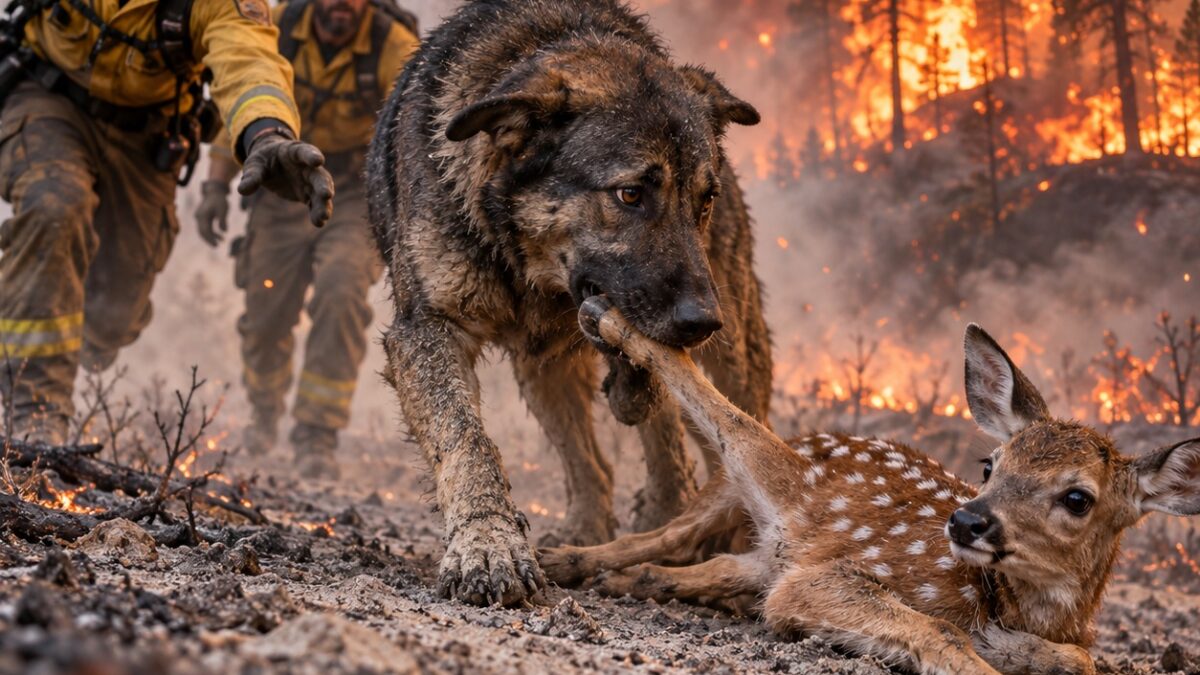
PART2:I Saw a Dog in the Wildfire Smoke Dragging a Fawn by One Leg—He Refused to Leave Until He Knew the Baby Was Safe
PART2
“Easy!”
The dog lifted his head.
I slowed before reaching him.
Fear makes injured animals unpredictable.
I did not want to become another threat.
The fawn lay on its side.
Its chest moved rapidly.
One ear twitched.
Alive.
The dog stood over it.
Protective.
But he did not growl.
His entire body trembled.
“Hey.”
I lowered myself.
“It’s okay.”
His eyes stayed on mine.
Dark.
Red around the edges from smoke.
He looked older from exhaustion than he probably was.
Daniel approached more slowly behind me.
“We need to move them.”
“I know.”
The dog glanced toward him.
Then back at me.
I reached one hand forward.
Not touching.
Just offering.
He smelled the air.
For a moment, the forest disappeared.
The engines.
The shouting.
The heat.
Everything narrowed to one exhausted dog deciding whether two human beings were safe enough to finish what he had started.
Then he lowered his head.
Not submission.
Permission.
I moved closer.
The fawn tried to raise itself.
Failed.
I placed one hand lightly against its side.
Rapid heartbeat.
No obvious heavy bleeding.
One leg looked weak, maybe injured, maybe simply exhausted.
The dog immediately touched its face again.
“Your friend’s alive.”
Daniel crouched.
“You think we can carry the fawn?”
“Yes.”
“What about him?”
The dog looked toward the forest again.
I understood the question differently.
Would he follow?
Would he try to go back?
Would he bite if we separated them?
I took my jacket off.
Spread it beneath the fawn as best I could without twisting the little animal more than necessary.
The dog watched every movement.
When the fawn made a soft cry, the dog moved forward.
I froze.
“It’s okay.”
He sniffed the fawn.
Then my hands.
We lifted.
The dog followed immediately.
Not ahead.
Not behind.
Beside the fawn.
Daniel and I carried the little deer toward clearer ground while the dog staggered next to us.
Every few yards he looked up.
Checking.
I had never seen anything like it.
He was not simply escaping with us.
He was escorting.
Making sure we did not take the fawn somewhere he could not follow.
Behind us, smoke folded between the trees.
Ahead, people moved around vehicles and temporary equipment.
Someone saw us.
“What’ve you got?”
“Fawn!”
“And a dog.”
“Both alive?”
“Yes.”
The answer felt almost unbelievable.
Two people came over with blankets.
The moment they reached for the fawn, the dog stepped in front.
“Easy.”
I stayed beside him.
“They’re helping.”
He looked at me.
I put a hand against his shoulder.
“Let them.”
He hesitated.
Then moved aside.
The fawn was transferred onto a padded surface.
People began checking breathing and injuries.
The dog remained standing.
Barely.
His legs were shaking now.
I brought water.
He sniffed.
Turned toward the fawn instead.
“Drink.”
Nothing.
The fawn made a weak sound.
The dog immediately moved closer.
That was when I finally understood the depth of it.
He had not simply dragged a deer out because instinct told him to.
He was still monitoring it.
Still waiting.
Still refusing to relax.
I dipped my hand into the water and let him lick it.
Once.
Twice.
Then he drank from the bowl.
Only a little.
His body swayed.
“Sit down.”
He did not.
I placed both hands carefully around his chest.
He resisted for half a second.
Then his weight collapsed into me.
I caught him.
“Jack.”
Daniel moved closer.
“I’ve got him.”
The dog leaned against my chest.
He was much lighter than I expected.
His fur smelled like smoke.
His paws were dirty and reddened.
When I looked closely, I could see small raw places where heat and rough ground had worn them.
I held him.
He did not struggle.
His head stayed turned toward the fawn.
That broke me.
Even in my arms, exhausted enough to collapse, he was still looking.
Still checking.
A few minutes later, someone brought the fawn closer.
It had been stabilized enough to move.
The dog lifted his head immediately.
His expression changed.
I cannot tell you exactly how.
Relief is a human word.
But something in his face softened.
I lowered him onto a blanket.
He tried to stand.
“No.”
He ignored me.
Tried again.
His legs failed.
I put my hand gently against his chest.
“Stay.”
The fawn was set down nearby.
The dog dragged himself forward only far enough to touch it with his nose.
Once.
The little deer moved.
The dog closed his eyes.
Just for a second.
Then his head dropped onto the blanket.
That was when I realized he had been waiting for proof.
He needed to know the fawn had made it.
Not just out of the trees.
To safety.
Daniel came beside me.
“Jack.”
I looked up.
“He won’t let you go.”
The dog had shifted until his shoulder pressed against my leg.
I smiled despite everything.
“I’m not letting him go either.”
Daniel glanced down.
“I think that’s exactly what he needed to hear.”
The dog’s eyes were nearly closed.
I lifted him carefully.
For one moment, he placed his head against my shoulder.
I could feel every breath.
Fast.
Then slower.
I whispered:
“You’re done.”
One ear moved.
“You don’t have to save anybody else today.”
His body loosened slightly.
We transported both animals to a quieter place where they could be evaluated, hydrated, fed, and watched.
I stayed.
I had no reason I could explain logically.
Other people were capable.
Both animals were safe.
I could have left.
I did not.
The dog was settled on a thick blanket.
Water nearby.
Food.
He drank more this time.
Ignored the food initially.
His attention kept returning to me.
Whenever I stood, his head lifted.
Whenever I moved toward the door, his eyes followed.
So I sat back down.
“You don’t know me.”
His eyes stayed open.
“I don’t know you.”
Tail.
Barely.
“But apparently we’re doing this.”
He placed his head between his paws.
I rested one hand over his shoulder.
“You can sleep.”
He did not.
“Really.”
Still watching.
“The fawn is safe.”
At the word—or maybe just my tone—his eyelids lowered.
I kept talking.
“No more smoke.”
His eyes closed.
“No more dragging anybody.”
His breathing deepened.
“You did enough.”
For the first time since he had appeared through the smoke, his entire body relaxed.
Not all at once.
Gradually.
Jaw.
Shoulders.
Back legs.
Then sleep took him.
I sat there longer than necessary.
Maybe because I was afraid if I moved, he would wake.
Maybe because after what I had just seen, leaving felt wrong.
I had spent most of that day thinking about escape routes.
Fire lines.
Smoke direction.
Distance.
Safety.
Then this dog walked out of a burning forest teaching me that survival is not always an individual act.
Sometimes something alive decides that making it out alone is not enough.
I did not know his name.
Did not know if he belonged to someone.
Did not know how he found the fawn.
Did not know whether he had been with it for minutes or hours.
I had questions.
None of them mattered while he slept.
The next morning, I went back.
I told myself I was checking on both animals.
That was technically true.
But I walked toward the dog first.
He was standing.
Not strong.
Better.
When he saw me, his ears lifted.
Then his tail started moving.
Slow at first.
Then harder.
I laughed.
“You remember me?”
He walked over.
I crouched.
He put his head on my knees.
No hesitation.
I ran my hand down his neck.
“All right.”
He leaned harder.
“Good morning to you too.”
The fawn was recovering as well.
Rest.
Fluids.
Food.
Monitoring.
No catastrophic injuries.
That felt like another miracle after everything.
The dog—still simply “the dog”—wanted to see it.
When the two were brought close again, he became completely alert.
He sniffed the fawn.
The fawn sniffed back.
Then, apparently satisfied, he returned to me.
That was when Daniel said:
“He needs a name.”
I looked at him.
“Maybe he already has one.”
“No collar.”
“We should check for an owner.”
“Of course.”
We did what we could.
But days passed.
No one came.
No clear answer about where he had come from.
I began realizing something that made me uneasy.
This dog might genuinely have no one waiting.
After what he had done for the fawn, the idea of him leaving that place alone felt impossible.
Daniel found me sitting with him one afternoon.
“You’ve decided.”
“I haven’t.”
“You have.”
“I’m thinking.”
“You named him in your head already.”
I looked down.
The dog was sleeping with one paw touching my boot.
“That obvious?”
“Yes.”
I thought about what he had looked like inside the smoke.
A shape appearing where everything else was gray.
Not bright exactly.
But something good coming out of something terrible.
“Ray.”
Daniel raised an eyebrow.
“Ray?”
“Like a ray of light.”
He smiled.
“Little dramatic.”
“You saw him.”
“Fair.”
I touched the dog’s shoulder.
“Ray.”
The dog opened one eye.
Daniel laughed.
“He accepts.”
“Apparently.”
From then on, he was Ray.
A few weeks passed.
Ray’s paws healed.
His breathing returned to normal.
The smoke smell disappeared from his fur.
Energy came back.
At first I thought that would change his personality completely.
It did not.
He remained watchful.
Gentle.
Always aware of whoever was near him.
Especially the fawn.
The little deer recovered faster than I expected.
Every day it stood more confidently.
Moved better.
Ate.
Watched us with that wild caution young deer carry naturally.
We kept human contact limited as much as practical.
The goal was not to turn it into a pet.
The goal was to return it.
That made sense intellectually.
Emotionally, I became attached.
Ray more than anyone.
Whenever he heard movement from the fawn’s area, his head came up.
Sometimes he would sit near the edge of the enclosure and simply watch.
No whining.
No trying to get in.
Just checking.
I wondered whether he thought of it as his responsibility.
Maybe.
Or maybe after everything they survived together, its presence had become familiar.
One afternoon, the fawn took several fast steps across the enclosure.
Ray stood.
Tail moving.
I laughed.
“Look at that.”
The fawn changed direction.
Ran again.
Ray bounced once on his front paws before catching himself.
“No.”
He looked at me.
“You are not chasing it.”
Tail.
“You dragged it out of a fire. You don’t get to traumatize it afterward.”
He sat.
I chose to believe that meant agreement.
The day came when the fawn was cleared for release.
I should have been happy.
I was.
Mostly.
But I thought about Ray.
Would he understand?
Probably not in the human sense.
We drove near the forest.
Not into the burned section.
Toward a safer area.
The landscape had begun changing already.
Fire marks remained.
Blackened trunks.
Ash.
But life had started pushing through.
Green at the edges.
Birds returning.
The forest looked wounded.
Not dead.
That mattered.
Ray stood near me.
Leash loose.
The fawn waited in its transport crate.
When the door opened, nothing happened at first.
The young animal stood still.
Smelled the air.
Looked toward the trees.
One step.
Then another.
I held my breath.
Ray did too, almost.
His body had gone completely still.
The fawn took several more steps.
Then suddenly ran.
Into the trees.
Gone.
I smiled.
A strange ache filled my chest.
Freedom should feel happy.
Sometimes it also feels like loss.
Ray stared toward the place where the fawn disappeared.
He did not pull.
Did not bark.
Just watched.
I crouched beside him.
“He went where he belongs.”
Ray looked at me.
“Or she.”
We had never been completely certain in those chaotic early hours.
I rubbed his neck.
“Either way.”
His ears stayed pointed toward the trees.
“Now you need somewhere to belong too.”
Ray turned his head.
Looked at me.
That was the moment.
I had been telling myself temporary.
Just until someone claimed him.
Just until we found the right family.
Just until his paws healed.
Just until the fawn was released.
I had run out of excuses.
“Come on.”
I opened the truck.
Ray climbed in.
That night, I took him home.
Temporarily.
Obviously.
A few days.
Maybe a couple of weeks.
Enough to figure things out.
That was what I told Daniel.
He laughed directly in my face.
“Temporary.”
“Yes.”
“With a dog you named.”
“Yes.”
“Who sleeps next to your truck.”
“That means nothing.”
“Sure.”
I ignored him.
The first night, I put a small bed near where I could keep an eye on Ray.
He circled twice.
Lay down.
I expected restlessness.
He had been through chaos.
Instead, he slept.
Deeply.
I woke early because something touched my hand.
I opened my eyes.
Ray stood beside me.
One paw resting gently against my fingers.
“Morning.”
Tail.
“What?”
More tail.
I sat up.
“You need something?”
He glanced toward the door.
“Outside?”
He looked back.
I laughed.
“Okay.”
We went out.
Ray walked into the yard.
Stopped.
Turned.
Waited for me.
That small action affected me more than I expected.
He had spent the first part of our relationship walking ahead toward danger.
Pulling something behind him.
Now he waited.
No smoke.
No urgency.
Just:
Are you coming?
I stepped outside.
“Yeah.”
His tail moved.
“I’m coming.”
By the end of the first week, Ray knew the yard.
By the second, he knew which door I used most often.
By the third, he knew where I kept food and had developed opinions about timing.
Temporary began becoming a joke.
I still told myself I would find him a good family.
Then I noticed that every time I left a room, he followed.
If a door closed between us, Ray sat outside it.
No scratching.
No barking.
Waiting.
If I sat in the yard, he positioned himself nearby.
If I went to the truck, he appeared beside me.
He was not panicked.
It felt more like he did not yet believe safety could exist without supervision.
I gave him time.
I did not push him away.
I also did not encourage constant dependence.
Sometimes I closed the bathroom door.
He waited.
I opened it.
He was there.
“Still here.”
Tail.
I started understanding that leaving and returning were their own language.
Ray had come out of a forest where everything changed in minutes.
Fire.
Smoke.
Animals running.
Noise.
Then suddenly me.
Then the fawn separated.
Then new rooms.
New people.
Then my house.
Of course he followed.
Consistency had to be taught.
Not with speeches.
Days.
Breakfast.
Walk.
Jack leaves.
Jack returns.
Evening.
Sleep.
Again.
One morning, I found him asleep in the living room while I had been in the kitchen for nearly twenty minutes.
That sounds ridiculous as a milestone.
It was not.
He no longer needed to account for every movement I made.
His body was beginning to believe the house would still exist if he closed his eyes.
Weeks passed.
Then Ray discovered a toy.
An old rubber thing I had bought without much expectation.
For days, he ignored it.
Then one afternoon, I was sitting outside when he came through the doorway holding it.
I looked up.
“Well.”
He stood there.
Toy between his teeth.
Tail.
“What’s that?”
He shook his head.
Hard.
The toy flapped from side to side.
I laughed.
“You know what to do with that?”
He ran toward me.
Stopped.
Dropped it.
I picked it up.
Threw.
Ray stared.
I stared back.
“The idea is you chase it.”
He looked toward the toy.
Then me.
Apparently heroism does not imply understanding fetch.
I went and picked it up.
Threw again.
This time he ran.
Not elegantly.
But happily.
He reached it.
Picked it up.
Ran in the opposite direction.
“Ray.”
He stopped.
“Wrong way.”
Tail.
“Come here.”
He did.
Eventually.
That toy became his favorite.
Every evening for weeks, he carried it around.
Sometimes placed it in my lap.
Sometimes hid it somewhere and then looked offended when he could not find it.
Ray was becoming a normal dog.
That may sound less impressive than pulling a fawn from a burning forest.
It mattered more to me.
A heroic moment tells you what someone can do under pressure.
Ordinary life tells you whether they finally feel safe enough to be silly.
Ray was silly.
He rolled in grass.
Barked once at his own reflection in a dark window and then acted embarrassed.
Tried to fit into places too small for him.
Learned that if he stared at me long enough during dinner, I occasionally became weak.
The first time he fell asleep on his back with his paws in the air, I took a picture.
Then another.
Then realized I had become exactly the kind of dog owner I used to make fun of.
Fine.
Daniel visited.
Ray greeted him enthusiastically.
Daniel looked around.
Dog bed.
Bowls.
Toys.
Leash by the door.
He said:
“So when does the temporary foster leave?”
“Shut up.”
“Just asking.”
“He’s staying.”
“What?”
“You heard me.”
Daniel smiled.
Ray sat beside me.
I scratched behind his ear.
“He’s staying.”
Daniel nodded.
“Good.”
That was the adoption ceremony.
No paperwork in that moment.
No speech.
Just two men, one dog, and a fact everyone already knew.
Ray had a home.
Months later, I sat in the yard while he lay beside me.
The wind carried the faint smell of the forest.
Nothing burning.
Just trees.
Leaves.
Earth.
Ray’s head rested near my knee.
I looked at him.
“You know what you did?”
He opened his eyes.
“Probably not.”
Tail.
“I do.”
I touched one ear.
“You went back.”
His eyes remained on me.
“You could’ve run out.”
Maybe he had been trapped with the fawn from the beginning.
Maybe he simply found it while fleeing.
I did not know.
But I had seen the end.
I knew he had refused to leave it.
“You kept going.”
Ray moved his head onto my lap.
I smiled.
“Everybody called you a hero.”
No reaction.
“You’re not.”
One ear lifted.
That sounded insulting even to me.
I laughed.
“I mean—you weren’t trying to be.”
I rubbed his head.
“You didn’t want applause.”
His eyes closed.
“You saw someone who couldn’t get out alone.”
A slow breath.
“And you stayed.”
That, to me, was courage stripped down to its simplest form.
Not grand speeches.
Not being fearless.
Not being stronger than everyone.
Just refusing to walk away because leaving would be easier.
Ray did not know that he had changed the way I thought about courage.
He wanted his ear scratched.
That was enough.
A few months after the fire, Ray and I went back toward the forest.
Not into any unsafe area.
The fire was long gone.
The landscape had begun recovering.
Burned trunks still stood.
Dark reminders.
But between them, life.
Green shoots.
Birds.
Insects.
The sound of wind through surviving branches.
Ray walked ahead.
Then came back.
Ahead.
Back.
He had developed that habit.
Never too far.
Always checking.
I wondered whether some part of him still remembered smoke swallowing distance.
Maybe keeping me visible mattered.
We walked for almost an hour.
At one point, Ray stopped.
Completely.
His head lifted.
I followed his gaze.
Between the trees, farther away, stood several deer.
A small group.
They watched us.
Ray watched them.
I did not move.
My chest tightened.
One of the younger deer shifted.
Was it the fawn?
I had no idea.
Months had passed.
It had grown.
The distance was too great.
Ray could not tell me.
Maybe scent could.
Maybe memory could.
Maybe none of it mattered.
“Ray.”
He remained still.
No pulling.
No barking.
The deer stood among the trees.
One turned.
Then another.
Ray watched.
For a few seconds, time seemed to fold.
Smoke.
Ash.
A dog dragging a tiny body.
My hands lifting the fawn.
Ray collapsing.
Then this.
Quiet.
No danger.
The deer free.
Ray safe.
The group began moving deeper into the woods.
Ray took one step.
My heart beat harder.
Then he stopped.
Turned.
And came back to me.
I sat down on a fallen log.
He approached.
Pressed his head against my shoulder.
I laughed softly.
“Was that your friend?”
No answer.
“Maybe.”
He leaned harder.
“Maybe not.”
The deer disappeared.
Ray did not follow.
I wrapped one arm around him.
“You know, you don’t have to follow everyone anymore.”
His tail moved.
“You did your job.”
I looked toward the trees.
“Come on.”
I stood.
“Let’s go home.”
That word meant something now.
Home.
Ray turned with me immediately.
No hesitation.
We walked back toward the truck.
He climbed into the passenger side area beside me.
I started the engine.
For a while, neither of us needed anything.
I thought about that first day.
Two animals had come out of the smoke.
One eventually went back to the forest.
The other became part of my life.
There was symmetry in that.
The fawn belonged to its world.
Ray had found another.
Mine.
On the drive, I kept one hand near him.
Ray rested his head against the seat.
Eyes half closed.
No fear of smoke.
No looking back.
When we reached my house, he jumped down before me.
Ran into the yard.
Then stopped.
Turned.
Waited.
Same as always.
I climbed out.
He ran back.
Placed his front paws against my legs.
Looked up.
“You know something?”
Tail.
“That day, I thought I got you out of the forest.”
Ray tilted his head.
“But I think you brought something out with you.”
He pressed closer.
“Me.”
That sounded sentimental.
I did not care.
Before Ray, I had understood rescue as action.
You find something in danger.
You remove it.
Done.
Ray complicated that.
He rescued the fawn.
Then somehow became part of my house.
Changed how I woke up.
Where I walked.
How long I stayed outside.
How often I laughed at ridiculous things.
He did not save me from a fire.
I would never cheapen what actual danger means by saying that.
But he pulled me toward something I had not realized I was missing.
Connection.
Responsibility that did not feel like burden.
A living presence waiting when I came home.
That matters.
The first night Ray lived with me, he slept near my truck.
Months later, he slept inside the house.
Near me.
Eventually, he stopped following me from room to room.
At first, I wondered if something was wrong.
Then I realized.
Trust.
He knew I returned.
He knew doors reopened.
He knew there would be another morning.
Safety was no longer something he had to watch continuously.
That was the life I wanted for him.
Not one where everyone retold the day he carried a fawn from wildfire smoke.
A life where nothing heroic was required.
Breakfast.
Walk.
Toy.
Nap.
Yard.
Home.
The heroic story belonged to one day.
Ray’s real life deserved thousands of ordinary ones.
There were still things that frightened him.
The smell of heavy smoke bothered him.
The first time a neighbor burned leaves far away, Ray froze in the yard.
Head high.
Body rigid.
I immediately understood.
I walked to him.
“Hey.”
No movement.
I crouched.
“You’re here.”
His breathing was faster.
I touched his chest.
“Look at me.”
Eventually, he did.
“No fire.”
I did not know whether that reassurance meant anything.
But after a minute, Ray leaned against me.
We went inside.
I closed the windows.
He lay near my chair.
That night, he followed me again from room to room.
Trauma returning for a few hours did not mean healing had failed.
I learned that too.
The next morning, he wanted his toy.
Life resumed.
I never tried to erase the forest from Ray.
Impossible.
Unnecessary.
It was part of his story.
What mattered was adding enough life after it that smoke did not get the final word.
Years later, if someone had met him in my yard, they might never have guessed.
Healthy coat.
Strong body.
Bright eyes.
A ridiculous attachment to one battered toy.
A habit of waiting beside the truck.
Gentle with animals.
Gentle with people.
They might have seen a normal dog.
That was victory.
Normal.
I sometimes told the story when people asked where Ray came from.
They usually focused on the same part.
“He dragged a fawn?”
“Yes.”
“By the leg?”
“Yes.”
“Out of a wildfire?”
“Through the smoke, yes.”
“That’s unbelievable.”
It was.
Then they would look at Ray.
“You’re a hero.”
Ray would usually be sniffing something inappropriate.
I would smile.
“He doesn’t care.”
That is one of the things I loved.
Humans need stories.
Dogs need now.
Ray did not wake each morning remembering that he once did something extraordinary.
He woke because he wanted outside.
He wanted food.
He wanted to see whether the yard had changed overnight.
His heroism did not become ego.
Maybe that is why I trusted what it meant.
He had acted because something needed help.
Then moved on.
Simple.
I tried to learn from that.
Do the good thing.
Do not build your identity around being the person who did it.
Help.
Then let the helped creature have its own life.
The fawn did.
That mattered too.
I never wanted Ray’s relationship with the fawn to become some fantasy where a wild animal returned to live beside us.
The best ending for the fawn was distance.
Forest.
Freedom.
The fact that we did not know whether one of those deer months later was the same animal made the ending better, not worse.
A successful rescue should sometimes disappear into the woods.
No ownership.
No proof.
Just life continuing somewhere you cannot see.
I think Ray understood that instinctively.
Or maybe I simply wanted him to.
He watched.
Then came home.
That was enough.
As time passed, the fire scars in the forest changed.
Some trees remained black.
Others fell.
New growth became stronger.
Places that looked dead developed color.
Nature does not restore things exactly as they were.
It grows around damage.
That reminded me of Ray.
He was not the dog he had been before the fire—whatever that dog was.
We did not know his previous life.
He had no way to tell me.
But the dog afterward was not broken.
Different is not broken.
Watchful.
Loyal.
Sensitive to smoke.
Deeply attached.
Playful once he trusted.
That was Ray.
I never needed the before version.
I only needed him.
There were nights when he slept near the door.
Not anxiously anymore.
He liked the cool floor.
I would step around him and think about the first time he collapsed in my arms.
Smoke in his fur.
Eyes still on the fawn.
“You don’t have to save anybody else today.”
Years later, I would sometimes whisper the same thing when he slept.
“You’re off duty.”
He never listened if a bird landed in the yard.
Apparently certain threats remained his responsibility.
I let him have that.
Daniel continued visiting.
He remained convinced Ray liked him more.
Incorrect.
Ray greeted him enthusiastically because Daniel brought treats.
“Love is love,” Daniel argued.
“Bribery.”
“Results matter.”
Ray sat beside him.
Traitor.
One afternoon we talked about the fire.
Daniel said:
“You ever figure out where Ray came from?”
“No.”
“You still wonder?”
“Sometimes.”
“Owner?”
“No one ever turned up.”
“Maybe he was already stray.”
“Maybe.”
“Maybe he got separated during the fire.”
“Possible.”
Daniel looked at Ray.
“You think he knew the fawn before?”
I had wondered that hundreds of times.
“No idea.”
Why would a dog risk himself for a wild animal?
Maybe he found it trapped.
Maybe the fawn’s distress triggered something.
Maybe they had been near each other before.
Maybe there was no history.
We want reasons because extraordinary kindness seems easier to understand if a relationship existed first.
But perhaps the most beautiful possibility is that none did.
Maybe Ray saw a frightened young animal that could not escape and simply refused to leave.
I said:
“I don’t think it matters.”
Daniel nodded.
“No.”
Ray placed his chin on my shoe.
I looked down.
“What matters is he did it.”
That became the center of the story for me.
Not motive.
Choice.
When smoke covered everything and instinct should have been shouting run, Ray chose not to leave alone.
People sometimes assume courage must be complicated.
Training.
Duty.
Identity.
Ray made it primitive.
Someone beside me cannot get out.
So I stay.
I have seen people with every advantage fail that test.
A dog passed it without words.
Ray grew more confident each year.
He took up more space in the house.
At first, he slept near my feet.
Then beside my chair.
Then one evening I found him stretched across the couch as if he had paid for it.
I stood over him.
“Really?”
One eye opened.
“That’s my seat.”
Nothing.
“You have a bed.”
Eye closed.
“I rescued you.”
Tail tapped once without opening his eyes.
Apparently past heroics had become legal leverage for furniture rights.
I sat beside him.
He shifted approximately one inch.
Generous.
That was how our life became.
Not grand.
Funny.
Quiet.
Good.
I started measuring time by small Ray habits.
The month he finally stopped waking when I went to the kitchen at night.
The day he brought his toy to Daniel instead of me.
Betrayal.
The first time he stayed in the yard while I went inside.
The morning he heard a distant deer call and only lifted his head.
The first winter after the fire when smoke from someone’s fireplace did not send him to the door.
Recovery hides in tiny moments.
People look for transformations.
Before-and-after photographs.
The real change is often a nervous system deciding this sound no longer means danger.
A door closing is fine.
A person leaving returns.
A smell belongs to a fireplace, not a burning forest.
Healing is boring enough that you can miss it while living inside it.
I tried not to.
I noticed.
That became one of Ray’s gifts.
Notice the ordinary good.
A dog sleeping.
A safe room.
A walk that ends at home.
A wild animal disappearing into trees because it no longer needs you.
These things used to seem small.
Not anymore.
I never saw the fawn again with certainty.
I am glad.
That is strange to say.
Part of me wanted a reunion I could recognize.
The fawn walking toward Ray.
Some magical proof.
But that would have been for me.
The fawn did not owe us a reunion.
Its job was to survive.
Ray’s job, if we can call it that, had ended when the young animal was safe enough to return.
He accepted that better than I did.
That day near the deer, he watched.
Then returned to me.
I think about that moment more than the fire sometimes.
Because it represented choice differently.
In the smoke, Ray chose the vulnerable animal.
Months later, when the animal’s world no longer needed him, Ray chose home.
Not ownership.
Home.
He knew where he belonged.
For a dog whose origin remained a mystery, that mattered.
We walked back to the truck together.
No pulling.
No looking over his shoulder.
At home, he ran into the yard.
Then waited.
Always waited.
That became our ritual.
Ray could run ahead because he trusted I was coming.
Maybe that is what home really is.
A place where you no longer have to fear that moving forward means losing whoever is behind you.
Ray had spent the first day I knew him constantly looking back at the fawn.
Checking.
Waiting.
Making sure it followed.
Later, he looked back for me.
Not from fear.
From connection.
And every time he did, I followed.
I still think about the exact second I first saw him.
Smoke.
A shape.
Something dragging behind.
If the wind had not shifted at that moment, I might have missed him.
I hate that thought.
So I do not stay there long.
What happened happened.
I saw.
I stopped.
Ray reached open ground.
The fawn lived.
Ray lived.
That is enough.
There is a tendency to make rescue stories about fate.
We were meant to meet.
Everything happens for a reason.
I am careful with that.
I do not believe the fire happened so Ray could find me.
Too much burned.
Too much was lost.
Suffering does not need to be justified by what grows afterward.
But good can still come after something terrible without making the terrible necessary.
Ray came into my life because of a bad day.
That does not make the bad day good.
It makes what we built afterward worth protecting.
The forest healed too.
Not completely.
Scars stayed.
New growth surrounded them.
Same as Ray.
Same as most of us, probably.
You do not return to untouched.
You become something living around what happened.
I liked that.
During one later walk, I found a blackened stump with tiny green shoots growing beside it.
Ray stopped to sniff.
I said:
“That’s us.”
He urinated on it.
I stared.
“Beautiful metaphor ruined.”
Ray continued walking.
Dogs keep philosophy under control.
Another reason to love them.
Years after the rescue, people still occasionally recognized the story if Daniel had told someone.
“Is that the dog?”
I always knew what they meant.
The wildfire dog.
The fawn dog.
Ray would accept a head scratch.
Then move on.
He had a larger life than his most dramatic moment.
I wanted everyone to remember that.
Survivors deserve identities beyond survival.
Heroes deserve lives beyond heroism.
Ray was not only the dog in the smoke.
He was terrible at fetch for the first several months.
He hated baths.
He loved eggs.
He once stole an entire sandwich from Daniel and displayed no remorse.
He preferred the left side of the truck.
He woke me with one paw instead of barking.
He liked afternoon sun in the yard.
He would stand between small animals and loud dogs even when nobody asked.
He snored softly.
He had opinions about rain.
That was Ray.
A whole dog.
The fire was one chapter.
The chapter mattered.
It did not get to own the book.
I have thought often about the word hero.
People use it because they need a container for actions that feel bigger than ordinary.
Maybe that is fine.
But Ray taught me courage can be ordinary in structure.
See need.
Stay.
Help.
No audience.
No certainty.
No reward.
Maybe that is why his choice affected me so deeply.
He could not know the fawn would survive.
Could not know Daniel and I would be there.
Could not know the smoke would clear.
He did not wait for guarantees.
He acted with what he had.
Teeth gentle enough to hold a leg.
Strength nearly gone.
Body moving anyway.
That is all courage sometimes gets.
Not enough.
Still used.
I hope I remember that whenever I am tempted to believe I cannot help because I cannot solve everything.
Ray could not put out the fire.
Could not treat the fawn.
Could not carry it elegantly.
He could drag.
So he dragged.
Then humans could carry.
Others could treat.
Eventually the forest could take the animal back.
Help passed from one set of hands—or paws—to another.
That is how many lives are saved.
Not one hero.
A chain.
Ray started ours.
I was simply lucky enough to be next.
As the years passed, Ray stopped needing to sleep near the door entirely.
He chose a spot close to my bed.
Sometimes on a blanket.
Sometimes directly where I needed to put my feet in the morning.
The first time he did that, I nearly fell.
“Ray!”
Tail.
“You’re going to kill me after all this?”
He stretched.
No remorse.
I sat on the edge of the bed and looked at him.
Healthy.
Safe.
Annoying.
Perfect.
I touched his head.
“You know, when I met you, you were almost dead.”
He licked my hand.
“Now you’re trying to trip me.”
Progress.
He followed me outside.
Morning cool.
No smoke.
Birds.
Ray stood in the yard.
He looked toward the distant tree line.
Then back at me.
I opened the gate.
“Walk?”
Tail.
We went.
That routine never became boring to me.
Because I remembered what walking had once cost him.
Every normal step was proof of something.
Life after.
Life beyond.
If I could speak to the version of myself standing in smoke that day, I do not know what I would say.
Maybe nothing.
He had enough to focus on.
Maybe simply:
Pick up the dog too.
Do not assume he has somewhere else to go.
That part still amazes me.
I had thought Ray must belong to someone because dogs like him seem as if they should.
But no one came.
No collar.
No clear owner.
No person waiting.
Maybe there had been someone once.
Maybe not.
In the end, origin mattered less than destination.
Ray came home with me.
And eventually stopped looking like a visitor.
His things multiplied.
His smell became part of the house.
His fur appeared in impossible locations.
The sound of his paws on the floor became normal.
Then necessary.
Home changed shape around him.
That is what animals do if you let them.
You think you are making room for a bed.
They occupy a part of your routine you did not know was vacant.
One evening, years after the fire, Ray and I sat in the yard near sunset.
The light turned orange.
He lay with his head across my foot.
I could smell distant trees.
No smoke.
Just summer.
I said:
“You know, people still think I saved you.”
Ray did not move.
“I carried you.”
One ear.
“Fed you.”
Nothing.
“Gave you a house.”
Tail once.
“So technically, I have evidence.”
He opened his eyes.
“But I think you did something too.”
He put his head back down.
“Before you, I thought courage was what people did in big moments.”
I looked toward the tree line.
“Maybe it is.”
I scratched his ear.
“But maybe it’s also just refusing to leave somebody alone.”
Ray sighed.
That was my answer.
The next time we visited the forest, the burn scars were harder to see.
Years of growth.
Not gone.
Covered.
Integrated.
Ray walked more slowly by then.
Still strong enough.
Older.
He stopped at the place where we had once seen the deer group.
Nothing there.
He sniffed.
Then walked on.
I did not feel disappointed.
The fawn had become part of the forest again.
That was exactly what we had wanted.
Ray was part of my life.
Exactly what I had not known I wanted.
Two animals came out of smoke.
One went back to the wild.
One went home with me.
Simple.
And maybe that is why the story never needed anything more.
No miraculous reunion.
No grand destiny.
Just survival turning into belonging.
On the way home that day, Ray slept beside me in the truck.
He did not watch the road behind us.
Did not look toward the forest.
Head resting on the seat.
Trusting me to take him where we were going.
Home.
When we arrived, he woke before I stopped the engine.
I opened the door.
Ray climbed out.
Walked into the yard.
Then turned.
Waited.
I laughed.
“You always do that.”
Tail.
“I know.”
I stepped down.
He came toward me.
Placed his paws against my legs.
I put both hands around his face.
Gray beginning now around the muzzle.
“Come on.”
I opened the front door.
Ray went inside.
No pause.
No looking back.
That is the image I keep.
Not smoke.
Not ash.
Not bloodshot eyes.
Not a dog dragging a helpless fawn with the last strength in his body.
Ray crossing my doorway as though there had never been a question about whether he belonged there.
Because that, to me, was the final rescue.
The fawn had found its way back to the forest.
Ray had found a place where he no longer had to pull anyone out of danger.
No mission.
No fire.
No animal waiting behind him.
Just a home where he could carry a toy instead of a life.
Sleep instead of stand guard.
Run because he wanted to, not because flames were behind him.
And wait for me only because he knew I was coming.
I once thought the day in the forest was the day I saved Ray.
Now I know better.
I helped him out of the smoke.
That part is true.
But Ray carried something out too.
He carried a fawn.
And somehow, without knowing it, he carried me toward a different kind of life.
One with another heartbeat in the house.
Another set of footsteps.
Another reason to come home.
I opened the door for him.
He walked inside.
And after that, neither one of us had to wonder where we belonged.








