PART2:I Found a Kitten Bleeding in the Road After a Car Hit Him—Then the Doctors Told Me His Back Legs Might Never Move Again
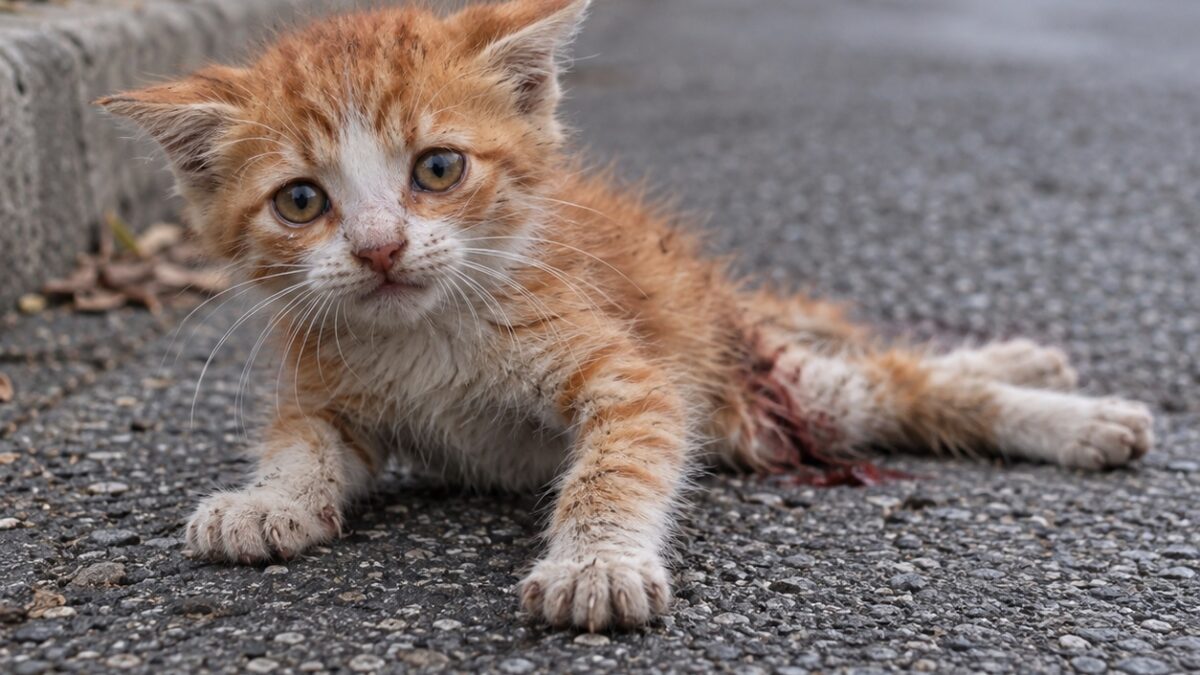
PART2
That night, I kept seeing him push himself up with his front legs.
Again.
Again.
As if effort alone could convince the back half of his body to remember what to do.
I slept badly.
The next morning, I called before anyone had to update me.
“How is he?”
“Stable.”
One word.
Beautiful word.
Not healthy.
Not safe.
Stable.
He had made it through the immediate danger.
I went to see him.
He looked smaller inside the hospital cage than he had on the road.
Maybe because now there were walls around him.
Equipment.
Blankets.
Medical supplies.
Everything made his body seem even more fragile.
He was awake.
I stood nearby.
“Hey.”
His ears moved.
That tiny response nearly destroyed me.
I had been thinking about names overnight.
Something about giving him a name felt important.
Maybe because an unnamed injured kitten is a case.
A named kitten is someone.
I called him Bonnie.
“Bonnie.”
His head turned.
Not much.
Enough.
“That’s you.”
His eyes found me.
I smiled.
“Bonnie.”
Again.
He responded.
There was still a person inside all that injury.
A little personality.
A little awareness.
Something listening.
That mattered more than I can explain.
The emergency treatment had gotten him out of immediate danger.
But the spinal injury had not changed.
He still could not use his hind legs.
The doctors explained that spinal trauma is complicated.
A fracture is one problem.
Nerve damage is another.
Even if bones stabilize, nerves may not recover fully.
Sometimes function returns slowly.
Sometimes partially.
Sometimes not at all.
I asked the question I was afraid to ask.
“Could he never walk again?”
“Yes.”
The answer came gently.
Still yes.
I stared at Bonnie.
He was watching us.
“Could he still live?”
Another pause.
“Yes, potentially.”
Potentially.
Another word to carry.
The doctors warned me that mobility might not be the only issue.
Damage to the nerves controlling the bladder could mean he would not be able to empty it normally.
That frightened me in a different way.
Walking was visible.
You could see two hind legs dragging.
But neurological damage can take away functions people do not think about until they are gone.
The ability to urinate.
The ability to stay clean.
The ability to manage basic bodily needs independently.
Suddenly Bonnie’s future seemed full of questions I had never expected to learn about.
I wanted more certainty.
So I sought another opinion.
Not because I distrusted the first hospital.
Because when someone tells you a kitten may never use half his body again, you want to know you have asked everyone you reasonably can.
We arranged evaluation at a larger hospital.
More examinations.
More neurological assessment.
I hoped someone would look at Bonnie and say:
The first team was wrong.
He’ll be fine.
That did not happen.
The second opinion confirmed how serious the damage was.
Severe nerve involvement.
No reliable use of the hind legs.
Problems emptying his bladder.
A catheter was necessary to help.
I remember standing there listening to instructions about urinary care while Bonnie lay nearby.
He had survived being hit by a car.
Now survival meant learning an entirely different way to care for him.
Medication.
Monitoring.
Bladder management.
Keeping his body clean because he could not always manage himself.
Regular follow-up.
Watching his skin because dragging limbs can cause injuries an animal may not protect normally.
The list grew.
I thought about his size.
He was still so small.
His entire future had changed in seconds.
One moving car.
One impact.
Then this.
I felt angry.
Not at anyone in particular.
Just at how quickly life can split into before and after.
Before:
Kitten.
Running, presumably.
Climbing.
Jumping.
Whatever little world he had been living.
After:
Hospital.
Catheter.
Paralysis.
Pain medication.
People discussing whether nerves might ever work again.
I sat beside him.
Bonnie looked at me.
I reached through carefully and stroked the top of his head.
He leaned into my fingers.
Then something happened that I still remember more clearly than many of the medical conversations.
Bonnie stretched one front paw toward me.
Slowly.
Not dramatically.
Just one small paw.
He reached until it touched my hand.
I stopped breathing for a second.
There are moments when people project enormous meaning onto small animal gestures.
Maybe Bonnie simply wanted contact.
Maybe he was shifting.
Maybe warmth drew him closer.
I don’t need to know.
What mattered was what the moment did to me.
Until then, I had been thinking almost entirely about loss.
He may never walk.
He may never control his bladder.
He may need help forever.
Then that paw touched me and I thought:
But he is here.
He can still reach.
He can still recognize.
He can still want.
Maybe I needed to stop grieving a future before Bonnie had even had the chance to live it.
“Okay.”
I whispered.
He kept his paw near my fingers.
“Okay, Bonnie.”
I stroked his head.
“We’ll figure out what your life looks like.”
Not what I had hoped it would look like.
What it actually could be.
That shift became important.
Bonnie stayed hospitalized.
His body needed time.
He was still weak from trauma.
Medication had to be managed.
His urinary needs required professional care.
And the hospital was the safest place while everyone determined what his baseline would become.
I visited.
Again.
Again.
As often as I could.
At first, every visit started with the same question.
“Any movement?”
I meant the hind legs.
The answer was usually:
“No significant change.”
Sometimes someone would say there had been a small reflex.
But reflex is not purposeful movement.
I learned that quickly.
I had to stop hearing hope in every twitch.
Medicine requires honesty.
So does love.
Bonnie still couldn’t stand.
But he started eating.
And that became our next celebration.
At first, appetite after major trauma can be unpredictable.
Pain.
Stress.
Medication.
Hospital environment.
All of it affects food.
Then Bonnie decided food was worth participating in.
He ate eagerly.
I brought his medication and nutritional support as directed and mixed what could appropriately be mixed into his meals.
I watched him eat.
He finished.
I remember laughing.
“Look at you.”
Bonnie kept going.
“You’re supposed to look sick.”
No interest.
He cleaned the bowl.
That appetite became reassuring.
The body may be injured.
The nervous system may be compromised.
But hunger says something.
Energy is being asked for.
Life is asking for fuel.
I began looking forward to feeding updates as much as neurological ones.
“How much did he eat?”
“All of it.”
Wonderful.
Somebody could have told me no hind-leg movement and I would feel crushed.
Then:
He ate well.
And I would breathe again.
Rescue teaches you how to live inside conflicting information.
Bad spine.
Good appetite.
Catheter still needed.
More alert today.
No walking.
Gained a little strength.
All true at once.
I started seeing Bonnie differently.
Not as a tragedy waiting for reversal.
As a kitten adapting in real time.
His front half became strong.
He used his forelegs to reposition himself.
He learned how to move what he could move.
When he wanted to face something, he figured out how.
When he wanted food, motivation appeared immediately.
The hospital staff began learning his personality.
He was not endlessly solemn.
That was a relief.
There were moments when he was curious.
Moments when he watched activity.
Moments when he seemed irritated by people handling him.
Good.
I liked irritation.
It meant he had enough energy to have preferences.
People heard about Bonnie.
His story spread.
A kitten hit by a car.
Broken spine.
Possibly paralyzed.
Needing prolonged hospitalization.
Medical bills grew.
Then people started helping.
Donations.
Small amounts.
Larger ones.
Enough people contributing that the care became possible to continue.
I will never forget that.
Most of the people helping Bonnie never met him.
Some may have seen one photograph.
Read a few lines.
That was enough.
They looked at a small injured animal and decided his life was worth contributing to.
Money is uncomfortable to discuss in rescue stories.
But veterinary care costs money.
Imaging.
Hospitalization.
Medication.
Catheter supplies.
Professional monitoring.
Follow-ups.
Compassion without resources can become helplessness.
The people who helped pay for Bonnie’s treatment were part of his rescue too.
I told him occasionally.
“You have investors.”
Bonnie blinked.
“High expectations.”
He ate.
That was his contribution.
Days became weeks.
The doctors continued assessing him.
No dramatic return of hind-leg function.
That was hard.
I had secretly expected that because he was so young, maybe the nerves would suddenly wake.
One day.
A toe.
Then a leg.
Then standing.
Recovery stories train us to expect visible miracles.
Bonnie did not offer one.
His progress looked different.
Stronger appetite.
Better body condition.
More alert.
More playful.
More able to move himself using the body he had.
The paralysis remained.
I had to learn not to make that erase everything else.
One visit, I found Bonnie grooming himself.
Carefully.
Focused.
I stood watching.
He licked one front paw.
Then his chest.
Worked at keeping himself clean in the areas he could manage.
Something about that broke my heart.
Cats are meticulous animals.
Grooming is independence.
Routine.
Normalcy.
Here was Bonnie in a hospital, unable to stand on his back legs, calmly washing himself as though to say:
There are still things I can do.
I sat nearby.
“Very handsome.”
He ignored me.
Cats are excellent at keeping rescuers emotionally humble.
Another day, I found him interested in something near the edge of his space.
His front paws worked.
He pulled himself closer.
Curious.
That curiosity became one of the most important signs that Bonnie was not living only inside his injury.
He wanted to investigate.
He wanted to know.
He wanted stimulation.
Paralysis had changed how he reached the world.
It had not removed his desire to reach it.
Eventually, the doctors gave us news I had been waiting for almost as much as I once waited for movement.
“He can go home.”
I stared.
“Home?”
“Yes.”
Not cured.
Not walking.
Medically stable enough to leave hospitalization with proper care.
That distinction mattered.
I was terrified.
At the hospital, there were trained people.
Equipment.
Immediate help.
At home, there would be me.
“What if I do something wrong?”
We went through the care plan.
Medication.
Hygiene.
Bladder management as advised.
Watching for complications.
Regular checkups.
Keeping him safe.
Helping him stay clean.
Monitoring his skin and his general condition.
The list was serious.
But possible.
“Can he really come home?”
“Yes.”
I looked at Bonnie.
He was lying on the blanket.
Home.
The word felt enormous.
Until that point, Bonnie’s entire life with me had been medical spaces.
The road.
Emergency hospital.
Larger hospital.
Cages.
Examination tables.
Now:
Home.
I prepared.
Soft places.
Easy-to-clean areas.
Food.
Medication organized.
Everything I knew he would need.
Then I brought him out of the hospital.
I remember carrying him.
His body had more weight than when I first lifted him off the road.
Not much.
Enough to notice.
His hind legs still did not support him.
But the kitten in my arms felt less fragile.
More present.
I set him down inside.
Bonnie looked around.
New smells.
New sounds.
No hospital barking.
No staff footsteps.
No medical equipment.
He pulled himself forward using his front legs.
I stayed close.
He moved toward one area.
Then another.
Every instinct in me wanted to help.
To lift him.
Place him where I thought he wanted to go.
But Bonnie needed opportunities to decide.
So I waited.
He dragged his hind legs behind him.
That was painful to see.
There was no way around it.
Every movement made the injury visible.
But the alternative was not movement without disability.
The alternative was preventing him from exploring.
So I let him move while keeping the environment safe.
He investigated.
That first day, I think I watched him every second.
Is he breathing normally?
Is he uncomfortable?
Does he need to urinate?
Is he dirty?
Did the skin drag too much?
Is he tired?
Bonnie eventually seemed annoyed by the surveillance.
Good.
Within days, the home started belonging to him.
His care became routine.
Medication at the right time.
Cleaning.
Food.
Helping with bodily needs.
Checking his hindquarters.
Follow-up appointments.
At first, every task felt medical.
Then something shifted.
It became daily life.
That is an important transition for caregivers of disabled animals.
In the beginning, disability feels like the center of everything.
Then the animal develops a schedule.
Preferences.
Favorite places.
Habits.
The medical care becomes something you do within a larger relationship.
Bonnie was not a spinal injury living in my house.
He was Bonnie.
And Bonnie was curious.
Far too curious.
The trash cans became an early obsession.
I discovered this when I heard a noise.
Turned.
And saw Bonnie investigating where he absolutely did not belong.
His front paws had gotten him farther than I expected.
“Bonnie.”
He froze.
Looked at me.
“What are you doing?”
No remorse.
I moved the trash.
Lesson learned.
Do not assume a disabled kitten lacks ambition.
If anything, Bonnie treated physical limitation as a design problem.
Can’t walk normally?
Fine.
Pull.
Slide.
Reach.
Adapt.
I started adjusting the house around him rather than constantly trying to adjust him to the house.
Objects moved.
Hazards removed.
Things he could safely investigate stayed available.
He found toys.
Some interested him.
Some did not.
He discovered random household objects were apparently more exciting than things purchased specifically for him.
Typical cat.
He began playing.
That was one of my happiest days.
A small object caught his attention.
He reached.
Patted it.
It moved.
His eyes changed.
Again.
He chased it with the body he had.
Front legs working.
Hind legs trailing.
Did it look like a healthy four-legged kitten running?
No.
Did Bonnie care?
Not remotely.
He played.
I laughed.
Then cried.
Then laughed at myself for crying while a kitten tried to attack an object on the floor.
The accident had taken function from him.
It had not taken play.
That mattered.
His appetite remained strong.
He gained weight.
The thin body from the hospital slowly filled out.
His coat looked better.
His face changed.
People sometimes think disability makes an animal permanently look “sad.”
Bonnie did not.
When he was hungry, he looked hungry.
When curious, curious.
When annoyed, extremely annoyed.
When sleepy, normal cat boredom with humans.
His hind legs still dragged.
That remained true.
But it stopped being the first thing I noticed every time I looked at him.
That may have been one of my own forms of healing.
At first:
Bonnie cannot walk.
Later:
Bonnie is trying to get into the trash again.
The difference is not denial.
I never forgot his care needs.
It is perspective.
Disability belongs in the picture.
It does not have to occupy the whole frame.
Bonnie began following me.
At first I did not realize that was what he was doing.
I’d move from one room to another.
A few moments later:
scrape.
movement.
Bonnie.
I went somewhere else.
Eventually:
Bonnie.
“You know you don’t have to supervise me.”
He disagreed.
When I worked, Bonnie stayed nearby.
Sometimes within reach.
Sometimes simply in the same room.
I learned the sounds of his movement.
The soft drag of his hind legs.
The stronger push from his forelimbs.
At first that sound hurt me.
Later it became:
Bonnie is coming.
Like footsteps.
His footsteps were simply different.
When I left the house, I worried.
Would he be okay?
Was everything positioned correctly?
Enough water?
Clean?
Safe?
I became obsessive for a while.
Then experience slowly built trust in the routine.
I came home.
And Bonnie started waiting.
Near the door.
The first time I saw him there, I stopped.
The kitten who had once been carried away from a road now knew there was a specific human who left and came back.
I opened the door.
“Hi.”
Bonnie moved toward me.
Front paws pulling.
Eyes bright.
I crouched.
He reached me.
That became our ritual.
I leave.
Bonnie stays.
I return.
He waits.
I had rescued him physically once.
Now I was learning that trust itself is built through hundreds of small returns.
Food.
Medication.
Cleaning.
Come back.
Appointment.
Come home.
Day.
Night.
Again.
Bonnie’s bladder care remained one of the most demanding parts.
The spinal injury had interfered with normal function.
It wasn’t glamorous.
Not the part people share when they want a quick inspirational story.
But this is the reality of caring for a neurologically injured animal.
Somebody has to deal with urine.
Clean bedding.
Skin care.
Catheters when medically necessary.
Monitor for complications.
Seek veterinary guidance.
Care is often intimate in unromantic ways.
I learned quickly that dignity does not mean pretending a body has no difficult functions.
Dignity means helping without making the animal feel like a burden.
Bonnie didn’t apologize.
Good.
Why should he?
His nervous system had been injured.
He had not chosen it.
So when cleaning was needed, I cleaned.
When medication was due, I gave it.
When a checkup was needed, we went.
Then we played.
That order mattered.
Care.
Then life.
The first weeks at home were exhausting.
I won’t pretend otherwise.
There were times I was afraid I had taken on more than I could handle.
Then I would look at Bonnie.
Usually doing something completely unreasonable.
Trying to investigate a bag.
Grooming.
Dragging himself after a toy.
Sleeping near me.
And the fear became manageable.
You do not have to feel capable every minute to continue caring responsibly.
You need a plan.
Veterinary support.
Consistency.
And willingness to learn.
Bonnie taught me a lot.
His body had limits.
He understood them differently than I did.
I saw:
He cannot stand on his hind legs.
Bonnie seemed to think:
I want to get over there.
Then he figured out how far he could go.
Animals are often practical in ways humans are not.
We mourn theoretical normality.
They negotiate actual life.
Bonnie wanted food.
Warmth.
Play.
Clean fur.
My presence.
He had those.
Would I still have chosen full mobility for him if I could?
Of course.
I still hoped the nerves might recover.
I massaged his hind legs gently as part of the care we had discussed and continued bringing him for follow-ups.
Every time I touched those legs, hope entered the room.
Move.
Anything.
A twitch with intent.
A withdrawal.
A toe.
Something.
Sometimes I imagined I felt a response.
Then I reminded myself not to confuse what I wanted with what was there.
Hope needs honesty or it becomes cruelty.
So I watched.
Waited.
Continued care.
At one month, Bonnie was stronger overall.
His front legs had developed noticeably because they did so much work.
His appetite remained excellent.
He had gained weight.
He was more active.
But his hind legs still did not support him.
People would ask:
“Any improvement?”
I knew what they meant.
Walking.
“No.”
Then I would add:
“But he’s doing really well.”
At first that sentence sounded contradictory.
Eventually it didn’t.
You can be disabled and doing well.
That is the simple truth people often take too long to understand.
Bonnie’s quality of life was not measured only by whether his spinal cord returned to normal.
He ate eagerly.
Played.
Groomed.
Explored.
Followed me.
Rested comfortably.
Trusted.
Those are measures too.
The hospital follow-ups continued.
At each one, the staff assessed him.
Neurological function.
Bladder needs.
General health.
Weight.
Skin.
Anything associated with his condition.
Bonnie usually tolerated the visits with varying levels of dignity.
I sometimes wondered whether he remembered the hospital as the place his pain began.
Probably not in that narrative way.
But he certainly recognized some smells.
Some people.
He would become more alert.
Then afterward, back home:
relax.
Home had become distinct.
That felt like a victory.
At the two-month checkup, I went in carrying more hope than I admitted.
Two months sounded like enough time for something dramatic to happen.
Maybe nerve healing is slow.
Maybe today someone will detect meaningful function.
Maybe Bonnie will surprise us.
The veterinarian examined him.
Carefully.
Reflexes.
Responses.
Strength.
We watched his hind legs.
Bonnie could still not stand on them.
No miracle.
No sudden recovery.
I felt the disappointment before anyone spoke.
It must have shown.
The veterinarian reminded me that severe nerve damage can have uncertain outcomes.
Some neurological injuries take a long time.
Others leave permanent deficits.
At two months, Bonnie’s continued inability to stand remained significant.
I nodded.
I had known.
Knowing and hearing are different.
On the way home, Bonnie rested quietly.
I kept one hand near him.
I felt guilty for being sad.
Bonnie was alive.
Healthy in many ways.
Happy.
Why was I mourning?
Because hope and gratitude can coexist.
I was grateful.
I also wanted more for him.
That did not mean the life he had was insufficient.
It meant I loved him.
When we got home, I set Bonnie down.
He pulled himself forward.
Went directly toward something he wanted.
No existential crisis.
No disappointment over the checkup.
No shame.
I watched him.
Then laughed.
“You don’t care, do you?”
Bonnie continued.
He had an evening to live.
Food to eat.
Objects to inspect.
I followed.
That night, I massaged his hind legs gently.
Slow movements.
Careful.
The same as before.
Not because I had been promised it would make him walk.
Because continued supportive care mattered and because I still hoped some movement might appear.
Bonnie lay there.
Patient for a while.
Then he had enough.
He reached with a front paw.
I stopped.
“Okay.”
His boundaries mattered.
I let him go.
He dragged himself toward his bed.
Then changed his mind and came back toward me.
Typical.
We settled.
I began understanding that a happy ending doesn’t always look like the ending people expect.
If you tell someone:
Kitten hit by car, spinal fracture, cannot walk.
Their mind immediately writes one desired conclusion.
Then he walks again.
That is the cinematic ending.
It might still happen for some animals.
It had not happened for Bonnie.
Not yet.
Maybe never.
But if we refuse to call his life meaningful until his hind legs work, we miss everything already happening.
The kitten who lay bleeding in the road had survived.
The kitten who could not stand had learned to move through a home.
The frightened patient ate with enthusiasm.
The hospital case became a trash-can investigator.
A grooming enthusiast.
A follower.
A door-waiter.
A companion.
That is not a consolation prize.
That is a life.
One morning, I was working.
Bonnie rested nearby.
I became focused enough to forget he was there.
Then I felt a front paw touch my foot.
I looked down.
He had pulled himself closer.
“What?”
Bonnie stared.
Maybe food.
Probably food.
I smiled.
“Very emotional.”
He kept staring.
“Fine.”
I checked the time.
Meal time.
He had trained me.
Good.
His daily routines became so normal that sometimes I forgot how unusual the beginning had been.
Then a sound would bring it back.
The scrape of his hind legs on the floor.
A medical supply.
A reminder for medication.
And for one second:
Road.
Blood.
Hospital.
Then Bonnie would attack a toy and the memory lost its grip.
Present beats past when you give it enough repetitions.
I made sure the floors and areas he used were as safe as possible for his movement.
Dragging can cause friction.
Skin needs checking.
Cleanliness matters.
Disabled animals often require environmental adjustments that healthy animals don’t.
Those adjustments are not evidence that their lives are miserable.
They are evidence that care is specific.
We adjust life for those we love.
A ramp.
A soft surface.
A schedule.
A cleaned area.
Medication.
Humans do this for one another too.
Bonnie’s needs became architecture.
The house subtly changed around him.
And once changed, it felt normal.
People visiting sometimes stared at his legs.
I understood.
It is the first visible thing if you do not know him.
Then Bonnie would do something.
Grab an object.
Move toward them.
Ignore them.
The legs became less central.
One visitor said:
“Does he know he’s disabled?”
I didn’t like the question at first.
Then I understood what they meant.
“No.”
I said.
“Not the way we think about it.”
Bonnie knows what his body can and cannot do.
He doesn’t appear to sit around comparing himself with an imaginary version.
He solves problems.
That is different.
Maybe that’s one of the gifts animals give us.
They are often better at inhabiting reality.
I still wanted nerve recovery.
Of course.
Every follow-up carried that hope.
But I stopped making Bonnie’s happiness wait for it.
We could pursue appropriate care and enjoy him now.
Both.
That’s the balance.
The donations that helped during his hospitalization remained something I thought about often.
People had invested in a future that was uncertain.
They did not know if Bonnie would walk.
They didn’t know if he would survive complications.
They helped anyway.
I sent updates.
Not only medical ones.
Bonnie ate.
Bonnie gained weight.
Bonnie came home.
Bonnie is playing.
Bonnie waits at the door.
People responded.
Some were surprised he still couldn’t walk.
But most were happy.
That gave me hope about humans too.
They understood the rescue was successful even without perfect physical restoration.
That matters.
Too often disabled animals are treated as unfinished stories.
As if the only acceptable ending is “normal again.”
Bonnie was not unfinished.
He was living.
The condition remained part of his care.
Maybe permanent.
But a permanent disability does not mean permanent suffering.
Pain and disability are not identical.
Dependence and misery are not identical.
Bonnie taught me to separate them.
When he was first hit, he was suffering.
Acute pain.
Shock.
Spinal trauma.
That required emergency treatment.
At home later, when medically stable and cared for, he had limitations.
Not the same thing.
His world still contained pleasure.
Food.
Play.
Grooming.
Attachment.
Rest.
Curiosity.
Those matter when evaluating a life.
The people who helped him did not save him so he could pass a walking test.
They saved him so he could have days.
He had days.
Good ones.
Bonnie developed favorite spots.
One near where I worked.
Another where he could watch part of the room.
He seemed to enjoy being included.
If I moved too many times, he eventually followed.
Sometimes slowly.
Sometimes with surprising speed.
His front legs were strong.
One day he reached the door before I expected.
I laughed.
“Were you waiting?”
He looked up.
When I returned home later, there he was again.
That became emotional for reasons I couldn’t entirely explain.
Maybe because I remembered carrying him away from the road.
On that first day, Bonnie had no reason to know whether the person holding him would remain part of his life.
Now he knew my schedule enough to wait.
Trust is not one dramatic gesture.
It is prediction.
I know what you do.
You leave.
You come back.
You feed me.
You help me.
You do not hurt me.
That is security.
Bonnie had it.
There were difficult days.
Important to say.
Cleaning accidents.
Worrying whether his bladder was emptying properly.
Medical appointments.
The stress of wondering if an infection might develop.
Fatigue.
There were moments when I wished care could be simple.
Then I felt guilty for wishing that.
Eventually I stopped feeling guilty.
Caregivers are allowed to be tired.
Tired does not mean regret.
You can love an animal and hate a difficult task.
You can be committed and overwhelmed.
The answer is support.
Veterinary guidance.
Routine.
Rest when possible.
Not pretending hardship is beautiful.
Bonnie’s life was beautiful.
Some parts of his care were not.
Both true.
I became faster and more confident.
Things that once took emotional preparation became ordinary.
Medication.
Check.
Cleaning.
Check.
Skin.
Check.
Food.
Bonnie’s favorite part.
Done.
Then play.
The balance improved.
His coat became healthier.
He groomed whatever areas he could reach.
I helped with what he couldn’t manage.
Another intimate collaboration he never asked for but accepted.
Sometimes he’d begin grooming while I was cleaning him.
As though saying:
I can handle this section.
Fine.
Team effort.
I liked that.
Bonnie wanted independence where possible.
I respected it.
Even small choices matter when an animal needs daily assistance.
Where to lie.
What toy to choose.
Whether he wants touch.
When possible, let the animal decide.
Disability can create a temptation to overhandle.
Help with everything.
But overhelping can remove the opportunities they still have.
So I learned to distinguish:
He needs assistance.
From:
I am uncomfortable watching him do it differently.
Important difference.
If Bonnie could pull himself across the floor safely, I let him.
It might look difficult to someone else.
To him, it was mobility.
He built skill.
Confidence.
Strength.
The hind legs remained behind him.
The front half carried the future.
Sometimes I wondered what he would do if movement suddenly returned.
Stand?
Fall?
Run?
Would his brain know immediately?
Those fantasies came and went.
I allowed them.
Hope is not wrong.
Only if it makes the current life feel worthless.
I refused that.
At night, Bonnie slept comfortably.
I would sometimes sit nearby and look at him.
The contrast with the road was impossible to ignore.
Then:
Blood.
Pain.
Cars.
No safety.
Now:
Warm.
Fed.
Clean.
Medication given.
Door closed.
Somebody nearby.
If his hind legs never moved again, nobody could take those differences away.
Rescue had already mattered.
That was the lesson I kept returning to.
Success is not always restoration.
Sometimes success is adaptation with love.
The two-month checkup did not give me the news I had secretly wanted.
But it gave us information.
Continue care.
Continue monitoring.
Hope responsibly.
And live.
So we did.
The next morning, Bonnie ate breakfast like nothing had happened.
He investigated something he wasn’t supposed to.
Groomed himself.
Then followed me.
I looked back.
His hind legs dragged.
I saw them.
Of course.
But I also saw his face.
Alert.
Interested.
Busy.
“Coming?”
I asked.
Bonnie kept moving.
I slowed so we could arrive together.
That became one of the simplest ways I understood love.
Not dragging him forward.
Not standing too far ahead and pitying him.
Just adjusting my pace.
He followed.
I waited.
We continued.
People sometimes ask whether disabled animals know they are loved.
I cannot answer what Bonnie conceptualizes.
I can tell you what he does.
When I work, he stays near.
When I leave, he waits.
When I return, he comes toward me.
He eats without fear.
Sleeps comfortably.
Plays in the house.
Grooms.
Explores.
Reaches his paw.
Those are facts.
If love is made visible through safety, repetition, and trust, then yes.
Bonnie lives inside it.
I still remember the first paw.
Hospital.
Weak body.
Spinal injury freshly diagnosed.
My hand near him.
Bonnie reaching.
At the time, I saw it as hope.
Now I see something else too.
Connection.
His back legs could not reach where he wanted to go.
So he used what could.
That became his entire way of living.
Use what still works.
Reach.
Pull.
Adapt.
Trust.
We humans tend to stare at what is gone.
Bonnie builds with what remains.
There is wisdom in that, though I would never romanticize his injury.
I would undo the accident in a second if I could.
He deserved an uninjured spine.
He deserved to run normally.
Wanting meaning from suffering should never make us grateful the suffering happened.
I am not.
The accident was terrible.
The paralysis may be permanent.
None of that was necessary for Bonnie to become worthy or lovable.
Goodness came after harm.
It does not justify harm.
That’s an important distinction.
What I am grateful for is what happened next.
Someone stopped.
Bonnie reached the hospital.
The doctors stabilized him.
A second hospital assessed him.
People helped pay.
He stayed long enough to get strong.
He came home.
Care continued.
That’s the part worth celebrating.
Human response.
Not tragedy.
I never learned what Bonnie’s life would have been if the car had missed him.
There is no use trying.
We have this life.
The one in front of us.
And in this life, Bonnie has a home.
He has meals he looks forward to.
He has a person.
He has routines.
He has medical care.
He has objects to knock around and trash cans to inspect against instructions.
He has a door he waits near.
That is enough to fill a day.
One afternoon, I noticed Bonnie sitting near me after grooming.
He had worked particularly hard at one shoulder.
His fur was slightly damp.
I said:
“Very clean.”
He stared.
“Excellent work.”
No response.
“Five stars.”
Bonnie moved away.
This is another part of happy endings people overlook.
Humor returns.
At the beginning, everything is solemn.
Will he live?
Will he walk?
Will he urinate?
Will he eat?
Then months later you’re arguing with him about garbage.
That shift is healing.
Not just for Bonnie.
For me.
I no longer approached every day expecting catastrophe.
I remained vigilant about his condition.
But vigilance softened into care.
Fear is exhausting.
Routine gives fear boundaries.
Check the things that matter.
Call the vet when needed.
Then let Bonnie be a cat.
I eventually stopped watching every bite.
He had proven his appetite.
Stopped staring whenever he moved.
He knew the house.
Stopped panicking over every nap.
He sleeps.
Good.
This gradual trust in his stability allowed both of us more normality.
I kept massaging his hind legs gently as part of our routine, continuing to hope that one day I might feel something intentional.
I never promised him he would walk.
You can’t promise biology.
Instead I gave him something I could promise.
“If you don’t, you’re still staying.”
That mattered to me.
Maybe he didn’t understand the sentence.
My actions could make it true.
A permanent home should not depend on a recovery milestone.
You do not adopt a disabled animal under the condition that they become less disabled later.
Bonnie was home now.
Whatever his nerves decided.
That certainty changed my hope.
I could hope without fear that failure would make him lose everything.
He didn’t have to walk to earn his place.
He already belonged.
That may be the biggest difference between rehabilitation and love.
Rehabilitation asks:
Can function improve?
Love answers:
Either way, I’m here.
Both matter.
Bonnie got both.
At three in the morning on one difficult night, I sat cleaning him after an accident.
I was tired.
Bonnie was annoyed.
Nothing inspirational about it.
I remember thinking:
This is the part nobody puts in the rescue video.
Then I laughed.
Bonnie looked offended.
“Sorry.”
I finished.
Changed the bedding.
Made sure he was comfortable.
Then he settled.
Within minutes, asleep.
I sat there for a while.
That was love too.
Not dramatic.
No music.
Nobody watching.
Care done because it needed doing.
Maybe the best forms of love are mostly invisible.
Bonnie had already attracted generosity from strangers while hospitalized.
But the life afterward was built from these private moments.
The things no donor saw.
No one applauded.
Medication.
Laundry.
Cleaning.
Appointments.
Massage.
Monitoring.
Returning home.
This is what makes rescue permanent.
Getting an animal off the road is the emergency act.
Building a sustainable life afterward is the long rescue.
Bonnie’s long rescue continues.
I don’t mean he remains in crisis.
I mean care continues because his condition continues.
That does not make his life tragic.
It makes his life supported.
There’s a difference.
One evening, I saw Bonnie waiting near the doorway before I entered fully.
He recognized me.
Moved forward.
I crouched.
“Were you waiting?”
He reached a paw.
Same gesture.
Not exactly.
Stronger now.
I touched it.
For a second, hospital and home overlapped.
Then weak.
Now strong.
Then uncertain future.
Now known routine.
Then catheter and ICU.
Now home.
Same paw.
Different life.
I swallowed.
“You really did make it.”
Not into walking.
Into life.
That is what I meant.
Some readers may still want the miracle.
They want me to say:
And then one morning Bonnie stood.
I cannot.
At two months, he still could not use his hind legs to stand.
His rescuer—me, in this telling—continued the care.
Continued massage.
Continued hope.
The future of his neurological function remained uncertain.
That is where honesty matters.
A satisfying ending does not have to lie.
Bonnie doesn’t need a fictional recovery to make the story worthwhile.
His real life is enough.
The kitten once bleeding in traffic now waits safely at a door.
The kitten once unable to eat without hospital oversight now anticipates meals.
The kitten whose body was defined by an X-ray now explores a home.
The kitten whose back legs still drag has somehow become fast enough to get into things he shouldn’t.
The kitten strangers helped save has become somebody’s family.
That is not an unfinished ending.
It’s a different kind of complete.
I still hope.
When I massage his legs, hope.
At checkups, hope.
If I notice any movement, I pay attention.
Maybe one day nerves will surprise us.
Maybe not.
But Bonnie does not spend his life waiting for that day.
Neither will I.
We have today.
Today he eats.
Today he plays.
Today he is clean.
Today he follows.
Today he waits at the door.
Today he knows home.
That is enough.
And tomorrow, we will do it again.
The medicines.
The care.
The meal.
The exploration.
The ridiculous interest in trash cans.
The grooming.
The follow-up when due.
The little paw reaching.
Again.
Again.
That repetition is what transformed Bonnie’s story.
Not one medical miracle.
Hundreds of ordinary decisions to continue.
I sometimes think about the person who first rushed him from the road to the hospital.
That first decision may have lasted seconds.
See kitten.
Stop.
Pick up.
Drive.
Simple.
Yet everything depended on it.
Bonnie could not save himself from the road.
Someone had to notice.
That’s where rescue began.
Then each person carried him another piece.
Doctors.
Nurses.
Donors.
Caregivers.
No single person owns the entire story.
But Bonnie owns the life.
That is important.
We did not save him so he would become an inspirational example for humans.
We saved him because he was alive and suffering.
The rest belongs to him.
If he wants to spend that saved life investigating the garbage, so be it.
Probably move the garbage higher.
I did.
He found something else.
Cats.
Bonnie grew.
That is another simple fact I cherish.
The tiny injured kitten gained weight.
His face changed with age.
His front body strengthened.
The house gradually stopped looking large around him.
He occupied it.
Home expands around personality, not legs.
Bonnie’s presence became normal enough that guests expected him.
“Where’s Bonnie?”
Nearby.
Always.
Watching.
Moving.
Sometimes asleep.
He became part of the household’s map.
One day I realized I had not thought about the accident for several days.
That surprised me.
At first, the road was always present.
Every time I looked at his spine.
Road.
Every time his legs dragged.
Road.
Then Bonnie accumulated enough new memories to dilute the first.
Trash can.
Door.
Meal.
Toy.
Work desk.
Nap.
Vet visit.
Home.
The accident did not disappear.
It became chapter one.
Not the whole book.
That’s healing for caregivers too.
You need enough present to stop living entirely in rescue day.
Bonnie gave me that.
One playful moment at a time.
I don’t know exactly what the future holds for him.
That’s honest.
His spinal nerve damage remains severe.
His hind legs may never function normally.
He may always need help with certain bodily needs.
He will need attentive care and veterinary monitoring.
Those truths remain.
But uncertainty works both directions.
We cannot promise deterioration either.
We care for the animal in front of us.
Bonnie today is engaged.
Curious.
Loved.
That’s the relevant prognosis for the heart.
I remember asking early:
“Can he still live?”
The doctor said:
“Potentially.”
Now I know what that answer looked like.
It looked like Bonnie pulling himself toward food.
It looked like him grooming his fur.
It looked like a front paw batting at something on the floor.
It looked like him following me through the house with two legs working normally and two trailing behind.
It looked like clean bedding.
Medicine.
A door.
Waiting.
Home.
Yes.
He could still live.
He does.
That doesn’t erase the sadness.
Sometimes I still look at his hind legs and feel it.
I imagine him running.
Jumping.
Climbing.
The cat he might have been.
Then Bonnie does something completely himself and reminds me that hypothetical cats do not need my grief.
The real one needs dinner.
Perspective.
I give him dinner.
He eats eagerly.
Good.
Afterward, he cleans his face.
Then begins moving toward me.
His back legs drag.
His front paws pull.
He arrives.
I reach down.
Bonnie touches my hand.
And again, just like the hospital, one tiny paw says enough.
I am here.
Maybe that is all any rescue story is really trying to preserve.
Not perfection.
Presence.
Bonnie is here.
He survived.
He trusts.
He has someone.
And no matter what his hind legs do next, the road is no longer where his story lives.
His story lives inside a home now.
In the sound of his body moving toward the person he trusts.
In the bowl he empties.
In the toys he finds.
In the trash cans he shouldn’t investigate.
In the clean blanket waiting for him.
In the gentle massage of legs that may or may not someday respond.
In the person who keeps hoping without making hope a condition of love.
That is Bonnie’s ending.
Not:
He walked again.
Not yet.
Maybe never.
Something quieter.
The kitten who could not get back on his feet after a car struck him no longer has to save himself.
He has people who lift him when lifting is needed.
People who let him move when he can.
People who clean him without shame.
Feed him without complaint.
Take him back to the doctor.
Wait for answers.
Celebrate appetite.
Laugh at mischief.
And open the door every time they come home.
Bonnie still drags his hind legs behind him.
But he does not drag his life behind him.
He lives in front of the injury.
One room.
One meal.
One game.
One day at a time.
And for a kitten who once lay bleeding in the middle of a road while cars moved around him, there is something profoundly beautiful about knowing exactly where he will sleep tonight.
Warm.
Fed.
Clean.
Safe.
And close to the person who stopped that day—
picked him up—
and never put him back down alone.








