PART2:I Found a Homeless Man Frozen at an Abandoned Train Station—But Under His Coat, Something Was Still Alive
PART2
He had been cold.
Dangerously cold.
He must have known it.
Even if he didn’t understand how close he was to dying, nobody could sit in that station and not feel what the temperature was doing.
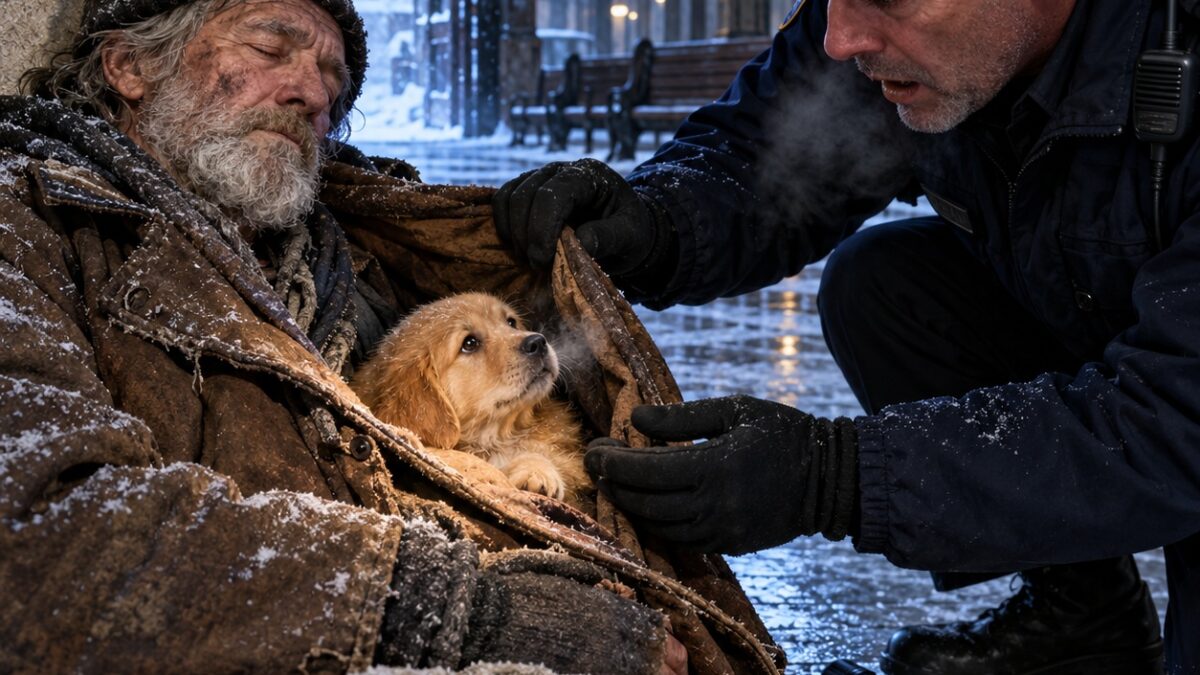
And still, the warmest part of his coat was wrapped around the puppy.
Not himself.
Her.
I slipped one hand beneath her.
She barely resisted.
Too tired.
Too cold.
But alive.
When I lifted her, I felt warmth trapped inside the folds of Henry’s coat.
The last warmth he had protected.
I held the puppy against my chest.
She trembled.
Then pressed closer.
I called emergency services.
The rest happened in procedure.
Police.
Paramedics.
Questions.
Names.
Documentation.
But most of that morning exists in my memory as fragments.
Henry’s hands.
Rough.
Still.
The puppy’s heartbeat against my palm.
The way his coat had been folded around her.
One officer said quietly:
“He saved her.”
Nobody answered.
Because yes.
That was obvious.
The puppy might not have survived the night exposed.
Henry had.
Somehow.
Used his own body as shelter.
When the authorities finished what they needed to do, I took the puppy to my room.
I didn’t know if I was officially supposed to.
Nobody stopped me.
My room looked absurdly small with another living creature inside it.
I placed her on the bed.
Wrapped her in the warmest blanket I owned.
She almost disappeared in it.
Only her face visible.
I turned the radiator higher.
It coughed.
Clanked.
Then finally gave more heat.
“Don’t you quit on me tonight.”
I wasn’t sure whether I was talking to the radiator or the puppy.
Probably both.
I warmed a little milk.
Mixed it with bread.
I didn’t know much about puppies.
Looking back, I would have done some things differently with better knowledge, but in that moment I used what I had.
I placed the dish in front of her.
The puppy stared.
Then at me.
Then at food.
She approached carefully.
Ate one bite.
Stopped.
Looked up.
That look destroyed me.
Not fear exactly.
Permission.
Can I?
Is this for me?
“Yes.”
My voice cracked.
“Eat.”
She took another bite.
I sat beside the bed.
“It’s yours.”
She ate slowly.
Every few seconds, she looked at me.
I kept thinking about Henry.
How many times had he watched her eat?
Had she looked at him the same way?
Had he told her the food was hers?
Had he gone hungry?
I didn’t know yet.
But something about the puppy’s behavior made me suspect she was used to food being uncertain.
When she finished, she turned in a circle on the blanket.
Then lay down.
I touched her head.
She flinched slightly.
Then relaxed.
“Daisy.”
I don’t remember exactly why that name came to me.
Maybe she looked delicate.
Maybe I needed a name immediately because calling her “the puppy from the dead man” felt unbearable.
“Daisy.”
Her ears moved.
Good enough.
I did not sleep that day.
Usually, after a night shift, I could fall asleep almost anywhere.
Not then.
I sat in my old chair near the window.
Daisy on my lap.
Morning slowly lightening behind gray clouds.
The station waking.
People arriving.
Announcements beginning again.
Everything ordinary.
And somewhere else, Henry’s body was being taken away.
That contrast bothered me.
The station continued.
Trains continued.
Coffee sold.
People checked phones.
Doors opened.
A man had died there, and by breakfast the building had resumed being a building.
I looked at Daisy.
She slept with her nose pressed into my sweater.
Henry Carter.
I had heard the name from the police.
That was almost all I knew.
Who were you?
I thought.
Where did you come from?
Who loved you?
Who stopped?
How did you end up dying on a freezing floor while protecting a puppy?
The question that stayed deepest was simpler.
Why her?
A man with almost nothing had something warm enough to keep one body alive.
He gave it away.
To a puppy.
She could not repay him.
Could not find him housing.
Could not save him from the cold.
Could not even understand the sacrifice.
He did it anyway.
That act disturbed me in the best possible way.
I had spent years telling myself that I couldn’t help everyone.
True.
Henry had apparently accepted something different.
You don’t have to help everyone.
Help the life in front of you.
The next day, I went to the police station.
Daisy came with me.
I didn’t trust leaving her alone yet.
A young officer named Rachel spoke to me.
When I said Henry Carter, her expression changed immediately.
“You found him?”
“Yes.”
“And the puppy?”
I lifted the carrier slightly.
“She made it.”
Rachel looked down.
Daisy’s small face appeared.
Rachel covered her mouth for a second.
“Oh.”
“You knew him?”
She nodded.
“We knew Henry.”
The way she said it wasn’t procedural.
Personal.
“How?”
“He’d been around for years.”
“Homeless?”
“Yes.”
“How long?”
She hesitated.
“Long time.”
Then she told me what the file alone couldn’t.
Henry had lost his family in a house fire around fifteen years earlier.
The details weren’t something Rachel gave me fully.
They weren’t mine.
But the result was.
After that loss, something in Henry’s life broke.
He ended up on the streets.
Police knew him.
Outreach workers knew him.
Shelters knew him.
People tried to help.
Sometimes he accepted food.
Sometimes a night indoors.
Often he refused longer-term help.
“Why?”
I asked.
Rachel’s eyes lowered.
“He used to say there were people who needed it more.”
I almost laughed.
Not because it was funny.
Because I was angry.
“He was sleeping outside.”
“I know.”
“He needed it.”
“I know.”
“He died from cold.”
Rachel’s eyes filled.
“I know.”
Silence.
Then she said:
“That was Henry.”
She told me about Daisy.
A few months earlier, Henry had found a puppy near a trash area.
Tiny.
Abandoned.
He started carrying her around.
People saw them everywhere.
Daisy tucked inside his coat.
Walking beside him as she grew stronger.
Sleeping against him.
Rachel said Henry used his last coins to buy dog food.
“People noticed.”
“He fed her instead of himself?”
“Sometimes.”
I stared.
Rachel continued.
“If someone gave him food, he’d separate part for Daisy first.”
I looked down at the carrier.
Daisy was chewing the edge of the blanket.
Alive because Henry had kept giving.
One meal.
Then another.
Then warmth.
Right to the end.
Rachel told me something else.
A volunteer once offered Henry a coat.
Better than the one he had.
Henry accepted it.
Two days later, someone saw another homeless man wearing it.
When they asked Henry where it went, he shrugged.
“He needed it.”
That phrase.
Again.
Someone else needed it.
I felt anger.
Admiration.
Grief.
All mixed.
Henry had lived in a world that forgot him.
And somehow that had not made him forget everyone else.
“How does that happen?”
I asked quietly.
Rachel understood.
She shook her head.
“I don’t know.”
I asked what would happen to him.
She looked uncomfortable.
“He doesn’t have family we know of.”
“No one?”
“Not anymore.”
“What about funeral arrangements?”
“The city will handle something.”
“What kind of something?”
“Probably small.”
Small.
The word hit wrong.
A modest city burial.
Few people.
A box checked.
One more homeless man gone.
I thought about Henry sitting in the station.
Coat around Daisy.
He deserved someone to say his name.
Not because he had been famous.
Because he had been human.
I left the station carrying Daisy.
On the walk back, she became restless.
I held her.
She licked my chin.
I laughed.
First laugh since finding Henry.
“Okay.”
Her tail moved.
“Okay, Daisy.”
I looked at her.
“I think you’re with me now.”
Tail faster.
“That’s not legally binding.”
She licked me again.
“Fine.”
That was how I became a dog owner.
I had never had a dog.
I had barely kept houseplants alive.
Suddenly I had a puppy.
She needed everything.
Food.
Vet care.
Vaccines.
Training.
Attention.
And sleep, apparently, only when positioned directly against me.
The first week was exhausting.
Daisy cried when I left the room.
Chewed things.
Had accidents.
Woke me.
I worked nights and tried to adjust my schedule around her.
I complained.
Then thought of Henry.
Complaint ended.
Not because I had no right to be tired.
Because perspective arrived quickly.
Daisy became my routine.
After night shifts, she waited at the door.
The first time she recognized my footsteps outside the room, I heard her before entering.
Tiny paws.
Then whining.
Door open.
Explosion.
Tail.
Jumping.
Licking.
I laughed.
Every time.
The room no longer felt like a place where I slept between shifts.
It felt occupied.
Living.
But Henry would not leave my mind.
During rounds, I began noticing people.
Really noticing.
A man sleeping beneath a bridge.
A woman wrapping cardboard around her legs for insulation.
Someone in a doorway trying to block wind with newspapers.
People had always been there.
I had simply categorized them.
Homeless.
Transient.
Problem.
Not Henry.
Not Martha.
Not names.
Henry changed that.
One evening, I went to a store.
Bought ten blankets.
Good ones.
Warm.
Not expensive individually.
Together, more money than I should have spent.
I stood at checkout looking at the total.
Almost put two back.
Then pictured Henry’s coat around Daisy.
Paid.
I loaded the blankets into my car.
Daisy came with me.
We went to places I knew people slept.
At the first bridge, two men looked at me suspiciously.
Fair.
Night security guard showing up with blankets and a puppy.
I held one out.
“Do you need this?”
One man stared.
“Why?”
I didn’t have a good answer.
Then I said:
“A man named Henry Carter wanted you to have it.”
The words surprised me.
I almost corrected myself.
Henry hadn’t told me that.
Not literally.
But it felt true.
The man took it.
Another.
Then another.
Later, I met a woman named Martha.
She was older than I expected.
Hands shaking from cold.
I offered a blanket.
“A man named Henry Carter wanted you to have this.”
She froze.
“Henry?”
“You knew him?”
Her eyes went immediately to Daisy.
Then widened.
“Oh my God.”
“You know her?”
“That’s his dog.”
I nodded.
“Daisy.”
Martha touched the blanket but didn’t take it yet.
“What happened?”
I didn’t want to say.
She read my face.
“No.”
“I found him at the station.”
Her mouth opened.
No sound.
“He died?”
“Yes.”
Martha sat on the curb.
I crouched.
Daisy moved toward her.
Martha began crying.
Not loudly.
The kind of crying people do when grief is old enough to know how to be quiet.
“He loved that dog.”
“I know.”
“He talked about her all the time.”
Daisy sniffed Martha’s hand.
She stroked her.
“Henry used to say we’d all have warmth one day.”
I looked at her.
“What?”
She laughed through tears.
“He said stupid things.”
“Like what?”
“That one day nobody would freeze.”
Her voice broke.
“He knew it wasn’t true.”
Maybe.
Maybe it was hope disguised as a joke.
Martha finally took the blanket.
Held it.
“Thank you.”
“No.”
I looked at Daisy.
“Thank Henry.”
That night I understood Daisy wasn’t Henry’s only legacy.
The puppy was proof.
Proof that Henry’s instinct had been to give.
Maybe that instinct could continue.
I bought more blankets.
Not many at first.
I couldn’t afford endless spending.
So I told people.
Colleagues.
Neighbors.
A friend.
Someone donated coats.
Someone gave socks.
One person offered canned food.
Small.
Then a local journalist heard about Henry.
I almost refused to talk.
I didn’t want his death turned into sentimental entertainment.
But the reporter listened.
Really listened.
The article came out with the title:
The Man Who Gave His Last Warmth
I read it twice.
Then put the newspaper away.
The response surprised me.
A woman called the station.
Her husband had died the year before.
She had kept his winter coats because she couldn’t throw them away.
After reading about Henry, she wanted to donate them.
“I think he’d want somebody using them.”
A school class collected two hundred dollars.
Bought socks.
Gloves.
Thermal hats.
A restaurant owner contacted me.
“Can we do soup?”
“Soup?”
“Monday nights.”
He offered hot soup.
Bread.
No publicity requirement.
Just food.
Things started accumulating.
Too much for my room.
Thank God.
Daisy considered cardboard boxes personal enemies.
A coworker said:
“You’ve started something.”
“No.”
“Yes.”
“I bought blankets.”
“Ethan.”
“I bought blankets.”
“And now there’s twenty people asking where to donate.”
I stared at him.
“That’s not my fault.”
He laughed.
It was absolutely my fault.
Or Henry’s.
We formed a small volunteer group.
No office.
No organization at first.
Just people.
We needed a name for practical reasons.
A teacher who had organized the school donation suggested:
“Henry’s Promise.”
I hated it for five minutes.
Then loved it.
Henry’s Promise.
Warmth.
Nobody alone.
We printed the name on simple paper signs.
No logo.
No budget.
We gathered coats, blankets, socks, food.
Then distributed.
Daisy came often.
She became our accidental mascot.
I noticed something immediately.
People distrusted us less when Daisy walked beside me.
Maybe because dogs cut through the weirdness.
You can question a stranger holding a clipboard.
A puppy wagging at you?
Different.
People smiled at Daisy before looking at me.
She created openings.
“What’s her name?”
“Daisy.”
“Cute dog.”
“She was Henry Carter’s.”
That often changed expressions.
People knew Henry.
Far more than I realized.
A man told me Henry once gave him gloves.
Another said Henry shared cigarettes.
Another remembered him feeding pigeons when he barely had enough for himself.
A woman said:
“He remembered everybody’s names.”
That sentence hurt.
The city hadn’t remembered Henry.
But Henry remembered everyone else.
One freezing night, we served soup near an underpass.
Daisy wore a ridiculous little coat someone had donated.
Yellow.
She looked offended.
I told her:
“You owe your life to coats.”
No appreciation.
A young man approached.
Early twenties maybe.
Hard to tell.
Homelessness ages faces unevenly.
He stared at our sign.
HENRY’S PROMISE.
“You knew him?”
I said:
“Only once.”
The young man looked confused.
“Then why all this?”
I told him.
Station.
Daisy.
Coat.
The young man stared at the dog.
Then looked away.
“He gave me a sandwich.”
“When?”
“Months ago.”
His voice shook.
“He said he wasn’t hungry.”
The young man laughed bitterly.
“Henry was always hungry.”
I didn’t answer.
“He lied.”
“Probably.”
“So I’d eat.”
He rubbed his face.
Then asked:
“Can I help?”
I looked at him.
“Right now?”
“Yes.”
“You’re here for food.”
“So?”
Fair.
He took a stack of cups.
Started pouring soup.
That night, Henry’s Promise gained another volunteer.
The next week, three more people joined.
Some had homes.
Some did not.
That mattered to me.
I didn’t want the group becoming “us helping them.”
Henry would have hated that.
People who received help one week distributed it the next.
Someone knew where blankets were needed.
Someone knew names.
Someone knew who hated shelters but accepted hot food.
Community formed around knowledge.
Daisy moved through all of it.
Tail.
Paws.
Warm nose.
She grew quickly.
Golden coat.
Ears slightly too large.
Energy far larger than my room.
By then, she slept in her own small bed near mine.
Usually.
Sometimes I woke with her on my mattress.
I stopped pretending this surprised me.
I kept Henry’s scarf.
That was one item from the night at the station I could preserve.
Old.
Worn.
Still carrying some scent I associated with him.
Maybe imagination.
I never washed it.
Daisy loved it.
On especially cold nights, she pushed her nose into the fabric.
Curled around it.
The first time I saw that, I sat on the floor beside her for almost an hour.
Did she remember him?
I don’t know.
She had been very young.
Animals remember scent.
Maybe.
Maybe the scarf was simply warm and familiar.
I preferred not to invent certainty.
But I kept it.
For her.
For me.
Months passed.
Henry’s Promise grew.
A local business owner offered us a small warehouse space.
Nothing fancy.
Concrete floor.
Shelves.
Heating that worked better than my station radiator.
We accepted.
Now we could organize donations properly.
Coats by size.
Blankets.
Socks.
Hygiene supplies.
Food.
We coordinated with shelters.
Soup kitchens.
Volunteer organizations.
I learned how little I knew.
Homelessness wasn’t one problem.
People had different reasons.
Different needs.
Different fears.
Different relationships to help.
Henry had refused some help.
That used to make me angry.
Then I met more people.
Some were terrified of shelters.
Some had trauma.
Some had pets shelters wouldn’t accept.
Some had been robbed.
Some had mental illness.
Some had addiction.
Some had none of those.
Life doesn’t fit one explanation.
I stopped asking:
Why don’t they just…?
That sentence became embarrassing.
Henry taught me the first lesson.
People taught me the rest.
We couldn’t fix everything.
Still true.
But “can’t fix everything” stopped meaning “do nothing.”
That’s the change.
Give blanket.
Serve food.
Know name.
Make referral.
Listen.
Come back.
Small acts aren’t worthless because they’re small.
Henry’s life proved that.
His final act looked tiny from the outside.
One coat.
One puppy.
No institution.
No cameras.
No funding.
Result:
Daisy lived.
I changed.
Martha got a blanket.
An article ran.
A restaurant served soup.
A school bought socks.
People volunteered.
Warehouse donated.
Hundreds helped.
You cannot always predict the distance a small act travels.
That became the philosophy of Henry’s Promise.
Not grand solutions.
Ripples.
One night, a man refused a blanket.
Old Ethan would have thought:
Fine.
His choice.
New Ethan asked:
“Why?”
He said:
“Already have one.”
Then pointed toward a woman farther down.
“She doesn’t.”
I laughed softly.
Henry again.
Not literally.
Pattern.
Scarcity doesn’t always erase generosity.
Sometimes it sharpens it.
We brought the blanket to her.
The man accepted soup.
Good.
Daisy eventually became so recognizable that people greeted her before me.
“Daisy!”
Tail explosion.
I became:
“Daisy’s guy.”
Fine.
She was better company.
One evening, a teenager approached our distribution table.
He had donated through school months earlier.
Now he came with his father.
He asked:
“Is this Henry’s dog?”
“Yes.”
He knelt.
Daisy licked his face.
He laughed.
His father said:
“He’s been talking about her for months.”
The boy looked at me.
“Did Henry really give her his coat?”
“Yes.”
“Even though he was cold?”
“Yes.”
“Why?”
There it was.
The question adults asked too.
Why?
I had thought about it endlessly.
I said:
“Because she needed it.”
The boy waited for more.
There wasn’t more.
Maybe that’s the point.
Kindness often gets complicated by explanation.
Henry saw a life smaller and more vulnerable.
He gave warmth.
Done.
The boy nodded.
Simple enough.
Henry’s city ceremony happened quietly.
But not as quietly as officials expected.
Rachel told people.
I told volunteers.
Martha came.
Several people from the streets came.
Coworkers.
Restaurant owner.
Teacher.
Students.
Not hundreds.
Enough.
Daisy came with me.
I held her close.
Someone spoke about Henry’s loss.
Someone else about his years outside.
Rachel said a few words.
Then Martha stood.
Unexpected.
She looked uncomfortable.
“I knew Henry a long time.”
Silence.
“He was a pain.”
Small laughter.
“He’d give away anything.”
More laughter through tears.
“You couldn’t keep him warm because if you gave him two blankets, he’d find someone with none.”
Martha wiped her face.
“He wasn’t stupid.”
She looked down.
“He just never stopped seeing people.”
That line stayed with me.
Never stopped seeing people.
The world had looked through Henry.
He hadn’t learned to look through anyone else.
Daisy whined during the ceremony.
I lowered her.
She sniffed around.
Then sat beside my leg.
When it ended, people stayed.
Talked.
Names exchanged.
Food shared.
Henry, who had supposedly died with nobody, had a crowd.
Late.
But real.
I went back to the station afterward.
Same waiting area.
Cleaned now.
Warmer.
The place where Henry sat looked ordinary.
I stood there.
Daisy beside me.
She sniffed the floor.
Nothing dramatic.
I touched the wall.
“Look what you did.”
Silence.
I didn’t believe in ghosts.
Still don’t know what I believe.
But I felt less alone in that room.
Maybe because Henry was no longer only a death scene.
He had become motion.
People.
Blankets.
Soup.
Daisy.
Legacy is a strange word.
Usually reserved for famous people.
Foundations.
Buildings.
Names engraved.
Henry Carter had no money.
No surviving family.
No property.
No office.
His legacy was warmth moving outward.
That seemed bigger than engraving.
The first full winter of Henry’s Promise nearly overwhelmed us.
Donations increased after another local story.
We served more people than expected.
Supplies disappeared fast.
There were nights we ran out of gloves.
One night, blankets.
I stood in the warehouse furious.
“How do we run out?”
A volunteer laughed.
“Because we gave them away.”
Fair.
I leaned against a shelf.
Daisy nearby.
“We need more.”
“So ask.”
I hated asking.
Still do.
But Henry had not been too proud to receive food for Daisy.
I could ask for blankets.
We asked.
People gave.
A hardware store donated heaters for approved shelters.
A church provided storage.
A college group ran a winter clothing drive.
No miracle funding.
Piece by piece.
The organization remained imperfect.
Good.
Perfection would’ve made it suspicious.
We forgot things.
Miscommunicated.
Showed up late.
Learned.
The important thing:
We came back.
Again.
People noticed.
Trust forms through repetition.
Same as with animals.
One night, a man named Samuel refused soup.
I had seen him before.
Always distant.
Daisy walked near him.
He looked down.
“Dog’s getting fat.”
I was offended on her behalf.
“Healthy.”
“Fat.”
Daisy sat.
Samuel scratched behind her ear.
I handed him soup.
He took it.
No argument.
Bridge.
Daisy.
Henry’s final rescue continuing.
Years later, I thought often about whether I had actually saved Daisy.
Physically?
I helped.
Henry did the decisive part.
He kept her alive until morning.
Emotionally?
Maybe she saved me.
The shelter director in another story would have said so.
But I don’t like balancing rescue like a ledger.
Who saved whom?
Too neat.
Henry saved Daisy.
Daisy changed me.
I helped people.
People changed Henry’s Promise.
All directions.
That’s how community works.
Warmth moves.
Not owned.
Passed.
One winter evening, Daisy came with me on distribution.
She was fully grown now.
Beautiful golden coat.
Still ears slightly too big.
Martha saw her.
“Look at you.”
Daisy wagged.
Martha held the old scarf.
I had brought it.
Not intentionally at first.
It was around Daisy’s neck.
Martha stopped.
“Is that his?”
“Yes.”
She touched it.
Very gently.
“He wore that forever.”
I looked at her.
“You recognize it?”
“Oh yes.”
She laughed.
“Ugliest scarf in the city.”
I smiled.
Daisy licked her hand.
Martha’s face changed.
“He would’ve loved seeing her like this.”
I swallowed.
“Healthy?”
“Bossy.”
“That’s healthy.”
True.
We stood in cold air.
Daisy warm.
Martha wrapped in a coat donated by someone she’d never meet.
A pot of soup steaming nearby.
People talking.
Henry would’ve understood.
Not because the world was fixed.
Far from it.
But for that hour, fewer people were cold.
That counted.
I thought of Rachel’s words.
Henry used to say others needed things more than him.
I still wish he’d taken more help.
That remains.
Selflessness can become self-destruction.
I don’t romanticize Henry dying.
He should have been warm too.
Important.
His kindness was extraordinary.
His death was not necessary to make it meaningful.
I wish we’d found him sooner.
I wish someone had convinced him to stay inside.
I wish he had accepted two blankets and kept one.
There is no nobility in preventable suffering.
That’s something I became careful about when telling the story.
People heard:
Man gives last coat to puppy.
They wanted martyrdom.
No.
Henry deserved warmth too.
Daisy surviving is beautiful.
Henry dying is tragic.
Both truths.
Good stories don’t have to make tragedy necessary.
Henry’s Promise evolved partly because of that.
We didn’t want people repeating Henry’s sacrifice.
We wanted fewer people forced to choose who got warmth.
More blankets.
More shelter.
More outreach.
Kindness without requiring self-destruction.
That felt like honoring him honestly.
Rachel agreed.
She became involved sometimes.
Off duty.
Never officially representing the department unless appropriate.
She knew people.
Names.
Histories.
She taught me how outreach fails when it’s done without relationship.
“You can’t just show up once and expect someone to trust you.”
Sound familiar?
Daisy.
People.
Same.
Trust needs return.
We returned.
Some people accepted help months after first refusing.
Worth it.
One young man—the one Henry had given his sandwich—became one of our most reliable volunteers.
He eventually found stable housing.
I won’t turn that into a miracle story.
There were setbacks.
Paperwork.
Jobs.
Problems.
But he kept volunteering.
One night, I watched him hand gloves to a teenager.
He said:
“Take them.”
Teenager hesitated.
“What about you?”
He held up his own pair.
“I’ve got some.”
I remembered Henry’s sandwich.
Ripple.
Again.
The young man later told me:
“I used to think nobody cared.”
“Then Henry?”
“He lied about being hungry.”
We laughed.
“That idiot.”
“Yes.”
Affection allows insult.
“He cared.”
“Yeah.”
That was enough.
Daisy matured into the calmest member of Henry’s Promise.
Mostly.
Unless squirrels appeared.
Then professionalism collapsed.
People who knew her story sometimes cried when meeting her.
Daisy did not understand.
She licked them.
Probably better response than words.
On cold nights, she still slept with Henry’s scarf.
I eventually did wash parts of her bedding.
Not the scarf.
I couldn’t.
Maybe sentimental.
Definitely.
It became thin.
Frayed.
I kept patching.
One evening, Daisy dragged it onto my bed.
Dropped it.
Looked at me.
I laughed.
“You inherited his habit of giving away your stuff?”
She jumped onto the bed.
“No. Apparently not.”
We slept with the scarf between us.
I thought about Henry.
A man whose family died in fire.
Years on streets.
A puppy found near trash.
Last night in a freezing station.
What remained?
Not possessions.
Not account.
Not address.
An act.
Funny what survives.
We spend lives accumulating things because we assume memory attaches to objects.
Sometimes memory attaches to behavior.
Give.
That was Henry’s verb.
He gave food.
Coat.
Scarf.
Warmth.
Then others gave.
That’s how his name lasted.
Not because we built a statue.
Because people acted.
Henry’s Promise eventually helped hundreds.
Blankets became thousands over time.
Coats.
Socks.
Hot meals.
Referral support.
Partnerships.
No single number tells the story.
The best moments weren’t statistics.
A woman crying because she got dry shoes.
A man refusing a second coat because someone else needed it.
A child donating allowance.
A restaurant worker staying late to package soup.
Daisy resting her head on someone’s knee while they ate.
Human dignity returns in details.
I learned that.
Before Henry, I might have thought:
Here’s food.
Problem addressed.
After Henry:
What’s your name?
Need anything else?
Where do you sleep?
Do you have dry socks?
Can we come back?
Seeing someone is more than servicing a need.
Henry knew names.
Martha said so.
I tried.
The first time someone called me Ethan instead of “security guy,” I realized the exchange worked both directions.
They saw me too.
Community.
Henry had created that indirectly.
One snowy morning, I stood outside the station where I’d found him.
Years had passed.
Daisy beside me.
The old waiting room was permanently closed by then.
I could still see the window.
Snow fell lightly.
Nothing like that fatal night.
Still, memory returned.
I imagined Henry cold.
Daisy beneath coat.
Then looked down.
Adult Daisy.
Thick golden fur.
Warm jacket.
Tail moving.
Life.
I whispered:
“She made it.”
Maybe for me.
Maybe Henry.
“She really made it.”
Daisy looked up.
We walked.
That should have been enough closure.
But stories like Henry’s never fully close.
Every winter reopened part of it.
Temperature drops.
I think:
Who’s outside tonight?
That question keeps Henry’s Promise alive.
Not guilt.
Responsibility.
There’s a difference.
Guilt paralyzes.
Responsibility moves.
We checked supplies.
Called partners.
Ran distributions.
Nobody should freeze alone if something small could prevent it.
We couldn’t guarantee that.
But we could push reality a little.
That’s all most good work is.
Push.
One blanket.
One meal.
One referral.
One person seen.
Then next.
People often asked why I kept doing it.
I used to tell Henry’s story.
Eventually, I answered:
“Because now I see them.”
Once vision changes, hard to reverse.
I still had nights when I wanted to go home.
Tired.
Cold.
Frustrated.
Then Daisy leaned against my leg.
Fine.
One more stop.
One more delivery.
Not sainthood.
Routine.
Henry’s Promise became less emotional over time.
That was healthy.
Systems.
Inventory.
Schedules.
Partnerships.
The romance of beginning wears off.
Then actual work remains.
That’s where commitment proves itself.
Henry’s final sacrifice inspired us.
But inspiration alone doesn’t distribute socks.
Someone has to count boxes.
Load vans.
Call donors.
Wash bowls.
Send emails.
Boring kindness.
I came to love boring kindness.
It’s sustainable.
Henry’s act was dramatic only because circumstances were terrible.
Our goal was to make kindness ordinary enough that nobody needed a last sacrifice.
That became my philosophy.
One year, the school that first donated money invited Daisy and me back.
New class.
The teacher told Henry’s story.
A child raised her hand.
“Was Henry a hero?”
I paused.
“Yes.”
“Because he saved the dog?”
“Yes.”
“But he died.”
“Yes.”
The child frowned.
“Heroes aren’t supposed to die.”
Adults create bad expectations.
I said:
“Heroes are people. People can die.”
“Then why didn’t somebody save him?”
Silence.
Teacher looked uncomfortable.
Good question.
I answered honestly.
“We didn’t reach him in time.”
“That’s sad.”
“Yes.”
“Could someone have?”
“Maybe.”
I refused easy absolution.
The child thought.
“Then we should help before people get that cold.”
Exactly.
“That’s the idea.”
Kids sometimes cut through narrative nonsense.
Don’t worship the sacrifice.
Prevent the need.
Henry’s Promise grew because of love.
It matured because of that lesson.
We started focusing more on early winter preparation.
Get coats out before the coldest week.
Blankets before storms.
Coordinate transportation.
Encourage shelter options early.
Not glamorous.
Better.
Daisy attended fewer late-night distributions as she aged.
Her body slowed.
That hurt.
First gray hairs around muzzle.
Then longer naps.
Still healthy.
But time visible.
I remembered the tiny puppy in the coat.
Hard to connect.
One evening, she climbed onto my lap despite being far too large.
I groaned.
“You used to fit.”
No regret.
I touched her ears.
Henry had held this same head, smaller.
Maybe.
Almost certainly.
I wondered if he imagined her grown.
Probably.
People who care for puppies naturally imagine future.
Maybe he pictured a yard.
Warm house.
Someone throwing a ball.
I hoped.
If so:
He got it.
Daisy’s life was full.
Walks.
Beds.
Food.
People.
Purpose.
Love.
She became the bridge Henry never got to see.
That thought comforted me.
The city eventually recognized Henry’s Promise formally.
People wanted plaques.
Awards.
I accepted some because visibility helped donations.
But every speech made me uncomfortable.
They praised me.
I redirected.
Henry.
Volunteers.
People doing daily work.
I was a night guard who found a coat moving.
That’s how it began.
One official said:
“You built this.”
I answered:
“No.”
Then realized that sounded falsely humble.
So I corrected.
“I helped build it. Henry started it.”
Accurate.
Ownership shared.
Daisy probably deserved executive title.
She attended events.
Accepted praise.
Demanded treats.
Excellent leadership.
Martha remained part of our orbit for years.
Sometimes as recipient.
Sometimes volunteer.
Sometimes neither.
Just Martha.
That’s important.
People should not have to remain inside categories.
Homeless woman.
Beneficiary.
No.
Person.
She helped sort clothes because she was excellent at it.
One day, she found an ugly scarf in donations.
Held it up.
“Henry would wear this.”
I laughed.
“Too clean.”
She laughed harder.
We had reached a point where Henry could be remembered with humor.
Healing.
Grief that only allows sadness isn’t complete.
Martha told me stories.
Henry once tried to fix someone’s shopping cart with wire.
Failed.
Henry snored.
Henry cheated at cards.
Henry hated canned peas.
Good.
I needed those.
My Henry had risked becoming saint-shaped.
Martyr.
The real Henry was a man.
Flawed.
Funny.
Stubborn.
Wouldn’t accept help.
Probably infuriating.
Generosity means more when attached to a real person.
Not symbol.
I added those stories whenever I spoke publicly.
“He hated peas.”
Audiences laughed.
Good.
Remember him human.
Not merely the dead homeless man with a puppy.
He deserved complexity.
Rachel later told me Henry had once argued with officers for twenty minutes because they wanted him indoors during a freeze.
That angered me.
“Why?”
“He said a friend was still outside.”
Of course.
“Did the friend come in?”
“Eventually.”
“And Henry?”
“Only after.”
Pattern.
Always someone else first.
Again, admirable.
Again, frustrating.
I wished I could have met him alive and told him:
You count too.
Would he listen?
Probably not.
Still.
I carried that into our work.
When generous people on the street tried to give away everything, we sometimes said:
“Keep one.”
Honor Henry by not repeating the part that killed him.
Compassion includes yourself.
That’s a lesson his life also taught, through absence.
Years passed.
The radiator in my station room finally died.
After all its threats.
Facilities replaced it.
New unit.
Quiet.
Efficient.
I missed the old coughing sound.
Daisy didn’t.
She loved the heat.
I had moved out of the room as a primary living arrangement by then, but still used it during long shifts.
I kept a small dog bed there.
Legacy of the beginning.
One night, Daisy slept while I filled paperwork.
Snow outside.
New radiator humming.
I looked at her.
Henry.
Station.
Warmth.
Same elements.
Different ending.
That felt sacred.
Not religious exactly.
Just meaningful.
I got down from chair.
Sat beside Daisy.
She opened one eye.
“Sorry.”
Closed it.
I rested hand on her back.
Warm.
Alive.
The heart Henry protected still beating years later.
That is what sacrifice means physically.
Time purchased.
Henry’s warmth bought Daisy hours.
Those hours became years.
Years became impact.
If he’d kept the coat fully around himself, would he have survived?
Maybe.
I don’t know.
That question haunted me early.
I stopped asking.
No answer.
I refuse to claim Daisy’s survival caused Henry’s death unless evidence says so.
The cold likely had already overwhelmed him.
What we know:
He used what warmth he had to protect her.
Enough.
Don’t inflate tragedy.
Truth carries weight.
I became more careful about that as Henry’s story spread.
Media liked phrases.
“Last breath.”
“Final sacrifice.”
Some may be true metaphorically.
I stuck to what I saw.
Henry dead.
Puppy alive under coat.
Warm enough to survive.
That is already extraordinary.
No embellishment needed.
One journalist asked:
“What do you think Henry was thinking?”
“I don’t know.”
“But surely—”
“No.”
I smiled.
“I know what he did.”
Same principle as Beck in another rescue story.
Behavior is enough.
Henry wrapped the puppy.
We can honor that without stealing his interior voice.
Daisy grew older.
Henry’s Promise grew larger.
I stayed Ethan.
Not founder in my head.
Night guard.
Dog owner.
Man who learned to notice.
That identity felt right.
When people thanked me, I sometimes said:
“Pass it.”
Not because I’m wise.
Because that’s literally how the project worked.
Pass warmth.
Hand to hand.
Heart to heart if you want poetry.
Coat to body.
Food to mouth.
Attention to person.
Nothing has to stop with receiver.
Martha gave volunteer hours.
Young man gave labor.
School kids gave money.
Restaurant gave soup.
Daisy gave trust.
Henry gave first spark.
Movement.
The most emotional moment years later came quietly.
A winter distribution.
A man in line received a coat.
He put it on immediately.
Too big.
Didn’t matter.
Daisy walked over.
He smiled.
Knelt.
“Hey, girl.”
Then he looked at me.
“This Henry’s dog?”
“Yes.”
He stroked her.
“My father knew Henry.”
I looked.
“Really?”
“He said Henry once gave him a blanket.”
Circle.
Again.
The man stood.
Pulled coat tighter.
“I guess it’s still going.”
I swallowed.
“Yeah.”
He tapped the coat.
“Still going.”
That was legacy.
Not bronze.
Warmth still moving years later.
Daisy died many years after the station morning.
That fact belongs to a later part of life, beyond the original source’s ending, so I won’t turn this story into that grief.
What matters here is the period supported by what happened:
She grew.
She became safe.
She lived beside me.
She slept near Henry’s scarf.
Henry’s Promise grew.
Hundreds helped.
Thousands of warm items distributed.
Meals served.
Hope passed.
That’s the ending I want to stay with.
Life.
Not loss.
Because Henry’s story already begins with death.
It deserves to end with what continued.
So when I think of him now, I don’t first see the body against the wall.
I see Daisy under the coat.
Heartbeat.
Warm.
Then adult Daisy.
Golden fur.
Walking beside volunteers.
People smiling.
A woman receiving a blanket.
A child donating socks.
Soup steaming.
Henry’s name on a sign.
Not as branding.
Reminder.
One man.
One choice.
Ripples.
I still walk the streets around the station.
Sometimes Daisy beside me in those years.
Sometimes alone.
I notice more than I used to.
That’s Henry’s deepest gift to me.
Sight.
Not visual.
Moral.
The ability to see people I had turned into background.
Once you learn names, invisibility becomes harder.
Martha.
Samuel.
Rachel.
Henry.
Names turn “the homeless” back into individuals.
Individuals create responsibility.
Not total responsibility.
Human-scale.
Can I help this person tonight?
Henry would understand.
He lived that way.
Maybe too far.
But with clarity.
One winter morning, I watched volunteers load a van.
Blankets stacked.
Soup containers.
Boxes of socks.
Daisy stood near the door.
Tail wagging.
A new volunteer asked:
“How did all this start?”
I pointed at Daisy.
“With her.”
He looked confused.
Then I corrected.
“With Henry.”
I told the short version.
Cold station.
Man.
Coat.
Puppy.
The volunteer went silent.
Then:
“That’s it?”
“What do you mean?”
“One puppy?”
“Yes.”
“All this because of one puppy?”
I looked around.
“No.”
“All this because one man decided one life in front of him mattered.”
He nodded.
That’s the lesson.
Scale comes later.
Start small.
Henry didn’t create Henry’s Promise.
He didn’t organize volunteers.
He didn’t contact newspapers.
He didn’t know me.
He simply chose not to keep the last warmth for himself alone.
Everything else followed because people witnessed the meaning and copied the motion.
Kindness is surprisingly contagious when made concrete.
Not “be good.”
Too abstract.
Here’s a coat.
Here is food.
Here is my scarf.
Here is a blanket.
Specific kindness travels.
I eventually returned to the old waiting room one last time before renovation.
Workers were about to convert the space.
The wall where Henry sat would be repaired.
Painted.
No marker.
I considered asking for one.
Didn’t.
Henry’s memory did not need to trap that room in tragedy.
Let the building change.
We had his name elsewhere.
In action.
I stood with Daisy.
She sniffed.
Then pulled toward the exit.
Perfect.
No need to linger.
We left.
Outside, winter sun.
Cold but bright.
Daisy trotted ahead.
Scarf around her neck.
Henry’s.
Frayed.
Ugly.
Beautiful.
I watched it move with each step.
A homeless man’s possession.
Then puppy blanket.
Then keepsake.
Then symbol.
Objects change meaning because people do.
Daisy stopped.
Looked back.
Waiting.
I followed.
That’s how I prefer to remember the entire story.
Not me carrying Daisy away from Henry.
Daisy ahead.
Alive.
Pulling me forward.
Because that’s what she did.
I had worked nights for years without believing my life mattered beyond the shift.
Clock in.
Walk.
Check.
Clock out.
Henry interrupted that.
A man I met only after he was gone changed the direction of my life more than many people I’d known for years.
Strange.
Maybe impact doesn’t require relationship.
Only witness.
I witnessed what he chose.
Could not unsee it.
The old version of me saw homelessness and thought:
Too big.
Can’t fix.
The new version still knew it was too big.
Still couldn’t fix.
But asked:
What’s the next blanket?
That’s practical hope.
Not fantasy.
Action sized to capacity.
Henry’s Promise never ended homelessness.
Of course not.
But someone was warmer.
Someone ate.
Someone was seen.
Some nights that’s enough to keep a heart beating until morning.
I know.
I once heard one beneath a worn coat.
Tiny.
Fast.
Alive.
That heartbeat became the sound underneath everything we did.
When I had a bad night, I remembered it.
When donations were low, remembered.
When paperwork annoyed me, remembered.
When someone criticized the effort as insufficient, remembered.
Insufficient compared with what?
Perfection?
Every act is insufficient against all suffering.
Still necessary.
Henry’s coat didn’t solve poverty.
It saved Daisy.
That is enough justification.
This is what Henry taught me.
The value of an act is not measured only by how much suffering remains afterward.
Sometimes one saved life is the whole universe to the life saved.
Daisy’s universe continued.
Mine changed.
Others warmed.
Done.
Years later, a reporter asked if I considered Henry’s death tragic.
“Yes.”
“And inspiring?”
I hesitated.
“The choice he made was inspiring.”
“Not the death?”
“No.”
Important.
“We should never need people to die for their goodness to matter.”
That quote ended up in the article.
I’m glad.
Henry deserved better than being romanticized as a martyr.
He deserved warmth.
Housing.
Help he could accept.
He deserved to live long enough to see Daisy grow.
He didn’t get that.
So we honor him not by praising the cold.
By fighting it.
Every blanket handed out said:
You should not have to be Henry.
You can keep your warmth.
There should be enough.
That’s the promise.
Henry’s Promise.
Not everyone understood the name that way.
I did.
Daisy did not.
She understood treats.
Probably healthier.
On cold nights, she curled with the scarf.
I often sat nearby.
Sometimes I’d say:
“Your old man started trouble.”
Tail.
“Look what he did.”
Nothing.
“Hundreds of people.”
Yawn.
“Very disrespectful.”
Sleep.
Good.
Dogs keep humans from drowning in symbolism.
Daisy had no interest in being a legacy.
She wanted life.
Exactly what Henry bought her.
We gave it.
There is no better tribute.
Today, when I think back to that frozen morning, I can still feel the old station air.
Cold enough to hurt my teeth when I breathed.
Flashlight beam.
Henry against wall.
Coat moving.
My hand reaching.
Tiny face.
Whimper.
I remember thinking only:
Alive.
That word.
It became the center.
Henry was gone.
Daisy alive.
What do you do with alive?
Protect it.
Feed it.
Carry it.
Let it grow.
Then, if you’re lucky, let that life teach you how to notice others.
Daisy did.
Henry did.
I am Ethan Miller.
I was a night guard who thought his job was to keep order inside an old train station.
Then one freezing morning, I found a man the world had nearly forgotten.
Henry Carter had almost nothing left.
No home.
No family beside him.
No warm room.
No audience.
No certainty that anyone would ever know what he did.
Still, beneath his coat was a puppy.
Warm.
Safe.
Breathing.
He had given her what he could.
That was enough to carry her into morning.
Then morning carried her to me.
I carried Henry’s story to someone else.
They carried blankets.
Others carried soup.
Children carried socks.
Volunteers carried boxes.
And eventually Henry’s name traveled farther through kindness than he ever could have traveled alone.
That’s what I mean when I say love does not disappear.
Not as magic.
As movement.
One person gives.
Another receives.
Then gives.
Again.
Again.
A chain not of debt, but warmth.
Henry’s final night ended in a cold station.
But his kindness did not end there.
It moved into Daisy.
Into me.
Into Martha’s blanket.
Into a young man’s soup cup.
Into a schoolchild’s bag of socks.
Into thousands of small acts done by people who never met him.
The man who gave away his last warmth never got to see the world it touched.
But every winter, when somebody wrapped a donated blanket around their shoulders, Henry Carter was there in the only way that mattered.
Not as a ghost.
Not as a saint.
As a choice being repeated.
Someone needs this more than I need to keep it.
Except now, because of what we learned from Henry, we tried to make sure there was enough warmth for both.
And whenever Daisy curled into that old scarf, safe beside my bed, I would remember the first time I saw her.
Tiny.
Hidden beneath his coat.
A heartbeat where I expected only death.
The most fragile sound in that frozen room.
And somehow, the beginning of everything.








