PART2:I Found a Dog Chained Behind an Abandoned Warehouse—Then I Learned He Had Been Waiting There for Eight Years
PART2
I called rescue organizations.
Then animal control.
Then everyone who seemed like they might know how to remove a dog from an abandoned property safely and legally.
That process took longer than my emotions wanted.
I wanted:
Come now.
Cut chain.
Done.
Real rescue is rarely that simple.
Ownership questions.
Property access.
Animal condition.
Safety.
Equipment.
The dog himself.
A frightened dog can hurt the people trying to help him.
Not because he’s “bad.”
Because fear is the last tool left when escape disappears.
When the rescue team finally arrived, I had already been visiting regularly.
Enough that the dog tolerated my presence.
Not touch.
Not closeness.
Presence.
That distinction mattered.
The lead rescuer was a woman in her forties.
Calm voice.
No dramatic energy.
I liked her immediately.
She stood near me and observed before moving.
“How close have you gotten?”
“About there.”
I pointed.
“Any growling?”
“Once when I moved too fast.”
“Snapping?”
“No.”
“Eating around you?”
“Only if I sit far enough away.”
She nodded.
“That makes sense.”
Another rescuer prepared equipment.
Nobody rushed.
The woman said:
“In cases like this, animals can become aggressive from fear.”
“I know.”
“Even if he hasn’t been aggressive with you.”
“I understand.”
Then she looked at the dog.
He was staring at me.
Not her.
Me.
Her expression changed.
“What?”
I asked.
She kept watching.
“He’s tracking you.”
“Yes.”
“You’re his reference point.”
I didn’t know what that meant.
Not yet.
The veterinarian arrived about twenty minutes later.
The dog reacted immediately.
Stranger approaching.
His body compressed.
Back against wall.
Eyes wide.
Muscles hard.
The vet stopped.
Good vet.
No pride.
No “I know what I’m doing” march forward.
He read the dog.
“He’s terrified.”
I swallowed.
“Can I try?”
The vet looked at me.
“Try what?”
“Get closer.”
A pause.
Then:
“Slow.”
I stood.
The dog’s eyes followed me.
I did not look directly into his.
Step.
Stop.
Step.
Stop.
Every movement felt enormous.
He could have growled.
He didn’t.
I reached the edge of his space.
Then sat on the ground.
Not beside him exactly.
Near.
The others stayed back.
Silence.
The dog did not move.
One minute.
Two.
Maybe more.
Time behaves strangely when you’re waiting for an animal to decide whether you are dangerous.
I could hear my own breathing.
The distant road.
A loose piece of metal tapping somewhere.
Then the dog shifted.
Barely.
His weight moved toward me.
Not much.
Enough.
I kept my hands on my knees.
Waited.
He leaned slightly closer.
Then stopped.
I raised one hand.
Slow.
Halfway.
Stopped again.
The dog’s eyes went to my hand.
Then my face.
His body remained tight.
But he did not retreat.
I moved the final few inches.
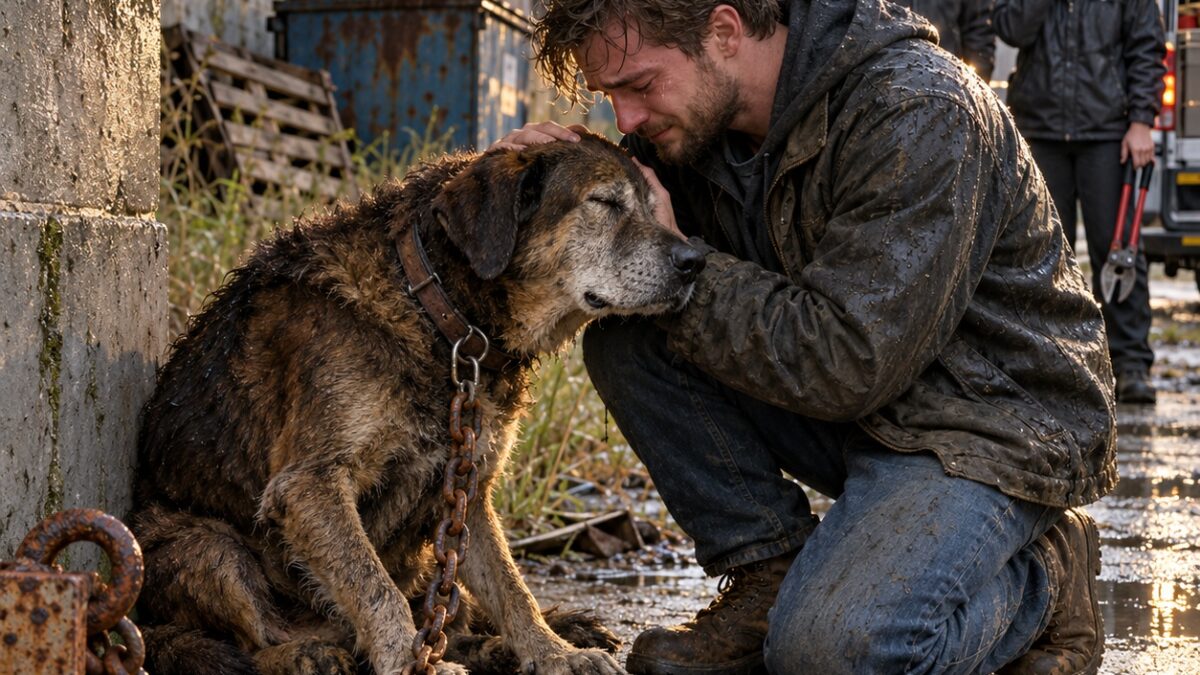
Touched the top of his head.
One light contact.
His eyes closed.
That was it.
No dramatic collapse.
No instant wag.
No lick.
He simply closed his eyes beneath my hand.
And I nearly broke.
Because that tiny action felt impossible.
An animal who had lived attached to a forgotten wall for years had enough trust left to close his eyes while a human touched him.
Closing your eyes is vulnerability.
For one second, he allowed himself not to watch.
I kept my hand there.
No petting yet.
Just contact.
His breathing changed.
Slightly deeper.
The veterinarian whispered behind me:
“Stay there.”
As if I planned to do anything else.
I don’t know how long we sat.
Eventually the rescue team moved in carefully.
Using my presence.
Talking softly.
No sudden grabbing.
The chain was removed.
The sound of metal releasing is something I still remember.
A click.
A scrape.
Then slack.
Years of restriction reduced to one piece of metal no longer holding tension.
The dog didn’t understand immediately.
That’s another thing people don’t think about.
Freedom can happen physically before an animal knows how to use it.
The chain fell.
He stayed in the same position.
Back near the wall.
As though the boundary remained inside him.
Someone said:
“He’s free.”
I looked at the dog.
Not yet.
Not really.
The chain was gone.
Freedom would take longer.
The veterinarian examined him as much as possible without overwhelming him.
Thin.
Neglected.
Old wounds.
Poor coat.
Muscle loss.
Nothing in the initial evaluation made his survival feel less astonishing.
He was transported to the shelter.
I rode separately.
I remember following the rescue vehicle and feeling panicked.
Ridiculous.
He was safer than he’d been in years.
And yet I kept imagining him arriving somewhere unfamiliar.
Metal doors.
Strange voices.
Other dogs.
No wall he knew.
No chain.
No idea where I had gone.
That night, I barely slept.
The next morning, I called.
Then visited.
He was registered as Hope.
I hadn’t named him.
Shelter staff had.
Hope.
I thought it was a little obvious.
Maybe even sentimental.
Still, it fit.
In my head, I called him something else.
The dog who waited.
Because that was what defined him to me then.
Eight years.
Waiting for what?
Food?
Release?
A person?
Nothing?
I didn’t know.
Maybe “waiting” was another human interpretation.
But that’s what it looked like.
His recovery started badly.
He would not eat with anyone in the room.
Food down.
Person leaves.
Then maybe.
He stayed in the far corner.
Body small despite his size.
Eyes open.
Always door-oriented.
He had learned survival through invisibility.
Don’t attract.
Don’t trust.
Don’t move unless necessary.
A shelter full of people trying to help can still feel terrifying to an animal whose experience says humans are unpredictable.
So I returned to the only thing that had worked.
Sit.
Wait.
Every day.
Same general time.
Same place.
Hands on knees.
No reaching unless he initiated something.
At first, Hope stayed across the room.
Then one day:
Slightly closer.
Maybe six inches.
That was progress.
Another day:
Another foot.
Some days, nothing.
Some days, backward.
I had to learn that healing doesn’t owe you a straight line.
One afternoon, I walked in wearing a different jacket.
Hope froze.
Wouldn’t approach.
I felt offended for half a second.
Then ashamed of feeling offended.
He did not owe me recognition across every variable.
Smell.
Shape.
Sound.
I sat.
Eventually his body softened.
Small lesson:
Trust can be context-specific before it becomes general.
I started wearing the same shoes.
Not intentionally at first.
Then intentionally.
He seemed to recognize the sound.
Soft squeak on shelter floor.
One morning, I turned the corner.
Hope’s ears lifted before he saw me.
That made my throat tighten.
Another day, he ate while I was still in the room.
Not close.
But there.
I pretended not to notice.
Shelter workers learn this.
Sometimes celebration frightens the very thing you’re celebrating.
So I looked at my phone.
Inside:
I wanted to yell.
He took another bite.
Then another.
I smiled at the floor.
Days became weeks.
Hope’s physical condition improved.
Food.
Medical care.
Sleep.
No chain.
But emotional recovery came slower.
He startled at doors.
Metal noises.
Sudden footsteps.
If someone dropped a bowl, he flattened himself.
The first time I saw that, rage hit me.
Not at him.
At whatever years had taught him that noise meant danger.
I wanted someone to blame.
A name.
A person.
An explanation.
The shelter manager said:
“Don’t let anger make you impatient with him.”
I looked at her.
“What?”
“You want to fix what happened.”
“Yes.”
“You can’t.”
That hurt.
“You can only help what happens now.”
Same lesson rescue keeps teaching.
The past is not repairable.
The present is.
So I stopped imagining confrontation with whoever had left him there.
Not because they deserved forgiveness.
Because Hope deserved my attention more than they deserved my anger.
One morning, I arrived and found a tennis ball in his enclosure.
Old.
Faded.
Shelter toy.
Hope was lying near it.
I sat.
Waited.
He stood.
Walked toward the ball.
Sniffed.
Picked it up.
My heart stopped.
He walked toward me.
Not all the way.
Stopped halfway.
Dropped it.
I looked at him.
He looked at me.
The ball sat between us.
“What?”
Ears.
I reached slowly.
Picked it up.
Rolled it.
Hope watched.
No movement.
I waited.
Then he walked after it.
Slowly.
Picked it up.
Returned.
Closer this time.
Dropped it near my shoe.
That was his first invitation to play.
I cried.
Quietly.
Embarrassing.
Beautiful.
Not sadness.
Something too large for the word happy.
A dog who had spent years limiting movement to survival had done something unnecessary.
Play is unnecessary.
That’s why it mattered.
Play means enough safety exists to spend energy on joy.
I rolled the ball again.
Hope followed.
Brought it back.
No tail yet.
But participation.
The shelter employee nearby whispered:
“He’s never done that.”
I couldn’t answer.
We played until Hope tired.
Maybe five minutes.
I left that day feeling as though he’d run a marathon.
A few weeks later, I went to the adoption center.
I told myself it was routine.
Just check on him.
That was another lie.
By then, my days had begun organizing around Hope.
Work.
Visit.
Home.
Think about Hope.
Sleep.
Repeat.
I walked into the hallway.
He was at the far end with a staff member.
Hope saw me.
Stopped.
Absolutely still.
I smiled.
“Hey.”
Then he ran.
Not the cautious walk.
Not the hesitant approach.
Ran.
His paws slipped on the smooth floor.
Recovered.
Kept coming.
I dropped to my knees.
He hit me hard enough that I nearly sat backward.
Head under my hand.
Body against my chest.
And then:
Tail.
Wagging.
Not tiny.
Not accidental.
So hard his whole back end moved.
I laughed.
Cried.
Hope pushed closer.
One staff member covered her mouth.
Her eyes filled.
“He has never done that with anyone.”
That destroyed me.
I held his head.
Felt his heartbeat.
Fast.
But different from fear.
Excitement.
Recognition.
Joy.
He knew me.
More importantly:
He wanted to be near me.
After all those hours when I sat waiting for permission to exist in his space, he had crossed the entire hallway on his own.
I knew then.
Maybe I’d known earlier.
But that moment removed the last excuse.
I wasn’t leaving him there.
I adopted Hope the following week.
The shelter director sat with me during paperwork.
She had seen hundreds of adoptions.
Maybe thousands.
Very little surprised her.
She watched Hope lying near my chair.
Then said:
“You know something?”
“What?”
“We see people save animals all the time.”
I smiled.
“That sounds like your job.”
“Sometimes.”
She looked at Hope.
“Very rarely, I think the animal saves the person too.”
I almost dismissed it.
Not because I thought she was wrong.
Because at twenty-nine, I didn’t think I needed saving.
I had an apartment.
Job.
Functioning life.
No dramatic tragedy.
Saving sounded too big.
Later, I understood she didn’t mean rescue from death.
Sometimes people are saved from smaller disappearances.
Isolation.
Numbness.
The feeling that nothing depends on you.
Hope did that.
But first, I had to get him through my apartment door.
I prepared everything.
Dog bed.
Food.
Water.
Toys.
Removed anything dangerous.
I had imagined bringing him home dozens of times.
In my imagination, Hope entered.
Sniffed.
Relaxed.
Home.
Reality:
He froze on the threshold.
Front paws outside.
Head inside.
Body rigid.
He looked into the room.
Then at me.
Then inside again.
As though expecting someone to say:
Wrong place.
Get out.
I kept the leash slack.
“Come in.”
Nothing.
I sat on the floor.
Hope watched.
“It’s okay.”
Ten minutes.
Maybe fifteen.
Then one paw.
Inside.
Pause.
Second.
He entered.
Slowly.
Sniffing every inch.
Wall.
Rug.
Table leg.
Water.
Bed.
Kitchen entrance.
Back to me.
He sat.
Looked.
“This is yours too.”
He had no idea.
Words are cheap when experience contradicts them.
Safe.
Home.
Forever.
Humans love saying them.
Traumatized animals believe repetition.
So I started repeating safety in actions.
Same morning routine.
Same bowl location.
Same calm voice.
Same return after leaving.
First week, Hope barely relaxed.
He chose one place on the floor with his back against the wall and a clear view of the door.
That was his position.
He didn’t use the dog bed.
Didn’t climb onto couch.
Didn’t explore much unless I moved first.
Vacuum terrified him.
The first time I turned it on, Hope disappeared into the farthest corner.
Body shaking.
I shut it off immediately.
Sat.
Waited.
“Sorry.”
Ridiculous perhaps.
Still.
Door sounds startled him.
Keys.
Footsteps in hallway.
Someone knocking.
Hope’s body went into alarm before his mind could learn context.
I began understanding what eight years of vigilance does.
Safety isn’t the removal of danger.
It’s the gradual loss of expectation that danger is coming.
Hope still expected.
Every sound.
Every door.
Every departure.
The hardest was leaving for work.
The first morning, I put on shoes.
Hope stood.
Keys.
He followed.
Coat.
Closer.
I reached the door.
His breathing changed.
He stared.
Something in his face made my chest hurt.
I crouched.
“I have to go.”
Useless sentence.
“I’ll come back.”
More useless.
He didn’t know return yet.
That knowledge had to be earned.
I left.
Closed the door.
Stood in the hallway for a full minute hating myself.
At work, I wondered what he was doing constantly.
When I returned, I unlocked the door.
Hope was exactly where I’d imagined.
Near entrance.
Waiting.
He didn’t rush me.
Just stared.
I stepped inside.
“See?”
Tail tip moved maybe once.
“I came back.”
Next day.
Again.
Leave.
Return.
Again.
Again.
This repetition became the most important lesson I could give him.
Departure doesn’t always mean abandonment.
Every evening:
I came back.
Hope slowly stopped stationing himself directly at the door.
One day, I found him several feet away.
Later:
On the rug.
Then couch.
That couch moment nearly made me laugh.
I came home and found Hope halfway onto it.
Front half up.
Rear paws floor.
As though he’d been caught committing a felony.
I froze.
He froze.
“Go ahead.”
Nothing.
I walked past.
Ten minutes later, all four paws on couch.
Weeks later, I came home and found him sleeping there.
Head on cushion.
Deep sleep.
That was huge.
The dog who once positioned himself where he could monitor every exit now slept somewhere soft while I was gone.
Trust.
Built from returns.
Our morning routine changed too.
I sat on the floor with coffee.
Talked.
Not because Hope understood the content.
Because my voice was predictable.
I told him about work.
Weather.
My brother in another state.
One morning I talked about missing my brother.
We hadn’t seen each other in too long.
Life.
Schedules.
Distance.
I said:
“I should call him.”
Hope walked closer.
I kept talking.
Then he put his head on my knee.
No warning.
Just weight.
Warmth.
I stopped.
My coffee stayed in my hand.
Hope sighed.
I put one hand on his neck.
Something inside me became very still.
Maybe the shelter director had been right.
I had been lonely in a way I hadn’t named.
Not abandoned behind a warehouse.
Nothing comparable.
But emotionally, I had been moving through life independently enough that I mistook isolation for strength.
Hope disrupted that.
He needed me to return.
Needed food.
Walks.
Patience.
And because he needed connection, I started noticing where I’d denied myself some.
That night, I called my mother.
We hadn’t talked properly in a long time.
I told her about Hope.
Everything.
Warehouse.
Chain.
Rescue.
Tennis ball.
Hallway.
Apartment.
My mother listened.
Then said:
“You’ve always been like this, Owen.”
“Like what?”
“You find things that need you.”
I laughed.
“That sounds unhealthy.”
“You know what I mean.”
I did.
Then she added:
“Maybe this one found you.”
I looked at Hope.
He was asleep near my foot.
“Maybe.”
Our relationship changed in small ways.
Hope followed me from room to room.
Not frantic.
Curious.
Bathroom door?
Wait outside.
Kitchen?
Supervise.
Bedroom?
Eventually enter.
The first time he got onto my bed, I wasn’t home.
I returned from work.
Walked into bedroom.
Hope was stretched across it.
Head on pillow.
He opened one eye.
No guilt.
I laughed.
A real laugh.
The kind I hadn’t heard from myself in a while.
“You spent eight years chained behind a warehouse and waited until my apartment to develop entitlement?”
Tail.
“Good for you.”
I let him stay.
Of course.
The stuffed frog came later.
I’d bought toys.
Hope ignored most.
Then one evening while I read on the couch, he got up.
Walked to basket.
Picked up a green stuffed frog.
Brought it.
Dropped at my feet.
Looked up.
That look was becoming familiar.
Your move.
I picked it up.
Tossed.
Hope watched it fly.
Looked at me.
“Go.”
He ran.
Picked it up.
Returned.
Dropped.
Again.
We did this for fifteen minutes.
Hope’s whole personality appeared.
Quick turns.
Paw sliding.
Toy shaking.
Tail.
Actual dog behavior.
Joy.
When he finally collapsed beside the couch, panting, he looked satisfied.
I called my mother that night.
The conversation about Hope turned into conversation about me.
That hadn’t happened in years.
He reopened a door without knowing.
Recovery was not smooth.
Important.
People like transformation stories because they want a clear before and after.
Trauma isn’t respectful enough to arrange itself that way.
Hope had setbacks.
A truck backfired on a walk once.
Instant.
He dropped.
Body against my legs.
Shaking violently.
No awareness of people around.
Just terror.
I sat on the sidewalk.
Right there.
Traffic.
Pedestrians.
Didn’t care.
Hope pressed against me.
I put both arms around him without trapping.
“I’m here.”
His heart pounded.
“It’s okay.”
Not yet.
“Take your time.”
Better.
People passed.
Some stared.
One person asked if he was injured.
“No.”
Eventually Hope’s breathing slowed.
Minutes.
Maybe longer.
He lifted his head.
Looked around.
The world hadn’t ended.
We stood.
Walked home.
I felt shaken afterward.
Not because the noise had scared him.
Because it showed how close the old fear still lived beneath progress.
That night I worried we had gone backward.
Next morning, Hope brought the frog.
There is the lesson.
A setback isn’t always a return to the beginning.
One moment of fear did not erase months of trust.
He had learned how to come back.
We kept walking.
Slowly.
New sounds.
New people.
Hope learned the doorbell was not an attack.
Delivery drivers existed.
Neighbors could say hello.
Elevator sounds were annoying, not fatal.
Rain against windows meant rain.
Not exposure.
The first time a thunderstorm rolled through after adoption, Hope paced.
Then came to me.
Not hiding behind furniture.
Me.
I sat.
He lay against my leg.
Thunder.
Body tensed.
Then relaxed.
Again.
Trust doesn’t remove fear.
It gives fear somewhere safe to go.
That may be the best definition I learned from him.
His relationship with strangers improved carefully.
I never forced introductions.
People asked:
“Can I pet him?”
I learned to answer:
“Let him decide.”
Some hated that.
Most understood.
Hope approached people who ignored him sooner than people reaching.
Funny.
The best way to earn trust sometimes is to stop demanding it.
One woman in our building crouched sideways and looked away.
Hope sniffed her.
She didn’t move.
He leaned.
She smiled.
Weeks later, Hope greeted her eagerly.
Evidence.
Again.
Repeated safe experiences.
His body filled out.
Coat changed.
Clean.
Glossy.
Muscle returned.
Vet visits showed improvement.
But the biggest transformation remained expression.
At the warehouse, Hope’s eyes had always looked open even when his body was still.
Scanning.
At home, sometimes his eyelids drooped while I moved around.
He could rest without tracking.
That meant more to me than weight gain.
Sleep is trust.
The first time he slept through me dropping something in the kitchen, I stared.
“Seriously?”
No movement.
I smiled.
Good.
Let the world make noise.
He no longer had to answer every sound.
I returned to the warehouse once.
Alone.
Bad idea maybe.
Needed it.
The place looked smaller.
That’s common with memory.
Things that hold enormous emotional weight become ordinary when revisited.
Wall.
Weeds.
Concrete.
The anchor point where the chain had been was still there.
Rust.
I stood.
Tried imagining Hope there.
Years.
Couldn’t.
Human brains resist scale when pain is repetitive.
One bad night is imaginable.
Eight years?
Too large.
You reduce it to a number.
But eight years contains thousands of mornings.
Weather.
Hunger.
Silence.
Maybe people occasionally helping.
Maybe not.
I stopped trying to construct scenes I couldn’t verify.
Source of his pain mattered less than source of his recovery now.
I touched the old wall.
Then left.
Didn’t bring Hope.
He didn’t need to return.
That history belonged behind him.
I carried enough for both.
At home, Hope greeted me.
Frog in mouth.
I laughed.
Exactly.
Why drag him back mentally when he was here?
Present.
The shelter staff invited us once for an adoption event.
Hope entering that hallway again worried me.
Would he remember?
He did.
But differently.
Tail.
Staff recognized him.
One woman cried immediately.
Hope approached.
Allowed touch.
Then looked for me.
Found.
Relaxed.
The employee who had once said he never reacted like that to anyone whispered:
“Look at him.”
I did.
Healthy.
Confident.
Still cautious.
That’s okay.
Caution is not failure.
It’s character shaped by history.
Hope had no obligation to become the world’s friendliest dog to prove healing.
He only needed a life that felt safe.
He had one.
People at the event asked about the name.
Hope.
I eventually stopped finding it obvious.
It grew into itself.
Not hope as optimism.
Hope as behavior.
The decision to keep some part of yourself available to possibility after repeated disappointment.
Hope had done that.
If every part of him had shut down completely, my visits would not have mattered.
Some tiny part still watched.
Evaluated.
Decided.
Hand.
Head.
Eyes closed.
That moment at the warehouse was proof.
Trust wasn’t dead.
Buried.
Not dead.
Maybe that’s what hope is.
People use “rescue” casually.
I rescued Hope.
Technically, organizations and vets did the actual removal and medical work.
I was there.
Started calls.
Stayed.
Adopted.
But the director’s words became clearer over time.
Hope rescued me from a different kind of chain.
Not tragedy.
Habit.
Distance.
Self-sufficiency so complete it had become isolation.
Because of him, I called family more.
Went outside more.
Talked to neighbors.
Built routine around another life.
Came home with purpose.
None of that means his suffering “happened for a reason.”
I reject that.
Hope should never have spent years chained.
My personal growth does not justify his pain.
Good can come after harm without making harm necessary.
Important distinction.
I wish he’d had eight good years instead.
I wish I had never needed to find him because there was nothing to rescue.
But reality didn’t ask what I wished.
I had the dog in front of me.
So I loved him.
That’s the only useful response.
One evening, rain hit the apartment windows.
Soft.
Steady.
Hope lay beside me.
Once, weather meant exposure behind a building.
Now?
Warm room.
Food.
Bed.
Me.
He didn’t lift his head.
I listened.
Thought of the first water bottle.
The way he’d waited until I turned away to drink.
Now his paw touched my hand while he slept.
Distance collapsed.
I whispered:
“You’re home.”
No reaction.
Good.
He no longer needed reassurance every second.
That is another form of healing.
Words become unnecessary.
The environment proves them.
Morning.
Food.
Walk.
Return.
Night.
Repeat.
I started thinking about the difference between waiting and abandoning.
Hope had waited.
For years.
But not, I think, in the romantic way people tell it.
He wasn’t necessarily waiting for one specific savior.
He survived until possibility arrived.
When it did, he didn’t instantly run.
He tested.
Watched.
Allowed one inch.
Then another.
That taught me patience differently.
Waiting isn’t doing nothing if what you’re waiting for is safety.
Sometimes staying alive is the work.
Hope did the work.
I just showed up often enough that he eventually included me in the future.
The phrase “he chose me” gets overused with rescue animals.
But there were moments when it felt accurate.
The hallway.
The run.
Head beneath my hand.
Tail.
He had other people caring for him.
Good people.
Yet when he saw me, his body decided.
There.
That’s my safe person.
Heavy responsibility.
Beautiful too.
I tried to deserve it.
Not through perfection.
Consistency.
That’s what trauma trusts.
Not promises.
Patterns.
Leave.
Return.
Feed.
Don’t hit.
Don’t yell.
Respect space.
Play.
Come back tomorrow.
Again.
Again.
Again.
A life can be rebuilt from predictable kindness.
Hope proved it.
One year after adoption, I bought him a new tennis ball.
Ridiculous thing.
Cheap.
Bright.
I took him to a quiet park.
We sat under a tree.
I showed the ball.
Hope looked at me.
Tail.
I threw.
He ran.
Full speed.
No chain.
That image hit me in a way I wasn’t prepared for.
There is something almost violent about seeing freedom after confinement.
Not because running is dramatic.
Because every stride contains contrast.
Years measured in radius.
Now:
Distance chosen.
Hope ran past the ball.
Turned.
Found it.
Grabbed.
Came back.
Dropped it.
I threw again.
He ran farther.
I cried.
Hope returned.
Looked confused.
I laughed.
“I’m fine.”
He nudged the ball toward me.
Again.
Of course.
Dogs don’t tolerate sentimental pauses when play is available.
Good.
We played.
That’s how I wanted his story to move.
Not chain to tears to permanent solemnity.
Chain to recovery to joy to annoyance to ordinary life.
The right ending for a rescued dog is not eternal gratitude.
It’s entitlement.
Stealing bed space.
Demanding walks.
Refusing cheap treats.
Bringing toys at inconvenient times.
Hope became very good at all of those.
One morning, I woke with him occupying most of the mattress.
I had approximately eight inches.
“Move.”
No.
“Hope.”
Tail.
“You were homeless once.”
No reaction.
“Have some perspective.”
He stretched.
Took more room.
I laughed.
Success.
My mother met him eventually.
Hope took time.
She knew.
Sat.
Waited.
He approached.
Sniffed.
Then leaned into her leg.
She looked at me.
“This is him.”
“Yes.”
“The warehouse dog.”
“I hate that description.”
“I know.”
She stroked him.
“He looks happy.”
That word.
Happy.
Not saved.
Not tragic.
Happy.
My throat tightened.
“He is.”
Mom smiled.
“So are you.”
I pretended not to hear.
Maybe true.
My brother came later.
Hope liked him faster.
Traitor.
We joked.
Family visits became more common partly because everyone wanted Hope.
Fine.
He was a better reason than obligation.
The dog expanded my social world.
Again.
No grand intention.
Presence.
People came to see him.
Stayed for coffee.
We talked.
Connection grew.
Sometimes recovery creates more recovery than intended.
Hope’s calm improved.
But certain things never disappeared entirely.
Loud metal clank.
He noticed.
Fast stranger movement.
Caution.
Someone raising an arm suddenly.
Flinch.
Those reactions hurt to see.
But I stopped treating them as evidence healing had failed.
Scars are not open wounds.
A body can remember and still live fully.
Hope did.
If he startled, he recovered faster.
Looked at me.
Assessed.
Moved on.
That’s resilience.
Not forgetting.
Returning.
The shelter behaviorist once said:
“The goal isn’t to erase history.”
I finally understood.
“It’s to make history stop controlling every next decision.”
Exactly.
Hope reached that place.
Mostly.
Enough.
I did too, in my own smaller ways.
I had spent years thinking I needed to be more accomplished.
More useful.
More successful.
Some abstract future version of Owen.
Hope simplified life.
Did I come home?
Did I feed him?
Did we walk?
Did I call Mom?
Did I notice today?
Strangely, these small acts built more peace than chasing vague standards ever had.
Maybe that’s why the director called it mutual rescue.
Hope taught scale.
One good day matters.
One safe night.
One returned call.
One walk.
One game.
Life is assembled from small proof.
When I write this now, Hope is beside me.
Older.
Comfortable.
Breathing slow.
Rain outside.
He doesn’t care.
A few minutes ago, his paw touched my hand while sleeping.
Still there now.
I could move.
I don’t.
Not because he’ll panic.
He probably won’t wake.
Because I like the weight.
I think about the warehouse.
The shadow near the wall.
Chain.
Eyes.
Water bowl.
The first touch.
Then I look at this dog.
Same body.
Different life.
That’s what safety can do.
Not erase past.
Reveal personality that fear hid.
Hope is funny.
Stubborn.
Toy-obsessed.
Selective about people.
Bad at personal space.
Very interested in chicken.
None of that was visible behind the warehouse.
Trauma takes up room.
Healing gives personality that room back.
That’s one of the best things I’ve witnessed.
I don’t know exactly how he survived eight years.
The source never gave me enough to tell that story honestly.
So I don’t invent it.
I don’t know who fed him when nobody else was there.
How often.
Who attached the chain.
Why.
Whether one owner died, left, or simply stopped caring.
There are gaps.
I used to hate them.
Now I respect them.
Hope’s past belongs partly to silence.
What I know is enough.
He was there for years.
He survived.
I found him.
Others helped remove him.
He learned trust.
I adopted him.
We built something afterward.
Facts can be powerful without filling every blank.
I also don’t know whether Hope had been “waiting for someone” for eight years in the human sense.
Maybe he was simply enduring.
But the name still fits.
Hope.
Because when I sat beside him and raised my hand, some part of him chose not to retreat.
After everything.
That decision gave us a future.
The deepest cruelty of long neglect isn’t only hunger.
Cold.
Pain.
It teaches expectation.
No one comes.
No one stays.
Nothing changes.
Hope had learned those things.
Then recovery required evidence that contradicted them.
Someone comes.
Again.
Someone stays.
Again.
Things change.
Again.
That is why I never call healing magic.
Magic is instant.
Healing is repetitive.
Boring, sometimes.
Food.
Sit.
Wait.
Return.
Roll ball.
Go home.
Come back.
Night.
Morning.
Pattern.
Months.
Then one day a formerly chained dog is asleep sideways on your bed with his back exposed and paws twitching.
That posture is a miracle built from routine.
If I had rushed Hope, maybe we’d have lost some of it.
If I’d insisted on touching.
Playing.
Walking.
Trusting.
He might have shut down harder.
I learned to let invitation matter.
That changed how I relate to people too.
Not everything broken wants advice.
Sometimes presence.
Sometimes:
I’m here.
No demand.
Hope taught that.
He taught me not to mistake quiet for emptiness.
At the warehouse, he was silent.
Inside, something still worked.
Observation.
Choice.
Survival.
The world had not gotten all of him.
That’s what saved us.
A year after finding him, I drove near the warehouse.
Didn’t stop.
Hope in the back seat.
Window cracked.
He didn’t react.
Maybe he didn’t recognize the area.
Maybe smell.
Maybe he did and chose nothing.
I kept driving.
No need to test trauma for symbolism.
Home was ahead.
We went to the park instead.
Correct decision.
Hope ran.
Ball.
Grass.
Sun.
I watched and thought:
Forward.
That’s enough.
People sometimes ask:
“Would you do it again?”
Find a dog like Hope?
Of course.
Then I think carefully.
Rescue was emotionally expensive.
Time.
Money.
Fear.
Setbacks.
Responsibility.
Still yes.
Not because I enjoy being needed.
Because no living thing deserves to be invisible once seen.
That’s the line for me.
Once seen, respond.
Maybe you can’t adopt.
Maybe can’t personally rescue.
Call someone.
Bring water safely.
Report.
Do something appropriate.
I was lucky enough to become Hope’s person.
But the first ethical act was simply refusing to pretend I hadn’t noticed him.
That part is available to almost everyone.
Look.
See.
Act.
Hope’s story also changed how I think about abandoned animals labeled “difficult.”
Fearful.
Unresponsive.
Unsocialized.
These words can be accurate.
But they describe current behavior, not final identity.
Hope was terrified.
He also became playful.
He was shut down.
He also became affectionate.
He hid.
He also ran toward me down a hallway.
Both true.
Animals aren’t frozen at intake.
Give time.
Behavior can unfold.
That’s why I still occasionally visit the shelter.
Not constantly.
Help when I can.
Sometimes I sit near a scared dog.
No touch.
Same method.
Wait.
I don’t imagine I’m Hope’s savior teaching universal wisdom.
Every animal is different.
But patience rarely hurts.
One volunteer once asked:
“How long do you sit?”
“Until I’m done.”
“No, like until the dog comes over.”
“Maybe it won’t.”
She looked disappointed.
“That’s still okay.”
Hope taught me that the outcome cannot be the price of respect.
You respect space even if trust never arrives on your schedule.
That’s harder.
Important.
Years after the warehouse, Hope remained a dog who liked walls behind him when nervous.
Interesting.
He chose security.
But now sometimes his back faced the room while sleeping.
That detail could make me cry if I allowed it.
Body exposed.
No monitoring.
Trust deep enough to stop watching.
I never celebrated in the moment.
Again.
Don’t wake the miracle.
Just notice.
The director who told me Hope might save me eventually retired.
I visited once before she left.
Brought Hope.
She crouched.
Hope approached.
She scratched his chest.
“You two still together?”
“Unfortunately.”
Hope leaned harder.
She laughed.
“I was right.”
“About what?”
“You know.”
I rolled my eyes.
She smiled.
“He looks good.”
“He is.”
“You?”
Pause.
“Yeah.”
She nodded.
“Good.”
That was enough.
No speech.
Sometimes people who work around suffering become allergic to speeches.
Understandable.
Hope and I left.
On the drive home, I thought about what saved means.
Maybe she had been right.
Not dramatic.
But yes.
I had been drifting through life waiting for some big purpose.
Hope reduced purpose to presence.
He needed someone who would show up.
So I did.
Then I realized showing up was enough to start rebuilding parts of myself too.
Maybe humans are more like frightened dogs than we like admitting.
We wait for overwhelming proof before trusting life.
Sometimes proof arrives as routine.
Someone calls.
Again.
Someone returns.
Again.
A door opens and doesn’t mean danger.
Again.
Eventually the nervous system changes.
Hope and I practiced that together.
Now when I leave for work, he barely gets up.
Offensive.
Sometimes he watches from couch.
“Goodbye.”
Tail once.
“That’s it?”
Nothing.
I close door.
Come back later.
Hope greets me.
Not panic.
Joy.
Difference.
He knows the story now.
Owen leaves.
Owen returns.
That’s what home means to him.
Maybe to me too.
If I could go back to the afternoon behind the warehouse and tell myself the ending, I wouldn’t.
I wouldn’t say:
You’ll adopt him.
He’ll sleep on your bed.
You’ll call your mother more.
You’ll learn trust from a dog.
Too much.
I would tell myself one thing.
Sit down.
Don’t rush him.
That’s where everything started.
Not the rescue truck.
Not adoption paperwork.
A man on concrete beside a frightened dog.
Waiting.
Then one hand.
One touch.
Eyes closing.
That tiny movement held the entire future.
Hope didn’t know.
Neither did I.
Maybe beginnings rarely know what they are.
Now, while I write this, Hope shifts.
Paw presses harder against my hand.
Rain continues.
Apartment warm.
His breathing deep.
I look at him.
The dog who spent years vigilant enough to survive.
Sleeping through weather.
Safe.
There is no chain.
No warehouse wall.
No need to wait for random footsteps.
Tomorrow morning we’ll walk.
Hope will pull toward the same bushes as always.
He’ll sniff each one as though new evidence has emerged overnight.
He’ll stare at strangers.
Choose some.
Ignore others.
We’ll return.
He’ll drink.
Then find sunlight on the floor.
Lie there.
And wait for me to sit nearby.
Not because he fears I’ll disappear.
Because he likes company.
That distinction is the whole story.
He used to wait because he had no choice.
Now he waits because he knows someone is coming.
My name is Owen.
I was twenty-nine when I found Hope.
Or when Hope found me.
I still don’t know which sentence is more accurate.
Maybe both.
He spent eight years in a world that taught him not to trust.
I spent a few months showing him something different.
Then he spent the years after showing me the same.
You can survive without trusting.
But you can’t fully live there forever.
At some point, if you’re lucky, someone sits down near you.
Doesn’t force.
Doesn’t demand.
Just stays long enough that you decide to move closer.
Hope moved closer.
So did I.
And if there’s one thing I carry from all of it, it is this:
Eight years of fear did not erase his ability to trust.
Eight years of waiting did not erase his ability to play.
Eight years of neglect did not erase the dog underneath.
The first time he placed that old tennis ball at my feet, I saw it.
Life.
Still there.
Waiting too.
All he needed was enough safety to come out.
So we gave it time.
He learned doors can open without pain.
Hands can touch without hurting.
People can leave and come back.
Beds can be soft.
Rain can stay outside.
Toys can be thrown just for fun.
And a home can be a place where you no longer have to watch the door every second.
I learned something beside him.
Being needed is not the same as being trapped.
Patience is not passivity.
Waiting is not always surrender.
And starting over doesn’t require forgetting what happened.
It requires discovering that what happened does not get to decide every day that comes after.
Hope still has scars.
So do I.
His are easier to see.
Mine are less dramatic.
But both of us learned the same lesson.
The future does not ask whether the past was fair before it offers another morning.
It simply comes.
And when it does, you can stay against the wall forever—
or, when you’re ready,
you can pick up the ball,
walk across the room,
drop it at someone’s feet,
and ask life to play again.








