PART2:I Called the Police on the Same Biker Every Wednesday for Seven Months—Then One Old Pit Bull Heard His Harley
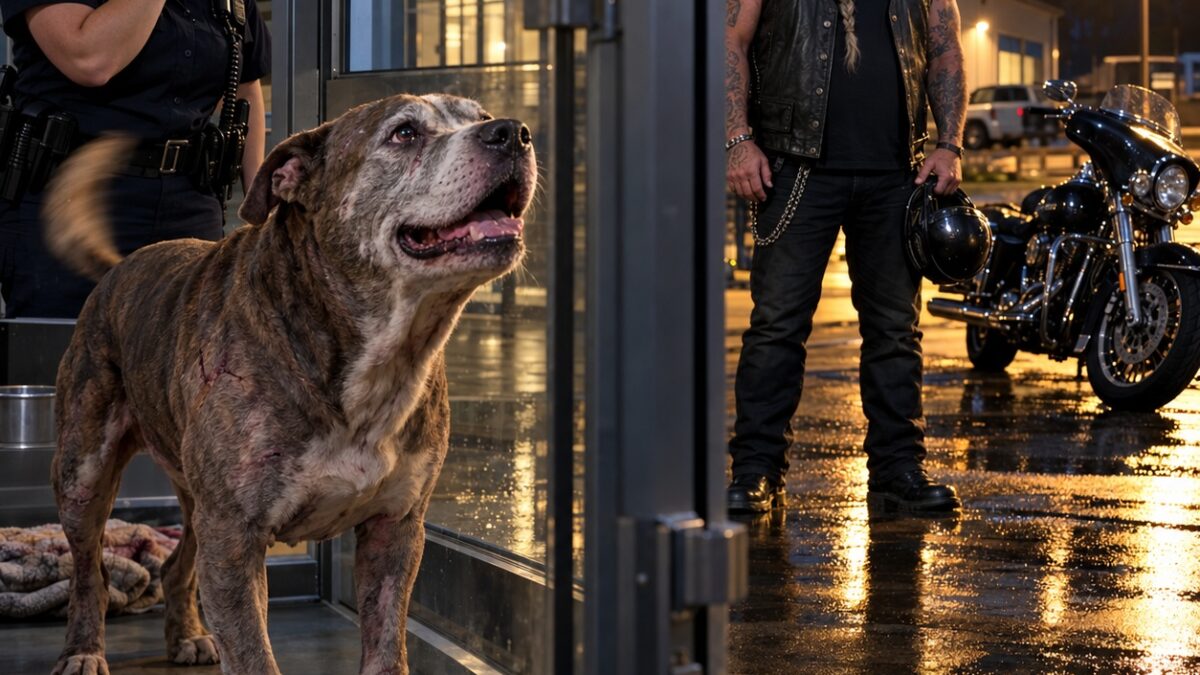
PART2
The first time I called police was after about six weeks.
I remember sitting behind the security desk with the phone in my hand, wondering whether I was overreacting.
Then I looked at the camera again.
Reaper sat in the far corner.
Black Harley beneath him.
Leather vest.
Beard.
Motionless.
Facing the shelter.
I called.
The responding officer came inside first.
I explained the pattern.
Every Wednesday.
Nine until eleven.
Never entering.
Never speaking.
Always watching.
The officer walked back outside and approached him.
From the camera feed, I could see them talking.
Reaper handed over identification.
The officer checked something from the patrol car.
Then came back inside.
“He’s legal,” he told me.
“No warrants?”
“None.”
“Bike?”
“Registration’s clean.”
“Why is he sitting there?”
The officer looked mildly irritated now.
“He’s allowed to sit in a public parking lot.”
That was not an answer.
It was the law.
Those were not always the same thing.
I knew the officer was right.
Reaper had not threatened anybody.
Had not approached an employee.
Had not tried a door.
Had not entered a restricted area.
He was simply existing somewhere he was legally allowed to exist.
Still, when the officer left and Reaper remained in the parking lot until eleven, I could not relax.
The next Wednesday he came back.
I started noticing details.
Sometimes he smoked.
One cigarette after another.
Other nights he hardly moved at all.
There were evenings when he sat so motionless for so long that I wondered whether he had fallen asleep sitting upright.
But when the shelter door opened, his head would move.
When an employee crossed the side walkway, he noticed.
Or at least I thought he did.
That became the problem.
Once I decided he was suspicious, everything looked like evidence.
A head turning became surveillance.
A cigarette became waiting.
Sitting quietly became planning.
His consistency felt ominous instead of sad.
He was there every Wednesday.
Always nine.
Always eleven.
Who does that?
That question followed me home after shifts.
I had a child.
I worked nights.
I knew exactly how vulnerable our staff could be leaving after closing.
By ten-thirty, the public activity had usually dropped.
By eleven, some kennel staff were already gone.
I started thinking about routines.
Who left by which door.
Who walked to which car.
What somebody could learn by sitting outside two hours every week.
I told myself I was doing my job.
Maybe I was.
Maybe I was also feeding my own fear.
At the time, I could not tell the difference.
By May, Reaper had become part of our Wednesday nights.
Not a welcome part.
A presence.
I called police again.
Different officer.
Same outcome.
No crime.
No warrants.
No legal reason to remove him.
The officer asked whether Reaper had spoken to anyone.
“No.”
“Threatened anyone?”
“No.”
“Entered the property after being told not to?”
“He’s in the public lot.”
The officer nodded.
There it was.
Nothing.
Again.
Reaper remained.
Inside, the staff had started joking.
Not because anyone thought it was funny.
Humor is what people do when they are uncomfortable for too long.
Around eight-fifty on Wednesdays somebody would say:
“Your boyfriend should be here soon, Tara.”
Or:
“Reaper’s date night.”
Then the Harley would roll in.
The jokes stopped.
No one laughed very hard anyway.
It was easier to make fun of my concern than admit none of us knew what he wanted.
He looked intimidating.
That mattered more than I wish it had.
Huge biker.
Long braided beard.
Full tattoos.
Black leather.
1% patch.
Harley.
Everything about him fit an image we already understood.
Or thought we understood.
Dangerous.
Criminal.
Unpredictable.
Maybe if he had arrived in khakis and a minivan, I would have invented different explanations.
I did not think about that then.
I simply watched.
June came.
Charlotte summer settled in.
Hot days.
Heavy evening air.
Thunderstorms.
And still:
Wednesday.
Nine o’clock.
Reaper.
Then came the storm.
It was late June.
The weather had been building all afternoon.
By evening, the clouds had turned nearly black.
Lightning flashed beyond the tree line.
Wind pushed against the shelter.
Rain came hard enough that water started running across the parking lot in sheets.
I expected the Harley not to appear.
No sane person would choose to sit on a motorcycle for two hours in that weather.
At nine, I heard it.
That engine.
Low.
Steady.
Through the rain.
Reaper entered the lot.
Same corner.
Same direction.
He parked.
And stayed.
Rain soaked him.
Lightning flashed.
Wind whipped the trees near the back kennel wing.
He did not leave.
At first he kept his helmet on.
Then, eventually, he removed it.
He sat in the storm.
For two hours.
No shelter.
No umbrella.
No reason I could understand.
That was the third time I called police.
This time I told dispatch everything.
Seven months had not passed yet, but the pattern had already become obsessive in my mind.
He comes every Wednesday.
He sits for hours.
He refuses to explain.
Tonight he is sitting through a severe thunderstorm.
Maybe he is scouting the building.
Maybe he is unstable.
Maybe he is in danger himself.
I did not know.
I only knew normal people did not sit motionless on a Harley in driving rain unless something mattered more than discomfort.
Sergeant Rodriguez responded.
Older patrol sergeant.
Calm voice.
The kind of officer who had probably heard every possible version of “something feels wrong.”
He went outside.
Rain poured off his uniform.
He stood beside Reaper for nearly ten minutes.
They talked.
Not aggressively.
No shouting.
At one point Rodriguez leaned closer, listening.
Reaper answered.
I could not hear any of it through the glass.
Then Rodriguez came inside.
He removed his wet hat.
Looked directly at me.
“Tara.”
Something about his tone made me defensive immediately.
“The man hasn’t committed a crime.”
“He’s here every week.”
“I know.”
“He won’t say why.”
Rodriguez paused.
“I asked.”
“And?”
“He won’t tell me either.”
“That doesn’t bother you?”
That question came out sharper than I intended.
Sergeant Rodriguez stood there for several seconds.
Rainwater dripped from his uniform onto the lobby floor.
Then he said:
“Honestly?”
“Yes.”
“It does.”
For a moment I felt vindicated.
Then he continued.
“But whatever he’s doing out there, it isn’t criminal.”
I looked past him toward the rain.
Reaper was still in the parking lot.
Rodriguez put his hat back on.
Before leaving, he turned.
“Some people carry grief in ways the rest of us don’t understand.”
I remember the sentence clearly because it irritated me.
Grief?
What did grief have to do with this?
I had worked in an animal shelter nine years.
I knew grief.
Owners surrendering dogs after divorces.
Families losing pets they could not afford to treat.
People crying at euthanasia.
Employees crying in storage rooms where adopters could not see them.
I was a single mother.
Life had given me enough of my own pain.
But nothing about the giant biker sitting outside every Wednesday looked like grief to me.
It looked like watching.
Rodriguez left.
At eleven, so did Reaper.
The next Wednesday he returned.
And the next.
Then July.
August.
Every Wednesday.
Nine to eleven.
By then I had called police enough times that dispatch recognized the address before I finished explaining.
Different officers came.
Some spoke to him.
Some simply drove through and checked the lot.
Nothing.
No crime.
No confrontation.
No explanation.
Reaper never retaliated.
Never complained about me.
Never came inside demanding to know why security kept calling cops on him.
That almost made me more suspicious.
If he were innocent, why not explain?
If there were some harmless reason, why not say it?
I had no answer.
So I filled the silence myself.
That was my mistake.
September arrived.
By then Reaper had been part of shelter life for roughly seven months.
Seven months of Wednesday nights.
Seven months of camera footage.
Seven months of security notes.
Seven months of me looking at a man I had never spoken to and deciding what kind of person he probably was.
The discovery came completely by accident.
Nicole was closing the medical kennels one Wednesday night.
Nicole was twenty-three.
Small.
Pink streaks in her hair.
A kennel technician who loved every animal too quickly and cried during owner surrenders more often than she would ever admit proudly.
Around ten, she came into the security area.
“Tara?”
I looked up.
“Yeah?”
“Have you ever noticed Tank when the biker comes?”
I frowned.
“Tank?”
“The old pit.”
I knew Tank.
Everybody did.
Large senior pit bull.
Scarred face.
Torn ears.
Arthritis in both hips.
Heartworm positive.
Nearly ten years old.
He had arrived from a cruelty case earlier that year and had spent almost eight months at the shelter.
Nobody wanted him.
That sounds harsher than the reality, but it was the reality.
Potential adopters would walk past.
Older.
Medical issues.
Scars.
Stiff movement.
People looked at younger dogs.
Easier dogs.
Dogs whose futures did not immediately suggest veterinary bills.
Tank remained.
“What about him?” I asked.
Nicole looked toward the hallway.
“Every time the motorcycle shows up, he stands at the kennel door.”
I stared at her.
“What?”
“The Harley.”
She pointed toward the rear wing.
“Every Wednesday.”
I felt something shift in my chest.
“You’re sure?”
“I just noticed the pattern.”
I stood.
We walked together toward isolation.
The kennels were quieter back there.
The noise from the public side faded.
Tank’s run was near the end.
And there he was.
Standing.
Not jumping.
Not barking.
Not pacing.
Just standing at the front of the run.
His old body was stiff.
His hips were bad enough that getting upright took effort.
But he was on his feet.
Facing the outer side of the building.
His tail moved.
Slow.
Back.
Forth.
Back.
Forth.
I watched him.
Then I heard the low Harley engine through the wall.
Tank’s ears shifted.
One torn ear moved better than the other.
His tail wagged again.
I looked at Nicole.
She looked at me.
Something inside me went cold.
Not fear this time.
Recognition.
I walked toward the small window on that side of the kennel wing.
From Reaper’s usual parking space, almost nothing at the rear of the shelter was visible.
Nothing except one section of window.
Tank’s.
I suddenly understood something I had been too certain to ask before.
Reaper was not staring at the shelter.
He was looking toward one kennel.
Nicole whispered:
“Oh my God.”
I did not answer.
Tank stayed standing.
His tail kept moving slowly.
He was not excited the way some dogs become when strangers arrive.
This was different.
He looked like a dog waiting for something familiar.
A sound.
A person.
A memory.
I thought about Sergeant Rodriguez.
Some people carry grief in ways the rest of us don’t understand.
My mouth went dry.
Nicole said:
“We should ask him.”
I immediately felt the old resistance.
What if we were wrong?
What if this connection meant something else?
What if going outside was a bad idea?
Then Tank’s tail moved again.
Seven months.
Enough.
For the first time since February, I did something other than watch Reaper through glass and cameras.
Nicole and I walked outside.
My heart was pounding.
I hated that it was pounding because by then I already suspected I had been wrong.
Still, bodies learn fear through repetition too.
Reaper saw us coming.
He shut off the Harley.
The sudden silence felt enormous.
Up close, he was even bigger.
But without the distance of the security camera, I noticed things I had never seen.
The deep lines around his eyes.
The tiredness in his face.
The gray in his beard.
He did not look angry.
He looked worn out.
Nicole spoke before I could.
“Is Tank your dog?”
Reaper looked at her.
Then toward the kennel window.
For a long moment, he said nothing.
Finally:
“Was.”
One word.
That was all.
And seven months of assumptions began falling apart.
We ended up sitting outside the shelter for nearly an hour.
Lawn chairs.
Water still dripping from part of the roof because another light rain had passed earlier.
Reaper told us his real name.
Mason Vance.
But Tank knew him long before we did.
Tank had belonged to Mason’s younger brother.
His brother had died suddenly from an overdose the previous winter.
Afterward, Mason tried to take Tank.
But the property was connected to an investigation.
Tank had been found there.
Because of the legal seizure process and prior housing violations connected to Mason’s motorcycle club affiliation, animal control had denied the ownership transfer.
Tank became evidence in the cruelty case.
That explained why he was at our shelter.
The case crawled through court.
Weeks became months.
By the time Tank was finally cleared legally for adoption, he had become one of those dogs shelters struggle desperately to place.
Senior.
Arthritis in both hips.
Heartworm positive.
History from a cruelty case.
Nearly ten years old.
Mason worked.
Wednesday nights were the only nights he had free.
So he came.
Every Wednesday.
Nine o’clock.
Not because he was watching us.
Because Tank knew the sound of his motorcycle.
Mason looked toward the back wing when he said it.
“He spent ten years hearing that bike pull into driveways.”
His voice had changed.
Quieter.
“I figured maybe hearing it again would let him know somebody still remembered him.”
I could not speak.
Nicole was already crying.
Of course she was.
Nicole could cry at an intake form.
But this time I was right behind her.
I thought about the storm.
Mason sitting on that Harley in pouring rain.
Lightning.
Wind.
Two hours.
Not because he was unstable.
Not because he was waiting for an opportunity to break in.
Because somewhere through the wall, an old dog heard the engine of a motorcycle he had known for ten years.
And Mason wanted Tank to know he had not been forgotten.
I asked the question that had been haunting me for months.
“Why didn’t you just come inside?”
Mason looked embarrassed.
That surprised me more than anything.
This enormous man.
Leather vest.
Tattoos.
1% patch.
Suddenly avoiding eye contact like a kid.
He told us he assumed we would judge him as soon as he walked through the doors.
Because of the vest.
The tattoos.
The club patches.
The motorcycle.
I wanted to say we would not have.
The words died before I could speak them.
Because we had.
I had.
I had called police on him over and over again.
I had watched him like a criminal.
I had logged his presence.
I had warned staff.
I had turned his silence into evidence.
Mason had been right about one thing.
We had judged him before he ever introduced himself.
“I just didn’t want him thinking everybody left,” he said.
That sentence was the one that broke me.
Not his brother’s overdose.
Not even the legal case.
That.
I just didn’t want him thinking everybody left.
Tank had already lost his person.
Then home.
Then freedom.
Then eight months in a kennel.
And Mason had no legal way to take him.
So once a week, he gave Tank the only thing he thought he was allowed to give.
The sound of home.
A Harley engine.
Two hours.
Every Wednesday.
Then Mason rode away.
I made it back inside somehow.
I do not remember exactly what I said to Nicole.
I do remember reaching the staff area.
Walking into the bathroom.
Locking the door.
Then crying so hard I could barely breathe.
Not graceful tears.
Not a quiet emotional moment.
I was ashamed.
Seven months.
Seven months I had looked at this man and seen danger.
Seven months he had looked through one little window hoping an old dog knew somebody still cared.
I thought about every police call.
The first officer.
The second.
Sergeant Rodriguez standing soaked in our lobby.
His strange warning about grief.
He had known something I had not.
Maybe Mason had said enough outside that night.
Maybe Rodriguez had simply recognized grief when he saw it.
Either way, I had kept seeing the vest.
The tattoos.
The patch.
The size.
The bike.
I had never looked for the sadness.
Later that night, I went back to Tank’s kennel.
Mason had already left.
Tank was lying down again.
His head rested on his front paws.
The kennel suddenly looked different to me.
Before, I saw an old shelter dog.
Hard placement.
Medical needs.
Long stay.
Now I saw ten years of history locked inside him.
He knew that motorcycle.
That engine was not noise.
It was memory.
Maybe his old home.
Maybe Mason’s brother.
Maybe Mason himself.
Maybe evenings when people he knew were alive and coming through the door.
Dogs do not understand legal seizure processes.
They do not understand court evidence.
They do not know why one day the familiar world ends.
Tank knew absence.
That was enough.
Every Wednesday, the absence changed for two hours.
Someone came back.
The next morning our shelter director pulled Tank’s file personally.
Not because we suddenly wanted to bend rules recklessly.
Because now we understood there was something worth reviewing.
The case status.
The prior transfer denial.
The medical information.
Mason’s relationship to Tank.
Everything.
We had spent months assuming there was no connection because Mason never explained one.
Now there was.
Two days later, the adoption restriction was waived.
I kept thinking about Mason.
Did he know?
Did anyone call him immediately?
I wanted the next Wednesday to arrive and feared it at the same time.
I did not know what I would say to him.
How do you apologize for turning someone’s grief into suspicion for seven months?
“I’m sorry” felt too small.
Wednesday came.
At eight-fifty, I found myself watching the clock.
Nicole was pretending not to.
So was everyone else.
At nine o’clock exactly, the familiar rumble started in the distance.
The lobby windows vibrated.
No one joked.
No one said Reaper was back.
The Harley entered the parking lot.
But this time Mason did not drive to the far corner.
He parked closer.
Shut off the engine.
Got off the bike.
For the first time in seven months, he walked toward the front doors.
I stood behind the desk.
My stomach twisted.
The man I had called police on again and again opened the door.
He seemed almost nervous.
That remains one of the strangest memories of the whole thing.
I had spent months frightened of Mason Vance.
Now Mason Vance looked frightened of us.
He entered.
No threats.
No anger.
No confrontation about the police calls.
He simply wanted Tank.
We walked him toward the kennel wing.
I do not think any of us were ready for what happened next.
Tank heard him before he saw him.
Maybe boots.
Maybe voice.
Maybe smell.
I do not know.
But when Mason came into view, Tank changed.
That old pit bull had spent eight months moving carefully because both hips hurt.
He had stood slowly.
Walked slowly.
Saved energy.
Not anymore.
He started crying.
Not barking.
Crying.
A broken, desperate sound came out of him before Mason had even reached the kennel door.
Tank’s entire body began wagging.
Not just his tail.
Shoulders.
Back end.
Everything.
His hips could barely handle it.
He almost fell.
Mason stopped.
For the first time since we had known him, the man everyone called Reaper looked completely defenseless.
We opened the kennel.
Mason went down onto his knees.
Concrete floor.
No hesitation.
Tank moved toward him.
Stiff legs suddenly trying to go faster than his body could manage.
Then the dog buried his face against Mason’s chest.
And stayed there.
Mason wrapped both arms around him.
Tank made these deep whining noises.
I had heard dogs cry before.
Fear.
Pain.
Stress.
This was something else.
I cannot prove what Tank understood.
I will not pretend dogs think about eight months of separation the same way people do.
But I know what I saw.
Recognition.
Relief.
Attachment.
A dog who knew that man.
A dog who had been waiting.
Mason pressed his face into Tank’s gray head.
The leather vest that had scared me for months was wrapped around an arthritic senior pit bull who could not stop trying to crawl closer.
Nobody in that room stayed dry-eyed.
Nicole was openly sobbing.
One of the kennel staff turned away.
Another employee kept wiping her face with the sleeve of her uniform.
I cried too.
This time I did not hide in the bathroom.
Mason did not seem embarrassed by any of us.
He was crying himself.
Quietly.
One hand held Tank’s scarred face.
The other rested over his shoulders.
Tank kept pressing into him.
As though every inch of space between them was unacceptable.
Eight months.
That is a long time for a dog.
Long time for a person too.
Mason had been close enough to hear Tank through a wall.
Close enough to see one window.
Not allowed to take him home.
Not confident enough to walk inside.
So he gave Tank the Harley.
Every Wednesday.
The sound that shook our windows had comforted a dog we thought nobody wanted.
That realization changed the sound forever.
We completed what needed to be completed.
Paperwork.
Medical information.
Everything that comes with sending an older shelter dog into a home.
Mason listened carefully.
Tank stayed as close to him as he could.
Sometimes leaning against one boot.
Sometimes looking up.
Sometimes simply standing there as if he needed physical confirmation that Mason had not disappeared again.
When it was finally time to leave, Mason walked toward the front doors with Tank.
I had watched thousands of animals leave shelters.
Some headed into foster homes.
Some adopted.
Some reunited with owners.
Every exit means something.
This one felt different.
Tank was not walking toward a stranger who had chosen him from a kennel.
He was walking back toward family.
Outside, the Harley waited.
The same black Road King that had become a symbol of every bad possibility in my imagination.
Now it looked completely different.
It was just a motorcycle.
A machine.
Metal.
Engine.
Seat.
Nothing dangerous in itself.
The meaning had always been in the person riding it.
And I had invented that meaning before I knew him.
Tank recognized the engine long before I understood the man.
That thought stayed with me.
Dogs notice different things.
They do not care about leather patches the way people do.
Tank did not care that Mason looked intimidating.
Did not care how strangers interpreted tattoos.
He remembered a sound tied to his life.
That was enough.
Mason took Tank home that night.
The kennel Tank had occupied for nearly eight months was empty afterward.
Empty kennels can feel wonderful or terrible depending on why.
That one felt like relief.
I stood there later and thought about all the Wednesdays Tank had risen when the Harley arrived.
How many times had he stood there listening?
Every week?
Almost certainly.
How many of us had walked past and never connected it?
We had been so focused on Mason outside that we had missed Tank inside.
The answer had been on both sides of the wall.
One man sitting.
One dog standing.
Both waiting.
Neither able to reach the other.
That detail haunted me.
If Nicole had not noticed, how long would it have continued?
Another week?
Another month?
Would Mason ever have walked inside?
Would Tank eventually have been adopted by someone else?
Nobody can answer those questions.
I am glad we never had to.
For months, I had treated Mason’s consistency as evidence of bad intent.
But consistency was actually the most loving part.
Rain.
Heat.
Good weather.
Bad weather.
Every Wednesday.
Nine to eleven.
He came.
Imagine what that meant emotionally.
Drive to the shelter.
Park where you can see one window.
Hear dogs inside.
Know Tank is somewhere behind the wall.
Know you cannot walk through the door and take him.
Sit.
Smoke.
Wait.
Then leave alone.
Come back seven days later.
Again.
Again.
Again.
I had thought obsession.
It was loyalty.
I had thought surveillance.
It was grief.
I had thought he was studying our building.
He was keeping a promise no one knew he had made.
You are not forgotten.
That was what the Harley said.
At least that is how I came to hear it.
I still felt embarrassed about the police calls.
Not because security concerns should always be ignored.
My job required caution.
A stranger repeatedly sitting outside an animal shelter for hours without explanation was unusual.
I still believe asking questions was reasonable.
But somewhere along the way I stopped asking.
I started deciding.
That is the difference.
I had filled every empty space with the worst version of Mason because his appearance made that version easy to imagine.
The vest mattered.
The patch mattered.
The tattoos mattered.
The Harley mattered.
Not legally.
In my head.
I had assigned each one a meaning.
Then collected those meanings until they became a person who did not exist.
Mason never threatened us.
Never touched the door.
Never caused trouble.
Never reacted aggressively when police questioned him.
Never returned my suspicion with hostility.
And still I made him dangerous in my mind.
The hardest part was knowing Mason had expected exactly that.
When Nicole asked why he had never come inside, he did not accuse us.
He simply admitted he assumed shelter staff would judge him.
We did.
I did.
Maybe that was why he trusted the motorcycle more than he trusted us.
A Harley could reach Tank without anyone needing to approve it.
He could sit legally in the parking lot.
The engine could carry through the night.
Tank would hear.
Nobody could take that from them.
Once I understood, every earlier Wednesday replayed differently.
The storm most of all.
I had watched Mason sit through pouring rain and thought:
Something has to be wrong with this man.
Something was wrong.
His brother was dead.
The dog connected to his brother was inside our shelter.
Mason could not take him home.
He had one free night a week.
So he sat in a storm because Tank was listening.
Sergeant Rodriguez had seen enough grief in his career to recognize something I had not.
“Some people carry grief in ways the rest of us don’t understand.”
I understood now.
Mason carried his on a motorcycle every Wednesday night.
Tank carried his behind a kennel door.
The rest of us kept walking between them.
After the adoption, Wednesdays changed.
Nine o’clock still made me look toward the parking lot for a while.
Habit.
I would catch myself checking the monitor.
No Harley.
No Reaper in the far corner.
The absence felt strange at first.
Then one Wednesday we heard the motorcycle.
Low rumble.
Everyone at the front desk looked up at once.
For half a second my old reflex returned.
Then the sound continued past the shelter.
Not into the parking lot.
Along the highway nearby.
Someone smiled.
Then someone else.
No one called police.
We just listened until the engine faded.
Another Wednesday it happened again.
The same low thunder.
Passing.
Gone.
And each time, everybody smiled.
Because now we knew what that sound meant.
Somewhere out there was Mason.
And Tank was no longer standing behind a shelter door listening from the other side of a wall.
Tank was with him.
Family.
I sometimes wondered whether Tank still reacted every time Mason started the motorcycle.
Probably.
Ten years of familiar sound does not disappear quickly.
Maybe now he heard the engine from a home instead of a kennel.
Maybe there was no confusion.
No waiting.
No wondering whether the sound would stop in the far corner of a parking lot and disappear two hours later.
Now Mason came back to him.
That thought healed something in me.
The cruelty case had taken months from Tank.
The court process had taken more.
Age and medical problems had made his future uncertain.
But the ending had not been a stranger choosing a difficult senior dog out of pity.
It had been someone who already loved him refusing to let him believe love had disappeared.
For seven months, I thought Mason was a man we needed to protect the shelter from.
In reality, he was a man trying to protect one old dog from feeling completely abandoned.
I will always carry some shame about that.
Maybe I should.
Not the kind that destroys you.
The kind that changes how you look at the next person.
Security work teaches you to notice risk.
That matters.
But people are not profiles.
Clothes are not motives.
Silence is not guilt.
And grief does not always look soft.
Sometimes grief wears black leather.
Sometimes it has a braided beard.
Sometimes it smokes cigarettes beneath a parking lot light.
Sometimes it arrives on a Harley loud enough to shake shelter windows.
I had expected grief to look like crying.
Mason’s looked like showing up.
Every Wednesday.
Exactly nine o’clock.
For two hours.
Then leaving.
He never asked anyone to praise him.
Never told the staff what he was doing.
Never posted a story about himself.
He simply wanted Tank to hear something familiar.
That was all.
Maybe that is why the truth hit me so hard.
There was no performance in it.
If Nicole had never noticed Tank standing at the kennel door, Mason might have kept coming quietly.
No audience.
No credit.
Just a man outside and a dog inside.
A sound traveling between them.
The first Wednesday after Tank left, I went into the isolation wing around nine.
His kennel was still empty.
Clean.
Ready for another dog.
I stood there longer than necessary.
Then I walked to the little window.
From that angle, the far parking space was easy to see.
I imagined Mason there.
Helmet off.
Beard wet with rain.
Or cigarette burning between his fingers.
Looking toward the window.
I imagined Tank standing exactly where I was.
Both of them probably closer than either realized.
A few hundred feet.
A wall.
Rules.
Fear.
Assumptions.
That was all separating them.
Eventually, somebody noticed.
I am grateful Nicole did.
I am grateful she asked the question I should have asked months earlier.
Is Tank your dog?
Three words.
A whole story opened.
“Was.”
One word.
And everything I believed rearranged itself.
I still remember Mason dropping to his knees in that kennel.
I remember Tank’s gray muzzle disappearing against the leather vest.
I remember the old dog almost falling because his body could not contain the excitement his joints could no longer support.
I remember those low cries.
I remember Mason’s hands.
Huge hands.
Gentle.
Holding Tank like something precious.
That image became the one that replaced every threatening picture I had built in my mind.
When I think of Reaper now, I do not see the far corner of the parking lot.
I see a man on concrete with his arms around an old pit bull.
I see Tank finally allowed to cross the distance he had been listening across for eight months.
I see Nicole crying.
I see myself crying.
I see everyone in the room giving up the ridiculous effort to pretend we were unaffected.
There was nothing professional to preserve in that moment.
It was simply beautiful.
The adoption paperwork mattered.
The legal restriction being waived mattered.
Tank’s medical needs still mattered.
His arthritis did not disappear because Mason hugged him.
His heartworm status did not change because he was loved.
He remained an old dog with a difficult history and real care needs.
But those facts no longer meant nobody wanted him.
That assumption had been false all along.
Someone wanted Tank desperately.
Someone had wanted him every Wednesday for seven months.
He simply believed the door was closed.
That may be the most painful thing about the entire story.
How often do we mistake silence for absence?
How often does someone care deeply but believe they are not welcome?
How often do people stand on opposite sides of a door because both are making assumptions about the other?
Mason assumed we would judge him.
I assumed he meant harm.
Tank was the one who knew the truth before any of us.
He heard the Harley.
Stood.
Waited.
Tail moving slowly.
Dogs have a way of stripping our complicated stories down to what matters.
Tank did not know Mason’s motorcycle club affiliation.
Did not know what a 1% patch meant to strangers.
Did not care about police calls.
Did not care about shelter security logs.
He knew:
That sound belongs to someone I know.
Someone I love.
Someone who came back.
That was enough.
And in the end, Tank was right.
Mason did come back.
Again.
And again.
And again.
Until finally we let him come through the door.
The last time I saw them leave together, I thought about all the nights I had watched Mason ride away alone.
This time Tank went with him.
That difference was everything.
Every Wednesday afterward, when that Harley occasionally passed on the highway around nine, the shelter reacted differently.
No tense shoulders.
No glances toward the security monitor.
No nervous jokes.
No hand reaching for the phone.
Just smiles.
The engine would rumble past.
Someone at the desk would look up.
And for a few seconds, all of us would remember the old pit bull who used to stand at the kennel door whenever he heard it.
Then the sound would fade into the distance.
I never heard danger in it again.
I heard what Tank had heard from the beginning.
Someone was coming back for family.








