PART2:I Adopted an 11-Year-Old Retired Search Dog Because My House Felt Empty—Then One Missing Child Woke Up the Hero He Never Forgot How to Be
PART2
On the drive home, he did not pace.
That surprised me.
Every dog I had known growing up either loved cars or considered them mechanical betrayal.
Bruno sat upright.
Looking through the window.
His head turned at intersections.
His ears lifted at distant sirens.
Once, when we passed a group of people gathered beside a stalled car, he leaned forward between the seats.
Watching.
I glanced at him.
“You’re retired.”
He looked at me.
“I mean it.”
Nothing.
“You have no responsibilities now.”
His attention returned to the road.
I smiled.
“We’re going to work on that.”
At home, he paused outside the front door.
I opened it wide.
He did not cross immediately.
He looked inside.
Then at me.
“Come on.”
He stepped over the threshold.
The house changed in that exact second.
Not dramatically.
No music.
No magical feeling.
There were simply now four paws clicking against the floor.
Bruno inspected the living room.
Kitchen.
Hallway.
My bedroom doorway.
Back door.
Terrace.
Then repeated the route.
Methodical.
I remembered what the shelter worker had said.
Search and rescue.
I wondered whether he was simply learning the environment the way he had once learned search zones.
“You’re off duty.”
He ignored me.
I had placed a large bed near the fireplace.
He sniffed it.
Walked away.
That first night, he slept beside the front door.
I woke at two in the morning to get water and nearly tripped over him.
“Bruno.”
He lifted his head.
“You have a bed.”
His tail moved once.
I pointed.
“Expensive bed.”
No reaction.
“Ridiculously expensive.”
He lowered his head again.
Within a week, I understood something about him.
Bruno did not know how to stop monitoring the world.
He watched doors.
Listened to engines.
Raised his head whenever footsteps passed outside.
On walks, he noticed everything.
A dropped glove beside the sidewalk.
A child crying in a garden.
A cyclist moving too fast around a corner.
Once, a man in the village called for his dog, and Bruno stopped so abruptly I almost walked into him.
“Bruno?”
The man shouted again.
“Charlie!”
Bruno listened.
Then relaxed when a small terrier came running from behind a hedge.
I looked down.
“That wasn’t even your dog.”
He kept walking.
Retirement, apparently, was going to require explanation.
But inside the house, he slowly softened.
By the second week, he used the bed.
By the third, he discovered the terrace.
That became his favorite place.
Morning sunlight.
Warm stone.
A view toward the road.
Perfect.
I put his water bowl there.
Most afternoons, I sat with a book while Bruno slept near my feet.
And for the first time in years, the house had small sounds again.
Toenails against wood.
Water being drunk.
A deep sigh from the hallway.
Collar tags moving at night.
The quiet had not disappeared.
It had changed.
Silence with another living creature inside it is not empty.
I had forgotten that.
Bruno never demanded much.
Food.
Walks.
The occasional hand against his neck.
He did not climb onto furniture.
Did not destroy things.
Did not beg at the table until he discovered chicken.
Then professional standards deteriorated slightly.
The people in the village began recognizing him.
“What a beautiful old boy.”
“How old?”
“Eleven.”
“He doesn’t look eleven.”
“Tell that to his hips after a long walk.”
Children wanted to pet him.
Bruno tolerated them with solemn patience.
One little girl hugged his neck without asking.
I almost corrected her.
Bruno simply stood still until she finished.
Then looked at me as though I were responsible for this breach of procedure.
I laughed.
“You’re a celebrity.”
He walked on.
I asked the shelter more about his history.
Not every detail was available.
But enough.
Search operations.
Missing hikers.
Lost children.
People injured in wooded terrain.
Long days.
Night searches.
Years of following scent where humans could not.
Bruno had spent much of his life going toward places other people desperately wanted to come back from.
I pictured him younger.
Faster.
Strong.
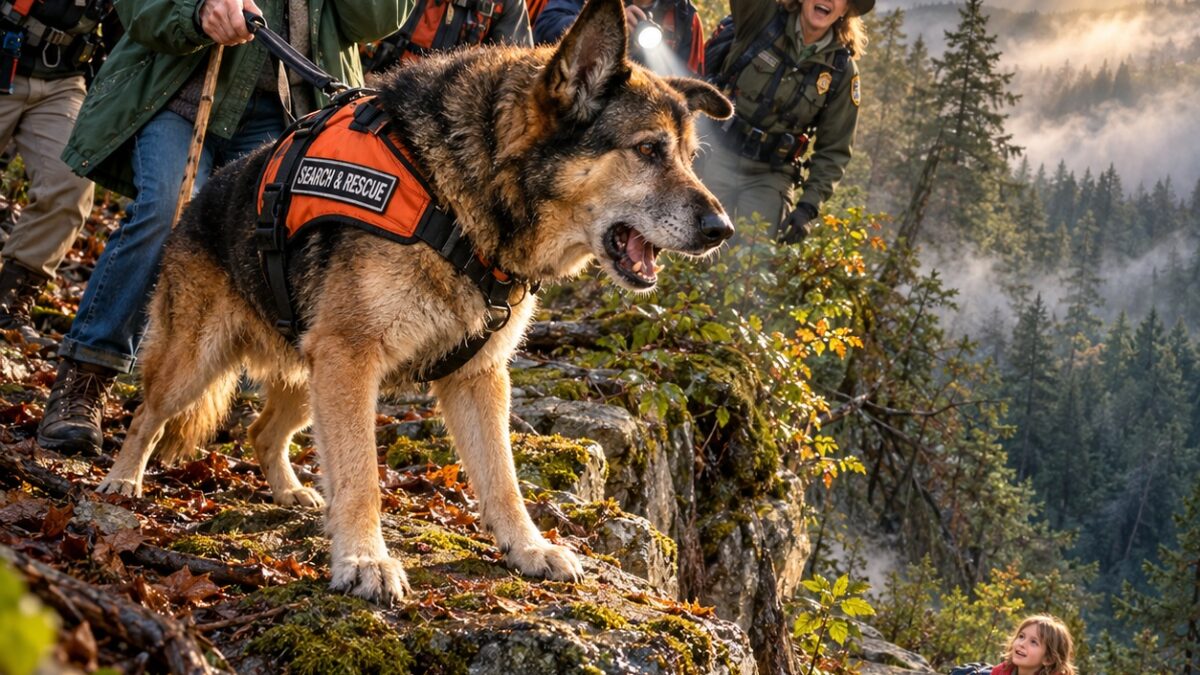
Harness on.
Handler beside him.
Moving through darkness.
Then I would look at the dog sleeping under my kitchen table and think:
You’ve done enough.
I believed that.
Completely.
Until the morning the village started looking for a child.
It was late summer.
Warm, but not brutally hot.
The day had begun normally.
Coffee.
Toast.
Bruno outside for a few minutes.
I was standing in the kitchen when somebody knocked hard on my door.
Not polite knocking.
Urgent.
I opened it.
A young man from farther down the road stood there breathing fast.
“Have you seen a boy?”
“What boy?”
“Eight years old. Maybe nine. Blue bicycle.”
“No.”
“He left home this morning.”
“How long?”
“His mother thinks almost two hours.”
Something inside me tightened.
“Where was he going?”
“Near the fields. Nobody knows.”
Behind him, other people were moving along the road.
Calling.
Doors opening.
A car pulled up.
Another neighbor jumped out.
Bruno came to stand beside me.
His ears were forward.
“What happened?” I asked again.
The young man explained more carefully.
The child had left on his bicycle.
His family assumed he was visiting a friend.
He never arrived.
Someone had seen him near the edge of the village.
After that, nothing.
People were spreading out.
Checking roads.
Fields.
Paths.
Calling his name.
Police and rescue services had been contacted, but villagers were searching immediately.
I grabbed my cardigan without thinking.
The young man looked at Bruno.
“Wasn’t he a rescue dog?”
I froze.
Bruno looked from him to me.
“Yes.”
“Could he help?”
The question felt unfair.
Bruno was eleven.
Retired.
He had not worked since before I knew him.
I did not even know the exact commands his former handler used.
I had no equipment.
No training.
I was a seventy-one-year-old woman with an old dog and a bottle of water.
“He’s retired,” I said.
“I know. I just thought…”
He trailed off.
Because we were both looking at Bruno.
He had changed.
That is the only way I can explain it.
His body seemed taller.
Not younger.
Different.
The sleepy dog from my terrace was gone.
His head was high.
Nose working.
Eyes fixed toward the road where people were calling.
I touched his back.
“Bruno?”
He stepped forward.
Stopped.
Looked at me.
Then toward the village.
I should have said no.
I probably should have waited for professionals.
But something about the way Bruno stood there made refusing feel like refusing him, not the young man.
“All right.”
I put on better shoes.
Took water.
Leash.
A few treats.
My phone.
We walked toward the gathering point.
The missing boy’s mother stood near a car crying while people asked questions too quickly.
What was he wearing?
Blue shirt.
Shorts.
Sneakers.
Helmet?
Yes.
Bicycle color?
Red.
Where did he like to go?
Creek.
Old quarry trail.
His friend’s house.
The mother kept repeating:
“He knows not to go far.”
Every parent believes that until a child is missing.
Then every known habit becomes fragile.
Someone had one of the boy’s jackets.
I did not know what to do with it.
Bruno did.
He moved toward it.
Sniffed.
Again.
Then lifted his head.
A man beside me said:
“Does he remember how?”
“I don’t know.”
That was the truth.
Bruno moved away.
Nose low.
Then back.
He circled.
People stopped talking.
I felt ridiculous.
Terrified of creating false hope.
“Let him work,” someone whispered.
Work.
That word.
I looked down at Bruno.
For months, I had been telling him he never had to work again.
Now everyone around us was watching to see whether he still could.
He moved toward the road.
Stopped at a bicycle track in dust.
Sniffed.
Then continued.
Three young men volunteered to come.
I said:
“I don’t know where he’s going.”
One answered:
“Neither do we.”
Fair.
We followed.
At first, Bruno moved along a familiar village lane.
Past houses.
Past a stone wall.
Toward the fields.
My heart beat harder.
He stopped several times.
Checked ground.
Air.
Grass beside the road.
Each pause looked deliberate.
Not wandering.
Not an old dog distracted by smells.
This was something else.
We reached the edge of the woods.
The marked path went left.
Bruno went right.
I pulled the leash slightly.
“Bruno.”
He resisted.
Not violently.
Firm.
Nose toward brush.
The young man beside me said:
“Let him choose.”
I looked into the trees.
No path.
My knees already complained.
“Wonderful.”
Bruno entered.
And we followed.
Within ten minutes, the village disappeared behind us.
The woods became denser.
Dry branches.
Rocks.
Roots.
Light broken by leaves.
Bruno moved faster than I expected.
Too fast for me.
“Slow down.”
He did.
For perhaps twenty seconds.
Then urgency pulled him forward again.
He was not simply moving quickly.
Every movement had purpose.
He would stop.
Lower his nose.
Examine a patch of ground.
Move.
Suddenly change direction.
Climb over rocky soil.
Drop toward lower ground.
Push between trees.
Then stop and wait.
The first time he looked back, I thought he was checking me.
The second time, I understood.
He was making sure the group remained together.
One of the young men was breathing hard.
“He’s guiding us.”
I looked at Bruno.
“Yes.”
The word came out quietly.
“So follow him.”
The forest thickened.
The path—if it had ever been a path—vanished entirely.
My legs hurt.
Branches caught my sleeves.
I stumbled once.
A young man grabbed my elbow.
“Careful.”
“I’m fine.”
“You’re seventy-one.”
“I know how old I am.”
He wisely said nothing else.
Bruno had gained distance.
He stopped.
Turned.
Waited.
I raised one hand.
“We’re coming.”
He moved again.
I began seeing the dog from the shelter differently.
“He waits, mostly.”
That was what the woman had said.
At the time, I thought she meant sadness.
Now I wondered whether waiting had simply been part of his nature.
Search.
Move.
Check.
Wait.
Make sure others followed.
All those months on my terrace, how much of Bruno’s old life had still been sitting quietly beneath the surface?
Maybe nothing had vanished.
Maybe age had only covered it.
Like dust on a tool still perfectly shaped for its purpose.
Forty minutes passed.
Then fifty.
We called the boy’s name periodically.
No answer.
One of the young men checked his phone.
Weak signal.
Rescue teams were organizing from another direction.
We sent coordinates when possible.
Bruno kept moving.
I began doubting.
That matters.
People like to tell rescue stories as if faith never breaks.
Mine did.
We had been in the woods almost an hour.
No bicycle.
No clothing.
No voice.
Only an old dog leading us farther from obvious trails.
What if he was wrong?
What if I had interpreted ordinary dog behavior as a miracle because I wanted to believe his history mattered?
What if the real search area was somewhere else?
What if people were following us because I had brought a retired animal into a situation too serious for sentiment?
I stopped.
“Bruno.”
He stopped too.
Looked back.
One young man asked:
“What?”
“I don’t know.”
My voice was lower now.
“I’m not sure we should keep going.”
Bruno lifted his head.
Wind moved through trees.
He turned toward a distant hill.
For several seconds, he stood completely still.
Then he went.
Faster.
Not hesitation.
Acceleration.
The men looked at me.
I looked at them.
Then started after him.
“Bruno!”
He disappeared between trees.
My heart slammed.
We pushed through.
Branches hit my arms.
Rocks shifted underfoot.
Then the forest opened.
Not fully.
Enough.
A rough clearing of stone and dry grass.
Beyond it, the ground dropped sharply.
A ravine.
Bruno stood at the edge.
Motionless.
I stopped several feet behind him.
The others arrived.
Nobody spoke.
Bruno looked down.
Then gave three barks.
Short.
Clear.
Separated.
Not frantic.
Signal.
One.
Two.
Three.
The hair on my arms rose.
One of the men moved closer.
“There’s something down there.”
We approached carefully.
At first, I saw red.
A bicycle.
Lying twisted between rocks and tall grass.
My breath stopped.
Then farther down—
A body.
Small.
Blue shirt.
Not moving.
“Oh God.”
One young man grabbed his phone.
“I’m calling.”
Another shouted the boy’s name.
No response.
Bruno barked again.
I grabbed the back of his collar.
“No.”
He leaned forward.
“Wait.”
The ravine was steep.
Loose stone.
We could create another victim if we rushed.
The young man gave emergency services our approximate coordinates.
Described the bicycle.
Child visible.
Possible fall.
Unconscious.
Bruno pulled once.
I looked down.
There was a narrow route along one side.
Not safe.
Safer.
“I’m going as far as I can.”
“Ma’am—”
“I am not climbing the cliff.”
One young man came with me.
We descended carefully.
Bruno moved lower with a steadiness I did not have.
He reached the child first.
Stopped beside him.
Sniffed his head.
Shoulder.
Chest.
Then sat.
Guarding.
Waiting.
By the time I reached them, my hands were shaking.
The boy’s face was pale.
One side dirty.
Small scrape near his temple.
I knelt.
“Sweetheart?”
No answer.
I did not move his neck.
Did not pull him upright.
I had enough common sense to know a fall and unconsciousness required caution.
I touched his hand.
Warm.
“Can you hear me?”
Nothing.
Bruno watched.
I leaned closer.
“We’re here.”
The boy’s fingers moved.
Tiny.
I almost thought I imagined it.
“Did you see that?”
The young man crouched nearby.
“What?”
“His hand.”
I spoke louder.
“We’re here. You don’t have to move.”
The boy made a sound.
Barely.
Not a word.
A breath with effort.
Relief hit so hard I nearly cried.
“He hears us.”
I looked up toward the others.
“He’s responding!”
Someone shouted back to rescue services.
Bruno remained beside the boy.
His breathing heavy now.
Age catching up to purpose.
I put my hand against his back.
“You found him.”
He did not look at me.
Only the child.
We waited.
Waiting was worse than searching in a different way.
During searching, every step feels like action.
Once you find someone, there can be nothing to do except not make things worse.
We kept talking to the boy.
Told him help was coming.
Told him not to try to stand.
Told him his family knew we were with him.
I had no idea if he understood.
I said it anyway.
Bruno eventually lay down close by.
Still facing him.
His sides moved heavily.
I gave him water from my hand.
He drank a little.
Then looked at the child again.
I whispered:
“You’re eleven years old.”
One ear moved.
“You are supposed to be asleep on my terrace.”
No reaction.
“This is unacceptable retirement behavior.”
The young man beside me laughed once.
Nervous relief.
We heard rescuers before we saw them.
Voices.
Equipment.
Someone calling.
Bruno stood.
Tail still.
Alert.
I answered.
“Down here!”
Professional rescue personnel reached the ravine.
Everything changed quickly after that.
Questions.
Assessment.
Stabilization.
Neck protection.
Pulse.
Breathing.
Possible head injury.
Possible fracture.
They worked around us with practiced calm.
I moved aside.
Bruno did not want to.
A rescuer gently reached toward his collar.
Bruno shifted back to the boy.
“I have him,” I said.
I held Bruno close.
“He found him.”
The rescuer looked at Bruno.
Then at me.
“He’s the search dog?”
“Retired.”
The man smiled briefly.
“Apparently not today.”
They secured the child.
Prepared the ascent.
The boy opened his eyes once.
Only briefly.
Confused.
He made a sound.
One rescuer said:
“You’re okay. We’ve got you.”
Bruno heard the voice.
His body relaxed slightly.
When they began carrying the child upward, Bruno tried to follow.
“Slow.”
I went with him.
Step by step.
My legs were shaking by the top.
When the stretcher reached safer ground, the team moved toward the access route where a vehicle could meet them.
Bruno followed several yards.
Then stopped.
He watched the child go.
I came beside him.
Put my hand on his back.
“It’s okay.”
He looked at me.
“You did what you had to do.”
For the first time since we entered the forest, his tail moved.
Once.
Slow.
That one movement broke something in me.
I cried.
Not elegantly.
Not quietly.
I bent and put both arms around Bruno’s neck.
He tolerated this indignity with patience.
One of the young men looked away, pretending not to see.
Good manners.
When we returned to the village, people were waiting.
News travels faster than vehicles in places where everyone knows everyone.
The boy’s family had already been told he was alive.
His mother stood near the rescue vehicle.
The moment she saw the stretcher, she ran.
Someone stopped her from interfering with medical care.
She covered her mouth.
Cried.
Repeated his name.
When the immediate rush settled, she came toward us.
Toward Bruno.
Not me.
Bruno sat beside my leg.
Exhausted.
His tongue out.
Dust covering his paws.
The woman knelt in front of him.
Her hands trembled.
She touched the side of his face.
For several seconds, she could not speak.
Finally:
“Thank you.”
Bruno looked at her.
Calm.
Almost solemn.
I stood a little behind him, crying again.
People surrounded us.
Questions.
Stories already forming.
“He went straight into the woods.”
“He kept stopping to check us.”
“He knew.”
“I’ve never seen anything like that.”
“Old boy still has it.”
Hero.
The word started circulating.
Hero dog.
Bruno the hero.
Everyone wanted to touch him.
Praise him.
Tell the story.
Bruno wanted water.
I moved him away from the crowd.
“He’s tired.”
That mattered to me.
He had done enough.
More than enough.
The boy was taken for medical evaluation.
His family went with him.
The village stayed awake emotionally long after the vehicles left.
People replayed the story.
Where the bicycle was.
How far.
How long.
What might have happened if—
I refused that question.
What if.
No.
He had been found.
Alive.
That was enough.
By evening, Bruno and I finally reached home.
I opened the front door.
For a moment, he stood on the threshold.
The same place where he had paused on adoption day.
Then he entered.
No inspection.
No checking every room.
He walked straight to his corner.
Turned once.
Lay down.
I stood over him.
“You’re tired?”
He opened one eye.
“I brought you here to rest.”
Eye closed.
“But apparently nobody explained retirement to you.”
I brought water.
Set it beside him.
Then sat on the floor.
At seventy-one, sitting on the floor is a commitment.
Getting back up is a separate negotiation.
I did not care.
I placed my hand on Bruno’s side.
His breathing slowed.
Within minutes, he slept.
Deep.
The house became quiet.
But again, not empty.
I thought about the shelter.
“He waits, mostly.”
Those words meant something different now.
Bruno had not spent his retirement waiting for someone to ask him to work again.
Maybe he had simply been waiting for home.
That realization hurt in a sweet way.
He had spent years finding other people.
Returning strangers to families.
Walking toward fear, cold, forests, confusion.
Then his working life ended.
And somehow, the animal who had always been sent to find others became the one waiting to be chosen.
I had chosen him because my house was too quiet.
Such a selfish little reason compared with the life he had lived.
And still, Bruno had accepted it.
Accepted me.
My terrace.
My routines.
My slow walks.
My overwatered basil.
Then one child needed him.
And every old instinct woke.
Not because somebody commanded him.
Not because he wore a vest.
Not because there was a reward.
Because that was who he was.
The next morning, I woke early.
Bruno did not.
That frightened me for approximately three seconds until I heard him snore.
“Good.”
I made coffee.
Opened the terrace door.
Bruno eventually came outside.
Slowly.
Very slowly.
Yesterday had collected its debt.
I watched his hips.
His steps.
The slight stiffness when he lowered himself.
“You are absolutely retired today.”
He drank water.
Lay in the sun.
No argument.
My phone rang.
The boy was going to be all right.
I sat down so quickly coffee spilled.
“What?”
The caller repeated it.
Injuries.
Bruising.
A head injury that needed monitoring.
But stable.
Awake.
Family with him.
Alive.
Safe.
I put the phone down.
Looked at Bruno.
“He’s okay.”
Bruno lifted his head.
I laughed through tears.
“You hear me? He’s okay.”
His tail tapped the terrace once.
Then he lowered his head again.
Of course.
Mission finished.
Rest.
For the next several days, everyone in the village knew Bruno.
Our walks became impossible.
People stopped us every twenty feet.
“There he is!”
“Bruno!”
“Good boy.”
One man knelt and talked to Bruno like they had survived war together.
Bruno stared at him.
I said:
“He is deeply moved.”
The man laughed.
Children especially loved him.
Parents told the story.
Perhaps with more drama each time.
By the end of the week, according to one child, Bruno had jumped over a river, fought a wolf, and carried the missing boy home personally.
I corrected that version.
Bruno did not need embellishment.
Reality was enough.
When people called him a hero, I usually smiled.
But privately, the word felt incomplete.
Bruno had not become a hero the day he found the child.
He had been that dog long before I met him.
I had simply been there the first time his old life became visible to me.
That distinction mattered.
A person—or animal—does not lose the truth of what they were because nobody happens to be watching.
Age had changed Bruno.
Retirement changed his days.
Neither erased him.
A few days later, the boy’s family came to my house.
His mother.
Father.
And the child.
He moved carefully.
Still recovering.
But walking.
Alive.
I opened the door.
Bruno was behind me.
The boy saw him.
His whole face changed.
“Bruno.”
I looked at his mother.
“You told him?”
“About a hundred times.”
The boy carried a sheet of paper.
He held it out.
“For you.”
“For me?”
He shook his head.
“For Bruno.”
Naturally.
I took it.
Drawing.
Crayons.
Brown-and-black dog with enormous ears.
A small stick figure beside him.
Trees.
A blue sky.
At the top, letters unevenly written:
BRUNO FOUND ME.
My throat closed.
I crouched beside him.
“This is beautiful.”
He pointed.
“That’s me.”
“I guessed.”
“And that’s Bruno.”
“He looks very handsome.”
Bruno sniffed the paper.
The boy laughed.
Then I asked:
“Where is Bruno going?”
The boy answered immediately.
“He’s coming to get me.”
I had to look away.
His mother started crying too.
Wonderful.
A house full of people crying around a confused dog.
Bruno went to the boy.
Sat.
The child put both hands against his face.
“Thank you.”
Bruno licked his wrist.
That seemed to satisfy everyone.
I kept the drawing.
Still have it.
In my bedroom.
Not because I need to remember Bruno found a child.
I remember.
I keep it because of the sentence.
BRUNO FOUND ME.
For years, that had been his work.
Find.
Locate.
Return.
But the most beautiful part of Bruno’s story was not the ravine.
Not to me.
The most beautiful part came afterward.
After everyone praised him.
After the rescue vehicles left.
After the village knew his name.
Bruno came home.
He did not remain with the rescue team.
He did not pace by my door searching for another mission.
He did not suddenly become restless with retirement.
He returned to his blanket.
Water bowl.
Terrace.
Me.
That mattered more than I can explain.
I worried for a while that finding the boy might reawaken something painful.
That ordinary life would no longer be enough.
Maybe Bruno would miss work.
Miss purpose.
Miss being needed in that particular way.
I watched him too carefully for signs.
Every walk.
Every distant voice.
Every emergency vehicle.
He still noticed.
Of course.
But then he returned home and slept.
One afternoon, a siren moved through the village.
Bruno lifted his head.
Listened.
Then looked at me.
I waited.
He lowered his head onto my shoe.
That was when I understood.
Bruno did not need to work to know who he was.
And he did not need to prove who he had been.
That was my lesson too.
At seventy-one, people begin speaking to you differently.
Not always intentionally.
They say:
“At your age…”
More often.
They ask whether you should still drive at night.
Climb ladders.
Travel alone.
Carry something.
Some concern is reasonable.
Some of it quietly erases you.
As though age turns a person into a collection of restrictions.
I had begun doing it to myself.
Before Bruno.
I told myself I was too old for certain kinds of change.
Too settled.
Too independent.
Too accustomed to living alone to suddenly share a home with a dog.
Then I adopted one.
And my life changed.
Not by becoming younger.
That is important.
I did not become a different age.
Bruno did not become a young search dog again.
We became more alive at the ages we already were.
There is a difference.
Bruno showed me that usefulness does not expire on schedule.
Neither does companionship.
Neither does courage.
Neither does the capacity to begin again.
The shelter worker visited once.
She wanted to see him.
Bruno was asleep on the terrace.
She laughed.
“Looks terrible.”
“Absolutely miserable.”
“You spoiled him.”
“He earned it.”
She sat with me.
We talked about the rescue.
She had heard.
Everyone had.
I asked:
“Did you know he could still do that?”
She looked at Bruno.
“I knew what he had done before.”
“That’s not what I asked.”
“No.”
She smiled.
“No, I didn’t know.”
“What did you mean when you told me he waited?”
She thought.
“Exactly what I said.”
“That’s helpful.”
“He would watch people.”
“People adopting?”
“Yes.”
“He never reacted?”
“Not much.”
“Until me?”
She smiled.
“Until you.”
I looked at Bruno.
“Why?”
“If I knew how dogs chose people, I’d charge more.”
Fair.
Maybe he chose me.
Maybe I happened to be the person who chose him.
I no longer cared which version sounded better.
What mattered was we both left the shelter together.
After the rescue, people sometimes suggested Bruno should receive some formal recognition.
A certificate.
Ceremony.
Photograph.
I hesitated.
Not because I disliked appreciation.
Because Bruno did not need a second career as a local attraction.
Eventually, the village arranged something small.
The boy’s family attended.
A few volunteers.
Some rescue personnel.
They gave Bruno a medal-shaped tag for his collar.
I put it on.
He tried to bite it.
Perfect.
The boy laughed harder than anyone.
Then Bruno lay down during the rest of the ceremony and slept.
Also perfect.
At home, I removed the tag and kept it in a drawer.
His normal collar suited him better.
Bruno’s hips worsened gradually.
That was expected.
He was eleven.
Then twelve.
I adjusted our walks.
Shorter.
More frequent.
No steep hills.
The forest search remained the longest and hardest day we ever spent together.
Sometimes people would see his slower gait and say:
“Hard to believe he ran through the woods like that.”
I believed it easily.
I had been there.
I had watched purpose carry an aging body farther than comfort ever would.
Still, I never asked it of him again.
When people jokingly said:
“Bruno, find somebody!”
I would answer:
“No.”
He had done enough.
Retirement meant something.
Rest was not uselessness.
That lesson might have been the most important one Bruno gave me.
We live in a world that admires usefulness.
What can you produce?
Fix?
Earn?
Find?
Carry?
Accomplish?
Working dogs are praised because they work.
People often are too.
Then age comes.
Illness.
Retirement.
Bodies change.
And suddenly a question appears:
If I am not doing what I used to do, what am I for?
Bruno answered by sleeping on my terrace.
He was for being Bruno.
That should be enough for anyone.
I had struggled with the same question more than I realized.
My days no longer had the urgency they once did.
There were fewer people depending on me.
No workplace.
No children in the house.
No partner.
No schedule I could not change.
I had mistaken reduced obligation for reduced meaning.
Bruno corrected that simply by needing breakfast every morning.
A walk.
A hand on his back.
Company.
Small needs.
Real meaning.
The boy visited occasionally.
Not constantly.
Life moved on.
That was healthy.
He recovered.
Returned to school.
Rode a bicycle again eventually.
His mother told me the first time terrified her.
Understandably.
They bought him a brighter helmet.
A small tracking device.
Rules.
Check-ins.
Parenting after fear becomes a negotiation between protection and freedom.
The first time he rode to my house, his mother walked behind him.
He was offended.
“I can do it.”
She answered:
“I know.”
She still followed.
Bruno greeted him at the gate.
The boy crouched.
“Hey, rescuer.”
Bruno wagged.
The boy showed him the bicycle.
“This one’s new.”
I said:
“Try keeping this one on the road.”
He looked embarrassed.
“Okay.”
His mother smiled.
Healing often arrives through jokes you could not have made earlier.
He asked whether Bruno remembered him.
“I think so.”
“How do you know?”
“I don’t.”
The boy considered this.
“Dogs remember smell.”
“Yes.”
“So he remembers.”
Good enough.
I never argued with children when they had science on their side.
That afternoon, he sat beside Bruno on the terrace.
No big conversation.
He read a comic book.
Bruno slept.
I watched from inside.
Two creatures linked by one terrible day, now doing absolutely nothing together.
Beautiful.
Months became a year.
My house changed in ways I stopped noticing.
Dog hair gathered in corners.
There was always a towel near the door.
A basket for toys Bruno barely used.
Medication eventually.
Joint supplements.
A ramp of his own for getting into the car.
The irony amused me.
Retired search dog now requiring assistance.
I bought the ramp without sadness.
Bodies change.
Tools help.
No shame in either.
The first time Bruno refused to use it, I said:
“You are not jumping.”
He stared at the car.
“Bruno.”
He looked at me.
“You are twelve.”
Tail.
“I am seventy-two.”
Nothing.
“Between the two of us, we have enough bad joints to start a weather station.”
He used the ramp.
Victory.
I had become more comfortable asking for help too.
That was unexpected.
One winter, snow made the walkway slick.
A neighbor offered to clear it.
My first instinct:
No, I can manage.
Then I looked at Bruno.
Old dog.
Old woman.
Ice.
I said:
“Yes, please.”
Such a small sentence.
It felt enormous.
For years, accepting help had seemed like admitting weakness.
Bruno had spent his career finding people precisely because humans sometimes need finding.
There is no moral failure in that.
Everyone gets lost somehow.
Not always in forests.
Sometimes in grief.
Routine.
Silence.
Pride.
A house too quiet to notice its own emptiness.
I had been lost in one of those places.
Bruno found me without searching.
The village eventually stopped talking about the rescue every day.
Then every week.
Good.
Stories should settle.
Bruno’s fame faded.
Children still knew him.
Adults still smiled.
But he became a normal old dog again.
That was exactly what I wanted for him.
We walked.
He slept.
He sometimes refused food until I added something better.
Retirement corrupted his standards.
On rainy days, he stood at the door, looked outside, then at me.
“No.”
I would say.
“We’re going.”
He stepped backward.
“You found a child in a ravine.”
No movement.
“You can survive drizzle.”
Apparently heroism had limits.
I bought him a coat.
He hated it.
I loved it.
We compromised badly.
At night, I sometimes sat beside him and thought about all the people he had found before me.
Names I would never know.
Families who remembered another day when someone said:
They found them.
How many kitchens had celebrated because Bruno followed a scent?
How many parents had cried into his fur?
How many exhausted rescue workers had trusted him?
A whole lifetime inside one sleeping animal.
We are all like that, I suppose.
People meet us late and assume the version they see is the whole story.
An old woman.
An old dog.
Quiet house.
They do not see everything that came before.
Maybe dignity begins with remembering that.
Every person contains chapters you did not witness.
Every aging body belonged to someone who ran once.
Worked.
Loved.
Failed.
Carried.
Searched.
Found.
Bruno made me gentler about that.
A man at the market moved slowly in front of me one day.
I almost became impatient.
Then thought:
You do not know his chapters.
I waited.
Not sainthood.
Just perspective.
Bruno gave me more of it than I had expected from a dog.
The drawing stayed on my bedroom wall.
BRUNO FOUND ME.
I would see it in the morning.
Sometimes I thought the words belonged to me too.
Not literally.
Bruno did not track me through a ravine.
But he found the part of my life I had stopped noticing was missing.
The sound of another being.
Responsibility.
Routine shared rather than performed alone.
A reason to open the door every morning besides habit.
The comfort of saying:
“We’re going home.”
We.
Such a small word.
I had not used it much before Bruno.
Now it appeared everywhere.
We need groceries.
We’re walking.
We’re tired.
We’re staying home.
We.
The first winter after the rescue, I sat near the fireplace with Bruno asleep beside me.
Wind outside.
House warm.
I realized I had gone an entire day without noticing the silence.
Because there was none.
Not really.
Even sleeping, Bruno had presence.
Breathing.
Occasional sigh.
Paw moving in dreams.
A life beside mine.
That was what I had wanted when I went to the shelter.
I just had not known how to name it.
When Bruno turned twelve, I bought him a ridiculous dog-friendly birthday treat.
The shelter worker came.
The boy and his family too.
A few neighbors.
Bruno looked deeply inconvenienced by celebration.
The boy gave him another drawing.
This time:
BRUNO RETIRED.
The picture showed Bruno lying under a giant sun.
I laughed.
“Better.”
The boy pointed at a small figure beside him.
“Who is that?”
“You.”
“Why am I so small?”
“I ran out of room.”
Children are ruthless.
Bruno ate the treat.
Accepted attention.
Then walked away from his own party and fell asleep under the table.
True retirement.
I sometimes wondered whether the day in the forest had shortened his life.
That thought frightened me.
He had pushed himself hard.
Too hard for his age.
I asked the veterinarian.
She examined him.
Listened.
Moved joints.
Checked everything.
Then said:
“One hard day doesn’t define his health.”
“But should I have stopped him?”
“Would you have been able to?”
I thought about Bruno accelerating toward the ravine.
“No.”
She smiled.
“There’s your answer.”
“But he was old.”
“He was capable.”
Different.
Old does not automatically mean incapable.
Another lesson.
Still, I watched him carefully.
Not fearfully.
Carefully.
Rest when tired.
Short walks.
Good food.
Pain management when needed.
No unnecessary heroics.
Bruno accepted all of this except nail trimming, which apparently violated his constitutional rights.
The child grew.
Bruno aged.
I aged.
Life continued.
No second miraculous rescue.
I am glad.
One is enough.
The story people wanted was Bruno finding someone again.
The story I loved was Bruno never needing to.
No more emergencies.
No more missing people.
No forests.
No ravines.
Just home.
People sometimes asked:
“Do you think he misses it?”
Search work.
I would look at him asleep in sunlight.
“I hope not.”
Not because the work meant nothing.
Because he deserved a life not built entirely around being useful to somebody else.
There is love in service.
There is also love in letting service end.
That became important to me personally.
At seventy-one, then seventy-two, I stopped apologizing for slower days.
If I wanted to sit with tea and read for three hours, I did.
If Bruno wanted to sleep in the sun, he did.
Not every day needs a rescue.
Not every life needs a dramatic purpose to justify its existence.
Some days are allowed to be warm floors and water bowls.
That is enough.
One evening, long after the village had stopped retelling the rescue every week, I sat outside.
Sun dropping behind the hills.
Bruno at my feet.
The same hills we had crossed that day were dark shapes far away.
I could not see the ravine.
Good.
I did not need to.
The boy was home somewhere.
Probably complaining about homework.
His mother probably checking whether he remembered to text.
The rescue team had other work.
The young men who followed Bruno had returned to their lives.
And Bruno?
Sleeping.
I bent.
Touched his back.
“I’m glad I brought you home.”
He did not open his eyes.
His tail moved once.
Exactly like it had after the child was rescued.
I smiled.
For months, I had interpreted every little movement from Bruno.
Maybe too much.
Humans cannot resist turning animals into poets.
Maybe the tail meant nothing more than:
I hear you.
That was enough.
I had opened one door at the shelter.
Or maybe the shelter had opened one for me.
Bruno entered my house.
And somehow, life followed.
That is what I would tell someone who asked why an elderly woman would adopt an elderly dog.
Because not every adoption needs to be about maximum years.
People say:
“But you know you won’t have as much time.”
Of course.
At seventy-one, I understand limited time better than most.
That is exactly why it matters.
Love is not made valuable by pretending it lasts forever.
It is valuable because time does not.
Bruno had eleven years before me.
I could not own them.
Could not recover them.
Could not make him young.
What I could give him was now.
A home now.
A terrace now.
A person beside him now.
He gave me exactly the same thing.
People worry about endings so much they refuse beginnings.
I had done that too.
Bruno cured me of some of it.
Not all.
Enough.
If I had walked out of the shelter because eleven sounded too old, the boy might still have been found by rescue teams.
Maybe.
Maybe not.
I cannot know.
But I know what I would have lost.
The morning footsteps.
The terrace.
The drawing.
The forest.
His head against my foot.
“We.”
All of it.
The boy’s mother once said to me:
“You saved my son by adopting Bruno.”
I corrected her.
“Bruno saved your son.”
She shook her head.
“If you hadn’t taken him…”
I stopped her.
There are roads of causation that become too large for one person to claim.
Shelter worker kept Bruno.
I adopted him.
Child left home.
Young men joined search.
Bruno followed scent.
Someone called rescue.
Professionals arrived.
Family waited.
No single hero.
Even Bruno did not bring the boy out alone.
He found.
Others carried.
That is how rescue works.
Connection.
Again.
The theme Bruno kept teaching me whether I wanted it or not.
Nobody does everything alone.
That is not weakness.
It is reality.
The last time the boy visited that year, he sat beside Bruno and asked:
“Does he remember finding me?”
I looked at the dog.
“I don’t know.”
The boy rubbed Bruno’s ear.
“I remember.”
That was enough too.
Bruno opened his eyes.
Looked at him.
Then put his head back down.
The boy smiled.
“He knows.”
I did not argue.
Some truths do not require proof.
Bruno never wore a search harness with me.
Never needed one.
I considered buying something symbolic once.
Then decided against it.
He was not a retired uniform.
He was Bruno.
At home, that was his only job.
Eventually, the village got another story.
Then another.
Life loves replacing headlines.
A flood one spring.
A school fundraiser.
Some political argument I happily ignored.
Bruno became part of local memory rather than daily conversation.
Perfect.
His world narrowed comfortably.
Home.
Terrace.
Two walking routes.
Veterinarian.
Occasional visitor.
Me.
I liked being part of a small world that finally felt full.
One morning, rain kept us inside.
I sat near the window.
Bruno slept.
I caught myself listening to the house.
Years earlier, I had hated that sound.
Refrigerator.
Clock.
Rain.
Empty rooms.
Now those sounds were still there.
So was Bruno’s breathing.
The silence had not disappeared.
It had stopped being empty.
That distinction became the final gift.
Loneliness is not always solved by noise.
Sometimes it is solved by presence.
Bruno rarely made much noise.
He simply existed beside me.
And that was enough to change the shape of every room.
I imagine there was a time when his days began with commands.
Harness.
Vehicle.
Search area.
Work.
Alert.
Reward.
Again.
Now his mornings began when I opened the terrace door.
He stepped out.
Smelled the air.
Chose sun or shade.
Drank water.
Sometimes looked at the hills.
Did he remember?
Maybe.
Then he lay down.
That was his life.
A life where nobody was missing.
Nobody needed finding.
Nobody waited in the dark.
I hope he understood how beautiful that was.
I did.
Whenever people tell the story, they usually end at the ravine.
Three barks.
Bicycle.
Missing child.
Hero dog.
It is a good ending.
Just not mine.
My ending happens later.
At home.
The door closes.
Bruno walks to his blanket.
Turns once.
Lies down.
No applause.
No mission.
No one asking him for anything.
I sit beside him.
And he sleeps.
That is the moment I understood what I had really given him.
Not retirement.
Home.
And what he had given me was not excitement, purpose, or some dramatic second life.
He had given me someone to come home to.
Those are different gifts.
Both enormous.
Sometimes I stand in the shelter doorway in my memory.
Bruno inside.
Me outside.
“He waits, mostly.”
I wish I could return to that woman I was.
The one worried about age.
Responsibility.
Whether adopting him was sensible.
I would tell her:
Open the door.
That is all.
You do not need to know the whole story.
You do not need to know about the forest.
The boy.
The ravine.
The drawing.
You do not need proof that this old dog still has something extraordinary inside him.
He does not have to earn your home.
Open the door because he needs one.
And because, though you do not know it yet, so do you.
Tonight, Bruno is sleeping at my feet.
The sunset has almost disappeared.
His muzzle is grayer than when I first saw him.
His breathing slow.
One paw stretched toward my chair.
There is no search tonight.
No missing child.
No crowd.
No emergency.
Just an old woman and an old dog in a quiet house.
And I have never felt less alone.
He spent years finding people who were lost.
One day, when everyone believed that part of his life was over, he walked into a forest and found one more.
But when he came home afterward, curled up beside my chair, and finally allowed himself to rest, I understood something the village did not.
Bruno had spent his life finding people.
And somewhere along the way, he had been waiting to be found too.
I thought I adopted him because I could not stand the silence anymore.
Now I think we were simply two old souls standing on opposite sides of the same open door.
I gave him a home.
He gave mine a heartbeat.
And after everything Bruno had spent his life searching for, that was the one place he never had to search again.








