PART2:Hope Was Found Crying Beneath the Forest Brush With Bare Skin and Twisted Bones—Weeks Later, She Ran Toward a Life She Had Never Been Allowed to See
PART2
A dog should not need to lie down because eating requires too much strength.
Hope did.
I sat near her.
Not touching.
She ate slowly.
Every few bites, she looked toward us without raising her head.
Checking.
Watching.
Ready for something we did not understand.
We let the room stay quiet.
No reaching.
No excited voices.
No attempt to convince her she was safe before she had enough evidence.
Hope finished what she could.
Then slept.
The next morning, we took her to the veterinary clinic.
She changed the moment we entered.
At home the previous night, she had at least begun to rest.
At the clinic, unfamiliar hands and smells brought the fear back.
Hope lowered her head.
Again.
Trying to make herself smaller.
A veterinarian approached slowly.
Hope looked away.
Her posture said:
Please don’t see me.
But we needed to see everything.
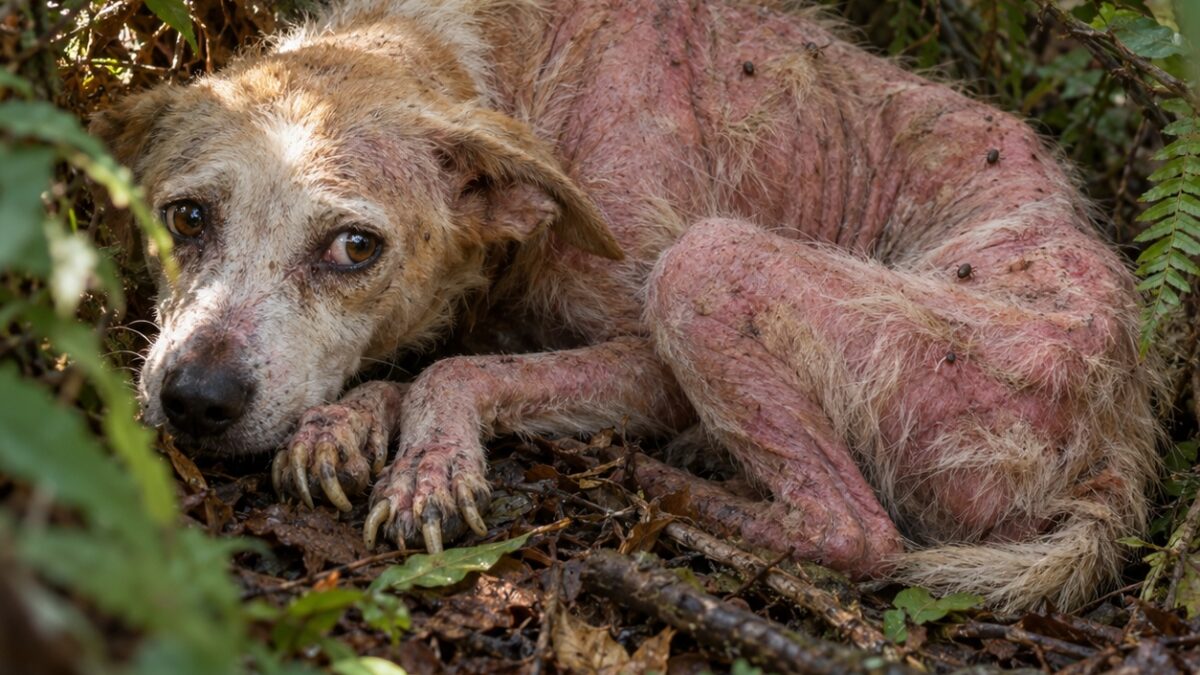
Her skin.
The ticks.
Her spine.
Her pelvis.
Her gait.
Her weakness.
The long nails.
The body beneath the missing fur.
Hope was only four years old.
That fact did not fit what we were looking at.
She moved like a dog much older.
Her back carried changes we would have expected after much more time or much more trauma.
The veterinarian examined her.
Carefully.
Hope flinched at touch.
Not every touch.
Some areas more than others.
The spine immediately raised concern.
Further evaluation followed.
Imaging.
Neurological examination.
A closer look at the structure of her back and pelvis.
Then the veterinarian sat with us.
“Her spine has serious changes.”
I looked through the doorway at Hope.
“What kind?”
“There is a herniated disc.”
My stomach tightened.
“And scoliosis.”
Her spine was curved abnormally.
That explained some of the way she carried herself.
Then:
“The pelvis is deformed too.”
I stared.
“All from an injury?”
The veterinarian hesitated.
“We can’t know every part of her history.”
That became important.
We could not turn suspicion into fact.
But the physical findings suggested something disturbing.
Her body looked like a body that had not developed with normal freedom of movement.
The veterinarian said it was possible Hope had spent a long time confined in a space far too small.
Perhaps a cramped cage.
Possibly used repeatedly for breeding before being abandoned.
The possibility made my throat close.
I looked at her.
Four years old.
Most fur gone.
Ticks attached.
Nails grown absurdly long.
Spine curved.
Pelvis altered.
Head lowered whenever hands approached.
If the suspicion was right, then Hope’s body had been shaped not only by disease but by restriction.
Imagine growing while unable to move normally.
Imagine the same small space.
Day after day.
Your bones forming around what your environment allows.
Your nails getting longer because there is nowhere appropriate to wear them down.
Your world measured in inches.
Then somehow ending up in a forest.
We never learned every detail.
I stopped trying to invent the missing pieces.
What we knew was enough.
Hope had suffered.
Hope needed help now.
That was the only history we could act on.
The veterinary team admitted her.
Three weeks.
That became the next chapter.
At first, I thought three weeks sounded short.
Then I lived them.
When an animal is medically fragile, one day can feel like a month.
The team began with stabilization.
Fluids.
Careful nutrition.
Skin care.
Monitoring.
Treatment guided by what Hope could tolerate.
Her body had been depleted for a long time.
You do not correct that with one meal and one bath.
Her skin needed time.
Hydration needed time.
Strength needed time.
Trust needed the most time of all.
The first days, Hope remained withdrawn.
When technicians approached, her head lowered.
She often turned her face away.
Touch around the body made her tense.
We gave her a soft place to rest.
Hope spent much of the day curled there.
People came.
People went.
Nothing bad happened.
That may sound unimpressive.
It was therapy.
Someone enters.
Food arrives.
Someone leaves.
Someone touches gently.
Nothing hurts beyond what medical treatment requires.
Hands do not become punishment.
Day after day, those experiences begin rewriting expectation.
Hope had ticks removed.
Her skin treated.
Her body cleaned.
The first baths were difficult.
Water on already irritated skin can make a frightened dog feel trapped.
We went slowly.
Hope stood only as long as she comfortably could.
When she tired, we adjusted.
When she trembled, voices softened.
When she looked overwhelmed, we paused where possible.
No one expected gratitude.
That matters.
Rescued animals are often asked emotionally to appreciate what we are doing.
Hope did not owe us that.
A bath was still a bath.
A clinic was still frightening.
She was allowed to dislike necessary care.
Our job was to make it safe enough.
Afterward she would return to her bed.
Curl up.
Sleep.
Then wake.
Eat.
Rest again.
Her appetite improved before her confidence did.
Food became one reliable thing.
Hope still often preferred eating low to the ground.
Sometimes lying down.
Her body was weak.
The spine and pelvis made posture uncomfortable.
So we brought food to the level she could manage.
No pride.
No expectation.
Eat however you need.
That sentence could have described her entire recovery.
Move however you can.
Rest whenever you need.
Trust at your speed.
Heal what can heal.
Accept what cannot simply be changed.
The herniated disc mattered.
The scoliosis would not disappear because she was finally loved.
The pelvis would not magically reshape itself.
Good care does not erase every consequence of bad care.
That was a hard thing to accept.
I wanted everything fixed.
We all do.
Find suffering.
Remove suffering.
Return perfect dog.
Real rescue is not that clean.
Some things remain.
The goal becomes:
Can she live comfortably?
Can pain be managed?
Can skin heal?
Can strength return?
Can she move better?
Can she trust?
Can life become bigger than what happened?
Those were better questions.
By the end of the first week, Hope was still frightened.
But she no longer looked quite as shut down.
One technician noticed she had started watching people directly for a second before looking away.
Another said she finished her food faster.
Someone else noticed she shifted toward the front of her resting area when familiar voices entered.
Small changes.
They accumulated.
I visited.
Sat beside her.
“Hi, Hope.”
Her head lifted.
That alone felt different.
I placed my hand on the floor.
Not on her.
Hope watched.
Then lowered her head again.
Fine.
The next day:
Hand on floor.
Hope sniffed the air.
Another day:
She leaned forward.
Her nose touched my fingers.
Then she moved back.
I smiled but tried not to react loudly.
Trust can be frightened by celebration.
A week earlier, she would barely look at me.
Now she had chosen contact.
That was enough.
Her skin began changing too.
The angry redness slowly reduced.
The constant itching eased.
The treatment was working.
New fur did not appear immediately.
First the skin simply looked less raw.
That mattered.
Hope scratched less.
Rested more.
The ticks were gone.
Her body no longer had parasites attached while it tried to heal everything else.
One layer of discomfort removed.
Then another.
The veterinary team continued stabilizing her.
Fluids when needed.
Medication.
Nutrition.
Careful movement.
There was no dramatic surgery.
No one procedure to mark the turning point.
Hope’s recovery was built from maintenance.
That makes for a less dramatic medical story.
It makes for a more honest one.
On the second week, she stood longer.
I happened to be there.
Hope had been lying down.
Someone entered with food.
Her head rose.
Then she pushed herself up.
Slowly.
Her back looked awkward.
The pelvis changed how she positioned the hind legs.
But she stood.
And stayed standing.
The technician froze.
“Look at you.”
Hope looked toward the bowl.
Of course.
“Food.”
We laughed quietly.
Hope took two careful steps.
Then another.
Not graceful.
Not painless-looking.
But forward.
I thought about her beneath the branches.
Trying to rise and sinking again.
Now she moved across a clinic floor toward something she wanted.
The distance was tiny.
Emotionally, it felt enormous.
After eating, Hope returned to bed.
Exhausted.
Progress does not mean fatigue disappears.
Her body had been deprived for too long.
Strength had to be built gradually.
And those skeletal problems meant movement might always look different.
We stopped comparing her to an imaginary normal dog.
The correct comparison was Hope yesterday.
Could she stand longer?
Could she walk farther?
Was the skin calmer?
Did she recover more quickly?
Did she look at us instead of hiding?
Those were the measures.
Hope versus Hope.
That is fairer.
The second week brought another change.
She began accepting affection.
Not tolerating.
Accepting.
A technician crouched beside her.
Hope sniffed the woman’s wrist.
The woman touched under her chin.
Hope stayed.
Then lifted her chin slightly.
Invitation.
The technician continued.
Hope’s eye softened.
Her ears relaxed.
The whole room changed.
No one spoke for a moment.
Because this was a dog whose first instinct had been to lower her head whenever people came near.
Now she raised it into a hand.
I felt tears.
The technician did too.
She whispered:
“Hi, pretty girl.”
Hope remained there.
That is how emotional recovery announces itself.
Not with a dramatic breakthrough.
Body language.
A chin rising.
A shoulder relaxing.
A dog deciding a hand might feel good.
From then on, Hope began developing favorites.
Certain voices brought her head up faster.
Certain hands got closer.
She still startled.
Still retreated sometimes.
But retreat was no longer the only answer.
Sometimes she stayed.
Sometimes she approached.
Sometimes she leaned.
A frightened animal becoming selective is progress.
It means fear no longer controls every interaction.
The skin continued healing.
Tiny areas of fur began returning.
At first soft, thin fuzz.
Someone pointed.
“Look.”
I leaned closer.
New coat.
Where there had been red exposed skin.
Hope did not understand why humans were interested in her hair.
We did.
It meant her body finally had enough resources to repair.
Nutrition was reaching places starvation and illness had neglected.
The skin environment was improving.
A body given care tries.
That is one of the most hopeful things I know.
Week three.
We began talking about taking Hope home.
Not forever yet.
Out of the hospital.
That distinction mattered.
A clinic can stabilize.
It cannot replace a quiet home environment.
Hope needed familiar people.
Routine.
Space.
But before discharge, the team wanted confidence that she could stand and move safely enough.
Every day we watched.
Hope stood.
Walked.
Rested.
Again.
One morning I arrived and found her already on her feet.
No one helping.
Hope was simply standing.
I stopped in the doorway.
She looked at me.
And for the first time, her expression seemed almost bright.
“Hope?”
Her tail moved.
Not much.
Enough.
I crouched.
Hope took one step toward me.
Then another.
Her gait was unusual.
That would likely remain.
But she came.
I held out my hands.
Hope reached me.
Pressed her nose into my palm.
I cried.
Of course.
Three weeks earlier, she had been hidden beneath brush too weak and frightened to look at us.
Now she had crossed a room on her own feet to reach a person.
That was discharge day.
Not because every problem had disappeared.
Because she had become stable enough to continue healing outside the hospital.
We gathered medications.
Instructions.
Skin treatments.
Bath schedule.
Everything.
The veterinary team reminded us about the lasting structural issues.
Her back would need understanding.
No forcing.
No ignoring pain.
Her pelvis remained deformed.
The scoliosis remained.
The past had left physical marks care could not simply wash away.
I listened.
Then looked at Hope.
She did not need perfection.
She needed a life that worked with the body she had.
We could give her that.
The first night home after the hospital was different from the first night we brought her out of the forest.
Then, she had hidden.
Now, she explored.
Slowly.
One room.
Pause.
Another.
Sniff.
Rest.
She still chose corners sometimes.
Habit.
But she did not press herself into them as desperately.
We put down a soft bed.
Hope inspected it.
Circled.
Lay down.
Then stretched.
Full length.
I smiled.
No branches.
No ticks.
No forest floor.
Just bed.
She slept.
The baths continued.
They became easier.
Hope still did not love every second.
But the trembling reduced.
She knew the pattern.
Warm water.
Gentle hands.
Towel.
Then food or rest.
Predictability calmed her.
Her fur returned more visibly.
Patches became coverage.
Her appearance changed week by week.
People who had seen the first photographs could barely believe it.
I could.
Because I had watched every boring step.
Healing is spectacular in retrospect.
While it happens, it is mostly routine.
Medication.
Bath.
Meal.
Nap.
Short walk.
Repeat.
Hope’s body needed routine more than spectacle.
Then one afternoon, something happened that none of us expected so soon.
Hope ran.
Not far.
Not fast by the standards of a healthy athletic dog.
But ran.
I had opened an area where she could move safely.
Hope started walking.
She heard someone call her.
Her head lifted.
Tail moved.
Then her pace changed.
One step.
Two.
A little bounce.
Then several quick strides.
I shouted:
“Hope!”
She kept going.
Her back moved differently.
Her pelvis still affected the gait.
But movement was movement.
Joy does not require textbook biomechanics.
Hope ran toward us.
Stopped.
Looked almost surprised by herself.
We were laughing.
Crying.
Calling her.
She wagged.
I crouched.
“You ran.”
Hope pushed into my hands.
If the first standing moment had been a medical victory, this felt like something else.
Running is unnecessary.
That is why it mattered.
Walking gets you food.
Water.
Bed.
Running because people are calling you means the body has enough strength and the mind has enough confidence to waste energy on happiness.
Hope had surplus.
Life beyond necessity.
That was the beginning of her world expanding.
We started taking her out more.
Carefully.
No exhausting her.
No pretending structural problems had vanished.
But experiences.
New smells.
New places.
Grass.
Different paths.
Quiet outdoor spaces.
Hope stopped constantly scanning for somewhere to hide.
She began scanning for information.
That is a profound change.
Fear asks:
Where can I escape?
Curiosity asks:
What is over there?
Hope became curious.
One day she stood with her nose in the air for almost a full minute.
I waited.
“What?”
Wind.
Some smell I could not detect.
Hope looked fascinated.
Then followed it several steps.
I loved watching her discover things other dogs may take for granted.
A different surface beneath her paws.
The sound of birds.
People sitting nearby.
A car ride ending somewhere pleasant instead of a clinic.
A new dog at a careful introduction.
New friends came gradually.
Hope had spent so long shrinking away that social confidence needed time.
We did not throw her into crowded spaces.
One calm encounter.
Then another.
She sniffed.
Observed.
Approached when ready.
Sometimes declined.
That was allowed.
Choice was part of healing.
If the veterinarian’s suspicion about prolonged confinement was right, Hope had spent too much of her life without meaningful choice.
Now choice mattered.
Go closer?
Stay back?
Rest?
Continue walking?
Accept touch?
Move away?
Her body belonged to her.
That sounds obvious.
Neglect and confinement can take that away.
Hope began reclaiming it.
Her nails had been dealt with carefully too.
Those overgrown nails were one of the first things people noticed.
They had made movement harder.
As they were gradually brought back under control, her feet could meet the ground more naturally.
Another small improvement layered onto others.
Skin.
Coat.
Hydration.
Nutrition.
Nails.
Confidence.
Strength.
None alone created the transformation.
Together, they changed the dog.
Weeks passed.
Hope’s coat thickened.
You could look at her without your eyes immediately going to red skin.
Her face looked younger.
That mattered because she was young.
Four.
Not an old dog approaching the end.
A dog whose early years may have been confined and used in ways that had already damaged her body.
But four still meant time.
Time to discover.
That became our focus.
Not mourning every thing she had missed.
Giving her more now.
Hope had enough medical care.
Now she needed experiences.
One outing became especially important to me.
The ocean.
I had no idea what Hope would think.
Some dogs love waves.
Some hate them.
Some run straight in.
Some decide salt water is proof humans have finally lost their minds.
Hope had never seen it with us before.
The drive was longer than her usual trips.
We made sure she was comfortable.
Rest.
Water.
No pressure.
When we arrived, she stepped onto the unfamiliar ground carefully.
The smell hit first.
Salt.
Wet air.
Then sound.
Waves.
A constant rolling thunder unlike anything indoors.
Hope stopped.
I stayed beside her.
No pulling.
No:
Come on.
Just let her look.
The ocean opened in front of her.
Endless compared with every confined space her body seemed to remember.
Water moved toward us.
Then away.
Again.
Hope stared.
Her ears shifted.
Nose high.
A wave rolled closer.
She stepped backward.
I laughed softly.
“Yeah. It moves.”
Another wave.
Hope watched.
Then moved forward again.
She stood at the shore.
Wind lifting the fur that had grown back over once-bare skin.
I could barely speak.
The contrast was too much.
Forest brush.
Hidden.
Red skin.
Ticks.
Head down.
Now:
Ocean.
Sky.
Wind.
A dog standing on her own feet watching the horizon.
People sometimes say rescued animals are grateful.
I am cautious with that.
Hope did not owe the ocean to anyone.
She did not owe us a meaningful expression.
She was simply experiencing something.
That was enough.
She walked along the shore.
Slowly.
Stopped often.
Looked at the waves.
Sniffed.
One wave reached farther and touched near her paws.
Hope jumped slightly.
Then stared at the retreating water.
Tail moving.
She followed a little.
Not into deep water.
Just closer.
I sat down on the sand.
Hope came near.
Stood beside me.
I scratched her chest.
“You have no idea how big the world is.”
Her eyes stayed on the water.
That sentence stayed with me.
How big the world is.
If Hope had indeed spent years in a cramped cage, her early world may have been small enough to measure with a few steps.
The forest, where we found her, was larger but terrifying.
Then hospital.
Home.
Walks.
Friends.
Ocean.
Her map kept growing.
That became the point.
Hope had so much left to discover.
Not because every day needed to be an adventure.
Ordinary discovery mattered too.
A sunny window.
A comfortable bed.
A person calling her name.
A car ride.
A dog friend.
A patch of grass.
The ocean was simply the largest symbol.
There was always something beyond the last thing she knew.
And now someone was there to take her.
That mattered more than the destination.
Someone beside her.
Not using her.
Not confining her.
Not abandoning her.
Accompanying.
There is a difference between taking a dog somewhere and making a dog part of your life.
Hope was becoming part of ours.
Her medications continued.
We did not pretend a beach trip cured spinal problems.
Her back still required consideration.
The herniated disc had happened.
The scoliosis remained.
The pelvis remained deformed.
There were limits.
We respected them.
But limits do not eliminate life.
They shape how you live it.
Hope showed us that.
She could run.
Not forever.
She could explore.
Not without breaks.
She could enjoy outings.
Then return home and rest.
That is a perfectly good life.
Health does not have to mean a flawless body.
Sometimes health means enough comfort and support to participate in the world.
Hope participated.
Increasingly.
Her expression continued changing.
The early photographs showed a dog avoiding eyes.
Later, she looked directly at the camera sometimes.
Not because cameras matter.
Confidence did.
Her head came up.
Mouth relaxed.
Ears interested.
The frightened girl hidden beneath the brush became recognizable as an individual.
She had preferences.
She liked some people immediately.
Others needed time.
She enjoyed certain outings more than others.
She had places where she wanted to linger.
She became excited when she recognized a routine she liked.
Personality returned as survival loosened.
I often think that is one of rescue’s quietest miracles.
Not weight gain.
Not fur.
Personality.
You meet an animal at the worst moment and think the frightened behavior is who they are.
Then safety changes the environment.
Suddenly:
Playful.
Curious.
Opinionated.
Affectionate.
Hope had been hidden twice.
Once beneath branches.
Again beneath fear.
Both coverings slowly came away.
There were setbacks.
A loud unfamiliar sound could make her lower her head.
A sudden hand could cause a flinch.
Some days her body looked stiffer.
Back issues do not follow emotional storytelling.
We adjusted.
Rest.
Medication as prescribed.
Gentle movement.
No shame.
No disappointment.
A frightened reaction after progress did not erase progress.
Neither did a painful day.
Healing is not a contract where one good week guarantees no hard days.
Hope taught us to look at the whole direction.
Was her life larger?
Yes.
Was she more comfortable?
Yes.
Was the skin better?
Yes.
Was she moving more?
Yes.
Was she choosing connection?
Yes.
Then keep going.
One evening, Hope lay beside me after an outing.
She was tired.
The good kind.
Not depleted.
Her head rested near my foot.
I looked at the fur on her back.
Months earlier, so much skin had been exposed that I barely knew what color her coat would eventually become.
Now there was softness beneath my hand.
I stroked once.
Hope leaned.
I smiled.
She had once pulled away from touch.
Now she helped position herself under it.
That movement still felt sacred.
Trust is not only a mental concept in animals.
It is physical.
A body choosing to move closer.
Muscles staying loose.
Eyes closing.
Weight leaning.
Hope’s body learned safety alongside everything else.
That mattered because her body had carried the evidence of confinement so visibly.
Spine.
Pelvis.
Skin.
Nails.
But the same body eventually carried new evidence.
Fur.
Strength.
Movement.
Relaxation.
No scan shows that last one.
You have to witness it.
Hope began greeting familiar people with excitement.
One person arrived.
Hope stood.
Tail.
Walked over.
Sometimes a short run.
That sound of paws coming toward someone instead of away from them never became normal to me.
The first forestry worker had to push branches aside to find her.
Later, Hope came out into open space willingly.
That contrast could have been the whole story.
Hidden versus seen.
But I think it is more precise to say:
Hidden versus willing to be found.
At first, rescue forced visibility because she needed medical help.
Later, Hope chose presence.
She did not spend all her time finding corners.
She entered rooms.
Followed.
Explored.
That is different.
When people came to know her story, they often focused on the possible breeding history.
Was she definitely used for breeding?
We could not prove every detail.
The veterinarian suspected it based on her condition and body.
That was enough to inform our concern.
Not enough to invent a complete past.
I preferred focusing on what we could verify.
Hope needed help.
Her spinal and pelvic changes were real.
Her fear was real.
The improvement was real.
Sometimes rescue storytelling becomes less honest when we feel pressured to explain every scar.
We do not always know.
Hope did not need a perfectly documented past for her suffering to matter.
The present gave us enough reason to care.
That became important to me.
Do not make pain more dramatic than it already is.
Hope lying beneath brush with most fur gone was dramatic enough.
A four-year-old dog with scoliosis, a herniated disc and deformed pelvis was enough.
Eating while lying down from exhaustion was enough.
Three weeks in hospital was enough.
We did not need villains with invented names.
We needed care.
That is where the energy belonged.
Her carers kept giving it.
Baths continued until the skin no longer demanded them so frequently.
Medication continued according to veterinary guidance.
Follow-ups mattered.
Hope tolerated clinics differently over time.
The first visit:
Head low.
Hide.
Later:
Still cautious.
But familiar staff could get a look.
One technician greeted her.
Hope’s tail moved.
That affected me.
The clinic had once represented fear.
Now at least one person inside represented familiarity.
Associations can change.
Again:
Evidence.
One safe visit.
Then another.
Hope learned.
I think people sometimes romanticize trust as an animal deciding humans are good.
Too broad.
Hope learned more specifically.
This person is safe.
This room is manageable.
This hand is gentle.
That car ride sometimes ends at the ocean.
Trust does not need to become universal to be meaningful.
Hope could retain caution.
That was intelligent.
The goal was not to erase survival instincts.
It was to stop them from ruling every second.
They stopped.
Gradually.
One day she was playing with another dog.
Nothing extraordinary.
A few quick movements.
A pause.
Sniff.
Another run.
I watched.
Hope’s body was not built perfectly.
Her back curved.
The pelvis altered mechanics.
Still she found a way to play.
Animals are good at adapting when pain is controlled and environment permits.
Hope did not spend time wishing her spine looked different.
She used the body she had.
That taught me something.
Humans look at deformity and see loss first.
Hope looked at the yard and saw somewhere to go.
So she went.
We remained responsible for making sure she did not overdo it.
She remained responsible for enjoying herself.
Fair arrangement.
The ocean trip became one of several outings.
Not constant.
We did not turn her into a travel project.
But the world expanded.
New places.
New smells.
New people.
New animal friends.
Every new experience required the same question:
Is Hope comfortable?
If yes, continue.
If not, back up.
That simple rule protected the trust we had spent weeks building.
She had lived too long with control.
We did not want rescue to become another version of it.
Choice whenever possible.
Consent in small forms.
Approach.
Retreat.
Pause.
Go.
Dogs communicate clearly if we stop demanding they speak like us.
Hope did.
Head lower?
Too much.
Body soft?
Okay.
Approach again?
Yes.
That communication deepened our relationship.
The dog who would not look at us began seeking us.
The dog who trembled at touch began resting beside us.
The dog who could only eat lying down later ran.
That sentence sounds impossible if you see only the beginning.
But recovery is not one jump between those images.
There were hundreds of ordinary moments connecting them.
Bowls washed.
Medication given.
Bath water prepared.
Blankets changed.
Ticks removed.
Appointments.
Food.
Sleep.
Walk.
Patience.
Those are the real architecture of rescue.
The viral moment is only the roof.
Hope was built back through routine.
I came to value her name differently too.
Hope.
At the beginning, it felt aspirational.
Almost unfair.
We had no idea whether she would recover enough to stand comfortably.
Whether her skin would heal well.
Whether fear would loosen.
Calling her Hope was like making a promise reality had not signed.
Later, the name fit.
Not because everything became perfect.
Because Hope kept discovering more than we expected.
Stand.
Run.
Friends.
Ocean.
The name stopped being a request.
It became description.
Not naive hope.
Practical hope.
Try.
Treat.
Wait.
See what happens.
That kind survives disappointment better.
We learned that some physical changes would remain.
Fine.
Hope remained too.
That was the point.
The day she ran did not erase scoliosis.
The beach did not erase the herniated disc.
The growing fur did not erase the period of severe skin disease.
Good experiences do not cancel bad ones mathematically.
They add.
And when enough are added, the story becomes larger than suffering.
Hope’s story became larger.
I think of one particular photo at the ocean.
Hope looking toward the water.
Not at us.
That is why I love it.
She was not performing gratitude.
Not looking into a camera.
Her attention belonged to the world.
Exactly where I wanted it.
For too long, survival had forced her attention inward.
Pain.
Fear.
Confinement.
Now something outside herself was interesting.
Waves.
That is recovery.
Attention moving from threat to possibility.
People sometimes ask whether Hope understood she was rescued.
Probably not the way we mean it.
She understood immediate truths.
Food comes.
Bed soft.
This person safe.
Body less itchy.
Walking possible.
Car means maybe somewhere interesting.
That is enough.
Rescue does not need narrative comprehension from the rescued.
We tell the story.
They live it.
Hope lived.
More every week.
Her world eventually contained things no cramped cage could have.
Distance.
Choice.
Relationships.
Movement.
The sea.
I wish I could give that expansion to every dog who has lived confined.
We cannot.
But we could give it to Hope.
That matters.
One afternoon, after months of progress, Hope ran a short distance toward me.
I bent down.
She reached me.
Put her front paws near my legs.
I steadied her.
“Slow.”
Tail.
“You’re showing off.”
She looked pleased.
I stroked her face.
The skin around it was healthy now.
Fur soft.
The dog from the forest still existed inside my memory.
Not visible in the same way.
I never wanted to forget her.
But I also did not want memory to trap Hope in that image forever.
Rescue animals deserve updated identities.
Hope was no longer “the bald dog in the forest.”
She was Hope.
She liked the ocean.
She liked certain dogs.
She could run.
She sought affection.
She had a body with limitations and a life larger than them.
That is a much better introduction.
Her future still needed consideration.
Medical issues do not vanish because the story becomes uplifting.
We remained attentive.
Changes in gait.
Pain.
Skin.
Everything.
Care is ongoing.
But there is a difference between living under constant crisis and living with managed needs.
Hope crossed that line.
Crisis stopped being her daily identity.
She became a dog with a medical history.
That phrasing alone feels like freedom.
History.
Not emergency.
One night, Hope slept near me.
Deeply.
Her paws moved.
Dreaming.
I watched for a moment.
Then looked away.
Let her sleep.
Earlier in rescue, I watched every breath because I was worried.
Now I could trust the morning.
That is another milestone nobody photographs.
The rescuer stops watching.
Not because care ends.
Because fear loosens on both sides.
Hope would wake.
Breakfast would come.
Another day.
Another place maybe.
The world had become predictable enough for all of us to relax.
I often returned mentally to the forestry worker hearing the cry.
What if he had worn headphones?
What if machinery had been louder?
What if he assumed the sound was wildlife?
What if he had not pushed the branches aside?
Dangerous questions.
No answer helps.
So I return instead to what did happen.
He heard.
He stopped.
He looked.
Hope was found.
Sometimes rescue begins with somebody taking a strange sound seriously.
That simple.
Notice.
Investigate.
Care enough to check.
Hope had been hidden.
Someone listened.
That is why she eventually saw the ocean.
All of those later experiences depended on one person not dismissing a cry in the forest.
There is humility in that.
We like dramatic heroism.
Often the first act is attention.
From there, help becomes collective.
Worker.
Rescuers.
Veterinary team.
Hospital staff.
Carers.
Friends.
Hope herself participating.
No single person owns the story.
That is good.
Rescue should be bigger than a hero.
Hope’s journey needed many people.
And every person did a different part.
One heard.
One carried.
One diagnosed.
One bathed.
One fed.
One sat.
One drove.
One took her toward the ocean.
Hope got farther because help passed from hand to hand without dropping her.
That is the kind of chain I believe in.
Not the chain that may have confined her.
The human kind built from responsibility.
I think about that contrast sometimes.
If the veterinarian was right and Hope had spent years in a cramped cage, confinement defined one part of her life.
Later, connection did.
Not restraints.
Relationships.
People choosing to stay near without forcing her to stay near them.
That distinction might be the emotional center of everything.
Forced proximity is not companionship.
Hope learned the difference.
She could walk away from us.
Then choose to come back.
Choice transformed closeness.
The first time she did that reliably, I knew trust was real.
She wandered several feet.
Sniffed.
Turned.
Came back.
No leash pulling.
No confinement.
Come back because she wanted to.
That is relationship.
I wish her earlier life had contained more of it.
We cannot alter that.
We can recognize what she has now.
Hope kept discovering.
Maybe one day a new trail.
Another beach.
Another friend.
Maybe just a new corner of a familiar yard.
It does not need to be grand.
Discovery is measured relative to what came before.
For a dog whose world may once have been a cage, the other side of a room can be expansion.
A whole coastline is almost unimaginable.
Hope got both.
That is why I refuse to describe her ending as simply “recovered.”
Recovered from what?
Some things, yes.
Skin infection.
Weakness.
Fear to a great extent.
Some things remained.
Spinal structure.
Pelvis.
Memory perhaps.
The better word is:
living.
Hope was living.
Running sometimes.
Resting when necessary.
Meeting dogs.
Going out.
Watching waves.
Receiving affection.
Giving it.
That is enough.
More than enough.
One afternoon I found her standing at a doorway.
The old Hope might have hesitated because beyond the doorway meant unknown.
This Hope looked out.
Then at me.
Then walked through.
I followed.
That small sequence felt like the whole story.
Hope goes first.
Someone follows.
Once, she had hidden and waited for somebody to find her.
Now she could move toward the world and trust somebody would come along.
That is the ending I want for her.
Not that she never struggles again.
Not that her body becomes something it never was.
Not that the past disappears.
But that she does not have to face what comes next alone.
Someone is there.
That final line in her source stays with me:
She had so much left to discover.
And now, someone was there to take her.
Yes.
That is it.
There are dogs who need a home.
There are dogs who need medicine.
There are dogs who need rehabilitation.
Hope needed all of that.
But after the emergency ended, she also needed somebody willing to say:
Come see this.
Come smell this.
Come meet them.
Come look at the water.
The world is bigger than what hurt you.
Not because the world is always safe.
Because now you do not have to explore it alone.
I think about Hope standing at the ocean.
Wind moving through the fur that had once been almost completely gone.
One eye on the waves.
Back curved because history remained written there.
Paws planted in sand.
A person nearby.
Nothing restraining her.
No branches hiding her.
No cage limiting the next step.
A wave comes forward.
Hope watches.
The water retreats.
She takes another step.
That is where I leave her.
Not beneath the brush.
Not trembling at the clinic.
Not eating while lying down because standing costs too much.
Hope is on her feet.
Her skin has healed.
Her coat has returned.
Her face is bright.
Behind her are people who know what her body has survived.
In front of her is something she has never seen before.
She does not have to understand how far she has come.
We do.
Hope looks at the ocean.
Then moves toward whatever comes next.
And this time, someone goes with her.








