PART2:HOA Queen Stormed My Father’s Funeral Demanding His Will and Threatened to Take Everything—She Had No Idea He’d Spent Six Years Building a Case Against Her
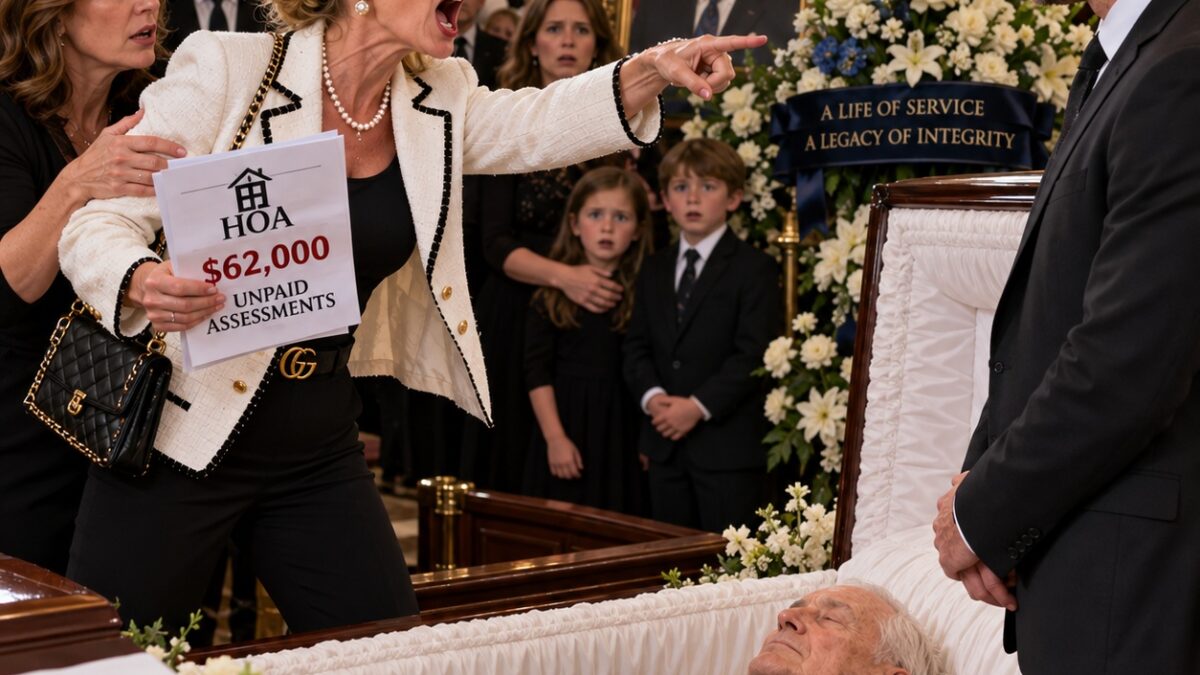
PART2
I grew up on the Hartfield estate.
Eighty-five acres of rolling Tennessee land about forty minutes east of Nashville.
Pasture.
Timber.
A spring-fed pond.
Hay barn.
Quarter mile of creek frontage.
Old farmhouse.
Workshop.
And Hartfield Lane.
My grandfather built that road in 1953.
Graded it with a borrowed bulldozer.
Spread gravel with a shovel and wheelbarrow.
Dad used to say Grandpa moved half the road one load at a time until his hands bled.
I left home at eighteen.
Joined the Army.
Spent ten years in military intelligence.
Two deployments overseas.
Three years at Fort Huachuca.
Two years at the Pentagon.
Intelligence work teaches you a strange form of patience.
People think it is about secrets.
Mostly it is about patterns.
What somebody says.
What they avoid saying.
What document changed.
What number does not match.
What person keeps appearing in the background.
The loudest person in the room is rarely the most dangerous.
The patient one usually is.
When I left the Army at twenty-eight, I used my GI Bill for a master’s degree in forensic accounting.
By the time Dad died, I worked for a Nashville firm specializing in fraud investigations.
Insurance fraud.
Embezzlement.
Asset concealment.
Shell companies.
Ghost invoices.
Cooked books.
I followed money for a living.
Dad knew that.
And during the last year of his life, he started telling me things.
Usually on the screened porch.
Coffee in his hand.
Mosquitoes buzzing.
Magnolia Heights visible through the trees.
“She’s billing homeowners for road maintenance on roads she doesn’t own.”
“Who?”
“Diane.”
I looked toward the subdivision.
“Dad, the HOA maintains those roads.”
“No.”
“What do you mean, no?”
“I mean they don’t own them.”
He took another sip.
“They’re mine.”
That got my attention.
He explained the history slowly.
Magnolia Heights was built in 2003 on about two hundred acres beside our property.
One hundred twelve homes.
Clubhouse.
Pool.
Tennis courts.
Artificial lake.
Homes from around four hundred thousand dollars to more than a million.
But the development had an unusual title structure.
The main entrance, Magnolia Drive, crossed Hartfield land under a recorded easement Dad granted the original developer in 2003.
One dollar per year.
And a written condition that the easement could not simply be converted into HOA ownership.
The internal roads were stranger.
My grandfather had sold development rights involving the eastern parcel years earlier but retained ownership of the actual road corridors through a recorded reservation.
Sell lots.
Keep roads.
Old-school planning.
Magnolia Heights residents drove across Hartfield property every day without realizing it.
The original developer, Gerald Fanning, understood the arrangement.
Then his company failed.
Fanning died.
Records got forgotten.
And the HOA began acting as though everything behind its gate belonged to the HOA.
Diane moved into Magnolia Heights in 2012.
Became president in 2016 because nobody else wanted the job.
And over the next several years, she turned a boring volunteer position into a private kingdom.
Wrong shade of beige on shutters?
Fine.
Truck parked overnight?
Fine.
Trash bin visible too long?
Fine.
She also hired her husband Marcus’s construction company—Prescott and Associates—for almost every HOA project.
Paving.
Drainage.
Landscaping.
Maintenance.
Dad noticed the numbers.
Retired appellate judges notice paper the way mechanics notice engine noise.
Something was wrong.
I once asked why he had never challenged her.
He looked tired.
“Your mother died.”
I nodded.
“I was old, Cole.”
He looked across the pasture.
“I didn’t have the energy to fight a woman who believes volume is the same thing as authority.”
Then he pointed toward the house.
“The records are in the safe.”
“What records?”
“Everything.”
“What do you mean, everything?”
“Everything she’s done.”
I thought he meant correspondence.
Maybe meeting minutes.
I underestimated him.
When I opened the safe after the funeral, I found six years of work.
HOA financial statements.
Photocopies.
Highlighted sections.
Dad’s handwritten notes in the margins.
Bank transfers.
Vendor invoices.
Board minutes.
Then different versions of the same board minutes.
County records.
Tax filings.
Photographs of roads supposedly repaired.
Copies of checks.
Permit searches.
A folder labeled:
PRESCOTT
And beneath all of it:
The original Hartfield deed.
Recorded 1951.
Amended when Dad inherited.
No HOA covenant.
No Magnolia Heights restrictions.
No legitimate HOA lien authority over our estate.
I sat in his chair until sunrise.
Two fingers of his bourbon melted around ice in a glass beside me.
The study smelled faintly of leather and pipe tobacco even though he had quit smoking fifteen years earlier.
Dad had not merely complained about Diane.
He had investigated her.
Quietly.
For six years.
From a recliner.
He just died before he could finish.
Three days later, Diane sent her first letter.
Gold-embossed Magnolia Heights letterhead.
Official-looking seal.
Threatening language.
The estate of Raymond C. Hartfield supposedly owed:
$62,400
in unpaid HOA assessments.
Eight years’ worth.
The letter threatened foreclosure.
Signed:
Diane Prescott, President
I read it twice.
Then I remembered Dad saying:
“She’ll come for the money first. She always leads with money.”
I put the letter in his Prescott file and drove to the Henderson County recorder’s office.
Patty Redmond had worked there thirty-one years.
She knew Dad.
She did not need much explanation.
“What are you looking for?”
“Magnolia Heights plats. Hartfield road reservations. Anything filed around 2017.”
Ten minutes later, documents covered the counter.
Original 2003 development plat.
Road reservation from 1987.
2003 easement.
Then:
A 2017 amended filing.
That document reclassified Hartfield road corridors as HOA common property.
There was one enormous problem.
My family had never signed it.
Instead, the filing carried the signature of Marcus Prescott.
Diane’s husband.
At the time:
Member of the Henderson County Planning Commission.
I stared at the document.
Patty looked at me.
“That shouldn’t be there.”
“No.”
Marcus had not owned our land.
Had no authority to transfer our road corridors.
Yet somehow an amended recorded plat now showed those corridors as HOA common areas.
That single filing was what Diane had been relying on.
To assess Dad.
To claim roads.
To threaten foreclosure.
I drove home.
Went into the workshop.
Dad’s tools were still hanging from the pegboard.
Labels in his handwriting.
Cedar shavings on the bench.
I sat there for a long time.
“You spent six years building this, Dad.”
No answer.
“I’ll finish it.”
The next morning, I called Jack Somerfield.
Dad had trusted him for thirty years.
Property attorney.
Thirty-four years of practice.
By the end of the week, Jack had filed:
A quiet-title action.
A motion challenging the 2017 plat amendment.
And a demand that the HOA remove the lien immediately.
Diane responded the following morning.
I woke to diesel engines.
Walked outside.
Four men in orange vests were installing an eight-foot chain-link fence across Hartfield Lane.
Razor wire across the top.
Like someone had dropped a prison barrier across the road my grandfather built.
Diane stood beside it holding a clipboard.
“Good morning, Mr. Hartfield.”
“What is this?”
“Community safety.”
“You’re fencing my road.”
“The board voted last night to secure HOA boundaries.”
“This is Hartfield property.”
She smiled.
“It falls within the HOA boundary according to the recorded plat.”
“That plat was forged.”
The smile flickered.
Just once.
“Your husband signed it.”
“Be careful, Cole.”
Her voice hardened.
“Defamation is actionable.”
“So is forgery.”
She stopped moving.
“So is fraud.”
Then:
“So is filing a false lien against a dead judge’s estate.”
Diane turned and walked toward her Escalade.
The crew finished by noon.
I spent the next three days accessing our land through a neighbor’s cattle gate.
Mile and a half of rutted track.
Every morning I passed the chain-link fence and felt something cold settle deeper into me.
Then Diane made it worse.
My father owned a 1967 Ford F-250.
He had driven it for almost thirty years.
Old blue paint.
Bench seat.
RH carved into the dashboard.
The truck sat on Hartfield Lane after he died.
My land.
I came home one afternoon and found it being loaded onto a tow truck.
“What are you doing?”
The driver looked uncomfortable.
“HOA violation.”
He handed me a pink form.
Vehicle stored on community property without valid parking permit.
Signed:
Diane Prescott.
I watched Dad’s truck disappear around the curve.
That was the moment I stopped thinking of this as a property dispute.
I called Jack.
“She towed Dad’s truck.”
Pause.
“From Hartfield Lane?”
“Yes.”
“Your property?”
“Yes.”
Another pause.
Then Jack said:
“Cole, I have practiced property law for thirty-four years.”
“I know.”
“I have never seen somebody work this hard to destroy herself.”
He was right.
The fence was evidence.
The tow was evidence.
The lien was evidence.
And Diane was doing all of it on camera.
After the funeral confrontation, I had installed four trail cameras.
Property line.
Road.
Workshop.
Main drive.
Cloud backup.
Every fence post.
Every worker.
Every tow truck.
Every clipboard.
Time-stamped.
Three days later, Jack got Dad’s F-250 released.
The towing company manager apologized.
He showed us the work order.
It looked official.
That was Diane’s real talent.
Everything looked official.
Letterhead.
Seal.
Forms.
Board titles.
The appearance of authority.
She had built an empire out of presentation and the assumption that nobody would check.
I drove Dad’s truck home.
Parked it exactly where it had been.
Then sat inside.
The cab still smelled like Old Spice, coffee, and the faint sweetness of pipe tobacco trapped in the upholstery.
I ran my thumb over the RH carved in the dashboard.
“They tried to take your truck, Dad.”
The engine ticked as it cooled.
“They won’t do it again.”
Diane shifted tactics.
She began going door to door inside Magnolia Heights.
Her story:
Cole Hartfield forged his father’s will.
Cole planned to steal community roads.
Cole intended to sell the estate to a commercial developer.
Gas station.
Truck stop.
Thirty-percent property-value collapse.
She collected forty-seven signatures.
Then called a special HOA meeting.
Attendance supposedly mandatory.
Two-hundred-dollar fine for absence.
Presentation title:
THE HARTFIELD THREAT
Aerial photographs.
My workshop circled in red.
Hay barn.
Dad’s truck collection.
Labels:
BLIGHT
HAZARD
EYESORE
Then a graph predicting a forty-percent property-value decline.
No source.
No appraisal.
No methodology.
Just fear with colored bars.
Then Diane went after Clare.
My sister lived in Nashville with her husband and two daughters.
Nine and eleven.
Nothing to do with the estate dispute.
One Tuesday morning, two child protective services workers appeared at their house.
Anonymous complaint.
Unsafe conditions.
Unregulated farm equipment.
Industrial chemicals.
Clare called me crying.
“They asked to see the girls’ rooms.”
I stopped speaking.
“They asked whether we had running water.”
“Clare.”
“My nine-year-old thinks she’s in trouble.”
That changed how I understood Diane.
Until then, I thought she was greedy.
Entitled.
Maybe desperate.
This was different.
She was willing to use children as leverage.
A system designed to protect abused kids had become another tool in her HOA war.
The next morning, I drove to Nashville.
Jack was waiting.
So was Rita Vasquez.
Former assistant district attorney.
Twelve years prosecuting fraud before going private.
I placed Dad’s files across the conference table.
Six years of them.
Rita started reading.
Bank statements.
Invoices.
Payments.
Board minutes.
Shell-company records.
She did not look up for ninety minutes.
Finally:
“How much?”
“Directly to the shell?”
“Yeah.”
“About three hundred forty thousand.”
“Period?”
“Five years.”
“What about Prescott and Associates?”
“Roughly another nine hundred thousand billed to the HOA.”
“For what?”
“Road resurfacing. Drainage. Landscaping. Infrastructure.”
“How much actual permitted work?”
“I haven’t finished that comparison.”
“Finish it.”
I did.
County permit records showed Prescott and Associates had pulled exactly two relevant permits over five years.
Combined documented project value:
Approximately $11,000.
Nine hundred thousand dollars billed.
Eleven thousand in permitted work.
Rita leaned back.
“Your father was building a criminal fraud case from his living room.”
“He was a judge.”
She gave me a tired smile.
“Old habits.”
Then she pointed to the 2017 plat.
“This isn’t only embezzlement.”
She began counting.
“Potential filing of false instruments. Insurance fraud. Mail fraud. Wire fraud if electronic transfers crossed jurisdictions. False lien. Possibly conspiracy.”
I had already started tracing the shell company.
MH Property Solutions LLC.
Formed in Delaware in 2018.
Anonymous entity structure.
Mailing address:
UPS Store box in Brentwood.
We could not directly obtain the renter identity immediately.
But the money left tracks.
Over five years:
162 deposits from the Magnolia Heights operating account.
Amounts from roughly $800 to $14,000.
Many transfers broken into smaller figures.
Different descriptions.
Consulting.
Administrative support.
Infrastructure coordination.
Vendor services.
But no real business footprint.
Then we got HOA bank records through subpoena.
Magnolia Heights collected around $420,000 annually in dues.
About $240,000 went to legitimate operating costs.
The remaining category—roughly $180,000 annually—was labeled infrastructure maintenance and road improvement.
Most of that money flowed to Prescott and Associates.
Marcus’s company.
A company billing residents to maintain roads Marcus and Diane did not own.
The insurance file was worse.
The HOA carried a multimillion-dollar property and liability policy listing the roads as HOA-owned assets.
They were not.
Then came board minutes.
Dad had copies of official minutes.
But he also had copies provided by Linda Cho.
Former HOA secretary.
She resigned in 2019.
Her versions showed objections.
Questions.
Board members challenging assessment authority.
Those objections vanished from the official copies later circulated to residents.
The supposed vote authorizing the Hartfield lien?
There had been no proper full-board vote.
Diane had invoked an “emergency powers” clause added to the bylaws in 2017.
Same year Marcus filed the amended plat.
Same period the money flows accelerated.
I built a forensic report.
Forty-seven pages.
Timeline.
Bank flowcharts.
Exhibits A through Q.
Every payment cross-referenced.
Every invoice tied to bank movement.
Every board record compared.
Every title document identified.
Dad had built the case.
I translated it into the language prosecutors and auditors use.
Then Rita gave me the strategy.
“Let the probate hearing happen.”
“Why?”
“Because Diane filed the lien against your father’s estate.”
“I know.”
“She wants money?”
“Yes.”
“She’ll have to appear and defend the claim.”
I understood.
Rita continued.
“We present title evidence, the false amendment, and the forensic findings in open court.”
“Then refer criminally.”
“Exactly.”
“Why not go straight to the DA?”
“Because probate gives you something useful.”
“What?”
“A public record.”
She pointed toward me.
“Homeowners will see it. Press may see it.”
Then:
“And Diane will be under oath.”
Rita smiled without humor.
“If she lies—and she seems like the sort of person who will—you have another problem for her.”
I spent the next two weeks preparing.
Jack handled title and probate filings.
Rita organized the criminal referral.
I traced money.
And I found Linda Cho.
Murfreesboro.
Office manager at a dental practice.
When she opened her front door and saw me, she immediately started crying.
“I knew someone would come eventually.”
We sat at her kitchen table.
She told me everything.
Diane pressured her to alter minutes.
Threatened her when she objected.
Prescott and Associates got paid for work Linda never saw performed.
Two sets of books.
“The real minutes and the homeowner minutes.”
“You typed both?”
“Yes.”
“Why?”
“She told me if I refused, she would sue me for breach of fiduciary duty.”
“Did you believe her?”
Linda looked embarrassed.
“I couldn’t afford to find out.”
That was how people like Diane operated.
Not every threat needed to be legally valid.
It only needed to be expensive enough to frighten someone.
I asked Linda whether she would testify.
She stared into her coffee.
Then:
“Your father was the only board member who treated me like a person.”
I waited.
“He brought me peach cobbler every Christmas.”
That sounded exactly like Dad.
“He told me once that truth eventually finds daylight.”
She looked at me.
“I didn’t believe him then.”
Pause.
“I do now.”
She agreed.
Two weeks before probate, Diane tried another attack.
County code enforcement.
Nine anonymous complaints.
Uninhabitable dwelling.
Unlicensed vehicle storage.
Unsafe workshop.
Failure to maintain “community aesthetic standards.”
Dave Tullik inspected.
Twenty-two years with Henderson County.
He walked the property.
Roof replaced 2019.
Electrical updated.
Septic inspection current.
Vehicles registered.
Workshop organized.
No violations.
He shut his clipboard.
“I’m closing everything.”
“Thanks.”
He stopped.
“I’ve had fourteen complaints about this place in two months.”
I looked at him.
“All anonymous.”
“I know.”
He glanced east toward Magnolia Heights.
“Whoever’s doing this is wasting county resources.”
Diane then attacked Dad publicly.
Magnolia Heights Facebook group.
Three hundred twelve members.
She accused a dead appellate judge and Navy veteran of tax evasion.
Property fraud.
Community freeloading.
Called him a parasite.
Margaret Torres, who lived on Oak Circle, replied.
Judge Hartfield helped my family through a boundary dispute and never charged us. This post is shameful.
Diane deleted Margaret’s comment within an hour.
I did nothing publicly.
No response.
No argument.
We archived the post.
Timestamp.
Screenshot.
Deletion.
Everything.
Dad once told me:
“When someone is determined to create evidence against herself, don’t interrupt.”
Twelve days until probate.
I reviewed the report three times.
Checked exhibit labels.
Verified every dollar.
Timed the route to court.
Set out the same charcoal suit I had worn at Dad’s funeral.
The night before the hearing, I sat on the porch with his bourbon.
Stars over the ridge.
Dry leaves.
Wood smoke.
I thought about Dad sitting in that same place after Mom died.
Too tired for confrontation.
Still willing to document.
He did not build the file for revenge.
That was important.
He did it because homeowners deserved to know where their money went.
Because our land deserved protection.
Because truth mattered even if he never lived long enough to see it exposed.
“Tomorrow, Dad.”
I raised the glass slightly.
“We finish.”
October 14.
Henderson County Probate Court.
Nine in the morning.
Packed room.
Forty-two Magnolia Heights residents.
Three local reporters.
Margaret Torres.
Linda Cho.
Diane arrived at 8:45.
Navy suit.
Pearls.
Perfect posture.
Marcus behind her.
Charcoal sport coat.
Arms crossed.
Her attorney, Philip Garner, carried one folder.
He looked bored.
For him, this was supposed to be routine probate enforcement.
Dead homeowner owes HOA.
Estate pays.
Go home.
Judge Katherine Morrow presided.
Sixty-one.
Had known Dad for thirty years.
Philip went first.
Lien.
2017 amended plat.
Eight years of supposedly unpaid assessments.
Eleven minutes.
Then he sat down.
Jack stood.
“Your Honor, we would like to begin with the original 2003 Magnolia Heights plat.”
The courtroom screen changed.
Clear boundary.
Hartfield property outside HOA control.
Then:
The 1987 road reservation.
Hartfield ownership of internal road corridors.
Murmurs started.
Then Jack displayed the 2017 amendment beside the original.
“Your Honor, the amendment on which the HOA relies was filed by Marcus Prescott, then a member of the Henderson County Planning Commission.”
People shifted in their seats.
Jack continued.
“The Hartfield family did not execute this conveyance.”
Philip Garner stopped looking bored.
Jack placed Dad’s original deed into evidence.
Then the road reservation.
Then the easement agreement.
Then the quiet-title chain.
Finally:
“Your Honor, we are also presenting a forty-seven-page forensic analysis of Magnolia Heights HOA financial records.”
The room changed.
Nobody whispered now.
Jack continued.
“The report documents approximately $340,000 transferred through an entity identified as MH Property Solutions LLC.”
Diane looked at Marcus.
“More than $900,000 in construction invoices paid to Prescott and Associates over five years, with documentation showing only a fraction of the claimed work.”
Marcus looked toward the door.
“Material misrepresentations concerning ownership of the road network in insurance documents.”
Philip Garner’s shoulders dropped slightly.
“And alteration of board records, including the deletion of objections to assessments and irregularities related to the lien against the Hartfield estate.”
Jack set the report on Judge Morrow’s bench.
Three color tabs.
Exhibits A through Q.
She put on her glasses.
Read.
Nobody moved.
Four minutes felt like twenty.
Then she looked at Diane.
“Mrs. Prescott.”
Diane stood.
“Your Honor.”
“Are you familiar with these allegations?”
Diane’s hands shook.
Her voice did not.
“The report is fabricated. Mr. Hartfield is attempting—”
Judge Morrow raised one hand.
“Stop.”
Diane froze.
“I knew Judge Raymond Hartfield for thirty years.”
Silence.
“I have reviewed his judicial work, his notes, and his analytical style for decades.”
She looked down at the report.
Then back up.
“I recognize his work.”
Diane’s face changed.
Judge Morrow continued.
“The HOA lien against the Hartfield estate is vacated.”
Someone in the gallery inhaled sharply.
“The quiet-title relief is granted.”
Then:
“The road corridors, access points, and interests established in the Hartfield reservation documents are confirmed as Hartfield family property.”
For six years, Dad had waited for those words.
He was not there.
I was.
The judge was not finished.
“I am referring the financial matters contained in this report to the Henderson County District Attorney’s Office and the Tennessee Bureau of Investigation for review.”
Diane sat.
Not gracefully.
Her legs seemed to stop supporting her.
Marcus uncrossed his arms.
Put both hands over his face.
Philip Garner closed his folder.
No argument.
No objection.
He looked like a man who had just discovered the simple lien proceeding he accepted had opened beneath him.
I looked at Diane.
Navy suit still perfect.
Pearl earrings catching courtroom light.
But the confidence was gone.
For one second, I almost felt something.
Then I remembered Dad’s casket.
Clare’s nine-year-old asking why strangers needed to inspect her bedroom.
The chain-link fence.
The truck.
Six years of notes.
The feeling passed.
Outside, Margaret Torres waited.
She did not say anything.
Just touched my arm.
Nodded.
Behind her, homeowners gathered in small groups.
The expressions were not angry yet.
Mostly stunned.
The look people get when somebody they trusted has just been revealed as something else entirely.
I drove home in Dad’s F-250.
Windows down.
October air.
Burning leaves.
Hay.
When I reached the estate, I stayed behind the wheel.
Looked at the house.
Workshop.
Porch.
Pasture.
“We got her, Dad.”
I stopped.
“No.”
That did not feel right.
“We got the truth out.”
Better.
But we were not finished.
The district attorney opened a formal investigation within seventy-two hours.
TBI assigned agents.
Because the phantom payments and electronic transfers crossed through interstate systems and entities, federal authorities were notified too.
Marcus was arrested first.
Day nine.
Allegations involving falsified public records.
Fraud conspiracy.
False instruments.
Bond:
$25,000.
Diane was arrested five days later.
Two TBI agents and a county deputy arrived at her house around 7:15 in the morning.
Embezzlement allegations.
Insurance fraud.
False lien.
Conspiracy.
Bond:
$50,000.
She posted it using equity in the Magnolia Court house.
That became important later.
Once the forensic audit became public, homeowners started doing their own math.
About $340,000 moving through the shell structure.
More than $900,000 invoiced to Marcus’s company.
Years of assessments for infrastructure residents had assumed they owned.
The HOA called an emergency meeting.
Diane was removed unanimously.
Emergency powers revoked.
Independent audit ordered.
Professional property-management firm hired.
New president:
Harold Wen.
Retired accountant.
Harold drove to my house one Saturday.
He brought bourbon.
And an apology.
We sat on Dad’s porch.
“We didn’t know.”
“I believe you.”
“We trusted her.”
“I know.”
“She had the meetings. Letterhead. Rules. She made everything look official.”
I poured two glasses.
“That’s what good fraud looks like.”
He waited.
“It looks like competence until somebody opens the books.”
Harold nodded.
Then asked about the roads.
“What do you want?”
I already knew what Dad would have done.
“I’m not selling.”
“Okay.”
“I’m not giving them away either.”
“Fair.”
“But the residents need roads.”
“Yes.”
“I’ll lease the corridors to the HOA.”
Harold looked surprised.
“Terms?”
“Twenty years.”
I told him.
“Three thousand dollars a year, inflation adjustment, HOA handles defined maintenance, liability coverage required, renewal option.”
Then:
“And one clause.”
“What?”
“No future board may claim ownership of property the HOA does not own.”
Harold laughed once.
“I think everyone can agree to that now.”
We shook hands.
Lease signed two weeks later.
The homeowners kept their road access.
Hartfield family kept ownership.
The annual three thousand dollars went directly into a scholarship fund.
Dad’s name.
Judge Raymond C. Hartfield Scholarship.
That mattered more than the lease income.
But the criminal investigation was still moving.
TBI Financial Crimes looked into Diane’s home.
The down payment traced back to money connected with MH Property Solutions.
Potential proceeds of fraud.
A judge eventually signed a forfeiture order.
Diane and Marcus were ordered to vacate.
They left Magnolia Heights in a rented U-Haul.
No Escalade.
That had already disappeared after missed payments.
No clipboard.
No gold seal.
No HOA authority.
Harold told me Diane carried a box out of the front door and stood for a moment looking up and down Magnolia Court.
No one came outside.
No one waved.
No one said goodbye.
That image stayed with me.
Not because I enjoyed it.
Because for years Diane had made sure everybody knew when she arrived.
At meetings.
Doorsteps.
Funerals.
Her authority had always been loud.
When she finally left, the neighborhood answered with silence.
The criminal cases took much longer.
About eighteen months.
Marcus resolved his case through a guilty plea.
Sentence included probation, community service, restitution, and loss of his construction license.
Diane refused plea offers.
She went to trial.
Linda Cho testified.
Calm.
Precise.
She explained the two books.
Real minutes.
Altered minutes.
Invoices.
Checks.
Pressure.
Threats.
The defense attorney tried to make her look confused.
Linda looked directly at him.
“I typed every check.”
He paused.
“I filed every invoice.”
Then:
“I know where the money went. Do you?”
That line ended more than the cross-examination.
A reporter later said jurors visibly reacted.
The jury deliberated about four hours.
Guilty.
Embezzlement.
Insurance fraud.
False lien.
Conspiracy.
Falsifying records.
The judge imposed a six-year prison sentence.
Her written findings described a systematic abuse of community trust for personal gain.
The appeal failed.
Clare’s CPS complaint was separately investigated and closed.
No credible basis.
Caseworker notes indicated it appeared retaliatory.
That report mattered to Clare.
Her nine-year-old still occasionally asked why those people had come to the house.
Clare told her:
“Someone made a bad report, and grown-ups fixed it.”
Simple.
No child needed the full story.
Margaret Torres became HOA vice president under Harold.
Quarterly financial transparency became mandatory.
Bank records.
Vendor payments.
Budgets.
Contracts.
Published to homeowners.
No more mystery money.
The independent audit confirmed Dad’s findings.
Then discovered another approximately $47,000 in misallocated funds he had not identified.
The auditor reportedly told Harold it was one of the most comprehensive HOA fraud files he had seen.
Harold said:
“It was built by a retired judge from a recliner.”
The auditor’s response:
“God bless that man.”
I kept all eighty-five acres.
Never sold.
Never intended to.
Hartfield Lane remained Hartfield property.
The HOA leased what it needed lawfully.
That arrangement worked because everybody finally started from the correct question.
Who owns what?
Not:
Who has been using it?
Not:
Who has been paying for it?
Not:
Who has the loudest president?
Ownership first.
Then agreement.
That should have happened twenty years earlier.
Dad’s tools stayed exactly where he left them.
Most of them, anyway.
I eventually had to move a few to use the bench.
His reading glasses stayed beside the bourbon glass in the study.
I could not bring myself to move them.
Still can’t.
On clear evenings, I sit on the screened porch.
Fireflies rise out of the pasture.
Same ridge.
Same sky.
Same creek.
Magnolia Heights lights visible through the trees.
Different HOA.
Different tone.
People wave now.
Not everybody.
They do not have to.
The relationship became boring.
That is the highest compliment I can give a property dispute.
Harold once asked whether I hated Diane.
“No.”
He looked surprised.
“How can you not?”
I thought about it.
“Hate takes maintenance.”
He laughed.
“I already maintain eighty-five acres.”
That was true.
Anger had been useful while I needed energy.
Once the cases were done, carrying her every day would have meant giving her something she no longer deserved.
Space in my life.
Dad would not have wanted that.
He had documented Diane because it was necessary.
Not because she fascinated him.
There is a difference.
After Mom died, he sat in that recliner with his yellow legal pad and quietly collected facts.
No Facebook wars.
No neighborhood speeches.
No threats.
He knew something I had to relearn.
Fraud needs noise.
Evidence does not.
A bank transfer sits there.
A deed sits there.
A forged filing sits there.
A permit record.
An invoice.
A timestamp.
The truth can wait longer than a liar usually can.
Diane was impatient.
Every time she felt control slipping, she escalated.
Funeral.
Lien.
Fence.
Tow truck.
Rumors.
CPS.
Code complaints.
Defamation.
Each move felt powerful in the moment.
Each one created another exhibit later.
That is the thing about people who confuse aggression with strength.
They rarely understand when to stop.
Dad understood.
“The thing about bullies,” he once told me, “is they don’t stop themselves.”
I remembered the rest too.
“They stop when somebody makes them stop.”
Then:
“And sometimes the best way to do that is let them keep going until they’ve gone too far to come back.”
Diane went too far at the funeral.
The rest was simply documentation.
I learned something about official-looking paperwork too.
The tow company manager apologized because Diane’s work order looked legitimate.
The CPS complaint triggered because anonymous reports must be taken seriously.
Code enforcement inspected because complaints require responses.
Insurance carriers relied on ownership declarations.
Homeowners relied on minutes.
Fraud does not always look like a masked thief.
Sometimes it looks like a seal.
Letterhead.
Clipboard.
A meeting agenda.
A woman who speaks confidently enough that everyone assumes somebody else already verified what she is saying.
That is why Dad’s work mattered.
He checked.
Every invoice.
Every permit.
Every title.
Every amendment.
Every board minute.
His patience turned Diane’s appearance of authority back into what it actually was.
Paper with no foundation.
Marcus’s construction invoices were similar.
Nine hundred thousand dollars sounds like enormous work.
Road resurfacing.
Drainage.
Landscaping.
Infrastructure.
Then you check permits.
Two projects.
Eleven thousand dollars.
Once numbers are compared, a story starts collapsing.
That is what I do professionally.
Follow the money.
Money is terrible at lying consistently.
People can.
Numbers eventually disagree.
A shell company has an address.
A payment has an origin.
A vendor has permits.
A property has a deed.
A board supposedly votes.
Minutes should show it.
Diane and Marcus survived for years because nobody assembled all of those systems in one place.
Dad did.
He did not need subpoenas for everything.
He used public records.
Homeowner documents.
Minutes people brought him.
Photographs.
Patience.
He built enough structure that once formal process began, investigators could finish.
That is what good evidence does.
It does not always prove every allegation alone.
It tells the next person exactly where to look.
I keep Dad’s original Prescott folder.
I added my forty-seven-page report behind his notes.
Not to memorialize Diane.
To memorialize Dad’s method.
His handwriting is careful.
Block letters.
Underlines.
Questions.
One margin note beside a road invoice says:
NO EQUIPMENT OBSERVED. CHECK PERMITS.
Another:
SECRETARY VERSION DIFFERS. WHY?
No anger.
Just questions.
That is how a judge thinks.
A good one.
Do not begin with guilt.
Begin with discrepancy.
Then follow.
That mindset kept me from making my own mistakes after the funeral.
I wanted to respond immediately.
Especially after Diane stood beside Dad’s casket.
Army instinct told me confrontation.
Forensic instinct told me wait.
The second one won.
Barely.
My hands were shaking when she left the funeral home.
People later told me they admired my restraint.
I did not feel restrained.
I felt one sentence away from doing something Dad would have hated.
Clare saved me partly by stepping between us.
Dad saved me too.
His voice in my head.
Wall, not weapon.
That became the standard.
Every legal move we made had to build a wall.
Quiet title.
Remove lien.
Recover truck.
Document harassment.
Expose money.
Protect Clare.
Lease roads lawfully.
Scholarship.
Those were walls.
Diane’s moves were weapons.
Threat.
Fence.
Tow.
CPS complaint.
Rumors.
The difference eventually mattered.
One creates boundaries.
The other creates damage.
After the new road lease, several Magnolia Heights homeowners visited me individually.
Not all.
Enough.
One man named Robert Hayes came with no apology prepared.
He just said:
“I paid those dues for eleven years.”
I nodded.
“My wife and I delayed replacing our roof because of special assessments.”
I had nothing useful to say.
He looked toward Magnolia Drive.
“She was stealing from us while telling us your father was the freeloader.”
“Yes.”
He laughed without humor.
“I don’t know how you didn’t kill her.”
I looked at him.
“My father was a judge.”
Robert smiled slightly.
“That answer everything?”
“Pretty much.”
Margaret visited too.
She told me Dad had helped her family with a boundary problem years earlier.
Never charged.
That sounded like him.
He believed access to law mattered.
Especially to people intimidated by lawyers.
When he retired, neighbors would show up with deeds and letters.
He would sit with them at the kitchen table.
Read.
Explain.
Then usually tell them to hire a lawyer before doing anything important.
He never represented them.
Just translated.
Diane hated that because Dad made people less afraid of official language.
Fear was one of her tools.
Dad took it away quietly.
The scholarship became the best use of the road lease money because it turned property into education.
Three thousand dollars a year was not huge.
But combined with additional contributions, it became meaningful.
Henderson County High School administered it.
Students interested in law, public service, accounting, or civic leadership could apply.
We named it for Dad.
Not because he had been a judge.
Because he taught me what institutions are supposed to do when they work properly.
Protect people.
Not dominate them.
The small brass plaque at Magnolia Heights entrance came later.
Margaret planted a magnolia tree.
The plaque read:
In Memory of Judge Raymond C. Hartfield
Who Built These Roads
Technically, Grandpa physically built Hartfield Lane.
Dad preserved the road rights.
I never corrected the plaque.
The sentiment was right.
Dad had built the legal foundation that kept the roads honest.
That mattered.
The first time I saw the plaque, I stood there longer than expected.
Not crying.
Just looking.
Diane had once stood at his funeral and called him a freeloader.
Now the neighborhood she ruled had his name at the entrance.
Life can produce cleaner endings than revenge ever could.
Her Escalade ended up at a county auction after all the financial trouble.
A farmer bought it.
Used it for feed.
Harold told me.
I laughed.
Then stopped.
Dad would have hated me enjoying it too much.
“Possessions don’t know who owned them,” he would have said.
He was annoyingly wise that way.
The truck became a farm truck.
Good.
Vehicles should work.
Dad’s F-250 still does.
I maintain it carefully.
Same dashboard.
Same carved RH.
I could restore the body completely.
I do not.
Some dents belong.
One came from a fence post Dad misjudged in 1988.
I remember Mom yelling from the porch.
Another from a trailer hitch.
History.
Not everything old needs polishing.
Sometimes wear is proof something was used.
Same with the estate.
It is not manicured like Magnolia Heights.
Never will be.
Pasture gets muddy.
Workshop looks like a workshop.
Hay barn is a hay barn.
That does not make it blight.
Diane’s worldview required everything valuable to look controlled.
Matching mailboxes.
Paint.
Shrubs.
Roads categorized.
People compliant.
Dad’s property offended her because it existed outside her system.
And instead of accepting that boundary, she tried absorbing it.
That was the original sin.
Not embezzlement.
That came with greed.
The deeper problem was entitlement.
She assumed neighboring property should answer to her because it affected the neighborhood she controlled.
Once you believe that, a false assessment becomes reasonable.
Then a false plat.
Then road claims.
Then a fence.
Then towing.
You keep rewriting reality until everything around you supports your authority.
Except reality is patient.
So was Dad.
One day the two met.
Dad won.
Not because he lived long enough to see Diane sentenced.
He did not.
But winning is not always personally watching the consequence.
He preserved enough truth that consequence became possible.
That is why I never say:
“I took Diane down.”
I didn’t.
Dad built the file.
Linda told the truth.
Jack filed the case.
Rita understood prosecution.
Judge Morrow ruled.
TBI investigated.
The DA charged.
The jury decided.
Homeowners replaced their board.
A functioning system has many hands.
That matters.
People who abuse authority love reducing everything to personal conflict.
Diane versus Cole.
Diane versus Raymond.
That framing makes accountability look like vengeance.
It was not.
Once documents entered public process, my feelings became largely irrelevant.
Either Hartfield owned the roads or it did not.
Either the lien was valid or it was not.
Either money went where the HOA said or it did not.
That is the beauty of records.
They remove personality.
The original plat did not care that Diane wore pearls.
Bank statements did not care Dad was dead.
The quiet-title chain did not care whether homeowners liked me.
Facts can be wonderfully impolite.
They refuse status.
Months after the criminal trial ended, Clare and I sat in Dad’s study.
Her daughters were outside chasing fireflies.
She picked up his reading glasses.
“You ever going to move these?”
“No.”
“They’re going to collect dust.”
“I know.”
She smiled.
“You’re ridiculous.”
“Yes.”
Then she looked toward the safe.
“Do you ever wonder why he didn’t tell us everything sooner?”
“Every day.”
“What do you think?”
I thought about it.
“He didn’t know when he’d have enough.”
“For court?”
“For himself.”
She waited.
“He spent his life making decisions after records were complete. Maybe he couldn’t stand accusing someone until he knew.”
Clare nodded.
“That sounds like Dad.”
It did.
He probably wanted one more bank record.
One more minute.
One more connection.
Then his heart stopped.
That is the danger of waiting too.
Eventually time makes decisions for you.
I learned something from that.
Patience is not the same as endless delay.
Dad built for six years because grief and age slowed him.
Once I opened the safe, the time for building was mostly over.
It was time to act.
That balance matters.
Gather evidence.
Then use it.
Otherwise documentation becomes another form of fear.
Dad did not leave me the file so I could admire it.
He expected me to finish.
The last page of his Prescott folder had only three lines.
No date.
Probably written near the end.
Roads are ours.
Money isn’t right.
Cole will understand.
I found that page after everything was over.
It broke me harder than the funeral had.
I sat on the workshop floor and cried like I had not allowed myself to cry since Wednesday morning when I found him.
Because those three words—
Cole will understand
—meant he had known the mission would probably become mine.
He trusted me with it.
Not to avenge him.
To understand.
There is a difference.
I folded the page carefully and put it back.
The estate became quieter after the cases ended.
No county inspectors.
No tow trucks.
No fencing crews.
No reporters parked on the shoulder.
Magnolia Heights residents used their roads under the lease.
Hartfield Lane remained open.
Harold sent the annual payment on time.
The first one arrived by certified mail.
Three thousand dollars.
I deposited it directly into Dad’s scholarship account.
No flourish.
No gold seal.
Just a check attached to a legally valid agreement.
I liked that.
Boring paperwork.
Correct authority.
No performance.
That is what governance should look like most of the time.
Boring.
Predictable.
Documented.
Diane made everything dramatic because drama protected her.
In confusion, people stop checking details.
Urgency helps fraud.
Emergency powers.
Immediate compliance.
Mandatory meeting.
Threatened foreclosure.
Thirty-day deadline.
Those tools pressure people into acting before thinking.
Dad moved at the opposite speed.
Read.
Verify.
Compare.
File.
That is why her thirty-day threat failed.
She thought the deadline belonged to me.
It belonged to her.
Thirty days after the funeral, most of what she had built was collapsing.
Not because fate likes symmetry.
Because she accelerated exactly when she should have stopped.
Every desperate move shortened the investigation.
The fake fence pushed the property case.
Truck tow created theft evidence.
CPS complaint showed retaliation.
Public defamation proved malice.
Lien forced probate.
Probate exposed financial records.
She kept giving us doors.
We simply opened them.
I sometimes tell younger forensic accountants a version of this story without names.
They ask:
“What was the break?”
They expect one dramatic clue.
There was not one.
That is rarely how fraud works.
The break was accumulation.
A road invoice with no permit.
A payment to an LLC.
Different minutes.
A false ownership claim.
Repeated smaller transfers.
A husband’s company.
A president with unilateral approval power.
One fact alone creates suspicion.
Together, they create structure.
The best fraud cases do not depend on one genius deduction.
They depend on boring persistence.
Dad understood that better than I did.
He was not trained as an accountant.
He was trained as a judge.
Same fundamental habit.
Evidence.
Sequence.
Corroboration.
The truth finding daylight.
Linda’s testimony proved another thing.
People who seem silent may not agree.
Sometimes they are frightened.
Diane had interpreted Linda’s resignation as victory.
It was not.
Linda took copies.
Preserved them.
Waited.
Then testified.
That is a powerful form of resistance.
Not everyone can afford confrontation when abuse first happens.
Do not confuse survival with consent.
Linda could not take on Diane in 2019.
She could tell the truth later.
And when she did, it mattered.
Margaret’s deleted Facebook comment mattered too.
Tiny.
One sentence.
But it showed people inside Magnolia Heights had resisted Diane’s narrative.
Dave Tullik’s inspection notes mattered.
The towing company work order mattered.
Each person added a brick to the wall Dad described.
No single brick was the wall.
Together they protected us.
I keep returning to the funeral because that was where Diane misunderstood everything.
She saw a dead man.
A grieving son.
An estate in transition.
Perfect moment to apply pressure.
Get the will before lawyers organize.
Threaten lien.
Demand roads.
Thirty days.
She believed grief made us weak.
And grief did make me weaker in some ways.
I was tired.
Angry.
Not sleeping.
I would have paid almost anything to hear Dad turn another page in that recliner.
But grief also made his work impossible to ignore.
Every handwritten note became his voice.
Every record became unfinished business.
Diane thought Dad’s death removed her biggest obstacle.
It released six years of preserved evidence to a son whose profession was following money.
That was the one calculation she never made.
There was one final thing Harold told me about the new HOA.
After Diane left, participation increased.
People volunteered.
Not because they suddenly loved meetings.
Because they finally believed questions were allowed.
That stayed with me.
Healthy institutions are not the ones where everybody agrees.
They are the ones where disagreement is safe.
Linda had objected.
Diane deleted her objections.
Other board members raised assessment concerns.
Deleted.
Once dissent disappears from minutes, the organization has already become dangerous.
Transparency is not paperwork for paperwork’s sake.
It is memory.
A community should be able to look back and see who said what.
Even inconvenient things.
Especially inconvenient things.
Harold’s quarterly reports became almost aggressively boring.
Income.
Expense.
Vendor.
Contract.
Balance.
Residents complained at first about too much information.
Harold told them:
“That’s the point.”
I liked him.
Dad would have too.
One spring evening, Harold came by with no bourbon.
Just an envelope.
Inside:
A photograph of the magnolia tree at the subdivision entrance.
Leaves finally coming in.
Small brass plaque beneath.
He said:
“We thought you should have this.”
I took it.
“Thanks.”
“Some residents want to hold a dedication.”
“No.”
He blinked.
“No?”
“Dad would hate that.”
Harold laughed.
“Fair.”
“Let the tree grow.”
So they did.
No speeches.
No ribbon cutting.
The plaque stayed.
The tree grew.
Perfect.
Dad never needed applause.
His file did not either.
He wanted systems to function.
Homeowners got honest accounting.
Our family retained the land.
The roads stayed usable.
Diane and Marcus faced consequences through the legal process.
Clare’s family was left alone.
That was enough.
Sometimes I imagine what Dad would have said after the probate hearing.
Probably not much.
Maybe:
“Good job.”
Then:
“Did you lock the workshop?”
That was him.
Everything important followed by something ordinary.
I miss that more than the legal advice.
Ordinary conversation.
Weather.
Wood finish.
Football.
Whether the creek was high.
Whether Clare called.
Death does not only take the profound parts of someone.
It takes the boring parts.
That is what hurts.
So I keep his glasses.
I keep the bourbon bottle.
I drive his truck.
Not because objects replace him.
They do not.
They give memory a physical place to land.
Diane never understood that when she had the truck towed.
To her, it was an unauthorized vehicle.
To me, it was Dad’s initials under my thumb.
Official language can become cruel when it refuses to recognize human context.
That does not mean rules should disappear.
It means authority needs judgment.
Dad had spent twenty-two years practicing exactly that.
Law without judgment becomes machinery.
Diane loved machinery because machines do not ask whether the operator is decent.
Fine.
Tow.
Lien.
Complaint.
Fence.
She activated systems.
Dad understood systems are supposed to serve fairness.
That difference defined them.
I think about his saying more now.
Law is not a weapon.
It is a wall.
A good wall does not chase people.
Does not humiliate them.
It stands where it belongs.
Protects both sides.
Our quiet-title order became a wall.
The lease became a wall.
Quarterly transparency became a wall.
The criminal judgments became another kind.
Not vengeance.
Boundaries.
Once boundaries returned, life settled.
That is the ending I prefer.
Not Diane leaving in a U-Haul.
Not the Escalade auction.
Not the courtroom verdict.
The boring years afterward.
Fireflies.
Pasture.
Road lease check arriving on time.
Scholarship applications.
Dad’s F-250 starting on the first turn.
That is peace.
One evening, about two years after everything ended, I sat in his recliner.
The Eisenhower biography was still on the shelf.
I had finally finished it.
Coffee on the side table.
Reading glasses still there.
For a moment, the room looked almost like the Wednesday Dad died.
Then I noticed my own forensic report inside the safe.
Behind his folder.
Two generations of work.
His investigation.
My completion.
I poured one finger of bourbon.
Raised the glass.
“The law wasn’t the weapon, Dad.”
Silence.
“You were right.”
Outside, crickets started.
Same sound they had made the night after the funeral.
Same song.
Indifferent.
Steady.
I thought about Diane standing beside his open casket screaming that she would take everything.
She was wrong about the land.
Wrong about the roads.
Wrong about the money.
Wrong about the man she insulted.
Most of all, she was wrong about silence.
She thought Dad’s silence meant surrender.
She thought mine did too.
But silence can be work.
Sometimes the quiet person is counting.
Checking.
Filing.
Waiting.
Building something strong enough that when the loud person finally notices, it is already too late to knock it down.
Dad spent six years doing that from a recliner.
He died before he could see the wall.
I did.
And it held.
I left the study and walked onto the porch.
Fireflies floated above the lower pasture.
Magnolia Heights lights glowed beyond the eastern trees.
People driving home on roads they now legally leased from us.
Nothing dramatic.
Nobody screaming.
Exactly the way Dad would have wanted it.
I sat in his chair outside.
Looked across the property my grandfather bought in 1951.
The workshop.
Hay barn.
Creek.
Hartfield Lane.
All still ours.
Then I said the only thing left to say.
“Rest easy, Dad.”
I looked toward the dark ridge.
“We finished it.”








