PART2:HOA Queen Stole My Mail Four Times in One Week—She Didn’t Know the Postal Inspectors Were Already Watching
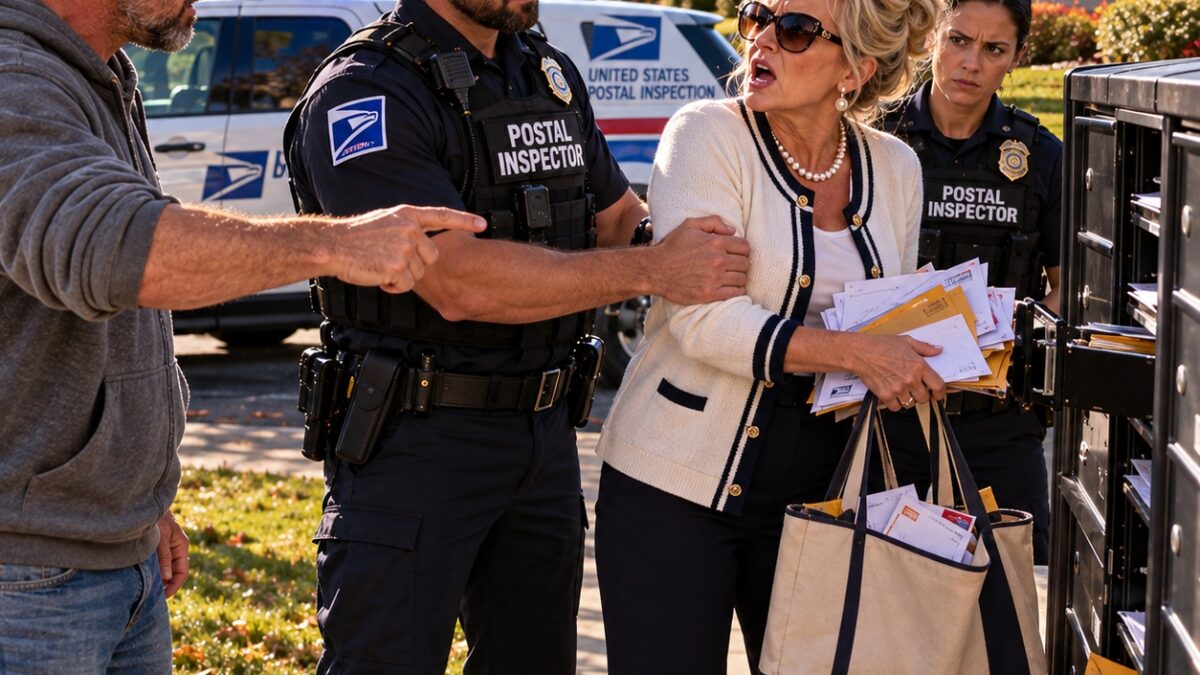
PART2
Most people know USPS.
Far fewer know USPIS.
Postal inspectors are federal law-enforcement officers.
Mail theft.
Mail fraud.
Tampering.
Fraud schemes that use the postal system.
They have been doing that work since the early history of the country.
I filed the complaint online.
Uploaded the clearest video.
Built a timeline.
Dates.
Approximate contents.
Missing contract.
Insurance correspondence.
Any envelope I could identify.
Twenty-five minutes.
Two days later, I received a case confirmation number.
I printed it.
Put it in a manila accordion folder.
At the time, that folder was thin.
That would change.
Two days after receiving the confirmation, I opened my mailbox and found a handwritten note.
No envelope.
No signature.
Six words.
YOU SHOULD BE MORE CAREFUL.
Careful handwriting.
Block letters.
I stood there in the morning sun holding it by the edges.
Not because I expected fingerprints.
Because handling evidence carefully had suddenly become a habit.
I photographed the note in place.
Then removed it.
Photographed front and back.
Scanned it.
Submitted it to the existing USPIS case.
Then added the original to the folder.
The thing about someone who has operated without consequences for seven years is that they eventually confuse success with intelligence.
Constance had gotten away with so much small manipulation that she no longer seemed capable of imagining anyone would build a case instead of arguing with her.
Her instinct under pressure was not restraint.
It was more procedure.
Three days after the note, she called an emergency HOA meeting.
Normally, Sycamore Creek required fourteen days’ notice.
Constance invoked an emergency provision that allowed shorter notice under limited circumstances.
Fourteen board members were eligible to vote.
She notified eleven.
Three received nothing.
At the meeting, the board supposedly adopted a new rule.
The cluster mailbox area was now designated HOA common property.
The board president could “manage access in the interest of community safety.”
The published minutes stated the vote was unanimous.
Eleven to zero.
My neighbor Wendell told me about it.
Wendell was a retired postal worker.
Lived three houses down.
Attended every HOA meeting.
Took handwritten notes.
Partly because he believed deeply in civic participation.
Partly because he enjoyed watching people make procedural mistakes.
His text ended:
Brod, she just made this much worse for herself.
He was right.
But suspicion was not proof.
So I requested records.
Ohio law gives homeowners in planned communities rights to inspect association records.
I sent Pinnacle Association Services—the outside company that administered Sycamore Creek—a certified written request.
Governing documents.
Bylaws.
Meeting minutes.
Board votes.
Policies.
Everything.
Pinnacle stalled nine days.
On day ten, I sent another certified letter citing the statute again.
By the end of the week, forty-seven pages arrived.
I made coffee.
Sat at my kitchen table.
Yellow highlighter.
And read every word.
Electrical work taught me patience with boring documents.
You can spend four days tracing a fault through an office building only to discover the problem is one loose neutral connection hiding behind a wall plate nobody wanted to remove.
The thing that matters is often in the place you almost skipped.
Article 11.
Section 4.
Board members could not take action interfering with the quiet enjoyment or legal rights of homeowners.
I underlined it twice.
Then noticed the emergency-meeting problem.
Fourteen eligible board members.
Eleven notified.
Minutes:
Unanimous vote.
No acknowledgment that three voting members had been excluded.
Constance had not merely held an unusual meeting.
She had published a record presenting partial attendance as if the full voting body had participated.
I compared the names.
Attendance lists.
Old meeting records.
The math did not work.
I looked out my kitchen window.
Quiet street.
Sprinklers.
Somebody’s kid riding a scooter.
Then said aloud:
“You really did that.”
Constance’s next move arrived eight days later.
She installed a parcel station.
Wooden box.
Post.
Combination lock.
Painted HOA beige.
Located directly beside the cluster mailbox bank.
A cheerful sign:
SYCAMORE CREEK PACKAGE MANAGEMENT STATION
Every homeowner received a letter.
The HOA was allegedly combating porch piracy.
All parcels would now be redirected through the station.
Residents would receive a code.
Everyone except me.
I stood beside the box reading the letter.
Teresa’s mail truck idled two houses away.
Diesel smell.
Late-summer heat beginning to build.
I almost admired the stubbornness.
Constance had gone from stealing my mail to creating her own unofficial mail-control infrastructure.
I called the local postmaster.
Asked whether the HOA had authorization to install and operate that structure beside the designated delivery area.
It did not.
He followed up in writing.
USPS carriers had not been authorized to use the box.
They had been told to bypass it.
I printed the email.
Added it to the folder.
Then sent Pinnacle a certified notice.
Parcel station unauthorized.
Written postal confirmation attached.
Remove within fourteen days.
Board attorney copied.
The lawyer called me two days later.
His Zoom background looked like his office shared space with a storage warehouse.
He spoke with the careful exhaustion of someone realizing his client had manufactured another problem he now had to bill for.
“I’ll investigate.”
“Thank you.”
Eleven days later, the parcel station disappeared.
No admission.
No apology.
Residents received a letter saying it had been removed temporarily for maintenance.
I added that too.
My accordion folder now needed both hands.
Then came the van.
My Ford Transit.
White.
Clean.
No permanent advertising.
I used removable magnetic door decals during work hours.
Constance sent me a $150 violation.
Commercial vehicle.
Visible driveway storage.
Forty-eight hours to remove or daily penalties would begin.
This time I smiled before I even opened the covenants.
The commercial-vehicle provision defined prohibited vehicles as exceeding 10,000 pounds GVWR or displaying more than two square feet of commercial advertising.
Ford Transit:
8,550 GVWR.
My magnetic decals:
1.8 square feet combined.
I photographed the decals beside a tape measure.
Pulled the manufacturer specification sheet.
Printed both.
Wrote another dispute.
Pinnacle rescinded the fine eleven days later.
No explanation.
Constance responded by moving to Facebook.
Private group.
SYCAMORE CREEK HOMEOWNERS FORUM OFFICIAL
Her posts were artful.
No direct accusation.
Just “concerns.”
A homeowner operating an unlicensed business.
Commercial vehicles threatening child safety.
A meditation on property values.
She never wrote my name.
She did not need to.
Within forty-eight hours, fourteen neighbors sent screenshots.
That was when selective enforcement became obvious.
Claudette ran a licensed home daycare.
Passenger van.
Never cited.
Another homeowner named Garrett owned a landscaping company.
Truck and trailer parked out front three days a week.
Never cited.
Both were friendly with Constance.
My van was smaller.
Within the written limits.
Still targeted.
I hired an attorney.
Not general practice.
HOA specialist.
Ninety-minute consultation.
Two hundred fifty dollars.
Best money I spent that year.
She explained selective enforcement.
Not merely unfair.
Potentially actionable.
Especially if board members knowingly applied the same provision differently depending on who they liked.
She also explained that falsified minutes could expose officers personally.
Not only the HOA.
I went home.
Opened Excel.
Built a spreadsheet.
Work vans.
Contractor trucks.
Trailers.
Commercial decals.
Vehicle weights where I could verify them.
Photos.
Dates.
Violation records.
Red:
Cited.
Green:
Identical or worse circumstances not cited.
The green column kept growing.
Then I found old board disclosure forms.
Fourteen months earlier.
Two board members had filed conflict-of-interest paperwork over a landscaping contract.
Their signatures proved their board status during the period Constance later claimed the emergency mailbox vote had been “unanimous.”
Same two people.
Plus a third board member.
All eligible.
None notified.
The minutes did not say:
Eleven present, eleven in favor.
They simply portrayed the vote as if the board had fully acted.
I called my attorney.
She listened.
Then said:
“That’s not a mistake.”
Pause.
“That’s a decision.”
The following week, she served a preservation letter.
Pinnacle.
Board attorney.
HOA.
Preserve emails.
Texts.
Logs.
Videos.
Financial records.
Minutes.
Drafts.
Everything.
Constance received a copy.
The next day, Wendell texted me.
Interesting.
I called him.
“What?”
“She didn’t go near the mailbox this morning.”
First time in weeks.
I still needed the money.
The thing about patterns is that once one appears, you start asking what else is connected.
I requested full HOA financials.
Reserve account.
Expenditures.
Vendor payments.
Contracts.
Pinnacle produced them quickly this time.
Their attorney had clearly told them delay was no longer helping.
Saturday morning.
Coffee.
Kitchen table.
I read.
The reserve fund should have held roughly $87,000.
Actual balance:
$41,200.
I looked at that number for a long time.
Then traced expenses.
One vendor repeated.
BCH PROPERTY MAINTENANCE LLC
Twenty-six payments.
Eight hundred dollars.
Twelve hundred.
Three thousand eight hundred.
Four thousand four hundred.
Different amounts.
Different months.
Twenty-six months.
Total:
$43,500.
I searched the supporting records.
Contract?
None.
Board vote?
None.
Work orders?
None.
Receipts?
None.
Photographs?
None.
Completed-project documentation?
Nothing.
I opened the Ohio Secretary of State business registry.
Typed the name.
BCH Property Maintenance LLC.
Registered agent:
Constance B. Holt.
Address:
UPS Store box in the next town.
Formation date:
Same month Constance first became HOA president.
BCH.
Birchfield.
Holt.
I sat still for around four minutes.
Outside, a sprinkler clicked.
A kid rode past my window.
Somebody started a mower.
One hundred forty families moving through an ordinary Saturday.
Meanwhile, $43,500 of their reserve money had gone to a company bearing the president’s initials with no evidence the company had ever repaired a single thing.
I called my attorney.
She did not let me finish before saying:
“Do not contact her.”
“I wasn’t going to.”
“Do not contact the board.”
“Okay.”
“Do not post anything.”
“Fine.”
“Do not call the neighbors.”
I looked toward Wendell’s house.
“Define neighbors.”
“Brod.”
“Fine.”
Her voice changed.
More focused.
“This is no longer only an HOA enforcement case.”
She called a forensic accountant.
Gretchen.
Former IRS agent.
Three hundred dollars an hour.
Worth more.
Then another lawyer specializing in white-collar matters.
The mail theft changed shape after that.
For weeks, I had assumed Constance stole my mail because she was petty.
Because we were fighting.
Because she wanted to inconvenience me.
But what if the motive came before the conflict?
I ran a home-based business.
I asked financial questions.
I attended meetings occasionally.
Invoices and contracts came through my mailbox.
Maybe she was not merely harassing me.
Maybe she was watching me.
Intercepting business correspondence.
Creating disruption.
Keeping me occupied with van fines and mailbox fights so I never looked at reserve-account payments.
Sabotage disguised as pettiness.
I sat on the back deck that evening.
Cold beer.
Late-summer heat trapped in the oak canopy.
Storm somewhere far west.
Air faintly electric.
My daughter called.
“What are you thinking about?”
“How much rope you give somebody before you stop them from tying themselves up.”
Pause.
“Dad.”
“Yeah?”
“Please don’t do anything illegal.”
I laughed.
First time in weeks.
“I won’t.”
“Promise?”
“Promise.”
Because taking Constance down was never going to require anything illegal.
That was the beauty of it.
All we needed was patience.
Documents.
Witnesses.
And a room full of people looking at the same facts.
The team formed quietly.
Wendell.
Retired postal worker.
Institutional memory.
Thirty years of postal contacts.
Excellent pecan cookies.
Teresa.
Our carrier.
Nine years on the route.
She had been keeping her own handwritten log of strange activity near the cluster boxes.
Dates.
Times.
Who was standing where.
Unusual removals.
She had not known whether anyone would ever ask.
She kept writing anyway.
Marcus and Diane.
Marcus was a CPA.
Diane sat on the HOA board and was one of the three members excluded from Constance’s “unanimous” emergency meeting.
She had been irritated for years.
Now she had become useful.
Daphne.
Real-estate attorney.
Owned two Sycamore Creek properties.
Eleven-year resident.
Had quietly disliked the HOA’s financial reporting for four years.
Gretchen.
Forensic accountant.
She spent two weeks dissecting everything.
Her report was forty pages.
No emotional words.
No accusations beyond what the numbers supported.
That made it devastating.
BCH Property Maintenance:
No Ohio contractor license.
No public business phone.
No website.
No reviews.
No advertising.
No documented employees.
No evidence of work for Sycamore Creek or anyone else.
Yet:
$43,500.
Twenty-six transactions.
Twenty-six months.
HOA reserve money.
Daphne organized a complaint to the Ohio Attorney General’s Charitable Law Section on behalf of herself and four other homeowners.
The AG’s office acknowledged receipt.
Daphne printed the acknowledgment.
Put it in a manila envelope.
Set it aside.
Annual homeowners meeting:
Third Saturday in October.
All 140 homeowners allowed to attend.
The one meeting where financial accounting could not be permanently hidden behind routine board procedure.
Constance had controlled it seven years.
Agenda.
Clock.
Microphone.
This year, my attorney served a formal financial-accounting demand ten days beforehand.
Certified.
Pinnacle.
Board counsel.
Return receipts.
No claim of surprise possible.
Then she coordinated with the Postal Inspection Service.
The USPIS investigation had developed independently.
My original complaint.
Teresa’s log.
Postal records.
Other material they had collected.
The inspector made no promises.
Simply asked:
“What time does the meeting start?”
Seven.
Wendell insisted on cookies.
“You’re kidding.”
“No.”
“Why do cookies matter?”
“People stay when they’re comfortable.”
“We’re discussing $43,500 in missing reserve money.”
“Exactly.”
I stared at him.
He continued:
“You want seventy people sitting there for three hours? Feed them.”
That was Wendell.
Practical.
He brought pecan cookies.
Two weeks before the meeting, Constance made another Facebook post.
Long.
Careful.
Passive-aggressive.
A “disgruntled homeowner” was weaponizing governance.
Volunteer board members were being harassed.
Community stability was under attack.
Experienced leadership mattered.
No name.
Everyone knew.
Something happened she did not anticipate.
Residents started responding.
Pool resurfacing delayed three years.
Why?
Playground replacement repeatedly budgeted then deferred.
Why?
Landscaping vendors changed twice.
Why?
An unexplained $1,100 administrative fee.
Why?
The comments piled up.
People who had stayed silent for years began comparing notes.
At 11:47 p.m., Constance deleted the post.
By morning I had fourteen screenshots.
Then she called Diane.
This may have been the moment even her remaining defenders should have realized the ground had shifted.
Constance offered to withdraw pending violations against four homeowners if Diane would support a motion delaying the financial review until a new “independent committee” could be assembled.
Diane recorded the call.
She sent it to my attorney.
My attorney listened twice.
Then:
“She just handed us everything.”
The offer sounded like governance.
It was leverage.
Favorable treatment in exchange for a vote.
At minimum, it was a serious fiduciary problem.
The recording went into the evidence file.
One week before the meeting, someone removed the official agenda notices from the clubhouse window and common bulletin board.
Sycamore Creek rules required public posting forty-eight hours before the annual meeting.
A clever person might later argue the meeting had not been properly noticed.
The clubhouse camera did not show the person clearly.
It did show a white Cadillac SUV near the frame at 9:43 Friday night.
Fortunately, my attorney had anticipated exactly that type of argument.
Three weeks earlier, certified notices went individually to all 140 homeowners.
Return receipts.
Every envelope.
The meeting remained valid.
The attempted sabotage became another page.
Constance spent the final days calling allies.
Four board members who had reliably backed her.
Three later withdrew support.
The fourth stopped answering.
Seven years of loyalty evaporated in four days.
People become principled quickly when federal investigators, lawyers, and forensic accountants arrive in the same story.
The afternoon before the meeting, I saw Mrs. Ketterer at the grocery store.
She was studying a soup label.
I told her:
“You don’t have to come tomorrow.”
She looked over her glasses.
“Why wouldn’t I?”
“Could get tense.”
“Broderick.”
“Yes?”
“I was a union steward at Timken for twenty-two years.”
She placed the soup in her cart.
“I know what tense looks like.”
Then:
“I’ll bring my own folding chair.”
I carried her groceries to her car.
That evening, my phone buzzed.
USPIS investigator.
Four words.
WE’LL BE IN THE AREA.
I stared at the message.
Then set my coffee maker for six.
Went to bed.
The annual meeting started at seven.
I arrived at six.
The Sycamore Creek clubhouse was not built for historic moments.
Beige siding.
Industrial carpet the color of old mustard.
Drop-ceiling tiles that had been slightly crooked since 2009.
Whiteboard still showing landscaping notes from March.
It had hosted seven years of meetings where Constance stood in front and decided what everyone knew.
I set up a folding table beside the entrance.
Thirty copies of the discrepancy report.
BCH payment log.
Business registration.
Gretchen’s executive summary.
Neat stacks.
I borrowed Wendell’s speaker because the room’s acoustics were terrible.
Laptop connected to the wall-mounted television.
Three slides.
That was all.
No giant presentation.
No dramatic animations.
Three slides.
By 6:45, seventy-four homeowners had arrived.
Previous record:
Thirty-one.
People stood against the wall.
Wendell’s cookies were disappearing rapidly.
He noticed me looking.
“Told you.”
Daphne arrived at 6:50.
Manila envelope in hand.
Set it on the board table where Constance could see it.
Marcus and Diane came together.
Teresa sat third row.
Off duty.
No uniform.
Mrs. Ketterer unfolded her own chair beside the wall.
Small woman.
Hands folded.
Expression suggesting somebody was about to disappoint her professionally.
At 6:53, Constance arrived.
Navy blazer.
Reading glasses chain.
Canvas tote.
The same tote I had watched carrying my mail.
Her eyes swept the room.
Seventy-four people.
Document stacks.
Daphne’s envelope.
Laptop.
Teresa.
Me.
You could see calculations happening.
She walked to the board table.
Sat.
No greeting.
At seven exactly:
Meeting called to order.
Then she tried to control the agenda.
Governance review.
Proposed independent committee.
Delay financial discussion.
Standard Constance.
Procedure first.
Daphne raised one hand before anyone seconded the motion.
“Point of order.”
Constance stopped.
“The financial review was properly noticed ten days ago under the homeowner records demand.”
She held up the statute.
“It cannot be removed by simple board motion.”
Then she read the relevant provision.
Flat voice.
No dramatics.
Seventy-four people looked from Daphne to Constance.
Constance stared at the paper.
Then the crowd.
Then the back door.
At 7:12, two people entered.
Plain clothes.
Khaki.
Unremarkable jackets.
Did not sit.
Stood along the rear wall.
Teresa looked toward them.
Then at me.
Tiny nod.
Postal inspectors.
Constance noticed too.
I watched the change.
Shoulders.
One small adjustment.
She shuffled papers.
Requested five-minute recess.
No second.
Motion failed.
She straightened her blazer.
My attorney leaned toward me.
“Your call.”
I looked around.
Wendell.
Cookies.
Mrs. Ketterer.
Teresa.
Diane.
Daphne.
Gretchen’s reports.
Seventy-four neighbors.
Seven years of decisions made in rooms where nobody asked enough questions.
I clicked the trackpad.
Slide one filled the screen.
Two columns.
Left:
BCH PROPERTY MAINTENANCE LLC — HOA RESERVE PAYMENTS
Twenty-six lines.
Dates.
Check numbers.
Amounts.
$1,200.
$800.
$3,800.
$4,400.
Running total:
$43,500
Right column:
SUPPORTING DOCUMENTATION
Blank.
Every row.
Blank.
No contracts.
No work orders.
No invoices.
No receipts.
No board approvals.
The room became so quiet I heard fluorescent lights buzzing overhead.
A chair creaked.
Then a woman in the second row said:
“That’s my money.”
Someone behind her:
“That’s our money.”
Then:
“Who is BCH?”
I clicked.
Slide two.
Ohio Secretary of State registration.
BCH PROPERTY MAINTENANCE LLC
Registered agent:
CONSTANCE B. HOLT
UPS Store mailing box.
Formation date:
Month she became HOA president.
The room did not explode.
It did something worse for Constance.
Silence.
Seventy-four people reading.
Understanding.
Arriving at the same conclusion without anyone telling them what conclusion to reach.
Constance stood.
School-administrator voice.
Calm.
Precise.
She said the documents were misleading.
There was a reasonable explanation.
This was not an appropriate forum.
The governance process required integrity.
The word appropriate got special emphasis.
Daphne opened her manila envelope.
Removed one page.
Slid it to the center of the board table.
Ohio Attorney General.
Charitable Law Section.
Complaint acknowledged.
Dated eleven days earlier.
“Five homeowners filed this,” Daphne said.
“Public record.”
That was all.
Then Diane opened her folder.
She read a short summary of the call.
Constance offering to withdraw enforcement actions against four homeowners.
In exchange for Diane supporting a vote to delay the financial review.
Diane stated she had recorded it.
Stated counsel possessed the recording.
Never looked at Constance.
Looked at the neighborhood.
A man in back said:
“She tried to bribe a board member?”
Nobody answered.
The answer was sitting in front of him.
Then the two people against the rear wall moved.
One stepped forward.
Introduced herself.
United States Postal Inspection Service.
The room froze.
She explained there was an active federal investigation into mail theft and obstruction of correspondence involving Sycamore Creek.
They were not there to make an arrest that night.
They were observing.
Follow-up contacts would occur through normal federal procedure.
Then she looked at Constance.
Two seconds.
No more.
Looked at me.
Professional nod.
Constance sat.
For the first time that evening, she did not speak.
Daphne made a motion.
Immediate administrative leave for the HOA president pending independent forensic audit.
Majority required.
Votes counted.
Sixty-one yes.
Eight no.
Five abstentions.
Recorded.
This time properly.
Diane wrote the minutes.
Four homeowners watched.
Wendell watched the four homeowners.
Nobody was letting one number disappear again.
The meeting continued for nearly two more hours.
Pool resurfacing.
Playground.
Budget gaps.
Maintenance.
Years of questions emerging all at once.
Around nine, I stepped outside.
October cold.
Breath visible.
Dead leaves.
Wood smoke from somewhere down the street.
Through the clubhouse wall, I could hear people asking questions.
Not screaming.
Questions.
That sound felt better than applause.
A neighborhood paying attention.
I finished my coffee.
Went back inside.
Consequences came quickly.
Within three weeks, the Ohio Attorney General opened a formal inquiry into Sycamore Creek’s reserve funds.
USPIS completed its investigative package and referred it to the U.S. Attorney’s Office for the Southern District of Ohio with recommended mail-theft and obstruction charges under the federal statutes cited in the investigation.
That did not mean instant conviction.
Federal cases do not work like television.
Referral.
Review.
Prosecutorial decisions.
Evidence.
Process.
But the matter was no longer Brod Callahan saying his neighbor took mail.
It was a federal investigative file.
Constance resigned ten days after the annual meeting.
One paragraph.
Sent to Pinnacle.
No apology.
No version of the word regret.
BCH Property Maintenance LLC was dissolved twenty-three days after the Attorney General complaint.
The newly elected HOA board brought a civil recovery action.
$43,500.
Interest.
Fees.
Eighteen months later:
Settlement.
$51,200.
Money returned to the association.
My business loss was harder.
The $14,000 client had moved on.
You cannot restore a missed deadline by winning later.
That is something these stories often pretend away.
Not every loss comes back.
My attorney documented the connection between the intercepted contract and my damages.
The civil resolution included a separate $9,500 payment to me as part of the larger settlement structure.
I bought new business equipment.
Kept working.
That was enough.
The new HOA board held its first transparent budget meeting two months after Constance left.
Actual financial reconciliation.
Reserve balance.
Vendor contracts.
Open questions.
Pool resurfacing finally funded.
Playground equipment finally assigned to a contractor.
Mrs. Ketterer joined the architectural review committee.
I asked whether that was wise.
She said:
“They needed someone who can read.”
Fair.
The spring block party returned.
Constance had discouraged large neighborhood gatherings for three years because of supposed noise concerns.
The new board approved it.
Tables.
Grills.
Kids.
Music.
Wendell’s cookies, obviously.
I spotted Teresa finishing her Saturday mail route.
Still in uniform.
I brought her a plate.
She stayed about an hour.
When she left, she paused beside her truck.
“I kept that log for two years.”
“I know.”
“Kept thinking somebody would ask.”
“Somebody finally did.”
She nodded.
Then climbed inside.
I watched her drive away.
People doing boring work carefully matter more than they realize.
A carrier writing dates in a notebook.
A board member saving emails.
A homeowner keeping certified-mail receipts.
A lawyer reading a statute.
A forensic accountant following checks.
None of it looks heroic while it is happening.
Then one day seventy-four people sit in a room and suddenly every quiet record has weight.
The new board changed how Sycamore Creek operated.
Financial records available.
Meeting minutes posted.
Vendor contracts accessible.
Complaint procedures clearer.
Selective enforcement reviewed.
Board members required to disclose conflicts.
No one person controlled everything.
That was important.
Constance had not become powerful because one rule gave her enormous authority.
She accumulated little controls.
Agenda.
Minutes.
Complaints.
Vendor decisions.
Social messaging.
Enforcement tone.
Information.
Neighbors were too busy to challenge each piece.
Eventually the pieces looked like a system.
Then the system looked inevitable.
Nothing about it was inevitable.
That may be the most useful lesson.
Petty power depends heavily on exhaustion.
People imagine corruption succeeds because everyone is afraid.
Sometimes.
More often people are simply tired.
Job.
Kids.
Mortgage.
Health.
You get a $150 fine.
You know it is probably wrong.
But fighting means letters.
Meetings.
Research.
Maybe attorney.
So you pay.
The person abusing the process learns:
Pressure works.
Then tries two hundred.
Then five hundred.
Then mail.
Then money.
Not because they are brilliant.
Because nobody has interrupted the experiment.
Constance’s biggest protection was isolation.
I thought my van fine was my problem.
Hardesty thought his issue was his problem.
Another homeowner thought the pool issue was separate.
Diane thought exclusion from meetings was board politics.
Teresa thought her strange mailbox observations might never matter.
Wendell had old notes.
Daphne had concerns.
Marcus understood numbers.
None of those pieces became dangerous to Constance until we compared them.
That is when her seven years of control collapsed.
Not because one of us became louder.
Because the records connected.
After the settlement, the HOA reserve was restored.
Legal fees paid.
Projects funded.
Then Claudette proposed something at a board meeting.
Scholarship.
Use part of the recovered funds and community fundraising to create an award for graduating seniors from local public high schools whose families lived in Sycamore Creek.
The board approved $8,000 to launch it.
They named it:
THE SYCAMORE CREEK COMMUNITY SCHOLARS AWARD
First year:
Two students.
Second year:
Four.
The first ceremony happened inside the same clubhouse.
Same ugly carpet.
Same crooked ceiling tiles.
Sixty people attended.
Wendell brought cookies.
Naturally.
One student planned to study nursing.
The other mechanical engineering.
The engineering student’s father worked warehouse nights.
Her mother cleaned dental offices.
She stood behind the same table where Constance once defended blank BCH invoices and thanked the neighborhood for helping her go to college.
I sat near the back.
Mrs. Ketterer beside me.
She leaned toward me.
“Better use of the money.”
“Much.”
She looked at the stage.
“You know what’s funny?”
“What?”
“Constance paid for part of this.”
“Indirectly.”
“Still counts.”
I smiled.
The student finished.
People applauded.
That was the ending I preferred.
Not federal investigators entering the clubhouse.
Not Constance resigning.
Not BCH disappearing from the state registry.
Those things were consequences.
Useful.
Necessary.
But consequences only look backward.
Scholarship looked forward.
My business recovered too.
Slowly.
The lost contract stayed lost.
But word got around that I had not gone under.
Old customers came back.
New ones arrived.
I hired another apprentice.
Bought the equipment with settlement money.
Nothing glamorous.
Work.
Invoices.
Drive time.
Bad coffee.
Exactly what I wanted.
The Ford Transit stayed in my driveway.
Same spot.
No weekly fines.
No Constance.
One evening, a new HOA board member stopped near my house.
Looked at the van.
I raised an eyebrow.
He raised both hands.
“Just walking.”
“Good answer.”
He laughed.
That relationship—normal teasing instead of fear—felt like progress.
The magnetic decals still come off every evening.
Habit.
I could probably leave them.
I do not.
Rules are easier to live with when you know they are being applied honestly.
That is something Constance never understood.
People are often willing to follow rules.
What they hate is unfairness disguised as rules.
If my van exceeded 10,000 pounds?
Fine.
If the decals violated the covenant?
Tell me.
I would comply or challenge through the proper process.
The problem was never that the HOA had standards.
The problem was Constance choosing which standards existed depending on whom she wanted to pressure.
The new board made a simple policy.
Any violation notice had to cite the exact covenant.
Include evidence.
Provide an appeal route.
Selective enforcement claims required comparison.
It reduced complaints immediately.
Not because everyone suddenly behaved.
Because vague enforcement stopped.
Clarity saves everyone time.
The fake minutes issue changed things too.
Diane became obsessive about attendance records.
Meeting starts:
Roll call.
Present.
Absent.
Recused.
Vote tally.
Names.
Nobody minded.
Once you discover official minutes can be manipulated, accurate minutes stop seeming boring.
Wendell attended most meetings anyway.
Still took his own notes.
I asked why.
“Trust but verify.”
“You were postal service, not CIA.”
“Same principle.”
He had a point.
Mrs. Ketterer became legendary on architectural review.
A young couple requested a shed.
One committee member said it was ugly.
Mrs. Ketterer replied:
“Ugly isn’t in the covenant.”
Approved.
Another owner wanted an eight-foot privacy fence where six was the maximum.
Denied.
He argued.
She showed him the rule.
He appealed.
Lost.
Fair.
That is governance.
Not everyone wins.
They just deserve the same measuring stick.
Constance’s white Cadillac disappeared about six months after she resigned.
House listed.
Sold.
I never asked where she moved.
Saw her once before closing.
Mailbox cluster.
I was walking toward mine.
She was standing beside hers.
No canvas tote.
No mint cardigan.
Dark coat.
We looked at each other.
I expected anger.
Maybe satisfaction.
Nothing came.
She looked older.
Smaller somehow.
Conflict does that.
While someone controls part of your life, they become enormous in your head.
Every letter matters.
Every sighting.
Every rumor.
Then the system stops protecting them.
They become ordinary again.
I checked my mail.
She got into the Cadillac.
Drove away.
Her tires crossed my property line by maybe two inches.
Old habit.
I laughed.
Did not care.
That was how I knew it was over.
For a while after the case, I checked my security camera every morning.
Then every few days.
Then stopped.
Mail arrived.
Contracts.
Bills.
Insurance letters.
Birthday cards.
Nothing missing.
The first certified business contract that arrived after Constance left felt almost ceremonial.
Teresa placed it in the box.
Camera caught her.
I walked out.
Retrieved it.
Opened it at the kitchen table.
Signed.
Returned.
Normal.
The word normal became important.
No one stealing envelopes.
No HOA president inventing rules.
No hidden parcel station.
No anonymous note.
Normal is easy to underestimate until someone interferes with it.
You begin appreciating things you previously never noticed.
Mail arriving.
Van staying put.
Board minutes adding up correctly.
Reserve money remaining where the budget says it should remain.
That is a good community.
Not one without conflict.
One where boring systems function.
My daughter still jokes that I keep too many files.
She came over one Sunday and saw the old accordion folder on a shelf.
“Dad, you know this is over?”
“Yes.”
“Then why do you still have all that?”
“Records.”
“You sound like Wendell.”
“That’s insulting.”
“I meant it that way.”
I opened the folder.
First USPIS confirmation.
Handwritten warning.
Parcel-station letter.
Van fine.
Financials.
Screenshots.
Old minutes.
Forty pages of Gretchen’s report.
Hundreds of pages now.
I rarely look.
But I keep it.
Not because I expect another fight.
Because documentation saved my business.
Maybe not completely.
But enough.
I had spent most of my working life thinking evidence was something lawyers dealt with.
Electricians deal with evidence too.
Burn marks.
Voltage readings.
Breaker history.
Heat discoloration.
A failed circuit leaves a story.
You follow it.
Do not guess.
Do not replace six things because one thing might be bad.
Test.
Measure.
Isolate.
The Constance situation was the same.
First:
Mail disappears.
Then:
Video.
Then:
Rule.
Then:
Minutes.
Then:
Money.
Follow the circuit.
Eventually you find the fault.
Looking back, the mail theft was the first visible arc.
The $43,500 was the overheated connection behind the wall.
Everything else was smoke.
One night, Wendell and I sat on my back deck.
Cold enough for jackets.
He had brought pecan cookies.
Again.
I asked:
“Why were you taking your own HOA notes all those years?”
He looked genuinely confused.
“Because minutes matter.”
“No. Why did you start?”
He thought.
“Postal service.”
“What about it?”
“You learn fast that if it isn’t written down, somebody remembers it differently.”
That simple.
Teresa kept logs for the same reason.
Diane recorded the call because she had learned verbal conversations disappear.
Daphne kept statutes.
Gretchen kept numbers.
Constance had relied on memory being fragmented.
Our side kept records.
That was the difference.
I asked Wendell whether he thought she started as a thief.
He shook his head.
“No.”
“Then what?”
“She started as somebody who liked being right.”
That sentence stayed with me.
Maybe that is how these things begin.
Not grand corruption.
A person who needs to win a small dispute.
Then learns a title helps.
Then learns most people do not check.
Then learns records can be shaped.
Then money starts moving.
Then somebody asks a question.
And suddenly protecting the position requires more misconduct than creating it ever did.
I do not know what Constance told herself.
Maybe she believed BCH had provided some vague administrative value.
Maybe she believed seven years of effort entitled her to money.
Maybe she believed every enforcement decision was for community good.
People can construct impressive internal explanations.
Documents do not care.
Twenty-six payments.
No contracts.
No work orders.
No approvals.
That was the record.
The postal case was similar.
Maybe she told herself opening or retaining my mail was merely “monitoring.”
The law does not care what euphemism you prefer.
Mail addressed to someone else is not your community-governance tool.
The postal inspectors understood that very clearly.
I was careful afterward when people asked:
“Did she go to federal prison?”
The source of this story ended before any final federal sentencing outcome.
What I knew was that USPIS completed its investigation and referred the matter to federal prosecutors with recommended charges.
I never needed to invent an ending beyond that.
The consequences we could verify were already substantial.
Resignation.
State financial inquiry.
Company dissolution.
Civil recovery.
Restitution.
Governance reform.
That is enough truth.
Not every story needs handcuffs to be satisfying.
Sometimes the stronger ending is watching the system she abused continue without her.
The pool finally got resurfaced.
Blue.
Clean.
Kids everywhere the following summer.
The playground replacement happened too.
New climbing structure.
Mrs. Ketterer complained the slide was too bright.
Then immediately clarified:
“That is a personal opinion, not a committee position.”
Progress.
The landscaping vendor became subject to competitive bids.
Three proposals posted publicly.
Residents could inspect.
BCH never appeared again.
The reserve account stabilized.
People stopped treating financial questions like accusations.
That might have been Constance’s most damaging legacy.
For years she made questions feel rude.
Why did this cost that?
Who approved it?
Where are the receipts?
Why was I fined when someone else wasn’t?
Those are not attacks.
Those are governance questions.
A healthy board can answer them.
A board that cannot answer them should want to know why.
Sycamore Creek eventually learned that.
The scholarship ceremony became annual.
Second year, four students.
Wendell demanded a larger cookie budget.
The board denied him.
He called it fiscal oppression.
Mrs. Ketterer moved to adjourn.
Motion carried.
I laughed harder than I had in months.
That is what recovery looked like.
Humor returning.
A board meeting where the biggest controversy was cookies.
I preferred it.
My daughter asked once whether I regretted not confronting Constance the first night I saw the footage.
I thought about it.
“No.”
“Not even a little?”
“I wanted to.”
“What would’ve happened?”
“She’d deny it.”
“And then?”
“She might destroy evidence.”
“So you did the smart thing.”
“Do not sound surprised.”
She smiled.
“What would Grandpa have done?”
My father had been a union electrician too.
Hard man.
Direct.
Probably would have walked across the street.
I said:
“Something less legally efficient.”
She laughed.
I was glad I waited.
Patience gave the Postal Inspection Service space to work.
Gave Teresa time to preserve her logs.
Allowed Constance to keep making decisions.
Emergency meeting.
Fake minutes.
Parcel station.
Van fines.
Facebook campaign.
BCH payments.
Diane call.
Agenda removal.
She kept adding weight.
At a certain point, I did not need to push.
Gravity handled it.
That may be the best thing I learned.
When somebody is actively creating evidence against themselves, do not interrupt unless safety requires it.
Document.
Protect yourself.
Get proper help.
Let facts accumulate.
Not because revenge feels good.
Because premature confrontation often converts a provable pattern into one ugly argument.
The annual meeting worked because nobody had to trust my personality.
Seventy-four people could see the records.
That is a stronger position than:
Believe Brod.
No.
Believe the checks.
Believe the Secretary of State.
Believe the business registration.
Believe the postal log.
Believe the video.
Believe the recorded call.
Believe the minutes that do not add up.
Evidence carries its own weight.
I still park the Transit in the driveway.
Sometimes decals remain on a few minutes longer than they used to.
Nobody measures them.
The neighborhood oaks still turn gold every October.
Sprinklers still hiss Tuesday mornings.
Kids still ride bicycles.
Mrs. Ketterer still reads soup labels like they are Supreme Court opinions.
Wendell still knows more about everyone’s property-tax history than any retired postal worker reasonably should.
Teresa still drives the same route.
Some mornings I hear the muted whump of her truck door before I see the vehicle.
That sound means mail has arrived.
For years I never noticed.
Now I do.
One Tuesday morning, almost exactly two years after I first saw Constance take my envelopes, I walked to the cluster boxes.
Cold fall air.
Leaves scattered across pavement.
Opened my box.
Electric bill.
Supplier catalog.
Birthday card from my daughter.
And a large envelope from a commercial client.
Contract.
I stood there holding it.
No fear.
No camera check.
No perfume.
No canvas tote disappearing around a corner.
Just mail.
Wendell walked up behind me.
“Anything good?”
“Contract.”
“How much?”
“That is none of your business.”
“Everything in this neighborhood is my business.”
“You’re retired.”
“More time now.”
I laughed.
He opened his box.
Then nodded toward the clubhouse.
“Scholarship meeting tonight.”
“I know.”
“You coming?”
“Probably.”
“Bring coffee.”
“You bring cookies.”
“Obviously.”
We walked back toward our houses.
The neighborhood looked ordinary.
That was exactly how I wanted it.
Constance spent seven years convincing people that authority belonged to whoever understood the procedures well enough to control them.
She was wrong.
Procedures belong to everyone who takes the time to read them.
Records belong to the membership.
Mail belongs to the person whose name is on it.
Reserve funds belong to the community that paid them.
A board presidency is not ownership.
A title does not make your preferences law.
And silence does not always mean nobody sees what you are doing.
Sometimes the mail carrier is keeping a log.
Sometimes the retired postal worker is taking notes.
Sometimes the quiet board member is recording the phone call.
Sometimes the electrician whose contracts you keep stealing spends his nights tracing financial records the same way he once traced bad wiring.
And sometimes seventy-four people walk into a room thinking they are attending another boring HOA meeting and walk out knowing exactly where $43,500 went.
Constance had always relied on one thing more than fear.
Isolation.
Each homeowner alone.
Each complaint separate.
Each missing dollar too small to notice.
Each piece of mail somebody else’s problem.
The moment we compared notes, the structure collapsed.
That is why I no longer think the most important moment was watching Constance take my mail.
It was not the Postal Inspectors entering the clubhouse either.
It was the silence after slide two.
Seventy-four neighbors staring at BCH Property Maintenance LLC.
Looking at Constance’s name.
Realizing the same thing at the same time.
Nobody needed me to tell them what happened.
Nobody needed a speech.
The numbers were already talking.
Everything after that was cleanup.
The reserve was restored.
The pool was repaired.
The playground came back.
The board became transparent.
The scholarship began.
And the $14,000 contract Constance cost me?
I never got that job back.
Some losses remain losses.
I learned to accept that.
Justice is not a time machine.
It does not return every missed opportunity.
It does not erase three months of stress.
It does not make you stop wondering what else she opened before you caught her.
What it can do is stop the damage.
Name what happened.
Recover what can be recovered.
Make the next abuse harder.
Then allow ordinary life to return.
That was enough.
One evening, I sat at my kitchen table with the old accordion folder open.
The first warning note was near the front.
YOU SHOULD BE MORE CAREFUL.
I looked at it for a while.
Then laughed.
Constance had meant it as intimidation.
In the end, it became good advice.
I was more careful.
With mail.
With records.
With bylaws.
With money.
With who I trusted simply because they had a title.
And because I became more careful, so did seventy-four other people.
Then 140.
Then the board.
Then the neighborhood.
I closed the folder.
Put it back on the shelf.
Outside, the oaks were turning gold.
My work van sat in the driveway.
Completely legal.
The mailbox stood where it always had.
And inside the clubhouse, on the same wall where Constance once controlled the agenda, there was now a framed photograph of the first Sycamore Creek scholarship recipients holding their checks.
That was what remained after seven years of petty power finally ran into people who started reading.
Not a revolution.
Not revenge.
Just documents.
Witnesses.
Questions.
A community paying attention.
And for the first time in a long time, every envelope in my mailbox stayed exactly where it belonged.








