PART2:HOA Queen Secretly Entered My House for 11 Months and Planted Evidence—She Didn’t Know I Do Digital Forensics for Federal Prosecutors
PART2
By the third year after Eliza died, the fines changed.
Carla created a new category.
CONTINUED PATTERN OF COMMUNITY DISREGARD.
That phrase appeared nowhere in the recorded covenants.
But each “pattern” violation cost $500.
By March I had received four.
By April, six.
Carla never yelled.
Never cursed.
Never lost her temper in public.
That was part of what made her effective.
She wore fresh blazers to every board meeting.
Brought homemade biscotti in Tupperware.
Called me “Pierce” with the warm patience of someone explaining simple arithmetic to a difficult child.
When I asked the board to show me the photographs supporting the fines, she produced a laminated binder.
Slowly.
Almost ceremonially.
She walked the other six board members through what she called “Mr. Whitfield’s compliance history.”
The clubhouse meeting room had beige carpet.
Bad coffee.
A standing fan near the back that rocked side to side and smelled faintly of overheated plastic.
Holden sat at Carla’s right.
Always.
Real-estate broker.
License plate:
HOLDEN1
His smile appeared and disappeared within the same half second.
The board listened to Carla.
Nobody asked why a man who did not smoke kept producing cigarette butts only while traveling.
Nobody asked why a man without a dog had a recurring dog-waste problem.
They saw photographs.
They saw a binder.
They saw confidence.
Most institutions will accept confidence for much longer than they should.
Then Carla went after Sloan.
May.
Pool season.
Sloan came home from the bus stop at 3:15.
Did not say hello.
Set down her backpack.
Walked into the living room.
Lay flat on the rug.
Face turned toward the floor.
For a moment she looked eight again.
Not twelve.
“What happened?”
Nothing.
I sat beside her.
“Sloan.”
She rolled onto her back.
Eyes wet.
“Mrs. Vestrick took my pool pass.”
I felt something cold settle into my stomach.
“Why?”
“She said our household isn’t in good standing.”
“How did you find out?”
“Madison’s mom told her yesterday.”
Carla had made sure another child knew before mine did.
That night I drove to the Vestrick house.
Cream-colored porch.
Two ceramic frogs beside the welcome mat.
Holden answered.
Half-second smile.
“Pierce.”
“I need to talk to Carla.”
“She’s unavailable.”
“She took my daughter’s pool access over disputed fines.”
“Put your concern in writing on the HOA portal.”
“I’m standing here.”
“And I’m telling you the procedure.”
The door closed.
Next afternoon, a Williamson County deputy appeared at mine.
Polite.
Embarrassed.
“Mr. Whitfield, I’m following up on a community welfare report.”
“What report?”
“Concern regarding a single father raising a minor daughter while traveling frequently overnight.”
I stared at him.
He shifted his weight.
“I’m required to make contact.”
I let him in.
He stayed eleven minutes.
Asked where Sloan stayed.
School arrangements.
My mother.
Emergency contacts.
Then apologized again and left.
I closed the door.
Leaned against it.
And for the first time since the day Eliza died, I felt a very particular kind of clarity.
White-hot.
Small.
Clean.
I had spent fifteen years helping federal prosecutors put people in prison for conduct more subtle than what Carla was doing.
She had moved from financial harassment to my daughter.
Then to government systems.
That changed the problem.
I called Mom.
“Can Sloan stay with you the next two weekends?”
“Bring her.”
No questions.
That Saturday, I sat at the kitchen island with a yellow legal pad.
I wrote four things.
One:
Carla was issuing fines for evidence that appeared only when I was away.
Two:
The evidence photographs aligned with my travel.
Three:
She had escalated from money to Sloan and law enforcement.
Four:
She had been HOA president for eleven years.
Then one question.
I circled it twice.
HOW IS THE EVIDENCE GETTING ONTO MY PROPERTY?
I went to Home Depot in Cool Springs.
Bought two cellular cameras.
Six motion sensors.
Installed coverage in the foyer.
Garage.
Back deck.
Master bedroom.
Sloan’s room.
Home office.
I did not tell the board.
Did not tell neighbors.
Did not post online.
The first rule of evidence collection is simple:
Do not warn the person creating evidence.
Three days later, I returned from Memphis.
Something was wrong in the kitchen.
Nothing obvious.
Then I saw my coffee mug.
White ceramic.
Small chip on the rim.
Eliza bought it at the Belle Meade Farmers Market in 2019.
I had left it on the counter.
Now it sat inside the cabinet.
Second shelf.
Handle facing left.
That detail sounds absurd until you understand people are creatures of habit.
I am right-handed.
Eliza was right-handed.
Every mug handle in my cabinet faces right.
Has for sixteen years.
I checked the doorbell camera.
No entry.
Foyer.
Nothing.
Garage.
Nothing.
Back deck.
Nothing.
Then I walked the house.
Mail bowl on the entry table.
Shifted slightly.
Bathroom towel.
Second hook instead of first.
Sloan’s bedroom door.
Four inches open.
I always closed it before traveling.
Always.
Two years earlier, she had woken crying for Eliza on a morning I was in New York.
After that, I developed the habit of closing her door before every trip.
Somebody had been inside.
I went to my office.
Pulled the smart-lock logs.
Schlage Encode.
Every user code recorded by time.
Mine.
Sloan’s.
Mom’s.
Cleaning service.
Then:
CODE 6
Eight entries.
Not mine.
Not assigned.
First:
Eleven months earlier.
Latest:
Sunday, 1:18 p.m.
Two hours after my flight left Nashville.
I poured coffee.
Let it go cold.
Called Schlage support.
The technician traced Code 6.
Generated through an installer account.
He gave me the email.
I read it three times.
Magnolia Bluff did not have the legal authority to enter member homes.
There was no inspection clause giving Carla interior access.
No emergency key system.
No blanket consent.
Yet she had somehow tied herself to an installer account and created a code to my front door.
I did not call police.
Not that night.
Because I knew exactly what would happen.
Patrol car.
Knock on Carla’s door.
Denial.
Neighborhood gossip by dinner.
Evidence destroyed by morning.
Instead, I called Mom.
Asked her to keep Sloan through Saturday.
Then I bought four more cameras.
Pinhole units.
Audio recorder.
Magnetic sensor for Sloan’s door.
Backup smart-lock logging.
Then I drove past Carla’s house at dusk.
Nine minutes.
I noted the Escalade plate.
Her Ring doorbell.
Landscape-light placement.
Front-window angle.
Not because I planned to break into her home.
Because I wanted to understand what someone who believed she controlled surveillance looked like from the outside.
Carla had taken a small risk once.
Gotten away with it.
Then another.
Then another.
People who survive repeated risk without consequence eventually stop behaving carefully.
That is one of the oldest rules in forensic work.
Success makes amateurs sloppy.
The following week, Tennessee’s Department of Children’s Services received an anonymous report.
A twelve-year-old girl allegedly being left alone for long periods by a frequently traveling single father.
A social worker named Renata Stoneham came to my house.
Kind.
Professional.
She apologized before she sat down.
I gave her Mom’s contact information.
School counselor.
After-school program.
Flight records.
Work calendars.
Nine months of scheduling.
Renata reviewed everything.
Then closed her notebook.
“Mr. Whitfield, I don’t think you have anything to worry about.”
“Good.”
She hesitated.
“Do you know who might make this report?”
“Yes.”
She wrote Carla’s name.
Then looked at me.
“This is the fourteenth anonymous report I’ve handled from Magnolia Bluff in three years.”
I did not need anything else from her.
Fourteen.
That afternoon, I drove to the Williamson County Sheriff’s Office.
Asked to speak with a detective about a pattern of property crime.
They sent me to Reagan Crawford.
Forties.
Brown hair pulled tight.
No jewelry.
County coffee mug with a chip almost identical to mine.
She listened for forty-five minutes.
No interruptions.
When I finished, she opened a drawer.
Pulled out a manila folder about three inches thick.
Placed it between us.
“Mr. Whitfield, I’ve been waiting six years for a homeowner like you to walk into this office.”
Inside:
Twelve open Magnolia Bluff cases.
Missing prescription medication.
Cash from drawers.
Wedding photographs.
Heirloom jewelry.
USMC dog tags.
Vintage Patek Philippe.
Two engagement rings.
Both taken from widows.
No forced entry.
No usable fingerprints.
No pawn-shop recovery.
Every home entered as though the offender had a key.
I said:
“I have Carla’s email tied to an unauthorized smart-lock code on mine.”
Reagan stopped writing.
Set down her pen.
Her entire expression changed.
Not excitement.
Focus.
“Then let’s catch her.”
That evening, sunset turned the bluff pink.
I sat in the garage after shutting off the engine.
Thought about Eliza.
She had always been the brave one.
I was the careful one.
She picked the house.
The neighborhood.
The life.
“The kids will grow up here.”
She said it like prayer.
Now somebody had turned that house into a place where Sloan could lose a pool pass, a deputy could arrive because of a lie, and a stranger could walk through our rooms while I was at work.
I went inside.
Checked the locks.
Checked the logs.
Closed Sloan’s door.
Then sat in the office with a fresh legal pad.
Across the top I wrote:
OPERATION CRESCENT
Crescent had been the code word Eliza and I used during the year we were trying for a second child.
Private joke.
Carla would never understand it.
She would understand the results.
I knew how evidence chains die.
One missed timestamp.
One unlabeled handoff.
One recording that cannot be authenticated.
One uncontrolled access point.
I was not going to give her any of those.
Over the next eleven days, I installed twenty-six surveillance assets.
Pinhole cameras inside books.
Smoke detector.
Ceiling fan housing.
Door contacts.
Floor sensor beneath the office rug.
Three-pound activation threshold.
Audio recording in permitted areas.
Redundant smart-lock logs mirrored to a cloud system outside Carla’s reach.
Then I built a honeypot.
Manila folder.
Label:
TAX RETURNS — CONFIDENTIAL
Inside:
Dummy documents printed with a custom traceable watermark linked to my forensic lab.
If photographed, the image would carry a pattern allowing us to identify what camera captured it and where the file later traveled.
Then I traveled.
Atlanta.
Chicago.
Memphis.
Every time, Carla entered within four hours of my departure.
Every time.
Smart-lock logs.
Video.
Audio.
She spent an average of thirty-one minutes inside.
She used my bathroom.
Opened my refrigerator.
Read mail.
Opened drawers.
Photographed the honeypot.
The watermark trace activated.
Then she stole.
Prescription bottle from the master bathroom.
Eliza’s silver bracelet from the second dresser drawer.
That bracelet was not valuable in any conventional sense.
Simple silver.
Oval links.
Eliza wore it almost every day.
I had moved it only once after she died.
From the hospital bag back into our dresser.
Watching Carla hold it beneath the bedroom light was the first time the investigation became difficult for me professionally.
You cannot run clean evidence collection while letting emotion decide when to intervene.
So I did not intervene.
I watched.
She opened the clasp.
Examined it.
Dropped it into her tote.
Then she planted items.
Ziploc bag of cigarette butts.
Piece of mail addressed to another resident.
Fake complaint letter about loud parties slid between two real bills.
One afternoon she moved my coffee mug.
Again.
By day eleven:
Ninety-six minutes of video.
Forty-two minutes of synchronized audio.
Three lock logs.
Watermark trace.
Inventory of planted and stolen property.
I drove it all to Reagan Crawford.
She watched the first minute.
Hand over her mouth.
Then leaned toward the screen.
We reached the frame where Carla lifted Eliza’s bracelet toward the light.
Reagan paused.
Neither of us spoke.
Finally:
“Pierce.”
“Yes?”
“Will you let me bring in the FBI?”
“Why FBI?”
She opened another file.
HOA bank statements.
Magnolia Bluff Homeowner Remediation Fund LLC.
Delaware.
Registered by Carla in 2018.
$310,000 over four years.
Eight hundred twenty-three transfers.
Odd amounts.
Each corresponding to fines residents had paid.
Money entered the HOA account.
Then was “remediated” into Carla’s Delaware LLC.
Federally insured bank.
Interstate wires.
Now it was federal.
Carla Vestrick was not just entering houses.
She had built a wire-fraud system around the fines.
“Yes,” I said.
“Bring them.”
FBI Special Agent Camille Whitlock arrived the following Tuesday.
Gray pantsuit.
Badge at her hip.
Eyes that did not blink unnecessarily.
Thirteen years white-collar fraud.
Nashville field office.
She read my timeline.
Watched video.
Reviewed watermark evidence.
Bank records.
Then looked up.
“I want simultaneous warrants.”
“Where?”
“HOA office. Vestrick residence. Banks.”
Pause.
“Eight days.”
Then:
“I need one more clean entry.”
I knew what she meant.
“Controlled?”
“Yes.”
She laid out the plan.
I announce travel.
Real flight.
Real manifest.
Phoenix.
I remain there until Sunday morning.
Carla’s pattern showed she entered my house Sunday at approximately 11:30.
Eleven times that year.
I would return early.
Walk through my front door while she was still inside.
I asked:
“Why do you need me there?”
Camille’s answer was quiet.
“Because juries don’t just watch cameras, Pierce.”
She leaned forward.
“They watch faces.”
She wanted Carla to look up and see the homeowner.
No ambiguity.
No argument that she thought the property was empty.
I agreed.
Then I hired Harlan Pickett.
Civil attorney in Franklin.
HOA litigation.
He filed a sealed preservation order over Magnolia Bluff financial records.
Prepared a parallel Tennessee Consumer Protection Act action.
Fifty-seven pages.
Signed.
Waiting.
Detective Crawford and I contacted other residents.
Rosalind Marsh.
Seventy-one.
Retired English teacher.
Widow.
Her wedding photograph disappeared in 2019.
She had assumed she misplaced it.
Branson Hollis.
Sixty-four.
Former Marine staff sergeant.
USMC dog tags disappeared from his sock drawer in 2021.
He had reported it.
Case closed.
When I told him we believed Carla had entered multiple homes, he sat down on the living-room floor.
Cried.
Not embarrassed.
Angry at himself for ever thinking he had misplaced them.
Four more families.
Same pattern.
Unauthorized entries.
Fines for planted evidence.
Payments.
Sloan remained with Mom.
Every Sunday after church, I drove to Murfreesboro.
Roast chicken.
Mashed potatoes.
Normal conversation.
I told Sloan enough to understand she was safe.
Not enough to make her carry the investigation.
I gave her one sentence.
If Carla ever approached her:
My father is at work. Please leave the door.
Sloan repeated it.
Once.
Exactly like Eliza.
The Friday before the Phoenix trip, Mom gave me a thermos and meatloaf.
Then patted my forearm twice.
Same gesture she used the night Eliza died.
“You go do it.”
“I will.”
“I’ve got the girl.”
That was all.
While we prepared, Carla started making mistakes faster.
First:
A $38,000 lien against my home.
Unpaid fines.
Late fees.
Remediation charges.
Board approved it at a meeting I had never been told about.
HOA bylaws required seven days’ notice.
I had received none.
Harlan laughed when I sent it.
Not because liens are funny.
Because Carla had created another document she could not defend.
He filed to invalidate it.
Attached:
Bylaws.
No notice.
Receipts showing I had already paid $11,400 in fines.
The same fines whose money had moved to Carla’s LLC.
Second mistake:
HOA newsletter.
CONCERNING RESIDENT BEHAVIORS
Unnamed homeowner.
Frequent photographing of female residents.
Aggressive approaches.
Refusal to accept accountability.
Everyone knew she meant me.
Harlan added defamation.
Third mistake:
Carla approached Sloan at the community pool.
Mom was there.
Sloan sat on the shallow-end steps with a Capri Sun and paperback.
Carla wore a wide-brimmed hat.
Coral sun shirt.
Sat four feet from my daughter.
Asked how school was.
Where I was traveling.
Whether I had “been acting strange.”
Then:
Did Sloan know my work schedule?
Sloan stood.
“My father is at work. Please leave the door.”
Then walked straight to Mom.
Mom called me from the parking lot.
Her voice was low.
Steady.
“Pierce.”
“Yeah.”
“I am seventy-one years old.”
“I know.”
“I raised two children.”
“I know.”
“I taught Sunday school thirty-two years.”
“Yes, ma’am.”
“If that woman touches my granddaughter again, I will personally go on television.”
I nearly smiled.
“You won’t need to.”
“Good.”
“Take Sloan home.”
“I already am.”
Fourth mistake:
Holden posted on Nextdoor.
Used my street address.
Described a “single male resident with frequent overnight absences” exhibiting suspicious behavior.
Told neighbors to report concerns to the HOA.
Within four hours:
Ninety-three replies.
Most from brand-new accounts.
Same adjectives.
Same wording.
Same two HOA email addresses.
Screenshots.
Reagan.
Camille.
Camille replied:
Add federal stalking enhancement.
That night I sat in my office.
Eliza’s photo under the gooseneck lamp.
“Honey,” I said quietly, “she thinks she’s winning.”
Then turned out the light.
Thirty hours later, I was flying to Phoenix.
Before leaving, I checked every surveillance asset.
Floor sensor.
Pinhole camera.
Audio.
Honeypot.
Cloud mirror.
Eliza’s picture frame remained in the same spot.
I left a note on the kitchen island.
Large enough to be impossible to miss.
Phoenix Wednesday. Back Sunday at noon. —P
Carla read mail.
She would read that too.
I drove to BNA at 4:30 Wednesday morning.
Checked a bag.
Boarded Southwest.
Ginger ale.
Two hours into the flight, my phone buzzed.
Reagan.
She just entered.
From my Phoenix hotel room, I watched everything.
Wednesday:
4:11 p.m.
The timestamp hit harder than I expected.
Eliza had died at 4:11.
Carla stayed forty-seven minutes.
Photographed honeypot papers.
Took the bracelet we had intentionally placed where she expected it.
Her fingers picked up a faint tracer dye we had applied to the clasp.
Thursday:
9:18 a.m.
Twenty-one minutes.
Moved the coffee mug.
Read mail.
Placed a fresh bag of cigarette butts in the pantry.
Friday:
1:42 p.m.
Forty-three minutes.
This time she brought her own folder.
Printed pages.
Designed to resemble my federal work product.
She swapped it for the honeypot.
Creating a future “discovery.”
A fake paper trail.
Saturday:
11:07.
Eleven minutes.
Restless.
Walked room to room.
Looked outside repeatedly.
Picked up the coffee mug.
Put it down.
Turned the handle right.
Then left.
Then right again.
Then left.
Finally walked away mid-correction.
That moment fascinated me.
Eleven months of intrusion had built unconscious habits.
Now suspicion was disrupting them.
She felt watched.
Did not know how.
By Saturday night, Camille had sealed warrants on the HOA bank.
Delaware entity.
Wire records through Pinnacle Bank.
Reagan had warrants on the Register of Deeds records.
The HOA mailbox.
Email backups.
Six additional victims had signed statements.
The district attorney had a forty-one-page indictment ready.
Camille sent one final message.
Sunday. Come home thirty minutes early. We will be one block south.
My return flight left Phoenix at 6:30 Sunday morning.
Landed Nashville 11:04.
Rental Toyota out of the garage at 11:11.
Magnolia Bluff Boulevard:
11:26.
Carla’s pearl-white Escalade blocked my garage.
I parked at the curb.
11:29.
Walked the front path.
Doorbell camera timestamp:
11:29:51.
At 11:29:56, I opened my front door.
Smart lock chimed.
Friendly two-tone sound I had chosen eighteen months earlier.
The house was quiet.
Morning light stretched across the foyer hardwood.
I smelled coffee.
And perfume.
Not Eliza’s.
Not mine.
Carla’s.
I walked normally.
No shouting.
No weapon.
No warning.
Stopped at the home-office doorway.
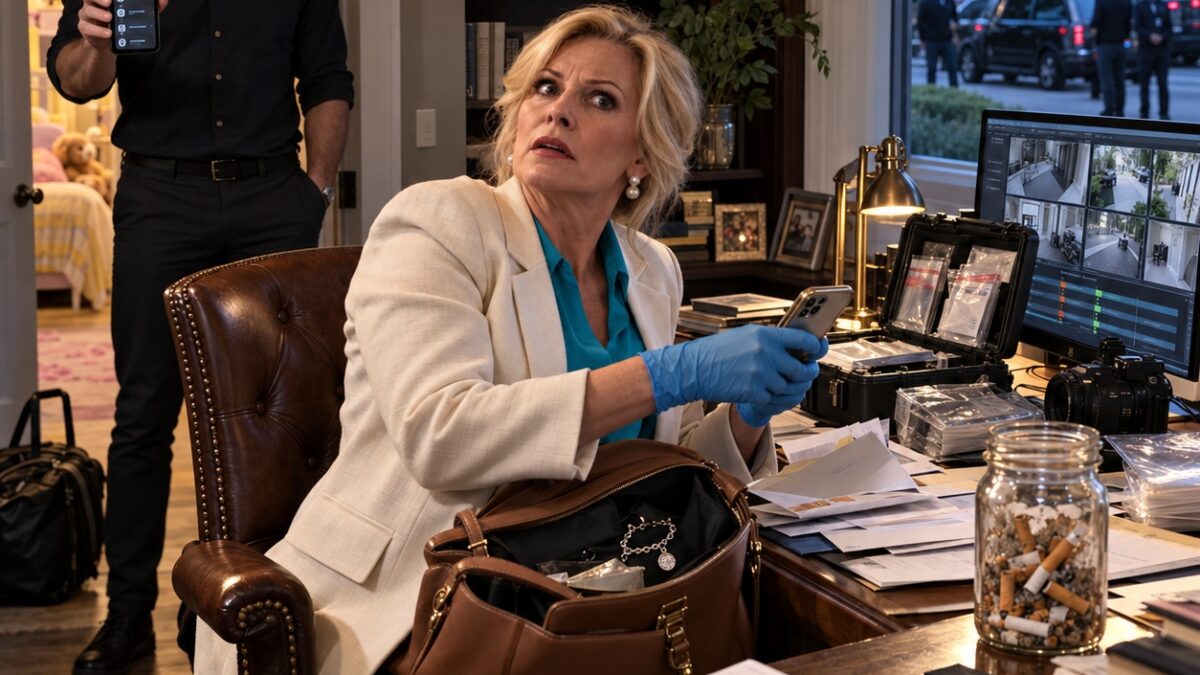
There she was.
Carla Vestrick.
Sitting in my desk chair.
Left elbow on my desk.
Printed page in her right hand.
Nitrile gloves.
Leather tote across her lap.
Faint pink tracer dye on her thumb.
Beside her:
Mason jar half full of cigarette butts.
She looked up.
Her face changed three times.
Surprise.
Calculation.
Then red.
“Pierce.”
Her voice brightened artificially.
“I let myself in. There was a community welfare check.”
I said nothing.
Held up my phone.
Pressed play.
On the screen:
Carla.
Same chair.
Wednesday at 4:11.
Opening my honeypot.
Photographing pages.
Sliding Eliza’s silver bracelet into her tote.
Carla stared.
I let thirty seconds play.
Long enough for the silence to become physical.
Then I lowered the phone.
“I have eleven months of access logs.”
She said nothing.
“Multiple entries on video.”
Her jaw tightened.
“Audio.”
Still nothing.
“Watermark trace.”
Then:
“You photographed federal-style honeypot documents using a device we already identified.”
Her eyes flicked toward the door.
“I just needed today.”
Her voice finally returned.
“This is community property. I have every right to be in here.”
That was the sentence.
Clear.
Recorded.
No ambiguity.
At 11:31, Detective Reagan Crawford appeared behind me.
Plain clothes.
Badge.
Arrest warrant.
Two deputies.
Two seconds later, Camille Whitlock stepped into view.
FBI credentials open.
Carla looked from them to me.
Then back.
The only sentence she had left was:
“You can’t prove anything.”
Reagan answered while reading the warrant.
“Carla Vestrick, you are under arrest for aggravated burglary, felony theft, fraud over ten thousand dollars, felony stalking, and twenty-three counts of interstate wire fraud.”
Carla stood.
Slowly.
Cuffs went on at 11:34.
At that exact minute, two FBI vehicles arrived at the Vestrick house three streets over.
Holden answered in a bathrobe.
Coffee mug in hand.
He met Special Agent Garrick Holm with a federal search warrant.
Home.
HOA office.
Electronic devices.
Delaware records.
At 11:40, another FBI team entered the clubhouse.
Seized the office computer.
Three external drives.
Six file cabinets.
A safe beneath the secretary’s desk.
Inside:
$41,000 cash.
Two handwritten ledgers in Carla’s handwriting.
And a Tupperware container of biscotti.
I have testified in enough federal cases to know evidence rarely has a sense of humor.
That one did.
At 12:06, Pinnacle Bank froze the HOA account.
At 1:15, Carla’s Delaware LLC registration was suspended pending federal review.
At 3:33, NewsChannel 5 Nashville parked a van at the Magnolia Bluff entrance.
By four, cameras were filming FBI agents carrying eleven evidence boxes from the Vestrick house.
Sloan and Mom watched from Murfreesboro.
At 4:13, my phone buzzed.
Sloan.
Daddy, Mom would be so proud.
I read it once.
Then again.
At five, I sat alone on my front porch.
Last FBI vehicle rolled away.
Holden in the back.
Still wearing his bathrobe.
The HOA board resigned before dark.
Every member.
By midnight, the structure Carla had built over eleven years no longer existed.
I locked my own front door.
The Schlage chimed.
Same sound.
But this time it sounded different.
Not because the lock had changed.
Because nobody else held a secret code.
Carla pleaded guilty November 9.
State and federal package.
Eight years in federal prison.
Five before parole eligibility under the agreement described in the source.
Full restitution:
$310,000.
Permanent prohibition on serving as an HOA board member, nonprofit officer, or LLC officer in Tennessee.
Holden pleaded three weeks later.
Conspiracy.
Federal cyberstalking count tied to the online campaign.
Eighteen months.
Served fourteen.
Magnolia Bluff’s old board dissolved.
New election in December.
Seven members.
None had served under Carla.
Rosalind Marsh became chair.
The retired English teacher whose wedding photograph had disappeared in 2019.
FBI found that photograph inside a shoebox in Carla’s pantry.
Rosalind framed it.
Then hung it in the new HOA office beside a small brass plaque.
RETURNED TO ITS RIGHTFUL PLACE — DECEMBER 14
Branson Hollis got his Marine dog tags back.
He had them shadow-boxed with a folded flag and his discharge papers.
Hung them above the place in his living room where he had sat on the floor and cried when I first told him what happened.
Eleven other residents recovered property.
Two diamond rings.
Vintage Patek Philippe.
Forty-six pieces of mail.
Six prescription bottles.
Three sets of car keys.
And one faded Polaroid of a little girl on a beach in 1981.
The owner was sixty-eight.
When Reagan handed it back, he cried harder than anyone expected.
That photograph had no resale value.
That is why Carla had kept it.
Control does not always need profit.
Sometimes people steal private things simply because possessing them makes them feel powerful.
That bothered me almost more than the money.
Reagan received a sheriff’s commendation.
Camille received a Department of Justice citation.
Harlan’s civil suit settled.
Restitution.
Attorney fees.
$200,000 in punitive damages distributed across victims.
My share went to two things.
The first was a tree.
The old Magnolia Bluff entrance sign was replaced.
Rosalind hated the oversized stone monument.
The new one was simple.
Brick base.
Clean lettering.
MAGNOLIA BLUFF
A NEIGHBORHOOD
Not “community.”
Not “exclusive.”
Not “master association.”
A neighborhood.
Beside it, we planted a twelve-foot magnolia.
White flowers.
Eliza’s favorite.
The board resisted the plaque at first.
I insisted.
It reads:
FOR ELIZA WHITFIELD
WHO PICKED THIS NEIGHBORHOOD FOR OUR KIDS
The second thing was the Eliza Whitfield Digital Safety Foundation.
We launched in February.
Free smart-lock audits.
Home security reviews.
Basic surveillance installation.
Priority to widows.
Single parents.
Elderly residents.
People living alone.
People who would never think to check whether an HOA president had generated Code 6 on their front door.
Reagan joined the board.
Rosalind joined.
Branson volunteered as community ambassador.
Sloan came on Saturdays.
Two hours filing paperwork.
Ten dollars she did not need.
Forty-seven homes audited the first year.
Sixteen compromised smart locks replaced.
Two more HOA officers caught using unauthorized entry methods similar to Carla’s.
Neither case ended quietly.
But the foundation was never supposed to become a war on HOAs.
Most HOA boards are boring.
That is good.
Boring government is underrated.
The problem was not that Magnolia Bluff had rules.
The problem was Carla turned information asymmetry into power.
She knew the portal.
The codes.
The bank accounts.
The board procedures.
The homeowners did not.
She exploited that difference.
Then hid behind official language.
The new board did the opposite.
Financials posted.
Minutes public.
Vendor contracts reviewed.
Smart-lock access prohibited unless explicitly consented to by the homeowner for a specific emergency service.
No standing installer codes.
No hidden access list.
Pool restrictions could not be applied to children because of disputed fines without due process.
Anonymous “welfare” complaints required review before HOA resources were used.
Basic things.
Things that should not have required federal warrants to inspire.
Sloan returned to the pool the following summer.
First day, I drove her.
She looked at the gate.
Then at me.
“You coming in?”
“No.”
“Why?”
“I’m forty-something years old and own no pool shoes.”
“You’re scared.”
“Of what?”
“People.”
“Correct.”
She rolled her eyes.
Then stopped.
Looked toward the clubhouse.
“Is Carla ever coming back?”
“No.”
“Like ever?”
“Not as president.”
“That’s not what I asked.”
I smiled.
“No, honey. She isn’t coming back here.”
Sloan nodded.
Walked through the gate.
I sat in my truck for five minutes.
Watched her join friends.
No one whispered.
No one pointed.
Normal.
That word became important.
Normal.
After Eliza died, normal disappeared.
Then slowly rebuilt itself around Sloan and me.
Breakfast.
School.
Flights.
Mom’s Sunday dinner.
The house.
Then Carla distorted everything.
Every object became suspicious.
Cigarette butt.
Coffee mug.
Mail.
Bedroom door.
A smart lock I installed for convenience became evidence someone had entered my home.
For months after Carla’s arrest, I checked the lock log constantly.
Morning.
Lunch.
Before bed.
Sometimes at two in the morning.
No unauthorized entries.
Still checked.
One Saturday, Sloan caught me.
“Dad.”
“Yeah?”
“You checked it ten minutes ago.”
“I know.”
“So?”
“Habit.”
She folded her arms exactly like Eliza used to.
“That’s not a reason.”
I laughed.
“No.”
She sat across from me.
“Is anybody getting in?”
“No.”
“Then stop checking.”
“I do federal forensics for a living.”
“That sounds like a you problem.”
Twelve years old.
Brutal.
She was right.
I reduced notifications.
Kept the security.
Let go of the obsession.
The goal of safety is not permanent surveillance.
The goal is being able to stop thinking about danger.
That lesson took longer.
Rosalind struggled too.
Her wedding photograph returned to the wall, but she kept walking over to make sure it was there.
Branson touched his shadow box every time he passed.
Another victim changed the locks twice after the FBI confirmed Carla had stolen nothing from her house.
Violation of home does that.
Objects stay in place, but trust changes shape.
That became one focus of the foundation.
Not only cameras.
Education.
What does a smart-lock log mean?
How do you revoke credentials?
How do you preserve footage?
When should you call police?
When should you avoid confronting the person?
How do you create a clean evidence trail?
Most people do not need twenty-six surveillance assets.
Operation Crescent was a law-enforcement-controlled evidence build.
Not normal home security.
For ordinary families, simple protections worked.
Unique codes.
No shared installer credentials.
Two-factor authentication.
Entry alerts.
Camera covering the primary door.
Audit old users twice a year.
Record serial numbers for valuables.
Keep copies of important documents off-site.
Boring.
Again.
Effective.
A widow named Marjorie came to the foundation in May.
Seventy-four.
Her handyman had created a permanent smart-lock code for himself two years earlier.
She thought he removed it.
He had not.
Nothing had been stolen.
No crime.
Just a vulnerability.
We deleted the code.
Reset everything.
She hugged Sloan.
Sloan had done most of the configuration.
In the car afterward, Sloan said:
“That was easy.”
“Yes.”
“So why didn’t somebody show her before?”
Exactly.
Security often fails because the person who understands the system assumes everyone does.
That is why Carla survived for years.
Not because she was a technical genius.
She exploited defaults.
Installer access.
Board trust.
Residents who believed photos.
Fines small enough that paying looked easier than fighting.
Anonymous complaints.
She did not need to hack anything sophisticated.
She needed people to assume someone else had checked.
In federal cases, we call that control failure.
Eliza would have called it people being too polite.
She was less diplomatic than I am.
I think about the day Carla first brought the lemon icebox pie.
Eliza liked her.
Not deeply.
But enough.
She said later:
“She’s intense.”
I said:
“She’s organized.”
Eliza laughed.
“That’s what men say when they don’t want to call a woman controlling.”
She was probably right.
The pie was good.
That annoys me.
Memory should not be allowed to contain details like that, but it does.
Carla was not a movie villain from the beginning.
She was a neighbor.
Friendly.
Useful.
Knows everyone’s name.
Organizes events.
Brings dessert.
That is another lesson worth keeping.
Bad actors rarely enter systems wearing warning labels.
They become dangerous because people trust them first.
Then authority accumulates.
Nobody reviews old permissions.
Nobody asks why one person controls the bank, the fines, the access, the communications, the board agenda, and the complaint process.
By the time somebody asks, the system already feels permanent.
Carla had eleven years.
Eleven years is a long time for a bad habit to start looking like tradition.
The new HOA imposed term limits.
Three years.
Maximum two consecutive terms.
Rosalind pushed that through.
At the meeting, somebody asked whether it was really necessary.
Rosalind pointed to the brass plaque under her returned wedding photo.
Motion passed unanimously.
The HOA also discovered something else during the audit.
Carla’s $310,000 wire scheme was only the money prosecutors could directly trace.
Residents had paid additional fines that remained in HOA accounts or were used for legitimate expenses.
The psychological cost was impossible to calculate.
Pool passes.
Embarrassment.
DCS visits.
Deputies.
Neighbors treating one another like suspects.
Holden’s online campaign had created dozens of fake or coordinated accounts.
People discovered that comments they thought represented community consensus had been manufactured.
That caused its own damage.
One resident told me:
“I stopped speaking to my neighbor for a year because I thought she called me unsafe.”
She had not.
Carla had.
From an account using the neighbor’s initials.
Technology made the manipulation easier.
Evidence eventually made it visible.
That is the paradox.
The same systems Carla exploited also recorded her.
Smart locks.
Email backups.
Wire transfers.
Cloud logs.
Metadata.
Every digital action leaves something.
Not always enough.
But usually more than people expect.
Carla thought Code 6 was invisible because nobody had noticed it.
It was never invisible.
It was merely unread.
That distinction defines half my career.
Data exists.
Someone has to ask the correct question.
The coffee mug was my question.
A handle facing left.
That tiny thing opened everything.
I sometimes wonder what would have happened if Carla had put it back correctly.
Probably something else would have surfaced.
Mail shifted.
Sloan’s door.
Towel hook.
People are bad at restoring a space exactly as they found it because houses contain thousands of micro-patterns only residents understand.
The more time an intruder spends inside, the more likely they disturb one.
She had become comfortable.
That comfort saved us.
Reagan once asked whether I regretted paying the first $11,400 in fines.
I said yes.
Then changed my answer.
“No.”
She looked at me.
“Why?”
“Because every payment became part of the wire-fraud trail.”
She smiled.
“Spoken like a forensic analyst.”
Still, it bothered me.
I had paid because I was tired.
After Eliza died, every administrative fight felt expensive.
Two hundred fifty dollars seemed cheaper than taking a day off.
Five hundred cheaper than an argument.
That is how systems like Carla’s work.
They price abuse just below the victim’s threshold for resistance.
Not enough to destroy you at once.
Enough to drain you gradually.
I did not pay because I believed her.
I paid because grief had taken away my appetite for conflict.
Carla mistook exhaustion for consent.
She made that mistake with many people.
Rosalind thought she misplaced her wedding photo because widows are constantly told grief makes them forgetful.
Branson thought maybe his dog tags were somewhere in storage.
Others blamed themselves.
Carla chose victims likely to doubt their own memory before accusing a respected HOA president.
That was sophisticated in a way the smart-lock trick was not.
She understood human hesitation.
The foundation began teaching that too.
If something feels wrong, document before dismissing yourself.
Do not assume theft.
Do not accuse.
Just document.
Photograph.
Log.
Check access.
Preserve records.
Evidence protects everyone.
Including the falsely accused.
That matters.
I do not believe suspicion is a virtue.
Verification is.
There is a difference.
One evening, Reagan and I spoke at a community safety workshop.
A man asked:
“Should everyone put cameras inside their homes?”
I said:
“No.”
He looked surprised.
Reagan smiled.
I continued.
“You should have security proportionate to your risk.”
Then:
“If your solution to fear is filming every square foot of your life forever, the criminal still changed how you live.”
That was the lesson I was still learning.
After Operation Crescent, I removed almost every interior camera.
The front door stayed.
Garage stayed.
Home office stayed.
Sloan’s bedroom camera was the first one I removed.
She stood beside me.
“Good.”
“You didn’t like it?”
“No.”
“I never monitored you.”
“I know.”
“Then?”
“It was still there.”
Fair.
We took it down.
Patched the tiny screw hole.
Yellow paint.
Summer cornfield.
Eliza’s color.
Sloan watched me.
“Mom did a better job.”
“Your mother never painted over a screw hole in her life.”
“You can’t prove that.”
I looked at her.
Wrong family to say that to.
She laughed before I did.
The magnolia tree at the entrance grew well.
The first summer after planting, it produced only a few blossoms.
Second summer, more.
Sloan sometimes asked me to slow down when we drove past.
The plaque is small.
Most people probably never read it.
That is fine.
I did not want a monument to tragedy.
I wanted Eliza’s name attached to something alive.
White flowers.
Green leaves.
Shade someday.
The house she chose remained ours.
That mattered more.
Mom visits often.
Still refuses to use the smart lock.
She says keys are trustworthy.
I remind her keys can be copied.
She says nobody ever hacked brass.
I stopped arguing.
She keeps the thermos from Operation Crescent.
I do not know why.
Maybe because she needed an artifact too.
Holden finished his sentence.
I heard through attorneys that he moved outside Tennessee.
No idea where.
Do not care.
Carla remained incarcerated under the plea described in the source.
I received one letter from her.
Did not open it.
Gave it to Harlan.
He asked:
“You sure?”
“Yes.”
“You’ve spent your whole career reading evidence.”
“That isn’t evidence.”
“What is it?”
“Someone trying to get back inside my head.”
He nodded.
Disposed of it according to counsel’s recommendation.
I never learned what she wrote.
I am fine with that.
Not every door needs opening.
Especially after you spent months proving someone had no right to walk through yours.
Sloan grew more interested in the foundation than I expected.
At first, ten dollars was the motivation.
Then she started talking to clients.
Not about crime.
About how security systems work.
She became good at explaining without making older people feel stupid.
One Saturday, an eighty-year-old man could not understand why his smart lock needed a separate admin credential.
Sloan sat beside him.
“Think of it like your mailbox.”
He nodded.
“You have the key.”
“Yes.”
“The mail carrier has a way to deliver things.”
“Yes.”
“But you don’t want the mail carrier living in your house.”
The man laughed.
“Exactly.”
She looked at me afterward.
“Better than your explanation?”
“Significantly.”
Eliza would have loved watching her.
That is the grief that never goes away.
Every new version of Sloan comes with the knowledge that Eliza does not get to meet her.
Twelve-year-old Sloan.
Thirteen.
Eventually sixteen.
College.
Whatever comes.
That ache remains.
But grief changed after Carla.
Before, I protected Eliza’s things because I feared losing more.
After, I understood memory was not as fragile as Carla had made it feel.
She could steal the bracelet.
We got it back.
She could touch the photograph.
Could enter our room.
Could weaponize our routines.
She still could not take what the house meant.
Could not take the way Sloan raises one eyebrow.
Could not take the first afternoon Eliza walked the foyer.
Could not take 4:11 from me either.
That timestamp hurt.
But eventually, another 4:11 became part of the story.
The moment Carla entered during the Phoenix operation.
Same numbers.
Different meaning.
I do not believe in cosmic signs.
I work in hashes and timestamps.
Still.
Sometimes data carries emotional weight whether you want it to or not.
The final civil distribution helped victims recover financially.
But the recovered objects mattered more to many.
Rosalind’s wedding photo.
Branson’s dog tags.
That Polaroid.
One woman received an engagement ring and immediately gave it to her granddaughter.
She said she had assumed it was gone forever and had already grieved it.
Now she did not want it sitting in a drawer again.
That stayed with me.
Recovery can change what you do with something.
Eliza’s bracelet returned to me through evidence release.
I did not put it back in the dresser.
Sloan wears it sometimes.
The first time, I almost told her to be careful.
Then stopped.
Jewelry should be worn.
Memories should move.
The silver links sit differently on her smaller wrist.
Too loose.
She likes them that way.
I told her we could resize it.
“No.”
“Why?”
“It was Mom’s size.”
I understood.
So we leave it.
The house also changed.
I replaced the smart lock.
Different manufacturer.
Different credential system.
Not because Schlage failed.
The installer process had been abused.
But emotionally, I wanted a new sound at the front door.
The replacement lock chimes lower.
Sloan says the old one sounded friendlier.
I prefer the new one.
Less cheerful.
More honest.
Our coffee mugs still face right.
Most of them.
Sometimes Sloan puts one left on purpose just to watch me notice.
I always do.
She thinks it is funny.
It is.
Now.
That is another way you know fear has loosened.
The trigger becomes a joke.
The first time she did it, I froze.
Then saw her watching me from the doorway.
Smiling.
“You’re terrible.”
“You noticed.”
“Of course I noticed.”
She laughed.
Moved the mug back.
I left it left.
All day.
That was harder than it sounds.
At night, I turned it right.
Progress has limits.
Reagan eventually asked to use Operation Crescent as an internal training example.
Not the family details.
Evidence architecture.
Controlled smart-lock logging.
Watermark honeypot.
Chain-of-custody discipline.
I agreed.
We removed names.
The point was not Carla.
The point was method.
Do not contaminate your own case.
Do not confront too early.
Do not install illegal surveillance.
Know consent laws.
Know where audio is permitted.
Preserve original files.
Hash copies.
Document device clocks.
Maintain logs.
That is the part social-media versions usually skip.
They make patience sound passive.
It is not.
Patience in an investigation is active.
You are building.
Every minute.
Every record.
Every decision.
Carla thought my silence meant surrender.
Actually, silence was the loudest part of Operation Crescent.
She kept filling it.
Entering.
Stealing.
Planting.
Writing liens.
Publishing newsletters.
Messaging online.
Each act added another support column to the case.
She built her own enclosure one decision at a time.
I did not need to trap her.
I needed to stop interrupting her long enough for the pattern to become undeniable.
That is different.
People sometimes ask what I would have done if she had stopped.
After the first unauthorized code.
After one entry.
After one theft.
I would have reported it.
The case would have been smaller.
Probably state charges.
Maybe no federal component.
Maybe less restitution.
But she never stopped.
People who confuse impunity with innocence rarely stop voluntarily.
Carla believed eleven years without consequences proved she had done nothing punishable.
Really, it proved nobody had assembled the evidence yet.
Rosalind said something at the foundation’s first anniversary dinner.
She stood with a glass of iced tea.
No prepared speech.
Then said:
“For years, Carla made us feel foolish for noticing things.”
She touched the wedding photo hanging behind her.
“Pierce made us write them down.”
That was better than any award.
Notice.
Write down.
Verify.
Not paranoia.
Memory with structure.
The old HOA clubhouse changed too.
No more Carla portrait.
No personalized president parking space.
Rosalind refused a reserved spot.
The board installed a bulletin board showing:
Monthly expenses.
Vendor contracts.
Meeting dates.
Complaint procedure.
Appeal process.
Simple.
One resident joked that transparency was ugly.
Rosalind answered:
“So was federal prison.”
No one argued.
I still travel for work.
Less than before.
Partly because Sloan is older and I want fewer missed evenings.
Partly because grief no longer feels like something I can outfly.
There is no airport far enough.
Eliza died here.
She also lived here.
Those are not the same statement.
For a long time, the first swallowed the second.
Carla’s invasion made me defend the house.
Defending it forced me to remember why we chose it.
Then why Eliza chose it.
The kids will grow up here.
We only had one child.
That sentence still came true.
Sloan is growing up here.
Not perfectly.
Not according to the plan.
But here.
The magnolia beside the entrance is taller now.
Someday it will shade the sign.
Eliza loved magnolias because she said they looked impossible.
Heavy white blossoms on dark waxy leaves.
“Like somebody designed a flower for a wedding cake.”
That was her description.
I thought it was ridiculous.
I planted one anyway.
Some evenings Sloan and I walk to the entrance.
Not often.
Just when the weather is good.
The plaque is set low in the brick.
She used to trace her mother’s name.
Now she does not.
Growing older changes how children carry grief.
Less visible.
Not necessarily less.
I try not to ask too much.
One Friday evening in October, we sat on the front porch.
Cicadas loud.
Light honey-colored across the street.
Somebody grilling four houses east.
Cut grass.
Smoke.
Normal neighborhood smells.
Sloan leaned her shoulder against mine.
The porch boards creaked.
Same boards beneath Eliza sixteen years earlier when we first moved in.
Sloan looked toward the magnolia at the entrance.
Then said:
“Dad?”
“Yeah?”
“I think Mom picked the right house.”
I did not answer immediately.
The old version of me might have felt the need to explain.
The neighborhood had failed us.
Carla had violated us.
The HOA had become corrupt.
But Sloan was not talking about any of that.
She meant the house.
The place.
Us.
I looked at the yellow glow from her bedroom window upstairs.
Summer cornfield.
Eliza’s color.
Then at the street.
Kids riding bikes.
Rosalind walking her little terrier.
Branson watering his lawn beneath the shadow box he had finally rehung inside.
A neighborhood.
Nothing more.
Nothing less.
“Yeah,” I said.
“She did.”
Sloan rested her head against my shoulder.
We stayed there until the porch light came on automatically.
No alerts.
No secret codes.
No anonymous reports.
No blazer at the end of the driveway.
Just my daughter.
My house.
My front door.
And the quiet certainty that nobody would ever again make me feel like I needed permission to belong inside it.








