PART2:HOA Queen Parked Her Mercedes Across My Timber Gate for 47 Mornings and Mocked My Dead Wife’s Bench—She Never Checked the 1968 Easement Under Her Tires
PART2
The first thing Diane did after my certified letter was complain to the Washington State Department of Transportation.
She claimed Brooks Timber was running unauthorized commercial vehicles through a residential access road.
She attached forty-three photographs.
She included Section 14.3 of her HOA manual as if the State of Washington was going to cancel a timber company’s access because a neighborhood president disliked Peterbilts.
DOT sent an inspector named Dale Prater.
Dale drove a Silverado older than Caleb.
He wore a fleece vest and the expression of a man who had been assigned a problem far stupider than anything he expected when he left home that morning.
I gave him our permits.
County records.
The access documentation we already had in the regular business file.
He reviewed everything.
Then looked across the road.
Diane stood there with her Nikon raised.
Dale walked over.
They spoke for less than two minutes.
Then he got back into his Silverado and left.
Diane posted online that afternoon.
THE SYSTEM IS BROKEN.
That was how she handled evidence she did not like.
If an institution agreed with her, it was proof.
If it disagreed, the institution was corrupt.
Then Caleb found the Standards Watch database.
Diane had created a private group inside a neighborhood-watch platform.
Administrator:
Diane Whitaker.
Uploaded spreadsheet:
Brooks Timber vehicle license plates.
Columns:
Date.
Time.
Plate.
Direction.
Notes.
She had recruited residents to log our trucks whenever they passed.
I stared at the screen.
Caleb said:
“That’s creepy.”
“It’s useful.”
“To who?”
“Us.”
He looked at me.
I opened the notebook.
May 8 — she built an app.
Then underneath:
Once a commercial easement attaches to the land, an HOA handbook doesn’t erase it.
My grandfather taught me that before I knew the legal vocabulary.
Land agreements outlive arguments.
They outlive neighbors.
Sometimes entire developments.
Diane did not understand that.
Or did not want to.
On day twenty-three, she called 911.
She told dispatch a Brooks Timber employee had threatened physical violence.
Said she feared for her safety.
Gave my address.
Then gave Caleb’s license plate.
Deputy Trent Callahan arrived at 7:11.
No siren.
He had already answered two calls involving Diane that month.
He stepped out.
“Morning, Mr. Brooks.”
“Morning.”
“What happened?”
I handed him the tablet.
“Last twenty minutes.”
He watched.
Four minutes of Diane standing beside the Mercedes.
Laughing at something on her phone.
Caleb waiting behind the gate.
Then lowering his window.
“Excuse me.”
That was the threat.
Two words.
Diane rolled her eyes and took another drink.
Callahan handed the tablet back.
Walked to her.
I could not hear what he said.
But I watched Diane’s face change.
Only for a second.
Then the smile returned.
“Officer, I appreciate you doing your due diligence. Standards must be enforced.”
Callahan did not answer.
Before leaving, he stopped beside me.
Rolled down his window.
“Third call this month.”
“I know.”
“I’m seeing a pattern.”
“So am I.”
“Keep the footage.”
“I will.”
That night, the conflict stopped being only harassment.
At 10:48, Caleb came inside.
“There’s a truck at the gate.”
We walked out.
Work lamp.
Two men in orange safety vests.
Power auger.
A third man holding an invoice.
And Diane’s Mercedes idling behind them.
She stepped forward carrying coffee.
“We’re installing signage for community coordination.”
The auger was three feet inside the easement.
I looked at the survey stake.
Then at Diane.
“What signage?”
She smiled.
“Purely aesthetic.”
The crew poured concrete around a steel post.
Two feet deep.
Then bolted a brass plaque to the top.
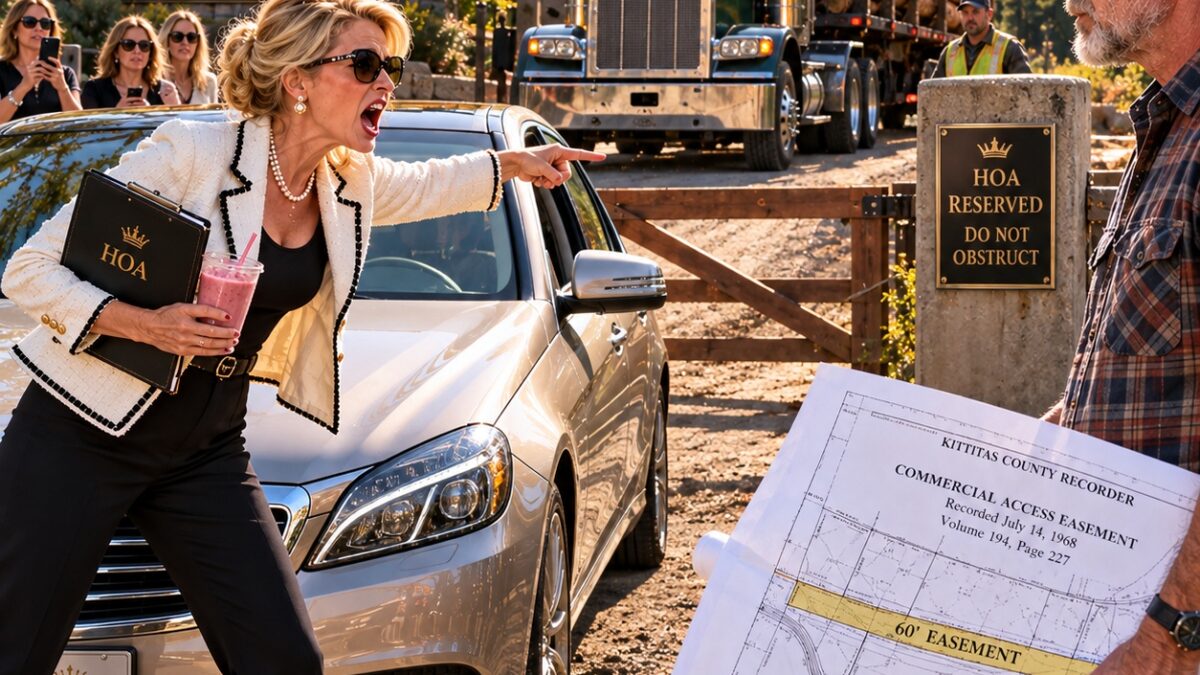
HOA RESERVED
DO NOT OBSTRUCT
CASCADE MEADOWS ESTATES
They installed it at the exact location where Diane had been parking her Mercedes.
Caleb leaned close.
“Dad, call Callahan.”
“Get the good camera.”
“What?”
“Nikon. Mill office.”
He stared.
“Go.”
He brought it.
I photographed everything.
Forty-three images.
Wide shot showing Diane.
Close view of wet concrete.
Survey marker.
Footprint inside the easement.
Plate.
Work crew.
Invoice.
Every angle.
Caleb finally asked:
“Why are you smiling?”
“Because she just gave us evidence I couldn’t have bought.”
At 11:51, I emailed the photographs to Katherine Ashford.
Kate was our timber attorney.
Sixty-one.
Silver-gray hair.
Thirty-four years of property, forestry, and business law.
She had handled Brooks paperwork since my father was alive.
Her reply arrived two minutes later.
That concrete post just cost her $50,000. Sleep well.
I did.
A few days later, Diane persuaded two newer homeowners to file complaints against us.
Meredith Voss.
Pediatric dentist.
Rebecca Landry.
Real estate assistant.
Diane invited them over.
Poured Pinot Noir.
Showed them selected footage stripped of context.
Showed them Section 14.3.
Told them Brooks Timber survived only because of an old technicality.
The two women signed complaints alleging we were trespassing on community space.
Kate called after receiving the filing.
“When somebody builds a permanent structure inside a recorded easement without permission, that’s encroachment.”
“I know.”
“Separate cause of action from harassment.”
“I know.”
“And recruiting residents to file complaints using selectively edited evidence?”
She paused.
“Potentially another problem.”
I wrote:
May 15 — wine, edited clips, complaints. Third lawsuit.
Then Diane put Ellen’s bench on the HOA enforcement docket.
The post went up at seven in the morning.
Same photograph.
New caption.
UPDATE: The committee has formally added this unpermitted memorial structure to the June enforcement docket. Rules are rules, even for the bereaved.
Caleb read it first.
His hand curled into a fist.
I touched his shoulder.
“Son.”
He looked at me.
“She wants that.”
“What?”
“You angry.”
“She’s talking about Mom.”
“I know.”
“She has no right.”
“I know.”
“She—”
“Look at me.”
He did.
“She just made a mistake she can’t take back.”
His breathing slowed.
Then my email chimed.
Subject: Mr. Brooks, is this happening to you?
Sender:
Marissa Coleman.
Twenty-seven.
Courthouse reporter for the Kittitas Valley Herald.
And one of Ellen’s former second-grade students.
Marissa remembered Ellen helping her practice reading aloud during recess.
She had seen Diane’s post.
Recognized the bench.
She asked for coffee.
Off the record.
I agreed.
Wednesday.
Silver Spoon Diner.
Nothing but a notebook.
Meanwhile, Diane hired Charlotte Bennett to photograph Brooks Timber.
Charlotte was Standards Team vice chair and ran a home-portrait business.
She spent an afternoon shooting our property from every possible angle.
Log decks.
Fuel storage.
An old 1996 chip truck behind the mill.
Anything that could be made to look bad if framed carefully enough.
Diane turned it into a forty-seven-slide presentation.
Garamond font.
Opening quotation from The Great Gatsby.
A bar chart showing hypothetical property-value impact without any citation.
Three separate red-text references to Section 14.3.
And multiple photographs of Ellen’s bench.
The HOA meeting took place Thursday night.
Thirty-two homeowners attended.
Diane stepped behind the podium in an ivory suit.
Grant sat in front.
The Standards Team clustered together.
I sat in the back with my notebook.
For forty-one minutes, Diane presented Brooks Timber as the neighborhood’s central threat.
Legacy tolerance.
Aesthetic reconciliation.
Community-driven revocation.
She used the word eyesore eleven times.
I counted.
Her final slide proposed:
REVOCATION OF BROOKS TIMBER OPERATIONAL TOLERANCE
That phrase almost impressed me.
Not because it had legal meaning.
Because Diane had invented authority so confidently she now wanted the HOA to vote on revoking a permission it had never given.
She finished.
Twelve people applauded.
Twenty did not.
“Questions?”
I raised my hand.
Did not stand.
“Has the board reviewed the recorded easements affecting the parcels along Bridal Ridge Road?”
The room went quiet.
Diane smiled.
Only half a second late.
“Wesley, that’s for another meeting.”
“Okay.”
“Tonight we’re focused on standards.”
I nodded.
Opened the notebook.
Wrote:
She doesn’t know.
Then she called the vote.
Grant voted yes.
Charlotte yes.
Meredith and Rebecca yes.
Twenty-two homeowners voted no.
The motion failed.
Diane’s expression stayed controlled.
Her hand gripping the podium did not.
That night I went back to the green tin box.
Caleb joined me.
We laid the 1968 easement on the workbench.
Then the hand-drawn survey.
Then Caleb opened county planning records.
He had been researching something else.
“Dad.”
“What?”
“Look at this.”
An LLC called Sunridge Heritage Holdings had acquired six lots along Cascade Meadows’ northern edge over twenty-two months.
A rezoning application had been filed about sixty days earlier.
Proposed use:
Timber Tourism Experience Venue
Cabins.
Demonstration mill.
Tourist logging exhibits.
Immediately adjacent to Brooks Timber land.
Registered agent:
Vivian Crawford.
Same Vivian listed on Diane’s Standards Team roster.
Then Caleb opened amended ownership records.
Beneficial owner:
Grant Whitaker.
Diane’s husband.
Grant had participated in multiple county planning votes affecting Cascade Meadows land-use matters while quietly holding an interest in the LLC positioned to profit from a timber-themed commercial development beside us.
His abstentions had not been recorded properly.
Caleb stared at the screen.
“This wasn’t about the trucks.”
“No.”
“The bench?”
“No.”
“Then what?”
I looked at the map.
“If they make Brooks Timber look incompatible with the neighborhood, they pressure us.”
“To sell?”
“Or lose enough access that the property becomes harder to operate.”
Caleb sat back.
“Then Sunridge buys?”
“That’s what it looks like.”
It was after three in the morning when I left the mill.
I sat on Ellen’s bench.
Fog gone.
Stars clear.
Yellow Pine Creek loud from snowmelt.
I ran my hand across the cedar.
“Ellen.”
I stopped.
Then tried again.
“I think I understand now.”
An owl called from the firs.
“I think it’s time to end it.”
The next morning, I drove into Ellensburg.
Kate’s office sat above a saddle shop on Pearl Street.
I put the original easement on her desk.
She read it twice.
Then smiled.
Not her usual small attorney smile.
All teeth.
“Wesley.”
“Yes?”
“You just brought me the cleanest easement case I’ve seen in ten years.”
She pulled out a yellow legal pad.
“Sit down.”
For three hours, we built the plan.
First:
Affirm the easement in current county records.
Not because the 1968 filing had disappeared.
It had not.
Because refreshing the record made future arguments harder.
Second:
Ethics complaint regarding Grant’s undisclosed interest and planning commission participation.
Third:
Formal cease and desist to Cascade Meadows.
Attached:
Forty-seven dashcam clips.
Photographs of the concrete post.
The HOA correspondence.
Section 14.3 cross-referenced against the actual easement.
Fourth:
A temporary restraining order drafted but not filed until needed.
Fifth:
Sheriff’s department briefed.
Sixth:
Do nothing to change our normal business schedule.
Kate looked at me.
“You still have that Weyerhaeuser load?”
“Two weeks Tuesday.”
“What kind of truck?”
“Peterbilt 389. Eighty-two-foot loaded trailer. Knuckle boom behind the cab.”
“When?”
“Eight.”
“Keep it.”
“There’s one issue.”
She waited.
“The gate geometry.”
I drew it.
Granite escarpment north side.
Thirty-four-degree grade.
Yellow Pine Creek south side.
Retaining bank.
One turning radius where an eighty-two-foot log rig could pivot into the loading yard.
Exactly where Diane parked.
Exactly where she installed her post.
Kate stared at the drawing.
“Are you telling me the pickup physically cannot happen with her Mercedes sitting there?”
“Yes.”
She sat back.
Then started laughing.
Not loudly.
Dry.
Deep.
“That isn’t a trap.”
“No.”
“That’s geometry.”
I called Harlan Whitfield.
Twenty-eight years driving log trucks in the Pacific Northwest.
Two million dollars in bonding.
Three hundred hours certified grapple operation.
He had hauled for my grandfather in 1982.
“Harlan.”
“Wesley.”
“Tuesday. Eight a.m.”
“Got it.”
“There may be a situation.”
He laughed.
“I hauled your granddad’s logs down Snoqualmie Pass in freezing rain. Whatever situation you have, I’ve seen worse.”
“Bring the rubber grapple pads.”
“Already got ’em.”
The filings started quietly.
Easement affirmation Thursday.
Ethics complaint Friday.
Marissa Coleman scheduled herself and a photographer for Tuesday morning.
The state ethics investigator assigned to Grant’s case, Bennett Hallstrom, notified Kate he would be in Kittitas County Tuesday with a subpoena.
On Monday morning I sent the HOA the legally required operational notice.
One email.
Truck type.
Scheduled arrival.
Expected pickup duration.
Recorded easement citation.
No threats.
No commentary.
Diane read it at 9:04.
By ten, she had created a Nextdoor event.
COMMUNITY AESTHETIC DEFENSE RALLY
Location:
Brooks Gate.
Tuesday.
6:00 a.m.
Coffee provided.
Bring folding chairs.
Dress smart casual.
Caleb showed me.
I read it twice.
Then handed the phone back.
“Perfect.”
“Perfect?”
“Let her bring chairs.”
Tuesday morning the fog came down thick.
Maybe twenty feet of visibility.
At 5:48, I heard tires arriving.
Mercedes first.
Then more.
By six, five expensive German vehicles sat bumper-to-bumper across the easement.
Then eleven.
Folding chairs came out.
Yeti coolers.
French press.
Oat milk.
Gluten-free scones.
Somebody set up a Bluetooth speaker playing classical music.
Then the linen banners.
KEEP CASCADE MEADOWS BEAUTIFUL
And:
STANDARDS ARE LOVE
I watched from the kitchen.
Diane wore an ivory Anne Fontaine suit.
Red-bottom heels sinking into wet ground.
Chanel No. 5 somehow penetrating fog and glass.
At 6:15, she started streaming.
“Good morning, Cascade Meadows.”
Her voice bright.
Confident.
“Today we’re going to witness what happens when someone believes he is above community standards.”
Hundreds watched.
Then thousands.
She told them an illegal commercial vehicle was scheduled for eight.
She described the rally as peaceful community defense.
By seven, more than eighteen hundred viewers were watching.
Everett Sinclair arrived around 6:40.
Retired Boeing engineer.
Quiet man.
He parked his Buick away from the rally.
Stood near the banner for a minute.
Then pulled Diane aside.
I could not hear him.
Later, he told me.
His late wife had bought their house from Randy Hollis before Cascade Meadows existed.
Randy had told them Brooks Timber held commercial access rights dating back to 1968.
Everett warned Diane.
“Are you sure you want to do this?”
Her answer:
“That’s ancient history. HOA rules supersede outdated agreements.”
Everett nodded.
Went back to his Buick.
He had done what reasonable people do.
Warned her once.
At 7:40, Kate called.
“Bennett crossed the county line.”
“Okay.”
“Callahan should be there at 8:09.”
“Okay.”
“Marissa’s ready.”
I looked through the window.
Diane was laughing into the livestream.
“Everything is on time.”
I hung up.
Caleb came into the kitchen.
I picked up my keys.
“Son.”
“Yes?”
“Let’s go to work.”
At 8:03, we heard the Peterbilt before we saw it.
Low diesel horn.
Then headlights through fog.
Cardinal-red Peterbilt 389.
Eighty-two feet of truck and trailer.
Douglas fir logs stacked six high.
Knuckle boom folded behind the cab.
Harlan at the wheel.
Diane lifted her phone.
“Ladies and gentlemen, here it comes.”
She stepped into the road.
Raised her hand.
Like a traffic cop.
Harlan stopped about forty feet from the Mercedes.
Rolled down the window.
“Ma’am, scheduled timber pickup. Your vehicle is blocking a recorded commercial easement. Please move it.”
Diane raised the smoothie.
Sipped.
“Sir, this is HOA property.”
“No, ma’am.”
“You’ll need to reschedule.”
Harlan did not argue.
He shut the engine down.
Climbed out.
Walked toward my F-250.
Diane turned to the livestream.
“He’s backing down.”
She smiled.
“Cascade Meadows has just won its first documented—”
Blue lights appeared through the fog.
8:09.
Deputy Trent Callahan.
No siren.
Slow approach.
Diane’s face brightened.
“Officer, thank goodness. This man—”
Callahan raised one hand.
“Ma’am, before you speak, I need to serve you.”
He handed her the order.
Temporary restraining order.
Kittitas County Superior Court.
Signed that morning.
Vehicle bearing Diane’s plate ordered removed from the Brooks Timber commercial easement.
Twenty minutes allowed for compliance.
Sheriff authorized to remove the obstruction if she refused.
Diane laughed.
Too bright.
“Officer, sweetheart, there’s been a misunderstanding.”
Callahan’s expression did not move.
“This easement predates your HOA by twenty-two years.”
She stared.
“You have four minutes.”
Then another vehicle arrived.
Black state SUV.
Government plates.
Bennett Hallstrom stepped out carrying a leather briefcase.
He walked directly to Diane.
“Mrs. Whitaker?”
“Yes?”
“I have a subpoena for Grant Whitaker relating to disclosures made before the Kittitas County Planning Commission.”
Her hand moved slightly.
“He’s at work.”
“Then I’ll serve him there.”
Then the third vehicle.
Dusty Subaru.
Press placard.
Marissa Coleman stepped out.
Photographer behind her.
The cameras came up immediately.
Diane tried calling her attorney.
No answer.
Grant.
No answer.
The livestream count passed six thousand.
Callahan checked his watch.
“Two minutes.”
She did not move.
At 8:15, he requested a tow.
Dispatch responded.
Then the tow driver called back.
Could not reach the Mercedes.
Too many vehicles.
Too many folding chairs.
The easement itself was blocked by Diane’s own rally.
Callahan turned toward Harlan.
Looked at the Peterbilt.
Then the knuckle boom.
“Can that grapple move a passenger vehicle safely?”
Harlan pushed his cap back.
“Officer, I lift eight-ton Douglas fir all day.”
He looked toward Diane’s Mercedes.
“That car weighs less than five thousand pounds.”
“Can you move it without damaging it?”
“Rubber pads are already on.”
Callahan nodded.
“Do it.”
The crowd went silent.
Diane did not.
“You can’t touch my car.”
Callahan addressed everyone.
“Court order is in effect. Tow access is blocked. The vehicle is obstructing a valid commercial easement. I am authorizing the equipment operator to move it.”
Diane screamed:
“This is illegal.”
“It’s a court order.”
“Do you know who my husband is?”
“I know there’s a subpoena waiting for him.”
That stopped her for about two seconds.
Then Harlan climbed back into the Peterbilt.
Hydraulics engaged.
The knuckle boom began unfolding.
Slow.
Controlled.
Black rubber pads lining the jaws.
And that was when Diane finally understood what was about to happen.
She reached for the Mercedes key fob.
Pressed a button.
Wrong one.
The rear passenger door unlocked.
Then opened.
Fast.
Straight into the concrete post Diane herself had installed inside my easement.
The brass plaque read:
HOA RESERVED — DO NOT OBSTRUCT.
The Mercedes door hit it hard.
Crunch.
Metal folded inward.
Glass cracked.
A piece of trim landed in the grass.
Diane screamed.
“My car!”
Marissa’s camera fired repeatedly.
The photograph captured almost everything in one frame.
Diane’s expression.
Open door.
Concrete post.
Brass plaque.
Fog.
Her own obstruction damaging her own vehicle.
Harlan spoke through the exterior PA.
“Officer, for the record, damage occurred from vehicle owner’s remote door activation. Grapple has not contacted vehicle.”
Callahan wrote it down.
Then Harlan lowered the grapple.
The padded jaws closed gently around the Mercedes.
Hydraulics hummed.
And the car rose.
A champagne-colored luxury SUV suspended in fog above the same patch of asphalt Diane had claimed every morning for forty-seven days.
Standards Team members covered their mouths.
Linen banners sagged.
French press forgotten.
The livestream count crossed nine thousand.
Diane shouted that Harlan was destroying her car.
He answered through the PA.
“Ma’am, three hundred hours certified grapple operation. Two million dollars in bonding. Your vehicle is safer up here than it was beside your post.”
Then he rotated the boom.
Moved the Mercedes roughly ninety feet.
Set it gently on the gravel turnout.
All four wheels touched.
No grapple damage.
Callahan photographed the position.
Harlan retracted the boom.
At 8:24, Bennett Hallstrom reminded Diane the subpoena for Grant still needed to be served.
She stepped toward the Peterbilt.
Phone raised.
Still livestreaming.
Her right heel was buried in the mud.
The shoe did not come with her.
Diane pitched forward.
Sat hard in the wet ground.
Ivory suit.
Brown mud.
More than twelve thousand people watching.
No one laughed at the scene in person.
Not then.
The silence was worse.
Everett folded his chair.
Walked to the Buick.
Four other families followed.
The Standards Team began packing the coffee.
Rolling the banners.
Closing coolers.
Nobody looked particularly committed to “Standards are Love” anymore.
At 8:28, Harlan started the Peterbilt.
The rig rolled through my gate.
Exactly where the easement said it could.
The fog began thinning.
Sunlight hit the top row of Douglas fir.
I walked to Ellen’s bench.
Put my hand on the cedar.
Said nothing.
I had imagined that morning for weeks.
Not the Mercedes in the air.
Not the mud.
I had imagined the moment the road became quiet again.
That was enough.
Three weeks later, Cascade Meadows held a special session.
Diane stood at the podium.
Black turtleneck.
No elaborate suit.
No Standards Team lined up behind her.
She started:
“I would like to address recent developments—”
Everett Sinclair opened his laptop.
Projected the 1968 easement.
Then the ethics complaint.
Then thumbnails from all forty-seven dashcam clips.
Then photographs of Diane’s concrete post.
Then Marissa’s image of the Mercedes suspended in the fog.
Diane stopped speaking.
The removal vote was:
Seventy-six to nine.
Four abstentions.
For eight years, Diane had behaved as though Cascade Meadows existed inside her clipboard.
It ended in one vote.
Grant’s situation moved separately.
The state investigation into his planning commission disclosures advanced.
He was suspended indefinitely from the county planning commission.
The rezoning request connected to Sunridge Heritage Holdings was denied.
The LLC came under further scrutiny regarding its land acquisitions and financial communications.
I did not need to control those investigations.
I provided documents when requested.
Then let the appropriate people do their jobs.
Diane’s Mercedes repair bill came to $3,847.
She filed an insurance claim.
Farmers denied it.
The denial stated the damage was self-inflicted through the policyholder’s remote door operation during a lawful court-ordered vehicle removal.
Charlotte Bennett photographed the letter.
Then accidentally shared it into a Nextdoor group where she still had administrator access.
Caleb showed me.
I laughed.
That was one of the few times.
The concrete post came out two weeks later.
Diane had to pay roughly $2,100 to have it demolished and hauled away.
I watched the crew from the mill.
Jackhammer.
Concrete pieces.
Brass plaque removed.
The survey stake beside it stayed.
The easement stayed.
That was the difference.
A person can pour concrete on top of a right.
Concrete does not erase the right.
Meredith Voss and Rebecca Landry came to the house in early July.
Each carried an apple pie.
Both looked embarrassed.
Meredith started crying before she reached the porch.
“Wesley.”
“Ma’am.”
“We didn’t know.”
“I know.”
“She told us the road belonged to the HOA.”
“I know.”
“She showed us those clips.”
“I know.”
Rebecca said:
“We signed the complaint.”
“Yes.”
“I’m sorry.”
I looked at the pies.
Then at them.
“Forgiveness isn’t difficult.”
Meredith wiped her face.
“What is?”
“Trust.”
They both nodded.
“Come in.”
I opened the door.
“Coffee’s on.”
That was how the neighborhood started changing.
Not with everybody suddenly becoming friends.
With smaller corrections.
People admitted what they had believed.
What Diane had told them.
What they had repeated.
Some apologized.
Some did not.
I did not need eighty-nine apologies.
I needed the harassment to stop.
It did.
The Standards Team disappeared.
Cascade Meadows revised its bylaws.
The aesthetic enforcement committee was dissolved.
The 147-page manual vanished from the HOA website.
Not before Marissa Coleman downloaded it.
Her article became a five-part investigative series.
The easement.
Diane’s obstruction campaign.
Grant’s land interests.
The planning commission questions.
The false complaint pattern.
The attempted use of neighborhood rules against a preexisting commercial right.
Her reporting traveled far beyond Kittitas County.
The part people loved most was naturally the Mercedes.
I understood.
Photographs are easier than property law.
A luxury SUV hanging twelve feet in fog is a visual.
An easement recorded in Volume 194, Page 227 is paperwork.
But the paperwork mattered more.
Without it, the Mercedes never moved.
That was what my grandfather meant when he taught me about land.
The loudest thing is rarely the strongest thing.
Diane had eleven cars.
Banners.
Livestream.
Thousands of viewers.
An HOA presidency.
Her husband on the planning commission.
I had six yellowed pages in a green tin box.
The six pages won.
Not because old automatically means powerful.
Because somebody in 1968 had written down the agreement correctly.
Names.
Width.
Purpose.
Duration.
Location.
County recording information.
A good easement does not need daily defense.
It waits.
Attached to the land.
Quiet.
Until somebody pretends it does not exist.
Then the paper wakes up.
Diane sold her house four months later.
Below market.
The Mercedes went to a dealer in Portland.
She moved to Arizona to stay with her sister.
Her last neighborhood post announced she was pursuing new opportunities.
Very few people engaged with it.
I did not.
By then she was no longer important to my life.
That mattered more than watching her leave.
The best ending to harassment is not endless humiliation.
It is irrelevance.
Grant’s planning career was no longer my concern.
Diane’s new address was not my concern.
Whatever happened to the Standards Team’s matching linen was certainly not my concern.
I had timber to move.
The first big haul after everything ended happened that August.
Six thousand board feet of Douglas fir.
No dramatic escort.
No court order.
No rally.
Just trucks moving where trucks had legally moved for generations.
That load did not go to Weyerhaeuser.
I donated it.
The community center porch had been rotting since 1952.
Brooks Timber supplied the material.
Our crew rebuilt the porch in six days.
At the ribbon cutting, Everett Sinclair stood behind the microphone.
He wore a corduroy jacket.
No speechwriter.
No slides.
He looked toward me.
Then toward Caleb.
“This porch is here because a widower kept his notes.”
People laughed softly.
I did too.
But he was right.
The notebook mattered.
Date.
Time.
Obstruction.
Duration.
Email.
911 call.
Post.
Photograph.
Complaint.
Every event recorded.
Not emotional.
Not exaggerated.
A timeline.
People underestimate what a clean timeline can do.
Harassment thrives on individual moments feeling too small.
Fourteen minutes blocked today.
One nasty post tomorrow.
One false complaint.
One letter.
One photograph.
One phone call.
Any one incident can be explained away.
Put forty-seven together.
Pattern.
That was what Deputy Callahan saw before I did.
Keep saving your footage.
That advice mattered.
Caleb’s dashcam mattered too.
I had been raised by men who trusted paper notebooks and physical markers.
My son added cloud backups and 4K video.
Different generations.
Same instinct.
Document reality.
The Ellen Brooks Youth Forestry Scholarship came later.
Brooks family seed money:
$50,000.
Three Kittitas County high school students each year receive support toward forestry, conservation, or sustainable land-use studies at Central Washington University.
We chose the name carefully.
Ellen Brooks.
Not Wesley Brooks.
Not Brooks Timber.
Ellen spent most of her adult life helping children believe they could become something larger than the circumstances they were born into.
A scholarship made sense.
The first recipients were announced in November.
One was a fifteen-year-old girl who wanted to become a wildlife biologist because her grandfather had planted trees near Yellow Pine Creek.
When I heard that, I had to leave the room for a minute.
Ellen would have loved her.
There are forms of grief you cannot solve.
You redirect them.
The bench had been one way.
The scholarship became another.
Six months after the foggy morning with the Peterbilt, I sat on Ellen’s bench at sunset.
Six elk stepped from the tree line.
Exactly the kind of evening she loved.
Caleb came out carrying two coffees.
He gave me one.
Sat beside me.
For a while neither of us spoke.
The creek moved below.
Fir trees darkened.
One elk raised its head.
Then went back to drinking.
I took out my pocketknife.
Caleb watched.
“What are you doing?”
“Adding something.”
Under Ellen’s name, I carved:
She stood watch here for 21 years. Now we do.
Caleb read it.
Then nodded.
That was enough.
My grandfather had a saying.
A good easement is like a good marriage.
It does not need to be loud to be permanent.
When I was younger, I thought that was the sort of thing older men said because they liked comparing everything to marriage.
Now I understood.
Ellen never needed to shout to hold our family together.
Neither did that 1968 easement.
Both outlasted louder things.
Diane spent eight years making Cascade Meadows believe authority came from visibility.
Clipboard.
Camera.
Rules.
Meetings.
Posts.
Enforcement teams.
Her strength depended on everybody seeing her exercise it.
The easement required none of that.
It sat in a county book.
Volume 194.
Page 227.
For decades.
Then one morning a court order arrived through the fog and reminded everyone that recorded rights do not disappear because somebody finds them inconvenient.
The story people tell is that a log truck lifted Diane Whitaker’s Mercedes.
That happened.
It makes a good photograph.
But that is not why she lost.
She lost because she kept trying to replace facts with performance.
A 147-page HOA manual did not override a perpetual commercial easement.
A neighborhood-watch database did not turn timber trucks into trespassers.
A brass plaque did not transform Brooks property into HOA parking.
A planning commission seat did not erase a conflict of interest.
A livestream did not make the rally lawful.
And thousands of viewers did not make Diane’s version of the road true.
The strongest thing at that gate was not the Peterbilt.
It was six sheets of paper recorded fifty-eight years earlier by people who expected future owners to honor what they signed.
That is why I tell landowners something now whenever access questions come up.
Pull your records.
Do not assume.
Find the easements.
Read the exhibits.
Check the survey.
Know whether a road is public, private, permissive, prescriptive, appurtenant, or something else entirely.
Because the wrong time to learn what you own is after someone has already convinced a neighborhood that you don’t own it.
My father kept the tin box because his father kept it.
They did not know Diane would exist.
They did not need to.
Good records are not created for a specific bully.
They are created because memory fails and ownership changes.
Paper does not.
At least not if people preserve it.
I added digital copies afterward.
County-certified copies.
Scans.
Cloud storage.
Kate has a set.
Caleb has access.
The original stays in the tin box.
Same dry-moss paint.
Same smell of old pencil lead and paper.
Sometimes I open it just to look.
Aloysius Brooks.
Randolph Hollis.
Their signatures created the right that protected us almost sixty years later.
That makes me think differently about what I sign.
Every contract can become somebody else’s inheritance.
Every survey.
Every easement.
Every deed.
Some future person may depend on you being precise.
That deserves respect.
Grant did not give planning records that respect.
His situation became a cautionary story around the county.
People focused on the ethics investigation.
I focused on the original mistake.
He had a private financial interest near the land-use decisions he was helping shape.
Maybe he convinced himself it was harmless.
People are good at that.
Especially when the benefit is indirect.
Especially when they think nobody will check.
Caleb checked.
Young man with a laptop.
Public records.
Nothing dramatic.
Just curiosity.
The same way he realized Diane wanted a confrontation on video.
I was proud of him.
Not because he helped beat Diane.
Because he did not become her.
He was angry when she mocked his mother.
Reasonably.
But he listened when I told him to breathe.
He kept recording.
Kept researching.
Kept working.
That is harder than yelling.
Ellen had taught him that better than I ever could.
She believed anger was useful only if you gave it a job.
Otherwise it just burned the person carrying it.
I heard her saying that throughout the entire dispute.
Give it a job.
So I did.
Anger became notes.
Cameras.
Records requests.
Photos.
Legal filings.
The job was clarity.
Once clarity arrived, anger had less to do.
That was healthy.
If I had confronted Diane on day one, maybe she would have gotten exactly what she wanted.
A clip.
A report.
An angry widower yelling at the HOA president.
Instead, by day forty-seven, the record showed a different story.
One woman repeatedly blocking a lawful commercial easement.
One timber company documenting it.
That distinction mattered to Callahan.
The court.
The press.
The homeowners.
Even Meredith and Rebecca.
They had believed Diane because she showed them fragments.
Then they saw the whole thing.
Context changes evidence.
That is why selective clips are so dangerous.
A frustrated expression can become aggression.
A paused truck can become intimidation.
A worker can look threatening if you crop out the Mercedes blocking his exit.
The full dashcam footage restored sequence.
What happened first?
Diane arrived.
Who blocked whom?
Diane.
What did Caleb say?
“Excuse me.”
That is why the cleanest defense to manipulated evidence is usually more evidence.
Not louder denial.
Marissa understood that.
Her investigation did not rely on my feelings.
She pulled records.
Interviewed people.
Reviewed planning documents.
Tracked the HOA manual.
Looked at Grant’s interests.
That is why her series traveled.
The story was absurd enough to attract people.
The reporting made it credible.
I was grateful Ellen had once helped her read.
Not because that created some cosmic circle.
Because small kindnesses last in ways nobody can predict.
Ellen stayed inside during recess with a second grader struggling to read aloud.
Years later that child became the reporter willing to ask whether a neighborhood president was abusing authority.
Ellen would never have connected those two moments.
Neither could I until they happened.
That is another kind of inheritance.
Not land.
Behavior.
People remember how you treated them.
Sometimes twenty years later.
Diane created memories too.
Different kind.
A Cub Scout leader fined over the wrong stain.
Homeowners photographed.
Families monitored.
Rules invented.
People tolerated it because each incident seemed manageable.
The Mercedes morning gave them permission to say enough.
But it was not the grapple that convinced seventy-six people to remove her.
It was the record Everett projected.
Easement.
Complaints.
Cameras.
Planning issues.
One image of the Mercedes might have made Diane look foolish.
The documents made her leadership indefensible.
That is why I do not think humiliation changes institutions.
Evidence does.
Cascade Meadows rewrote its bylaws.
That mattered.
If they had only removed Diane and kept the same concentration of authority, another Diane could have appeared.
The new rules reduced unilateral enforcement.
Removed the old Standards Team structure.
Required stronger review for complaints.
The Aesthetic Compliance Manual lost its status.
Normal governance returned.
Less dramatic.
Much healthier.
People stopped worrying about whether their mailbox flag sat at eighty-two degrees.
I never understood that rule.
Neither did anyone else once Diane was gone.
The road stayed the same.
That was the funny part.
Brooks Timber trucks still passed Cascade Meadows.
The neighborhood did not collapse.
Property values did not crater because a Peterbilt drove by.
Children still rode bicycles.
People still walked dogs.
Houses still looked expensive.
The sky did not care that commercial vehicles were “visually incompatible with harmony.”
Reality had been less fragile than Diane’s manual suggested.
Most communities are.
Rules can help people live together.
Good ones.
Safety.
Noise.
Shared spaces.
Maintenance.
But when rules become instruments for personal taste or private business interests, they stop protecting community and start protecting whoever controls the rulebook.
That had happened.
The fix was not no rules.
It was rules with boundaries.
The HOA controlled HOA property.
Brooks controlled Brooks property.
The commercial easement governed access.
The county governed planning.
Simple when properly separated.
Diane’s entire strategy depended on blurring those lines.
She called my road community property.
Called my bench a community issue.
Called commercial access a neighborhood privilege.
Called Grant’s development interests unrelated.
Language can blur a lot.
Records sharpen it again.
I still keep the notebook.
My father’s leather cover.
The first page from April 3.
Blocked gate — 14 minutes.
Then days.
Times.
Emails.
Post.
Concrete.
Complaints.
At the bottom of one page:
$50,000 and climbing.
Kate laughed when she saw that after everything ended.
“You keeping score?”
“No.”
“Looks like it.”
“I was keeping myself from doing something stupid.”
She nodded.
That was true.
Writing gave me somewhere to put the emotion.
Instead of arguing with Diane, I wrote.
Time.
Duration.
Exact words if I remembered them.
That habit came from timber work too.
Load tickets.
Scale receipts.
Harvest records.
Weather.
Operations.
Business survives on documentation.
Turns out grief sometimes does too.
The bench itself needed maintenance after all this.
Rain.
Snow.
Washington winters.
I sanded it the following spring.
Caleb helped.
We did not make it fancy.
No stain from Diane’s approved palette.
Just protective oil.
The cedar deepened.
Ellen’s name remained.
So did the line I added.
She stood watch here for 21 years. Now we do.
Some mornings I sit there before the mill starts.
Not because I am guarding against another Mercedes.
Those days are over.
I sit because Ellen did.
Elk still come.
Yellow Pine Creek still runs.
Douglas fir still moves in the wind.
The valley survived an HOA president.
It survived developers before her.
It will survive me too.
That perspective helps.
Diane once behaved as though eight years as HOA president made her permanent.
It didn’t.
My grandfather’s easement lasted longer than her presidency before she was born.
The trees will last longer than either.
Land has a way of correcting human scale.
We think our conflicts are enormous.
Then fog lifts.
Creek keeps moving.
That final morning with Caleb, six elk stepped out.
One young bull stood closest to the water.
Caleb handed me coffee.
We watched them.
No phones.
No cameras.
No notebook.
Eventually he said:
“Mom would’ve thought the Mercedes thing was funny.”
I smiled.
“She would’ve told me not to enjoy it too much.”
“She would’ve laughed first.”
“Definitely.”
We sat another minute.
Then he asked:
“You knew it was going to happen?”
“The car getting lifted?”
“Yeah.”
“No.”
“The court order?”
“Yes.”
“The investigator?”
“Yes.”
“The truck needing that exact turning point?”
“I knew the geometry.”
“So when you told me six days earlier something was coming behind her Mercedes…”
“I knew Harlan was coming.”
Caleb laughed.
“You’re impossible.”
“No.”
I took a drink.
“Your grandfather taught me to read maps.”
That was all.
People later retold the story as if I engineered a stunt.
I did not.
I scheduled a legitimate timber pickup.
The same kind our company had made for decades.
Diane chose to organize a protest inside a recorded commercial easement after receiving notice.
The court ordered her car moved.
The tow truck could not reach it because her rally vehicles blocked access.
The sheriff found another safe removal method.
Harlan happened to operate machinery capable of lifting far heavier loads.
That is sequence.
No trap.
Geometry.
Kate still uses that line.
Whenever we disagree about something complicated, she says:
“That’s not a trap, Wesley.”
I answer:
“That’s geometry.”
Then she rolls her eyes.
The Mercedes photograph hung in the Herald newsroom for a while.
Marissa told me.
I never asked for a copy.
Caleb has one saved.
Of course he does.
I prefer the photograph of Ellen on the bench.
Summer evening.
Hands folded.
Elk blurred in the background.
That is the picture worth keeping.
The other one belongs to the story.
Ellen belongs to my life.
Important difference.
Diane once tried to reduce that bench to an aesthetic violation.
She failed.
Not because the HOA later changed.
Because the bench’s meaning never depended on her approval.
That lesson extends beyond property.
Some things matter even when someone powerful calls them ugly.
Some things remain yours even when a committee votes otherwise.
Some histories survive because a family writes them down.
And sometimes the quietest piece of paper in a fifty-eight-year-old tin box is stronger than the loudest person holding a velvet clipboard.
Brooks Timber still operates.
The trucks still use the same road.
We give the required operational notices.
We honor safety rules.
We maintain our side.
Cascade Meadows maintains theirs.
No one blocks the gate.
No one photographs plates.
No one tracks Caleb through a neighborhood app.
The steel HOA Reserved post is gone.
The survey markers remain.
Grant’s tourism project never happened.
That strip of land did not become a faux logging attraction for tourists to pose beside.
Real log trucks still move through it.
That feels appropriate.
The Ellen Brooks Youth Forestry Scholarship has become the part I care about most.
Three students a year.
Forestry.
Conservation.
Sustainable land use.
Young people learning how to manage the kind of landscape my grandfather depended on.
Not everybody needs to become a logger.
Forests need biologists.
Scientists.
Policy people.
Engineers.
Good land managers.
People willing to understand that resources and property come with responsibility.
Ellen would approve.
She always believed teaching mattered because you rarely get to see where a lesson goes.
You give it.
Then years pass.
Maybe it becomes something.
Maybe not.
Her old student Marissa became a reporter.
Caleb became the kind of son who tells his father to install a dashcam instead of yelling.
I became slightly better at patience than I used to be.
Maybe that is enough.
I still open Dad’s notebook sometimes.
Not the litigation file.
The old leather one.
His pages first.
Timber tallies.
Fuel notes.
Weather.
Dates.
My entries start decades later.
Different handwriting.
Same block style.
He would recognize it.
On the page after the Mercedes morning, I wrote only:
June 18 — gate cleared, 8:24 a.m.
Pickup completed.
No damage to cargo.
Nothing about Diane in the mud.
Nothing about twelve thousand viewers.
Nothing about the Mercedes hanging in fog.
Business record.
The truck got through.
That was the operational fact.
I like that.
It keeps the story in proportion.
For all the drama, Brooks Timber needed a road open so a truck could do its job.
Diane created everything else.
The road had been carrying timber since before Cascade Meadows.
It will probably carry timber after I am gone.
If Caleb keeps the company, the easement becomes his responsibility.
He already knows where the tin box is.
More importantly, he knows the county volume and page now.
I made him memorize it once as a joke.
“Volume 194.”
“Page 227.”
“Width?”
“Sixty feet.”
“Duration?”
“Perpetual.”
“Purpose?”
“Appurtenant commercial access for Brooks Timber operations.”
I nodded.
“Good.”
“Dad, it’s also scanned in four places.”
“Paper doesn’t need Wi-Fi.”
He sighed.
His mother would have smiled.
Every generation thinks the previous one is paranoid until the power goes out.
Or until an HOA president tells you a fifty-eight-year-old easement is “ancient history.”
Then you appreciate the tin box.
That phrase from Diane stayed with me.
Ancient history.
As though age weakens recorded rights.
Sometimes age strengthens them.
A right consistently recognized for decades can become more clearly established, not less.
Diane thought newer meant superior.
New neighborhood.
New rules.
New manual.
New standards.
But the land arrived first.
Then the easement.
Then the road.
Cascade Meadows came later.
Legal history is not fashion.
A newer document does not automatically overwrite an older one just because it has better graphic design.
That sounds obvious.
It was not obvious to Diane.
Or maybe it was inconvenient enough that she chose not to know.
Either way, reality caught up.
And once it did, all the expensive performance around it collapsed very quickly.
The banners.
The Standards Team.
The livestream.
The reserved post.
The HOA presidency.
Grant’s planning influence.
None could survive the same question.
Where is your actual authority?
That question is worth asking any time someone uses official language to tell you what you may do with your own property.
Not because every HOA is wrong.
Most are not.
Not because every neighbor is hostile.
Most are not.
Because legitimate authority should be able to show you its source.
Deed.
Covenant.
Statute.
Recorded easement.
Contract.
Something.
If the answer is only:
“Because I’m president.”
Keep looking.
Diane stopped looking decades before this story began.
She had gotten used to people moving their trash cans when she asked.
Repainting when she complained.
Removing things when she declared them noncompliant.
That kind of repeated obedience can teach the wrong lesson.
You begin believing compliance proves authority.
Sometimes it only proves people do not have time to argue.
Then you meet the person who kept the paperwork.
That was me.
Not because I was smarter than everyone in Cascade Meadows.
Because my grandfather was smart enough to record what mattered.
My father was careful enough to preserve it.
Caleb was curious enough to dig deeper.
Kate knew how to use it.
Callahan respected the court.
Harlan knew how to operate his equipment without damaging property.
Marissa knew how to document the public-interest side.
Everett knew when the neighborhood had gone too far.
It took all of us.
That is the part that gets lost when people call it “Wesley versus Diane.”
Very little in life is really one person versus another.
Systems matter.
Records matter.
Witnesses.
Institutions.
People willing to do their part correctly.
Diane’s system failed because too much depended on Diane.
Her interpretation.
Her Standards Team.
Her manual.
Her husband.
Her connections.
When she was wrong, there was no internal brake.
That is bad governance.
The revised HOA rules created brakes.
That is better.
I never joined the board.
People asked.
No.
I had timber to manage.
I am happier with trees than committees.
Everett helped for a while.
Others stepped up.
That is how it should be.
A community should not need the person who fought one bad leader to become the next leader.
Power does not become safe merely because it moves to someone you like.
Good structure matters more.
That may be another lesson Grant accidentally taught everybody.
Conflict-of-interest rules exist because good intentions are not enough.
You disclose.
You abstain.
You document.
Otherwise every decision becomes questionable later.
Grant’s project died partly because nobody could trust the process around it.
If Sunridge Heritage Holdings had openly purchased land and submitted an honest commercial proposal, maybe the county would have evaluated it on merit.
Instead, secrecy contaminated everything.
Again:
Bad process can destroy a potentially legitimate idea.
I do not know whether a timber-tourism venue would have succeeded.
I never had to decide.
The application failed for reasons larger than my opinion.
That was appropriate.
One evening, months after Diane moved, Meredith and Rebecca came back.
No pies that time.
They wanted to ask about the scholarship.
Their children were too young.
They wanted to contribute anyway.
I accepted.
Trust takes time.
It had started growing back.
That felt more important than pretending nothing happened.
Forgiveness is not amnesia.
You can let someone sit at your kitchen table again without deleting what they did.
Maybe that is what Ellen would have done.
She rarely wrote people off permanently.
She believed most people behaved badly from fear before malice.
Diane was an exception I never solved.
But Meredith and Rebecca had been misled.
Different.
Distinctions matter.
That is something anger tends to erase.
Once you decide everyone on the other side is equally guilty, cruelty becomes easier.
I did not want that.
Cascade Meadows was full of people.
Not a single organism.
Twenty-two had voted against Diane’s revocation motion even before the easement surfaced.
Everett warned her before the rally.
People left when the truth became clear.
That deserves remembering too.
Communities are usually healthier than their loudest representative.
Diane made herself the face of Cascade Meadows.
She was never the whole place.
Today, when trucks pass, some neighbors wave.
Some do not notice.
Normal.
That is the best possible outcome.
The road has returned to infrastructure instead of theater.
Ellen’s bench has returned to being a bench.
I sit there.
Caleb sits there.
Sometimes a scholarship student visits and asks about her.
I tell them Ellen taught second grade.
Loved elk.
Hated when I brought sawdust into the house.
Made the best blackberry cobbler in Kittitas County.
The bench becomes about her again.
Not Diane.
That may be the deepest victory of the whole story.
For a while Diane hijacked the bench’s meaning.
Every time I looked at it, I thought of the post.
The hashtag.
The enforcement docket.
Then time did what time sometimes does kindly.
The association faded.
Ellen returned.
Now I see cedar and remember her hand resting on the back rail.
That is how I know the conflict is actually over.
Not because a judge signed something.
Because Diane no longer appears in my memory before my wife does.
Six elk still come down occasionally.
Not always.
Wild animals do not follow schedules just because humans sentimentalize them.
When they do appear, I stop whatever I’m doing.
If Caleb is around, he usually joins me.
We sit quietly.
The carved line beneath Ellen’s name has weathered darker.
She stood watch here for 21 years. Now we do.
I used to think we were watching the road.
We are not.
Not anymore.
We are watching the valley.
The company.
The creek.
The forest.
The rights my grandfather recorded.
The responsibilities that came with them.
The next generation.
That is what stewardship actually looks like.
Not winning one fight.
Remaining attentive afterward.
My grandfather’s road carried his timber.
My father’s timber.
Mine.
Maybe Caleb’s one day.
Diane blocked it for forty-seven mornings.
Forty-seven feels long when you are living it.
Against seventy-six years, it is nothing.
That perspective gives me peace.
She thought she had become permanent because nobody had challenged her for eight years.
The easement had already been sitting quietly in the county record for thirty years before Cascade Meadows poured its first foundation.
There is a lesson somewhere in that about confusing visibility with durability.
Diane was visible.
The easement was durable.
When the two finally collided, durability won.
Not loudly.
Not instantly.
But completely.
So if you asked me what I remember most clearly from that foggy Tuesday, I would not say the Mercedes hanging twelve feet in the air.
Not Diane sitting in mud.
Not the livestream counter climbing.
Not even the court order.
I remember Harlan asking:
“Scheduled delivery. Please move your vehicle.”
That was the last ordinary opportunity Diane had.
One simple request.
Move the car.
She could have gotten behind the wheel.
Moved twenty feet.
Harlan would have entered.
Logs loaded.
Truck left.
She might still have faced the ethics fallout and the easement case later, but that morning would not have become what it became.
She refused because moving would have meant acknowledging something she had spent forty-seven mornings denying.
The road was not hers.
Sometimes the most expensive thing a person can own is an ego that cannot survive one correct answer.
Diane’s did not.
Mine almost did not either.
That is why I kept the notebook.
Why Caleb installed the camera.
Why Kate told me to wait.
Restraint was work.
People make patience sound passive.
It is not.
There were mornings I wanted to get out and shove her Mercedes myself.
Mornings I wanted to yell.
After the bench post, I wanted to say things Ellen would have hated hearing from me.
Instead, I wrote.
Saved.
Waited.
Then the right process arrived.
That is what I am proud of.
Not that Diane lost.
That I did not become stupid while she was trying to make me angry.
Ellen would appreciate that.
At least I hope she would.
The sun was going down the last time Caleb and I sat on the bench together.
Yellow light through the firs.
Creek shining.
No Mercedes.
No clipboard.
No standards rally.
He asked:
“Dad, do you think Grandpa knew this would matter?”
“The easement?”
“Yeah.”
“No.”
“Then why keep it so carefully?”
I looked toward the old road.
“Because he knew something would matter.”
Caleb thought about that.
Then nodded.
That is probably the best reason to preserve records I have ever heard.
You rarely know which paper your children will need.
So keep the important ones.
Write clearly.
File properly.
Tell somebody where the box is.
My grandfather did.
My father did.
Now I do.
The rules that outlast the loudest person in the room are usually not the ones printed in bold red font by someone demanding compliance.
They are the quiet ones.
Signed.
Surveyed.
Notarized.
Recorded.
Then put away by people who never imagined anybody would need to prove them again.
Diane Whitaker spent forty-seven mornings trying to make me admit her rules controlled my road.
In the end, she learned the road had already answered that question in 1968.
All I had to do was keep the paperwork long enough for someone to read it.








