PART2:HOA Queen Invented $47,000 in Fines and Threatened to Bulldoze My Father’s House—She Didn’t Know Her 6,000-Sq-Ft Mansion Sat on My Land
PART2
Three weeks later, Brenda sent another letter.
This one came on heavy Stone Ridge letterhead with the HOA logo embossed at the top.
The language had changed.
No invitation.
No “welcome.”
Now I was supposedly violating Section 4.7 of the Stone Ridge community covenant.
Unapproved exterior materials.
Improper landscaping.
Commercial vehicle storage in a residential zone.
I read it twice at the kitchen table while Lily practiced Chopin in the next room.
Then I pulled up the county assessor records.
My property was zoned agricultural.
Had been agricultural since my grandfather bought it in 1962.
Stone Ridge’s recorded covenants applied to Stone Ridge parcels.
My ranch was not one.
Never had been.
I had never signed a covenant.
Never voted in their elections.
Never paid dues.
Never even been asked to join after Brenda’s first “voluntary” invitation.
Her letter was legally meaningless.
So I filed it.
That should have been the end.
Instead, Brenda began treating every failure as a reason to escalate.
The third attack arrived in a white county truck.
A building inspector named Doug stepped out carrying a camera and clipboard.
“Mr. Lawson?”
“Yes.”
“We received a complaint that this residence may be structurally unsafe.”
I looked at my house.
Then at him.
“Unsafe how?”
He checked the paperwork.
“Imminent structural hazard to neighboring residents.”
The nearest Stone Ridge home sat hundreds of feet away.
I let him inspect.
Foundation.
Roof.
Attic.
Electrical panel.
Walls.
Porch supports.
He ran his hand across the limestone in the hall and actually whistled.
When he finished, we stood outside.
“Mr. Lawson, this place is in better condition than half the new construction I inspect.”
“Thank you.”
“Complaint is unfounded.”
He closed his folder.
“Whoever filed it either hasn’t been inside or doesn’t know buildings.”
I knew who filed it.
Two weeks later, large yellow warning signs appeared near the Stone Ridge entrance.
WARNING
CONDEMNED STRUCTURE ADJACENT TO COMMUNITY
DO NOT APPROACH
Except Brenda’s installers had placed them on my side of the property line.
Six feet inside Lawson Ranch.
I walked down with channel locks and a pry bar.
Pulled each post.
Stacked them neatly on the Stone Ridge side.
Then taped a note to the top.
These were installed on my land. Please collect your property.
Brenda called the sheriff.
That was how I first met Deputy Colton Weeks.
Young guy.
Crew cut.
Starched tan uniform.
Respectful.
He explained a complaint had been filed alleging trespass and destruction of HOA property.
I showed him the property line.
The stacked signs.
My note.
He stared south at Stone Ridge for a moment.
Then back at me.
“I don’t see a crime.”
“Neither do I.”
“Have a good afternoon, Mr. Lawson.”
Lily was waiting on the porch when I walked back.
Sketchbook on her knees.
She had drawn Deputy Weeks’s cruiser.
Pretty good drawing too.
“Did we do something wrong, Dad?”
“No, sweetheart.”
“Then why did the police come?”
I sat beside her.
“Because somebody else said we did.”
She thought about that.
“Were they lying?”
“Yes.”
That answer bothered me more than I wanted her to see.
That night, I sat outside after Lily went to bed.
The summer air felt thick enough to hold.
Somewhere to the south, Stone Ridge streetlights glowed beyond the fence.
I could smell diesel from my equipment yard and dry cedar from the creek line.
I thought Brenda might finally stop now that an actual county inspector and deputy had both rejected her complaints.
Instead, her lawyer sent me a cease-and-desist letter.
Kilpatrick, Barnes, and Duff.
The letter ordered me to stop all Lawson Demolition operations because heavy equipment violated residential zoning regulations applicable to what they called the “greater Stone Ridge community area.”
I called my friend Clint, who did zoning work for ranches all over the county.
He laughed for almost a full minute.
“Garrett, your land has been agricultural since Kennedy was president.”
“I know.”
“Residential zoning rules apply to you about as much as parking rules apply to a boat in the Gulf.”
“I know that too.”
I put the lawyer’s letter with the others.
Then Brenda found a county official willing to help.
I received notice of a zoning hearing.
A commissioner named Dale Perkins had requested that part of my ranch be reclassified from agricultural to residential.
Dale Perkins also happened to be Wade Hargrove’s old college fraternity brother.
I brought two things to the hearing.
My deed.
My agricultural exemption history.
Sixty-three consecutive years.
Commissioner Perkins read the proposal.
Asked whether anyone objected.
I stood.
“My name is Garrett Lawson. I own the land.”
One of the other commissioners, Maria Gutierrez, leaned toward her microphone.
“Is the owner requesting this zoning change?”
Perkins shifted.
“No.”
“Is the agricultural exemption current?”
“Yes.”
“How long?”
I answered.
“Since 1962.”
She looked at Perkins.
“I move to dismiss.”
“Second,” said the third commissioner immediately.
Seven minutes.
That was all the hearing lasted.
When Brenda stood up, her clipboard hit the chair hard enough to echo.
I drove home thinking maybe that embarrassment would finally slow her down.
Three days later, two concrete Jersey barriers appeared across my access road.
Orange and white.
Placed side by side.
My ranch foreman, Hector, radioed me.
“Boss, cattle can’t get through to the south pasture.”
I called the county road department.
The clerk checked the location.
“That’s a county easement.”
“Yes.”
“There’s no permit for barriers.”
“I figured.”
A county crew removed them the next day.
No owner.
No authorization.
No paperwork.
Somebody had simply dropped them there.
Then Brenda mailed personal letters to every Stone Ridge homeowner.
Not HOA notices.
Personal letters.
She described me as a dangerous man operating industrial machinery beside a family neighborhood.
She claimed there were ongoing county investigations.
There were none.
She warned that my equipment threatened children.
Friday afternoon, Lily came home from school with red eyes.
“Dad?”
I knew before she spoke that something had happened.
“A boy said his mom told him you’re dangerous.”
I crouched in front of her.
“He said your bulldozers are going to hurt somebody.”
“Listen to me.”
She looked at me with Sarah’s eyes.
Brown.
Serious.
“We do our work safely. We follow the law. Nobody is in danger.”
“Why would his mom say that?”
“Because somebody told her something that wasn’t true.”
Lily nodded.
Went to her room.
A few minutes later, piano started.
Slow.
Sad.
That was the first time Brenda reached my daughter.
And that was when I stopped assuming the problem would burn itself out.
Then came the Tuesday morning Deputy Weeks returned.
I was making pancakes.
Lily had syrup on her chin.
Tires crunched outside.
Weeks climbed the porch looking deeply uncomfortable.
“Mr. Lawson.”
“Deputy.”
“I have something to serve.”
He handed me a thick legal-size envelope.
Inside was a document formatted to resemble a court order.
Judicial-looking header.
Case number.
Formal language.
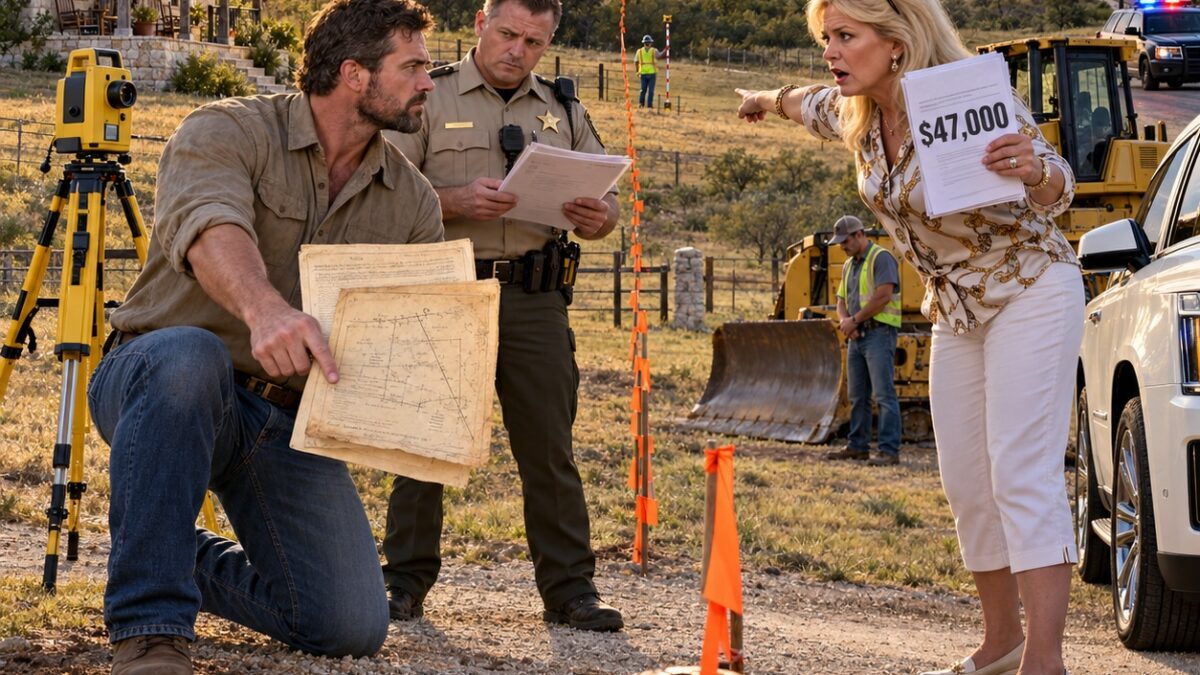
It claimed I owed Stone Ridge Estates $47,000 in accumulated fines, penalties, and enforcement fees.
Then came the threat.
Pay within thirty days or my “non-compliant structure” would become subject to mandatory demolition proceedings.
My home.
Dad’s house.
Pay Brenda Hargrove forty-seven thousand dollars or she would try to bulldoze it.
I read every line twice.
Then I saw what the document actually was.
Not a court order.
An HOA enforcement notice designed to look like one.
Fabricated case number.
Invented judicial language.
She had somehow gotten the sheriff’s office to deliver it as a courtesy, making it appear more official than it was.
But attached to the notice was something real.
A recorded lien.
County stamp.
Document number.
Forty-seven thousand dollars.
Stone Ridge Estates HOA against Garrett Lawson.
My parcel.
That changed things.
A fake HOA threat could be ignored.
A recorded lien could cloud title.
Block refinancing.
Complicate transfers.
Create legal leverage.
I sat on the porch step holding the paper.
Lily had gone back to the piano.
Debussy this time.
Soft notes drifting through the screen door while somebody tried to attach a financial weapon to sixty-three years of Lawson ownership.
I called Earl Stanton.
Seventies.
Retired county clerk.
Family had lived nearby since the forties.
He knew more about old local deeds than almost anyone alive.
“Earl, Stone Ridge filed an HOA lien against my ranch.”
Long silence.
“That’s impossible.”
“I’m holding it.”
“Your parcel isn’t in their covenants.”
“I know.”
“Then intake should have rejected it.”
“They didn’t.”
Another silence.
Then:
“Somebody pushed that thing through.”
“Who?”
“I can’t tell you.”
Pause.
“But Wade Hargrove has had friends inside that courthouse for years.”
I folded the lien.
Locked it in my fireproof safe beside Dad’s deed.
If Brenda wanted a property fight, fine.
But I was done letting her define the battlefield.
Earl called again at 6:15 the next morning.
“Garrett, go pull three records.”
“I’m listening.”
“Your grandfather’s 1962 deed.”
“Okay.”
“Your father’s 1978 deed.”
“Okay.”
“And Wade Hargrove’s 2018 subdivision plat.”
“What am I looking for?”
“You’ll know.”
I dropped Lily at school.
Drove straight to county records.
Four hours later, I had all three documents under a magnifying lamp.
Granddad’s deed came first.
March 14, 1962.
The southern Lawson boundary followed a creek bed from an original concrete monument on a specific bearing.
Dad’s 1978 deed repeated the same description.
Same monument.
Same line.
Then I opened the Stone Ridge plat.
Lone Star Land Services.
June 2018.
I traced Wade’s northern subdivision boundary with my finger.
Stopped.
Went back.
Checked again.
The lines did not match.
Not by a few inches.
Not by normal surveying tolerance.
Wade’s plat moved the boundary roughly 340 feet north.
That shift absorbed about 2.3 acres of Lawson Ranch.
I pulled the Stone Ridge lot map.
Lots 41 through 45 sat inside the stolen strip.
Then I checked lot ownership.
Lot 43.
Premium corner property.
Six-thousand-square-foot custom residence.
Pool.
Detached garage.
Large driveway.
Owner:
Wade and Brenda Hargrove.
I sat back in the records-room chair.
For two years, Brenda had been trying to fine me for a home outside her HOA.
Trying to rezone my land.
Trying to shut down my demolition business.
Trying to have my house declared condemned.
Trying to place a lien on my deed.
And all that time, her own mansion had been built on my grandfather’s property.
Every square foot of it.
I called Earl from the parking lot.
“You knew.”
“I suspected.”
“They moved the line 340 feet.”
“How much land?”
“Two-point-three acres.”
“Anything built on it?”
I looked south even though Stone Ridge was miles away.
“Brenda’s house.”
Earl went silent.
Then:
“Well.”
That one word from a seventy-something former county clerk contained more satisfaction than most speeches.
He gave me the name of an attorney.
Nina Calloway.
Austin.
Real-estate litigation.
Boundary fraud.
I called her before leaving the parking lot.
Her first instruction was immediate.
“Do not rely on your own interpretation, even if the deeds look obvious.”
“I wasn’t planning to.”
“Hire an independent licensed surveyor. No relationship to the Hargroves. Have him retrace the Lawson boundary from the 1962 legal description.”
I hired Jesse Vance.
Forty years surveying around Central Texas.
Jesse spent two full days on the ranch.
GPS equipment.
Old field descriptions.
Creek bearings.
Metal detector.
Brush clearing.
Then he called me to the southern line.
The original concrete monument was still there.
Buried under about eight inches of dirt and brush.
Sixty-three years old.
Never moved.
Jesse knelt beside it.
Checked his equipment.
Then looked up.
“Your grandfather’s deed is right.”
“And Stone Ridge?”
“Wrong by approximately 340 feet.”
“How much?”
“About 2.3 acres.”
“Lots?”
“Five.”
“Brenda?”
“All of it.”
“Pool?”
“Yes.”
“Garage?”
“Yes.”
“Driveway?”
“Yes.”
I stared south through the mesquite.
Twenty-four hours earlier, Brenda’s lien had made me feel as if my family’s home was under attack.
Now a licensed surveyor had confirmed I owned the dirt beneath hers.
I did not celebrate.
Because something about it felt too serious.
I drove to Austin Friday morning and met Nina.
Her office had three monitors, a glass desk, and a framed copy of Texas property law behind her chair.
I laid out everything.
1962 deed.
1978 deed.
2018 plat.
Jesse’s survey.
Lien.
Violation letters.
County complaints.
Photos of Brenda’s signs.
Nina read for forty-five minutes without talking.
Then she removed her glasses.
“Garrett.”
“Yes?”
“You own the ground her house sits on.”
I nodded.
“Every square foot.”
“I know.”
“The 2018 plat moved the boundary.”
“Yes.”
“This is not a close survey dispute.”
“No.”
She picked up the HOA lien.
“And this is void on its face because your parcel is not subject to Stone Ridge covenants.”
“How did it get recorded?”
“That is a different question.”
She placed it aside.
“Here is what we do.”
First:
Quiet-title action.
Confirm ownership of the 2.3 acres.
Second:
Formal complaint regarding the 2018 subdivision survey.
Third:
Challenge and remove the HOA lien.
Fourth:
Criminal referral if evidence supported fraudulent filing.
Then she tapped Jesse’s survey.
“After title is confirmed, we ask the court for removal of unauthorized structures.”
I looked at her.
“Brenda’s house.”
“Yes.”
“You think a judge would order that?”
“I think a judge will follow the evidence.”
She pointed at the concrete monument photograph.
“The law does not move because somebody built an expensive house in the wrong place.”
Then:
“I also want an emergency motion addressing the harassment.”
I nodded.
“When?”
“If the judge gives us expedited consideration, a few weeks.”
That evening, I walked into my equipment yard.
The D9 sat at the far end.
Sixty-eight thousand pounds.
Yellow steel.
Twelve-foot blade.
I climbed into the operator’s seat.
Looked south.
Stone Ridge lights glowed beyond the fence.
Then I climbed back down.
Nothing had happened yet.
A demolition contractor understands something most people do not.
The machine comes last.
Before steel touches a building, paperwork has already done most of the work.
That was how I intended to handle Brenda.
Legal first.
Everything documented.
Earl agreed to testify about deed history.
Jesse prepared his expert declaration.
Three neighboring ranchers signed affidavits describing Brenda’s harassment.
Nina assembled the filing.
A local reporter, Tom Bridger, heard rumors about the survey dispute.
He called me.
“When the court record is ready, I’ll show you everything.”
“Fair enough.”
Then Wade learned I had a lawyer.
The south fence was cut three nights later.
Not one cut.
Three.
Clean bolt-cutter cuts spaced about fifty yards apart.
Hector called at dawn.
“Boss, cattle are moving toward Stone Ridge.”
We spent two hours on horseback gathering them.
If they had reached the subdivision, I could already imagine Brenda’s complaint.
Fortunately, I had installed trail cameras after the Jersey-barrier incident.
At 2:14 a.m., one camera recorded a man approaching from the Stone Ridge side.
Dark clothes.
Bolt cutters.
First cut.
Second.
Third.
At the third location, he turned toward the infrared camera.
Clear face.
I did not know him.
Then he walked toward a white work van.
I zoomed in.
HARGROVE CUSTOM CONTRACTING
Two days later, Brenda filed an animal-control complaint.
Loose aggressive livestock.
Danger to children.
Request for fines and impoundment.
I went to animal control carrying a USB drive.
“Before you process that complaint, please watch this.”
They did.
Complaint dismissed before lunch.
I sent the footage to Nina.
She replied:
Keep everything. Do not contact Brenda.
Wade’s attorney then tried delaying the quiet-title hearing.
Claimed more time was required for survey review.
Judge Patricia Keen denied it.
Two weeks.
That was what they had left before court.
Then somebody hand-delivered an envelope to my mailbox.
No postage.
No return address.
One sheet of paper.
Four words.
DROP IT OR ELSE.
I stood beside the county road holding it while the sun dropped behind the live oaks.
Next morning, I gave everything to Deputy Weeks.
Threat letter.
Envelope.
Fence footage.
Statement.
He looked at me differently now than the first time Brenda called him about her signs.
“Mr. Lawson, we’re going to take this seriously.”
“Thank you.”
“You planning to back off?”
“No.”
He nodded once.
“I didn’t think so.”
Fourteen days later, Nina and I sat in Judge Patricia Keen’s courtroom.
She was early sixties.
Silver hair.
Reading glasses.
Eighteen years on the bench.
Everything about her suggested she disliked unnecessary performance.
Good.
I did too.
Our table held three binders.
Original deeds.
Jesse’s survey.
Photographs.
Lien.
Threat letter.
Fence footage.
County inspector statement.
Neighbor affidavits.
Brenda sat across the aisle with Wade’s attorney, Keith Dunlap.
Navy dress.
Pearls.
No clipboard.
Wade sat behind her.
Nina began with the deeds.
Same southern boundary.
Same concrete monument.
Then Jesse’s independent survey.
Then the 2018 Stone Ridge plat.
She projected the maps together.
Anyone in the room could see it.
The subdivision line sat about 340 feet north of the true Lawson boundary.
“Your Honor,” Nina said, “approximately 2.3 acres of Lawson property were absorbed into the Stone Ridge subdivision without conveyance, consent, or compensation.”
Judge Keen studied the image.
Then looked at Dunlap.
“Do your clients dispute the location of the original monument?”
He stood.
“The respondents contend that the 2018 survey controls and that continuous occupation establishes adverse possession.”
Judge Keen removed her glasses.
“How long has Stone Ridge occupied the disputed property?”
“Approximately six years.”
“And what period are you relying on for adverse possession?”
Dunlap glanced toward Wade.
Then his notes.
He knew the problem.
Six years was not the period they needed under the theory they were advancing.
Judge Keen waited.
“Do you have another argument?”
Dunlap requested a moment to confer.
He and Wade whispered for about ninety seconds.
Then Dunlap stood again.
His entire posture had changed.
“Your Honor, I request permission to withdraw as counsel for the respondents.”
Even Nina looked at him.
Judge Keen stared over the top of her glasses.
“You are asking to withdraw in the middle of this hearing?”
“Yes, Your Honor.”
“Mrs. Hargrove.”
Brenda stood.
“Your attorney is requesting withdrawal. Do you wish to proceed?”
Her hands were shaking.
“This is my home.”
Judge Keen waited.
“You can’t take my home.”
No one answered.
Judge Keen looked down at the evidence.
Then spoke.
“The court finds that the 1962 Lawson deed includes the disputed 2.3 acres.”
Brenda’s face went white.
“The 2018 subdivision plat does not reflect the established boundary.”
She continued.
“The court therefore finds for the plaintiff on the quiet-title claim.”
I felt Hector’s hand touch my shoulder from the row behind me.
Judge Keen was not finished.
“The structures located on the disputed lots were constructed without authorization from the landowner.”
Brenda whispered:
“No.”
“The plaintiff may petition for removal of unauthorized improvements consistent with the court’s order and applicable supervision.”
Nina glanced at me.
Judge Keen looked directly at Brenda.
“You may pursue claims against the developer and other responsible parties.”
Brenda’s voice rose.
“This is insane.”
“Mrs. Hargrove.”
“This is my house!”
“It is a structure built on Mr. Lawson’s land.”
That was the sentence.
Everything Brenda had done for two years came down to that.
The house was hers.
The ground was mine.
And Wade had sold her a home on land his subdivision never owned.
The court issued removal authority under supervision.
Seventy-two hours.
When I returned to the ranch that evening, Deputy Weeks was there again.
He had one more piece of Brenda’s old paperwork.
The $47,000 HOA lien notice was still working its way through the administrative system.
He held it out.
I read it.
Then looked at him.
“Deputy.”
“Yes?”
“You might want to stay around tonight.”
He looked toward my equipment yard.
The D9 sat beneath the lights.
“I figured.”
At nine o’clock, I climbed into the cab.
Before anyone imagines I simply drove a bulldozer into a neighborhood because I was angry, understand what had happened first.
Court order.
Title judgment.
Survey.
Sheriff notified.
Utilities coordinated.
Safety personnel.
Legal counsel.
Removal authority.
We did demolition for a living.
We did it correctly.
Hector followed in a pickup.
Two dump trucks behind him.
At the Stone Ridge entrance, two sheriff’s cruisers waited.
Not to stop me.
For scene control.
Tom Bridger stood on the shoulder with a photographer.
Neighbors emerged as the D9 passed.
Porch lights.
Phones.
Bathrobes.
Children held back by parents.
The sound of steel tracks on residential asphalt carried farther than the engine itself.
Slow.
Heavy.
Unmistakable.
I stopped about forty feet from Brenda’s house.
The place was enormous.
Six thousand square feet.
Beige stucco.
Decorative columns.
Three-car garage.
Pool behind it.
Every inch on Lawson land.
Brenda came through the front door wearing a white robe.
She had no sunglasses.
No clipboard.
No polished HOA voice.
“You can’t do this!”
I climbed down.
Held up the order.
“By order of Judge Patricia Keen—”
“I don’t care what that says.”
I continued reading.
She called 911.
“There’s a man with a bulldozer outside my house!”
The dispatcher apparently told her what everyone on scene already knew.
Deputies were present.
The order was valid.
I looked at Weeks.
He gave me a small nod.
That was enough.
I climbed back into the D9.
Engaged the hydraulics.
The blade lowered.
I had demolished hundreds of buildings.
Condemned apartments.
Industrial shells.
Burned warehouses.
Structures too dangerous to leave standing.
They were jobs.
This one felt different, so I treated it even more mechanically.
No anger in the controls.
No speed.
No theatrics.
Procedure.
The blade contacted the front wall.
Stucco cracked.
Wood framing folded behind it.
Glass broke.
Dust moved through the headlights.
The decorative columns went next.
Then portions of the roof.
Three controlled passes.
By 10:20, the structure Brenda had spent six years believing was permanently hers sat below the fence line.
Debris.
Wood.
Tile.
Drywall.
Concrete.
Brenda stood on the lawn.
Silent.
I did not look at her for long.
There was no satisfaction in that part.
Her house had been real to her.
Whatever Wade had done, she had lived there.
Built a life there.
But she had also known enough to spend two years trying to force me away from the land connected to the problem.
What happened next explained why.
Deputy Weeks approached Wade.
“Mr. Hargrove, we need to talk about the 2018 survey.”
Wade asked whether he was under arrest.
Weeks told him he could come voluntarily or they could formalize the process.
He went voluntarily.
I shut the D9 down.
The engine ticked in the night.
Then I drove home.
Lily was asleep.
I walked through our mesquite front door.
Touched the limestone wall my father had built.
Cool.
Solid.
Still standing.
Brenda had threatened to bulldoze it.
Instead, the house her husband built on stolen land was gone.
Three weeks later, a county grand jury indicted Wade.
Survey fraud.
Filing a fraudulent instrument.
Wire-fraud allegations tied to the sale of property he did not own.
The original concrete monument became one of the strongest pieces of evidence.
Sixty-three years underground.
Untouched.
You can argue with lawyers.
You can manipulate paperwork.
A monument sitting exactly where a 1962 deed says it should be is harder to explain away.
Investigators then reviewed the rest of Wade’s subdivision.
Four more families discovered title problems.
Not every error involved my ranch.
Some involved another neighboring parcel.
But the pattern pointed back to the same 2018 survey.
More buildable acreage.
More lots.
More profit.
At somebody else’s expense.
The homeowners sued Hargrove Custom Contracting and Lone Star Land Services.
Wade’s insurer began talking settlement before depositions even started.
Then Stone Ridge homeowners removed Brenda as HOA president.
Emergency meeting.
Vote:
94–3.
According to what I was later told, those three votes included Brenda, her sister, and another resident who claimed she pressed the wrong button on her phone.
I never checked whether that story was true.
It was funny enough without verification.
Brenda’s legal problems continued separately.
The false lien.
Harassment.
Fence cutting.
The trail-camera footage showing a Hargrove employee deliberately cutting my fence became particularly damaging.
Then prosecutors found emails.
Messages between Brenda and Wade discussing the property-line adjustment months before construction began.
That changed her role in the survey investigation.
The woman who had spent two years insisting I was the dangerous neighbor now had investigators examining whether she had known from the beginning that her own house sat beyond Stone Ridge’s legitimate boundary.
My civil case settled six months after the demolition.
Total:
$620,000.
Insurance money and what remained of Wade’s developer corporation.
Property damage.
Legal expenses.
Harassment damages.
Punitive components tied to the fraudulent lien.
People assumed I would buy something.
New truck.
Bigger house.
More equipment.
I did not need any of those things.
I used $100,000 to pay off what remained of the ranch mortgage.
Put $50,000 into Lily’s college account.
Then I took the remaining $470,000 and created the Lawson Property Rights Fund.
Nina helped structure it.
Earl became honorary chairman.
Jesse provided pro bono survey consultations.
The purpose was simple.
Help homeowners and landowners who could not afford to fight fraudulent liens, HOA overreach, boundary manipulation, or recorded instruments that should never have existed.
In the first year, the fund handled nineteen cases.
Fourteen lien removals.
Three boundary corrections.
Two criminal referrals.
Lily designed the logo.
A fence.
An open gate.
Under it, she wrote:
COME THROUGH
I framed her original drawing.
Hung it beside Dad’s deed in my office.
That meant more to me than the settlement check.
Stone Ridge Estates did not disappear.
One hundred eight of the original homes remained standing.
Lot 43 became an open clearing.
Grass returned.
I mowed it twice a month.
Not because I wanted to stare at an empty monument to Brenda.
Because it was ranch land again.
Sometimes Lily rode her bicycle down there Saturday mornings.
At first, I worried about how the Stone Ridge neighbors would react.
They waved.
She waved back.
Most of those families had never known their developer moved a boundary.
They had bought homes.
Raised children.
Paid mortgages.
They were not responsible for Wade’s survey.
I had no interest in treating all of Stone Ridge like Brenda treated me.
That distinction mattered.
Earl visited one evening about a month after the settlement.
We sat on the porch.
Iced tea.
Orange sunset.
Long live-oak shadows across the pasture.
From inside, Lily played piano.
Something new.
Her own melody.
Earl listened.
Then set his glass down.
“Your daddy would be proud.”
I looked at the limestone wall.
The cedar roof.
The mesquite door.
I thought about my father laying those stones in 1978.
Sarah sitting on that porch during her last summer.
Lily learning to walk on those floors.
Brenda had called it non-conforming.
Then hazardous.
Then condemned.
Then attached $47,000 in invented HOA debt to it.
She believed expensive paper could turn lies into authority.
It couldn’t.
The house remained.
So did we.
For months afterward, people asked what I thought the turning point had been.
The court hearing?
Finding the 1962 monument?
The demolition?
The lien?
I always gave the same answer.
The original deed.
Everything began there.
The lien looked official.
So I checked the deed.
The HOA letters looked official.
Checked the deed.
The subdivision plat looked official.
Compared it to the deed.
Wade’s survey had professional lines, signatures, lot numbers, bearings.
Still wrong.
The document that mattered most was older.
Plain.
Typed before I was born.
My grandfather’s property description.
The survey monument on the ground agreed with it.
That was enough.
I also thought often about my first reaction to Brenda’s letters.
Ignore them.
For the first one, that was reasonable.
She had no authority.
But ignoring something legally meaningless does not always stop a person who believes she can manufacture authority by repetition.
If I could change one part of what happened, I would have documented sooner.
Every call.
Every sign.
Every letter.
Every conversation.
I eventually did.
Fortunately.
The trail cameras caught the fence cutting.
The county records preserved the lien.
Jesse found the monument.
Those things turned an ugly neighbor dispute into evidence.
Evidence matters because anger is easy to dismiss.
Documents are harder.
Brenda called me dangerous.
The county inspector documented the house as sound.
She said my demolition yard violated residential zoning.
County records showed agricultural use.
She claimed my cattle endangered residents.
Video showed a contractor tied to Wade cutting my fence.
She claimed her HOA had rights over my property.
The deed said otherwise.
She called her own home legally built.
The monument said otherwise.
At every stage, the answer was not yelling.
It was:
Show me the record.
Nina said something after the settlement that stayed with me.
“You didn’t win because Brenda was obnoxious.”
“I know.”
“You won because your title chain was clean.”
“Yes.”
“People confuse those things.”
She was right.
Brenda’s personality made the story dramatic.
Her legal mistake made it winnable.
If Wade had legitimately purchased those 2.3 acres in 2018, I could have hated his wife forever and none of that would have made her mansion mine.
But he had not.
No deed.
No sale.
No consent.
No compensation.
A fraudulent line on a subdivision map cannot magically take land.
That is why I tell people facing property disputes to separate emotion from ownership.
Start with boring things.
Legal description.
Survey.
Deed.
Recorded easements.
Tax history.
Monuments.
The boring things determine whether the dramatic ones matter.
I owned bulldozers.
That was not the source of my power.
Any demolition contractor could operate a D9.
The court order mattered.
Without that, the machine would have stayed parked.
I was never going to drive heavy equipment into Stone Ridge because Brenda made my daughter cry.
Or because she called my house ugly.
Or because she sent county inspectors.
If I had done that, I would have been exactly the dangerous man she told everyone I was.
Instead, I waited.
That was harder.
Especially after Lily came home from school.
Especially after the fence was cut.
Especially after the “Drop it or else” note.
But every time I wanted to move too early, I looked at Dad’s house.
The walls were built one stone at a time.
You do not build something meant to last by skipping the foundation.
Same with a case.
Dad would have understood that.
He hated shortcuts.
When he forged the hinges for the front door, he rejected the first pair because one sat slightly out of square.
Mom told him nobody would notice.
He said:
“I’ll notice.”
That was the Lawson standard.
Not HOA standard.
Our own.
Do it correctly because you have to live with what remains.
That was why I cared about how Brenda’s house came down too.
People imagine I must have driven the D9 with revenge in my chest.
No.
I had twelve men who worked for me.
A daughter watching everything I did.
A court order.
Deputies present.
A professional reputation.
There was no room for revenge in the controls.
Only sequence.
Safety.
Procedure.
The building was unauthorized.
Court ordered removal.
I removed it.
What happened afterward belonged to Wade and Brenda’s choices.
Wade had to answer for his survey.
Brenda had to answer for her lien, harassment, and role in the boundary scheme.
Stone Ridge residents had to repair trust after discovering the people running their development had hidden serious title problems.
None of that was my job to manage.
My job was the ranch.
Lily.
Lawson Demolition.
The fund.
Life became ordinary surprisingly quickly.
The county inspector stopped coming.
No more cease-and-desist letters.
No more concrete barriers.
No more signs calling my home condemned.
Stone Ridge elected a new HOA board.
They stayed on their side of the property line.
That was all I ever wanted.
One of the new board members came to my house a few months later.
His name was Aaron Bell.
Lot 27.
Middle-aged.
Software engineer.
He stood awkwardly on the porch holding nothing.
No clipboard.
Good start.
“Mr. Lawson.”
“Garrett.”
“Garrett, I wanted to apologize.”
“You didn’t do anything.”
“I believed Brenda.”
“A lot of people did.”
“She told us you were trying to destroy property values.”
“I know.”
“She said your company was operating illegally.”
“I know.”
“I repeated it.”
I waited.
“My daughter goes to school with Lily.”
That explained why he was there.
“I’m sorry.”
I nodded.
“Thank you.”
He looked toward the limestone wall.
“This place is beautiful.”
I smiled.
“County inspector thought so too.”
He laughed.
That was enough.
I did not need Stone Ridge residents begging forgiveness.
Most had been lied to.
Better to let the neighborhood repair itself.
The Property Rights Fund gave me another way to use what happened.
First case involved a retired couple facing an HOA lien for dues on acreage that had been excluded from a subdivision decades earlier.
Sound familiar.
Nina took one look at the deed.
Lien removed.
Second case was a family whose fence had been moved during development.
Jesse found the old iron markers.
Boundary corrected.
By the third case, I stopped thinking of the fund as something created out of anger.
It became work.
Useful work.
That mattered.
Sarah used to tell me I was happiest when I had something physical to fix.
Broken fence.
Old truck.
Leaking roof.
Grief frustrated me because there was nothing to fix.
No machine for it.
No permit.
No sequence.
Cancer took her and left me with a daughter, an empty side of the bed, and too much silence.
Lawson Property Rights Fund gave some of that energy somewhere to go.
Help somebody keep their land.
Stop a false lien.
Pay for a survey.
Find the record.
Good enough.
Lily started asking more questions as she got older.
“Did Mrs. Hargrove really want to tear our house down?”
“Yes.”
“Would she have?”
“I don’t know.”
“She couldn’t, right?”
“She should not have been able to.”
“That’s different.”
“Yes.”
She thought about that.
Then:
“Were you happy when you tore hers down?”
I did not answer immediately.
“No.”
She looked surprised.
“Why not?”
“Because tearing down somebody’s home isn’t happy.”
“But she was mean.”
“Yes.”
“And it was ours.”
“The land was ours.”
“Then why weren’t you happy?”
I looked toward the empty southern clearing.
“Because being right and enjoying somebody else’s loss are different things.”
She nodded slowly.
I do not know if she understood at eleven.
Maybe I barely understood myself.
The demolition was necessary under the court order the source of our dispute produced.
That did not require celebration.
The part that made me happy was coming home afterward and seeing our house still standing.
That was enough.
The Lawson house looks almost exactly the same now as it did before Stone Ridge.
Same limestone.
Same cedar smell when summer rain hits.
Same porch.
Same cast-iron stove.
I repaired one section of roof last year.
Lily helped hand up shingles.
She is not good at it.
She knows it.
Piano remains her thing.
Sometimes she plays while I sit outside.
The sound comes through the screen.
That always takes me back to the morning Deputy Weeks handed me the $47,000 notice.
I remember how frightened I was.
I did not tell anyone that part for a long time.
People assumed the demolition-company owner with three bulldozers never got scared.
Of course I did.
A recorded lien against your family home is frightening.
Especially when you are raising a child alone.
Especially when government offices have already shown that somebody connected to your opponent can make paperwork move.
I thought about Dad.
Sarah.
Lily.
What if I missed something?
What if the lien created costs I could not stop?
What if Brenda succeeded in dragging us through years of litigation?
Fear does not mean weakness.
It means you understand consequences.
The trick is not letting fear choose the next move.
Earl helped with that.
Nina helped more.
Competent people reduce panic because they translate chaos into steps.
Pull deeds.
Get survey.
Challenge lien.
File quiet title.
Preserve evidence.
One thing at a time.
That is another reason the Property Rights Fund includes free initial consultations.
Sometimes what people need first is not a courtroom.
They need someone to say:
Here is what this document actually means.
Here is what it does not mean.
Here is the next step.
Brenda’s greatest weapon had been uncertainty.
She kept sending documents designed to make me wonder whether she had found some legal mechanism I had overlooked.
Heavy letterhead.
Law firm.
County hearing.
Sheriff delivery.
Recorded lien.
Each escalation looked more official.
The natural human reaction is:
Maybe she knows something I don’t.
Once we discovered the fraudulent boundary, I realized something.
The Hargroves had been relying on that reaction from the beginning.
Wade’s subdivision plat looked official too.
Survey firm.
Recorded map.
Lots.
Roads.
Numbers.
Buyers trusted it.
Banks trusted it.
Builders trusted it.
Then Jesse dug eight inches into Texas dirt and found an old concrete monument.
One piece of concrete older than the subdivision by more than half a century.
And that monument exposed the whole thing.
You can create a lot of fiction on paper.
The ground is less cooperative.
That is why I kept Jesse on the fund’s board of advisors.
He understood that better than anyone.
He visited the ranch a year after the case.
We drove to the monument.
I had cleared brush around it.
Not too much.
Just enough that future surveyors could locate it easily.
Jesse crouched.
Touched the top.
“You going to mark this with something bigger?”
“No.”
“Why?”
“It did fine for sixty-three years.”
He smiled.
“Fair.”
I had certified copies of his survey inside the safe.
Digital backups.
GPS coordinates.
Photos.
Nobody would need Earl’s memory next time.
That was one change I made.
Our family had been lucky Dad and Granddad preserved their paperwork.
I was not leaving the next generation with only luck.
Lily’s college account grew quietly.
Fifty thousand from the settlement went in.
I told her once.
She shrugged.
At eleven, fifty thousand dollars is just a large number.
Then she asked if she could buy a horse.
“No.”
“What if college is cheap?”
“No.”
“What if I get a scholarship?”
“We’ll discuss it.”
She smiled.
Sarah would have sided with her.
Probably while pretending not to.
Those ordinary conversations mattered after two years of fighting.
For a long time Brenda occupied too much space in our house even when she was not physically there.
Her letters on the table.
Calls.
Appointments.
Court filings.
Survey maps.
Nina on speakerphone.
Lily hearing adults whisper.
After settlement, I put every Hargrove document into two banker’s boxes.
Labeled them.
Moved them to the fireproof records room at my office.
Not the house.
That was intentional.
Home needed to become home again.
No more Brenda at the kitchen table.
No more lien beside the toaster.
That helped.
The empty Lot 43 also changed over time.
At first, neighbors drove slowly past.
Curious.
Then grass came.
Texas grass is good at erasing drama.
Rain fell.
Wildflowers showed up.
By spring, if you did not know a mansion had stood there, you might assume it had always been open.
I considered fencing it.
Did not.
The legal boundary was already resurveyed.
Markers set.
Everyone knew.
Lily sometimes took her bike there.
A Stone Ridge boy about her age eventually started riding with her.
His parents had sued Wade.
That was how strange things became.
Two families placed on opposite sides of Brenda’s conflict ended up connected by children riding bicycles across grass.
Probably healthier than anything the adults had done.
Wade’s criminal case went on longer than I expected.
Law moves slower after headlines fade.
His attorneys challenged intent.
Survey responsibility.
Reliance on professionals.
Emails complicated those arguments.
So did the original monument.
So did testimony about planning.
I gave statements where necessary.
Then stopped following every filing.
I did not want Wade’s case to become my hobby.
Same with Brenda.
Their consequences belonged to the legal system.
My part was finished once the land and lien were corrected.
That decision mattered.
It is easy to become addicted to watching someone who hurt you suffer.
Every new charge feels validating.
Every bad headline feels like proof.
Then one day you realize you are still organizing your life around them.
No.
I had already let Brenda influence too many evenings.
She was not getting the years afterward.
So I stopped checking.
If Nina needed me, she called.
Otherwise I worked.
One Friday, Hector and I took the D9 out to a condemned feed warehouse west of Seguin.
Normal job.
Permits posted.
Utilities cleared.
Building empty.
The blade went through an old concrete-block wall.
Dust rose.
Hector looked at me over the radio.
“This one feel easier?”
“What?”
“No Brenda screaming.”
I laughed.
“Much.”
That was the first joke we made about it.
After that, the D9 went back to being equipment.
Not the machine from the Stone Ridge story.
I wanted that too.
Tools should not be trapped inside memories.
Dad’s house returned to being Dad’s house.
The bulldozer returned to being a bulldozer.
The ranch returned to cattle and dust and Lily’s piano.
That was healing.
One evening, Earl sat beside me on the porch while the sun dropped orange over the fence.
He asked:
“What did you learn?”
I thought he meant legally.
“Never trust a subdivision plat without checking the deed?”
He laughed.
“No.”
“What?”
“About people.”
That took longer.
Finally:
“Some people mistake nobody stopping them for permission.”
Earl nodded.
“That’s close.”
“What would you say?”
He took a drink.
“People will stand wherever you let them stand.”
I looked toward the Stone Ridge lights.
“You mean boundaries.”
“I mean boundaries.”
That was the entire story in one word.
Brenda never respected one.
HOA boundary.
Property boundary.
Zoning authority.
Family.
School gossip.
County offices.
Fence lines.
She crossed everything she believed she could cross without consequence.
Wade literally moved one on paper.
Three hundred forty feet.
It should not surprise me that they were married.
The Lawson Property Rights Fund began using a phrase Nina liked.
Verify before you comply.
Not resist everything.
Not fight every rule.
Verify.
Does the HOA actually cover your parcel?
Does the lien have authority?
Where is the recorded covenant?
Where is the survey monument?
What did you sign?
What did the previous owner sign?
What does the deed reserve?
Boring questions.
Expensive answers.
I think that is why Brenda’s $47,000 demand frightened me at first.
It was designed to make the number the focus.
Forty-seven thousand.
Huge.
Urgent.
Pay or demolition.
But the right question was never:
How do I pay?
It was:
What gives you the right to demand one dollar?
Answer:
Nothing.
Once that became clear, the size of the fake debt stopped mattering.
Same with her zoning complaint.
The question was not whether my equipment looked ugly beside Stone Ridge.
It was whether residential restrictions applied to agricultural Lawson land.
No.
Done.
A lot of abusive authority survives by making people debate the wrong question.
Is your truck attractive?
Are the cattle scary?
Does the old limestone house fit Stone Ridge’s aesthetic?
None of those questions mattered.
Does Stone Ridge control Lawson Ranch?
No.
Everything else was decoration.
The most expensive decoration was Brenda’s mansion.
I sometimes wonder whether she ever stood inside that 6,000-square-foot house knowing the survey problem existed.
The emails prosecutors found suggested she knew something about the boundary adjustment.
I do not know exactly what she believed.
Maybe Wade told her it was handled.
Maybe she thought recording the subdivision plat made the change permanent.
Maybe she believed enough years of occupation would eventually protect them.
Maybe that was why she was so desperate to push me away before the ten-year period she later tried invoking.
I can infer.
I cannot know.
And I do not need to.
The source of my ownership was not her state of mind.
It was my deed.
That distinction saved me from obsessing over motive.
Motive matters in criminal cases.
Property title can be simpler.
Mine.
Not yours.
Recorded.
Surveyed.
Monumented.
That was enough.
My father’s deed now hangs in a climate-controlled frame in the Lawson Demolition office.
The original stays protected.
Beside the framed copy is Lily’s open-gate drawing.
Two generations of protection.
One legal.
One hopeful.
Visitors sometimes ask about the logo.
I tell them:
“My daughter designed it.”
“What does ‘Come Through’ mean?”
“Means people don’t need to fight alone.”
That is the only explanation I give unless they ask for more.
The fund became larger than my dispute.
That was the point.
A settlement spent on something flashy would eventually disappear.
A legal fund can outlive me.
Maybe a rancher thirty years from now gets a fraudulent lien removed because Brenda Hargrove once tried putting one on mine.
There are worse ways for a bad experience to echo.
Dad used to say land is the one thing people fight over because nobody can make more of it.
He was mostly right.
You can make islands.
Reclaim coast.
But not another acre of our ranch exactly where it sits.
That is why boundary work matters.
Three hundred forty feet on a survey can become houses.
Pools.
Mortgages.
Lawsuits.
Families.
Once concrete is poured, everyone wants the line to become whatever causes the least trouble.
But title is not supposed to depend on how expensive the mistake became.
The court recognized that.
The settlement process then dealt with human consequences.
That balance made sense to me.
Truth first.
Remedy second.
If you reverse the order, pressure determines truth.
Brenda had tried exactly that.
Build enough.
Fine enough.
Threaten enough.
Maybe Garrett gives up.
Maybe the false line becomes reality through exhaustion.
No.
The original monument did not care how tired I was.
It remained.
I like that about physical evidence.
Patient.
Unemotional.
A little like Dad.
He never shouted either.
If Brenda had confronted him when he was alive, I imagine he would have invited her onto the porch.
Listened.
Let her talk.
Then pulled the deed from his file cabinet.
He would have said:
“Ma’am, you’re mistaken.”
She would have hated him.
Sarah would have loved watching.
I wish they both had been there for the end.
That is another thing about inheritance.
The people who built what you are protecting often do not get to see you protect it.
Dad never knew Stone Ridge.
Sarah saw only the early construction before cancer took over our lives.
I carried both of them into the fight anyway.
Not symbolically.
Practically.
Dad built the house.
Sarah made it home.
Those are different things.
Brenda threatened both.
Maybe that was why I was so controlled.
I was not only protecting property value.
I was protecting continuity.
That sounds sentimental for a demolition contractor.
We know better than most people that buildings are temporary.
I can turn a warehouse into rubble in hours.
Structures are not sacred because they exist.
Some are dangerous.
Some obsolete.
Some simply in the wrong place.
What makes a home different is not the material.
It is what happened inside.
Dad’s limestone walls held decades.
Mom cooking.
Sarah laughing.
Lily learning piano.
You cannot appraise that properly.
Brenda tried to reduce the house to “non-conforming architectural style.”
That told me everything about how differently we saw land.
She saw control.
I saw history.
Neither view changes title.
But one explains why I never considered leaving.
Years after the case, summer rain still hits the cedar roof.
The smell comes through the screen.
Warm wood.
Earth.
The same smell I remember as a child.
Lily is older now.
Her piano is better.
My hearing is worse.
Cattle still ignore property disputes.
The fund still operates.
Jesse still complains that younger surveyors trust GPS too much and old monuments too little.
Nina still answers the phone too quickly.
Earl visits less because age is catching him.
Stone Ridge remains south of us.
Without Brenda.
Without Lot 43.
The new HOA president once mailed me a courtesy notice about a community event.
Not a violation.
The envelope clearly said:
FOR INFORMATION ONLY — LAWSON RANCH IS NOT SUBJECT TO STONE RIDGE HOA GOVERNANCE.
I laughed when I read it.
Maybe excessively cautious.
Fine by me.
Clarity is cheaper than litigation.
I kept that letter too.
Not in the evidence box.
Different file.
GOOD NEIGHBORS.
One afternoon, Lily asked why.
“Because sometimes it’s worth saving proof that people learned.”
She smiled.
“Dad, that sounds like something Earl would say.”
Probably.
The last time Earl came over, we sat watching sunset.
Lily played something bright through the open window.
He listened.
Then repeated what he had said after settlement.
“Your daddy would be proud.”
This time I answered.
“I hope so.”
“He would.”
I looked at the house.
Local limestone.
Cedar roof.
Mesquite door.
Same porch Sarah had loved.
Still there.
Not because I owned three bulldozers.
Not because I was stronger than Brenda.
Not because a judge liked me more.
Because when somebody tried to turn a fake line into reality, the old records were still there.
The deed.
The monument.
The survey.
My grandfather had bought the land in 1962.
My father built the house in 1978.
Neither man ever imagined a subdivision called Stone Ridge Estates.
They did not need to.
They had done the important part correctly.
The boundary was written.
The monument was set.
The deed recorded.
Sixty-three years later, that was enough.
Brenda spent two years manufacturing violations against a home she had no authority over.
She planted signs.
Called inspectors.
Blocked roads.
Used friends in government.
Spread fear.
Filed a $47,000 lien.
Threatened demolition.
All of it designed to make me believe official-looking pressure was stronger than ownership.
Then I finally stopped reading her letters and started reading my family’s deeds.
That was the moment everything changed.
Not when the D9 started.
Not when Judge Keen ruled.
Not when Wade was indicted.
The real turning point happened quietly under fluorescent lights in a county records room.
Three documents spread across a table.
One line where it had always been.
Another line moved 340 feet north.
And a 6,000-square-foot mansion sitting squarely between them.
Brenda wanted to bulldoze my father’s house.
She never imagined the first house the court would order removed would be hers.
But even that was not the lesson I carried forward.
The lesson was simpler.
Never let somebody else’s confidence tell you what you own.
Find the deed.
Find the survey.
Find the monument.
Then let the land speak for itself.








