PART2:HOA Queen Had My $94,000 John Deere Towed Off My Own Land—Three Days Later, the U.S. Army Came Looking for It
PART2
Ridgeline’s board had five members.
Darla controlled three votes.
Hers.
Then two people who agreed with her so consistently that Clifford once described them as “Darla wearing different shirts.”
The other two were Fern Bollstock and Prentice Chadwell.
Fern was a retired teacher.
Twenty-nine years in middle school.
Small woman.
Silver hair.
Voice so calm that people often did not realize she was destroying their argument until three minutes after she finished.
Prentice worked in IT.
Late thirties.
Quiet.
Organized.
Remembered everything.
The emergency vote was three to two.
Darla’s side upheld the fine.
Fern and Prentice formally objected.
They made sure their objections went into the minutes.
Then both texted me that night.
Fern:
You are correct about Section 3D. Keep your documents.
Prentice:
I saved tonight’s minutes and the board packet. Let me know if you need them.
I saved both texts.
At that point, I still thought the dispute was stupid.
Annoying.
But stupid.
Three hundred dollars.
One tractor.
One HOA president with too much confidence.
Then Darla called her cousin.
Bobby Halstead owned Halstead Towing.
I had seen his trucks around Knoxville.
Big yellow lettering.
Heavy recovery equipment.
Bobby himself communicated mostly by shrugging, according to everyone who knew him.
Darla put his company “on standby” to remove my tractor.
No recorded board vote.
No hearing.
No appeal completed.
Nothing.
At the same time, she filed a nuisance complaint with the county.
Her claim:
My John Deere was an abandoned vehicle creating neighborhood blight.
That was false.
I had run it the previous weekend.
The county compliance officer was new and overwhelmed.
He did not visit the property.
He issued a ten-day removal notice based on Darla’s complaint.
A piece of paper ended up taped to my door.
I came home after a long day, read it, and felt something different from irritation.
Darla had taken her HOA argument and pointed county government at me.
That matters.
When somebody misuses a private rule, you fight the private rule.
When somebody starts manufacturing government complaints, you start documenting a pattern.
I called Aldean Pierce at the Army Corps field office in Knoxville.
Aldean had coordinated the creek project with me.
Methodical.
Never said three words when one would work.
I told her about the notice.
She pulled up my equipment agreement.
There was a pause.
Then:
“Garrett.”
“Yeah?”
“During active project support periods, interference with designated equipment can create a federal-property issue.”
“How serious?”
“Potentially serious enough that I would prefer nobody find out experimentally.”
I smiled slightly.
Then she cited the relevant provisions and told me to send the county a limited copy of the agreement.
“Don’t give them everything,” she said.
“Why?”
“Because all they need to know right now is that federal interests exist.”
That was good advice.
I mailed the compliance office a short response.
Certified.
The tractor was subject to an active federal equipment-use arrangement.
Any enforcement should be paused pending review.
First page of the Corps agreement attached.
Within two days, the county compliance officer forwarded the issue to the county attorney.
Then stopped returning Darla’s calls.
If Darla had backed down then, the story probably would have ended as one of those neighborhood arguments people tell over beer.
She did not.
Two weeks later, she called what she described as a neighborhood safety meeting.
Ridgeline clubhouse.
Low ceiling.
Fluorescent lights.
Carpet that somehow smelled like cleaning solution and dry-erase marker at the same time.
About thirty homeowners came.
Darla had prepared a laminated poster.
An actual poster.
Color photographs of my property taken from the county right-of-way.
My workshop.
Welding stock.
John Deere.
Some steel I had stacked at the rear of the lot.
Across the top:
ONGOING COMMERCIAL OPERATIONS IN A RESIDENTIAL COMMUNITY
I stared at it.
I had not run my welding company from that property for more than three years.
My business registrations listed Knoxville.
My workshop was personal.
Like half the garages in Ridgeline.
But Darla stood beside the poster talking about traffic, safety, declining property values, and “industrial encroachment.”
Fern raised her hand.
Darla tried ignoring her.
Fern kept it raised.
Eventually:
“Yes, Fern?”
“You stated Mr. Wallover is operating a commercial business from his residence.”
“That is the concern.”
“Have you filed a zoning complaint with the county?”
“We are in the process.”
Fern opened a spiral notebook.
Wrote something down.
Then:
“So the answer is no.”
Darla’s jaw moved.
Prentice raised his hand next.
“Did this board vote to authorize a towing arrangement with Halstead Towing?”
Darla’s answer came faster.
“That is an operational matter within the president’s authority.”
“Where?”
“What?”
“What section gives the president unilateral authority to contract towing against private lots?”
Darla looked toward her two allies.
Then back at Prentice.
“This meeting is not a legal deposition.”
“No.”
Prentice nodded.
“It was just a question.”
Three homeowners in the back exchanged looks.
That meeting did not formally change anything.
But Darla made a mistake.
She took a private dispute and showed it to everybody.
In the parking lot afterward, people approached me.
A man named Rick Hardesty said:
“She did something like this with our RV.”
A younger woman:
“She fined us for the basketball hoop. Said it created visual clutter.”
Another homeowner:
“She came onto my driveway once to photograph a trailer.”
Different details.
Same behavior.
Pattern.
Patterns matter.
That week, I made a formal books-and-records request.
Board minutes.
Correspondence with towing companies.
Five years of compliance notices.
Fine records.
Financial statements.
Discretionary spending.
Everything I had the right to inspect as a dues-paying homeowner.
Darla waited until the deadline had practically expired.
Then emailed a forty-page PDF.
It looked like someone had assembled it during a fire drill.
Missing months.
Incomplete meeting minutes.
No authorization for Halstead Towing.
No contract approval.
No vote.
Then I reached the 2023 budget.
One line:
ADMINISTRATIVE DISCRETIONARY — $14,200
No explanation.
No invoice breakdown.
No authorization.
Fourteen thousand dollars in an HOA collecting only around eighty thousand annually.
I called Fern.
“Do you remember approving administrative discretionary spending for fourteen-two?”
“No.”
“You were on the board?”
“Yes.”
“Ever see the line?”
“No.”
“You sure?”
Her teacher voice arrived.
“Garrett, I taught seventh-grade mathematics for twenty-nine years. I know what fourteen thousand dollars looks like.”
Fair enough.
I copied the PDF onto two thumb drives.
Emailed it to myself.
Printed the full thing.
Placed the paper copy inside my fireproof safe.
Then I called Thaddeus Crane.
Real-estate lawyer in Knoxville.
HOA experience.
Office full of old law books and furniture designed before backs were invented.
Thaddeus read for forty minutes.
Then tapped Section 3D.
“Grandfather defense is solid.”
Next:
The safety-meeting poster.
“Potential defamation.”
Next:
The budget.
“This needs an audit.”
He looked at me.
“You want me involved?”
“Yes.”
He leaned back.
“This is getting interesting.”
Lawyers say that when they mean somebody has created a lot of billable mistakes.
We agreed on contingency plus costs.
While I was sitting in Thaddeus’s office, Darla made the decision that changed everything.
At 9:17 that morning, Halstead Towing entered my property.
I was in Knoxville buying supplies.
Clifford saw them.
His chicken coop had a security camera aimed toward the road because Darla had once complained about his compost bins and Clifford responded the way Clifford responded to most things:
By installing surveillance.
He called me.
“Tow truck’s at your place.”
“What?”
“Bobby Halstead.”
“What is he doing?”
“Backing to the Deere.”
I was already standing.
“Record it.”
“I am.”
Bobby’s crew had the tractor hooked and off my property in twenty-three minutes.
They left a notice on the workshop door.
Violation Section 7B.
Impound location:
Halstead Towing.
Fees would begin immediately.
A towing company hired by Darla’s HOA was now charging me storage for machinery it had taken from my property on Darla’s order.
I got home around 11:45.
The gravel apron beside my workshop was empty.
That sight hit harder than I expected.
It was not only the tractor’s value.
Ninety-four thousand dollars.
Twenty-two years of saving.
It was the message.
I can reach onto your land.
Take your property.
Then make you pay me to get it back.
I stood there for roughly half an hour.
Did nothing.
Then I called Aldean.
“When?”
“About two hours ago.”
Pause.
“They actually removed it?”
“Yes.”
“Our project authorization is active.”
“I know.”
“Garrett.”
Her voice flattened even more.
“Do not retrieve it yourself.”
“I wasn’t planning to.”
“Do not pay the impound.”
“Okay.”
“Do not sign anything.”
“Understood.”
“I need to make calls.”
Then Thaddeus.
He answered:
“What happened?”
“They towed the Deere.”
Three seconds.
Then:
“Perfect.”
I almost laughed.
“Perfect?”
“For the case.”
“That tractor cost me ninety-four thousand dollars.”
“I understand.”
“You sound happy.”
“I sound like a lawyer whose opposing party just turned a weak dispute into conversion of property.”
Then he said:
“Say nothing publicly.”
That was harder than people think.
Darla had taken my tractor.
Every instinct told me to knock on her door.
Demand it back.
Tell everyone what she had done.
Instead, I told four people.
Aldean.
Thaddeus.
Fern.
Clifford.
I went to Clifford’s house that afternoon.
His kitchen smelled like firewood, coffee, and old paper.
He handed me a USB drive.
“Full video.”
“Thank you.”
He shrugged.
“I always figured she’d go too far.”
“You could’ve warned me sooner.”
“I thought the lanyard was warning enough.”
Fair.
Twenty-four hours after the tow, Thaddeus filed three things.
Civil complaint.
Wrongful conversion.
Tortious interference.
Defamation.
Named personally:
Darla Hutchins.
Ridgeline Estates HOA.
Halstead Towing.
Second:
Formal financial audit demand.
Third:
Notice to the HOA liability carrier.
That third document mattered more quickly than I expected.
Once the insurance company learned the HOA had been sued and the president was personally named, discretionary spending was frozen pending review.
Their insurer started asking questions Darla’s own board had never asked.
Who authorized the tow?
Where were the minutes?
What authority existed?
Why was a grandfathered item targeted?
Where did $14,200 go?
Insurance companies do not care about neighborhood politics.
They care about exposure.
That was useful.
Thursday morning, two days after the tow, a gray government sedan pulled into Ridgeline.
Tennessee plates.
No logos.
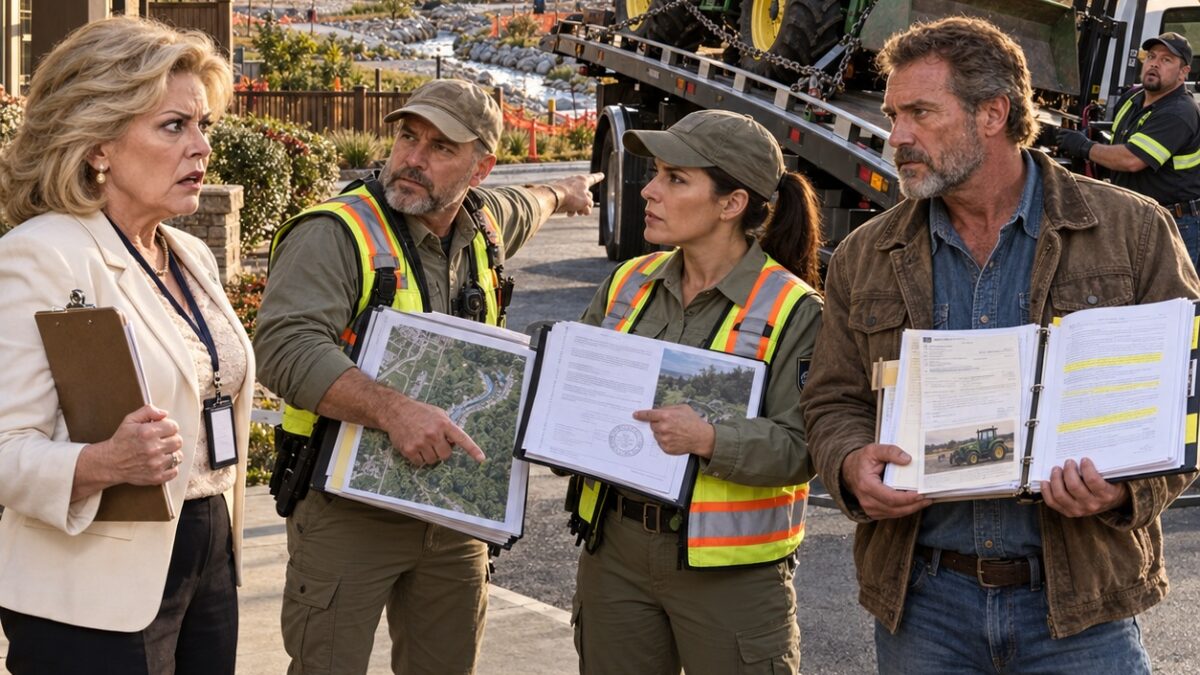
Two Army Corps representatives stepped out wearing field uniforms.
They knocked on the clubhouse.
Locked.
Then went to Darla’s house.
She apparently did not answer.
They slipped a card under the door.
The card stated that the Corps was investigating the removal of federally designated project-support equipment.
It requested immediate information regarding location and condition.
It warned that failure to cooperate could constitute interference with a federal program.
Then the two men drove away.
Clifford’s wife saw them.
Called Clifford.
Clifford called me.
By afternoon, Darla had called her personal lawyer.
Then HOA counsel.
Then Bobby.
Bobby did not answer.
His lawyer had already told him to stop talking directly to his cousin.
For the first time, Darla was scared.
I did not enjoy that.
But I did not lose sleep over it either.
Then Thaddeus found the money.
Buried in attachments to 2021 meeting minutes.
One-page document.
EXECUTIVE COMPENSATION ADJUSTMENT — BOARD PRESIDENT
Signed by Darla.
And her two reliable board allies.
Monthly stipend:
$575.
No membership vote.
No proper disclosure.
Twenty-six months by the time Thaddeus found it.
$14,950.
Almost exactly the unexplained administrative line in the budget.
Darla had been paying herself.
Neighborhood money.
No membership approval.
No transparent authorization.
When Thaddeus told me, I said:
“So that fourteen-two…”
“Was camouflage.”
“How bad?”
“At minimum, serious governance misconduct. Potentially worse depending on intent and accounting.”
He would not label it criminal prematurely.
Good lawyers do not.
But the insurance auditor later had fewer reservations.
Meanwhile, Aldean was digging through the tractor agreement.
She found a clause I had barely paid attention to when signing.
During active project periods, the designated equipment carried a federal program interest.
Not ownership in the ordinary sense.
But enough of a government interest that the equipment could not be lawfully transferred, impounded, disposed of, or materially interfered with without federal consent.
Darla had not simply towed private machinery.
She had seized equipment tied to an active federal watershed project.
The Knoxville field office escalated.
Regional counsel in Nashville.
Department of Justice liaison.
Then the FBI’s government-property people were notified for review.
I learned the full chain on Saturday morning.
Thaddeus’s office.
He laid it out.
Civil suit.
Insurance freeze.
Audit.
Federal program interest.
Federal counsel.
DOJ.
Possible criminal review.
I sat quietly.
Finally:
“She took a tractor.”
Thaddeus smiled.
“She took a tractor.”
That became the sentence we used whenever the case became too absurd.
All of this because Darla could not leave my tractor alone.
The next three weeks were quiet.
Surface quiet.
Underneath:
Everything moved.
Thaddeus.
Fern.
Prentice.
Aldean.
Corps engineer Sully Bramhurst.
Me.
We met at my kitchen table three times.
Coffee constantly running.
Documents stacked beside the salt shaker.
The plan had three tracks.
Financial.
Pattern.
Federal.
Financial first.
Thaddeus’s audit demand hit resistance.
Darla’s attorney claimed technical deficiencies.
Thaddeus filed in circuit court.
Before the argument got far, the HOA insurer sent its own auditor.
The auditor found the unauthorized $14,950 on day one.
Not week one.
Day one.
She wrote a memo.
The memo became discoverable.
Independent auditor.
Selected by the HOA’s own insurance carrier.
Confirming compensation without documented member approval.
That was no longer my accusation.
Second track:
Pattern.
Prentice began gathering affidavits.
Hardestys.
RV.
Winfrees.
Basketball hoop.
Mr. Soloway.
Garden shed that complied with code but had somehow offended Darla personally.
Three more households.
Six sworn statements.
Same methods.
Overreach.
Threats.
Procedural shortcuts.
Selective enforcement.
Darla often using county complaints after residents resisted.
One bad decision can be error.
Six in the same direction start looking like policy.
Third:
Federal.
Sully arranged a formal administrative demand letter from the regional Corps office.
Not dramatic language.
Government letters rarely need drama.
Eight paragraphs.
Serial number.
Equipment agreement.
Unauthorized removal.
Immediate-return demand.
Impound fees assigned as liability.
DOJ referral noted.
Potential federal consequences if interference continued.
The letter would be hand-delivered to Darla.
Twenty-four hours before the Ridgeline annual meeting.
That timing was deliberate.
The meeting was held second Saturday in December.
Usually twelve people attended.
Fern and Prentice personally called residents.
Their message was simple:
“You may want to be there.”
Forty-one of fifty-two households confirmed.
Meanwhile, the tractor remained at Halstead’s yard.
Five weeks.
November weather.
Outside.
The hydraulic seals I had been waiting to repair sat exposed to freezing temperatures.
I hired an appraiser.
Minor damage.
Real damage.
Storage fees:
$2,340.
Added to the file.
The night before the federal letter was delivered, I sat in my workshop.
Cold metal smell.
Old oil.
Empty gravel apron where the Deere should have been.
I thought about patience.
People misunderstand patience.
They think it means allowing something.
Sometimes patience is simply force that has not yet reached its target.
Darla could feel that.
She did not know exactly what was coming.
That made her more aggressive.
The week before the meeting, she hand-delivered a letter to every mailbox.
Unsigned.
Typed.
It accused me of legal harassment.
Called the lawsuit frivolous.
Said my property violations were costing everyone money.
No evidence.
No section numbers.
No specifics.
Just fear.
Most people ignored it.
Several gave theirs directly to Fern.
Fern stacked them.
Prentice scanned them.
Everything Darla produced now became another exhibit.
Then she floated settlement.
Through someone else because counsel had told her to stop contacting me directly.
Proposal:
I drop the lawsuit.
She returns the tractor.
Everybody “moves forward.”
When Thaddeus told me, I said:
“That’s not a settlement.”
He laughed.
“No.”
“That’s her returning something she should never have taken.”
“Correct.”
“And asking us to forget everything else.”
“Also correct.”
We rejected it.
Bobby Halstead was becoming nervous too.
He had employees.
Trucks.
Contracts.
A towing business worth protecting.
His lawyer contacted Thaddeus.
Bobby’s position:
He had been told the HOA possessed lawful authority.
He had never been informed about federal project designation.
He wanted to cooperate.
Documents.
Recorded statement.
Work order.
Communication from Darla.
Full testimony.
He wanted distance from the federal issue.
The person Darla had hired to carry out the tow was now a witness against her.
Then she filed another county complaint.
Commercial activity.
Again.
This time, the zoning investigator actually came.
Walked the property.
Reviewed my business registrations.
Workshop.
Tractor area.
Back lot.
Result:
No commercial activity.
The report also noted repeated complaints from the same source concerning substantially identical allegations.
Recommendation:
Close file.
Flag additional unsupported complaints for review.
Third county attempt.
Third failure.
Official.
Timestamped.
Documented.
Two days before the annual meeting, Aldean called.
“The letter is signed.”
“Delivery?”
“Tomorrow morning.”
Friday.
9:53 a.m.
Process server knocked on Darla’s door.
Official white envelope.
Department of the Army seal upper left.
She confirmed her identity.
Accepted it.
Server left.
Prentice heard through neighborhood gossip that Darla sat down immediately after opening it.
I did not know whether that part was true.
I did know what the letter said.
Identify John Deere 5075E by serial number.
Recognize its federal project designation.
Demand immediate return.
State that impound fees accrued from unauthorized detention were not my responsibility.
Note DOJ liaison referral.
Warn against continued interference.
That afternoon, Darla’s attorney called Thaddeus.
New proposal.
Return tractor.
Pay impound fees.
Pay my legal fees.
Written retraction.
Drop suit.
Do not pursue financial misconduct with the membership.
Thaddeus called me.
I asked:
“What about everyone else?”
Pause.
“What about Hardesty?”
“I know.”
“Winfrees?”
“Yes.”
“Soloway?”
“I know where you’re going.”
“If I settle this and Darla stays president, she does it again.”
Thaddeus said:
“That is the right question.”
I countered.
Three conditions.
Full independent CPA audit.
Distributed to the membership.
Darla resigns as board president at the annual meeting.
Formal homeowner complaint and appeal procedure added to the governing documents so residents no longer needed an attorney simply to challenge board action.
Thaddeus wrote.
Then looked up.
“You know those aren’t really damages.”
“No.”
“They’re governance repairs.”
“Exactly.”
Two hours later, Darla agreed to the audit.
Agreed to the complaint procedure.
Would not agree to resign beforehand.
She wanted to announce a “leadership transition.”
Her own speech.
Her own framing.
I thought for thirty seconds.
“Fine.”
Thaddeus raised one eyebrow.
“She can give the speech?”
“In front of everyone.”
Prentice spent the week building twelve presentation slides.
Clean.
No insults.
No memes.
No dramatic colors.
Dates.
Amounts.
Documents.
Timeline.
$14,950 month by month.
Six affidavit summaries.
Three county complaints.
Insurance action.
Federal demand.
Reform proposals.
I drove home Friday night.
Bare trees.
Dark fields.
Headlights sweeping the road.
This had started with one tractor.
It was ending because Darla had used the HOA against people repeatedly, paid herself without proper approval, lied about my property, used county processes as pressure, and finally reached onto my land to take something she had no right to touch.
I slept better that night than I had in two months.
Saturday.
Annual meeting.
10:02 a.m.
Two minutes late because there were not enough chairs.
Forty-one households.
Some sent couples.
Clubhouse packed.
People standing along the back wall.
Bad coffee.
Winter coats.
Tension.
I sat second row.
Fern left.
Clifford right.
Clifford wore a tie.
I looked at him.
He noticed.
“What?”
“Nothing.”
“You were going to say something.”
“No.”
“I own a tie.”
“I can see that.”
“Funerals and revolutions.”
I almost laughed.
Darla arrived last.
She was wearing the lanyard.
HOA badge caught fluorescent light.
For one second she looked exactly like the version of herself she had spent four years constructing.
In charge.
She moved to the front.
Organized papers.
Called order.
Previous minutes.
Routine budget.
Then Fern raised her hand.
Darla pretended not to notice.
Fern kept the hand up.
Eventually:
“Yes?”
“I move that Mr. Wallover be given the floor.”
Darla stiffened.
“That is not on the agenda.”
Fern opened the charter.
“Section 14C.”
She read it.
Any homeowner in good standing may request five minutes at the annual meeting for matters involving community governance.
My dues were paid.
Disputed fine under litigation.
Still good standing.
Clear.
Darla’s two allies looked at the floor.
I stood.
No notes.
I had rehearsed nothing.
I had read the facts enough that I did not need to.
“Most of you know parts of why we’re here.”
Silence.
I continued.
“My tractor was parked on my property behind my fence.”
I explained Section 3D.
Purchase date.
Grandfather clause.
Fine.
County complaint.
Towing.
Poster.
Books-and-records request.
Then:
“The financial records produced by this association contain payments totaling fourteen thousand nine hundred fifty dollars to the board president under a compensation arrangement that was not approved by the membership.”
A murmur.
I raised one hand.
“Prentice will show the documents.”
Then:
“Six households have signed affidavits describing similar enforcement conduct.”
A few people turned toward the Hardestys.
Then I held up the Department of the Army letter.
“This came yesterday.”
No one spoke.
“The tractor that this association ordered removed was being used under an active United States Army Corps of Engineers watershed project agreement.”
I paused.
“The federal government has a documented program interest in that equipment during active use periods.”
I looked around.
“This letter demands its return.”
Then:
“This is not why I wanted to sue my neighbors.”
I set the letter down.
“I sued because every ordinary way of resolving this had already been ignored.”
Prentice plugged in his laptop.
Slide one.
Timeline.
Slide two.
Section 3D.
Slide three.
Tow.
Four:
County complaints.
Five:
Financials.
By slide nine, the room saw Darla’s $575 monthly payments laid out one by one.
One of her two allied board members stood.
Walked out.
Did not return.
Prentice continued.
Six affidavits.
Federal letter.
Three proposed reforms.
No editorial.
No yelling.
Facts.
Then Darla stood.
She had prepared a speech.
Of course she had.
She said she had always acted in the best interests of Ridgeline.
Said compensation was legally reviewed.
Said my lawsuit was an overreaction.
Said the neighborhood had become divided.
Then she announced she would voluntarily step aside to allow “fresh leadership.”
Like she had planned it.
Nobody laughed.
That was almost kinder.
Nobody applauded either.
When she finished, Fern stood.
“Motion to accept President Hutchins’s resignation effective immediately.”
Hands rose.
Every hand.
Even her remaining board allies.
“Motion carries.”
Second:
Independent CPA audit.
Unanimous.
Third:
Adopt formal complaint procedure.
Unanimous.
Fourth:
Demand repayment of $14,950.
Unanimous.
Thaddeus had prepared the repayment resolution.
Fern signed it at the folding table.
Blue ballpoint pen.
The whole room watched.
No explosion.
No dramatic speech.
Just forty-one households raising hands.
Same direction.
Quiet.
Final.
That was the moment Darla lost Ridgeline.
Not when the Army letter arrived.
Not when my lawsuit was filed.
When the people she assumed would always be too tired to challenge her finally looked at the same documents at the same time.
Afterward, I walked outside.
Cold clean air.
Gray sedan at the edge of the lot.
Two Corps representatives had been sitting inside since 9:45.
One walked toward me.
“Mr. Wallover?”
“Yes.”
“Halstead has agreed to return the equipment Monday morning.”
“Condition?”
“Photographed and inspected before release.”
“Impound fees?”
“Not yours.”
I shook his hand.
“Thank you.”
He nodded.
Then went back to the sedan.
Clifford came out behind me.
Tie slightly crooked.
“You know what I’m thinking?”
“I’m afraid to ask.”
“Chili.”
“What?”
“Neighborhood needs a chili cook-off.”
I stared at him.
“Darla just resigned ten minutes ago.”
“Exactly.”
Then he walked to his truck.
That is Clifford.
My John Deere came home Monday at eight.
Halstead flatbed.
Bobby did not come personally.
Two employees unloaded it.
Professional.
No conversation.
The Deere looked smaller than I remembered.
Maybe because I had spent five weeks turning it into a legal symbol.
But once it rolled onto my gravel, it became a tractor again.
Mostly.
I ran my hand along the hood.
Checked hydraulic connections.
Tires.
Seat.
Controls.
The appraiser had been right.
The seals had taken some damage.
Nothing catastrophic.
Bobby’s separate settlement covered impound fees and repairs.
Roughly $6,800.
He cooperated fully with the federal review and civil case.
That mattered.
Four months later, the civil case settled.
Independent audit confirmed Darla’s unauthorized compensation.
Insurance carrier decided continued litigation made no sense.
Settlement terms were confidential.
Thaddeus called the amount “sufficient.”
That is the word lawyers use when they are pleased but professionally committed to sounding bored.
Darla repaid the full $14,950.
Every cent went into Ridgeline’s general reserve.
Visible in the books.
Fern became interim president.
If you have never watched a twenty-nine-year middle-school teacher run an HOA meeting, I recommend it.
Agenda starts on time.
People read documents before arriving.
Nobody talks over anyone.
If somebody makes a factual claim without support, Fern looks over her glasses and waits until they regret speaking.
Ridgeline became boring.
That was excellent.
The new complaint procedure was used eleven times in the first eighteen months.
Six disputes resolved informally.
Three board decisions upheld.
Two complaints dismissed because the resident did not have standing.
No lawsuits.
No tow trucks.
No midnight letters.
No one crying in the clubhouse parking lot.
A system that allows disagreement without requiring war.
That was the point.
Prentice won a regular board seat.
Digitized every record back to incorporation.
Shared drive.
Meeting minutes.
Budgets.
Contracts.
Violation logs.
Any homeowner could open them.
Transparency did what punishment never could.
It made bad behavior harder to hide before it became expensive.
Darla sold eight months after the meeting.
Moved to a townhouse community in West Knoxville.
She sent no farewell letter.
Nobody asked for one.
I heard once that she had joined the landscaping committee there.
I did not verify it.
Some things are funnier as rumor.
The creek project finished the following spring.
My John Deere returned to active support within three weeks of coming home.
Fresh hydraulic seals.
Full service.
I drove it down the access path on a cold morning.
Aldean was there.
Sully too.
We moved riprap.
Reshaped the worst section of bank.
Installed erosion-control matting.
Native grasses.
Willow stakes.
The work was slow.
Mud.
Diesel.
Cold water.
Real problems.
The kind I prefer.
By May, the creek ran cleaner after storms.
Not perfectly clear.
No natural waterway is perfect.
But the orange clay plumes diminished.
Banks held.
Roots took.
Places that had lost six inches a season stopped moving.
There was something satisfying about ending a property fight by making property stronger.
One afternoon, Sully stood beside the creek.
Hands in jacket pockets.
“Worth all the trouble?”
I looked at him.
“The project?”
He nodded.
“Yes.”
“The tractor?”
“That too.”
He almost smiled.
“Government agrees.”
Then walked away.
That was Sully’s version of humor.
In the fall, Clifford decided the neighborhood needed a festival.
Because apparently resigning one HOA president naturally leads to chili.
We held the first Ridgeline fall festival beside the clubhouse.
Chili cook-off.
Craft tables.
Kids painting pumpkins.
Raffle.
Fern organized sign-up sheets with military precision.
Prentice built online registration.
Clifford insisted on judging chili despite having no qualifications beyond being hungry.
I donated welding work.
Small steel firepit.
It raised more money in the raffle than I expected.
At the end of the day, we had enough proceeds to start something none of us originally planned.
Scholarship.
Local community college.
First-generation student from the Knoxville metro.
Engineering.
Construction.
Environmental science.
Fields where people build, repair, or protect things.
Ridgeline funded the first award partly through money that had returned to the HOA after Darla’s unauthorized compensation was repaid.
The first recipient was nineteen.
East Knoxville.
First person in her family to attend college.
Environmental-engineering track.
At the ceremony, she stood at a podium holding the award certificate.
Thanked Ridgeline Estates.
A neighborhood she had never visited.
I sat beside Fern.
Clifford on my other side.
He whispered:
“So Darla funded an engineer.”
“Technically.”
“She’d hate that.”
“Probably.”
Fern leaned over.
“I can hear both of you.”
We shut up.
The student finished.
Her mother cried.
That was the ending I liked.
Not Darla losing the lanyard.
Not the federal letter.
Not even the Deere rolling back into my driveway.
Something useful created out of money that had been handled badly.
I did not begin this fight wanting to reform Ridgeline.
I wanted my tractor left alone.
That is all.
But once you start reading documents, it gets difficult to stop at your own problem.
The grandfather clause protected me.
The records showed others had been targeted.
The budget showed money moving without proper approval.
The affidavits showed repetition.
The county reports showed escalation.
Each piece made the problem less personal.
That mattered.
If this had only been Garrett versus Darla, we probably would have settled much earlier.
She returns Deere.
Fine canceled.
Maybe apology.
Done.
But it was not only me.
The Hardestys had dealt with the same intimidation.
Winfrees.
Soloway.
Others.
The system had taught residents that resisting the board cost more than complying.
That kind of system does not fix itself when one homeowner gets his tractor back.
It waits for the next homeowner.
So we changed the structure.
That is the part I am proud of.
Not the lawsuit.
Structural repairs.
I built things most of my adult life.
Welds.
Frames.
Equipment.
Creek banks.
When something fails repeatedly, you do not keep patching the crack.
You ask why the load keeps arriving there.
Ridgeline’s load problem was concentrated authority.
Darla interpreted.
Enforced.
Spent.
Complained to government agencies.
Selected vendors.
Then controlled the information residents received.
Too much load on one connection.
Eventually that connection failed.
The new system spread it out.
Appeal process.
Records access.
Audit.
Recorded votes.
No president acting alone on major enforcement.
Boring.
Strong.
People love dramatic solutions because they are easier to tell.
But most durable solutions are paperwork.
That still makes me laugh.
Darla once told me:
“You don’t get to decide what the rules mean.”
She was right.
I did not.
Neither did she.
The recorded documents did.
The board procedure did.
The county did.
The courts did.
The federal agreement did.
That is the lesson she never understood.
Rules are useful precisely because they exist outside the personality of whoever temporarily holds a title.
President.
Owner.
Attorney.
Engineer.
Nobody gets to make them mean whatever feels convenient that morning.
I made mistakes too.
I skimmed forty-seven pages at closing.
I should have read them.
Had I known Section 3D from day one, maybe the first letter ends differently.
Maybe not.
Darla knew what it said once I mailed it to her.
She still proceeded.
But understanding your own documents changes posture.
You stop asking:
“Can they really do this?”
And start asking:
“Where exactly does the document authorize it?”
Very different question.
I also learned that certified mail is worth whatever the post office charges.
Not glamorous.
But return receipts become timestamps.
Same with screenshots.
PDF copies.
Board minutes.
Emails.
Clifford’s chicken-coop camera.
Without that video, Darla could have claimed Bobby towed the tractor independently.
Bobby could have said the crew believed it was abandoned.
Video turned ambiguity into sequence.
Truck enters.
Crew hooks Deere.
Notice cites HOA Section 7B.
Everything connected.
Evidence does not have to be sophisticated.
It only has to be preserved.
A twenty-year-old security camera aimed at chickens can become the most useful device in a lawsuit.
Clifford mentions this constantly.
His version now is that his hens personally saved Ridgeline.
I let him have it.
The tractor still sits beside my workshop sometimes.
Same gravel apron.
Same cedar fence.
I replaced one fence panel after a storm.
Otherwise, nothing changed.
The first week after the settlement, I parked the Deere in exactly the same place where Darla first complained.
Not to provoke anyone.
It was the best spot.
Fern drove by.
Slowed.
Rolled down her window.
“Visible from the street?”
“No.”
“Grandfathered?”
“Yes.”
“Carry on.”
Then drove away.
Best HOA interaction I ever had.
I eventually read every Ridgeline governing document.
Not because I wanted to become a neighborhood-law expert.
Because once you have paid a lawyer to explain a sentence you could have read yourself, motivation improves.
The complaint procedure matters most.
It starts with written notice.
Specific covenant cited.
Evidence disclosed.
Homeowner response.
Board review.
Appeal if necessary.
No emergency towing except genuine safety conditions.
No vendor relationship involving board relatives without disclosure and recusal.
That last one went in because Bobby was Darla’s cousin.
Bobby was not some criminal mastermind.
He believed what his customer told him.
But family relationships make bad decisions easier.
Disclosure makes everyone slow down.
Slowing down would have saved all of us months.
I ran into Bobby about a year later.
Gas station.
He was pumping diesel into one of the Halstead trucks.
He saw me.
Looked away.
Then back.
Finally walked over.
“Garrett.”
“Bobby.”
He shoved both hands into his jacket.
“Deere running all right?”
“Yes.”
“Good.”
Pause.
“I should have checked the paperwork.”
“Yes.”
Another pause.
“Darla told me you’d lost the appeal.”
“I hadn’t.”
“I know that now.”
Wind blew across the lot.
Diesel smell.
Traffic passing.
He said:
“I’m sorry.”
I nodded.
“I believe you.”
That was it.
No need for punishment speech.
He paid for the damage.
Cooperated.
Changed his company policy too, I later heard.
No HOA tow from owner-occupied private property without documented authorization reviewed by counsel.
Good.
Sometimes accountability works.
Sometimes somebody learns.
Darla was different.
I never spoke with her after the annual meeting.
Our attorneys handled everything.
I saw her once before she moved.
Mailbox cluster.
She was driving the same SUV.
No HOA lanyard.
Stopped.
We looked at each other through the windshield.
She did not wave.
Neither did I.
I felt less than I expected.
For months, I imagined that moment.
Thought I might feel victory.
Anger.
Something.
Instead, she looked like a sixty-one-year-old woman in a car.
Temporary.
That helped.
People become enormous in your mind while conflict is active.
Every letter from Darla had felt like a weather event.
Afterward?
Paper.
Just paper.
The house sold.
Someone else moved in.
Ridgeline continued.
That is healthy.
No community should permanently organize its identity around the person who caused its worst meeting.
We kept the reforms.
Dropped the obsession.
The scholarship grew.
Second year, local plumbing contractor added money.
Third year, an environmental consulting firm matched our contribution.
The scholarship now supports two students some years.
One civil engineering.
One construction technology.
The first recipient came back to our fall festival after completing her first year.
Clifford immediately tried recruiting her to judge chili.
Fern stopped him.
“You cannot invite a scholarship recipient here and make her work.”
“She’s an engineering student.”
“What does that have to do with chili?”
“Structural integrity.”
I walked away.
Some arguments are not worth joining.
The creek itself changed beautifully.
Native plants filled the stabilized bank.
Switchgrass.
Willow.
Dogwood.
After heavy rain, I walked down sometimes.
Watched water move over the stone.
The erosion scars softened.
Birds returned to sections that had been bare mud.
Sully told me another decade of unmanaged erosion could have threatened two downstream culverts.
That made the project feel larger than my three acres.
Land problems rarely stop at property lines.
Water certainly does not.
The federal equipment agreement ended once the project entered maintenance status.
The government released its interest in the Deere.
Aldean mailed me formal confirmation.
I framed it.
Not because it was beautiful.
Because after everything, I wanted proof that the most expensive HOA argument in Ridgeline history had officially returned to being about one privately owned tractor.
Clifford saw the frame.
“You framed government paperwork?”
“Yes.”
“That’s sad.”
“You framed a picture of your rooster.”
“He won county fair.”
Fair.
I still have the original three-hundred-dollar violation notice too.
That one is not framed.
It sits in the same folder as the Corps release.
Occasionally I look at the first letter.
Commercial equipment visible from street.
It seems almost harmless.
That is another thing I learned.
Most large conflicts start with a small claim somebody refuses to correct.
Darla could have read Section 3D.
Canceled the fine.
Sent:
Apologies. Prior-use exemption applies.
Done.
Instead she needed to win.
That need cost her presidency.
Money.
Community trust.
Home.
Possibly a lot more stress than the tractor was worth.
Leadership is dangerous when winning matters more than being correct.
Fern taught the opposite.
During her year as interim president, somebody challenged a board interpretation about fencing.
Fern thought the board was right.
Homeowner produced a clause she had missed.
She read it.
Then said in the meeting:
“You’re correct. I was wrong.”
That was all.
Nobody died.
Ridgeline did not collapse.
Her authority actually increased because people learned she could admit error.
I told her that later.
She said:
“Garrett, middle-school teachers who cannot admit being wrong don’t survive until retirement.”
Then she added:
“Children smell fear.”
I have no reason to doubt that.
When Fern stepped down after a year, Prentice helped recruit three candidates.
Actual candidates.
People campaigned.
Sent emails.
One held a backyard Q&A.
Imagine that.
An HOA election where residents knew who they were voting for.
Turnout tripled.
Darla had once run unopposed because nobody cared.
Afterward, people cared enough to read.
There is probably no better guardrail than that.
Not lawsuits.
Attention.
Institutions go strange when everyone competent decides participation is annoying.
That is how Darla became president in the first place.
Nobody wanted the job.
So she took it.
Then nobody challenged her.
Four years later, she had a badge around her neck and believed she could tow a ninety-four-thousand-dollar tractor from somebody else’s private gravel.
Apathy had given her room.
Transparency closed it.
I joined no committee.
People asked.
No.
I helped with creek issues.
Festival.
Scholarship.
That was enough.
Governance needs people.
It does not need everyone.
I knew my limits.
The workshop stayed my preferred place.
Cold mornings.
Coffee on the welding bench.
John Deere outside.
Metal smell.
Creek behind the trees.
Some days I started the tractor just because I could.
Diesel catches.
Engine settles into that low pulse.
I would sit for a minute.
Hands on the wheel.
Not thinking about Darla.
That part faded.
Good.
A victory that requires you to keep reliving the conflict is not much of a victory.
The Deere returned to being equipment.
That was what I wanted.
One Saturday, a new neighbor came over.
He had bought after Darla left.
Young guy.
Electrical contractor.
He pointed toward the tractor.
“That the famous one?”
I stared at him.
“What?”
“The Army tractor.”
“It is not an Army tractor.”
He laughed.
“People told me—”
“It’s my tractor.”
“Yeah, but—”
“My money.”
“Federal thing?”
“Project agreement.”
He grinned.
“Still famous.”
I sighed.
“Want coffee?”
He did.
We stood by the workshop.
I explained the short version.
His only question:
“Why would she tow a tractor behind a fence?”
I looked toward the road.
“That remains one of the great mysteries of East Tennessee.”
He laughed.
Then told me his last HOA had fought him over a work van.
We talked documents.
Grandfather clauses.
He went home and read his covenants that night.
Sent me a text at 10:14:
Found a tool-storage exemption. You created a monster.
I replied:
Good.
That may be the best long-term result.
People read now.
Not because they are suspicious of everything.
Because understanding your obligations is part of owning property.
Rules can be useful.
Fence standards prevent disputes.
Drainage provisions matter.
Road assessments matter.
Nobody wants the community pool operated through voluntary hope.
But rules need boundaries.
The person enforcing them needs boundaries too.
Darla forgot that.
Or never believed it.
The line she said to me still comes back occasionally.
“You don’t get to decide what the rules mean.”
Correct.
Neither of us did.
That is why we write rules down.
I think about my Army Corps years sometimes.
Projects were full of hierarchy.
Chain of command.
Procedures.
Sign-offs.
People outside government imagine rules are about bureaucracy.
Partly.
But good procedure protects people from improvisation.
A crane lift does not depend on whether the supervisor feels confident.
You calculate.
Inspect.
Communicate.
Authorize.
Because steel does not care about personality.
Neither does a deed.
Neither does Section 3D.
Darla ran Ridgeline based on personality.
The reformed HOA ran on procedure.
Procedure is slower.
Less exciting.
Also much harder to abuse.
The day the creek project officially closed, Aldean came out.
Sully too.
Small inspection.
No ceremony.
We walked the bank.
Checked riprap.
Vegetation.
Drainage.
Water clarity.
Sully filled out the last field form.
Signed.
Handed it to Aldean.
She looked at me.
“Project complete.”
“That’s it?”
“That’s it.”
“No federal sedan?”
“No.”
“No demand letter?”
“Not unless you want one.”
“I’m good.”
She smiled.
Rare event.
Then:
“You kept the tractor out of trouble?”
I looked at the Deere parked near the access trail.
“Mostly.”
“Try harder.”
They left.
I stayed at the creek.
The bank looked stable.
Water ran over stone.
Clear enough to see small fish holding behind rocks.
For the first time in fifteen years, the channel was not actively eating the property.
That was worth more emotionally than the lawsuit settlement.
Building beats fighting.
Every time.
That is why I liked the scholarship too.
Something forward.
Not only repayment.
The young woman who received the first award eventually sent us a photo from a soil-mechanics lab.
Hardhat.
Safety glasses.
Holding a sample cylinder.
Message:
Tell Ridgeline I’m still here.
Fern printed it.
Put it on the clubhouse bulletin board.
Directly under the posted financial statements.
That placement felt right.
Money returned.
Then sent somewhere useful.
Darla had paid herself nearly fifteen thousand dollars without approval.
Years later, that same neighborhood was helping someone learn how to build infrastructure correctly.
I do not believe the universe plans irony.
But I appreciate it when it appears.
The fall festival became annual.
Clifford still judges chili.
Unqualified.
Fern still objects.
Prentice runs registration.
I usually bring something welded for the raffle.
Fire ring.
Garden bench.
Once, a mailbox shaped like a locomotive for Clifford.
He pretended not to love it.
Put it at his driveway the next morning.
He also finally moved the chicken-coop camera.
Not because he needed to.
Because the angle annoyed him.
I asked whether he was worried about losing future legal evidence.
He said:
“Garrett, I’m seventy. I’m trying to see chickens.”
Fair.
Ridgeline is quieter now.
Not silent.
People still disagree.
That is normal.
One homeowner wanted a six-foot vinyl fence.
Neighbor hated vinyl.
They used the complaint process.
Board heard both.
Approved five feet with landscaping.
Nobody hired a lawyer.
Nobody called a tow truck.
Nobody contacted the Army.
Success.
Another resident challenged a late fee.
Board records showed the payment had been mailed on time.
Fee removed.
No drama.
That is the system working.
I sometimes wonder whether Darla ever hears how normal the neighborhood became without her.
Probably not.
Doesn’t matter.
The point of reform is not making the person who caused the problem understand.
The point is making repetition harder.
That is enough.
My John Deere now has more hours on it.
Paint scratched.
Seat cracked slightly near one edge.
I could replace it.
Do not care.
Machines are supposed to look used.
The hood still carries one faint mark from the tow chain.
I left it.
Not as a memorial.
Because sanding and repainting it would require effort for no functional benefit.
I am practical.
Clifford calls it “the federal scar.”
I tell him to stop.
He does not.
One winter morning, I found a tiny plastic U.S. Army flag zip-tied to the tractor mirror.
Clifford denied responsibility.
Badly.
I left it for a week.
Then removed it before Aldean saw it and developed an opinion.
I keep the first violation letter in my fireproof safe beside the federal release.
Occasionally I show it to somebody dealing with their own HOA dispute.
Not because every situation ends the way mine did.
Most do not involve federal equipment.
Thank God.
I show them because of Section 3D.
A clause I had ignored.
Sitting in my own documents.
Ready to protect me.
The power was not secret.
I had simply never read it.
That embarrassed me at first.
Now I tell people openly.
“I skimmed the covenants too.”
Because shame does not help anyone.
Read them now.
Understand them now.
If a board sends something, do not assume they are right because the letterhead is official-looking.
Also do not assume they are wrong because you dislike the rule.
Read.
Compare.
Ask.
Document.
That is less satisfying than yelling.
Much more useful.
The same applies to financial records.
Members have rights.
Use them.
Books-and-records requests are not declarations of war.
They are normal governance.
If a board treats a reasonable request as aggression, that itself tells you something.
Fern says the healthiest thing Ridgeline did after Darla was normalize questions.
At meetings, people ask:
“Where did this number come from?”
“Was that bid competitive?”
“Who voted?”
No one treats that as disrespect.
Good.
Authority that cannot tolerate questions is usually more fragile than it looks.
I learned one other thing.
Coalitions matter.
If I had been alone, I could still have won the tractor issue.
Probably.
Section 3D.
Corps agreement.
Thaddeus.
But the neighborhood would not have changed.
Fern mattered.
Prentice.
Clifford’s camera.
Hardesty affidavit.
Winfree.
Soloway.
Insurance auditor.
Aldean.
Sully.
Even Bobby, eventually.
Everyone carried one piece.
Darla’s power had relied on people staying separate.
One resident thinks:
It’s only me.
Another thinks:
Maybe I really am wrong.
Another pays the fine.
Pattern stays invisible.
The moment records came together, the story changed.
That is how systems fail.
And how they improve.
The funniest part is that Darla gave us the opportunity herself.
She called the safety meeting.
Put my property on a laminated poster.
Invited thirty neighbors.
If she had kept the dispute private, residents might not have compared notes.
She wanted social pressure.
Created social awareness instead.
Then she towed the tractor.
Wanted to prove authority.
Created federal scrutiny.
Then resisted the audit.
Made the insurer curious.
Then sent the unsigned neighborhood letter.
Gave Fern forty-one more examples of panic.
Escalation kept producing the thing she feared.
Attention.
People in control sometimes make that mistake.
They believe the cure for losing authority is demonstrating more authority.
Often the opposite is true.
When legitimacy weakens, force makes everyone inspect the foundation.
Darla’s foundation had cracks.
Section 3D.
No tow authorization.
Secret stipend.
Missing records.
Repeat enforcement.
County complaints.
Once people looked, there was too much to ignore.
The annual meeting itself lives differently in memory now.
At the time, it felt huge.
Forty-one households.
Darla’s lanyard.
Department of Army letter.
Prentice slides.
Now what I remember most is the sound.
Bad coffee machine humming.
Winter jackets rustling.
Fern’s pen clicking.
Then hands rising.
Not cheering.
No one screaming at Darla.
Just hands.
Forty-one households deciding the system was changing.
Quiet can be final.
That day taught me that.
When I drove home afterward, the tractor was still impounded.
Civil case still open.
Audit unfinished.
Nothing material had been fixed yet.
But everything had changed.
Darla no longer controlled the story.
People had seen the same record.
Once that happens, fear loses a lot of leverage.
Monday, the Deere came home.
Tuesday, I replaced one damaged seal.
Wednesday, started it.
That diesel engine turned over on the second attempt.
Smoke.
Then steady idle.
I sat in the seat.
Hands on wheel.
Clifford stood near the fence.
“Going somewhere?”
“Creek.”
“Need escort?”
“No.”
“Federal convoy?”
“Go feed your chickens.”
He smiled.
I drove down the trail.
Cold sun through bare branches.
Creek ahead.
For about ten minutes, I forgot everything except grade, traction, and where Sully wanted the stone placed.
That was one of the happiest moments of the whole story.
Not victory.
Work.
The machine was back doing what it was supposed to do.
I was too.
Years of physical work taught me something simple.
Tools do not want symbolism.
A tractor does not care that it became evidence.
It wants diesel.
Maintenance.
A job.
People are similar.
Eventually we need to stop being plaintiffs, defendants, victims, presidents, witnesses.
Go back to ordinary identity.
Neighbor.
Teacher.
Welder.
Student.
Chicken keeper.
That is why I am glad Ridgeline stopped talking about Darla.
We remember enough to keep the safeguards.
Then move forward.
Fern eventually stepped down.
Prentice still serves.
I remain happily unelected.
The scholarship continues.
The creek holds.
The tractor runs.
And my gravel driveway sounds exactly the way it did before the first certified letter.
Crunch beneath my boots.
Diesel somewhere near the workshop.
Wind through cedar.
Some mornings I pour black coffee and walk outside before sunrise.
The Deere sits beside the workshop.
Inside my property line.
Behind the fence.
Exactly where Darla first decided it could not be.
I do not park it there to make a point.
There is no longer anyone I need to make the point to.
It is simply the best place for the tractor.
One morning, sunlight came over the trees and hit the hood.
I remembered Darla’s voice from that first phone call.
You don’t get to decide what the rules mean, Mr. Wallover.
I smiled.
She had been absolutely right.
Neither one of us did.
That was the whole problem.
The rules had already been written.
Section 3D.
The board charter.
The nonprofit requirements.
The federal equipment agreement.
All I finally did was read them.
And once everyone else read them too, the tractor came home, the money came back, the creek got fixed, the neighborhood changed, and a nineteen-year-old girl none of us knew received a scholarship to study how to build things better than we found them.
I looked toward the creek.
Clear water moving beyond the trees.
Then climbed onto the John Deere.
Turned the key.
The engine caught.
And I went back to work.








