PART2:HOA Queen Cut Down My Dead Marine Father’s Flagpole Before Memorial Day—She Had No Idea What Kind of Federal Case She Had Just Created
PART2
The farmhouse sat mostly empty through the winter and early spring.
Work kept me in Roanoke.
The boys had school.
Catherine had her own schedule.
Chesty stayed between my sister-in-law’s place and ours when we could not be in Bedford.
Memorial Day weekend would be our first real return.
I left Roanoke before dawn on Friday, May 23.
Catherine and the boys planned to come Saturday after Porter finished an SAT makeup session.
I wanted one night alone on the property first.
Just Dad’s porch.
Chesty.
The ridge.
At sundown, I planned to lower the flag myself.
It would be the first time since Dad entered hospice.
I was on I-81 when the Ring alert hit.
Motion detected.
Front drive.
I opened the feed.
Yellow skid steer.
F-350 pickup.
Flatbed trailer.
Three workers.
Then Brittany Ashcroft.
Khaki shorts.
White polo.
Sunglasses.
Hands on hips like she was supervising removal of a dead tree.
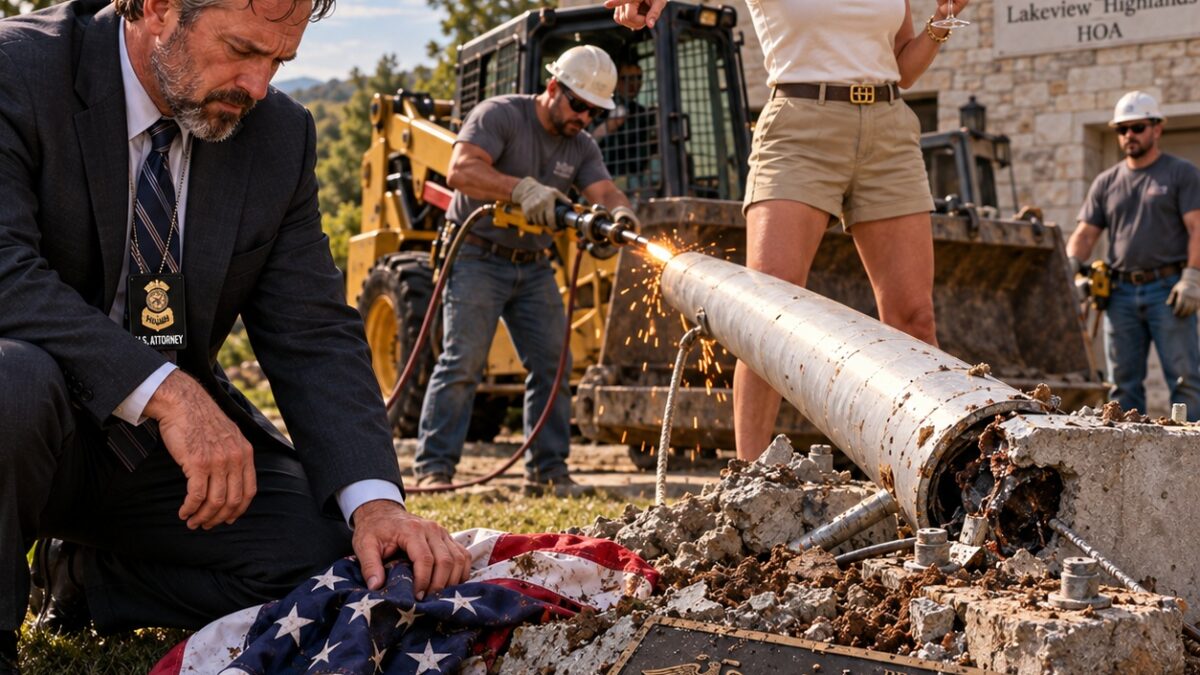
One worker pulled on a welding hood.
The torch ignited.
Bright blue-white flare.
Then I heard Brittany through the camera microphone.
“Cut it down, Lenny.”
The worker hesitated.
“The flag’s still on it.”
“I don’t care if the flag’s still on it.”
I stopped breathing for a second.
The torch went into the aluminum near the base.
Sparks fell across Dad’s gravel.
Then the steel gave.
The pole leaned.
The American flag was still at half-staff.
Exactly where Dad had left it before hospice.
The flag caught the air once.
Then the halyard tore loose.
The cloth hit the gravel.
I heard it before I understood I was hearing it.
Fabric dragging.
Metal striking dirt.
The thirty-foot pole bounced.
Then the skid steer moved toward the concrete base.
The bucket lowered.
Once.
Twice.
The bronze plaque cracked.
My grandfather’s name disappeared beneath the bucket.
Brittany said:
“Cut all of it out. Haul it to the landfill.”
Someone asked about the flag.
She answered:
“I don’t care about the flag. It’s just fabric.”
I pulled off at the next exit.
Chesty was in the back.
He whined.
I sat in the driver’s seat for seventy seconds.
I know because the camera footage later showed the timestamps.
My hands were on the wheel.
I did not punch anything.
Did not call Brittany.
Did not call Garrett.
I called Catherine.
“Kate.”
“What happened?”
“Bring the boys tomorrow.”
Pause.
“And bring Dad’s dress blues from the cedar chest.”
She went quiet.
“What happened, Weston?”
I told her.
When I finished, she asked:
“You’re not going to handle this yourself, are you?”
“No.”
That was important.
I was a federal prosecutor.
I was also the victim’s son.
Those roles could not mix.
“I’m giving it to the right people.”
Then I called Christopher Palmer, the United States Attorney for the Western District of Virginia.
7:22 a.m.
Friday before Memorial Day.
He answered on the third ring.
“Chris, it’s Wes.”
“Morning.”
“They destroyed Dad’s memorial this morning.”
Silence.
“What?”
“Flagpole. Plaque. Flag. Contractor. HOA president on video. VA registration. Legion easement. Possible forged enforcement order.”
His voice changed immediately.
“Wes, are you okay?”
“I’m fine.”
“Are you on the property?”
“Ten miles out.”
“Do not enter until Bedford County arrives.”
“I understand.”
“I’m calling the sheriff.”
Pause.
“And Roanoke FBI.”
“Chris—”
“You are recused.”
“I know.”
“Say it.”
“I’m recused.”
“Good.”
Another pause.
“I’m assigning Miranda Shaughnessy to any federal prosecution.”
“Thank you.”
“Wes.”
“Yeah?”
“I’m sorry about your dad’s pole.”
I looked through the windshield at traffic moving north.
“So am I.”
By 7:50, I turned onto Dad’s gravel drive.
Deputy Cal Rutherford was already there.
Cruiser lights flashing.
Evidence tape around the concrete base.
The place looked wrong immediately.
Not because the pole was gone.
Because the sky above the porch was empty.
Dad’s flagpole had always divided that view.
House.
Pole.
Ridge.
Now just house and ridge.
The concrete base remained like a grave marker somebody had vandalized.
Cratered dirt.
Fresh tire tracks.
Shattered concrete.
No plaque.
No pole.
No flag.
I let Chesty out.
He walked straight toward the base.
Sniffed where the flag had landed.
Then sat.
Tail low.
That almost broke me more than the video.
Deputy Rutherford removed his hat.
“Mr. Hargrove, I’m sorry for your loss.”
“Thank you.”
“And for this.”
I nodded.
“Sheriff Vestal called me directly. We’re preserving everything.”
“Good.”
Chesty leaned against my leg.
Seventy pounds of gray retired Marine dog.
I put one hand on his head.
“Semper Fi, Dad.”
Sheriff Barrett Vestal arrived around nine.
Former Marine.
Late fifties.
Eagle, globe, and anchor tattoo on his forearm.
He had attended Dad’s funeral in uniform.
Barrett stood beside the concrete base for about thirty seconds before speaking.
Then:
“Start at the beginning.”
I told him.
Ring feed.
Brittany.
Lenny.
Torch.
Flag.
Plaque.
Years of harassment letters.
VA registration.
Legion easement.
Timing.
Memorial Day three days away.
Barrett listened without interrupting.
When I finished, he said:
“I’m interviewing Brittany this afternoon.”
“Good.”
“I want you there.”
I looked at him.
“As what?”
“Victim-witness.”
“Not prosecutor.”
“Not even a little.”
I almost smiled.
“Why me?”
“I want to see what she says while she thinks she’s talking to a country sheriff and a grieving son.”
That made sense.
At two, we drove into Lakeview Highlands.
Brittany and Garrett owned the largest house on the cul-de-sac.
Three-car garage.
White columns.
Perfect mulch.
Barrett knocked.
Brittany opened the door wearing pink tennis whites.
Her smile formed automatically.
Then she saw me behind Barrett.
The smile flickered.
“Sheriff.”
Then:
“Mr. Hargrove.”
Barrett removed his Stetson.
“Mrs. Ashcroft, we’d like to ask about an incident at the Hargrove property this morning.”
“What incident?”
“The removal of a flagpole.”
Her expression relaxed.
“Oh.”
Like we were discussing a storm-damaged mailbox.
“The Hargrove pole.”
“Yes, ma’am.”
“The HOA authorized that removal last week.”
My hands stayed at my sides.
Barrett asked:
“Under what authority?”
“The estate was non-compliant.”
“The estate?”
“Colonel Hargrove passed. The property has been neglected.”
“Neglected how?”
“The structure violated Lakeview Highlands visual standards.”
Barrett’s voice remained calm.
“Mrs. Ashcroft, may I see the enforcement order?”
“Of course.”
She disappeared inside.
Returned with a document.
Lakeview Highlands letterhead.
Removal of “non-compliant industrial structures on abutting parcel.”
Covenants, Chapter 4, Section 11.
Dated May 19.
Signed:
Garrett Ashcroft.
HOA Chief Enforcement Officer.
Notarized by Pearl Henley.
Barrett read it once.
Then again.
His jaw tightened slightly.
“Mrs. Ashcroft, is this your husband’s signature?”
“Yes.”
“Your HOA formally recognizes the Hargrove property is outside Lakeview Highlands, correct?”
Brittany stopped.
“It is adjacent.”
“That wasn’t my question.”
She looked at me.
Then back.
“The parcel was not originally incorporated.”
Barrett nodded.
“Correct.”
He folded the document carefully.
“And no Lakeview covenant is recorded against the Hargrove deed.”
Brittany’s expression changed.
“We have standing under Virginia law regarding abutting properties.”
Barrett said:
“No, ma’am.”
She blinked.
“There is no general doctrine in Virginia allowing an HOA to enforce private covenants against neighboring land merely because the parcel is adjacent.”
Garrett appeared behind her.
Golf shorts.
Polo.
Same developer confidence he had probably used at a thousand closings.
“Sheriff, this is a private association matter.”
Barrett looked at him.
“Mr. Ashcroft, I’m requesting neither of you leave Bedford County for seventy-two hours.”
Garrett actually laughed once.
“What?”
“If you need to travel, notify my office.”
“On what basis?”
“A federal investigator from Roanoke will speak with you Monday morning.”
Garrett stopped smiling.
“Federal?”
Barrett held the enforcement order by one edge.
“The property you removed this morning included a registered veterans memorial.”
He continued.
“The flag was actively displayed.”
Then:
“The contractor was directed under a written order asserting legal authority your HOA does not possess.”
Garrett looked at Brittany.
Barrett added:
“That order was transmitted to the contractor. Federal investigators will determine what statutes apply.”
I said nothing.
Not one word.
That was deliberate.
Barrett had been right.
Brittany had expected a local property argument.
Garrett expected attorneys.
Neither expected federal investigators.
On the drive back, Barrett said:
“I’ve interviewed a lot of people over twenty-nine years.”
I looked out the window.
“That woman had no idea who your father was.”
I shook my head.
“No.”
“What?”
“She knew exactly who he was.”
I looked at him.
“She just decided he didn’t matter anymore because he was dead.”
Barrett was silent.
Then nodded.
“That’s worse.”
“Yes.”
Catherine and the boys arrived Saturday morning.
Porter walked directly from the car to the bare concrete.
Drew followed.
Neither spoke.
Porter knelt.
Ran one thumb along the jagged edge where the plaque had been.
Then stood.
“Dad.”
“Yeah?”
“We’re getting it back.”
That was the first time I cried that weekend.
Not much.
Just enough that I had to turn away.
Catherine had brought Dad’s Marine dress blues.
She hung them in the front hall closet.
Chesty walked over.
Smelled one sleeve.
Then lay down beneath it.
That afternoon, FBI Special Agent Maureen Galbraith arrived from Roanoke.
Fifteen years in the Bureau.
Veterans-fraud and hate-crime coordination.
We had worked together before.
She knew Dad by reputation.
She and her partner photographed everything.
Concrete.
Gravel.
Tire tracks.
Fence line.
They transferred the Ring footage onto government-certified storage.
Took Dad’s folder of Brittany’s old violation letters.
Interviewed me on record for two and a half hours.
At the kitchen table afterward, Maureen said:
“We’re keeping this quiet.”
“Good.”
“Subpoenas Tuesday.”
She sipped coffee.
“We want contractor records. Payment records. Communications. Notary.”
“Lenny Faircloth.”
She wrote the name.
“I know Faircloth. Heavy-equipment operator out of Boones Mill.”
Then:
“Anything you need from me?”
“One thing.”
“Go.”
“American Legion Post 154 needs notice.”
Maureen nodded.
“They’re scheduled here Monday.”
“Ten a.m.”
“Who’s commander?”
“Sergeant Major Dale Whitfield. Retired.”
“I’ll call him.”
“Thank you.”
Maureen left around six.
The ridge went rose and purple.
We sat on the porch.
Catherine.
Porter.
Drew.
Me.
Chesty at my feet.
I told the boys:
“Your grandfather’s old unit is coming tomorrow.”
“For the ceremony?” Drew asked.
“For what’s left of it.”
Porter said:
“Can I help?”
“Yes.”
“With what?”
“You’re carrying the flag.”
He sat straighter.
“Okay.”
Sunday at 0600, Sergeant Major Whitfield arrived.
Seventy-three.
Crew cut.
Legion cap.
Posture of a twenty-year-old.
He had served under Dad in 1970.
Once carried him through the A Shau Valley after Dad was hit.
Six veterans followed.
They unloaded chairs.
Flags.
Temporary stand.
PA system.
Whitfield shook my hand.
“Wes.”
“Sergeant Major.”
“We are holding the ceremony tomorrow.”
“I know.”
“Same place.”
I looked at the broken concrete.
“Yes.”
“The Ashcrofts do not get to cancel Memorial Day.”
“No, sir.”
Then he said:
“My wife made calls.”
I waited.
“Marine Corps League chapters. Charlottesville to the Tennessee line.”
“How many?”
“Probably two hundred.”
I swallowed.
“Thank you.”
He nodded.
“Tomorrow your father will be honored.”
Then his face hardened slightly.
“And Mrs. Ashcroft will learn what she tore down.”
The veterans spent Sunday cleaning the site.
Sweeping gravel.
Raking dirt.
Marking the old processional path.
One man brought survey twine.
Another had Dad’s old ceremony diagrams.
Porter and Drew carried chairs.
Chesty wandered between them like a retired NCO making sure everyone remained productive.
Catherine brought coffee and lemon pound cake.
Around noon, senior reporter Lyla Brackett from the Roanoke Times arrived.
She had covered one of my federal cases years earlier.
I gave her the facts on background.
She listened.
Asked careful questions.
Then:
“I’ll be here tomorrow unless you want me off.”
“I want you here.”
“With respect?”
“With respect.”
That evening, my phone rang.
Maureen.
11:00 p.m.
“Weston, you awake?”
“Yes.”
“We found things.”
I moved into the kitchen.
Catherine woke but stayed in bed.
“Go.”
“Lenny Faircloth called us voluntarily.”
That surprised me.
“He wants a cooperation agreement.”
“What did he say?”
“Brittany paid him two thousand dollars cash last Tuesday.”
I leaned against the counter.
“Instruction?”
“Take the pole down before the family gets back for the holiday.”
I closed my eyes.
“She gave him the enforcement order.”
“Yes.”
“He believed it?”
“Claims he did.”
“Anything else?”
“Plenty.”
Maureen began listing.
The Hargrove parcel was formally excluded from Lakeview Highlands in a 2018 boundary survey.
Filed by the Ashcrofts themselves.
Meaning Garrett’s HOA order claimed authority he already knew the HOA did not possess.
Lenny had the certified mailing.
The notary information.
Payment receipt.
Crew records.
Then the memorial documentation.
Dad’s registration.
Legion easement.
Then another issue.
FAA obstruction marker.
Dad’s ridge sat near an approach zone where the original pole installation required a marker system.
Garrett had complained about that same marker during Lakeview’s permitting years earlier.
The skid steer had destroyed part of it.
Maureen continued.
Then she went quiet.
“There’s one more thing.”
“What?”
“Texts.”
My hand tightened around the phone.
“How many?”
“Thirty-one from Brittany to Lenny.”
“Read me the worst.”
Pause.
“May fifteenth.”
Then:
It’s just an old man’s flagpole and he’s dead. His family doesn’t even live here. Get it done before Memorial Day.
I did not respond.
“Weston?”
“Read it again.”
She did.
Same words.
The kitchen seemed smaller.
I could see Dad in hospice.
Weak.
Still amused enough to dictate:
Ma’am. Semper Fi. C.H.
I asked:
“How many counts are you looking at?”
“Preliminary? Multiple federal and state theories.”
“Brittany?”
“Fourteen potential federal counts at this stage.”
“Garrett?”
“Eleven.”
“Pearl Henley?”
“Six under review.”
“That’s a lot.”
“We haven’t presented to grand jury yet.”
“Understood.”
Then Maureen said:
“Palmer wants the announcement after the Memorial Day ceremony.”
I turned toward the dark window.
“You’re announcing charges there?”
“If the indictment is returned.”
“Dad would hate that.”
“He’d hate cameras more.”
I almost smiled.
“Yes.”
“But he’d understand why.”
I looked toward the hall where his dress blues hung.
“Do it.”
I slept ninety minutes.
At 3:30 Monday morning, Memorial Day, I was awake.
Coffee.
Porch.
Chesty at my boot.
The Blue Ridge was still black.
For the first time, I understood why Dad loved the hour before dawn.
Nothing asks you to perform before sunrise.
No phone calls.
No arguments.
Just preparation.
At four, Maureen called.
Final materials were moving.
Grand jury scheduled.
Miranda leading prosecution.
At 4:30, I spoke with Mom.
She was staying in Lynchburg.
She said:
“I will come Tuesday for arraignment.”
“Not today?”
“No.”
Then:
“Today belongs to your father.”
“Yes, ma’am.”
At five, Sergeant Major Whitfield confirmed ceremony logistics.
Honor guard.
Color detail.
Father Eamonn Doherty.
Catherine’s tribute.
Porter with the flag.
Drew assisting.
At 6:30, I woke the boys.
At seven, we sat at the kitchen table.
I explained the thirteen folds the way Dad taught me.
Porter wrote notes on his palm in black Sharpie.
Drew practiced the final fold twice.
At 7:30, I dressed.
Blue pinstripe suit Dad bought me for my first day at the U.S. Attorney’s Office.
I had not worn it outside a courtroom in nineteen years.
I polished my shoes the way he taught me.
Pinned his silver-star lapel pin to my jacket.
Then I took Dad’s funeral flag from the mantel.
Walked outside.
Unfolded it.
The fabric was heavy in the cool morning air.
I refolded it once.
Slowly.
Chesty watched.
When I finished, he stepped forward.
Pressed his muzzle against the triangle.
Held it there.
Thirty seconds.
Then thumped his tail.
“Good Marine,” I whispered.
Brittany spent the weekend doing something very different.
She went online.
Saturday evening, twenty-one hours after destroying Dad’s memorial, she livestreamed to almost fifty thousand real-estate followers.
Cream cardigan.
Red eyes.
Pink tissue.
She said the flagpole had been a visual nuisance.
She said the HOA acted lawfully.
She said my family was using Dad’s death to harass a legitimate community association.
Then she said:
Colonel Hargrove, God rest him, would have wanted his family to move on.
I watched from Dad’s kitchen.
Chesty at my feet.
Catherine behind me.
Brittany cried at minute seventeen.
At nineteen, she accused me of using my position as a federal prosecutor to intimidate the HOA.
I did not comment.
Did not post.
Did not defend myself.
Christopher Palmer later told me that video did more damage to Brittany than anything I could have written.
People become very useful witnesses against themselves when they believe the camera belongs to them.
Meanwhile, Lenny’s cooperation expanded.
His lawyer delivered:
Thirty-one texts.
Garrett’s enforcement order.
Cashier’s-check receipt.
Crew time sheets.
Sworn statement.
Brittany’s admissions.
The state real-estate board opened review.
Pending home sales tied to Ashcroft Homes began collapsing.
A bank started questioning Garrett’s credit line.
Lakeview’s HOA board held an emergency Zoom meeting.
Most members stayed home.
One woman, Louise Kincannon, physically came to the clubhouse.
Retired teacher.
She baked brownies because she expected people to look one another in the eye.
Instead, she sat alone in a room staring at laptop screens.
She emailed me afterward.
Weston, I brought brownies because I wanted to see the faces of the people who let this happen. They all hid behind their screens. Tell me what I can do.
I replied:
Come Monday at 10. Bring the brownies.
She did.
At eight Monday morning, the first Legion van arrived.
By 8:30, forty veterans.
By nine, close to one hundred.
By 9:30, more than two hundred Marines, soldiers, sailors, airmen, spouses, and families filled Dad’s gravel drive.
Ray Eldridge opened his hayfield for parking without being asked.
Sergeant Major Whitfield directed traffic like he was staging an amphibious landing.
Then Buddy Hendrix arrived with the replacement pole.
Retired Seabee.
Sixty-one.
Flatbed.
Two helpers.
Borrowed crane truck.
Marine Corps League had voted Sunday night to donate the pole.
Nobody asked me for money.
Buddy repaired Dad’s old concrete base with a structural collar.
Set the replacement.
Plumbed it.
Bolted hardware.
Then a new bronze plaque arrived from Richmond.
Overnight.
The wording had changed.
Dad’s name had been added beside Elmer’s.
IN MEMORIAM OF
PRIVATE ELMER HARGROVE
COLONEL CLIFTON HARGROVE JR.
AND ALL MARINES OF FIRST BATTALION, NINTH MARINES
THE WALKING DEAD
VIETNAM
SEMPER FIDELIS
I ran my thumb across Elmer’s name.
Then Dad’s.
Could not speak.
Chesty pressed his head against my calf.
At 9:15, three flags were rigged.
American.
Marine Corps.
POW/MIA.
At 9:30, Louise arrived carrying two pans of brownies and coffee.
Navy dress.
She found me beside the pole.
Took both my hands.
“Weston Hargrove.”
“Yes, ma’am?”
“Your father raised a good son.”
That almost undid me.
I looked down.
She squeezed once.
Then walked away before I had to answer.
At 9:45, the JROTC bugler arrived.
Senior from Bedford High.
At 9:50, I saw Brittany.
Far edge of Ray’s hayfield.
Pale pink dress.
Garrett beside her in a navy suit.
Three HOA board members nearby.
They had come to watch.
Maybe because Brittany still believed this was a public-relations battle she could survive.
They stayed behind the traffic cones.
Twenty feet behind them stood two men in dark suits.
FBI.
They were not there to interfere with Dad’s ceremony.
They were simply making sure the defendants did not disappear.
At 9:55, Christopher Palmer’s Suburban came up the drive.
He stepped out.
Miranda Shaughnessy.
Maureen Galbraith.
Chris shook my hand.
“Thank you for letting us be here.”
“Thank you for coming.”
At 9:59, two hundred twelve veterans rose.
At exactly 10:00, the ceremony began.
Father Doherty gave the invocation.
Short.
No politics.
No anger.
Peace for Dad.
Peace for the Marines who did not come home.
Peace for the Hargrove family.
Amen.
Sergeant Major Whitfield spoke next.
Six minutes.
He told Porter and Drew stories I had never heard.
Dad carrying Whitfield through the A Shau Valley while injured himself.
Dad installing the original pole.
Dad refusing to have his own name on the plaque because, as he told Whitfield:
“This pole is for Elmer, not me.”
Then Whitfield said:
“Colonel Hargrove did not miss a Memorial Day service here for twenty-two years.”
He looked across the gravel.
“He is not missing this one.”
Nobody moved.
Catherine spoke.
Tomatoes.
A Marine Corps teddy bear Dad gave baby Porter.
Ruby’s old Tokyo china set.
Small family things.
Exactly right.
Porter stood beside the pole.
Grandfather’s Marine ring on his finger.
Drew held Catherine’s hand.
At 10:27, we raised the flags.
Full staff first.
Then slowly to half-staff.
The honor guard fired the salute.
Taps came from the ridge.
Clean notes.
The kind of silence after the final note that makes hundreds of people sound like nobody.
Then the folding.
Porter stepped forward.
Drew helped.
Thirteen folds.
Slow.
Precise.
Porter’s hands shook only once.
When the triangle was complete, he carried it to me.
He was seventeen.
And suddenly exactly Dad’s height.
I took the flag.
Looked at him.
“Good job.”
His jaw tightened.
“Yes, sir.”
I carried the triangle to Sergeant Major Whitfield.
White gloves.
He received it.
Then carried it to Christopher Palmer.
Chris had asked for the ceremonial role.
He held Dad’s flag for one long second.
Then said into the microphone:
“Colonel Clifton Hargrove Jr., United States Marine Corps.”
Pause.
“Semper Fidelis.”
Then he returned the flag to me.
And stepped toward the microphone again.
The ceremony had ended.
What came next was different.
Chris looked across the crowd.
“My name is Christopher Palmer, United States Attorney for the Western District of Virginia.”
Every camera turned.
“I have an announcement directly related to the memorial we have just honored.”
Across the hayfield, Brittany went very still.
Chris continued.
He described the May 23 entry onto Dad’s property.
The destruction.
Flagpole.
Plaque.
American flag.
FAA marker.
Forged HOA authority.
Then he announced that federal charges had been authorized and that the Ashcrofts were facing a multi-count prosecution alongside Virginia charges.
He read the categories carefully.
Memorial destruction.
Mail fraud.
Conspiracy.
Destruction of federally regulated marker equipment.
Aiding and abetting.
Forgery-related state counts.
The crowd did not cheer.
That mattered.
This was still Dad’s Memorial Day ceremony.
These were veterans.
They understood solemnity.
But the entire crowd exhaled at once.
Then Chris looked directly across the hayfield.
At Brittany.
His voice did not rise.
“Mrs. Ashcroft.”
She stared back.
“The memorial you ordered destroyed was not simply an aluminum pole.”
Pause.
“It carried the name of a Marine killed at Khe Sanh.”
Then:
“This office will prosecute the conduct before us according to the law and the evidence.”
Brittany’s face had gone almost gray.
Garrett placed one hand at her elbow.
They turned.
Started walking toward the Cadillac.
The FBI agents stepped forward.
Chesty barked once.
One bark.
Sharp.
Porter looked down at him.
I do not know what Chesty meant.
I know what I heard.
Brittany and Garrett were taken into custody later that afternoon.
By Tuesday, photographs were everywhere.
National wire services.
Garrett in handcuffs.
Brittany being escorted.
Federal courthouse.
Reporters.
Indictment.
The real numbers were less cinematic than social media wanted.
Nobody was instantly sentenced to sixty years.
The case moved the way federal cases actually move.
Counsel.
Motions.
Negotiation.
Sentencing guidelines.
Restitution.
State charges.
By August, both defense teams were discussing pleas.
In September, Brittany pleaded guilty to eight federal counts and five state counts.
Garrett pleaded to six federal and three state.
Pearl Henley, the notary who authenticated documents she should never have notarized, pleaded to three federal counts.
Sentencing came in November.
Brittany:
Fifty-one months federal.
Then twenty-four months state.
Consecutive.
Garrett:
Thirty-three months federal.
Then twelve months state.
Pearl:
Probation.
Notary commission permanently gone.
Restitution across the Hargrove family, Legion Post 154, and other affected entities totaled $231,000.
People asked whether that felt like enough.
I never knew how to answer.
How do you put a dollar figure on my father’s flag hitting the dirt?
Grandfather’s plaque under a skid-steer bucket?
Porter touching the broken concrete?
Chesty sitting where the pole used to stand?
Money does not fix those things.
So we did not use most of it for ourselves.
About forty thousand went toward making the permanent replacement memorial stronger than the first.
New galvanized pole.
Thirty-five feet.
Reinforced foundation.
Laser-engraved bronze plaque.
Modern hardware.
Eight thousand replaced the FAA marker system.
Another portion reimbursed the Marine Corps League for the emergency replacement they had paid for.
The remaining $168,000 became something Dad would probably have resisted having named after him.
The Clifton Hargrove Memorial Grant.
Free legal representation for veterans and veteran families whose private memorials, grave markers, flag installations, or commemorative sites are threatened by HOAs, developers, or local enforcement action.
We established it through American Legion Post 154.
Small back office.
Nothing fancy.
Sergeant Major Whitfield ran intake.
Miranda advised pro bono where federal questions appeared.
The first year, the grant handled twenty-one cases across Virginia, Tennessee, and West Virginia.
Seven involved private veteran flagpoles.
Five involved grave markers in contested association property.
Three involved memorial gardens facing questionable code actions.
Others were easements.
Boundary disputes.
Threatened removals.
Every case was different.
That mattered.
We did not assume the veteran was automatically right.
Sometimes the flagpole actually violated a legitimate safety rule.
Sometimes the memorial was built on land the family did not own.
Sometimes compromise was necessary.
The grant existed for one purpose:
Make sure nobody lost something sacred simply because the other side had more money, more paperwork, or a louder board president.
Dad would have understood that.
The most unexpected consequence happened inside Lakeview Highlands.
The HOA recalled its board.
Louise Kincannon became president.
Sixty-one votes to four.
Her first meeting contained no white linen blazer.
No developer presentation.
Just Louise.
Reading glasses.
A stack of paper.
And, naturally, brownies.
They amended the bylaws.
No enforcement against adjacent non-HOA property.
Mandatory property-line verification before any action near subdivision boundaries.
Board liability coverage.
Documented votes.
Outside counsel review for extraordinary enforcement.
The changes later circulated among other Virginia community associations as a cautionary model.
I never expected Dad’s flagpole to become an HOA governance lesson.
Life is strange.
Chesty lived long enough to see the permanent new pole raised.
That mattered to me more than I expected.
He was fifteen by then.
Gray muzzle.
Stiff back legs.
Could not hear well.
Still knew 0600.
When the pole went up, Chesty walked to the base.
Sniffed the bronze.
Then lay down.
He died in his sleep on the porch in August 2026.
I found him just after dawn.
Head resting on his paws.
Facing the pole.
Porter helped me bury him.
At the foot of the memorial.
We installed a small paver.
CORPORAL CHESTY HARGROVE
USMC K9
2011–2026
GOOD DOG. GOOD MARINE.
Drew said the rank was made up.
Porter told him to shut up.
I told both boys Dad would have approved.
He absolutely would have.
Porter changed after that year.
Not dramatically.
He had always been serious.
But something about Memorial Day stayed with him.
He began asking more questions about Dad’s service.
About my grandfather.
About why Dad rarely spoke of Vietnam.
He started wearing Dad’s Marine Corps ring on Sundays.
Eventually, he chose Virginia Military Institute.
He told Catherine before he told me.
Probably because he expected me to talk him out of it.
I did not.
“Marine Corps?”
He nodded.
“That the plan?”
“Yes, sir.”
“You sure?”
“No.”
Good answer.
Drew went another direction.
Coast Guard.
At least that is what he talks about now.
He likes boats more than mud.
Dad would have teased him mercilessly.
Every Memorial Day, the ceremony continues.
Sergeant Major Whitfield still organizes it, though each year somebody tells him he should let a younger person take over.
He ignores them.
Catherine runs the tomato-sandwich table.
Louise brings coffee.
Ray Eldridge’s hayfield is now the unofficial official parking lot.
Father Doherty still gives the invocation.
The bugler is always some JROTC kid from Bedford High trying very hard not to shake.
The crowd has grown.
Two hundred forty last year.
That number would have embarrassed Dad.
He liked twelve men in folding chairs just fine.
The first permanent ceremony after the case ended, I stood beside the pole at 5:45 in the morning.
Nobody else had arrived.
Fog low over Ray’s field.
Chesty’s paver damp.
I ran my hand over Dad’s name on the plaque.
Then Elmer’s.
For a long time after Brittany destroyed the pole, people kept asking me whether I had been angry.
Of course I was.
But anger was never the thing that mattered.
Anyone can be angry.
Anger is immediate.
Evidence takes discipline.
If I had driven from I-81 straight into Brittany’s driveway and threatened her, what happens?
She calls police.
I become the angry federal prosecutor abusing his position.
The case becomes personal.
Messy.
Instead, I called my boss.
Recused myself.
Waited for Bedford County.
Let Barrett interview her.
Let Maureen collect the contractor.
Let Miranda prosecute.
That was not weakness.
That was procedure.
Dad would have understood.
The Marine Corps taught him that discipline is not the absence of emotion.
It is deciding who controls it.
He brought that home.
Passed it to me.
When I was a boy, I once watched Dad catch his hand under a barn hinge.
Tore the skin nearly to bone.
I panicked.
Dad wrapped the hand in a shop towel and said:
“Weston. First we stop the bleeding. Then we get mad.”
That sentence became my career without my realizing it.
First you preserve the scene.
Then you can feel whatever you want.
Brittany’s biggest mistake was assuming grief made our family weak.
She saw an obituary.
Empty farmhouse.
A dead Marine.
Family in Roanoke.
She concluded there would be nobody standing at the other end of the flagpole.
But Dad had never been alone.
Not in Vietnam.
Not after.
Not even in death.
He had Marines who remembered him.
Legion men.
Neighbors.
Family.
A retired K9.
A county sheriff who attended his funeral.
The United States Attorney who had known him for years.
None of that made Dad more legally important than anyone else.
That distinction matters.
The law did not protect Dad’s memorial because he was my father.
Or because I was a prosecutor.
It protected evidence.
Recorded easement.
Property rights.
Memorial registration.
Fraudulent document.
Contractor communications.
Payment records.
The system worked because there were records.
Brittany believed her confidence could substitute for title.
Her HOA letterhead for law.
Garrett believed a signature could create authority.
Pearl believed a notary stamp could transform a false document into a real one.
That is what frightened me most.
Not hatred.
Certainty.
They were certain nobody would check.
That is how petty abuses grow.
First letter.
Then another.
Then somebody stops resisting.
Soon the person with the clipboard begins believing every boundary exists where she says it exists.
Dad resisted her letters for six years.
Not dramatically.
He framed them.
That was his style.
Brittany wrote paragraphs about industrial obstructions.
Dad wrote:
Semper Fi.
Four words.
She mistook brevity for irrelevance.
That was expensive.
After the case, I found another folder in Dad’s desk.
Every letter Brittany sent.
Every certified receipt.
Copies of his replies.
He had preserved everything.
Of course he had.
At the bottom was a yellow sticky note in his handwriting.
Weston will know what to do if this gets stupid.
I sat in Dad’s desk chair holding that note.
Laughed.
Then cried.
Because that was Dad.
Trusting me without asking.
I had spent a career prosecuting difficult cases.
Dad never cared much.
When I got my first major conviction, he said:
“Good.”
Then asked whether I had checked the hive boxes.
When I became senior counsel, he asked if it meant I would stop working weekends.
It did not.
He was not impressed by titles.
That was probably healthy.
The Memorial Grant became one of the few professional things I did that I knew he would have understood immediately.
Not because his name was on it.
Because old veterans started getting help.
One case involved a Korean War veteran’s widow in Tennessee.
Her husband had built a small memorial garden beside their driveway.
After he died, a developer bought neighboring land and tried arguing the garden encroached on a new access easement.
The widow was eighty-one.
Could not afford litigation.
The grant paid for a survey and attorney.
Turned out the developer’s access map was wrong by fourteen feet.
Garden stayed.
No national news.
No arrests.
No dramatic hearing.
Just flowers where her husband planted them.
That case meant as much to me as ours.
Maybe more.
Because we stopped the damage before anyone brought a skid steer.
Prevention is quieter than justice after destruction.
Quiet is better.
Another case involved an HOA that actually was correct.
A veteran had installed an eighty-foot flagpole near an approach path without required safety review.
The grant helped negotiate a shorter pole and proper marker system.
He kept the memorial.
The community kept its safety compliance.
That mattered too.
We were not building a revenge machine.
Dad would have hated that.
We were making sure grief did not leave families defenseless against complicated paperwork.
There is a difference.
I never spoke to Brittany after sentencing.
She wrote an apology through counsel.
I read it because it was part of the case record.
It said she had underestimated the symbolic importance of the memorial.
That sentence irritated me more than if she had said nothing.
Symbolic importance.
As though the problem had been poor communication.
She did not underestimate symbolism.
She decided another family’s symbolism was less important than her preferred view from expensive homes.
That is not misunderstanding.
That is entitlement.
Still, I did not respond.
There was nothing useful left to say.
Garrett eventually lost most of his development business.
Some because of the conviction.
Some because lenders stopped trusting him.
I did not celebrate that.
Companies employ innocent people too.
Subcontractors.
Office staff.
Salespeople.
Punishment has ripples.
That is another thing prosecutors learn.
No sentence lands only on the defendant.
But Garrett had signed the document.
He had known the property was excluded.
That mattered.
Accountability is not cruelty.
Neither is restraint.
Both can exist together.
Pearl Henley’s part bothered me in a different way.
One notary stamp.
One willingness to authenticate what should not have been authenticated.
Small role.
Huge consequence.
People imagine fraud as a mastermind at a desk.
More often, fraud needs ordinary professionals deciding not to ask one extra question.
Is the signer authorized?
Does the property fall within the jurisdiction?
Is this document accurate?
A stamp can become a bridge.
Pearl supplied one.
That became part of the training material the grant later developed.
Notaries.
HOA board members.
Contractors.
Before you execute an enforcement order against someone else’s land:
Verify.
Lenny Faircloth cooperated.
Some people asked why he was not treated the same as the Ashcrofts.
Because facts matter.
He had been handed a document purporting to authorize removal.
He should have checked more.
Absolutely.
Especially when an American flag and memorial plaque were visibly involved.
But when investigators contacted him, he voluntarily turned over everything.
Texts.
Payment.
Affidavit.
Phone.
No deletion.
No cover story.
Cooperation does not erase conduct.
It changes what prosecutors can prove about intent.
Again:
Evidence.
Not emotion.
I saw Lenny once afterward.
At a hardware store.
He recognized me.
Stopped.
Removed his cap.
“Mr. Hargrove.”
“Lenny.”
“I’m sorry.”
I waited.
He looked at the floor.
“I should’ve walked away when I saw the flag.”
“Yes.”
No comfort.
No cruelty.
Just truth.
He nodded.
“I think about that.”
“I expect you will.”
Then we both kept walking.
That was enough.
My mother came to the permanent rededication ceremony.
She stood beside the new plaque.
Touched Dad’s name.
Then my grandfather’s.
People watched, but she did not care.
She said quietly:
“Clifton would have complained that this pole is five feet taller.”
“He would.”
“And that the plaque is too fancy.”
“Yes.”
“And then he’d show it to everybody.”
I laughed.
“That too.”
She smiled.
Grief softened her face.
Then she looked at me.
“Thank you.”
“You don’t have to thank me.”
“I’m not thanking the prosecutor.”
I knew.
She meant the son.
That landed differently.
For months after Dad died, I had felt guilty.
Not rationally.
Grief rarely respects rationality.
I wondered whether I had visited enough.
Called enough.
Sat with him enough.
Worked too much.
Talked about cases when I should have asked about Vietnam.
Then Brittany destroyed the pole and suddenly I had a task.
A concrete thing.
Protect the memorial.
Recover the plaque.
Get the flag back if possible.
Hold the ceremony.
Tasks are easy compared with mourning.
That worried me.
I did not want the prosecution to become a way to avoid grieving.
Catherine saw it before I did.
After sentencing, she said:
“You know it’s over now.”
“I know.”
“You can stop preparing.”
“I know.”
“You don’t look like you know.”
She was right.
For months, every morning started with case updates.
Motions.
Calls.
Grant planning.
Memorial reconstruction.
Then suddenly nothing urgent remained.
Dad was still dead.
No indictment could fix that.
No restitution.
No new pole.
So I began spending more weekends in Bedford.
Not working.
Just being there.
Tomatoes.
Bees.
Porch.
Dad’s old chair.
The first few weekends were difficult.
His routines were everywhere.
Coffee can.
Work gloves.
Marine Corps mug.
Old radio set permanently to a station he no longer listened to.
Then something shifted.
The farmhouse stopped feeling like a crime scene and became Dad’s house again.
That was important.
Brittany’s act had temporarily changed how I saw the property.
Every view became evidence.
Concrete base.
Ring camera angle.
Skid-steer marks.
Text messages.
Eventually those things had to return to being gravel.
Grass.
A flagpole.
Home.
The new pole weathered.
The fresh metal lost its shine.
The concrete collar darkened.
Rain streaked the bronze.
Good.
I did not want it looking new forever.
Dad’s old pole had dents.
Oxidation.
One place halfway up where a rope had slapped against it during a storm.
Memorials should age.
That is how they become part of place.
Porter learned the morning routine.
Raise.
Check the halyard.
Stand back.
Never let the flag touch the ground.
The first time he did it alone, I watched from the porch.
He did everything exactly right.
At sundown, Drew helped lower it.
Drew rushed the fold.
Porter corrected him.
They argued.
I nearly intervened.
Then stopped.
Dad would have enjoyed that argument.
He probably watched me and my brother do the same thing decades earlier.
Family traditions survive partly because each generation performs them imperfectly until somebody older complains.
That is continuity.
Not perfect preservation.
When Chesty died, that lesson returned.
Porter wanted a full marker.
Drew wanted dog tags.
I wanted something simple.
We compromised.
Small paver.
Name.
Dates.
Good dog.
Good Marine.
Sergeant Major Whitfield objected to calling a canine corporal without paperwork.
Then donated the engraving.
Hypocrite.
Every Memorial Day now, somebody leaves a biscuit beside Chesty’s paver.
Nobody admits doing it.
Probably Louise.
Maybe Whitfield.
Could be Catherine.
I have stopped asking.
The new Lakeview board eventually invited me to speak about boundary enforcement.
I declined twice.
Louise asked a third time.
She showed up with brownies.
That is unfair influence.
So I went.
Clubhouse.
Same subdivision that had spent six years complaining about Dad’s pole.
I stood in front of about sixty homeowners.
Not as prosecutor.
Just neighbor.
I held up the 2018 boundary survey.
“This line matters.”
I traced it.
“Everything inside your association is governed according to your recorded documents.”
Then pointed outside.
“Everything outside is not yours.”
Someone laughed nervously.
I continued.
“Your view does not create jurisdiction.”
That line became the only quote anyone remembered.
Fine.
Another homeowner asked:
“What if something next door hurts property values?”
“Talk to your neighbor.”
“What if they refuse?”
“Use whatever lawful remedy exists.”
“What if there isn’t one?”
I shrugged.
“Then sometimes living near other people means seeing something you would not personally choose.”
That is civilization in one sentence.
We have rights.
So do neighbors.
The mistake is believing expensive property entitles you to erase whatever existed before you arrived.
Lakeview residents were not all Brittany.
Most had never supported destroying Dad’s pole.
Some had no idea the letters existed.
After the case, several came to the farm.
Apologized.
One man said:
“I thought the pole was technically inside the HOA.”
“It wasn’t.”
“I know that now.”
Another woman brought flowers for Dad.
One couple donated to the grant.
People are allowed to learn.
I tried to remember that.
It would have been easy to turn the entire subdivision into an enemy.
That would have been lazy.
Brittany and Garrett made decisions.
They owned those decisions.
Not ninety-six families who happened to buy houses from them.
Dad would have insisted on that distinction.
He hated collective blame.
Probably because war had taught him how dangerous it was.
One afternoon I found another of Brittany’s old letters behind Dad’s desk.
Not framed.
Folded.
She had written:
The prominence of military symbolism on the adjacent parcel creates an inconsistent visual message for prospective buyers.
Dad wrote one sentence at the bottom in pencil.
Good.
That was all.
I laughed for a full minute.
Then put the letter in the Grant office.
Not as legal evidence.
As decoration.
Sergeant Major Whitfield framed it.
Underneath he placed a typed card:
COMMUNITY VISUAL MESSAGE, 2020
Dad would have hated that too.
We left it.
The grant continued growing.
Donations came from veterans.
Law firms.
Contractors.
One anonymous check for twenty-five thousand dollars arrived from a Richmond development company with a note:
For better developers.
I respected the humor.
We used it for surveying costs.
Because many memorial disputes turn out to be boundary disputes before they become constitutional or veterans-law questions.
That is another lesson from Dad’s pole.
Big emotion still sits on physical land.
Before arguing principle, know the parcel.
Who owns it?
What easement exists?
What was recorded?
What authority actually reaches it?
Brittany skipped every one of those questions.
She started with:
I don’t like the pole.
Then invented law around the preference.
That sequence causes more trouble than most people realize.
Preference.
Confidence.
Authority.
Enforcement.
If nobody interrupts between confidence and authority, the rest can become very expensive.
In our case:
Federal expensive.
One morning, a young attorney volunteering with the grant asked me:
“What was the exact moment you knew they were finished?”
I thought about the Ring footage.
The enforcement order.
Lenny’s texts.
Memorial registration.
Could have chosen any.
Instead, I said:
“When Barrett asked Brittany whether Dad’s property was in the HOA.”
The attorney frowned.
“Why?”
“Because she knew the answer.”
That was the moment.
Not when she learned I was a prosecutor.
Not when FBI arrived.
When she was asked a simple factual question and had to decide whether to continue the lie.
She did.
Every case has a hinge.
That was ours.
Dad taught me to notice hinges.
Literally at first.
He believed doors told you whether a carpenter cared.
Bad hinge alignment meant somebody had rushed the whole job.
Maybe that shaped me.
Look at the small joinery.
People reveal entire structures in tiny answers.
Brittany said the property was separate.
Then claimed authority anyway.
Everything followed.
Sometimes I think about her sentence:
It’s just an old man’s flagpole, and he’s dead.
She was right about two things.
Dad was old.
And dead.
That was precisely why the flagpole mattered.
The dead cannot argue.
Cannot replace what you destroy.
Cannot stand at the property line and tell you to leave.
Memorials exist because memory needs help surviving the silence of the people being remembered.
Dad’s pole was never only about metal.
Neither was Elmer’s plaque.
A name on bronze is a small defense against disappearance.
Brittany believed death made the owner irrelevant.
Dad believed death made remembrance more important.
That is the conflict in its simplest form.
After Chesty died, I spent one Sunday alone on the porch.
Catherine and the boys had stayed in Roanoke.
At sundown, I walked to the pole.
Lowered the flag.
Thirteen folds.
My hands remembered.
Dad’s voice came back in fragments.
Tighten that edge.
Keep the stars out.
Don’t let it sag.
I carried the triangle to the porch.
Sat in his chair.
The Blue Ridge turned purple.
Mourning dove in the fence row.
Wind across Ray’s hayfield.
Chesty’s paver beneath the pole.
No cameras.
No agents.
No reporters.
Just evening.
That was when I finally understood something.
We had not won because Brittany went to prison.
Prison was consequence.
The real victory was that the ritual continued.
Sundown.
Raise.
Lower.
Fold.
The thing she tried to stop lasted longer than her power.
That is all Dad would have cared about.
Porter is nineteen now.
VMI sophomore.
Still talking Marine commissioning.
Drew is sixteen.
Leaning Coast Guard.
Catherine says she is not emotionally prepared to have both boys in uniform.
I told her neither has signed anything.
She says that is not reassuring.
Fair.
Every Memorial Day, Porter stands beside me at the pole.
Drew works the chairs.
Catherine makes tomato sandwiches because Dad insisted no ceremony was complete without them.
Louise runs coffee.
Sergeant Major Whitfield pretends he is not too old to supervise everyone.
The crowd continues growing.
That embarrasses me.
Dad would complain.
Then secretly count every car.
At exactly 10:00, Father Doherty gives the invocation.
The names are read.
The flag goes up.
Then half-staff.
Taps.
Silence.
No one mentions Brittany during the ceremony.
That is deliberate.
She does not own a permanent place in Dad’s memorial.
The prosecution exists in records.
The grant exists because of what happened.
But Dad’s Memorial Day is about Dad.
Elmer.
The Marines.
Not the woman who tried to erase them.
That boundary matters too.
Sometimes victims accidentally let offenders become the center of every future memory.
I refused.
The pole belonged to Dad before Brittany.
It belongs to him after.
The final thing I do every time I stay in Bedford is the same.
The property is quiet.
I walk outside.
Sometimes Catherine comes.
Sometimes one of the boys.
Most mornings I do it alone.
I clip the flag.
Check the halyard.
Then raise it.
The fabric climbs.
Morning wind catches it.
For a few seconds, the sound is only rope against metal.
Then the flag opens.
At sundown, I lower it.
Thirteen folds.
Carry the triangle to the porch.
Set it on the same table Dad used for twenty-two years.
Sometimes I sit there afterward with it in my lap.
No prosecutor.
No witness.
No cameras.
Just a son.
The ridge goes purple.
Wind moves through Ray Eldridge’s hay.
A dove calls.
Chesty’s paver disappears into evening shadow beneath the pole.
And I think about Brittany Ashcroft standing in Dad’s gravel that May morning, telling a contractor:
It’s just an old man’s flagpole, and he’s dead.
She forgot something important about old men’s flagpoles.
The old man may die.
The metal may fall.
The plaque may crack.
The flag may hit the dirt.
But if enough people remember what stood there, somebody will raise another one.
I look up at Dad’s pole.
Then at the flag.
“Semper Fi, Dad.”
The fabric moves in the Shenandoah wind.
“We kept it up.”








