PART2:HOA Queen Cut Down My 380-Year-Old Family Oaks While I Was Away—She Never Checked the $2.4 Million Bond Her HOA Had Already Approved
PART2
That summer, I attended an arborist conference in Sacramento.
Elena and Matteo came with me.
Four days.
Nothing unusual.
No reason to believe our land needed guarding from the people living on the ridge above it.
I had spent a career around trees valuable enough to inspire bad decisions.
Timber theft.
Illegal clearing.
Developers taking one more oak than a permit allowed.
Neighbors pruning across property lines.
But seven registered heritage oaks on land that had been in one family since 1854?
I did not imagine somebody would be reckless enough to cut them all while I was away.
We drove home Wednesday evening.
The sun was dropping behind the mountains.
Radio playing softly.
Matteo asleep in the back seat.
Elena reading on her phone.
I turned from Highway 101 onto the gravel road leading to our property.
Rolled down the window.
Dry oats.
Warm dust.
Summer oak.
The smells I had known most of my life.
Then I crested the rise.
Something was wrong with the horizon.
That was the first thing.
Not the stumps.
The sky.
There should have been a massive dark crown rising above the land.
Big Cyrus always appeared before the house.
You could orient yourself by that tree.
That evening, there was empty orange sky where the grove belonged.
I slowed.
Stopped.
Elena looked up.
Her face changed.
I drove the last quarter mile without speaking.
Matteo woke.
Pressed his face against the window.
“Dad, where are the trees?”
I had no answer.
The smell reached us before we reached the grove.
Fresh-cut coast live oak has a heavy scent.
Green.
Sweet.
Almost spicy.
Mixed with hot sap.
Diesel.
Wood-chip dust.
The metallic smell of machinery that has been working hard all day.
Seven stumps.
That was what remained.
Seven.
All of them.
Big Cyrus’s stump measured four feet across.
The growth rings were wet.
Sap still bleeding.
The trunk itself was gone.
The limbs gone.
The canopy that had shaded four generations of my family had already been fed through machinery or loaded onto trailers.
My father’s brass tag lay in the dirt.
Someone had pried it off.
Thrown it aside.
147.
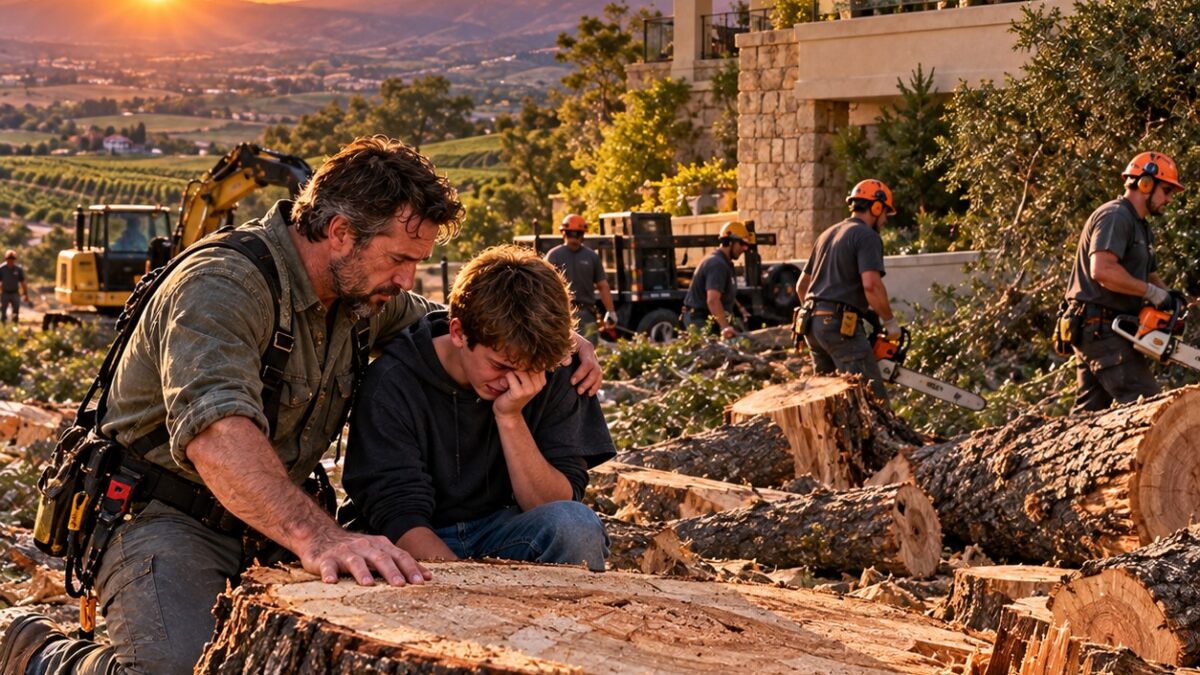
Matteo walked to Big Cyrus’s stump.
Stopped.
Then started crying.
He was fourteen.
He had not cried that way since he was little.
Elena wrapped both arms around him.
I knelt.
Picked up the brass tag.
Warm from the sun.
Sap stuck to the back.
The pin still sharp.
I rubbed it clean with my thumb.
Then noticed something near the lower southern edge of the stump.
Two letters.
CM.
Matteo’s initials.
The cut had passed just above them.
The carving survived.
The tree did not.
A flatbed was leaving in the distance.
Loaded with oak heartwood.
About twenty cords.
That detail would matter later.
At the time, I could barely process it.
Then I looked toward Vista Verde.
Bridget Holloway stood on her view-side balcony.
White wine in one hand.
Watching us.
When our eyes met, she raised the glass.
Then smiled.
That image did something to me.
Not rage exactly.
Rage is hot.
This was cold.
I walked back to the truck.
Called Sloan Ridley.
My attorney.
Environmental litigator.
Sixty-three.
Thirty-five years in practice.
She had argued cases before the California Supreme Court.
I got her emergency line.
Told her what happened in eleven sentences.
She went quiet.
Then told me not to move anything.
Photograph every stump.
Bag wood chips.
Save the heritage tag.
She would be there the next morning.
I sent Matteo inside with Elena.
Then went to work.
That was the only thing I knew how to do.
Photographs.
Every stump.
Every saw cut.
Every tire track.
Every disturbed patch of dirt.
I put fresh chips into separate Ziploc bags.
Measured cut diameters.
Logged GPS coordinates.
Wrote down the time.
Documented the path of the chipper.
Where limbs had fallen.
Where trucks had turned.
Two and a half hours.
The sun vanished.
By nine that night, headlights came up the gravel drive.
Bridget.
Pearl-white Range Rover.
Window lowered.
Tom Ford perfume reached me before her voice did.
She smelled like expensive perfume and Chardonnay.
She told me she was sorry about the inconvenience.
The county fire authority had supposedly issued an emergency removal order Friday.
My grove was a fire hazard.
The HOA had been forced to act.
I asked for the order.
She said it had been mailed to the property owner.
I asked how the HOA had obtained a copy of an emergency order supposedly issued to me.
She blinked once.
Then smiled.
“Some of us value views over weeds, Holden.”
Window up.
Range Rover gone.
I stood in the dust with my father’s brass tag in my pocket.
Weeds.
Big Cyrus was older than California statehood.
The youngest of the six planted trees had stood there about 170 years.
Heritage trees are not weeds because somebody’s balcony faces west.
That night Elena had Matteo on the couch.
Blanket over him.
He was not crying anymore.
He stared at the ceiling.
I sat on the floor beside them.
My father’s tag in my hand.
Matteo asked the question I knew was coming.
Were we going to do something?
“Yes.”
I told him we were going to do everything.
Sloan arrived at nine the next morning in an old Land Cruiser.
Gray hair.
Black coffee.
Wedding ring hanging from a chain around her neck.
She walked the entire grove.
No drama.
No outrage for show.
She photographed.
Measured.
Asked me questions.
Called her associate.
Then called the California heritage-tree registry.
Cal Fire.
County environmental crimes.
By two that afternoon, Captain Walt Hennessy drove in.
Regional Cal Fire director.
Old-school fire officer.
Flat eyes.
Green agency truck.
He inspected the stumps.
Read the tag.
Removed his hat.
Then told me Cal Fire had issued no emergency removal order.
None.
The grove had been rated low risk the previous October.
Whoever told the HOA otherwise had lied.
Sloan asked whether he would put that in writing.
He said he would put it on a billboard.
By four, Holly Kaine from the California Heritage Tree Registry arrived from Sacramento.
Plant biologist.
Fifty.
Beat-up Subaru.
She moved through the grove like somebody entering a crime scene and a funeral at the same time.
She authenticated tag 147.
Confirmed Big Cyrus’s registry status.
Inspected all seven stumps.
Then filed an emergency environmental violation report on the spot.
By six, Pearl Donigan from the local Tribune arrived with a photographer.
Pearl had been investigating HOA misconduct in Vista Verde for four months.
She told me she had been waiting for one thread strong enough to pull.
I gave her the whole spool.
The story ran Sunday.
Front page.
380-YEAR-OLD HERITAGE OAKS DESTROYED; HOA PRESIDENT FACES CRIMINAL INQUIRY
Captain Hennessy quoted.
Holly quoted.
Photograph of Big Cyrus’s stump.
My father’s brass tag in the foreground.
Monday morning, my phone began ringing.
Tuesday morning, Bridget escalated.
A county fire inspector named Carl Davenport—connected through her family—issued me a trespass advisory claiming I had entered HOA property to photograph the tree stumps.
The stumps were on my twenty-two acres.
The county magistrate tossed the advisory within forty-eight hours.
Wednesday:
Noise complaint about my arborist equipment.
Sloan responded with a cease-and-desist and licensing documentation.
Thursday:
Another threat.
This time aimed at my contractor credentials through the state licensing board.
My contact there called directly.
He wanted to know what kind of stupidity Bridget was trying to manufacture.
I documented it.
Every call.
Every notice.
Every date.
Friday was the one that hurt.
Avery Holloway.
Twenty-four.
Bridget’s daughter.
Aesthetic Standards Coordinator.
She stood in front of her mother’s new unobstructed sunset view and filmed a TikTok.
She mocked the dead trees.
Called them dirty ranch trees.
Said the HOA had done everyone a favor.
Then she joked about Matteo.
Called him the little tree hugger.
Four-point-seven million views in eighteen hours.
Matteo saw it at school.
Lunch period.
He came home.
Said almost nothing for two days.
He ate cereal at the kitchen table and barely touched it.
Went to his room.
Skipped dinner.
Elena went upstairs the second night.
When she came down, her eyes were red.
She did not tell me what they had talked about.
She made me black coffee.
Put her hand on the back of my neck.
Kept it there.
I sat in my workshop later.
The shelves still held eleven mason jars.
My father’s last fall, he collected acorns from Big Cyrus and the other registered trees.
Each jar had a paper label.
Date.
Donor tree.
His handwriting.
I held tag 147.
Looked at the jars.
Called Sloan.
“We escalate.”
She was quiet for half a second.
Then said:
“We were already escalating. Now we go nuclear.”
The county environmental crimes unit opened a formal investigation Monday.
Sergeant Augusta Pollock led it.
Soft-spoken.
Forty-five.
Years investigating timber theft in Northern California.
She arrived with two crime-scene technicians and a ground-penetrating radar unit.
They mapped stumps.
Chip patterns.
Saw cuts.
Vehicle routes.
By Friday, they identified the tree company.
Sunshine Tree Services out of Atascadero.
Owner:
Ed Moley.
Small outfit.
Not some organized criminal crew.
Ed had not known the oaks were registered.
He had been told they were wild ranch oaks covered by verbal county authorization.
The following Tuesday, he walked into the sheriff’s office voluntarily.
Brought everything.
Work order.
Messages.
Notes.
Payment record.
He named names.
Bridget had paid him personally.
Forty-eight thousand dollars.
Cash.
Unmarked bills.
Money drawn from the HOA discretionary fund.
Then he described the conversation.
Avery had told him her father’s county connection would handle the paperwork.
Just hurry.
Ed became the third major piece.
Cal Fire had already said no emergency order existed.
Holly confirmed protected-tree status.
Now the contractor admitted he had been given false information and paid outside normal board procedure.
Sloan attacked the financial side.
Sunshine Act requests.
Five years of HOA records.
Bond records.
That was where the $2.4 million wall appeared.
I had stumbled across it during one of my late-night research sessions.
Approved in 2018.
Three-quarter supermajority of Vista Verde homeowners.
Purpose:
A defensive privacy and fire-suppression wall along the western boundary.
Exactly the boundary beside my oaks.
Ninety feet high.
Three-quarters of a mile long.
The bond money had been sitting in county escrow for six years.
Bridget had blocked implementation over and over.
The wall would destroy her sunset view.
She had spent six years keeping it from moving forward.
Then she killed the grove that had partially blocked the same view.
She thought the wall was dead.
She was wrong.
The people who wanted that wall had never disappeared.
They had simply stopped winning votes while Bridget controlled the board.
Once the heritage-tree story broke, they called me.
Their leader was Margaret Wilcox.
Seventy-three.
Retired botanical illustrator.
Denim jacket with twelve enamel pins.
Mostly birds.
Coffee with two sugars.
She drove to my workshop in a 1998 Volvo wagon whose back seat looked like a rolling filing cabinet.
She had known my father.
She brought engineered wall plans.
A list of seventy-eight Vista Verde homeowners who had supported recalling Bridget at different points over six years.
A stack of proxies.
A contractor bid.
And a small watercolor of Big Cyrus she had painted in 1991.
She handed me the painting.
For a moment I could not take it.
The tree was there.
Alive.
Massive.
The exact angle I remembered from the lower field.
Margaret apologized for what her HOA had done.
Then asked for one favor.
Help bring the wall back to a vote.
I asked how ready they were.
Bond money in escrow.
Plans engineered.
Contractor pre-bid.
Homeowners ready.
They needed Bridget recalled.
Two hundred seventy votes maybe.
Two hundred ninety would make it impossible to challenge.
They had proxies.
I told her I would help.
That afternoon, I pulled our original 1854 land patent from the county recorder.
Holly authenticated the property record.
When I returned home, the grove was still empty.
The stumps were covered to preserve evidence.
Matteo sat beside me on the porch.
Sunset moved across the place Big Cyrus used to occupy.
He asked quietly whether the trees were really gone.
“Yes.”
I was not going to lie.
“Big Cyrus is gone. They’re gone.”
He kept looking.
I told him about our great-great-grandfather.
The acorns.
My father’s eleven jars.
The possibility of new oaks.
Big Cyrus’s children.
We could plant them.
We could make sure nobody ever cut them down again.
Matteo looked at me.
Then nodded.
No smile.
Not yet.
But he listened.
Late August brought the discovery that turned the case from environmental destruction into something much larger.
Sloan returned with three banker boxes.
She sat at my kitchen table with Sergeant Pollock and Holly Kaine.
Document after document.
The first problem was Carl Davenport’s supposed fire paperwork.
Wrong form.
Generic vegetation removal.
Not a true emergency fire-abatement order.
The document referenced Cal Fire authorization that never existed.
That made the paper itself evidence of fraud.
The second problem was money.
Forty-eight thousand dollars from the HOA discretionary fund.
The HOA bylaws required a board supermajority for expenditures above five thousand.
No board vote.
No record.
No proper authorization.
The money had been taken from homeowner dues and turned into cash for the cutting.
Third was an internal HOA email Bridget wrote three weeks before the trees came down.
Her own words.
With those weeds gone, they could argue the western boundary was a defensive fire line.
The wall faction would lose its leverage.
Premeditation.
Bridget had not reacted to an emergency.
She had planned around the wall.
Then came the worst document.
Greer Holloway.
Her husband.
Wine-industry attorney.
He had been negotiating with a Napa development firm to purchase my twenty-two acres.
The plan:
Luxury winery and tasting room.
The letter of intent was dated two months before my grove was cut.
Purchase price contingent on removal of vegetation that limited the viewshed and complicated entitlement.
There it was.
Not merely vanity.
Money.
The clearing was part of a land-acquisition strategy.
The proposed price adjustment:
$3.1 million below market.
They called it a remediation adjustment connected to loss of the grove.
Destroy the heritage trees.
Damage the property’s environmental and historic value.
Make the land less desirable to me.
Then arrive with a discounted offer and make it look generous.
I read the document twice.
Then stopped.
Holly leaned back.
She said the State of California had been waiting for a case like this for years.
The state would join the criminal complaint.
Sloan began listing exposure.
Heritage-tree offenses.
Conspiracy.
Fraud.
Bribery.
Embezzlement.
Interference with property rights.
Civil damages conservatively above eleven million.
Then I asked about the wall.
Sloan smiled.
The wall, she said, was the bow on top.
Bridget destroyed seven historic trees because she wanted a better view.
If Vista Verde recalled her, that same HOA could authorize release of a $2.4 million bond for a ninety-foot wall directly in front of her estate.
A view block she had spent six years preventing.
Matteo had come downstairs.
He sat on the floor beside my chair.
“Dad, are we going to win?”
By then, I understood something.
Winning no longer meant making Bridget feel bad.
The criminal case existed.
The environmental case existed.
The financial record existed.
The wall faction existed.
The acorns existed.
So I told him:
“Son, we already are.”
The next two weeks became a precision build.
Sloan assembled a four-attorney team.
Environmental law.
Real-estate fraud.
Civil litigation.
State environmental crime.
The criminal complaint ran forty-three pages.
It named Bridget Holloway.
Greer Holloway.
Avery Holloway.
Carl Davenport.
The civil complaint sought $11.8 million in restoration damages, additional punitive recovery, and disgorgement tied to any planned development profit.
Holly prepared a thirty-six-page expert affidavit.
Tree-ring density.
Age.
Carbon sequestration.
Wildlife habitat.
Ecosystem services.
Historic value.
Her appraisal placed the destroyed grove at $9.3 million.
Captain Hennessy issued a formal Cal Fire repudiation of the supposed emergency order.
Every Vista Verde homeowner received a copy.
Margaret quietly prepared the recall.
Community center booked.
Ballots printed.
Proxies gathered.
Wall plans ready.
I worked in my workshop until late every night.
I wrote my statement three times.
Read the final draft to Elena at the kitchen table around eleven one night.
She listened.
Changed one line.
Then told me it was right.
Pearl Donigan kept publishing.
Three follow-up stories.
Then a fourth.
The fourth featured a photograph of the eleven mason jars of acorns.
Headline about a 170-year family legacy reduced to stumps and the law that might help restore it.
NPR’s Central Coast affiliate picked it up.
Then the Los Angeles Times.
Then Sacramento political press.
The story had moved beyond my land.
That made me uncomfortable.
Matteo surprised me.
He came home from school one Friday with three boys.
They had heard about Big Cyrus.
They wanted to help plant.
Elena made dinner.
The boys sat on the porch asking Matteo about the mason jars.
For the first time in almost three weeks, he talked about something besides what had been cut.
Sunday, Holly returned with five state forestry staff.
They surveyed all twenty-two acres.
Twenty-three potential planting areas.
If the acorns germinated well, the eleven jars could produce up to six hundred saplings.
Six hundred descendants.
The forestry crew brought a brass-tag stamping machine.
Holly had arranged it without telling me.
They offered to stamp three hundred tags in my father’s honor.
The first new number:
148.
They handed it to Matteo.
He held it carefully.
Like glass.
Six hundred trees.
He repeated the number.
I told him every one of them might outlive us.
That was the first real smile I had seen from him since the chainsaws.
Bridget’s criminal charges did not bring humility.
They brought panic.
She made bail late at night.
The next morning, she announced a community defense rally at the Vista Verde clubhouse.
Every homeowner invited.
Slideshow ready.
She was going to set the record straight.
Twelve people attended.
Three relatives.
Two left during her speech.
Bridget cried on stage.
KSBY aired the clip that evening.
Then she sued us.
Three hundred thousand dollars.
Defamation.
Me.
Pearl Donigan.
Captain Hennessy.
Forty-one-page complaint accusing us of coordinated character assassination.
The problem was simple.
She could not identify a meaningful statement that was false.
Sloan filed an anti-SLAPP motion.
The judge granted it.
Bridget was ordered to pay about $83,000 in legal fees connected to the failed suit.
Front page again.
Pearl framed the order and hung it in the newsroom.
Then Bridget made the mistake even I could not believe.
Four nights before the recall vote, she called Margaret Wilcox.
Offered thirty thousand dollars from personal funds.
Cancel the recall.
Call it community healing.
What Bridget apparently did not know was that before Margaret became a botanical illustrator, she had worked as a forensic accountant.
She had recorded her phone interactions with Bridget for years.
The recording device lived in the side pocket of that denim jacket.
Margaret recorded the entire call.
At eight the next morning, Sergeant Pollock had a copy.
Bridget’s criminal file grew again.
Then came her counter-petition.
Greer pressured partners at his law firm to circulate a homeowner support letter.
Two hundred forty households received it.
Thirty-one signatures supporting Bridget.
One hundred seventy-three opposing her.
Some homeowners signed the opposition side twice.
Then the press conference.
Two days before the vote.
Navy dress.
Pearls.
Prepared statement.
She apologized for any miscommunication.
Claimed the trees had been removed in good-faith reliance on a clerical error by one county inspector.
Claimed the HOA had been victimized by Carl Davenport.
She did not apologize for cutting the trees.
Did not mention the $48,000 cash payment.
Did not mention the winery agreement.
Did not mention the bribery call.
Did not mention Big Cyrus by name.
Did not mention my father.
Did not mention Matteo.
We watched from my kitchen.
When she finished, Matteo turned to me.
“Dad, she’s lying again.”
“Yes.”
“Is anyone going to believe her?”
“No.”
He turned the television off himself.
Then walked outside.
Sat on the bench my father built in 1994.
Looked toward the empty grove.
Elena eventually sat beside him.
He leaned into her shoulder.
They stayed until the sun was gone.
The morning of the recall vote, I woke at 4:30.
Dark room.
Elena asleep.
Matteo down the hall.
Morning dove on the porch rail.
I made coffee.
Sat at the kitchen table.
Dad’s brass tag number 147 in front of me.
Prepared statement beside it.
At six, Sloan arrived with two associates and breakfast burritos from a truck stop in Templeton.
She also brought one more piece of evidence.
Notarized affidavit.
Russell Trumbo.
Retired attorney.
Former Vista Verde HOA board member.
He had served with Bridget for two years.
The affidavit described five separate board discussions where Bridget talked about removing my grove and Greer’s plan to acquire the cleared parcel for winery development.
Russell had contacted Sloan two days after the cutting.
He wanted to remain anonymous until the recall.
That day he was ready to put his name on it.
Nine in the morning, Margaret called.
Two hundred eighty-seven confirmed proxies and attendees.
Eleven, Sergeant Pollock called.
Greer had been served with another criminal warrant related to the winery conspiracy.
One, Holly called.
The California Heritage Tree Registry had voted unanimously to designate my property a restoration site of special interest.
At three, I shaved.
Put on a clean white shirt.
Placed tag 147 in the breast pocket.
Helped Matteo button his Sunday shirt.
Elena wore green.
We reached the Vista Verde clubhouse at five.
Parking lot full.
Three local news vans.
Tribune photographer.
Pearl inside.
Captain Hennessy in uniform.
Holly with a leather portfolio.
Margaret in the denim jacket.
Russell Trumbo sitting front row.
Sloan arrived shortly after us.
Three hundred thirty-eight homeowners and proxies checked in.
Previous attendance record:
Twenty-six.
Bridget sat at the front table.
Cream blazer.
Pearls.
She did not look at me when we entered.
Matteo took my hand.
Elena held my arm.
We sat in the back.
Acting president Jerome Fielding opened at 5:30.
Margaret spoke first.
The wall.
Ninety feet tall.
Three-quarters of a mile long.
Pre-engineered.
Bond funded.
Ready to break ground within six weeks if approved.
Eleven-minute presentation.
Charts.
Renderings.
Cost breakdown.
When she finished, applause lasted about two minutes.
Then Jerome called my name.
I walked to the front.
The microphone smelled like dust and old foam.
Fluorescent lights buzzed.
Every chair full.
People lining walls.
Standing in the doorway.
I unfolded my statement.
Then removed my father’s brass tag from my pocket.
Placed it on the podium.
I told the room I wanted to read four things.
First:
The heritage-tree protections that applied to registered trees like Big Cyrus.
Seven registered trees had been destroyed.
The statutory and civil exposure was enormous.
Second:
Captain Hennessy’s formal Cal Fire statement.
No emergency removal order existed.
Any document suggesting otherwise was fraudulent.
Third:
Bridget’s own internal email.
Her words.
Without those weeds blocking them, the HOA could claim a defensive fire boundary.
The wall faction would lose leverage.
I stopped.
Let the silence sit.
Then fourth:
Russell Trumbo’s affidavit.
Five separate board discussions.
Bridget’s intention to remove the grove.
Greer’s plan to acquire the land afterward.
I folded the page.
Picked up tag 147.
“My father stamped this in 1986.”
I held it up.
Big Cyrus had been about 348 years old then.
My father had told me on his deathbed that I was the steward of those oaks.
I told the room the hardest truth I had.
I failed him.
The HOA killed those trees while I was at a conference about saving trees.
There was no legal victory that could make a 380-year-old oak stand again.
No settlement that could add 380 years to a sapling.
But there was one thing I could still do.
Bridget had killed the grove for a view.
The wall faction now had the floor.
I yielded mine.
I sat down.
Ten seconds of silence.
Russell Trumbo clapped first.
Slow.
Steady.
Margaret joined.
Captain Hennessy.
Holly.
Then more.
The applause grew.
People stood.
I counted automatically.
Fifteen seconds.
Thirty.
Sixty.
Ninety-three.
I counted because my father used to count growth rings when teaching me how to age a tree.
Margaret stood.
Moved to call the recall vote.
Ballots.
Show of hands.
Proxies verified.
The result:
287 to 25.
Bridget Holloway removed as HOA president.
Then the wall.
291 to 21.
The $2.4 million bond was authorized for release.
Construction to begin in four weeks.
Bridget stood.
Pale.
Greer was not beside her.
Avery was not beside her.
For the first time since I knew that family, Bridget looked completely alone.
She walked toward the rear exit.
Then the projector behind her lit up.
Margaret had loaded a rendering.
Ninety-foot privacy wall.
Three-quarters of a mile.
Solid concrete and stucco.
Running the western boundary of Vista Verde Estates.
Directly between Bridget Holloway’s $4.2 million house and the sunset she had destroyed seven historic trees to see.
She walked out underneath the image of her own permanent view block.
Pearl’s photographer caught the moment.
Front page the next morning.
The irony spread faster than any statement I could have made.
But the wall was not the end.
The criminal cases moved.
According to the outcome in the source, Bridget pleaded guilty to seven heritage-tree felony counts, two fraud counts, bribery, and embezzlement.
She received an eighteen-month state-prison sentence, five years probation, and restitution.
Greer pleaded guilty to fraud and conspiracy.
His California State Bar status was suspended for two years.
He was fined $400,000.
The winery deal collapsed before arraignment.
Avery pleaded to misdemeanor harassment.
Her social-media account disappeared.
The invented HOA job disappeared with it.
Carl Davenport lost his county position and pleaded guilty to forgery and bribery.
He received a one-year sentence.
The civil settlement:
$11.8 million.
The HOA paid within ninety days using insurance and a special assessment.
Bridget’s $4.2 million estate went on the market within a month.
The privacy wall went up.
Eight months after the recall, it stood ninety feet high and three-quarters of a mile long.
Smooth gray concrete.
Stucco finish.
From Vista Verde, the westward wine-country sunset was gone.
From my land, the subdivision that had orchestrated the destruction of my grove disappeared too.
Both sides blocked.
For the first time in months, the property felt quiet.
Bridget’s estate eventually sold fourteen months later.
Final price:
$2.6 million.
I did not celebrate the loss in value.
The irony already spoke for itself.
She had destroyed a 380-year-old tree to improve a view.
Then the people she had spent six years preventing from building a wall voted overwhelmingly to block that view permanently.
There are consequences you engineer yourself.
Nobody needs to add anything.
The money could not restore Big Cyrus.
That mattered more than every verdict.
Settlement numbers sound dramatic.
$11.8 million.
$9.3 million ecological valuation.
$2.4 million bond.
$3.1 million proposed development discount.
But trees do not grow in dollars.
A century is a century.
Big Cyrus had lived through the Civil War.
Two world wars.
Depression.
Drought.
Decades of my family.
Then one afternoon with chainsaws ended it.
No judge can reverse a cut.
So we planted.
March.
The first hundred saplings went into the ground on the parcel where the original grove stood.
Holly and the state heritage tree program matched my privately funded plantings one for one.
Matteo and I planted every tree by hand.
Not alone.
Margaret came.
Captain Hennessy.
Sergeant Pollock.
Twelve of Matteo’s classmates.
Elena.
People who had been strangers before the case.
We dug.
Set roots.
Backfilled.
Watered.
Protected trunks.
The grove looked almost ridiculous compared with what had been there.
Tiny green stems.
Protective tubes.
Bare soil.
No ninety-five-foot crowns.
No deep shade.
No massive limbs.
You could walk across the new planting in sunlight.
Still, there were trees.
Big Cyrus’s children.
That became the name.
I established the Cyrus Marquetti Heritage Tree Conservation Trust.
It helped California landowners facing similar conflicts.
In the first eighteen months, it assisted sixteen families.
One case helped protect a 220-year-old oak grove in Northern California from another HOA dispute.
The story had moved outward.
That felt right.
My father had registered Big Cyrus because he believed stewardship meant thinking beyond one property.
The trust did the same.
We also created a forestry scholarship.
Matteo’s idea.
Named in honor of my late father.
Full tuition each year for two students studying urban forestry or arboriculture at Cal Poly San Luis Obispo.
Matteo was fifteen by then.
He had decided he wanted to become an arborist.
Then decided he also wanted to be a state forester.
He told me, seriously, that he wanted to work with trees in the morning and read law in the afternoon.
I told him that sounded like the best kind of forester.
He started carrying a small notebook in his back pocket.
Just like my father.
Bird names.
Acorn dates.
Sapling diameters.
Weather.
Growth.
Half full.
Half waiting.
Every Sunday morning, Elena and I still walk the grove.
The saplings were about eleven inches tall when the source ends.
Eventually they will be eleven feet.
Later, larger.
Not Big Cyrus.
Never Big Cyrus.
Something new.
The first descendant planted on the original stump was Little Cyrus.
Tag:
148
Matteo carved his initials into the protective stake.
Not the sapling.
The stake.
The wood will eventually rot.
By then, the tree will be larger.
Maybe he will carve them again when the trunk is ready.
Maybe he will decide not to.
That choice belongs to him.
Tag 147 sits on a shelf in my workshop.
My father’s tag.
Beside a framed photograph of Matteo on his grandfather’s shoulders.
Tag 148 belongs to Little Cyrus.
149 waits for the next tree.
The state gave us three hundred more.
Some days I walk to the grove and find Matteo sitting in the grass.
Reading.
Always near the place Big Cyrus used to cast shade around four in the afternoon.
There is no shade there yet.
He says the light is right.
I leave him alone.
I think often about my father’s last week.
Hospital room.
His voice weaker.
Telling me those oaks could outlive me by a thousand years if I did my job right.
For a long time after the cutting, that sentence felt like an accusation.
I had left.
They came.
The trees died.
Steward.
What kind of steward allows chainsaws to take seven protected trees while he is attending a conference about conservation?
The rational answer is obvious.
I did not fail because someone committed a planned crime while I was away.
But grief does not always accept rational answers immediately.
The guilt sat there.
Heavy.
Then I watched Matteo plant tag 148.
I watched his classmates carry buckets.
I watched Holly explain root flare.
I watched Margaret stand beside the watercolor she had painted thirty-three years earlier.
And slowly I understood something.
Stewardship is not a promise that nothing will ever be harmed.
No human being can make that promise.
Stewardship is what you do before the harm.
During it.
After it.
My father protected Big Cyrus.
Registered it.
Collected acorns.
Recorded dates.
Stored eleven jars.
Without knowing why.
That last act saved the future of the grove.
His stewardship continued after his death because he left something capable of continuing.
The acorns did not care that Bridget won one afternoon.
They waited.
Glass jars.
Workshop shelf.
Labels in pencil.
Patient.
That word mattered.
Patience.
Bridget mistook patience for weakness.
She saw a man who answered her letter with three polite lines.
A family that left town for four days.
A quiet parcel below her luxury subdivision.
An arborist.
A ranch.
Old trees.
She saw obstacles.
She did not see records.
Registry numbers.
Environmental statutes.
Tree-age documentation.
Fire-risk reports.
Land patents.
HOA bylaws.
Escrow bonds.
Emails.
Bank records.
A contractor willing to tell the truth.
An old woman in a denim jacket holding six years of wall plans.
A retired attorney ready to sign an affidavit.
Eleven jars of acorns.
She did not check any of those things.
She assumed authority could be created by speaking with enough certainty.
That assumption worked for a while.
County forms.
HOA stationery.
Threats.
Her husband’s connections.
Her daughter’s social-media audience.
A polished image can intimidate people before facts have time to arrive.
Facts arrived anyway.
Cal Fire.
The heritage registry.
Sergeant Pollock.
Sloan.
Pearl.
Margaret.
Russell.
Ed Moley.
Each person held a different piece.
Once those pieces met, Bridget’s version of events became impossible.
No emergency order.
No legal authorization.
No innocent mistake.
No community safety crisis.
Just a plan.
Cut the grove.
Improve the view.
Weaken the wall faction.
Depress the value of my property.
Acquire the land.
Build a luxury winery.
Then profit.
The trees were not collateral damage.
They were part of the strategy.
That was the detail I had the hardest time accepting.
The first night, I thought Bridget killed Big Cyrus because she was vain.
That would have been awful enough.
The documents showed something colder.
She looked at 170 years of family stewardship and a 380-year-old living organism and saw a line item interfering with a development opportunity.
The grove had value because it was ancient.
She needed it to have less value.
So she made it less valuable.
Then planned to discount the land based on the damage she helped cause.
That was what turned public sympathy into anger.
Vista Verde homeowners understood it too.
Bridget had used their money.
Forty-eight thousand dollars from their dues.
No supermajority vote.
Then she tried to undermine the wall project they had already funded with a $2.4 million bond.
She did not merely attack my family.
She treated her own neighbors as accounts she could spend.
That is why the recall vote became so overwhelming.
287 to 25 was not people choosing me over Bridget.
It was homeowners realizing what had been done in their name.
The wall vote mattered for the same reason.
291 to 21.
For six years, Bridget had made the wall feel impossible.
Her grip on the board was too strong.
Her view too valuable.
Her influence too deep.
Then the grove came down.
One act of overreach broke the fear maintaining everything else.
Margaret had been waiting.
Seventy-eight signatures over the years.
Proxies.
Plans.
Contractor.
Bond.
The wall was not revenge I invented after the trees were cut.
It was an approved community project Bridget had suppressed.
That distinction mattered to me.
I did not pour ninety feet of concrete beside her house.
Vista Verde homeowners did what they had already authorized years earlier.
I simply stopped standing in the way of their decision.
If Bridget had left Big Cyrus alone, she might have kept her sunset.
Instead she destroyed the trees protecting her from the political consequence of her own obsession.
There was poetry in that.
But not enough poetry to make me glad the trees were gone.
I would trade the wall, settlement, headlines, trust, scholarship, every dollar, every satisfying vote, if I could put Big Cyrus back where he stood.
That remained true.
A satisfying consequence is not the same thing as a worthwhile loss.
People like clean endings.
Bad person punished.
Good person compensated.
Trees replanted.
Done.
Nature does not work that quickly.
Neither does grief.
Little Cyrus will not reach Big Cyrus’s size in my lifetime.
Probably not Matteo’s.
Maybe not his children’s.
That is precisely why heritage trees matter.
They demand a kind of thinking human beings are bad at.
You plant for people you will never meet.
Protect something whose full value belongs to another century.
My great-great-grandfather planted.
My father registered.
I inherited shade.
Now the sequence starts again.
We plant.
Some future child may inherit shade.
That is stewardship.
Not owning time.
Borrowing from it responsibly.
Matteo understands that now in a way I wish he never had to learn.
Before the cutting, Big Cyrus was simply there.
Children accept ancient things like gravity.
Afterward, he understood absence.
Then regeneration.
The new notebook appeared after planting.
He measures Little Cyrus.
Logs rain.
Birds.
Acorn drops from surviving trees elsewhere on the property.
He notices things because loss trained his attention.
Again, I would rather he had learned attention without pain.
We do not choose every lesson our children receive.
We choose what we help them do with it.
The TikTok hurt him in a way legal damages never captured.
Four-point-seven million views.
Avery mocking him.
A teenager reduced to content because he loved a tree.
For two days he almost disappeared into his room.
Then classmates came asking to help plant.
That became another reversal.
The same public story that humiliated him also connected him to people who understood.
His school friends did not call him the little tree hugger.
They wanted to plant Big Cyrus’s descendants.
Three came first.
Then twelve helped in March.
Avery’s video vanished.
The trees remained.
Not tall.
Not dramatic.
Still there.
I never asked Matteo whether he forgave her.
That is his business.
The scholarship was his answer.
Instead of using what happened to punish another person, he wanted to help future arborists.
That told me enough about the man he might become.
Elena carried more of this story than people saw.
News photographs showed me.
Matteo.
Stumps.
Bridget.
Officials.
Attorneys.
Elena stayed just outside the frame most of the time.
She was the one who sat upstairs with our son when he stopped talking.
The one who made coffee at midnight.
The one who read my recall statement and changed a single sentence.
The one who walked the new grove with me every Sunday after everything ended.
Public fights often produce private caretakers.
They rarely get headlines.
I knew.
The restoration trust carried my family name.
The grove carried Big Cyrus’s.
But home survived because Elena kept it functioning while I spent weeks dealing with lawyers, investigators, reporters, and documents.
That was another kind of stewardship.
Pearl asked me once, after the civil settlement, whether I felt vindicated.
I told her the word was too clean.
Vindication suggests the thing that hurt you is corrected by proving you were right.
The court could prove I was right.
The state could prove Bridget lied.
The HOA could recall her.
A wall could erase her view.
Still, Big Cyrus was a stump.
What I felt was closer to responsibility.
The outcome gave me resources.
Attention.
Money.
Access.
What would I do with those?
That question mattered more.
The conservation trust answered part of it.
The scholarship answered another.
The new grove answered most.
Use the aftermath to protect something else.
If the story stopped with Bridget in prison and me holding a settlement check, I think my father would have considered that incomplete.
Planting was the missing part.
So we planted.
The first hundred.
Then more.
Tag 148.
Numbers continuing where 147 stopped.
That sequence became important.
A registry is a bureaucratic thing.
Numbers.
Forms.
Coordinates.
Species.
Measurements.
But those brass tags became a family timeline.
147:
Big Cyrus.
My father.
My childhood.
Matteo’s initials at six.
148:
Little Cyrus.
Matteo at fifteen.
Restoration.
The next tags belong to trees whose stories have barely begun.
Maybe somebody else will hold one in 2186.
Maybe not.
You cannot guarantee the future.
You can improve its odds.
That is what my father meant.
I still keep the calendar from 2024.
March:
Bridget’s pruning letter.
August:
Conference.
Cutting.
Investigators.
Every date marked.
Not because I need evidence anymore.
The cases are over.
Because the calendar shows how quickly a world can change.
Tuesday:
Trees standing.
Wednesday:
Stumps.
Then, gradually:
Evidence.
Truth.
Community.
Planting.
There are days I flip through it.
Not often.
Enough.
My father used to say a man who marks days seldom loses them.
The phrase meant more after the case.
Documents did not bring Big Cyrus back.
They prevented Bridget from rewriting why he disappeared.
That distinction matters.
She tried.
Fire hazard.
Emergency order.
Clerical error.
Victim of a county inspector.
Miscommunication.
Every version attempted to move responsibility somewhere else.
The documentation kept the story anchored.
Low-risk Cal Fire rating.
No emergency order.
Cash payment.
Email.
Letter of intent.
Recorded bribery call.
Affidavit.
The truth had dates.
That is why it held.
The criminal outcome was satisfying because the charges matched different parts of the conduct.
The civil outcome was satisfying because it recognized ecological and property damage.
The recall was satisfying because the homeowners reclaimed their own association.
The wall was satisfying because Bridget’s obsession with the view produced the exact opposite result.
But the deepest satisfaction came later.
No cameras.
No court.
No applause.
Just Matteo kneeling beside Little Cyrus.
Packing soil around the base.
Tag 148 waiting.
The first time he watered it, the sapling leaned slightly under the weight of the stream.
He reduced the flow.
Adjusted.
Watched the water soak in.
Careful.
That was the moment I thought of my father.
Not the courtroom.
Not the recall.
That.
A boy learning the amount of water a young oak can take.
The land did not forget what happened.
Neither did we.
But memory became something other than an open wound.
It became instruction.
Do not assume protection is automatic.
Register.
Document.
Maintain.
Teach.
Store acorns.
Keep copies.
Know the law.
Know your neighbors.
Build alliances before you need them.
And when somebody mistakes politeness for surrender, do not waste energy trying to sound more frightening than they do.
Facts can carry farther.
Bridget spent years cultivating the appearance of control.
The Range Rover.
Pearls.
HOA office.
Political connections.
Family jobs.
Law-firm relationships.
Press conferences.
She understood performance.
I understood trees.
Sloan understood evidence.
Margaret understood numbers and voting.
Pollock understood criminal patterns.
Holly understood heritage law.
Hennessy understood fire authority.
Pearl understood public records.
Nobody beat Bridget alone.
Her downfall came from many people doing their jobs correctly at the same time.
That may be the most important part.
People like to imagine corruption requires one heroic opponent.
Usually it requires systems deciding to function.
An agency director willing to say no emergency order existed.
A contractor willing to admit he was misled.
An investigator willing to follow cash.
An old homeowner willing to preserve wall plans for six years.
A reporter willing to verify rather than sensationalize.
A lawyer willing to read every page.
A child willing to plant again.
The result looked explosive at the recall meeting.
The real work was quieter.
Phone calls.
Copies.
Maps.
Bank statements.
Acorn labels.
That is where the case was won.
Four weeks after the recall, heavy equipment arrived along Vista Verde’s western boundary.
Not chainsaws.
Wall construction.
I did not go watch.
I did not need to.
Concrete trucks came.
Forms.
Rebar.
Crews.
Month after month.
Eventually the structure rose high enough to cut the Holloway estate off from the valley view.
Ninety feet.
Three-quarters of a mile.
From my property, Vista Verde also disappeared.
That surprised me emotionally.
I expected the wall to feel aggressive.
Instead it felt quiet.
The subdivision that had stared down into my grove was gone behind concrete.
No Bridget on the balcony.
No Range Rover visible.
No silhouettes on the ridge.
Only land.
The new grove.
Sky.
The wall created the separation that probably should have existed all along.
The wall had originally been proposed for privacy and fire suppression.
Once built, it finally did both.
Bridget’s estate sold later.
$2.6 million.
Far below the original $4.2 million value referenced in the source.
Again, I did not throw a party.
I had no interest in watching strangers tour her house.
By then she had become less important to me.
That was another sign of healing.
During the first month, every decision revolved around Bridget.
What did she do?
What did she file?
What did Avery post?
What did Greer negotiate?
Later, I began making decisions that had nothing to do with them.
Where should Little Cyrus go?
How many planting sites?
What should the trust fund first?
Which students should qualify for the scholarship?
That was freedom.
Not seeing your enemy lose.
No longer organizing your day around them.
The grove returned to being the center.
Not the Holloways.
Big Cyrus’s stump remained.
We did not grind it out.
I could not.
Holly agreed there was ecological value in leaving parts of it as nurse wood and habitat where appropriate.
The main stump became something else too.
Marker.
Not a monument exactly.
I did not add a plaque.
No dramatic inscription.
The growth rings were enough.
Matteo sometimes sits nearby.
He reads.
The sun reaches him differently now.
Once, Big Cyrus would have shaded that spot by four in the afternoon.
Now the light stays longer.
Matteo says he likes it.
I think he is partly convincing himself.
That is okay.
One day Little Cyrus will cast shade.
Not the same shade.
Its own.
By then I may not be there.
That is also okay.
Heritage work requires comfort with endings you never see.
My great-great-grandfather did not see Big Cyrus at 380.
My father did not see the grove cut.
He also did not see tag 148.
We inherit unfinished work.
Then leave it unfinished for somebody else.
That idea bothered me less after everything.
For years, I thought stewardship meant preserving exactly what had been given to me.
Now I know it also means responding when preservation fails.
Big Cyrus is gone.
That sentence remains true.
I can say it without breaking now.
The new grove exists.
Also true.
Both matter.
One does not erase the other.
The settlement did not erase the loss.
The planting did not erase the crime.
The wall did not restore the canopy.
Justice is not erasure.
It is acknowledgment, consequence, and the ability to build forward without pretending nothing happened.
That became the ending I could live with.
Tag 147 stays on the workshop shelf.
I pick it up sometimes.
Brass has darkened slightly.
The pin is still sharp.
Sap is long gone.
My father’s stamped numbers remain.
One.
Four.
Seven.
I could attach it to Little Cyrus.
I will not.
That tag belongs to Big Cyrus.
The new tree has its own number.
That decision matters.
We are not pretending Little Cyrus is the same tree.
Replacement is not resurrection.
The new grove deserves its own history.
Tag 148.
Then 149.
Then whatever comes.
Matteo understands.
He does not ask to put 147 back in the ground.
He keeps his notebook.
Measures.
Reads.
Plans.
At fifteen he talks about forestry with the seriousness some teenagers reserve for cars or sports.
He wants law too.
Not because he wants revenge.
Because he saw what happens when somebody weaponizes paperwork against people who know less about it.
He wants to understand both trees and the systems deciding whether trees survive.
I find that hopeful.
Avery Holloway used millions of views to mock him.
The experience could have taught him that attention is power.
Instead, he learned knowledge is power.
I would take that trade.
Elena says he has my stubbornness.
I tell her he has my father’s hands.
Both are probably true.
We still walk Sundays.
Same day Dad walked.
Not because I planned it.
Habit became tradition before I noticed.
Elena and I go through the new grove.
Check guards.
Moisture.
Rodent damage.
Growth.
Some saplings will fail.
That is inevitable.
Not every acorn becomes a mature oak.
We replant.
Adjust.
Continue.
Nature does not promise perfect survival.
It promises opportunity.
Bridget destroyed seven giants.
We planted hundreds of opportunities.
That is the only arithmetic that matters to me now.
Seven gone.
Six hundred possible.
Not replacement in years.
Replacement in intention.
The Cyrus Marquetti Heritage Tree Conservation Trust eventually helped another family facing pressure over a grove older than their subdivision.
When I heard their trees survived, I went into the workshop.
Looked at tag 147.
Thought:
There.
That is part of your shade too.
My father would have understood.
He believed trees connect places across time.
Maybe institutions can too.
One protected grove because another grove was lost.
One family reading its paperwork because our family learned what happens when somebody else fabricates it.
That is what makes suffering useful without ever making it necessary.
I would still choose a world where Big Cyrus stands.
Given reality, I choose to use what happened.
The wall remains.
Gray.
Tall.
Quiet.
On the other side, Vista Verde continues.
Families.
Cars.
Dogs.
Ordinary life.
The HOA changed leadership.
The people who supported Bridget had to live with what happened.
The people who opposed her had to rebuild trust.
That was their work.
I did not join the board.
Did not need to.
My boundary was finally clear in every sense.
The land has its quiet back.
That is enough.
Some evenings I stand where Bridget once stood visible on her balcony.
Except now I cannot see her former house.
Only concrete beyond the far boundary.
Then trees.
Then sky.
The sunset is still there.
That was the absurdity underneath everything.
The sun never belonged to Bridget.
The mountains never belonged to her.
The fact that seven trees interrupted one angle of one sunset did not deprive her of beauty.
She decided beauty required removal.
That decision cost her the view entirely.
I do not know whether she understood the irony before prison.
It does not matter.
I understand it.
Matteo understands something better.
He does not talk about the wall much.
He talks about saplings.
Where 148 is putting out new leaves.
Which tag comes next.
Whether acorns from jar seven germinated better than jar four.
Bird nests.
Soil moisture.
Future.
That is how I know the story ends in the right place.
Not with Bridget.
With Matteo.
Not with the chainsaw crew.
With planting.
Not with the ninety-foot wall.
With an eleven-inch oak.
Last Sunday, Elena and I walked the grove just after sunrise.
Mist hung low over the field.
Little Cyrus had tiny new leaves.
Bright green.
Almost translucent.
Matteo was already there.
Notebook in his back pocket.
Sitting where Big Cyrus used to cast afternoon shade.
Reading.
I stopped.
Did not call out.
Elena stood beside me.
For a few seconds, I could see three generations layered over the same ground.
My great-great-grandfather carrying acorns.
My father stamping tag 147.
Matteo holding tag 148.
None of them could keep every tree alive forever.
That was never the promise.
The promise was simpler.
Care for what you inherit.
Document it.
Defend it.
And if somebody destroys what you were supposed to protect, do not let destruction be the last thing planted there.
Big Cyrus is gone.
I can finally say that without feeling like I failed my father.
His children are in the ground.
Tag 147 is safe in my workshop.
Tag 148 catches morning light on Little Cyrus.
Three hundred more brass tags wait.
Eleven mason jars became a forest we have not lived long enough to see.
And every Sunday, my son carries a notebook through the place where a woman once believed one afternoon with chainsaws could erase 170 years of family history.
She was wrong.
The trees remember in rings.
The land remembers in roots.
Families remember in the things they choose to plant next.








