PART2:HOA Queen Called the FBI on My Family Farm—She Had No Idea the Land Was Protected Forever
PART2
Her opening shot looked almost reasonable if you ignored everything behind it.
Bartow County Code Enforcement received a formal nuisance complaint.
Persistent malodorous emissions.
Disruptive mechanical noise.
Visually degraded agricultural landscape.
Negative impact on property values and residential enjoyment.
Sixteen photographs attached.
Every one taken from the Etowah Bluffs walking trail about four hundred yards from my nearest cattle pen.
The images showed cows.
Standing.
Grazing.
Lying down.
Doing the same things cattle have done since human beings first decided to keep them.
Beth Garner handled the complaint.
Beth had grown up on a pecan farm in southern Bartow.
That mattered because she understood what she was looking at before she ever opened a statute book.
She came out Thursday morning.
Walked the boundary with me.
Checked setbacks.
Looked at the pastures.
Then tucked her clipboard under one arm.
“Travis, this is a textbook agricultural operation.”
Georgia’s Right to Farm Act protected farms like mine from nuisance claims when agriculture predated surrounding residential development.
My family had been there since 1972.
Etowah Bluffs got its first occupancy permit in 2020.
Beth closed the complaint that afternoon.
She sent Diane a formal county letter explaining that normal agricultural activity on pre-existing farmland could not be treated as a residential nuisance simply because development arrived next door.
I figured that would end it.
It should have.
Three weeks later, an envelope came from the Etowah Bluffs HOA.
Six pages.
Embossed letterhead.
Diane’s signature.
Two other board members.
The HOA had supposedly established an aesthetic and environmental buffer zone extending six hundred feet beyond its own property line.
According to the letter, any property inside that zone would now be subject to community livability standards.
My fence materials were inconsistent with neighborhood aesthetics.
My agricultural machinery was visible from homes.
Livestock could not remain inside the buffer during quiet hours between seven at night and seven in the morning.
Then came the line that almost made me throw my coffee mug.
Unapproved impoundment structure creating potential flood and mosquito hazard.
They meant my stock pond.
Virgil dug it in 1976 with a D6 Caterpillar.
It had watered cattle longer than Diane had probably been driving.
I called my uncle Luther.
Luther had served twelve years on the Bartow County Board of Commissioners.
Before that, eight years as the county’s chief planning officer.
He knew the zoning regulations because he had personally drafted many of them.
I read him the letter.
Silence.
Then:
“Travis, that document has the same legal weight as a grocery list.”
An HOA cannot extend jurisdiction onto land that never joined it.
No covenant.
No contract.
No membership.
No authority.
Luther told me not to respond.
File it.
So I did.
But I also started a folder.
Heavy-duty expanding file.
Kitchen counter beside the coffee maker.
Everything went in.
Letters.
Photographs.
Dates.
County responses.
Certified mail receipts.
Dad had taught me that.
“If somebody’s reaching for your land, stack paper until you’ve got more documentation than they’ve got ambition.”
The following Sunday, Luther caught me after church.
Pine Hollow Baptist.
Holcombs had occupied the fourth pew since 1973.
“If she files one more thing,” he said, “you call me.”
I told him I could still handle it quietly.
That optimism lasted until Diane went after Holcomb Mill Road.
Holcomb Mill Road runs a mile and a quarter from my farm to Georgia State Route 61.
Granddad built the original road in 1974.
Hired a grading crew.
Hauled crush-and-run.
Maintained it himself.
The county formally accepted it as a public rural road in 1981.
Technically, maintenance became their responsibility.
Practically, Holcombs kept grading it because if you call a county road department about one pothole, you may get action sometime between next Tuesday and the second coming.
Etowah Bluffs had its own main entrance farther south.
But the developer’s walking trail crossed Holcomb Mill Road at one point.
They had installed decorative stamped-concrete crosswalk paving and reflective markings.
No county permit.
No consultation.
No approval.
Diane decided that crosswalk transformed Holcomb Mill Road into a neighborhood access corridor.
She petitioned the county for speed bumps.
Ten-mile-per-hour limit.
Ban on agricultural equipment during what she called pedestrian priority hours.
Five to nine in the morning.
Three to seven in the evening.
In other words, ban farm machinery during the exact hours farmers often need it.
She also requested child-safety bollards paid for by the county.
Sixty-three Etowah Bluffs residents signed.
Beth Garner called me.
“Travis.”
I could hear exhaustion in the first word.
“She’s going after the road.”
The petition reached the Board of Commissioners at the next regular meeting.
Luther sat in the gallery.
He was retired, but four of the five current commissioners had farming backgrounds or agricultural family ties.
Dale Stoddard ran a poultry operation.
Janet Pugh came from four generations of cotton farmers.
Diane arrived prepared.
Twenty-six-slide PowerPoint.
Professional graphics.
Satellite imagery.
Red danger zones.
Stock photography of tree-lined suburban streets.
Federal pedestrian-safety statistics.
Rural-fatality data.
She spoke sixteen minutes.
Polished.
Organized.
Completely disconnected from the practical reality of moving hay equipment, cattle trailers, tractors, and timber machinery through rural Georgia.
When public comment opened, I stood.
Work boots.
Faded Carhartt jacket.
I had been cutting timber since six that morning.
I said only what mattered.
My grandfather built Holcomb Mill Road in 1974.
The county accepted it in 1981.
The decorative crosswalk was installed by the developer in 2020 without county authorization.
The road existed forty-six years before Etowah Bluffs cleared its first lot.
Commissioner Stoddard asked one question.
Had the county transportation department approved the crosswalk?
No.
No permit.
No consultation.
Nothing.
The petition failed.
Five to zero.
Then Commissioner Pugh added another motion.
Remove the unauthorized decorative crosswalk from Holcomb Mill Road.
That passed unanimously too.
Diane sat in the third row.
Leather portfolio squeezed between both hands.
Her knuckles went white.
Afterward, she caught me in the hallway.
Heels striking tile.
Fast.
Angry.
“You think because your name is on a road sign you own this county?”
I looked at her.
“I know people,” she continued. “I know agencies. I know how to escalate past county government. You have no idea what’s coming.”
She was trembling.
Not fear.
Fury.
That was when I finally understood.
This was not about cattle odor.
Not about road safety.
Not about a pond.
Diane could not emotionally process losing.
Especially to a man in muddy work boots.
I told her I had been working that land since I could carry a fence post.
I would still be there long after she sold that house.
Then I walked away.
The county minutes posted the following week.
Petition denied.
Pre-existing agricultural use.
Established county road.
Unauthorized trail infrastructure.
My cousin Shelby, who runs the Bartow County Farm Bureau, called.
“She’s going nuclear.”
I told her I knew.
“Keep that folder fat.”
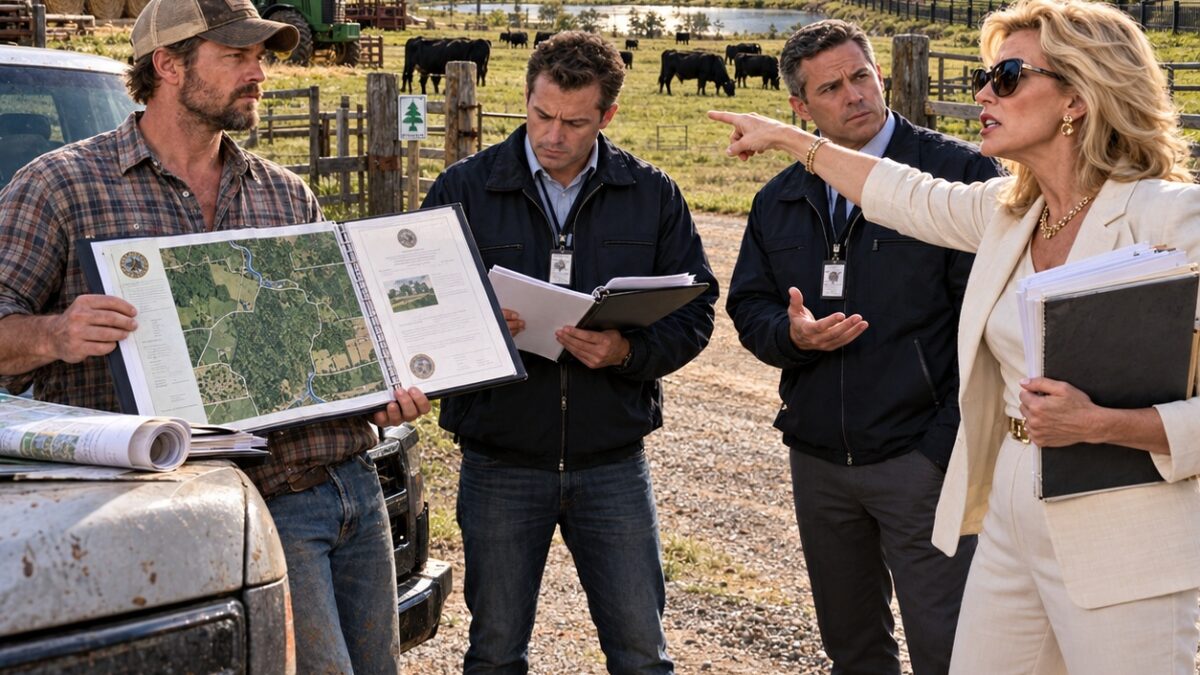
Eight weeks later, the FBI came up my driveway.
Wednesday morning.
I was knee-deep in a drainage ditch rebuilding a culvert washed out by a thunderstorm.
Red clay up my arms.
Cow manure on my boots.
Dark blue Chevrolet Tahoe.
Federal plates.
Two agents.
Special Agent Mercer.
Mid-forties.
Calm.
Precise.
His partner, Suarez, younger, carrying a tablet and camera.
Mercer told me they had received a detailed complaint alleging environmental crimes.
Unlicensed discharge of agricultural waste into the Etowah River watershed.
Confined animal feeding operation without EPA registration.
Fraudulent agricultural tax classification.
Unauthorized damming of a tributary waterway.
I stood there listening.
The allegations sounded like they had been written by someone who knew how to copy federal terminology without understanding what a cattle farm actually looked like.
I asked who filed it.
Mercer could not tell me.
The complaint, he said, was extensive.
Photographs.
GIS maps.
Private lab water data.
Federal statutory citations.
I did not need a name.
Diane’s fingerprints were all over the style.
I told them to walk every acre they wanted.
Nothing to hide.
We started with the cattle.
Open rotational grazing.
Six paddocks.
No confined feeding operation.
Then the stock pond.
Then the seasonal branch flowing toward Pine Log Creek and ultimately the Etowah.
Then composting.
UGA Extension guidelines.
Management records.
Agricultural tax documentation.
County inspections.
Mercer took notes.
Suarez photographed fences.
Water crossings.
Compost windrows.
Drainage.
They tested water in three places.
Examined the stock pond dam.
Asked questions.
Professional.
Three hours.
At the end, Mercer closed his notebook.
Everything he had seen was consistent with a standard cattle and timber operation on agricultural land.
Nothing matched the complaint.
They would file their report.
I asked one question.
“What happens if somebody knowingly lied to get you here?”
Mercer paused.
Then reminded me that knowingly making false statements to a federal agency can itself violate federal law.
They left.
Dust settled.
I stood there another minute.
Then went back to the culvert.
The farm did not care that I was furious.
That night, after chores, I sat at the kitchen table.
Two fingers of bourbon.
Expanding folder open.
She had called the FBI on my family farm.
Not a county inspector.
Not another HOA complaint.
The federal government.
She had accused me of offenses that could potentially destroy the operation.
Land.
Income.
Reputation.
Everything.
That was the night I stopped treating her like an annoying neighbor.
I began treating her like an adversary.
Diane had made one fundamental mistake.
She assumed the Holcomb name on road signs and county buildings meant political influence was our defense.
Connections existed.
Of course they did.
My family had lived there more than fifty years.
But what protected the farm was not family influence.
It was history in writing.
My grandmother Edna spent thirty-one years running the Bartow County Public Library system.
When Pine Hollow needed a branch in the 1990s, she organized bake sales, livestock auctions, letters to the legislature, and enough local fundraising to secure a matching grant.
The Pine Hollow Branch opened in 1996.
Bronze plaque above the entrance:
THE EDNA V. HOLCOMB COMMUNITY LIBRARY
BUILT BY NEIGHBORS FOR NEIGHBORS
Diane checked out books there every other Thursday.
Walked under Edna’s name without ever wondering why it was there.
Luther had written agricultural zoning protections.
My cousin Shelby represented more than three hundred agricultural operations through Farm Bureau.
Holcomb Mill Road carried Granddad’s name.
Pine Hollow Church Road carried the history of a church my great-grandmother helped charter.
Holcomb Branch appeared on USGS mapping because Granddad donated a riparian corridor for conservation.
But the document that mattered most sat inside a fireproof safe in the barn office.
Behind Virgil’s original 1972 deed.
Leather portfolio.
Permanent marker across the front.
DO NOT LOSE
Inside:
A conservation easement.
Filed in 1989.
Permanent.
Recorded.
Agricultural and forestry use in perpetuity.
No residential development.
No commercial conversion.
No rezoning.
The land was legally dedicated to agriculture and timber under Georgia conservation law.
Diane was not merely asking the county to treat the farm differently.
Her campaign was running straight into a state-backed conservation agreement intended to protect exactly this kind of land from exactly this kind of encroachment pressure.
I closed the safe.
Finished the bourbon.
Then made calls.
Shelby at Farm Bureau was first.
She activated the legal defense fund immediately.
Connected me with Marcus Tate in Atlanta.
Agricultural litigation.
Twenty years fighting nuisance suits and zoning attacks against Georgia farms.
State appellate work.
Supreme Court experience.
I walked him through the timeline.
Nuisance complaint.
Fake HOA buffer zone.
Road petition.
Federal complaint.
He went quiet.
Then:
“Travis, I’ve been waiting for a case this clean.”
Marcus had four moves.
Attorney General consumer-protection complaint over harassment and abuse of process.
Federal records request for the complaint that brought the FBI to the farm.
Civil suit against Diane personally.
Defamation.
Tortious interference.
Abuse of process.
And a formal county resolution confirming the farm’s protected agricultural status.
Next call:
Luther.
Not Uncle Luther.
Former commissioner Luther.
Former planning director Luther.
He called current commissioner Dale Stoddard.
Within a week, the county attorney drafted a resolution.
The Holcomb property was agricultural.
No HOA could impose rules on non-member parcels.
Duplicative complaints against the farm based on matters already resolved should be dismissed.
The resolution passed four to one.
One dissent.
A newly elected commissioner from a subdivision-heavy district.
Campaign records later showed contributions from Piedmont Heritage Homes.
That dissent actually strengthened the appearance of legitimacy.
This was not the county blindly protecting an old local family.
They had reviewed the record.
Third call:
Georgia Department of Agriculture.
Karen Whitfield.
No relation to Diane.
Right-to-Farm Compliance Division.
She had been tracking the same pattern across North Georgia.
New developments filing complaints against older farms.
Bartow.
Cherokee.
Forsyth.
Hall.
She called my case exactly the data point they needed for a legislative report.
I sent her the file.
Fourth call:
Aaron Caldwell at the Atlanta Journal-Constitution.
Rural affairs.
Agriculture.
We had met two years earlier at a Farm Bureau legislative event.
I told him an HOA president called the FBI on a farm that had operated since 1972.
He did not want a phone interview.
He wanted five days.
Farm.
Barn.
Road.
Neighbors.
Documents.
Everyone.
Fifth call:
Russell Eaton.
Two hundred acres north of me.
Hay.
Poultry.
His family was distantly connected to the people who sold Dad additional land.
Russell had received his own Etowah Bluffs complaints.
Chicken-house odor.
Tractors before seven.
Dust from haying.
He started calling farmers.
Three weeks later, eleven affidavits.
Rooster noise.
Poultry litter.
Timber harvesting disturbing outdoor yoga.
One resident had literally demanded a working logger stop because chainsaws disrupted a morning wellness routine.
By the end of the month, the fight had changed.
It was no longer Holcomb versus Prescott.
It was the question of whether a new subdivision could use agencies and paperwork to make surrounding agricultural land impossible to operate.
I built the master file.
Three-ring binder now.
Color tabs.
Chronological.
1972 deed.
1974 road records.
1981 county acceptance.
1989 conservation easement.
HOA letters.
County findings.
FBI visit.
Tax records.
Water records.
Cattle sales.
Hay receipts.
Timber contracts.
Extension-service plans.
Everything.
Then Diane attacked the water.
Bartow County Health Department received a complaint alleging cattle runoff had contaminated groundwater serving Etowah Bluffs.
This one came with private laboratory results.
Elevated fecal coliform.
Elevated nitrates.
Threat to children.
Threat to immunocompromised residents.
Public-health language.
Scary enough that the county had to act.
Dr. Linda Cho handled the investigation.
Environmental health specialist.
She took independent samples.
Stock pond.
Seasonal branch at four points.
Five residential wells.
Fourteen days.
Then she called.
My pond tested within normal parameters for a rural agricultural system.
Seasonal creek results matched ordinary wildlife activity.
Deer.
Raccoons.
Turkey.
Etowah Bluffs wells:
Clean.
Every one.
No contamination.
No nitrate issue.
Nothing.
Then Dr. Cho said something more important.
The sample Diane submitted did not resemble any water they found anywhere on or near my property.
The coliform count was four to six times higher than anything they detected.
Either that sample came from a completely different location.
Or somebody tampered with it.
I asked for that in writing.
She gave me exactly that.
County letterhead.
Signed.
Full data.
For most people, an official report like that would have ended the accusation.
Diane had already moved the accusation online.
She created a Facebook group.
Etowah Cliffs Clean Water Alliance.
Daily posts.
Articles about factory-farm pollution.
Photographs of my cattle paired with frightening captions.
Graphics telling parents to protect children from agricultural runoff.
Then a petition demanding the county rezone my property from agricultural to residential.
Eighty-one signatures.
A GoFundMe titled something like a legal fund to stop Holcomb Farm pollution.
$17,400 raised in four weeks.
The damage became real.
Six families stopped coming to my farm market.
One woman who bought peaches every Saturday told Shelby she no longer felt safe buying food grown on our soil.
A teacher at Pine Hollow Elementary quietly asked Luther whether there was any truth to the contamination claims.
That was the part people underestimate about false accusations.
Corrections move slower.
A lie with a frightened child in the headline can cross a neighborhood in minutes.
Lab data takes two weeks.
Marcus sent Diane a cease-and-desist.
Official county testing had disproven the contamination claim.
Continuing to publish false health allegations could constitute defamation and interference with my business.
She did not stop.
She went on local AM radio.
Claimed powerful farming families were using political connections to suppress evidence of contamination.
Did not say Holcomb.
Did not need to.
Everybody knew.
That interview spread through the agricultural community.
Within seventy-two hours, Farm Bureau received calls from five counties.
Three farmers mailed unsolicited checks to the defense fund.
A retired state senator who had raised cattle thirty years called Shelby.
“If they can do it to the Holcombs, nobody’s safe.”
Then Diane targeted the one mechanism that could truly kill the farm without ever laying a hand on a cow.
CUVA.
Georgia’s Conservation Use Valuation Assessment.
Agricultural land taxed at agricultural-use value rather than development-market value.
For 340 acres surrounded by expanding subdivisions, the difference was massive.
My annual property taxes were around $4,200.
At full market valuation, they could have been around $78,000.
Seventy-eight thousand dollars a year would make the operation financially impossible in short order.
Diane filed a formal challenge.
Twelve pages.
Single-spaced.
Exhibits.
She claimed the farm was not genuinely agricultural.
My cattle herd supposedly too small.
Hay and timber income supposedly nominal.
Agricultural classification supposedly a tax dodge used to hold valuable land for future development.
That final claim was almost impressive considering the conservation easement permanently prohibited the speculative development she claimed I was secretly planning.
Tax assessor Paul Whitaker had inspected the farm seven times in twelve years.
He rejected Diane’s challenge in three days.
His written response was short.
The Holcomb operation met every requirement.
The challenge lacked factual and legal basis.
Diane appealed.
Georgia Board of Tax Appeals.
That one cost me sleep.
Not because I thought she could win.
Because process itself costs money.
Atlanta hearings.
Attorney time.
Documentation.
Days away from hay season.
Timber thinning.
Every hour defending the farm was an hour not running it.
Then I understood the strategy completely.
She did not need to win.
She needed defending myself to become more expensive than surrender.
Marcus answered with fifty-four years of evidence.
Deeds.
Tax history.
Conservation easement.
UGA management plans.
Cattle receipts.
Hay sales.
Timber revenue.
More than $220,000 in agricultural revenue the previous fiscal year.
Dismissed complaints.
County determinations.
Clean-water report.
FBI finding.
Then Marcus did something I had not expected.
He filed a State Bar complaint against Diane’s attorney, Craig Landon.
Frivolous proceeding.
Unsupported factual claims.
A competent attorney had access to the tax assessor’s ruling, conservation easement, and business records before signing the appeal.
The Bar opened an investigation.
Within five days, Landon withdrew from Diane’s case.
Terminated representation.
She was now cycling through lawyers.
Every new attorney inherited a bigger file and a worse client.
That was when Aaron Caldwell’s article appeared.
Sunday.
Metro front page.
Long-form.
Five days of reporting.
He had walked the barn.
Photographed the pond.
Holcomb Mill Road.
The cattle.
The patched roof.
He interviewed Beth Garner.
Dr. Cho.
Shelby.
Russell.
Farmers.
He reviewed my binder.
Every complaint.
Every denial.
Every official report.
The headline framed the story plainly.
A multi-generation Georgia farm.
An HOA.
FBI complaints.
Fake lab claims.
A year-long effort to shut down a cattle operation.
The photograph showed me in front of Virgil’s barn.
Heart-pine frame.
Metal roof.
South pasture behind me.
Angus scattered across the grass.
Caption:
Travis Wayne Holcomb, 39, raises cattle on the same land his grandfather bought in 1972.
The article was shared more than forty thousand times in three days.
Atlanta television picked it up.
Then agricultural press.
Farmers from Texas.
Iowa.
Virginia.
California.
Messages.
Stories.
Support.
The publicity mattered.
The government response mattered more.
The FBI’s Atlanta Field Office issued a statement.
Their investigation found no federal environmental violations.
Case closed.
Then one additional sentence.
The bureau was reviewing the circumstances surrounding the initial complaint.
Federal language.
Careful.
But anyone who understood law enforcement heard the implication.
Somebody might have knowingly fed them false information.
The Georgia Department of Agriculture publicly defended right-to-farm protections and cited my case as evidence of the pressure older farms were facing from newer residential development.
Then Bartow County revisited the agricultural protection resolution.
This time:
Five to zero.
Even the commissioner who had previously dissented voted yes.
The resolution formally reaffirmed my zoning and declared no HOA in Bartow County had authority to extend standards onto non-member agricultural land.
They named it the Holcomb Agricultural Protection Resolution.
Luther sat in the gallery.
Said nothing.
He did not need to.
The Georgia Board of Tax Appeals dismissed Diane’s CUVA appeal without even holding a hearing.
Continuous agricultural use.
County assessor findings.
Comprehensive record.
No legitimate dispute.
Every major attack had now failed.
Farm nuisance complaint.
Failed.
HOA jurisdiction.
Meaningless.
Road petition.
Failed.
FBI allegations.
Unfounded.
Water contamination.
Disproven.
CUVA.
Dismissed.
Then Etowah Bluffs turned on Diane.
Emergency HOA meeting.
Ninety-three residents.
People who had signed petitions because they thought children might be drinking contaminated water now had Dr. Cho’s actual tests.
People who donated to the GoFundMe learned the contamination story had no official support.
People who believed I was abusing political influence read county, federal, and state records showing the opposite.
They were embarrassed.
Then angry.
The motion came.
Remove Diane Prescott as HOA president.
Vote:
84 to 9.
Her vice president resigned before the vote.
The secretary resigned during it.
Diane sat in front.
Back straight.
Face still.
Staring at the far wall.
When the result was announced, she stood.
Picked up her handbag.
Walked out.
No speech.
No threat.
No final PowerPoint.
Ten days later, the house appeared for sale.
The legal case continued about six more months.
Marcus sued Diane personally.
Defamation.
Tortious interference with business relationships.
Abuse of process.
Intentional infliction of emotional distress.
The complaint included everything.
Fake contamination.
Social-media campaign.
Radio statements.
Fraudulent HOA buffer-zone letter.
CUVA challenge.
False FBI complaint.
Damages sought:
$475,000.
Diane hired another Atlanta lawyer.
Her fifth.
Four hundred fifty dollars an hour.
Settlement negotiations followed.
Final amount:
$158,000 in damages and legal fees.
But the money was not the most important part.
She signed a consent order permanently prohibiting her from filing further complaints against my farm with local, state, or federal agencies.
She had to delete the Facebook group.
Shut down the GoFundMe.
Return remaining donor money.
She also had to publish a written retraction of the water-contamination claims.
Etowah Bluffs newsletter.
Community website.
Mailed to every household.
The FBI ultimately did not bring federal charges.
Her counsel argued she had relied on private lab information in good faith.
But the bureau issued a formal advisory warning about false complaints to federal law enforcement.
That warning became part of her federal record.
County health closed all matters involving the farm.
Dr. Cho’s clean-water report was distributed to every Etowah Bluffs household with a cover letter from the county health director.
Then the fight produced an outcome I never expected when I first opened that six-page HOA letter.
The Georgia legislature took up stronger farm protections.
Karen Whitfield’s Department of Agriculture report used my case prominently.
House Bill 247.
Georgia Agricultural Protection Act.
The measure strengthened right-to-farm protections.
Explicitly prohibited HOAs from extending jurisdiction onto non-member agricultural property.
Created a civil cause of action for farmers facing frivolous complaints from neighboring developments.
It passed the following session with overwhelming bipartisan support.
One HOA president’s obsession had helped create legal protection for farms she would never see.
That part still makes me smile.
The new Etowah Bluffs board contacted me.
Their president was Dr. Sam Patton.
Retired large-animal veterinarian.
A man who had spent enough time around cattle to know smell is not an environmental emergency.
He invited me to a neighborhood barbecue.
For a second, I almost said no.
Then decided peace had to begin somewhere.
I brought smoked brisket from one of my steers.
My mother’s coleslaw recipe.
Three coolers of sweet tea.
Eighty-some people came.
Sam introduced me.
“The neighbor who was farming this land before any of us knew Bartow County existed—and who’ll probably be farming it long after we’re gone.”
A few people laughed.
Several apologized.
Not dramatic apologies.
Some simply said:
“We didn’t know.”
One man admitted signing Diane’s clean-water petition.
He looked embarrassed.
“I’ve got kids. I believed her.”
I told him I understood.
Fear is effective.
That was why Diane used it.
A couple of children asked if they could see the calves in spring.
I told them the gate was always open.
Not literally all day every day.
But close enough.
The settlement money went back into the farm.
New fencing along the south and east pasture.
Pressure-treated four-board.
Welded pipe corners.
New equipment shed.
Proper concrete floor.
Stock pond drainage upgrades.
Some went to the Pine Hollow Branch Library children’s book fund.
Edna’s library.
The place Diane had walked through every other Thursday without ever bothering to learn the name above the door.
Another donation went to Pine Hollow Baptist’s building fund.
Four generations of Holcombs had been baptized, married, and buried through that church.
Putting money back into the institutions that outlasted the conflict felt better than buying anything for myself.
Diane sold her house.
Fifty-one thousand less than she had paid.
Moved to a high-rise condominium in Buckhead.
No cattle view.
No adjacent agricultural land.
No walking trail beside a fence line she did not control.
Shelby later heard Diane told her realtor she would never again live within five miles of a farm.
That might have been the wisest decision she made in three years.
For a while after she left, I expected something else to happen.
Another envelope.
Another agency truck.
Another person at the gate carrying a clipboard.
You can get conditioned to conflict.
Every new vehicle becomes a question.
Every certified letter raises your heart rate.
Then weeks passed.
Nothing.
I got up before daylight.
Fed cattle.
Moved paddocks.
Cut hay.
Walked timber.
Patched fence.
Farm market opened Saturday.
People returned.
The peach customer who had stopped buying because of the contamination rumor came back one morning.
She stood beside the produce table longer than necessary.
Then picked up a basket.
“I’m sorry.”
I told her it was okay.
She bought peaches.
That was enough.
The land returned to being land.
Not evidence.
Not a newspaper photograph.
Not a legal exhibit.
That may have been the most satisfying ending of all.
Diane had tried to make every ordinary feature of the farm look criminal.
Cattle became pollution.
A pond became illegal impoundment.
A road became neighborhood infrastructure.
Farm equipment became nuisance machinery.
Tax conservation became fraud.
Water became contamination.
Even the barn, in the opening moments when she shouted at federal agents, became something suspicious simply because she wanted it to be.
Afterward, the barn was a barn again.
Heart pine.
One roof leak.
Hay dust.
Swallows in spring.
The stock pond was a stock pond.
Cows drank there.
Frogs called from the edges.
Holcomb Mill Road was a county road again.
Tractors went through whenever work required.
No ten-mile-per-hour HOA limit.
No pedestrian priority hours.
No decorative unauthorized crosswalk.
The farm did not need to prove itself every morning.
It simply operated.
I thought a lot about documentation after everything ended.
Not because paper won some abstract moral battle.
Because records preserved reality when somebody tried to manufacture a different one.
Granddad’s deed.
Road construction records.
County acceptance.
Conservation easement.
Tax filings.
Extension plans.
Water tests.
FBI report.
Sales receipts.
Each document answered a different lie.
Diane’s strength had been volume.
She filed more.
Posted more.
Called more agencies.
Produced longer complaints.
Built elaborate PowerPoints.
She assumed quantity created credibility.
For a while, it did.
The difference was that her paper did not connect to reality.
Mine did.
That is why Dad’s advice kept coming back.
Stack paper until you have more documentation than they have ambition.
He never imagined the FBI.
Or Facebook.
Or GoFundMe.
Or GIS exhibits.
But he understood people.
If somebody wants your land badly enough, memory is not enough.
You need records.
The conservation easement became my favorite example.
Virgil filed it in 1989.
Twenty-five years before I took over management.
Thirty-two years before Diane’s first complaint.
He had no idea who Diane Prescott was.
No idea Etowah Bluffs would ever exist.
He simply wanted to ensure the farm remained agricultural after he was gone.
One decision made decades earlier became a wall against every rezoning argument she could manufacture.
That is what stewardship looks like.
Planning for conflict you will never live to see.
My uncle Luther’s zoning work was similar.
He wrote buffer protections because residential growth was already pushing north from Atlanta.
He knew farms would eventually have subdivisions beside them.
The regulation looked boring when adopted.
Years later, it became part of the reason Diane’s first complaint failed immediately.
Good rules rarely look heroic when written.
They become heroic when somebody needs them.
The same happened with CUVA.
People outside agriculture sometimes treat tax-use valuation like a subsidy.
On land near Atlanta, it is often the difference between a working farm and forced liquidation.
If property taxes jump from around four thousand dollars to nearly eighty thousand because subdivision prices inflate nearby land, farming becomes financially irrational even when the operation is productive.
That pressure converts farms into development.
Then people wonder why the countryside disappeared.
Diane understood enough of that to target it.
She knew the classification mattered.
That made the attack more serious.
It was never only about whether she liked cows.
She began looking for any lever that could make the land harder to hold.
Complaints.
Road controls.
Water accusations.
Tax pressure.
Federal scrutiny.
She was testing systems.
If one failed, use another.
That is why Marcus called the pattern abuse of process.
Government agencies exist for legitimate complaints.
When somebody repeatedly uses them as personal weapons, eventually the pattern itself becomes evidence.
Beth noticed.
The county commissioners noticed.
Dr. Cho noticed.
The tax assessor noticed.
The FBI noticed.
The State Bar noticed when Diane’s lawyer signed a challenge any competent attorney should have recognized as unsupported.
Diane kept assuming the next institution would give her the answer she wanted.
Instead, each institution produced another written finding contradicting her.
That became the irony.
She thought agencies were weapons.
They became witnesses.
The FBI visit was the moment I stopped being passive.
But in hindsight, it also became one of the strongest pieces in my favor.
Federal agents walked the farm themselves.
Three hours.
Water.
Cattle.
Compost.
Tax records.
No violations.
Once the public story exploded, people did not have to trust me.
They could trust an independent federal inspection.
Same with Dr. Cho.
Independent water testing.
Same with Whitaker.
Independent tax assessment.
Same with Beth.
Independent code enforcement.
Diane had spent a year claiming Holcomb influence corrupted local government.
Yet every level she reached produced essentially the same answer.
The farm was real.
Legal.
Active.
Protected.
At some point, conspiracy becomes a less reasonable explanation than admitting you were wrong.
Diane never reached that point voluntarily.
Her neighbors did.
That emergency HOA meeting mattered more than I expected.
Eighty-four to nine.
People often talk about communities as if every resident shares the behavior of the loudest leader.
Etowah Bluffs taught me the opposite.
Diane controlled the narrative because most residents had no reason to investigate her.
When she said the water was contaminated, parents believed someone had tested it.
When she said the farm violated regulations, people assumed some authority backed her.
When she called it a clean-water campaign, most donors genuinely thought they were protecting families.
Then the documents appeared.
Their anger changed direction.
That matters.
People can be manipulated without being malicious.
Several residents had signed petitions against me.
Later they came to the barbecue.
Apologized.
Asked about calves.
I could have spent years treating every one of them as enemies.
What would that accomplish?
Diane would still be controlling the relationship even after leaving.
No.
They knew the truth.
The board changed.
The farm survived.
That was enough.
The barbecue helped more than the settlement.
I did not expect that.
There was something powerful about carrying brisket into the same neighborhood whose president had accused my cattle of contaminating children’s water.
I could have made a point of it.
I did not.
Food does not need a speech.
People ate.
Kids asked farm questions.
One man wanted to know whether cows really sleep standing up.
Another asked why hay rolls are wrapped the way they are.
Normal conversations.
The boundary between subdivision and farm became less hostile without becoming meaningless.
They were still residents.
I was still a farmer.
Different uses.
Different land.
That is healthy.
The problem had never been proximity.
It was refusal to respect boundaries.
Diane moved beside agriculture and then tried to make agriculture behave like subdivision landscaping.
The new board understood the obvious answer.
If you move next to a farm, sometimes you will hear tractors.
Sometimes you will smell cattle.
Sometimes hay gets cut before breakfast.
The farm does not become a decorative backdrop simply because your kitchen window faces it.
That idea eventually reached the state legislature too.
I never imagined my family’s dispute would help produce a law.
House Bill 247 felt abstract when Karen first mentioned it.
By the time it passed, farmers from other counties were calling Farm Bureau about what it meant.
Explicit protection from HOA jurisdiction creep.
Civil remedy for frivolous complaints.
That mattered.
My case ended.
The pattern statewide did not.
Growth around Atlanta keeps moving.
Developments keep reaching farmland.
People keep wanting rural views without rural activity.
There will be more conflict.
Maybe the law will shorten some of them.
If so, something useful came out of mine.
That is how I think about the $158,000 too.
People hear settlement and imagine winning money.
Most of it represented cost.
Attorney time.
Lost market sales.
Reputation damage.
Stress.
Work interrupted.
Hours I will never get back.
I was not richer because Diane attacked the farm.
The better question was what to do with the recovery.
Fencing.
Drainage.
Equipment shed.
Library.
Church.
Put it into things that stay.
That felt right.
The new south fence is particularly satisfying.
Pressure-treated four-board with welded pipe corners.
Solid.
Straight.
Every time I see it, I remember the ridiculous HOA letter criticizing my old fencing materials.
Diane wanted subdivision-style aesthetics.
Her settlement helped pay for stronger agricultural fencing.
Life occasionally writes its own punchlines.
The stock pond drainage upgrades were even better.
She called it an illegal impoundment.
Then her money helped improve its long-term function.
Again, I did not need to say anything.
The work spoke.
The Edna V. Holcomb Library children’s fund meant more to Mom than anything.
Grandma Edna built that branch through stubbornness and bake sales.
Diane had probably walked through the door dozens of times.
Maybe checked out novels.
Never looked closely at the bronze plaque.
That became a pattern in her entire campaign.
She looked at surfaces.
Not history.
Holcomb Mill Road.
She saw a convenient neighborhood connection.
Did not ask why the road carried that name.
Farm.
She saw acreage near valuable houses.
Did not check the conservation easement.
Creek.
She saw something to label environmental risk.
Did not understand the conservation history.
Library.
She saw a county service.
Did not see Edna.
People often underestimate old families because the evidence of their history becomes ordinary.
Road signs.
Church pews.
Library plaques.
Fences.
Barns.
You stop noticing them.
Then someone new arrives and mistakes ordinary for ownerless.
Nothing on my farm was ownerless.
Not because we believed we owned the county.
We did not.
Because every boundary had a story and a record.
That distinction became important after Diane accused us of using connections.
Yes, Luther knew commissioners.
Shelby knew farmers.
I knew Aaron.
But those relationships could not create facts.
They helped facts reach the right people.
The conservation easement existed whether Luther made a phone call or not.
The water was clean whether Aaron wrote about it or not.
The CUVA records were valid whether Farm Bureau activated a defense fund or not.
Connections are not a substitute for truth.
They are useful when truth needs a route through systems.
That is what happened.
Aaron’s reporting was another version.
He did not write that I was right because he knew me.
He spent five days checking.
Every document.
Every agency.
Every allegation.
That was why the article hit so hard.
Diane had spent months saying the farm was protected by influence.
Then a major newspaper independently verified the entire history.
Once published, her accusation about hidden political power looked less like a warning and more like another unsupported claim.
I still keep a copy of that article in the binder.
Not framed.
Just filed.
The binder stayed on the kitchen counter for months after everything ended.
Then one day I realized I had not opened it in weeks.
I carried it to the barn office.
Placed it inside the fireproof safe beside Virgil’s leather portfolio.
That felt like closing a chapter.
Not throwing it away.
Documentation should remain.
But it no longer needed to live beside the coffee maker.
The kitchen could be a kitchen again.
Morning routines returned.
Coffee.
Weather.
Cattle notes.
Hay forecast.
No certified envelope waiting beside the mug.
That peace is difficult to explain to somebody who has never spent a year expecting the next accusation.
You stop trusting quiet.
Then eventually quiet becomes ordinary again.
One morning, maybe two months after Diane moved away, I drove the tractor along the south pasture.
Her old house stood on the ridge.
New owners.
A couple outside with a dog.
They waved.
I waved back.
Cows grazed.
Nothing happened.
That moment felt bigger than it should have.
Same ridge.
Same farm.
Different relationship.
It proved the conflict had never been inevitable.
A subdivision could exist beside cattle.
People could live there without trying to regulate land outside their covenants.
It required one thing.
Accept that your property line is not the edge of your preferences.
Diane never learned that while living there.
The new owners seemed to understand it immediately.
Good.
Spring came.
Calves.
Children from Etowah Bluffs visited.
A few parents brought them through the gate.
I showed them how rotational grazing worked.
Why cows move between paddocks.
How manure goes back into soil.
How hay gets stored.
One boy asked whether the FBI barn was the main barn.
I laughed.
Apparently that part of the story had reached school.
“Yes.”
He stared at it.
“Doesn’t look criminal.”
“Nope.”
He thought a second.
“Just looks old.”
“That’s about right.”
Kids reduce things to proportion.
The barn is old.
That is all.
Not a symbol of federal overreach.
Not Exhibit A.
Just Virgil’s barn.
Heart-pine frame.
Roof leak.
I prefer their version.
My father Glenn never liked the publicity.
He understood why it happened.
Still did not like it.
He once looked at the television crew near the pasture and told me Granddad would have chased them off with a broom.
Probably true.
But Dad appreciated the paper trail.
Especially the conservation easement.
“That’s why your granddad filed it,” he said.
“Not for her specifically.”
He looked toward Etowah Bluffs.
“For somebody.”
Exactly.
Good planning does not need to predict names.
Only pressures.
Development pressure.
Tax pressure.
Use pressure.
Virgil understood land near Atlanta would become more valuable.
He wanted the farm to remain a farm even when selling became financially tempting.
The conservation easement bound his heirs too.
Including me.
I cannot turn those 340 acres into a subdivision even if I wanted to.
Some people would call that limiting ownership.
Virgil called it protecting purpose.
Diane treated it like an obstacle.
I treat it like inheritance.
The difference is values.
She saw what land might be worth if changed.
We see what it is worth by remaining.
That is why I never considered selling when the fight got ugly.
There were nights I was tired.
Angry.
Worried.
The CUVA appeal especially.
If somehow the tax classification collapsed, the financial math became frightening.
But surrender would have rewarded the strategy.
Make farming expensive enough that development becomes easier.
That pressure exists all over growing counties.
I was not going to volunteer the farm into it.
The new law helps.
But law cannot replace people willing to stay.
Farming itself is an act of staying.
Seasons repeat.
Hay comes when weather allows.
Timber takes decades.
Cattle generations turn.
You cannot rush any of it.
Diane lived in the rhythm of escalation.
File.
Post.
Demand.
Appeal.
Repeat.
The farm operated on longer time.
That became an advantage.
I had records older than her subdivision.
Trees older than her house.
A road older than her HOA.
Government designations older than most of the current county staff.
She tried to overwhelm me with urgency.
History answered slowly.
But history answered.
The false water sample still bothers me more than most of what she did.
Not because it almost succeeded.
It did not.
Because public-health fear is powerful.
People with children deserve truthful information.
Once somebody tells you water may be contaminated, you cannot simply ignore it.
That is why the county had to investigate.
That is why families stopped buying produce.
Diane exploited the responsibility institutions have to take danger seriously.
That was the pattern beneath everything.
Federal agencies must investigate credible environmental complaints.
Health departments must test contamination claims.
Tax boards must review appeals.
Government cannot simply ignore paperwork because someone might be malicious.
She used procedural good faith as a weapon.
The response had to be equally procedural.
Inspect.
Test.
Document.
Close.
Repeat.
Eventually, misuse becomes visible.
Dr. Cho’s report was crucial.
Not because she defended me personally.
She did not.
She tested.
Numbers.
Samples.
Chain of custody.
Clean wells.
Unmatched private-lab result.
That neutrality gave the truth weight.
I thanked her later.
She said she was just doing her job.
Exactly.
That is what saved us repeatedly.
People doing their jobs.
Beth.
Whitaker.
Mercer.
Suarez.
Dr. Cho.
Commissioners.
Karen.
Aaron.
Marcus.
No heroic shortcut.
Just competent systems.
Diane’s campaign collapsed when enough competent people compared her claims to reality.
That is less dramatic than a courtroom ambush.
More reassuring.
It means ordinary institutions can work when records are clear and people refuse to bend them for pressure.
The State Bar complaint against Craig Landon also mattered because it changed the economics of helping Diane.
Until then, she could hire lawyers to give aggressive filings a layer of legitimacy.
Once one attorney faced professional scrutiny for signing something obviously baseless, others became more careful.
By her fifth attorney, I suspect the first question was no longer:
How do we win?
It was:
What exactly has this client already done?
That changes representation.
Again, documentation.
A difficult client can hide patterns from each new lawyer.
Unless the record follows.
Ours did.
Marcus made sure of it.
The settlement consent order finally stopped the cycle because it removed her access to agencies as a weapon against the farm.
That clause mattered more than dollars.
She could disagree with me.
She could dislike the smell.
She could complain privately.
What she could not do was keep manufacturing government investigations against the operation.
The day Marcus sent me the final signed copy, I read that provision three times.
Then drove out to check cows.
No celebration.
Just relief.
Cattle had moved to the far side of the paddock.
One calf had somehow gotten its head through a section of fencing.
Normal problems.
I spent twenty minutes getting it loose.
That is what I wanted back.
Problems that were actually mine.
Fence.
Weather.
Hay prices.
Calving.
Not fabricated federal offenses.
The statewide attention faded eventually.
National agricultural outlets moved on.
Television crews disappeared.
Social-media messages slowed.
Good.
Farms are bad stages.
Too much work happening.
The story remained in state policy circles.
Karen’s report.
HB 247.
Farm Bureau training.
I spoke once at a right-to-farm seminar.
Never became comfortable with it.
I told the room the same thing Dad told me.
Stack paper.
Someone laughed.
I was serious.
A farmer keeps records for taxes, production, sales, veterinary work, forestry, equipment.
Add conflict records when needed.
Do not depend on memory.
Do not answer every provocation emotionally.
Let official findings accumulate.
That was what saved us.
Diane’s escalation worked against her because each failed attack created a new independent document.
County nuisance dismissal.
Commission road denial.
FBI closure.
Health report.
Assessor rejection.
Tax appeal dismissal.
County resolution.
By the time Aaron wrote the article, he did not need to call me trustworthy.
He could cite institutions.
That is stronger.
The folder became heavier every time Diane lost.
She thought she was wearing me down.
She was building my evidence.
I wish she had stopped after the first complaint.
I genuinely do.
A year of conflict benefits nobody.
Her neighbors paid too.
Embarrassment.
Broken trust.
GoFundMe donations.
HOA turmoil.
A house sold at a loss.
People who wanted ordinary suburban life were dragged into an unnecessary war because their president could not accept cattle beyond a fence.
That is why the new board’s barbecue mattered.
Not reconciliation in some sentimental sense.
Reset.
A new relationship.
Farm here.
Neighborhood there.
Gate between.
Respect.
Dr. Sam Patton understood cattle.
But more importantly, he understood governance.
The HOA’s job was not to make everything visible from Etowah Bluffs subject to Etowah Bluffs standards.
It was to govern property and residents actually bound by its documents.
Once leadership accepted that, most tension vanished.
Amazing how much peace comes from staying inside your jurisdiction.
A few residents became farm-market regulars.
One family buys eggs from a neighbor and peaches from us.
Another brings their children during calving season.
Nobody asks me to move tractors before seven.
Nobody complains when timber trucks use Holcomb Mill Road.
The unauthorized crosswalk never came back.
The county patched that section normally.
Road remains what it always was.
A rural road carrying rural work.
I think Granddad would appreciate that.
He built it because access mattered.
Not aesthetics.
He would have laughed at the idea of pedestrian priority hours.
Then probably said something unprintable about speed bumps under a loaded hay trailer.
Virgil was practical.
He also understood conservation better than people assume old loggers did.
Thirty-year timber cycles require thinking beyond one season.
So does a permanent easement.
He cut trees for a living and still protected land.
Those are not contradictions.
Managed timber is agriculture.
Conservation does not mean nothing changes.
It means change follows a purpose bigger than immediate profit.
Diane saw conservation language as another regulatory angle to manipulate.
Granddad saw it as a promise.
His version lasted longer.
The farm remains under that promise.
I will not be the last manager if things go right.
Maybe children.
Maybe nieces or nephews.
Maybe someone not born yet.
Whoever follows will inherit rules I cannot change for convenience.
That is intentional.
The land will still be agricultural when Atlanta spreads closer.
Maybe houses reach the north side one day too.
Maybe every boundary ends up facing rooftops.
The easement remains.
HB 247 remains unless future lawmakers change it.
The Holcomb Agricultural Protection Resolution remains in county records.
Diane accidentally strengthened the farm’s defenses beyond what existed before her campaign.
That is another irony.
She wanted the operation weakened.
Instead, the county formalized protection.
The state passed stronger law.
Farm Bureau gained a precedent.
The public learned the history.
Our records became cleaner.
Our fences stronger.
Drainage better.
Sometimes attack exposes where protections need reinforcement.
We reinforced.
But none of that means I am grateful she did it.
I am not.
There is a temptation in storytelling to turn suffering into a gift.
No.
I would rather have spent that year farming.
I would rather never have seen federal agents in my driveway.
Never lost customers to a fake contamination story.
Never worried about the CUVA appeal.
Never paid lawyers to defend obvious truth.
The positive outcomes came in response to harm.
They do not justify it.
They simply mean harm did not get the final word.
That distinction matters.
The final word belonged to ordinary life.
One evening after hay season, I sat on the tailgate beside the main barn.
Sun dropping behind the ridge where Etowah Bluffs sits.
Cows moving slowly toward water.
Dust in the low light.
The barn roof still leaked in that one spot.
I had the money to replace the whole roof after the settlement.
I did not.
Patched it again.
Maybe sentiment.
Maybe stubbornness.
Some things need fixing.
Some imperfections become family.
Virgil built that barn.
Glenn worked inside it.
I grew up stacking feed there.
Federal agents walked through it because Diane called it suspicious.
Now it was quiet.
That felt satisfying enough.
Dad joined me.
We sat without saying much.
Eventually he looked toward the ridge.
“You keeping the folder?”
“Safe.”
“Good.”
That was all.
Holcomb communication.
Elaborate affection is not our strength.
The folder is still there.
Fireproof safe.
Beside the conservation easement.
Anyone running the farm after me will know where it is.
I added a label.
ETOWAH BLUFFS — 2021–2024
Not because I expect the conflict to return.
Because memory fades.
A future Holcomb may need to know why certain county resolutions exist.
Why the conservation easement matters.
Why the state law changed.
Paper explains.
I also keep Dr. Cho’s water report.
The FBI closure statement.
CUVA dismissal.
All of it.
Not paranoia.
Maintenance.
You service tractors before they fail.
You maintain legal records for the same reason.
One Saturday, years after the first peaches scared customers away, the farm market was busy again.
Cars along the road.
Children carrying corn.
Someone asking whether we had more field peas.
The woman who had once worried about contaminated soil stood beside the peach table.
Now she brings her granddaughter.
No awkwardness anymore.
That is healing too.
Not every wound needs permanent discussion.
At some point, people behave differently.
That can be enough.
I never spoke to Diane after settlement.
Did not need to.
Heard about Buckhead through Shelby.
High-rise.
No farm within five miles.
I hope she likes it.
Truly.
Some people are not meant to live beside agriculture.
There is nothing wrong with that.
The wrong part is moving beside something you dislike and then demanding it disappear.
Cities exist.
Condos exist.
Places without cattle exist.
Choose them.
A farm is not unfinished suburbia.
That sentence became almost a motto among the local farmers after the case.
Russell used it at a Farm Bureau meeting.
People applauded.
I did not invent it formally.
It was simply the truth.
Land already in use is not empty space awaiting whatever the newest neighbor prefers.
The past matters.
Not because old owners deserve more rights than new owners.
Because existing lawful use creates expectations the law recognizes.
Right-to-farm statutes exist for that reason.
Without them, development could surround farms and then complain agriculture out of existence.
Noise.
Dust.
Odor.
Hours.
One complaint at a time.
Diane demonstrated exactly why the protections were necessary.
Her campaign became the argument for strengthening them.
I sometimes wonder what she thought when HB 247 passed.
Probably nothing pleasant.
Her name did not need to appear in the law.
The case did.
That was enough.
Farmers elsewhere gained a remedy.
That is better than my personal satisfaction.
Karen sent me a copy of the final bill after the governor signed it.
I folded it.
Put it in the binder.
Another page.
Dad would approve.
The library donation led to something unexpected too.
The children’s room started a small agriculture section.
Books about livestock.
Soil.
Forestry.
Georgia farming.
Edna would have loved that.
A photograph of Granddad hauling pulpwood hangs nearby now.
The librarian asked permission.
I gave it.
The photograph shows Virgil younger than I ever knew him.
Work shirt.
Mud.
Truck loaded.
No idea his grandson would someday fight an HOA with FBI records and conservation law.
History looks obvious backward.
It never is while being lived.
Granddad just worked.
Edna just raised money.
Luther just wrote ordinances.
Each act became useful decades later.
That changed how I think about my own decisions.
Maybe the new fencing matters to somebody after me.
Maybe the drainage work.
Maybe the legal binder.
Maybe the state law.
You do not know which ordinary thing becomes the protection somebody needs.
Do it right anyway.
That is farming.
That is family.
The most explosive moment of the whole story was probably the FBI Tahoe in my driveway.
At least from the outside.
Two federal agents.
HOA president imagining the farm being shut down.
But when I remember the story now, that is not the scene I think about most.
I think about the emergency HOA meeting.
Eighty-four to nine.
Diane walking out quietly.
Because that was the moment her own community stopped giving her borrowed authority.
An HOA president only has power because documents and residents give it.
Diane began treating the office as something personal.
Once residents withdrew support, the title became a chair she no longer occupied.
That lesson applies beyond HOAs.
Authority is not identity.
It has limits.
Terms.
Rules.
Jurisdiction.
She forgot.
The new board did not.
Neither did the residents.
That was a healthier ending than simply seeing her punished.
The neighborhood corrected itself.
Then reached across the boundary.
Barbecue.
Apologies.
Calf visits.
Normality.
I would rather have a good neighbor than a defeated enemy.
The farm has enough fences already.
No need to build one inside your head.
So I let most of the anger go.
Not memory.
Anger.
Different.
Memory keeps you prepared.
Anger keeps you tied to the person who caused it.
Diane moved to Atlanta.
I stayed.
That was the entire contest in the end.
She wanted the farm to change for her.
The farm remained.
I still wake before daylight.
Still run Angus.
Still cut hay.
Still sell four hundred round bales in a good year.
Still manage loblolly.
Still open the market.
Truck has more miles now.
Jeans still carry clay.
The barn still leaks in one place.
Cattle still do whatever cattle want regardless of subdivision standards.
Holcomb Mill Road still carries tractors.
The pond still holds water.
The conservation easement still sits in the safe.
The library still has Edna’s name.
The church still has Holcombs in the fourth pew.
The land kept doing what it had been doing.
That was the victory.
Not transforming it.
Preventing somebody else from forcing it to become something it never agreed to be.
One morning in spring, I stood at the south fence.
New four-board line running straight toward the creek.
Etowah Bluffs homes beyond.
A couple of children were walking the trail with their father.
They waved.
I waved.
Behind me, calves moved through fresh grass.
No complaint.
No camera.
No petition.
Just neighbors seeing each other across a boundary and understanding that the boundary matters.
That is peace.
Not pretending we all own the same thing.
Knowing where one property ends and another begins.
Diane spent years trying to erase that line.
The law kept putting it back.
Eventually everyone else did too.
I looked toward the old barn.
Virgil’s roof.
Virgil’s pasture.
Dad’s records.
My cattle.
And I thought about the first day Diane filed a complaint describing the farm as a visually degraded landscape.
Maybe that was the clearest difference between us.
She looked at pasture and saw something ugly that lowered property values.
I looked at the same pasture and saw fifty-four years of work.
Fences repaired after storms.
Calves born in February rain.
Hay stacked before hurricanes.
Timber planted by one generation and harvested by another.
My mother’s peach trees.
Granddad’s pond.
Dad’s handwriting.
A landscape is only degraded if you do not understand what you are looking at.
I understood.
The county eventually understood.
The FBI understood.
The state understood.
Even Etowah Bluffs understood.
That was enough.
I went back to work.
Because the land still did not care whether I was tired.
And unlike Diane Prescott, it had never asked me to be anything except a farmer.








