PART2:HOA Queen Called My 640-Acre Ranch “Worthless Dirt” and Tried to Force Me to Sell—She Never Read the 47 Words Buried in Her Own Deed
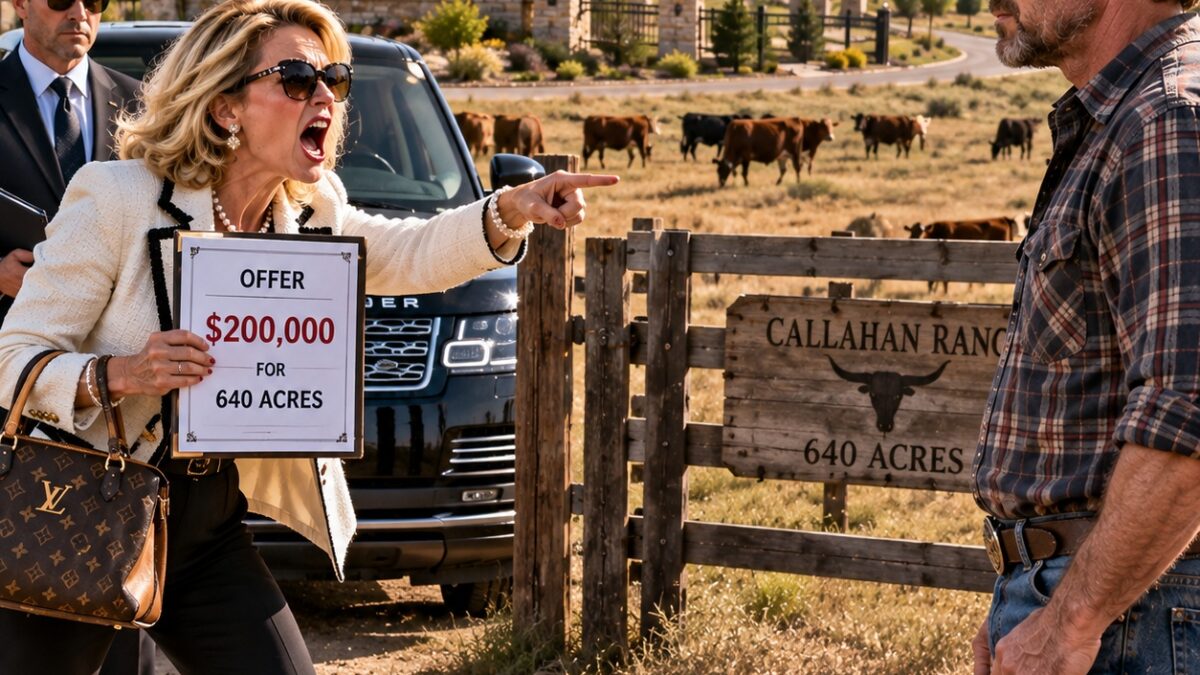
PART2
Miranda began with paperwork.
Within three weeks, Colton County code enforcement received seven anonymous complaints about Callahan Ranch.
Dust from my gravel road.
Livestock odor.
Visual blight.
Early-morning equipment noise.
Unsafe outbuildings.
Environmental concerns involving cattle runoff.
Every complaint was investigated.
Every complaint failed.
Deputy Inspector Carl Meeks came out five times in six weeks.
He inspected my barn.
Walked fence lines.
Measured setbacks.
Checked the cattle pens.
Read agricultural zoning.
On his fifth visit, he sat on my tailgate drinking a glass of Elena’s sweet tea.
He looked exhausted.
“Mr. Callahan.”
“Jesse.”
“Jesse, these complaints aren’t about code.”
“I know.”
“They’re about somebody wanting your land.”
“I know that too.”
He looked toward Hawthorne Creek’s limestone entrance wall.
The subdivision sat where Hank’s southern pasture had once been.
Two hundred twenty houses spread across those 560 acres.
Pool.
Clubhouse.
Walking paths.
Perfect lawns.
Miranda had governed it for six years.
Carl shook his head.
“I get more complaints from that development than the rest of my district combined.”
He closed his clipboard.
“I’ll keep responding if they file them.”
“I understand.”
“But unless your cattle learn to violate county ordinances, I’m running out of things to inspect.”
That was the end of the first campaign.
So Miranda moved to public pressure.
She went door to door collecting signatures.
She told residents my ranch reduced their property values by twelve to fifteen percent.
There was no appraisal supporting that number.
She said coyotes coming from my land endangered children near the playground.
Coyotes had lived there before the playground existed.
She collected forty-seven signatures and presented them at a county commissioners’ meeting.
I attended.
Miranda stood at the microphone wearing a blazer that probably cost more than the saddle in my barn.
“Commissioners, I represent two hundred twenty families.”
Commissioner Wayne Briggs leaned forward.
Seventy-one.
Former cattleman.
Zero patience for theater.
“Your subdivision was built next to an operating ranch, correct?”
“Yes, but—”
“And the ranch was operating before the subdivision?”
“Yes.”
“Sixty-one years.”
“That’s correct.”
He placed her petition on the desk.
“Noted.”
“Commissioner, our residents—”
“Next item.”
Miranda returned to her seat.
No smile.
She did not quit.
In June she brought another developer.
Cliff Saunders.
He wore a blue suit in ninety-eight-degree heat and looked increasingly unhappy as sweat spread through it.
His offer:
$400,000.
Twice Miranda’s first offer.
Still ridiculous.
He proposed eighty homes.
A community equestrian center.
Landscaped trails.
The whole thing packaged as Phase Three of Hawthorne Creek.
“Fair market for unimproved ranch land,” Cliff said.
I looked at the barn Hank built in 1964.
The corral welded in 1972.
The stock tank dug in 1981.
Miles of maintained fence.
“Unimproved?”
Cliff glanced at Miranda.
Miranda stared at me.
“What exactly do you think this land is worth?”
That was the first time I almost told her.
Not about oil.
I did not know enough yet.
But I knew the ranch was worth more than she understood.
“It’s not for sale.”
Miranda hired a land-use attorney.
Bradley Chesterton.
His first letter used the word blight seven times.
He cited laws aimed at abandoned hazardous property and tried applying them to an active cattle ranch that was current on taxes and compliant with agricultural code.
I forwarded the letter to Dell Harmon.
Dell had practiced mineral and property law in Midland for thirty-one years.
His office contained a wooden desk, a Texas flag, and almost nothing decorative.
He read the letter.
Then looked at me.
“She’s trying to scare you.”
“I assumed.”
“This isn’t a serious condemnation case.”
“She won’t stop.”
“No.”
Dell folded the letter.
“But every complaint and threat she sends you becomes part of the record.”
“So let her continue?”
“Document everything.”
That suited me.
Then Miranda stopped hiding behind paper.
On September 23, I drove along my eastern fence and found a gate where no gate had existed.
Sixteen feet of barbed wire had been removed.
Two cedar posts had been set in concrete.
A steel gate hung between them.
Beyond the gate, a crushed-granite walking path crossed ninety-three feet of my pasture to the Hawthorne Creek boundary.
A sign read:
HAWTHORNE CREEK COMMUNITY TRAIL
HOA MEMBERS ONLY
I sat in my truck staring at it.
Miranda had built a trail across my ranch.
Not near it.
Not beside it.
Across it.
I called Dell.
“They cut my fence.”
Silence.
“Then installed a gate.”
Longer silence.
“And a walking trail.”
“How far?”
“Ninety-three feet into the pasture.”
Dell took about six seconds before answering.
“Photograph everything.”
“I already started.”
“Do not remove anything yet.”
“Fine.”
“I’m serious, Jesse.”
“So am I.”
I took forty-seven photographs.
Gate.
Concrete around the posts.
Granite trail.
Sign.
Fence cuts.
Tire marks from the installation crew.
Then I installed two trail cameras.
Infrared.
Cloud backup.
Over the next week, they recorded 216 separate uses.
Joggers.
Dog walkers.
Couples.
People who almost certainly had no idea they were trespassing because Miranda had told them it was a community amenity.
At an HOA meeting, she described my pasture as “community-adjacent open space.”
She called the trail an informal recreational arrangement.
Then she described Callahan Ranch as “functionally vacant.”
Functionally vacant.
At the time, I had eighty-four Angus cattle.
Two stock tanks.
Fourteen miles of fencing.
Equipment running almost every day.
But Miranda only saw what fit her argument.
The ranch looked empty to her because it was not covered in houses.
By September, I had stopped caring what she thought about the surface.
Because I had started understanding what was under it.
When Elena and I moved back in March, I walked every part of the ranch.
All 640 acres.
That was habit.
Petroleum engineers look at ground differently.
A rock outcrop is not scenery.
A dry draw is not just a drainage feature.
Color matters.
Fracture patterns matter.
Porosity matters.
Stratigraphic relationships matter.
On the eastern side, erosion exposed limestone with characteristics I recognized from formations I had studied in the Permian Basin.
Below it sat darker organic-rich shale.
Source rock.
I collected fourteen soil samples.
Sent them to a laboratory in Midland.
The results came back showing elevated light hydrocarbons.
Methane.
Ethane.
Propane.
Levels consistent with possible thermogenic migration from a deeper source.
Not proof.
But enough to make me quiet.
I called Marcus Webb, my former supervisor at Sentinel.
“Pull the public seismic data around Colton County.”
“What did you find?”
“Maybe nothing.”
“Jesse.”
“Maybe not nothing.”
Marcus spent several days overlaying regional Railroad Commission seismic information with my sample locations.
He called at eleven one night.
Elena and I were already in bed.
I went onto the porch.
“What?”
“There’s an anticline.”
I sat down.
“Where?”
“Centered almost directly beneath your ranch.”
“How deep?”
“Potential reservoir between twenty-eight hundred and thirty-two hundred feet.”
I said nothing.
Marcus continued.
“The structure extends south.”
“How far?”
“Under Hawthorne Creek.”
I looked through the darkness toward the subdivision.
Two hundred twenty homes.
Pool lights.
Street lamps.
Clubhouse.
Miranda’s house somewhere behind the limestone wall.
“You sure?”
“No.”
That was the right answer.
“We need better seismic.”
I smiled.
“Now you sound like yourself.”
I went inside.
Elena was waiting.
“What happened?”
I sat beside her.
“I may have found oil.”
“On the ranch?”
“Under the ranch.”
Pause.
“And under Hawthorne Creek.”
She stared.
“Do we own it?”
“Hank kept the minerals.”
“All of them?”
“I need Dell to verify the chain.”
Elena leaned back against the headboard.
Then she laughed once.
“What?”
“That woman called this place worthless dirt.”
I laughed too.
For about ten seconds.
Then I stopped.
“Not a word to anybody.”
She nodded.
That was one thing Hank had taught both of us.
You do not celebrate oil before you prove oil.
The first thing Dell did was pull the entire mineral title.
1961 acquisition.
2006 surface sale.
Mineral severance.
Probate transfer.
Tax records.
No leases.
No encumbrances.
No later conveyances.
The mineral estate covered all 1,200 original acres.
My remaining 640-acre ranch.
And all 560 acres beneath Hawthorne Creek.
Dell placed the title chain on his desk.
“I’ve rarely seen one cleaner.”
“Hank knew what he was doing.”
“He absolutely knew what he was doing.”
Next I contacted Palisade Energy.
Mid-sized exploration company.
West Texas specialists.
Their chief geologist, Dr. Sarah Chen, reviewed the available data.
She wanted 3D seismic.
That meant twelve days of field work.
Vibrator trucks.
Hundreds of geophones.
Grid patterns across the ranch.
Miranda was still complaining about cattle and landscaping while an actual geophysical survey was happening on the property she had called worthless.
The results confirmed the structure.
A sealed hydrocarbon trap in the Ellenburger Formation.
Estimated recoverable potential:
Approximately 4.2 million barrels of oil.
Around twelve billion cubic feet of natural gas.
Gross in-place economic value around $330 million at the assumptions being used then.
I stared at the report.
Dr. Chen sat across from me.
“Understand what this number means.”
“It’s an estimate.”
“Exactly.”
“Not a bank balance.”
“No.”
“Production can underperform.”
“Yes.”
“Prices change.”
“Yes.”
“Reservoir behaves however it wants.”
She smiled.
“You really are a petroleum engineer.”
But the important part was no longer speculation.
The formation was real.
And better:
Palisade believed it could be developed entirely from my ranch using horizontal drilling.
Pads on my surface.
Vertical wells down roughly three thousand feet.
Then laterals extending south beneath Hawthorne Creek.
No drill pad beside their clubhouse.
No rig in Miranda’s driveway.
No need for HOA surface access.
I owned the mineral estate.
Hawthorne Creek residents owned their surface homes.
Those were separate property interests.
Hank had preserved mine before the first foundation was poured.
In October 2022, I signed a lease with Palisade.
Signing bonus:
$6,000 per mineral acre.
Across 1,200 acres:
$7.2 million.
Royalty:
Twenty-five percent.
I signed the papers at Dell’s office.
When the final page was done, I thought of Hank.
Eleven years as a roughneck.
Forty-five years running cattle.
Never told anybody what he suspected.
Never sold the minerals.
He had left me a sentence in a deed worth more than the ranch house, barns, cattle, and every luxury house next door combined.
Palisade filed drilling permits with the Texas Railroad Commission in November.
Callahan No. 1.
Callahan No. 2.
Public records.
Anybody could have looked.
Miranda did not.
She was too busy trying to get the county to take my trail dispute seriously as an HOA-access issue.
Dell sent Hawthorne Creek a formal trespass notice.
The trail would have to be removed.
Fence restored.
Miranda’s attorney disputed it.
Then January arrived.
The drilling rig came before dawn.
January 8, 2023.
A 147-foot Schramm rig on a multi-axle carrier.
Pipe trucks.
Support equipment.
Lighting.
Crew.
By sunrise, the derrick stood over the northeast pad.
I stood near the cattle fence with coffee.
I had spent most of my professional life around rigs.
But this one felt different.
Not because it was mine.
Minerals do not become emotional just because your grandfather owned them.
It felt different because Hank had stood on that land sixty years earlier and seen possibility when everyone else saw scrub.
Day two, Miranda finally noticed.
Her Range Rover stopped at my gate.
Trail camera recorded her sitting there for several minutes.
Then she called the county.
County told her the drilling was under state oil-and-gas authority.
She called the Railroad Commission.
Permits valid.
Setbacks compliant.
She called Bradley Chesterton.
Then other attorneys.
Then the newspaper.
A reporter came out.
Miranda gave him a statement.
“No one consulted our community about industrial activity on our doorstep.”
I read the quote at breakfast.
Elena nearly choked on coffee.
“Did she consult you before building a walking trail through your pasture?”
“No.”
“Just checking.”
The article discussed drilling near Hawthorne Creek.
It did not yet explain the mineral ownership.
That part remained buried in county records where it had been since 2006.
Callahan No. 1 spudded January 15.
At 2:15 one morning, the mud logger called me to the rig floor.
“Gas at twenty-nine twelve.”
He held out cuttings.
“Oil shows at twenty-nine forty.”
Under ultraviolet light, the cuttings fluoresced.
Bright.
Golden.
Oil-saturated rock.
I looked at them for longer than necessary.
Hank had been right.
Not spiritually.
Not symbolically.
Geologically.
Callahan No. 1 came online February 18.
Initial production:
Around 1,400 barrels per day.
Approximately 2.6 million cubic feet of gas.
Callahan No. 2 followed about six weeks later at roughly 1,100 barrels per day.
Combined daily gross revenue at the prices then in effect was near $200,000.
My twenty-five-percent royalty was roughly $50,000 per day before taxes and expenses applied at my level.
Those numbers did not feel real at first.
Cattle ranchers think in feed.
Fence.
Rainfall.
Calf prices.
I was now receiving production reports that made Miranda’s original $200,000 offer look almost surreal.
The oil was not merely beneath Callahan Ranch.
The horizontal laterals extended south beneath Hawthorne Creek.
Beneath the pool.
The clubhouse.
Homes.
Roads.
Miranda’s own driveway.
The residents owned their houses.
I owned the mineral estate underneath.
Then, on March 4, Miranda returned.
Not in heels.
That was the first thing I noticed.
Flat shoes.
Simple gray dress.
No sunglasses.
No Birkin.
No blazer.
She walked toward the porch where Elena and I were sitting.
The pumpjacks moved in the distance.
“Jesse.”
“Miranda.”
“I need to talk to you about the mineral rights.”
I waited.
“Your grandfather retained them.”
“Yes.”
“Under the entire development.”
“Yes.”
“All 1,200 acres.”
“Yes.”
She closed her eyes for a second.
Then:
“I have a proposal.”
Of course she did.
“The HOA can contribute surface access.”
“You don’t have surface access I need.”
She stared.
“The wells are on my ranch.”
“But the formation—”
“Horizontal drilling.”
“I understand that.”
“Then you understand Palisade does not need one square foot of Hawthorne Creek surface.”
She paused.
“Then a revenue share.”
“No.”
“Ten percent.”
“No.”
“Five.”
“Why?”
Her face tightened.
“Because the oil is under our homes.”
“You own the surface.”
“And you own—”
“The minerals.”
She looked at the pumpjacks.
“There has to be some equitable arrangement.”
“The arrangement is already in your deed.”
She looked back at me.
“Paragraph 9B.”
That was when I knew she had finally read it.
“Hank retained the minerals before your subdivision existed.”
“I’ll sue.”
The way she said it did not sound like the old Miranda.
Not a threat.
More like a last available door.
“You can.”
Her eyes narrowed slightly.
“The lease is valid. Mineral title is recorded. Permits are approved.”
“There has to be something.”
“No.”
I did not enjoy saying it.
I simply knew it was true.
“My grandfather worked rigs for eleven years. That paragraph was not an accident.”
She stood there another few seconds.
Then walked back to the Range Rover.
Hawthorne Creek hired an Austin law firm.
They alleged nuisance.
Argued the old severance was unconscionable.
Claimed modern residential development had changed the equities.
Dell responded with a motion to dismiss.
Deed.
Mineral severance.
Probate.
Tax records.
Lease.
Railroad Commission permits.
He also attached a Hawthorne Creek newsletter Miranda herself had written months earlier describing the subdivision as being built on “the finest land in Colton County.”
I appreciated that detail.
Judge Katherine Morales dismissed the HOA’s claims.
Her order was straightforward.
Texas law recognizes severed mineral estates.
The reservation was clear.
The HOA had purchased or succeeded to surface interests subject to that recorded mineral ownership.
No legal basis existed to rewrite it because current homeowners disliked the result.
The settlement that followed resolved the rest.
Hawthorne Creek dropped its mineral claims.
The HOA formally acknowledged the Callahan mineral estate.
The community trail through my pasture was removed.
The steel gate came out.
The crushed-granite path was cleared.
My fence was restored.
I agreed to a 1,000-foot surface setback from the development.
That concession cost me almost nothing.
Horizontal laterals could still reach the reservoir beneath Hawthorne Creek from pads on my ranch.
Two weeks later, Miranda resigned as HOA president.
The vote was overwhelmingly against her.
I did not attend.
I had cattle work.
That felt more useful.
During the first twelve months, the Callahan mineral estate produced about $18.4 million in gross revenue.
My royalty share was approximately $4.6 million.
The $7.2 million signing bonus went mostly into a conservative diversified trust.
Hank would have approved of that.
He distrusted flashy money.
Always had.
Elena and I did spend some of the first-year proceeds.
We rebuilt the ranch house.
Same footprint.
Same limestone-and-cedar character.
New plumbing.
New roof.
Modern electrical.
New kitchen.
Elena chose every tile herself.
Oil money had not reduced her interest in arguing about backsplash colors.
We replaced fourteen miles of fencing.
Expanded the Angus herd from eighty-four head to two hundred twenty.
Drilled a new stock-water well.
The irony of drilling for water on land sitting above hundreds of millions in hydrocarbons was not lost on either of us.
Then we created the Hank Callahan Agricultural Scholarship.
Full tuition support for a Colton County student pursuing agriculture, petroleum engineering, geology, or another field tied to understanding the land beneath us.
That mattered more to me than buying anything expensive.
Hank had worked rigs because college was not an option available to him.
If the minerals he preserved could give somebody else that choice, the money had done something useful.
Palisade later added a third well targeting another productive zone.
The reservoir performed better than initial decline models predicted.
Production continued.
So did ranching.
That was important.
Oil did not replace the cattle.
The land was not valuable only because petroleum existed beneath it.
That would have been Miranda’s mistake in reverse.
She looked at the ranch and saw only what the surface was worth to a developer.
If I looked at it now and saw only royalty checks, I would be doing the same thing.
Callahan Ranch was still Hank’s fences.
His barn.
His stock tanks.
The porch where he told me the ground was not empty.
Cattle moving through mesquite at sunset.
Elena’s smoker running on Saturdays.
Family.
The minerals added another layer.
They did not erase the first one.
Miranda’s replacement as HOA president was Roger Doyle.
Retired accountant.
Khaki shorts.
Plain polo shirts.
His idea of HOA leadership involved maintaining the pool, balancing the budget, and avoiding lawsuits.
I liked him immediately.
One Saturday he stopped at the ranch.
Elena had started selling brisket plates on weekends mostly as a hobby.
Roger bought one.
We sat outside.
After a while he said:
“Most of us never agreed with the way Miranda handled you.”
“I figured some didn’t.”
“She had a blind spot.”
“What?”
Roger looked toward Hawthorne Creek.
“She only saw the surface.”
I smiled.
He continued.
“She looked at houses and saw curb appeal. People and saw clothes. Land and saw landscaping. She never asked what was underneath anything.”
“No.”
“She didn’t.”
“Your grandfather did.”
“Hank spent eleven years on drilling crews.”
“He knew.”
“He suspected.”
“Why didn’t he ever develop it?”
That was a good question.
Maybe oil prices.
Maybe technology.
Maybe timing.
Maybe he did not have enough data.
I only knew what Hank told me.
“Because telling everybody what you have is a good way to stop having it.”
Roger nodded.
“Smart.”
“Very.”
Hank owned the same pair of work boots for years.
His wristwatch probably cost forty dollars.
He never cared what something looked like if it worked.
Miranda cared intensely about how everything looked.
Neither trait automatically makes a person good or bad.
But in their case, those habits shaped what they noticed.
Hank looked at scrubland and wondered what created the rock.
Miranda looked at scrubland and wondered how quickly it could become luxury homes.
Both were seeing value.
Just at different depths.
Only one of them owned the minerals.
Elena once said Hank did not leave me a ranch.
“He left you a test.”
“What test?”
“Whether you’d sell something because another person told you it looked worthless.”
I thought about that often.
If I had accepted Miranda’s first offer, the $200,000 would have seemed like money.
Not good money.
Still money.
And depending on how a mineral conveyance had been drafted, I could have exposed or even lost interests far more valuable than the surface.
That was why Hank’s final warning mattered.
Do not sell the minerals.
Not for any price.
Not for anyone.
He knew exactly which part of the inheritance mattered most financially.
That did not mean I never negotiated.
Palisade leased.
Surface contractors worked under agreements.
County utilities crossed defined areas.
Business still happened.
The difference was that I understood what I owned before discussing price.
That changed every conversation.
Miranda’s biggest advantage during our first encounter had been her assumption that she understood my ranch better than I did.
She saw agricultural appraisal values.
Old house.
Cattle.
Dust.
She knew developers wanted acreage.
So she believed I should be grateful for $200,000.
Then $400,000.
She never asked why a petroleum engineer who had evaluated hundreds of well sites came home and started collecting soil samples.
That question might have saved her a lot of embarrassment.
Her second mistake was even simpler.
She never read the deed.
Hawthorne Creek residents were not cheated.
The mineral reservation was public record.
Their developer bought the surface subject to it.
Later buyers purchased homes in a subdivision where the mineral estate had already been severed.
Title companies could find it.
Lawyers could find it.
The county clerk had preserved it.
Nothing was hidden legally.
It was simply ignored.
There is a difference.
People said later that I had a secret.
Not really.
I had information no one bothered to read.
The deed did not need to announce itself on a billboard.
Forty-seven words were enough.
That changed the way I thought about property.
The largest facts are sometimes buried in the dullest documents.
Everybody reads the purchase price.
Address.
Lot size.
Few people get excited about reservation clauses.
Exceptions.
Easements.
Mineral interests.
Those boring paragraphs can be the most valuable lines on the page.
Hank understood because he had watched oil companies live by them.
I understood because I had spent my career around landmen and title attorneys.
Miranda understood only after pumpjacks appeared.
Too late.
The illegal trail taught me a similar lesson.
Physical use can make people feel ownership even when paperwork says otherwise.
Two hundred sixteen recorded crossings in one week.
Morning joggers.
Dog walkers.
People pushing strollers.
None of them thought they were stealing anything.
Miranda told them the path was community space.
Most believed her.
If I had allowed that trail to continue for years, stories would develop around it.
We’ve always used it.
It connects the neighborhood.
It’s part of the community.
Eventually memory begins competing with title.
That is why Dell acted immediately.
Photograph.
Notice.
Record objection.
Do not let convenience harden into assumed entitlement.
When the settlement required the trail removed, I restored the fence.
No sign.
No dramatic warning.
Just barbed wire.
Exactly as before.
I did not hate the residents.
Most had no idea.
The problem was Miranda deciding my silence counted as permission.
It didn’t.
The same pattern appeared in her complaints.
She expected repetition to manufacture truth.
Seven code complaints.
Then petition.
Then developer.
Then condemnation threat.
Then trail.
Each escalation assumed that enough pressure would eventually convert no into yes.
That works on people sometimes.
They get tired.
Eleanor Gilliam types exist everywhere—the person who knows something is wrong but has less time, money, energy, or confidence than the bully applying pressure.
I had advantages.
Professional knowledge.
Dell.
Financial stability.
A grandfather who preserved title.
And eventually a mineral lease large enough to remove any leverage money could create.
Miranda chose the wrong person at the wrong time.
But the principle mattered beyond me.
Property rights should not depend on whether the owner is intimidating enough to defend them.
That is why records and courts exist.
When Hawthorne Creek sued, the judge did not care what I looked like.
Did not care that Miranda sold expensive real estate.
Did not care whether two hundred twenty homeowners were frustrated.
She read the reservation.
Clear.
Recorded.
Valid.
That was enough.
I respected the simplicity.
Law sometimes becomes messy because facts are messy.
This part was not.
Surface and mineral estates had been severed.
Hank kept one.
Developer bought the other.
Everything flowed from that.
The drilling itself brought another irony.
Miranda had spent months trying to remove ranch activity because she believed cows and dust damaged the luxury character of Hawthorne Creek.
Then a drilling rig appeared next door.
Not because I wanted to punish anyone.
Because a commercial reservoir had been confirmed.
The same land she called embarrassing became the operating location for wells producing from beneath her neighborhood.
People called it revenge.
I never did.
Revenge would have meant drilling somewhere stupid simply to annoy her.
Palisade selected pads based on engineering.
Road access.
Setbacks.
Surface conditions.
Well trajectories.
Economics.
The laterals ran where the reservoir dictated.
Geology had no opinion about Miranda.
That made the outcome better.
Nothing needed to be manipulated.
She simply misjudged the asset.
Badly.
I was careful about the $330 million figure for that reason too.
People hear that and imagine I had $330 million in cash underground.
That is not how petroleum economics works.
It was an estimated gross value based on projected recoverable hydrocarbons and market assumptions.
Production costs matter.
Gas prices move.
Oil prices move.
Decline rates matter.
Taxes.
Operating expenses.
Future development.
No competent engineer looks at gross reservoir value and calls it personal wealth.
What mattered was scale.
Miranda valued 640 surface acres at $200,000.
The mineral estate beneath the original tract represented an asset many orders of magnitude larger.
That mismatch was the point.
Not a guaranteed fortune.
Even our early production could have declined faster than expected.
It did not.
The field performed well.
But we treated the money as volatile.
The signing bonus went into trust.
Royalties were planned conservatively.
I had watched too many oil families live as though every boom was permanent.
Then prices fell.
Hank had watched even more.
We were not repeating that.
The ranch improvements came first.
House.
Fences.
Water.
Herd.
Scholarship.
No supercars.
No mansion.
No watch worth more than a pickup.
Elena joked that if I ever bought a crocodile handbag she would have me evaluated.
“I don’t think they make one for me.”
“That’s not the point.”
Our house stayed in the same location.
Same porch orientation.
Same stone character.
We could have built something enormous.
I did not want enormous.
I wanted the place to remain recognizable if Hank somehow walked up the drive.
Modern systems.
Same soul.
That was enough.
Miranda eventually disappeared from HOA life almost completely.
I still saw her occasionally in Midland.
Once in a grocery store.
Different aisle.
She noticed me.
I nodded.
She nodded back.
Nothing else.
No dramatic confrontation.
No second apology.
No need.
Her resignation had happened.
The lawsuit had been dismissed.
The trail was removed.
Mineral rights acknowledged.
We had nothing left to discuss.
That is one thing revenge fantasies rarely understand.
The best outcome is not making an enemy think about you forever.
It is reaching the point where you no longer need to think about them.
Miranda eventually became irrelevant to the ranch.
That was peace.
Roger’s board proved Hawthorne Creek itself had never been the true enemy.
The new leadership worried about ordinary things.
Pool heater.
Landscaping contracts.
Reserve funds.
Roof repairs at the clubhouse.
Their residents lived their lives.
I lived mine.
The reservoir existed below both.
No one needed to turn it into a moral relationship.
They owned homes.
I owned minerals.
Palisade operated wells.
Clear boundaries.
Most conflicts become easier when everybody stops pretending boundaries are insults.
Miranda had treated my refusal to sell as an attack on her.
It wasn’t.
It was ownership.
She wanted Phase Three.
I wanted my ranch.
Both desires could exist.
Only one had legal control over my property.
That frustrated her.
Frustration is not authority.
The county taught her that.
The court taught her again.
The deed had been saying it since 2006.
The story of Hank’s forty-seven words became local folklore.
People exaggerated.
They said he knew exactly how much oil was there.
I do not know that.
He suspected geology.
A roughneck with eleven years in the Permian can recognize things most ranchers never notice.
But no 1961 ranch purchase came with modern 3D seismic and production modeling.
Maybe he knew there was potential.
Maybe he simply understood that minerals were the one asset you should never casually give away.
Both would explain the reservation.
I refuse to invent certainty because the real decision is impressive enough.
He kept the minerals.
That was smart.
He did not need clairvoyance.
Good property decisions often look prophetic only because later events reveal how much optionality they preserved.
Hank did not need to know oil would be produced in 2023.
He only needed to avoid signing away the possibility.
That is wisdom.
Preserve options when you do not yet know their future value.
I applied that lesson after the discovery too.
Palisade did not receive every right imaginable.
The lease defined development rights.
Surface use.
Royalty.
Operations.
Reclamation.
Access.
Insurance.
Terms.
Dell negotiated every line.
Because once money becomes large, vague language becomes dangerous.
Miranda’s mistake had been failing to read an old clause.
I was not going to repeat it by being distracted by a $7.2 million signing check.
Dell once slid a draft back across his desk.
“They want broader surface-use language.”
“How broad?”
“Broad enough that you’ll hate me in five years if I let you sign it.”
“Fix it.”
He did.
That was what professional advice was for.
Not dramatic courtroom speeches.
Preventing future conflict before the ink dries.
The scholarship became Hank’s favorite legacy in my mind, even though he never saw it.
The first recipient was a girl from Colton County whose father repaired farm equipment.
She wanted to study geology.
When Elena told me, I laughed.
“What?”
“Hank would have liked that.”
“Why?”
“He spent his whole life waiting for somebody smart enough to look underneath.”
At the scholarship dinner, I kept my remarks short.
I did not tell the Miranda story.
Not the place.
I talked about curiosity.
About land being more complicated than appearances.
About agricultural science and petroleum engineering sharing a basic habit.
Observe carefully.
Understand systems.
Respect what you do not know yet.
That was the real lesson.
Not that ugly land might hide oil.
Most ugly land does not.
Not that refusing to sell always leads to riches.
Usually it does not.
The lesson was to understand an asset before letting someone else define its value for you.
Sometimes the asset is land.
Sometimes a contract.
A skill.
A business.
A piece of family history.
Other people have incentives when they tell you what your property is worth.
Miranda wanted the ranch cheap because she wanted Phase Three.
That did not automatically make every statement she made false.
It simply meant I should never use her opinion as my appraisal.
I had to know for myself.
Hank knew that.
I learned it again.
Callahan Ranch looks different now.
Fences newer.
House stronger.
More cattle.
Production equipment on the northeast side.
But at sunset, from the porch, much remains the same.
Mesquite turns orange.
Wind moves across grass.
Cattle collect near water.
Pumpjacks nod beyond them.
The machines are not beautiful in the way Miranda understood beauty.
They are functional.
Steel.
Counterweights.
Gearboxes.
Repetition.
I find them beautiful anyway.
Not because they produce money.
Because they confirm a conversation I had when I was ten.
“This ground ain’t empty.”
Hank was right.
Every evening those pumpjacks move, I hear that sentence.
I wish he had lived long enough to see the first oil sample.
The fluorescence under UV.
Production numbers.
The title opinion confirming everything he preserved.
He would probably have nodded once.
Then asked whether the cattle had been fed.
That was Hank.
Money changed circumstances.
Not priorities.
I try to remember that.
It would be easy to become Miranda from the opposite direction.
Money can create its own form of blindness.
Designer clothes were not what made her arrogant.
Certainty did.
Believing her preferences deserved priority over other people’s rights.
Wealth can teach the same lesson if you let it.
So we keep the ranch working.
Employees are paid properly.
Palisade follows the surface agreement.
We respect Hawthorne Creek’s property too.
No unnecessary traffic through their roads.
No equipment stored on their land.
No shortcuts.
The easiest way to become a hypocrite would be celebrating my property rights while ignoring theirs.
I have no interest in that.
Roger and I developed a decent relationship.
Once he joked:
“You own everything under my house.”
“The minerals.”
“Comforting distinction.”
“Your foundation is safe.”
“Good.”
Then he asked a serious question.
“What happens if a well causes surface damage?”
“Palisade handles it under the operating agreements and state requirements.”
“And if something goes wrong?”
“We deal with facts.”
He smiled.
“Refreshing.”
That was the difference between him and Miranda.
Questions instead of assumptions.
You do not need to agree with someone to respect them.
You need to understand where your rights end and theirs begin.
Hawthorne Creek eventually became accustomed to the wells.
The initial panic faded.
Property values did not collapse the way Miranda predicted.
The pool remained open.
Children still played.
People still walked their legal trails.
The world did not end because minerals under their homes belonged to somebody else.
This was common enough in Texas.
Many homeowners simply had never thought about split estates until ours became visible.
The HOA began providing clearer disclosures about mineral ownership to prospective buyers.
That was good.
I did not want people blindsided.
A buyer deserves to know what estate they are purchasing.
Surface.
Minerals.
Easements.
Restrictions.
Every important layer.
Transparency prevents resentment.
If Hawthorne Creek’s original developer had emphasized the severance more clearly, perhaps Miranda would not have acted shocked later.
The deed had disclosed it legally.
That does not mean every homeowner understood.
There is a gap between disclosure and comprehension.
Good systems try to close it.
Another thing changed.
Residents stopped using the phrase worthless ranch.
Not because oil made the land morally superior.
Because they finally understood how foolish the phrase had been.
A working ranch had never been worthless.
Even if the reservoir had been dry.
Cattle.
Family history.
Agricultural production.
Habitat.
Open space.
Those were values before the first seismic truck arrived.
Miranda had confused not valuable to my development plan with not valuable.
Those are different statements.
That error happens everywhere.
If something does not serve us, we call it useless.
If someone’s skills are unfamiliar, we underestimate them.
If an old building is not fashionable, we call it blight.
If land is not landscaped, we call it empty.
Surface judgment.
Roger was right.
That was Miranda’s real blind spot.
She only looked at things long enough to decide how they affected her.
The ranch blocked Phase Three.
Therefore worthless.
Cattle smelled.
Therefore nuisance.
My old house lacked luxury finish.
Therefore embarrassment.
A deed complicated her plan.
Therefore unfair.
Once you start evaluating the world only through usefulness to yourself, entitlement follows naturally.
Hank was almost the opposite.
He valued what he did not yet fully understand.
Land.
Minerals.
Patience.
Possibility.
He could wait.
That was why he held the mineral estate for sixteen years after selling the surface and why I held it after him.
Geology moves on a scale that makes human impatience look silly.
The oil had been trapped for millions of years.
Miranda could not wait six months before trying another tactic.
Time favored the person who understood it.
I did not beat her through aggression.
I outlasted her assumptions.
That is different.
Every time she escalated, I documented.
Complaint.
Inspection.
Petition.
Offer.
Legal letter.
Gate.
Trail.
Lawsuit.
The more she did, the clearer the record became.
Meanwhile, subsurface work continued quietly.
Soil samples.
Seismic.
Title.
Lease.
Permits.
Drilling.
Two parallel stories.
Hers happening loudly above ground.
Mine happening quietly beneath it.
Eventually they crossed.
That was the moment the rig appeared.
To Miranda, it probably felt sudden.
It was not.
That is another surface illusion.
Visible events often look instantaneous because people do not see preparation.
A rig rises overnight.
But behind it are months of geology, title work, engineering, contracts, permitting, road construction, logistics.
A lawsuit gets dismissed in one hearing.
Behind it are decades of recorded property rights.
A ranch becomes “valuable” overnight.
It was valuable before anyone noticed.
Recognition is not creation.
The oil existed before my soil samples.
The minerals belonged to Hank before Miranda built a trail.
The deed meant what it meant before a judge read it.
Facts do not begin when arrogant people finally become aware of them.
That thought gave me more satisfaction than Miranda’s resignation ever did.
I never needed her to acknowledge the ranch’s worth.
The land did not require her approval.
Neither did Hank’s decision.
Neither did my profession.
That independence is powerful.
If you know what you own, other people’s contempt becomes information about them rather than about the asset.
When Miranda called the ranch dirt, she revealed ignorance.
I nearly let the insult become personal.
Then I remembered:
She did not know enough for the opinion to matter.
That principle has stayed with me.
Criticism is only as useful as the critic’s understanding.
A petroleum geologist telling me a formation lacks porosity?
I listen.
A mineral attorney warning about title?
I listen.
A cattle vet telling me something is wrong with the herd?
I listen.
An HOA president telling me a working ranch is worthless because it does not match her landscaping?
I can safely continue my day.
Expertise should determine weight.
Not confidence.
Miranda had enormous confidence.
Hank had enormous knowledge.
The market eventually paid for the second.
The first lost an HOA election.
Years later, the illegal-trail photographs still sit in my property file.
Gate.
Granite.
Sign.
I sometimes look at the Hawthorne Creek logo printed beneath HOA MEMBERS ONLY and marvel at the psychology.
A professionally printed sign can make trespass feel legal.
That was the point.
Residents saw design.
Branding.
Finished path.
They assumed permission.
Same as Miranda with authority.
Surface again.
The sign looked official.
The deed was official.
Only one mattered.
The trail is gone now.
Grass recovered.
Fence line restored.
If you did not know, you would never guess hundreds of people once walked through that part of the pasture believing it belonged to their subdivision.
That is how fast physical mistakes can disappear when title remains intact.
The mineral wells will disappear someday too.
Production declines.
Equipment gets removed.
Pads reclaimed.
That is part of the lifecycle.
Oil feels permanent while money is flowing.
It isn’t.
The land comes first.
Then development.
Then production.
Then reclamation.
Hank’s ranch existed before the wells.
I intend for it to exist after them.
That is why we did not sell when money arrived.
Plenty of companies asked.
Royalty buyers.
Mineral aggregators.
Private equity.
Letters appeared offering lump sums for future production.
Some offers were enormous.
I declined.
Not automatically.
Dell reviewed them.
We modeled expected value.
But Hank’s instruction still mattered.
Do not sell the minerals.
Not because dead relatives get to control every future choice.
Because the reasoning remained sound.
We understood the asset.
We could tolerate price volatility.
There was no need to convert it into a one-time payment.
So we kept it.
The same patience that protected the minerals before discovery protected them afterward.
People often become impatient once value is visible.
That can be just as expensive as selling too early.
Elena keeps me grounded.
If production reports arrive strong, she says:
“Good.”
Then asks whether I fixed the water line at the south tank.
If crude prices rise:
“Nice.”
Then reminds me we promised to help with the scholarship interviews.
It is difficult to become an oil caricature while married to someone unimpressed by petroleum.
Useful arrangement.
The brisket stand became her thing.
It started with neighbors asking for plates.
Then county workers.
Then drilling crews.
Saturday mornings, smoke rolls behind the house.
By noon she often sells out.
One day Roger joked that we probably earn less selling brisket than one well makes in minutes.
Elena said:
“The brisket tastes better.”
End of argument.
Life should contain things you do because they matter independent of scale.
Hank had cattle.
Elena has brisket.
I have the ranch.
Miranda had image.
Maybe that was why losing authority hit her so hard.
She had built too much identity around being seen as the person in control.
When the mineral deed contradicted her, she experienced it almost personally.
But the deed was not attacking her.
It did not know she existed.
That is another benefit of objective systems.
They remove personal drama.
A survey line does not hate you.
A mineral reservation is not disrespectful.
A geological formation is not mocking you.
A permit is not impressed.
You either satisfy the requirement or you do not.
Miranda had spent years making everything interpersonal.
Disagree with her aesthetics?
You lacked community spirit.
Challenge a fine?
You disrespected leadership.
Refuse to sell?
You were selfish.
The mineral estate escaped that frame completely.
It existed.
Nothing more.
She could not shame oil into belonging to the HOA.
Could not organize signatures against stratigraphy.
Could not fine an anticline.
There was relief in that.
The most powerful part of my position was never my anger.
It was that I did not need her.
No surface access.
No HOA vote.
No shared infrastructure.
Palisade could develop from Callahan land.
Horizontal drilling made her cooperation irrelevant.
That is why her proposed partnership was almost strange.
“What do you contribute?”
Surface access we did not need.
What would I contribute?
The entire mineral estate.
Fifty-fifty.
Then ten percent.
Then five.
From her perspective, she was negotiating.
From mine, she was offering me a smaller share of something I already owned in exchange for something I did not need.
There was no deal to make.
The best negotiation skill is sometimes recognizing when no transaction is required.
People get trapped believing every conversation needs a compromise.
No.
Sometimes the correct answer is simply that the current allocation of rights already works.
Mine did.
Dell said it best after the lawsuit ended.
“You didn’t win the minerals.”
“I know.”
“You already owned them.”
“Exactly.”
“The litigation only stopped somebody from pretending otherwise.”
That is how I think about the entire year.
Miranda did not lose my ranch.
She never owned it.
She did not lose the oil.
She never owned that either.
She lost assumptions.
The assumption my ranch could be bought cheaply.
The assumption complaints could push me out.
The assumption the HOA could create recreational rights by installing a gate.
The assumption houses above minerals automatically owned minerals below.
The assumption money, beauty, status, and confidence could substitute for title.
Those assumptions collapsed.
Everything else remained where it had been.
My ranch.
Her subdivision.
My minerals.
Their homes.
That clarity was the real ending.
Today, Callahan Ranch still runs cattle.
The pumpjacks still move.
The scholarship has sent more than one student to Texas A&M.
The old porch where Hank talked about empty ground was rebuilt using timber salvaged from the original structure.
I sit there sometimes after dark.
Hawthorne Creek lights glow in the distance.
A line of houses where his south pasture used to be.
No resentment.
He chose to sell that surface.
It gave him money late in life.
The subdivision is part of the landscape now.
So are the wells.
So are the cattle.
Land accumulates uses.
Ownership layers.
History.
The mistake is assuming the newest layer erased everything before it.
Hawthorne Creek existed on top of Hank’s mineral estate.
That did not erase the minerals.
Miranda’s HOA existed beside Callahan Ranch.
That did not erase sixty-one years of agricultural use.
A luxury gate does not reset history.
Neither does a complaint.
Neither does a lawsuit.
Records remember.
The ground remembers differently.
Geology certainly does.
Millions of years beneath a neighborhood obsessed with mailbox height.
That contrast still makes me smile.
If Miranda taught me anything, it was how easy it is for people to overestimate whatever sits closest to the eye.
Paint.
Landscaping.
Clothes.
Cars.
Architecture.
All real.
All visible.
But visible does not mean foundational.
A house stands because of what is under it.
A legal right stands because of its underlying document.
A person’s worth often rests on things no stranger sees immediately.
Skill.
History.
Character.
Patience.
Hank looked ordinary.
Same boots.
Cheap watch.
Dusty hat.
He left a mineral estate worth millions because he understood what people with cleaner clothes ignored.
Miranda looked extraordinary.
She failed because she never thought to check underneath.
That contrast is almost too neat.
But sometimes life hands you one.
The last time I looked at the original 2006 deed, I ran my finger under paragraph 9B.
Forty-seven words.
Hank’s greatest financial decision.
No dramatic language.
No warning.
No bold print.
Just legal text.
If Miranda had read it before offering me $200,000, perhaps she would have behaved differently.
Maybe not kindly.
But differently.
She might have understood why I would never sell casually.
Might have known the HOA had no claim to the subsurface.
Might have avoided litigation.
Might have saved herself the resignation.
All because of forty-seven words.
That is why I tell people now:
Read the boring parts.
Especially the boring parts.
The expensive truth is often hiding there.
Miranda once stood in my driveway and told me:
“Nobody wants your worthless dirt.”
Today, that dirt still grows grass.
Still supports cattle.
Still carries the house my grandfather built.
And several thousand feet beneath it, oil continues moving through rock toward wells bearing the Callahan name.
Not because I outsmarted geology.
Because I understood enough to respect it.
Not because I defeated Miranda.
Because my grandfather understood enough to preserve what was his.
He spent eleven years helping other men pull wealth out of the ground.
Then he bought land everybody underestimated.
And when the time came to sell part of it, he kept the one thing nobody else was looking deeply enough to value.
The surface changed.
Luxury homes appeared.
HOA presidents came and went.
Fashions changed.
Oil prices changed.
Hank died.
But paragraph 9B stayed exactly where he put it.
And in the end, that was all I needed.
Miranda saw worthless dirt.
My grandfather saw a reason to keep looking underneath.
He was right.








