PART2:HOA Queen Called 911 on My Wife Inside Our Own Home—The Officer Took One Look at Her and Whispered, “That’s the Chief”
PART2
There were no minutes.
Not for my fine.
Not for the supposed landscaping-rule change.
Not for several enforcement decisions.
Not even for parts of the prior year’s budget approval.
Nothing.
Sheila had been running Stonebridge Crossing as though typing something onto HOA letterhead made it law.
Virginia procedure required notice.
Opportunity to be heard.
Board action.
Records.
She had skipped nearly all of it.
I saved every document.
Backed them up.
Then did something Sheila probably found more irritating than an angry email.
Nothing.
The roses stayed.
Two weeks later, Stonebridge issued a new rule.
Effective immediately:
No home-based commercial operation without prior written approval from the Architectural and Business Review Committee.
Interesting.
I had never heard of that committee.
Neither had the bylaws.
Neither had the HOA directory.
Because it did not exist.
The amendment appeared eleven days after Sheila learned I ran my landscape business from home.
The notice ordered me to close my studio within thirty days or face fines of $500 per day.
Five hundred dollars.
For using a laptop and drawing tablet inside my own house.
I checked county zoning.
Home businesses were permitted if the workspace remained under twenty-five percent of total residential square footage.
Mine was eighteen percent.
Completely legal.
Then I renewed my county business license.
Routine.
I had done it for a decade.
This time the application came back.
HELD PENDING ENVIRONMENTAL IMPACT ASSESSMENT.
I called the planning office.
“For a landscape-design studio?”
The clerk sounded embarrassed.
“Yes, sir.”
“I don’t store chemicals.”
“I understand.”
“No commercial traffic.”
“I understand.”
“I draw gardens on a computer.”
“I understand.”
“So who flagged it?”
“I’m not permitted to disclose that.”
She did not need to.
Dale Braftoft sat on the planning commission.
A few days later, a forty-seven-page environmental-impact form arrived.
Chemical runoff.
Noise pollution.
Habitat disruption.
Migratory birds.
I designed patios.
The only birds affected by my business were birds that occasionally landed on the patios after construction.
I left the form blank.
Instead, I opened the Stonebridge homeowner directory.
Started calling people.
Friendly conversations.
“Do you work from home?”
Three did.
Candace Whitfield sold custom candles online from a guest bedroom.
No HOA notice.
Doug Emer tutored teenagers in his basement.
Nothing.
Pam Salazar had run a real-estate office from home for six years.
No fine.
No mysterious environmental review.
At the next meeting, I asked Sheila why my business was being targeted while theirs were not.
“Those situations are being reviewed case by case.”
Meaning:
She had no answer.
I went home and put three sticky notes on my studio wall.
Candace.
Doug.
Pam.
The case was starting to develop shape.
This was never about roses.
Or landscaping.
Or home businesses.
It was about control.
Sheila had confused authority with ownership.
And her husband had enough influence inside county government to help reinforce the illusion.
Then came the police.
Saturday evening.
Nora and I were grilling burgers with Rhonda.
Normal evening.
Charcoal.
Hickory smoke.
Virginia sunset.
Doorbell rang.
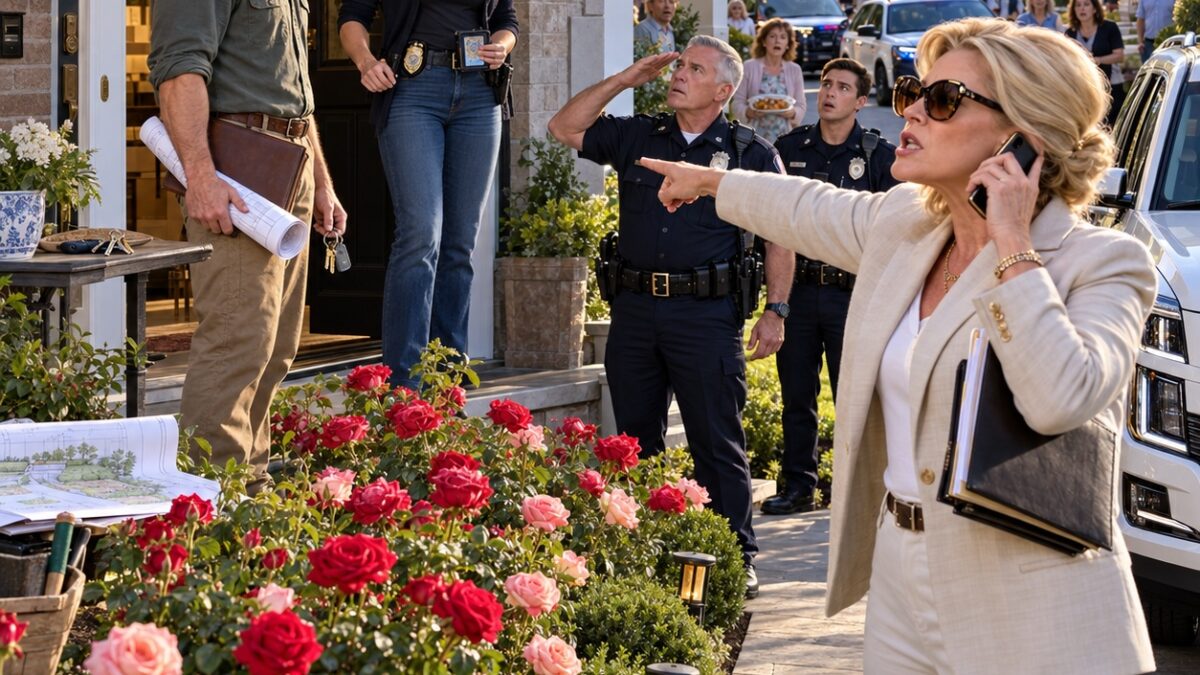
Two uniformed officers stood outside.
Young.
Nervous.
“Sir, we received a report of a domestic disturbance.”
I stared at them.
“There isn’t one.”
“We need to make sure everyone inside is okay.”
“We’re grilling hamburgers.”
Nora appeared behind me wearing flip-flops and an old Army T-shirt.
Hair pulled back.
She looked nothing like the official photograph the county had released when she became chief.
One officer glanced toward her.
Then started asking whether everyone in the residence belonged there.
Nora reached into her back pocket.
Pulled out her badge.
“Chief Ellison. Lowden County PD.”
The taller officer’s face went white.
His posture changed immediately.
“Chief.”
The other officer looked like his brain had temporarily stopped receiving instructions.
Nora’s voice became very quiet.
That was always worse than shouting.
“Preserve the dispatch recording.”
“Yes, ma’am.”
“I want the originating number documented.”
“Yes, ma’am.”
“Full report before end of watch.”
“Yes, Chief.”
They left.
Rhonda stood in the kitchen doorway.
Then said:
“She did the same thing to the Hadleys.”
I turned.
“What?”
“Tom and Beth Hadley. Birch Court.”
Rhonda sat down.
“She called police on them six times in four months.”
“For what?”
“Noise. Suspicious cars. Welfare checks.”
“Was anything ever found?”
“No.”
“Why six calls?”
Rhonda looked tired.
“Because eventually they moved.”
That sentence stayed with me.
She told us about Beth Hadley reading on her porch when officers arrived for a welfare check because Sheila reported she appeared confused and possibly off medication.
Beth was a kindergarten teacher.
Healthy.
Embarrassed.
Exhausted.
Four months later, she and Tom sold their house.
“Why didn’t anyone stop Sheila?”
Rhonda looked at me.
“Because everybody figured leaving was easier than fighting.”
Nora sat beside me that night.
“That’s the second false police report involving us.”
“I know.”
“In Virginia, knowingly filing false police reports can be criminal.”
“I know.”
Then she said:
“This isn’t an HOA dispute anymore.”
She was right.
So I stopped treating it like one.
I filed a public-records request.
911 logs.
Dispatch records.
Incident reports.
Nine years.
Eleven days later, the county sent me a flash drive.
I plugged it into my studio computer around ten at night.
I expected a handful of incidents.
I found thirty-four.
Same originating number.
Sheila’s personal phone.
Thirty-four police calls.
Nine years.
Seven different households inside Stonebridge Crossing.
I built a spreadsheet.
First calls tended to be vague.
Suspicious vehicle.
Stranger in neighborhood.
Possible trespass.
Then escalation.
Noise.
Domestic concern.
Welfare check.
More police presence.
Seven families targeted.
Four eventually sold their homes and left.
Not one of Sheila’s thirty-four reports resulted in an arrest.
Not one produced a verified criminal complaint.
Not one resulted in a meaningful citation.
At two in the morning, I began pulling property transfers for the families who had moved.
Hadleys.
Morrisons.
Suarez family.
Penningtons.
Every property had been purchased by the same company.
Ridgerest Holdings LLC.
Registered agent:
Chad Braftoft.
Dale’s younger brother.
I stared at the screen.
Then started calculating.
Hadley house:
Purchased around $60,000 below market.
Held seven months.
Resold for roughly $42,000 profit.
Morrison house:
About $51,000 below market.
Resold for roughly $38,000 profit.
Same pattern.
Family gets harassed.
Police keep showing up.
Stress increases.
House gets listed.
Braftoft-connected LLC appears with a low offer.
House later flips for profit.
The product was fear.
And somebody in Sheila’s family was monetizing it.
I dug into HOA finances.
Nine years of payments to Braftoft Landscaping LLC.
About $47,000.
No competitive bidding documentation.
Then another approximately $23,000 categorized as administrative consulting.
No contracts.
No work products.
No meaningful documentation.
Around $70,000 flowing into entities connected with Chad or Dale.
I called Nora.
She was still at headquarters.
“It’s a racket.”
Silence.
Then:
“Explain.”
I did.
Police harassment.
Property sales.
Ridgerest Holdings.
Family connection.
HOA payments.
When I finished, Nora said:
“We do this correctly.”
“I know.”
“Every step documented.”
“Yes.”
“No shortcuts.”
“None.”
She could not investigate Sheila herself.
Obvious conflict.
The target had filed reports against our household and now evidence involved Nora’s own department.
So Nora referred everything outside the department.
Virginia Attorney General’s Office.
Civil Rights Division.
Formal cover memo.
Records attached.
Investigator Carla Voss was assigned.
Mid-forties.
Direct.
Unimpressed by drama.
She reviewed the call logs.
Property transfers.
Initial financial records.
Then opened an investigation.
Meanwhile, I installed six security cameras around our house.
Front.
Driveway.
Rose garden.
Side yard.
Back patio.
Cloud backup.
Continuous recording.
If Sheila came onto the property again, I wanted nothing dependent on memory.
Then I spent six weeks doing what I do when designing a landscape.
Build from the foundation.
The witnesses came first.
Tom Hadley lived about thirty miles west.
When I called, he did not hesitate.
“I’ve been waiting three years for somebody to fight back.”
Beth got on the phone.
“We’ll sign whatever we need to sign.”
The Morrisons were harder.
They wanted to forget Stonebridge.
I understood.
Then I showed them the call pattern.
Seven households.
Same phone.
Same escalation.
Same type of pressure.
Same connected buyer.
They agreed.
Eventually I had sworn affidavits from all four families who had sold.
Detailed.
Notarized.
Dates.
Calls.
Attempts to complain.
Financial losses.
Then I hired Phil Meechum.
Forensic accountant.
Former IRS auditor.
A man who genuinely enjoyed spreadsheets.
The first afternoon he reviewed the HOA books, he started whistling.
That was his tell.
By the time he reached the Braftoft entities, he sounded like a kettle.
“This isn’t sloppy.”
“What is it?”
“Deliberate.”
He tapped a line item.
“They barely hid it.”
Phil’s final report:
Twenty-three pages.
Approximately $47,000 in questionable landscaping contracts.
Around $23,000 in undocumented consulting fees.
Roughly $70,000 total.
Connected entities.
No proper bidding process.
No meaningful board authorization.
He signed the report.
Offered to testify.
I also reviewed five years of HOA governance.
Votes.
Rules.
Fines.
Minutes.
Where minutes existed.
Around sixty percent of the major enforcement actions I reviewed had no corresponding documented vote.
No quorum.
No formal minutes.
No signatures establishing proper action.
Sheila was not running an HOA board.
She was issuing decrees and letting three passive board members create the appearance of governance.
My studio wall filled with color.
Yellow:
Financials.
Blue:
Police reports.
Green:
Procedural violations.
Red:
Families.
Nine years stretched across drywall.
That was when Dale finally became nervous.
He called at 6:14 one Thursday evening.
“Mr. Ellison.”
“Dale.”
“I understand you’ve been asking questions.”
“Public records.”
“You’re making a mistake.”
I put him on speaker.
Recording running.
“What mistake?”
“This neighborhood has a long memory.”
“Are you threatening me?”
“I’m advising you as a neighbor.”
“Noted.”
I ended the call.
Saved the recording.
Sent it to Carla.
Sheila responded by calling another emergency HOA meeting.
Agenda:
Review of the Ellison Family Compliance Status and Potential Assessment of Enhanced Penalties.
Enhanced penalties.
For fines that were already legally questionable.
Twelve residents attended.
More than usual.
Sheila showed photographs of Mom’s roses.
Screenshot of my business website.
County zoning map with our house circled in red like I was storing nuclear material behind the azaleas.
She finished.
I raised my hand.
“Can you show the recorded board vote authorizing my fines?”
The room became still.
“The decisions are reflected in our records.”
“Then produce the minutes.”
Sheila stared.
“And the minutes adopting the home-business restriction.”
No answer.
“And the vote creating the Architectural and Business Review Committee.”
Her laser pointer drifted upward.
A little red dot circling the ceiling.
Then one board member spoke.
Linda Puit.
She had barely said anything at previous meetings.
“Sheila.”
Sheila turned.
Linda swallowed.
“He has a point.”
The room changed.
“Do we actually have minutes for that vote?”
The look Sheila gave her could have killed indoor plants.
“This is not the time to undermine the board.”
She ended the meeting minutes later.
Linda caught me in the parking lot.
Keys clutched in both hands.
“I’ve been on the board four years.”
I waited.
“I’ve never seen a proper vote.”
“What happens?”
“She tells us what we decided.”
That was the crack.
Sheila realized it too.
So she escalated.
Again.
She filed a complaint with county council member Warren Fitch alleging Nora was using her position as police chief to protect our household from legitimate HOA enforcement.
Nora was called in.
She brought documentation.
Recusal records.
Attorney General referral.
Internal reports.
Timeline.
County counsel review.
Fitch looked at everything and dismissed Sheila’s complaint.
That should have ended that tactic.
Instead, Sheila called the press.
Anonymous tip to the Lowden Times Mirror.
The county’s new police chief was supposedly abusing her badge to shield her husband from HOA rules.
The reporter was Kyle Drummond.
Wire-rimmed glasses.
Notepad.
He called me.
“Would you like to comment?”
“Come over.”
“For an interview?”
“I’ll make lemonade.”
He sat at our kitchen table for three hours.
I showed him everything.
Thirty-four police calls.
Seven families.
Four below-market sales.
Ridgerest Holdings.
Chad.
Phil’s report.
HOA money.
Affidavits.
Void fines.
The invented committee.
The forty-seven-page environmental assessment for a man drawing gardens on a tablet.
Kyle wrote constantly.
Then stopped.
Looked over his glasses.
“Mr. Ellison.”
“Garrett.”
“This isn’t a story about a police chief’s conflict of interest.”
“No.”
“This is a nine-year harassment campaign.”
Then he told me Sheila had contacted him before.
Twice.
With “tips” about other residents.
The Morrisons.
The Penningtons.
Two families later driven from Stonebridge.
Police pressure first.
Media pressure second.
She had tried to use Kyle as part of the same system.
Neither story had survived verification.
Sheila thought she was giving him a scandal about Nora.
Instead, she had pointed a reporter toward the biggest story Stonebridge Crossing had ever produced.
When Kyle left, I stood on the porch.
The roses were beginning their second bloom.
Soft petals catching evening light.
For weeks, Sheila had tried to make those flowers evidence that I did not belong.
Instead, Mom’s garden had become the reason I started asking questions.
October arrived.
Annual HOA meeting.
Usually maybe forty people.
They set up sixty chairs.
Then eighty.
Then a hundred.
One hundred twenty residents showed up.
Sheila walked into that room dressed like nothing unusual was happening.
New blazer.
Fresh blowout.
Earrings reflecting the fluorescent lights.
She started normally.
Budget.
Landscaping.
Pool schedule.
Recycling.
Misdirection.
I waited.
Old business.
New business.
Then she moved toward adjournment.
I stood.
“I’d like to address the membership.”
“That isn’t on the agenda.”
“State law gives homeowners the right to be heard on matters affecting the community.”
She looked at the crowd.
Then at me.
“Five minutes.”
“I’ll need fourteen.”
I connected my laptop to the projector.
Same projector Sheila once used to put photographs of my mother’s roses on a screen.
Slide one.
Nine-year timeline.
Thirty-four 911 calls.
All connected to Sheila’s number.
Each plotted against the targeted families.
Then the sale dates.
People shifted.
Slide two.
Property records.
Seven targeted households.
Four sold.
All four purchased by Ridgerest Holdings LLC.
Registered agent:
Chad Braftoft.
Below-market acquisitions.
Resales within twelve months.
Profits.
Someone whispered:
“Oh my God.”
Slide three.
Phil Meechum’s report.
Approximately $70,000 in HOA funds paid through Braftoft-connected entities.
No adequate competitive bidding.
No documented services for portions of the payments.
No proper approvals.
Slide four.
Witnesses.
I played thirty seconds of Tom Hadley.
He sat in his new living room.
Looked directly at the camera.
“She called police on Beth while my wife was gardening.”
Nobody moved.
“Three times in one month.”
Then:
“We finally sold because we couldn’t take it anymore.”
The room had gone completely silent.
Sheila stood.
“This is slander.”
Her voice rose.
“This is a coordinated attack.”
I closed the laptop halfway.
“You might want to call an attorney.”
“I already have one.”
“Maybe call a different kind.”
The double doors opened.
Carla Voss walked in.
Navy suit.
State identification hanging from a lanyard.
Another investigator followed.
Then two Lowden County sheriff’s deputies.
They had been waiting outside.
Carla walked to the front table.
“Sheila Braftoft?”
For the first time since I had met her, Sheila did not answer immediately.
“Yes.”
“Dale Braftoft?”
Dale looked toward the side door.
A deputy moved slightly.
Carla spoke calmly.
“We have warrants for both of you.”
The sound of the handcuffs was surprisingly small.
One click.
Then another.
Seven counts involving false police reports were among the charges Sheila faced.
Conspiracy allegations.
HOA-fund issues.
Dale faced allegations connected to misuse of public office.
Sheila walked past my row.
Same perfume she had worn during almost every confrontation.
She did not look at me.
Dale followed.
His expression was almost blank.
Rhonda sat near the back.
She was crying.
Not because she felt sorry for them.
Because something she had spent years believing could never change had finally changed.
Fourteen minutes.
That was how long my presentation took.
Nine years of behavior reduced to a timeline people could finally see.
The legal cases did not end that night.
Real cases rarely do.
Sheila eventually took a plea agreement.
Seven counts related to filing false police reports.
Eighteen months supervised probation.
Four hundred hours of community service.
Permanent ban on holding HOA office anywhere in Virginia.
Restitution:
$34,000 divided among the four families driven out.
Dale was removed from the planning commission before his case fully resolved.
His resignation letter was two sentences long and used the phrase personal reasons three times.
He ultimately received two years’ probation and a $45,000 fine connected to misuse of public office.
Chad’s civil exposure went directly to the property profits.
A judgment required him to disgorge approximately $178,000 earned from the four house flips.
Disgorge is a legal word meaning:
Give back what you improperly gained.
Kyle’s story ran on the front page.
HOA PRESIDENT ARRESTED AFTER 9-YEAR HARASSMENT CAMPAIGN
It was shared thousands of times.
Stonebridge held a special election in March.
Rhonda Kesler ran for HOA president.
Unopposed.
Vote:
93–0.
Her first action:
Void every Sheila fine issued without a proper board vote.
Second:
Independent audit of the previous decade.
Third:
A suggestion box in the community room.
That sounds almost laughably small.
In Stonebridge, it felt revolutionary.
People were finally allowed to suggest something without asking Sheila whether the suggestion met aesthetic standards.
Tom and Beth Hadley eventually moved back to Stonebridge.
Different house.
Maple Court.
Two streets from where they had lived before.
Beth planted a garden during their first week.
Nobody fined her.
Nobody called police.
Nobody photographed her.
The Morrisons moved back near the area too.
Not Stonebridge itself.
Close enough to reconnect with old friends.
I used part of the civil recovery connected to our own case to create something I wished had existed when this started.
The Stonebridge Welcome Fund.
Free initial legal consultations for homeowners dealing with HOA overreach anywhere in Lowden County.
Template public-records requests.
Know-your-rights guides.
Sample requests for minutes.
Instructions for challenging fines.
Plain English.
No legal jargon unless necessary.
Forty-two people contacted the fund during its first month.
That number bothered me.
Because it meant Stonebridge was not unique.
Sheila was merely one version of a much larger problem.
People receive an official-looking letter.
Gold seal.
Fine.
Deadline.
Threat.
They assume authority must exist because the document looks professional.
Sometimes it does.
Sometimes it doesn’t.
The first question should always be:
Show me the rule.
Then:
Show me the vote.
Then:
Show me the record.
Legitimate organizations should be able to do that.
Sheila could not.
That was why everything collapsed once people started asking.
The roses never moved.
Not one.
By the following spring, they were stronger than they had been the year before.
Desdemona bloomed twice.
Gertrude Jekyll put out thick new canes.
The Generous Gardener climbed the porch railing so aggressively I had to install another trellis.
Mom would have accused it of showing off.
I considered it a victory lap.
Then I added one rose.
A deep crimson variety.
Dark at the center.
Strong fragrance.
I planted it in the front corner where morning sun hit first and the soil stayed richest.
I called it Eleanor.
Nora and I sat on the porch one evening in late May.
Roses.
Fresh-cut grass.
Streetlights coming on one at a time.
Somewhere down the road, a kid bounced a basketball.
A screen door slammed.
Normal neighborhood sounds.
Nora looked toward the garden.
“You know what your mother would say?”
“She’d say I need more mulch.”
Nora laughed.
“Probably.”
Then she rested her hand on mine.
“She’d also say you did good.”
I looked across the roses.
For months, people had called the whole thing a fight.
Garrett versus Sheila.
HOA versus homeowner.
Police chief’s husband versus neighborhood president.
That was never really what happened.
I did not defeat Sheila because I was louder.
I was rarely louder.
I did not defeat her because Nora was police chief.
In some ways, Nora’s position made everything harder because it forced us to be more careful.
Every referral.
Every recusal.
Every report.
Everything had to be clean.
Sheila brought herself down because she had become predictable.
Thirty-four calls.
Same phone.
Same escalation pattern.
Same types of accusations.
Nine years.
Seven households.
Then property records connected four of those homes to the same buyer.
Then money connected HOA payments to the same family circle.
Then governance records showed fines and rules without votes.
One incident can be explained away.
Thirty-four form a pattern.
One discounted property purchase might be luck.
Four become interesting.
One missing set of meeting minutes might be sloppy administration.
Years of missing votes become something else.
Sheila had spent almost a decade teaching everyone how her system worked.
Nobody had put all the pieces beside each other.
Once we did, the pattern stopped being invisible.
That is why Rhonda’s warning stayed with me.
“She runs this place.”
No.
Sheila had never owned Stonebridge.
She had merely convinced enough residents that challenging her would cost more than obeying her.
That illusion survived until someone was willing to read ninety-four pages of bylaws at two in the morning.
Not heroic.
Not cinematic.
Boring.
Documents.
Spreadsheets.
Phone logs.
Affidavits.
Public records.
Most abuses of authority do not collapse because someone delivers the perfect speech.
They collapse because the record finally becomes too clean to argue with.
I also learned something about Nora.
I already knew she was disciplined.
Army military police will teach that.
Command teaches more.
But throughout everything, she never once used her title for personal revenge.
When Sheila filed false reports, Nora preserved them.
When there was a conflict, she referred it outside her department.
When Sheila complained to the county council, Nora brought the paperwork.
That was it.
No cruiser parked outside Sheila’s house.
No unofficial pressure.
No favors.
One night I asked why she was so calm.
“She’s trying to make this personal.”
“It is personal.”
“No.”
Nora shook her head.
“What she did to your mother’s roses feels personal.”
“Yes.”
“What she did to the Hadleys feels personal.”
“Yes.”
“But the investigation can’t be.”
She was right.
The minute accountability becomes personal, people like Sheila have an argument.
Retaliation.
Bias.
Vendetta.
So we gave her none.
That was harder than shouting.
But stronger.
The same was true with Dale.
His phone call—“This neighborhood has a long memory”—made me angry.
I could have threatened him back.
Instead:
“Are you threatening me?”
He retreated.
Called it advice.
I saved the recording.
Done.
That is how you turn intimidation into evidence.
Do not decorate it.
Do not exaggerate.
Let the person speak.
Then preserve what they said.
Phil taught me something similar about the money.
When he showed me his first spreadsheet, I started using words like theft.
He stopped me.
“We prove transactions first.”
“I know what they were doing.”
“You know what you believe they were doing.”
He tapped the numbers.
“The court gets the verbs.”
That was good advice.
So we showed payments.
Connections.
Missing documentation.
Lack of bids.
Connected parties.
The investigators decided how to characterize them.
Evidence before adjectives.
Sheila lived on adjectives.
Eyesore.
Noncompliant.
Unsafe.
Suspicious.
Unapproved.
Threatening.
Community standards.
She built fear with labels.
We answered with dates.
The Hadleys taught me something darker.
People ask why they sold.
Why not fight?
Because fighting costs energy.
Money.
Time.
Sleep.
They had children.
Jobs.
A mortgage.
Police at the door.
Letters.
Rumors.
At some point, a cheaper house thirty miles away starts feeling like freedom.
That was the brilliance of Sheila’s system.
She did not need to legally force anyone out.
Only make staying exhausting.
Then Chad appeared with a convenient offer.
That is why I never blamed the families for leaving.
They did what they needed to do.
The shame belonged to the people who profited from their exhaustion.
When Tom returned to Stonebridge, I helped him choose plants for Beth’s garden.
Nothing elaborate.
Hydrangeas.
Lavender.
A dogwood.
Beth wanted roses too.
She laughed when she said it.
“Think the HOA will approve?”
Rhonda was standing nearby.
“Plant twenty.”
Beth did.
That garden mattered.
Not because flowers are political.
Because they finally were not.
A rose should be allowed to be a rose.
Not evidence of defiance.
Not violation.
Not symbol.
Just something beautiful growing in someone’s yard.
It took Stonebridge a long time to return to that level of normal.
The new HOA did not abolish standards.
People sometimes assume that was the lesson.
No.
Stonebridge still had rules.
Pool hours.
Parking.
Common-area maintenance.
Architectural review for actual structural modifications.
The difference was procedure.
Votes happened.
Minutes existed.
Homeowners got hearings.
Board members disagreed publicly.
Rhonda encouraged it.
At her first budget meeting, one homeowner challenged a landscaping contract.
Sheila would have treated that as insubordination.
Rhonda said:
“Good question.”
Then opened the bid sheets.
That tiny exchange told me Stonebridge was finally healthy.
Good authority can survive questions.
Only fake authority needs silence.
I kept the ninety-four-page CC&Rs.
Marked copy.
Yellow highlights.
Notes.
The original rose violation too.
Gold seal.
Fourteen-day deadline.
Two hundred dollars per day.
Sometimes visitors see it framed in my studio and assume I kept it as a trophy.
I didn’t.
I kept it because it reminds me how ordinary the beginning was.
Flowers.
That was all.
If Sheila had left the roses alone, I might never have looked at the meeting minutes.
If she had stopped after the first failed fine, I might never have investigated the business rule.
If Dale had not interfered with my license, I might never have called other home-business owners.
If Sheila had not called police, Rhonda might never have told me about the Hadleys.
If that second false report had not happened, I might never have filed the broader records request.
Sheila had exit after exit.
She chose escalation every time.
That was why the ending felt inevitable only in hindsight.
At the time, it was just one unnecessary choice after another.
Arrogance often looks powerful because it moves quickly.
Patience looks weak because it waits.
But patience accumulates.
I think Mom knew that.
Roses teach it.
You cannot pull a cane upward to make it grow faster.
Cannot threaten a bloom into opening.
You prepare soil.
Water.
Prune.
Wait.
Then one morning something is there that was not visible the night before.
That was how the case felt.
For six weeks, nothing happened publicly.
Sheila drove past.
Board meetings continued.
Her Escalade rolled slowly.
She probably believed I had surrendered.
Meanwhile:
Affidavits.
Financial analysis.
Attorney General review.
Call records.
Title records.
Governance audit.
Cameras.
Everything growing underground.
Then October came.
Fourteen minutes.
And the whole structure surfaced at once.
Sheila’s downfall did not start when Carla walked through those double doors.
It started years earlier.
Call one.
House one.
Lowball purchase one.
Undocumented check one.
The arrest was simply the point where the accumulated pattern became visible.
After the meeting, Rhonda told me something.
“I used to watch that Escalade come down the street and feel my stomach tighten.”
“Why?”
“Because you never knew who she’d picked that day.”
She looked toward the road.
“For nine years.”
Then:
“The morning after they arrested her, I saw a white Cadillac turn the corner and almost panicked.”
Different car.
Different driver.
Her body reacted anyway.
That is what harassment leaves behind.
Not just legal damage.
Conditioning.
You hear a knock.
See a vehicle.
Police lights.
Official envelope.
Your body remembers before your brain catches up.
That was another reason the Welcome Fund mattered.
Legal information alone does not erase fear.
But knowing somebody will help you answer the first letter can stop fear from growing into surrender.
We wrote the guide in plain English.
If you receive an HOA violation:
Read the cited rule.
Request meeting minutes.
Request proof of board authority.
Document communication.
Do not destroy records.
Do not respond in anger.
Know the appeal process.
Know state law.
If police are repeatedly called without cause:
Request incident records where legally available.
Preserve dates.
Document patterns.
Do not obstruct officers doing their jobs.
Ask for reports.
Simple things.
Not magic.
People imagine defending themselves requires a brilliant attorney immediately.
Sometimes the first defense is an organized folder.
Sheila depended on nobody having one.
The fund began getting calls from outside Stonebridge.
A retired couple facing repeated parking fines unsupported by their covenants.
A single mother being threatened over a wheelchair ramp.
A veteran dealing with selective enforcement.
Different facts.
Same first question.
Show the authority.
Some complaints turned out legitimate.
That mattered too.
The fund was not designed to help people dodge valid rules.
Sometimes a homeowner would bring a violation and our volunteer attorney would say:
“The HOA is right.”
Good.
Fairness works both ways.
A system loses credibility if every homeowner automatically assumes every board is corrupt.
Most are not.
Most HOA volunteers are people who agreed to attend meetings nobody else wanted to attend.
Sheila was not dangerous because she was an HOA president.
She was dangerous because she operated without accountability and found ways to profit from people’s fear.
Important distinction.
Nora insisted on that whenever reporters tried turning the case into a broader political argument.
One interviewer asked:
“Chief, do you think HOAs should have less authority?”
Nora answered:
“I think every authority should have exactly the authority the law gives it.”
That sounded like her.
Precise.
No drama.
Then:
“And no more.”
I wrote that down.
The state investigation also changed how the police department handled repeat neighborhood complaints.
Not because Nora created special rules for Stonebridge.
She could not.
Instead, department leadership improved flagging for patterns of repeated unsubstantiated calls while preserving the obligation to respond appropriately to genuine safety concerns.
That balance mattered.
You cannot ignore a domestic-disturbance report simply because a caller has been wrong before.
The next one could be real.
Sheila understood that.
She exploited systems designed to err on the side of safety.
That was what made her behavior so ugly.
She knew officers had to respond.
Knew welfare checks had to be taken seriously.
Knew the humiliation itself could become punishment even without an arrest.
You cannot solve that problem by refusing future calls.
You solve it by documenting intentional misuse and addressing the caller through the proper process.
Which eventually happened.
The Hadleys’ six police visits had once looked like six unrelated events.
Nine years of records turned them into evidence of a method.
That is the power of pattern.
I still think about the opening confrontation sometimes.
Sheila on our porch.
Me explaining we had bought the house three weeks earlier.
Her saying:
“I know every face on this street.”
As though recognizing residents created ownership over them.
Then Nora opened the door.
Sheila looked at my wife and saw someone unfamiliar.
That was enough.
Another trespasser.
The arrogance is almost difficult to believe now.
But that was her whole worldview.
If Sheila did not recognize you, you were suspicious.
If Sheila did not approve it, it was noncompliant.
If Sheila did not remember voting, she simply invented the vote.
If somebody resisted, she increased pressure.
Authority flowed outward from her personal certainty.
Then she met someone whose job was to command a police department and another person stubborn enough to read meeting minutes.
Nora never told me what she thought the first time Sheila tried to have her removed from her own home.
Months later, after everything was finished, I asked.
She was trimming one of Eleanor’s roses with me.
“What did you think?”
“When?”
“Front porch.”
She smiled.
“I thought she was going to have an interesting year.”
“That’s all?”
“No.”
She cut a dead stem.
“I also thought you planted these too close together.”
I laughed.
“Mom planted them closer.”
“Your mother wasn’t always right.”
“Careful.”
“She raised you.”
“Fair.”
That was the first time we could joke about it without the memory carrying tension.
Healing often looks like that.
The story becomes funny at the edges.
Not because the harm stopped mattering.
Because it stopped controlling the room.
The roses helped.
Mom’s garden became more beautiful every season.
At first, every bloom reminded me of the violation notice.
Then slowly the notice disappeared from the association.
I smelled the roses and thought of Mom again.
Her kitchen scissors because she never bought proper pruning shears.
Her sun hat.
The way she talked to plants.
The way she would tell me:
“Roots matter more than flowers.”
She meant horticulture.
After Stonebridge, it sounded like something else.
Sheila was all flower.
Appearance.
Official stationery.
Escalade.
Meetings.
Rules.
Laser pointer.
Public certainty.
The roots beneath her system were rotten.
No votes.
No minutes.
Financial conflicts.
False reports.
Targeted families.
Once we exposed the roots, the rest could not stand.
Stonebridge had to be replanted.
New board.
Transparent records.
Independent audit.
Real procedure.
Rhonda was almost embarrassed when people elected her 93–0.
“I don’t want to be queen.”
“Good.”
“What?”
“That probably makes you qualified.”
She laughed.
Rhonda ran meetings in under an hour.
She hated speeches.
If someone asked for records, she gave them records.
If the board needed a vote, they voted.
If she did not know the answer, she said:
“I don’t know. Let me check.”
That sentence may have been the biggest change in Stonebridge.
Sheila never said it.
People who cannot admit uncertainty eventually start inventing certainty.
That is dangerous.
Dale had been different.
He knew enough about institutions to understand exactly what lines he was crossing.
That was why I had less patience with him.
Sheila behaved like she believed her own mythology.
Dale knew processes.
Planning commission.
Permits.
Administrative holds.
He understood what flagging my business-license renewal meant.
He did it anyway.
His threat on the phone told me he knew scrutiny was dangerous.
He wanted me to stop.
Not because I had misunderstood.
Because I was looking in the right place.
His removal from the planning commission was necessary.
Public office only works if people believe decisions are not secretly serving family interests.
Once that trust disappears, every approval becomes suspect.
His case was not only about me.
It was about protecting the office from him.
Chad’s role was simpler.
Buy distressed properties.
Resell them.
Profit.
The civil disgorgement took those profits back.
Some neighbors wanted criminal penalties beyond that.
That was not my decision.
Nor should it have been.
I had spent months insisting authority needed boundaries.
That included my own.
I gathered evidence.
Investigators investigated.
Prosecutors decided charges.
Judges decided consequences.
Homeowners elected their board.
No one person should own the whole process.
That had been Sheila’s mistake.
I was not going to repeat it because I happened to be on the winning side.
One afternoon, Kyle returned to the house.
No interview.
He brought a printed copy of his front-page story.
Signed the bottom.
I made lemonade.
Same recipe Mom used.
Fresh lemons.
Sugar.
Pinch of salt.
Kyle pointed toward the garden.
“Those are the famous roses?”
“I hope they aren’t famous.”
“You know what I mean.”
“They’re my mother’s.”
He nodded.
After a moment, he said:
“She contacted me six times over the years.”
“I know about two.”
“Four other tips didn’t become stories.”
“About residents?”
“Yes.”
He looked down at his glass.
“I keep wondering if I should’ve seen the pattern.”
“You had separate calls years apart.”
“Still.”
“That’s how patterns hide.”
He appreciated that.
So did I.
Nobody had failed alone.
Every institution possessed a fragment.
Police had individual calls.
County had business flag.
HOA residents had isolated fines.
Real-estate records had separate sales.
Reporter had failed tips.
Bank records had payments.
No one saw the entire machine until someone deliberately assembled it.
That may be the most important thing I learned.
Abuse often survives in the gaps between systems.
Each piece looks explainable.
Combined, it becomes undeniable.
That was my job.
Not to outshout Sheila.
Connect the pieces.
Today, the wall of sticky notes in my studio is gone.
I kept one.
Blue.
It says:
34 calls.
It sits inside the file with the original rose violation.
The other notes went in the trash after the case ended.
I did not want my workspace permanently dedicated to Sheila.
Gardens need room for new things.
So do people.
The Stonebridge Welcome Fund occupies one filing cabinet.
Mom’s plant catalogs occupy three.
That ratio feels correct.
My business recovered without ever completing the forty-seven-page environmental-impact assessment.
The county released the hold after reviewing how it had been placed.
My studio continued exactly as before.
Laptop.
Drawing tablet.
Clients.
No poisoned rivers.
No devastated migratory-bird populations.
As far as I know, Northern Virginia wildlife survived my patio sketches.
Candace kept selling candles.
Doug kept tutoring.
Pam kept running her real-estate business.
The fictional Architectural and Business Review Committee disappeared from the rules.
It had never held a meeting.
Hard to dissolve something that never existed.
Rhonda removed the language anyway.
Clean soil.
That was the phrase I kept thinking about.
When a garden has diseased roots, you do not scream at the plant.
You diagnose.
Remove what is rotten.
Improve conditions.
Replant.
Wait.
That was Stonebridge.
Not destroyed.
Restored.
A neighborhood is not its HOA president.
That was another mistake Sheila made.
She thought removing her meant attacking Stonebridge.
It did not.
Stonebridge improved after she left.
Children still played basketball.
Pools opened.
Lawns got mowed.
People complained about trash bins.
Normal life.
Turns out civilization did not depend on one woman driving a white Escalade at eight miles per hour.
The first summer under Rhonda, she knocked on my door.
No banana bread.
Just a clipboard.
I looked at it.
She saw my expression.
Then laughed.
“Relax.”
“What do you want?”
“We’re planting new landscaping around the community room.”
“You need a designer.”
“We do.”
“Paying client?”
“Obviously.”
I took the job.
My first design for the HOA included roses.
Rhonda noticed.
“Seriously?”
“Absolutely.”
“What kind?”
“Something resilient.”
She laughed.
The board approved the design through an actual vote.
Recorded in minutes.
I asked for a copy.
Rhonda rolled her eyes.
“You’re never letting us live that down, are you?”
“Correct.”
The planting went in that fall.
Nothing extravagant.
Native shrubs.
Perennials.
A few roses.
Good drainage.
Simple irrigation.
The kind of landscape that does not need somebody standing over it every day telling it how to grow.
I liked the symbolism.
I never told anyone.
The deepest crimson rose in our own front corner kept growing.
Eleanor.
I had named it myself even though Mom would probably have said roses already come with perfectly good names.
That plant became my favorite.
Not because it was rare.
Because I chose where it went.
Morning light.
Rich soil.
Protected from hard west wind.
It bloomed later than the others.
When it finally opened, Nora called me outside before work.
“Garrett.”
“What?”
“Your mother’s showing off.”
One dark red bloom.
Almost black toward the center.
I stood there longer than necessary.
Mom had been gone nearly two years.
Sheila was gone from office.
Cases resolved.
Neighborhood quiet.
And for the first time, those roses felt completely separate from the conflict.
Just hers again.
That was when I knew I was done.
Not when handcuffs clicked.
Not when Rhonda won 93–0.
Not when restitution was ordered.
Not when Kyle’s article ran.
When I could look at the garden without thinking about Sheila Braftoft.
That is the part nobody tells you about winning a long dispute.
The final victory is forgetting to be angry.
Anger had done useful work.
It got me through records requests.
Late nights.
Calls.
Witness interviews.
But anger is terrible permanent landscaping.
Nothing else grows if you let it cover everything.
So I pulled it.
Root by root.
The same way we had dismantled Sheila’s system.
And I kept what was useful.
Documents.
Knowledge.
The Welcome Fund.
New friendships.
Better HOA procedures.
Mom’s roses.
That was enough.
One evening, Nora and I sat on the porch while the streetlights came on.
The Generous Gardener had reached the gutter.
I needed to prune it.
Nora knew I was avoiding the job.
“You’re going to let that rose take the roof.”
“My mother liked vigorous plants.”
“Your mother also had common sense.”
“Debatable.”
A kid rode past on a bicycle.
Rhonda waved from her porch.
Tom Hadley’s pickup passed slowly down the street.
Nobody looked nervous.
Nobody reached for a phone.
Nora leaned back.
“You realize none of this would’ve happened if Sheila had just left your roses alone.”
“I’ve thought about that.”
“She picked a fight with a landscape designer over his dead mother’s garden.”
“Strategically questionable.”
Nora smiled.
“She also called the cops on the police chief.”
“Also questionable.”
For a second, we both laughed.
Then I looked across the garden.
My mother always said roses need two things.
Good soil.
And a little fight.
She meant resilience.
Winter cuts them back.
Disease comes.
Heat comes.
Storms strip petals.
You prune what is dead.
Protect the roots.
And wait.
Given the right conditions, they come back.
Neighborhoods are not so different.
Stonebridge Crossing had spent nine years with one person cutting away anything she did not like.
Families.
Businesses.
Questions.
Dissent.
Eventually nothing healthy can grow under that kind of control.
So we changed the conditions.
Transparency.
Votes.
Records.
Limits.
Help for people afraid to push back alone.
Then something ordinary happened.
People began trusting each other again.
That was worth more than watching Sheila lose.
The house is still ours.
My studio is still open.
Nora is still chief.
Rhonda still lives two doors down.
And the twenty-two roses my mother spent more than a decade tending are still exactly where I planted them three weeks after we moved in.
Except now there are twenty-three.
Eleanor stands in the front corner.
Dark red.
Morning light.
The first thing you see when you approach the porch.
Sheila once told me Stonebridge Crossing had standards.
She was right.
It does now.
Real ones.
Rules that exist.
Votes that happen.
Minutes people can read.
Authority with boundaries.
And one standard I wish somebody had insisted on nine years earlier:
If you are going to use power over your neighbors, you had better be able to show exactly where that power came from.
Sheila never could.
All she had was confidence.
Thirty-four phone calls.
A white Escalade.
And a neighborhood too exhausted to ask questions.
Once we started asking, the entire thing came apart.
Not because I was louder.
I never needed to be.
I simply kept digging until we reached the roots.








