PART2:HOA Queen Bulldozed My Late Wife’s Memorial Bridge and Threw a Rosé Party—She Didn’t Know I Owned the Lake Beneath Her $1.8 Million Resort
PART2
I saw the cedar dust first.
It hung above the inlet in the afternoon light.
Pale.
Fine.
Almost like smoke.
For one irrational second, my mind tried to explain it away.
Maybe somebody had cut a tree.
Maybe a storm had broken something.
Then I saw the water.
Open.
Nothing crossing it.
I stopped the truck.
Did not turn off the engine immediately.
I just stared.
Three hours earlier, the bridge had been there.
The new board I had installed was still lighter than the others.
I remembered looking at it as I left for Stanton that morning.
Now there was no bridge.
Only wreckage.
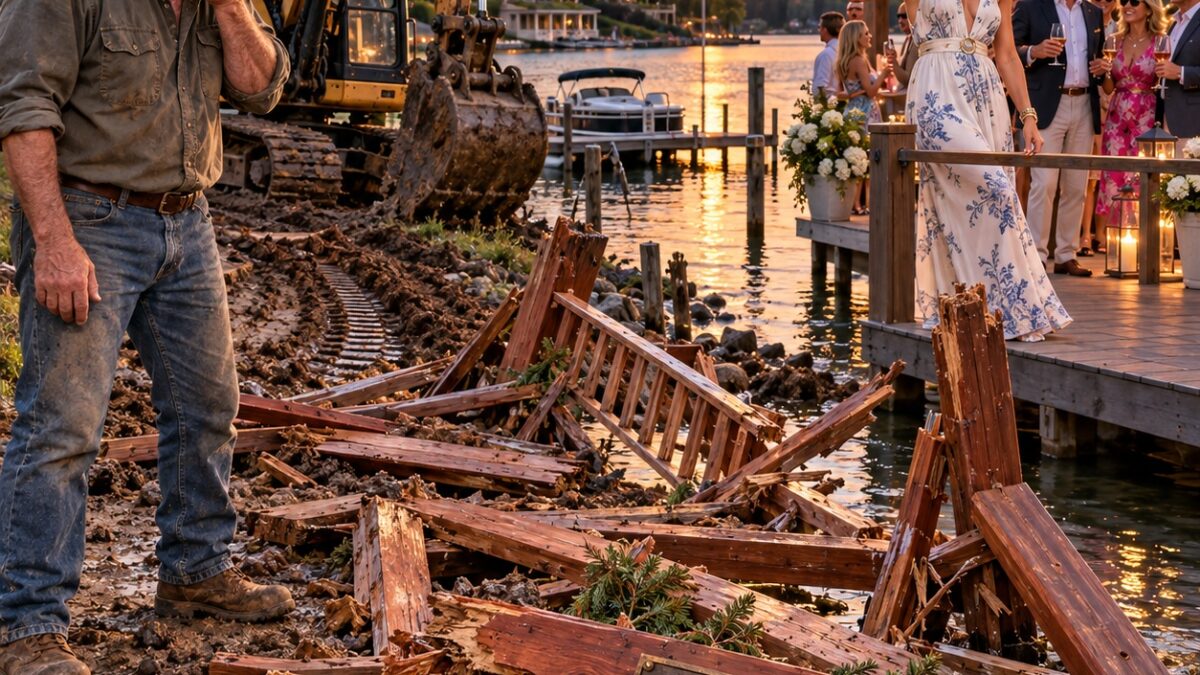
Cedar beams had been split lengthwise.
Bluestone footings cracked.
Steel hardware lay half submerged in the shallows.
The backhoe tracks were still visible in the damp soil.
I walked toward the inlet.
Slowly.
One step at a time.
I found the brass plaque face down in six inches of mud.
For a second, I could not bend to pick it up.
Then I did.
SARAH’S WALK.
Silt packed the letters.
The brass was scratched.
But it had not broken.
I wiped it against my shirt and put it inside my jacket.
Against my chest.
That was when Hank Morrison called.
Hank lived in a cabin on the north ridge.
Sixty-eight.
Retired commercial fisherman.
He had heard machinery around 9:14 that morning.
By the time he reached the shore, two men wearing Craig Kellerman’s company logo were tearing the bridge apart.
Brenda had been standing on the east bank.
White sundress.
Sunglasses.
Iced coffee.
Directing them.
Hank yelled that the bridge belonged to me.
He reminded her that the county had inspected it and found it structurally sound.
Brenda told him Lakeview Terrace had its own standards.
Then the backhoe kept working.
Forty-seven minutes.
That was all it took.
Three months for me to build.
Forty-seven minutes for her to destroy.
The county engineer had already confirmed the bridge could safely support a fire truck.
Its permit was valid.
The HOA had no jurisdiction.
None of that mattered to Brenda.
She wanted the view.
So she took it.
That evening, Hank called again.
His voice was different.
“Garrett.”
“What?”
“You might want to stay home tonight.”
“Why?”
“They’re having a party.”
I looked across the water.
The HOA dock was visible through the trees.
Fairy lights had been strung between posts.
People stood around the deck.
“What kind of party?”
He was quiet.
Then:
“They’re celebrating.”
I did not answer.
“Rosé. Caterer. Food. Brenda’s calling it a lakefront liberation party.”
I walked onto my porch.
Across the lake, the lights began coming on as the sun faded.
Someone laughed.
Music carried over the water.
Later, Brenda posted photographs.
Sunset over the newly unobstructed lake.
Wine glass in her hand.
Caption:
Finally, our lake view is restored.
Another clip showed glasses touching.
Cheers.
It was not enough that she destroyed something Sarah and I had loved.
She celebrated the destruction.
I sat outside until after midnight holding the plaque.
I thought about calling the sheriff.
My attorney.
The county.
I would do all of that later.
At one in the morning, I got into my truck and drove to the dam.
Ten minutes through woods my grandfather had known better than anyone.
The road narrowed near the crest.
I parked.
Got out.
The lake was black beneath the night sky.
On the downstream side, Carter Creek continued as a small dark channel beyond the embankment.
Two forty-two-inch butterfly valves controlled the outlet works.
My grandfather and I had replaced them together when I was sixteen.
I walked to the mechanism.
Put my hand on one wheel.
Turned it slightly.
Smooth.
Then back.
Still good.
Sixty-two years old.
Still working.
I looked at the lake.
Then downstream.
One side held forty-five acres of water that had become the central marketing image for Lakeview Terrace.
The other showed what had existed before Emmett Thornton built the dam.
A creek.
A valley.
Dry ground.
I did not open the valves.
Not that night.
That would have been anger.
And anger is a terrible engineering method.
Instead, I drove home.
At eight the next morning, I went to the Augusta County courthouse.
I wanted records.
All of them.
Lakeview Terrace plat.
Water rights.
Development filings.
Disclosures.
Construction documents.
The clerk brought me a banker’s box.
I started with the subdivision plat.
Craig Kellerman had signed it.
Right in the center of the drawing, over the lake area, was a notation.
Private impoundment.
Thornton Family Trust.
Parcel 12A.
Not included in the development.
No water rights conveyed.
I read it three times.
Craig’s initials sat directly beneath the notation.
He knew.
I pulled the sales disclosures for the homes.
Eighty-nine files.
Not one clearly disclosed that Thornton Lake was privately owned.
Not one explained that Lakeview Terrace had never acquired permanent water rights.
Not one told buyers that the lake existed only because a private dam on Thornton property impounded Carter Creek.
Then I found the resort permits.
That was where the situation became much worse.
The $1.8 million clubhouse complex had been built at an elevation of 1,847 feet above sea level.
I knew the normal pool elevation of Thornton Lake without checking.
1,852.
Five feet higher.
I pulled the old USDA construction records.
Confirmed it.
Then pulled parcel maps for the lakebed.
The ground beneath the clubhouse and adjoining resort facilities was part of Parcel 12A.
Thornton Family Trust.
Mine.
When the lake was full, the shoreline made Craig’s resort property look larger than it actually was.
When water dropped below normal pool, the legal lakebed appeared.
And the resort sat on it.
I leaned back in the courthouse chair.
Brenda had held a party celebrating the destruction of my bridge.
On my lake.
Beside a clubhouse built partly on my lakebed.
Craig had known enough to sign a plat explicitly stating that no water rights were conveyed.
Yet his company marketed the development around permanent lake access.
I kept reading.
Craig had listed the private forty-five-acre lake as a development amenity when seeking financing.
That claim helped support a roughly $2.3 million loan increase.
My grandfather’s dam had helped finance a business that never owned the water it was selling as lifestyle.
I photographed everything.
Then ordered certified copies.
I did not call Brenda.
I did not call Craig.
I called Pete Sullivan.
Pete had worked with me on Corps projects.
By then he ran a dam-safety consulting practice in Roanoke.
“I need an inspection.”
“Your dam?”
“Yes.”
“What are you expecting?”
“The truth.”
He understood.
Pete spent two days examining the structure.
Core condition.
Seepage.
Embankment profile.
Outlet works.
Spillway.
Monitoring data.
He found deterioration along the eastern toe.
Not imminent failure.
But enough seepage and pore-pressure concern that a controlled drawdown was justified for a sixty-two-year-old earthen dam.
Sunday evening, Pete sat at my kitchen table with his report.
“If this were a Corps structure, I’d lower the pool.”
“How far?”
“Minimum pool at least. Full dewatering would make the grouting work cleaner.”
“Engineering recommendation?”
He looked offended.
“I don’t write revenge reports.”
“I know.”
“Then don’t ask.”
Fair.
He slid the report toward me.
Twenty-three pages.
Controlled drawdown recommended.
Seepage investigation.
Grouting evaluation.
Embankment stability assessment.
Sixty to ninety days estimated.
I called Neil Chambers.
Water-rights attorney in Richmond.
He reviewed the deed.
Dam ownership.
Lakebed title.
Development documents.
Then Pete’s report.
“You own the dam.”
“Yes.”
“You own the bed.”
“Yes.”
“No easement requiring you to maintain a recreational pool elevation?”
“None.”
“No contractual water-level obligation?”
“None.”
He adjusted his glasses.
“Then you are legally entitled to maintain your dam.”
“That means drawing the lake down.”
“It does more than mean you can.”
He tapped Pete’s report.
“It gives you an engineering reason why you should.”
Next call went to the Virginia Department of Conservation and Recreation.
I filed the formal thirty-day drawdown notice.
Form DS-12.
Every field completed.
Pete’s report attached.
Proposed monitoring plan.
Flow limits.
Instrumentation.
Schedule.
I installed a digital stage gauge.
Flow sensors.
Additional piezometers.
Time-lapse camera.
Everything calibrated.
If this became litigation, I wanted defensible data.
Then I filed criminal complaints over Sarah’s Walk.
Unauthorized demolition.
Trespass.
Destruction of a permitted structure.
Hank Morrison gave a statement.
So did several older valley residents who remembered my grandfather building the dam.
One was eighty-one-year-old Walter Dawes.
He had watched Emmett move earth in 1962.
His statement was simple.
The Thornton family created the lake.
Everybody around there knew it.
That night, I mounted Sarah’s brass plaque temporarily on the concrete headwall near the spillway.
Not as decoration.
As a reminder.
Do this correctly.
Do not let anger choose the flow rate.
Brenda received the official drawdown notice on a Thursday.
She came to my house Friday morning.
No elaborate outfit.
No polished presentation.
Hair pulled back.
Face pale.
“You can’t drain the lake.”
“I’m maintaining my dam.”
“You’re doing this because of the bridge.”
“The dam inspection recommends drawdown.”
“If that water level drops, I will sue you.”
“Then hire someone who understands dam-safety law.”
“This will destroy our community.”
“No.”
I looked toward the lake.
“It will expose what your husband built.”
Her expression changed.
“What are you talking about?”
“Read your plat.”
She stared at me.
“This isn’t fair.”
That sentence almost made me laugh.
Instead I said:
“Neither was sending a backhoe onto my property and throwing a party afterward.”
She walked away.
Craig’s attorneys filed for an emergency injunction.
They moved quickly.
Their filing claimed catastrophic economic harm.
Property values.
Clubhouse operations.
Marina access.
Residential quality of life.
The hearing took place before Judge Anna Crawford.
Craig’s lawyers spoke for nearly forty-five minutes.
Charts.
Aerial photographs.
Value estimates.
Economic analysis.
Neil spoke for about twelve.
He presented three categories of evidence.
One:
I owned the dam.
Two:
Pete’s engineering report recommended maintenance.
Three:
Virginia dam-safety procedure had been followed.
Judge Crawford did not need much time.
She ruled that the court would not order a dam owner to neglect a sixty-two-year-old structure because neighboring homeowners preferred the recreational view.
Motion denied.
Brenda immediately started a public campaign.
SAVE OUR LAKE.
Blue T-shirts.
Yard signs.
Online fundraiser.
Drone footage set to emotional piano music.
She appeared on local television standing on the HOA dock.
Tears.
Wind in her hair.
Lake shining behind her.
“He’s punishing an entire community because of a personal disagreement.”
The reporter asked one question.
“Is it true your HOA demolished a bridge on Mr. Thornton’s private property?”
Brenda froze.
The segment aired that evening.
Public sympathy changed quickly.
Not because everyone suddenly understood water law.
Because destroying a dead woman’s memorial and then accusing the widower of being vindictive was difficult to explain.
Craig tried a different approach.
Money.
He asked me to meet at a diner outside Waynesboro.
I agreed.
I also recorded the conversation.
Virginia law allowed me to record a conversation I was part of.
Craig slid a check across the table.
$200,000.
“Bridge. Legal fees. Inconvenience.”
“And what do you want?”
“Cancel the drawdown.”
“No.”
He leaned forward.
“You’re being unreasonable.”
“I’m following an engineering report.”
“You don’t want to find out what happens if you keep doing this.”
He started talking about people he knew.
Inspectors.
Commissioners.
Planning officials.
Influence.
I listened.
Then reminded him that I had spent twenty-two years designing dams for the federal government.
Threatening me over a lawful maintenance procedure was not likely to improve his position.
When I mentioned the recording, the color left his face.
Neil loved it.
Not because threats automatically win cases.
Because Craig had volunteered evidence showing what mattered to him.
Not dam safety.
Not residents.
Stopping the drawdown.
Three days before we were scheduled to begin, one of my spillway cameras sent an alert around 5:30 in the morning.
Two men on the dam.
Company truck.
Chains.
Padlocks.
They were attempting to chain the butterfly-valve controls closed.
I called the sheriff.
Deputies arrived before they finished.
The workers had no authority to be there.
Then Brenda arrived.
She demanded to know why her workers were being treated as criminals.
A deputy explained they were tampering with regulated private dam infrastructure.
The criminal situation escalated from there.
The workers faced trespass charges.
Brenda became part of the investigation involving the attempt to interfere with the dam controls.
By that point, Craig’s legal team stopped pretending the situation was manageable through intimidation.
Day thirty came on a Wednesday.
Every notice period had expired.
No injunction.
No valid order preventing maintenance.
No chain on the valves.
At six in the morning, I walked onto the dam.
Mist covered Thornton Lake.
Sarah’s plaque caught the first gray light.
I put my hand on the first valve wheel.
Cold steel.
Familiar.
I had done controlled drawdowns on more structures than I could remember.
This one happened to contain most of my life.
I opened the first valve.
Then the second.
The water responded immediately.
Not violently.
Not dramatically.
Controlled.
I set total discharge around six hundred cubic feet per minute with both forty-two-inch butterfly valves partially open.
Enough to lower the lake safely.
Not enough to scour the downstream channel or create a flood.
The lake began falling.
Hour twelve:
Three feet.
Boat slips started looking wrong.
Floating docks sat lower on pilings.
Some cradles tipped.
Mud appeared along the shoreline.
Homeowners gathered near the marina watching the water retreat.
By then everyone understood this was real.
Hour thirty-six:
Seven feet.
The infinity pool’s intake system began sucking air.
The pump could no longer draw lake water properly.
The perfect blue surface deteriorated quickly.
The dining pavilion’s lake view became a view of wet stone and exposed bank.
The marina looked less like a resort amenity and more like equipment left behind after a drought.
Then came hour sixty.
Twelve feet below normal pool.
The transformation was astonishing even to me.
Twenty-four boats sat awkwardly on mud.
The lakebed steamed under the afternoon sun.
Old tree stumps appeared.
Rocks no one had seen since before 1962 emerged.
Carter Creek returned as a thin brown channel winding across the valley.
And then the survey monuments appeared.
Orange-capped rebar.
Original parcel markers.
Thornton property.
A line of them extended through the exposed lakebed.
Toward the resort.
Under the marina.
Toward the dining pavilion.
Toward the clubhouse.
Physical evidence that had spent decades underwater.
I stood beside one marker and brushed mud from the cap.
PARCEL 12A — THORNTON.
There it was.
No interpretation.
No HOA vote.
No brochure.
Iron.
Ground.
Title.
Exactly where the records said.
Lakeview Terrace called an emergency HOA meeting Thursday evening.
All eighty-nine homeowners attended.
Many wore blue Save Our Lake shirts.
Brenda stood at the podium.
Craig sat several rows away.
I stayed near the back until she began talking about legal action and restoring what belonged to the community.
Then I raised my hand.
“May I speak?”
The room turned.
I walked forward carrying one manila folder.
I had learned long ago that if evidence is clean, you do not need theatrical volume.
I placed the original development plat on the table.
“This identifies Thornton Lake and the dam as private property belonging to the Thornton Family Trust.”
Silence.
“Craig Kellerman signed it.”
I placed the sales disclosures beside it.
“These are the property disclosures for all eighty-nine sales.”
I looked around.
“Not one clearly disclosed that the lake was privately owned or that Lakeview Terrace had no guaranteed water rights.”
People shifted.
Then I showed the lakebed survey.
“The resort complex is built below the lake’s normal pool elevation on Parcel 12A.”
Somebody asked:
“What does that mean?”
“It means the land beneath portions of the resort is mine.”
The room changed.
Not loud yet.
Just pressure.
Then I played Craig’s diner recording.
His voice came through my phone.
Offer.
Pressure.
Threat.
Nobody moved.
A retired teacher named Connie Watts stood.
She was small.
Maybe five-two.
Her voice shook anyway.
“Are you saying nobody ever guaranteed this lake would stay full?”
“The lake exists because my grandfather built the dam.”
I looked around the room.
“Your developer never secured permanent water rights before selling lakefront homes.”
Craig started shifting in his chair.
I continued.
“I did not take your lake away.”
I pointed toward the folder.
“I maintained my dam.”
Then:
“The lake was never yours to lose.”
Craig tried to stand.
Several homeowners moved into the aisle.
Nobody touched him.
They simply did not move aside.
He sat back down.
Brenda stepped toward the microphone.
“I’m sure we can—”
Connie turned.
“Sit down, Brenda.”
For the first time I had ever seen, Brenda obeyed somebody else without an argument.
The motion to dissolve the HOA board passed eighty-four to five.
Brenda walked out alone.
Nobody watched her leave.
That might have been the first room she had exited in seven years without making sure everyone noticed.
The aftermath came in several pieces.
First:
Craig.
The property disclosures became the center of a much larger legal problem.
Eighty-nine homeowners had purchased residences marketed around lakefront living without adequate disclosure of private lake ownership and the lack of permanent water rights.
Claims followed.
Regulatory investigations followed.
Questions about financing followed.
Homeowners sought recovery for the premiums they had paid for property advertised around a lake the development did not legally control.
Second:
Brenda.
The bridge demolition could not be turned into an HOA enforcement action because there had never been valid HOA authority over my property.
The county had already confirmed Sarah’s Walk was structurally sound.
She eventually resolved the criminal charges through a plea agreement that included restitution, community service, and a permanent restriction keeping her away from my property.
Two hundred hours of community service.
I did not attend.
I did not need to watch.
Third:
Craig and Brenda left.
They listed their house below what they had paid.
It sat.
Eventually they moved away.
Her final social-media post framed everything as a new chapter.
That was fine.
Everybody needs a way to tell themselves a story they can live with.
I did not need to correct hers anymore.
The truth had already been filed where it mattered.
The most important part came afterward.
Ed Whitaker, the former HOA treasurer, came to my house one Saturday morning.
No official letterhead.
No embossed seal.
No invented title.
He brought a pound cake his wife had baked.
We sat on the porch.
Two hours.
That was the first honest conversation I had ever had with anybody representing Lakeview Terrace.
He asked about the dam.
The lake.
Water rights.
Maintenance.
Insurance.
Emergency drawdowns.
Long-term obligations.
Cost.
Most important:
He asked what I wanted.
I thought about Sarah’s broken bridge.
My grandfather.
The eighty-nine families who had not created the deception.
“I want this done properly.”
That became the beginning.
Negotiations lasted about six weeks.
Neil drafted a permanent recorded water-rights easement.
Lakeview Terrace would receive legally defined access to Thornton Lake.
Not ownership.
Not control of the dam.
Access and recreational rights under agreed conditions.
The document recognized that the Thornton family owned the dam, lakebed, and related riparian rights.
It defined maintenance responsibilities.
Emergency procedures.
Inspection access.
Drawdown authority.
Annual compensation.
Everything the developer should have negotiated before selling the first house.
No more assumptions.
No more brochures functioning as contracts.
No more pretending a view created ownership.
Once the agreement was recorded, I began refilling Thornton Lake.
Valves closed.
Upstream flow restored.
Carter Creek did the rest.
Water returned slowly.
An inch.
Then another.
Then several.
Mud disappeared.
Boat slips floated again.
The infinity pool intake was repaired.
The marina recovered.
By October, the lake had returned to full pool.
The Blue Ridge reflected across it the way it had for decades.
But something was different now.
Everyone knew whose water it was.
And everyone with a legal interest had a document explaining what that meant.
That was healthier than the old arrangement.
Even before the conflict, Lakeview Terrace had existed on a fiction.
The residents believed the lake belonged to the community.
Craig knew otherwise.
Brenda behaved as though confidence could correct the missing paperwork.
Now the truth was less convenient but more stable.
Shared use based on consent.
That is what should have existed from the beginning.
Then I rebuilt the bridge.
I could have hired someone.
I did not.
I wanted my hands on it.
Same material.
Western red cedar.
Same kind of bluestone.
Same narrow inlet.
Same orientation toward the mountains.
The work took months because I did not rush.
I shaped each joint.
Checked every bearing surface.
Sealed the cedar carefully.
Some days I worked quietly.
Other days I talked to Sarah.
Just like the first time.
The new brass plaque was slightly different.
SARAH’S CROSSING.
Not Walk.
Crossing.
It felt right.
A walk is movement.
A crossing means you came through something.
I used part of Brenda’s restitution and part of the settlement funds to create two things.
The Thornton Valley Watershed Conservation Trust.
Its purpose was simple:
Protect the dam.
Protect the lake.
Protect the surrounding forest and watershed so no future developer could build a business model around assumptions instead of rights.
The second was the Sarah Thornton Engineering Scholarship.
Full tuition assistance for Augusta County students pursuing civil or environmental engineering.
Sarah used to say that the people who build things quietly are the ones holding the world together.
She would have liked helping some young engineer become one of them.
The first scholarship award mattered more to me than any court ruling.
A student who had never met Sarah would carry her name into a profession that shaped roads, bridges, water systems, and communities.
That is a better monument than cedar alone.
Lakeview Terrace changed too.
The new community leadership stopped treating me like an obstacle.
Residents started coming over.
Some apologized.
Most did not need to.
They had been sold something by a developer.
They had trusted disclosures.
They had believed the language in brochures.
Their anger during the drawdown had come from fear.
Not everyone wearing a blue shirt was my enemy.
That distinction mattered.
One man approached me after the lake refilled.
He had bought one of the more expensive homes.
He looked toward Sarah’s Crossing.
“I thought you were trying to destroy us.”
“I know.”
“I told people you were unstable.”
“I know that too.”
He looked embarrassed.
“Sorry.”
I nodded.
Then he said:
“My daughter wants to fish off the bridge.”
“Bring her Saturday.”
He looked surprised.
“Really?”
“It’s a bridge.”
That was the point.
Sarah’s bridge had never been built to exclude people.
It had been destroyed because Brenda treated beauty like ownership.
I did not want my grief to become another weapon.
So we opened Sarah’s Crossing during community events under the new agreement.
Not as HOA property.
Not because anybody was entitled to it.
Because I chose to share it.
Consent changes everything.
Lakeview Terrace eventually started an annual spring event near the shore.
Bluegrass.
Food trucks.
Kids with cane poles.
Old residents telling stories about Emmett building the dam.
They named it the Sarah’s Crossing Festival.
The first year, I almost said no.
I worried it would feel commercial.
Then I pictured Sarah.
She loved noisy family gatherings.
Loved children near water.
Loved people using things instead of preserving them behind ropes.
So I agreed.
With rules.
No nails in the bridge.
No banners attached to the rails.
No vehicles on the approach.
No one touching the plaque.
Ed laughed.
“Those seem oddly specific.”
“They are.”
The festival worked.
The bridge filled with children.
Nobody knew exactly where to cast.
Lines crossed.
Hooks caught sleeves.
A boy dropped an entire container of worms.
Sarah would have laughed until she cried.
That afternoon, I stood farther up the bank and realized something.
The bridge had stopped being only where I remembered my wife.
It had become somewhere new memories were happening.
At first, that scared me.
Then it felt right.
Grief had convinced me the only way to honor Sarah was to preserve every part of our life exactly as it had been.
But Sarah had never lived that way.
She changed things.
Improved things.
Invited people.
The replacement bridge did not erase the original.
It carried it forward.
The new plaque helped.
Sarah’s Crossing.
A place between what had been and what still could be.
I began thinking differently about the lake too.
For years, Thornton Lake had simply existed.
My family maintained it.
People fished.
Birds nested.
Stormwater collected.
Carter Creek flowed in and out.
Then Craig turned the lake into marketing.
Brenda turned it into identity.
Lakeview Terrace began treating the water as proof of status.
Premier lakefront living.
Infinity pool.
Marina.
Weddings.
All those things were fine by themselves.
The mistake was forgetting the physical system beneath the image.
A dam made the lake.
A private dam.
An aging earthen structure.
Forty thousand cubic yards of compacted clay.
Outlet works.
Seepage.
Pore pressure.
Maintenance.
The lake was not wallpaper.
It was infrastructure.
Infrastructure requires responsibility.
That truth became visible only when the water disappeared.
The drawdown frightened homeowners.
But it also gave us the most thorough inspection the dam had received in decades.
Pete supervised remediation.
We pressure-grouted the deteriorated eastern section.
Improved monitoring.
Reworked drainage.
Repaired areas of the outlet structure.
Updated the emergency action plan.
Installed modern instrumentation.
The dam was safer afterward.
That fact mattered more than the photographs of stranded boats.
Had I ignored the seepage to protect property values, and the dam later failed, every person Brenda claimed to represent would have faced a real catastrophe.
That is why Judge Crawford’s sentence stayed with me.
A court would not order an owner to neglect a dam because neighbors enjoyed the view.
That was not revenge.
That was common sense.
Water infrastructure cannot be governed by aesthetics.
Neither can grief.
Brenda learned both too late.
She had looked at Sarah’s Walk and seen only something blocking a sightline.
Weathered cedar.
Old-fashioned design.
A structure not chosen by her.
She never asked why it existed.
Never asked whether it belonged there legally.
Never asked who built it.
She knew Sarah was dead.
That made her statement worse.
“Your wife is dead. That pile of wood won’t bring her back.”
Technically, she was right about one thing.
The bridge could not bring Sarah back.
Nothing could.
That had never been its purpose.
People misunderstand memorials if they think we build them because we believe stone or wood can reverse death.
We build them because memory needs somewhere to rest.
For me, that was a bridge.
For somebody else, a bench.
A tree.
A photograph.
A recipe.
The object does not contain the person.
It contains a place where the living can meet the memory.
When Brenda destroyed Sarah’s Walk, she did not destroy Sarah.
That took me months to understand.
At first, seeing the splintered cedar felt like losing her again.
But Sarah was not in the beams.
Not entirely.
She was in eighteen summers.
Evening walks.
Fishing lines.
Copper mountains.
The way she said my name when I became too serious.
Brenda could not put a backhoe bucket through any of that.
The new bridge taught me that.
The first time I crossed Sarah’s Crossing after rebuilding it, I stopped in the center.
Same inlet below.
Same ridge.
Different boards.
The world had not ended.
Memory survived reconstruction.
That helped me forgive something I never thought I could forgive.
Not Brenda personally.
I never developed a relationship with her again.
I mean I forgave reality for allowing the original bridge to be destroyed.
That sounds irrational.
Grief is irrational.
You become angry at time.
Disease.
Weather.
Other people.
Your own body for continuing.
Eventually you learn that carrying every loss at full weight is impossible.
So you build again.
That was Sarah’s Crossing.
The lakebed markers stayed documented after the refill.
I did not need them visible forever.
They had done their job.
During drawdown, they proved on the ground what the courthouse documents already showed.
When water rose, they disappeared again.
Truth did not disappear with them.
That became another lesson.
Visible evidence is powerful.
Recorded evidence is durable.
Craig had signed the plat.
That signature mattered even when the lake covered the boundary.
The lakebed had always been Parcel 12A.
Water over land does not transfer ownership.
A developer’s brochure cannot do it either.
People sometimes asked why I had not challenged the resort earlier.
Simple.
I believed the property line was being respected.
The lake had been full.
The resort looked like it sat along the edge.
Nothing appeared obviously wrong from the surface.
It took the bridge dispute to make me examine every development record.
That discovery made me uncomfortable.
I was an engineer.
I had spent my career telling people to inspect systems before failure.
Yet I had allowed assumptions around my own land to continue for years.
I learned from that.
After the settlement, I had every boundary around Thornton property professionally resurveyed and monumented.
Updated legal descriptions.
Digital copies.
Physical copies.
Multiple storage locations.
Neil kept certified records.
My trust documents were revised.
The water-rights easement was explicit enough that a future HOA president would need extraordinary imagination to misunderstand it.
That was intentional.
The best legal document is often the one that makes future conflict boring.
Who owns dam?
Thornton Trust.
Who owns lakebed?
Thornton Trust.
Who holds recreational water access?
Lakeview Terrace under recorded easement.
Who controls dam-safety operations?
Thornton owner subject to Virginia law and engineering requirements.
Can HOA destroy private Thornton structures?
No.
Done.
Nobody needs perfume.
Gold embossing.
Invented code sections.
Just language that survives personality.
I kept one of Brenda’s original violation letters.
The one citing Waterfront Aesthetic Harmony Code Section 7.4.2.
There had never been such a code.
She created it.
Typed it.
Embossed the HOA seal.
Signed with a calligraphy pen.
Mailed it like authority could be manufactured through stationery.
That document fascinates me.
Not because it was clever.
Because it shows how easily presentation can imitate legitimacy.
Most people receiving an official-looking violation notice react emotionally before checking the source.
Fine amount.
Deadline.
Legal language.
Seal.
They assume somebody already verified the rule.
I did not.
That habit saved me.
I went to the records.
No 7.4.2.
No waterfront aesthetic harmony code.
No jurisdiction over my parcel.
Nothing.
The document was beautiful nonsense.
That should have been the end.
Instead, Brenda escalated because she had spent years learning that people usually obeyed before checking.
The fake code led to complaints.
Then Glenn Mercer’s inspection report.
Then danger signs.
Then legal threats.
Then physical demolition.
Every escalation protected the original false assumption.
That is how bad leadership becomes dangerous.
The leader cannot admit the first claim was wrong, so every later action must make it appear right.
Brenda needed the bridge to be dangerous because she had already called it dangerous.
When the county engineer said it was structurally sound, she ignored him.
She needed it removed because she had promised the community she would remove it.
Eventually the backhoe was easier for her ego than saying:
I was wrong.
That one sentence would have saved almost everything.
Craig behaved similarly.
He knew the lake was private.
His signature proved that.
Yet the development depended commercially on residents believing lakefront permanence existed.
Once the truth threatened the model, he tried law.
Then money.
Then pressure.
Then somebody attempted to physically prevent the valves from operating.
Escalation again.
Nobody wanted to return to the foundational fact.
They never owned the water.
The most expensive problems often begin with one fact somebody refuses to accept.
The new Lakeview board did the opposite.
Ed arrived and started there.
Who owns it?
You.
What rights do we currently have?
None guaranteed.
What rights do residents need?
Stable recreational access.
Can we negotiate them?
Yes.
Six weeks.
Problem solved.
No cameras.
No television.
No arrests.
No injunction.
Just two sides discussing real rights.
That was what cooperation looked like.
It did not require me to give away the lake.
It required us to identify what each side actually needed.
Lakeview needed access.
I needed ownership recognized, safety control preserved, and fair compensation.
Those interests were compatible.
Brenda had turned them into war because she believed recognition of my rights diminished hers.
It did not.
A shared agreement created more security for everyone.
Homeowners now have stronger lake rights than they had before the conflict.
Before, they had assumptions.
After, they had a recorded easement.
That irony still makes me smile.
The man Brenda called hostile eventually gave the community the first real legal right it had ever possessed.
Not because she forced me.
Because Ed asked.
The difference between force and request can change an entire neighborhood.
Over time, homeowners stopped blaming me for the drawdown.
Especially after they understood the dam needed maintenance regardless of the dispute.
Pete presented the engineering findings at a community meeting.
No drama.
Charts.
Seepage readings.
Age.
Recommended work.
People asked serious questions.
What happens if a dam like this is not maintained?
Could the seepage have worsened?
What would an uncontrolled failure mean?
Pete answered carefully.
No exaggeration.
By the end, many residents were relieved we had inspected.
One man told me:
“I was angry you lowered the lake.”
“I know.”
“Now I’m angry nobody told us what we actually lived beside.”
“That makes more sense.”
People think lakes are landscapes.
Engineers know they can be stored energy.
Forty-five acres of water behind an embankment deserves respect.
Sarah understood that.
She loved the lake but never romanticized my work.
If I started explaining seepage, she listened.
Then asked whether the dam was safe.
Simple.
That was why the scholarship in her name felt appropriate.
Engineering at its best is not about impressive structures.
It is about responsibility for consequences people may never see.
If a dam performs correctly, nobody applauds.
Water stays where it belongs.
Road stays open.
Building stands.
Boring success.
Sarah appreciated quiet competence.
So did Emmett.
My grandfather would have hated almost everything about Brenda’s party.
Not because of rosé.
Emmett drank worse things.
He would have hated people celebrating ownership over something they had never bothered to understand.
He spent years building that dam.
Every load of clay.
Every compaction lift.
Every drainage feature.
He knew water had to be respected.
The Lakeview brochures reduced his work to “lake views.”
That is what development does sometimes.
It takes somebody’s infrastructure and turns it into scenery.
I do not resent that anymore.
Scenery is valuable.
People deserve beauty.
But beauty still rests on systems.
A resort can call the water an amenity.
The dam remains a dam.
The family trust remains the owner.
The law remains the law.
The same principle applies beyond lakes.
People enjoy electricity without thinking about grids.
Roads without thinking about drainage.
Buildings without thinking about foundations.
Water without thinking about pressure.
Civilization is held up by invisible competence.
Sarah was right.
The people building things quietly hold the world together.
That is why I wanted students in her scholarship program to understand more than equations.
I wanted them to understand stewardship.
Every design affects people who may never know your name.
Emmett never imagined eighty-nine luxury homes would depend socially and economically on Thornton Lake.
Still, the quality of his 1962 work mattered to those families sixty years later.
That is legacy.
Not plaques.
Not headlines.
Consequences of doing something properly.
I tried to follow that when rebuilding Sarah’s Crossing.
Every connection designed to last.
Every support inspected.
Every fastener appropriate.
Could I have made the bridge flashier?
Yes.
Steel arches.
Decorative lights.
Glass panels.
No.
Sarah would have hated it.
Cedar.
Bluestone.
Mountains.
Enough.
The first festival arrived in April.
Bluegrass band on the lawn.
Families brought folding chairs.
Food trucks lined the approved area.
Children crowded the water.
An old man told a group of kids that Emmett had moved ten thousand truckloads of clay.
The number grew every time he told it.
I did not correct him.
Some stories earn a little enlargement when nobody is using them in court.
A boy caught a bluegill from Sarah’s Crossing.
Maybe six years old.
He screamed as though he had landed a marlin.
Everyone laughed.
For a second, I looked at the brass plaque.
Light hit the letters.
I thought:
This is what she would have wanted.
Not the bridge preserved in sorrow.
Used.
Lived on.
Laughed across.
That was the moment Brenda finally disappeared from the bridge.
Until then, even after rebuilding, her demolition remained attached to the story.
After that child’s shout, the meaning changed.
Sarah’s Crossing belonged to the future too.
A memorial does not have to face backward forever.
I began saying one sentence when I stood there alone at sunset.
“You’d like what I did with the place, Sarah.”
At first, saying it hurt.
Then less.
Now it feels conversational.
The boards creak under my weight.
Carter Creek whispers below.
Blue Ridge changes color.
Nothing answers.
That is okay.
Grief does not require an answer.
It needs room.
The bridge gives me that.
Thornton Lake has remained full under the new agreement except when maintenance requires adjustment.
Lakeview residents still call it “our lake” conversationally.
I do not correct them.
There is a difference between emotional belonging and legal ownership.
A community can love a lake.
Use it.
Build memories around it.
That does not require pretending title belongs somewhere else.
I learned to separate those ideas.
Maybe Brenda never could.
For her, loving the view meant controlling whatever affected it.
Bridge blocks view?
Destroy bridge.
Owner objects?
Invent rule.
Engineering report inconvenient?
Ignore it.
Dam owner lowers water?
Stop him.
That is not stewardship.
It is possession without responsibility.
Ed’s board became better precisely because they accepted responsibility.
Annual compensation.
Rules.
Emergency procedures.
Safety meetings.
They now understand that lake access carries obligations.
That knowledge made them better neighbors.
It also made me more comfortable sharing.
Respect creates generosity.
Entitlement kills it.
I could have kept Thornton Lake entirely private after everything.
Legally, I had leverage.
But what would that accomplish?
Eighty-nine families had built lives around the water.
Children had learned to swim there.
People married at the pavilion.
Retirees watched sunsets.
Those memories were real even if the original development documents were flawed.
Punishing residents for Craig’s deception would not bring Sarah back.
Would not rebuild the bridge faster.
Would not honor Emmett.
So we found a lawful structure that preserved use.
That is where the story stops being revenge.
People like the image of me opening valves and watching Brenda’s perfect resort turn into mud.
It is dramatic.
I understand why.
But if that were the ending, it would be shallow.
The real ending was closing the valves again.
Refilling the lake.
Recording the easement.
Rebuilding the bridge.
Creating something more stable than what existed before.
Destruction revealed the truth.
Reconstruction made the truth useful.
That is more important.
Craig’s money offer taught me another lesson.
$200,000 sounded large sitting on diner Formica.
It was more than enough to rebuild Sarah’s Walk several times.
Could have covered legal fees.
Could have made the immediate conflict disappear.
All I had to do was cancel legitimate dam maintenance and accept his version of the world.
No.
Money offered to make you ignore risk is not compensation.
It is a transfer of liability.
If the dam later developed serious internal erosion after I ignored Pete’s report, who would Craig blame?
Me.
Correctly.
I was the owner.
Professional engineer.
Former Corps specialist.
I could not claim ignorance.
That is why his offer had never actually been generous.
He wanted me to absorb the technical and legal risk so he could preserve property values.
Engineers are paid partly to say no when people want convenience over safety.
I had done it throughout my career.
Military officers.
Contractors.
Local governments.
Developers.
Sometimes they hated me for weeks.
Then storms came.
Structures held.
Nobody remembered the argument.
That is success.
Thornton Dam deserved the same professionalism.
The fact that Sarah’s bridge had been destroyed made my emotions complicated.
It did not change the engineering.
That was important.
Had Pete inspected the dam and found it perfect, I would not have manufactured a drawdown report.
I needed the action to stand without revenge.
It did.
Every regulator could review it.
Every calculation could be defended.
That is what allowed me to sleep after opening the valves.
Brenda could call it punishment.
Craig could call it extortion.
The data remained.
Seepage existed.
Maintenance was justified.
Not every consequence somebody dislikes is retaliation.
Sometimes their comfort depended on deferred maintenance they were never entitled to demand.
I kept Pete’s report with the lake records.
Future owners need it.
So do future engineers.
The dam has an inspection history now far better organized than before.
Digital monitoring.
Updated drawings.
Maintenance schedule.
Water-rights agreement.
Emergency contacts.
Sarah’s plaque may be what visitors notice.
I am more proud of the files nobody sees.
That is how systems survive.
Brenda’s fake code was the opposite.
A document created only to look official.
No foundation.
No authority.
No chain.
It disappeared the moment somebody checked.
Good records do not depend on appearance.
They depend on provenance.
Who issued this?
Under what authority?
What parcel?
What right?
What standard?
Those questions can save people from enormous mistakes.
Lakeview homeowners learned that painfully.
Many told me they had never read their full closing packages.
I did not judge them.
Residential closings can bury people in paper.
They trusted professionals.
The failure belonged higher in the chain.
But after this, buyers in the valley became much more interested in water-rights language.
Title companies too.
Sometimes one public disaster improves behavior for everyone nearby.
I would rather Sarah’s bridge never have been destroyed.
Still, if something useful came from it, I will take that.
Craig’s legal problems continued longer than mine.
Regulators examined the construction-loan representations.
Homeowners pursued disclosure claims.
I stayed involved only where my testimony or records were necessary.
I refused to let his case become my hobby.
That is another trap.
Winning a conflict can keep you emotionally tied to the person who caused it.
You start checking every update.
Following every hearing.
Hoping each consequence hurts more.
That gives them permanent space in your life.
I had already given cancer fourteen months of Sarah’s life.
I was not giving Craig and Brenda the rest of mine.
So I testified when needed.
Signed what Neil asked.
Then went home.
Work.
Bridge.
Dam.
Scholarship.
Festival.
Life.
Eventually I stopped knowing where Craig and Brenda lived.
Good.
The restraining order meant Brenda did not return to my property.
Also good.
I did not need an apology from her.
Some people expected one.
I didn’t.
An apology cannot rebuild cedar.
Cannot erase the party.
Cannot put the original bridge back.
Restitution paid for damage.
Community service imposed consequence.
Legal boundaries prevented repetition.
That was enough.
Closure does not always require mutual understanding.
Sometimes it requires enforceable distance.
The new community relationship developed without her.
Better that way.
Ed once asked whether I thought Brenda understood what she had done.
“I don’t know.”
“Does that bother you?”
“No.”
He looked surprised.
“It used to.”
“What changed?”
“I realized understanding is her responsibility.”
That is true.
I had spent too much time wanting people to recognize why Sarah’s bridge mattered.
Most did.
Brenda might never.
I could not control that.
I could control what happened next.
That became the healthier question.
What now?
Rebuild.
Protect.
Teach.
Share carefully.
That is where the conservation trust came from too.
Thornton Valley Watershed Conservation Trust now holds funds dedicated to maintenance, shoreline habitat, forest protection, and long-term dam stewardship.
The lake should not depend on whether the next Thornton has money at exactly the right moment.
Emmett built it through personal sacrifice.
I want the future to be less fragile.
The trust means dam inspections continue.
Watershed preserved.
No casual sale of lakebed.
No developer turning private infrastructure into an advertising prop without agreements.
That may be the most durable response to what Craig did.
Not suing forever.
Designing the future so the same thing is harder to repeat.
Engineers like redundancy.
So do good legal arrangements.
The Sarah Thornton Engineering Scholarship has grown too.
The first student studied environmental engineering.
Another chose civil.
One wanted water resources.
I met them.
Told them about seepage.
Dams.
Responsibility.
I did not tell the full Brenda story unless they asked.
Young engineers do not need revenge lessons.
They need ethics.
I told them:
“Your drawing can affect people fifty years after you’re dead.”
That usually got their attention.
Then:
“Someone trusted my grandfather’s embankment sixty years later. Build accordingly.”
That is the lesson I wish Craig had learned in his own field.
Developers also shape lives after signatures dry.
A disclosure omitted in 2017 can terrify eighty-nine families years later.
Professional responsibility is not merely avoiding criminal conduct.
It is understanding that other people arrange their futures around what you tell them.
Homes are not abstract.
Mortgages are twenty or thirty years of labor.
If you market “permanent lakefront living,” you had better know whether the lake is yours.
Craig knew it was not.
That was why I had little sympathy for him.
I had more for Brenda than people expect.
Not because what she did was excusable.
It wasn’t.
But I think she built an identity around control and became trapped inside it.
Former beauty queen.
Developer’s wife.
HOA president.
Lake Lady.
Every layer told her the community existed partly as a reflection of her competence.
Then Sarah’s old cedar bridge sat in the sightline.
Something she had not approved.
Something she could not control.
Instead of accepting limitation, she interpreted it as a challenge.
That is a dangerous personality pattern.
If you need every environment to confirm your authority, somebody else’s independence feels like rebellion.
My bridge was not rebellious.
It was just not hers.
That should have been enough.
She could have asked:
Could we landscape around the view?
Could we discuss maintenance?
Could we photograph around it?
Anything.
Instead:
Tear it down.
That first impulse contained every later failure.
No curiosity.
No negotiation.
Only control.
I recognize that trait now much faster.
During Corps work, I saw milder versions in project managers.
People who treated technical disagreement as disrespect.
The best leaders asked questions.
The worst demanded agreement.
Water punishes the second type.
So does property law.
Brenda happened to collide with both.
Today, if somebody asks why I drained the lake, I answer carefully.
I did not drain it because Brenda hurt me.
I lowered it because an engineering inspection found maintenance needs, and the legal process confirmed my right and responsibility to do so.
The fact that the drawdown also exposed her husband’s deception was a consequence.
Not the engineering purpose.
That distinction matters to me.
I do not want Sarah’s memory attached to reckless retaliation.
She would have hated that.
Sarah believed in fairness even when she was angry.
Especially then.
When she was sick, she sometimes apologized to nurses for needing help.
I told her to stop.
She never did.
That was who she was.
If I had endangered downstream property or ignored dam-safety procedure simply to punish Brenda, I would have betrayed the person whose bridge I was supposedly defending.
So I did it by the book.
Inspection.
Report.
Notice.
Flow calculation.
Monitoring.
Legal review.
Court.
Then valves.
No shortcuts.
That is how I honor Sarah more than any plaque.
The lake came back because the goal had never been to destroy it.
People forget that when they retell the story.
They remember the mudflat.
Boats tilted.
Green pool.
Exposed markers.
They forget October.
Water full.
Mountains reflected.
Marina restored.
Children fishing.
That is the image I prefer.
Systems restored under honest rules.
Nothing hidden.
The lake belongs legally to one family trust and emotionally to many people.
Those realities can coexist.
Ownership does not have to mean exclusion.
Community does not have to mean seizure.
You can share something without surrendering it.
You can respect a boundary without resenting it.
That is the arrangement we eventually found.
If Brenda had understood that at the beginning, Sarah’s Walk might still be the original bridge.
Maybe we would have negotiated lake rights without a crisis.
Maybe Craig’s disclosure problems would still have surfaced eventually.
Maybe not.
There are too many alternate histories.
I stopped living in them.
What happened happened.
Cedar broke.
Water fell.
Truth appeared.
Then we rebuilt.
That is enough.
Last Tuesday, I walked out to Sarah’s Crossing just before sunset.
The lake was full.
A light wind moved across it.
The Blue Ridge turned copper.
Exactly the color Sarah loved.
I put my hand on the south railing.
The brass plaque caught the last sunlight.
SARAH’S CROSSING.
On the far shore, a child shouted.
He had caught a bluegill.
The sound bounced across the water.
For a moment, I could almost hear Sarah laughing.
Not literally.
Memory.
That is what bridges are good for.
They connect things separated by space.
Sometimes they connect times too.
Who I was with her.
Who I became without her.
The old bridge.
The new one.
Grief.
Life.
I looked toward the dam my grandfather built.
Still there.
Stronger now.
Monitored.
Protected.
The lake around it no longer rested on assumption.
Neither did the community.
Craig once sold a dream he did not own.
Brenda once believed an HOA title gave her authority over anything she could see.
Both mistakes came from confusing appearance with foundation.
The resort looked like it owned the lake.
It did not.
The bridge looked old to Brenda.
It was structurally sound.
Her violation letter looked official.
The rule did not exist.
Her engineer’s report looked professional.
His credentials had expired and his analysis was wrong.
Her husband’s development looked permanent.
Part of it rested on my lakebed.
The full lake looked like it belonged to the homes surrounding it.
The valves proved otherwise.
That is what the entire experience taught me.
Do not confuse what looks permanent with what actually is.
Water can leave.
Wood can break.
Leadership can disappear.
A luxury development can become a mudflat in seventy-two hours.
What lasts is what has a foundation.
The dam.
The deed.
The survey.
The law.
Memory.
The people you loved.
Sarah is still gone.
No bridge changes that.
No court ruling.
No restored lake.
But the life we built together still shapes what I choose.
The trust.
The scholarship.
The bridge.
The way I handle the community.
Those things come from her.
That is enough for me now.
Sometimes I stand there after everybody leaves and say the same thing.
“You’d like what I did with the place, Sarah.”
Then I listen.
Boards creak.
Water moves beneath the bridge.
Carter Creek keeps entering Thornton Lake like it has since 1962.
No applause.
No dramatic answer.
Just a private lake, a safe dam, a community finally built on honest agreements, and a cedar bridge standing where one arrogant woman once believed nothing could stop her from deciding what belonged in my view.
She was wrong.
Not because I owned more power than she did.
Because I knew what I owned.
And, in the end, the deed, the dam, and the water all agreed.








