PART2:HOA Queen Built 512 Homes on My Family’s Land—Then She Told Me to Sign or She’d Make My 340 Acres Worthless
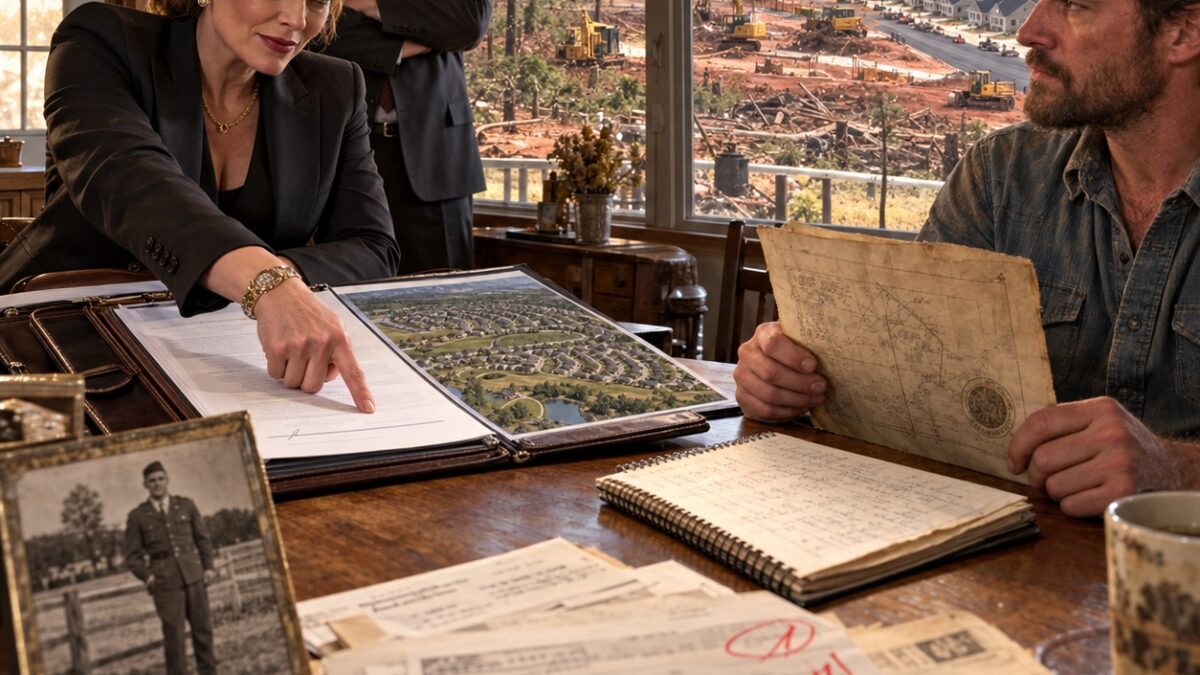
PART2
I wrote down everything.
Time.
Weather.
Names.
What Claudette said.
What Vickers said.
What I said.
The fact that neither had asked permission before behaving like my kitchen was a conference room.
The fact that no one had notified me about the rezoning hearing.
Even the smell of Claudette’s perfume.
Floral.
Heavy.
The kind that hung in the kitchen almost an hour after her Audi disappeared down my gravel road.
At the time, I did not know that notebook would eventually reach 412 pages.
I called it the log.
I did not start it because I had some grand legal strategy.
I started it because my grandfather had believed strongly in remembering exactly what people promised.
And because something about the way Claudette said we’ll make sure this land is worthless to you told me that conversation was not going to be the end.
A month later, the property-tax reassessment arrived.
I was standing at the mailbox in November cold when I opened it.
The fields behind me looked the color of dry wheat.
Frozen gravel moved beneath my boots.
The county, citing the new residential zoning classification, had increased my annual property tax bill from about $4,200 to more than $31,000.
That was not a small adjustment.
That was financial pressure.
An extra twenty-seven thousand dollars every year could force a farmer to reconsider whether holding land was still worth it.
I took the notice inside.
Made coffee.
Opened my laptop.
I am not a lawyer.
Never claimed to be one.
But I can read.
I searched the North Carolina General Statutes.
Eventually I found Section 105-277.3.
Agricultural land deferral.
Qualifying farmland could be valued based on agricultural use rather than speculative residential development value.
My acreage remained actively used for hay production and cattle grazing.
The county could call it residential on a zoning map.
That did not magically stop agricultural activity.
I filed the required paperwork myself.
Paid forty dollars.
Six weeks later, the reassessment was rolled back.
First pressure point neutralized.
I added everything to the log.
Notice.
Statute.
Application.
Receipt.
Reversal.
Claudette did not respond directly.
She simply found another lever.
The county water authority informed me that my existing well permits were under review.
The review might take as long as eighteen months.
During that period, new construction could be restricted.
The notice was carefully written.
Nothing explicitly said the farmhouse or existing farm structures were threatened.
But the implication was there.
Cooperate.
Or ordinary life becomes complicated.
I drove to the water authority office Thursday morning.
Orange plastic chairs bolted to the floor.
Wall clock running three minutes slow.
Forty-minute wait.
A young clerk eventually called my name.
He looked uncomfortable before I even sat down.
He told me the review was routine.
I asked him to identify the statutory authority authorizing that specific review.
He could not.
I asked for the supervisor.
Supervisor came out.
Same question.
Same absence of an answer.
I wrote both names in the log while sitting in my truck outside.
Added time.
Location.
Exact language.
Then drove home.
Meanwhile, Claudette was building the public version of Meadowgate.
The Caldwell Register ran a story.
Architectural renderings.
Commissioner Vickers talking about economic development.
A sidebar on housing demand.
My name appeared nowhere.
The article called my farm the undeveloped parcel.
Three times.
I remember staring at that phrase.
Undeveloped.
As though Herschel Drummond had not cleared those fields.
As though fifty-plus years of agriculture amounted to nothing because nobody had poured cul-de-sacs over it.
As though land did not become meaningful until somebody put a clubhouse on it.
Claudette was holding preview events for buyers inside a temporary sales office.
New carpet.
Scale model.
Floor plans beneath glass.
Wait list.
People choosing future houses.
She was selling a vision built on land I had never agreed to sell.
That winter, I began reading every night.
Real-property law.
County ordinances.
Rezoning procedures.
Notice requirements.
The Carolina cold pressed against the kitchen windows while I sat under the same light my grandfather used for farm accounts.
Eventually I found Chapter 160D.
For rezoning affecting a specific parcel, the owner was supposed to receive written notice by first-class mail at least ten days before the hearing.
I had received nothing.
No letter.
No postcard.
No phone call.
Nothing.
I wrote the statute number in the log.
Underlined it twice.
Claudette believed the rezoning was finished.
I now knew the process underneath it was defective.
I still did not call a lawyer.
Not yet.
I had a cousin, Thaddeus, who worked commercial real estate in Charlotte.
Thaddeus knew lawyers.
He had already mentioned one.
Paxton.
Land-use attorney in Asheville.
Twenty-two years’ experience.
Methodical to the point of alarming, according to him.
I kept her number.
Kept gathering.
By the summer of 2012, the pressure stopped being merely irritating.
The Development Authority filed for a development easement across my property.
If approved, it could let them begin preliminary site work before any purchase agreement was completed.
The theory seemed obvious.
Get equipment onto the farm.
Start changing the ground.
Create expense.
Create confusion.
Make the legal situation complicated enough that surrendering begins to look cheaper than fighting.
The application relied on a county economic-development provision allowing expedited treatment for public-benefit infrastructure.
This time, notice was required.
This time, I received it.
I was in the barn when the certified letter arrived.
August.
Heat pressing down.
Cut hay smell.
Red-clay dust.
Work gloves still on my hands.
I read the notice once.
Then again.
Walked inside.
Called Thaddeus.
Thaddeus called Paxton.
Two days later, I drove to Asheville.
Her office occupied a converted Victorian on Merrimon Avenue.
The first thing I noticed was her desk.
Perfectly organized.
No loose stack.
No missing folder.
I immediately liked her.
She listened to me for forty-five minutes.
Read sections of the log.
Asked only three questions.
Then leaned back.
“They don’t have standing for this easement.”
“Why?”
“They skipped a required environmental pre-screen.”
The county ordinance required environmental review before development activity on parcels larger than one hundred acres.
Mine was three hundred forty.
The Development Authority had filed as if that requirement did not exist.
Paxton objected formally within the week.
The easement application was suspended.
For several mornings before the ruling, bulldozers had sat close enough to my property line that I could hear diesel engines from the house.
Low rumble.
Like a storm refusing to arrive.
After Paxton filed, the equipment disappeared.
That was the first time Claudette seemed to take me personally.
She started showing up at my church.
Small Baptist congregation off Route 18.
Eighty or ninety people on a good Sunday.
Pastor knew everyone’s truck.
Second-Sunday potluck mattered almost as much as the sermon.
Claudette was not a member.
Did not live nearby.
Had never shown the slightest interest in joining.
Then she appeared three Sundays in a row.
Coffee in the fellowship hall.
Warm smile.
Soft voice.
She told people she was worried about me.
Said I might be struggling financially.
Said she hoped the community would look out for me.
Sometimes, she said, people in difficult financial positions make decisions they later regret.
The implication was elegant.
I was broke.
Embarrassed.
Too stubborn to accept the generous deal she had supposedly offered.
A church deacon named Weston told me.
He had known me since I was a child.
We stood beside the parking lot after service.
His discomfort told me how calculated Claudette’s approach had been.
I thanked him.
Then asked:
“Would you write down exactly what she told you, in your own words, and sign it?”
He looked surprised.
Then nodded.
“Sure.”
That became witness statement number one.
Paxton loved the idea.
Over the following months, we collected eleven.
Signed.
Dated.
First person.
People describing only what they had personally heard or seen.
Weston.
The water-authority clerk.
A former survey employee.
Others.
Each entered the growing binder.
By then, the spiral notebook had company.
Folders.
Photographs.
Certified letters.
County documents.
The case was taking physical shape.
Still, Claudette kept moving.
The easement application returned in revised form.
Paxton objected on different grounds.
Suspended again.
I watched this from the farm.
Fixed fence.
Cut hay.
Ate sandwiches on the tailgate.
There was a hawk that circled the east field almost every Saturday afternoon that fall.
Wide loops.
No hurry.
I began thinking of the case the same way.
Claudette wanted urgency.
Sign now.
Sell now.
Move now.
Decide now.
I did not have to use her clock.
Time was giving me more documents.
More witnesses.
More mistakes.
The longer she pushed, the more she wrote down.
Then, in spring 2013, she crossed a line I could see from my own pasture.
She broke ground.
Not across the entire farm.
On a thirty-acre strip along my eastern boundary.
The Development Authority produced a survey saying the strip actually belonged to an adjacent parcel it had purchased two years earlier.
Survey firm:
Piedmont Land Services LLC.
I searched its registration.
Fourteen months old.
Registered agent:
Claudette’s brother-in-law.
Tuesday morning, I drove to the eastern fence line.
A Caterpillar D6 was pushing Carolina clay through a stand of mature longleaf pine.
The trees had taken decades to reach that height.
They smelled like turpentine and history.
Now roots were exposed.
Trunks splintered.
Piles of wood where shade had been.
I did not approach the operator.
I took photographs.
Dozer number.
Company name.
License plate on the support truck.
Time.
Coordinates.
Then called Paxton.
She contacted the grading contractor directly.
Written notice:
Boundary under active legal dispute.
Continued operations could expose the company itself to liability.
The contractor was a small operation out of Lenoir.
They had no appetite for becoming a defendant in somebody else’s title dispute.
Equipment came out the next day.
Too late for the trees.
Three acres of mature longleaf pine were gone.
Less than forty-eight hours.
That loss hurt in a way tax notices did not.
Those trees could not be reinstated by paperwork.
Paxton filed for a temporary restraining order in Caldwell County Superior Court.
Judge Alara Finch.
Sixteen years on the bench.
No patience for theater.
She granted it within forty-eight hours.
No development activity near the disputed boundary until the survey question was resolved.
Two days later, Claudette appeared in the newspaper.
Called it a minor procedural delay.
Promised Meadowgate remained on schedule.
Behind her was a glossy rendering of the finished subdivision.
She wore a dark blazer.
Smiled.
What she did not tell prospective buyers was that the Development Authority had already begun pre-selling lots.
Three hundred twelve contracts.
Prices between roughly $85,000 and $140,000.
Real people.
Real deposits.
Real signatures.
Tied to property whose title remained disputed.
That changed the case.
Paxton explained why.
Selling binding interests in land you know you may not own can stop being a simple civil problem.
North Carolina law on false pretenses becomes relevant when money is obtained through representations the seller knows are false.
Paxton had a quiet conversation with the Caldwell County District Attorney’s Office.
Not a public accusation.
Not a press conference.
She showed them a limited portion of the file.
The DA opened a preliminary inquiry.
Then Commissioner Vickers appeared at my farmhouse one Saturday.
No appointment.
He looked like a man who had recently been informed that something he believed was routine might not be.
I let him in.
Made coffee.
We sat at the kitchen table.
He talked about compromise.
Community benefit.
The possibility that a reasonable package might let everyone move on.
I poured him a second cup.
Then excused myself.
Walked to the back room.
Activated the recorder on my phone.
I had looked up North Carolina’s one-party recording law months earlier.
I returned.
We talked forty-one more minutes.
Vickers became more direct.
If I made the legal complications go away, certain county issues could become easier.
If I did not, county services might remain less cooperative.
He never said:
Sell or we punish you.
Men comfortable with power rarely say the ugly sentence cleanly.
They imply it.
The recording captured the implication well enough.
Paxton had it professionally transcribed.
The audio and transcript went into the file.
By then, my evidence no longer looked like a private notebook.
Paxton’s paralegal, Obadiah, helped organize everything.
Three-ring binders.
Tabs.
Index.
Cross-references.
Dates.
Witness names.
Exhibits.
The log remained the spine.
Four hundred twelve pages eventually.
But the surrounding record had become something built for court.
The biggest discovery arrived in fall 2013.
Not because Claudette escalated.
Because Obadiah did a routine title search.
He checked my chain of title from 1947 forward.
Clean.
Herschel Drummond.
Proper transfers.
Proper probate.
No lien.
No easement giving Meadowgate rights.
No gap.
Then he pulled the Development Authority’s organizational records from 2010.
The enabling resolution establishing its jurisdiction included my 340 acres.
That alone was not necessarily shocking.
Development authorities sometimes include territory they intend to acquire.
What mattered was the process used to create that jurisdiction.
The county commission had approved the resolution on a consent agenda.
Routine items bundled together.
No individual debate.
The county attorney certified that all affected property owners had been notified.
But the notification list had been prepared by Claudette’s own administrative office.
My name was not on it.
They had created the legal mechanism claiming jurisdiction over my land without notifying the person who owned every acre of it.
Same defect as the rezoning.
Except earlier.
Deeper.
Foundational.
Paxton called that night.
I stood at the kitchen window while she explained.
November fields outside.
Last light flattening across the western ridge.
“So the authority that claims jurisdiction over my land set up that claim without notifying me.”
“Yes.”
“And that can make the enabling resolution void?”
“That’s what we’re going to ask the court to declare.”
I looked at the binder on the table.
“Without the resolution, they have no jurisdiction.”
“Correct.”
“Without jurisdiction, the rezoning, easements, survey actions, lot sales—”
“Every one of those actions becomes legally vulnerable.”
I was quiet.
Then I smiled.
First time in three years the case felt smaller than the truth behind it.
“They were finished before we knew they were finished.”
Paxton gave a quiet laugh.
“Essentially.”
We decided not to celebrate.
Not publicly.
No newspaper.
No threatening letter.
No demand that Claudette surrender.
We spent the next six months building.
The legal strategy had three main parts.
First:
Quiet title.
Paxton would ask the court to formally establish the Drummond ownership and extinguish competing claims.
The deed was already clear.
But a judicial quiet-title order would put the issue beyond the Development Authority’s storytelling.
Second:
Declaratory judgment.
Separate but coordinated.
Judge Finch would be asked to declare the enabling resolution invalid as applied to my land because statutory notice had never been provided.
If that foundational claim failed, everything resting on it became suspect.
Third:
Evidence of the pressure campaign.
Eleven witness statements.
Water-authority records.
Church statements.
The employee from Piedmont Land Services who said the disputed survey had been prepared to reach a desired conclusion rather than discover an accurate one.
The Vickers recording.
The trees.
Tax notices.
Letters.
Dates.
A former Assistant U.S. Attorney known to Paxton reviewed the Vickers tape.
His phrase was:
“Color of official right.”
Meaning the suggestion that public authority was being used as leverage in a private economic dispute could support more serious scrutiny if investigators chose to pursue it.
That phrase went into the log.
Paxton also filed a complaint with the North Carolina Real Estate Commission over the pre-sale contracts.
That created another front.
Separate regulator.
Separate investigative power.
Different problem for Claudette.
While all of that moved, I farmed.
August hay.
Sweat before nine in the morning.
Fence repair.
Sunday drives across the back fields.
I replanted the eastern boundary.
Young longleaf pines in black nursery pots.
Small.
Thin.
Nothing like the trees the dozer had destroyed.
They would need decades.
That was all right.
Some things you rebuild for people you may never know.
On those drives, I started thinking about Meadowgate’s families.
That became important because anger makes it easy to flatten everyone on the other side into one enemy.
Claudette was an adversary.
The buyers were not.
They were families.
Teachers.
Mechanics.
Nurses.
Parents.
People who saved money.
Picked floor plans.
Selected carpets.
Enrolled children in school.
Signed contracts because a professional development authority represented that it had the legal right to sell.
Some were already living there.
They did not conspire to take my farm.
They trusted the seller.
If I won—and by then I believed we would—the court could create enormous uncertainty for people who had done nothing wrong.
I did not want that.
Thaddeus connected me with a financial advisor named Kelsey in Morganton.
Quiet.
Practical.
Paxton joined the conversations.
Over months, usually after Sunday drives, we developed a plan.
If the court restored the property record completely, we would not use the judgment as a weapon against innocent residents.
We would use it as the foundation for a clean solution.
The plan covered families already in completed homes.
Deposit holders.
Mortgages.
Title insurance.
The remaining undeveloped land.
I told almost nobody.
Timing mattered.
Spring 2014 brought another change in Claudette.
She stopped coming to the farm.
Commissioners stopped dropping by.
The pressure went quieter.
More bureaucratic.
A county building inspector arrived in April.
No notice.
Three alleged violations.
Farmhouse roofline supposedly violated updated setback requirements.
Electrical panel needed reinspection.
Stair risers a quarter inch short.
I called Birch.
Contractor friend.
Big man.
Chewed toothpicks.
Built houses in two counties.
We checked every issue.
Roofline accusation relied on an outdated setback rule superseded in 2009.
Electrical panel had been inspected and passed the previous year.
I had the paperwork.
Stairs were compliant.
Birch wrote a two-page response citing exact code provisions.
All three violations disappeared within three weeks.
Paxton looked at the timing.
Every fresh regulatory action arrived shortly after a court filing in our case.
That was not proof by itself.
But patterns matter.
She filed a motion for protective relief in the quiet-title case.
The motion described repeated regulatory pressure and suggested retaliatory coordination.
Commissioner Vickers was implicated.
Once filed, the motion became public.
The Caldwell Register finally wrote about the property fight.
Cautiously.
Private landowner.
County-affiliated Development Authority.
Allegations of coordinated regulatory pressure.
A reporter named Clive called.
I declined substantive comment.
Then suggested he read the Superior Court filings.
He did.
The wall around the story began to crack.
Meanwhile, Real Estate Commission investigators contacted the lot buyers.
Three hundred twelve deposit holders.
Investigators reviewed standard sales paperwork.
One clause jumped out.
The seller represented that it held clear and marketable title to the property being sold.
The Development Authority did not.
Not to my acreage.
Not while the dispute was active.
The Commission referred the matter to the state Attorney General.
Then the Charlotte Observer published a story.
Page B3.
Below the fold.
Still mattered.
Third-generation farmer.
Grandfather purchased land in 1947.
County-backed development authority.
Disputed title.
Paxton quoted:
Her client’s property rights had been repeatedly disregarded by entities that should have known better.
Shortly afterward, Claudette called Paxton.
For the first time:
Settlement.
Paxton asked whether I wanted to hear an offer.
I looked through the kitchen window.
July heat shimmering above the fields.
“No.”
“You sure?”
“I’ll see her in court.”
That was not anger talking.
A private settlement could give me money and leave the buyers’ title problems unresolved.
I wanted a judgment.
Public.
Clear.
Final.
A piece of paper every family, bank, insurer, regulator, and future owner could rely on.
The months before the hearing were the worst.
Not because we lacked evidence.
Because Claudette had apparently realized the ground beneath her was moving.
The rumors returned.
Debt.
Claims that I had mortgaged the farm years before.
A story that I had rejected an extraordinarily generous purchase offer because I was stubborn and now hundreds of families were suffering for it.
None true.
All designed to make me responsible for uncertainty created by people who sold land they did not own.
But three years of logging conversations had trained me.
I traced rumors.
Asked people politely where they heard them.
Several paths led back toward employees or associates of the Development Authority.
Paxton added possible defamation claims to our file.
We did not need them yet.
Then Claudette’s attorneys tried to remove the quiet-title action to federal court.
They argued the interests of Meadowgate buyers created a federal question.
Paxton called it delay.
Our state hearing was scheduled for February.
Federal transfer could create months or longer of procedural uncertainty.
Judge Finch denied the motion.
Claudette moved for reconsideration.
Denied again.
Judge Finch’s written order included one sentence Paxton printed for her wall:
The court declines to allow procedural maneuvering to substitute for substantive defense.
I copied it into the log.
While Claudette’s legal team fought venue, I worked on the homeowners.
Thaddeus connected me with Carolina Housing Rights.
Nonprofit organization in Raleigh.
They represented working families hurt by predatory or defective development transactions.
I gave them what we knew.
The Real Estate Commission findings.
Sales contracts.
Title problem.
They began contacting deposit holders and residents.
The conversations were difficult.
Some families had already moved into Meadowgate homes.
Children had bedrooms.
Mortgages had closed.
Lawns had grown in.
They suddenly learned the legal chain beneath their houses might not be what the developer promised.
But this was not automatically an eviction crisis.
Real property law has ways to cure defective title when the true owner cooperates.
I intended to cooperate.
Fairly.
The night before the hearing, I ate leftover chicken.
Watched the weather forecast.
Set a clean dark-blue shirt on the chair beside my bed.
Dress boots on the floor.
The same boots I wore to Herschel’s funeral.
I slept.
Maybe six hours.
Enough.
Caldwell County Superior Courthouse sits in Lenoir.
Brick.
Old paper.
Floor wax.
The kind of building that makes people lower their voices without being told.
I arrived early.
Second row of the gallery.
Claudette entered later.
Two attorneys.
Suits worth more than my truck.
She did not look at me.
Commissioner Vickers was not there.
He had resigned in December.
Official explanation:
Personal health reasons.
Maybe true.
Maybe not.
Paxton thought the timing spoke for itself.
The gallery kept filling.
Charlotte Observer.
Clive from the Register.
Carolina Housing Rights.
Three deposit holders.
Weston, the church deacon, drove forty minutes on a weekday morning.
He sat near the back.
Judge Finch entered.
No theatrics.
Paxton began with the deed.
Herschel Drummond.
Clean chain.
Unencumbered.
Then the Development Authority’s enabling resolution.
Jurisdiction claimed over my 340 acres.
Approved without statutory notice to me.
She walked through the county’s notice process.
Notification list created by Claudette’s office.
Certification that affected owners had been notified.
My absence from the list.
Then everything built on that foundation.
Rezoning hearing.
No notice.
Easement applications.
Survey dispute.
Pre-sales.
Three hundred twelve purchase contracts representing clear and marketable title.
Then Vickers.
The recording.
Claudette’s lawyers objected.
Judge Finch overruled.
Forty-one minutes played in full.
Nobody moved much.
Vickers’s voice sounded exactly as it had in my kitchen.
Reasonable.
Calm.
That made the implications worse.
“You make the legal complications go away, and certain things become a lot easier for you around here.”
The room shifted.
You could feel discomfort moving through the gallery.
Paxton did not comment dramatically afterward.
She walked to our table.
Picked up a manila folder.
Placed a document before Judge Finch.
The original Drummond deed.
Certified.
County seal.
Recorded September 14, 1947.
Book 214.
Page 388.
The same ownership story every year since Herschel walked out of the clerk’s office with it folded in his coat pocket.
“Your Honor,” Paxton said, “this land has belonged to the Drummond family for seventy-seven years. Nothing that has happened in this county over the last three years changed that. We are asking this court to confirm what has always been true.”
Claudette’s attorneys spent around forty minutes responding.
Their core argument was no longer really ownership.
It was consequence.
The Development Authority had relied in good faith on its enabling resolution.
Voiding its claim would create chaos.
Homeowners.
Buyers.
Mortgages.
Community.
Judge Finch listened.
No expression.
Then she said the sentence I had waited three years to hear.
The chaos was created by the Development Authority when it chose to develop land it did not own and sell contracts on land it had no title to.
The court was not responsible for fixing the consequences of that decision.
And neither was the Drummond family.
She granted the quiet title.
The Drummond ownership was confirmed.
The enabling resolution was declared void as to my property because required notice had not been provided.
The Development Authority was enjoined from further activity on the Drummond land.
The order was signed at 11:14 that morning.
I did not cheer.
Did not cry.
I had spent three years imagining what victory might feel like.
In the end, it felt quiet.
Paxton’s table.
My grandfather’s deed.
Judge’s signature.
Something official finally matching something that had been true every day since 1947.
I nodded.
Then looked at Paxton.
“Let’s go talk to those homeowners.”
In the back, Weston closed his eyes for a moment.
That was the end of the fight over ownership.
It was the beginning of the harder part.
A quiet-title order does not mean five hundred families disappear the next morning.
That was never going to happen.
The law now gave us a clear foundation.
What we built on it depended on choices.
Carolina Housing Rights became the intermediary.
For the families already living in completed Meadowgate homes, we created court-supervised fair-market land sale agreements.
Not Claudette’s inflated pricing.
Assessed land values.
Direct conveyance from the Drummond ownership.
Clean.
Recorded.
Mortgage lenders notified.
Title insurance corrected.
Families kept their homes.
Their ownership stopped depending on a legal fiction.
Within seven months, the completed Meadowgate residences had deeds their owners could actually rely on.
Then came the three hundred twelve deposit holders whose lots had not moved forward.
They had signed contracts.
Paid money.
Planned houses.
But construction had not begun.
Carolina Housing Rights negotiated full refunds with interest.
The money came through surety bonds the Development Authority had been required to maintain.
That was exactly what surety bonding was for.
When the entity responsible for a project fails, those instruments can protect buyers who otherwise would be left fighting over an empty account.
I remember one couple coming to the farmhouse after their refund cleared.
They were in their early thirties.
Two children.
They had been planning their first home.
The husband looked embarrassed.
“I feel like we were part of what they did to you.”
“You weren’t.”
“We signed.”
“You signed what they told you was legal.”
His wife started crying.
Not loudly.
She said she had spent months believing they might lose their savings.
I told them Claudette’s decisions belonged to Claudette.
Buyers who acted in good faith were not my enemies.
That sentence became important during those months.
Some people expected me to punish Meadowgate.
Why?
Because Claudette used them as leverage?
That would have completed her damage, not repaired it.
The residents had already been misled.
I was not going to turn their homes into weapons.
State regulators moved against the Development Authority that August.
It was dissolved.
Its operating license was revoked by the Real Estate Commission.
The Attorney General announced a settlement.
No admission of guilt.
Large fines.
Large enough for the Charlotte Observer front page.
Commissioner Vickers moved to Tennessee.
Whatever political career he once imagined in Caldwell County ended.
Claudette fought the Real Estate Commission censure for another eighteen months.
Eventually settled.
Later she gave an interview to a regional business publication.
Said she had always acted in the community’s best interests.
Said the outcome had been unfortunate for everyone.
I read the quote once.
Closed the article.
Did not need to answer it.
The court had already answered.
What mattered next was the land.
The original 340 acres no longer existed in exactly the same form because Meadowgate existed.
That was reality.
A court can confirm title.
It cannot erase roads, foundations, families, or years.
The structured resolution transferred land beneath occupied homes lawfully.
The refunded lots stopped other construction from proceeding.
After all the title corrections and negotiated transfers, ninety acres of my original land remained undeveloped.
Western quarter.
Rolling ground.
Hardwood stand beside the creek.
Old tobacco barn Herschel built in 1951.
I had thought about that part for years.
During Sunday drives.
During legal meetings.
During the worst nights when the entire farm seemed trapped inside paperwork.
I did not want another developer showing up ten years later and restarting the story with a different portfolio.
So I divided the future differently.
Forty acres went to a land trust.
Permanent conservation easement.
No subdivision.
No luxury estate.
No sales office.
Walking trail.
Small picnic shelter.
County maintenance.
Free public access.
People can walk there now.
Children.
Families.
Meadowgate residents.
Anybody.
That decision confused a few people.
After fighting three years to prove the land was mine, why give forty acres away?
Because ownership was never about keeping everybody out.
It was about deciding honestly what happened to it.
Claudette wanted to remove my choice.
The court returned it.
I chose conservation.
The remaining fifty acres became something else.
I partnered with Caldwell Community College and local 4-H.
The Drummond Agricultural Education Center.
Working farm.
Not decorative agriculture.
Students come out on Thursdays.
High school kids learn equipment operation.
Soil science.
Water management.
Basic land stewardship.
Food grown there goes to three local food banks.
The first time I watched a class walk into Herschel’s old tobacco barn, I stood outside longer than necessary.
Teenagers asking questions.
Instructor explaining tools.
A building my grandfather constructed in 1951 being used by kids who would never have known him.
That felt right.
In 2017, the center established a scholarship.
Herschel Drummond Scholarship.
Annual award for one Caldwell County student pursuing agriculture, land management, or environmental science.
The board included Weston.
Thaddeus.
A retired county extension agent named Pearl.
We hung a photograph of Herschel inside the education center.
Army veteran.
Farmer.
Man who paid $3,200 for 340 acres.
No developer rendering.
No ceremonial groundbreaking.
Just him beside a fence post.
Work clothes.
Hands that looked like they had earned every line in them.
The log went onto a shelf in the back room.
Four hundred twelve pages.
I sometimes pulled it down.
Not often.
The first entries are almost funny now.
Date.
Time.
Claudette’s Audi.
Vickers’s handshake.
Perfume.
Rezoning meeting.
No notice.
Then the handwriting becomes more structured.
Statute numbers.
Witnesses.
Cross-references.
By the final year, the log looks less like something written by a farmer and more like something a law office might maintain.
Paxton deserves some credit for that.
Obadiah too.
But the first page was just me.
Alone.
Kitchen table.
Cheap notebook.
No legal strategy.
Just refusing to let another person become the only narrator of what happened.
That may have been the most important decision.
People asked later what won the case.
Paxton?
Absolutely important.
The defective enabling resolution?
Central.
The deed?
Everything rested on it.
Vickers’s recording?
Powerful.
Real Estate Commission?
Critical pressure.
But none of those pieces would have fit together as cleanly if I had not written down the story while it happened.
The log told us what to search for.
What dates mattered.
Who had spoken.
Which agency acted after which court filing.
Which witness might remember something.
Documentation creates memory that does not get tired.
That matters when a fight lasts three years.
Human memory softens.
Dates blend.
Exact phrases become impressions.
A written record stays where you left it.
Claudette depended on exhaustion.
That is what I understood later.
Her strategy was not necessarily to win every legal point.
She did not need that.
She needed enough pressure to make selling feel reasonable.
Taxes.
Water.
Rezoning.
Easement.
Boundary survey.
Code inspections.
Rumors.
County officials.
Each problem alone might be survivable.
Stack enough at once and a landowner can begin wondering whether thirty years of fighting is worth it.
Except I did not fight thirty years.
I documented three.
Then let the accumulated contradictions speak.
She thought time favored the developer.
Every month increased carrying costs.
Buyers waited.
Politicians wanted results.
To me, time was evidence.
Every additional month brought another mistake.
That difference mattered.
When they raised the tax bill, I found the agricultural deferral.
When the water authority initiated review, nobody could identify proper authority.
When they filed for the easement, they had skipped required environmental screening.
When they pushed a false boundary, the survey firm was connected to Claudette’s family.
When Vickers came privately, I recorded him.
When they claimed jurisdiction, Obadiah found the enabling-resolution defect.
When they sold lots, their contracts represented title they did not have.
When code inspectors appeared after court filings, timing itself became evidence of possible retaliation.
When they tried federal court, Judge Finch refused to let procedure substitute for substance.
One move after another.
Each intended to increase pressure on me.
Each eventually became another page against them.
I never forgot the longleaf pines.
Those three acres were the only part nobody could give back.
I replanted.
Young trees.
Black nursery pots.
At first, they looked ridiculous.
Thin stems where mature pines had stood.
The new row barely cast shade.
I knew I would not live long enough to see them look exactly like the grove Claudette’s contractor destroyed.
That is part of owning land.
Some improvements are for the next person.
Herschel understood that.
He planted fences whose posts I replaced.
Built a barn I still maintain.
Bought land I eventually divided in a way he never could have imagined.
Inheritance is not preserving every detail exactly.
It is preserving the right to make responsible decisions.
The quiet-title judgment gave that back.
I think about the 512 houses differently now too.
At first, Meadowgate represented everything wrong.
Half a billion dollars of construction rising from a premise nobody had bothered to verify.
Roads on land Claudette did not own.
Lawns.
Mailboxes.
Families.
But the families changed how I saw it.
Once their titles were corrected, Meadowgate stopped being Claudette’s monument.
It became their neighborhood.
That distinction mattered.
Children grew up there.
People painted bedrooms.
Planted tomatoes.
Hosted birthdays.
The original sin of the development did not need to define every life built afterward.
That was why the court-supervised title solution mattered so much.
A satisfying legal victory would have been easy to imagine as revenge.
Evict everybody.
Tear down everything.
Force the Authority to face maximum consequences.
But that would have punished buyers more than Claudette.
The people most responsible already had legal and regulatory consequences coming.
My responsibility was different.
Protect what was mine without turning innocent people into collateral damage.
Paxton called the final arrangement unusually generous.
Maybe.
I thought it was practical.
Granddad had been practical.
He would have cared about the deed.
He also would have looked at a family standing inside a house they had paid for and asked whether throwing them onto the road made anything right.
I know what his answer would have been.
So the occupied homes stayed.
Titles became real.
Depositors got refunds.
Undeveloped land returned fully to my control.
Then I used that control.
Forty acres protected.
Fifty acres teaching agriculture.
Core farm still mine.
The best revenge would have been making Claudette watch me become rich from a settlement.
I was not interested.
The better outcome was creating something she could never have put in a sales brochure.
Students learning soil.
Food going to food banks.
Walking trail.
Scholarship.
An old tobacco barn still standing.
The first Herschel Drummond Scholarship ceremony was small.
Community-college room.
Folding chairs.
Coffee.
Sheet cake.
The student wanted to study environmental science.
Her parents both worked hourly jobs.
She spoke about watershed management and sustainable agriculture.
I listened.
Thought about Herschel.
A tobacco farmer born into a different world.
He probably would not have known half the technical terms she used.
He would have understood the purpose.
Take care of the land.
Leave something usable.
That is enough.
Claudette’s story faded.
For a while, people in Caldwell County talked about her constantly.
The articles.
The censure.
The Development Authority being dissolved.
Vickers leaving.
Then other news arrived.
Election.
Storm.
School budget.
Football.
People move on.
I did too.
The Ford pickup lasted longer than anyone expected.
Still smelled like oil and cedar.
The back room still held the log.
I kept farming.
Hay.
Fence.
Weather.
None of that makes dramatic newspaper copy.
That is exactly why I liked it.
After three years of being described as obstruction, holdout, financial concern, stubborn farmer, disputed owner, I returned to being a man working his own land.
That was what I wanted from the beginning.
One morning, years later, I walked the eastern boundary.
The replacement longleaf pines had grown.
Still not mature.
But no longer fragile.
Wind moved through needles.
The sound was lighter than the old grove.
Different.
I stopped beside one.
Put my palm against the trunk.
Thought about that Caterpillar D6 pushing through the originals.
At the time, destruction felt like evidence Claudette was winning.
Bulldozers are visually persuasive.
They make power look physical.
A judge’s order is paper.
A deed is paper.
A notebook is paper.
Yet the bulldozer left.
The paper stayed.
That contrast still makes me smile.
People often confuse loudness with strength.
Diesel engine.
County seal.
Development rendering.
Commissioner.
Attorney.
Large number on a purchase offer.
Those things feel powerful.
The original deed was quiet.
Sat in a folder for decades.
No one saw it until it mattered.
Then it became the one document the entire project could not talk around.
Book 214.
Page 388.
September 14, 1947.
That is what I saw when Paxton placed it in front of Judge Finch.
Not paper.
Herschel walking out of the clerk’s office.
Coat pocket.
Probably thinking about fence.
Maybe tobacco.
Maybe whether rain was coming.
No idea that seventy-seven years later, the same deed would sit in Superior Court with a five-hundred-home development hanging behind it.
He did one thing right.
He recorded ownership properly.
Then every generation after him kept the chain clean.
Sometimes the most important preparation for a future crisis is ordinary paperwork done correctly before the crisis exists.
That became one of the lessons I carried into the education center.
We teach students soil and equipment.
But I also tell them land management includes documents.
Deeds.
Easements.
Water rights.
Tax records.
Permits.
Contracts.
A farmer who knows every inch of his pasture but never reads what is recorded against it is vulnerable.
I learned that from Claudette.
Not happily.
Still learned it.
The water authority clerk eventually came to one of the education-center open houses.
He found me beside the barn.
Older.
Less nervous than when I first met him.
He apologized for the original review.
I told him I remembered.
“I should’ve pushed back earlier.”
“You told the truth when it mattered.”
He had signed one of our witness statements.
That mattered more.
People working inside systems sometimes see pressure before outsiders do.
They have to decide whether they serve the pressure or the record.
He chose the record.
So did the former Piedmont employee.
So did Weston.
So did enough people that Claudette could no longer control the version.
That is another reason the case succeeded.
Documentation by one person is useful.
Documentation supported independently is stronger.
Eleven witnesses.
Public filings.
County documents.
Recorded conversation.
Survey history.
Title records.
Separate institutions finding separate problems.
No single dramatic piece had to carry everything.
The case had structure.
Paxton loved that word.
Structure.
She said a good case should feel inevitable by the time it reaches trial.
Not because judges enjoy certainty.
Because every important question should already have an answer in the exhibits.
Ours did.
Did I own the land?
Deed.
Was I notified?
No notice.
Was notice required?
Statute.
Did the Development Authority claim jurisdiction anyway?
Enabling resolution.
Did it sell interests?
Contracts.
Did it represent title?
Yes.
Did it have title?
No.
Did county officials pressure me?
Recording.
Did the boundary survey have irregularities?
Witness.
Did development occur during dispute?
Photographs.
Once laid out, Claudette’s argument depended increasingly on consequence.
Too many homes.
Too much money.
Too much chaos to undo.
Judge Finch refused that logic.
That was the most satisfying legal moment.
You do not gain ownership by creating enough downstream complications around somebody else’s rights.
If that worked, the most aggressive violator would always win.
Build fast.
Sell fast.
Then tell the court the innocent owner must surrender because correcting the wrong would be inconvenient.
Judge Finch put responsibility where it belonged.
The people who created the chaos.
That ruling made fairness possible afterward.
Without it, every negotiation would have started with uncertainty.
With it, the title baseline was clear.
I owned.
Then I could choose to convey.
That difference is everything.
Consent after coercion is not consent.
Consent after rights are recognized can be.
The Meadowgate families received real deeds because I signed them from a position the court had confirmed.
That made every transfer honest.
I kept copies of some of the thank-you notes.
One family sent a photograph of their children standing on the front porch.
I put it in the binder.
Paxton laughed.
“That’s not evidence.”
“No.”
I slid it behind the settlement documents.
“It belongs there anyway.”
The binder eventually became more than a prosecution file.
It became the complete story.
Threat.
Resistance.
Judgment.
Repair.
That mattered to me.
If somebody finds it fifty years from now, I do not want the last page to be Claudette’s defeat.
I want the last pages to show what came afterward.
Land trust.
Education center.
Scholarship.
Clean titles.
Because winning is not merely stopping someone.
It is deciding what you protect with the space that victory gives you.
The forty-acre conservation tract became popular faster than I expected.
Walking trail.
Creek.
Hardwoods.
Picnic shelter.
Nothing elaborate.
I sometimes park nearby and watch people enter.
Most have no idea the land was once part of the Meadowgate fight.
Good.
Public land does not need a grievance attached to every tree.
A family can walk there without knowing Claudette Breckenridge ever existed.
That feels healthier.
The Drummond Agricultural Education Center kept Herschel’s name visible for a different reason.
Not ownership.
Work.
Students come because land is useful.
Because agriculture still matters in a county where subdivisions keep spreading.
Some arrive never having driven anything larger than a car.
By spring they can handle equipment under supervision.
Test soil.
Understand runoff.
Talk about water management.
Grow vegetables.
Load boxes for food banks.
That continuation means more to me than any court citation.
My grandfather’s land still produces something people need.
Not tobacco anymore.
Knowledge.
Food.
Opportunity.
One Thursday afternoon, I watched a student replace a section of fence.
He had trouble setting the post straight.
I showed him how to brace it.
He asked how many fences I had built.
I laughed.
“Not enough to stop fixing them.”
He did not understand the joke.
Maybe later.
Land keeps giving you the same jobs.
That consistency is comforting.
Claudette promised to make the property worthless to me.
In the narrowest possible sense, she failed completely.
But value was never only market price.
That was the mistake inside her threat.
To her, land value was development potential.
Lots.
Density.
Sales.
To Herschel, value was control over his own work.
To me, value became the ability to decide which acres stayed farm, which were conserved, which taught kids, and which could be transferred fairly to families who had been misled.
Claudette could offer sixty-two cents on the dollar and still not understand what she was trying to buy.
That is why I never accepted.
Not because I hated development.
Meadowgate exists.
Families live there.
I helped clean up the title so they could stay.
The problem was never houses.
It was the belief that enough money, enough county cooperation, and enough procedural pressure could replace consent.
That belief failed.
The original deed did not care how many lots were pre-sold.
It did not care how polished the renderings looked.
It did not care how much construction had already happened.
Ownership remained ownership until lawful transfer.
Simple principle.
Complicated consequences.
The 412-page log sits on the shelf now.
The first notebook is inside the binder.
Spiral bent.
Cover worn.
Cheap paper yellowing slightly.
I sometimes open to page one.
Claudette.
Vickers.
Kitchen.
Threat.
Perfume.
Audi.
No notice.
The handwriting is quick.
Angry without sounding angry.
I can see myself at forty-one.
Not yet knowing Paxton.
Not yet knowing quiet-title law.
Not knowing about the defective enabling resolution.
Not knowing 312 buyers would need help.
Not knowing Judge Finch would read Herschel’s deed.
I only knew something wrong had happened and I did not want anyone later telling me I remembered it incorrectly.
That was enough.
Everything else grew from that choice.
Years later, people still ask what I would have done differently.
I might have called Paxton sooner.
Maybe.
We could have challenged the rezoning immediately.
Stopped certain steps earlier.
Possibly saved the longleaf pines.
That part bothers me.
But gathering before acting also revealed the full pattern.
There is no perfect timeline in a real fight.
You make decisions with what you know then.
I know this much:
I am glad I did not sell under pressure.
Glad I did not let the tax reassessment frighten me.
Glad I asked the water authority for statutory authority.
Glad I photographed the bulldozer instead of confronting its operator.
Glad I recorded Vickers.
Glad Obadiah checked the enabling resolution.
Glad Paxton refused premature settlement.
Glad Carolina Housing Rights represented the buyers.
Glad the court order came before the final negotiations.
Each choice made the next one possible.
The most powerful moment still remains quieter than people expect.
Not Judge Finch’s ruling.
Not the newspaper.
Not the Development Authority being dissolved.
It was the day Claudette left my kitchen after saying she would make the land worthless.
I closed the door.
Locked it.
Picked up a notebook.
The whole future of the case existed inside that gesture before I understood it.
Not because writing is magic.
Because documentation turns intimidation into something reviewable.
A threat spoken in a room can later become:
I never said that.
A date in a log narrows the lie.
A witness statement narrows it more.
A recording removes it completely.
A county action with no notice becomes detectable if you save your mail and check the statute.
A survey becomes challengeable if you examine who prepared it.
A development authority’s jurisdiction becomes vulnerable if somebody reads the resolution creating it.
Power often survives because ordinary people assume somebody else already checked.
I stopped assuming.
That was the real shift.
Claudette had attorneys.
Commissioner Vickers.
A development authority.
County cooperation.
Sales staff.
Surveyors.
Renderings.
Millions of dollars moving toward construction.
I had a deed.
A pickup.
A kitchen table.
And eventually 412 pages.
Turns out that can be enough if the deed is real and the pages are accurate.
I still farm the core land.
Hay in August.
Fence on Saturdays.
Truck older than it should be.
Oil and cedar smell.
The world has not left me completely alone.
But it leaves me alone enough.
Meadowgate sits where it sits.
Its residents have clean title.
Kids ride bikes on streets Claudette once used in renderings.
The conservation trail sits west of them.
The education center runs on Thursdays.
The scholarship goes out every year.
Those things coexist.
That is the ending I wanted.
Not a crater where the subdivision stood.
Not hundreds of families punished.
Not a landowner becoming exactly as ruthless as the people who pressured him.
A corrected record.
Clear ownership.
Fair transfers.
Protected acreage.
Education.
Then quiet.
Sometimes, near sunset, I drive the back field.
Windows down.
Radio low.
Young longleaf pines on the eastern side.
Hardwoods along the protected creek.
The old tobacco barn farther west.
Herschel’s land changed.
Of course it did.
Land always changes.
What mattered was that the final changes happened with lawful consent.
Mine.
Not Claudette’s.
Not Vickers’s.
Not a development authority created without notifying me.
That distinction cost three years to establish.
It was worth every one.
I stop the truck occasionally near the ridge.
Look across Meadowgate.
Five hundred-plus roofs catching late light.
Then toward the education center.
Then back toward the farmhouse.
People sometimes imagine property disputes are about greed.
Sometimes they are.
Mine was about authorship.
Who gets to write the future of something my grandfather bought and my family maintained?
Claudette believed power gave her the pen.
The court disagreed.
The deed had given that decision to the Drummond family all along.
I still have the original.
Certified copies do most of the work now.
The original stays protected.
When I hold it, the paper feels too light for everything people tried to build over it.
$3,200.
Book 214.
Page 388.
Herschel’s ownership.
Then mine.
Seventy-seven years summarized in lines of ink.
Claudette once looked at that same land and saw 512 houses.
I look at it now and see something better.
Families with honest deeds.
Forty acres nobody can develop.
Fifty acres teaching young people how land actually works.
A scholarship carrying my grandfather’s name.
And a farm that still belongs to the family he intended to keep it in.
The leather portfolio is gone.
Commissioner Vickers is gone.
The Development Authority is gone.
Claudette eventually became somebody I rarely thought about.
The deed remains.
So does the log.
And every time I pass the shelf where those 412 pages sit, I remember the sentence she gave me in my own kitchen.
Sign the papers, or we’ll make sure this land is worthless to you.
She misunderstood the land.
She misunderstood me.
But most of all, she misunderstood what patience looks like when somebody is quietly writing everything down.








