PART2:HOA Queen Broke Into My Private Garage and Parked Her Family’s Three Trucks Inside—72 Hours Behind My Locks Cost Her Everything She Thought She Controlled
PART2
I did not call Wendy.
I did not call Derek.
I did not walk across the street angry.
I bought locks.
Good ones.
Three Abloy Protec2 padlocks.
Hardened.
Drill-resistant.
Pick-resistant.
Built to survive people more determined than the Prescott family.
I bought hardened-steel hasps.
A Medeco high-security deadbolt with a restricted keyway for the side entry.
Case-hardened chain.
Carriage bolts with smooth exterior heads.
Then I came home and went to work.
I secured my garage the way I would secure any structure where unauthorized entry had already occurred once.
The exterior hardware could not simply be unscrewed.
The overhead door tracks were chained.
The hinge pins were reinforced.
By two in the morning, those three trucks were still exactly where Wendy had put them.
The difference was that now nobody could get them out without me.
Phil was on his porch at six the next morning.
He saw the new locks.
Then looked at me.
“You locked them in.”
“I secured my garage.”
He sipped coffee.
“How long?”
“As long as necessary.”
Phil nodded.
“Good.”
At 6:45, Derek showed up.
He tried the side door.
Then the first overhead door.
Then the second.
Then the third.
He pulled harder each time.
Nothing moved.
Finally he rang my bell.
I opened the door with coffee in my hand.
“Morning, Derek.”
“Cole, I need my truck.”
“I imagine you do.”
“Open the garage.”
“No.”
He stared.
“What do you mean, no?”
“You cut my lock, entered my building without permission, moved my property, damaged my tools, damaged my motorcycle, and parked three vehicles inside my private garage.”
“Wendy had a resolution.”
“Two votes from a seven-person board isn’t a resolution.”
“It’s HOA authority.”
“Not over my garage.”
His face darkened.
“You can’t keep our trucks.”
“I’m not keeping your trucks.”
I pointed behind him.
“I’m keeping my garage locked.”
“Same thing.”
“No.”
“It absolutely is.”
“Then you can let a judge explain the distinction.”
He stepped closer.
“You have one hour.”
I almost smiled.
“No, Derek.”
“What?”
“I have as much time as I want. It’s my garage.”
He walked away.
Fifteen minutes later, Wendy arrived.
She was dressed like she was attending a board luncheon instead of a property dispute.
Silk blouse.
Cream trousers.
Designer heels.
Diamond earrings.
Expensive watch.
Leather clipboard.
The smile appeared before she reached my porch.
“Cole, honey, I think we’ve had a little miscommunication.”
“No.”
Her smile held.
“The board authorized temporary use of your auxiliary structure while you were away.”
“There is no ‘auxiliary structure’ designation in our CC&Rs.”
“It’s covered under Section 11.4.”
“I’ve read Section 11.4.”
I had the documents ready.
“It deals with protective measures involving community infrastructure.”
“This was a community need.”
“My garage is not community infrastructure.”
“The board voted.”
“Two members voted.”
“They represented the board.”
“No quorum. No notice. No owner consent.”
Her smile tightened.
“I’m sure we can work this out like adults.”
“Your husband already came over and threatened me.”
“I’m sure he was frustrated.”
“So am I.”
I looked directly at her.
“Your husband cut my lock.”
She started to speak.
I continued.
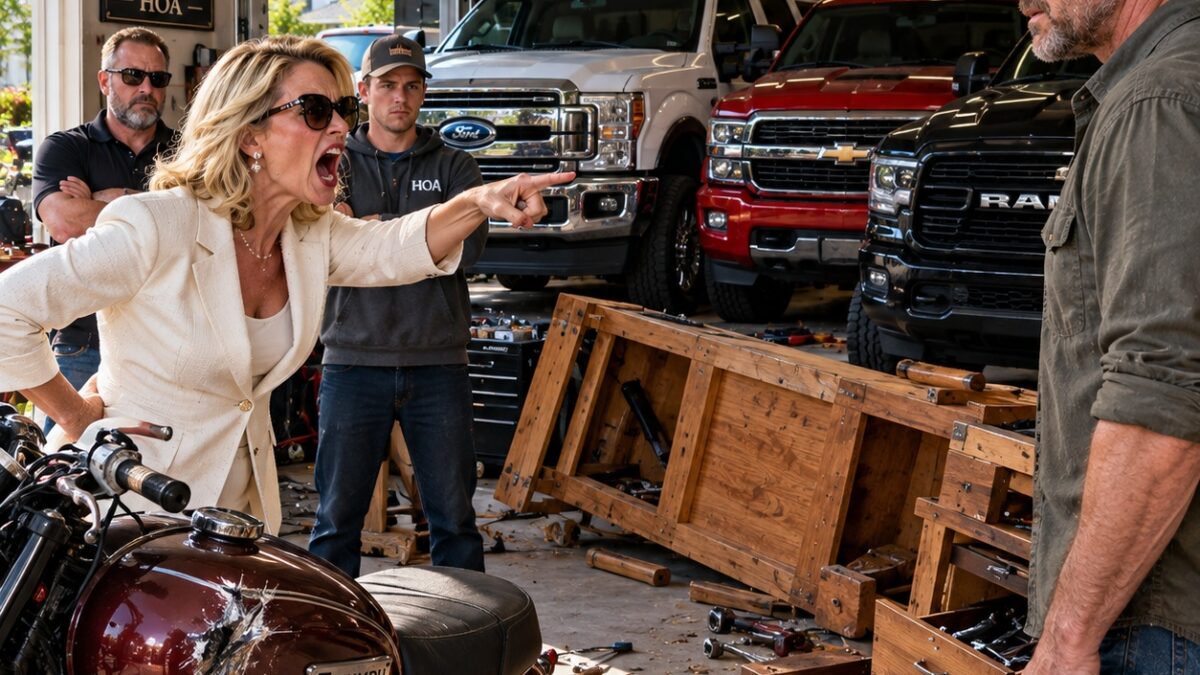
“He shoved my father’s workbench across the floor. My grandfather’s marking gauge is broken. My tool cabinet is damaged. Your Silverado hit the fuel tank on a motorcycle I’ve been restoring for three years.”
The expression on her face changed.
Then I said:
“Your family’s trucks are sitting on top of tools that belonged to my grandfather, and you’re standing on my porch asking me to be reasonable about property you broke into.”
The smile disappeared completely.
“You’re going to regret this, Cole.”
That was the threat.
Quiet.
Cold.
Confident.
I had heard more frightening threats in less comfortable places.
“Wendy, I spent sixteen years as a combat engineer.”
She looked at me.
“Your clipboard isn’t going to be the thing that scares me.”
She turned and walked back to the Escalade.
Forty-five minutes later, a Greenville County sheriff’s deputy arrived.
Deputy Carter Hayes.
Young.
Professional.
He explained the complaint.
“Mr. Barrett, we received a report that vehicles are being unlawfully detained on this property.”
“I expected that.”
He raised an eyebrow.
I brought him inside.
Deed.
Garage building permit.
Inspection certificate.
CC&Rs.
Section 11.4.
Wendy’s two-signature “resolution.”
Then the video.
Derek with bolt cutters.
Lock dropping.
Trucks entering.
Tool cabinet falling.
Triumph being damaged.
Wendy walking through afterward.
Deputy Hayes watched all of it.
Then watched part again.
Finally he said:
“I don’t see any legal basis to compel you to open your own garage.”
I nodded.
“The vehicles were placed here without your consent.”
“Yes.”
“And your property appears to have been damaged during entry.”
“Yes.”
He handed the papers back.
“The complainant may have exposure for trespass and property damage.”
“I understand.”
“Are you planning to file?”
“When I’m ready.”
He paused.
“You were Army?”
“Combat engineer.”
“How long?”
“Sixteen years.”
He smiled.
“My father was engineers with the Eighty-Second.”
“Good people.”
Deputy Hayes looked toward the detached garage.
“He’d probably approve of your locks.”
“Tell him I said thank you.”
The deputy left.
Wendy was waiting outside her own house.
She had expected him to return with an order requiring me to open the garage.
He stopped near her driveway.
Rolled down the window.
Said something.
I couldn’t hear it.
I didn’t need to.
Her face told me.
The authority she had assumed would automatically support her had just asked for actual law instead.
By Saturday evening, about twelve hours into the standoff, Wendy hired a locksmith.
Gary Delano from Greenville Lock and Key.
I watched from my porch while he inspected everything.
The locks.
Hasps.
Welded pins.
Carriage bolts.
Then he turned toward Wendy.
I could hear part of the conversation.
“I’d need written authorization from the owner.”
“I’m the HOA president.”
“That’s not this address.”
“This building has been designated for community use.”
“I don’t have authorization to enter it.”
She argued.
He did not care.
That is the thing about competent tradesmen.
Steel does not care about social status.
Neither do people who work with steel long enough.
Gary packed his tools and drove away.
Wendy remained in my driveway staring at the garage.
No amount of staring changed the locks.
By Sunday morning, the trucks had been inaccessible for about twenty-eight hours.
That was when consequences began spreading beyond the HOA argument.
Derek had a major landscaping installation scheduled in Simpsonville.
His largest contract of the season.
About $45,000.
The client expected work to begin Monday.
Thirty-six pallets of Bermuda sod were arriving at seven in the morning.
Derek needed his equipment.
Mowers.
Sod cutter.
Hydraulic auger.
Tools stored in the F-350 and Silverado.
Every bit of it was inside my garage.
The developer called to confirm.
Derek had to explain there was an “equipment situation.”
That description did not impress the client.
If the crew could not start Monday, somebody else would.
For the first time, Derek understood that Wendy had not merely commandeered parking.
She had put his business assets behind somebody else’s door.
Then there was Brandon.
His lifted Ram was the third vehicle inside.
He had missed plans Saturday.
Missed another outing Sunday.
More importantly, Monday was supposed to be his first day at a construction job.
His first steady work in months.
Brier Ridge was not exactly friendly to a twenty-two-year-old without transportation.
He could pay for rides.
But his truck was sitting behind locks he had no right to open.
Sunday afternoon, Wendy called an emergency HOA meeting.
“Urgent community matter.”
Full attendance requested.
Four o’clock.
Eight households came.
Eight out of eighty-four.
That alone should have told Wendy something.
She stood in front of the clubhouse wearing a navy blazer and called for a vote that would “compel the owner of Lot 47 to provide immediate access to HOA-designated community storage.”
Before anyone could second the motion, Lena Whitfield stood.
Lena was a retired high school principal.
Silver hair.
Reading glasses on a chain.
A voice that could stop a cafeteria riot without amplification.
“Wendy.”
Wendy looked at her.
Lena said:
“I want to make sure I understand this correctly.”
The room went quiet.
“You designated a man’s private garage as community property while he was out of town.”
Wendy tried to interrupt.
Lena continued.
“Your husband cut his lock.”
“That’s an inflammatory description.”
“Did he cut the lock?”
Silence.
Lena looked around.
“You parked your family’s three trucks inside his garage, damaged his property, and now you want us to vote to force him to give you access again.”
“This is a community matter.”
“No.”
Lena’s voice sharpened.
“This is your family’s matter.”
Nobody moved.
Then:
“Talk to a lawyer before you make it worse.”
Wendy’s motion died.
Nobody seconded it.
She gathered her papers and left.
For seven years, residents had let her confidence substitute for review.
That afternoon, eight people finally saw the mechanism clearly.
If you take away the title and the polished language, Wendy wanted the neighborhood to vote that private property belonged to her because she had already put something inside it.
Monday morning marked roughly forty-two hours.
Derek came back.
This time he brought two gas-station coffees.
No anger.
No threats.
He looked exhausted.
“Cole.”
I waited.
“Man to man, I know I messed up.”
That was the first useful sentence he had said.
“I shouldn’t have cut your lock.”
“No.”
“I’m sorry about the motorcycle.”
I said nothing.
“My business is on the line. There’s about $110,000 worth of equipment tied up behind those doors.”
“I know.”
“I can lose my biggest job.”
“That’s possible.”
He stared at me.
“Can we work something out?”
For a second, I felt sorry for him.
Then I remembered that he was the one holding the bolt cutter in the footage.
Not Wendy.
Derek could have said no.
Instead he cut my lock.
“I didn’t put your trucks in my garage.”
“I know.”
“I didn’t invent the resolution.”
“No.”
“I didn’t break my grandfather’s tool.”
He looked down.
“Your wife created this problem. You helped her do it.”
“What do you want?”
“Not from you.”
He looked across the street toward his house.
I did too.
“When Wendy is ready to deal with what she actually did, she knows where I live.”
He walked home.
He did not go inside immediately.
He sat on the front steps with both coffees.
I spent the rest of Monday building a case.
I had already downloaded all security footage from the eleven days I was gone.
Four cameras.
Cloud backups.
Timestamps.
Multiple angles.
Then I called Jim Riddle, a licensed property appraiser.
He documented every damaged item.
Workbench damage.
Floor gouging.
Tool cabinet.
Broken drawer slides.
The marking gauge.
The Triumph tank.
His report ran twelve pages.
Estimated total:
$7,600.
The marking gauge bothered him.
“How do you value something handmade in 1962 by the owner’s grandfather?”
“You don’t.”
He looked at me.
“I need a number for the report.”
“I understand.”
We documented replacement value while noting that the original could not truly be replaced.
That distinction mattered to me.
Money repairs function.
It does not restore history.
That Sunday, while Wendy’s emergency meeting was failing, I also visited Eleanor Gilliam.
Mrs. Gilliam was seventy-nine.
Widowed.
Lived near the Brier Ridge entrance.
Two years earlier, Wendy had decided Eleanor’s carport would be useful for HOA holiday storage.
Twelve bins.
Inflatable snowmen.
Extension cords.
A six-foot nutcracker.
Decorations.
Eleanor had asked twice for the items to be removed.
Both times Wendy told her the board had “temporarily designated” the carport as community storage.
That designation had no basis in the governing documents.
Eleanor did not fight.
Not because she agreed.
Because she was tired.
That is how people like Wendy build authority.
Not every target loses the legal argument.
Some simply decide the argument is too exhausting.
When I asked Eleanor whether she would write down what happened, she placed her teacup on the table.
Then she said:
“Young man, I’ve been waiting two years for someone to ask me that.”
Her statement was three handwritten pages.
Careful cursive.
Signed.
Dated.
Pattern established.
The next morning, at roughly forty-eight hours, I called Ryan Kesler.
Ryan and I had served together at Fort Bragg.
He had been Army JAG.
Now he practiced real estate litigation in Greenville.
I laid everything across his conference table.
Deed.
CC&Rs.
Fake resolution.
Video.
Damage report.
Eleanor’s statement.
Ryan read.
Asked a few questions.
Then leaned back.
“Cole, this is not complicated.”
“Good.”
“Trespass. Property damage. Invalid HOA action. Potential criminal issues from the entry. And Gilliam helps establish pattern.”
“I want both civil and criminal options prepared.”
“Fine.”
He looked toward me.
“When are you opening the garage?”
“After the paperwork is ready.”
Ryan smiled.
“You were always the guy who waited until the last possible second to blow the charge.”
“Timing matters.”
“I remember.”
By Tuesday morning, we were approaching sixty hours.
At six, someone knocked on my front door.
Wendy.
For the first time since I had known her, she did not look like HOA President Wendy Prescott.
No silk blouse.
No blazer.
No gold jewelry arranged as armor.
She wore a gray bathrobe.
Hair pulled back carelessly.
No makeup.
Her eyes were red.
“Cole.”
I waited.
“Please.”
That was different.
“Please open the garage.”
I looked at her.
“Derek lost the Harrove contract.”
The $45,000 job.
Gone.
“Brandon lost the construction job before his first day.”
She pressed both hands against her face.
“Derek says this is my fault.”
I said nothing.
“He’s right.”
That was the second useful sentence from the Prescott house.
I stepped onto the porch.
“Sit down.”
She sat on the concrete step.
For years, Wendy had stood in other people’s driveways holding violation notices as though the neighborhood existed inside her clipboard.
Now she was sitting outside my house because her authority could not open one door.
I said:
“Two years ago, you filled Eleanor Gilliam’s carport with HOA decorations.”
Wendy’s face changed.
“She asked you twice to remove them.”
No answer.
“You told her the board had designated her carport as community storage.”
Silence.
“That designation doesn’t exist.”
She looked down.
“She’s seventy-nine years old. She lives alone. She didn’t fight you because she was tired.”
Wendy’s hands tightened around the robe.
“You counted on that.”
“I was trying to solve a storage problem.”
“With somebody else’s property.”
She closed her eyes.
“Then you did the same thing to me.”
“Cole—”
“Your husband cut my lock.”
She stopped.
“My cameras recorded everything. Four angles. Cloud backups.”
Her eyes opened.
“My attorney has the damage assessment. $7,600. He has Eleanor’s statement. He has the resolution you passed without a quorum.”
She looked smaller sitting there than I had ever seen her standing.
“Ryan is preparing the civil complaint.”
Her voice was quiet.
“And criminal?”
“That option is prepared too.”
Wendy looked at me for several seconds.
Then asked:
“What do you want?”
I already knew.
“Three things.”
She waited.
“First, a written retraction of the garage resolution.”
She nodded slowly.
“Every board member gets a copy. Permanent HOA record. It states that the garage is private property and the resolution was invalid.”
Another nod.
“Second, you resign from the HOA board immediately.”
Her head came up.
“Cole.”
“No farewell speech. No ‘personal reasons.’ You resign and acknowledge that you exceeded your authority.”
She stared at me.
“And third?”
“You empty Eleanor Gilliam’s carport.”
Her face tightened.
“All of it.”
I continued.
“Every storage bin. Every decoration. Everything out by the end of the week.”
“What about the garage?”
“If you do those things, I open my garage.”
“And the criminal referral?”
“I don’t file it.”
She sat quietly.
Then asked:
“And Derek?”
“He gets his trucks.”
“Brandon?”
“Same.”
“What about the civil claim?”
“The property damage still gets paid.”
She looked at the ground.
I did not enjoy that moment.
People imagine satisfying confrontations feel like triumph.
Mostly, it felt like watching someone discover the real cost of years spent assuming nobody would ever push back.
Wendy had options.
I was not asking for her house.
Her money beyond the damage.
Her Escalade.
Her clothes.
I was asking her to give back authority she had never possessed.
She agreed.
At 7:15 that morning, she sat at my kitchen table.
Ryan had emailed the language.
Wendy signed the retraction.
In blue ink.
Not gold.
I noticed.
I doubt she did.
Her resignation followed.
Then, at nine o’clock, I walked to the detached garage with my keys.
The standoff had lasted about seventy-two hours.
I removed the chain.
Unlocked the side door.
Then the first overhead bay.
Derek’s F-350 sat exactly where he had left it.
The dome light had been on.
Battery dead.
He had to get jumper cables.
He stood in my driveway waiting without saying a word.
Second bay.
Brandon’s Ram.
One rear tire was flat.
A roofing nail that had fallen when Derek knocked over the tool cabinet had found it.
Not sabotage.
Just consequence.
Third bay.
Silverado.
Undamaged except for the fact that it had sat inside my locked building for three days after its owner put it there without permission.
Derek moved each truck out.
One at a time.
No argument.
No thank-you.
No apology beyond the one he had already given.
That was enough.
Wendy watched from across the street.
She had changed clothes.
She looked polished again.
But her posture was different.
No clipboard.
No instructions.
No wave.
Just watching.
The garage became mine again not because the trucks left.
It had always been mine.
The trucks leaving simply made reality visible again.
Three weeks later, the civil damage claim settled.
$7,600 for documented property damage.
Another $2,200 in related costs.
Total:
$9,800.
Wendy paid from her personal account.
The check cleared.
That closed the money side.
But the neighborhood side was only beginning.
Brier Ridge elected a new board the following month.
Lena Whitfield ran for president.
Nobody opposed her.
Her first major action was not landscaping.
Not fence rules.
Not mailbox colors.
She ordered a review of Wendy’s seven years in office.
The results explained how Wendy had operated so freely for so long.
Eleven actions had been taken without a proper quorum.
Three attempts to “designate” private property for community use had no support in the CC&Rs.
Two fines referenced violations that did not actually exist.
The problem was larger than my garage.
My garage was simply where she finally met somebody who had the time, documentation, and willingness to force the issue.
Section 11.4 was rewritten.
Emergency powers clarified.
Quorum requirements reinforced.
Private property specifically protected against unilateral “temporary designation.”
Good.
Rules should become harder to abuse after someone proves how easily they can be twisted.
Eleanor Gilliam’s carport was emptied the following Saturday.
I went over to help.
Derek and Brandon hauled the bins.
Inflatable snowmen.
Nutcracker.
Lights.
Decorations.
Everything.
Eleanor stood inside her kitchen with a glass of sweet tea.
When the final box left, she opened the door.
Looked at the empty carport.
Then looked at me.
“Two years.”
“I know.”
“That woman told me I was being difficult.”
“You weren’t.”
Eleanor smiled.
“I know that now.”
That sentence stayed with me.
Not because Wendy had convinced Eleanor legally.
She had convinced her emotionally.
That resistance was unreasonable.
That asking for her own space back was selfish.
That a widow nearing eighty should accommodate the needs of the HOA because fighting would make her the problem.
That kind of pressure is harder to photograph than a cut padlock.
Still real.
I spent the next month repairing the garage.
The floor needed resurfacing where the workbench and cabinet had gouged the seal.
The cabinet got new drawer slides.
The damaged tools were replaced where possible.
New marking gauge.
New chisels.
Sockets.
The Triumph tank went out for refinishing.
The old rosewood gauge was the one thing money could not fix.
My grandfather had made the handle in 1962.
His hands shaped it.
Used it for decades.
Then my father kept it.
Then me.
A replacement could perform the same function.
It could not carry the same history.
That was the loss Wendy never seemed to understand when she called my tools “junk.”
Objects are not valuable only because somebody can sell them.
Sometimes value is the number of hands that touched them before yours.
History.
Memory.
Continuity.
You do not see that in a price tag.
The broken gauge stayed in my drawer.
Both pieces.
I could have thrown them away.
I did not.
Not as evidence.
The case was settled.
I kept it because broken history is still history.
The Triumph came back in August.
Aubergine paint.
Clear coat.
Chrome polished.
The restored tank looked almost impossibly deep in afternoon light.
The first ride was on a Sunday morning.
I headed north toward Travelers Rest and the foothills.
Cool air.
Engine steady.
Road climbing through green.
I thought about my grandfather.
My father’s bench.
The garage.
The months of work behind the motorcycle.
I did not think about Wendy.
That surprised me.
For weeks she had occupied far too much space in my head.
Then suddenly she didn’t.
That was better than watching her resign.
The best ending to a conflict is when the person who caused it stops being important.
Derek’s landscaping company survived.
Barely, for a while.
Losing the Harrove installation hurt.
Then several spring clients pulled out after scheduling problems.
He rebuilt gradually.
Smaller jobs.
Then larger.
His business did not disappear forever.
I was glad.
I never wanted his livelihood destroyed.
I wanted him to understand that cutting somebody else’s lock because your wife handed you a piece of HOA letterhead was a choice.
He learned.
Brandon eventually found other work.
His lost job was painful but not permanent either.
Again, I did not celebrate it.
He participated in moving the vehicles onto my property.
He also was twenty-two and following the habits of his parents.
Consequences mattered.
Permanent ruin did not.
Wendy remained in Brier Ridge.
That surprised some people.
They expected her to sell after resigning.
She didn’t.
But the neighborhood changed around her.
Or maybe she changed inside it.
The morning Escalade patrol disappeared.
No clipboard.
No unofficial inspections.
No gold-ink notices appearing because somebody’s trash can sat outside five minutes too long.
I occasionally saw Wendy walking.
White sneakers.
Earbuds.
Head down.
Sometimes she still dressed exactly as she always had.
That was fine.
Designer clothes had never been the actual problem.
The problem was believing they were armor.
Believing polish created legitimacy.
Believing confidence created authority.
Believing other people’s silence meant consent.
After seventy-two hours, she knew better.
My garage returned to normal.
Three bays.
Triumph.
Father’s workbench.
Tools.
Project area.
Clean floor.
The security stayed upgraded.
Three Abloy locks.
Medeco deadbolt.
Reinforced hardware.
Some people asked whether I was being excessive.
Maybe.
But once somebody cuts one lock, you learn what the first lock failed to communicate.
I made a small walnut sign from scrap.
Hung it inside the side door.
Not outside.
I did not need to threaten the neighborhood.
The sign was for me.
TRESPASSERS WILL BE SECURED.
Phil saw it once.
He laughed for nearly a minute.
“That’s terrible.”
“I like it.”
“Of course you do.”
He remained the person who first told me what happened while I was gone.
I asked him later why he had not called me immediately.
He looked embarrassed.
“I thought maybe there really was some HOA rule.”
That answer mattered.
Wendy’s power had not come only from intimidation.
It came from borrowed credibility.
She had official letterhead.
A title.
A board seat.
Years of precedent.
People saw those things and assumed somebody else had already verified the authority.
Phil knew the garage was mine.
Still, when Derek held up the resolution, a part of him wondered whether some strange HOA rule made it legitimate.
That is why abuse inside organizations can last so long.
Most people do not read governing documents.
They rely on whoever appears to know them.
Wendy appeared to know them.
Often she simply knew which sentence she could stretch farthest before anyone checked.
I checked.
Ryan checked.
Then Lena checked seven years of records.
Once people looked underneath the presentation, the structure was weak.
As a structural engineer, that comparison was impossible for me to ignore.
A beautiful finish can hide a bad foundation.
Stone veneer.
Polished surfaces.
Perfect paint.
None of those things carry load.
You can make a structure attractive without making it sound.
Wendy’s presidency worked the same way.
Beautiful finish.
Poor structure.
No quorum.
Invented authority.
Residents too tired to challenge.
Eventually load finds weakness.
My garage became the load test.
The system failed.
The new board did something smart afterward.
They did not merely say:
Wendy was bad.
They fixed procedure.
That mattered.
If all you do after an abusive leader leaves is replace the person, the next one inherits the same tools.
Lena tightened meeting requirements.
Documented votes.
Notice.
Limits.
Review.
People complained that board action became slower.
Good.
Some things should be slow.
Taking control over somebody else’s property should be extremely slow.
Preferably impossible without actual legal authority.
I attended one meeting after the rewrite of Section 11.4.
Lena read the new language.
One homeowner asked:
“What if there’s a real emergency?”
“Then genuine emergency provisions apply.”
“What if somebody is away?”
“That does not transfer ownership.”
Simple.
That sentence would have prevented everything.
Being absent does not make your property available.
It should not need saying.
Now it was written.
The strangest part of the entire situation remained Wendy’s original logic.
I had left for work.
Therefore my garage was empty.
Their trucks needed space.
Therefore using it was efficient.
The word she liked was improving.
She once told Phil she was improving the situation.
Wendy did not see herself as stealing space.
She saw unused capacity.
That mindset is dangerous.
If something is not actively being used the way you would use it, you start telling yourself nobody loses when you take it.
My third bay had open floor area.
That did not mean it was available.
Eleanor’s carport had space.
That did not mean it belonged to the HOA.
A neighbor’s empty driveway while he visited family did not become public parking.
Ownership does not disappear during inactivity.
A locked door should make that obvious.
Apparently Wendy needed a seventy-two-hour demonstration.
I got asked one question repeatedly after the story spread around Brier Ridge.
“Were you legally allowed to lock their trucks inside?”
The answer was never as simple as neighbors wanted it to be.
I was allowed to secure my own garage.
The vehicles had been placed there without my permission.
The sheriff found no basis to force me to open it on Wendy’s demand.
Once legal counsel became involved, I handled the situation through that process.
That distinction matters.
I did not tow the trucks somewhere secret.
Did not damage them.
Did not sabotage equipment.
Did not threaten anybody.
I secured my building after it had been broken into.
Then preserved evidence.
That was the cleanest position I could take.
It also happened to create pressure.
But pressure was not the legal justification.
Ownership was.
That separation kept me from doing something stupid.
Anger makes people want symmetry.
You broke my property?
I’ll break yours.
No.
That would have given Wendy the story she wanted.
Vindictive veteran traps innocent family’s vehicles.
Instead:
My deed.
My garage.
My lock.
Your unauthorized vehicles.
Talk to your attorney.
Far less emotionally satisfying in the moment.
Much stronger afterward.
The security cameras mattered for the same reason.
Without them, Wendy could have described the incident differently.
Temporary community storage.
No damage.
Owner had implied consent.
Tools already broken.
Motorcycle already scratched.
Who knows?
Video ended all of that.
Derek cut the lock.
Time stamped.
Work bench moved.
Time stamped.
Cabinet fell.
Time stamped.
Truck door hit tank.
Time stamped.
Wendy walked through afterward.
Time stamped.
Facts do not eliminate conflict.
They narrow it.
Wendy could argue authority.
She could not credibly argue what physically happened.
That was enough.
I started telling neighbors something afterward.
Before you fight about motives, establish events.
Who entered?
When?
What document?
What vote?
What damage?
Then discuss intention.
People reverse that order constantly.
They begin with:
Wendy is selfish.
Cole is stubborn.
Derek is angry.
HOA is corrupt.
Those are conclusions.
Start with the lock.
Cut.
Start with the resolution.
Two of seven.
Start with the deed.
Cole Barrett.
Then the bigger judgment becomes easier.
Ryan operated that way.
He never cared about Wendy’s clothes.
The gold ink.
Her social reputation.
Funny details, maybe.
Legally irrelevant.
He wanted:
Recorded ownership.
Governing language.
Quorum requirement.
Footage.
Damages.
Pattern.
That discipline helped me too.
Because if I had made the story about Wendy being shallow or vain, she could deny the personality claim.
If I made it about a cut lock, she had video.
Strong cases are often boring.
That is good.
The neighborhood version became less accurate over time.
People added things.
Wendy got arrested.
No.
Derek went bankrupt.
No.
Brandon lost the truck forever.
No.
I kept them locked for a week.
No.
Seventy-two hours.
Approximate.
The truth was already satisfying enough.
There was no reason to enlarge it.
Wendy resigned.
The resolution was retracted.
Eleanor got her carport back.
Damage was paid.
Governance changed.
Garage restored.
That is a complete consequence chain.
Nobody needs prison to make the ending work.
I also never forgot that Derek apologized before Wendy did.
Imperfect apology.
Mixed with desperation.
Still.
He said:
“I messed up.”
That mattered.
People sometimes do terrible things because somebody close to them has normalized those things for years.
That does not remove responsibility.
It does explain how otherwise functioning adults end up holding bolt cutters in somebody else’s driveway.
Wendy said the board approved.
Derek wanted parking.
He accepted the explanation because it benefited him.
Convenient authority is easy to believe.
That is another lesson.
If somebody says you are allowed to take something you want, check harder.
Bias works in your favor at exactly the moment you need skepticism most.
Derek did not check.
It cost him $45,000 immediately and far more indirectly.
The coffee he brought Monday morning stays in my memory.
Gas-station coffee.
Two cups.
He had probably bought one for me.
I never drank it.
He ended up drinking both on his own steps.
That image felt like the first moment he understood the difference between Wendy’s problem and mine.
He had thought the locked trucks were my action against him.
Eventually he realized the real action happened when he drove them into my building.
Cause and consequence.
Order matters.
Wendy’s Tuesday morning visit changed something similar.
Until then, every conversation started from what she needed.
Open the garage.
Honor the resolution.
Cooperate.
Tuesday began with:
“I was wrong.”
That was finally a useful starting point.
I did not need her emotionally destroyed.
I needed the behavior stopped.
Retraction.
Resignation.
Eleanor.
Three concrete corrections.
Then the garage opened.
Some neighbors later told me I should have filed the criminal referral anyway.
Maybe.
Ryan and I discussed it carefully.
But I had leverage because criminal exposure existed.
I used that leverage to produce remedies that mattered more to the neighborhood.
Permanent retraction.
Leadership change.
Eleanor’s property restored.
Civil damages handled separately.
That resolution made sense to me.
I did not want Derek’s criminal record if accountability could be achieved another way.
Not everyone agreed.
That was fine.
I had to live with the decision.
I still think it was right.
The line I cared most about in Wendy’s retraction was simple:
The detached garage on Lot 47 is private property and is not subject to HOA storage designation.
Obvious.
Now permanent.
Sometimes institutions spend hundreds of words creating confusion and one sentence ending it.
That one sentence mattered more to me than her resignation.
Future board.
Future resident.
Future dispute.
Pull the record.
Read.
Done.
I gave a copy to Ryan.
Kept another in the fireproof cabinet with the deed and building permit.
The physical locks protect doors.
Records protect meaning.
You need both.
Eleanor kept her copy of the new Section 11.4 too.
She told me:
“I’m too old to read all this.”
“Then why keep it?”
“So the next woman with a clipboard knows I can.”
Fair.
She had earned that.
Lena became a good HOA president precisely because she seemed to dislike power.
She treated the position like maintenance.
Budget.
Roads.
Community property.
Rules that actually existed.
No patrols.
No theatrical notices.
No personal kingdom.
The neighborhood became boring.
I mean that as praise.
Boring governance is wonderful.
Nobody should wake excited to discover what their HOA president plans to do today.
I wanted to think about bridge calculations.
Motorcycles.
Woodworking.
Not a board’s interpretation of community infrastructure.
Lena gave us that.
My grandfather’s broken gauge stayed with me longer emotionally.
I eventually bought another marking gauge.
High quality.
Rosewood handle.
Beautiful tool.
It worked perfectly.
Still wrong in my hand for months.
The old one had worn edges shaped by decades of use.
A tiny dark patch where my grandfather’s thumb rested.
My father’s initials scratched underneath.
The replacement had none of that.
That was how I came to understand damage beyond money.
Wendy’s check covered replacement cost.
It did not make the loss disappear.
But holding onto resentment would not bring the old tool back either.
So I used the new one.
At first reluctantly.
Then regularly.
Eventually it developed its own marks.
Mine.
Maybe one day Ben—if I ever have a grandson or someone else in the family who cares about woodworking—will inherit it.
You do not honor old tools by refusing to use new ones.
You keep building.
The same was true of the garage.
For a while after the trucks left, I caught myself looking at the door before entering.
Remembering the brass padlock.
The Silverado.
The scattered sockets.
Then work took over again.
A cabinet project.
Triumph parts.
A shelf for the house.
Routine repopulated the space.
The garage stopped feeling violated.
It became mine in my head again.
That took longer than changing locks.
Property disputes are strange that way.
A deed can remain unchanged while your sense of control changes overnight.
Someone enters without consent and suddenly every familiar room feels slightly different.
Restoring ownership requires more than law.
It requires ordinary life returning.
That happened.
One evening I was planing a piece of walnut at my father’s bench when I realized I had gone almost three hours without thinking about Wendy.
That was the moment the garage was truly back.
Not when the Silverado reversed out.
Not when the check cleared.
When she became irrelevant inside the space.
That was victory.
The Triumph ride did the same outside the garage.
Engine.
Road.
Foothills.
Nothing behind me but Greenville.
No HOA.
No locks.
Just movement.
Funny, considering the entire conflict had been about vehicles that could not move.
Wendy thought possession was power.
Park the trucks first.
Create a condition.
Force me to accommodate it.
But physical presence does not automatically create entitlement.
A truck inside my garage remained somebody else’s truck trespassing inside my building.
Finished action did not become permission.
That is a broader lesson.
People often act first because they believe reversal will be too inconvenient.
Move the fence.
Park the truck.
Use the driveway.
Store the boxes.
Build the thing.
Then say:
It’s already done. Why make a fuss?
Because “already done” is sometimes the tactic.
That was Wendy’s entire method.
Create a fact.
Then shame the owner for objecting.
Eleanor had experienced it.
Bins already there.
Why be difficult?
Ed’s driveway.
Truck already parked.
Why complain?
My garage.
Three vehicles already inside.
Surely I would just accept it.
No.
Sometimes refusing to normalize the finished violation is the only way to stop the pattern.
That is what happened.
I did not create Wendy’s consequences.
I interrupted the assumption that everybody would absorb them for her.
The seventy-two hours mattered because for the first time, her convenience depended on somebody else’s consent.
She hated it.
Then learned from it.
Or at least changed behavior afterward.
That is enough for me.
I do not know what Wendy thinks today.
Maybe she believes I humiliated her.
Maybe she thinks the neighborhood turned unfairly.
Maybe she understands exactly what happened.
I never asked.
Apology was not required for the outcome.
Behavior changed.
That is measurable.
No more patrol.
No more property designations.
No more gold-ink violations from Wendy.
Eleanor’s carport empty.
Garage untouched.
Good.
People sometimes wait for emotional closure from the person who harmed them.
An admission.
A perfect apology.
Understanding.
You may never get those.
Concrete closure can be enough.
Door locked.
Damage paid.
Authority removed.
Move forward.
That worked for me.
I still see the Blue Ridge line from the mailbox station.
Residents still argue about minor things.
Grass.
Parking.
Fences.
Dogs.
That is normal.
But the scale changed.
After Wendy, people asked more questions.
“Where is that rule?”
“Was there a quorum?”
“Does the HOA actually control that?”
Healthy questions.
Lena encouraged them.
A good authority figure should not fear documentation.
If the rule exists, show it.
If the vote happened, show minutes.
If property is common area, show the plat.
Transparency makes reasonable governance easier.
Wendy preferred mystery.
She knew better than you.
Trust her.
That model died with the fake garage resolution.
Good.
One day Phil and I were standing beside the mailbox station.
He looked toward my property.
“You know what I still can’t believe?”
“What?”
“She waved at me.”
I laughed.
The slow wave after locking the garage.
“Like she’d just conquered something.”
“She thought she had.”
Phil shook his head.
“I wish I’d called you.”
“You didn’t know.”
“I knew it looked wrong.”
“Next time trust that.”
He nodded.
That was another positive consequence.
People became less passive.
Not aggressive.
Less willing to outsource judgment to authority.
Those are different.
I do not want eighty-four homeowners becoming amateur litigators every time the HOA sends an email.
I want them willing to ask:
Is this legitimate?
Small question.
Big protection.
Mrs. Gilliam started attending meetings after Lena became president.
Not every one.
Enough.
She sat near the front.
Sometimes said nothing.
Her presence itself mattered.
Wendy’s system had depended on quiet people remaining home.
Lena’s worked better when they showed up.
That is how communities correct.
Not through one confrontation forever.
Through habits after it.
The $9,800 settlement became ordinary money quickly.
Repairs ate much of it.
That was fine.
It was never a jackpot.
I did not get rich because someone broke into my garage.
I got compensated for documented damage and costs.
That is what civil remedies are supposed to do.
The better result had no dollar figure.
My property rights were clearer.
The board was healthier.
Eleanor had her space back.
Those mattered more.
The Harrove contract loss was more expensive than my damage claim.
People sometimes call that karma.
I call it logistics.
Derek had a landscaping contract.
Equipment was inaccessible.
He could not perform.
Client replaced him.
No cosmic judgment needed.
Choices interact with schedules.
He chose to place equipment somewhere he did not control.
Then discovered that control matters.
Simple.
Same with Brandon.
His first workday depended on transportation.
He left transportation inside somebody else’s locked building.
The job did not wait.
Again, consequence.
Not magic.
Framing it that way kept me from becoming self-righteous.
I was not teaching the universe a lesson.
I was locking my garage.
Everything else followed.
That distinction kept the story grounded for me.
I am proud of how I handled it.
I am not proud that other people suffered.
Different things.
I could be satisfied Wendy’s abuse stopped while still understanding Derek’s lost contract hurt his employees too.
I could be glad my property was secure while recognizing Brandon losing a job was painful.
Accountability affects networks.
That is why people should think before creating conflicts.
Wendy did not.
She assumed costs would land on me.
They landed outward instead.
Her family.
Her board seat.
Her reputation.
That was the part she had never calculated.
Structural engineers think about load paths.
Where does force go?
Push here.
What carries it?
Where does it transfer?
Wendy applied force to my property because she assumed I would absorb it.
I didn’t.
The load transferred back through her own system.
Derek.
Business.
Brandon.
HOA.
Reputation.
Eventually the system failed at its weakest point.
Her authority.
That may be the most engineering way possible to understand an HOA conflict.
It is also accurate.
Her presidency had no proper foundation once residents stopped supplying passive consent.
Take that away and the superstructure looked impressive but carried nothing.
Gold ink is not reinforcement.
Pearls are not shear walls.
Designer shoes do not transfer load.
Procedure does.
Law does.
Consent does.
She learned.
I learned too.
The first thing I did after everything settled was improve my documentation.
Garage permit copies.
Photographs.
Serial numbers for tools.
Cloud backups verified.
Inventory updated.
Not because I expected another Wendy.
Because good preparation is quiet until you need it.
That had been true in the Army.
Still true in suburbia.
The cameras cost less than one repair to the Triumph.
The footage carried more value than any angry confrontation could have.
Technology can be intrusive when abused.
On your own property, used responsibly, it can also preserve truth.
Mine did.
Without it, Phil still witnessed some things.
But not everything.
Derek might have claimed the tank was already damaged.
The tool cabinet unstable.
Lock removed under honest belief.
Video removed ambiguity.
I recommend evidence over eloquence every time.
I was never going to out-perform Wendy socially.
She had spent years mastering presentation.
I did not need to.
My camera did not care what she wore.
That is why factual systems are powerful.
They do not get dazzled.
Deputy Hayes cared about ownership.
Locksmith Gary cared about authorization.
Ryan cared about law.
Appraiser Jim cared about documented damage.
Lena cared about governing procedure.
Different independent people reached compatible conclusions.
That is what legitimate accountability looks like.
Not one opponent declaring victory.
Multiple systems checking the same facts.
I trusted that more than my anger.
The small walnut sign still hangs inside the side door.
TRESPASSERS WILL BE SECURED.
It is mostly a joke now.
Almost.
New neighbors sometimes see it if they are invited into the garage.
They ask.
I tell them the short version.
“Old HOA president borrowed my garage without asking.”
They laugh.
Then I add:
“For three trucks.”
They usually stop laughing.
If they want the full story, I tell it.
But I never start with Wendy’s clothes.
Those details are funny.
Not important.
The important part is simpler.
She had a title.
She mistook that title for ownership.
Then her husband cut a lock based on that mistake.
Everything after came from correcting it.
That is the useful story.
Titles have boundaries.
President of an HOA is not owner of every structure inside the subdivision.
Community need is not a deed.
A two-person vote is not a seven-person board action.
An absent homeowner is not an invitation.
And a private garage does not become community storage because somebody prints the phrase on letterhead.
Basic.
Yet basic rights are often the ones people surrender because fighting over them feels embarrassing.
“Is it worth making a big deal?”
That question traps people.
Wrong question.
Ask:
“Is the claim legitimate?”
If yes, comply.
If not, decide what response protects the boundary without creating new problems.
In my case, the answer was locks, evidence, law, patience.
Not everybody needs military hardware.
Not everybody needs litigation.
But everyone should know what they own and who actually has authority over it.
Eleanor’s experience taught me the other half.
Not everyone can fight the way I could.
I had training.
Income.
Cameras.
A lawyer I trusted.
Time.
A seventy-nine-year-old widow may have none of that energy.
That makes restraint by people in power more important.
Good leaders do not measure authority by how much resistance a target can produce.
They measure it by what they are actually allowed to do.
Wendy had done the opposite.
She pushed until someone pushed back.
That is not leadership.
It is testing weakness.
Once the neighborhood understood that, her image could not protect her.
The board review after her resignation mattered because it showed how often she had chosen targets unlikely to fight.
Small fines.
Temporary designations.
Confusing language.
Rules that sounded plausible.
Nothing dramatic enough individually to unite eighty-four homes.
Abuse often grows that way.
Incrementally.
Each act too small to justify the energy of resistance.
Then one day the pattern reaches somebody willing to open the book.
My garage happened to be that point.
I never planned to become it.
I wanted to inspect old brick buildings and finish a motorcycle.
Life assigns strange projects.
I handled this one.
Then moved on.
The Triumph still runs.
That may be my favorite concrete ending.
Not Wendy walking in sneakers.
Not Derek rebuilding his business.
Not the new board.
The Triumph.
Because when I first saw the gouged tank, the damage represented someone treating three years of my work as irrelevant.
Finishing the restoration reversed that feeling.
The machine did not stay damaged as a memorial to violation.
I fixed it.
Painted it.
Rode it.
Objects are supposed to return to use when possible.
So are people.
The first ride through the foothills felt like reclaiming time.
Not territory.
Time.
The hours I had spent angry no longer mattered.
The work did.
Engine responding.
Road opening.
Home behind me.
That was enough.
Today my garage looks almost exactly the way I wanted when I bought Lot 47.
Bay one:
Triumph.
Bay two:
Father’s bench.
Hand tools organized.
The broken marking gauge tucked away in a drawer.
Bay three:
Open project space.
Nothing parked there unless I put it there.
That last part still makes me smile.
No brass clearance-bin padlock.
No gold-ink resolution.
No Silverado.
My doors.
My locks.
My decision.
The simplest possible arrangement.
The entire seventy-two-hour disaster happened because Wendy believed that simple arrangement was negotiable without me.
It wasn’t.
That is all she really had to learn.
All the lost contract money, locksmith visit, failed meeting, sheriff call, resignation, settlement and board review came from delaying that lesson.
If she had called me in Charleston and said:
“Cole, our garage is full and Derek desperately needs somewhere secure to park three trucks for a week. Could we rent your garage?”
I would probably have said no.
My workshop was full.
The Triumph was exposed.
Tools everywhere.
Not suitable.
But she would have received an answer.
And that answer would have been the end.
Instead, she believed asking risked hearing no.
So she skipped consent.
That is the choice underneath almost every entitlement story.
People do not hate permission because permission is complicated.
They hate permission because the other person might refuse.
But the possibility of refusal is exactly what makes permission meaningful.
Without it, you are not asking.
You are informing.
Wendy informed me after the fact.
My locks answered.
Seventy-two hours later, so did she.
That is why, if somebody asks whether I would handle it differently now, my answer is mostly no.
I might call Ryan slightly sooner.
Maybe.
I would still secure the garage.
Still preserve video.
Still avoid touching the trucks.
Still let the sheriff see the evidence.
Still document damages.
Still insist on retraction, resignation and Eleanor’s carport.
Because the goal was never to punish a woman for wearing expensive shoes.
The goal was to restore boundaries.
Mine.
Eleanor’s.
The board’s.
Once those boundaries returned, the neighborhood could breathe again.
That is the part people sometimes miss when they retell the story as revenge.
Revenge wants pain.
Boundaries want order.
I wanted order.
My garage back.
My tools respected.
My neighbor’s carport returned.
An HOA president who understood she was president of an association, not owner of a kingdom.
That happened.
So the story ended.
The locks remain because lessons are cheaper to maintain than relearn.
Every once in a while, I run my hand over the repaired workbench edge.
You can still see the faintest scar where it scraped across the floor during those eleven days.
The concrete has been resurfaced.
The gouge is mostly gone.
The Triumph tank shines.
New marking gauge sits in the drawer.
Nothing looks like a crime scene anymore.
That matters.
Spaces heal too.
The garage is a workshop again.
Not evidence.
Not leverage.
Not community storage.
Not the place Wendy lost her presidency.
Just my garage.
Exactly what it was before she decided otherwise.
And if there is one thing I carried away from those seventy-two hours, it is this:
Authority is not something you create by acting confident enough.
You either have it or you don’t.
A board vote without a quorum does not become valid because the paper looks official.
A trespass does not become community service because the HOA president ordered it.
A private garage does not become public storage because the owner is out of town.
And three trucks sitting behind somebody else’s locked doors do not suddenly make those doors yours.
Wendy thought her title would open my garage.
It didn’t.
My deed closed the argument long before the first lock ever clicked.








