PART2:HOA President Fined Me $100 Every Time My Dog Barked—Then My Night Cameras Caught Her Doing Something Much Worse
PART2
By lunchtime, I had ordered a professional-grade audio monitoring system.
Not a cheap baby monitor.
Not a phone app.
Something designed to record continuously, maintain precise timestamps, and distinguish sound levels across multiple channels.
Four microphones.
One inside near Apollo’s usual sleeping area.
One on the rear patio.
Two outside facing the street from opposite sides of the property.
Local storage.
Cloud backup.
Noise-threshold logging.
Continuous overnight capture.
The system arrived two days later.
I spent most of Saturday installing it.
Apollo followed me from room to room.
“What do you think?”
He wagged his tail.
“Good.”
I pointed at the microphone beside his bed.
“That one is for your legal defense.”
He sneezed.
Sunday night was the first full recording.
I went to bed almost hoping Apollo would bark.
At least then I could understand where Brenda’s numbers came from.
He slept.
Monday morning, I checked the logs.
One elevated event at 3:12 a.m.
Air-conditioning unit outside.
No barking.
Second night.
A delivery truck somewhere outside the community around 5:30.
A distant dog.
Wind.
Apollo shifted on the tile.
No bark.
Third night.
One bark.
Just one.
2:41 a.m.
Less than three seconds.
Then silence.
I listened twice.
Apollo had apparently heard something outside.
Perfectly normal.
I started building a spreadsheet.
Date.
Time.
Duration.
Channel.
Noise classification.
I hated myself slightly for how much I enjoyed the organization.
Then Brenda sent the second notice.
Thirty-one new bark incidents.
Two nights.
$3,100.
My total alleged balance was now $7,800.
I stared at the numbers.
Then opened the recordings for those exact dates.
First cited night.
Brenda claimed seventeen barks.
My system recorded two.
2:17 a.m.
Four seconds.
4:50 a.m.
Roughly three seconds.
Second cited night.
Brenda claimed fourteen.
Apollo barked zero times.
Not once.
I replayed the entire overnight log.
Then again at higher sensitivity.
Nothing.
The difference was no longer something I could explain as perception.
If Brenda said three and I counted two?
Maybe.
Five versus three?
Maybe she heard another dog.
Fourteen versus zero?
No.
That was not a disagreement.
That was invention.
I exported the audio.
Saved it locally.
Uploaded copies to two different cloud drives.
Saved screenshots of the system timestamps.
Then I called an attorney.
His name was Harrison Clark.
Phoenix property-rights lawyer.
More than a decade dealing with HOA disputes around Maricopa County.
He asked me to email the notices and audio logs.
I sent them.
He called before the end of the afternoon.
“Michael?”
“Yes.”
“I’ve gone through both notices.”
“And?”
“Do not pay them.”
“I wasn’t planning to.”
“Do not confront Brenda.”
“Wasn’t planning that either.”
“Good.”
“Can she fine per bark?”
“That is one of several questions.”
“What are the others?”
“Whether the rule exists in the form she is applying it.”
I waited.
“Whether the board authorized this enforcement method.”
Another pause.
“Whether the evidence exists.”
“And?”
“And whether somebody intentionally fabricated violations.”
There it was.
“Fraud?”
“Potentially.”
“That serious?”
Harrison’s voice stayed calm.
“You have an HOA president attaching thousands of dollars in assessments to a homeowner’s deed based on specific alleged events.”
“Right.”
“If those events did not occur, that matters.”
“What do I do?”
“Keep recording.”
“How long?”
“Every night.”
“Anything else?”
“Nothing unusual.”
“Meaning?”
“Live your life.”
“Okay.”
“Do not change Apollo’s routine just to make the evidence cleaner.”
I looked toward the dog.
Apollo was asleep on a stolen sock.
“That won’t be difficult.”
“Save everything.”
“I already have two cloud backups.”
Harrison paused.
“You work in tech?”
“Yes.”
“I like you already.”
The third notice arrived three days later.
Twenty-six more “incidents.”
Then the fourth.
By then, the alleged balance had crossed $9,000.
Brenda began referencing lien proceedings.
My stomach changed when I saw that word.
Not because I thought she was right.
Because bad claims become dangerous when paperwork turns them into property problems.
A lien was no longer:
My dog annoys you.
It was:
I am putting pressure on your house.
Harrison told me the same thing.
“Do not confuse absurdity with harmlessness.”
“So we respond?”
“Soon.”
“Why not now?”
“Because she is still creating evidence.”
I leaned back.
“You want her to keep sending fake notices?”
“I want to know whether they are fake.”
“We already know.”
“We know yours appear unsupported.”
“That sounds lawyerly.”
“It is.”
“What else are you looking for?”
“Pattern.”
At first, I thought he meant a pattern in the fines.
Then the microphones caught something else.
Night eight.
11:47 p.m.
Exterior microphone number two detected footsteps.
Slow.
Measured.
Concrete.
The sound began near the sidewalk outside my southern fence.
Apollo lifted his head inside.
I could hear the collar tags move.
Footsteps continued.
Then Apollo barked.
Three times.
The footsteps moved past the property and faded.
Total barking duration:
Nine seconds.
The following morning, another HOA notice arrived.
Brenda claimed nine bark incidents.
I stared at the time.
11:47 p.m.
Same window.
I pulled exterior camera footage.
The video took less than a minute to find.
A woman walking past my property.
Dark slacks.
Dark top.
Hair recognizable immediately.
Brenda Sterling.
She was not jogging.
Not walking a dog.
Not carrying anything.
She moved slowly along the sidewalk outside my house, looked toward the fence, continued past the end, then disappeared in the direction of her own property at 56 Maplewood Drive.
I watched again.
Then again.
My pulse started rising.
Coincidence.
Could be.
She lived nearby.
Maybe she took nighttime walks.
People do.
So I said nothing.
Two nights later:
11:52 p.m.
Footsteps.
Apollo barked twice.
Camera:
Brenda.
Dark clothing.
Slow walk.
No destination.
She passed my fence.
Turned around farther down the street.
Walked back.
Apollo barked again when she returned.
That morning?
Another violation notice.
Brenda had counted eleven incidents.
My recordings showed less than twenty seconds total barking, all associated with somebody walking immediately outside the property near midnight.
The third occurrence came three nights later.
12:08 a.m.
Footsteps.
Apollo barked.
Camera.
Brenda.
This time she stopped for several seconds near the edge of the property.
Not directly at my gate.
Not technically inside my yard.
But close enough that Apollo heard her.
Then she walked away.
Notice arrived the next day.
I called Harrison before opening it.
“I found your pattern.”
“What?”
“Brenda is walking past my house at night.”
Silence.
“What do you mean?”
“I have video.”
“What times?”
I listed them.
“Do those nights correspond to notices?”
“Every one.”
“Do the barks correspond to her footsteps?”
“Yes.”
Another silence.
Longer.
“Harrison?”
“Send me everything.”
I created one package.
Video clips.
Raw audio.
Enhanced audio.
Notices.
Timeline.
Spreadsheet.
Cloud links.
I included screenshots showing timestamps synchronized between camera and monitoring equipment.
Harrison called at 7:12 the next morning.
He said four words.
“We have her now.”
I stood in my kitchen with coffee halfway to my mouth.
“That confident?”
“She is not just exaggerating.”
“What do you think she’s doing?”
“I think we present facts first.”
“That wasn’t my question.”
“I know.”
“Harrison.”
He exhaled.
“If this is what it appears to be, she may be intentionally creating the conditions she later claims are violations.”
That sounded worse when somebody else said it.
“You mean provoking Apollo.”
“Potentially.”
“For money?”
“For enforcement.”
“That’s insane.”
“Maybe.”
“She walks past my house at midnight, gets him to bark, then charges me per bark.”
“We need to prove intent carefully.”
“But the numbers are still false.”
“Yes.”
“Even when he barks because of her, she multiplies the count.”
“Yes.”
“What now?”
“Board meeting.”
Oakfield Ridge held quarterly meetings at the community center.
The next one was twelve days away.
Harrison requested time on the agenda.
The board granted it.
I told nobody.
Not my neighbors.
Not Brenda.
Not even the guy next door who usually knew every community rumor before email notifications went out.
I kept recording.
Brenda kept sending notices.
One new notice accused Apollo of twenty-one nighttime incidents.
Actual recording:
One short bark after a car door slammed outside.
Another claimed eighteen.
Actual:
Zero.
The alleged balance grew so large I stopped reacting emotionally to the number.
It became data.
Every fake incident was another row.
Every row another contradiction.
Every contradiction another reason not to panic.
But sleep got harder.
That surprised me.
I knew the evidence favored me.
Still, I would lie in bed listening.
Did Apollo move?
Did he bark?
Was Brenda outside?
At 11:30 one night, I found myself standing behind the curtain looking toward the sidewalk.
Nobody there.
I hated that.
Brenda had managed to change my relationship with my own house.
That made the whole thing feel different.
It was not just money anymore.
It was surveillance.
Waiting.
Wondering if somebody was walking past in darkness because she wanted my dog to react.
One night, Apollo raised his head and looked toward the front room.
I froze.
Nothing.
He went back to sleep.
I did not.
The board meeting arrived Tuesday.
I got there early.
Third row.
Laptop open.
Apollo stayed home.
Harrison sat near the front.
Brenda was already at the board table.
HOA lanyard.
Clipboard.
Water bottle.
Stack of documents.
Calm.
She had run these meetings for eight years.
People deferred to her automatically.
When someone asked a procedural question, they looked at Brenda.
When the secretary lost track of an agenda item, Brenda corrected her.
When the treasurer hesitated over landscaping expenses, Brenda supplied the amount from memory.
She looked exactly like a woman who had never seriously imagined the room might stop obeying her.
My item came after budget review.
The board chair said:
“Next, homeowner enforcement matter for 42 Maplewood Drive. Mr. Harrison Clark has requested time.”
Brenda looked up.
Our eyes met.
Just for a second.
No reaction.
Harrison stood.
Connected his laptop to the display.
No dramatic introduction.
No angry speech.
“My firm represents Michael Vance, homeowner at 42 Maplewood Drive.”
A few neighbors turned toward me.
Brenda stayed still.
“We are here regarding a series of animal-noise violation notices issued under President Sterling’s authority.”
Brenda adjusted her pen.
Harrison continued.
“The notices allege specific numbers of barking incidents on specific nights and assess fines at one hundred dollars per individual bark.”
One board member frowned.
“Per bark?”
Brenda answered before Harrison could.
“Per documented incident.”
Harrison looked at her.
“Thank you.”
That should have worried her.
He clicked.
First slide.
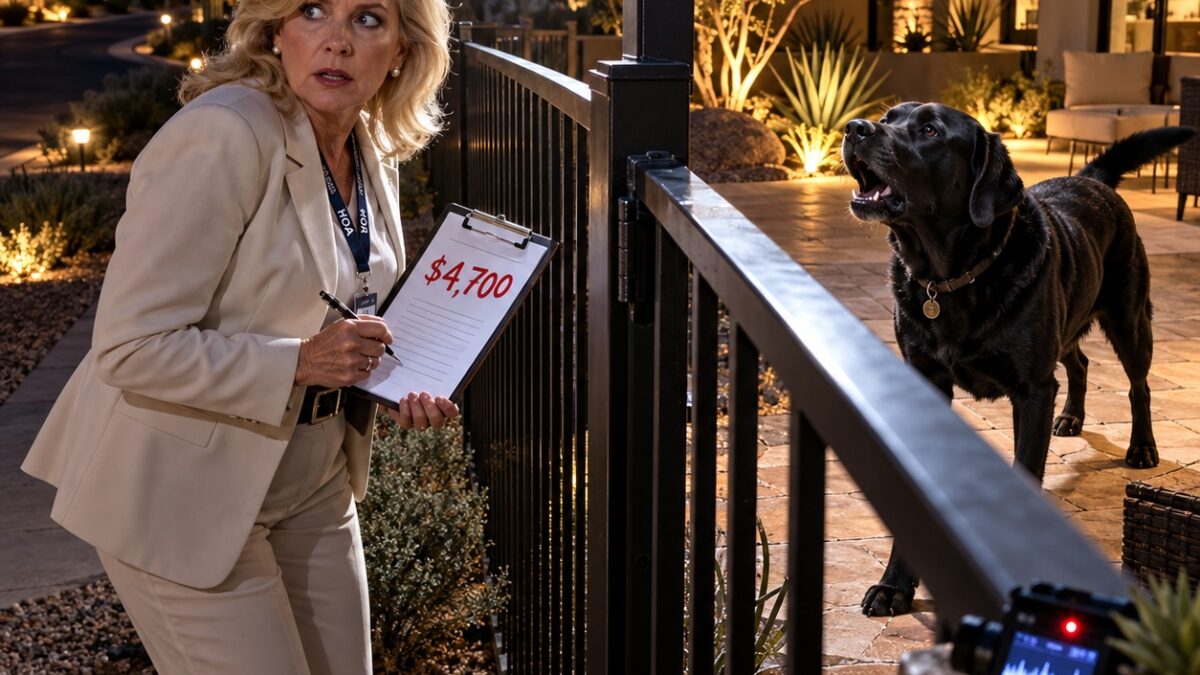
Photograph of the original notice.
47 BARK INCIDENTS.
$4,700.
A murmur moved through the room.
Harrison said:
“My client disputed the accuracy of this count.”
Brenda leaned toward the microphone.
“He never filed a formal appeal.”
Harrison nodded.
“He gathered evidence.”
Click.
Technical diagram of my monitoring system.
Four microphones.
Timestamp synchronization.
Continuous recording.
Cloud backup.
Harrison explained the setup.
One board member asked:
“This was professionally calibrated?”
“Yes.”
“Continuous?”
“Yes.”
“Can it distinguish barking from ambient noise?”
“The raw audio allows direct review.”
Then Harrison stopped explaining.
He played the first recording.
A timeline appeared.
11 p.m. to 6 a.m.
Long silence.
Air-conditioning.
Distant car.
At 2:17:
Apollo barked.
Four seconds.
Then silence.
At 4:50:
Another bark.
Three seconds.
Harrison paused the playback.
“This is one of the nights for which President Sterling billed Mr. Vance nineteen individual bark incidents.”
Nobody spoke.
Brenda did.
“Electronic systems can miss sound.”
Harrison nodded.
“Correct.”
Click.
He displayed waveforms from four separate microphones.
Inside.
Patio.
Street-facing one.
Street-facing two.
“All four missed the same seventeen events?”
Brenda did not answer.
He moved to the second night.
Notice:
Fourteen barks.
Recording:
Zero.
Third.
Notice:
Eleven.
Recording:
Two brief barking sequences.
Fourth.
Notice:
Eighteen.
Recording:
One.
The room changed slowly.
At first people watched politely.
Then they leaned forward.
Then they started looking at Brenda instead of the screen.
Her face stayed controlled.
But I watched her hand.
The pen had stopped moving.
Harrison said:
“The discrepancies are not minor.”
He displayed a table.
Notice count.
Actual recorded barking.
Duration.
Difference.
47 versus 3.
31 versus 2.
26 versus 1.
More.
The numbers were brutal because they did not need interpretation.
Then he said:
“However, that is not the most concerning evidence.”
For the first time, Brenda turned fully toward him.
Harrison clicked.
Video.
Timestamp:
11:47:16 p.m.
My front sidewalk.
Brenda walking into frame.
The room went silent.
She passed the fence slowly.
Audio played with video.
Footsteps.
Apollo’s collar.
Three barks.
Brenda kept walking.
Harrison froze the frame.
Her face visible under a streetlight.
A woman in the audience whispered:
“That’s Brenda.”
No one needed the identification.
Harrison played the second clip.
11:52 p.m.
Brenda again.
Same sidewalk.
Apollo barking briefly.
Third clip.
12:08 a.m.
Brenda stopped near the edge of my property.
Apollo reacted.
Then she walked away.
Harrison turned toward the board.
“These three nighttime visits each correspond to dates included in violation notices issued by Ms. Sterling.”
Brenda finally spoke.
“I walk in my neighborhood.”
Harrison nodded.
“Of course.”
“There is no rule against walking.”
“Correct.”
“This proves nothing.”
“By itself?”
He looked at her.
“No.”
Then he opened another slide.
Violation notice time windows beside camera timestamps.
Apollo’s recorded reaction.
Brenda’s claimed bark count.
She had alleged nine incidents during a period when Apollo barked three times after she walked directly past.
Eleven on another.
Eight on another.
Harrison said:
“What concerns my client is that the association president appears repeatedly outside his property near midnight, his dog reacts briefly to her presence, and the following day she converts those reactions into dramatically inflated fines.”
Brenda’s expression changed.
Not collapse.
Anger.
“This is a disgusting accusation.”
Harrison remained calm.
“It is evidence.”
“You’re implying I intentionally disturbed that animal.”
“I am showing the board recordings.”
“You are trying to embarrass me.”
“I am trying to prevent false assessments from attaching to my client’s deed.”
The board chair raised a hand.
“Brenda.”
She stopped.
He asked:
“How were these counts obtained?”
She stared at him.
“What?”
“The bark counts.”
“I monitored complaints.”
“That doesn’t answer my question.”
“I personally documented repeated noise.”
“From where?”
Her face tightened.
“My residence. Common areas. Reports.”
“Did other residents submit counts?”
“Some complained.”
“Who?”
“Complaints are confidential.”
Harrison said:
“We have requested the supporting records.”
Brenda looked toward him.
“And you’ll receive what you’re entitled to.”
The chair asked:
“Do we have audio recordings supporting HOA counts?”
Silence.
“Written logs?”
Brenda lifted her clipboard.
“Yes.”
“Created by whom?”
“Me.”
“Any independent verification?”
“No.”
A board member at the far end asked:
“Did this board approve a per-bark fine?”
Brenda snapped:
“The nuisance provision gives enforcement discretion.”
“That isn’t what I asked.”
She looked at him.
The room was now completely different from the one we entered.
Authority had shifted without a vote.
Then Harrison said:
“My client is not the only homeowner.”
I did not know that was coming.
He had not told me.
He walked to his table.
Picked up a folder.
Placed it before the board.
“This belongs to an Oakfield Ridge homeowner who contacted me after learning why I requested agenda time.”
Second folder.
“Another.”
Third.
“And another.”
The audience started whispering.
Brenda went pale.
Harrison continued.
“Three additional dog owners have received substantially similar per-bark assessments during the past eighteen months.”
One woman stood from the fifth row.
I recognized her vaguely.
She lived near the north loop.
“My name is Diane Foster.”
Brenda said:
“This is not an open-comment portion.”
The board chair said:
“Let her speak.”
That was the moment Brenda knew she had lost control of the meeting.
Diane held papers.
“She fined me $2,600 last year.”
Brenda stared.
“My terrier barked when coyotes came near the wall.”
“That is not relevant to Mr. Vance’s—”
“I paid.”
Diane’s voice cracked slightly.
“Because you threatened a lien.”
The room went quiet.
Another man stood.
“Three thousand eight hundred.”
Then another.
“Mine was twelve hundred.”
Harrison opened the folders one at a time.
Violation notices.
Home-camera footage.
Neighbor statements.
Discrepancies.
Not as technically perfect as mine.
Enough.
The board chair looked at Brenda.
“How many homeowners have been assessed under this per-incident barking policy?”
Brenda said:
“I don’t have that number with me.”
Harrison did.
“Based only on documentation provided to us so far, at least four.”
He closed his laptop.
Then looked at the board.
“We will be filing in Maricopa County Superior Court Friday morning.”
That ended the presentation.
Nobody applauded.
That would have made it easier for Brenda to dismiss the room as emotional.
Instead, there was silence.
Professional.
Heavy.
The sound of people realizing paperwork they had trusted might not mean what they thought.
Brenda sat staring at the frozen image on the screen.
Her own face.
11:47 p.m.
Outside my house.
For once, her clipboard offered nothing.
Friday morning, Harrison filed.
The lawsuit named Brenda Sterling personally.
It also named the Oakfield Ridge HOA.
Claims included fabricated violation notices.
Fraud.
Harassment.
Abuse of HOA authority.
Improper assessments.
And the documented nighttime behavior associated with provoking the dog whose reactions she was billing.
The other three owners submitted supporting complaints.
That was when the story stopped being:
Michael versus Brenda.
It became:
What has Brenda been doing for eight years?
The board called an emergency meeting Monday.
I did not attend.
Harrison advised me not to.
“You’ve shown your evidence.”
“So?”
“Now let them investigate themselves.”
“That sounds optimistic.”
“It’s better than helping Brenda turn you into the villain.”
He was right.
The meeting lasted less than twenty minutes before Brenda was removed as president.
Not from the board permanently at first.
From the presidency.
Immediate.
The association hired separate counsel.
That mattered.
Their new attorney’s first recommendation was a full enforcement audit.
Every fine.
Every assessment.
Every lien warning.
Every animal-noise complaint.
Eight years.
I remember Harrison calling me.
“They’re auditing.”
“All of it?”
“Yes.”
“How bad do you think this gets?”
“I don’t guess before documents.”
“That’s irritating.”
“I know.”
The first audit findings came three weeks later.
Eleven homeowners.
Not four.
Eleven separate dog owners had received per-bark fines over roughly three years.
Some fought.
Most paid.
Why?
Because a few hundred dollars feels cheaper than litigation.
One family paid $1,900.
Another over $5,000.
A retired couple paid repeatedly because their beagle barked near sunrise.
Another homeowner had been threatened with escalating lien action.
The total amount collected passed $60,000.
Sixty thousand dollars.
For alleged barking.
Not necessarily all fake.
That distinction mattered.
Dogs bark.
Nobody disputed that.
The problem was that Brenda’s counting system had no reliable independent verification.
No standardized measurement.
No recording requirement.
No board review for individual counts.
And once we had actual recordings in my case, her numbers collapsed.
Then the audit uncovered something else.
Brenda had been unusually involved in almost every dog-noise case.
Walking neighborhoods.
“Monitoring.”
Sending emails late at night.
Calling owners personally.
Keeping handwritten incident logs.
In several cases, homeowners had security footage showing her near their property during alleged incidents.
Not every case.
Enough.
Harrison called me after reviewing one batch.
“She built a system where she was complainant, investigator, witness, and enforcement authority.”
“Is that illegal?”
“Not automatically.”
“Terrible?”
“Yes.”
“Fraud?”
“Depends on proof.”
“What about mine?”
He paused.
“Yours is strong.”
Meanwhile, Brenda hired her own attorney.
The board’s attorney distanced the association from her decisions.
That was predictable.
Residents became angry.
Not because everyone suddenly loved dogs.
Some people genuinely hated barking.
Fair.
But there is a difference between controlling persistent nuisance noise and inventing billable events.
The HOA posted a temporary suspension of per-bark enforcement.
A new rule required objective verification before major noise fines.
Complaints needed dates.
Times.
Duration.
Multiple incidents.
Opportunity for response.
Reasonable investigation.
No more hundred-dollar mathematical fantasy every time a Labrador made a sound.
Apollo, meanwhile, slept.
That was almost insulting.
While attorneys traded letters about his alleged reign of nighttime terror, the defendant spent most evenings upside down beside the couch.
One night Harrison came to my house to review original audio files.
Apollo met him at the door.
One bark.
Single.
Deep.
Then tail wagging.
Harrison looked at me.
“One hundred dollars.”
“Get out.”
He laughed.
Apollo stole his sock before he left.
Professional relationship survived.
Discovery began.
That was where Brenda’s confidence really started breaking.
Her handwritten logs became evidence.
Dates.
Times.
Bark counts.
Some counts aligned with nights when my system showed nothing.
Harrison asked:
“How did you determine nineteen separate events?”
Brenda answered through written response that she personally heard repeated barking.
From where?
Various community locations.
Why was she outside 42 Maplewood near midnight?
Routine neighborhood observation.
Was monitoring part of her elected responsibility?
In her interpretation, yes.
Did the board authorize her to conduct nighttime surveillance?
She objected to that characterization.
Did she walk past other dog owners’ homes after complaints?
Occasionally.
Did she document her routes?
No.
Did she know dogs might bark in response to footsteps near fences?
She refused the implication.
Each answer created another question.
I sat through a deposition months later.
Brenda across the table.
No clipboard.
Just her attorney.
Harrison asked:
“Ms. Sterling, did you personally count forty-seven individual bark events over three nights?”
“Yes.”
“Did you create a recording?”
“No.”
“Video?”
“No.”
“Independent witness?”
“I received complaints.”
“Names?”
Her attorney objected.
Harrison continued.
“Did any complainant provide the number forty-seven?”
Silence.
“No.”
“So forty-seven was your number?”
“Yes.”
He placed my audio summary in front of her.
“Our recordings show three brief bark events across those nights.”
“I dispute the accuracy.”
“Based on what?”
“My personal observations.”
“Your personal observations while walking near the property at night?”
Her attorney objected again.
Brenda’s mouth tightened.
Harrison played the 11:47 video.
Computer speakers.
Footsteps.
Apollo’s bark.
Brenda on-screen.
Harrison paused.
“That’s you?”
“Yes.”
“Why were you there?”
“I was walking.”
“At 11:47 p.m.”
“Yes.”
“Past a property whose dog you were actively citing.”
“I lived in the same community.”
“Did you know Apollo reacted to people walking near his fence?”
“No.”
“You heard him bark while you walked past.”
“I heard barking.”
“And you cited Mr. Vance the next morning.”
“I documented a violation.”
“How many?”
“Nine.”
“How many do we hear here?”
Her attorney objected to the form.
Harrison waited.
Then rephrased.
“How many barking vocalizations are audible in this recording?”
Brenda looked toward her attorney.
Then the laptop.
“Three.”
Three.
That word mattered more than any speech.
Three.
Her notice said nine.
The same pattern repeated.
Eleven versus two.
Eight versus three.
Nineteen versus two.
Fourteen versus zero.
Numbers do not become emotional under pressure.
They just sit there.
That was why I trusted them.
The case took four months to reach judgment on the central claims.
Four months sounds short when summarized.
It did not feel short.
Legal disputes invade ordinary life.
Emails at breakfast.
Attorney calls during work.
Documents after dinner.
A certified envelope can ruin a weekend without containing anything new.
I started checking cameras compulsively.
Even after Brenda stopped walking past.
Apollo noticed my tension.
Dogs do.
He started following me more closely at night.
That made me angry at Brenda all over again.
She had taken a peaceful house and inserted anticipation into it.
Harrison kept reminding me:
“Do not let the case become your hobby.”
“It already is.”
“Then get a worse hobby.”
“Suggestions?”
“Golf.”
“I’d rather litigate.”
“Fair.”
The court eventually ruled in my favor.
Every fine attached to my deed was declared unenforceable and dismissed.
All of them.
Zero balance.
No lien.
No ongoing assessment.
That should have been enough.
It was not the biggest part.
The fraud finding mattered.
The discrepancy between Brenda’s documented counts and actual recordings established something far more serious than overzealous enforcement.
Her numbers could not be treated as reliable.
The court ordered restitution involving the improper fines collected from affected homeowners.
Interest included.
Eleven households.
Money that had quietly disappeared over years began coming back.
Diane called me after receiving her refund notice.
“I cried.”
That surprised me.
“Because of the money?”
“No.”
Pause.
“Because I knew I wasn’t crazy.”
I understood.
That may have been the worst part of Brenda’s system.
She made people doubt themselves.
Your dog barked twenty-three times.
Did he?
You were asleep.
Maybe.
Your beagle disturbed the community all night.
Did she?
Maybe you did not hear.
Your Labrador is a nuisance.
Is he?
Enough official-looking paper can make a person question memory.
Data gave me something those owners had never had.
Proof.
The damages awarded in my case covered legal costs and additional compensation tied to the sustained harassment and documented provocation.
I asked Harrison whether I should feel vindicated.
“That isn’t a legal term.”
“You are exhausting.”
“Yes.”
“What should I feel?”
“Whatever you feel.”
I felt relieved.
Mostly.
Not victorious.
Not yet.
The board’s audit report became public to homeowners after the judgment.
More than $60,000 had been collected under Brenda’s per-bark system across the eleven cases.
Some payments were refunded directly by the association first, then allocated according to legal responsibility.
Others were part of the court-ordered repayment process.
Insurance became involved.
Attorneys argued about indemnification.
I stopped following every detail.
My own case was enough.
Brenda resigned completely from HOA leadership.
No committee.
No enforcement authority.
No clipboard in meetings.
Then she sold her house at 56 Maplewood Drive.
The financial pressure from refunds, legal fees, and civil damages had become more than she could reasonably absorb.
The FOR SALE sign appeared quietly.
I saw it while walking Apollo.
He stopped to smell the base.
“Don’t.”
He looked at me.
“Have some dignity.”
He did not.
Dogs do not respect symbolic moments.
Weeks later, a moving truck came.
I did not stand outside.
Did not film.
Did not wave.
Did not celebrate.
I worked from my office.
When I took Apollo outside that evening, 56 Maplewood was empty.
For the first time in months, I realized I had not checked the security camera all afternoon.
That felt bigger than seeing Brenda leave.
A week after the judgment, I turned off the professional audio system.
Not removed.
Off.
I stood at the equipment rack for a moment before pressing the control.
The waveform stopped.
Silence became silence again instead of evidence.
That night, Apollo slept near my bed.
11 p.m.
Nothing.
Midnight.
Nothing.
2:17 a.m.
Nothing.
4:50.
Nothing.
No footsteps.
No midnight president.
No violation notice waiting in the mailbox.
In the morning, Apollo stretched.
Walked into the kitchen.
Sat beside me.
I scratched his ears.
“You cost me a lot of attorney fees.”
Tail wag.
“And saved eleven households sixty grand.”
More tail.
“Still stealing socks?”
He walked away.
Suspiciously.
Life in Oakfield Ridge did not collapse after Brenda.
That mattered.
For years, she had made people believe aggressive enforcement was the only thing standing between the neighborhood and chaos.
It was not.
The lawns stayed trimmed.
Gates still worked.
Property values did not crater because Labradors occasionally barked.
People still complained about noise.
They just had to prove it.
The new board changed the process.
No per-bark fines.
Noise complaints required documented duration and pattern.
Residents received notice.
Opportunity to respond.
Repeat cases could involve independent review.
No single HOA officer acted as sole witness and decision-maker.
That seemed obvious.
It had not been obvious while Brenda ran everything.
At the first meeting under new leadership, I sat near the back.
Not because I needed anything.
Because curiosity got me.
A homeowner complained about a neighbor’s dog barking early in the morning.
The new president listened.
Asked:
“How long?”
The homeowner said:
“Maybe ten minutes.”
“How often?”
“Three mornings.”
“Do you have recordings?”
“Yes.”
“Good. We’ll contact the owner and follow the process.”
No outrage.
No $100 multiplication table.
No nighttime patrol.
Just process.
Boring.
Beautiful.
Afterward, Diane approached me.
“You still recording Apollo?”
“No.”
“Brave.”
“I’ve got cameras.”
She laughed.
“I bought an audio recorder after your case.”
“Really?”
“My terrier snores louder than she barks.”
We both laughed.
Then she said:
“Thank you.”
“You paid for Harrison too?”
“No.”
“Then thank him.”
“I mean for fighting.”
I thought about correcting her.
I had not fought at first.
I had measured.
That was the difference.
But maybe measuring was how I fought.
So I nodded.
“You’re welcome.”
Three months after Brenda moved, I found one of the original violation notices while reorganizing files.
$4,700.
Forty-seven barks.
I stared at it.
It looked ridiculous now.
But the day I received it, it felt threatening.
That is something people forget after a bully loses.
They remember the ending and retroactively make the victim fearless.
I was not fearless.
When Brenda mentioned liens, I worried about my house.
When I heard footsteps at midnight, I felt watched.
When the fines crossed $9,000, I wondered how much damage somebody with eight years of institutional authority could cause before anyone stopped her.
Evidence gave me confidence.
Not bravery.
Confidence.
Every recording reduced uncertainty.
That is why documentation mattered.
Harrison once said:
“People think evidence wins because it proves the other side wrong.”
“What actually happens?”
“It keeps you from being talked out of what you know.”
That was exactly right.
Without recordings, Brenda could say:
Apollo barked.
I could say:
No, he didn’t.
She had eight years as HOA president.
I was one homeowner.
Whose word sounds official?
With recordings?
2:17 a.m.
Four seconds.
4:50.
Three seconds.
Second night.
Zero.
Authority had to argue with a timestamp.
That is much harder.
Apollo’s behavior returned completely to normal after Brenda left.
Not that it had changed much.
He slept.
Barked occasionally when someone approached.
Quieted.
Stole socks.
One night, months later, he barked at 11:42.
Three deep barks.
I sat up instantly.
For half a second, my body remembered.
Brenda.
Fine.
Camera.
Then I heard a delivery van outside.
Wrong address.
Driver turned around.
Apollo stopped.
I lay back.
No one billed me.
That simple fact made me smile in the dark.
I eventually removed two exterior microphones.
Kept the patio one for general security.
Not because I expected another HOA battle.
Because I had already paid for the equipment.
Software architects do not waste good hardware.
Harrison joked that I should sell a homeowner evidence package.
“Four microphones, synchronized cameras, anti-Karen analytics.”
“Please never say that again.”
“Startup opportunity.”
“I sold my soul to corporate software once already.”
“You still work in software.”
“Details.”
He became a friend.
A dangerous one because lawyers enjoy old stories.
Every time we met for lunch, he told someone:
“This is the bark guy.”
I hated it.
“So your dog really got fined per bark?”
“No.”
I would point at Harrison.
“He got paid per fake bark.”
Harrison always answered:
“Best client acquisition strategy Brenda ever invented.”
Fair.
The other homeowners stayed in touch too.
Not all close.
But there is a weird bond among people who discover the same person has been quietly doing the same thing to all of them.
We compared stories.
One owner had received notices after her dog barked at landscapers.
Another after coyotes approached the wall.
One elderly couple’s beagle was mostly deaf and rarely vocal.
Brenda still submitted counts.
That one made me angrier than mine.
They had paid because they were terrified of a lien.
Five thousand dollars over time.
The husband told me:
“We kept trying to make him quieter.”
“How?”
“Changed his routine. Kept him inside more. Stopped letting him in the yard early.”
“Did it help?”
“No.”
Of course not.
Because the number was not coming from the dog.
It was coming from Brenda’s clipboard.
The couple received their money back with interest.
Their beagle died naturally the next year.
Old age.
They sent me a photo once.
Dog asleep in sunlight.
Caption:
He finally beat the bark charges.
I laughed.
Then felt sad.
Not because of Brenda.
Because dogs’ lives are too short already.
Apollo grew older too.
White around his muzzle.
Slower climbing stairs.
Still quiet.
When he turned eight, I took him to the patio one evening.
No microphones anymore.
Arizona sunset turning everything orange.
He rested his head on my foot.
A new family lived at 56 Maplewood.
Young couple.
No HOA obsession.
They had a golden retriever.
The dog barked at Apollo through the fence once.
Apollo raised his head.
One bark back.
Then put his head down again.
I looked toward Brenda’s old house.
“One hundred dollars.”
Apollo sighed.
That became our joke.
One bark.
“One hundred.”
Doorbell bark.
“One hundred.”
Squirrel.
“One hundred.”
Harrison visited once and joined in.
Apollo barked at him.
Harrison pulled out his wallet.
“I accept cash.”
I threw him out.
What Brenda had done stopped feeling dangerous over time.
Eventually it became absurd again.
That is a privilege of surviving something.
But I never stopped understanding what could have happened if I had simply paid.
That thought bothered me.
Suppose the first notice had been $300.
Maybe I would have paid.
Suppose Brenda counted three barks instead of forty-seven.
Maybe I never buy the audio system.
Suppose she never became greedy.
Then Diane keeps paying.
The retired couple keeps paying.
Others keep paying.
Maybe nobody ever asks where the rule came from.
Overreach often survives by staying small.
Brenda’s mistake was excess.
Forty-seven incidents.
$4,700.
Then another $3,100.
Then more.
She made the numbers large enough to justify my curiosity.
Her certainty forced me to measure.
Once measured, the whole structure collapsed.
That is the strangest part.
She could have continued for years if she had been slightly more restrained.
That lesson is uncomfortable.
Bad systems do not always fail because they are wrong.
Sometimes they fail because somebody gets greedy.
The new board commissioned an outside review of other enforcement categories too.
Not just dogs.
Architectural penalties.
Landscaping.
Parking.
Most were legitimate.
Some procedures had become too concentrated in the president’s office.
Those changed.
I appreciated that.
It would have been easy for residents to swing too far.
Brenda abused enforcement, therefore all rules are bad.
No.
Oakfield Ridge was a shared community.
Noise matters.
Parking matters.
Common spaces matter.
The answer to arbitrary rules is not zero rules.
It is accountable ones.
That distinction made the reforms last.
New board members received training.
Large fines required review.
Evidence retention became mandatory.
Conflict-of-interest procedures were written down.
No single person could act as investigator, complainant, and final decision-maker.
I never joined the board.
People asked.
Absolutely not.
Diane asked at least three times.
“You’d be good.”
“That is exactly why I refuse.”
“We need competent people.”
“I value my evenings.”
“You know the system.”
“I know enough to stay away.”
Harrison agreed.
“Never join.”
“You’re supposed to encourage civic participation.”
“I make more money when boards are incompetent.”
“At least you’re honest.”
Years later, I sometimes told younger colleagues the story as an engineering lesson.
Not HOA drama.
Engineering.
They laughed.
I would say:
“What do you do when somebody gives you a surprising metric?”
Validate the measurement.
“What if the metric drives financial consequences?”
Validate harder.
“What if the person producing the metric has incentives?”
Independent instrumentation.
Forty-seven barks.
The number looked authoritative because it was specific.
Specificity tricks people.
Forty-seven sounds measured.
Exactly $4,700 sounds calculated.
A table looks objective.
None of those things make data true.
Garbage input remains garbage.
Brenda had numbers.
I had observations.
Then I built measurement.
That was the turning point.
One junior engineer asked:
“So your dog caused an HOA audit?”
“No.”
“My microphones did.”
“That’s nerdier.”
“Correct.”
Apollo was asleep beneath my desk during that conversation.
Still serving as educational material.
The association eventually created a formal policy requiring sustained dog-noise complaints to involve duration thresholds rather than raw bark counts.
That alone solved most arguments.
Ten minutes continuous.
Repeated patterns.
Certain quiet hours.
Reasonable exceptions.
Emergency conditions.
Actual nuisance.
Not:
One bark equals one hundred dollars.
I read the policy.
Sent Harrison one line.
Civilization restored.
He replied:
Billable achievement.
I hate lawyers.
The legal judgment became less important to me as time passed.
At first, I kept copies everywhere.
Laptop.
Cloud.
Printed binder.
Safe.
Then I realized nobody was coming back.
Brenda had moved.
The board had changed.
The fines were gone.
The restitution process finished.
Apollo was sleeping.
I archived the folder.
Not deleted.
I am still me.
But archived.
One year after judgment, I did not remember the anniversary until Harrison texted:
Happy Bark Day.
I stared at the message.
Then blocked him for six minutes.
Apollo died several years later.
Not because of anything related to Brenda.
Old age.
Cancer that moved faster than we expected.
I almost do not want to include that because every story about a dog eventually becomes about losing the dog if you let it.
This one is not.
Apollo’s story is that he lived.
He slept through nights.
Stole socks.
Barked when people deserved barking at.
Sat beside my mailbox the morning a woman tried to turn his voice into debt.
And for years after Brenda was gone, he had absolutely no idea that his three-second bark at 2:17 in the morning had once become evidence in Superior Court.
That makes me smile.
When he was gone, the house felt wrong.
Quiet in a way I had once thought I wanted.
I kept one of his collars in my desk.
Not beside legal paperwork.
Separate.
Brenda does not get to share that space.
Eventually I adopted another dog.
Smaller.
Female.
Named Luna.
She barked more than Apollo.
Naturally.
The first week, she barked at a rabbit near midnight.
I woke.
Then laughed so loudly I probably violated a noise ordinance myself.
No fine arrived.
The next morning, the new HOA president passed me while walking.
Luna barked.
He waved.
“Working on it?”
“Yep.”
“Have a good morning.”
That was it.
Reasonable governance in eight words.
I almost hugged him.
Did not.
Boundaries.
The new family at 56 Maplewood never learned much about Brenda.
I never told them.
Why poison somebody’s house with old history?
They deserved their own relationship with the place.
Their golden retriever and Luna became fence friends.
Sometimes they barked at each other.
Briefly.
No one died.
Property values survived.
Oakfield Ridge survived.
The sun continued rising over Scottsdale despite unmonetized barking.
Remarkable.
Once, years later, Diane asked whether I ever wondered where Brenda went.
“No.”
“Really?”
“Not much.”
“She moved to Nevada, I heard.”
“Okay.”
“Do you think she joined another HOA?”
I stared at her.
“Don’t put that into the universe.”
We laughed.
I meant it.
But even if she did, I hoped she learned something.
Not because she deserved redemption more than the homeowners deserved refunds.
Because people who never learn repeat damage elsewhere.
Maybe seeing her own face on that community-center screen at 11:47 p.m. changed something.
Maybe the court did.
Maybe losing money did.
Maybe selling the house did.
I do not know.
And I do not need to.
Her learning is no longer my responsibility.
Mine was.
I learned documentation is not paranoia when someone is relying on your inability to prove a negative.
How do you prove a dog did not bark fourteen times?
Record the night.
How do you prove the person counting the barks was outside?
Camera.
How do you show a pattern?
Timeline.
How do you stop a confident lie?
Sometimes you do not argue with it.
You measure around it.
That approach probably came from software.
When somebody reports a bug you cannot reproduce, do not shout that they are wrong.
Instrument the system.
Log events.
Get timestamps.
Compare expected behavior with actual behavior.
The truth usually lives somewhere in the difference.
Brenda’s story lived in the difference.
47 versus 3.
31 versus 2.
14 versus 0.
Her authority sounded enormous until it met those numbers.
Then it became very small.
The board learned another lesson.
Do not let confidence substitute for oversight.
Brenda served eight years because she did the work.
That is what residents told me afterward.
She showed up.
Read documents.
Tracked complaints.
Answered emails.
People appreciated that.
Then dependence grew.
If Brenda handled everything, why check?
If Brenda counted barking, why ask how?
If Brenda issued fines, surely authority existed.
Competence can become dangerous when nobody audits it.
Especially perceived competence.
I think about that professionally too.
The best engineer on a team still gets code review.
The most experienced surgeon still has checklists.
Pilots still use procedures.
Authority without verification is not efficiency.
It is fragility.
Oakfield Ridge had been fragile.
Brenda was one point of failure.
My dog exposed it.
Or maybe the microphones did.
Apollo would have preferred credit.
The reimbursement checks eventually went out to all affected residents.
Some amounts small.
Some large.
Interest added.
One woman used hers to repaint her kitchen.
Diane bought a new patio set.
The retired couple put theirs toward veterinary bills.
Someone joked we should all buy dog treats with Brenda’s money.
I did not.
I used part of my damages to cover legal expenses not otherwise reimbursed.
Then I upgraded the backyard shade structure.
Apollo liked that.
Good investment.
The first afternoon it was finished, he slept underneath for three hours.
Zero barks.
I considered invoicing him for lost revenue.
The old microphones stayed in a storage cabinet for years.
I almost threw them away during a garage cleanout.
Then I stopped.
Not sentimental.
They were equipment.
Still useful.
I donated them to a local animal-rescue group that monitored kennel noise.
That felt appropriate.
A tool once used to prove a dog was not a nuisance became useful for understanding actual animal noise.
Systems should do honest work.
Harrison loved that line.
“You’re getting philosophical.”
“I’m getting old.”
“Same thing.”
No.
But close.
The final time I saw the original security clip, I was transferring old files to new storage.
11:47 p.m.
Brenda walking into frame.
Apollo barking.
She kept moving.
Such a small moment.
No shouting.
No confrontation.
No dramatic music.
If I had not installed microphones, it would have disappeared.
Instead, that quiet clip helped unravel three years of fines against eleven households.
People imagine evidence as something spectacular.
A confession.
A hidden ledger.
A witness bursting through courtroom doors.
Sometimes evidence is nine seconds of a Labrador reacting exactly the way dogs react when someone walks beside a fence at midnight.
Ordinary truth.
Captured.
Timestamped.
Saved.
I closed the file.
Did not watch again.
I already knew how it ended.
The fines disappeared.
Residents were repaid.
The HOA changed.
Brenda lost her presidency and eventually her house.
Apollo slept.
That last part remains my favorite.
He slept the same way after the judgment that he had before Brenda ever noticed him.
Curled slightly.
Head near the doorway.
Occasionally dreaming hard enough that his paws moved.
The entire conflict existed in human paperwork.
To Apollo, nights were still nights.
Maybe there is something useful in that.
Brenda tried to turn ordinary sound into proof of disorder.
Then turn that proof into money.
Then use money as pressure.
The whole system depended on nobody asking whether the sound had actually happened the way she claimed.
I asked.
Then I measured.
Everything after that followed.
If I had to reduce the entire experience to one sentence, it would not be:
Never trust an HOA.
That is too easy.
It would not be:
Install cameras.
Though I recommend them.
It would be this:
When somebody attaches a number to your guilt, ask where the number came from.
Forty-seven barks.
Why forty-seven?
Who counted?
From where?
At what time?
Using what standard?
Recorded how?
Verified by whom?
Those questions dismantled Brenda long before any judge did.
The judge simply made the answer official.
And whenever Luna barks once at a rabbit outside my window now, I sometimes look at her and say:
“Careful. That used to cost a hundred dollars.”
She stares at me.
Then barks again.
Two hundred.
I let her.
Because for the first time in a long time, a dog barking at my house is exactly what it should be.
Just a dog barking.
Nothing more.








