PART2:HOA Karen Tried to Fine Me for My Mailbox—Then Called 911 and Learned My House Was Never in Her HOA
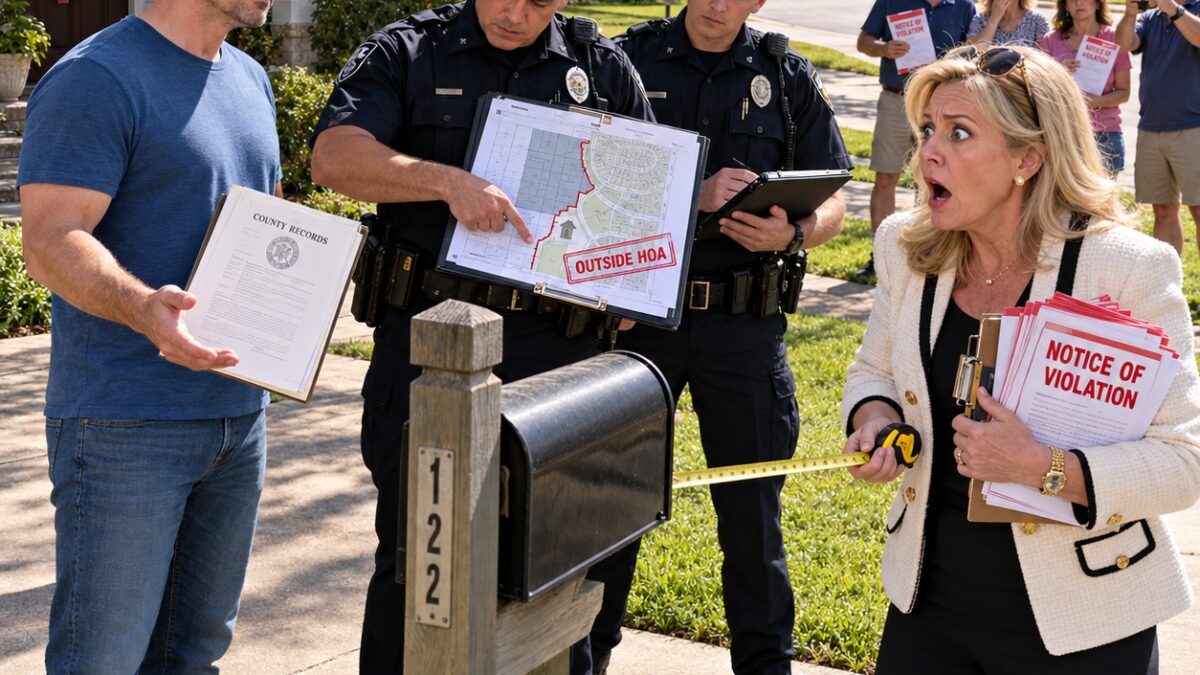
PART2
She returned that evening.
Clipboard.
Pen.
Same determined expression.
“I noticed you removed the notice.”
“I did.”
“You haven’t corrected anything.”
“I corrected the notice.”
She frowned.
“What?”
“I put it in the trash.”
Her lips pressed together.
“This isn’t optional.”
“Yes, it is.”
“No.”
“Yes.”
“Failure to comply may result in fines.”
I folded my arms.
“From who?”
“The HOA.”
“I’m not a member.”
“That does not exempt you from neighborhood standards.”
“It exempts me from your HOA rules.”
Pamela tapped her pen against the clipboard.
“You live here.”
“That’s not how contracts work.”
“You benefit from the community.”
“I use public streets.”
“You benefit from Meadowbrook property values.”
“I also benefit from Texas sunshine. I don’t owe the sun annual dues.”
That did not help.
Pamela stepped closer.
“You seem to think this is funny.”
“I think you trying to fine somebody who isn’t in your association is funny.”
“There can be legal consequences.”
“Then send something from an actual lawyer.”
“I’m warning you.”
“No, Pamela.”
I pointed toward the sidewalk.
“I’m warning you. Stop taping fake violations to my house.”
She looked almost offended.
“They are not fake.”
“They have no authority here.”
“Everyone follows rules.”
“I do follow rules.”
“Clearly not.”
“I follow rules that apply to me.”
That sentence somehow made her angrier than everything else.
Because Pamela’s version of order did not include people deciding where her authority stopped.
She left.
The next morning, I made a sign.
Not angry.
Not threatening.
Just factual.
THIS PROPERTY IS NOT GOVERNED BY THE MEADOWBROOK ESTATES HOA.
Then, because Pamela had already turned the whole thing ridiculous, I added:
COMPLAINTS MAY BE DIRECTED TO THE WIND.
I placed it inside my front window.
Two hours later, my doorbell camera notified me.
Pamela.
Of course.
She stood on the sidewalk staring at the sign.
Then at my door.
Then back at the sign.
She took a photograph.
Typed furiously on her phone.
Left.
Five minutes later, my neighbor Mike texted.
Dude.
I replied:
What?
Pamela is losing her mind.
How do you know?
She just came to my house ranting about your “hostile anti-community signage.”
I laughed.
Then another message arrived.
She says you are mocking neighborhood integrity.
I typed:
Did she measure my grass yet?
Three dots appeared.
Then:
Bro.
I think you summoned her.
I walked toward the front window.
Pamela was in my yard.
Actually in it.
Bent over.
Holding a ruler.
For several seconds, I did nothing because the scene was so absurd my brain needed time.
She moved to another patch.
Pressed the ruler into the lawn.
Wrote something on her clipboard.
I opened the front door.
“Pamela?”
She jumped.
Not dramatically.
Enough.
Then she straightened like being caught trespassing was somehow my social mistake.
“Do you need help?”
“Your grass exceeds regulation height.”
I walked down the steps.
“You’re measuring my lawn.”
“Yes.”
“Why?”
“I received additional complaints.”
“From who?”
“Residents.”
“Which residents?”
“Confidential.”
I looked at the ruler.
Then her.
Then my grass.
“Again, Pamela, I’m not in the HOA.”
“That doesn’t mean you can ignore community standards.”
I almost smiled.
“Oh, I don’t ignore them.”
She narrowed her eyes.
“I interpret them creatively.”
Her face went red.
“You think this is a joke.”
“At this point?”
I looked at the ruler.
“Yes.”
She stormed off.
Mike was standing across his driveway pretending to check the mail.
The moment Pamela disappeared around the corner, he yelled:
“HOW TALL?”
I laughed.
“Apparently criminal.”
That should have been the point where the whole neighborhood recognized Pamela had gone too far.
Instead, people started telling me stories.
Mike came over that evening with two beers.
“You know you’re not the only one.”
“I assumed.”
He handed me one.
“She gave me a warning because my porch light was too bright.”
“What’s too bright?”
“Exactly what I asked.”
“And?”
“She said it disturbed neighborhood harmony.”
“Did she give you a lumen limit?”
“Yes.”
I looked at him.
“Seriously?”
“No. She told me not to get smart.”
I laughed.
He did not.
“She fined me for my trash cans.”
“Actually fined?”
“Fifty dollars.”
“For what?”
“They were visible after pickup.”
“How long?”
“Maybe half an hour.”
“Did the board approve the fine?”
He shrugged.
“Pamela sent it.”
That interested me.
“What did the invoice say?”
“Meadowbrook compliance penalty.”
“Signed?”
“Her.”
“Did you pay?”
“Yes.”
I stared at him.
“Why?”
“Because fifty bucks was cheaper than dealing with Pamela for two weeks.”
That sentence explained how people like her accumulate power.
Not because everyone believes them.
Because everyone gets tired.
Mike continued.
“The Roberts couple got a warning over their garden flamingos.”
“You’re kidding.”
“No.”
“Flamingos?”
“They had three.”
“Apparently the fourth one is where property values collapse.”
Mike smiled.
“Single mom down the street got yelled at because her kids left bikes in the driveway.”
“Actual violation?”
“No idea.”
“Anybody read the rules?”
“Probably not.”
“That’s the problem.”
Mike looked toward Pamela’s street.
“She has a binder.”
“A binder?”
“Neighborhood offenders.”
“No.”
“Yes.”
“Please tell me that isn’t the actual title.”
“I saw it.”
I laughed again.
He took a drink.
“Man, I’m serious. She’s been collecting complaints on people.”
That changed the tone.
What had seemed like one obsessive neighbor was starting to look more institutional.
The next week brought three more notices.
Trash.
Door color.
Grass.
One warning accused me of “noncooperation with compliance inspection.”
I emailed the actual Meadowbrook board address.
Subject:
UNAUTHORIZED HOA ENFORCEMENT AGAINST NON-MEMBER PROPERTY
I attached my deed summary.
Property description.
Copies of Pamela’s notices.
A photograph of her measuring my lawn.
I asked one question:
Please confirm whether the Meadowbrook Estates HOA claims jurisdiction over my property.
Nobody answered immediately.
Pamela did.
She appeared the next afternoon.
“Did you contact the board?”
“Yes.”
“You should have addressed concerns through me.”
“No.”
“I’m the standards representative.”
“I’m not under your standards.”
“You are creating unnecessary hostility.”
“I sent a jurisdiction question.”
“You’re trying to undermine established processes.”
I looked at her.
“Pamela, this is simple.”
“No, it isn’t.”
“Yes, it is. Either my house is legally bound to Meadowbrook or it isn’t.”
“You are geographically part of the neighborhood.”
“That is not a legal answer.”
She stepped closer.
“You should be careful.”
“Why?”
“Escalating these matters can have consequences.”
I stared at her.
“Are you threatening me?”
“No.”
“Good.”
I pulled out my phone.
“Because now I’m documenting conversations.”
Her eyes dropped to the phone.
“You cannot record me without permission.”
I laughed.
“Texas is a one-party consent state.”
Her face froze.
I had looked it up that morning.
Not because I planned a trap.
Because dealing with Pamela had made me start researching everything.
She turned and left.
Two days later, the board finally responded.
Short email.
Mr. Carter,
Our preliminary records indicate your property may not be subject to the Meadowbrook Estates declaration. We are reviewing the matter and will respond formally.
Pamela came back anyway.
That was what told me this was not really about HOA authority.
If the board itself was questioning jurisdiction, a reasonable person would pause.
Pamela accelerated.
She started photographing my trash cans from the sidewalk.
She complained to the city about lawn height.
City inspector came.
Measured.
Compliant.
She complained about my fence.
Compliant.
She reported an “unauthorized exterior paint scheme.”
City employee politely explained the city did not care that my beige door offended her.
Then came the porch-light issue.
I did not even have a particularly bright porch light.
Pamela claimed the fixture created “inconsistent nighttime character.”
Mike told me:
“She’s building a case.”
“A case for what?”
“Against civilization, apparently.”
I started saving everything.
Every notice.
Every email.
Doorbell footage.
Photographs.
Board responses.
I made a folder.
Then another.
Pamela had infected me.
I had paperwork now.
The situation became neighborhood entertainment.
People slowed down when she approached my house.
One retired guy named Mr. Alvarez would conveniently walk his dog whenever Pamela was outside.
Mrs. Roberts—the flamingo victim—added two more flamingos.
Mike started deliberately rolling his trash cans in fifteen minutes later than usual.
“Don’t antagonize her.”
He looked offended.
“I’m conducting a timing study.”
“You’re an idiot.”
“That too.”
But not everybody laughed.
Some people supported Pamela.
A small group inside Meadowbrook believed strict enforcement protected property values.
That itself was not unreasonable.
What was unreasonable was assuming strict enforcement mattered more than actual authority.
One woman told Mike:
“If people don’t like HOA standards, they shouldn’t move here.”
He answered:
“He didn’t.”
That fact kept causing problems for Pamela.
I had not moved into Meadowbrook.
Meadowbrook had grown around properties like mine.
She wanted the visual benefits of controlling the entire street without the inconvenience of having legal power over it.
Several weeks passed.
Then Pamela did something I still would not believe if I had not lived through it.
She called 911.
I was in the backyard on a Saturday afternoon.
Beer.
Folding chair.
No crime in progress.
No emergency.
Then I heard sirens.
Not one cruiser.
Two.
I stood.
Looked toward the street.
Police vehicles stopped in front of my house.
Pamela stood at the end of my driveway.
Arms folded.
Clipboard against her chest.
I set the beer on the table.
Walked forward.
One officer stepped out.
Mid-forties.
Looked tired.
The second was younger and already scanning the situation like he expected the problem to be somewhere other than where dispatch had described.
I reached the driveway.
“Afternoon, officers.”
The older one sighed.
“Sir, we received a complaint involving trespassing and a neighborhood dispute.”
I blinked.
“Trespassing?”
Pamela stepped forward.
“He is occupying property subject to Meadowbrook governance while refusing all compliance.”
I looked at the officer.
“Apparently I’m trespassing in my own house.”
Pamela snapped:
“That isn’t what I said.”
The officer looked at her.
“Ma’am, you reported that an individual was unlawfully occupying property and refusing to comply with lawful neighborhood authority.”
“Yes.”
He pointed at me.
“This is the homeowner?”
“Yes.”
“And he owns this property?”
Pamela hesitated.
“Yes, but—”
The officer closed his eyes for half a second.
I almost felt sorry for him.
“Ma’am, what exactly is the emergency?”
“It’s an active violation situation.”
“What violation?”
“HOA standards.”
He looked at me.
I said:
“My property is not in her HOA.”
The younger officer turned toward Pamela.
“Is that true?”
Pamela lifted the clipboard.
“He lives within the Meadowbrook community area.”
“That isn’t what I asked.”
She shifted.
“Technically, the parcel was never incorporated into the association.”
The older officer stared at her.
“So he is not an HOA member.”
“He still affects the neighborhood.”
“That is not a police matter.”
“He refuses to comply.”
“Again, not a police matter.”
Pamela raised her voice.
“If people can simply ignore standards, the whole community system breaks down.”
The officer rubbed his forehead.
I said nothing.
I had learned by then that silence made Pamela fill empty space with increasingly damaging statements.
She continued.
“His grass is over height.”
The younger officer looked at my lawn.
Then at her.
“You called 911 over grass?”
“It’s not just the grass.”
“Then what crime occurred?”
Pamela’s face reddened.
“He has harassed me.”
The older officer turned toward me.
“Have you threatened her?”
“No.”
“Contacted her residence?”
“No.”
“Followed her?”
“No.”
I pulled out my phone.
“I have security footage if you want it.”
Pamela pointed.
“He records people without permission.”
The officer looked at her.
“He has exterior home security cameras.”
“That’s surveillance.”
The officer’s expression became almost painful.
“Ma’am.”
She stopped.
He spoke slowly.
“Unless this gentleman is committing a crime, police do not enforce HOA rules.”
“He’s ruining the neighborhood.”
“That is not a crime.”
“He refuses notices.”
“That is not an emergency.”
Mike had come outside by then.
So had Mrs. Roberts.
Mr. Alvarez appeared with his dog like he had been summoned by some neighborhood bat signal.
Pamela realized we had an audience.
Her voice became sharper.
“You’re taking his side.”
“I’m explaining the law.”
“He’s mocking the association.”
“That is also not a crime.”
Mike made a sound that was dangerously close to laughter.
The officer looked toward him.
Mike suddenly became very serious.
Pamela folded her arms.
“So you’re just leaving?”
“Unless there is an actual criminal complaint, yes.”
“What about misuse of property?”
“Civil issue.”
“Community standards?”
“HOA.”
“His sign?”
I looked at my window.
THIS PROPERTY IS NOT GOVERNED BY THE MEADOWBROOK ESTATES HOA.
COMPLAINTS MAY BE DIRECTED TO THE WIND.
The younger officer read it.
His mouth twitched.
Pamela noticed.
“That’s harassment.”
“No, ma’am.”
The older officer took out a form.
For a second Pamela looked satisfied.
Then he handed it to her.
Her face changed.
“What is this?”
“A warning regarding misuse of emergency services.”
The entire street went quiet.
Then Mike whispered:
“Ooooh.”
Like we were watching a schoolyard argument.
I looked at him.
He shrugged.
Pamela stared at the officer.
“You’re warning me?”
“Yes.”
“I called for help.”
“You called 911 over an HOA dispute involving a property outside your HOA.”
“That’s not accurate.”
“It is what you described.”
“I want your supervisor.”
“You may contact the department.”
“This is outrageous.”
“Do not call emergency services again unless there is an emergency.”
Her face turned a shade of red I had previously associated mostly with overheating machinery.
The officers left.
One of them nodded at me.
“Have a good afternoon.”
“I’m already home.”
He smiled slightly.
“Even better.”
Pamela stood there holding the warning.
For once, her clipboard seemed less powerful.
She looked at me.
“This is not over.”
I said:
“I sincerely hope it is.”
Then I walked back to my beer.
That police warning changed everything.
Not immediately.
But the neighborhood felt different.
People who had been quietly annoyed started speaking openly.
Mike texted me that night.
Board meeting Tuesday.
I replied:
Good for them.
You’re coming.
No.
You are.
I’m not in the HOA.
Exactly why it’ll be funny.
I had no intention of attending.
Then the formal board response arrived Monday morning.
Mr. Carter,
Following review of recorded declarations and parcel records, your property is not subject to mandatory membership in the Meadowbrook Estates Homeowners Association.
The Association does not claim authority to impose assessments, architectural restrictions, maintenance standards, or compliance fines upon your parcel.
I read it twice.
Then I looked at all Pamela’s notices.
Grass.
Door.
Mailbox.
Trash.
I thought about Mike’s fifty-dollar fine.
Mrs. Roberts’ flamingos.
The single mother’s children’s bikes.
I called Mike.
“What time Tuesday?”
He laughed.
“Knew you’d come.”
The Meadowbrook community center was packed.
More people than the board had chairs for.
I sat in the back beside Mike.
Technically, I had no voting rights.
Fine.
I had no desire to vote.
I wanted to hear whether Pamela would finally accept reality.
She stood near the front with the binder.
THE binder.
Thick.
Tabbed.
Apparently Mike had not exaggerated.
Pamela began the meeting before the actual board president had fully finished calling it to order.
“I need to address the ongoing standards crisis affecting the western boundary.”
The president, Harold Whitman, looked tired.
He was probably seventy.
Retired engineer.
Glasses.
The expression of a man regretting every volunteer commitment he had ever made.
“Pamela, we have an agenda.”
“This is directly relevant.”
Harold sighed.
“Briefly.”
She opened the binder.
“Several properties adjacent to Meadowbrook are exploiting technical membership gaps to disregard standards that impact all homeowners.”
Several people looked at me.
I smiled.
Waved.
Pamela’s jaw tightened.
She continued.
“If we allow unrestricted properties to exist visibly within our community environment, residents will reasonably question why they should comply.”
Someone behind me muttered:
“Because we signed the HOA documents.”
Laughter.
Pamela raised her voice.
“This is exactly the attitude I’m talking about.”
Harold adjusted his glasses.
“Pamela.”
She turned.
“The board has reviewed the parcel.”
“Yes, and I believe the declaration should be amended.”
“You cannot amend somebody else’s deed.”
“We can extend community standards.”
“No.”
The room went still.
Harold said it again.
“We cannot regulate property that is not in the association.”
Pamela looked stunned.
“But we should.”
“That is not the same thing.”
“If we let him do anything he wants—”
Harold interrupted.
“He cannot do anything he wants. He is subject to municipal, county, state, and federal law.”
“What about our standards?”
“They do not apply to him.”
Pamela pointed toward me.
“Then he has more rights than paying members.”
“No.”
Harold sounded exhausted now.
“He has different contractual obligations because he did not enter the HOA.”
Pamela looked around the room for support.
A few people avoided eye contact.
Then one woman on the board, Denise Walker, pulled out a stack of papers.
“Since we are discussing compliance authority, there is another issue.”
Pamela looked at her.
“What issue?”
“We’ve received complaints.”
Pamela relaxed slightly.
“Exactly.”
“About you.”
Silence.
Real silence.
Pamela’s mouth opened.
Denise continued.
“Residents have reported receiving fines and violation notices that were not authorized under current board procedures.”
“That is false.”
Mike leaned toward me.
“Oh, this is good.”
I whispered:
“Shut up.”
Denise lifted another document.
“We reviewed thirty-seven notices issued in the last six months.”
Pamela’s face paled.
“Those are compliance matters.”
“Twelve had no documented committee approval.”
“I have delegated authority.”
Harold said:
“Not for monetary penalties.”
Pamela looked between them.
Denise continued.
“Several notices also cite standards that do not appear in our governing documents.”
“Interpretive standards.”
Mike whispered:
“She means imaginary.”
I almost laughed.
Denise kept going.
“Examples include porch-light brightness, decorative bird placement, bicycle storage visibility, temporary seasonal objects, and trash-container timing inconsistent with the written rule.”
Mrs. Roberts called from three rows ahead:
“FLAMINGOS.”
People laughed.
Pamela snapped:
“This is serious.”
Mrs. Roberts turned.
“So were my flamingos apparently.”
Harold banged the small gavel.
“Order.”
The room settled.
Then he looked at Pamela.
“There is also the police incident.”
“That was separate.”
“No.”
“It involved a non-member.”
“That is exactly the problem.”
Pamela’s voice rose.
“I was trying to protect Meadowbrook.”
“You called emergency services over lawn and HOA compliance.”
“He was hostile.”
Harold looked toward me.
“Mr. Carter, did you threaten Ms. Reynolds?”
I stood.
“No.”
“Enter her property?”
“No.”
“Contact her except when she came to yours?”
“No.”
Pamela said:
“He mocked me.”
I answered:
“That part may be true.”
Laughter.
Harold closed his eyes.
Even he almost smiled.
Then Denise placed another stack of complaints on the table.
“There are nine resident statements alleging overreach.”
“Nine?”
“Eleven now.”
Pamela stared.
Mike raised his hand.
Denise nodded.
“Twelve.”
That broke the room.
People started talking at once.
Harold called for quiet.
Pamela stood rigid.
“This is a coordinated attack.”
“No,” Denise said.
“It’s a review.”
“You’re undermining enforcement.”
“We’re reviewing whether you had authority to enforce some of these things at all.”
“I am the standards representative.”
Harold looked at her.
“Not anymore.”
The sentence landed softly.
That made it harder.
Pamela stared.
“What?”
Harold read from a prepared motion.
“Effective immediately, you are removed from all compliance, architectural, standards, and neighborhood-enforcement committees pending full audit of prior notices and penalties.”
Pamela’s face went white.
“You cannot do that.”
“The board can.”
“I built this compliance system.”
“That is part of what we are reviewing.”
“I have records.”
Denise looked at the binder.
“We know.”
Pamela clutched it tighter.
“If you remove standards, this neighborhood will collapse.”
“No one is removing standards.”
Harold leaned forward.
“We’re removing unauthorized enforcement.”
The distinction mattered.
Maybe not to Pamela.
But to everyone else.
She looked around.
No applause.
No cheering.
Just people watching.
That seemed to hurt more.
She grabbed the binder.
Turned.
Knocked into a plastic chair.
The chair fell.
She did not pick it up.
The door slammed behind her.
For several seconds, nobody spoke.
Then Mrs. Roberts said:
“So about the flamingos…”
The room exploded in laughter.
Harold covered his face.
The formal review lasted almost two months.
I heard about most of it through Mike.
Some fines were refunded.
Others credited.
Not every notice Pamela issued had been wrong.
That surprised people.
Sometimes the grass really was too tall.
Sometimes trash cans really were left out against written rules.
Sometimes architectural changes genuinely required approval.
The problem was not that all enforcement was illegitimate.
The problem was that Pamela had stopped distinguishing actual rules from personal preferences.
She blurred them together.
Then used her reputation as “the standards person” to make neighbors assume every demand had official backing.
The board rewrote its procedures.
No monetary fine without documented board or committee authority.
Violation notices had to cite the actual covenant or rule.
Appeal instructions required.
No individual compliance volunteer could create new standards through “interpretation.”
And one line that made Mike laugh for ten minutes:
Association enforcement shall apply only to parcels legally subject to the governing declaration.
I said:
“That feels obvious.”
“Pamela made obvious expensive.”
Fair.
The street responded in the most mature possible way.
Meaning not mature at all.
The weekend after Pamela lost her committee role, inflatable decorations appeared everywhere.
Not Christmas season.
July.
One house had an eight-foot Santa.
Another put three giant flamingos near the sidewalk.
Mike installed an inflatable snowman beside his mailbox.
I walked over.
“Seriously?”
“It complies.”
“With what?”
“My personal standards.”
Mrs. Roberts added six flamingos.
“They’re breeding,” she told me.
“This is your fault.”
“They finally feel safe.”
The street looked ridiculous.
Harold sent a neighborhood email asking residents to “exercise tasteful judgment.”
Mike printed it and framed it.
Despite all the joking, the neighborhood genuinely improved.
People talked more.
Partly because they were no longer worried every conversation would become a violation report.
The HOA still existed.
Dues still existed.
Standards still existed.
People still argued about budgets.
They still had rules about fencing.
Roof colors.
Parking.
Pool access.
Common landscaping.
But those rules became predictable again.
That matters more than people realize.
A reasonable HOA should be boring.
You should rarely think about it.
If everybody is constantly talking about the board, something has probably gone wrong.
Pamela remained in the neighborhood for a while.
Without the clipboard authority, she was simply Pamela.
She still noticed things.
You could see it.
Trash can out late?
She looked.
Decorative sign too large?
Look.
Mike’s cat wandering through three yards?
Very long look.
But she could no longer issue notices herself.
She could file complaints through the same process as everyone else.
That apparently felt unbearable.
The first time I saw her after the meeting, she was walking past my house.
No clipboard.
I was pulling weeds.
She stopped.
I stood.
“Morning.”
She looked toward my front door.
Still beige.
Then the lawn.
Then the mailbox.
“You’re enjoying this.”
“Gardening?”
“You know what I mean.”
I wiped my hands on my shorts.
“I’m enjoying being left alone.”
“You embarrassed me.”
I thought about that.
Then said:
“I told you I wasn’t in the HOA.”
“That isn’t what I mean.”
“You called the police.”
“You made everything confrontational.”
“I threw away notices that didn’t apply to me.”
“You put up that sign.”
I looked toward the window.
COMPLAINTS MAY BE DIRECTED TO THE WIND.
“Okay.”
She stared.
“Okay?”
“That part was confrontational.”
She seemed surprised I admitted it.
“I was annoyed.”
“You were mocking me.”
“Yes.”
She took a breath.
For a second, I wondered whether we might actually have a normal conversation.
Then she said:
“You still should maintain your property to neighborhood standards.”
I laughed.
Conversation over.
“Have a good day, Pamela.”
She walked away.
Mike appeared ten minutes later.
“Was that peace?”
“No.”
“Truce?”
“No.”
“Ceasefire?”
“Temporary atmospheric disturbance.”
He nodded.
“Very diplomatic.”
Several months later, Pamela and her husband listed their house.
Nobody knew whether the HOA drama caused it.
Probably not entirely.
People’s lives are bigger than neighborhood arguments.
Her husband had apparently wanted to move closer to family.
Pamela told someone she wanted a community with “stronger governance.”
Mike nearly injured himself laughing when he heard.
“Stronger governance?”
“She’s moving to a more aggressive HOA.”
“Nature is healing.”
I told him not to be cruel.
He said:
“I paid fifty dollars because my trash can existed.”
Fair.
The moving truck arrived on a Thursday.
I happened to be outside.
Pamela supervised loading.
Of course.
She looked toward my house once.
I raised a hand.
She hesitated.
Then raised hers.
That was it.
No apology.
No final speech.
No dramatic defeat.
She moved.
Mike came over that evening with beer.
“You know what this is?”
“Thursday?”
“Victory.”
“Don’t be dramatic.”
He pointed toward the empty house.
“The clipboard has left the neighborhood.”
I laughed.
We sat in our driveways.
Sunset.
Kids riding bikes.
Mrs. Roberts’ flamingos glowing pink in the evening light.
Normal.
Or our version of it.
The best part came later.
Nothing happened.
No violation notice.
No one measured my grass.
No one photographed my trash cans.
No one told me my beige door was disruptive.
The actual HOA board never contacted me again except once, when Harold sent an apology letter clarifying that my property had no association obligations.
I kept it.
Not because I expected another war.
Because paperwork had become strangely comforting.
Mike saw the folder one day.
“Look at you.”
“What?”
“You have a compliance binder now.”
“It’s a property file.”
“You became Pamela.”
“Get out.”
He laughed.
I made one final addition to the front of the property.
A small custom decal on my mailbox.
Clean lettering.
Nothing insulting.
Nothing dramatic.
NOT IN THE HOA.
Mike saw it first.
He stood on the sidewalk staring.
Then smiled.
“That is beautiful.”
“It’s practical.”
“No.”
He put a hand over his heart.
“It’s art.”
Mrs. Roberts ordered one for her husband’s workshop.
She was in the HOA, so I explained that hers would be inaccurate.
She said:
“I know. That’s why it’s funny.”
I refused involvement.
Years passed.
The story became one of those neighborhood legends people told badly.
New families would hear that “some HOA lady once called the police because of a mailbox.”
Almost true.
Someone claimed I had been arrested.
False.
Another version said Pamela received a thousand-dollar fine.
Also false.
Someone said she had been HOA president for twenty years.
No.
Reality was simpler.
She liked control.
She had some legitimate neighborhood authority.
Then she slowly stopped respecting where that authority ended.
My house became the clearest example because I was never under the HOA at all.
It should have been impossible to confuse.
Yet she confused it because “you live here” felt stronger to her than recorded property documents.
That is what I remember.
Not the ruler.
Not even the 911 call.
The sentence:
You live here. The rules apply to everyone.
Sounds reasonable until you ask:
Which rules?
Created by whom?
Binding whom?
Authority always sounds most persuasive when nobody asks those questions.
That experience made me read documents.
Not because I became paranoid.
Because I realized how many people obey things they never verify.
Mike paid his fake or unauthorized fine because fifty dollars was easier than resistance.
Mrs. Roberts almost removed her flamingos because she assumed Pamela spoke for the board.
The single mother started hiding her kids’ bikes because she did not want another confrontation.
Individually, tiny.
That is why overreach survives.
Each cost is too small to fight.
Twenty dollars.
Fifty dollars.
Move the bike.
Change the light.
Put away the decoration.
Nobody wants to hire a lawyer over a flamingo.
So power expands through exhaustion.
Pamela was not some criminal mastermind.
That would have been easier.
She genuinely believed she was protecting Meadowbrook.
I believe that.
She liked neat lawns.
Uniform appearance.
Order.
She probably thought people would thank her eventually.
The problem was that good intentions do not expand jurisdiction.
You can want something good and still have no right to force it.
That lesson stayed with me.
It also made me less dismissive of the homeowners who actually liked their HOA.
At first, after dealing with Pamela, I thought:
Why would anyone voluntarily live under this?
Then Harold showed me the other version.
Predictable meetings.
Budgets.
Pool maintenance.
Common-space repairs.
Clear rules.
Appeals.
The HOA was not inherently the villain.
Pamela’s misuse of it was.
That distinction matters.
Mike once asked:
“So you don’t hate HOAs now?”
“No.”
He looked disappointed.
“That ruins every good story.”
“I hate people using organizations as personal weapons.”
“Longer bumper sticker.”
“More accurate.”
Harold retired from the board a year later.
Denise became president.
She was efficient.
Quiet.
Not interested in anybody’s grass unless the actual documents required it.
The meetings got shorter.
Attendance dropped.
That was success.
People only showed up when something mattered.
Nobody maintained an “offenders binder.”
The neighborhood fountain kept running.
The pool opened every summer.
Roofs remained mostly the same approved colors.
Civilization survived my mailbox.
Mike eventually sold his house too.
Moved fifteen minutes away.
Before leaving, he walked over to my mailbox.
Touched the NOT IN THE HOA decal.
“You keeping this?”
“Yes.”
“Will it convey with the property?”
“I’m not selling.”
“Put it in your will.”
“To who?”
“Future generations.”
I laughed.
He became serious.
“You know you could have just ignored her.”
“I tried.”
“No.”
“I mean really ignored her.”
I thought.
“Maybe.”
“She probably would’ve moved on.”
“Maybe.”
“Why didn’t you?”
That was a fair question.
I leaned against the fence.
“Because she was already doing it to everybody else.”
Mike nodded.
“You knew about the fines.”
“Not at first.”
“But later.”
“Yes.”
He smiled.
“So this wasn’t actually about your mailbox.”
“No.”
It started there.
But it became about whether one loud person could make everyone else treat personal preference like law.
That is worth resisting.
Not because every rule is oppression.
Because actual rules deserve the dignity of being distinguishable from somebody’s opinion.
Years later, the mailbox eventually needed replacement.
Rust inside the post.
Nothing dramatic.
I bought a new one.
Installed it.
Measured the official postal height carefully.
Mostly because the irony made me laugh.
My wife—who moved in several years after the Pamela era—watched me attach the old decal to the new box.
“What does that mean?”
I had never told her the full story.
So I did.
Pamela.
Grass ruler.
Beige door.
Fake notices.
Board meeting.
The binder.
The inflatable July Santa.
My wife listened quietly.
Then asked:
“You really wrote complaints may be directed to the wind?”
“Yes.”
“That’s obnoxious.”
“I know.”
“Funny.”
“Also yes.”
She looked at the mailbox.
“So we are definitely not in the HOA?”
I stared at her.
She laughed.
“Just checking.”
I showed her the property documents that night.
Romantic.
Marriage changes priorities.
We kept living there.
Children eventually came.
They grew up thinking the mailbox decal was just part of the house.
When my oldest was eight, she asked:
“What’s an HOA?”
I gave her the basic explanation.
“A group of homeowners who agree on rules for their neighborhood.”
She pointed at our mailbox.
“And we don’t?”
“No.”
“Why?”
“Because this house never joined.”
She thought.
“Is that good?”
“Depends.”
She frowned.
I smiled.
“That answer will make more sense when you’re older.”
A year later, she left her bike in the driveway.
I almost told her to move it.
Then I started laughing.
She looked at me.
“What?”
“Nothing.”
I let the bike stay until dinner.
Not because Pamela had won.
Because my own child taught me there are worse things than visible bicycles.
Our street changed over the years.
Old houses renovated.
New families.
Different cars.
Trees larger.
Some original Meadowbrook residents gone.
The HOA rules evolved too.
Digital notices replaced paper.
Meetings became hybrid.
People complained online instead of in person.
Human nature remained.
Every few years, somebody became overly enthusiastic about enforcement.
But Pamela’s legacy helped.
The board had procedures now.
People remembered.
If someone tried saying:
“Everybody on this street has to…”
Somebody else asked:
“Is that actually in the documents?”
Good.
Questions are healthy.
One new compliance volunteer once emailed me about a hedge.
Polite.
Short.
Mr. Carter, our records indicate the hedge along your property may exceed Meadowbrook visibility standards.
I answered:
Thanks for reaching out. My parcel is not part of Meadowbrook Estates. Attached is the recorded parcel information and the association’s prior confirmation.
Twenty minutes later:
Apologies for the error. No action required.
That was it.
No drama.
No rulers.
No 911.
I showed my wife.
“This is how it’s supposed to work.”
She read the exchange.
“Boring.”
“Exactly.”
Boring is underrated.
There was one moment, years after Pamela moved, when I unexpectedly understood her a little better.
I was visiting a friend in another subdivision.
One property had a yard filled with broken vehicles, loose trash, old appliances, and a fence falling into the sidewalk.
It was genuinely affecting neighbors.
My friend said:
“The HOA has been fighting them for two years.”
I looked.
For the first time, I thought:
Okay.
I understand why standards exist.
The mistake is not having standards.
The mistake is believing standards justify anything.
Rules need boundaries too.
Pamela lost that.
She started with real concerns.
Then turned every visual preference into a moral emergency.
Mailbox height.
Door beige.
Lawn half an inch.
Porch-light brightness.
Once you convince yourself you are defending “community integrity,” almost any intrusion can feel noble.
That is dangerous.
I caught myself doing smaller versions.
Kids leaving toys in the living room.
Neighbor parking briefly near my driveway.
Someone’s music.
You can become the thing you mock if you mistake irritation for authority.
So sometimes I remember Pamela.
Not with anger.
As a warning.
Ask:
Is this my business?
Do I actually have authority?
Does this matter?
Or do I simply dislike it?
Those questions save relationships.
I wonder if Pamela ever learned that.
I never heard much after she moved.
Mike once found her social-media profile.
I told him I did not want to see.
“Come on.”
“No.”
“She’s on another HOA board.”
I stared.
“You’re kidding.”
“I am absolutely not kidding.”
I laughed.
Then stopped.
“Good luck to them.”
That was all.
Not my neighborhood.
Not my problem.
That sentence had become wonderfully literal.
The Meadowbrook story ended the way I wanted.
Not with revenge.
Not with Pamela destroyed.
With jurisdiction restored to reality.
My property remained mine.
The HOA handled its members.
The board fixed its enforcement process.
Several residents got refunds or canceled penalties.
The police warning reminded everyone 911 was not an HOA hotline.
Pamela left.
Life moved on.
That is enough.
There is a temptation when telling stories like this to make every difficult person into a monster.
Pamela was not.
She was overbearing.
Controlling.
Sometimes absurd.
She crossed lines.
She misused authority.
Those things are true.
She was also a person.
Probably convinced herself she was preserving something.
That does not excuse the behavior.
It makes the lesson more useful.
Real overreach usually arrives carrying a justification.
Property values.
Safety.
Community.
Standards.
Efficiency.
Order.
Those words can describe good goals.
They can also become shields against the basic question:
Do you actually have the right to do this?
Pamela never wanted to answer that.
The board eventually did.
No.
She did not have the right to regulate my property.
No.
She did not have the right to fine people without proper authorization.
No.
She did not have the right to invent standards.
No.
She did not have the right to use emergency services to pressure someone into HOA compliance.
Once those noes became official, everything got simpler.
That is what boundaries do.
They simplify.
My house.
Their HOA.
City law.
Police emergencies.
Separate things.
The mailbox decal is still there.
The letters faded once.
I replaced them.
My wife called me stubborn.
Probably.
But it is not really about Pamela anymore.
It reminds me to know what I agreed to.
Know what I did not.
Read documents.
Ask questions.
Respect the rules that actually apply.
Challenge authority that cannot explain where its power comes from.
And, perhaps most importantly, never assume somebody carrying a clipboard knows more than you simply because they brought a clipboard.
The funniest part?
My mailbox has always been regulation height.
I measured it the day Pamela first complained.
Then again when I replaced it.
Perfect.
Sometimes I imagine her standing beside it with that tape measure.
Certain she had discovered something.
Certain I would fold.
Certain the neighborhood depended on her winning.
Instead, years later, the street still looks peaceful.
Kids still ride bikes.
People still leave trash cans out occasionally.
Mrs. Roberts eventually replaced the flamingos with garden cranes.
Mike’s old cat is long gone, but neighborhood cats continue violating property boundaries with complete confidence.
Grass grows.
Doors come in different shades.
The world survives.
And whenever somebody new asks about the little decal on my mailbox, I usually give them the short version.
“Had an HOA president once who thought my house belonged to them.”
They look toward Meadowbrook.
“Did it?”
“No.”
“What happened?”
“She eventually found out.”
If they want the long version, I tell them.
The ruler.
The fake violations.
The police.
The meeting.
The binder.
The July Christmas decorations.
They usually laugh.
Then they ask:
“What would you do differently?”
Easy.
I would contact the real board sooner.
I would put everything in writing immediately.
I would stop joking once I realized other residents were being charged unauthorized fines.
And I would still tell Pamela the same thing the first morning she pointed at my mailbox.
“I’m not in the HOA.”
Because sometimes an entire ridiculous conflict begins with one person refusing to believe a very simple boundary.
And sometimes the best way to end it is not to scream louder.
It is to keep repeating the truth until everyone who actually has authority finally listens.
Pamela wanted control over my property.
She never got it.
The board eventually controlled Pamela.
The police controlled their own emergency line.
The neighbors got their neighborhood back.
And I kept my beige door, my grass, my mailbox, and my peace.
No dramatic trophy.
No giant settlement.
Just one small decal:
NOT IN THE HOA.
Honestly, that was enough.








