PART2:Her Owner Replaced Her With Another Puppy While She Hid Outside, Too Sick to Open Her Eyes
PART2
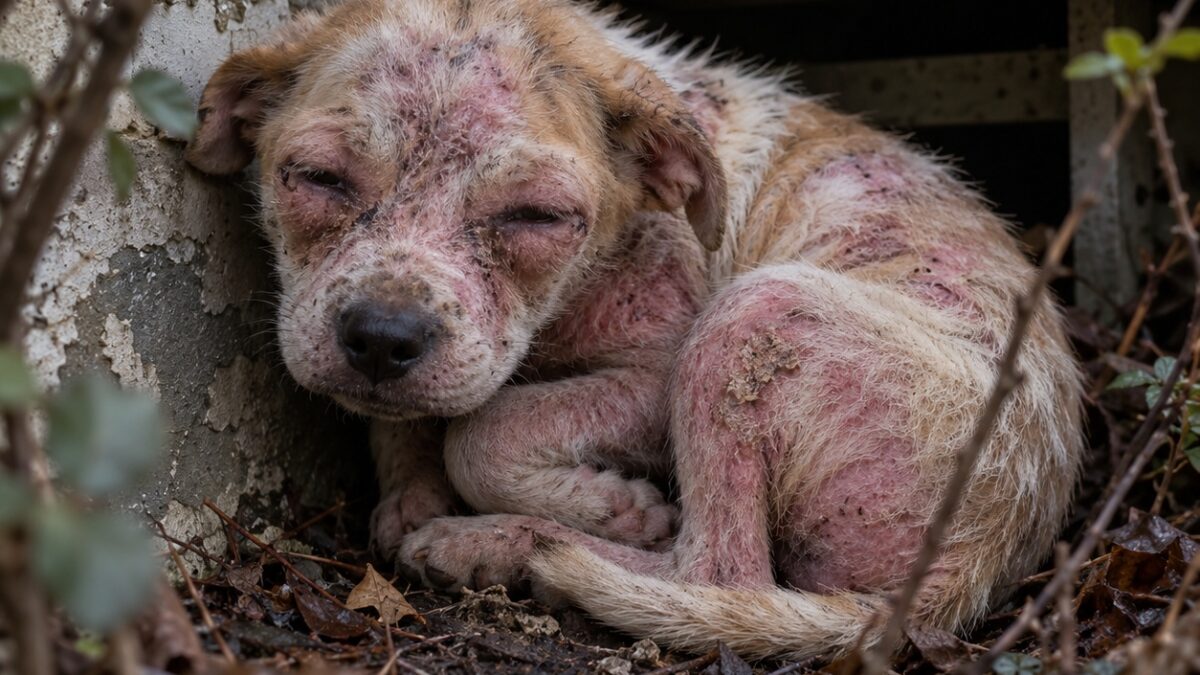
At the veterinary clinic, we finally began understanding what Gracie’s body had been trying to tell everyone.
She was malnourished.
Dehydrated.
And suffering from a severe skin infection.
The inflammation that made her face difficult to look at wasn’t a cosmetic problem.
It wasn’t something that made her “ugly.”
It was disease.
Pain.
A medical condition that needed treatment.
I remember looking at her on the examination table and thinking about how easily people confuse sickness with appearance.
Someone had looked at this puppy and apparently decided:
I don’t want that anymore.
We looked at the same puppy and thought:
She needs a doctor.
That difference changed her life.
The veterinarian examined the affected skin carefully.
Gracie was frightened by the handling.
Every new touch made her body tighten.
I stayed near enough that she could see me.
Not because she trusted me yet.
She didn’t.
But I wanted one familiar presence in a room filled with unfamiliar hands.
The team explained that she needed specific medication.
Not something we could simply pick up and begin immediately.
The treatment had to be brought in from abroad.
That meant another kind of waiting.
We knew what she needed.
Now we had to get it.
Until then, care still mattered.
Nutrition.
Hydration.
Cleaning.
Gentle management of the infected skin.
Making sure she did not become more frightened every time people tried to help.
That last part became almost as important to me as the medical treatment.
Because Gracie did not understand the distinction between:
This human is touching me to hurt me.
And:
This human is touching me because my skin needs care.
A hand was a hand.
A bath was frightening.
Being held was frightening.
Having water run over irritated skin was frightening.
So we had to teach her slowly.
Not by telling her.
By repeating a new pattern.
Touch.
Nothing bad happens.
Release.
Bath.
You are supported.
Done.
Food.
Rest.
Again.
The first bath was hard.
Gracie tried to pull away.
Not violently.
Desperately.
Her body became rigid.
She looked for an exit.
I kept my voice low.
“Easy.”
She struggled again.
“We’re not trapping you.”
The irony wasn’t lost on me.
For a puppy who had spent much of her young life confined, a bath area probably felt like another small place controlled by humans.
So we slowed everything.
No unnecessary movement.
No shouting.
No rushing because we wanted the task finished.
Warm water.
Gentle hands.
Pause when she became overwhelmed.
Continue when she settled.
It took time.
That’s fine.
Trust usually does.
Afterward, Gracie looked exhausted.
We wrapped her.
She did not suddenly crawl into my lap.
No dramatic rescue moment.
She simply stayed where we put her and watched.
That was enough.
The treatment plan became part of our days.
Meals to rebuild her body.
Water.
Skin care.
Waiting for the medication she specifically needed.
Watching her eyes.
Watching the inflammation.
Watching the puppy beneath all of it.
At first, most of what we saw was fear.
If I moved too quickly, she pulled back.
If someone reached from above, she ducked.
If handling lasted too long, her body became tense.
But puppies are curious creatures, even when life has tried to teach them otherwise.
Little glimpses began appearing.
A sound caught her attention.
Her head tilted slightly.
A moving object made her eyes follow.
Food preparation became very interesting.
That made me smile.
“There you are.”
Gracie looked at me.
I had begun saying that often.
Not because she was physically disappearing.
Because I could feel a personality waiting underneath everything.
The illness.
Fear.
Confinement.
Abandonment.
Those things had covered Gracie the way the inflammation covered her skin.
But they were not Gracie.
They were things happening to her.
There is an important difference.
The medication eventually arrived.
I remember feeling enormous relief over something that looked so ordinary.
Medicine.
A package.
The kind of thing people rarely think about until an animal needs something that is not immediately available.
Now we could begin the treatment the veterinarian believed would help address her severe skin condition more effectively.
Again, no overnight miracle.
Medication needs time.
Inflamed skin needs time.
A malnourished body needs nutrition.
Dehydration needs correction.
Fear needs repetition.
Everything about Gracie’s recovery required patience.
So we gave it.
Day after day.
The changes came gradually enough that sometimes we did not notice until we compared.
Her eyes.
That was one of the first things.
The swelling and inflammation around them began easing.
At the beginning, she could barely open them comfortably.
Then a little more.
Then more.
The day I realized I could clearly see her looking directly at me, I froze.
Her eyes were larger than I remembered.
Or maybe I had simply never been able to see them properly.
“Hi.”
Gracie stared.
I smiled.
“So that’s what you look like.”
She did not appreciate the commentary.
Good.
The more comfortable her skin became, the more interested she became in what happened around her.
The world had probably seemed painful in every direction before.
Imagine your skin constantly irritated.
Your face inflamed.
Your eyes difficult to open.
Then people judge you for the appearance caused by the very illness nobody treated properly.
As the physical discomfort eased, Gracie could spend energy on things besides surviving it.
And she did.
The first toy did not create an immediate breakthrough.
We placed something near her.
Gracie watched.
Nothing.
Later, she sniffed it.
Then left it.
Another day, movement caught her attention.
A little more.
Eventually she touched a toy.
Small moment.
Then one day she responded with unmistakable interest.
Her body shifted.
Eyes followed.
Paw moved.
I almost laughed.
“Gracie.”
She looked.
“You know that’s for you, right?”
She reached again.
There it was.
Play.
The thing a puppy should have had all along.
It is difficult to explain how emotional it can be to watch a young animal discover something ordinary late.
Toys are normal.
A puppy playing should not be a rescue milestone.
But if the beginning of her life has been confinement and illness, normal becomes precious.
Gracie learned that an object placed near her might not be there to restrain her.
It might simply be fun.
She investigated.
Pawed.
Mouthed.
Then looked at us.
The more she played, the less she watched hands suspiciously.
Not immediately.
But enough to notice.
Attention helped too.
At first, affection seemed almost confusing.
If I stroked her gently, she sometimes pulled back.
Then paused.
What is this?
Eventually she stayed.
Later, she leaned.
The first time Gracie leaned toward my hand instead of away from it, I had to look down because I could feel tears coming.
That hand.
The same thing she had fled from near her owner’s home.
Now she was moving toward one.
Not because we had forced trust.
Because evidence had accumulated.
Feed.
Touch gently.
Stop when she is uncomfortable.
Come back.
Still gentle.
Bath.
No punishment.
Medicine.
Food.
Toy.
Sleep.
Again.
Eventually her nervous system had enough information to reconsider.
Maybe hands were not all the same.
That is the quiet miracle in rescue.
Not making an animal forget.
Giving them enough new experiences that fear stops being the only available prediction.
Gracie’s appearance continued changing.
The skin became less inflamed.
Her face looked more comfortable.
Her eyes opened properly.
Her body slowly responded to nutrition.
She still needed care.
We did not pretend the moment she looked better that treatment could stop.
The medication continued according to the veterinary plan.
Baths.
Monitoring.
Nutrition.
All of it.
But emotionally, we were beginning to leave the emergency stage.
That meant Gracie could learn things unrelated to medicine.
One of my friends gave her a new bed.
It was clean.
Soft.
Nothing extraordinary to anyone who has bought a pet bed before.
I placed it down.
Gracie noticed immediately.
She approached.
Sniffed.
Circled.
Then climbed onto it.
I wish I had a better word for what happened to her expression.
Surprise, maybe.
Or simple comfort.
She pressed herself into the bed.
Shifted.
Found a position.
Then looked up.
I remembered where she had come from.
The cramped, dirty confinement.
The places where she had been expected to lie before.
And now she had a bed made specifically for an animal to be comfortable.
Not the floor.
Not filth.
Not wherever there was room.
Her bed.
Gracie moved around on it like she couldn’t quite believe softness could belong to her.
I sat nearby.
“You like it?”
She settled deeper.
“I’ll take that as yes.”
The bed became important quickly.
She rested there.
Played near it.
Returned to it.
The idea of ownership seems human, but animals absolutely develop preferred spaces.
This is mine because I am always safe here.
Gracie had one.
That bed meant more to me than the object itself.
It was evidence that her life no longer had to be organized around whatever somebody else was willing to give her.
Someone had thought specifically:
Gracie needs somewhere comfortable.
Then provided it.
For a puppy who had been discarded because her sick skin made her undesirable, individualized care was its own form of healing.
People now noticed what she liked.
What frightened her.
What helped.
What she needed medically.
Gracie was no longer an inconvenience.
She was an individual.
Her baths changed too.
At first:
Fear.
Pull away.
Tense.
Later:
Still not necessarily her favorite activity.
But less panic.
She knew the sequence.
She knew the hands.
She knew it would end.
Predictability made a huge difference.
I would talk through it.
“Almost done.”
Maybe she didn’t understand the words.
She understood tone.
Then towel.
Warmth.
Bed.
Food sometimes.
Patterns.
Animals live through patterns.
Her previous pattern had apparently taught her confinement and rejection.
We were building another one.
When you’re cared for, people come back.
When you’re sick, they treat you.
When your skin looks bad, nobody replaces you.
That last one mattered to me more than Gracie could know.
The other puppy remained something I thought about occasionally.
I wondered whether it was loved.
I hoped so.
I never blamed that puppy.
It had done nothing.
The cruelty was not that another animal received a home.
The cruelty was that Gracie was made disposable.
Two puppies could have been loved.
Illness should not have turned one into garbage.
I had to remind myself of that whenever anger returned.
The goal was never to resent the new puppy.
The goal was to make sure Gracie’s future no longer depended on someone capable of replacing her so casually.
And it didn’t.
The more comfortable she became, the more puppy-like she seemed.
Curiosity grew.
She responded when we moved toys.
She began looking for attention.
She explored the space around her.
Sometimes she did something mildly naughty.
Wonderful.
I love mild trouble in recovered puppies.
Trouble means spare energy.
A dog fighting severe discomfort does not waste much energy being mischievous.
A healthier one absolutely will.
Gracie started showing us what we had been missing.
She could be playful.
Interested.
Sweet.
Curious.
There was no ugliness to fix.
There had been illness to treat.
The distinction should be obvious.
Sadly, for the person who had rejected her, it had not been.
One afternoon I sat beside Gracie’s bed while she played.
She moved toward my hand.
Not food.
Not because I was giving medicine.
Just attention.
I rubbed her gently.
Gracie stayed.
Then she shifted closer.
I thought about the first day again.
My hand reaching.
Her body immediately trying to flee.
Same species.
Same dog.
Same human gesture.
Different meaning.
This time, she knew enough to wait and see.
Then choose.
That choice mattered enormously.
I did not want Gracie to become friendly because she had surrendered.
I wanted her to become friendly because experience taught her safety.
There’s a difference.
Her body language showed it.
Less bracing.
More curiosity.
Eyes open.
Approach instead of retreat.
Those are the milestones no blood test measures.
Eventually, she was ready for another first.
A walk.
Her first real opportunity, as far as we knew, to explore the world with someone beside her instead of experiencing life from confinement.
I had been thinking about it for days.
Would she be frightened?
Would open space overwhelm her?
Would traffic sounds trigger panic?
We didn’t know.
So we kept expectations small.
This was not supposed to be a long adventure.
It was supposed to be choice.
Outside.
Smells.
Air.
Movement.
Gracie stepped out.
Paused.
The world immediately began talking to her in a thousand ways.
Scents we couldn’t detect.
Sounds.
Movement.
Ground beneath her paws.
Distance.
So much distance.
That part got me.
A dog who had known a cramped cage now looking at space without walls.
Gracie sniffed.
Then another scent caught her.
She moved.
I followed.
Not pulling.
No hurry.
This was her walk.
Every few steps, she discovered something.
A patch of ground.
A sound.
Something moving.
She would stop.
Look.
Process.
Then continue.
I found myself watching her more than the surroundings.
Her eyes were open now.
Truly open.
Physically, because the treatment had eased the inflammation.
Emotionally too, if I may borrow the metaphor carefully.
She was seeing a world she had been denied.
No one had to carry her.
No one was chasing her away.
Someone was simply beside her.
That first walk became one of my favorite memories.
There was no dramatic running scene.
No huge destination.
The victory was exploration itself.
She could choose where to point her nose.
Where to stop.
What interested her.
Confinement removes choices most people never notice.
Which direction?
How fast?
Stop or continue?
Gracie finally had those little freedoms.
I kept the leash loose enough for her to investigate safely.
At one point she looked back at me.
Only briefly.
Then continued.
That look stayed with me.
Not frightened.
Checking.
Still there?
Yes.
Go ahead.
That is what I wanted our relationship to become.
Not:
I control where you go.
But:
You can explore because I am here.
When we came back, Gracie went to her bed.
Collapsed into it with the satisfaction of a puppy whose brain had been overloaded by the outside world.
I smiled.
“Big day.”
She slept.
That night, I thought about the dirty cage.
I imagined the two images beside each other.
Gracie confined.
Gracie exploring.
I hated the first.
But I did not want hatred to become the center of her story.
Her future needed more space than her past.
So we kept adding things.
Another walk.
Another toy.
Another safe bath.
Another meal.
Another nap in the new bed.
Ordinary experiences.
Enough ordinary experiences and the rescue day begins losing its monopoly over memory.
At least for humans.
Perhaps for dogs too, in their own way.
Gracie continued improving.
Her skin changed visibly.
People who had seen early images sometimes struggled to believe it was the same puppy.
I was careful about that reaction.
Yes, the transformation was remarkable.
But I never wanted the lesson to become:
She became beautiful, so now she deserved love.
No.
Gracie deserved love when her skin was inflamed.
When her eyes could barely open.
When she was thin.
When she smelled of illness.
When she was scared.
The healthier appearance was a consequence of receiving care.
Not the reason care was justified.
Worth came first.
That mattered to me because rejection had apparently been tied directly to appearance.
I wanted everything after rescue to contradict that.
She could look terrible and still receive treatment.
She could be frightened and still receive patience.
She could resist a bath and still be handled gently.
She could need expensive imported medication and still be worth obtaining it.
She could simply exist.
Enough.
Eventually, adoption became the next question.
It was both exciting and terrifying.
Gracie had made so much progress with people she knew.
But a permanent home would mean new routines.
New environment.
A new person.
Would she regress?
Maybe.
Would the adopter understand that trust might take time?
Would they continue medical care if needed?
Would they love Gracie if her skin ever had another bad period?
That last question mattered.
I could not bear the thought of her being chosen because she looked healthier now and rejected again if illness changed her appearance.
So we needed someone who understood the whole story.
Not simply the after photograph.
A kind woman came forward.
She wanted Gracie.
Not a renamed version.
Not a puppy without history.
Gracie.
She even kept the name.
That moved me more than I expected.
The name had survived confinement.
Abandonment.
Rescue.
Treatment.
Recovery.
Now it would travel into home.
We spoke about her needs.
Her history.
Her fear.
Her progress.
Her skin.
Her care.
The woman listened.
Not impatiently.
Not looking for the moment when we would say:
And now she’s perfectly easy.
Because rescue animals are not products with repaired defects.
They’re individuals.
Gracie had learned a lot.
She might still need patience.
The woman understood.
They met.
I watched Gracie.
She did not immediately become fearless.
Good.
That would have felt unrealistic.
She observed.
Approached when comfortable.
Accepted attention.
The woman did not force more.
That told me something.
Some people want an animal to validate them immediately.
Come here.
Love me.
Sit in my lap.
A good adopter can tolerate being unknown for a while.
This woman let Gracie decide.
Exactly what Gracie needed.
The adoption moved forward.
The day she left was painful in the familiar rescue way.
Everything we do points toward goodbye.
Then goodbye arrives and feels unfair.
Gracie had become part of our routine.
Her bed.
Meals.
Walks.
Treatment.
Toys.
Her face looking up when someone entered.
Now she was supposed to leave with somebody else.
Correct outcome.
Still hurts.
I knelt beside her.
“Okay, little girl.”
Gracie looked at me.
“You’re going home.”
That phrase again.
We use it a lot in rescue.
Sometimes too casually.
But this time I wanted to believe the full meaning.
Not simply a building.
A place where her existence had permanence.
No one replacing her.
No one deciding her skin made her undesirable.
No cage as the definition of her world.
Home.
Her adopter took her.
I watched them leave.
For a few moments, I could see the puppy from the first day superimposed over the one walking away.
Inflamed face.
Eyes barely open.
Trying to escape my hand.
Then:
Healthier skin.
Clearer eyes.
Walking beside someone who had chosen her.
I cried after they left.
There is no dignity in pretending otherwise.
The first updates came.
Gracie was adjusting.
Eating.
Exploring.
Playing.
Good.
Then more.
Confidence.
Comfort.
Home beginning to feel like hers.
The best updates were not medical.
They were ridiculous.
Gracie getting into playful trouble.
Gracie discovering things.
Gracie being a puppy.
And then the duck.
I still smile when I think about it.
There was something so completely normal about seeing Gracie engaged in playful mischief involving a duck.
No tragedy.
No treatment room.
No owner rejecting her.
Just a dog with enough confidence and energy to get herself involved in nonsense.
Perfect.
This was what I had wanted.
Not a permanent rescue mascot.
A puppy.
One capable of being annoying.
Funny.
Curious.
Her family shared moments of Gracie playing and exploring.
Every one felt like a small argument against the first chapter of her life.
You were confined.
Now you explore.
You were avoided because of how you looked.
Now someone seeks you out.
You were frightened of hands.
Now human attention means affection.
You were unwanted.
Now somebody expects you to be there tomorrow morning.
That final one matters the most.
Being loved is not only the moment someone says:
I want this dog.
It’s the repeated expectation of presence.
Buy food because Gracie will need breakfast.
Leave a bed because Gracie sleeps there.
Watch the door because Gracie wants to go out.
Notice when she is quiet.
Notice when she gets into trouble.
Structure life with the assumption:
Gracie belongs in it.
That is family.
She had it.
I sometimes looked back at the early photographs.
Her face was difficult to see.
Not emotionally only.
Physically.
Eyes narrowed by severe inflammation.
I would compare them with later photos.
Eyes open.
Alert.
Playful.
The temptation is to say:
Look how beautiful she became.
But I resist.
Look how comfortable she became.
Better.
Beauty belongs to human judgment.
Comfort belongs to Gracie.
That is the real success.
Her skin no longer dictated every moment.
She could focus on toys.
Walks.
People.
The duck.
Life.
The imported medication had done its work as part of the larger treatment plan.
The baths that once frightened her became something she had survived enough times to understand.
Nutrition rebuilt her.
Hydration returned.
But perhaps the deepest shift happened through repetition.
Humans stayed.
One person after another.
Someone rescued.
Veterinarian treated.
Someone bathed.
Friend gave a bed.
Someone walked beside her.
Then one woman said:
I’ll take her home.
Different human hands kept making the same argument.
You are worth caring for.
Eventually Gracie believed enough of it to play.
I remember wondering whether she would ever stop pulling away from touch.
Now people sent us updates showing her engaged, relaxed, comfortable.
That is why I am cautious when someone labels a frightened animal “not affectionate.”
Maybe.
Or maybe affection has never been safe.
Give them evidence before deciding personality.
Gracie had needed evidence.
Once she had it, another side appeared.
Not because we manufactured it.
Because fear stopped blocking it.
This is why time matters.
Treatment helped her skin.
Time helped her interpret people.
You cannot medicate trust into an animal.
You demonstrate it.
The friend who gave Gracie the bed probably did not think it was a life-changing object.
To me, it was.
I still remember her excitement.
A clean place.
Soft.
Her own.
How many times had she slept on dirty, cramped surfaces?
The source does not tell us exactly.
I won’t invent a number.
But enough that the new bed mattered visibly.
Sometimes rescue works through dramatic interventions.
Sometimes through furniture.
I love that.
A bed says:
We expect you to rest here.
We made room.
That sentence can be spoken without words.
Gracie understood the comfort, if nothing else.
Her first walk said something similar.
We expect you to have a world.
Go look.
We will come with you.
There is an enormous difference between a leash used to control and a leash used to keep a curious puppy safe while she explores.
Context changes everything.
Gracie learned that too.
The more updates arrived, the less I worried.
At first, every message from her adopter made my heart race.
Something wrong?
Did the skin flare?
Is she afraid?
Then I opened it.
Photo.
Gracie playing.
Another.
Gracie exploring.
Eventually my nervous system learned too.
Messages could contain happiness.
Rescuers need retraining sometimes.
We spend enough time in emergencies that silence feels suspicious.
Gracie gave us normality.
Thank goodness.
Her adopter kept the name.
That small decision became symbolic for me.
Gracie had not needed to become someone else to be loved.
She did not have to erase the puppy who had been sick.
Gracie sick.
Gracie healing.
Gracie walking.
Gracie adopted.
Same dog.
That’s important.
Trauma narratives sometimes imply rescue creates a brand-new animal.
No.
The animal who suffered deserves to be connected to the animal enjoying life later.
Otherwise we unconsciously treat pain as something shameful to separate from.
Gracie did not need a new identity.
She needed a new environment.
She got one.
I occasionally wondered what her former owner would think if he saw her now.
I do not know.
And I learned not to care much.
The temptation in rescue stories is to seek justice through regret.
Make the person who abandoned the animal see what they lost.
Maybe satisfying for humans.
Irrelevant to Gracie.
Her new life did not need his remorse.
She already had what mattered.
Someone who wanted her.
The other puppy he brought home had never been Gracie’s enemy.
I hoped it was safe too.
The real contrast was never:
Old puppy versus new puppy.
It was:
A human being capable of treating one dog as replaceable versus another human being willing to treat Gracie as permanent.
Gracie ended up with the second.
That’s the justice.
Not punishment.
Belonging.
The duck episodes became a favorite part of the updates because they were so far removed from suffering.
There is almost nothing heroic about a dog getting into playful trouble with a duck.
That is exactly why it made me happy.
Rescue stories should eventually stop being heroic.
Heroism is exhausting.
Normal life is better.
Let Gracie get muddy.
Curious.
Annoying.
Let her be corrected gently when needed.
Let her sleep afterward.
Let her be young.
Her early life had taken enough puppyhood.
Now she could use the rest.
One day I received a photo of her resting after play.
Eyes open.
Clear.
I stared at them.
Those eyes.
At the beginning, inflammation had nearly closed them.
She could barely see us properly.
Now she looked directly at the world.
I thought about the metaphor and almost rejected it because it was too neat.
But sometimes reality gives you one.
Her eyes opened as she healed.
And the world around her opened too.
From cage.
To rescue space.
To bed.
To first walk.
To home.
To whatever ridiculous situation she found with the duck.
Expansion.
That is Gracie’s story.
The first person had made her world smaller.
Rescue made it larger.
I think confinement hurts young animals in ways people underestimate.
Puppies learn through exploration.
Smell.
Movement.
Social interaction.
Novel objects.
Safe risks.
A cramped environment restricts more than the body.
It restricts experience.
That is why her first walk mattered.
She was not merely exercising.
She was gathering information about the world.
This smell is new.
This surface.
This sound.
And there is someone beside me.
Safety and novelty together.
That is how confidence grows.
Gracie’s adopter continued that education naturally.
Not as a formal rehabilitation program.
Life.
Every day provides lessons when the environment is safe.
Visitors.
Sounds.
Rooms.
Objects.
Animals.
The duck, apparently.
Gracie became more capable because she was allowed opportunities.
Her skin recovery made those opportunities physically comfortable.
Her home made them emotionally possible.
Both mattered.
I want to be honest about the baths.
People often turn them into cute rescue scenes after the fact.
Gracie was scared.
She did not understand.
There were moments she wanted out.
The correct response was not:
She must learn.
The correct response was:
Make necessary care as safe and predictable as possible.
Her skin needed treatment.
So baths happened.
But within them, we respected her.
That distinction built the later trust.
You can do something an animal dislikes without betraying them if the care is necessary and handled well.
Gracie learned:
I may not enjoy this, but these people do not hurt me deliberately.
That is a sophisticated kind of trust.
Not believing every experience will feel good.
Believing the person will keep you safe through the uncomfortable ones.
Her adopter inherited that trust and continued earning it.
Medication, if still needed.
Checkups.
Normal veterinary care.
No life is free of unpleasant handling.
The question is what follows.
Does the person stay?
Yes.
Gracie had that answer now.
The source says a kind woman offered to adopt her.
No elaborate selection process is described.
So I don’t invent one.
What I know is enough.
She wanted Gracie.
Kept her name.
Cared for her.
Gracie plays now.
Explores.
Gets into trouble with a duck.
That’s the endpoint.
A puppy once rejected because of her sick appearance became simply a loved dog doing dog things.
There is profound satisfaction in that simplicity.
No huge career.
No special title.
No rescue celebrity life.
Home.
People.
Play.
Trust.
Perfect.
Sometimes I imagine the first Gracie watching the later one.
Again, animals don’t narrate themselves this way, but humans do.
The frightened puppy hiding near the owner’s home.
Would she recognize herself running around?
Would she believe a human hand could one day mean something she moved toward?
Would she believe a clean bed might be hers?
Probably the question is meaningless to her.
But it matters to me.
Because it reminds me never to define an animal by first presentation.
Fearful today does not guarantee fearful forever.
Sick today does not define personality.
Neglected does not mean unlovable.
A condition can hide behavior.
Environment can suppress it.
Change the conditions.
See who emerges.
Gracie emerged.
First through her eyes.
Then toys.
Then attention.
Then bed.
Then walk.
Then home.
Each milestone removed one layer of survival.
By the time the duck appeared, I knew we had succeeded.
Not because the duck was important.
Because Gracie finally had enough security to waste time.
Animals in survival mode do not have much room for nonsense.
A loved puppy does.
Nonsense is one of my favorite rehabilitation goals.
Get into harmless trouble.
Investigate.
Make somebody sigh your name.
“Gracie.”
That tone.
Half annoyance.
Half laughter.
Family.
I hope she hears it often.
One of the painful truths in her story is how quickly someone replaced her.
The hopeful truth is that replacement says nothing about the value of the one replaced.
That’s a human decision.
Not a verdict.
Gracie did not become less worthy because a new puppy arrived.
She became less convenient to someone unwilling to care for sickness.
Later, another person looked at the exact same dog—with medical history, fear, and all—and chose her.
Different person.
Different outcome.
This is why I resist statements like:
Nobody wanted her.
Someone did.
Eventually.
One person can fail an animal terribly.
That does not mean the world has unanimously rejected them.
Rescue exists in the gap.
Find the next human.
The one who stays.
Gracie found hers.
The first days with her made me watch my own hands differently.
We take hands for granted.
Reach.
Pet.
Pick up.
A well-socialized dog may welcome all of it.
Gracie taught me that hands have biographies.
An animal interprets them based on experience.
My intention did not automatically matter.
I knew I was trying to help.
Gracie saw an approaching hand.
Her body supplied the meaning.
Danger.
So I had to change what the hand predicted.
That took more than saying:
Trust me.
It took behavior.
Move slowly.
Stop when appropriate.
Feed.
Treat.
Play.
Offer affection.
Repeat.
Eventually:
Hand.
Curiosity.
Then:
Hand.
Comfort.
That’s the journey.
When I see later pictures of her with people, I always look at posture.
No flinch.
No shrink.
That tells me more than any caption.
The body believes.
Trust has entered muscle.
The bed did something similar.
At first, she was excited.
Then later, beds probably became ordinary.
Good.
The dream is not for a rescued dog to remain grateful for every comfort.
The dream is entitlement.
Not spoiled in a harmful sense.
Secure.
Of course I have a bed.
Of course food comes.
Of course you come back.
That is the nervous system of a loved pet.
Gracie deserved to become boringly confident.
Her adopter gave her that opportunity.
When people ask why we care so much about rescue even when the original owner refuses to listen, Gracie is one answer.
We tried to speak to him.
He refused.
The conversation ended.
But Gracie’s future did not depend on convincing him to become compassionate.
That is important.
Sometimes justice is not transforming the person who caused harm.
It is removing the vulnerable being from their power and building something better elsewhere.
We did not need his agreement to know Gracie deserved treatment.
The veterinary tests told us she was sick.
Her behavior told us she was afraid.
Her body told us she had been deprived.
Enough.
Act.
And then, after acting, resist letting anger become the whole story.
Gracie deserves more words about her first walk than about the man who refused to talk.
More words about the new bed.
More about toys.
More about the woman who adopted her.
That is how you return narrative ownership to the animal.
Her life becomes larger than the person who failed her.
I remember the car ride because she slept.
Such a small detail.
A puppy falling asleep.
But I had expected panic.
Instead, she surrendered to exhaustion.
Maybe the car was the first contained space in her life that carried her toward safety instead of holding her away from it.
Again, I cannot know her thoughts.
I only know she slept.
And I remember looking at her face.
Inflamed.
Eyes almost closed.
Young.
So tired.
I wondered how long it had been since anyone had watched over her while she slept.
Now someone was.
That alone changed the meaning of rest.
Later, in her new home, I hope she slept without anyone thinking it was remarkable.
Again:
Normality.
Rescue starts with extraordinary attention.
Success means attention becomes ordinary family care.
We stop counting breaths.
Stop photographing every meal.
The dog remains.
Life continues.
Gracie reached that stage.
That is the happy ending.
Not simply adoption day.
The weeks after.
Then months.
Playing.
Exploring.
Duck.
When an adopter sends a funny story instead of a medical update, I know the center of gravity has shifted.
The animal is no longer primarily a patient.
They are family.
I would choose a ridiculous duck story over a thousand inspirational captions.
It means Gracie’s day had room for play.
People around her had room to laugh.
Nobody was urgently trying to save her.
She was already living.
That is what we wanted.
Sometimes I still think about her owner’s new puppy.
Not resentfully now.
I hope somebody gave that animal proper medical care when needed.
Because the lesson from Gracie is not that some dogs are more deserving.
All of them deserve not to become disposable when health changes.
Puppies get sick.
Dogs age.
Skin conditions happen.
Medical needs arise.
Ownership should not be a lease valid only while the animal is convenient and visually pleasing.
That is not companionship.
Gracie learned the consequences of that failure too young.
Her adopter taught the opposite.
You stay because she is Gracie.
Not because her coat looks perfect.
Not because she behaves perfectly.
Gracie.
Enough.
That is the kind of permanence every animal should have.
I hope if her skin ever irritates again—and I do not know that it did—her first experience would be veterinary attention, not rejection.
That is what a safe home changes.
Illness becomes:
Call the vet.
Not:
Get another puppy.
The distinction seems so obvious.
Yet it is the heart of this story.
Gracie never needed to become more worthy.
The humans around her needed to act more responsibly.
Some eventually did.
That saved her.
There is another photograph in my mind.
The new bed.
Gracie settling into it.
I think about all the money people spend on elaborate pet things.
Sometimes the emotional value has nothing to do with price.
That bed meant clean.
Soft.
Mine.
A friend gave it.
One person noticing a need.
Again.
The story is full of that.
Owner sees sickness and rejects.
Others see sickness and respond.
Same visual information.
Different moral reaction.
When I think about hope, I think less about dramatic miracles now.
I think about interpretation.
What do you see when an animal looks terrible?
A burden?
Or a patient?
When an animal is frightened?
A difficult dog?
Or one who needs time?
When a puppy has no idea how to walk on a leash?
A failure?
Or someone who never had the chance to learn?
The labels determine what happens next.
Gracie was lucky enough to reach people willing to choose the kinder interpretation.
Then act on it.
Her treatment did not happen because we felt sorry.
It happened because veterinary evaluation showed what she needed.
The medication from abroad mattered.
Science mattered.
Proper skin care mattered.
Nutrition and hydration mattered.
Compassion without treatment would have left her suffering.
Treatment without compassionate handling might have deepened fear.
She needed both.
That balance is worth remembering.
Rescue isn’t only love.
It’s competent love.
Get the tests.
Follow instructions.
Use the right medication.
Then sit gently with the frightened puppy after the bath.
Gracie’s transformation belonged to that combination.
Her first walk, too, needed judgment.
Not simply:
She’s healthier, release the energy.
Young dogs recovering from illness need appropriate pacing.
We kept it safe.
The source tells us she got to explore.
That’s the point.
Freedom within care.
She had spent early life with too much restriction.
Good rescue did not mean zero boundaries.
It meant boundaries serving her safety rather than someone else’s convenience.
A leash can be a form of safety.
A cage used as long-term deprivation is something else.
Context matters.
Gracie learned that environments can contain without imprisoning.
Car.
Clinic.
Home.
All spaces, but now connected to care.
That may be why the first walk felt so big.
A door opened.
She went out.
Then came back.
Voluntarily enough, within the safe routine.
Freedom with a return point.
Home.
Eventually adoption gave her the permanent return point.
The kind woman kept the name Gracie.
I keep returning to that because I love it.
Grace.
Not because she needed to forgive anyone.
The name itself is simply hers.
But there is something fitting about a dog receiving care she did not have to earn.
Grace in the human sense is unearned favor.
Gracie did not earn rescue by being gentle.
She did not earn medication by being cute.
She did not earn a home by recovering.
She needed help.
People gave it.
Then someone loved her.
That’s enough.
Today—within the ending we’re given—Gracie plays.
Explores.
Gets into playful trouble with a duck.
She has people she trusts.
That final sentence matters more than appearance.
Trust.
The puppy who recoiled from my hand has people she can trust.
If you had told me that on the first day, I would have wanted to believe you.
But I would not have rushed her toward it.
Trust is not a destination you carry an animal to.
They walk there.
You make the road safe.
Gracie walked.
First figuratively.
Then literally on that first outing.
Then into a new home.
That is her arc.
From trying to escape a hand—
to exploring with a human beside her.
From being replaced—
to being specifically chosen.
From dirty confinement—
to a clean bed.
From eyes barely opening—
to watching the world.
From fear—
to play.
From being unwanted—
to being Gracie.
Just Gracie.
No longer the sick puppy near someone’s house.
No longer the one who looked “wrong.”
No longer a problem someone had exchanged for another puppy.
She became the dog her adopter knew.
The one who plays.
The one who explores.
The one who somehow ends up in trouble with a duck.
I love that final image because there is no tragedy in it.
Maybe mild chaos.
Good.
Let there be chaos.
Let a young dog use her life.
Let someone call her name because she has wandered toward something ridiculous.
Let her turn around with healthy eyes.
Let the person calling her be someone she knows will still be there afterward.
That is enough.
I don’t need a larger ending.
No confrontation.
No apology from her former owner.
No dramatic revenge.
Gracie does not need any of it.
The most satisfying answer to someone treating an animal as replaceable is for that animal to end up somewhere she is irreplaceable.
That is what happened.
There is a woman now for whom Gracie is not “a puppy.”
She is Gracie.
Specific.
Known.
Loved.
A skin infection could not erase that.
Fear could not erase that.
Another dog could not take that place because family does not work like inventory.
That is the lesson the first home failed to understand.
The second did not.
Sometimes, when I see her enjoying herself, I remember my hand.
That first reach.
The immediate escape attempt.
I remember pulling my hand back.
Waiting.
At the time, it felt like almost nothing.
Now I think perhaps that was the beginning of everything.
She said no in the only language she had.
I listened.
Later, she said maybe.
Then yes.
Trust grew from there.
If I could return to that first frightened puppy and tell her anything, it would not be:
You will become beautiful.
She already had worth.
I would not say:
You will forget.
I don’t know what animals remember.
I would say:
The next hands will be different.
One will carry you to the car.
Some will examine you.
Some will bathe you carefully.
Someone will prepare the medicine you need.
A friend will bring you a bed.
Someone will hold a leash while you discover the world.
And eventually one woman will reach toward you not to put you back into confinement, not to reject you because of your skin, but because she has chosen you.
And you won’t have to run.
That is the ending.
The girl who once hid for two days close to a home where she was no longer wanted now has a home she can explore freely.
The puppy whose inflamed skin made someone turn away now has people who come closer.
The dog who thought a hand meant danger learned another meaning.
And every time Gracie plays, every time she investigates something new, every time she gets herself into harmless trouble, she proves something without knowing she proves it:
She was never the problem.
She was a sick puppy who needed treatment.
A frightened puppy who needed patience.
A confined puppy who needed a world.
And finally—
she got all three.








