PART2:Her Jaw Was Broken, Three Legs Were Injured…- They Almost Gave Up on This Injured Cat—But One Small Sign Changed Her Fate Forever
PART2
The first surgery felt like the beginning of a battle we had no idea how long we would be fighting.
Bianca’s jaw needed to be stabilized.
Three fractures meant that even the basic act of opening her mouth involved structures that could not safely move the way they were supposed to.
Her injured legs required their own careful planning.
Bones needed support.
Alignment mattered.
Pain control mattered.
Swelling mattered.
Every procedure had to be considered in relation to every other injury.
And through all of it, the team was trying to preserve as much vision as possible in the eye that could still serve her.
It is difficult to explain how vulnerable an animal looks under anesthesia.
All personality disappears temporarily.
No stubbornness.
No fear.
No resistance.
Only body.
Numbers.
Breath.
Heart rate.
The lives of animals like Bianca shrink for a while into things displayed on monitors.
Stable.
Not stable.
Pressure.
Oxygen.
Temperature.
Then the waiting.
I hated the waiting.
There is a particular helplessness in standing outside a surgical room when the thing you care about is being repaired by hands more skilled than yours.
You want to do something.
There is nothing to do.
So you imagine.
Usually badly.
When the first procedure was over, nobody celebrated.
Not yet.
Getting through surgery was only one gate.
Bianca still had to wake.
Still had to tolerate pain.
Still had to avoid complications.
Still had to heal.
The fractures in her jaw meant she couldn’t simply wake up hungry and eat.
Her body needed nutrition while her mouth could not safely perform one of the most basic jobs a mouth is supposed to do.
Assisted feeding became part of her life.
At first, everything was slow.
Careful.
Measured.
The kind of feeding where every small amount matters because too much, too quickly, could create another problem.
Bianca couldn’t understand why she was being restrained.
Couldn’t understand why food wasn’t placed in a bowl like it should be.
Couldn’t understand why hands kept returning to her face.
So we learned to slow down.
Talk softly.
Pause.
Let her breathe.
Try again.
Those first days were not dramatic in the way rescue stories become dramatic when condensed into a few minutes.
There was no music.
No montage.
No miraculous jump to her feet.
There were medications.
Cleaning.
Monitoring.
Feeding.
Repositioning.
Checking casts.
Checking swelling.
Checking her eye.
Checking the jaw.
Checking whether she was comfortable enough to sleep.
Then doing it again.
And again.
And again.
Recovery is repetitive before it becomes inspiring.
Sometimes brutally repetitive.
Bianca spent so much time lying down that lifting her head became an event.
I remember one of the first times she did it.
Nothing prompted her.
No food in front of her.
No veterinarian touching her.
She simply gathered what little strength she had and raised her head.
Only a few inches.
Her neck trembled.
She held it.
One second.
Two.
Then lowered it again.
You would have thought she had climbed a mountain from the way we reacted.
“There you go.”
“Good girl.”
“That’s it.”
Bianca blinked.
Probably wondering why several grown adults had lost their minds over a head movement.
But we knew what it meant.
Participation.
Her body was no longer only receiving treatment.
Somewhere inside that injured little cat, effort was beginning.
The next victory was even smaller.
And somehow bigger.
Her legs were still protected.
Movement remained limited.
Nobody expected her to do much with them.
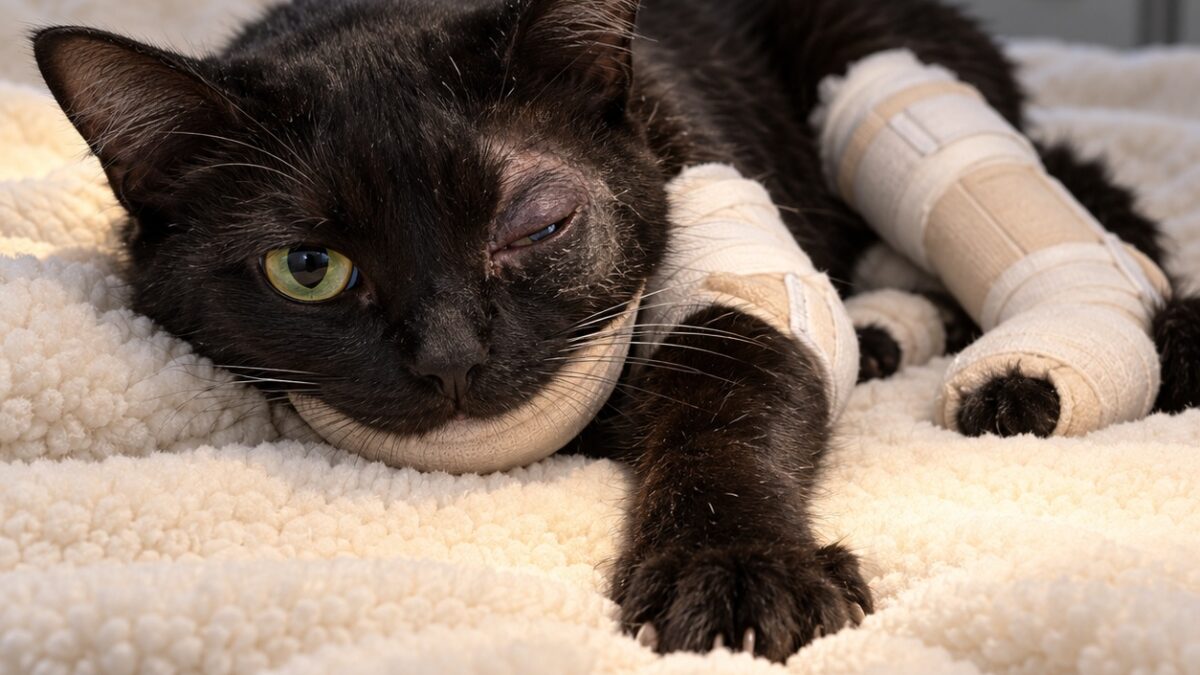
Then one day, while resting on a blanket, Bianca pressed one paw downward.
Released.
Pressed again.
At first I wasn’t sure what I was seeing.
Then somebody said:
“Is she kneading?”
We all looked.
Press.
Release.
Press.
Release.
Making biscuits.
A normal cat behavior.
An ordinary, almost silly thing healthy cats do when they’re comfortable.
Except nothing about Bianca’s condition was ordinary.
She had three injured legs.
Her jaw was still healing.
Her body had been broken badly enough that euthanasia had been discussed.
And she was trying to knead a blanket.
The movement was imperfect.
Small.
But unmistakable.
I turned away because my eyes had filled.
That sounds ridiculous.
I had watched surgeries.
Wounds.
Emergency cases.
I had seen animals survive worse than anyone expected.
And a cat moving one paw into a blanket made me cry.
Because pain had not taken every instinct from her.
There was still a cat inside all those casts.
Still Bianca.
Still something in her that remembered comfort strongly enough to reach for it.
After that, we began watching for every tiny sign.
Whiskers moving when someone spoke.
Her head following movement.
The way she leaned into gentle touch.
The way she seemed more alert before feeding.
None of it guaranteed recovery.
But healing rarely announces itself with certainty.
It arrives through accumulation.
A little more awareness.
A little less pain.
A little more strength.
Then one day you realize the animal in front of you is no longer the same animal who came through the door.
Bianca’s jaw remained one of our biggest concerns.
You can immobilize a limb more easily than you can ask a cat never to use her mouth.
She wanted to lick.
Yawn.
Shift her jaw.
Eventually eat.
But bone does not care what instinct wants.
It heals according to biology.
Slowly.
So we protected it.
Fed her.
Waited.
There were days when she seemed exhausted by the process.
Those were the days that frightened me most.
Progress creates expectations.
Once you have seen the head lift, you want it every day.
Once you’ve seen her knead, you want more.
But bodies recovering from severe trauma do not move in straight lines.
Some mornings Bianca seemed brighter.
Other mornings she slept.
Sometimes she tolerated everything.
Sometimes she clearly wanted everyone to leave her alone.
We had to learn not to interpret every quiet day as failure.
Healing uses energy.
Sometimes the work is invisible.
Bone knitting.
Inflammation settling.
Muscle trying to wake after inactivity.
The veterinary team kept examining the jaw.
The legs.
Her remaining vision.
We celebrated stability.
That sounds strange if you’ve never cared for a critically injured animal.
People expect celebration only after improvement.
But when deterioration is possible, “no worse” is worth something.
Stable means you get another day.
Another day means another chance for the body to repair itself.
Bianca kept getting those days.
And then came the moment with the food.
I will never forget it.
Up to that point, feeding had belonged to us.
We decided when.
How much.
How.
Bianca participated only as much as her injuries allowed.
It meant survival, but it also meant dependence.
Everything was done for her.
Then her jaw became strong enough that we could cautiously let her try more.
Nobody wanted to rush.
A fracture that reinjures can destroy weeks of work.
So the food was soft.
Small.
Easy.
Placed near her.
Bianca smelled it.
We watched.
I remember holding my breath without realizing it.
She lowered her head.
Opened her mouth.
Stopped.
Tried again.
There was hesitation.
Maybe discomfort.
Maybe unfamiliarity after so many assisted meals.
Then:
A bite.
Tiny.
Barely anything.
She took it herself.
I laughed.
Someone behind me said:
“She did it.”
Bianca chewed as carefully as if she understood exactly how fragile the machinery in her face still was.
Then swallowed.
One bite.
That was all it took to change the room.
After days of tubes, syringes, careful nutritional support and worry, Bianca had moved food from bowl to mouth by herself.
Independence had entered the recovery.
Just one bite.
But hers.
We did not immediately give her a full bowl and declare victory.
Recovery doesn’t work like that.
She still needed support.
Still needed monitoring.
Still needed patience.
But after that first bite came another.
Then more.
The stronger her jaw became, the more clearly we could imagine the day she would no longer need us for every meal.
Her legs were following their own timeline.
Casts protected healing structures.
But protection creates its own challenge.
Muscles weaken when they cannot work normally.
Balance changes.
A cat who once moved instinctively now had to rediscover where to place her feet.
When we first supported Bianca upright, her whole body shook.
Her legs seemed unsure of the information coming from the floor.
She leaned.
We steadied.
She tried again.
For a moment, she stood.
Then sank back down.
“That counts.”
I said it partly to her.
Partly to myself.
Everything counted.
Standing two seconds.
Lifting her head.
One bite.
One knead.
Rescue people learn arithmetic differently.
Small numbers become enormous.
The next attempts lasted longer.
Bianca learned where her healing legs could bear weight.
One leg.
Shift.
Another.
Pause.
She stumbled.
We caught her.
She got frustrated.
You could see it in her face.
Cats are not famous for appreciating assistance.
Being physically dependent offended something in her personality.
I loved that.
It meant her spirit was getting strong enough to be annoyed.
One day she tried to move before we were ready.
Nearly scared years off my life.
“Bianca.”
She looked at me.
“No.”
Cats do not respect rehabilitation protocols simply because humans explain them.
We adjusted.
More supervision.
More controlled opportunities.
Little by little, the body we had once feared might never walk again began remembering movement.
There were still veterinary checkups.
Imaging.
Bandage changes.
Eye examinations.
Pain management.
Every visit carried anxiety.
You can have ten good days and still fear the veterinarian will say something has gone wrong.
But Bianca kept moving forward.
The eye injury left her relying on vision in one eye.
That meant the world looked different to her.
Depth.
Approach from one side.
Objects appearing where she didn’t expect them.
At first, I worried the adjustment would frighten her.
Instead, Bianca adapted the way animals so often do.
Not with speeches about overcoming adversity.
She just learned.
She turned her head more.
Used whiskers.
Listened.
Mapped space.
Adjusted.
Animals rarely mourn physical difference in the abstract way humans imagine for them.
They care whether they can move.
Eat.
Rest.
Feel safe.
Bianca began doing those things.
That was enough.
Eventually came the day one cast came off.
Then another.
Every removal exposed a leg that looked thinner than before.
Muscles reduced.
Fur altered.
Not beautiful in a before-and-after-photo sense.
But free.
The first time Bianca felt more of the floor beneath her paws, she stared downward as if someone had changed the laws of physics.
She moved one foot.
Then another.
Unsteady.
Slow.
I crouched nearby.
“Take your time.”
She did.
Nobody dragged.
Nobody demanded.
Bianca had already survived a car accident and surgeries.
She had nothing left to prove to us.
Progress belonged to her.
A few days later, she walked farther.
Not far.
But intentionally.
From one side of her recovery area to the other.
I followed like an overprotective parent.
She ignored me.
Good.
Then came another milestone I had almost been afraid to imagine.
The feeding tube was no longer needed.
For weeks, that tube had represented survival.
I had hated seeing it.
Also been grateful for it.
It gave Bianca nutrition while her jaw couldn’t.
Medical equipment becomes emotionally complicated like that.
You want it gone because its presence proves something is wrong.
You don’t want it gone one second before the patient can live without it.
When the veterinary team finally decided Bianca could continue eating sufficiently on her own, I felt almost nervous.
Are we sure?
Is she ready?
What if?
But she was.
The tube came out.
Bianca remained.
And when a bowl of food was placed before her later, she walked toward it.
Walked.
Those two facts together almost overwhelmed me.
The cat who had arrived unable to stand crossed the floor under her own power.
The cat whose jaw had broken in three places lowered her face into a bowl.
Then ate.
Not one symbolic bite.
A meal.
Hungry.
Enthusiastic.
Normal.
I remember watching her and feeling tears start again.
Food disappeared.
Bianca did not care that she was participating in one of the most emotional moments of my life.
She was hungry.
Correct priority.
A few weeks before, we had measured nourishment carefully.
Now I found myself laughing because she was eating with enough determination to get food on her face.
“That’s yours.”
I whispered.
“All of it.”
She kept eating.
That image replaced the examination table in my mind.
For a long time, when I thought of Bianca, I saw the first day.
Body still.
Jaw broken.
Legs damaged.
Eye injured.
People wondering if ending her life might be kinder.
Now I had another image.
Bianca standing over her own bowl.
No hands holding her up.
No assisted feeding.
Just a cat eating dinner.
Some miracles are deliberately unimpressive.
That’s what makes them beautiful.
Walking to food should not be extraordinary.
Until you’ve watched an animal lose the ability.
Then ordinary becomes sacred.
As Bianca’s strength returned, her personality began taking up more space.
That may have been my favorite stage.
In the early days, pain defined everything.
Then treatment defined everything.
Now Bianca began defining Bianca.
She liked soft places.
She liked being comfortable.
She liked certain kinds of affection.
And she loved to knead.
The little behavior that had nearly made us cry when she first attempted it in casts became something she did freely.
Front paws working into blankets.
Press.
Release.
Press.
Release.
No bandages restricting her.
No trembling from the effort.
Just contentment.
“Making biscuits.”
We’d joke.
But I could never watch it casually.
Every time, I remembered the first one.
That fragile movement.
One paw trying to remember normal.
Now Bianca could knead until she fell asleep.
That was not simply a cute behavior to me.
It was evidence.
Her body felt safe enough to perform comfort instead of survival.
There is a difference.
When an animal is critically injured, every action serves survival.
Breathe.
Stay still.
Endure.
Later comes comfort.
Stretch.
Play.
Knead.
Sleep deeply.
Those behaviors mean the emergency has finally left the body.
Bianca began sleeping differently too.
Not curled tightly.
Sometimes stretched.
Sometimes with paws loose.
Sometimes completely absorbed in rest.
Healing isn’t only walking.
It’s being able to stop bracing.
I would look at her and think:
You did it.
Then correct myself.
We did it.
Because Bianca’s recovery was never one person.
Rescuers.
Veterinarians.
Technicians.
People assisting with feeding.
People changing bandages.
People watching her carefully enough to notice small problems before they became large ones.
People who chose to invest time in a cat whose future had initially been uncertain.
And Bianca.
Especially Bianca.
No amount of veterinary skill can force a body to heal perfectly.
Medicine creates opportunity.
The body has to answer.
Bianca answered.
Again.
Again.
Again.
There were setbacks small enough that people hearing the final story might never know.
Days she seemed sore.
Appointments that made us nervous.
Times we worried about infection.
Moments when she tired faster than we wanted.
Nothing erased the trajectory.
Forward.
Slow.
But forward.
The eye remained part of her new reality.
She navigated primarily with vision in one eye.
At first, she sometimes misjudged where something was.
Turned her head.
Adjusted.
Soon, watching her from across a room, you could forget anything was different.
She didn’t.
Her body compensated.
She mapped the environment intelligently.
Used sound.
Smell.
Whiskers.
Memory.
Confidence.
One eye did not make her half a cat.
Three injured legs did not make her permanently broken.
A repaired jaw did not make her fragile forever.
She became Bianca again.
Maybe for the first time since we had known her.
The adoption conversation began only after we knew she was medically stable enough.
That was another emotional shift.
During recovery, the future had been measured in days.
Get through surgery.
Get through night.
Eat.
Walk.
Next checkup.
Then suddenly we were discussing years.
Home.
Family.
Where would she sleep?
Who would continue veterinary follow-ups?
Who would understand that one eye meant she might need certain accommodations?
Who would not look at her scars and see a project?
Who would look at Bianca and simply see a cat?
I wanted that more than anything.
Rescue can create a strange possessiveness.
You spend enough nights worrying about an animal and part of you begins believing nobody else will ever watch carefully enough.
That’s not healthy.
The goal is not to keep every survivor inside rescue forever.
The goal is a life beyond rescue.
Still, I judged every possibility in my mind.
Would they notice if she stopped eating?
Would they understand that she had already been through enough?
Would they make sure she kept appointments?
Would they let her knead their blankets until they were covered in fur?
Then the right family came.
No dramatic announcement.
No orchestra.
People willing to take her as she was.
Not because they pitied her.
Because they wanted her.
That distinction mattered.
Pity looks backward.
Love can look at the present.
They met Bianca.
She did not perform a dramatic adoption scene.
No running leap.
No cinematic moment.
She behaved like a cat.
Observed.
Allowed attention.
Settled.
And slowly, comfort appeared.
Someone stroked her.
Bianca leaned into the hand.
I watched.
That old image came back again.
The examination table.
One frightened eye.
A body unable to move.
Now gentle fingers beneath her chin.
Bianca lifting her head toward affection.
It should not have felt revolutionary.
It did.
They asked questions.
Good questions.
Medical history.
Eye.
Jaw.
Legs.
Food.
Future checkups.
Behavior.
That reassured me more than emotional declarations ever could.
Love needs logistics.
Especially after trauma.
They understood.
Bianca’s adoption became official.
I thought I’d be purely happy.
I wasn’t.
I was happy.
And sad.
And terrified.
And proud.
Rescue endings are complicated.
You work toward goodbye and then feel shocked when goodbye arrives.
On her last day with us, I watched Bianca eat.
Of all things.
Just eat.
She walked to the bowl.
Lowered her head.
Ate.
I thought:
Remember when we didn’t know if you’d ever do this?
Bianca did not remember in the same narrative way I did.
Thank God.
Animals don’t need to carry our trauma stories for us.
She finished.
Cleaned one paw.
Then walked toward a soft blanket.
Kneaded.
Of course.
I laughed.
“Show-off.”
She looked at me briefly.
Then continued.
Her family arrived.
Carrier ready.
Supplies.
Instructions reviewed.
Records.
Everything.
I picked Bianca up carefully.
She was no longer the fragile body I’d been afraid to touch.
She had weight.
Strength.
Warmth.
I held her for a moment longer than necessary.
“You don’t know any of this.”
She looked at me.
“You don’t know how scared we were.”
Blink.
“You don’t know how many people argued for you.”
Ear movement.
“You don’t know how many meals we watched.”
Bianca shifted.
Fair.
She wanted down.
I smiled.
“Okay.”
I placed her in the carrier.
Her family took her home.
And that was the point.
Home.
Not recovery room.
Not clinic.
Not rescue cage.
Home.
A place where the day did not revolve around injury.
Where she could sleep because she wanted to sleep.
Eat because dinner was served.
Walk because she wanted another room.
Receive affection without anyone simultaneously evaluating her pain score.
Become ordinary.
That is the highest outcome I know.
Updates came.
Bianca resting.
Bianca eating.
Bianca moving confidently.
Bianca receiving affection.
Bianca kneading.
Always the kneading.
I looked at those photos longer than necessary.
There is a particular joy in seeing a former critical patient doing absolutely nothing medically interesting.
No complication.
No emergency.
Just cat.
Soft bed.
Human hand.
Food bowl.
Sunlight.
Rest.
That is success.
Her family continued the follow-up care she needed.
Every checkup mattered.
But checkups became confirmation instead of crisis.
Her life no longer existed between procedures.
The procedures existed around her life.
Huge difference.
I sometimes thought back to the euthanasia discussion.
People hear that and imagine villains.
Someone wanted to kill her.
No.
That is unfair.
Euthanasia can be an act of mercy.
There are injuries from which no reasonable recovery exists.
There is suffering medicine cannot meaningfully reverse.
The people who asked the question were looking at Bianca’s condition honestly.
Broken jaw.
Three injured legs.
Damaged eye.
Unable to eat.
Unable to walk.
Pain.
Multiple procedures ahead.
They were asking:
Will treatment help her?
Or will it extend suffering?
That’s a necessary question.
What changed Bianca’s story was that treatment offered a plausible path and her rescuers chose to let her try.
That doesn’t make every aggressive treatment decision correct.
It makes hers specific.
She had a chance.
She used it.
That nuance matters to me.
The story is not:
Never give up no matter what.
Sometimes letting go is love.
Bianca’s story is:
Don’t decide a life has no future solely because the present looks devastating when medicine still offers a humane path forward.
She had one.
And people walked it with her.
Every step.
Literally.
The first bite remained one of my favorite memories.
People expected me to name a surgery.
A dramatic turning point.
No.
Food.
Because that bite represented agency.
Bianca doing something for herself.
Before:
We feed you.
We move you.
We hold you.
We treat you.
Then:
I will eat.
That is different.
The first confident walk carried the same meaning.
I will go there.
Not:
Move me.
Independence returning piece by piece.
That’s what recovery is.
Not simply the absence of injury.
The restoration of choice.
Bianca eventually chose where to sleep.
When to eat.
Whose hand to lean toward.
Which blanket to knead.
Where to walk.
Trauma had taken control of almost everything.
Healing gave control back.
When I explain why her biscuits mattered, people sometimes laugh.
A cat kneading is cute.
Yes.
But for Bianca it was also the return of voluntary comfort.
She could have used that energy for vigilance.
Instead:
Press.
Release.
Press.
Safety.
The family told us she loved soft blankets.
No surprise.
I liked imagining her surrounded by them.
Not because material comfort erases pain.
Because she had earned softness.
I don’t mean morally.
Animals do not have to earn kindness through suffering.
I mean emotionally, for us.
We had seen enough hard surfaces around her.
Exam tables.
Casts.
Medical equipment.
Clinic floors.
Softness felt corrective.
One day, I received a picture of Bianca asleep while a hand rested near her.
Her face was loose.
No tension.
One eye closed.
The other side of her face relaxed.
I stared at it.
The title people gave her story sometimes used words like warrior.
Fighter.
Miracle.
All understandable.
But the photo made me think of another word.
Safe.
Maybe safe is better than heroic.
No one should have to be heroic forever.
Survival should eventually become living.
Bianca reached that point.
She no longer needed applause for eating.
No one gathered when she stood.
No medical team watched every step.
She could simply exist.
That’s what we had wanted all along, even before we knew how to say it.
The early photographs are hard for me to revisit.
Bianca after the accident.
At the clinic.
After surgeries.
You can see fragility.
But I don’t avoid them completely.
They remind me what progress actually cost.
Not in money alone.
Time.
Pain.
Work.
Patience.
People often see the final cat and say:
“She looks amazing.”
She does.
But “amazing” was built through feeding when she couldn’t feed herself.
Supporting her body.
Managing pain.
Returning to the vet.
Watching incisions.
Protecting bones.
Accepting that sometimes today’s victory was only that nothing got worse.
The internet compresses rescue.
Before.
After.
What disappears is the middle.
The middle is where love lives.
The middle is 2 a.m.
The middle is another syringe.
Another bandage.
Another worry.
Another check.
Another tiny movement no outsider would consider meaningful.
Bianca’s story belongs to that middle as much as the ending.
Especially the middle.
One memory returns more than the dramatic ones.
Bianca lying under a blanket after one of the hardest periods.
Her paw began moving.
Knead.
Weak.
Pause.
Knead.
I remember thinking:
How can you still know comfort?
After everything your body has just endured, how is that instinct still there?
Maybe I had the question backward.
Perhaps comfort behaviors survive because they are part of how animals regulate themselves.
No symbolism necessary.
Still, to us, it meant hope.
Not hope as a slogan.
Hope as motion.
A paw pressing into fabric.
Years of rescue work teach you to distrust big speeches.
Animals don’t give speeches.
They give signs.
Eat.
Walk.
Sleep.
Play.
Knead.
Look for them.
Bianca gave us enough signs to keep moving.
Her family later described her as affectionate.
That moved me.
Not because injured animals owe people affection.
They don’t.
Bianca could have remained independent, cautious, distant and still deserved everything we did.
But she chose closeness.
She leaned into hands.
Rested near people.
Made biscuits.
The accident had broken bones.
It had not permanently broken her ability to trust touch.
Another thing pain failed to take.
I thought about the driver sometimes.
Not because the source gave us any story about them.
It didn’t.
So I refuse to invent blame.
Accidents happen.
Cars and animals intersect terribly.
All I know is the aftermath.
Bianca was found.
Rescuers acted.
That is enough.
Her story does not need a villain.
The injuries are already the conflict.
The question is what people do after harm exists.
They can look away.
Or act.
Bianca’s rescuers acted.
That changed everything.
When the first suggestion of euthanasia entered the conversation, nobody knew the ending.
That’s important.
We tell the story backward now.
Of course she survived.
Of course she walked.
Of course she ate.
Of course she was adopted.
No.
At the beginning, none of that was guaranteed.
Decisions feel easy when you know the outcome.
They weren’t.
People committed to care without knowing whether the effort would succeed.
That’s a different form of courage.
Not Bianca’s.
Ours.
The willingness to try responsibly while accepting uncertainty.
Every surgery could fail.
Every fracture could heal poorly.
Her eye could worsen.
She could refuse food.
An infection could change everything.
Yet nobody could justify assuming failure in advance while a viable medical path remained.
So:
One procedure.
Then another.
One day.
Then another.
One bite.
Then another.
One step.
Then another.
That’s how an impossible-looking case became a cat in a home.
I think that progression is why Bianca’s story affected so many people.
Not because she was superhuman.
Or super-cat.
Because she wasn’t.
She was vulnerable.
Needed help.
Needed feeding.
Needed surgery.
Needed rest.
Resilience did not mean independence from care.
It meant responding to care.
That’s a distinction people forget.
We sometimes praise survivors as though needing help makes the survival less impressive.
No.
Bianca survived because her body fought and people supported it.
Both.
Strength and dependence can coexist.
That is not weakness.
Her family understood that.
They accepted that Bianca might need ongoing attention.
Regular veterinary checkups.
Observation.
A home appropriate for a cat relying on one eye.
They didn’t treat those needs like defects.
Just part of caring for Bianca.
Every animal comes with needs.
Hers happened to have a medical history.
Then daily life took over.
Feed.
Clean.
Pet.
Sleep.
Repeat.
A home can normalize things a hospital makes feel frightening.
One damaged eye becomes:
Remember not to startle her from that side.
Old leg injuries become:
Notice if she’s sore.
History becomes routine care.
That’s how trauma loses its throne.
It becomes information.
Not identity.
Bianca’s identity expanded.
Favorite bed.
Favorite food.
Preferred spot.
Biscuit technique.
People.
Home.
The words “hit by a car” stopped being the first thing anyone needed to know about her.
Good.
I want every rescue animal to reach the point where the rescue story becomes background.
Not erased.
Background.
You ask:
Who’s Bianca?
Answer:
Our cat.
Not:
The cat with the shattered jaw.
That is success.
We received an update once showing Bianca leaning over her food bowl.
No dramatic caption.
Just eating.
I loved it.
I remembered the feeding assistance.
How difficult every meal had once been.
Now her face was buried in food without dignity.
Perfect.
Eat.
Make a mess.
Be normal.
The first time she had eaten alone, we watched like anxious parents.
Now nobody needed to.
Independence had become boring.
That is how you know it is real.
Her walking became boring too.
Wonderful.
She crossed rooms.
Jumping remained something her family monitored according to her veterinary needs, but movement itself stopped being an event.
Think about that.
The cat once unable to take one step could now walk without anyone stopping to photograph the miracle.
I could not ask for more.
I occasionally wondered whether Bianca remembered the accident.
We can’t know.
Animals can form fear associations.
They can carry responses.
But the source did not tell us she feared cars or certain sounds later, so I won’t invent it.
What we do know is what she demonstrated.
She settled.
Ate.
Moved.
Kneaded.
Accepted affection.
Whatever memories her nervous system kept, they did not prevent her from building safety.
That’s enough.
The family that adopted her became the final link in a chain of people who each did one part.
Finder.
Rescuers.
Veterinary team.
Recovery caregivers.
Adopters.
No one person did everything.
This is another truth rescue stories often flatten.
Hero rescuer.
Hero vet.
Hero adopter.
Reality is collaborative.
Someone stops.
Someone transports.
Someone diagnoses.
Someone pays.
Someone feeds.
Someone changes bandages.
Someone adopts.
Remove one link and the ending may change.
Bianca needed a network.
She got one.
That fact makes me hopeful in a very practical way.
Compassion doesn’t always require one person to carry the entire burden.
Maybe you cannot perform surgery.
Call someone.
Maybe you cannot adopt.
Foster.
Donate.
Transport.
Share accurate information.
Help with recovery.
Every role matters.
Bianca’s life is evidence.
The moment she left for her forever home, I stood watching longer than necessary.
The carrier disappeared.
Door closed.
Vehicle gone.
Then silence.
For weeks, my attention had been partly organized around her.
How did she eat?
How did she stand?
What did the vet say?
Did the jaw look okay?
How was the eye?
Then suddenly:
Not my daily question anymore.
Her family had taken over.
That is what successful rescue asks you to tolerate.
Letting go of responsibility because someone trustworthy has accepted it.
I went inside.
Saw the blanket she had used.
Indentation still visible.
I put my hand on it.
Stupidly emotional.
There might have been a few black hairs.
I laughed at myself.
Then I imagined her new house.
New soft blanket.
New bowl.
New hands.
Good.
She didn’t need to remain in the place where she had been sick simply because we loved her there.
Love should move life forward.
A few weeks later, the updates made that clear.
Bianca comfortable.
Settled.
Loved.
One photo showed her making biscuits.
I stared.
There it was.
The same motion.
But everything around it had changed.
No casts.
No clinic.
No question whether she would survive.
Just paws sinking into something soft.
Sometimes a whole story fits inside one repeated movement.
The first biscuits said:
I am still here.
The later biscuits said:
I am home.
That is Bianca’s story to me.
Not the broken jaw.
Not three injured legs.
Not the damaged eye.
Not even the surgeries.
A movement returning under different circumstances.
At first, fragile.
Later, peaceful.
People called her a fighter.
She was.
But fighters deserve to stop fighting.
That may be the most important ending.
Bianca does not spend every day “fighting.”
She doesn’t need to.
She survived the emergency.
Now she lives.
There are meals.
Checkups.
Affection.
Sleep.
Soft surfaces.
Human hands that mean comfort.
One eye seeing the life in front of her.
Four legs carrying her through it, even after three had been badly injured.
A jaw that can take food from her own bowl.
These things sound ordinary.
They aren’t to me.
Not after seeing where she started.
If I could return to the first examination and speak to the version of us standing around that table, I wouldn’t say:
“Don’t worry. Everything will be perfect.”
Because it wasn’t guaranteed.
I would say:
“Be careful about confusing how broken she looks right now with what her entire future can become.”
That’s different.
We often make permanent judgments during temporary crises.
Bianca looked catastrophically injured.
She was.
That fact remained.
But injured is not always hopeless.
Dependent is not always permanent.
Unable today does not always mean unable forever.
Medicine exists partly inside that gap.
So does rescue.
I also would not say:
“Never consider euthanasia.”
That would be dishonest.
If Bianca’s pain had been uncontrollable, if injuries could not reasonably be repaired, if treatment only prolonged suffering, mercy might have meant something else.
But that was not the path her team chose after weighing her case.
They saw enough possibility to continue.
Bianca gave them enough response to keep believing.
Together, they found the other side.
That is what makes the story meaningful.
Not blind refusal to let go.
Informed hope.
Careful hope.
Hope willing to do the hard middle.
Surgeries.
Feeding.
Pain control.
Rehabilitation.
Waiting.
Hope with work attached.
Bianca’s family inherited the easier kind.
Not easy in every sense.
But easier than those first weeks.
They inherited the result of countless hours they hadn’t witnessed.
That’s how care works across people.
Someone carries the hard shift so another can receive a healthier future.
No resentment.
That’s the goal.
When they stroked Bianca, they were touching work done by many hands.
When she ate dinner, she was using a jaw repaired by people who once worried she’d never chew.
When she walked across the floor, she was standing on legs people had protected through weeks of recovery.
When she looked around with one functioning eye, she was using the vision a veterinary team had fought to preserve.
And when she slept safely, she was experiencing the reason everyone had tried.
Not survival for survival’s sake.
Life.
I think about how close people came to never seeing that version of her.
That isn’t criticism of the people who questioned treatment.
Again, the question was legitimate.
It’s simply sobering.
Decisions made in the first hours of trauma can close or open futures.
The team chose to open hers.
Bianca walked through.
Literally.
Sometimes that is all rescue can do.
Open a possibility.
The animal does the rest with biology, time and support.
Today, Bianca’s story no longer needs a cliffhanger.
She is not on an operating table.
Nobody is debating whether she can make it.
She does not need to be fed every mouthful.
Her legs are not hidden beneath heavy casts.
A feeding tube is not keeping her nourished.
She can walk.
She can eat.
She can find a soft place.
She can lean into a hand.
She can close her eye and sleep.
She can make biscuits.
And she can wake up in a home where nobody is measuring how long she has survived since the accident.
They are simply living with her.
That might sound less dramatic than the beginning.
Good.
Happy endings should become less dramatic.
They should become breakfast.
Blankets.
Appointments.
Naps.
Food bowls.
A familiar voice.
Another ordinary evening.
The accident made Bianca’s life dramatic without her consent.
Love gave her ordinary back.
That is the gift.
Sometimes I still see her first day when I close my eyes.
Black fur.
Still body.
Three injured legs.
Broken jaw.
Damaged eye.
The awful thought:
Maybe this is too much.
Then another memory arrives.
Paw.
Blanket.
Press.
Release.
Press.
Release.
A tiny cat behavior cutting through the medical crisis.
Bianca didn’t know it was symbolic.
Better that way.
She was simply doing what cats do.
And perhaps that was the first real sign of where she was heading.
Back toward being a cat instead of a patient.
Back toward choosing instead of enduring.
Back toward softness.
Eventually, all the way home.
If someone asks me what the most important moment was, they may expect:
The successful surgery.
The casts coming off.
The feeding tube removal.
The adoption.
All of those mattered.
But I still choose the paw.
Because it happened before the ending was certain.
Before walking.
Before independent meals.
Before the home.
Bianca was still surrounded by evidence of everything that had happened to her.
And yet one paw pressed into the blanket.
Then again.
Something inside her was already reaching past pain toward comfort.
We noticed.
So we kept going.
Maybe that is what second chances often look like at first.
Not dramatic.
Not strong.
Not even obviously hopeful.
Sometimes they look like a broken little cat making one tiny movement beneath a cast while the people around her suddenly realize:
She’s still in there.
Keep going.
And we did.
Until Bianca could keep going on her own.








