PART2:He Waited 26 Days for the Family Who Abandoned Him—Then the Wrong Car Pulled Into the Driveway
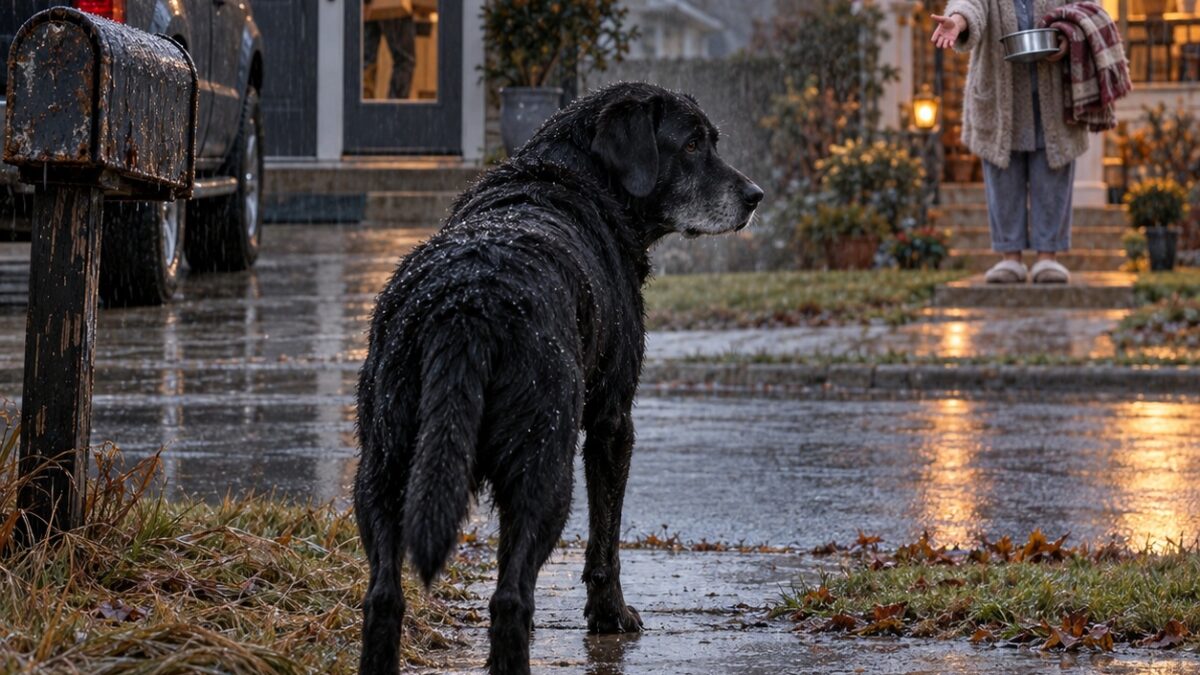
PART2
A man climbed down first.
I had never seen him before.
Then a woman.
Then two children.
They stood beside the truck looking at the house.
Keys in the man’s hand.
The children were excited.
The woman pointed toward the porch.
Nothing about them matched the family who had left twenty-six days earlier.
The Labrador did not know that yet.
He ran straight toward them.
Tail moving.
Barking.
Circling.
Looking from one face to another.
I could almost see his confusion.
He kept waiting for recognition.
For one of them to say his name.
For somebody to drop to their knees and throw their arms around him.
The man looked at the dog.
Then at the woman.
The woman looked at the children.
They were not cruel.
That is important.
They simply had no idea who he was.
To them, he was a strange dog standing in front of the house they had just bought.
They walked toward the front door.
The Labrador followed a few steps.
The man unlocked it.
The family went inside.
The dog remained outside.
Then the door closed.
The sound was not loud.
I heard it anyway.
A simple click.
The dog stared at the door.
Then at the mailbox.
Then toward the road.
For nearly four weeks, that road had represented one thing to him.
Return.
If he stayed long enough, if he watched carefully enough, surely the same vehicle would come around the corner.
Surely the people he loved would realize their mistake.
Surely somebody would come back and call him.
Now a vehicle finally had come.
People had entered the house.
Life was restarting behind those windows.
And none of it belonged to him.
He stood there.
Completely still.
Then slowly turned his head.
Across the street.
Toward my house.
Toward my kitchen window.
Toward me.
For twenty-six days, I had walked food across the road.
For twenty-six days, he had eaten but refused to follow.
Animal control had tried.
He had refused.
I had spoken softly from a distance.
He had kept his loyalty fixed on the mailbox.
But that morning he took one step toward me.
I stopped washing dishes.
My hands were still wet.
I opened the back door, walked through the house, and stood on the front porch.
The dog looked at me.
I did not call.
Did not clap.
Did not beg.
Something told me the choice had to be his.
He crossed the road slowly.
One step.
Then another.
He stopped at the edge of my yard.
Looked back.
Mailbox.
New truck.
Closed front door.
Then he faced me again.
He entered my yard.
Walked up the path.
Stopped directly in front of me.
For the first time, I said the name aloud.
“Benny.”
His ears moved.
That nearly broke me.
He did not know why I had chosen that name.
Did not know it had belonged to the man whose absence had filled my own house for years.
He only knew my voice.
I opened the door.
He walked inside.
No hesitation once he crossed the threshold.
He entered my living room.
Looked around.
Then sat on the floor.
And sighed.
I had heard dogs sigh before.
Comfort.
Sleepiness.
Contentment.
This was different.
Long.
Heavy.
The sound of something finally giving way.
I sat beside him.
We stayed there together.
No television.
No conversation.
No explanation.
Just an eighty-year-old widow and an abandoned Labrador sitting in a quiet room while a moving truck unloaded across the street.
The first day, Benny would not eat.
I put food in front of him.
He looked at it.
Then turned his head away.
Water stayed nearby.
He drank a little.
Food, no.
The second day was the same.
Third day.
Same.
He lay in one corner of the living room with his head on his front paws.
Eyes open.
He did not sleep deeply.
Did not explore.
Did not ask to go anywhere.
He simply existed in that corner.
Sometimes he looked toward the door.
I knew what he was doing.
Waiting.
Even after leaving the mailbox, some part of him was still sitting beside it.
I did not force food into him.
Did not drag him around the house.
Did not insist he play.
People sometimes want recovery to happen because we are ready for it.
Benny was not.
His entire understanding of home had collapsed in twenty-six days.
He needed time to decide whether another one was possible.
So every morning I made coffee.
Then sat on the floor beside him.
At eighty, getting onto the floor is easier than getting back up.
I learned that quickly.
Still, I sat.
Some mornings I said nothing.
Other mornings I rested one hand on his back.
Sometimes I ran my fingers slowly through his fur.
Not brushing.
Just touch.
There were mornings when he did not look at me once.
That was all right.
I wanted him to learn one thing before anything else.
I was still here.
If he decided to eat, I would be here.
If he decided not to, I would still be here.
If he wanted the corner, the corner was his.
If he wanted the door, I would not punish him for looking.
I could not explain to him that I had no intention of leaving.
Consistency was the only language available.
Morning.
Coffee.
Elizabeth on floor.
Food in the same place.
Water.
Quiet.
Evening.
Same house.
Same woman.
Another morning.
Again.
At the end of the first week, Benny ate.
Not much.
I nearly made the mistake of reacting.
I wanted to clap.
Cry.
Tell him how proud I was.
Instead, I stayed still.
He lowered his head.
Took a little food.
Paused.
Looked at me.
Then ate another bite.
I pretended to be very interested in my coffee.
Inside, I felt something loosen.
It was the first time since he entered my house that Benny had behaved as though tomorrow might matter.
Eating requires a belief in continuation.
Maybe not a conscious belief.
But the body choosing food is the body choosing to remain.
The beginning of the second week, Benny stood and walked through the living room.
Slowly.
Not playful.
Not curious in the way a comfortable dog explores.
He seemed to be inspecting the room.
Couch.
Table.
Hallway.
Front door.
Back to the corner.
It looked almost like he was mapping the boundaries of safety.
I let him.
The next day, he went a little farther.
Kitchen entrance.
Back again.
Then toward the hallway.
I began leaving doors open.
Not all at once.
I did not want to overwhelm him.
But enough that he could decide.
He did not follow me from room to room yet.
He simply checked.
Is this place still here?
Is she still here?
Can I return to the same corner?
Yes.
Every time.
At the end of the second week, something happened I had been waiting for without admitting I was waiting.
I was sitting in my chair.
Not on the floor.
My knees had filed a formal complaint about that routine.
Benny stood.
Walked toward me.
I stayed completely still.
He sat at my feet.
Then rested his head on my knees.
I cried.
Immediately.
There was no stopping it.
I had promised myself I would not make his recovery about me.
Then one warm, heavy Labrador head settled into my lap and every careful wall I had built disappeared.
Tears ran down my face.
I wiped them with one hand.
Benny lifted his head.
Looked at me.
Then licked my hand.
Once.
Only once.
Then put his head back down.
We stayed like that until sunset.
The room slowly changed color around us.
Gold.
Then orange.
Then gray.
I did not move except when I had to.
My legs went numb.
I did not care.
For twenty-six days, Benny had waited for somebody who never came back.
For two weeks, I had waited for him to decide I might be someone worth leaning on.
That evening, he did.
The beginning of the third week, I saw his tail move for the first time.
Tiny.
Almost nothing.
He was lying on the rug.
I walked past with coffee.
His tail tapped once.
Maybe twice.
I stopped.
Looked down.
Benny looked at me.
I smiled.
Did not say anything.
I did not want him to feel as though I had been standing there with a checklist.
Eat.
Walk.
Tail.
Good dog.
Next milestone.
Recovery should not become another performance.
He did not owe me happiness because I had given him a room.
So I simply sat beside him.
The tail did not move again that morning.
It did not need to.
I had seen enough.
Something was returning.
I began learning the difference between Benny’s silence and despair.
At first they were the same.
Later, he could lie quietly without looking empty.
He started sleeping more deeply.
Sometimes his paws twitched.
Dreaming, perhaps.
He stretched.
He began choosing different places to rest instead of returning automatically to the corner.
Near my chair.
Beside the kitchen doorway.
In the patch of afternoon sunlight that moved across the floor.
A dog reclaiming space.
That is what it looked like.
Week four brought the tennis ball.
I found it in a closet.
Old.
Faded.
Probably belonged to one of my grandchildren years earlier.
I put it on the living-room floor without ceremony.
Benny ignored it for three days.
On the fourth morning, I came in from the kitchen and found him standing over it.
He nudged it with his nose.
It rolled.
He watched.
That was all.
The next day, he picked it up.
I nearly held my breath.
Benny stood there with the ball in his mouth.
Looked at me.
Then walked over and dropped it at my feet.
I stared at it.
Then at him.
“Really?”
His ears lifted.
I picked up the ball.
Tossed it gently across the room.
He ran.
Not fast.
But ran.
Grabbed it.
Returned.
And this time his tail was wagging.
Not the tiny movement from week three.
A real wag.
Side to side.
Body involved.
I threw the ball again.
He ran again.
I laughed.
A full laugh.
Loud enough that it surprised both of us.
I had not heard myself laugh that way in a long time.
Benny stopped with the ball in his mouth.
Looked at me.
Then his tail moved faster.
That night he lay at my feet while I sat in my chair.
I rested my hand on his head.
He sighed.
The first night in my house, his sigh had sounded like exhaustion finally collapsing.
This one sounded different.
Soft.
Deep.
Settled.
Peace.
Trust.
Home.
I knew I was probably giving the sound too much meaning.
I did not care.
It was a different dog making it.
That was enough.
Week five was the door.
Until then, Benny had stayed inside except when necessary.
I had not taken him for a real walk.
I wanted him to feel safe in the house first.
One morning, I clipped a leash to his collar.
He looked at me.
Then at the front door.
We walked toward it.
The moment I opened it, his body changed.
Tense.
He stepped onto the porch.
Then stopped.
Across the street:
The mailbox.
Same post.
Same curb.
Same road.
The new family lived in the house now.
Their curtains were different.
A child’s bicycle sometimes lay near the garage.
To me, it was clearly not the same home anymore.
To Benny, memory still lived there.
He stared at the mailbox.
Then down the road.
I did not pull the leash.
I stood beside him.
One minute.
Two.
Three.
He remained frozen.
Then he looked up at me.
That moment was small.
But I felt its weight.
I said nothing.
Benny turned away from the mailbox.
We walked.
He did not look back.
The road toward the park was full of things he had not experienced while sitting in one place for twenty-six days.
Grass.
Trees.
Fences.
Smells left by other dogs.
A delivery truck.
A woman pushing a stroller.
Birds.
The world had kept going while Benny waited.
Now he was entering it again.
He sniffed.
Stopped.
Moved.
Sniffed again.
The leash gradually loosened.
By the time we reached the park, his posture had changed.
Not completely relaxed.
But no longer anchored to the road behind us.
He was looking ahead.
That walk became part of our routine.
I never forced him to pass the mailbox quickly.
For the first few days, he noticed it.
Then less.
Eventually, not at all.
That was one of the most beautiful things I witnessed.
Not forgetting.
Reorienting.
The past remained across the street.
His life no longer pointed toward it.
Week six, Benny barked.
A squirrel crossed my yard.
That was all.
A perfectly ordinary squirrel committing the serious crime of existing within Labrador eyesight.
Benny saw it.
Leaped up.
Barked.
One loud, joyful sound.
The squirrel disappeared.
Benny looked almost pleased with himself.
I laughed again.
He turned toward me.
And there was something in his eyes that had not been there when he entered my house.
Interest.
Brightness.
Life.
It was not that his eyes had been dead before.
He had always been alive.
But grief had narrowed what he could see.
Now the world was becoming larger again.
Squirrels mattered.
A tennis ball mattered.
The park mattered.
My movements mattered.
Food mattered for enjoyment, not simply survival.
By the seventh week, I realized Benny no longer used the corner.
Not once.
He had stopped watching the door.
Stopped waiting.
Morning arrived and he came to find me.
If I was slow getting out of bed, I would hear him move in the hallway.
He ate with appetite.
Played.
Slept at my feet.
Followed me from room to room.
When I reached for my coat, he appeared beside the door.
The look he gave me made leaving him behind almost impossible.
So I started taking him everywhere I reasonably could.
Morning coffee.
Together.
Noon walk.
Together.
Evening chair.
Together.
The house felt different.
For years after my husband died, silence had occupied more rooms than I realized.
I had told myself I liked it.
At eighty, people expect a widow to become comfortable with quiet.
There is a difference between quiet and absence.
I had not admitted how much absence remained.
Benny changed that.
I started talking to him.
Not because I believed he understood every sentence.
Because he listened better than most people.
I told him about my day.
He rested near me.
I told him about my husband.
My Benny.
The man whose name I had quietly borrowed for this dog.
I told him how stubborn my husband had been.
How faithful.
How he could sit through an argument for an hour and still refuse to admit he might be wrong.
The dog would put his head in my lap.
I told him I was afraid of growing old alone.
That was harder.
I had not said it aloud often.
Maybe never quite that directly.
At eighty, loneliness can become embarrassing because everyone assumes you have already learned how to handle it.
You become careful not to sound needy.
I had children.
Neighbors.
People who cared.
That is not the same as someone sharing your house.
At night, rooms become large.
Morning coffee becomes a one-person ritual.
You stop setting two places years before you stop noticing there should have been two.
Benny listened.
Then licked my hand.
The same way he had at the end of week two.
That was when I understood we had been doing the same thing.
For different reasons.
Benny sat beside a mailbox waiting for a family who would not return.
I had been sitting beside my own invisible mailbox for years.
Waiting for my husband.
Not literally.
I knew he was dead.
Grief is not ignorance.
But part of me had refused to leave the emotional place where he disappeared.
I maintained the house.
Paid bills.
Visited people.
Lived.
Technically.
But some part of me was still looking down the road.
Waiting for the life I had known to turn the corner.
Benny taught me something I could not have taught myself.
Waiting is not the same as loyalty.
Love does not require you to remain frozen in the last place you saw someone.
Moving forward does not betray the person who is gone.
Benny had loved his old family.
I had no doubt.
His twenty-six days proved it.
But eventually, continuing to wait became another form of dying.
He had to turn.
Look somewhere else.
Choose the person who was actually standing there.
I had to do the same.
Not replace my husband.
Benny could not replace him.
Nothing could.
But life did not ask me to replace the past.
It asked me whether I was willing to live in the present.
One evening, Benny and I sat on the porch.
Sunset orange across the neighborhood.
He lay at my feet.
The mailbox remained across the street.
I looked at it.
Then at him.
“Benny,” I said, “you’re my home now.”
He lifted his head.
Looked at me.
Then did something he had never done before.
He stood.
Moved toward me.
And somehow, despite being a large Labrador and despite my being an eighty-year-old woman with very little structural capacity for a full Labrador in my lap, he climbed up.
Not elegantly.
He settled against me.
Head on my chest.
Eyes closed.
I wrapped my arms around him.
For a long time, we stayed that way.
Two creatures whose waiting had ended in different forms.
A year passed.
Benny became almost unrecognizable from the dog who spent twenty-six days beside the mailbox.
Happy.
Playful.
He barked at squirrels.
Ran in the park.
Greeted neighbors.
People on our street knew him.
Children called his name.
His tail seemed to have forgotten the weeks when it barely moved.
But the change I noticed most was simpler.
He no longer waited.
He trusted departures.
If I stepped outside, he did not panic.
If I told him goodbye because I needed to go somewhere without him, he could settle.
He had learned the difference between leaving and abandoning.
That took time.
I was careful.
When I left, I came back.
Again.
Again.
Again.
Enough repetitions for him to understand a pattern.
Goodbye did not mean forever.
The door closing did not mean the relationship had ended.
The engine starting did not mean he had been erased.
He knew I returned.
That knowledge gave him freedom.
He did not have to guard the future every second.
I learned the same thing from him in reverse.
My husband was not returning.
There was no pattern I could rebuild around that.
But love had returned.
Different form.
Four legs.
Black fur.
Tennis-ball obsession.
The tendency to place an enormous head exactly where I was trying to read.
Life had not restored what I lost.
It had brought something new.
That mattered.
Sometimes I still look at the mailbox across the road.
It is still there.
Same shape.
Same position.
The new family uses it now.
Mail arrives.
Someone collects it.
Normal.
No sign that a dog once sat beside it through rain and cold for twenty-six days.
That is probably good.
Places do not need monuments to every heartbreak they witness.
I remember enough.
Sometimes I think about the family who left Benny.
I do not know why they did it.
The source of this story does not give me an explanation.
Maybe they thought someone else would take him.
Maybe circumstances were complicated.
Maybe they made a cruel decision.
I cannot know.
So I do not invent their motive.
I know only what I saw.
They moved.
Benny stayed.
He waited.
They did not return.
That was enough damage.
For a long time, I felt anger when I looked across the street.
Later, the anger faded.
Not because what happened became acceptable.
Because Benny no longer needed my anger.
He needed walks.
Food.
Play.
Routine.
The life we had.
Anger points backward.
Dogs are often much better at living forward.
Once Benny stopped waiting, he did not organize his days around the people who left.
He organized them around what existed.
Me.
Park.
Squirrels.
Food.
Sunlight.
That helped me.
I had spent years asking questions grief cannot answer.
Why him?
Why then?
Why am I still here?
Questions can become another mailbox.
You sit beside them waiting for an answer that never comes.
Benny did not answer my questions.
He gave me better things to do.
Get up.
Make coffee.
Open door.
Walk.
Throw ball.
Laugh.
Feed someone.
Be expected.
That is a life.
Simple.
Not small.
There is a difference.
One morning, about a year after he came into my house, I woke and found Benny sitting at the foot of my bed.
Watching me.
Not anxiously.
Patiently.
Waiting for me to wake.
That kind of waiting is different.
It contains confidence.
He knew morning would happen.
He knew I was there.
I opened my eyes.
He wagged his tail.
I smiled.
“Good morning.”
He stood immediately and ran toward the kitchen.
Food.
Of course.
Some mysteries in dogs are not mysterious at all.
I got up.
My knees reminded me that I was eighty.
I made coffee.
Fed Benny.
Then opened the back door.
He ran into the yard.
Stopped in a patch of sunlight.
Lifted his head.
Closed his eyes.
Breathed.
I watched from the doorway.
No road.
No mailbox.
No desperate search for a familiar car.
Just sun.
Air.
Home.
He looked free.
And standing there, I realized I felt free too.
For years, I had thought home meant the place where you wait for the people you love.
I had been wrong.
Home is the place where you are not abandoned.
The place where someone expects you back.
Where departures have return built into them.
Where love is present tense.
Benny had learned that.
So had I.
I had lived in the same physical house for forty years.
But houses and homes are not always the same thing.
After my husband died, the walls remained.
Furniture remained.
My dishes.
My coffee cup.
My bedroom.
All familiar.
Yet part of the home disappeared.
I kept living in the structure.
Then Benny walked through the door.
Sat on my living-room floor.
Released that first exhausted sigh.
And over seven weeks, the house changed again.
Not because of anything structural.
Because another life had begun trusting it.
That changes a place.
Dog hair appeared.
Toys.
A leash near the door.
Food bowls.
The sound of nails on the floor.
A dark shape beside my chair.
Suddenly rooms had movement again.
Home returned gradually.
The same way Benny did.
One bite.
One walk across the room.
One head on my lap.
One tail movement.
One tennis ball.
One walk past the mailbox.
One bark at a squirrel.
Small things.
That was the pattern.
Healing rarely announced itself.
You notice afterward that the corner has been empty for days because the dog no longer needs it.
You notice you laughed yesterday.
You notice you made two small routines without planning them.
You notice loneliness is still present but no longer in control.
That is what happened to both of us.
Sometimes neighbors told me I saved Benny.
I always found that incomplete.
Yes, I gave him food.
Opened my door.
Sat beside him.
Stayed.
But he gave me something I did not know I needed.
A reason to participate in the day.
Someone to speak to.
Someone who needed me home.
Someone whose trust could be built only by repetition.
That last part mattered.
Grief makes people suspicious of attachment.
You learn that anything loved can disappear.
So you hold back.
Not consciously.
Just enough.
Benny forced me to practice commitment again.
Morning.
Again.
Walk.
Again.
Dinner.
Again.
Return.
Again.
Love becomes less frightening when built as routine instead of promise.
Promises can break.
Patterns become evidence.
Benny needed evidence I would return.
Maybe I did too.
Each day together was evidence that life could still contain something reliable.
That did not erase the unreliability of death.
Nothing does.
But it gave grief less room.
The first weeks with Benny, I spoke very little because I thought silence was what he needed.
Later, I spoke constantly.
I would tell him ridiculous things.
Which neighbor parked badly.
Which television host irritated me.
Whether the grocery-store tomatoes looked terrible.
He listened with the solemn concentration of someone reviewing important national policy.
Then sometimes fell asleep halfway through.
My husband had done the same thing, though he claimed otherwise.
I would tell Benny that.
“You’re just like him.”
Benny would open one eye.
I could almost hear my husband objecting.
Those moments made me smile.
Memory stopped hurting in only one direction.
Before Benny, remembering my husband often ended in absence.
After Benny, sometimes memory created connection.
A story to tell.
A reason to laugh.
Love from the past becoming something usable in the present.
That was another lesson the dog never intentionally taught.
Loyalty does not require silence.
You can speak about who is gone while loving who is here.
One does not cancel the other.
Benny got his name because of my husband.
At first I worried that was unfair.
Maybe I had placed too much history on a dog who needed his own identity.
Over time, the name changed.
When I said “Benny,” I no longer thought first of loss.
Sometimes I thought of my husband.
Sometimes the dog.
Often both.
The name became a bridge rather than a replacement.
I liked that.
My husband would have liked the dog.
I was certain.
He would probably have pretended not to spoil him.
Then fed him from the table when I was not looking.
I told Benny that too.
He seemed interested in the part involving table food.
Naturally.
The new family across the street eventually learned Benny’s story.
They had not known anything the day they moved in.
How could they?
They saw a black Labrador outside their new house.
No collar story written in the air.
No explanation.
I never blamed them for walking inside.
In fact, their arrival gave Benny the final piece of truth he needed.
The family was not coming back to that house.
His old home had changed.
Cruel lesson.
Necessary.
Without that day, I do not know how long he would have remained beside the mailbox.
Maybe another week.
Another month.
Animal control could not force him.
I could not persuade him.
He had to see for himself.
Sometimes healing requires the moment hope finally becomes impossible in its old form.
That sounds harsh.
It is.
Benny’s joy when the truck arrived was one of the hardest things I ever watched precisely because I knew what followed.
He gave everything to that run.
Tail.
Bark.
Body.
Twenty-six days of expectation exploding at once.
Then strangers.
Closed door.
Silence.
The emotional distance between those two moments could not have been more than five minutes.
Joy.
Then devastation.
Yet that devastation pushed him toward me.
I would never say it happened “for a reason.”
I dislike that phrase when people use it about suffering.
Pain does not need justification.
His abandonment was wrong regardless of what came later.
My husband’s death did not happen so I could meet a dog.
That would be a cruel way to understand either loss.
What I believe is different.
After loss happens, life can still build something.
Not because loss was necessary.
Because life is stubborn.
Benny was stubborn.
So was I.
Maybe that is why we found each other.
The original story ends with me saying love comes when you least expect it.
That is true.
But I would add something.
Sometimes love arrives and does not look like love at first.
It looks like responsibility.
A food bowl carried across the street.
A phone call to animal control.
An eighty-year-old woman lowering herself onto the floor every morning beside a dog who will not eat.
Only later do you realize what you were building.
Benny did not come running into my arms on day one.
He did not immediately choose me instead of his old family.
That would have made a simpler story.
But real loyalty is not erased by new kindness.
He needed to grieve.
That made me respect him more.
For twenty-six days, he remained faithful to what he knew.
Then for weeks after entering my home, he remained emotionally attached to the possibility of return.
I did not defeat that loyalty.
I waited beside it.
Eventually it changed direction on its own.
That is the kind of trust worth having.
Not stolen.
Not forced.
Chosen.
At some point during the seventh week, Benny stopped being the abandoned dog from across the street.
I cannot tell you exactly when.
Maybe the first tennis ball.
Maybe the first walk.
Maybe the squirrel.
Maybe the morning I realized he no longer looked at the door.
Identity changes quietly.
He simply became my dog.
And I became his person.
No ceremony.
No document in the story.
No dramatic adoption scene.
Just routine becoming fact.
He slept at my feet.
That was home.
He followed me.
That was home.
I came back.
That was home.
If I had been younger, perhaps I would have imagined many years.
At eighty, I do not think that way.
Time becomes more honest.
I do not know how many years I have.
I do not know how many Benny has.
He was eight when all this began.
That knowledge could make me afraid.
Sometimes it does.
But Benny taught me the danger of spending today waiting for tomorrow’s loss.
He spent twenty-six days doing that.
I had spent years doing my version.
I refuse to waste what we have now by sitting beside another imaginary mailbox.
So we walk.
We play.
We argue about whether he needs another treat.
He always believes yes.
I usually lose.
I drink coffee.
He lies nearby.
That is enough.
A year after the day he crossed my yard, the house sounds alive.
Not loud.
Just inhabited.
There is a difference.
If I drop something in the kitchen, Benny appears.
If someone knocks, he announces it.
If I sit too long, he eventually decides we should move.
He has opinions.
The dog who once barely seemed connected to the world now insists on participating in all of it.
I love that.
Sometimes I catch him looking out the front window.
The mailbox is visible.
The road too.
Early on, that would have tightened my chest.
Now it does not.
He is not waiting.
He is watching.
Huge difference.
A car passes.
His head follows.
Then he lies back down.
Life can look at the past without returning to live there.
Benny does it every day.
I try to do the same.
When people ask how I knew he would recover emotionally, I tell them I did not.
I hoped.
That is all.
There were days during the first week when I wondered whether he might simply stop eating completely.
The sadness in him seemed physical.
I knew dogs could decline after loss.
I watched carefully.
But I also understood that grief could not be argued out of him.
So I stayed.
If there is one thing I would want people to understand from Benny, it is that presence can be active even when it looks passive.
Sitting beside someone is not nothing.
Not forcing is not nothing.
Waiting without demanding progress is not nothing.
Those first mornings, I felt useless.
Coffee on the floor.
Hand on fur.
Silence.
Now I think those mornings may have been the most important.
Benny needed proof that I could exist beside pain without leaving because he was not entertaining.
He was not playful.
Not affectionate yet.
Not grateful in a visible way.
I stayed.
Eventually he believed it.
Humans need that too.
Someone who does not require you to become cheerful before remaining close.
My husband had been that kind of person.
Maybe that is why I recognized the need in Benny.
Maybe that is why I named him as I did.
The dog gave the lesson back to me later.
When I spoke about loneliness, he did not fix it.
Did not tell me to move on.
He rested his head on me.
Presence.
Again.
There are lessons animals teach simply because they do not have language to complicate them.
Stay.
Return.
Eat.
Walk.
Rest.
Play when you can.
Do not wait forever for what is gone.
That is most of what I needed.
The mailbox remains across the street.
I suppose someday someone will replace it.
Everything changes eventually.
Maybe the new owners will repaint it.
Maybe it will rot.
Maybe a delivery truck will hit it.
Objects do not know they have become symbols.
To Benny, it was simply where he last believed his people would come back.
To me, it became a picture of grief.
A place you sit because leaving feels like betrayal.
But loyalty can become a prison if it requires you to stop living.
Benny showed me that.
The beautiful thing was not that he forgot.
I do not believe he did.
The beautiful thing was that memory and life eventually occupied the same dog.
He could remember and still run toward the park.
I could remember my husband and still love Benny.
That is healing.
Not erasure.
Expansion.
One life becoming large enough to hold what was lost and what remains.
Sometimes, in the evening, I sit on the terrace while Benny lies beside me.
The sunset goes orange.
Exactly the kind of light from the evening when I told him he was my home.
He no longer tries climbing fully into my lap.
Thank goodness.
He has no understanding of what eighty-year-old bones can reasonably support.
Instead he leans against my legs.
I put a hand on his head.
The neighborhood settles.
Doors close.
Cars arrive.
Lights come on.
Ordinary sounds.
I think about the first moving truck.
The family leaving.
Benny running.
Then the second truck.
The strangers.
His slow turn toward me.
Life can hinge on a dog turning his head.
If he had sat back down by the mailbox, I would have kept feeding him.
Maybe eventually something else would have changed.
But that morning he looked across the road.
I happened to be there.
That is all.
People call fate whatever they need to call the meeting point between two lives.
I do not know what I call it.
I know I opened the door.
He walked through.
That was enough.
I once thought home was a building you kept.
Forty years in one house will do that to you.
Then my husband died and I learned a building can remain while home changes.
Benny was abandoned by a family and learned the same lesson from the opposite direction.
The house remained.
Home left.
Then, across the street, another house became home because someone stayed.
That is why I no longer define home by walls.
Home is where return is reliable.
Where the door opens again.
Where your name is spoken as though your presence matters.
Where you do not have to earn another day.
Benny knows that now.
So do I.
This morning, he was waiting at the foot of my bed.
Not for someone who had disappeared.
For me to wake up.
That kind of waiting is love without despair.
I opened my eyes.
His tail moved.
I smiled.
We went to the kitchen.
I made coffee.
He ate breakfast.
I opened the door.
He ran into the garden.
Sunlight hit his black coat.
He stopped.
Raised his head.
Closed his eyes.
Breathed.
For several seconds, he did nothing else.
I stood in the doorway watching.
An eight-year-old Labrador once spent twenty-six days believing home was a place across the street where somebody might return.
A year later, he knew better.
Home was behind him.
It was the open door.
My voice.
His bowl.
His ball.
The chair where he slept at my feet.
The woman who left and came back.
Again and again.
And as I watched him standing in the sun, I realized I had spent years misunderstanding the word too.
Home is not where you wait.
Home is where someone waits for you.
Where you are expected.
Where you are missed.
Where goodbye means see you soon instead of forever.
I am Elizabeth.
I am eighty years old.
I have lived in this house for forty years.
For a long time after my husband died, I believed that meant I lived here alone.
I do not anymore.
I live with a black Labrador who once waited twenty-six days for a family who never returned, then taught an old woman that loyalty does not mean staying frozen beside the place where love disappeared.
Sometimes love asks you to turn around.
Cross the road.
Walk through a different door.
And choose the person who is still there.








